Article

Spatio-Temporal Joint Trajectory Planning for Autonomous Vehicles Based on Improved Constrained Iterative LQR

1
National Engineering Laboratory for Electric Vehicles, Beijing Institute of Technology, Beijing 100081, China
2
State Key Laboratory of Advanced Design and Manufacturing Technology for Vehicle, Changsha 410082, China
*
Author to whom correspondence should be addressed.
Sensors 2025, 25(2), 512; https://doi.org/10.3390/s25020512
Submission received: 13 October 2024 / Revised: 5 January 2025 / Accepted: 7 January 2025 / Published: 17 January 2025

Abstract

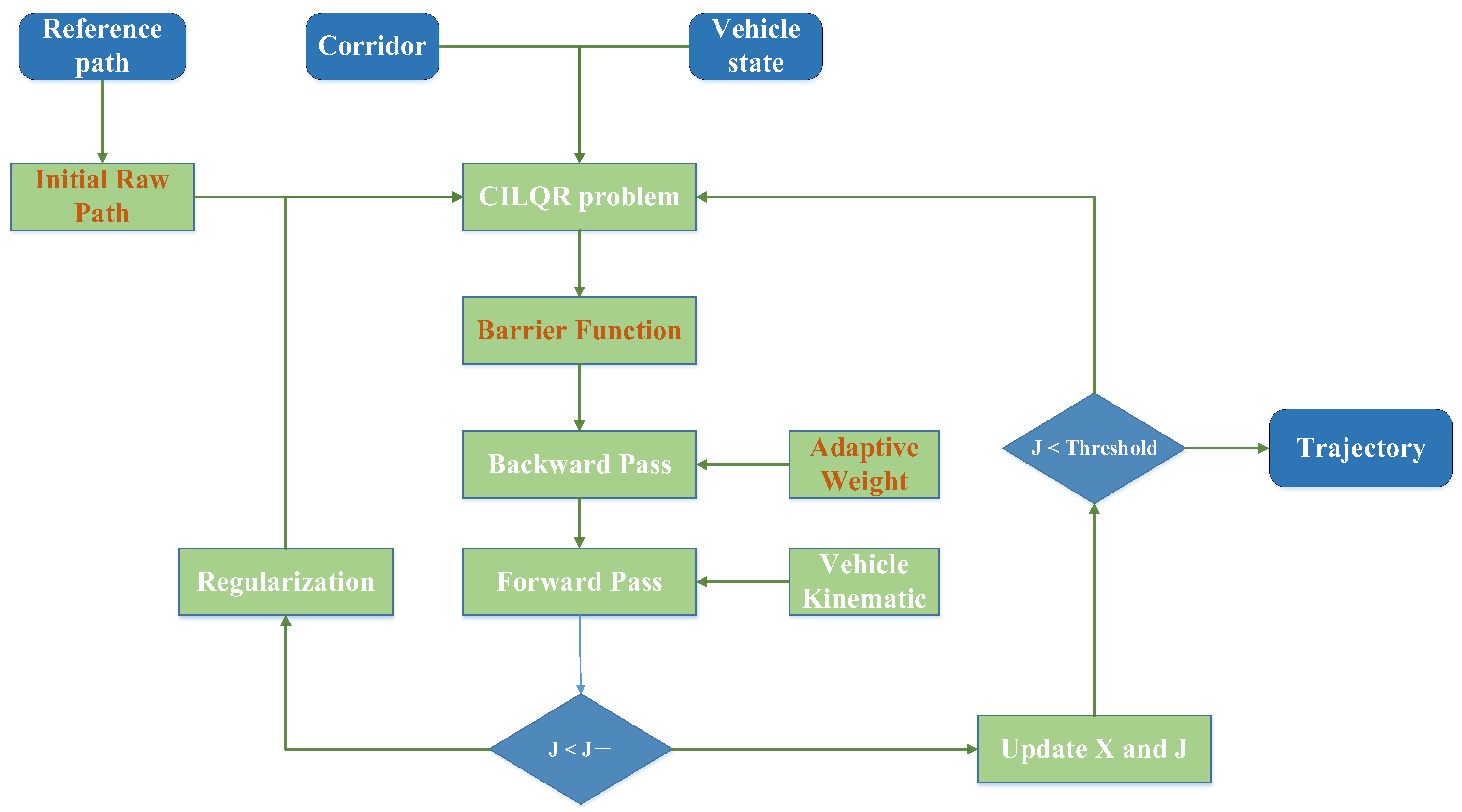
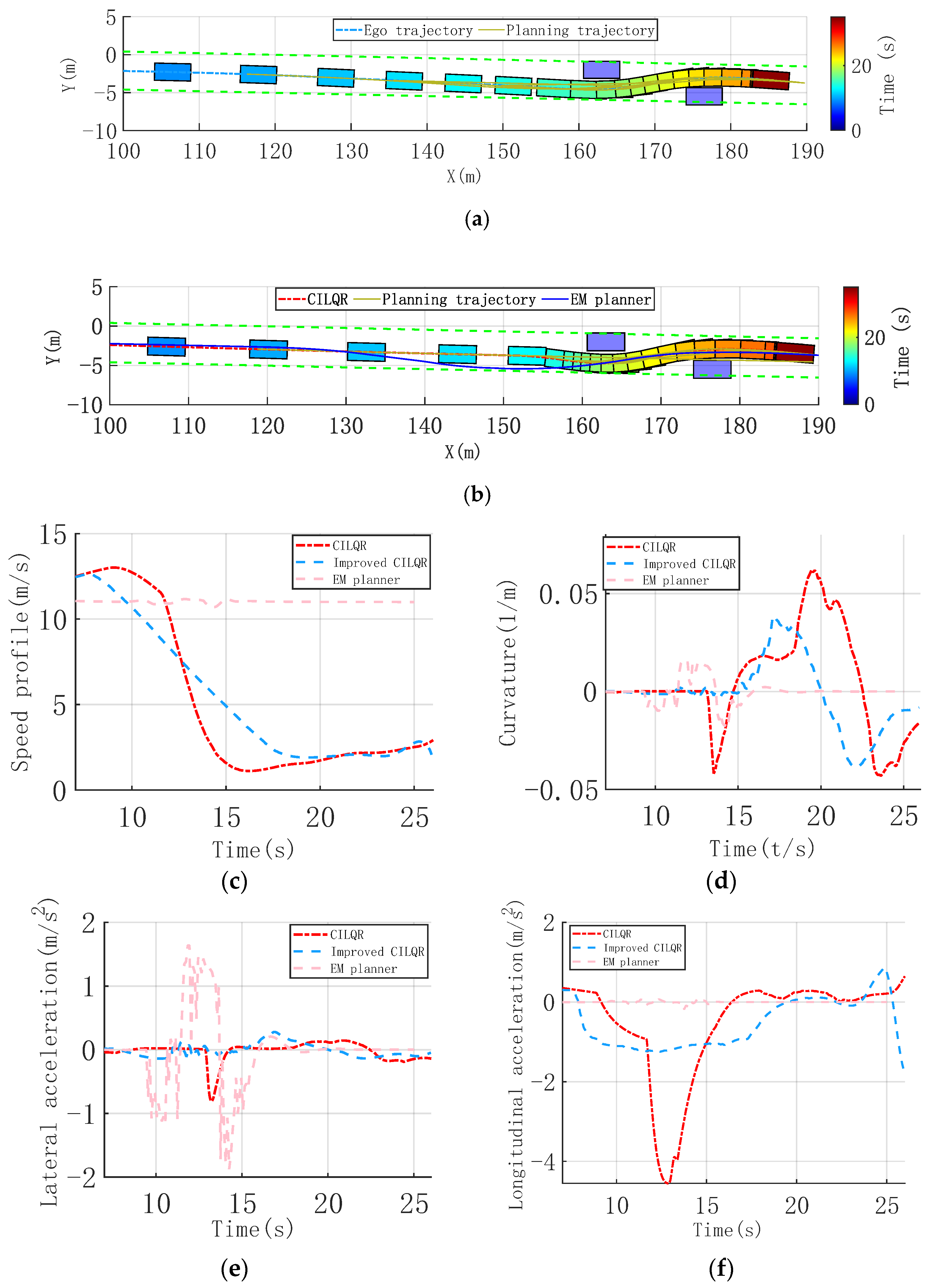
With advancements in autonomous driving technology, the coupling of spatial paths and temporal speeds in complex scenarios becomes increasingly significant. Traditional sequential decoupling methods for trajectory planning are no longer sufficient, emphasizing the need for spatio-temporal joint trajectory planning. The Constrained Iterative LQR (CILQR), based on the Iterative LQR (ILQR) method, shows obvious potential but faces challenges in computational efficiency and scenario adaptability. This paper introduces three key improvements: a segmented barrier function truncation strategy with dynamic relaxation factors to enhance stability, an adaptive weight parameter adjustment method for acceleration and curvature planning, and the integration of the hybrid A* algorithm to optimize the initial reference trajectory and improve iterative efficiency. The improved CILQR method is validated through simulations and real-vehicle tests, demonstrating substantial improvements in human-like driving performance, traffic efficiency improvement, and real-time performance while maintaining comfortable driving. The experiment’s results demonstrate a significant increase in human-like driving indicators by 16.35% and a 12.65% average increase in traffic efficiency, reducing computation time by 39.29%.
Keywords: trajectory planning; constrained iterative LQR; autonomous driving trajectory planning; constrained iterative LQR; autonomous driving