Article

Robotic Odor Source Localization via Vision and Olfaction Fusion Navigation Algorithm

1
Department of Computer Science, Louisiana Tech University, 201 Mayfield Ave., Ruston, LA 71272, USA
2
Department of Electrical Engineering, Louisiana Tech University, 201 Mayfield Ave., Ruston, LA 71272, USA
*
Author to whom correspondence should be addressed.
Sensors 2024, 24(7), 2309; https://doi.org/10.3390/s24072309
Submission received: 16 February 2024 / Revised: 28 March 2024 / Accepted: 3 April 2024 / Published: 5 April 2024
(This article belongs to the Section Sensors and Robotics)

Abstract

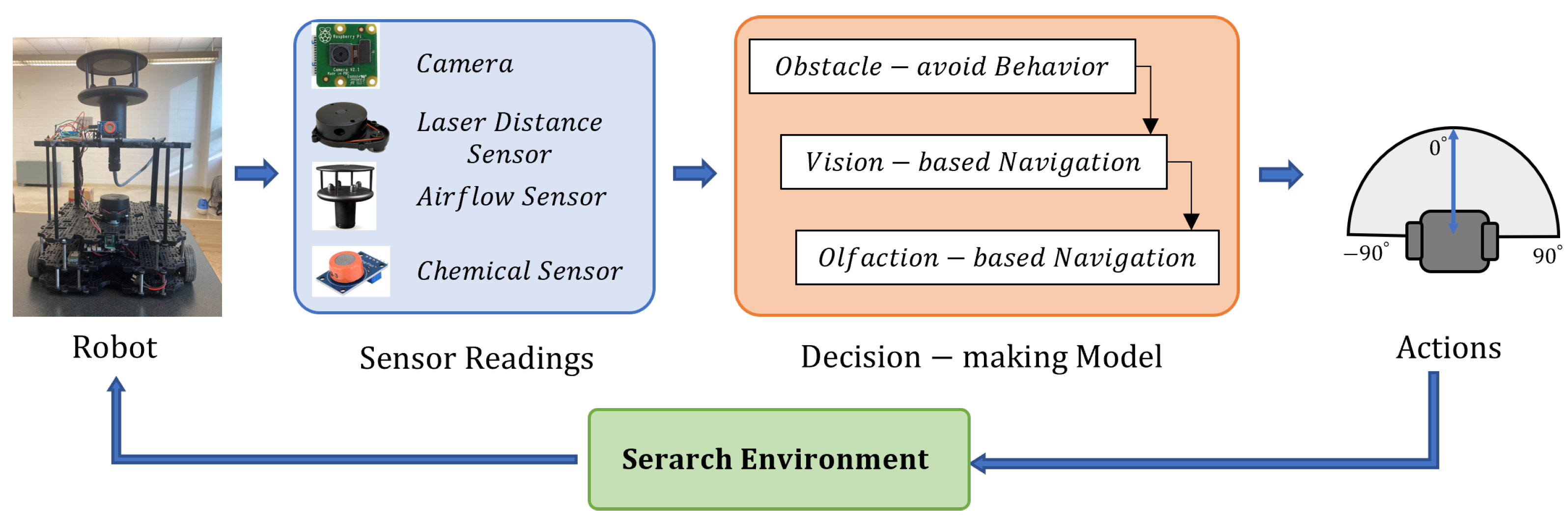
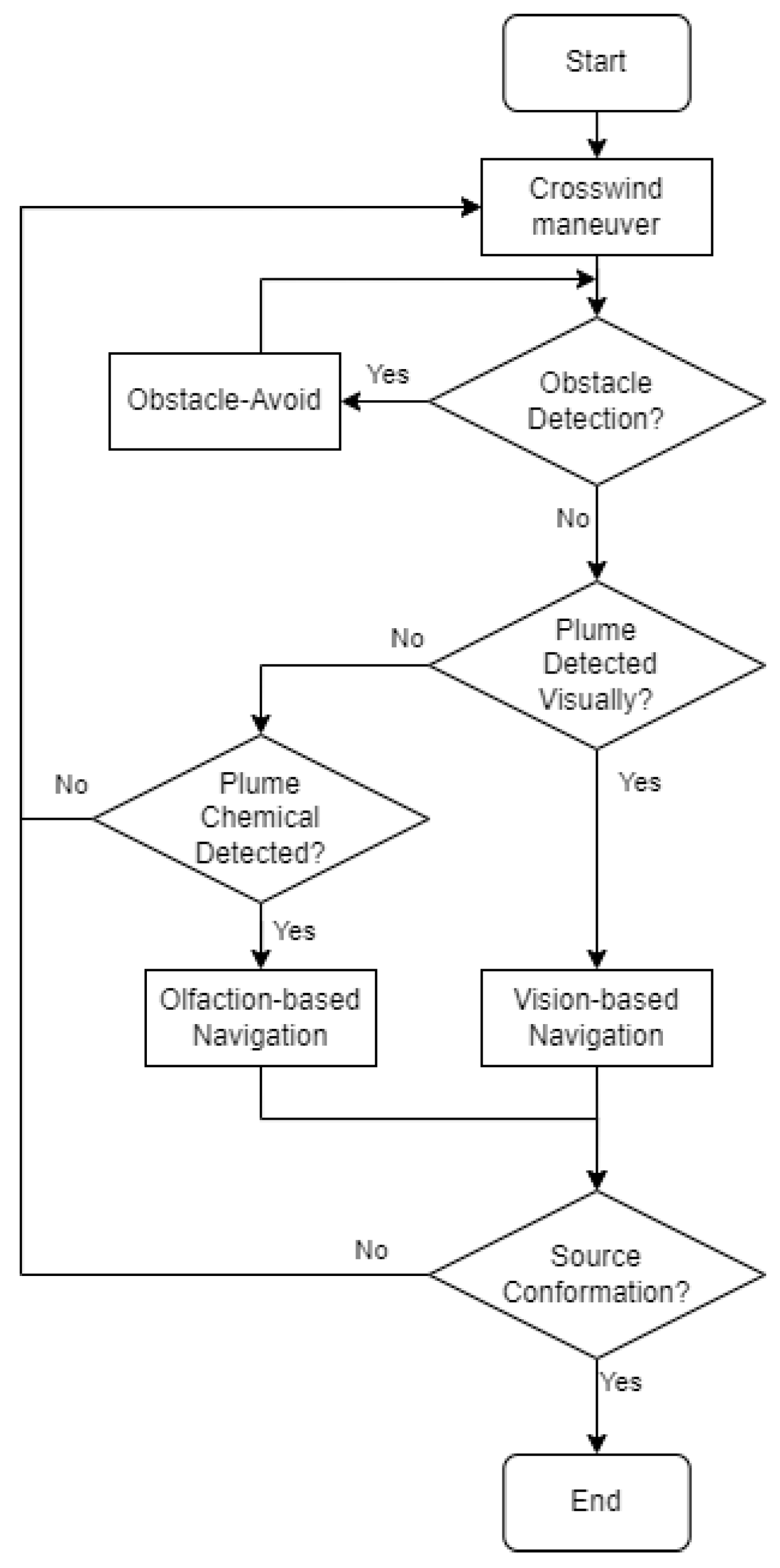
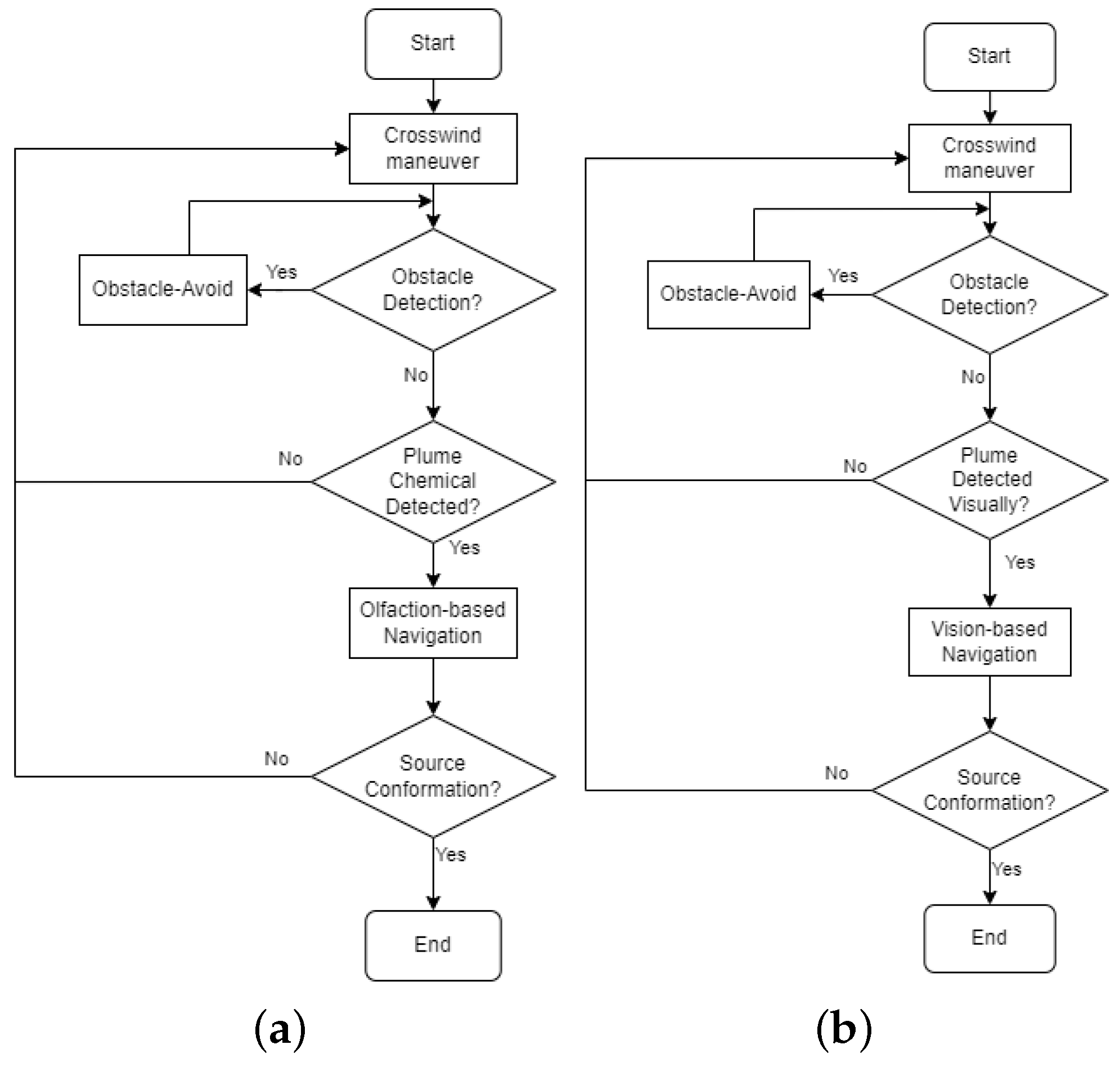
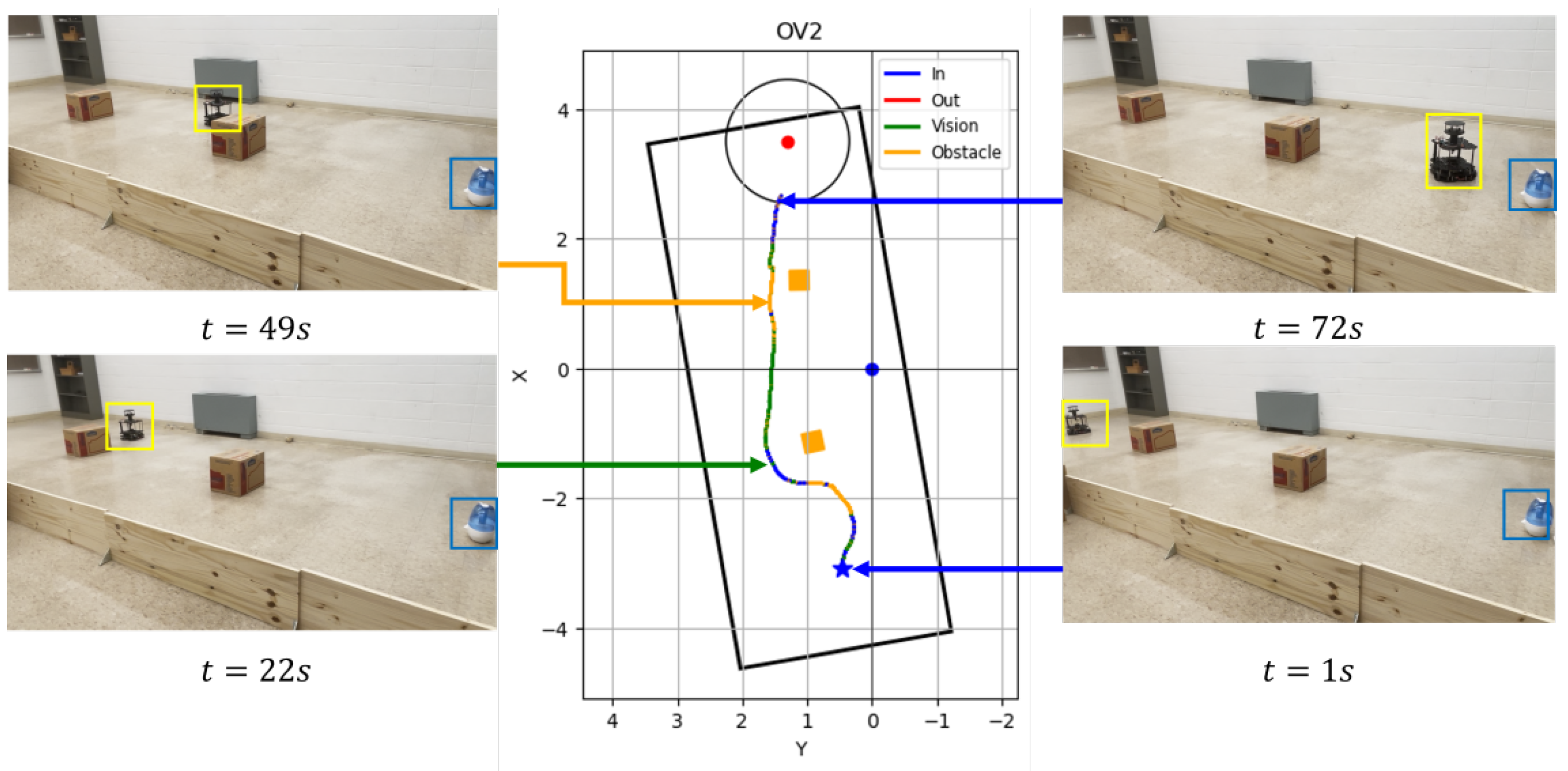
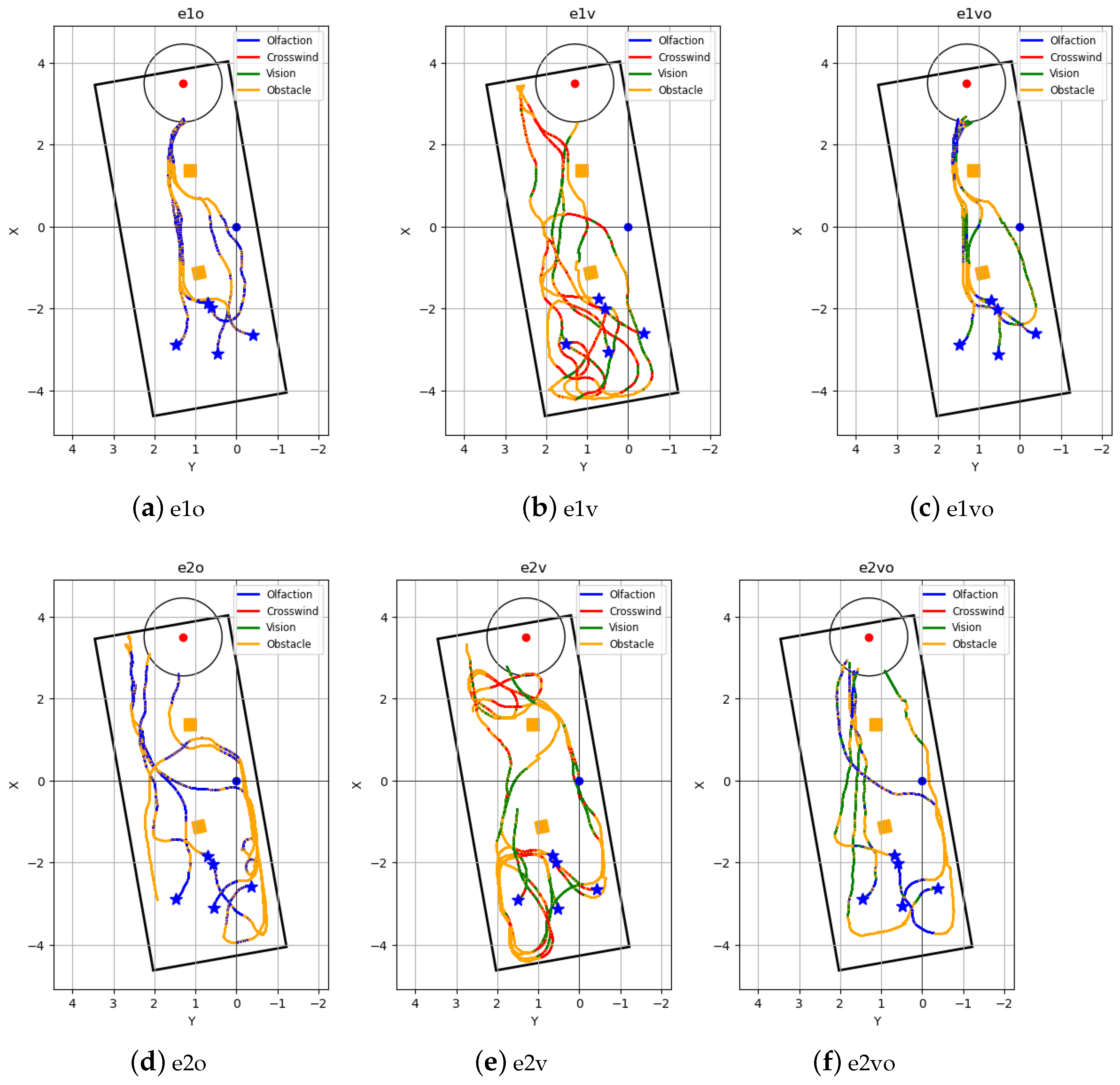
Robotic odor source localization (OSL) is a technology that enables mobile robots or autonomous vehicles to find an odor source in unknown environments. An effective navigation algorithm that guides the robot to approach the odor source is the key to successfully locating the odor source. While traditional OSL approaches primarily utilize an olfaction-only strategy, guiding robots to find the odor source by tracing emitted odor plumes, our work introduces a fusion navigation algorithm that combines both vision and olfaction-based techniques. This hybrid approach addresses challenges such as turbulent airflow, which disrupts olfaction sensing, and physical obstacles inside the search area, which may impede vision detection. In this work, we propose a hierarchical control mechanism that dynamically shifts the robot’s search behavior among four strategies: crosswind maneuver, Obstacle-Avoid Navigation, Vision-Based Navigation, and Olfaction-Based Navigation. Our methodology includes a custom-trained deep-learning model for visual target detection and a moth-inspired algorithm for Olfaction-Based Navigation. To assess the effectiveness of our approach, we implemented the proposed algorithm on a mobile robot in a search environment with obstacles. Experimental results demonstrate that our Vision and Olfaction Fusion algorithm significantly outperforms vision-only and olfaction-only methods, reducing average search time by 54% and 30%, respectively.
Keywords: odor source localization; moth-inspired algorithm; computer vision-based navigation; robot operating system; multi-modal robotics odor source localization; moth-inspired algorithm; computer vision-based navigation; robot operating system; multi-modal robotics