Skip to Content
  • Article
  • Open Access

8 February 2024

Detection of Rehabilitation Training Effect of Upper Limb Movement Disorder Based on MPL-CNN

,
,
,
and
1
College of Electronic Information Engineering, Changchun University, Changchun 130012, China
2
Jilin Provincial Key Laboratory of Human Health Status Identification Function & Enhancement, Changchun 130022, China
3
Key Laboratory of Intelligent Rehabilitation and Barrier-Free for the Disabled, Changchun University, Ministry of Education, Changchun 130012, China
4
College of Computer Science and Technology, Changchun University, Changchun 130022, China
This article belongs to the Section Sensing and Imaging

Abstract

Stroke represents a medical emergency and can lead to the development of movement disorders such as abnormal muscle tone, limited range of motion, or abnormalities in coordination and balance. In order to help stroke patients recover as soon as possible, rehabilitation training methods employ various movement modes such as ordinary movements and joint reactions to induce active reactions in the limbs and gradually restore normal functions. Rehabilitation effect evaluation can help physicians understand the rehabilitation needs of different patients, determine effective treatment methods and strategies, and improve treatment efficiency. In order to achieve real-time and accuracy of action detection, this article uses Mediapipe’s action detection algorithm and proposes a model based on MPL-CNN. Mediapipe can be used to identify key point features of the patient’s upper limbs and simultaneously identify key point features of the hand. In order to detect the effect of rehabilitation training for upper limb movement disorders, LSTM and CNN are combined to form a new LSTM-CNN model, which is used to identify the action features of upper limb rehabilitation training extracted by Medipipe. The MPL-CNN model can effectively identify the accuracy of rehabilitation movements during upper limb rehabilitation training for stroke patients. In order to ensure the scientific validity and unified standards of rehabilitation training movements, this article employs the postures in the Fugl-Meyer Upper Limb Rehabilitation Training Functional Assessment Form (FMA) and establishes an FMA upper limb rehabilitation data set for experimental verification. Experimental results show that in each stage of the Fugl-Meyer upper limb rehabilitation training evaluation effect detection, the MPL-CNN-based method’s recognition accuracy of upper limb rehabilitation training actions reached 95%. At the same time, the average accuracy rate of various upper limb rehabilitation training actions reaches 97.54%. This shows that the model is highly robust across different action categories and proves that the MPL-CNN model is an effective and feasible solution. This method based on MPL-CNN can provide a high-precision detection method for the evaluation of rehabilitation effects of upper limb movement disorders after stroke, helping clinicians in evaluating the patient’s rehabilitation progress and adjusting the rehabilitation plan based on the evaluation results. This will help improve the personalization and precision of rehabilitation treatment and promote patient recovery.

1. Introduction

Stroke is a common disease caused by haemorrhagic or ischaemic brain damage, and is one of the leading causes of death and physical disability [1]. The latest information provided by the World Stroke Organization (WSO) Global Stroke Fact Sheet 2022 [2] shows that, from 1990 to 2019, the incidence of stroke increased by 70.0%, the number of stroke deaths increased by 43.0%, and the disability-adjusted life-year prevalence of stroke was 143.0%. With the improvement in medical standards, the mortality rate of stroke has been continuously reduced. However, due to problems associated with an increasing and aging population, more and more people suffer physical disabilities after stroke. However, more than two-thirds of stroke patients experience upper limb movement disorders and dysfunction [3], which are characterized by muscle spasms, muscle weakness, and loss of movement coordination. In addition, post-stroke patients require six months of upper limb rehabilitation to restore basic motor functions [4]. Impairment of upper limb function is a common and serious dysfunction in stroke patients, with 32% of stroke patients having severe upper limb impairment and 37% having mild impairment. Most stroke patients can subsequently suffer from hemiplegia, which seriously affects the daily life of patients. Therefore, the rehabilitation of upper limb motor function is very important in the rehabilitation treatment of stroke patients. Patients with upper limb motor dysfunction can undergo rehabilitation training through neuroplasticity in the first three months, which is also essential to promote the recovery of upper limb motor function [5].
Due to the large number of patients and limited hospital resources, the rehabilitation training time for many patients is far less than six months, hindering full recovery of upper limb functions in affected patients when performing daily activities. This results in non-standard movements and difficulty in restoring motor memory, which will then lead to a decline in the patient’s self-care ability, seriously affecting the quality of life of stroke patients in addition to placing a significant financial burden on the patient’s family. To prevent the adverse consequences of upper limb motor dysfunction on the daily life of stroke patients, it is particularly important to provide timely and accurate scientific rehabilitation medical guidance for stroke patients. Therefore, conducting Fugl-Meyer upper limb assessment training and testing research on stroke patients bears very important social significance [6].
The algorithm for action recognition of stroke patients collects continuous video frames through common visual sensors, such as RGB cameras, and intelligently processes the video data to determine the current level of training of stroke patients [7]. Under the guidance of rehabilitation doctors, the collection of Fugl-Meyer upper limb rehabilitation exercise video data is completed. The intelligent processing of the collected data includes: classifying and labeling the collected original video data, and passing the labeled video data through Blaze-Pose [8] and Blaze-Hands to perform recognition of human bone joint points and hand joint points, and finally the deep learning algorithm completes Fugl-Meyer upper limb rehabilitation training action recognition. Since the conditions of stroke patients are different, the rehabilitation stages of the patients are also different. Evaluation of the rehabilitation effect of the patients needs to be carried out by experienced rehabilitation doctors. To this end, under the guidance of rehabilitation doctors, we selected scientific and effective assessment scales and rehabilitation movements, and used RGB cameras to collect Fugl-Meyer upper limb rehabilitation training movements.
Currently, commonly used algorithms for extracting key points of human skeleton include DensePose [9], Openpose [10], DeepPose [11], etc. When stroke patients undergo rehabilitation training, in order to meet the accuracy of the training process and better understand the patient’s rehabilitation situation, the real-time nature of the detection process needs to be considered. At the same time, during the Fugl-Meyer upper limb detection process, it is necessary to consider the movement of multiple parts of the body, such as shoulder joints, elbow joints, hand joints, and wrist joints. Therefore, Blaze-Pose and Blaze-Hands in Mediapipe [12] are selected to extract the feature information of the human body as a whole, including the human body and hands.
With the development of machine learning and the improvements in neural networks, this technology can apply many models for detecting human posture recognition and verify its effectiveness in action classification and behavior prediction. Convolutional neural network (CNN) [13] and long short-term memory neural network (LSTM) [14] have achieved breakthroughs in applications. CNN can extract features in data space, and LSTM can extract features in time. This article uses an LSTM-CNN behavior recognition and detection algorithm that can handle complex time series problems, and uses a two-layer network fusion algorithm to effectively perform upper limb rehabilitation and evaluate the effectiveness of training patient movements. First, OpenCV is used to segment the upper limb movement posture collected by the visual sensor into different frames, planarize the video data of standard actions, and connect the local features extracted by CNN and the long-distance features extracted by LSTM at the same time as a fully connected layer to ensure data flow. The continuity is used to improve the accuracy of the model, and the output results are used as movement standards for upper limb rehabilitation training for stroke patients. Finally, when patients undergo rehabilitation training, they only need to use visual sensors to evaluate the effects of current rehabilitation actions.

3. Methodology

3.1. Mediapipe Joint Point Extraction

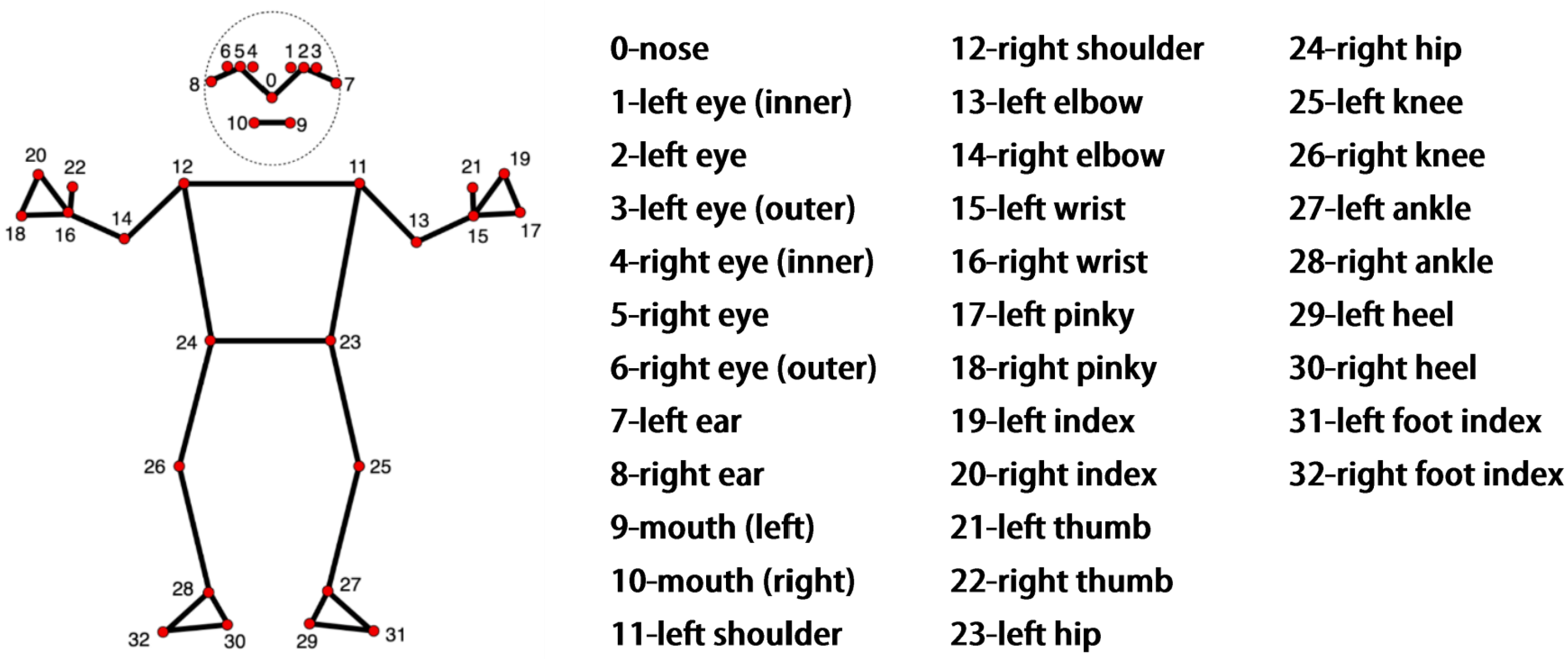
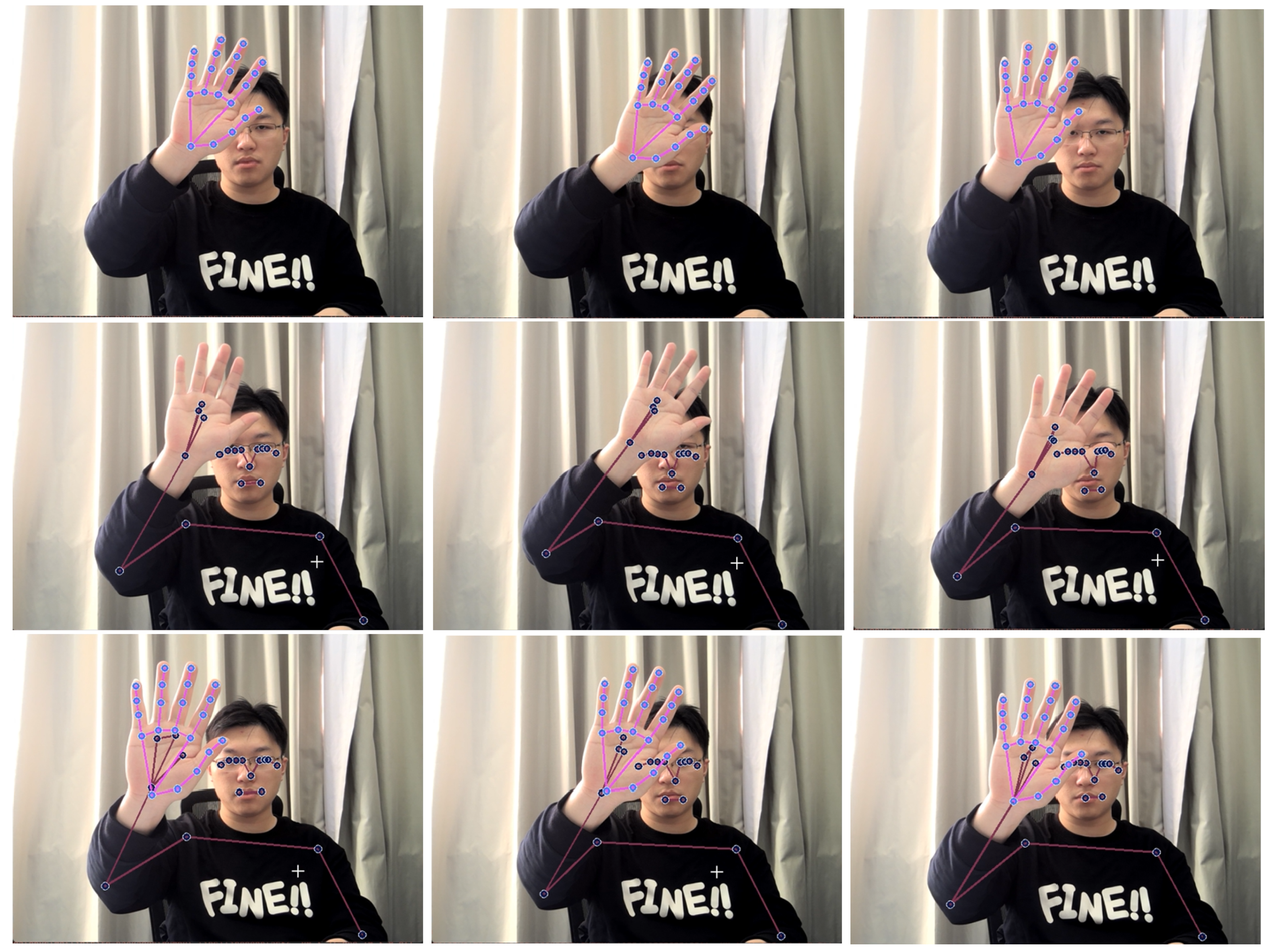
Using the Blaze-Pose and Blaze-Hands models in MediaPipe, efficient and accurate human joint point detection and hand joint point detection can be achieved. The detection display is shown in Figure 4.
Figure 4. Detection of Blaze-Pose, Blaze-Hands and overall detection. The three pictures in the first row represent the hand joint points detected by Blaze-Hands; the three pictures in the second row represent the upper limb joint points detected by Blaze-Pose; the third picture represents the joint points of the upper limb and hand overall detection.
The Blaze-Pose model is based on deep learning technology, and with the help of advanced neural network architecture and training strategies, it can quickly and accurately estimate the three-dimensional joint point position and posture information of the human body in real-time scenes. The Blaze-Hands model focuses on the detection of hand joint points and achieves highly accurate inference of hand postures and gestures by combining deep learning and computer vision algorithms. MediaPipe is used to perform pose estimation and gesture recognition in parallel to achieve multi-task key point detection tasks. Among them, pose estimation aims to extract the three-dimensional joint point positions and posture information of the human body from the input video, while gesture recognition focuses on accurately inferring the joint point positions and gesture movements of the hand. Therefore, in the process of testing the effect of rehabilitation training for upper limb motor dysfunction, the joint points of the human body and the joint points of the hand are extracted at the same time. It can provide rehabilitation doctors with more complete rehabilitation training information, making it more accurate for rehabilitation doctors to evaluate rehabilitation effects.

3.2. LSTM-CNN Rehabilitation Action Recognition Network

CNN is a deep learning model specially used for image processing. CNN can automatically learn and extract features in images and be used for tasks such as classification, detection, and segmentation. In image classification, CNN usually consists of a series of convolutional layers, pooling layers and fully connected layers. Convolutional layers are used to extract local features of the image. The pooling layer is used to reduce the dimensionality of the feature map, and the dropout layer can prevent over-fitting problems. The fully connected layer is used to map the extracted features to category labels. Agnieszka Szczęsna et al. [35] applied CNN to analyze functional upper limb movement patterns, To find the differences present in the upper limb movement patterns, the movement characteristics of the dominant and non-dominant upper limbs of healthy participants were compared with the movement characteristics of the flaccid and non-flaccid upper limbs of stroke participants. A new CNN application is proposed for recognition of motion data with two different class label configurations.
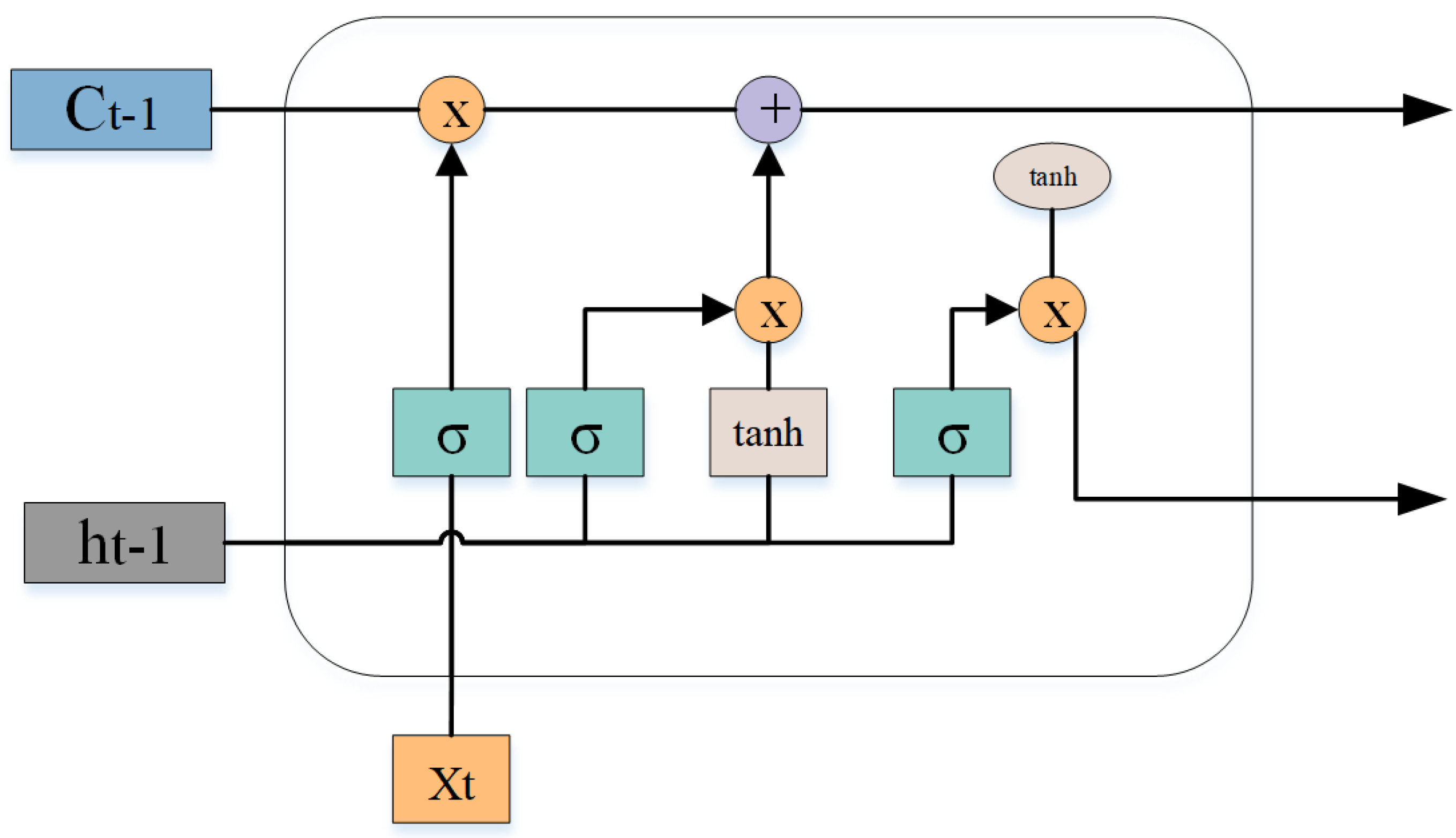
For action recognition tasks, in addition to spatial features, it is also necessary to model the temporal information of actions. However, traditional CNN structures are not specifically designed for temporal modeling and cannot fully capture the temporal dependencies in action sequences. Recurrent neural networks (RNN) have great advantages in processing time series information. However, due to the lack of spatial construction of RNN, and the network structure of RNN, the problems of gradient explosion and gradient disappearance are unavoidable, making RNN ineffective for processing time series information. To solve this problem, this study uses long short-term memory neural network (LSTM) to process temporal skeleton information. LSTM is a special recurrent neural network. The use of LSTM can ensure the effective long-term storage of information [36] and solve the long-term dependency problem existing in recurrent neural networks. The memory unit is introduced into the LSTM network, which can remember important information in long-term time series through the storage unit of the self-renewal mechanism, as shown in Figure 5. When LSTM processes time series data, it needs to pass through three joint gates: input gate, output gate and forget gate. It also includes long and short memories, and calculates the mapping from the input sequence vector to the output probability vector by using the following formula:
Figure 5. LSTM workflow diagram.
input gate:
i t = σ W f · [ h t 1 , x t ] + b f
output gate:
o t = σ W o · [ h t 1 , x t ] + b o
forget gate:
f t = σ W f · [ h t 1 , x t ] + b f
C t ˜ = tan W c · [ h t 1 , x t ] + b c
Two memories:
Long memory:
C t = f t C t 1 + i t C t ˜
Short memory:
h t = o t tanh C t
From time t = 1 to N to iterate, LSTM will map the input sequence vector X = X 1 , X 2 , X 3 , , X n to the output through the formula. Among them, C t is the current memory unit, σ is the s i g m o i d activation function, t a n h is the t a n h activation function, W represents the weight matrix, C t ˜ is the current cell status at this moment. f t is the information that determines the discarding.
Long short-term memory network (LSTM) and convolutional neural network (CNN) each have their own characteristics. By combining LSTM with CNN, LSTM’s sequence modeling capabilities and CNN characteristics extraction capabilities, this helps reduce the excessive risk of model fitting It can also be further improved by adding regular techniques such as Dropout.
When the time sequence data are input into the LSTM-CNN network, the model can effectively capture the time correlation and space correlation in timing data, and gradually extract higher-level features. This helps to understand the abstract level of data and improve the expression of the model. The front end of the model proposed in this article is the LSTM part, and the back end is the CNN part, which combines the features extracted to output the final result.

4. Experiments

4.1. Fugl-Meyer Upper Limb Rehabilitation Training Standards

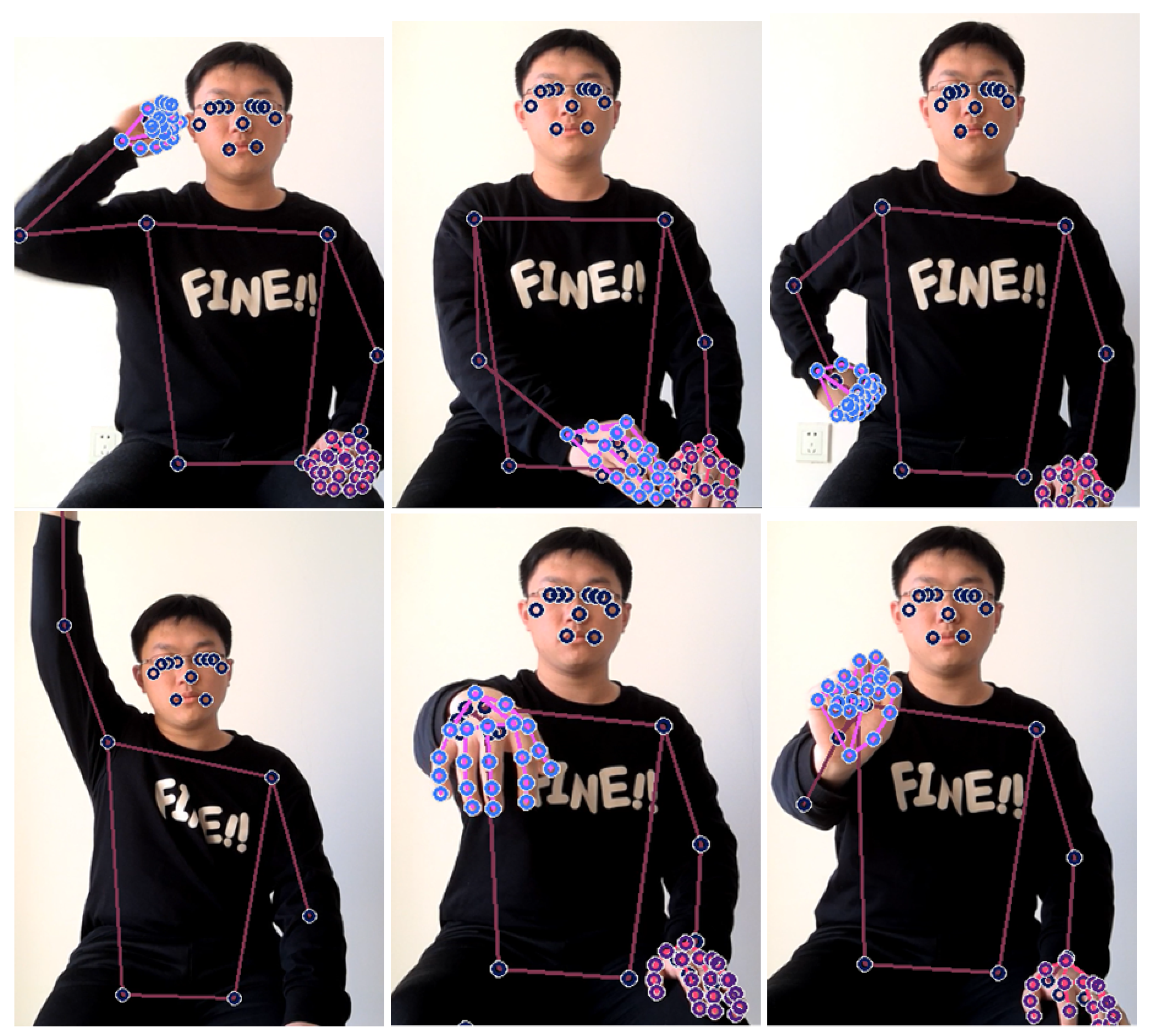
When selecting movement characteristics for upper limb rehabilitation training, the selection needs to be based on the Fugl-Meyer Upper Limb Functional Assessment Scale (FMA) under the guidance and supervision of a clinician. FMA test items generally include movements of the shoulder joint, elbow joint and wrist joint. At the same time, we added hand movements based on the FMA test items to meet the needs of action feature selection in this experiment. Some FMA actions are shown in the Figure 6 below.
Figure 6. FMA standard posture detection. The three pictures in the first row represent the coordinated movement of flexor muscles, the joint movement of extensor muscles and the accompanying joint movement, respectively; the three pictures in the second row represent isolated movement, wrist stability and affected movement, respectively.
Since the collected movements are continuous, such as the coordinated movement of flexor muscles, the movement process is to touch the ear on the same side with your hand, and then move your hand to touch the knee joint on the opposite side. The details of FMA rehabilitation training movements are shown in the table below.

4.2. Dataset Introduction

Since there are currently no publicly available action recognition and Fugl-Meyer video data sets for upper limb sports rehabilitation training, we completed the Fugl-Meyer upper limb rehabilitation training through these 10 subjects. A total of ten neurologically normal adults, including five men and five women, participated in the study and underwent Fugl-Meyer upper limb motor rehabilitation training for data collection. They had no orthopedic or neurological conditions that limited upper limb movement, no cognitive or speech impairments, and an average age of 48.4 years. The age range is generally consistent with the age of patients undergoing rehabilitation for upper limb movement disorders after stroke and those undergoing rehabilitation for upper limb movement disorders. All participants completed corresponding rehabilitation actions under the guidance of doctors with experience in post-stroke movement disorder assessment and clinical treatment. Videos of all movements of each subject completing five rehabilitation training postures were recorded. This experiment mainly collects motion signals from standard rehabilitation training. These signals are under the guidance and supervision of clinical rehabilitation physicians to ensure the accuracy and scientificity of rehabilitation actions. The original video is in MP4 format, and all poses are completed within a distance of 2–3 m in front of the camera. In an indoor environment, all poses were collected within 10 s at 30 frames per second (FPS), with each subject repeating different rehabilitation training actions 2 times and 5 times each, for a total of over 42,000 frames. A description of the collected dataset is shown in the figure, including the number of people and videos for each pose. The data set is divided into a training set and test set according to a 4:1 ratio. The introduction of the data set is shown in Table 1 and Table 2 below.
Table 1. Fugl-Meyer upper limb rehabilitation exercise score [37].
Table 2. Dataset introduction.

4.3. Model Design

This experiment entails building an action recognition model based on the LSTM model. The LSTM model can better learn action feature information by adding CNN, thereby improving the performance and training effect of the model. The LSTM-CNN model as a whole consists of eight layers of sequences. The first two layers of the model are composed of LSTM. The first layer of LSTM has 64 hidden units and the input shape is (30, 258), which means that the input data has 30 time steps and 258 features, and the complete output sequence is returned. The second layer of LSTM has 128 hidden units, and the activation functions used in both layers are Relu. It is then used to extract spatial features through CNN. The CNN layer contains two one-dimensional convolution layers and a maximum pooling layer. The first one-dimensional convolution layer contains 64 3 × 3 convolution kernels. The second layer of one-dimensional convolution contains 128 3 × 3 convolution kernels. The maximum pooling layer uses a pooling window of size 2 to perform a maximum pooling operation on the input sequence. The activation function used is Relu. After the flattening layer, the input data are converted from multi-dimensional tensors to one-dimensional vectors. Then through the Dropout layer, a part of the input data is randomly discarded with a dropout rate of 0.2 to reduce overfitting. Afterwards, through three fully connected layers with 64, 32 and 4 hidden units, the activation function of the first two layers is ReLU and the third layer is the hyperbolic tangent function (tanh). Finally, the classification results are output through softmax. Its network model structure is shown in Figure 7.
Figure 7. LSTM-CNN model architecture.

4.4. Experiment Analysis

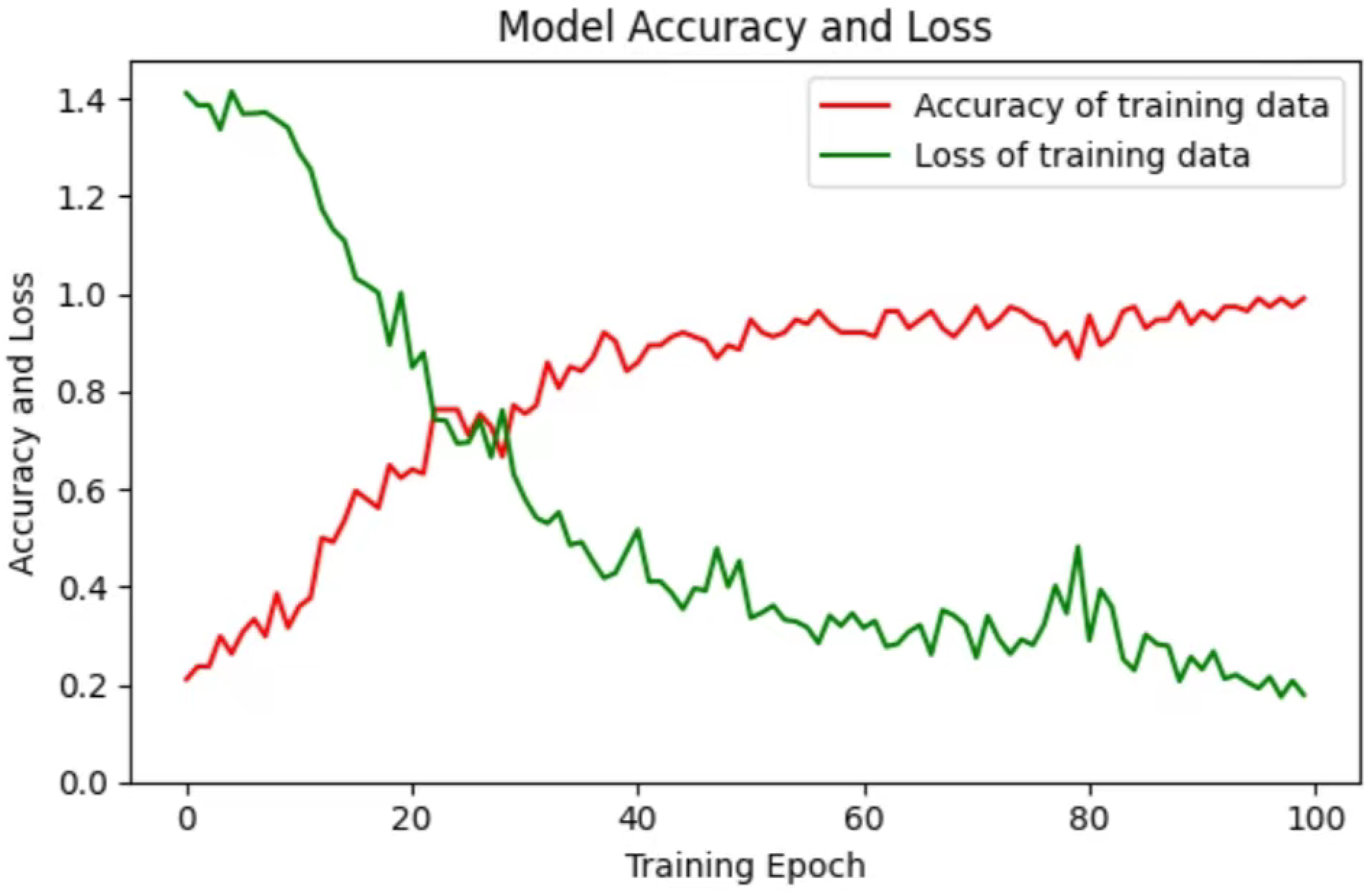
In order to ensure that the detected upper limb movement disorder rehabilitation training movements are scientific and effective, this study used the Fugl-Meyer Upper Limb Rehabilitation Assessment (FMA) standard movements. These movements include flexor co-movements, extensor co-movements, accompanying co-movements, isolation movements, wrist stability and hand movements. The data set was collected using BlazePose and BlazeHands according to the standard movements in FMA. Compared with the simple extraction of upper limb key points, this study also extracted hand key points. The collected data set is input into the LSTM-CNN model to detect the standard actions of FMA. The LSTM-CNN model consists of two LSTM layers. Through the dimensionality reduction operation of the first LSTM layer, the model can extract important feature representations from the input sequence and reduce the computational complexity of subsequent LSTM layers. After dimensionality upscaling by the second layer, the high-dimensional input is mapped to a low-dimensional hidden state representation, which helps capture key patterns and long-term dependencies in the sequence. And it reduces the amount of calculation at each time step, thereby improving the efficiency of training and inference to a certain extent. CNN consists of two convolutional layers and a max pooling layer. The convolutional layer extracts local features at different locations through a 3 × 3 convolution kernel, and learns different filter weights to capture different patterns and features in the input sequence. Max pooling helps the model extract the most salient and important features from the input data. It is converted into a one-dimensional vector in the Flatten layer, and the ReLU method is used to improve the generalization ability between networks. Afterwards, the previous features can be further combined and transformed through the fully connected layer model to obtain higher-level features and generate feature representations. In the last fully connected layer, the learned features are mapped to the four-dimensional output space, and finally the Softmax output is used to complete the classification task. In the model, the learning rate of each parameter is adaptively adjusted through the Adam algorithm. The learning rate can be automatically adjusted according to the gradient change of the parameters, so that the learning rate can adapt to the update needs of different parameters. By using the Adam algorithm, the training process can converge faster, making it easier to achieve good performance than manually setting the learning rate. And use categorical_crossentropy to measure the difference between the model prediction results and the real labels, prompting the model to better learn the differences between categories. By minimizing this loss function, the model can better distinguish feature differences between different categories and improve the accuracy of classification tasks. The loss and accuracy of classification results training and testing change with the iteration curve as shown in the Figure 8.
Figure 8. Model loss and accuracy iteration process.
During the upper limb rehabilitation training process, the visual sensor receives real-time video information and generates a human skeleton information sequence through pre-processing steps such as Blaze-Pose and Blaze-Hand. This skeletal information sequence is real-time and continuous, and it contains key joint position and motion information of human posture and hand movements. In order to better process this sequence of bone information, we used the LSTM-CNN model for detection. LSTM (Long Short-Term Memory) is a variant of Recurrent Neural Network (RNN) suitable for sequence data, capable of capturing temporal dependencies in the sequence. CNN (Convolutional Neural Network) can extract spatial features. By combining LSTM and CNN, our model is able to effectively process skeletal information sequences and detect and classify actions. The LSTM model can model the temporal information in the sequence and capture the evolution of the action. The CNN model can extract spatial features in the skeletal information sequence, such as joint positions and motion patterns. In addition, in order to further improve the performance of the model, we propose the MPL-CNN model. This model pays special attention to feature information in time and space when processing skeletal information sequences. This means that we focus not only on the temporal evolution in the sequence, but also on the spatial relationships and motion patterns between different joints.
By using the MPL-CNN model, we are able to more comprehensively analyze and understand the skeletal information sequence in upper limb rehabilitation training. This method of comprehensively considering temporal and spatial features helps improve the accuracy and robustness of the model for action recognition and analysis, thereby better supporting the upper limb rehabilitation training process. This study uses a self-made upper limb posture data set, including shoulder joints, elbow joints, wrist joints and gestures, and inputs the data into the model for training. The evaluation index calculation formula is as follows:
A c c u r a c y = T P + T N T P + F N + F P + T N
P r e c i s i o n = T P T P + F P
R e c a l l = T P T P + F N
F 1 = 2 · P r e c i s i o n · R e c a l l P r e c i s i o n + R e c a l l
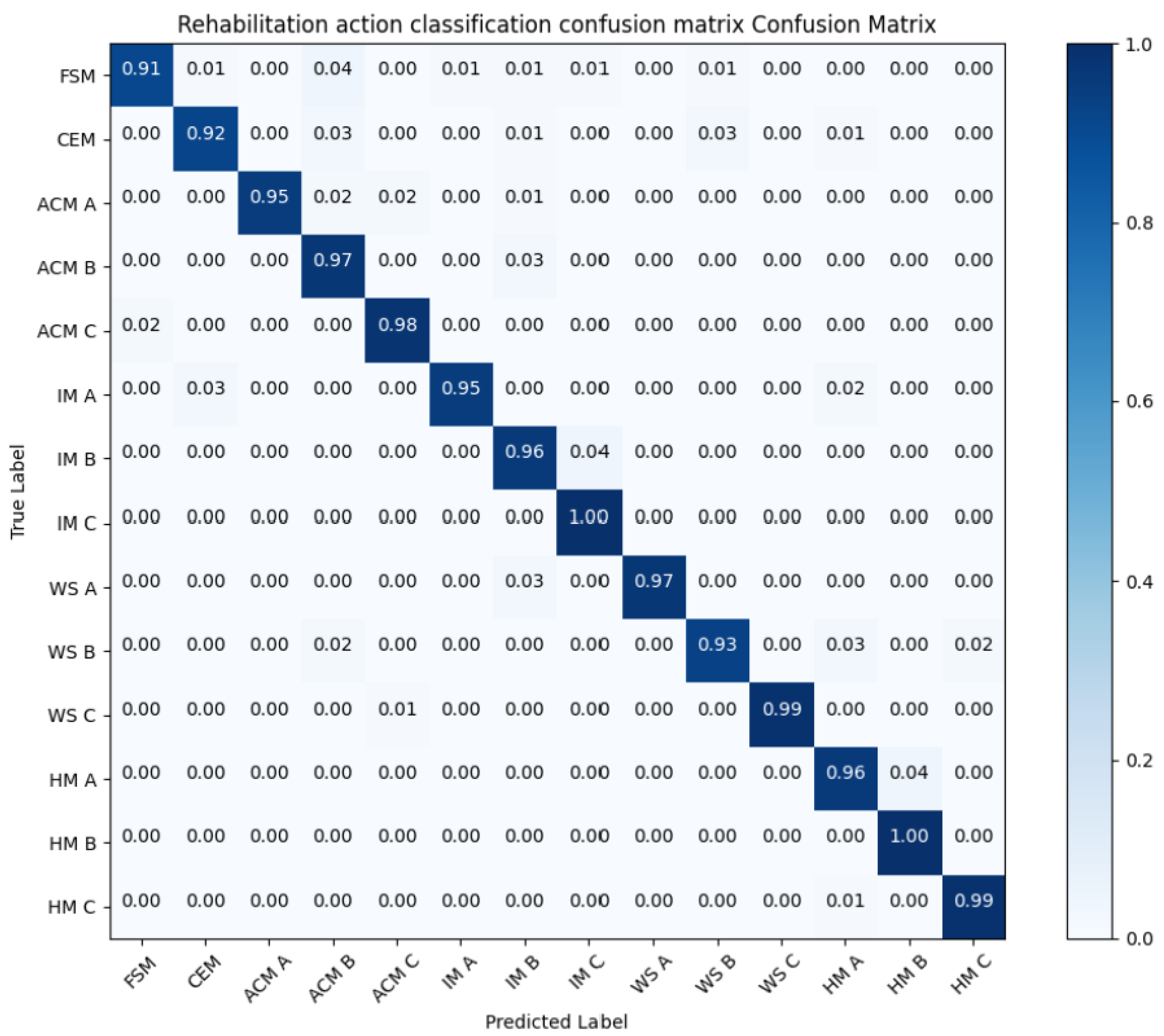
The model’s detection of rehabilitation training actions is shown in the Table 3 and Figure 9. Upper limb rehabilitation training movements recognized using MPL-CNN including co-movement of flexor muscles, co-movement of extensor muscles, accompanied by co-movement, wrist stability and hand movement. The average classification accuracy is 97.54%, and the recall rate and F1-score are both above 90%. proving that the MPL-CNN model has high efficiency and reliability in upper limb movement disorder rehabilitation training detection tasks. It can meet the requirements for detecting the effects of rehabilitation training on stroke patients. The accuracy of MPL-CNN in classifying upper limb rehabilitation movements is 99.22%. The upper limb movement detection network structure based on MPL-CNN proposed in this study has an accuracy increase of 2% compared with the method proposed by Ashwini [38]. Compared with machine learning methods [39], the accuracy has also been improved to a certain extent. Compared with spatiotemporal CNN [40], the recognition accuracy is increased by 3.44%. To sum up, the upper limb movement disorder detection model proposed in this article based on MPL-CNN can use Mediapipe to extract action information only by using an RGB camera. It can achieve good real-time performance while also achieving better detection accuracy.
Table 3. MPL-CNN recognizes rehabilitation training action results.
Figure 9. Confusion matrix of standard movements of Fugl-Meyer upper limb movement disorder rehabilitation training.

4.5. Ablation Experiment

In order to explore the impact of adding three modules to MPL-CNN (1. Introduction of LSTM, 2. Introduction of CNN convolution module, 3. Adding Dropout to optimize LSTM-CNN) on the final performance, this article uses the upper limbs to conduct ablation experiments on the skeletal key point frame data obtained by Mediapipe, and combines different modules to calculate the accuracy. In order to better quantify the impact of each module on model performance, in addition to category accuracy, the recognition accuracy of different upper limb movement disorder rehabilitation training actions was also increased. In order to balance the differences in actions, different action types may have different difficulties and characteristics, resulting in differences in recognition accuracy. By taking the average P of the recognition accuracy of multiple action types, we balance the impact of each action type and reduce the impact of certain action types on the overall performance evaluation. The test results are shown in Figure 4. It can be seen from the analysis in Table 4 that through the addition of various network modules, the accuracy rate has been significantly improved, reaching 99.22%. Compared with single network performance, the maximum improvement is 15.59%. Compared with a single network, P’s performance can be improved by up to 6.25%. The results show that adding three modules to the MPL-CNN model improves the performance of upper limb movement disorder rehabilitation training action detection, proving its effectiveness.
Table 4. Ablation experiments verify the impact of each module on MPL-CNN.

5. Conclusions

This study is based on the use of Mediapipe and LSTM-CNN for motion detection in rehabilitation training of stroke patients. In this process, we employed the Fugl-Meyer standard movements for upper limb motor function assessment and established a standard movement data set. Mediapipe is used to extract feature information of standard actions, including upper limb posture feature information extracted by Blaze-pose and gesture feature information extracted by Blaze-Hands. Both are under the Mediapipe framework, so the upper limbs can detect postures and gestures at the same time, ensuring the richness of key point information during standard action detection for upper limb movement disorder rehabilitation training. The MPL-CNN model was proposed to identify standard rehabilitation training movements for upper limb movement disorders, and a detection experiment for upper limb rehabilitation training movements was conducted. Experimental results show that the recognition accuracy of the MPL-CNN model is improved in identifying standard rehabilitation training movements for upper limb movement disorders. The standard movements for the Fugl-Meyer upper limb motor function assessment all reach over 95%. By observing the average accuracy of each rehabilitation movement category, reaching 97.54% ensures the stability of the model in different action categories, proving that the model can be effectively used for the detection of upper limb rehabilitation training in stroke patients.
Based on the characteristics of Mediapipe’s real-time and cross-platform support, it can be directly deployed on mobile devices, and our later work will mainly focus on deploying the MPL-CNN model on mobile devices for experimental testing to determine the practicality of our model. After being deployed on mobile devices, patients can observe their rehabilitation training effect at any time through mobile devices, save their rehabilitation training records, and provide rehabilitation information to rehabilitation doctors, so as to provide more scientific and effective rehabilitation training guidance to patients.

Author Contributions

Conceptualization, L.S.; methodology, R.W.; software, R.W.; validation, J.Z. (Jing Zhang); formal analysis, J.Z. (Jian Zhao); investigation, J.Z. (Jing Zhang); resources, Z.K.; data curation, L.S.; writing—original draft preparation, R.W.; writing—review and editing, L.S.; visualization, J.Z. (Jing Zhang); supervision, J.Z. (Jian Zhao); project administration, Z.K.; funding acquisition, L.S. All authors have read and agreed to the published version of the manuscript.

Funding

This work was partially supported by the Jilin Provincial Department of Science and Technology (No.YDZJ202301ZYTS496, YDZJ202303CGZH010, 20230401092YY, 20210101477JC) and The Education Department of Jilin Province (No. JJKH20230673KJ).

Institutional Review Board Statement

The studies did not involve humans or animals.

Data Availability Statement

Data is contained within the article.

Acknowledgments

The authors would like to thank all of the authors cited in this article and the anonymous reviewers for their helpful suggestions.

Conflicts of Interest

The authors declare no conflicts of interest.

References

  1. Stinear, C.M.; Lang, C.E.; Zeiler, S.; Byblow, W.D. Advances and challenges in stroke rehabilitation. Lancet Neurol. 2020, 19, 348–360. [Google Scholar] [CrossRef] [PubMed]
  2. Feigin, V.L.; Brainin, M.; Norrving, B.; Martins, S.; Sacco, R.L.; Hacke, W.; Fisher, M.; Pandian, J.; Lindsay, P. World Stroke Organization (WSO): Global Stroke Fact Sheet 2022; WSO: Singapore, 2022; Volume 17, pp. 18–29. [Google Scholar]
  3. He, C.; Xiong, C.H.; Chen, Z.J.; Fan, W.; Huang, X.L.; Fu, C. Preliminary Assessment of a Postural Synergy-Based Exoskeleton for Post-Stroke Upper Limb Rehabilitation. IEEE Trans. Neural Syst. Rehabil. Eng. 2021, 29, 1795–1805. [Google Scholar] [CrossRef] [PubMed]
  4. Kwakkel, G.; Kollen, B.J.; van der Grond, J.; Prevo, A.J.H.; Kollen, B.; Prevo, J. Probability of regaining dexterity in the flaccid upper limb: Impact of severity of paresis and time since onset in acute stroke. Stroke 2003, 34, 2181–2186. [Google Scholar] [CrossRef] [PubMed]
  5. Sammali, E.; Alia, C.; Vegliante, G.; Colombo, V.; Giordano, N.; Pischiutta, F.; Boncoraglio, G.B.; Barilani, M.; Lazzari, L.; Caleo, M.; et al. Intravenous infusion of human bone marrow mesenchymal stromal cells promotes functional recovery and neuroplasticity after ischemic stroke in mice. Sci. Rep. 2017, 7, 6962. [Google Scholar] [CrossRef] [PubMed]
  6. Hochleitner, I.; Pellicciari, L.; Castagnoli, C.; Paperini, A.; Politi, A.M.; Campagnini, S.; Pancani, S.; Basagni, B.; Gerli, F.; Carrozza, M.C.; et al. Intra- and inter-rater reliability of the Italian Fugl-Meyer assessment of upper and lower extremity. Disabil. Rehabil. 2023, 45, 2989–2999. [Google Scholar] [CrossRef]
  7. Li, D.; Fan, Y.; Lü, N.; Chen, G.; Wang, Z.; Chi, W. Safety Protection Method of Rehabilitation Robot Based on fNIRS and RGB-D Information Fusion. J. Shanghai Jiaotong Univ. 2021, 27, 45–54. [Google Scholar] [CrossRef]
  8. Yang, H.; Wang, Y.; Shi, Y. Rehabilitation Training Evaluation and Correction System Based on BlazePose. In Proceedings of the 2022 IEEE 4th Eurasia Conference on IOT, Communication and Engineering (ECICE) 2022, Yunlin, Taiwan, 28–30 October 2022; pp. 27–30. [Google Scholar]
  9. Güler, R.A.; Neverova, N.; Kokkinos, I. DensePose: Dense Human Pose Estimation in the Wild. In Proceedings of the IEEE Conference on Computer Vision and Pattern Recognition 2018, Salt Lake City, UT, USA, 18–23 June 2018; pp. 7297–7306. [Google Scholar]
  10. Cao, Z.; Hidalgo, G.; Simon, T.; Wei, S.E.; Sheikh, Y. OpenPose: Realtime Multi-Person 2D Pose Estimation Using Part Affinity Fields. IEEE Trans. Pattern Anal. Mach. Intell. 2021, 43, 172–186. [Google Scholar] [CrossRef]
  11. Toshev, A.; Szegedy, C. DeepPose: Human Pose Estimation via Deep Neural Networks. In Proceedings of the 2014 IEEE Conference on Computer Vision and Pattern Recognition, Columbus, OH, USA, 23–28 June 2014; pp. 1653–1660. [Google Scholar]
  12. Quiñonez, Y.; Lizarraga, C.; Aguayo, R. Machine Learning solutions with MediaPipe. In Proceedings of the 2022 11th International Conference On Software Process Improvement (CIMPS) 2022, Acapulco, Mexico, 19–21 October 2022; pp. 212–215. [Google Scholar]
  13. Iffat, Z.T.; Abdul, M.; Hafsa, B.K. Vision Based Human Action Classification Using CNN model with Mode Calculation. In Proceedings of the 2021 IEEE International Women in Engineering (WIE) Conference on Electrical and Computer Engineering (WIECON-ECE), Dhaka, Bangladesh, 4–5 December 2021; pp. 37–42. [Google Scholar]
  14. Shi, Z.; Kim, T.K. Learning and Refining of Privileged Information-Based RNNs for Action Recognition from Depth Sequences. In Proceedings of the IEEE Conference on Computer Vision and Pattern Recognition 2017, Honolulu, HI, USA, 21–26 July 2017; pp. 4684–4693. [Google Scholar]
  15. Doumas, I.; Everard, G.; Dehem, S.; Lejeune, T. Serious Games For Upper Limb Rehabilitation After Stroke: A Meta-Analysis. J. Neuroeng. Rehabil. 2021, 18, 100. [Google Scholar] [CrossRef]
  16. Cherry-Allen, K.M.; French, M.A.; Stenum, J.; Xu, J.; Roemmich, R.T. Opportunities for Improving Motor Assessment and Rehabilitation After Stroke by Leveraging Video-Based Pose Estimation. Am. J. Phys. Med. Rehabil. 2023, 102, S68–S74. [Google Scholar] [CrossRef]
  17. Nam, C.; Rong, W.; Li, W.; Cheung, C.; Ngai, W.; Cheung, T.; Pang, M.; Li, L.; Hu, J.; Wai, H.; et al. An Exoneuromusculoskeleton for Self-Help Upper Limb Rehabilitation After Stroke. Soft Robot. 2022, 9, 14–35. [Google Scholar] [CrossRef]
  18. Li, J.; Cao, Q.; Dong, M.; Zhang, C. Compatibility evaluation of a 4-DOF ergonomic exoskeleton for upper limb rehabilitation. Mech. Mach. Theory 2021, 156, 104146. [Google Scholar] [CrossRef]
  19. Guillén-Climent, S.; Garzo, A.; Muñoz-Alcaraz, M.N.; Casado-Adam, P.; Arcas-Ruiz-Ruano, J.; Mejías-Ruiz, M.; Mayordomo-Riera, F.J. A usability study in patients with stroke using MERLIN, a robotic system based on serious games for upper limb rehabilitation in the home setting. J. Neuroeng. Rehabil. 2021, 18, 41. [Google Scholar] [CrossRef] [PubMed]
  20. Zhou, B.; Zhang, J.; Zhao, Y.; Li, X.; Anderson, C.S.; Xie, B.; Wang, N.; Zhang, Y.; Tang, X.; Bettger, J.P.; et al. Caregiver-Delivered Stroke Rehabilitation In Rural China: The Recover Randomized Controlled Trial. Stroke 2019, 50, 1825–1830. [Google Scholar] [CrossRef]
  21. Chen, Y.; Abel, K.T.; Janecek, J.T.; Chen, Y.; Zheng, K.; Cramer, S.C. Home-based technologies for stroke rehabilitation: A systematic review. Int. J. Med. Inform. 2019, 123, 11–22. [Google Scholar] [CrossRef] [PubMed]
  22. Lin, R.C.; Chiang, S.L.; Heitkemper, M.M.; Weng, S.M.; Lin, C.F.; Yang, F.C.; Lin, C.H. Effectiveness of Early Rehabilitation Combined with Virtual Reality Training on Muscle Strength, Mood State, and Functional Status in Patients with Acute Stroke: A Randomized Controlled Trial. Worldviews Evid.-Based Nurs. 2020, 17.0, 158.0–167.0. [Google Scholar] [CrossRef]
  23. Paraense, H.; Marques, B.; Amorim, P.; Dias, P.; Santos, B.S. Whac-A-Mole: Exploring Virtual Reality (VR) for Upper-Limb Post-Stroke Physical Rehabilitation based on Participatory Design and Serious Games. In Proceedings of the 2022 IEEE Conference on Virtual Reality and 3D User Interfaces Abstracts and Workshops (VRW), Christchurch, New Zealand, 12–16 March 2022; pp. 716–717. [Google Scholar]
  24. Guo, J.; Li, N.; Guo, S. A VR-based Upper Limb Rehabilitation Hand Robotic Training System. In Proceedings of the 2018 IEEE International Conference on Mechatronics and Automation (ICMA), Changchun, China, 5–8 August 2018; pp. 2364–2369. [Google Scholar]
  25. Mekbib, D.B.; Debeli, D.K.; Zhang, L.; Fang, S.; Shao, Y.; Yang, W.; Han, J.; Jiang, H.; Zhu, J.; Zhao, Z.; et al. A Novel Fully Immersive Virtual Reality Environment for Upper Extremity Rehabilitation in Patients with Stroke. Ann. N. Y. Acad. Sci. 2021, 1493, 75–89. [Google Scholar] [CrossRef]
  26. Xia, Y.; Yun, H.; Liu, Y.; Luan, J.; Li, M. MGCBFormer: The multiscale grid-prior and class-inter boundary-aware transformer for polyp segmentation. Comput. Biol. Med. 2023, 167, 107600. [Google Scholar] [CrossRef]
  27. Yan, H.; Hu, B.; Chen, G.; Zhengyuan, E. Real-Time Continuous Human Rehabilitation Action Recognition using OpenPose and FCN. In Proceedings of the 2020 3rd International Conference on Advanced Electronic Materials, Computers and Software Engineering (AEMCSE), Shenzhen, China, 24–26 April 2020; pp. 239–242. [Google Scholar]
  28. Tao, T.; Yang, X.; Xu, J.; Wang, W.; Zhang, S.; Li, M.; Xu, G. Trajectory Planning of Upper Limb Rehabilitation Robot Based on Human Pose Estimation. In Proceedings of the 2020 17th International Conference on Ubiquitous Robots (UR) 2020, Kyoto, Japan, 22–26 June 2020; pp. 333–338. [Google Scholar]
  29. Li, Y.; Wang, C.; Cao, Y.; Liu, B.; Tan, J.; Luo, Y. Human Pose Estimation Based In-Home Lower Body Rehabilitation System. In Proceedings of the 2020 International Joint Conference on Neural Networks (IJCNN) 2020, Glasgow, UK, 19–24 July 2020; pp. 1–8. [Google Scholar]
  30. Wu, Q.; Xu, G.; Zhang, S.; Li, Y.; Wei, F. Human 3d Pose Estimation In A Lying Position By Rgb-D Images For Medical Diagnosis And Rehabilitation. In Proceedings of the 2020 42nd Annual International Conference of the IEEE Engineering in Medicine & Biology Society (EMBC), Montreal, QC, Canada, 20–24 July 2020; pp. 5802–5805. [Google Scholar]
  31. Ji, B.; Hu, B.; Dong, Y.; Yan, H.; Chen, G. Human Rehabilitation Action Recognition Based on Posture Estimation and GRU Networks. Comput. Eng. 2021, 47, 12–20. [Google Scholar]
  32. Shen, M.; Lu, H. RARN: A Real-Time Skeleton-based Action Recognition Network for Auxiliary Rehabilitation Therapy. In Proceedings of the 2022 IEEE International Symposium on Circuits and Systems (ISCAS), Austin, TX, USA, 27 May–1 June 2022; pp. 2482–2486. [Google Scholar]
  33. Lugaresi, C.; Tang, J.; Nash, H.; McClanahan, C.; Uboweja, E.; Hays, M.; Zhang, F.; Chang, C.L.; Yong, M.G.; Lee, J.; et al. Mediapipe: A framework for building perception pipelines. arXiv 2019, arXiv:1906.08172. [Google Scholar]
  34. Bazarevsky, V.; Grishchenko, I.; Raveendran, K.; Zhu, T.; Zhang, F.; Grundmann, M. Blazepose: On-device real-time body pose tracking. arXiv 2020, arXiv:2006.10204. [Google Scholar]
  35. Szczęsna, A.; Błaszczyszyn, M.; Kawala-Sterniuk, A. Convolutional neural network in upper limb functional motion analysis after stroke. PeerJ 2020, 8, e10124. [Google Scholar] [CrossRef] [PubMed]
  36. Memory, L.S.T. Long short-term memory. Neural Comput. 2010, 9, 1735–1780. [Google Scholar]
  37. Song, X.; Chen, S.; Jia, J.; Shull, P.B. Cellphone-based Automated Fugl-Meyer Assessment to Evaluate Upper Extremity Motor Function after Stroke. IEEE Trans. Neural Syst. Rehabil. Eng. 2019, 27, 2186–2195. [Google Scholar] [CrossRef]
  38. Ashwini, K.; Amutha, R. Compressive sensing based recognition of human upper limb motions with kinect skeletal data. Multimed Tools Appl. 2021, 80, 10839–10857. [Google Scholar] [CrossRef]
  39. He, J.; Chen, S.; Guo, Z.; Pirbhulal, S.; Wu, W.; Feng, J.; Dan, G. A comparative study of motion recognition methods for efficacy assessment of upper limb function. Int. J. Adapt. Control. Signal Process. 2019, 33, 1248–1256. [Google Scholar] [CrossRef]
  40. Basha, S.H.S.; Pulabaigari, V.; Mukherjee, S. An information-rich sampling technique over spatio-temporal CNN for classification of human actions in videos. Multimed. Tools Appl. 2022, 81, 40431–40449. [Google Scholar] [CrossRef]
Disclaimer/Publisher’s Note: The statements, opinions and data contained in all publications are solely those of the individual author(s) and contributor(s) and not of MDPI and/or the editor(s). MDPI and/or the editor(s) disclaim responsibility for any injury to people or property resulting from any ideas, methods, instructions or products referred to in the content.

Article Metrics

Citations

Article Access Statistics

Multiple requests from the same IP address are counted as one view.