Article

Realizing the Calculation of a Fully Normalized Associated Legendre Function Based on an FPGA


School of Information and Electronic Engineering, Zhejiang University of Science and Technology, Hangzhou 310023, China
*
Author to whom correspondence should be addressed.
These authors contributed equally to this work.
Sensors 2024, 24(22), 7262; https://doi.org/10.3390/s24227262
Submission received: 19 September 2024 / Revised: 22 October 2024 / Accepted: 13 November 2024 / Published: 13 November 2024
(This article belongs to the Section Physical Sensors)

Abstract

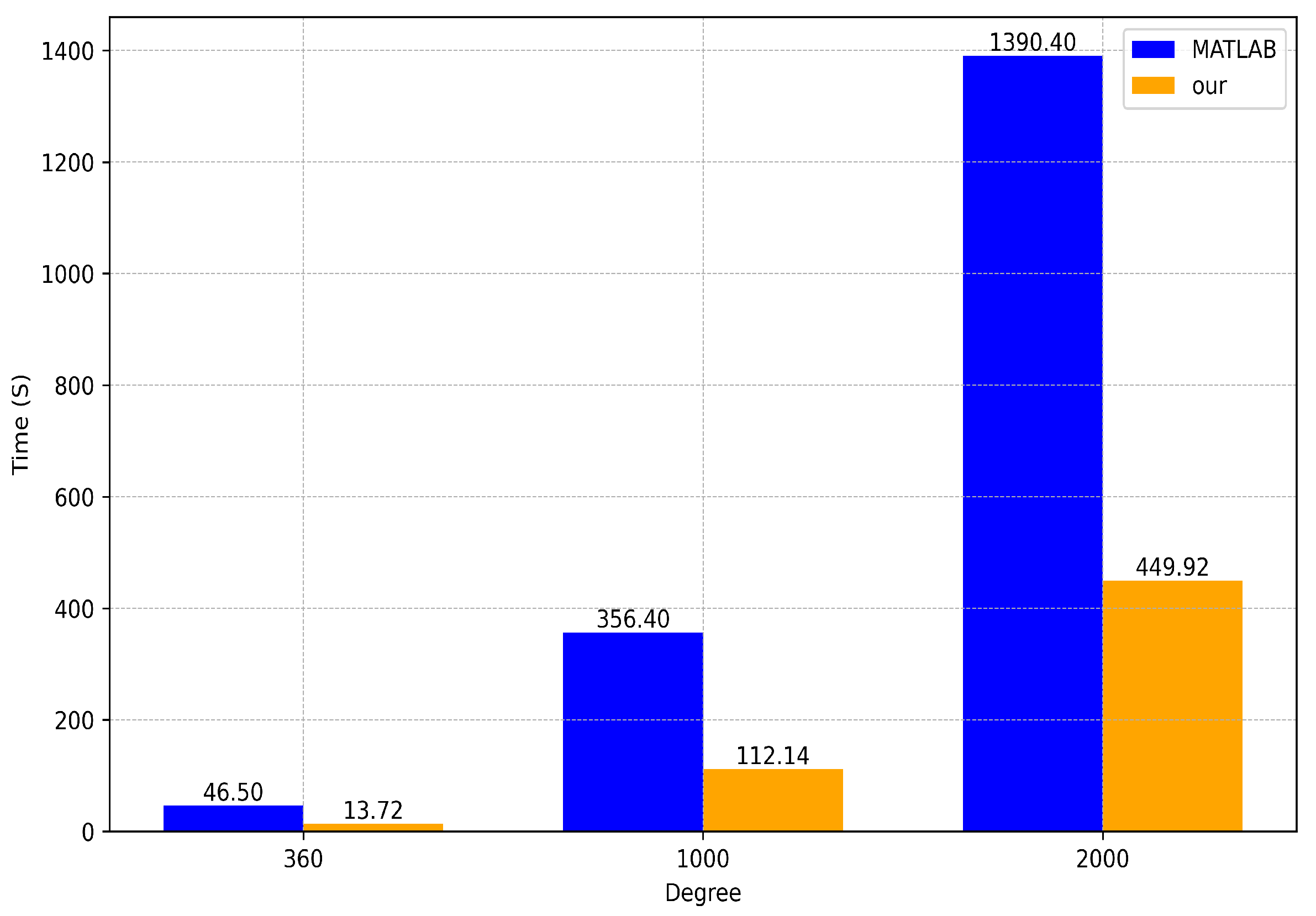
A large number of fully normalized associated Legendre function (fnALF) calculations are required to compute Earth’s gravity field elements using ultra high-order gravity field coefficient models. In the surveying and mapping industry, researchers typically rely on CPU-based systems for these calculations, which leads to limitations in execution speed and power efficiency. Although modern CPUs improve instruction execution efficiency through instruction-level parallelism, the constraints of a shared memory architecture impose further limitations on the execution speed and power efficiency. This results in exponential increases in computation time as demand rises alongside high power consumption. In this article, we present a new computational implementation of an fnALF based on the ZYNQ platform. We design a task-parallel “pipeline” architecture which converts the original serial logic into a more efficient hardware implementation, and we utilize a redundant calculation layer to handle repetitive coefficient computations separately. The experimental results demonstrate that our system achieved accurate and rapid calculations. Under the only one geocentric residual latitude condition, we measured the computation times for spherical harmonic coefficient degrees of 360, 720, and 1080 to be 0.155922 s, 0.520950 s, and 1.401609 s, respectively. In the case of the multiple geocentric residual latitudes condition, our design generally yielded efficiency gains of over three times those of MATLAB R2020b implementation. Additionally, our calculated results were used to determine the geoid height in the field with an error of less than ±0.1m, confirming the reliability of our computations.
Keywords: associated Legendre function; gravity field; recursive algorithm; FPGA associated Legendre function; gravity field; recursive algorithm; FPGA