Article

Hand Gesture Recognition Using FSK Radar Sensors

1
Department Semiconductor Systems Engineering, Sejong University, Gunja-dong, Gwangjin-gu, Seoul 05006, Republic of Korea
2
Department of Convergence Engineering of Intelligent Drone, Sejong University, Gunja-dong, Gwangjin-gu, Seoul 05006, Republic of Korea
3
Department of Smart Drone Convergence, Korea Aerospace University, Goyang 10540, Gyeonggi-do, Republic of Korea
4
School of Electronics and Information Engineering, Korea Aerospace University, Goyang 10540, Gyeonggi-do, Republic of Korea
5
Department Electrical Engineering, Sejong University, Gunja-dong, Gwangjin-gu, Seoul 05006, Republic of Korea
*
Author to whom correspondence should be addressed.
Sensors 2024, 24(2), 349; https://doi.org/10.3390/s24020349
Submission received: 8 December 2023 / Revised: 25 December 2023 / Accepted: 5 January 2024 / Published: 6 January 2024
(This article belongs to the Section Radar Sensors)

Abstract

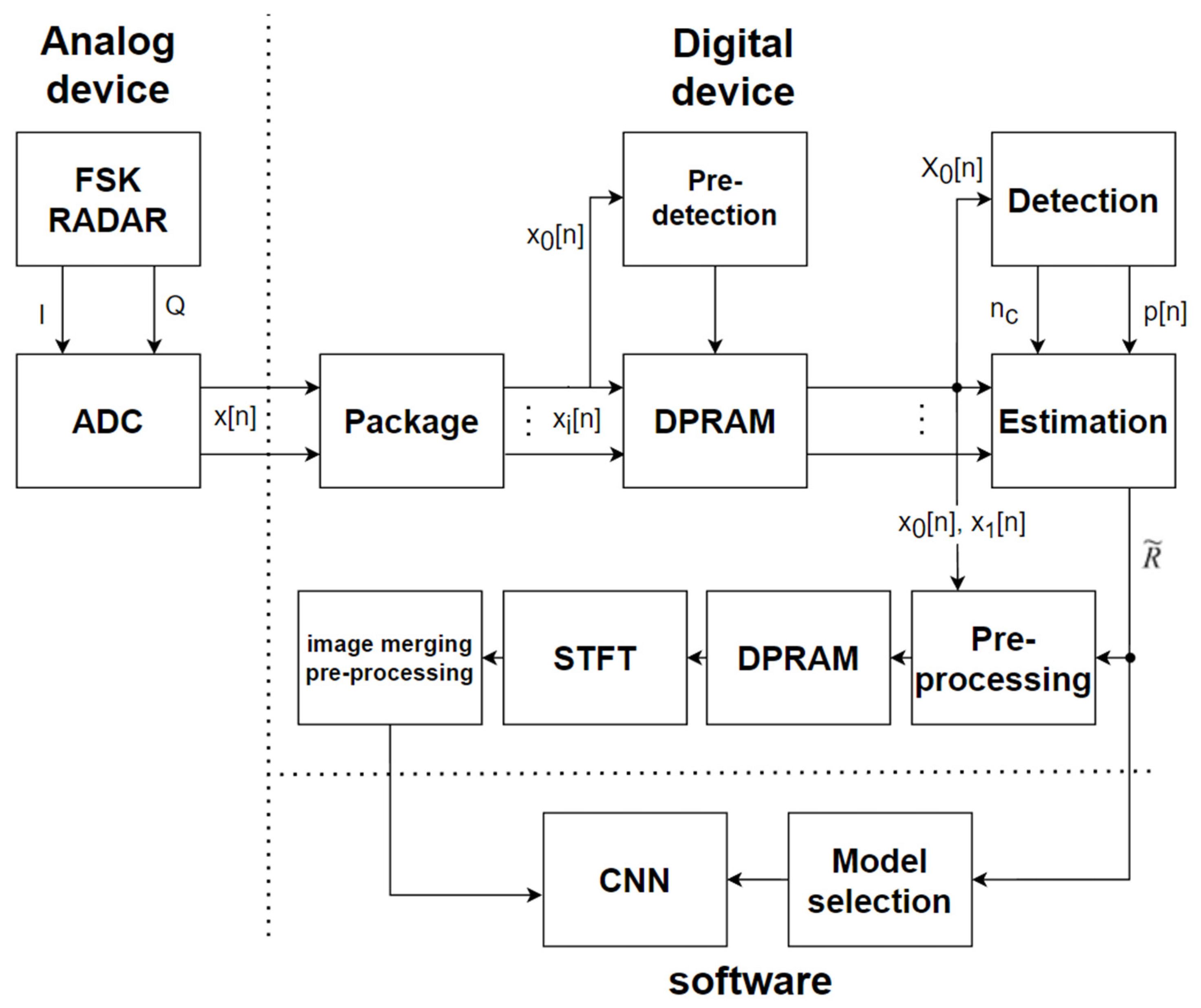
Hand gesture recognition, which is one of the fields of human–computer interaction (HCI) research, extracts the user’s pattern using sensors. Radio detection and ranging (RADAR) sensors are robust under severe environments and convenient to use for hand gestures. The existing studies mostly adopted continuous-wave (CW) radar, which only shows a good performance at a fixed distance, which is due to its limitation of not seeing the distance. This paper proposes a hand gesture recognition system that utilizes frequency-shift keying (FSK) radar, allowing for a recognition method that can work at the various distances between a radar sensor and a user. The proposed system adopts a convolutional neural network (CNN) model for the recognition. From the experimental results, the proposed recognition system covers the range from 30 cm to 180 cm and shows an accuracy of 93.67% over the entire range.
Keywords: human–computer interaction; hand gesture recognition; micro-Doppler signature; FSK radar; Doppler radar; convolutional neural network; data preprocessing human–computer interaction; hand gesture recognition; micro-Doppler signature; FSK radar; Doppler radar; convolutional neural network; data preprocessing