Article

Virtual Needle Insertion with Enhanced Haptic Feedback for Guidance and Needle–Tissue Interaction Forces

Robotics and Mechatronics Research Group, Faculty of Electrical Engineering, Mathematics and Computer Science, University of Twente, 7500 AE Enschede, The Netherlands
*
Author to whom correspondence should be addressed.
Sensors 2024, 24(17), 5560; https://doi.org/10.3390/s24175560
Submission received: 28 June 2024 / Revised: 17 August 2024 / Accepted: 19 August 2024 / Published: 28 August 2024
(This article belongs to the Special Issue Robotics and Haptics: Haptic Feedback for Medical Robots)

Abstract

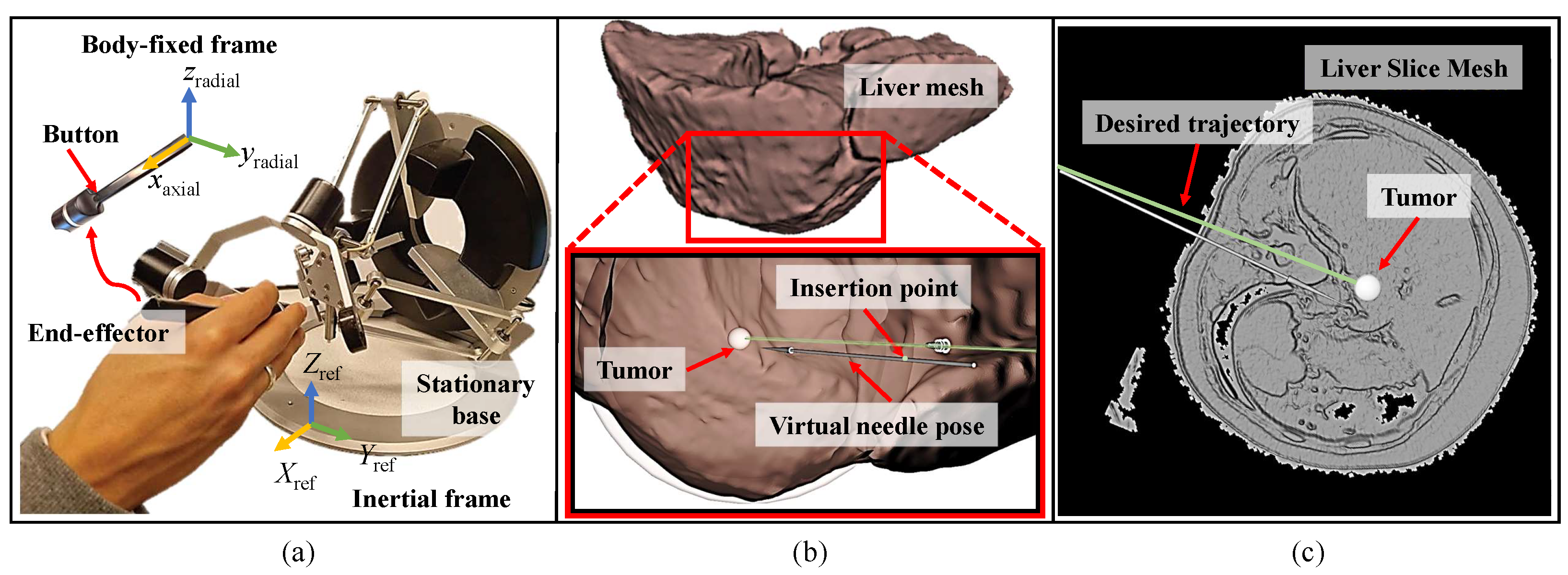
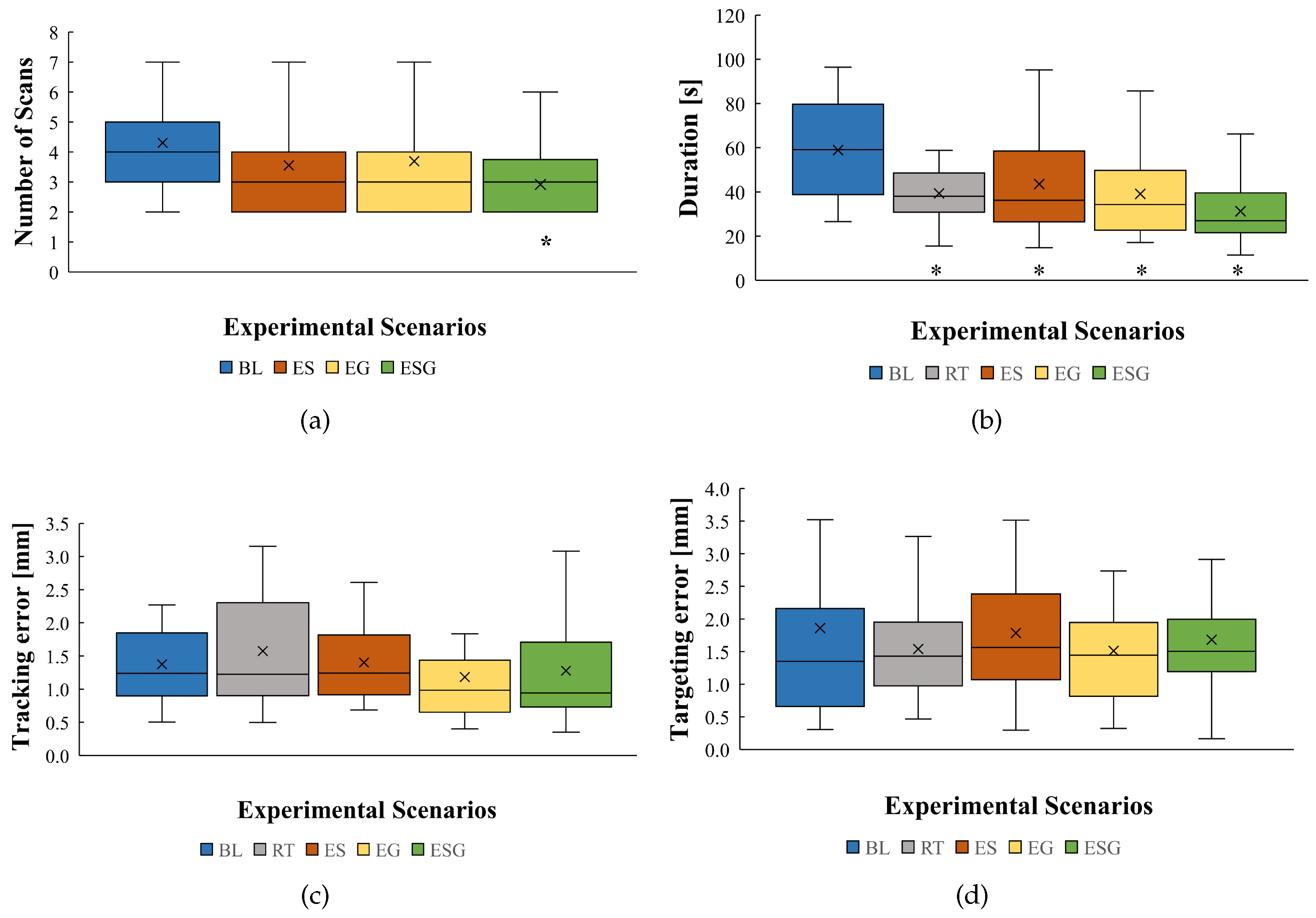
Interventional radiologists mainly rely on visual feedback via imaging modalities to steer a needle toward a tumor during biopsy and ablation procedures. In the case of CT-guided procedures, there is a risk of exposure to hazardous X-ray-based ionizing radiation. Therefore, CT scans are usually not used continuously, which increases the chances of a misplacement of the needle and the need for reinsertion, leading to more tissue trauma. Interventionalists also encounter haptic feedback via needle–tissue interaction forces while steering a needle. These forces are useful but insufficient to clearly perceive and identify deep-tissue structures such as tumors. The objective of this paper was to investigate the effect of enhanced force feedback for sensing interaction forces and guiding the needle when applied individually and simultaneously during a virtual CT-guided needle insertion task. We also compared the enhanced haptic feedback to enhanced visual feedback. We hypothesized that enhancing the haptic feedback limits the time needed to reach the target accurately and reduces the number of CT scans, as the interventionalist depends more on real-time enhanced haptic feedback. To test the hypothesis, a simulation environment was developed to virtually steer a needle in five degrees of freedom (DoF) to reach a tumor target embedded in a liver model. Twelve participants performed in the experiment with different feedback conditions where we measured their performance in terms of the following: targeting accuracy, trajectory tracking, number of CT scans required, and the time needed to finish the task. The results suggest that the combination of enhanced haptic feedback for guidance and sensing needle–tissue interaction forces significantly reduce the number of scans and the duration required to finish the task by 32.1% and 46.9%, respectively, when compared to nonenhanced haptic feedback. The other feedback modalities significantly reduced the duration to finish the task by around 30% compared to nonenhanced haptic feedback.
Keywords: liver cancer; CT liver biopsy; haptic feedback; needle insertion simulation; needle guidance liver cancer; CT liver biopsy; haptic feedback; needle insertion simulation; needle guidance