Article

Improved Motion Artifact Correction in fNIRS Data by Combining Wavelet and Correlation-Based Signal Improvement


by
Hayder R. Al-Omairi
1,2,
Sebastian Fudickar
3,4,
Andreas Hein
3 and
Jochem W. Rieger
1,5,*
1
Applied Neurocognitive Psychology Lab, Carl von Ossietzky Universität Oldenburg, D-26129 Oldenburg, Germany
2
Department of Biomedical Engineering, University of Technology—Iraq, Baghdad 10066, Iraq
3
Assistance Systems and Medical Device Technology, Carl von Ossietzky Universität Oldenburg, D-26111 Oldenburg, Germany
4
Institute for Medical Informatics, University of Lübeck, D-23538 Lübeck, Germany
5
Cluster of Excellence Hearing4all, Carl von Ossietzky Universität Oldenburg, D-26129 Oldenburg, Germany
*
Author to whom correspondence should be addressed.
Sensors 2023, 23(8), 3979; https://doi.org/10.3390/s23083979
Submission received: 15 February 2023 / Revised: 31 March 2023 / Accepted: 7 April 2023 / Published: 14 April 2023
(This article belongs to the Collection Sensors and Intelligent Control Systems)

Abstract

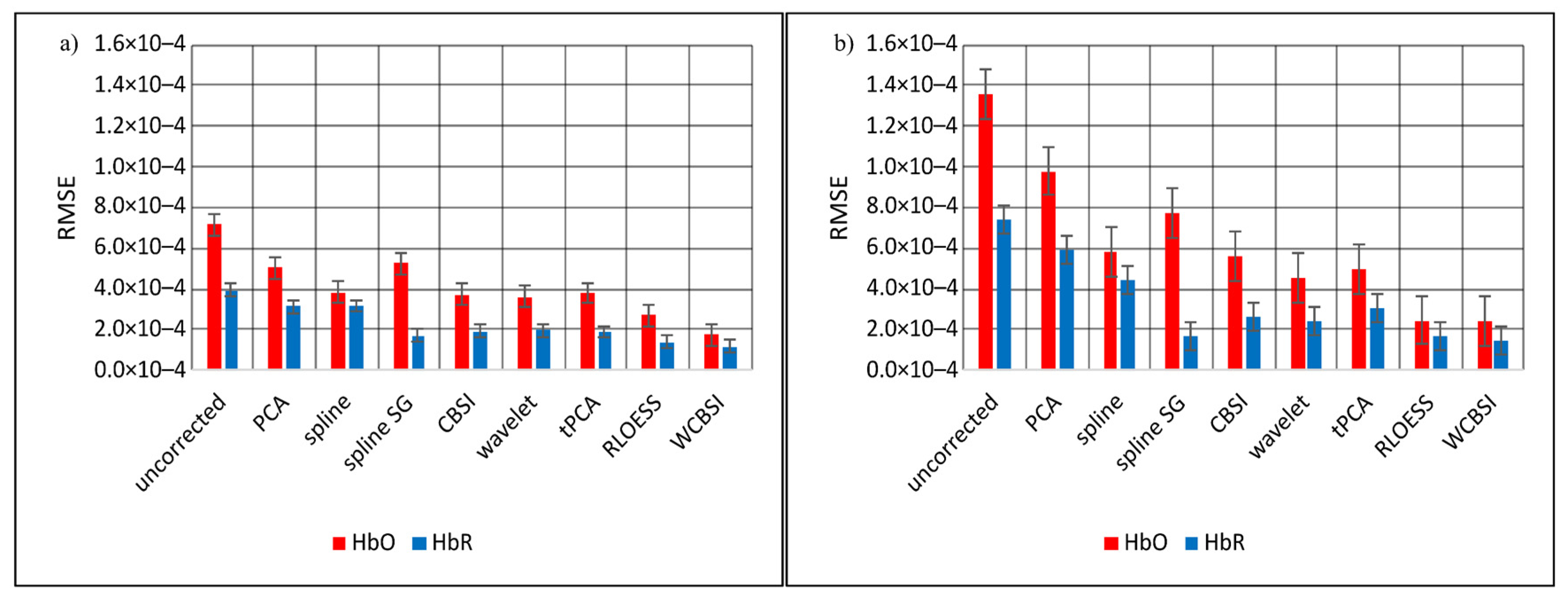
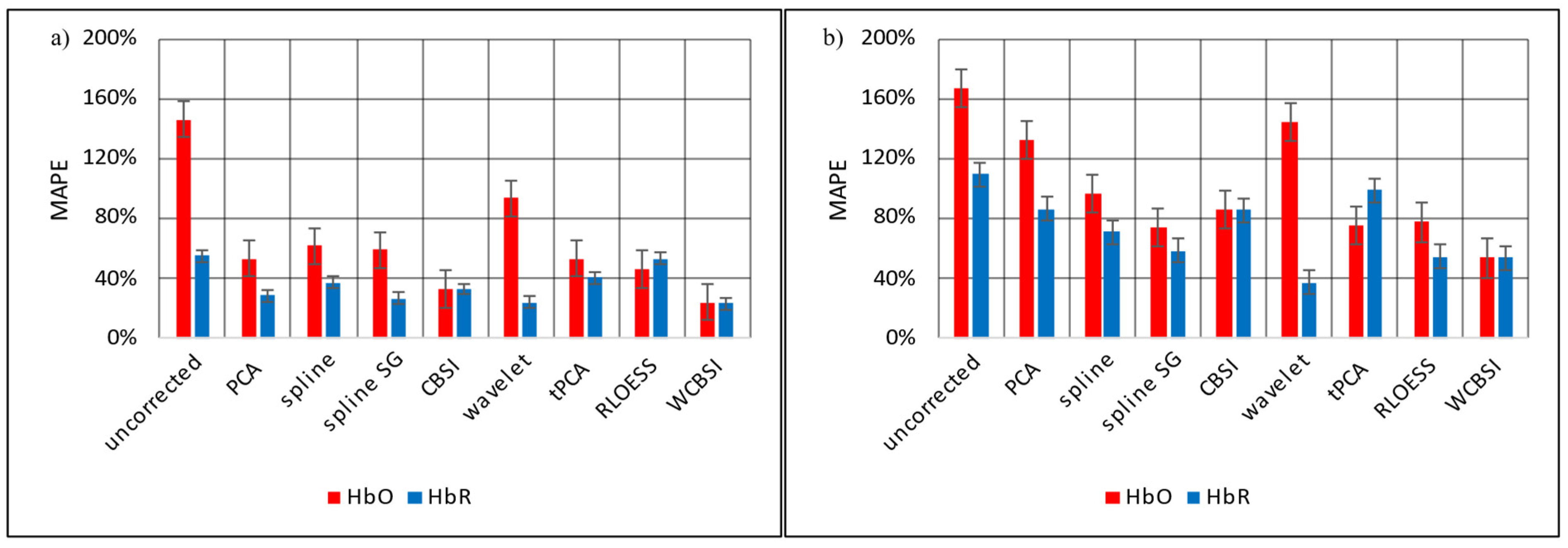
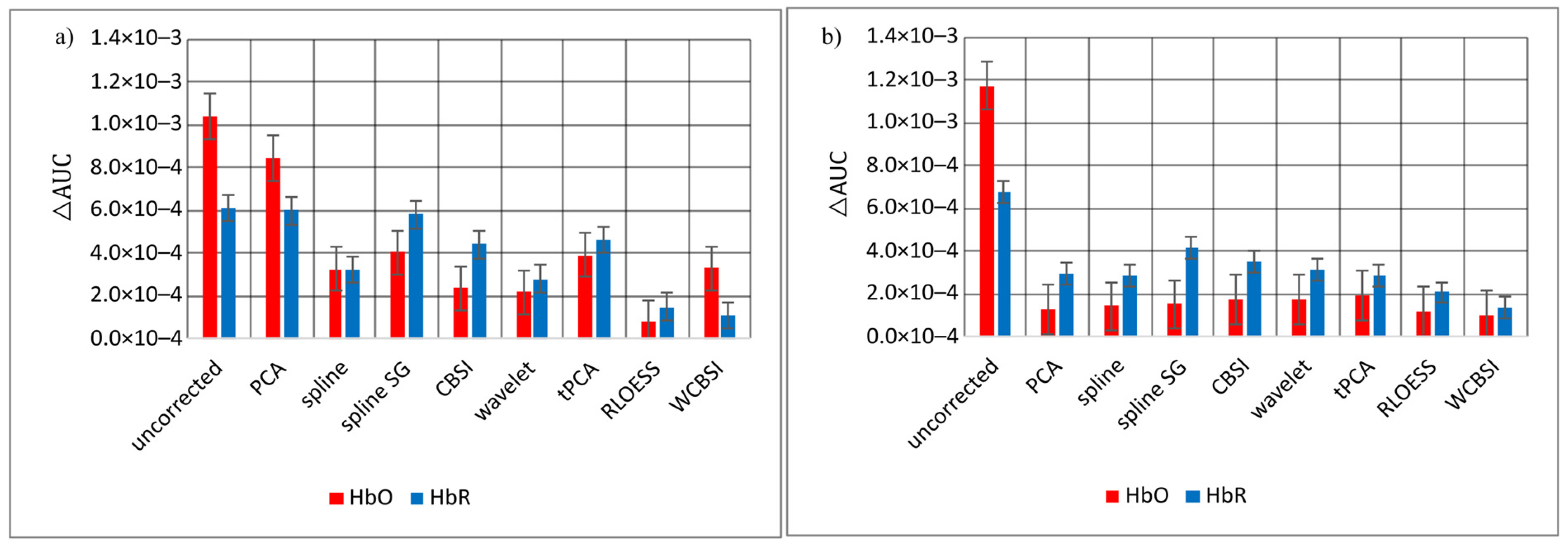
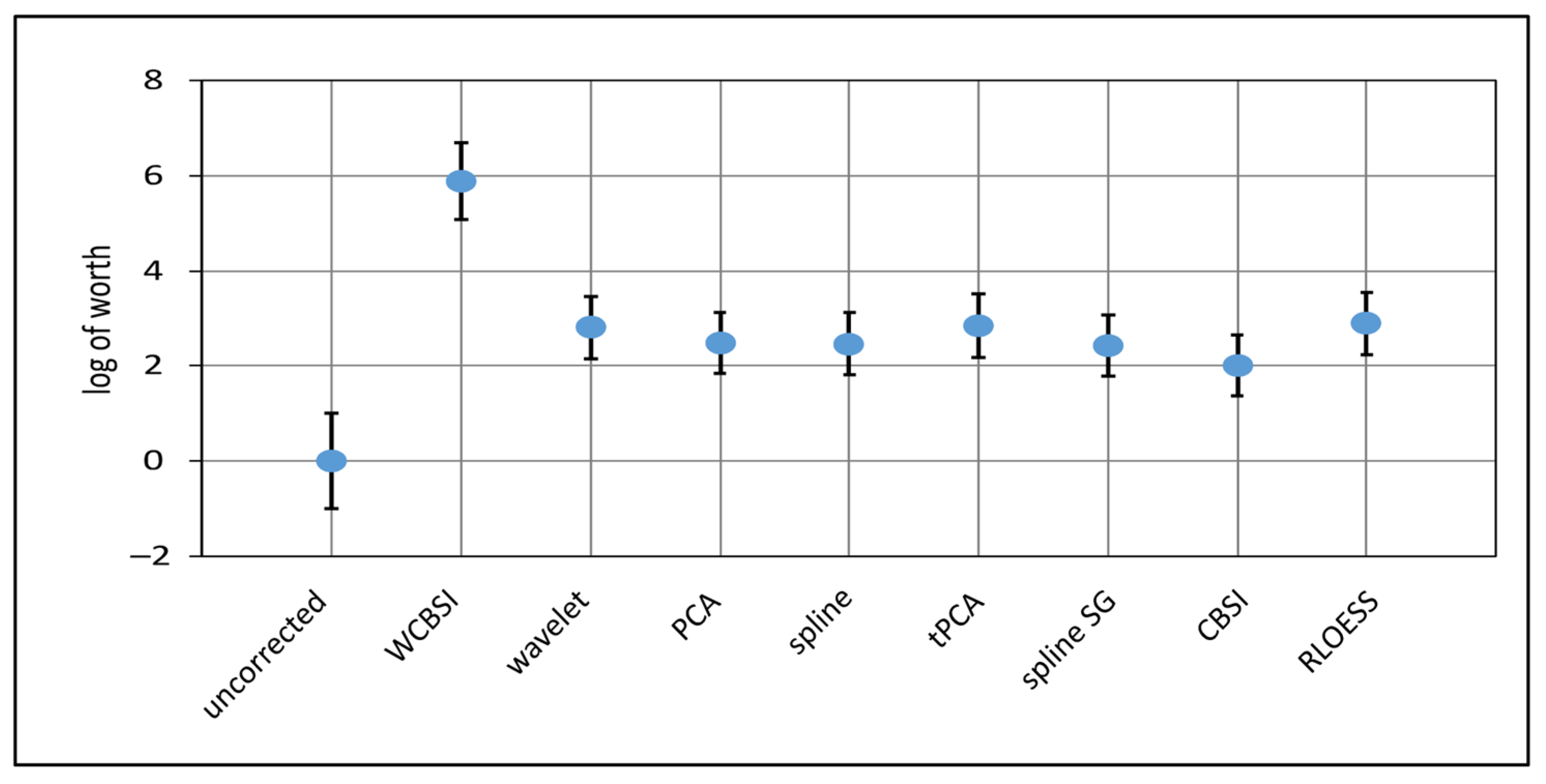
Functional near-infrared spectroscopy (fNIRS) is an optical non-invasive neuroimaging technique that allows participants to move relatively freely. However, head movements frequently cause optode movements relative to the head, leading to motion artifacts (MA) in the measured signal. Here, we propose an improved algorithmic approach for MA correction that combines wavelet and correlation-based signal improvement (WCBSI). We compare its MA correction accuracy to multiple established correction approaches (spline interpolation, spline-Savitzky–Golay filter, principal component analysis, targeted principal component analysis, robust locally weighted regression smoothing filter, wavelet filter, and correlation-based signal improvement) on real data. Therefore, we measured brain activity in 20 participants performing a hand-tapping task and simultaneously moving their head to produce MAs at different levels of severity. In order to obtain a “ground truth” brain activation, we added a condition in which only the tapping task was performed. We compared the MA correction performance among the algorithms on four predefined metrics (R, RMSE, MAPE, and ΔAUC) and ranked the performances. The suggested WCBSI algorithm was the only one exceeding average performance (p < 0.001), and it had the highest probability to be the best ranked algorithm (78.8% probability). Together, our results indicate that among all algorithms tested, our suggested WCBSI approach performed consistently favorably across all measures.
Keywords: functional near-infrared spectroscopy (fNIRS); real fNIRS data; motion artifact; motion correction functional near-infrared spectroscopy (fNIRS); real fNIRS data; motion artifact; motion correction