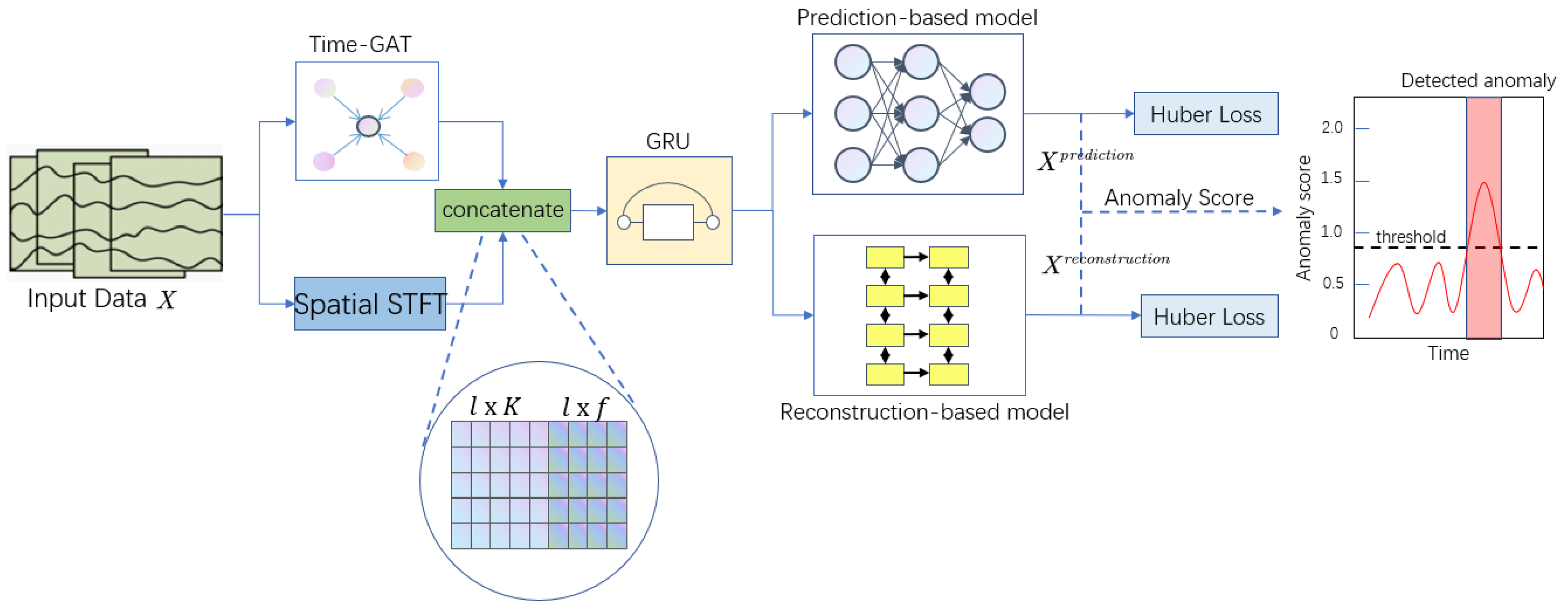
DCFF-MTAD: A Multivariate Time-Series Anomaly Detection Model Based on Dual-Channel Feature Fusion


Abstract
Share and Cite
Xu, Z.; Yang, Y.; Gao, X.; Hu, M. DCFF-MTAD: A Multivariate Time-Series Anomaly Detection Model Based on Dual-Channel Feature Fusion. Sensors 2023, 23, 3910. https://doi.org/10.3390/s23083910
Xu Z, Yang Y, Gao X, Hu M. DCFF-MTAD: A Multivariate Time-Series Anomaly Detection Model Based on Dual-Channel Feature Fusion. Sensors. 2023; 23(8):3910. https://doi.org/10.3390/s23083910
Chicago/Turabian StyleXu, Zheng, Yumeng Yang, Xinwen Gao, and Min Hu. 2023. "DCFF-MTAD: A Multivariate Time-Series Anomaly Detection Model Based on Dual-Channel Feature Fusion" Sensors 23, no. 8: 3910. https://doi.org/10.3390/s23083910
APA StyleXu, Z., Yang, Y., Gao, X., & Hu, M. (2023). DCFF-MTAD: A Multivariate Time-Series Anomaly Detection Model Based on Dual-Channel Feature Fusion. Sensors, 23(8), 3910. https://doi.org/10.3390/s23083910