RFE-UNet: Remote Feature Exploration with Local Learning for Medical Image Segmentation

Abstract
1. Introduction
- (1)
- In this paper, a new multi-organ segmentation dataset is created, and the advantages and disadvantages of both the convolution operation and the transformer are verified.
- (2)
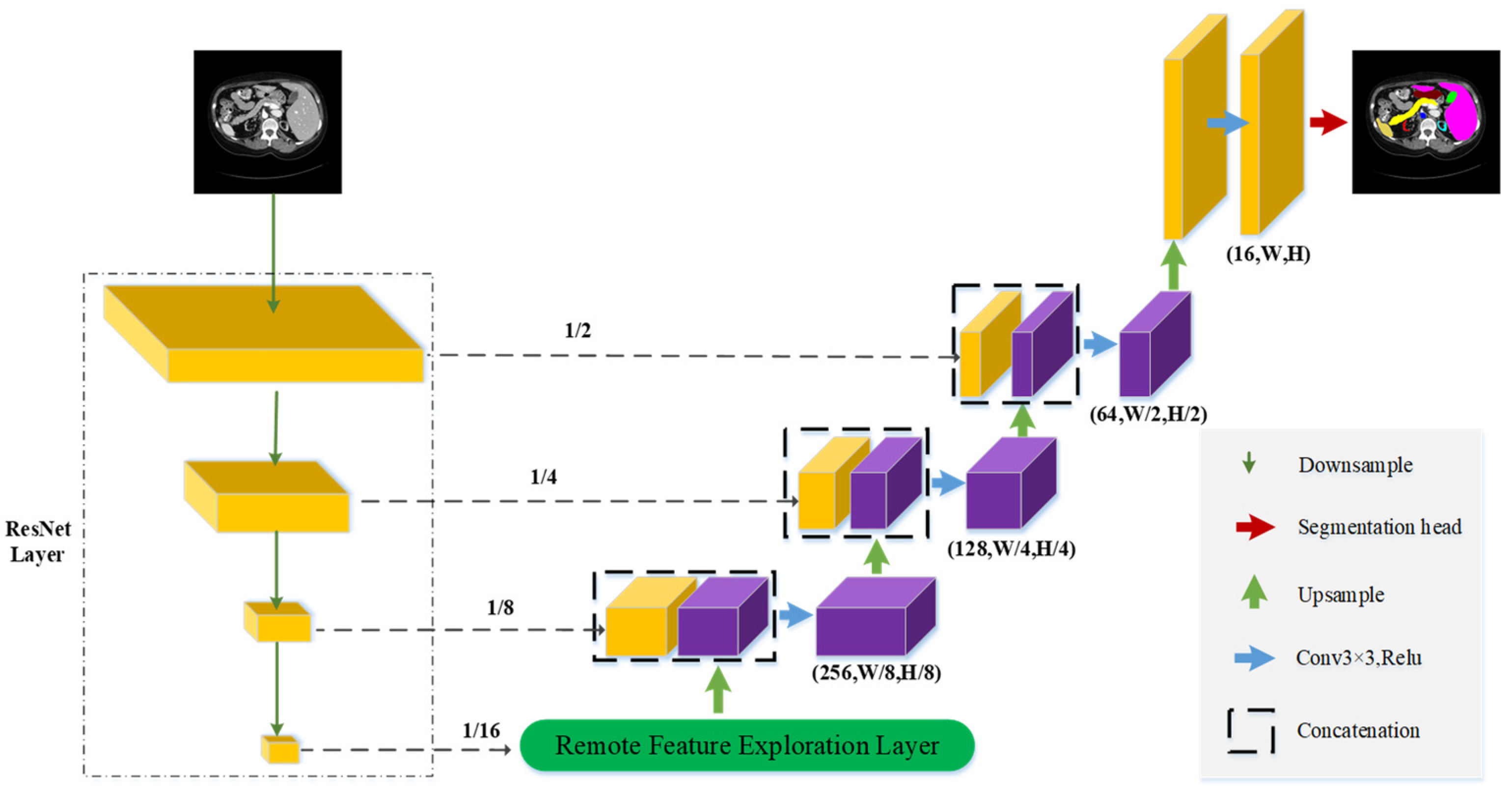
- In this paper, we propose that the remote feature exploration layer can be used to assist the network in learning local elements using remote elements. This capability allows the network to not only capture local details but also model the relationships between distant elements.
2. Related Work
3. Methods
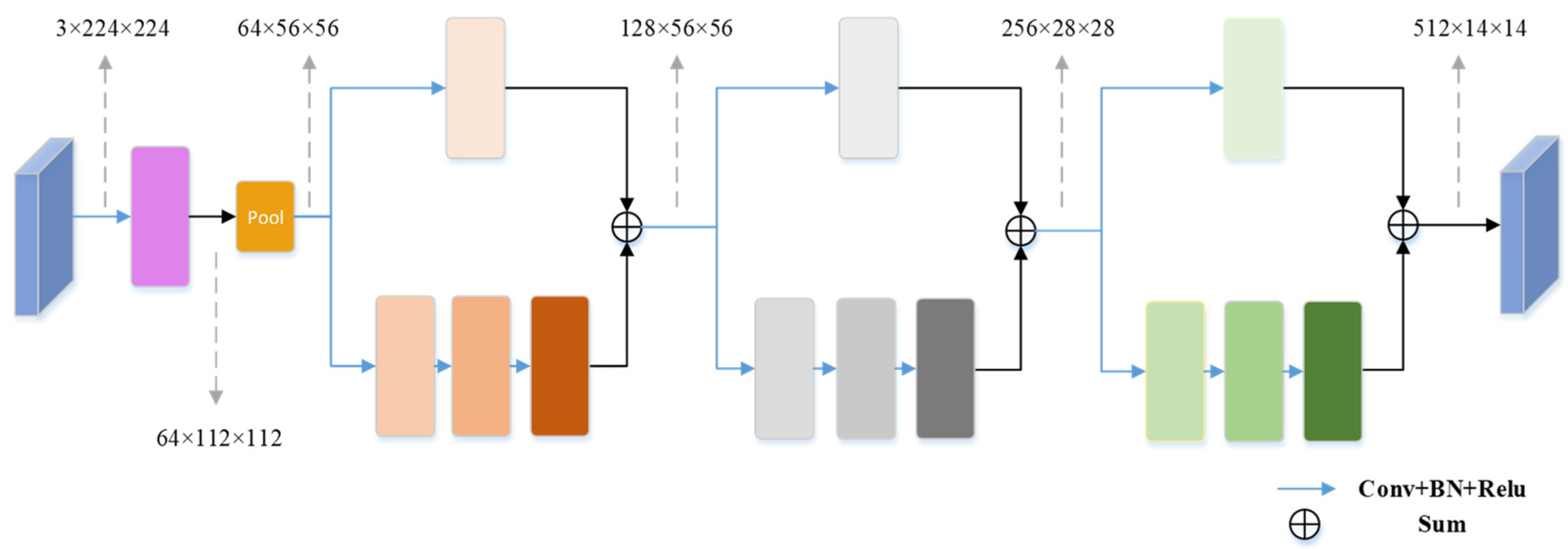
3.1. ResNet Layer
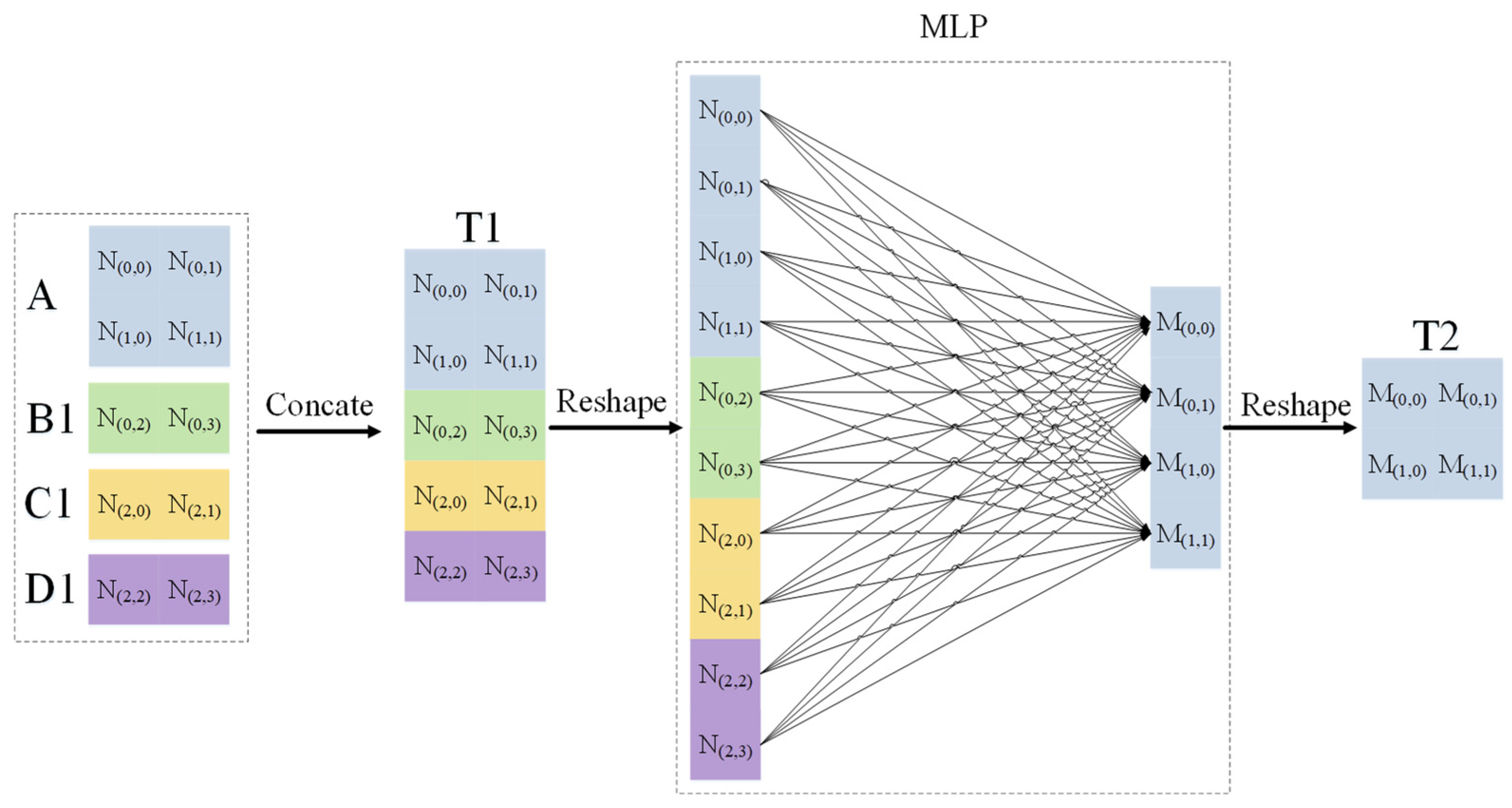
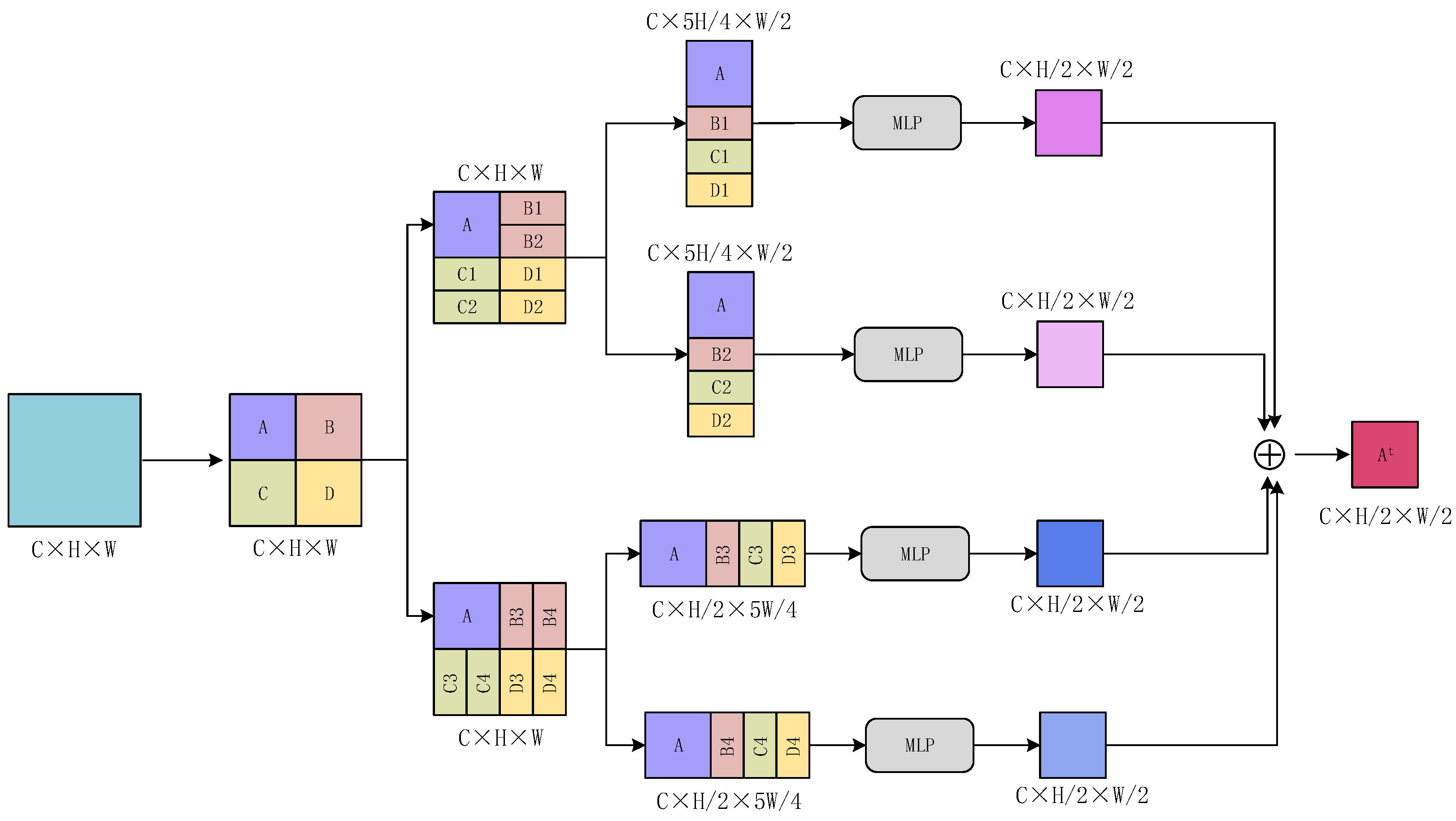
3.2. Remote Feature Exploration Layer
3.3. Decoder of RFE-UNet
4. Experiments and Analysis
4.1. Datasets
4.2. Implementation Details
4.3. Loss Function
4.4. Evaluation Metrics
4.5. Experimental Results
4.6. Analytical Study
4.7. Visualizations
5. Conclusions
Author Contributions
Funding
Institutional Review Board Statement
Informed Consent Statement
Data Availability Statement
Conflicts of Interest
References
- Ronneberger, O.; Fischer, P.; Brox, T. U-Net: Convolutional networks for biomedical image segmentation. In Proceedings of the 18th International Conference on Medical Image Computing and Computer-Assisted Intervention (MICCAI 2015), Part III, Munich, Germany, 5–9 October 2015; Volume 9351, pp. 234–241. [Google Scholar]
- Isensee, F.; Jaeger, P.; Kohl, S.; Petersen, J.; Maier-Hein, K. nnU-Net for Brain Tumor Segmentation. In Proceedings of the 6th International Workshop on Brainlesion: Glioma, Multiple Sclerosis, Stroke and Traumatic Brain Injuries (BrainLes 2020), Held in Conjunction with MICCAI 2020, Part II, Lima, Peru, 4 October 2020; Volume 12659, pp. 118–132. [Google Scholar]
- Isensee, F.; Maier-Hein, K. An attempt at beating the 3D U-Net. arXiv 2019, arXiv:1908.02182. [Google Scholar]
- Jin, Q.; Meng, Z.; Sun, C.; Cui, H.; Su, R. RA-UNet: A hybrid deep attention-aware network to extract liver and tumor in CT scans. arXiv 2018, arXiv:1811.01328. [Google Scholar] [CrossRef] [Scilit] [PubMed]
- Bakas, S.; Maier-Hein, K.H. Identifying the Best Machine Learning Algorithms for Brain Tumor Segmentation, Progression Assessment, and Overall Survival Prediction in the BRATS Challenge. arXiv 2018, arXiv:1811.02629. [Google Scholar]
- Heller, N.; Sathianathen, N.; Kalapara, A.; Walczak, E.; Moore, K.; Kaluzniak, H.; Rosenberg, J.; Blake, P.; Rengel, Z.; Oestreich, M.; et al. The KiTS19 Challenge Data: 300 Kidney Tumor Cases with Clinical Context, CT Semantic Segmentations, and Surgical Outcomes. arXiv 2019, arXiv:1904.00445. [Google Scholar]
- Simpson, A.; Antonelli, M.; Bakas, S.; Bilello, M.; Farahani, K.; Van Ginneken, B.; Kopp-Schneider, A.; Landman, B.A.; Litjens, G.; Menze, B.; et al. A large annotated medical image dataset for the development and evaluation of segmentation algorithms. arXiv 2019, arXiv:1902.09063. [Google Scholar]
- Yu, L.; Cheng, J.Z.; Dou, Q.; Yang, X.; Chen, H.; Qin, J.; Heng, P.A. Automatic 3D cardiovascular MR segmentation with densely-connected volumetric convnets. In Proceedings of the 20th International Conference on Medical Image Computing and Computer Assisted Intervention (MICCAI 2017), Part II, Quebec City, QC, Canada, 11–13 September 2017; Volume 10434, pp. 287–295. [Google Scholar]
- Li, X.; Chen, H.; Qi, X.; Dou, Q.; Fu, C.W.; Heng, P.A. H-DenseUNet: Hybrid densely connected UNet for liver and tumor segmentation from CT volumes. IEEE Trans. Med. Imaging 2018, 37, 2663–2674. [Google Scholar] [CrossRef] [Scilit] [PubMed]
- Yu, Q.; Xie, L.; Wang, Y.; Zhou, Y.; Fishman, E.K.; Yuille, A.L. Recurrent saliency transformation network: Incorporating multi-stage visual cues for small organ segmentation. In Proceedings of the 2018 IEEE Conference on Computer Vision and Pattern Recognition (CVPR 2018), Salt Lake City, UT, USA, 18–22 June 2018; pp. 8280–8289. [Google Scholar]
- Zhou, Y.; Xie, L.; Shen, W.; Wang, Y.; Fishman, E.K.; Yuille, A.L. A fixed-point model for pancreas segmentation in abdominal CT scans. In Proceedings of the 20th International Conference on Medical Image Computing and Computer Assisted Intervention (MICCAI 2017), Part I, Quebec City, QC, Canada, 11–13 September 2017; Volume 10433, pp. 693–701. [Google Scholar]
- Zhou, Z.; Rahman Siddiquee, M.M.; Tajbakhsh, N.; Liang, J. Unet++: A nested u-net architecture for medical image segmentation. In Proceedings of the 4th International Workshop and 8th International Workshop on Deep Learning in Medical Image Analysis-and-Multimodal Learning for Clinical Decision Support (DLMIA 2018 and ML-CDS 2018), Held in Conjunction with MICCAI 2018, Granada, Spain, 20 September 2018; Volume 11045, pp. 3–11. [Google Scholar]
- He, K.; Zhang, X.; Ren, S.; Sun, J. Deep residual learning for image recognition. In Proceedings of the 2016 IEEE Conference on Computer Vision and Pattern Recognition (CVPR 2016), Las Vegas, NV, USA, 27–30 June 2016; pp. 770–778. [Google Scholar]
- Chen, L.; Papandreou, G.; Kokkinos, I.; Murphy, K.; Yuille, A. DeepLab: Semantic Image Segmentation with Deep Convolutional Nets, Atrous Convolution, and Fully Connected CRFs. IEEE Trans. Pattern Anal. Mach. Intell. 2018, 40, 834–848. [Google Scholar] [CrossRef] [Scilit] [PubMed]
- Gu, Z.; Cheng, J.; Fu, H.; Zhou, K.; Hao, H.; Zhao, Y.; Zhang, T.; Gao, S.; Liu, J. CE-Net: Context Encoder Network for 2D Medical Image Segmentation. IEEE Trans. Med. Imaging 2019, 38, 2281–2292. [Google Scholar] [CrossRef] [Scilit] [PubMed]
- Li, W.; Wang, G.; Fidon, L.; Ourselin, S.; Cardoso, M.J.; Vercauteren, T. On the Compactness, Efficiency, and Representation of 3D Convolutional Networks: Brain Parcellation as a Pretext Task. In Proceedings of the 25th International Conference on Information Processing in Medical Imaging (IPMI 2017), Boone, NC, USA, 25–30 June 2017; Volume 10265, pp. 348–360. [Google Scholar]
- Fu, J.; Liu, J.; Tian, H.; Li, Y.; Bao, Y.; Fang, Z.; Lu, H. Dual Attention Network for Scene Segmentation. In Proceedings of the IEEE Conference on Computer Vision and Pattern Recognition (CVPR 2019), Long Beach, CA, USA, 16–20 June 2019; pp. 3146–3154. [Google Scholar]
- Wang, X.; Girshick, R.; Gupta, A.; He, K. Non-local neural networks. In Proceedings of the 2018 IEEE Conference on Computer Vision and Pattern Recognition (CVPR 2018), Salt Lake City, UT, USA, 18–22 June 2018; pp. 7794–7803. [Google Scholar]
- Zhang, H.; Goodfellow, I.; Metaxas, D.; Odena, A. Self-Attention Generative Adversarial Networks. In Proceedings of the 36th International Conference on Machine Learning (ICML 2019), Long Beach, CA, USA, 9–15 June 2019; Volume 97, pp. 7354–7363. [Google Scholar]
- Devlin, J.; Chang, M.W.; Lee, K.; Toutanova, K. Bert: Pre-training of deep bidirectional transformers for language understanding. In Proceedings of the 2019 Conference of the North American Chapter of the Association for Computational Linguistics: Human Language Technologies (NAACL-HLT 2019), Minneapolis, MN, USA, 2–7 June 2019; Volume 1 (Long and Short Papers), pp. 4171–4186. [Google Scholar]
- Vaswani, A.; Shazeer, N.; Parmar, N.; Uszkoreit, J.; Jones, L.; Gomez, A.N.; Kaiser, Ł.; Polosukhin, I. Attention is all you need. In Proceedings of the Advances in Neural Information Processing Systems 30: Annual Conference on Neural Information Processing Systems 2017, Long Beach, CA, USA, 4–9 December 2017; pp. 5998–6008. [Google Scholar]
- Dosovitskiy, A.; Beyer, L.; Kolesnikov, A.; Weissenborn, D.; Zhai, X.; Unterthiner, T.; Dehghani, M.; Minderer, M.; Heigold, G.; Gelly, S.; et al. An image is worth 16 × 16 words: Transformers for image recognition at scale. In Proceedings of the 9th International Conference on Learning Representations, Virtual Event, 3–7 May 2021. [Google Scholar]
- Bello, I. LambdaNetworks: Modeling long-range Interactions without Attention. In Proceedings of the 9th International Conference on Learning Representations (ICLR 2021), Virtual Event, 3–7 May 2021. [Google Scholar]
- Zhao, C.; Xiang, S.; Wang, Y.; Cai, Z.; Shen, J.; Zhou, S.; Zhao, D.; Su, W.; Guo, S.; Li, S. Context-aware Network Fusing Transformer and V-Net for Semi-supervised Segmentation of 3D Left Atrium. Expert Syst. Appl. 2023, 214, 119105. [Google Scholar] [CrossRef] [Scilit]
- Carion, N.; Massa, F.; Synnaeve, G.; Usunier, N.; Kirillov, A.; Zagoruyko, S. End-to-end object detection with transformers. In Proceedings of the 16th European Conference on Computer Vision (ECCV 2020), Part I, Glasgow, UK, 23–28 August 2020; Volume 12346, pp. 213–229. [Google Scholar]
- Chen, J.; Lu, Y.; Yu, Q.; Luo, X.; Adeli, E.; Wang, Y.; Lu, L.; Yuille, A.L.; Zhou, Y. Transunet: Transformers make strong encoders for medical image segmentation. arXiv 2021, arXiv:2102.04306. [Google Scholar]
- Bao, H.; Dong, L.; Piao, S.; Wei, F. BEiT: BERT Pre-Training of Image Transformers. In Proceedings of the tenth International Conference on Learning Representations (ICLR 2022), Virtual Event, 25–29 April 2022. [Google Scholar]
- Wang, H.; Cao, P.; Wang, J.; Zaiane, O.R. UCTransNet: Rethinking the skip connections in U-Net from a channel-wise perspective with transformer. In Proceedings of the Twelveth Symposium on Educational Advances in Artificial Intelligence, Virtual Event, 22 February–1 March 2022; pp. 2441–2449. [Google Scholar]
- Cao, H.; Wang, Y.; Chen, J.; Jiang, D.; Zhang, X.; Tian, Q.; Wang, M. Swin-unet: Unet-like pure transformer for medical image segmentation. In Proceedings of the Computer Vision—ECCV 2022 Workshops, Part III, Tel Aviv, Israel, 23–27 October 2022; Volume 13803, pp. 205–218. [Google Scholar]
- Oktay, O.; Schlemper, J.; Folgoc, L.L.; Lee, M.; Heinrich, M.; Misawa, K.; Mori, K.; McDonagh, S.; Hammerla, N.Y.; Kainz, B.; et al. Attention u-net: Learning where to look for the pancreas. arXiv 2018, arXiv:1804.03999. [Google Scholar]
- Xiao, X.; Lian, S.; Luo, Z.; Li, S. Weighted Res-UNet for High-Quality Retina Vessel Segmentation. In Proceedings of the 2018 9th International Conference on Information Technology in Medicine and Education (ITME), Hangzhou, China, 19–21 October 2018; pp. 327–331. [Google Scholar]
- Fu, S.; Lu, Y.; Wang, Y.; Zhou, Y.; Shen, W.; Fishman, E.; Yuille, A. Domain adaptive relational reasoning for 3d multi-organ segmentation. In Proceedings of the 23rd International Conference on Medical Image Computing and Computer Assisted Intervention (MICCAI 2020), Part I, Lima, Peru, 4–8 October 2020; Volume 12261, pp. 656–666. [Google Scholar]
- Huang, H.; Lin, L.; Tong, R.; Hu, H.; Zhang, Q.; Iwamoto, Y.; Han, X.; Chen, Y.W.; Wu, J. Unet 3+: A full-scale connected unet for medical image segmentation. In Proceedings of the 2020 IEEE International Conference on Acoustics, Speech and Signal Processing (ICASSP 2020), Barcelona, Spain, 4–8 May 2020; pp. 1055–1059. [Google Scholar]
- Milletari, F.; Navab, N.; Ahmadi, S.A. V-net: Fully convolutional neural networks for volumetric medical image segmentation. In Proceedings of the Fourth International Conference on 3D Vision (3DV 2016), Stanford, CA, USA, 25–28 October 2016; pp. 565–571. [Google Scholar]
- Cicek, O.; Abdulkadir, A.; Lienkamp, S.; Brox, T.; Ronneberger, O. 3D U-Net: Learning Dense Volumetric Segmentation from Sparse Annotation. In Proceedings of the 19th International Conference on Medical Image Computing and Computer-Assisted Intervention (MICCAI 2016), Part II, Athens, Greece, 17–21 October 2016; Volume 9901, pp. 424–432. [Google Scholar]
- Valanarasu, J.M.; Oza, P.; Hacihaliloglu, I.; Patel, V. Medical Transformer: Gated Axial-Attention for Medical Image Seg-mentation. In Proceedings of the 24th International Conference on Medical Image Computing and Computer Assisted Intervention (MICCAI2021), Part I, Strasbourg, France, 27 September–1 October 2021; Volume 12901, pp. 36–46. [Google Scholar]
- Zhang, Z.; Sun, B.; Zhang, W. Pyramid Medical Transformer for Medical Image Segmentation. arXiv 2021, arXiv:2104.14702. [Google Scholar]
- Tang, Y.; Yang, D.; Li, W.; Roth, H.R.; Landman, B.; Xu, D.; Nath, V.; Hatamizadeh, A. Self-supervised pre-training of swin transformers for 3d medical image analysis. In Proceedings of the IEEE/CVF Conference on Computer Vision and Pattern Recognition, New Orleans, LA, USA, 18–24 June 2022; pp. 20730–20740. [Google Scholar]
- Hatamizadeh, A.; Tang, Y.; Nath, V.; Yang, D.; Myronenko, A.; Landman, B.; Roth, H.R.; Xu, D. Unetr: Transformers for 3d medical image segmentation. In Proceedings of the IEEE/CVF Winter Conference on Applications of Computer Vision, Waikoloa, HI, USA, 4–8 January 2022; pp. 574–584. [Google Scholar]
- Liu, W.; Tian, T.; Xu, W.; Yang, H.; Pan, X.; Yan, S.; Wang, L. Phtrans: Parallelly aggregating global and local representations for medical image segmentation. In Proceedings of the 25th International Conference on Medical Image Computing and Computer Assisted Intervention (MICCAI 2022), Singapore, 18–22 September 2022; pp. 235–244. [Google Scholar]
- Schlemper, J.; Oktay, O.; Schaap, M.; Heinrich, M.; Kainz, B.; Glocker, B.; Rueckert, D. Attention gated networks: Learning to leverage salient regions in medical images. Med. Image Anal. 2019, 53, 197–207. [Google Scholar] [CrossRef] [Scilit] [PubMed]
- Wang, H.; Xie, S.; Lin, L.; Iwamoto, Y.; Han, X.H.; Chen, Y.W.; Tong, R. Mixed transformer U-Net for medical image segmentation. In Proceedings of the IEEE International Conference on Acoustics, Speech and Signal Processing (ICASSP 2022), Singapore, 23–27 May 2022; pp. 2390–2394. [Google Scholar]
- Li, W.; Wang, X.; Xia, X.; Wu, J.; Xiao, X.; Zheng, M.; Wen, S. Sepvit: Separable vision transformer. arXiv 2022, arXiv:2203.15380. [Google Scholar]


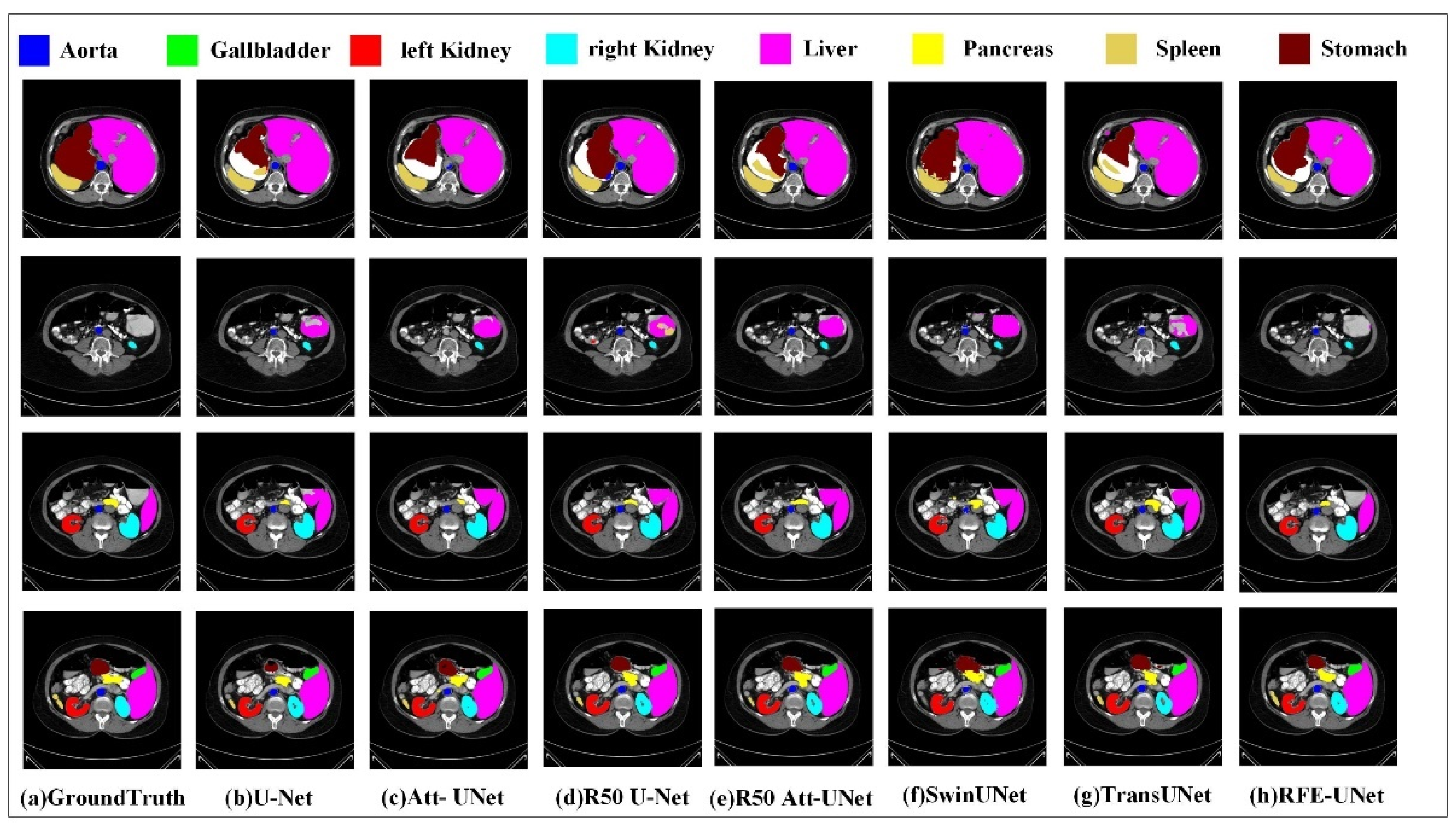
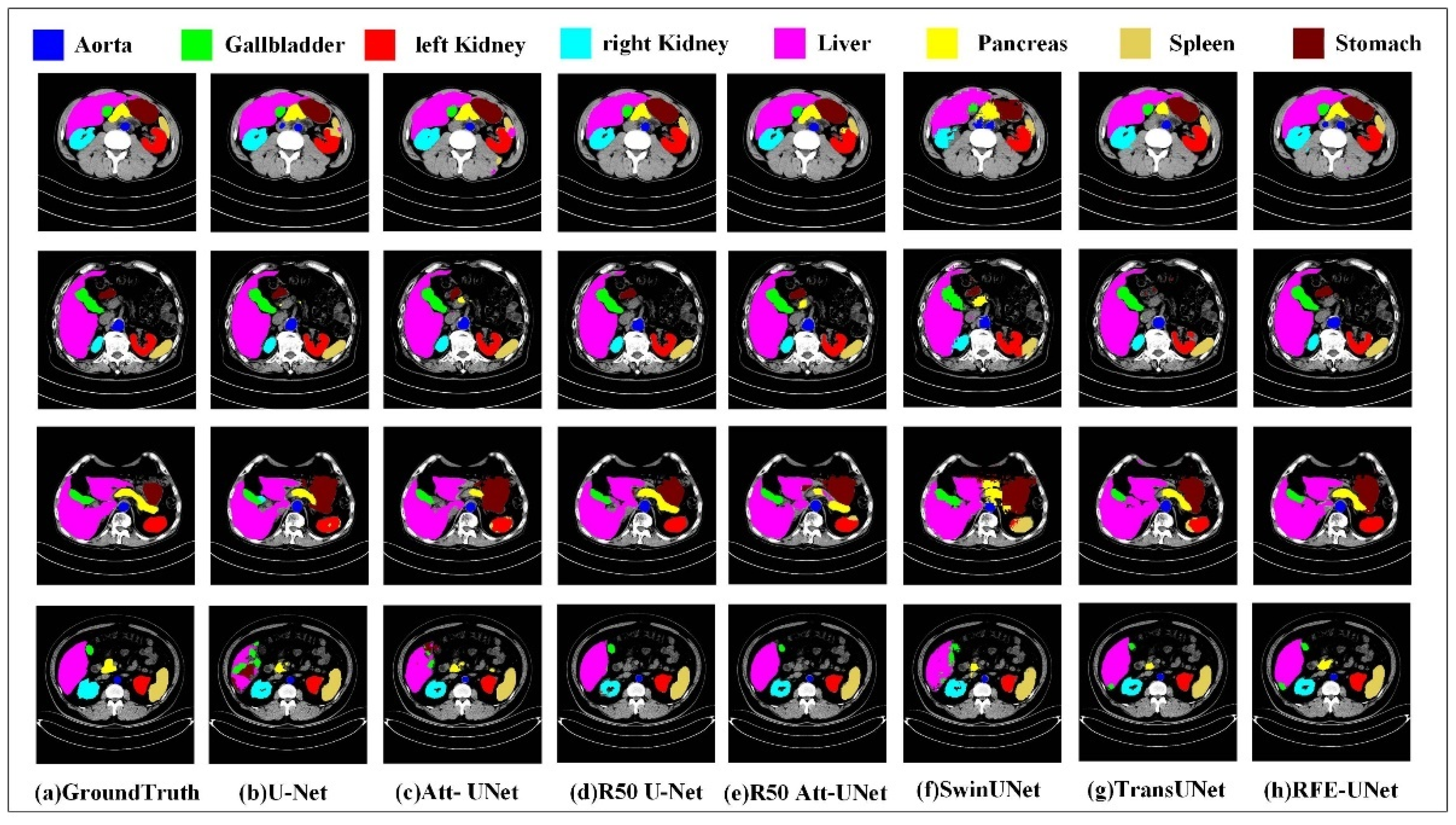

| Method | DSC (%) | HD95 (mm) | Aorta | Gallbladder | Kidney (L) | Kidney (R) | Liver | Pancreas | Spleen | Stomach |
|---|---|---|---|---|---|---|---|---|---|---|
| V-Net [34] | 68.81 | - | 75.34 | 51.87 | 77.10 | 80.75 | 87.84 | 40.05 | 80.56 | 56.98 |
| DARR [32] | 69.77 | - | 74.74 | 53.77 | 72.31 | 73.24 | 94.08 | 54.18 | 89.90 | 45.96 |
| R50 U-Net [31] | 74.68 | 36.87 | 84.18 | 62.84 | 79.19 | 71.29 | 93.35 | 48.23 | 84.41 | 73.92 |
| R50 Att-UNet [31] | 75.57 | 36.97 | 55.92 | 63.91 | 79.20 | 72.71 | 93.56 | 49.37 | 87.19 | 74.95 |
| U-Net [1] | 76.85 | 39.70 | 89.07 | 69.72 | 77.77 | 68.60 | 93.43 | 53.98 | 86.67 | 75.58 |
| UNet++ [12] | 78.13 | 25.65 | 89.27 | 62.35 | 83.00 | 78.98 | 94.53 | 56.70 | 85.99 | 74.20 |
| UNet3+ [33] | 73.81 | 30.82 | 86.32 | 59.06 | 79.16 | 71.26 | 93.13 | 46.56 | 84.94 | 70.08 |
| Att-UNet [41] | 77.77 | 36.02 | 89.55 | 68.88 | 77.98 | 71.11 | 93.57 | 58.04 | 87.30 | 75.75 |
| R50 ViT [22] | 71.29 | 32.87 | 73.73 | 55.13 | 75.80 | 72.20 | 91.51 | 45.99 | 81.99 | 73.95 |
| ViT [22] | 61.50 | 39.61 | 44.38 | 39.59 | 67.46 | 62.94 | 89.21 | 43.14 | 75.45 | 69.78 |
| TransUNet [26] | 77.48 | 31.69 | 87.23 | 63.13 | 81.87 | 77.02 | 94.08 | 55.86 | 85.08 | 75.62 |
| SwinUNet [29] | 79.13 | 21.55 | 85.47 | 66.53 | 83.28 | 79.61 | 94.29 | 56.58 | 90.66 | 76.60 |
| MT-UNet [42] | 78.59 | 26.59 | 87.92 | 64.99 | 81.47 | 77.29 | 93.06 | 59.46 | 87.75 | 76.81 |
| UCTransNet [28] | 79.11 | 25.08 | 88.58 | 64.34 | 82.93 | 75.93 | 95.42 | 56.77 | 88.20 | 80.67 |
| SepViT [43] | 77.77 | 30.37 | 88.36 | 67.49 | 80.97 | 77.36 | 93.21 | 53.27 | 88.31 | 73.21 |
| RFE-UNet (Ours) | 79.77 | 21.75 | 87.32 | 65.40 | 84.18 | 81.92 | 94.34 | 59.02 | 89.56 | 76.45 |
| Method | DSC (%) | HD95 (mm) | Aorta | Gallbladder | Kidney (L) | Kidney (R) | Liver | Pancreas | Spleen | Stomach |
|---|---|---|---|---|---|---|---|---|---|---|
| R50 U-Net [31] | 73.64 | 5.10 | 88.82 | 87.12 | 62.07 | 48.54 | 93.81 | 59.12 | 74.81 | 74.84 |
| R50 Att-UNet [31] | 74.62 | 4.46 | 88.87 | 87.29 | 62.01 | 50.78 | 95.19 | 56.51 | 78.32 | 78.00 |
| U-Net [1] | 74.58 | 6.34 | 88.07 | 85.81 | 62.38 | 52.99 | 93.94 | 63.65 | 75.85 | 73.91 |
| Att-UNet [42] | 74.56 | 5.55 | 88.40 | 85.93 | 64.12 | 53.04 | 94.36 | 63.25 | 73.89 | 73.49 |
| TransUNet [26] | 73.35 | 7.32 | 87.90 | 83.83 | 62.72 | 50.87 | 94.38 | 54.86 | 79.14 | 73.13 |
| SwinUNet [29] | 70.90 | 10.31 | 74.43 | 74.76 | 66.20 | 52.08 | 90.33 | 69.89 | 71.09 | 68.43 |
| UCTransNet [28] | 73.10 | 6.48 | 87.50 | 82.11 | 63.82 | 51.72 | 93.75 | 58.25 | 73.82 | 73.83 |
| RFE-UNet (Ours) | 75.12 | 7.43 | 88.11 | 84.72 | 66.43 | 50.91 | 94.27 | 63.98 | 77.34 | 75.21 |
| Model | DSC (%) | HD95 (mm) | Aorta | Gallbladder | Kidney (L) | Kidney (R) | Liver | Pancreas | Spleen | Stomach |
|---|---|---|---|---|---|---|---|---|---|---|
| RFE-A | 80.64 | 22.44 | 87.41 | 64.75 | 84.84 | 82.78 | 94.50 | 62.77 | 88.70 | 79.35 |
| RFE-B | 79.58 | 20.81 | 87.71 | 58.43 | 85.95 | 81.61 | 94.48 | 59.28 | 90.33 | 78.88 |
| RFE-C | 79.90 | 25.99 | 87.54 | 66.07 | 82.52 | 79.90 | 94.27 | 59.71 | 89.23 | 79.95 |
| RFE-D | 80.16 | 20.67 | 87.76 | 66.96 | 83.63 | 81.16 | 95.08 | 59.81 | 89.05 | 77.86 |
| RFE-Layer | 79.77 | 21.75 | 87.32 | 65.40 | 84.18 | 81.92 | 94.34 | 59.02 | 89.56 | 76.45 |
| Model | DSC (%) | HD95 (mm) | Aorta | Gallbladder | Kidney (L) | Kidney (R) | Liver | Pancreas | Spleen | Stomach |
|---|---|---|---|---|---|---|---|---|---|---|
| RFE-A | 72.60 | 6.44 | 89.65 | 83.95 | 63.66 | 49.22 | 94.33 | 57.70 | 70.94 | 71.39 |
| RFE-B | 73.14 | 5.82 | 89.60 | 84.98 | 63.24 | 49.53 | 94.53 | 57.87 | 73.22 | 72.12 |
| RFE-C | 73.13 | 5.94 | 89.60 | 85.62 | 63.53 | 50.27 | 94.68 | 56.60 | 72.60 | 72.13 |
| RFE-D | 73.19 | 6.04 | 89.71 | 86.06 | 62.56 | 49.51 | 94.64 | 57.29 | 73.01 | 72.69 |
| RFE-Layer | 75.12 | 7.43 | 88.11 | 84.72 | 66.43 | 50.91 | 94.27 | 63.98 | 77.34 | 75.21 |
| Resolution | DSC (%) | HD95 (mm) | Aorta | Gallbladder | Kidney (L) | Kidney (R) | Liver | Pancreas | Spleen | Stomach |
|---|---|---|---|---|---|---|---|---|---|---|
| 224 | 79.77 | 21.75 | 87.32 | 65.40 | 84.18 | 81.92 | 94.34 | 59.02 | 89.56 | 76.45 |
| 256 | 80.47 | 23.19 | 86.77 | 68.85 | 82.77 | 81.21 | 94.63 | 60.65 | 89.33 | 79.53 |
| Resolution | DSC (%) | HD95 (mm) | Aorta | Gallbladder | Kidney (L) | Kidney (R) | Liver | Pancreas | Spleen | Stomach |
|---|---|---|---|---|---|---|---|---|---|---|
| 224 | 75.12 | 7.43 | 88.11 | 84.72 | 66.43 | 50.91 | 94.27 | 63.98 | 77.34 | 75.21 |
| 256 | 76.12 | 6.57 | 88.45 | 85.26 | 69.88 | 50.56 | 94.32 | 68.95 | 75.15 | 76.38 |
Disclaimer/Publisher’s Note: The statements, opinions and data contained in all publications are solely those of the individual author(s) and contributor(s) and not of MDPI and/or the editor(s). MDPI and/or the editor(s) disclaim responsibility for any injury to people or property resulting from any ideas, methods, instructions or products referred to in the content. |
© 2023 by the authors. Licensee MDPI, Basel, Switzerland. This article is an open access article distributed under the terms and conditions of the Creative Commons Attribution (CC BY) license (https://creativecommons.org/licenses/by/4.0/).
Share and Cite
Zhong, X.; Xu, L.; Li, C.; An, L.; Wang, L. RFE-UNet: Remote Feature Exploration with Local Learning for Medical Image Segmentation. Sensors 2023, 23, 6228. https://doi.org/10.3390/s23136228
Zhong X, Xu L, Li C, An L, Wang L. RFE-UNet: Remote Feature Exploration with Local Learning for Medical Image Segmentation. Sensors. 2023; 23(13):6228. https://doi.org/10.3390/s23136228
Chicago/Turabian StyleZhong, Xiuxian, Lianghui Xu, Chaoqun Li, Lijing An, and Liejun Wang. 2023. "RFE-UNet: Remote Feature Exploration with Local Learning for Medical Image Segmentation" Sensors 23, no. 13: 6228. https://doi.org/10.3390/s23136228
APA StyleZhong, X., Xu, L., Li, C., An, L., & Wang, L. (2023). RFE-UNet: Remote Feature Exploration with Local Learning for Medical Image Segmentation. Sensors, 23(13), 6228. https://doi.org/10.3390/s23136228