Article

A Covariance Matrix Reconstruction Approach for Single Snapshot Direction of Arrival Estimation

1
James Watt School of Engineering, University of Glasgow, Glasgow G12 8QQ, UK
2
Research and Development Department, RFNet Technologies Pte Ltd., Singapore 319319, Singapore
*
Author to whom correspondence should be addressed.
Sensors 2022, 22(8), 3096; https://doi.org/10.3390/s22083096
Submission received: 18 February 2022 / Revised: 5 April 2022 / Accepted: 15 April 2022 / Published: 18 April 2022
(This article belongs to the Section Intelligent Sensors)

Abstract

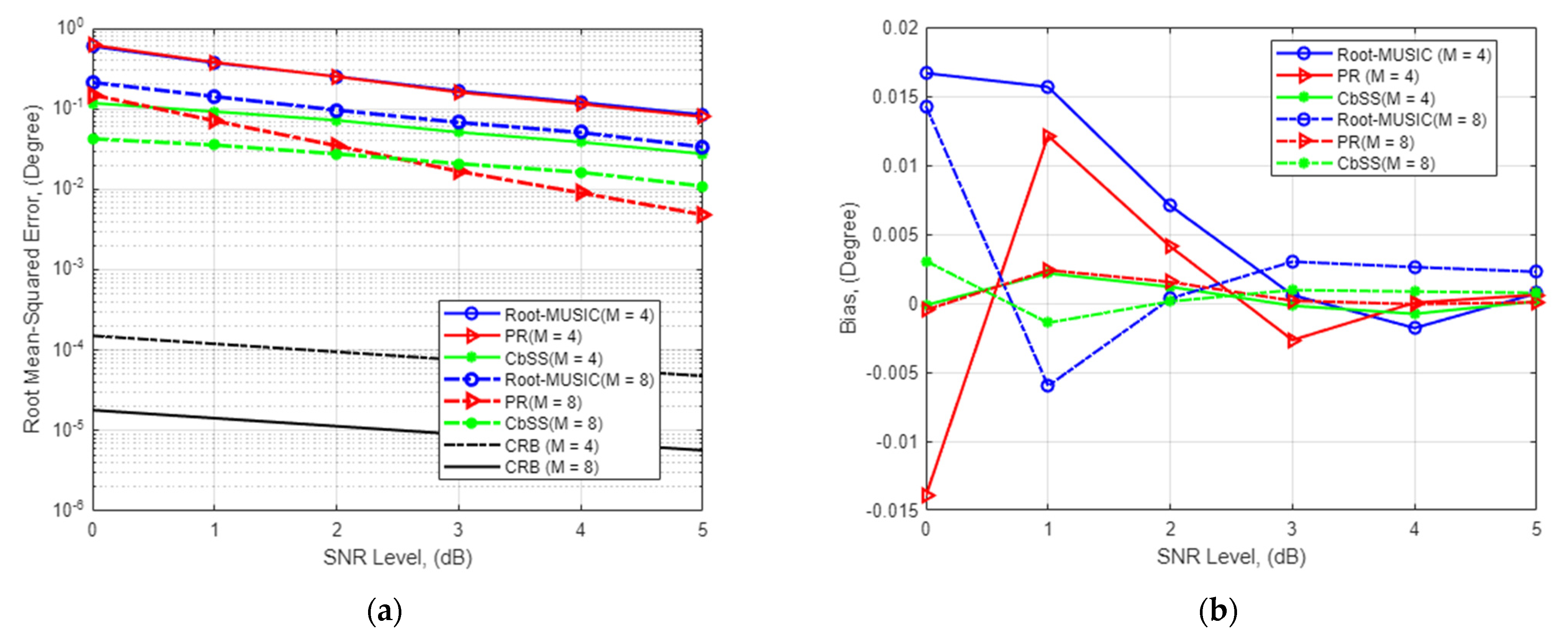
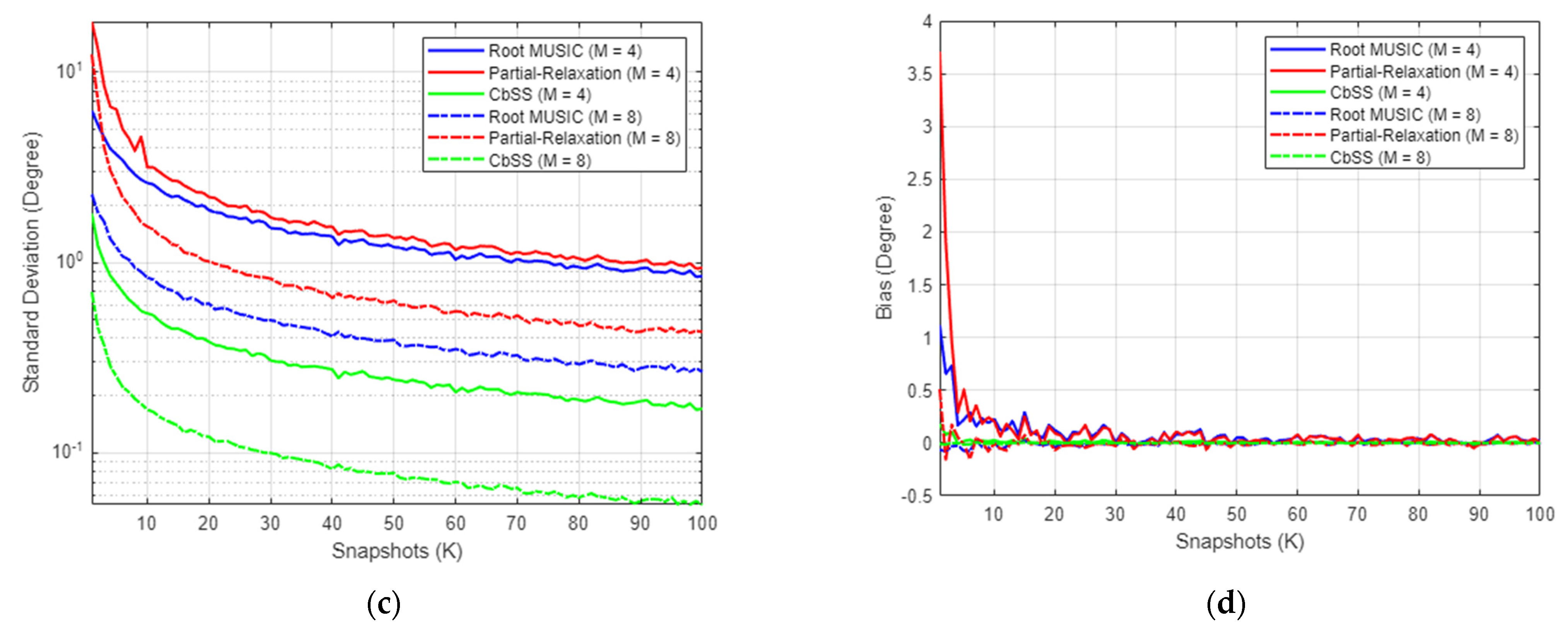
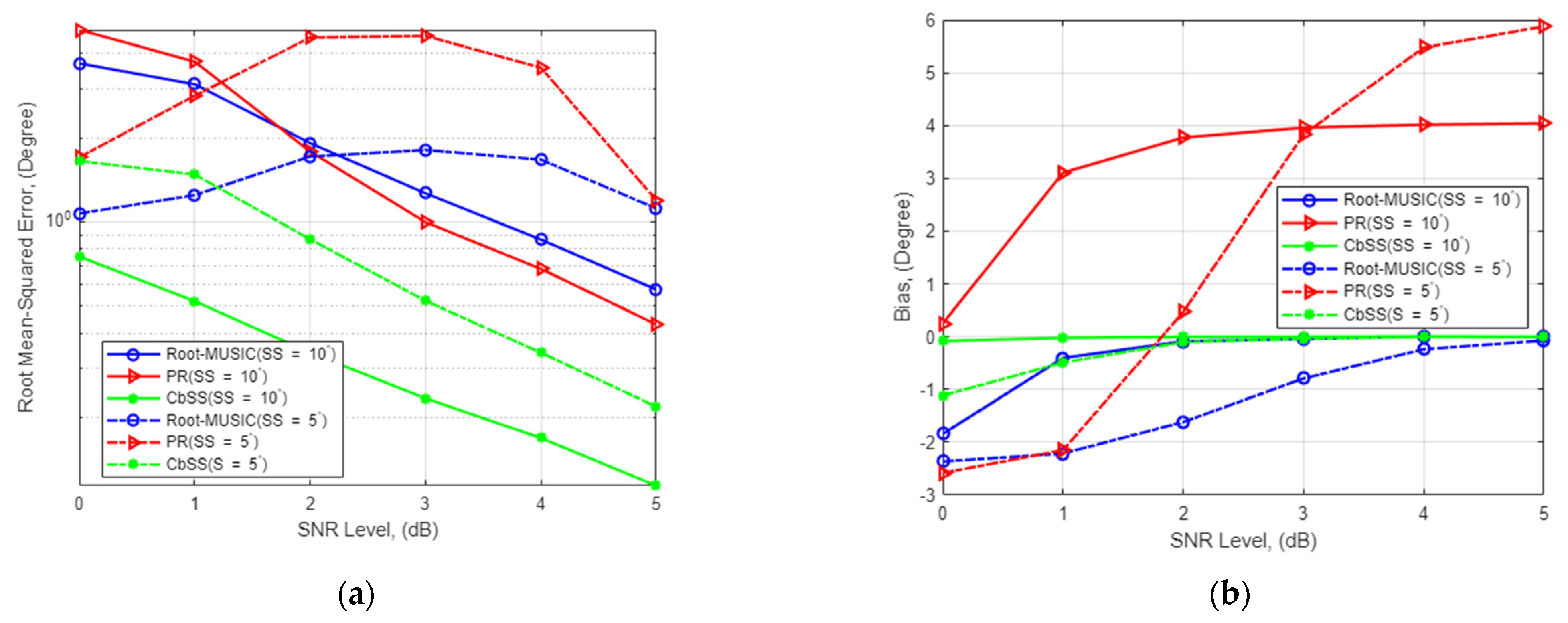
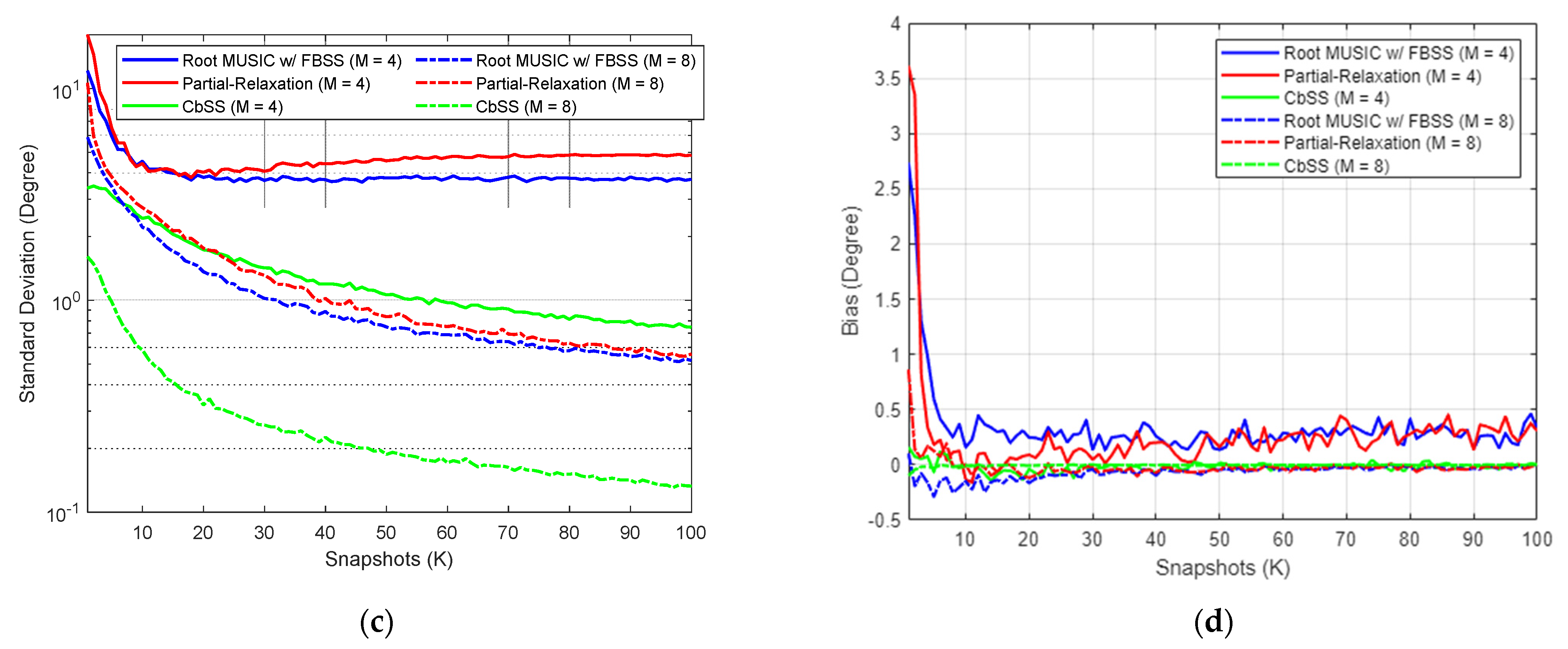
Achieving accurate single snapshot direction of arrival (DOA) information significantly improves communication performance. This paper investigates an accurate and high-resolution DOA estimation technique by enabling single snapshot data collection and enhancing DOA estimation results compared to multiple snapshot methods. This is carried out by manipulating the incoming signal covariance matrix while suppressing undesired additive white Gaussian noise (AWGN) by actively updating and estimating the antenna array manifold vector. We demonstrated the estimation performance in simulation that our proposed technique supersedes the estimation performance of existing state-of-the-art techniques in various signal-to-noise ratio (SNR) scenarios and single snapshot sampling environments. Our proposed covariance-based single snapshot (CbSS) technique yields the lowest root-mean-squared error (RMSE) against the true DOA compared to root-MUSIC and the partial relaxation (PR) approach for multiple snapshots and a single signal source environment. In addition, our proposed technique presents the lowest DOA estimation performance degradation in a multiple uncorrelated and coherent signal source environment by up to 25.5% with nearly negligible bias. Lastly, our proposed CbSS technique presents the best DOA estimation results for a single snapshot and single-source scenario with an RMSE of 0.05° against the true DOA compared to root-MUSIC and the PR approach with nearly negligible bias as well. A potential application for CbSS would be in a scenario where accurate DOA estimation with a small antenna array form factor is a limitation, such as in the intelligent transportation system industry and wireless communication.
Keywords: antenna array; direction-of-arrival; DOA; single snapshot; uniform linear array; ULA antenna array; direction-of-arrival; DOA; single snapshot; uniform linear array; ULA