Article

A Control Process for Active Solar-Tracking Systems for Photovoltaic Technology and the Circuit Layout Necessary for the Implementation of the Method
by
Henrik Zsiborács
*,
Gábor Pintér
,
András Vincze
and
Nóra Hegedűsné Baranyai
Renewable Energy Research Group, Soós Ernő Research and Development Center, University Center for Circular Economy, University of Pannonia Nagykanizsa, 8800 Nagykanizsa, Hungary
*
Author to whom correspondence should be addressed.
Sensors 2022, 22(7), 2564; https://doi.org/10.3390/s22072564
Submission received: 8 March 2022 / Revised: 24 March 2022 / Accepted: 24 March 2022 / Published: 27 March 2022
(This article belongs to the Special Issue Advanced Sensing Technologies in Photovoltaic Systems)

Abstract

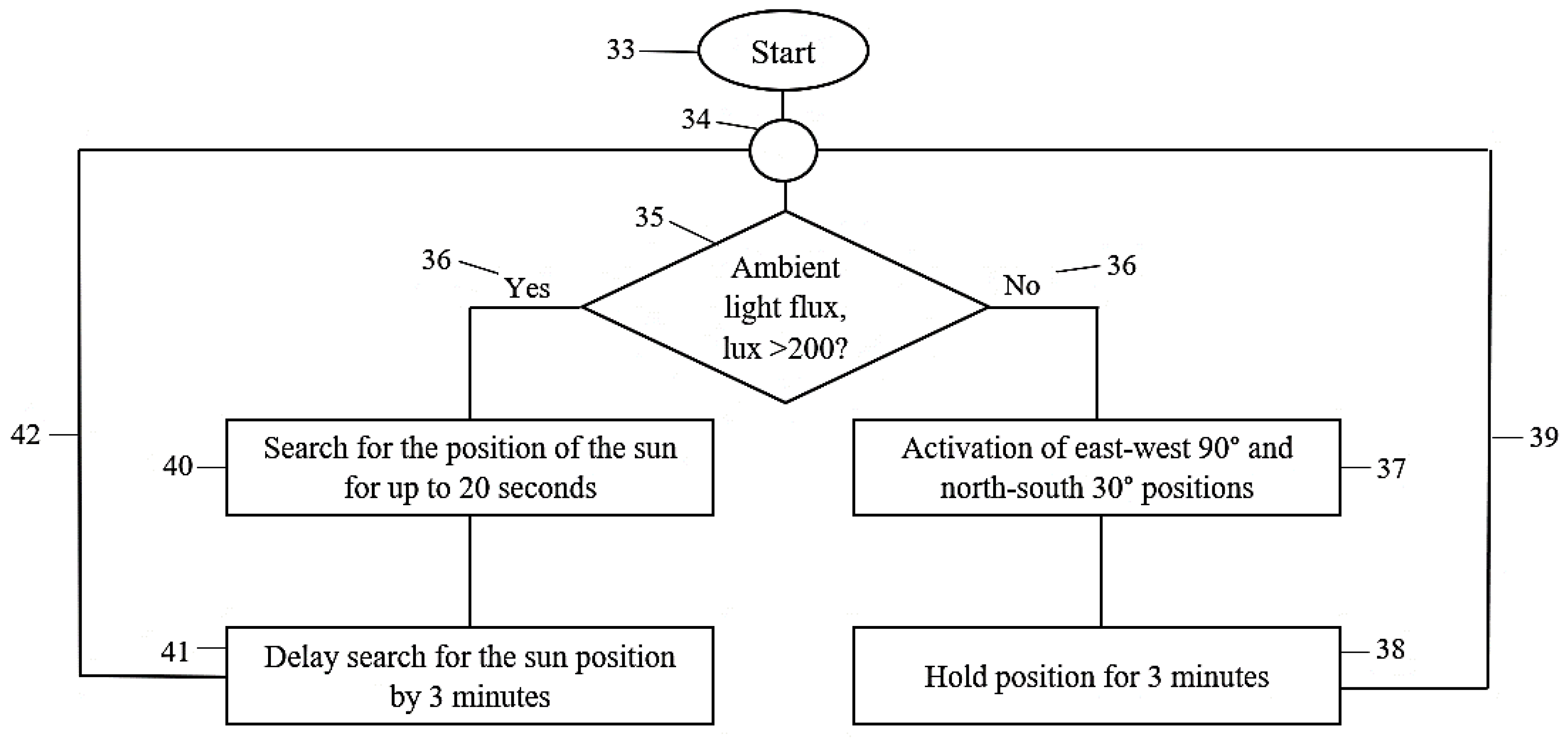
What basically determines how much energy is generated by a photovoltaic (PV) system is the amount of solar irradiation that is absorbed by its PV modules. One of the technical solutions to boost this quantity, and thusly also maximize the return on PV investments, is solar tracking, which makes the following of the sun on its daily and annual journey in the sky possible and also takes changes in cloud conditions into consideration. The solar-tracking solutions that PV systems are most frequently equipped with deploy active sensor technologies, while passive ones are less common in present-day practice. However, even the popular solutions of today have their limitations. Their active sensor-tracking algorithms leave room for improvement for at least three major reasons, as they do not prevent the unnecessary operation of the motors in cloudy weather, they do not make the modules assume an appropriate position after nightfall, and they do not make sure that the structure and the electronics of the PV systems are protected from rain and the strong winds in the event of storms. This paper introduces a new active sensor-tracking algorithm, which has not only been tested but it is also in the process of patenting (patent ID: p2100209). By their contribution, the authors endeavor to propose a solution that can solve all three of the issues mentioned above. The concept is based on two fundamental findings. According to the first one, periodic movement can not only considerably decrease motor movement but also increase system lifetime, while the second one simply suggests that moving the modules into an almost horizontal position facing the equator at low light levels is conducive to the prevention of damages caused by storms and fast reaction to the increase in the amount of light at daybreak. A positive feature of the new system for PV power plant operators is that it performs the tracking of the sun practically without any decrease in power compared to the focal point position, since it works with an average inaccuracy of 1.9°.
Keywords: solar energy; active tracking system; sun tracking; sun-tracking sensor; azimuth angle; tilt angle solar energy; active tracking system; sun tracking; sun-tracking sensor; azimuth angle; tilt angle