Article

Online Activity Recognition Combining Dynamic Segmentation and Emergent Modeling
1
School of Computer Science and Engineering, Sun Yat-sen University, Guangzhou 510006, China
2
Key Laboratory of Machine Intelligence and Advanced Computing, Ministry of Education, Guangzhou 510006, China
*
Author to whom correspondence should be addressed.
Sensors 2022, 22(6), 2250; https://doi.org/10.3390/s22062250
Submission received: 19 February 2022 / Revised: 8 March 2022 / Accepted: 11 March 2022 / Published: 14 March 2022
(This article belongs to the Section Intelligent Sensors)

Abstract

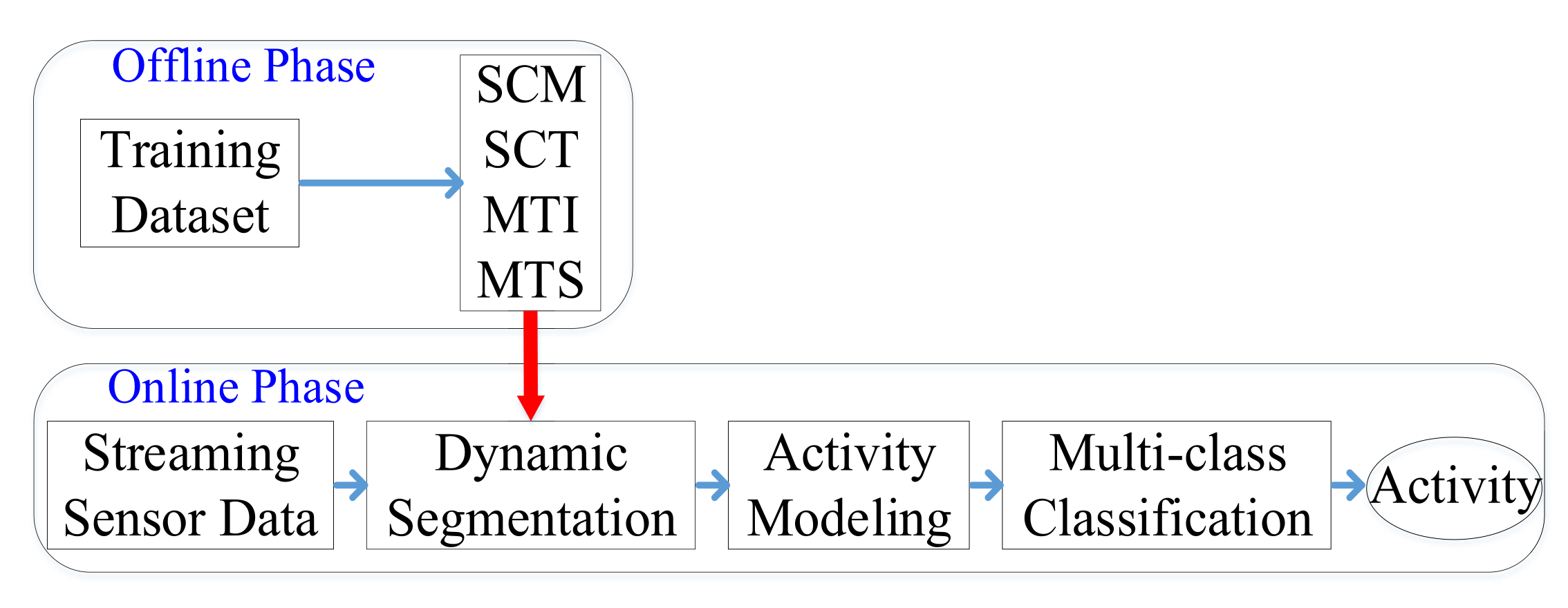
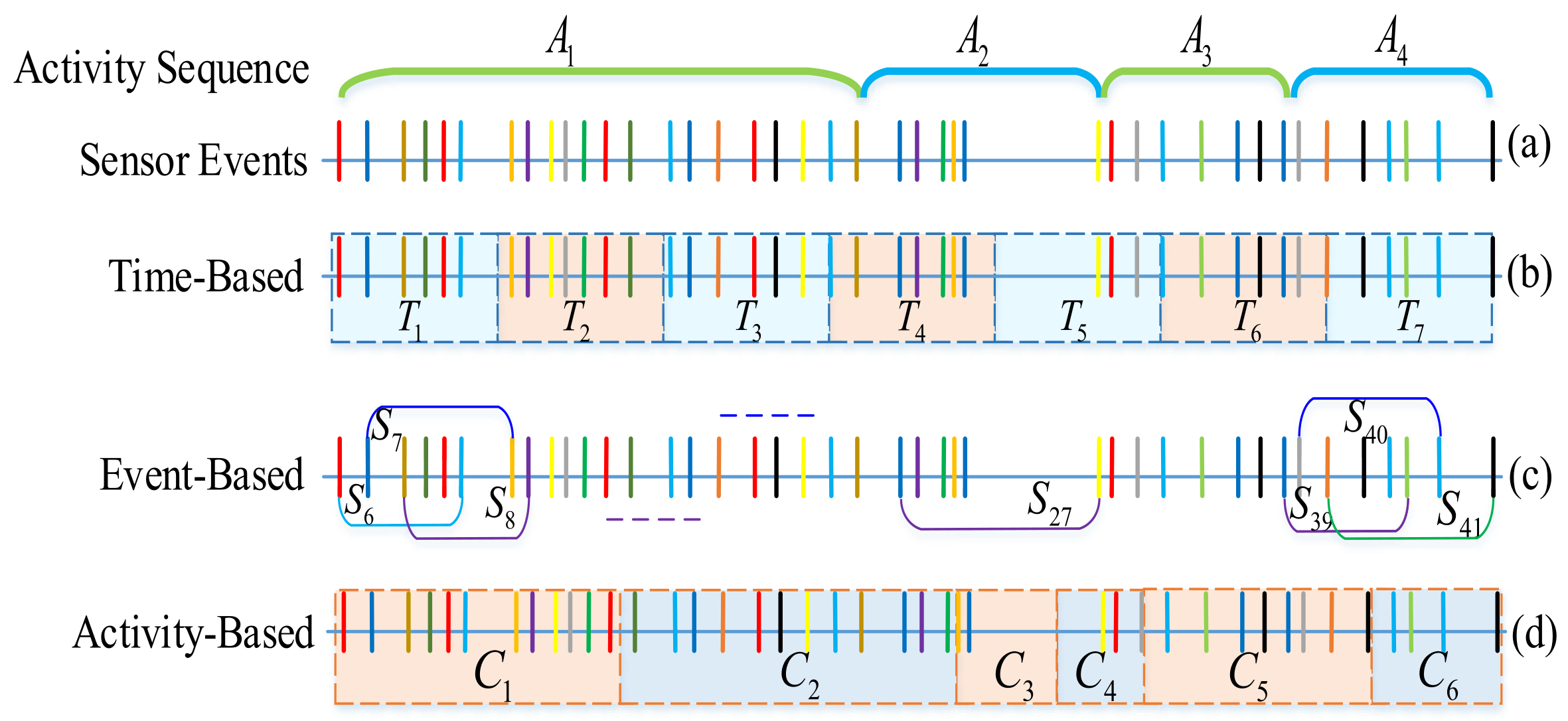
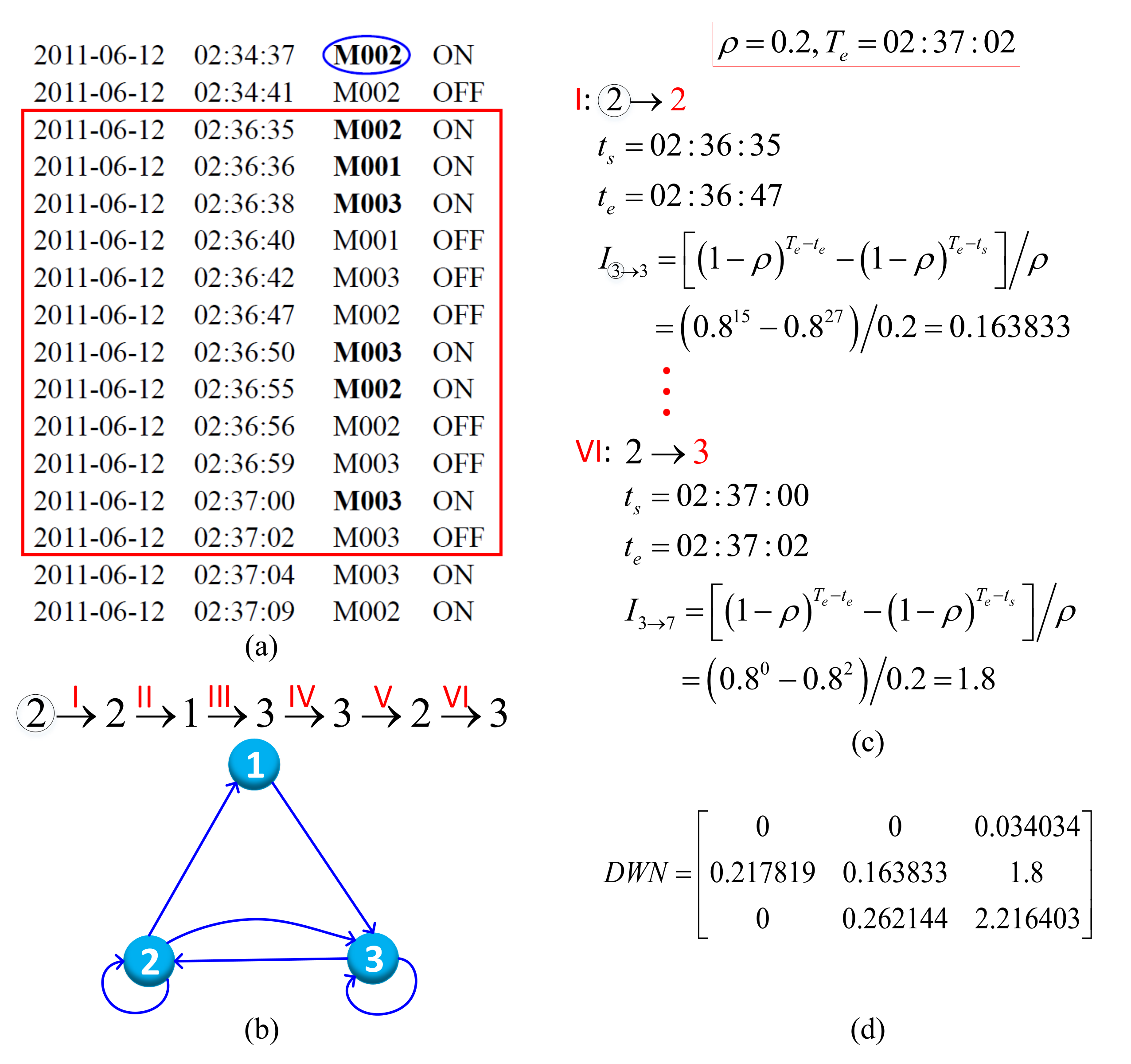
Activity recognition is fundamental to many applications envisaged in pervasive computing, especially in smart environments where the resident’s data collected from sensors will be mapped to human activities. Previous research usually focuses on scripted or pre-segmented sequences related to activities, whereas many real-world deployments require information about the ongoing activities in real time. In this paper, we propose an online activity recognition model on streaming sensor data that incorporates the spatio-temporal correlation-based dynamic segmentation method and the stigmergy-based emergent modeling method to recognize activities when new sensor events are recorded. The dynamic segmentation approach integrating sensor correlation and time correlation judges whether two consecutive sensor events belong to the same window or not, avoiding events from very different functional areas or with a long time interval in the same window, thus obtaining the segmented window for every single event. Then, the emergent paradigm with marker-based stigmergy is adopted to build activity features that are explicitly represented as a directed weighted network to define the context for the last sensor event in this window, which does not need sophisticated domain knowledge. We validate the proposed method utilizing the real-world dataset Aruba from the CASAS project and the results show the effectiveness.
Keywords: online activity recognition; dynamic segmentation; emergent modeling; directed weighted network online activity recognition; dynamic segmentation; emergent modeling; directed weighted network