Article

Study of Generalized Phase Spectrum Time Delay Estimation Method for Source Positioning in Small Room Acoustic Environment

1
Laboratory for Acquisition, Processing and Manipulating Biological Signals, Institute of System Integration and Security, Tomsk State University of Control Systems and Radioelectronics, 40 Lenina Ave., 634050 Tomsk, Russia
2
Department of Complex Information Security of Computer Systems, Faculty of Security, Tomsk State University of Control Systems and Radioelectronics, 40 Lenina Ave., 634050 Tomsk, Russia
3
Irkutsk Supercomputer Center of SB RAS, 134, Lermontova, 664033 Irkutsk, Russia
*
Author to whom correspondence should be addressed.
Sensors 2022, 22(3), 965; https://doi.org/10.3390/s22030965
Submission received: 18 November 2021 / Revised: 31 December 2021 / Accepted: 24 January 2022 / Published: 26 January 2022

Abstract

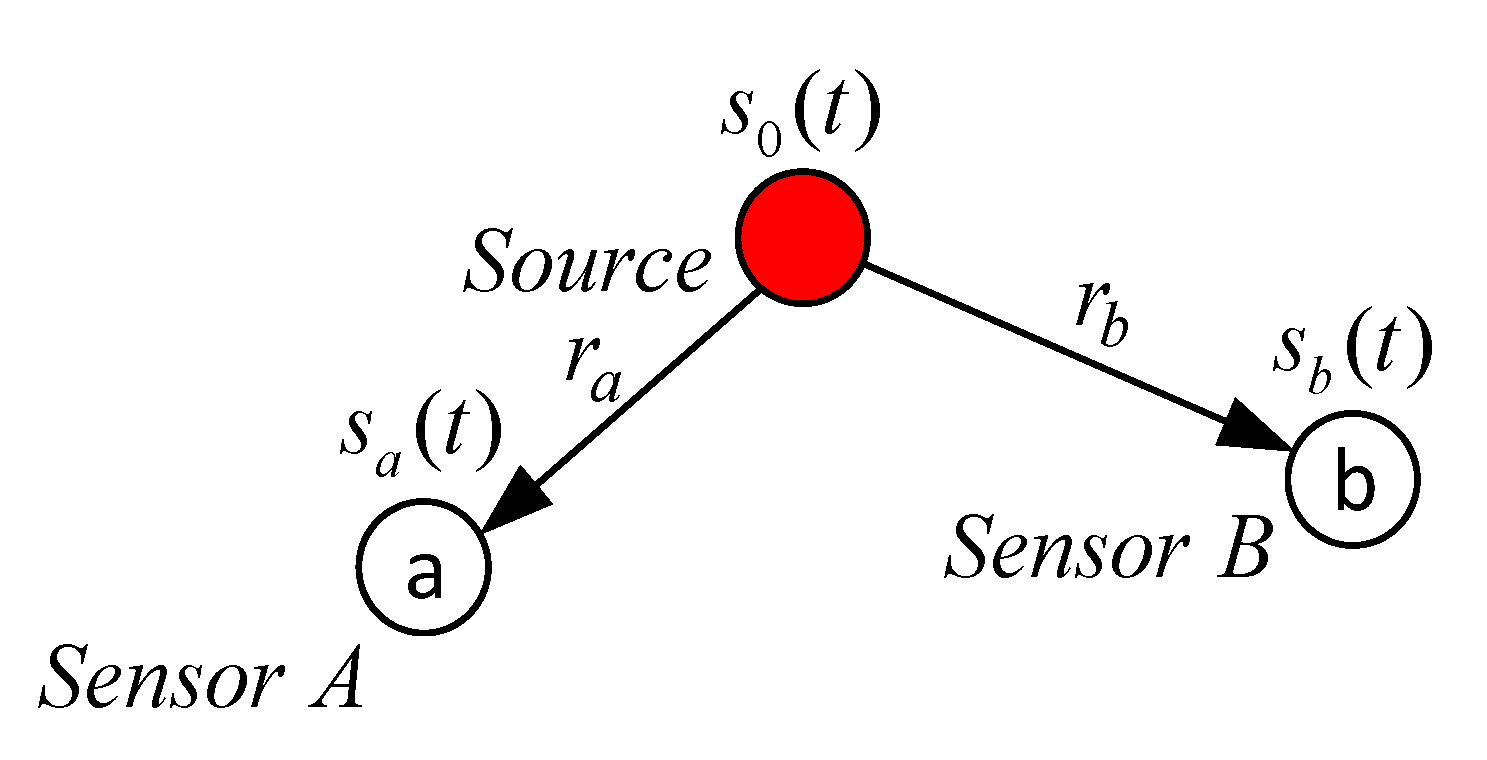
This paper considers the application of signal processing methods to passive indoor positioning with acoustics microphones. The key aspect of this problem is time-delay estimation (TDE) that is used to get the time difference of arrival of the source’s signal between the pair of distributed microphones. This paper studies the approach based on generalized phase spectrum (GPS) TDE methods. These methods use frequency-domain information about the received signals that make them different from widely applied generalized cross-correlation (GCC) methods. Despite the more challenging implementation, GPS TDE methods can be less demanding on computational resources and memory than conventional GCC ones. We propose an algorithmic implementation of a GPS estimator and study the various frequency weighting options in applications to TDE in a small room acoustic environment. The study shows that the GPS method is a reliable option for small acoustically dead rooms and could be effectively applied in presence of moderate in-band noises. However, GPS estimators are far less efficient in less acoustically dead environments, where other TDE options should be considered. The distinguishing feature of the proposed solution is the ability to get the time delay using a limited number of the adjusted bins. The solution could be useful for passively locating moving emitters of narrow-band continual noises using computationally simple frequency detection algorithms.
Keywords: generalized phase spectrum; time delay estimation; indoor positioning; room acoustics; sensors array generalized phase spectrum; time delay estimation; indoor positioning; room acoustics; sensors array