Article

VDBFusion: Flexible and Efficient TSDF Integration of Range Sensor Data
Institute of Geodesy and Geoinformation, University of Bonn, 53113 Bonn, Germany
*
Author to whom correspondence should be addressed.
Sensors 2022, 22(3), 1296; https://doi.org/10.3390/s22031296
Submission received: 23 December 2021 / Revised: 1 February 2022 / Accepted: 3 February 2022 / Published: 8 February 2022
(This article belongs to the Special Issue Best Practice in Simultaneous Localization and Mapping (SLAM))

Abstract

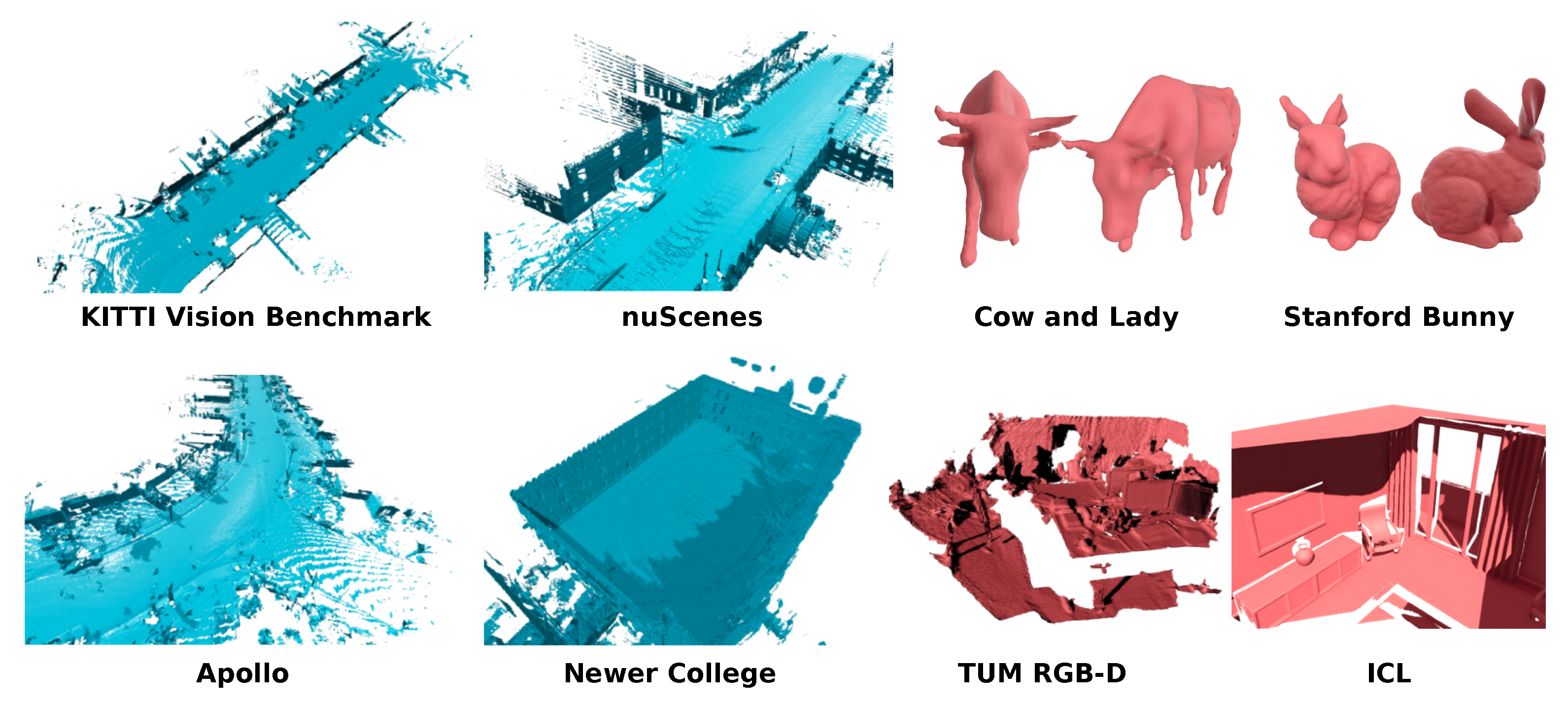
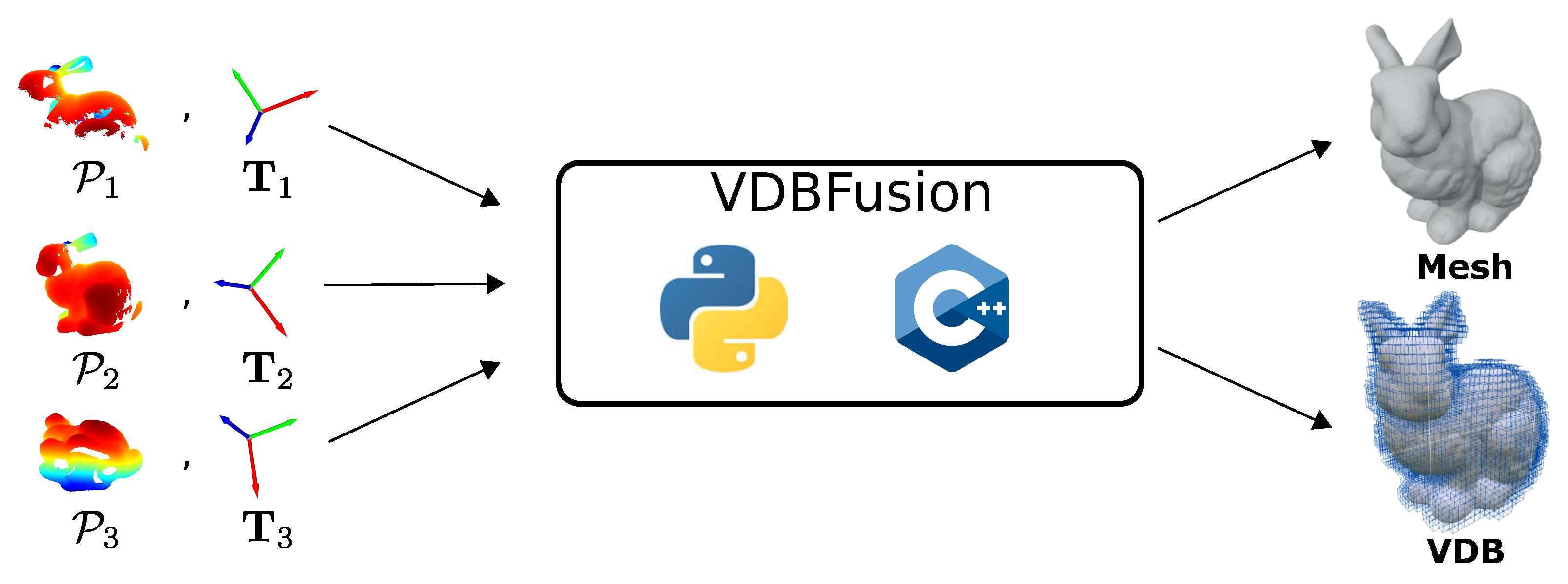
Mapping is a crucial task in robotics and a fundamental building block of most mobile systems deployed in the real world. Robots use different environment representations depending on their task and sensor setup. This paper showcases a practical approach to volumetric surface reconstruction based on truncated signed distance functions, also called TSDFs. We revisit the basics of this mapping technique and offer an approach for building effective and efficient real-world mapping systems. In contrast to most state-of-the-art SLAM and mapping approaches, we are making no assumptions on the size of the environment nor the employed range sensor. Unlike most other approaches, we introduce an effective system that works in multiple domains using different sensors. To achieve this, we build upon the Academy-Award-winning OpenVDB library used in filmmaking to realize an effective 3D map representation. Based on this, our proposed system is flexible and highly effective and, in the end, capable of integrating point clouds from a 64-beam LiDAR sensor at 20 frames per second using a single-core CPU. Along with this publication comes an easy-to-use C++ and Python library to quickly and efficiently solve volumetric mapping problems with TSDFs.
Keywords: 3D mapping; 3D surface reconstruction; volumetric integration; TSDF 3D mapping; 3D surface reconstruction; volumetric integration; TSDF