Article

Deep Learning-Based Energy Expenditure Estimation in Assisted and Non-Assisted Gait Using Inertial, EMG, and Heart Rate Wearable Sensors


by
João M. Lopes
1,2,
Joana Figueiredo
1,2,*,
Pedro Fonseca
3,
João J. Cerqueira
4,
João P. Vilas-Boas
3,5 and
Cristina P. Santos
1,2
1
Center for MicroElectroMechanical Systems (CMEMS), University of Minho, 4800-058 Guimarães, Portugal
2
LABBELS—Associate Laboratory, 4710-057 Braga/4800-058 Guimarães, Portugal
3
Porto Biomechanics Laboratory (LABIOMEP), Faculty of Sports, University of Porto, 4200-450 Porto, Portugal
4
Life and Health Sciences Research Institute (ICVS), School of Medicine, University of Minho, 4710-057 Braga, Portugal
5
Faculty of Sports and CIFI2D, University of Porto, 4200-450 Porto, Portugal
*
Author to whom correspondence should be addressed.
Sensors 2022, 22(20), 7913; https://doi.org/10.3390/s22207913
Submission received: 13 September 2022 / Revised: 7 October 2022 / Accepted: 14 October 2022 / Published: 18 October 2022
(This article belongs to the Special Issue Sensorimotor and Cognitive Wearable Augmentation Devices)

Abstract

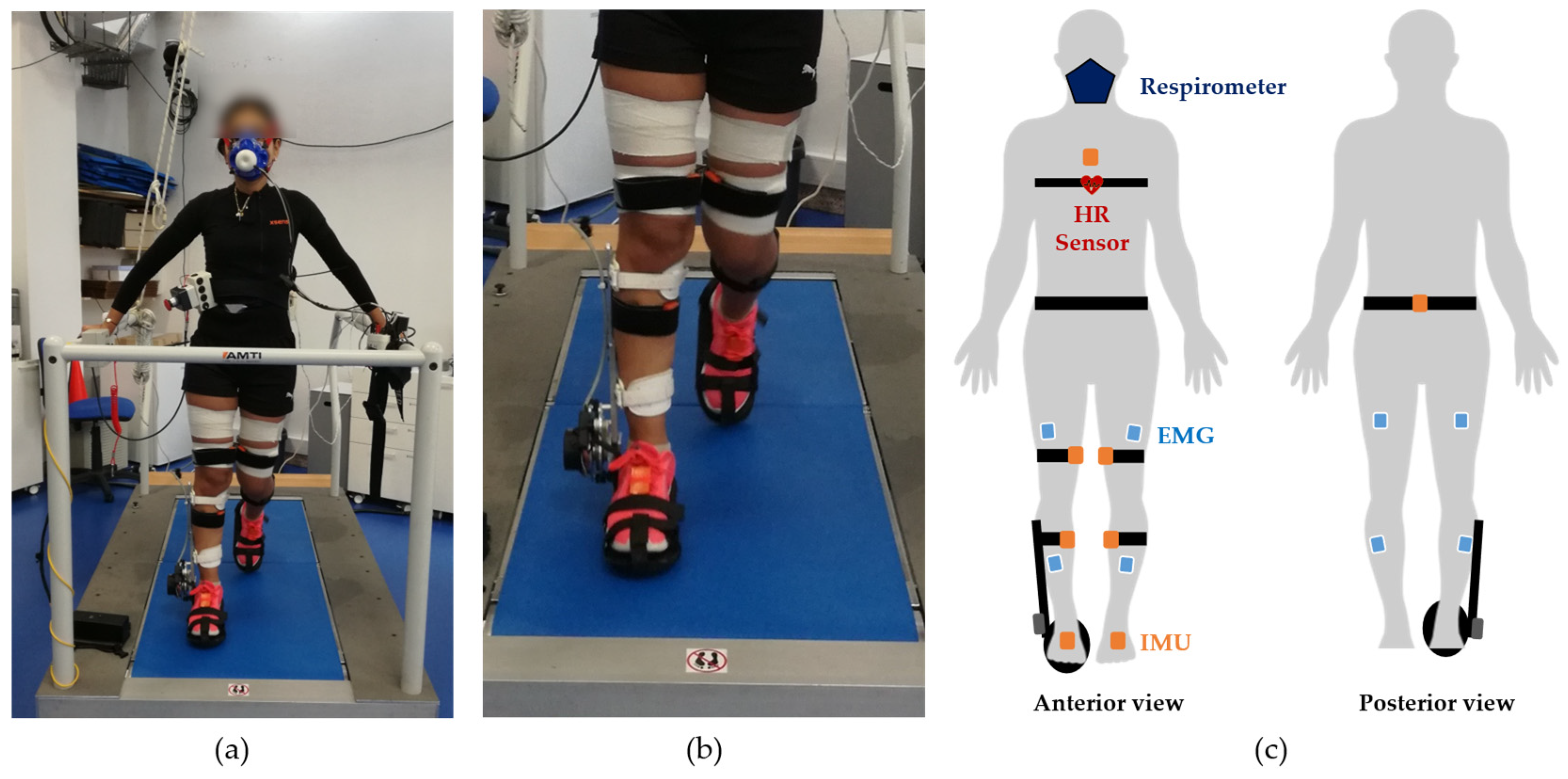
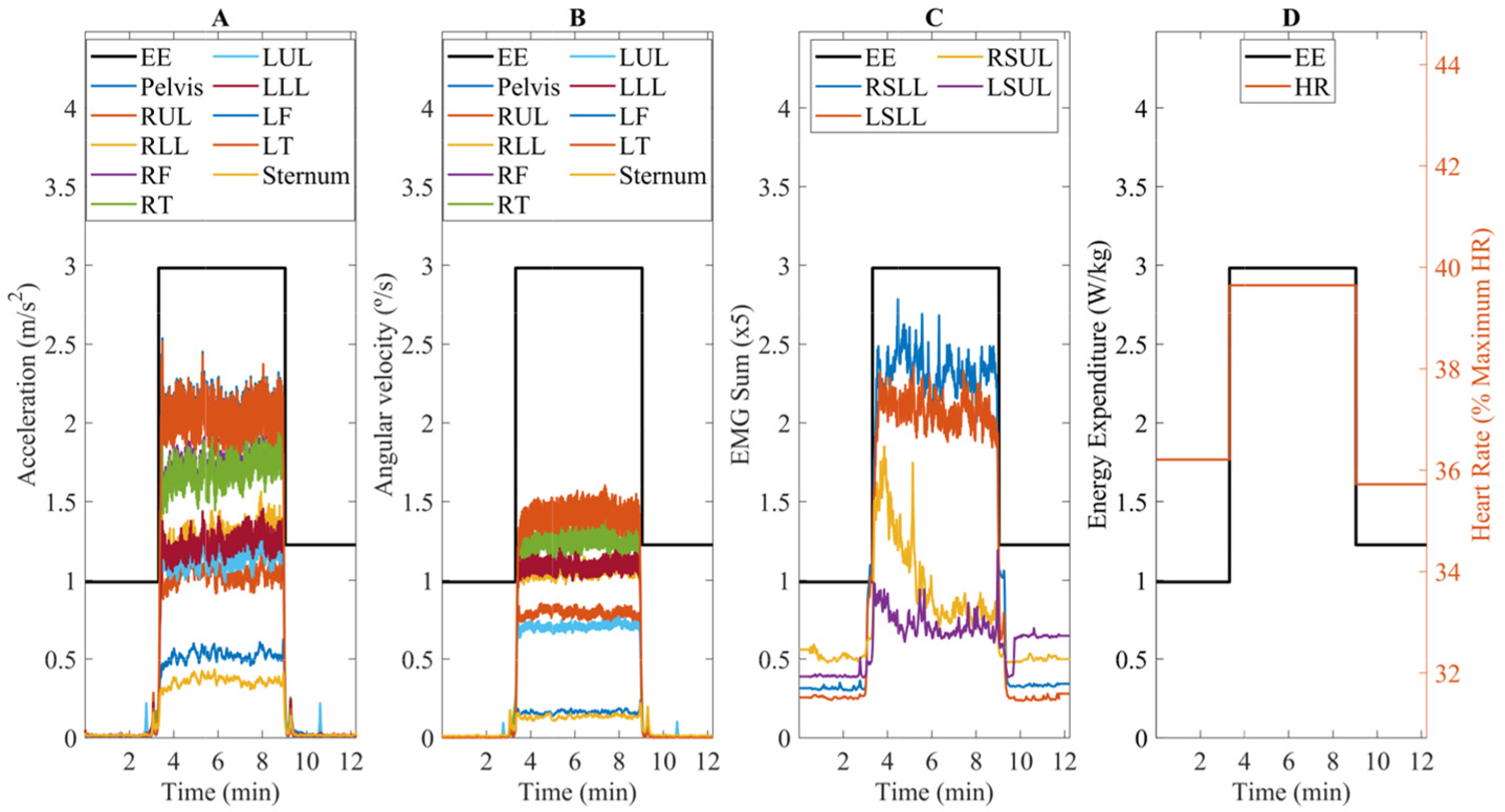
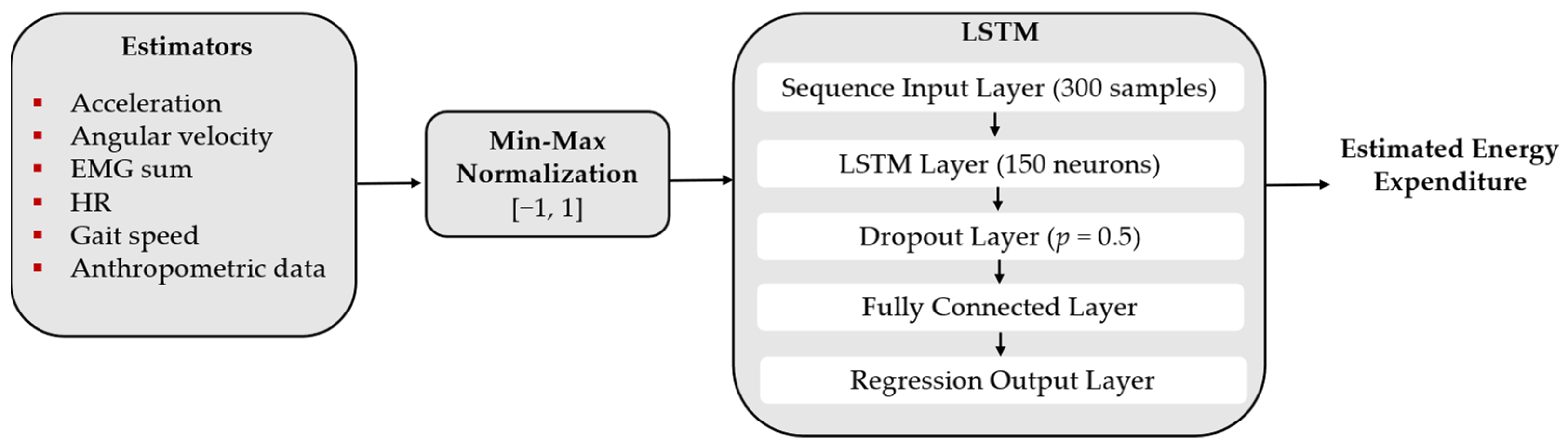
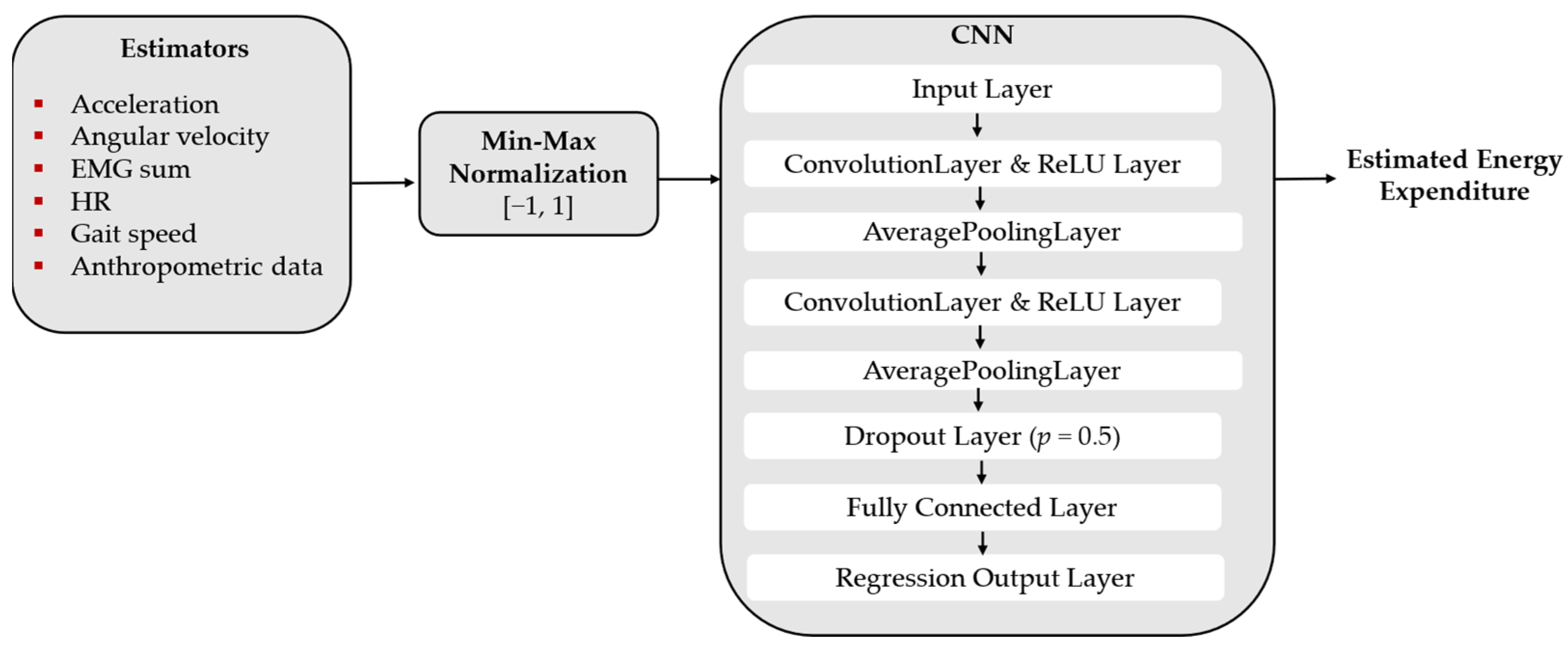
Energy expenditure is a key rehabilitation outcome and is starting to be used in robotics-based rehabilitation through human-in-the-loop control to tailor robot assistance towards reducing patients’ energy effort. However, it is usually assessed by indirect calorimetry which entails a certain degree of invasiveness and provides delayed data, which is not suitable for controlling robotic devices. This work proposes a deep learning-based tool for steady-state energy expenditure estimation based on more ergonomic sensors than indirect calorimetry. The study innovates by estimating the energy expenditure in assisted and non-assisted conditions and in slow gait speeds similarly to impaired subjects. This work explores and benchmarks the long short-term memory (LSTM) and convolutional neural network (CNN) as deep learning regressors. As inputs, we fused inertial data, electromyography, and heart rate signals measured by on-body sensors from eight healthy volunteers walking with and without assistance from an ankle-foot exoskeleton at 0.22, 0.33, and 0.44 m/s. LSTM and CNN were compared against indirect calorimetry using a leave-one-subject-out cross-validation technique. Results showed the suitability of this tool, especially CNN, that demonstrated root-mean-squared errors of 0.36 W/kg and high correlation (ρ > 0.85) between target and estimation (R¯2 = 0.79). CNN was able to discriminate the energy expenditure between assisted and non-assisted gait, basal, and walking energy expenditure, throughout three slow gait speeds. CNN regressor driven by kinematic and physiological data was shown to be a more ergonomic technique for estimating the energy expenditure, contributing to the clinical assessment in slow and robotic-assisted gait and future research concerning human-in-the-loop control.
Keywords: artificial intelligence; deep learning; energy expenditure; gait rehabilitation; human-in-the-loop; robotics-based rehabilitation; wearable sensors artificial intelligence; deep learning; energy expenditure; gait rehabilitation; human-in-the-loop; robotics-based rehabilitation; wearable sensors