Article

Implementing Machine Learning Algorithms to Classify Postures and Forecast Motions When Using a Dynamic Chair

1
Department of Electrical and Computer Engineering, Western University, London, ON N6A 3K7, Canada
2
School of Biomedical Engineering (BME), Western University, London, ON N6A 3K7, Canada
3
Formid, London, ON N0L 1G0, Canada
*
Author to whom correspondence should be addressed.
Sensors 2022, 22(1), 400; https://doi.org/10.3390/s22010400
Submission received: 30 November 2021 / Revised: 17 December 2021 / Accepted: 27 December 2021 / Published: 5 January 2022
(This article belongs to the Section Biomedical Sensors)

Abstract

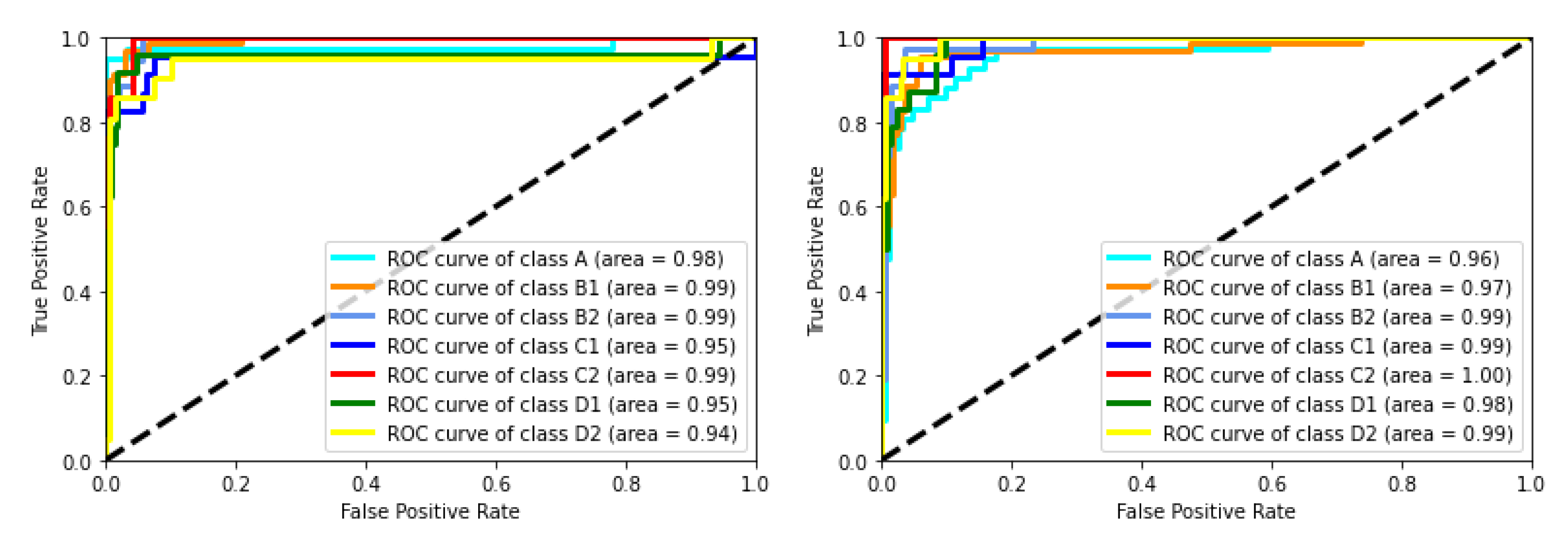
Many modern jobs require long periods of sitting on a chair that may result in serious health complications. Dynamic chairs are proposed as alternatives to the traditional sitting chairs; however, previous studies have suggested that most users are not aware of their postures and do not take advantage of the increased range of motion offered by the dynamic chairs. Building a system that identifies users’ postures in real time, as well as forecasts the next few postures, can bring awareness to the sitting behavior of each user. In this study, machine learning algorithms have been implemented to automatically classify users’ postures and forecast their next motions. The random forest, gradient decision tree, and support vector machine algorithms were used to classify postures. The evaluation of the trained classifiers indicated that they could successfully identify users’ postures with an accuracy above 90%. The algorithm can provide users with an accurate report of their sitting habits. A 1D-convolutional-LSTM network has also been implemented to forecast users’ future postures based on their previous motions, the model can forecast a user’s motions with high accuracy (97%). The ability of the algorithm to forecast future postures could be used to suggest alternative postures as needed.
Keywords: dynamic chairs; posture classification; machine learning application; long short-term memory (LSTM); 1D-CNN-LSTM dynamic chairs; posture classification; machine learning application; long short-term memory (LSTM); 1D-CNN-LSTM