


Abstract
In recent decades, modern societies are experiencing an increasing adoption of interconnected smart devices. This revolution involves not only canonical devices such as smartphones and tablets, but also simple objects like light bulbs. Named the Internet of Things (IoT), this ever-growing scenario offers enormous opportunities in many areas of modern society, especially if joined by other emerging technologies such as, for example, the blockchain. Indeed, the latter allows users to certify transactions publicly, without relying on central authorities or intermediaries. This work aims to exploit the scenario above by proposing a novel blockchain-based distributed paradigm to secure localization services, here named the Internet of Entities (IoE). It represents a mechanism for the reliable localization of people and things, and it exploits the increasing number of existing wireless devices and blockchain-based distributed ledger technologies. Moreover, unlike most of the canonical localization approaches, it is strongly oriented towards the protection of the users’ privacy. Finally, its implementation requires minimal efforts since it employs the existing infrastructures and devices, thus giving life to a new and wide data environment, exploitable in many domains, such as e-health, smart cities, and smart mobility.
1. Introduction
Our everyday activities produce an ever increasing amount of information, as each of them is accompanied by a large number of devices aimed at supporting us (e.g., smartbands, credit cards, home automation devices, and so on). Indeed, several authoritative studies indicate that in 2025 the number of smartphones will reach about 7.5 billion units, and the number of IoT devices in the same year will be 16.44 billion (https://www.statista.com/statistics/1183457/iot-connected-devices-worldwide/statista.com) (accessed on 1 September 2021). This scenario has been further revolutionized with the advent of cryptocurrencies, in particular Bitcoin [1], which have traced a new paradigm for the decentralization of services. A synergistic combination of security and anonymity is the basis of their success, since this paradigm allows the users to exchange money without involving trusted authorities as intermediates. The strategy behind this revolutionary way to operate is mainly based on the exploitation of digital signature schemes, to implement a fully-decentralized and immutable public ledger where all the transactions are recorded. Such a ledger is known as the blockchain and involves a distributed consensus protocol operating in a peer-to-peer network [2].
The paradigm proposed in this work, here called Internet of Entities (IoE), revolves around the wireless-based ecosystem. Some existing devices (hereinafter referred to as trackers) are used to track the activity of other devices strictly associated with people or things (hereinafter referred to as entities), registering the collected information in a permanent way by leveraging the features offered by a blockchain-based distributed ledger.
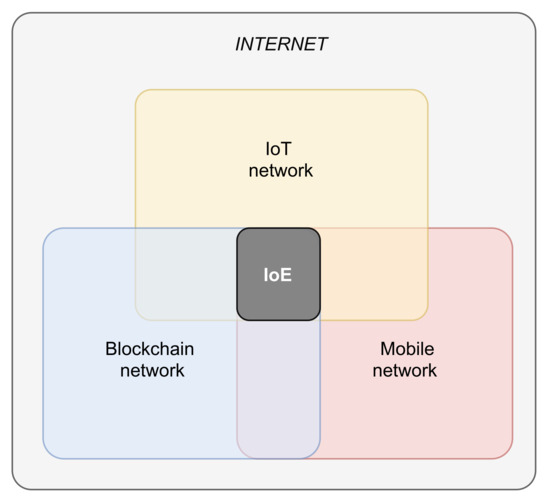
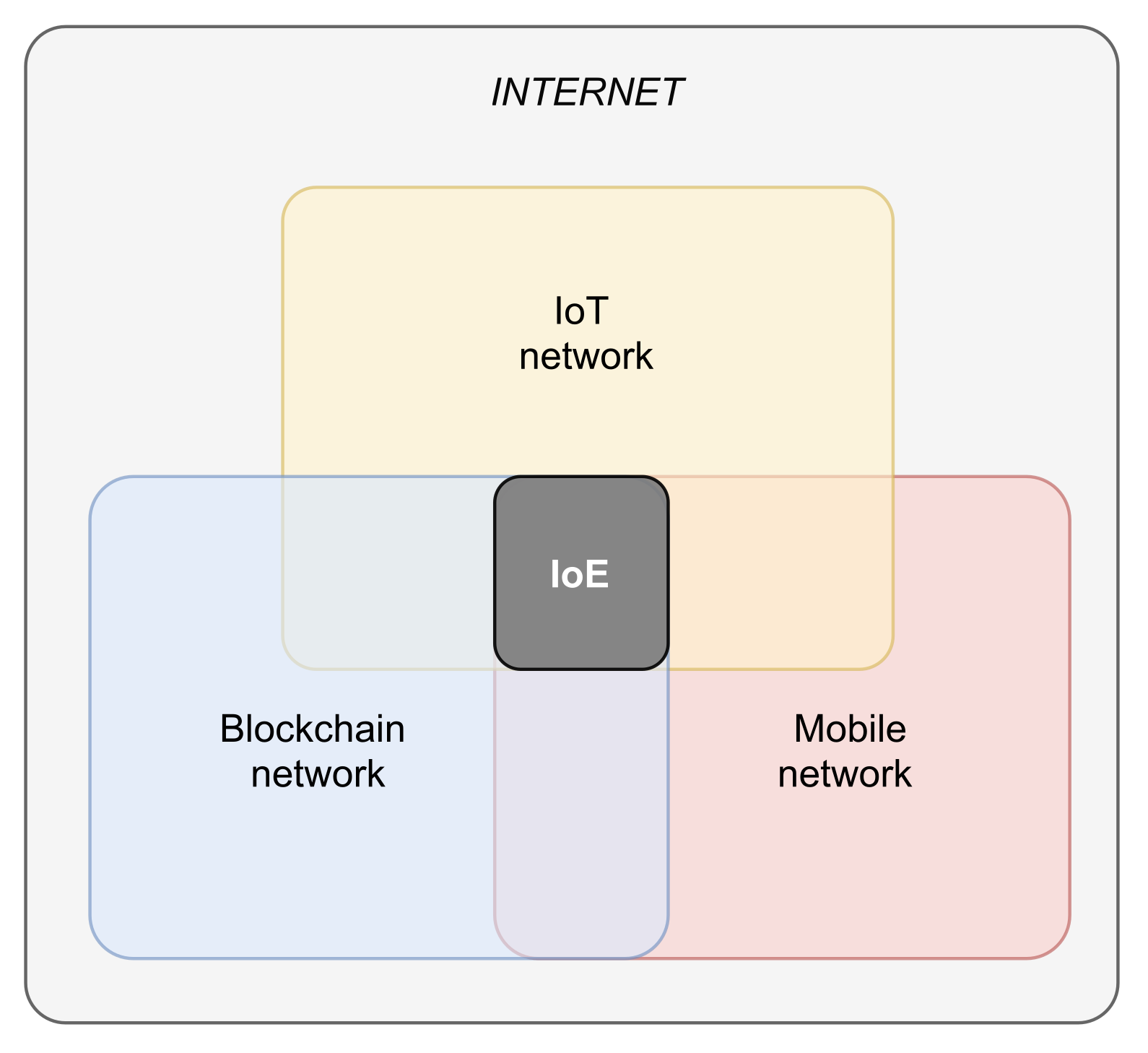
Figure 1 shows the placement of the proposed IoE paradigm with respect to the existing network technologies. Notably, it is designed to require a minimum set of additional functionalities for the existing devices (e.g., smart objects, smartphones, etc). In short, we aim to combine a few entity data (i.e., unique identifier and sensors data) with a few tracker data (e.g., timestamp, geographic location, sensors data, etc.) and store them in a blockchain-based distributed ledger, to implement reliable tracking/localization services. Hence, for devices such as smartphones and tablets, the required operations can be performed in a pretty transparent way by installing a simple application, while for the IoT devices, they only require a software update.
Figure 1.
IoE placement.
Furthermore, the proposed paradigm ensures the privacy of users, since only the entity owner is able to associate its unique identifier to the related data registered by the trackers on the remote ledger. In this sense, the possibility of involving one or more neighbor entities, detected by the tracker near the entity, over a certain time window, leads to more granular and accurate tracing results, without violating the anonymity of the involved users.
Although tailored to the scope of localization, this approach can be also exploited in other areas, such as e-health and smart cities. In the first case, the sensor data available for trackers (e.g., humidity, temperature, light level, altitude, position, etc.) together with the sensors available on the entities (e.g., heart rate, blood pressure, etc.) can be exploited to evaluate the health status of an entity. Moreover, one of the advantages related to such a configuration is the capability to monitor the interactions (even those latent) between the entities and the environment. Similarly, in the context of smart cities, such an approach helps to highlight latent aspects related to the interaction between users, otherwise difficult to identify. In this sense, it offers a twofold advantage: it is able to discover latent characteristics of the involved entities, and it is able to group them on the basis of certain criteria, safeguarding their privacy.
In the light of the previous observations, we list below the primary scientific contributions of the IoE paradigm proposed in this work:
- (i)
- Definition of the entities and trackers concept as elements able to exchange their role when they operate within a specific wireless-based environment;
- (ii)
- Formalization of data exchange methods between entities and trackers, and trackers and blockchain-based distributed ledgers, in terms of both device identification and communication protocols;
- (iii)
- Formalization of the data structures involved in the entities and trackers, and trackers and blockchain-based distributed ledger communications.
In addition, since this work represents an extension of our previous one [3], we extended the aforementioned contributions by adding the following ones:
- (i)
- A comprehensive discussion of the context and the scientific background in which the paradigm proposed in the present work is placed;
- (ii)
- An extended formalization of the notions of entities and trackers, able to interchange their roles, which operate within the wireless-based environment to provide secure localization services;
- (iii)
- A timely definition of the interaction model and communication protocols between entities, trackers and the blockchain-based distributed ledger, with the goal of reliably and permanently recording tracking information in a verifiable fashion and respecting their privacy;
- (iv)
- The identification of specific heuristics and strategies, to reconstruct the entities movements by means of the history of positions stored on the distributed ledger;
- (v)
- A series of experiments aimed to verify and evaluate the practical feasibility of the proposed IoE paradigm in a real-world scenario;
- (vi)
- An in-depth analysis and coverage of the potential usage applications, future developments and implementation directions of such a paradigm.
We also notice that the adopted terminology (i.e., entities, trackers, and their operative environment) is purely functional to the description, since it better exemplifies the features of these components in the context of the proposed paradigm, therefore it can be different from the canonical definitions of these elements (e.g., client, proxy, etc.).
The paper is organized as it follows: Section 2 provides a detailed overview of the background and related work; Section 3 illustrates the adopted formal notation; Section 4 describes the approach formulation of the proposed paradigm; Section 5 reports the results of the experiments performed in order to verify and evaluate the practical feasibility of the proposed paradigm in a real-world scenario; Section 6 analyzes the potential applications, limitations and future directions of IoE; Section 7 closes the paper with some concluding remarks.
2. Background and Related Work
This section aims to introduce the most important concepts exploited in this work. It starts by offering an overview of the Mobile Network and Internet of Thing environments, then delving into the notion of blockchain and its applications. Finally, it concludes with some considerations on the security aspects related to the aforementioned scenarios.
2.1. Mobile Environment
The mobile (or cellular) environment is a radio network distributed over land areas (defined cells), where each cell is served by at least one base station (i.e., a fixed-location transceiver) [4]. This configuration divides the radio network into overlapping geographic areas, producing a mesh of hexagonal cells served by a base station () placed in the center of the area. The cell overlapping grants a continuous radio coverage of the connected mobile devices since each base station operates like an hub, retransmitting a mobile device’s radio signal to another mobile device, and adopting different frequencies to avoid interferences. Moreover, the base stations grant the connection between mobile devices when they move between cells.
The proposed IoE paradigm can exploit such an environment since the radio coverage allows data exchange between entities and trackers and between trackers and distributed ledgers.
2.2. IoT Environment
The Internet of Things (IoT) environment involves a huge number of devices with access to the Internet, and their number is constantly growing day by day. This is mainly given by the concordance of two factors: the low cost of the devices and the significant number of possible practical applications. Canonical devices such as computers, smartphones, and laptops are combined with other devices such as wearable ones, IP cameras, and many others, generating a novel ecosystem where each element can communicate without any geographical limitation.
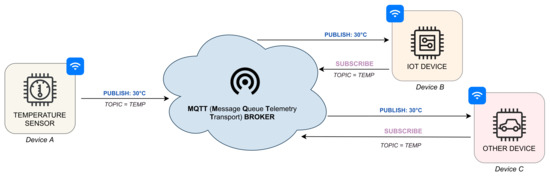
This new communication paradigm, where each device can communicate with another one, is simplified in Figure 2, which shows how it is possible to exchange information between geographically distant devices using the Message Queue Telemetry Transport (MQTT) protocol. In more detail, this process is performed by using two operations, publish and subscript. First, through the MQTT protocol, a device publishes data on a server (conventionally called Broker). Then, other devices can receive the data by subscribing to a topic (a channel mechanism that allows us selective intercommunication between devices) where they are stored.
Figure 2.
IoT communication paradigm.
Internet of Everything. The rise of the IoT model and, more generally, the development of wireless-based technologies has contributed to the definition of a model called the Internet of Everything [5], further pushed forward by the advent of smartwatches, e-health devices, smart vehicles, to name a few. With respect to the Internet of Things, the Internet of Everything model is used to refer to the intelligent interconnection of data, processes, things, and people, a scenario that involves billions of objects connected over public or private networks by using different protocols (standard or proprietary), which can detect the environment around them (sensors) or can interact with it (actuators).
Identity of Things. The Identity of Things represents a concept mainly related to the Internet of Things environment. It refers to assigning a unique identifier to all objects operating in such an environment to allow their real-time interaction with people and other objects (things). A centered and quite recent example of the scenario mentioned above is that of autonomous vehicles [6], where the concept of unique identification becomes day after day even more crucial [7]. The identifier can be created by using information that uniquely characterizes the IoT device, such as the manufacturer, the serial number, and so on. Alternatively, the identifier can be assigned to the IoT device by using a centralized or decentralized assignation remote service, manually or automatically. Some possible approaches able to perform this operation are presented in Section 4.1.
2.3. Blockchain Environment
The blockchain data structure has been introduced in the context of cryptocurrencies like Bitcoin [2,8] and, later, Ethereum [9], as a shared and transparent distributed ledger to store and trace financial transactions. It can be imagined as an ever-growing chain of blocks, where each block stores a set of transactions and contains a cryptographic signature of its predecessor, thus making it computationally hard to alter or remove the older blocks. However, its functionality can also be exploited in non-financial contexts, in all the cases where an application needs to ensure trust services. In other terms, it can be employed to define the underlying trust level of an application. For example, its ability to verify identity through a reliable authentication process [10] is nowadays exploited in the context of heterogeneous environments, such as, for instance, those related to e-health [11], smart cities [12], and IoT [13] applications.
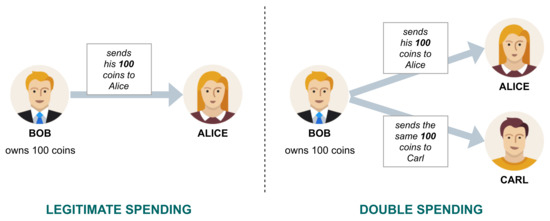
Double Spending. The main peculiarity of the blockchain is that it can guarantee (or strongly limit), in a decentralized manner, the presence of double spendings. These issues arise from the absence of a central intermediary in the decentralized context of the blockchain. Roughly, let us assume that an entity Bob owns 100 and binds them in a transaction to pay another entity Alice for a certain service/good. A double spending occurs if Bob, illegitimately, binds the same 100 in a second transaction, to pay another entity (e.g., Carl) for a different service/good. Since there is no central intermediary (e.g., a bank), it may be challenging to determine that one of the two transactions was invalid. This problem, graphically summarized in Figure 3, has been faced by adopting a distributed timestamp mechanism to determine which transactions should be accepted and rejected. More specifically, common blockchain technologies (like, for example, Bitcoin) exploits a hash-chain approach to address this task [11]. To clarify this point, suppose that a block stores the transaction from Bob to Alice and a subsequent block stores the transaction from Bob to Carl: through the hash-chain mechanism, each participant can verify that is older than and thus reject the double spending transaction from Bob to Carl.
Figure 3.
Double spending issue.
Consensus Mechanism. The consensus mechanism stands at the base of the blockchain paradigm: it allows the system to append new blocks to the blockchain, by preserving the hash-chain and avoiding double spendings and forks. The literature defines as validators the blockchain nodes that participate in the consensus process. More specifically, the most famous consensus mechanism, first introduced by Bitcoin [2], is the so-called Proof-of-Work: it assumes that each validator (known as miner in the context of this cryptocurrency) employs some large computational power to solve a cryptographic puzzle, for earning the right to append the current block to the blockchain. It is is aimed to protect the system against alterations and other fraudulent activities, since it usually requires a very high computation load, which involves resources that are generally not available for a single user or a small group of users. Nowadays, the literature offers other consensus mechanisms to effectively replace the PoW, such as, for instance, the Proof-of-Stake (PoS) [14,15,16].
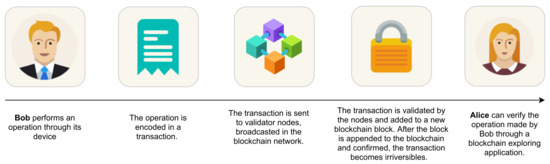
Blockchain as a Distributed Ledger. The core of functionality of the blockchain is the possibility to exploit it as a Distributed Ledger Technology (DLT). The insertion and validation of operations carried out by leveraging on the blockchain as a distributed ledger has been exemplified in Figure 4. There exist mainly two types of distributed ledgers: unpermissioned and permissioned. Well-known examples of unpermissioned ledgers are the Bitcoin and Ethereum environments, designed to be open and uncontrolled. This is in contrast with the permissioned ones, where only granted users can append new blocks to the ledger. In any case, using the blockchain as a distributed ledger model implies to store a very large amount of data. with a constant and continuous increasing in its size, thus raising a crucial scalability issue that must be effectively faced in the future [17].
Figure 4.
The blockchain as a distributed ledger.
Blockchain and IoT Integration. From a general point of view, the blockchain fits well in all the applications where there is the need to identify entities (e.g., people, vehicles, documents). For instance, [18] uses blockchain to get a verifiable identity through a reliable authentication process; [19] introduces blockchain-based intelligent transportation systems; [20] exploits blockchain to define a public identities ledger in the context of an identity management system; [21] faces the Value Added Tax (VAT) fraud problem. More specifically, literature discusses scenarios characterized by the integration of blockchain-based infrastructures with IoT devices, such as in [22], where the authors identify the following operative modalities:
- IoT-IoT: characterized by low latency and a high level of security, since the involved IoT devices operate between them for most of the time, by exploiting the canonical protocols and by limiting the blockchain use for storing only a few information;
- IoT-Blockchain: by following this strategy, all the IoT information is stored on the blockchain, assuring its immutability and traceability, but increasing the bandwidth consumption and the latency-time;
- Hybrid Paradigm: this last strategy combines the two previous ones, performing part of the activities directly between the IoT devices, and limiting the interaction with the blockchain to the data storage activity.
For the needs of the proposed IoE paradigm, the second and third strategies (i.e., IoT-Blockchain and Hybrid) are the most suitable. However, by adopting optimized criteria, the best method results in the Hybrid one, since it better balances the advantages offered by the IoT-IoT and IoT-Blockchain strategies.
2.4. Security Aspects
Many works in the literature [23] evidence that wireless-based technologies evolution did not keep up with the security one. It means that a series of problems that affect security in a broad sense jeopardize the significant opportunities offered by these new technologies. Some cases in point are fraud related to the e-commerce infrastructure [24], where several approaches, proactive and retroactive, have been experimented in order to face such problems [25], as well as the ever-increasing number of identity theft [26] or, even more simply, the countless frauds made by exploiting the people’s trust [27], often by recurring to social engineering techniques [28].
Furthermore, in the mobile network context, we can observe similar problems because the smart devices that operate in this environment inherit the security risks that characterize the Internet-based devices (e.g., desktop computers, laptops, and so on), such as the ones above. In addition, there are a series of more specific risks related to this context [29], such as, for instance, those related to bot-net-based attacks [30], or those that jeopardize user privacy [31].
Security issues also flank the potential advantages of blockchain-based technologies, where criminals try to exploit them fraudulently. Moreover, surveillance authorities can not easily detect such criminal activities [32]. Another example of a security issue related to the blockchain concerns the Proof-of-Work consensus.
As a group of people can operate jointly (i.e., forming a mining pool) to reduce time variance in the mining of new blocks, if they achieved a grouped computational power that is at least of the total of the network, they can gain a full control of the blockchain, breaking down its decentralization [33,34]. This attack has been theorized in the literature as the majority attack [2], but never occurred in real use.
2.5. Localization Data Encoding
Blockchains have various ways to encode and store timestamps, locations, and further metadata (i.e., data not related to financial operations). These techniques vary depending on the target blockchain. Indeed, since Bitcoin’s birth, several applications have exploited different fields of its protocol to append metadata for various use cases, including tracking objects [35]. The most common technique in the Bitcoin blockchain, which also applies to Litecoin, exploits the OP_RETURN field [36]: applications append a string of data encoded by following a personal protocol. After a few years, Ethereum [9] arose, providing the (currently) most widespread technique for encoding data and performing computations on blockchains: the smart contracts.
More recently, permissioned blockchains like Hyperledger Fabric sprung up [37]. They still use smart contracts. However, they differ from previous (permissionless) blockchains because they do not have a public network, releasing users from the disadvantages of a public fee but requiring them to configure and maintain a custom network. For this reason, the cost of a transaction in a permissioned system may highly vary, and it is not possible for us to estimate it. Accordingly, we did not include this kind of blockchain in our analysis, although we remark that Hyperledger Fabric is widely used for tracking positions and the life cycle of objects [38], to emphasize the generality of our paradigm.
2.6. Related Work
The literature presents several approaches that face similar tasks to those proposed in this manuscript. Although the idea behind almost all of these works covers specific application areas, it can not be considered a paradigm extensible across varied domains, even very different ones, as in our case. For instance, in [39] the authors consider the blockchain technology as a business strategy, proposing and discussing its application in the fresh food delivery area, also proposing some considerations about the use of this technology in reducing the logistics costs. Similarly, in [40], the authors propose a blockchain-based framework to automate business flows in tracking supply chain processes. Other works exploit the capabilities of blockchain, such as in [41], where the advantages of the blockchain are combined with machine learning algorithms in the education field, or in [42], where instead the 5G cellular network is combined with the blockchain technology in order to provide reliable communication and enhanced information security.
Practically, what characterizes and differentiates the proposed IoE paradigm from the other works in the literature is that we define a common approach potentially exploitable on a wide variety of application domains rather than on a specific one.
3. Formal Notation
We use the term entity to indicate a device designed to operate in an IoE environment, strictly associated with a person or thing. We use the term tracker to indicate a generic (new or already existing) device that operates in a wireless-based environment, which is aimed to interact with the entities. Given the above considerations, we introduce the following formal notation:
- (i)
- We denote as a set of entities, and we use to indicate such information related to an entitye;;
- (ii)
- We denote as the entities in E detected by a tracker device within seconds after detecting an entity (then ), and we use to indicate such information related to an entitye;
- (iii)
- We denote as a set of geographic locations, with , , and we use to indicate such information related to an entitye when a tracker device detects it;
- (iv)
- We denote as a set of timestamps, with , and we use to indicate the timestamp related to detecting an entitye by a tracker device;
- (v)
- We denote as a set of (i.e. Globally Unique IDentifiers, whose structure is formally defined in the RFC-4122 and explained in Section 4.1), using the notation to indicate the associated with an entitye, and the notation to indicate the associated with a tracker device;
- (vi)
- We denote as a payload, with , and we use to indicate a payload related to an entitye;
- (vii)
- We denote as a set of registration made on a blockchain-based distributed ledger, with , and we use and to indicate, respectively, a registration related to an entitye and all the registrations associated with that entity.
4. Approach Formulation
This section describes the four steps required to define the proposed IoE paradigm; we summarize them in the following:
- (i)
- Elements Definition: it introduces the concept of entity and tracker in the IoE environment, as well as the method to assign them a Globally Unique Identifier, outlining some possible operative scenarios;
- (ii)
- Elements Detection: the detection process of an entity device is here described, from the detection-time by a tracker device to the recording-time of the collected data on a blockchain-based distributed ledger, focusing on the characteristics of the state-of-the-art wireless technologies able to perform these activities;
- (iii)
- Elements Communication: it formalizes the data structures and the software procedures able to merge the information related to the involved entity and tracker devices, generating the data structure that represents the information to store on the blockchain-based distributed ledger;
- (iv)
- Elements Localization: extensively, it describes the activities made to trace an entity, introducing some baseline strategies and a series of localization rules aimed to exploit the available information on the blockchain, directly or indirectly.
4.1. Elements Definition
Entities can be either persons or objects, like vehicles or goods. Each entity is always associated with a Globally Unique Identifier (GUID).
Conversely, trackers usually are generic devices able to detect entity devices, capturing their GUIDs and sensors data, and performing a registration into a blockchain-based distributed ledger. Such a registration (i.e., the set r) is defined by joining entity and tracker data, according to the formal notation defined in Section 3.
The unique identifier of the tracker devices could be already available (e.g., MAC-address, IP-address, etc.), while that of the new entity devices placed in the IoE environment needs to be defined and assigned. There exist several ways for generating unique identifiers [43], but the two most common methods use: (i) serial numbers created by following an incremental or sequential criterion; (ii) random numbers generated by using a range of numbers enough larger to classify the expected number of objects. In the proposed approach, we perform this operation using one of the most effective methods: the Globally Unique Identifier.
Globally Unique Identifier: The Globally Unique Identifier (GUID), also known as Universally Unique Identifier (UUID), is a 128-bit integer number commonly used to identify resources uniquely [44]. In particular, [44] also provides a formal definition of GUID string and algorithms able to generate it: for instance, f81d4fae-7dec-11d0-a765-00a0c91e6bf6 represents an example of GUID string.
Through the application of the birthday paradox [45], we can obtain a mathematical demonstration of the GUID robustness in terms of hash collision probability. By following this mathematical approach, considering that a GUID is a 128-bit long number, we can identify a quadrillion entities (i.e., ) before we have a one in a billion possibility to get a collision.
Some considerations can be made about the policies to adopt in order to assign the GUID to each entity device that operates into the IoE environment, assuring that this information remains stable along the time. This is because the IoE tracing mechanism uses such information and a variation of it (i.e., the device GUID) during the life of an entity device leads towards inconsistent data.
Some solutions involve a centralized GUID distribution, such as in [46], offered as service to the users by following a free or paid modality, or an autonomous generation of this information made directly by the users [44]. It is appropriate to reserve part of the GUID information to distinguish the IoE devices from the other devices operating in the wireless-based environment.
Operative Scenarios: About the hardware to use in the IoE environment for allowing the entity devices to interact with the tracker ones, we can outline several scenarios:
- (i)
- The entity device has limited or absent hardware resources (e.g., CPU, memory, etc.), then it performs the identification process by exploiting passive technologies like RFID (Radio-Frequency IDentification). In this first scenario, the tracker device must be able to manage the identification process adopted by the entity;
- (ii)
- The entity device has hardware resources to adopt active technologies for the identification process (e.g., 6LoWPAN and ZigBee, both defined by the technical standard IEEE 802.15.4). This is the most common scenario, where the entity device uses canonical wireless technologies and the tracker device does not need any additional capability to interact with it;
- (iii)
- The entity device can perform processes that require considerable hardware/software resources. Such a scenario allows us to move on the IoE-side some processes usually performed on the tracker-side, and it also allows the IoE device to handle complex processes related to its sensors.
The scenario we consider in this paper is the second one, where the IoE device has enough hardware/software resources that allow it to use active technologies for its identification because it enables us to implement the IoE immediately and transparently, postponing the other scenarios to possible future implementations.
4.2. Elements Detection
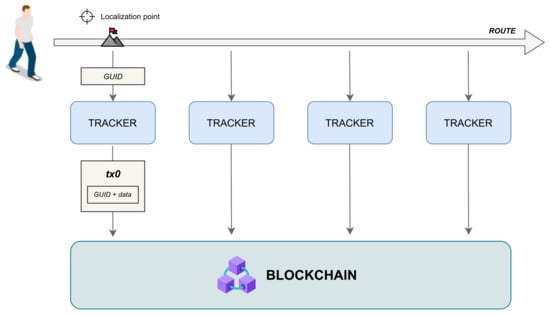
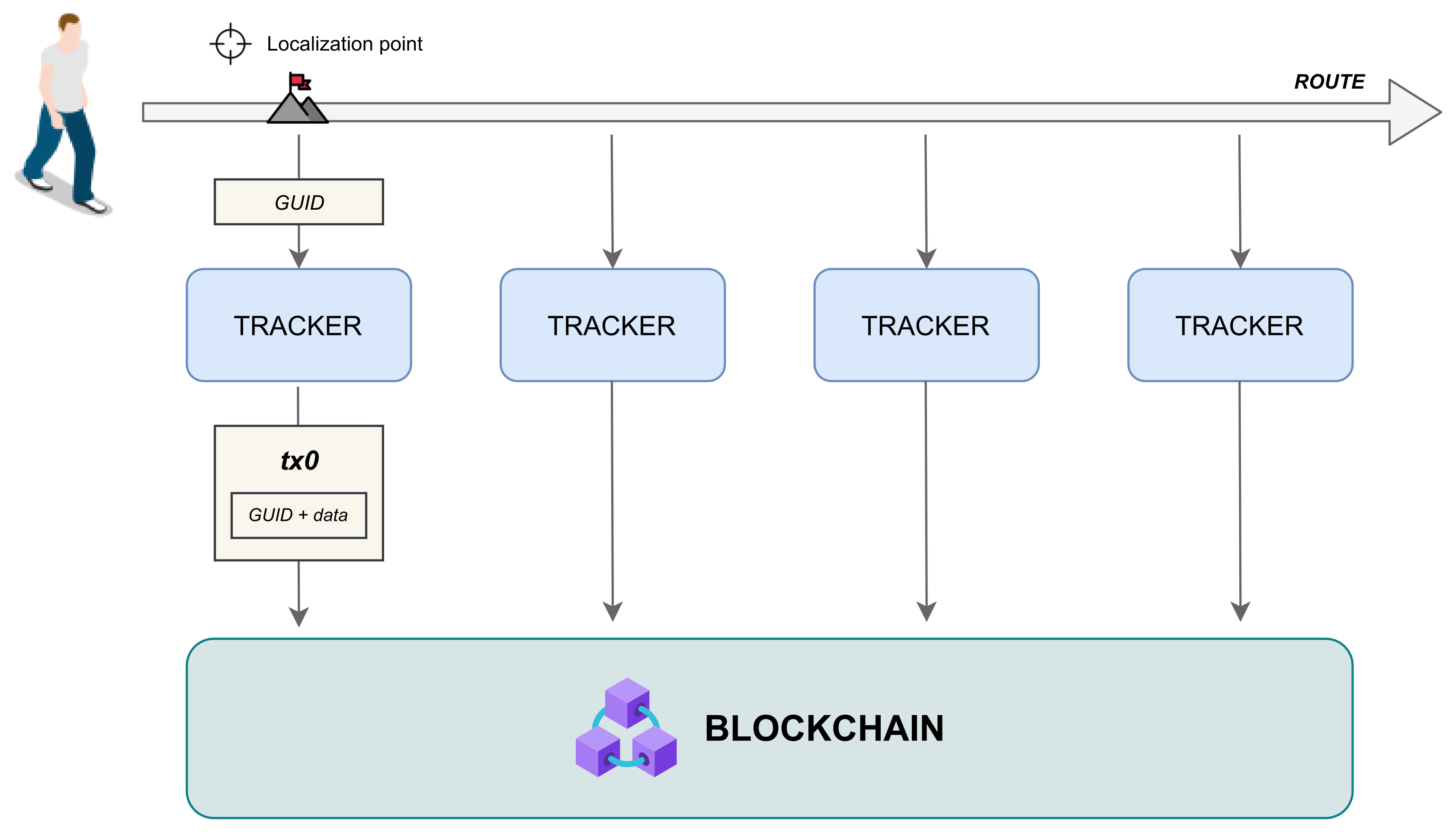
As shown in the high-level working model of Figure 5, when an entity e enters within the coverage area of a tracker device, such a device detects its identifier i (i.e., the GUID, as formalized in Section 3), and it creates and submits a registration r on a blockchain-based distributed ledger.
Figure 5.
Working model of the Internet-of-Entities.
Figure 5 indicates the detection time of an entity e as data capture, and it coincides with the timestampt, which represents the point in the space where a tracker device detects the entity and submits the information r to the blockchain-based distributed ledger.
All the above operations are managed using specific data structures, whose possible implementation has been proposed in Section 4.3.
Wireless Technologies: Regarding the technology to use for broadcasting the entity GUID, the literature offers several technologies and protocols to perform this operation [47]. Some examples of them are: Internet Protocol Version 6 over Low-Power Wireless Personal Area Networks (6LoWPAN), Bluetooth Low Energy (BLE), Z-Wave, ZigBee, Near Field Communication (NFC), Radio Frequency IDentification (RFID), SigFox, and 2G/3G. SigFox and 2G/3G are classified as Low-Power Wide Area Network (LPWAN) protocols, while the other ones as Short-range Wireless protocols.
Table 1 summarizes their characteristics, where the reported ranges (i.e., frequency range and operative range) indicate only the lowest and the highest supported value (e.g., if the protocol supports 125 KHz, 13.56 MHz, and 860 MHz, we report 125 KHz ÷ 860 MHz).
Table 1.
Wireless technologies.
The protocol choice should take into account the entity type. For example, in the case of a person, such a choice should be oriented toward protocols able to ensure a low-power consumption and a mid/short operative range. While in the case of objects (e.g., a vehicle), the choice could be instead oriented toward protocols characterized by a long operative range and a mid/high power consumption.
However, the above considerations are strongly related to the context of a custom IoE device: when it is a standard device such as, for instance, a smartphone or a tablet, the choice of the wireless protocols is driven by those supported by the operating system (e.g., 802.11 b/g/n [48] and Bluetooth Low Energy (BLE) [49] protocols).
4.3. Elements Communication
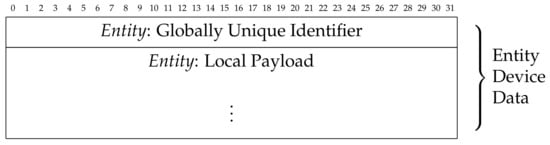
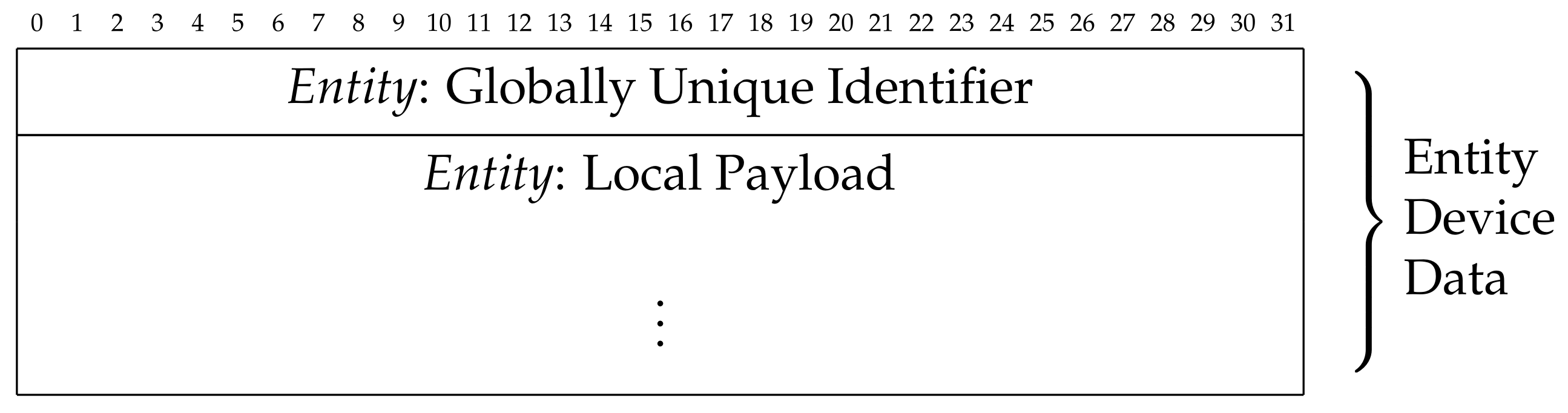
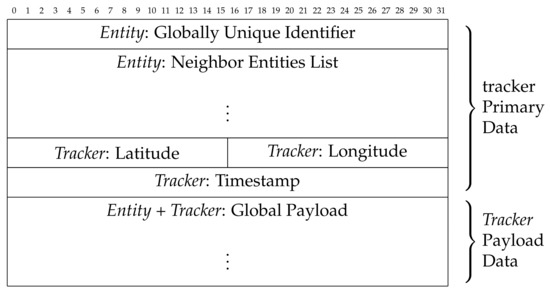
The communication between an entity e and a tracker device can be performed by adopting elementary data structures, whose possible formalization is proposed in Figure 6 and Figure 7.
Figure 6.
Entity-side data structure.
Figure 7.
Tracker-side data structure.
They refer, respectively, to the data structure used to transmit data from an entity device to a tracker device (i.e., entity-side) and to the data structure used to transmit the registration data from a tracker device to the blockchain-based distributed ledger (i.e., tracker-side).
About the Entity-side data structure, the GUID information, 128-bit long, is stored by using five groups of hexadecimal digits, with the following sizes: eight hexadecimal digits, four hexadecimal digits, four hexadecimal digits, four hexadecimal digits, and 12 hexadecimal digits.
The registration data r are defined by merging a series of identification data (Tracker Primary Data) with the sensors data related both to the entity and tracker devices activity (Tracker Payload Data). In some contexts, the Payload Data could be partially (only the entity or tracker sensors data) or completely absent (no sensors data), and, in these cases, the entity information will be the GUID, the location, and the timestamp.
The hardware/software process performed on the entity-side is limited to broadcast its data (GUID and local payload) at regular intervals using the wireless functionality. Regarding the tracker-side hardware/software process, when there are no other priority tasks active, the tracker device operates a listening activity to detect entities in its wireless coverage area, sending the collected entity and tracker data to the blockchain-based distributed ledger.
Notably, in the data structures, we classify the payload based on the data it refers to, using the term local to indicate that generated by the entity device and global to indicate that generated by the tracker device, which also includes the local payload.
The data anonymity and data immutability offered by a blockchain-based distributed ledger, joined with the low cost of the devices needed for the data transmission and the wireless coverage provided by the ever-increasing number of wireless-based devices, give life to a robust environment on which the proposed IoE paradigm is based.
The data that we need to store on the blockchain-based distributed ledger is that described in Section 3: the first field i contains the Globally Unique Identifier of the IoEentity; the field contains, when it is applicable, a list of Globally Unique Identifiers related to the other entities captured together with the entitye in a defined temporal frame ; the l field contains the geographic position (i.e., latitude and longitude) of the e-health device that detected the entitye; the field t reports when the data capture event occurred, in the format yyyy-mm-dd-hh-mm-ss; the last field P contains a series of values in the format key,value which refer to the sensors data of the entity device (local payload) and the sensors data of the e-health device (global payload).
Software Procedures: The software to perform the entity-tracker and tracker-ledger communications can be an update, in case of IoE and custom devices, or an application (app), in most other cases (i.e., smartphones, tablets, and similar devices). It has to fulfill the IoE paradigm needs, from the entity detection to the data registration, by performing the following operations:
- entity-side: it provides to broadcast the device GUID along with the payload (i.e., local sensors data) by using the built-in wireless device functionality;
- tracker-side: it performs a listening activity aimed to detect and recognize (distinguishing them from the other devices through the mechanism adopted in the implementation phase, for instance, a specific GUID preamble) entities within its wireless coverage area;
- tracker-side: it appends the e-health device data (i.e., primary and payload data) with the data transmitted by the entity device (i.e., GUID and payload), building a data packet suitable for registration on the blockchain-based distributed ledger;
- tracker-side: it submits the defined data packet on the blockchain-based distributed ledger to perform an immutable registration of the entity device activity;
- tracker-side: it waits to receive from the blockchain-based distributed ledger the registration acknowledge of the submitted packet; otherwise, it repeats the submission.
A series of custom data dashboards (i.e., management tools able to display, track and analyze information) can also be designed to manage all the processes involved in the IoE paradigm, which is related to the constant tracking of the entities.
4.4. Elements Localization
When we need to investigate an entity e, first we get all needed data related to it by performing a data gathering process, such as that reported in Algorithm 1, then we can manage such data through different strategies, such as the baseline ones described below:
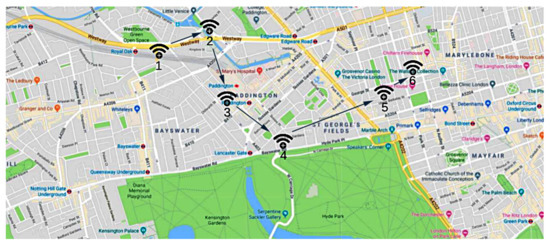
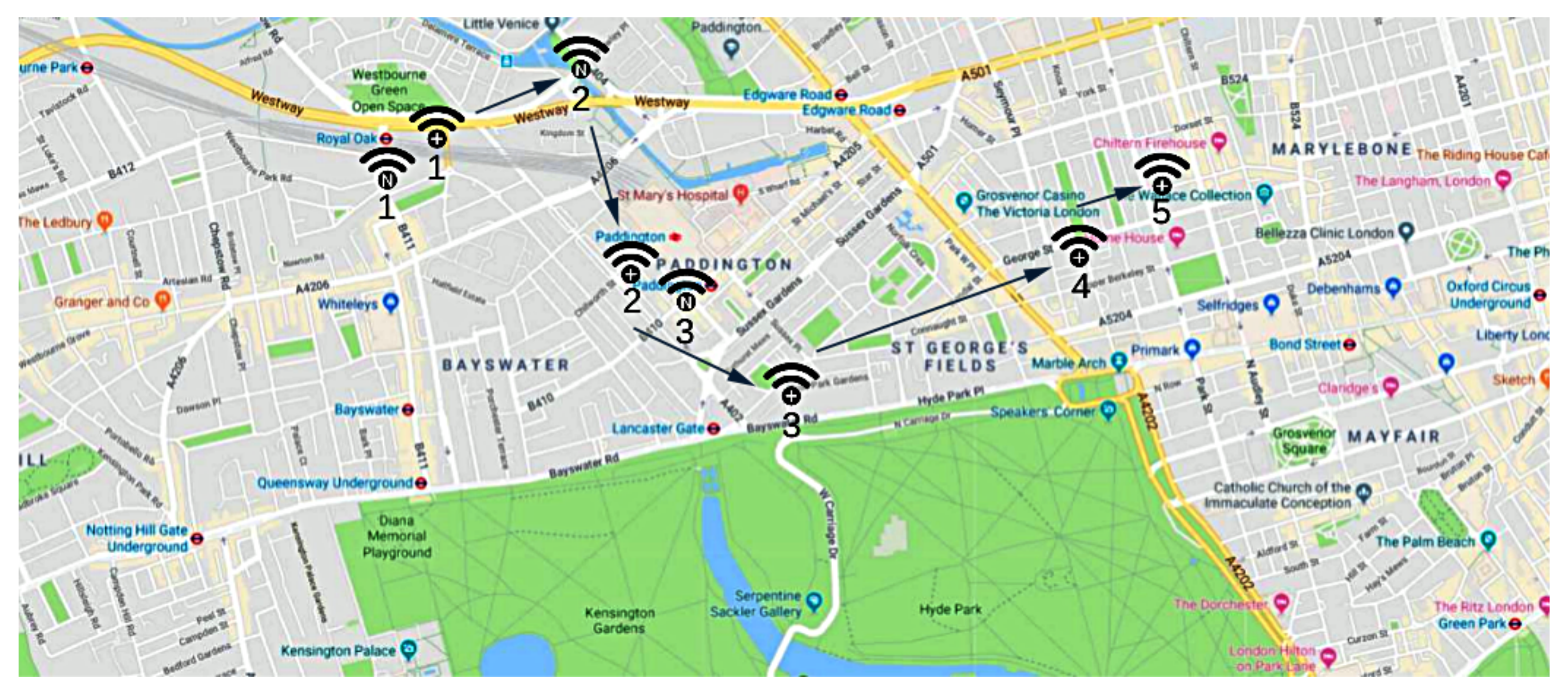
- Direct Tracing: by following this strategy, the movements of an entitye, from its first introduction in the IoE environment, are traced by using the information and in , according to the formalization given in Section 3.Figure 8 shows this process, and presents six detection points l of an entitye, chronologically numbered by using the timestamp information t. In more detail, we first query the blockchain-based distributed ledger to extract all the registrations , and then we number each location (i.e., latitude and longitude) along the chronological sequence given by the timestamp information .Figure 8. IoE direct tracing.More formally, given a series of entity locations , we introduce a Trace Location Set to store all the locations in the chronological order determined by the timestamp information , as formalized in Equation (1).
Algorithm 1 Blockchain-based distributed ledger data gathering. Require:e = Entity, R = Blockchain-based distributed ledger registrations
Ensure: = Registrations related to entity e- 1:
- procedure getEntityRegistrations(e, R)
- 2:
- for each r in R do
- 3:
- 4:
- if then
- 5:
- 6:
- end if
- 7:
- end for
- 8:
- return
- 9:
- end procedure
- The localization resolution is directly related to the e-health device that has detected the entity. We can obtain a high-resolution localization when the e-health device runs a localization service (e.g., GPS) an its location is near the detected entity. Instead, we obtain a low-resolution localization when the localization data are related to another device. For instance, this happens when the e-health device operates in the mobile network but without any active localization service. In this case the location could refer to the mobile network cell.This is represented in Figure 8 and Figure 9: the high-resolution localization coincides with the entity map-point, while the low-resolution localization can be considered any map-points within the grid-square where the entity is placed, which represents the mobile network cell.Figure 9. IoE interpolate tracing.
- 2.
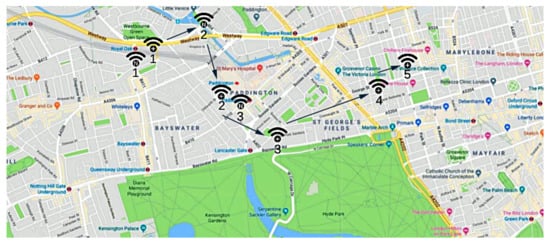
- Interpolate Tracing: in this strategy, we take into account the information , , and in . When applicable, the information contains the other entities detected by the e-health device within seconds from the detection of e (the entity under analysis), as described in Section 3.We exploit the new information to reconstruct the entity movements by interpolating the data with the same data of the entities in (neighbor entities). Figure 9 graphically shows this process, where + denotes the entity under analysis and N a neighbor entity in .In the example of interpolate tracing shown in Figure 9, we can observe how the first localization of the entity + includes a neighbor N that we found another time in the third location of the location chronology of +. This represents a naive example of interpolate tracing, based on the reasonable probability that such a configuration indicates that the neighbor entity is somehow related to the primary entity under analysis, especially when this pattern repeats over time. In other words, it is very likely that in the second localization of N, the entity + was also present and that it has not been detected for some reasons such as, for instance, a temporary e-health device overload, or because the entity device was out of the wireless e-health range. This pattern, repeated over time, could underline interesting connections between entities, as well as the last location of a missing entity.More formally, given the Trace Location Set previously defined and given a series of entity locations , at each location (with ) we extract from the set a subset of valuable neighbor entities by following the criterion in Equation (2).We can generalize the previous criterion by varying the distance between the step (i.e., where we extract the valuable neighbor entities from ) and the previous and next step that we take into account. Denoting as such a distance (i.e., the number of considered locations), we can re-formalize the former criterion as shown in Equation (3).We underline that we do not infringe the privacy of the involved neighbor entities since the entity data are collected anonymously into the blockchain-based distributed ledger.
- 3.
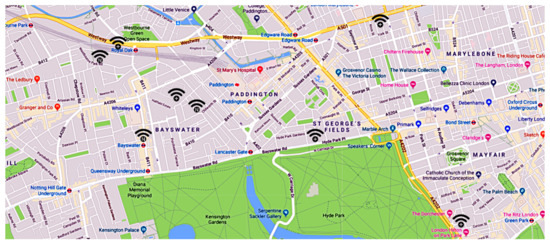
- Spread Tracing: this last baseline criterion exploits all the neighbor entities in , with and , where denotes the entity under analysis.As valuable neighbor entities of , we add all the entities in their locations L have as neighbor entity, as shown in Equation (4).The result can be expressed as the tracing matrix shown in Equation (5), where each row refers to a different valuable entitye. In other words, each matrix-row refers to a different valuable entity e, and it reports the locations l where the entitye has the entity as a neighbor in .After ordering the matrix row elements by location and counting how many entities are involved in each matrix column, we can evaluate the probability that the entitye was in a specific position, although a e-health device has not detected it. Figure 10 graphically shows this criterion, where the grid-size (i.e., square-side) represents a tolerance value, which we denoted as . This means that all the entity detections that occur in the same grid square refer to the same matrix row index (i.e., Equation (5)).Figure 10. IoE spread tracing.
The grid of Figure 10 represents different information, with respect to that of Figure 8 and Figure 9, since, in this case, it does not represent the mobile network cells but the tolerance value . Moreover, all the previous criteria can be combined for defining a more complex strategy based on different localization rules.
As a final remark, we observe that this work is mainly devoted to provide a conceptual framework that aims at exploiting and combining, synergistically, the different potentials of the IoT, mobile and blockchain worlds. A massive implementation and testing of concrete use cases in real-world scenarios have not yet been carried out, although they represent the natural future direction of research towards which this work is heading.
5. Experimental Findings
In the light of what we said in Section 4, considering that an exhaustive validation of the proposed IoE paradigm would require a wide diffusion, as happened with other paradigms (e.g., IoT), the experiments carried out and reported in this section are aimed to verify and evaluate the practical feasibility of the proposed IoE paradigm in a real-world scenario.
In this context, the implementation of the proposed paradigm has been tested through a prototype based on several ESP32 boards, equipped with the Zerynth (zerynth.com) (accessed on 1 September 2021) library, and interfacing with the Ropsten blockchain (an Ethereum testnet). The purpose of the performed experiments has been focused on the following four fundamental aspects that characterize the proposed IoE paradigm:
- (i)
- definition of entities and trackers;
- (ii)
- detection of the entities within the wireless coverage area of the trackers;
- (iii)
- communication of data made by the trackers on a remote blockchain-based distributed ledger;
- (iv)
- localization of entities by applying the baseline strategies formalized in this paper.
5.1. Setup of the Experiments
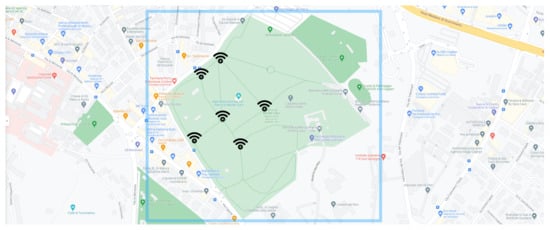
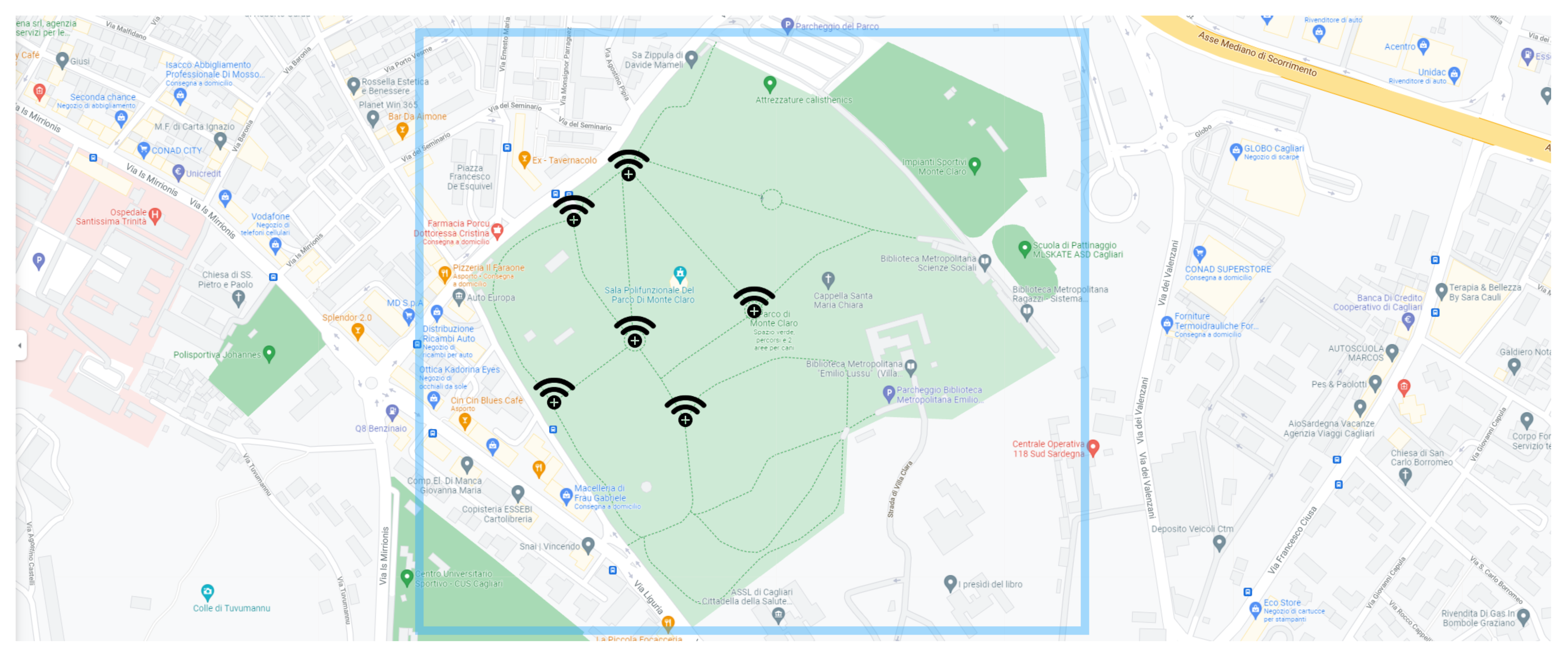
In order to achieve the set goals, the experiments have been carried out with the aim to simulate, in a restricted context, the real behavior of entities and trackers, as well as their interaction with the distributed ledger. Specifically, we set up the experiments by first choosing a set of locations , where we disposed of j trackers. Afterwards, we engaged a set of kentities. We assigned a Globally Unique Identifier to each entity and tracker. Figure 11 shows the main experiment venue, along with trackers’ position. For convenience, such a venue were identified as an urban park in Cagliari, Sardinia. Hence, the engaged entities were free to move in the venue: whenever one of them met a tracker, the communication started and the data were stored in the Ropsten blockchain.
Figure 11.
Map of the experiment venue, with the position of each tracker.
To measure the operational parameters of the paradigm, in each experiment we varied the number of involved entities and trackers. Moreover, for all of them, we analyzed two different scenarios by evaluating, respectively, the BLE technology (Table 2) and the RFID one (Table 3). In particular, we use to indicate the detection time, i.e., the average time that trackers require to detect and perform the handshake with entities. Furthermore, we denote as the registration time, i.e., the average time required to save a transaction in the Ropsten blockchain. Since determining these values for each detection during the experiment was unfeasible, particularly due to the limitations of the boards, they were measured beforehand in a controlled environment, and then kept fixed to calculate the final results. Thus, from the controlled measurements, we obtained, on average, s and s (regardless of the type of wireless technology considered).
Table 2.
Experimental results using BLE as wireless technology.
Table 3.
Experimental results using RFID as wireless technology.
Accordingly, the first goal of our experiments was to determine the average communication time per tracker , i.e., the average time spent by each tracker to detect and record entities, defined as:
where and indicate, respectively, the total number of detections and the total number of trackers of each experiment.
For the sake of completeness, the second goal was to determine the average cost each tracker affords to store all its transactions in the blockchain. Since the experiments were conducted by means of the Ropsten blockchain, an Ethereum testnet whose transaction cost is free of charge, we simulated the actual cost by considering three different and widely distributed public blockchains, specifically Ethereum (as it is already available for use by the prototype), Litecoin and Binance, that for implementation characteristics are overlapping, but currently more economically advantageous. In light of the above, for each considered blockchain , we retrieved the average fee cost in USD (determined at the time of writing, i.e., September 2021); such values, for the three considered blockchains are, respectively, , , and USD.
With such ingredients, we finally calculated the average cost per tracker, for each blockchain, as:
where is the specific blockchain transaction fee as listed above.
5.2. Results and Discussion
The results of the experiments carried out are reported in Table 2 and Table 3 below. The first column defines an unique identifier of each experiment. The second and third columns show the amount of entities and trackers involved in each experiment. Similarly, the fourth column indicates the total number of entities detections , which also corresponds to the number of blockchain transactions performed to permanently store these events. Finally, the last three columns show the estimated values of average fee per tracker, for the three blockchains considered.
What emerges from the results, albeit in a very limited context, but which is fully reflected in real experience, is that the increase in the number of trackers—thus indicating a greater pervasiveness of the paradigm—does not seem to affect the average time and cost per tracker, since the burden is better distributed among them. However, we observe that trackers with a much higher overall burden will always exist, whenever they are associated with inherently busier real-world locations.
The second interesting finding from this preliminary study is that as the number of entities increased, average times and costs per tracker increased in an apparently linear fashion, regardless of the number of trackers. Again, in a massive usage scenario, busier locations will inevitably be subject to a more pronounced growth trend.
Finally, although not the subject of these experiments, we want to recall that it is possible to reconstruct the path of entities, ex post, by retrieving their positions history from the blockchain and applying one of the localization strategies presented in Section 4.4, i.e., Direct Tracing, Interpolate Tracing, or Spread Tracing.
6. Potential Applications, Limitations and Future Directions
This section discusses some future directions where the proposed IoE paradigm is oriented, and it also makes general considerations about its potential spread.
6.1. Secure Payload Storing
The first future direction we suggest is an extension of the IoE paradigm that could manage as payload large and sensitive sensors data by recurring to external storage services and encryption protocols. Such a problem arises concerning the payload data generated by the e-health device that detect an entity. Indeed such data could refer to sensitive information generated by some classes of sensors such as, for instance, microphones and video cameras, instead of non-sensitive information generated by other classes of sensors (e.g., temperature sensors, humidity sensors, etc.).
A possible and effective solution able to face this problem exploits the asymmetric encryption model [57], which analogously to the canonical encryption mechanism adopted nowadays in several applications (e.g., Secure Socket Shell, Open Pretty Good Privacy, Secure Multi-Purpose Internet Mail Extensions, etc.) is exploited for encrypting the data locally (when the e-health functionalities allow us this operation) or remotely (e.g., in a distributed database).
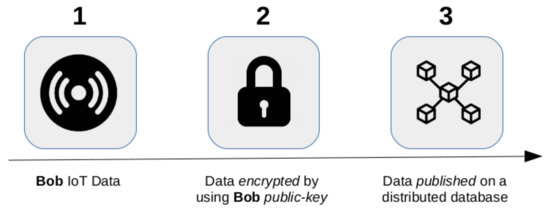
Data Encryption: The data encryption is performed by using the e-health device public key. In this way only it can decrypt the data by using its private key, although the involved entity has access to that data in encrypted form. Figure 12 summarizes the entire process.
Figure 12.
Data encryption process.
This already happens in the context of the blockchain technology, where the private key cryptography mechanism provides a powerful ownership method that fulfills the authentication requirements (i.e., the ownership is private-key-based), without the need to share more personal information. In this context, such a mechanism also grants both privacy and ownership.
When there is the need to investigate an entity using such encrypted data (e.g., in case of a criminal event like kidnappings, thefts, etc.), the involved authorities in charge can access data. It is possible to exclude this information using others (e.g., location, timestamp, etc.) in minor events.
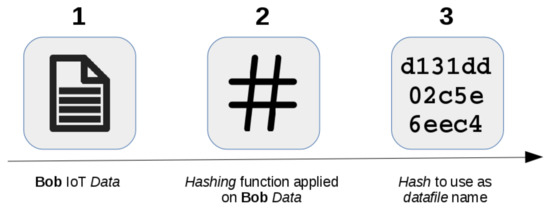
Data Hashing: The connection between the encrypted data (stored locally or remotely) and the entity is possible using a string generated by a hash function as data-name [58]. Such a function is a particular class of hash functions largely used in cryptography. Some common examples are: MD4 [59], SHA [60], TIGER [61], and WHIRLPOOL [62].
In more detail, by adopting a mathematical algorithm is possible to map data (characterized by arbitrary size) to a bit string (characterized by a fixed size). The result is a defined hash, and it represents a one-way function that is infeasible to invert. The literature usually refers to the input data as message and the output data (i.e., the hash) as message digest or digest.
A hash process shown in Figure 13 makes it possible to validate the file data integrity, detecting all modifications since they change the hash output. While an encryption process represents a two-way function based on the encryption and decryption operations, hashing represents a one-way function that irreversibly transforms the source data used as input into a plain text output (i.e., the hash of data).
Figure 13.
Data hashing process.
Data Consistency: A problem that could emerge adopting the proposed paradigm is certainly related to the consistency of the data stored on the blockchain [16,63,64]. In this sense, excessive network latency or the presence of malicious nodes could compromise the chronological order of entities’ registration. On the other hand, replay or tampering attacks [65] on transactions are natively prevented by the digital signature protocols of most existing blockchain systems [66].
However, regarding the chronological order, we remark that even a delayed (or missed) registration can generate, in some specific scenarios, significant limitations in the use of the IoE paradigm. Notably, several protocols [15,16,67,68] have been proposed in the literature to guarantee the consistency of transaction publication, mainly through incentive mechanisms parallel to those of the main consensus mechanism of the blockchain used. Although theoretically allowed, integrating such protocols with the IoE paradigm, as they are fundamentally domain-independent, represents a significant future development of this work to its more practical conceptualization.
6.2. IoE Technology Spread
As happened with other similar technologies, even in the proposed IoE one, the greatest obstacle to overcome is the spread across users of such a technology.
Although it is possible to create a new network of devices that operate according to the proposed IoE paradigm, we can substantially reduce this problem by integrating the IoE network into the existing wireless-based ones (e.g., IoT and mobile). This process, which allows us to maximize the IoE potential, can be facilitated by adopting several strategies, such as the following ones:
- (i)
- Designing transparent and straightforward procedures of integration of the needed IoE functionalities in the existing e-health devices. This can be achieved, for instance, by integrating these as a service in the new devices, by recurring to a well-documented firmware/software upgrade process, or by making available an application (in those cases where the trackers or the entities are implemented in devices that allow us this solution, e.g., smartphones, tablets, etc.);
- (ii)
- Making effective campaigns of information aimed to underline the advantages for each user that joins the IoE network, empathizing the gained opportunity to exchange data between a large community of users, a massive amount of valuable data that they can exploit in many contexts, such as that of localization taken into account in this paper;
- (iii)
- Offering benefits to the users that join their devices to the IoE network as trackers, allowing the system to perform the entity detection and the distributed-ledger registration tasks. Such benefits could include the free use of some services related to the IoE network, such as, for instance, the services used for remote data storage.
As previously underlined, the exploitation of the mobile network contributes to impress a substantial acceleration to the spread of the IoE network, since such a network already involves an enormous number of potentially configurable devices, by recurring to simple applications, to operate according to the IoE paradigm. In this case, the information related to the geographic location of the trackers can be obtained by a local service (i.e., GPS) or by querying the mobile cell to which the e-health is connected. The sensors data related to the e-health side will be those available for that device; otherwise, this data will be absent.
The use case taken into account in this paper relies on the interaction between entities and trackers, implemented by using custom (e.g., wearable solutions) or standard (IoT, smartphone, and tablet) devices. However, the IoE potentiality could be improved by adding to the IoE network other classes of devices such as, for instance, routers, access-points, hot-spots, and many others. Although this type of expansion is potentially practicable, it requires an implementation effort more significant than needed by using the devices we considered in this paper.
Business Models: Some conclusive general observations are about exploiting the proposed IoE paradigm in the context of a hypothetical commercial scenario. From the point of view of a Business-to-Business (B2B) model, we can start by observing that many financial analysts underline that only the area related to the IoT has given rise to an interesting and profitable financial market, whose value in the next 5-10 years has been estimated around trillions of dollars [69].
Consequently, as a specialized sub-area of the wireless-based technologies market, the proposed IoE paradigm could offer new stimulating and profitable opportunities, considering that its applications involve a considerable number of customers, both private and commercial ones. To summarize, the activity core could be oriented towards developing IoE solutions for business customers, who in turn can offer this service to their customers, according to a Business-to-Consumer (B2C) model.
Such solutions involve both hardware and software aspects, from the hardware/software development of the IoE devices (e.g., wearable devices, smartphone applications, vehicle equipment, etc.) to the management of the needed services (e.g., unique identifier distribution, remote storage, etc). In some cases, these opportunities could be further expanded by defining and offering services in partnership with public or private investigative agencies (e.g., security guards, local police, etc.), giving rise to an attractive transversal market.
A B2C scenario could also include other services such as, for instance, the management of entities initially directly managed by customers or the development and commercialization of custom hardware and software solutions.
7. Conclusions
In this paper, we generalized and extended our novel paradigm, which we baptized Internet of Entities (IoE). First, we discussed the context in which we proposed our paradigm. Then, we formalized the notions of entity and trackers, providing also a timely definition of the interaction model and communication protocols between entities, trackers, and the blockchain. Subsequently, we performed a series of experiments aimed to verify and evaluate the practical feasibility of the proposed IoE paradigm in a real-world use case. We also identified specific heuristics and strategies for reconstructing the entities movements and, finally, we discussed the potential usage applications and future implementation of our paradigm.
The paradigm joins the capabilities of the wireless-based environment with the certification capability provided by the blockchain-based distributed ledgers. It has two core components, entities and trackers, billions of new or already-existing devices that operate interchangeably across the its environment. Although such a paradigm exploits existing and widespread technologies, it offers a novel way to reliably trace the activity of people and objects in a certified and privacy-friendly way, producing valuable, exploitable, and investigative-valid data. In this sense, the concept of robust network in its unstructured simplicity, expressed by Satoshi Nakamoto during their Bitcoin formulation [2], well describes also the Internet of Entities network, whose capabilities are destined to grow, day after day, thanks to the continuous introduction of new wireless devices, which provide an ever-expanding coverage area.
Concluding, if, on the one hand, the proposed paradigm can be easily implemented by exploiting existing technologies and infrastructures, on the other hand, it produces a series of advantages for the community, revealing the potential for growth in many real-world scenarios, such as that of the localization taken into consideration in this paper.
Author Contributions
Conceptualization, R.S., A.S.P., L.P., D.R.R. and G.F.; data curation, R.S., A.S.P. and L.P.; formal analysis, R.S.; methodology, R.S., A.S.P., L.P., D.R.R. and G.F.; resources, R.S., A.S.P., L.P., D.R.R. and G.F.; supervision, D.R.R. and G.F.; validation, R.S., A.S.P., L.P. and D.R.R.; writing, original draft, R.S.; writing, review and editing, R.S., A.S.P., L.P. and D.R.R. All authors have read and agreed to the published version of the manuscript.
Funding
This research received no external funding.
Institutional Review Board Statement
Not applicable.
Informed Consent Statement
Not applicable.
Data Availability Statement
Not applicable.
Conflicts of Interest
The authors declare no conflict of interest.
References
- Bonneau, J.; Miller, A.; Clark, J.; Narayanan, A.; Kroll, J.A.; Felten, E.W. SoK: Research Perspectives and Challenges for Bitcoin and Cryptocurrencies. In Proceedings of the 2015 IEEE Symposium on Security and Privacy, San Jose, CA, USA, 17–21 May 2015; pp. 104–121. [Google Scholar] [CrossRef] [Scilit]
- Nakamoto, S. Bitcoin: A peer-to-peer electronic cash system. Decentralized Bus. Rev. 2008, 21260. [Google Scholar]
- Saia, R.; Carta, S.; Recupero, D.R.; Fenu, G. Internet of entities (ioe): A blockchain-based distributed paradigm for data exchange between wireless-based devices. In Proceedings of the 8th International Conference on Sensor Networks, SENSORNETS, Prague, Czech Republic, 26–27 February 2019; SciTePress: Setúbal, Portugal, 2019; pp. 77–84. [Google Scholar]
- Kaufman, B.; Aazhang, B. Cellular networks with an overlaid device to device network. In Proceedings of the IEEE 42nd Asilomar Conference on Signals, Systems and Computers, Pacific Grove, CA, USA, 26–29 October 2008; pp. 1537–1541. [Google Scholar] [CrossRef] [Scilit]
- Yang, L.T.; Di Martino, B.; Zhang, Q. Internet of everything. Mob. Inf. Syst. 2017, 2017. [Google Scholar] [CrossRef] [Scilit]
- Gerla, M.; Lee, E.K.; Pau, G.; Lee, U. Internet of vehicles: From intelligent grid to autonomous cars and vehicular clouds. In Proceedings of the 2014 IEEE World Forum on Internet of Things (WF-IoT), Seoul, Korea, 6–8 March 2014; pp. 241–246. [Google Scholar]
- Shao, J.; Xie, G.; Wang, L. Leader-following formation control of multiple mobile vehicles. IET Control Theory Appl. 2007, 1, 545–552. [Google Scholar] [CrossRef] [Scilit]
- Danezis, G.; Meiklejohn, S. Centrally banked cryptocurrencies. arXiv 2015, arXiv:1505.06895. [Google Scholar]
- Wood, G. Ethereum: A secure decentralised generalised transaction ledger. Ethereum Proj. Yellow Pap. 2014, 151, 1–32. [Google Scholar]
- Pilkington, M. 11 Blockchain technology: Principles and applications. In Research Handbook on Digital Transformations; Edward Elgar Publishing: Cheltenham, UK, 2016; p. 225. [Google Scholar]
- Kuo, T.T.; Kim, H.E.; Ohno–Machado, L. Blockchain distributed ledger technologies for biomedical and health care applications. J. Am. Med. Inf. Assoc. 2017, 24, 1211–1220. [Google Scholar] [CrossRef] [Scilit] [PubMed]
- Biswas, K.; Muthukkumarasamy, V. Securing smart cities using blockchain technology. In Proceedings of the 2016 IEEE 18th International Conference on High Performance Computing and Communications; IEEE 14th International Conference on Smart City; IEEE 2nd International Conference on Data Science and Systems (HPCC/SmartCity/DSS), Sydney, NSW, Australia, 12–14 December 2016; pp. 1392–1393. [Google Scholar]
- Xu, Q.; Aung, K.M.M.; Zhu, Y.; Yong, K.L. A blockchain-based storage system for data analytics in the internet of things. In New Advances in the Internet of Things; Springer: Cham, Switzerland, 2018; pp. 119–138. [Google Scholar]
- Lin, I.C.; Liao, T.C. A Survey of Blockchain Security Issues and Challenges. IJ Netw. Secur. 2017, 19, 653–659. [Google Scholar]
- Bartoletti, M.; Lande, S.; Podda, A.S. A proof-of-stake protocol for consensus on bitcoin subchains. In Proceedings of the International Conference on Financial Cryptography and Data Security, Sliema, Malta, 3–7 April 2017; pp. 568–584. [Google Scholar]
- Longo, R.; Podda, A.S.; Saia, R. Analysis of a consensus protocol for extending consistent subchains on the bitcoin blockchain. Computation 2020, 8, 67. [Google Scholar] [CrossRef] [Scilit]
- Croman, K.; Decker, C.; Eyal, I.; Gencer, A.E.; Juels, A.; Kosba, A.; Miller, A.; Saxena, P.; Shi, E.; Sirer, E.G. On scaling decentralized blockchains. In Proceedings of the International Conference on Financial Cryptography and Data Security, Christ Church, Barbados, 22–26 February 2016; Springer: Berlin/Heidelberg, Germany, 2016; pp. 106–125. [Google Scholar]
- Abbasi, A.G.; Khan, Z. VeidBlock: Verifiable identity using blockchain and ledger in a software defined network. In Proceedings of the 10th International Conference on Utility and Cloud Computing, Austin, TX, USA, 5 December 2017; pp. 173–179. [Google Scholar]
- Yuan, Y.; Wang, F.Y. Towards blockchain-based intelligent transportation systems. In Proceedings of the 2016 IEEE 19th International Conference on Intelligent Transportation Systems (ITSC), Rio de Janeiro, Brazil, 1–4 November 2016; pp. 2663–2668. [Google Scholar]
- Muftic, S. Blockchain Identity Management System Based on Public Identities Ledger. US Patent 9,635,000, 25 April 2017. [Google Scholar]
- Ainsworth, R.T.; Shact, A. Blockchain (distributed ledger technology) solves VAT fraud. Boston Univ. Sch. Law Law Econ. Res. Pap. 2016, 16–41. [Google Scholar] [CrossRef] [Scilit]
- Reyna, A.; Martín, C.; Chen, J.; Soler, E.; Díaz, M. On blockchain and its integration with IoT. Challenges and opportunities. Future Gen. Comput. Syst. 2018, 88, 173–190. [Google Scholar] [CrossRef] [Scilit]
- Saia, R.; Carta, S.; Recupero, D.R. A Probabilistic-driven Ensemble Approach to Perform Event Classification in Intrusion Detection System. In Proceedings of the 10th International Joint Conference on Knowledge Discovery, Knowledge Engineering and Knowledge Management, KDIR, Seville, Spain, 18–20 September 2018; SciTePress: Setúbal, Portugal, 2018; pp. 139–214. [Google Scholar]
- Carta, S.; Medda, A.; Pili, A.; Recupero, D.R.; Saia, R. Forecasting e-commerce products prices by combining an autoregressive integrated moving average (ARIMA) model and google trends data. Future Internet 2019, 11, 5. [Google Scholar] [CrossRef] [Scilit]
- Saia, R.; Carta, S. Evaluating the benefits of using proactive transformed-domain-based techniques in fraud detection tasks. In Future Generation Computer Systems; Elsevier: Amsterdam, The Netherlands, 2019; pp. 18–32. [Google Scholar]
- Bilge, L.; Strufe, T.; Balzarotti, D.; Kirda, E. All your contacts are belong to us: Automated identity theft attacks on social networks. In Proceedings of the 18th International Conference on World Wide Web, Madrid, Spain, 20–24 April 2009; pp. 551–560. [Google Scholar]
- Arachchilage, N.A.G.; Love, S.; Beznosov, K. Phishing threat avoidance behaviour: An empirical investigation. Comput. Hum. Behav. 2016, 60, 185–197. [Google Scholar] [CrossRef] [Scilit]
- Mouton, F.; Leenen, L.; Venter, H.S. Social engineering attack examples, templates and scenarios. Comput. Secur. 2016, 59, 186–209. [Google Scholar] [CrossRef] [Scilit]
- Liu, P.; LaPorta, T.F.; Kotapati, K. Cellular Network Security. In Computer and Information Security Handbook; Elsevier: Amsterdam, The Netherlands, 2009; pp. 183–203. [Google Scholar]
- Traynor, P.; Enck, W.; McDaniel, P.; Porta, T.L. Mitigating attacks on open functionality in SMS-capable cellular networks. IEEE/ACM Trans. Netw. 2009, 17, 40–53. [Google Scholar] [CrossRef] [Scilit]
- Firoozjaei, M.D.; Yu, J.; Choi, H.; Kim, H. Privacy-preserving nearest neighbor queries using geographical features of cellular networks. Comput. Commun. 2017, 98, 11–19. [Google Scholar] [CrossRef] [Scilit]
- Moore, T. The promise and perils of digital currencies. IJCIP 2013, 6, 147–149. [Google Scholar] [CrossRef] [Scilit]
- Courtois, N.T.; Bahack, L. On subversive miner strategies and block withholding attack in bitcoin digital currency. arXiv 2014, arXiv:1402.1718. [Google Scholar]
- Eyal, I.; Sirer, E.G. Majority is not enough: Bitcoin mining is vulnerable. Commun. ACM 2018, 61, 95–102. [Google Scholar] [CrossRef] [Scilit]
- Bartoletti, M.; Pompianu, L.; Bellomy, B. A journey into Bitcoin metadata. J. Grid Comput. 2018, 17, 3–22. [Google Scholar] [CrossRef] [Scilit]
- Bartoletti, M.; Pompianu, L. An analysis of Bitcoin OP_RETURN metadata. In Proceedings of the Financial Cryptography Workshops, LNCS, Sliema, Malta, 7 April 2017; Springer: Berlin/Heidelberg, Germany, 2017; Volume 10323, pp. 218–230. [Google Scholar]
- Cachin, C. Architecture of the hyperledger blockchain fabric. In Proceedings of the Workshop on Distributed Cryptocurrencies and Consensus Ledgers, Chicago, IL, USA, 25 July 2016. [Google Scholar]
- Podda, A.S.; Pompianu, L. An overview of blockchain-based systems and smart contracts for digital coupons. In Proceedings of the IEEE/ACM 42nd International Conference on Software Engineering Workshops, Seoul, Korea, 27 June–19 July 2020; pp. 770–778. [Google Scholar]
- Perboli, G.; Musso, S.; Rosano, M. Blockchain in logistics and supply chain: A lean approach for designing real-world use cases. IEEE Access 2018, 6, 62018–62028. [Google Scholar] [CrossRef] [Scilit]
- Chang, S.E.; Chen, Y.C.; Lu, M.F. Supply chain re-engineering using blockchain technology: A case of smart contract based tracking process. In Technological Forecasting and Social Change; Elsevier: Amsterdam, The Netherlands, 2019; pp. 1–11. [Google Scholar]
- Shah, D.; Patel, D.; Adesara, J.; Hingu, P.; Shah, M. Exploiting the capabilities of blockchain and machine learning in education. In Augmented Human Research; Springer: Berlin/Heidelberg, Germany, 2021; pp. 1–12. [Google Scholar]
- Chen, J.; Wang, W.; Zhou, Y.; Ahmed, S.; Syed, H.; Wei, W. Exploiting 5G and blockchain for medical applications of drones. IEEE Netw. 2021, 35, 30–36. [Google Scholar] [CrossRef] [Scilit]
- Jones, A.R.; Quah, E.E.L.; Nielsen, D.J.; Eminovic, L. Creating a Globally Unique Identifier of a Subscriber Device. US Patent 8,213,935, 3 July 2012. [Google Scholar]
- Leach, P.; Mealling, M.; Salz, R. A universally unique identifier (uuid) urn namespace. RFC 2005, 4122, 1–32. [Google Scholar] [CrossRef] [Scilit]
- Mironov, I. Hash functions: Theory, attacks, and applications. Microsoft Res. Silicon Val. Campus. Noviembre De 2005. [Google Scholar]
- Manku, G.S.; Bawa, M.; Raghavan, P. Symphony: Distributed Hashing in a Small World. In Proceedings of the USENIX Symposium on Internet Technologies and Systems, Seattle, WA, USA, 26–28 March 2003; p. 10. [Google Scholar]
- Al-Sarawi, S.; Anbar, M.; Alieyan, K.; Alzubaidi, M. Internet of Things (IoT) communication protocols. In Proceedings of the 2017 8th International Conference on Information Technology (ICIT), Odisha, India, 21–23 December 2017; pp. 685–690. [Google Scholar]
- Uzcátegui, R.A.; De Sucre, A.J.; Acosta-Marum, G. Wave: A tutorial. IEEE Commun. Mag. 2009, 47, 126–133. [Google Scholar] [CrossRef] [Scilit]
- Gomez, C.; Oller, J.; Paradells, J. Overview and evaluation of bluetooth low energy: An emerging low-power wireless technology. Sensors 2012, 12, 11734–11753. [Google Scholar] [CrossRef] [Scilit]
- Mulligan, G. The 6LoWPAN architecture. In Proceedings of the 4th Workshop on Embedded Networked Sensors, Cork, Ireland, 25–26 June 2007; ACM: New York, NY, USA, 2007; pp. 78–82. [Google Scholar]
- Kuzlu, M.; Pipattanasomporn, M.; Rahman, S. Review of communication technologies for smart homes/building applications. In Proceedings of the Innovative Smart Grid Technologies-Asia (ISGT ASIA), Bangkok, Thailand, 3–6 November 2015; pp. 1–6. [Google Scholar]
- Kinney, P. Zigbee technology: Wireless control that simply works. Commun. Des. Conf. 2003, 2, 1–7. [Google Scholar]
- Cerruela García, G.; Luque Ruiz, I.; Gómez-Nieto, M.Á. State of the art, trends and future of Bluetooth low energy, near field communication and visible light communication in the development of smart cities. Sensors 2016, 16, 1968. [Google Scholar] [CrossRef] [Scilit]
- Jia, X.; Feng, Q.; Fan, T.; Lei, Q. RFID technology and its applications in Internet of Things (IoT). In Proceedings of the 2012 2nd International Conference on Consumer Electronics, Communications and Networks (CECNet), Yichang, China, 21–23 April 2012; pp. 1282–1285. [Google Scholar]
- Raza, U.; Kulkarni, P.; Sooriyabandara, M. Low power wide area networks: An overview. IEEE Commun. Surv. Tutor. 2017, 19, 855–873. [Google Scholar] [CrossRef] [Scilit]
- Novo, O.; Beijar, N.; Ocak, M.; Kjällman, J.; Komu, M.; Kauppinen, T. Capillary networks-bridging the cellular and iot worlds. In Proceedings of the 2015 IEEE 2nd World Forum on Internet of Things (WF-IoT), Milan, Italy, 14–16 December 2015; pp. 571–578. [Google Scholar]
- Simmons, G.J. Symmetric and asymmetric encryption. ACM Comput. Surv. (CSUR) 1979, 11, 305–330. [Google Scholar] [CrossRef] [Scilit]
- Bakhtiari, S.; Safavi-Naini, R.; Pieprzyk, J. Cryptographic Hash Functions: A Survey; Technical Report 95–09; Department of Computer Science, University of Wollongong: Wollongong, Australia, 1995; Volume 4. [Google Scholar]
- Rivest, R. The MD4 message-digest algorithm. Conf. Theory Appl. Cryptogr. 1990, 11, 303–311. [Google Scholar]
- Bellare, M.; Rogaway, P. Optimal asymmetric encryption. In Proceedings of the Workshop on the Theory and Application of Cryptographic Techniques, Perugia, Italy, 9–12 May 1994; Springer: Berlin/Heidelberg, Germany, 1994; pp. 92–111. [Google Scholar]
- Mendel, F.; Rijmen, V. Cryptanalysis of the Tiger hash function. In Proceedings of the International Conference on the Theory and Application of Cryptology and Information Security, Kuching, Malaysia, 2–6 December 2007; Springer: Berlin/Heidelberg, Germany, 2007; pp. 536–550. [Google Scholar]
- Stallings, W. The Whirlpool secure hash function. Cryptologia 2006, 30, 55–67. [Google Scholar] [CrossRef] [Scilit]
- Tseng, L.; Yao, X.; Otoum, S.; Aloqaily, M.; Jararweh, Y. Blockchain-based database in an IoT environment: Challenges, opportunities, and analysis. Clust. Comput. 2020, 23, 2151–2165. [Google Scholar] [CrossRef] [Scilit]
- Carrara, G.R.; Burle, L.M.; Medeiros, D.S.; de Albuquerque, C.V.N.; Mattos, D.M. Consistency, availability, and partition tolerance in blockchain: A survey on the consensus mechanism over peer-to-peer networking. Ann. Telecommun. 2020, 75, 163–174. [Google Scholar] [CrossRef] [Scilit]
- Iqbal, M.; Matulevičius, R. Comparison of blockchain-based solutions to mitigate data tampering security risk. In Proceedings of the International Conference on Business Process Management, Vienna, Austria, 1–6 September 2019; Springer: Cham, Switzerland, 2019; pp. 13–28. [Google Scholar]
- Raikwar, M.; Gligoroski, D.; Kralevska, K. SoK of used cryptography in blockchain. IEEE Access 2019, 7, 148550–148575. [Google Scholar] [CrossRef] [Scilit]
- Hao, K.; Xin, J.; Wang, Z.; Cao, K.; Wang, G. Blockchain-based outsourced storage schema in untrusted environment. IEEE Access 2019, 7, 122707–122721. [Google Scholar] [CrossRef] [Scilit]
- Huang, B.; Zhang, R.; Lu, Z.; Zhang, Y.; Wu, J.; Zhan, L.; Hung, P.C. BPS: A reliable and efficient pub/sub communication model with blockchain-enhanced paradigm in multi-tenant edge cloud. J. Parallel Distrib. Comput. 2020, 143, 167–178. [Google Scholar] [CrossRef] [Scilit]
- Kranz, M. Industrial applications are the juicy part of the Internet of Things. Lond. Sch. Econ. Political Sci. 2017. [Google Scholar]









Publisher’s Note: MDPI stays neutral with regard to jurisdictional claims in published maps and institutional affiliations. |
© 2021 by the authors. Licensee MDPI, Basel, Switzerland. This article is an open access article distributed under the terms and conditions of the Creative Commons Attribution (CC BY) license (https://creativecommons.org/licenses/by/4.0/).