Article

Indoor Carrier Phase Positioning Technology Based on OFDM System
1
School of Electronic and Information Engineering, Beihang University, Beijing 100191, China
2
State Key Laboratory of Wireless Mobile Communications, China Academy of Telecommunications Technology, Beijing 100083, China
*
Author to whom correspondence should be addressed.
Sensors 2021, 21(20), 6731; https://doi.org/10.3390/s21206731
Submission received: 12 July 2021 / Revised: 4 October 2021 / Accepted: 6 October 2021 / Published: 11 October 2021
(This article belongs to the Special Issue Sensors and Systems for Indoor Positioning)

Abstract

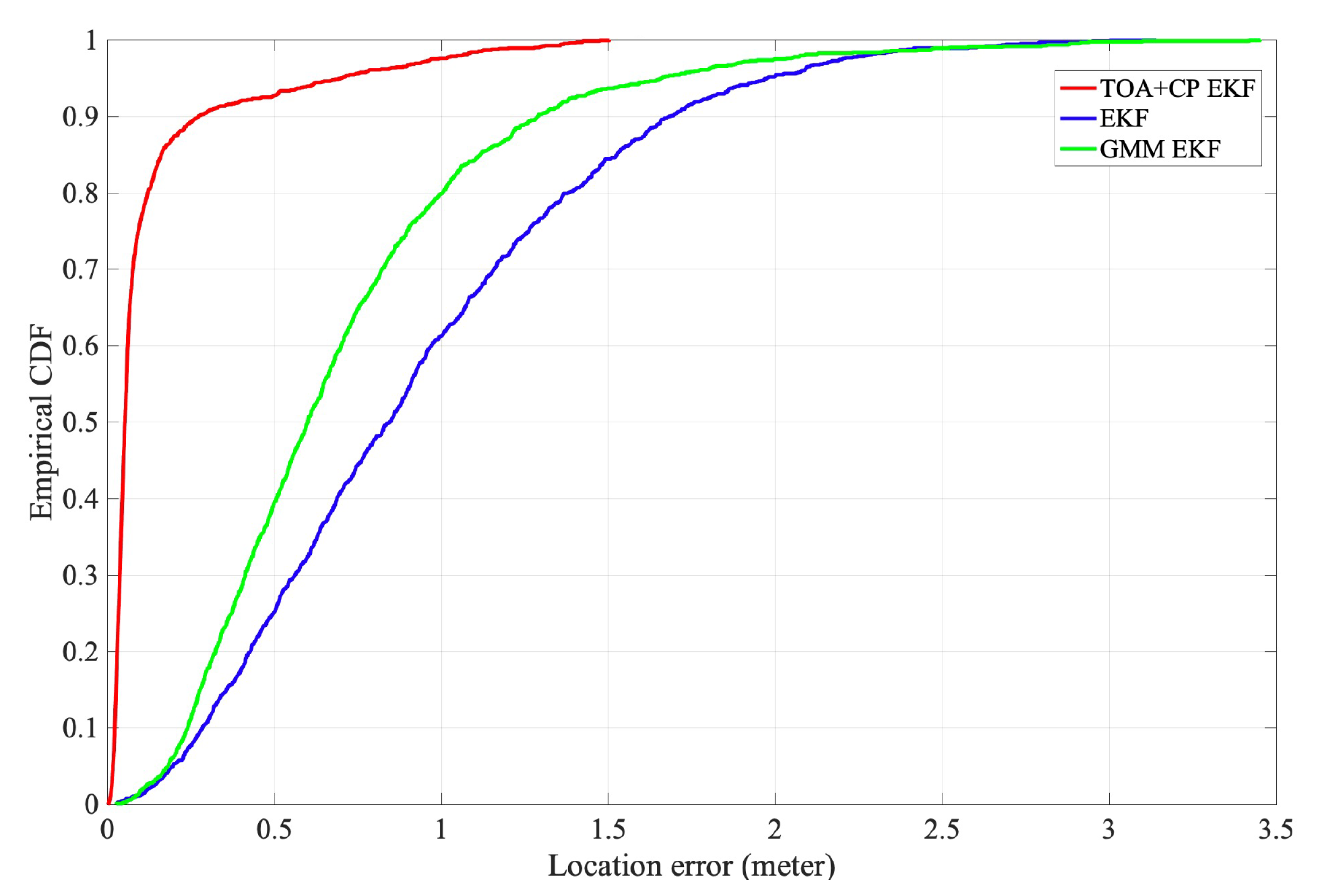
Carrier phase measurement is a ranging technique that uses the receiver to determine the phase difference between the received signal and the transmitted signal. Carrier phase ranging has a high resolution; thus, it is an important research direction for high precision positioning. It is widely used in global navigation satellite systems (GNSS) systems but is not yet commonly used inwireless orthogonal frequency division multiplex (OFDM) systems. Applying carrier phase technology to OFDM systems can significantly improve positioning accuracy. Like GNSS carrier phase positioning, using the OFDM carrier phase for positioning has the following two problems. First, multipath and non-line-of-sight (NLOS) propagation have severe effects on carrier phase measurements. Secondly, ambiguity resolution is also a primary issue in the carrier phase positioning. This paper presents a ranging scheme based on the carrier phase in a multipath environment. Moreover, an algorithm based on the extended Kalman filter (EKF) is developed for fast integer ambiguity resolution and NLOS error mitigation. The simulation results show that the EKF algorithm proposed in this paper solves the integer ambiguity quickly. Further, the high-resolution carrier phase measurements combined with the accurately estimated integer ambiguity lead to less than 30-centimeter positioning error for 90% of the terminals. In conclusion, the presented methods gain excellent performance, even when NLOS error occur.
Keywords: extended Kalman filter; localization; time of arrival; carrier phase; ambiguity resolution extended Kalman filter; localization; time of arrival; carrier phase; ambiguity resolution