Article

LPWAN and Embedded Machine Learning as Enablers for the Next Generation of Wearable Devices
by
Ramon Sanchez-Iborra
Department of Engineering and Applied Techniques, University Center of Defense at General Air Force Academy, Santiago de la Ribera, 30729 Murcia, Spain
Sensors 2021, 21(15), 5218; https://doi.org/10.3390/s21155218
Submission received: 13 July 2021 / Revised: 27 July 2021 / Accepted: 28 July 2021 / Published: 31 July 2021
(This article belongs to the Special Issue Advances of Wearables in Health Monitoring)

Abstract

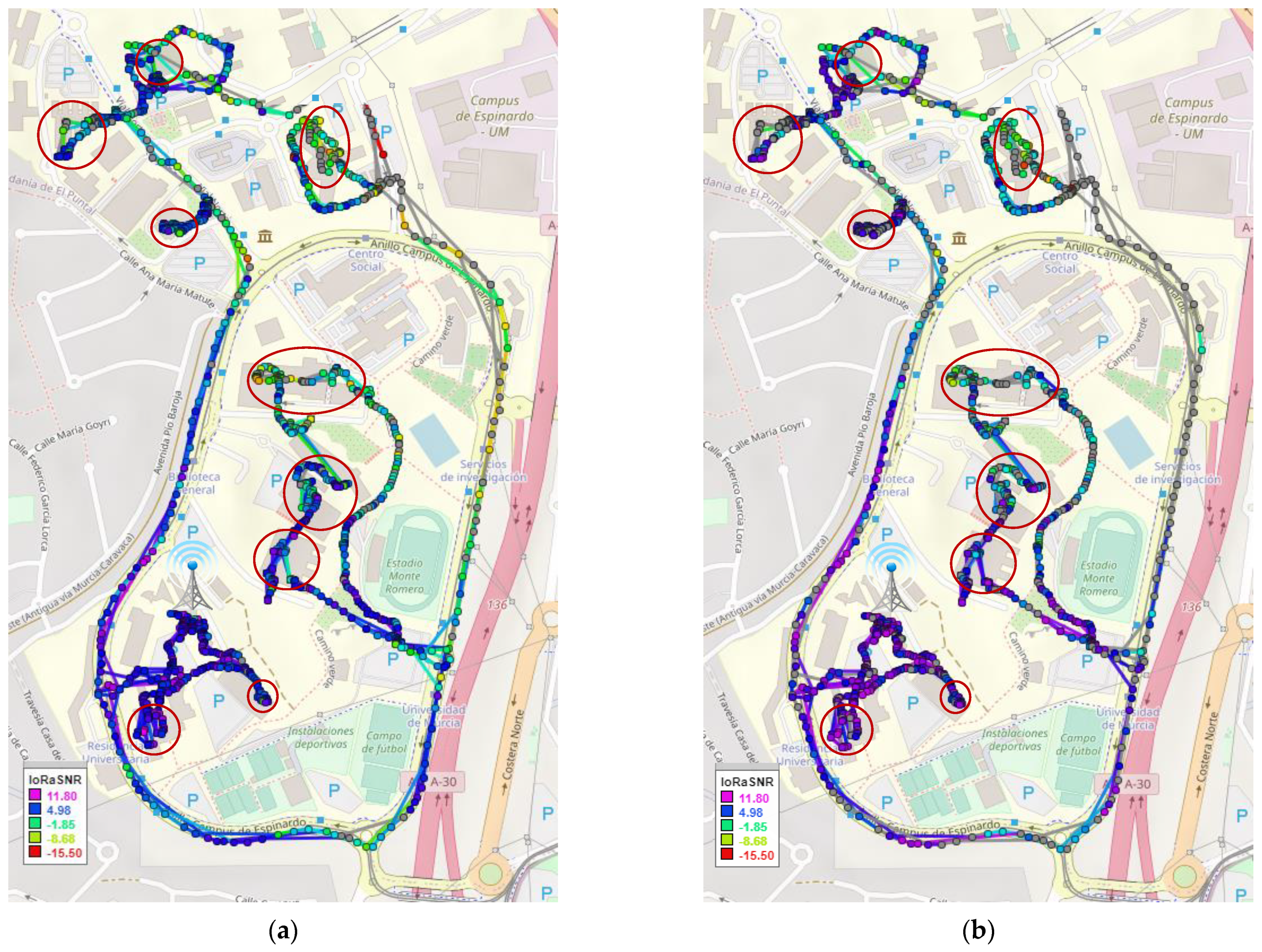
The penetration of wearable devices in our daily lives is unstoppable. Although they are very popular, so far, these elements provide a limited range of services that are mostly focused on monitoring tasks such as fitness, activity, or health tracking. Besides, given their hardware and power constraints, wearable units are dependent on a master device, e.g., a smartphone, to make decisions or send the collected data to the cloud. However, a new wave of both communication and artificial intelligence (AI)-based technologies fuels the evolution of wearables to an upper level. Concretely, they are the low-power wide-area network (LPWAN) and tiny machine-learning (TinyML) technologies. This paper reviews and discusses these solutions, and explores the major implications and challenges of this technological transformation. Finally, the results of an experimental study are presented, analyzing (i) the long-range connectivity gained by a wearable device in a university campus scenario, thanks to the integration of LPWAN communications, and (ii) how complex the intelligence embedded in this wearable unit can be. This study shows the interesting characteristics brought by these state-of-the-art paradigms, concluding that a wide variety of novel services and applications will be supported by the next generation of wearables.
Keywords: wearables; TinyML; LPWAN; LoRAWAN; machine learning wearables; TinyML; LPWAN; LoRAWAN; machine learning