Article

Wireless Geophone Networks for Land Seismic Data Acquisition: A Survey, Tutorial and Performance Evaluation

Institute of Communication Networks, Hamburg University of Technology, 21073 Hamburg, Germany
*
Author to whom correspondence should be addressed.
Sensors 2021, 21(15), 5171; https://doi.org/10.3390/s21155171
Submission received: 1 June 2021 / Revised: 27 July 2021 / Accepted: 28 July 2021 / Published: 30 July 2021
(This article belongs to the Section Sensor Networks)

Abstract

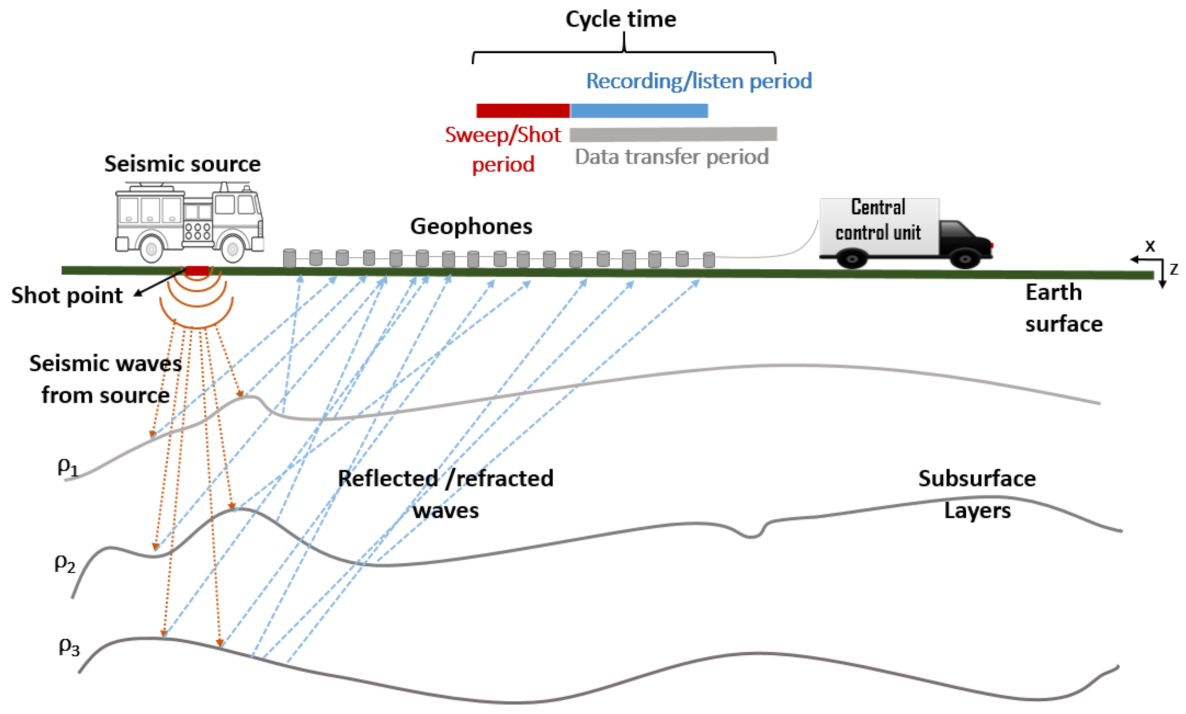
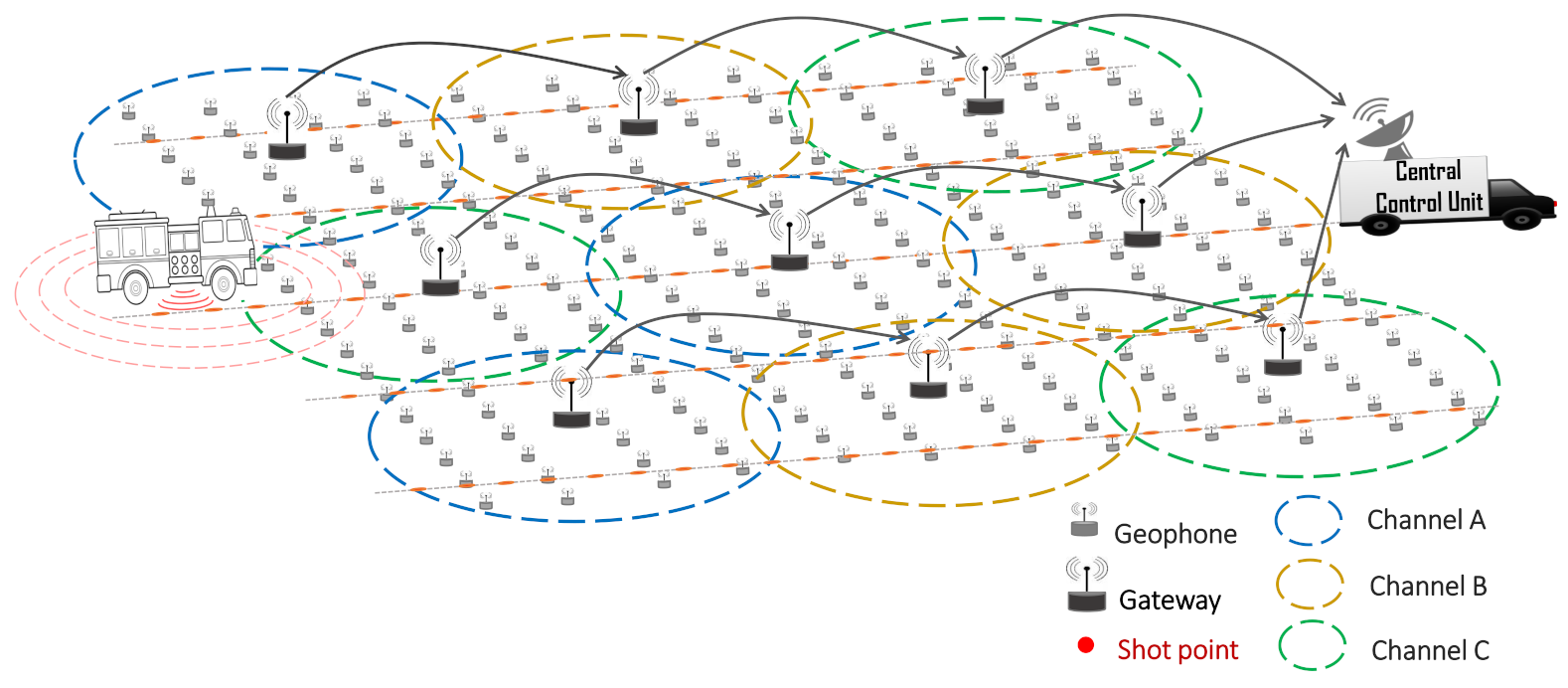
Seismic data acquisition in oil and gas exploration employs a large-scale network of geophone sensors deployed in thousands across a survey field. A central control unit acquires and processes measured data from geophones to come up with an image of the earth’s subterranean structure to locate oil and gas traps. Conventional seismic acquisition systems rely on cables to connect each sensor. Although cable-based systems are reliable, the sheer amount of cable required is tremendous, causing complications in survey logistics as well as survey downtime. The need for a cable-free seismic data acquisition system has attracted much attention from contractors, exploration companies, and researchers to lay out the enabling wireless technology and architecture in seismic explorations. This paper gives a general overview of land seismic data acquisition and also presents a current and retrospective review of the state-of-the-art wireless seismic data acquisition systems. Furthermore, a simulation-based performance evaluation of real-time, small-scale wireless geophone subnetwork is carried out using the IEEE 802.11 g technology based on the concept of seismic data acquisition during the geophone listen or recording period. In addition, we investigate an optimal number of seismic samples that could be sent by each geophone during this period.
Keywords: central control unit (CCU); geophones; seismic survey; wireless seismic data acquisition (WSDA); wireless geophone network (WGN) central control unit (CCU); geophones; seismic survey; wireless seismic data acquisition (WSDA); wireless geophone network (WGN)