Classification of Granite Soils and Prediction of Soil Water Content Using Hyperspectral Visible and Near-Infrared Imaging



Abstract
1. Introduction
2. Materials and Methods
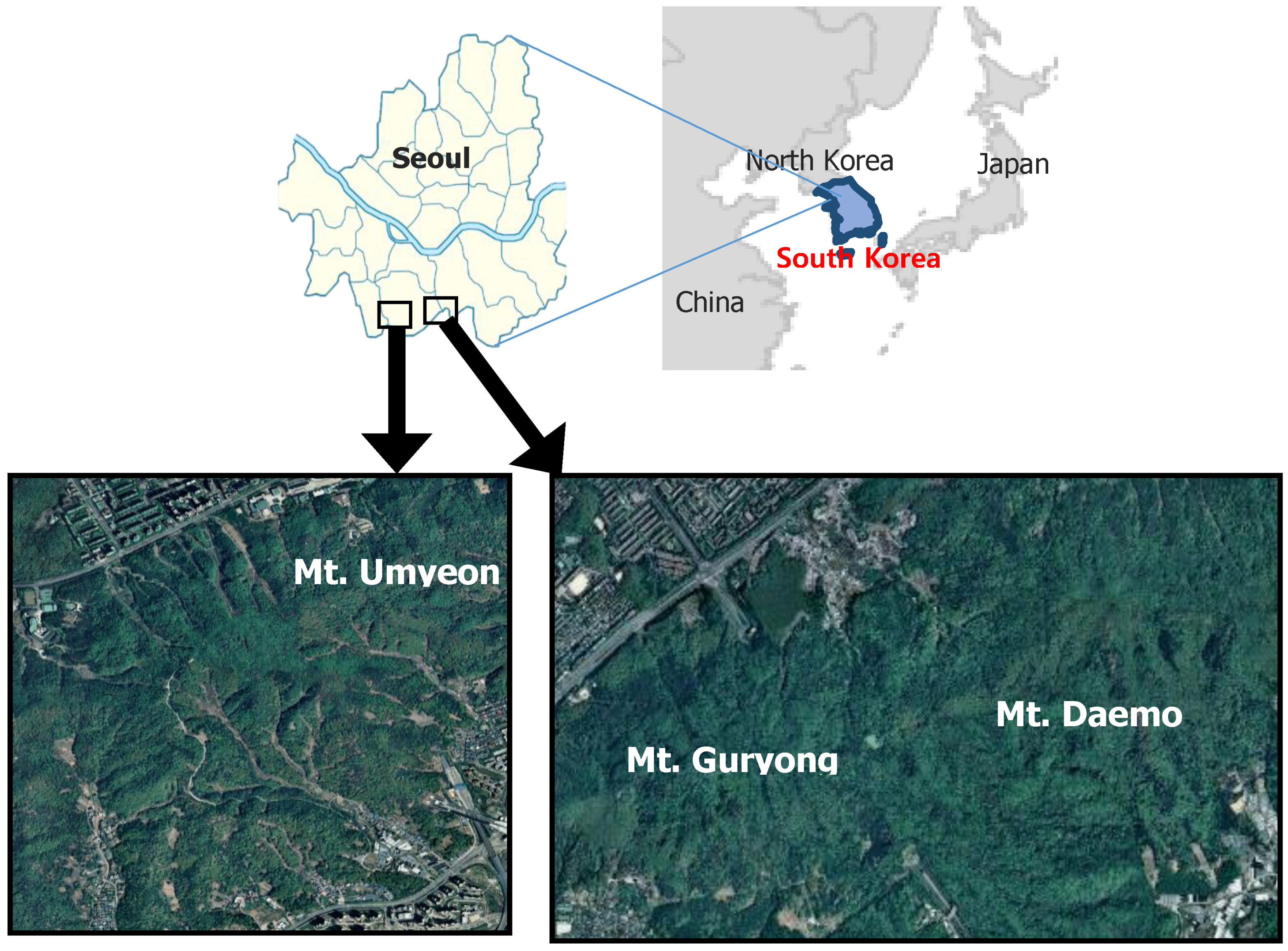
2.1. Study Area Descriptions
2.2. Hyperspectral Camera System
2.3. Image Correction
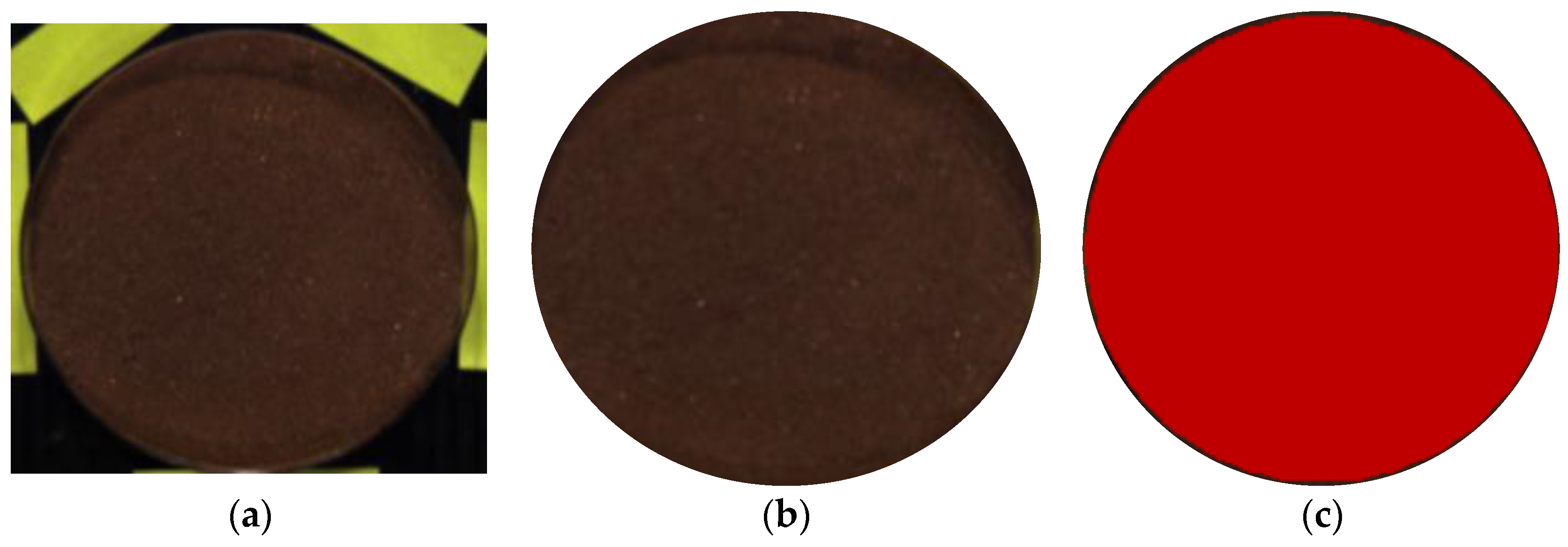
2.4. Region of Interest (ROI) Selection
2.5. Spectral Feature and Image Texture Feature Extraction
2.5.1. Spectral Pre-Processing
2.5.2. Selection of Effective Wavelength
2.5.3. Image Texture Feature Extraction
- (1)
- Contrast: Returns a measure of the intensity contrast between a pixel and its neighbor over the entire image:
- (2)
- Correlation: Returns a measure of how correlated a pixel is to its neighbor over the entire image:
- (3)
- Energy: Returns the sum of the squared elements in the GLCM:
- (4)
- Homogeneity: Returns a value that measures the closeness of the distribution of elements in the GLCM to the GLCM diagonal:
2.5.4. Classification Models and Regression Analysis
2.5.5. Prediction of Soil Water Content Variation
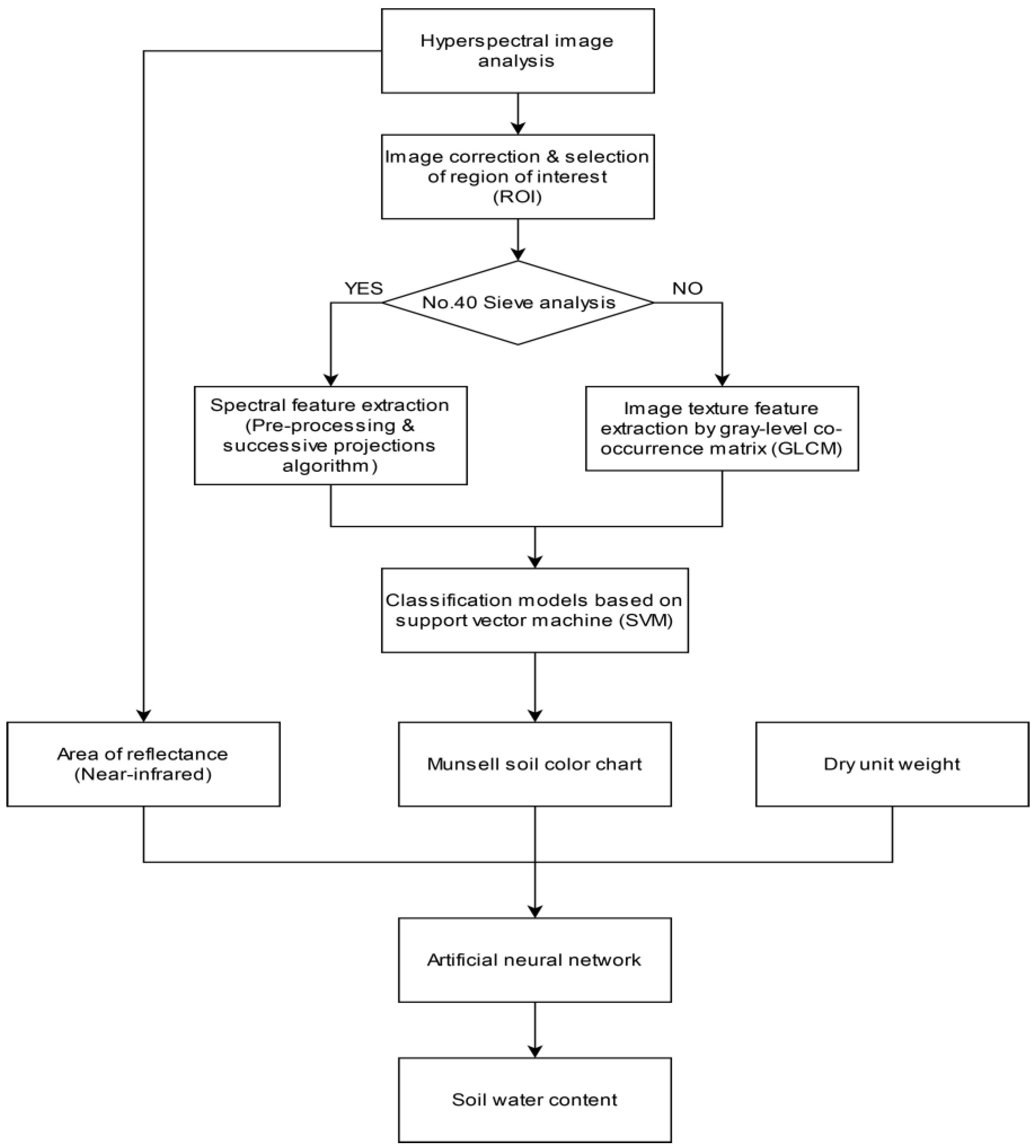
2.6. Overall Developed Workflow
3. Results and Discussion
3.1. Comparison of Pre-Processing Methods
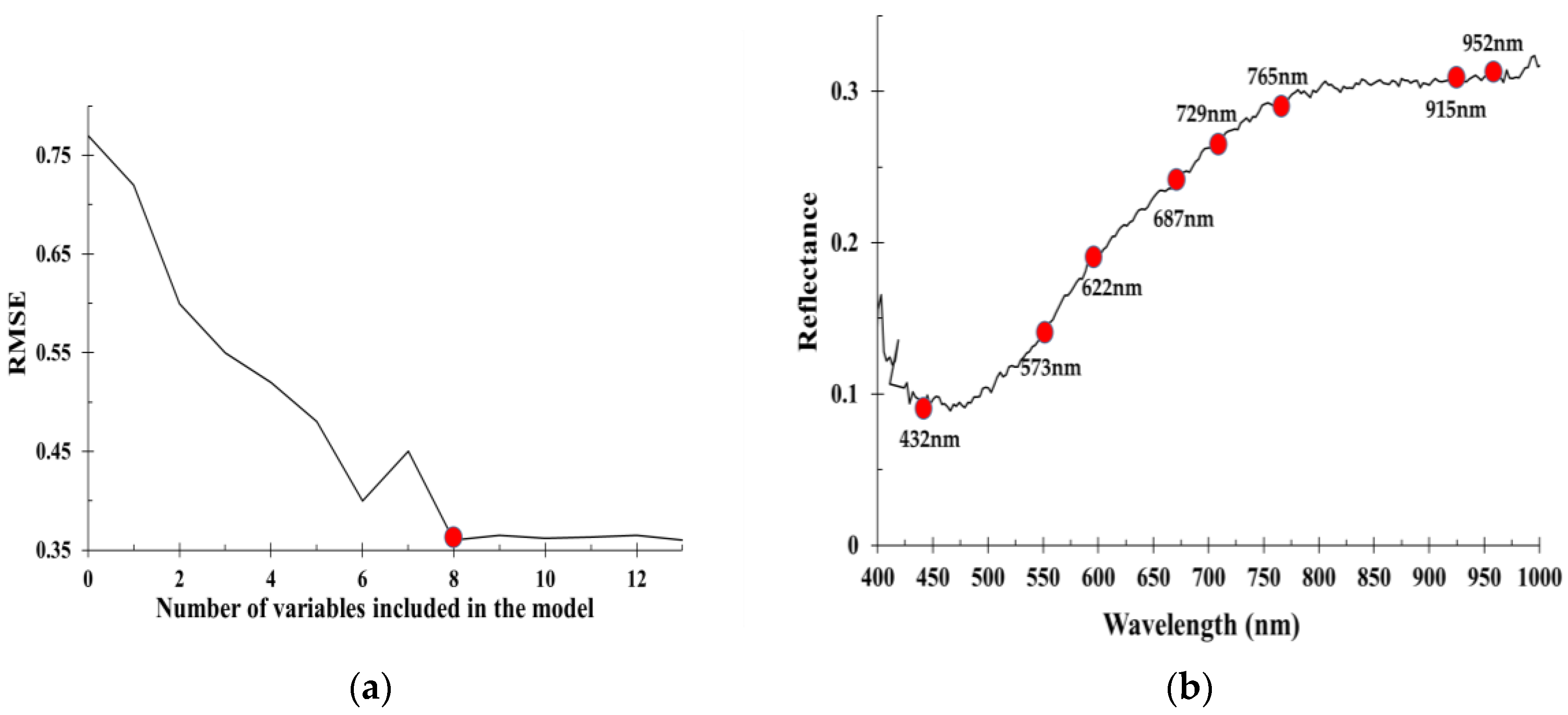
3.2. Selection of Effective Wavelength
3.3. Optimal ANN Structure for the Prediction of Soil Water Content
3.4. Validation of the Selected ANN Model
4. Conclusions
- (1)
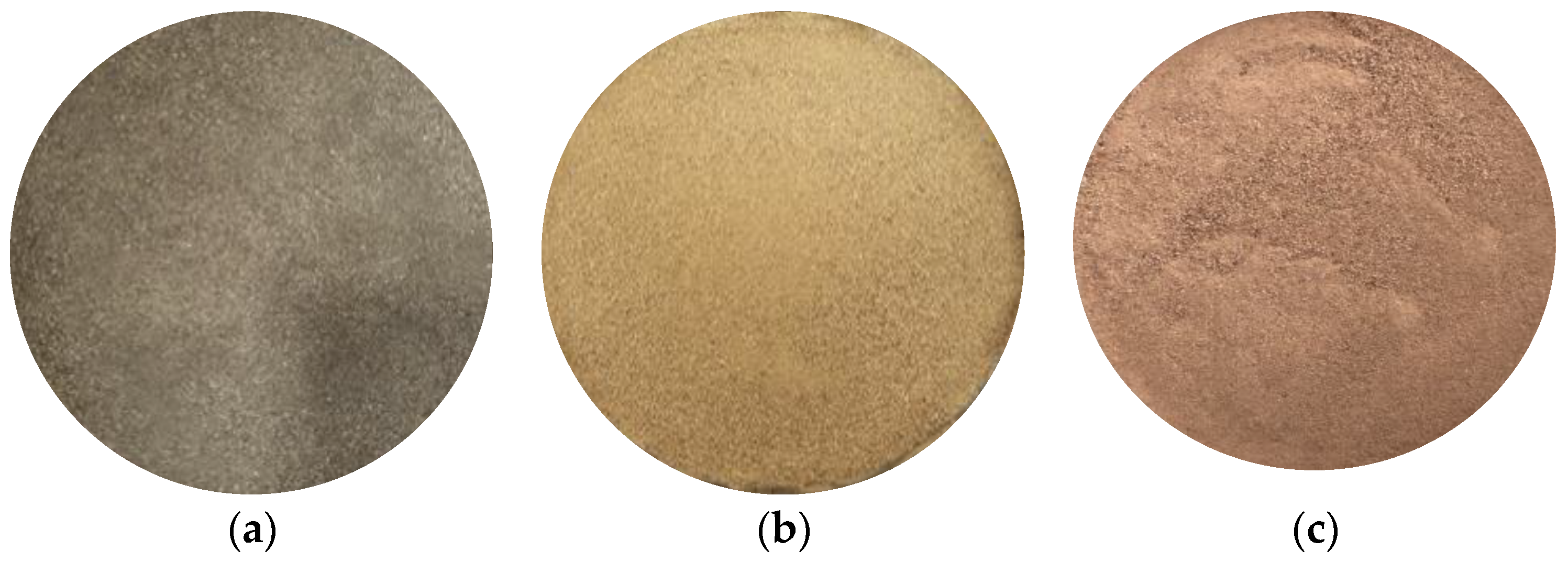
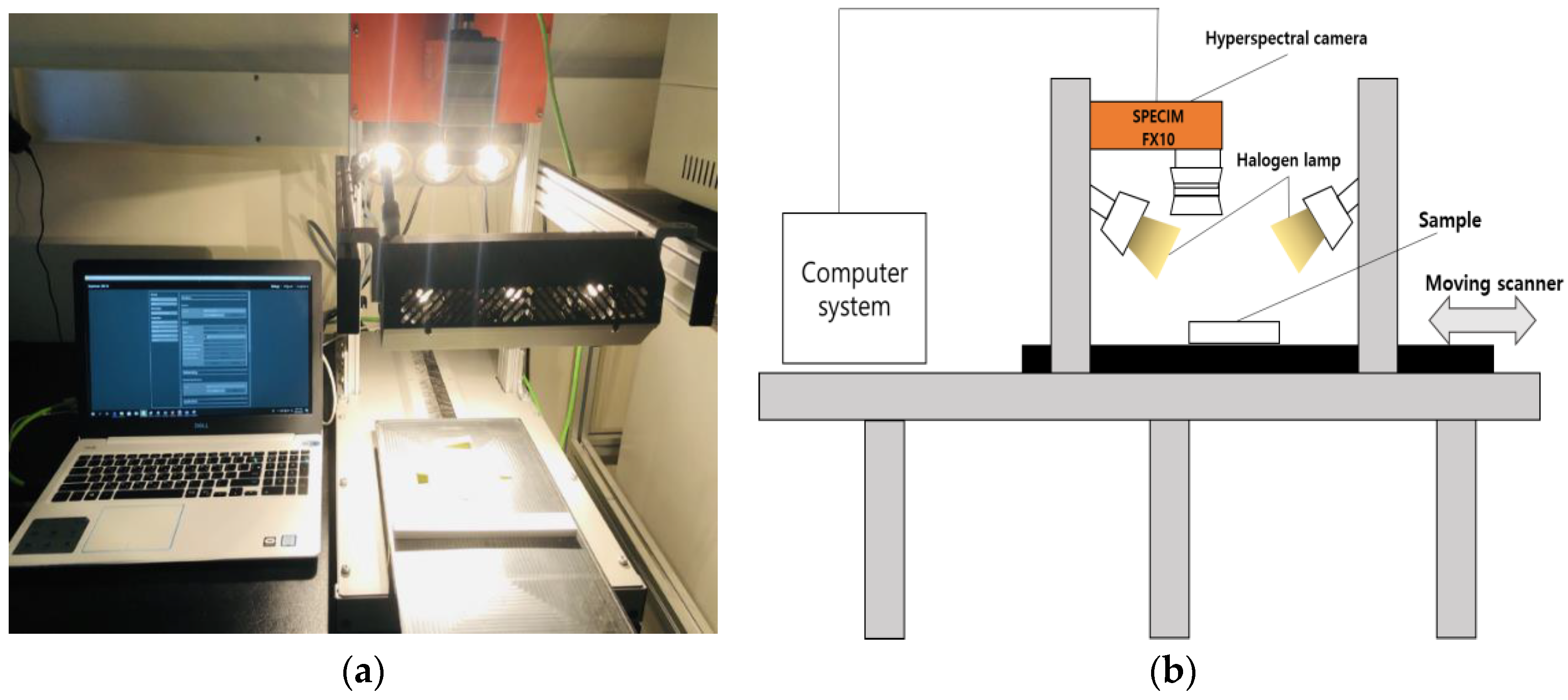
- A total of 162 granite weathered soil samples were collected from Mt. Umyeon, Mt. Guryong, and Mt. Daemo in Seoul. Hyperspectral near-infrared images were acquired in 224 bands from 400 to 1000nm. To reduce spectral noise and error, the beginning and end of the wavelength spectrum were removed and only 204 bands were used.
- (2)
- The second derivative method was selected as the pre-processing method. The classification model produced the best results with a combination of eight effective wavelengths and GLCM-texture features of contrast, correlation, energy, and homogeneity. The testing set accuracy of the classification model was 89.8%.
- (3)
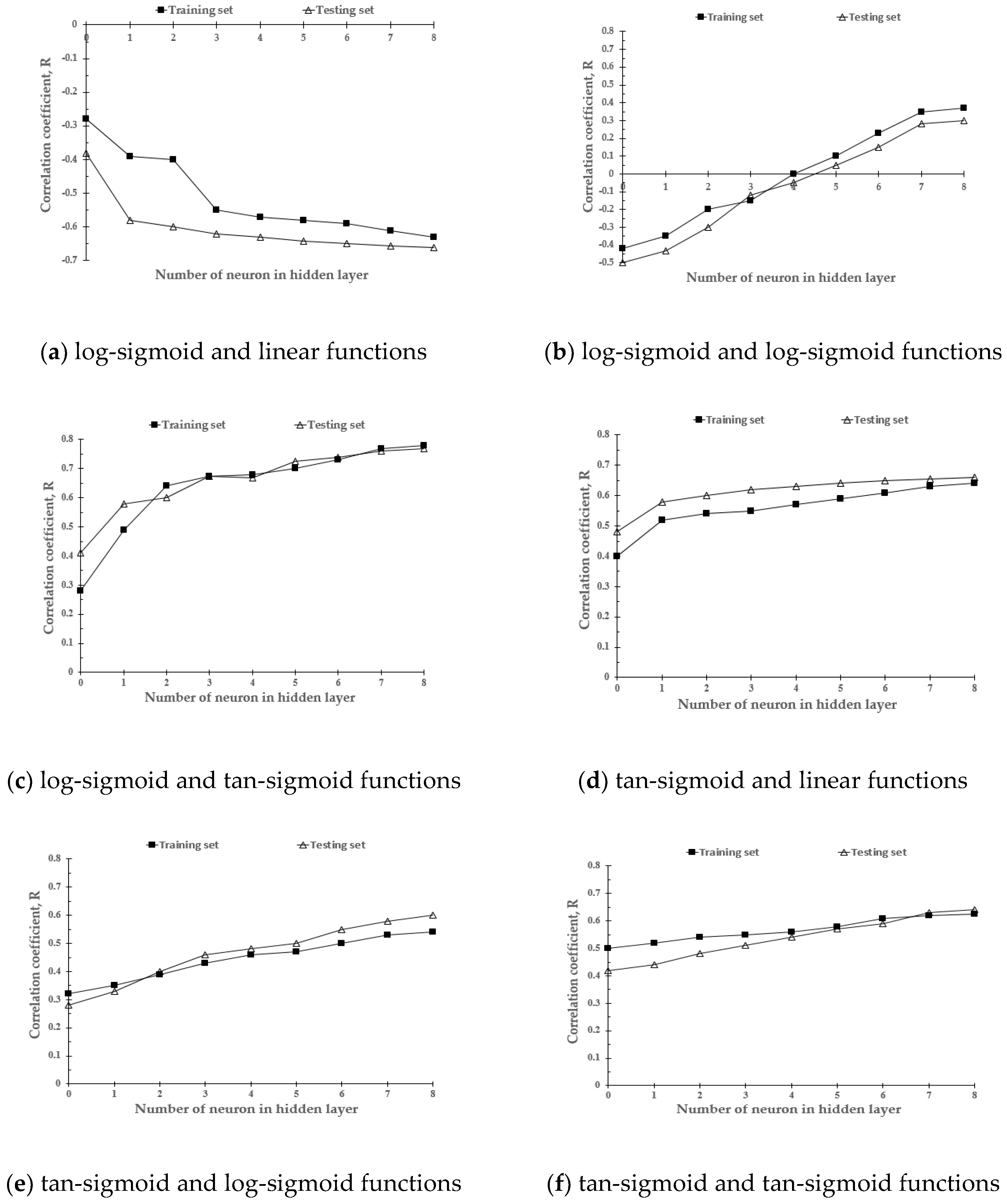
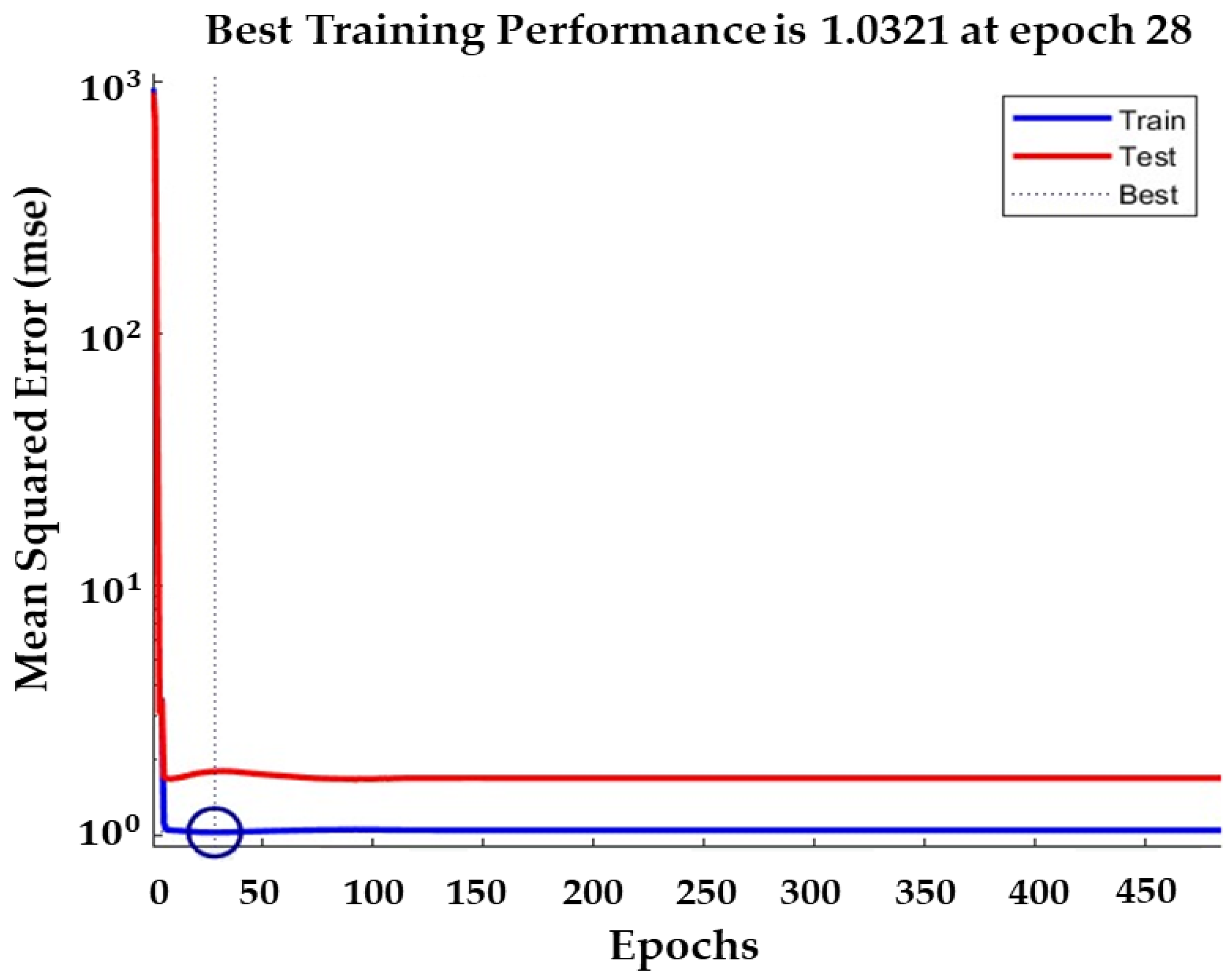
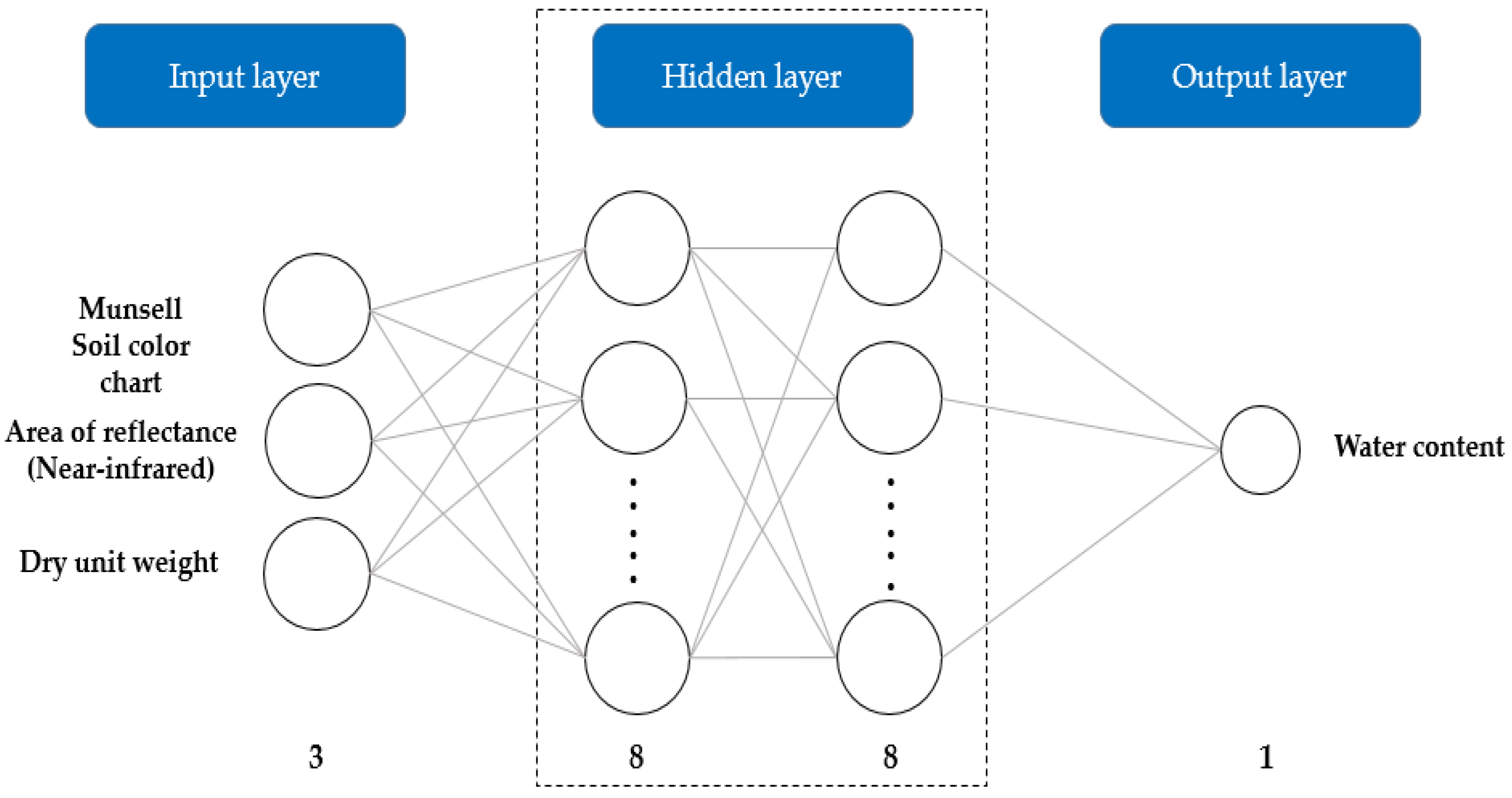
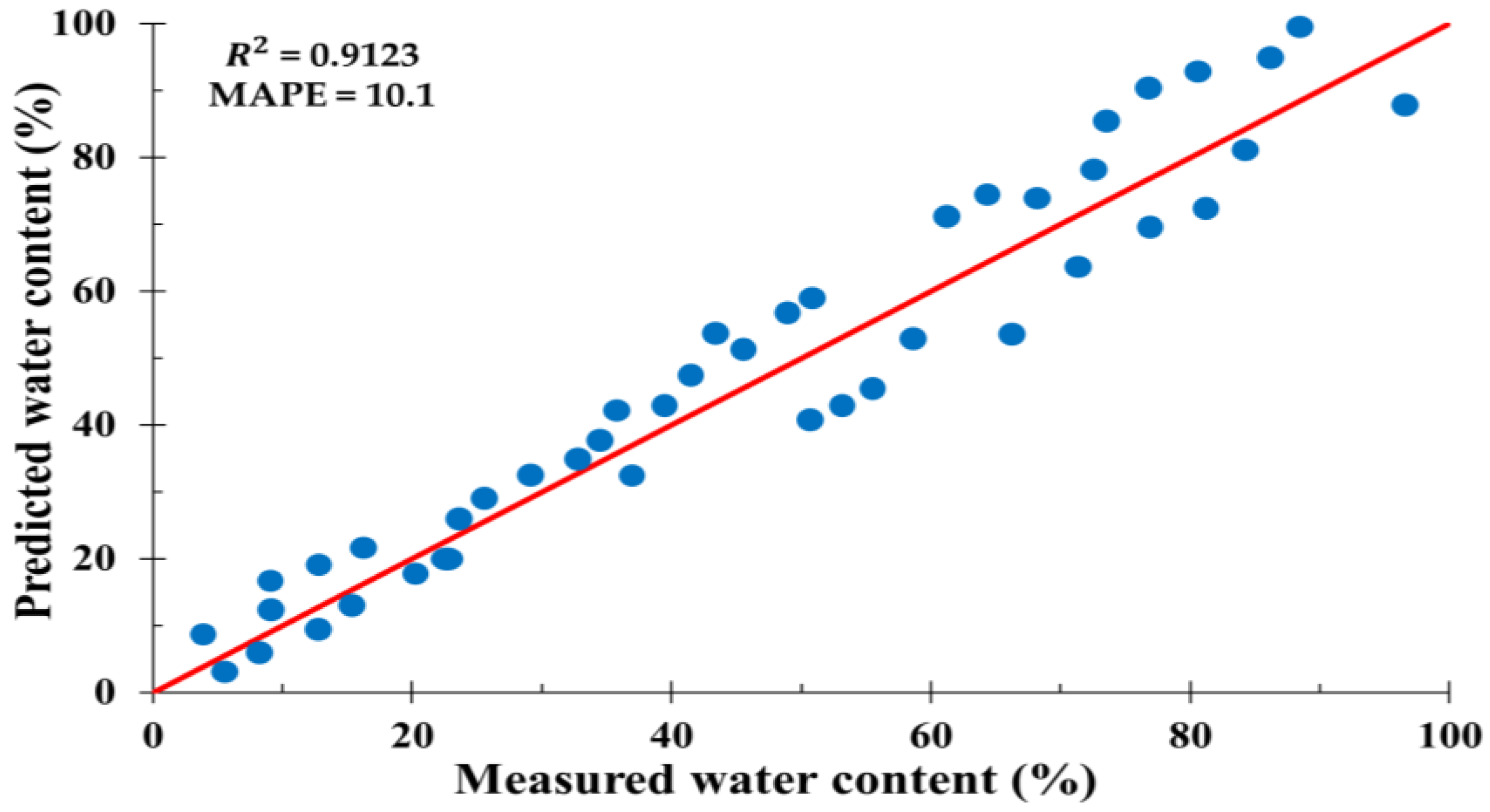
- An optimal ANN model was developed for water content prediction. The ANN had three input parameters, eight neurons in the hidden layers, and one output parameter. The transfer functions involved were a log-sigmoid function in the first hidden layer, a tan-sigmoid function in the second hidden layer, and a pure linear function in the output layer. The developed ANN model exhibited good prediction accuracy, generating an R2 value of 0.91 and a MAPE of 10.1%. In addition, the training performance in terms of the convergence of ANN for the data variables was the highest at epoch 28 with a mean squared error of 1.0321. Therefore, it can be concluded that the ANN model can be successfully used to predict variations in soil water content accurately.
Author Contributions
Funding
Conflicts of Interest
References
- Ray, R.L.; Jacobs, J.M. Relationships among remotely sensed soil moisture, precipitation and landslide events. Nat. Hazards 2007, 43, 211–222. [Google Scholar] [CrossRef]
- Di, B.; Zhang, H.; Liu, Y.; Li, J.; Chen, N.; Stamatopoulos, C.A.; Zhan, Y. Assessing susceptibility of debris flow in southwest China using gradient boosting machine. Sci. Rep. 2019, 9, 1–12. [Google Scholar] [CrossRef] [PubMed]
- Guzzetti, F.; Gariano, S.L.; Peruccacci, S.; Brunetti, M.T.; Marchesini, I.; Rossi, M.; Melillo, M. Geographical landslide early warning systems. Earth Sci. Rev. 2019, 200, 102973. [Google Scholar] [CrossRef]
- Rossel, R.V.; Walvoort, D.J.J.; McBratney, A.B.; Janik, L.J.; Skjemstad, J.O. Visible, near infrared, mid infrared or combined diffuse reflectance spectroscopy for simultaneous assessment of various soil properties. Geoderma 2006, 131, 59–75. [Google Scholar] [CrossRef]
- United States Department of Agriculture, National Cooperative Soil Survey. Exploring Soil Colors. Available online: https://www.nrcs.usda.gov/wps/portal/nrcs/detail/wi/soills/?cid=NRCSEPRD1370419 (accessed on 2 January 2020).
- Ibáñez-Asensio, S.; Marques-Mateu, A.; Moreno-Ramón, H.; Balasch, S. Statistical relationships between soil colour and soil attributes in semiarid areas. Biosyst. Eng. 2013, 116, 120–129. [Google Scholar] [CrossRef]
- The National Atlas of Korea. Available online: http://nationalatlas.ngii.go.kr/pages/page_678.php (accessed on 20 December 2019).
- De Smedt, F. Slope Stability Analysis Using GIS on a Regional Scale: A Case Study of Narayanghat-Mungling Highway Section, Nepal. Ph.D. Thesis, Universiteit Gent, Gent, Belgium, 2005. [Google Scholar]
- Park, S.; Kim, J.; Lee, S. A study on speedy water content measurement method for soils. J. Korean Geotech. Soc. 2017, 33, 57–65. [Google Scholar]
- Berney, E.; Ernest, S.; Kyzar, J.; Oyelami, L. Device Comparison for Determining Field Soil Moisture Content. U.S. Army Engineering Research and Development Center: Vicksburg, MS, USA, 2011; ERDC/GSL TR-11-42. [Google Scholar]
- Jia, S.; Li, H.; Wang, Y.; Tong, R.; Li, Q. Hyperspectral imaging analysis for the classification of soil types and the determination of soil total nitrogen. Sensors 2017, 17, 2252. [Google Scholar] [CrossRef]
- Njoku, E.G.; Entekhabi, D. Passive microwave remote sensing of soil moisture. J. Hydrol. 1996, 184, 101–129. [Google Scholar] [CrossRef]
- Ulaby, F.T.; Dubois, P.C.; Van Zyl, J. Radar mapping of surface soil moisture. J. Hydrol. 1996, 184, 57–84. [Google Scholar] [CrossRef]
- Xing, J.; Bravo, C.; Jancsók, P.T.; Ramon, H.; De Baerdemaeker, J. Detecting bruises on “golden delicious” apples using hyperspectral imaging with multiple wavebands. Biosyst. Eng. 2005, 90, 27–36. [Google Scholar] [CrossRef]
- Leiva-Valenzuela, G.A.; Lu, R.; Aguilera, J.M. Prediction of firmness and soluble solids content of blueberries using hyperspectral reflectance imaging. J. Food Eng. 2013, 115, 91–98. [Google Scholar] [CrossRef]
- Mitra, K.; Melvin, J.; Chang, S.; Park, K.; Yilmaz, A.; Melvin, S.; Xu, R.X. Indocyanine-green-loaded microballoons for biliary imaging in cholecystectomy. J. Biomed. Opt. 2012, 17, 116025. [Google Scholar] [CrossRef] [PubMed]
- Zhang, L.; Xia, G.S.; Wu, T.; Lin, L.; Tai, X.C. Deep learning for remote sensing image understanding. J. Sensors 2016, 2016, 1–2. [Google Scholar] [CrossRef]
- Galvao, R.K.H.; Araujo, M.C.U.; Fragoso, W.D.; Silva, E.C.; Jose, G.E.; Soares, S.F.C.; Paiva, H.M. A variable elimination method to improve the parsimony of MLR models using the successive projections algorithm. Chemom. Intell. Lab. Syst. 2008, 92, 83–91. [Google Scholar] [CrossRef]
- Li, J.; Tian, X.; Huang, W.; Zhang, B.; Fan, S. Application of long-wave near infrared hyperspectral imaging for measurement of soluble solid content (SSC) in pear. Food Anal. Methods 2016, 9, 3087–3098. [Google Scholar] [CrossRef]
- Mollazade, K. Non-destructive identifying level of browning development in button mushroom (Agaricus bisporus) using hyperspectral imaging associated with chemometrics. Food Anal. Methods 2017, 10, 2743–2754. [Google Scholar] [CrossRef]
- Cai, S.; Zhang, R.; Liu, L.; Zhou, D. A method of salt-affected soil information extraction based on a support vector machine with texture features. Math. Comput. Modell. 2010, 51, 1319–1325. [Google Scholar] [CrossRef]
- Mohanaiah, P.; Sathyanarayana, P.; GuruKumar, L. Image texture feature extraction using GLCM approach. Int. J. Sci. Res. Publ. 2013, 3, 1–5. [Google Scholar]
- Gadkari, D. Image Quality Analysis Using GLCM. Master’s Thesis, University of Central Florida, Orlando, FL, USA, December 2004. [Google Scholar]
- Perception Wiki. Available online: https://wiki.perception-park.com/display/MAN/LUMO+Scanner+Setup (accessed on 28 February 2020).
- ENVI User’s Guide. Harris Geospatial Solution Inc., Visual Information Solutions, Boulder, CO, USA. Available online: http://www.harrisgeospatial.com/portals/0/pdfs/envi/ENVI_User_Guide.pdf (accessed on 5 November 2019).
- SPEIM IQ User Manual. Available online: https://www.specim.fi/iq/manual/index.html (accessed on 25 November 2019).
- Perner, P. Machine learning and data mining in pattern recoginition, 2nd ed. In Proceedings of the 12th International Conference, New York, NY, USA, 16–21 July 2016; pp. 460–462. [Google Scholar]
- Rinnan, Å.; Van Den Berg, F.; Engelsen, S.B. Review of the most common pre-processing techniques for near-infrared spectra. TrAC Trends Anal. Chem. 2009, 28, 1201–1222. [Google Scholar] [CrossRef]
- Shao, X.; Ma, C. A general approach to derivative calculation using wavelet transform. Chemom. Intell. Lab. Syst. 2003, 69, 157–165. [Google Scholar] [CrossRef]
- Araújo, M.C.U.; Saldanha, T.C.B.; Galvao, R.K.H.; Yoneyama, T.; Chame, H.C.; Visani, V. The successive projections algorithm for variable selection in spectroscopic multicomponent analysis. Chemom. Intell. Lab. Syst. 2001, 57, 65–73. [Google Scholar] [CrossRef]
- MATLAB. MathWorks Inc.: Natick, MA, USA. Available online: https://www.mathworks.com/help/ident/ref/spa.html (accessed on 5 November 2019).
- Vidyashanakara, N.M.; Kumar, G.H. Leaf classification based on GLCM texture and SVM. Int. J. Future Revolut. Comput. Sci. Commun. Eng. 2018, 4, 156–159. [Google Scholar]
- Xian, G.M. An identification method of malignant and benign liver tumors from ultrasonography based on GLCM texture features and fuzzy SVM. Expert Syst. Appl. 2010, 37, 6737–6741. [Google Scholar] [CrossRef]
- Zhang, L. Optimizing ANN training performance for chaotic time series prediction using small data size. Int. J. Mach. Learn. Comput. 2018, 8, 1–7. [Google Scholar]
- Olawoyin, R.; Nieto, A.; Grayson, R.L.; Hardisty, F.; Oyewole, S. Application of artificial neural network (ANN)-self-organizing map (SOM) for the categorization of water, soil and sediment quality in petrochemical regions. Expert Syst. Appl. 2013, 40, 3634–3648. [Google Scholar] [CrossRef]
- Rosenblatt, F. Principles of Neuro Dynamics: Perceptrons and the Theory of Brain Mechanisms; Spartan Books: Washington, DC, USA, 1962; pp. 29–51. [Google Scholar]
- Bagińska, M.; Srokosz, P.E. The optimal ANN model for predicting bearing capacity of shallow foundations trained on scarce data. KSCE J. Civ. Eng. 2019, 23, 130–137. [Google Scholar] [CrossRef]
- Pendleton, R.L.; Nickerson, D. Soil colors and special Munsell soil color charts. Soil Sci. 1951, 71, 35–44. [Google Scholar] [CrossRef]
- Thompson, J.A.; Pollio, A.R.; Turk, P.J. Comparison of Munsell soil color charts and the GLOBE soil color book. Soil Sci. Soc. Am. J. 2013, 77, 2089–2093. [Google Scholar] [CrossRef]
- Lim, H.; Cheon, E.; Lee, D.; Jeon, J.; Lee, S. Soil water content measurement technology using hyperspectral visible and near-infrared imaging technique. J. Korean Geotech. Soc. 2019, 35, 51–62. [Google Scholar]
- Kumar, V.; Jahangeer, J.; Tripathi, P.N.; Shaktibala, S. Comparative study of soil physical characteristics of Jaipur district, Rajasthan. Afr. J. Environ. Sci. Technol. 2017, 11, 45–55. [Google Scholar]
- Song, A.; Jeon, W.; Kim, Y. Study of prediction model improvement for apple soluble solids content using a ground-based hyperspectral scanner. Korean J. Remote Sens. 2017, 33, 559–570. [Google Scholar]
- MacKay, D.J. Bayesian interpolation. Neural Comput. 1992, 4, 415–447. [Google Scholar] [CrossRef]
- Sim, K.; Kwon, H. A study on forecasting visit demands of Korea national park using seasonal ARIMA model. Korean Soc. For. Sci. 2011, 100, 124–130. [Google Scholar]
- Mui, H.W.; Chu, C.W. Forecasting the spot price of gold: Combined forecast approaches versus A composite forecast approach. J. Appl. Stat. 1993, 20, 13–23. [Google Scholar] [CrossRef]
- Gunter, S.I.; Aksu, C. N-step combinations of forecasts. J. Forecast. 1989, 8, 253–267. [Google Scholar] [CrossRef]
- Flores, B.E.; White, E.M. Subjective versus objective combining of forecasts: An experiment. J. Forecast. 1989, 8, 331–341. [Google Scholar] [CrossRef]
- Lam, K.F.; Mui, H.W.; Yuen, H.K. A note on minimizing absolute percentage error in combined forecasts. Comput. Oper. Res. 2001, 28, 1141–1147. [Google Scholar] [CrossRef]





| Type | Sample Number |
|---|---|
| Brown soils | 61 |
| Yellow soils | 52 |
| Red soils | 49 |
| Parameter | Value |
|---|---|
| Spectral Range | 400 nm~1000 nm |
| Spectral Bands | 224 |
| Spatial Sampling | 1024 px |
| Spectral Full width at half maximum | 5.5 nm |
| Field of view (α) | 38° |
| Camera Signal to noise ratio (Peak) | 660:1 |
| Dimensions | mm |
| Weight | 1.26 kg |
| Number of Neurons | Combination of Transfer Functions |
|---|---|
| 1–8 | log sigmoid—pure linear |
| log sigmoid—log sigmoid | |
| log sigmoid—tan sigmoid | |
| tan sigmoid—pure linear | |
| tan sigmoid—log sigmoid | |
| tan sigmoid—tan sigmoid |
| Pre-Processing Method | Calibration (Support Vector Machines) | Prediction (Support Vector Machines) |
|---|---|---|
| First Derivative | 77.8 | 76.9 |
| Second Derivative | 82.2 | 80.8 |
| Input | Parameters (C, g) 1 | Training Set Accuracy | Testing Set Accuracy |
|---|---|---|---|
| Full wavelength | (53.34, 1.52) | 87.8 % | 84.2 % |
| Effective wavelengths | (38.22, 5.4) | 90.2 % | 85.3 % |
| GLCM-Texture features | (98.73, 1.22) | 72.3 % | 69.7 % |
| Effective wavelengths + GLCM-Texture features | (170.36, 5.33) | 92.3 % | 89.8 % |
© 2020 by the authors. Licensee MDPI, Basel, Switzerland. This article is an open access article distributed under the terms and conditions of the Creative Commons Attribution (CC BY) license (http://creativecommons.org/licenses/by/4.0/).
Share and Cite
Lim, H.-H.; Cheon, E.; Lee, D.-H.; Jeon, J.-S.; Lee, S.-R. Classification of Granite Soils and Prediction of Soil Water Content Using Hyperspectral Visible and Near-Infrared Imaging. Sensors 2020, 20, 1611. https://doi.org/10.3390/s20061611
Lim H-H, Cheon E, Lee D-H, Jeon J-S, Lee S-R. Classification of Granite Soils and Prediction of Soil Water Content Using Hyperspectral Visible and Near-Infrared Imaging. Sensors. 2020; 20(6):1611. https://doi.org/10.3390/s20061611
Chicago/Turabian StyleLim, Hwan-Hui, Enok Cheon, Deuk-Hwan Lee, Jun-Seo Jeon, and Seung-Rae Lee. 2020. "Classification of Granite Soils and Prediction of Soil Water Content Using Hyperspectral Visible and Near-Infrared Imaging" Sensors 20, no. 6: 1611. https://doi.org/10.3390/s20061611
APA StyleLim, H.-H., Cheon, E., Lee, D.-H., Jeon, J.-S., & Lee, S.-R. (2020). Classification of Granite Soils and Prediction of Soil Water Content Using Hyperspectral Visible and Near-Infrared Imaging. Sensors, 20(6), 1611. https://doi.org/10.3390/s20061611