How Laboratory Experiments Can Be Exploited for Monitoring Stress in the Wild: A Bridge Between Laboratory and Daily Life

 , , and
Abstract
1. Introduction
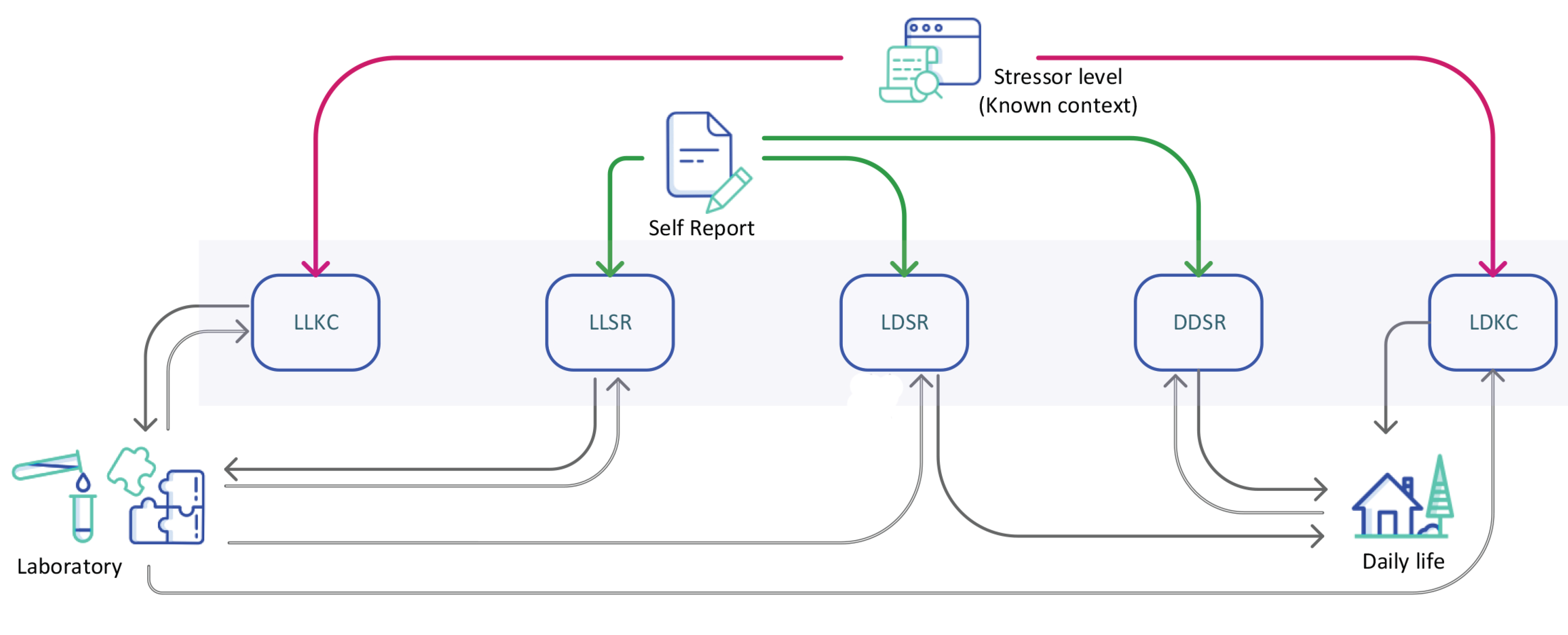
- Developing laboratory-based models to improve the performance of daily life stress detection systems;
- Comparing the performance of laboratory, daily life, and hybrid laboratory-daily life models;
- Collection of smartwatch-based EDA and HRV data coming from the laboratory and daily life (14 participants, 1003 h of physiological data with 388 ecological momentary assessments (EMAs)), with self-reports and context information;
- Investigating the effect of using context and self-report labels while training the model on system accuracy in different environments.
2. Related Work
3. Methodology
3.1. Laboratory Data Collection
- Setup
- Pre-stress measurements (baseline)
- The TSST (Trier Social Stress Test) (inducing stress)
- Post-stress recovery measurements (recovery)
3.1.1. Setup
- Preparation of experiment areas: The camera should be set. Empatica E4 should be ready.
- Interviewers should keep eye contact with the participant. Their gestures and facial expressions should be neutral.
- The participant is informed about the procedure and then signs the consent form.
- The participant wears the smart band (Empatica E4).
- The participant is asked to turn off his/her phone in order to eliminate distraction.
3.1.2. Pre-Stress Measurements
- The participant filled out the Perceived Stress Scale (PSS) with 14 questions.
- The participant was told to stay in the waiting area and get rest for 10 min. Reading materials such as magazines with emotionally-neutral contents (home and garden, car magazines) were presented to the participant for this period.
3.1.3. The TSST
- The participant was directed to the interview area.
- TSST speech preparation period: the following text was read to the participant: “This is the speech preparation portion of the task; you are expected to prepare a five-minute speech describing why you study [name of the degree that the participant studies/studied] and why you would be a good candidate for your ideal job. Your speech will be videotaped and reviewed by the psychologists that we conduct the research with. You have five minutes to prepare and your time begins now.”
- The participant prepared his/her speech. There should be a digital timer in the room set to five minutes. Interviewers should leave the room.
- The following text was read to the participant at the end of the speech preparation period: “This is the speech portion of the task. You should speak for the entire five-minute time period. Your time begins now”. Interviewers should start the recording of the camera.
- TSST speech performance period: If the participant stopped during this period, interviewers allowed him/her to stay silent for around 20 s and then prompted: “You still have time remaining.”
- After the first 2 min of the speech period, the participants were interrupted and asked to continue their speech in English by telling them: “Could you continue in English from now on, please?”
- At the end of 2.5 min, if the participant did not attempt to reply to both questions, interviewers prompted the participant to answer the other question.
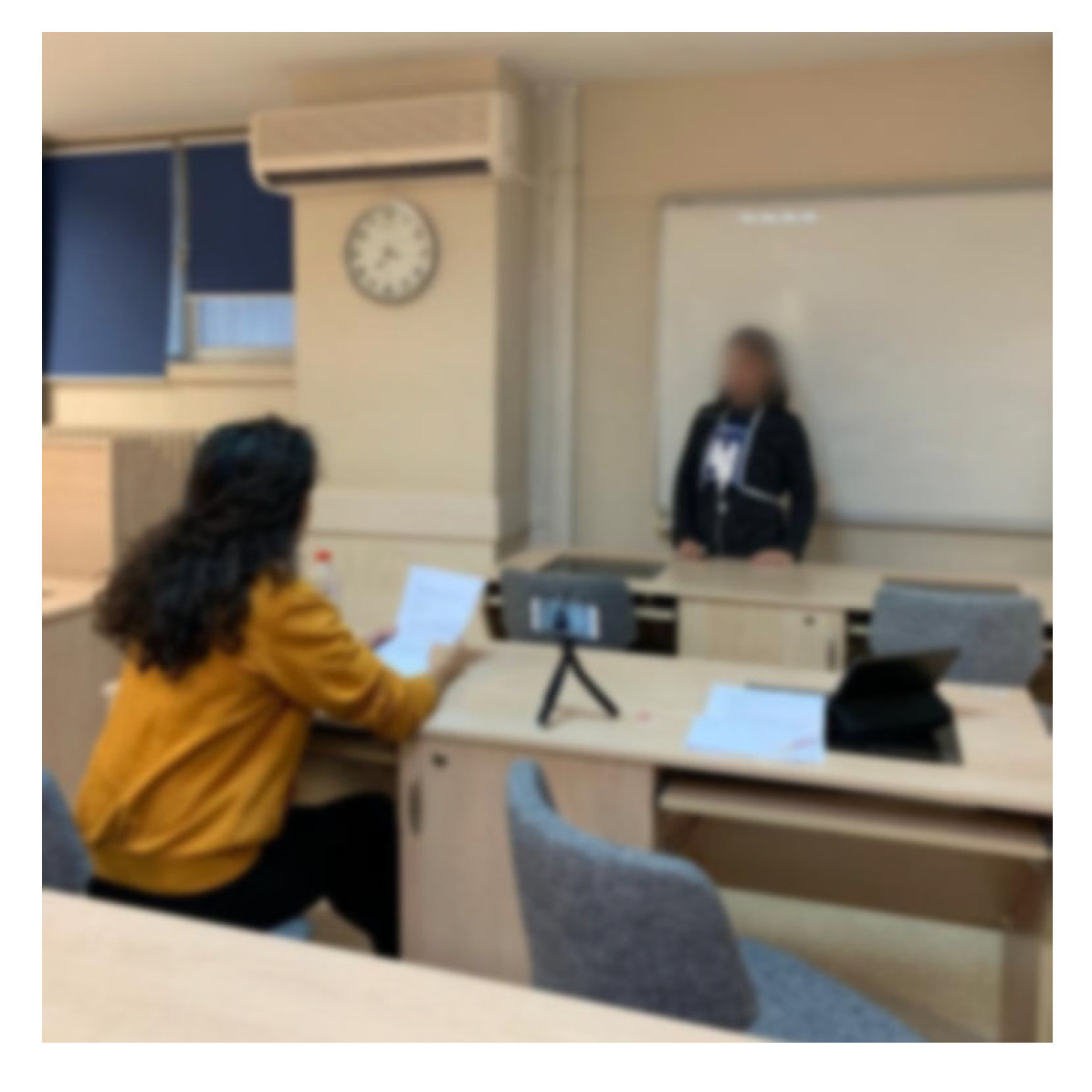
- At the end of the speech performance period, the communication between interviewers and the participant resumed in Turkish. Interviewers reset the timer to 5 min and read the following to the participant: “During the final five-minute math portion of this task, you will be asked to subtract 13 from 1022 sequentially. You will verbally report your answers aloud, and be asked to start over from 1022 if a mistake is made. Your time begins now.” If the participant makes any mistake, the interviewer says the following: “That is incorrect, please start over from 1022.” (Figure 2)
- Participant filled out the PSS-5 questionnaire.
3.1.4. Post-Stress Recovery Measurements
- Participants were directed to the couch as a relaxing place.
- Participants wore an Apple Watch given to him/her at this stage, followed the breathing exercise built in the Apple Watch for a minute and then followed a mindfulness video, for the remaining four minutes, on a comfortable couch, sitting or lying as the participant preferred.
- Interviewers should leave the room after giving the Apple Watch.
- At the end of the five minute long recovery period, interviewers returned to the room, and the participant filled out the PSS-5 questionnaire.
3.2. Daily Life Data Collection and Ecological Momentary Assessment
3.3. Stress Recognition Framework
3.3.1. Preprocessing
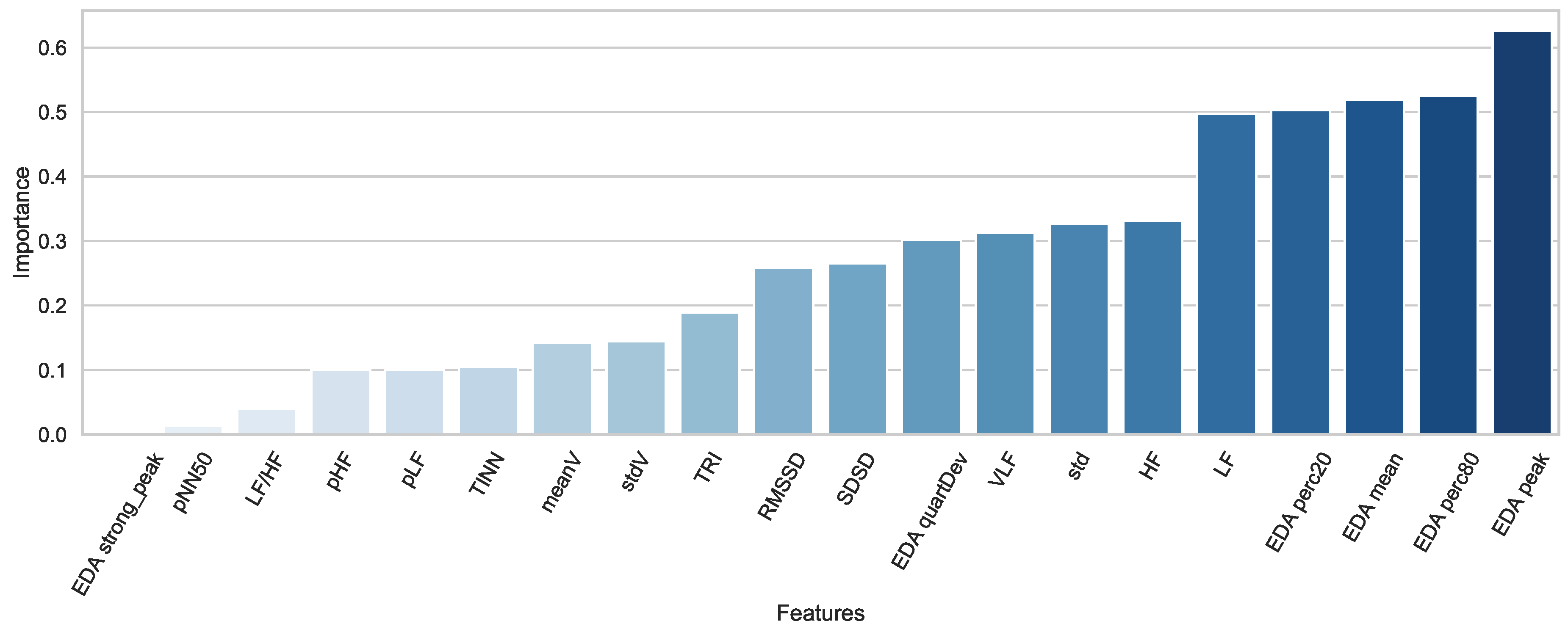
3.3.2. Feature Extraction
- Mean value
- Standard deviation
- Number of peaks
- Number of strong peaks
- Twentieth percentile
- Eightieth percentile
- Quartile deviation
- Mean value of the inter-beat (RR) intervals
- Standard deviation of the inter-beat interval
- Root mean square of the successive difference of the RR intervals.
- Percentage of the number of the successive RR intervals varying more than 50 ms from the previous interval
- Total number of RR intervals divided by the height of the histogram of all RR intervals measured on a scale with bins of 1/128 s
- Triangular interpolation of RR interval histogram
- Power in the low-frequency band (0.04–0.15 Hz)
- Power in the high-frequency band (0.15–0.4 Hz)
- Ratio of LF to HF.
- Prevalent low-frequency oscillation of the heart rate
- Prevalent high-frequency oscillation of the heart rate
- Power in the very low-frequency band (0.00–0.04 Hz)
- Related standard deviation of successive RR interval differences
3.3.3. Feature Selection
3.3.4. Preparation of the Data for ML Algorithms
3.3.5. Forming ML Models
3.3.6. Classification Algorithms
4. Experimental Results and Discussion
4.1. Laboratory Experiments
4.2. Testing the Models in the Wild
5. Conclusions
Author Contributions
Funding
Conflicts of Interest
References
- Andreassi, J.L. Psychophysiology: Human Behavior and Physiological Response; Psychology Press: Hove, UK, 2010. [Google Scholar]
- Quintana, D.S.; Guastella, A.J.; Outhred, T.; Hickie, I.B.; Kemp, A.H. Heart rate variability is associated with emotion recognition: Direct evidence for a relationship between the autonomic nervous system and social cognition. Int. J. Psychophysiol. 2012, 86, 168–172. [Google Scholar] [CrossRef] [Scilit] [PubMed]
- Berntson, G.G.; Thomas Bigger, J., Jr.; Eckberg, D.L.; Grossman, P.; Kaufmann, P.G.; Malik, M.; Nagaraja, H.N.; Porges, S.W.; Saul, J.P.; Stone, P.H.; et al. Heart rate variability: Origins, methods, and interpretive caveats. Psychophysiology 1997, 34, 623–648. [Google Scholar] [CrossRef] [Scilit] [PubMed]
- Critchley, H.D. Electrodermal responses: What happens in the brain. Neuroscientist 2002, 8, 132–142. [Google Scholar] [CrossRef] [Scilit] [PubMed]
- Poh, M.Z.; Swenson, N.C.; Picard, R.W. A wearable sensor for unobtrusive, long-term assessment of electrodermal activity. IEEE Trans. Biomed. Eng. 2010, 57, 1243–1252. [Google Scholar]
- Krumpal, I. Determinants of social desirability bias in sensitive surveys: A literature review. Qual. Quant. 2013, 47, 2025–2047. [Google Scholar] [CrossRef] [Scilit]
- Northrup, D.A. The Problem of the Self-Report in Survey Research; Institute for Social Research, York University: Toronto, ON, Canada, 1997. [Google Scholar]
- Liapis, A.; Katsanos, C.; Sotiropoulos, D.; Xenos, M.; Karousos, N. Stress Recognition in Human-Computer Interaction Using Physiological and Self-Reported Data: A Study of Gender Differences. In Proceedings of the 19th Panhellenic Conference on Informatics, Athens, Greece, 1–3 October 2015; Association for Computing Machinery: New York, NY, USA, 2015; pp. 323–328. [Google Scholar] [CrossRef] [Scilit]
- Sharma, N.; Gedeon, T. Elsarticle-template-1-numObjective measures, sensors and computational techniques for stress recognition and classification: A survey. Comput. Methods Programs Biomed. 2012, 108, 1287–1301. [Google Scholar] [CrossRef] [Scilit]
- Mohr, D.C.; Zhang, M.; Schueller, S.M. Personal sensing: Understanding mental health using ubiquitous sensors and machine learning. Annu. Rev. Clin. Psychol. 2017, 13, 23–47. [Google Scholar] [CrossRef] [Scilit]
- Picard, R.W. Automating the Recognition of Stress and Emotion: From Lab to Real-World Impact. IEEE MultiMedia 2016, 23, 3–7. [Google Scholar] [CrossRef] [Scilit]
- Ghamari, M. A review on wearable photoplethysmography sensors and their potential future applications in health care. Int. J. Biosens. Bioelectron. 2018, 4, 195. [Google Scholar] [CrossRef] [Scilit]
- Setz, C.; Arnrich, B.; Schumm, J.; La Marca, R.; Tröster, G.; Ehlert, U. Discriminating stress from cognitive load using a wearable EDA device. IEEE Trans. Inf. Technol. Biomed. 2009, 14, 410–417. [Google Scholar] [CrossRef] [Scilit]
- Zubair, M.; Yoon, C.; Kim, H.; Kim, J.; Kim, J. Smart wearable band for stress detection. In Proceedings of the 2015 5th International Conference on IT Convergence and Security (ICITCS), Kuala Lumpur, Malaysia, 24–27 August 2015; pp. 1–4. [Google Scholar]
- Castaldo, R.; Montesinos, L.; Melillo, P.; Massaro, S.; Pecchia, L. To What Extent Can We Shorten HRV Analysis in Wearable Sensing? A Case Study on Mental Stress Detection. In EMBEC & NBC 2017; Springer: Berlin, Germany, 2017; pp. 643–646. [Google Scholar]
- Abouelenien, M.; Burzo, M.; Mihalcea, R. Human acute stress detection via integration of physiological signals and thermal imaging. In Proceedings of the 9th ACM International Conference on PErvasive Technologies Related to Assistive Environments, Corfu Island, Greece, 29 June–1 July 2016; p. 32. [Google Scholar]
- Vanitha, V.; Krishnan, P. Real time stress detection system based on EEG signals. Biomed. Res. 2016, 1, S271–S275. [Google Scholar]
- Can, Y.S.; Chalabianloo, N.; Ekiz, D.; Ersoy, C. Continuous Stress Detection Using Wearable Sensors in Real Life: Algorithmic Programming Contest Case Study. Sensors 2019, 19, 1849. [Google Scholar] [CrossRef] [Scilit] [PubMed]
- Sandulescu, V.; Andrews, S.; Ellis, D.; Bellotto, N.; Mozos, O.M. Stress detection using wearable physiological sensors. In Proceedings of the International Work-Conference on the Interplay Between Natural and Artificial Computation, Elche, Spain, 1–5 June 2015; pp. 526–532. [Google Scholar]
- Tivatansakul, S.; Ohkura, M. Improvement of emotional healthcare system with stress detection from ECG signal. In Proceedings of the 2015 37th Annual International Conference of the IEEE Engineering in Medicine and Biology Society (EMBC), Milan, Italy, 25–29 August 2015; pp. 6792–6795. [Google Scholar]
- Akmandor, A.O.; Jha, N.K. Keep the Stress Away with SoDA: Stress Detection and Alleviation System. IEEE Trans. Multi-Scale Comput. Syst. 2017, 3, 269–282. [Google Scholar] [CrossRef] [Scilit]
- Ciman, M.; Wac, K. Individuals’ stress assessment using human-smartphone interaction analysis. IEEE Trans. Affect. Comput. 2016, 9, 51–65. [Google Scholar] [CrossRef] [Scilit]
- Hovsepian, K.; Al’Absi, M.; Ertin, E.; Kamarck, T.; Nakajima, M.; Kumar, S. cStress: Towards a Gold Standard for Continuous Stress Assessment in the Mobile Environment. In Proceedings of the 2015 ACM International Joint Conference on Pervasive and Ubiquitous Computing, Osaka, Japan, 7–11 September 2015; ACM: New York, NY, USA, 2015; pp. 493–504. [Google Scholar]
- Vildjiounaite, E.; Kallio, J.; Kyllönen, V.; Nieminen, M.; Määttänen, I.; Lindholm, M.; Mäntyjärvi, J.; Gimel’farb, G. Unobtrusive stress detection on the basis of smartphone usage data. Pers. Ubiquitous Comput. 2018, 22, 671–688. [Google Scholar] [CrossRef] [Scilit]
- Mishra, V.; Hao, T.; Sun, S.; Walter, K.N.; Ball, M.J.; Chen, C.H.; Zhu, X. Investigating the Role of Context in Perceived Stress Detection in the Wild. In Proceedings of the 2018 ACM International Joint Conference and 2018 International Symposium on Pervasive and Ubiquitous Computing and Wearable Computers, Singapore, 8–12 October 2018; pp. 1708–1716. [Google Scholar]
- Gjoreski, M.; Luštrek, M.; Gams, M.; Gjoreski, H. Monitoring stress with a wrist device using context. J. Biomed. Inform. 2017, 73, 159–170. [Google Scholar] [CrossRef] [Scilit] [PubMed]
- Li, F.; Xu, P.; Zheng, S.; Chen, W.; Yan, Y.; Lu, S.; Liu, Z. Photoplethysmography based psychological stress detection with pulse rate variability feature differences and elastic net. Int. J. Distrib. Sens. Netw. 2018, 14, 1550147718803298. [Google Scholar] [CrossRef] [Scilit]
- Lin, W.H.; Wu, D.; Li, C.; Zhang, H.; Zhang, Y.T. Comparison of heart rate variability from PPG with that from ECG. In Proceedings of the International Conference on Health Informatics, Verona, Italy, 15–17 September 2014; pp. 213–215. [Google Scholar]
- Bolanos, M.; Nazeran, H.; Haltiwanger, E. Comparison of heart rate variability signal features derived from electrocardiography and photoplethysmography in healthy individuals. In Proceedings of the 2006 International Conference of the IEEE Engineering in Medicine and Biology Society, New York, NY, USA, 30 August–3 September 2006; pp. 4289–4294. [Google Scholar]
- Selvaraj, N.; Jaryal, A.; Santhosh, J.; Deepak, K.K.; Anand, S. Assessment of heart rate variability derived from finger-tip photoplethysmography as compared to electrocardiography. J. Med. Eng. Technol. 2008, 32, 479–484. [Google Scholar] [CrossRef] [Scilit]
- Billeci, L.; Tonacci, A.; Brunori, E.; Raso, R.; Calderoni, S.; Maestro, S.; Morales, M.A. Autonomic nervous system response during light physical activity in adolescents with anorexia nervosa measured by wearable devices. Sensors 2019, 19, 2820. [Google Scholar] [CrossRef] [Scilit]
- Smets, E.; Velazquez, E.R.; Schiavone, G.; Chakroun, I.; D’Hondt, E.; De Raedt, W.; Cornelis, J.; Janssens, O.; Van Hoecke, S.; Claes, S.; et al. Large-scale wearable data reveal digital phenotypes for daily-life stress detection. NPJ Digit. Med. 2018, 1, 67. [Google Scholar] [CrossRef] [Scilit]
- Can, Y.S.; Arnrich, B.; Ersoy, C. Stress detection in daily life scenarios using smart phones and wearable sensors: A survey. J. Biomed. Inform. 2019, 92, 103139. [Google Scholar] [CrossRef] [Scilit] [PubMed]
- Giannakakis, G.; Grigoriadis, D.; Giannakaki, K.; Simantiraki, O.; Roniotis, A.; Tsiknakis, M. Review on psychological stress detection using biosignals. IEEE Trans. Affect. Comput. 2019. [Google Scholar] [CrossRef] [Scilit]
- Kirschbaum, C.; Pirke, K.M.; Hellhammer, D.H. The ‘Trier Social Stress Test’—A tool for investigating psychobiological stress responses in a laboratory setting. Neuropsychobiology 1993, 28, 76–81. [Google Scholar] [CrossRef] [Scilit] [PubMed]
- Cohen, S.; Kamarck, T.; Mermelstein, R. A global measure of perceived stress. J. Health Soc. Behav. 1983, 24, 385–396. [Google Scholar] [CrossRef] [Scilit] [PubMed]
- Plarre, K.; Raij, A.; Hossain, S.M.; Ali, A.A.; Nakajima, M.; Al’absi, M.; Ertin, E.; Kamarck, T.; Kumar, S.; Scott, M.; et al. Continuous inference of psychological stress from sensory measurements collected in the natural environment. In Proceedings of the 10th ACM/IEEE International Conference on Information Processing in Sensor Networks, Chicago, IL, USA, 12–14 April 2011; pp. 97–108. [Google Scholar]
- AppleWatch Series 5—Apple. 2019. Available online: https://www.apple.com/newsroom/2019/09/apple-unveils-apple-watch-series-5 (accessed on 10 December 2019).
- Shiffman, S.; Stone, A.A.; Hufford, M.R. Ecological Momentary Assessment. Annu. Rev. Clin. Psychol. 2008, 4, 1–32. [Google Scholar] [CrossRef] [Scilit] [PubMed]
- Empatica. 2018. Available online: https://ec.europa.eu/research/participants/documents/downloadPublic/Zjc3emJFS1pUazFRWVZ3RzVDTStGL2R3Z0tJamw2N29nZlZ2RG96c2l2MWNhNXhxVU9tTUZRPT0=/attachment/VFEyQTQ4M3ptUWZXRzJwcjZDUWRSMHlVRmFDUkJoS3A= (accessed on 5 December 2018).
- Understanding the Stress Response. 2018. Available online: https://www.mentalhealth.org.nz/assets/Working-Well/FS-understanding-stress-reponse.pdf (accessed on 5 December 2018).
- Cinaz, B.; Arnrich, B.; Marca, R.; Tröster, G. Monitoring of Mental Workload Levels During an Everyday Life Office-work Scenario. Pers. Ubiquitous Comput. 2013, 17, 229–239. [Google Scholar] [CrossRef] [Scilit]
- Tarvainen, M.P.; Niskanen, J.P.; Lipponen, J.A.; Ranta-aho, P.O.; Karjalainen, P.A. Kubios HRV—A Software for Advanced Heart Rate Variability Analysis. In Proceedings of the 4th European Conference of the International Federation for Medical and Biological Engineering, Munich, Germany, 7–12 September 2009; Vander Sloten, J., Verdonck, P., Nyssen, M., Haueisen, J., Eds.; Springer: Berlin/Heidelberg, Germany, 2009; pp. 1022–1025. [Google Scholar]
- Taylor, S.; Jaques, N.; Chen, W.; Fedor, S.; Sano, A.; Picard, R. Automatic identification of artifacts in electrodermal activity data. In Proceedings of the 2015 37th Annual International Conference of the IEEE Engineering in Medicine and Biology Society (EMBC), Milano, Italy, 25–29 August 2015; pp. 1934–1937. [Google Scholar]
- Greco, A.; Valenza, G.; Lanata, A.; Scilingo, E.P.; Citi, L. cvxEDA: A Convex Optimization Approach to Electrodermal Activity Processing. IEEE Trans. Biomed. Eng. 2016, 63, 797–804. [Google Scholar] [CrossRef] [Scilit]
- Gjoreski, M.; Gjoreski, H.; Luštrek, M.; Gams, M. Continuous Stress Detection Using a Wrist Device: In Laboratory and Real Life. In Proceedings of the 2016 ACM International Joint Conference on Pervasive and Ubiquitous Computing: Adjunct, Heidelberg, Germany, 12–26 September 2016; ACM: New York, NY, USA, 2016; pp. 1185–1193. [Google Scholar]
- Alberdi, A.; Aztiria, A.; Basarab, A. Towards an automatic early stress recognition system for office environments based on multimodal measurements: A review. J. Biomed. Inform. 2016, 59, 49–75. [Google Scholar] [CrossRef] [Scilit]
- Singh, D.; Vinod, K.; Saxena, S. Sampling frequency of the RR interval time series for spectral analysis of heart rate variability. J. Med. Eng. Technol. 2004, 28, 263–272. [Google Scholar] [CrossRef] [Scilit]
- Hall, M.A.; Holmes, G. Benchmarking attribute selection techniques for discrete class data mining. IEEE Trans. Knowl. Data Eng. 2003, 15, 1437–1447. [Google Scholar] [CrossRef] [Scilit]
- Holmes, G.; Donkin, A.; Witten, I.H. WEKA: A machine learning workbench. In Proceedings of the ANZIIS’94—Australian New Zealnd Intelligent Information Systems Conference, Adelaide, Australia, 18–20 November 1994; pp. 357–361. [Google Scholar]
- Kotsiantis, S.; Kanellopoulos, D.; Pintelas, P. Handling imbalanced datasets: A review. Gests Int. Trans. Comput. Sci. Eng. 2006, 30, 25–36. [Google Scholar]
- Le Cessie, S.; Van Houwelingen, J.C. Ridge estimators in logistic regression. J. R. Stat. Soc. Ser. Appl. Stat. 1992, 41, 191–201. [Google Scholar] [CrossRef] [Scilit]
- Eibe, F.; Hall, M.; Witten, I. The WEKA Workbench. Online Appendix for Data Mining: Practical Machine Learning Tools and Techniques. In Morgan Kaufmann; Elsevier: Amsterdam, The Netherlands, 2016. [Google Scholar]
- PSS-14. 2019. Available online: http://www.ebserh.gov.br/sites/default/files/concurso/arqconc/2019-12/MINUTA%20EDITAL%20NORMATIVO_02_%20PSS%2014.2019-%20HUAP-UFF-1_ajustado%2025nov2019.pdf (accessed on 5 December 2019).



| Article | Stress Signal | Stress Test | Unobtrusive | Model Type | Accuracy | |||||
|---|---|---|---|---|---|---|---|---|---|---|
| LLKC | LLSR | DDSR | LDKC | LDSR | Lab | Daily Life | ||||
| [13] (2009) | EDA, ECG, ACC, Respiration | MIST | ✗ | ✓ | ✗ | ✗ | ✗ | ✗ | 82.8% | - |
| [14] (2015) | EDA, Bluetooth, ACC | Mixed | ✗ | ✓ | ✗ | ✗ | ✗ | ✗ | 91% | - |
| [15] (2017) | ECG | SCWT | ✗ | ✓ | ✗ | ✗ | ✗ | ✗ | 70% | - |
| [16] (2016) | PPG, EDA, Respiration, Thermal Camera | Lie Detection | ✗ | ✓ | ✗ | ✗ | ✗ | ✗ | 73% | - |
| [17] (2016) | EEG | Arithmetic Task | ✗ | ✓ | ✗ | ✗ | ✗ | ✗ | 89% | - |
| Our Previous Work [18] (2019) | PPG, EDA | Programming Contest | ✓ | ✓ | ✓ | ✗ | ✗ | ✗ | 97.92% | - |
| [19] (2015) | EDA, PPG | TSST | ✗ | ✓ | ✗ | ✗ | ✗ | ✗ | 80% | - |
| [20] (2015) | ECG, Facial recognition | IAPS | ✗ | ✗ | ✓ | ✗ | ✗ | ✗ | 83% | - |
| [21] (2017) | ECG, GSR, Blood Oximeter, Blood Pressure, Respiration | Ice Test, IAPS | ✗ | ✓ | ✗ | ✗ | ✗ | ✗ | 95.8% | - |
| [22] (2016) | Mobile App Usage Pattern, Light, Physical Activity | Daily Life | ✓ | ✗ | ✓ | ✓ | ✗ | ✗ | 80% | 70% |
| [23] (2015) | ECG + Respiratory + Accelerometer | Daily Life | ✗ | ✗ | ✓ | ✗ | ✗ | ✓ | 90% | 72% |
| [24] (2018) | Usage Data for Different Application Categories | Daily Life | ✓ | ✗ | ✗ | ✓ | ✗ | ✗ | - | 68% |
| [25] (2018) | HR (Heart Rate)-ACC | Daily Life | ✓ | ✗ | ✗ | ✓ | ✗ | ✗ | - | 0.76 precision |
| [26] (2017) | BVP, EDA, Skin Temperature, RR | Daily Life | ✓ | ✓ | ✗ | ✗ | ✓ | ✗ | 83% | 76% |
| [27] (2018) | PPG | Daily Life, Arithmetic Tasks | ✓ | ✗ | ✓ | ✗ | ✗ | ✓ | 0.7 correlation | 0.56 correlation |
| Our Work | PPG, EDA | TSST, Daily Life | ✓ | ✓ | ✓ | ✓ | ✓ | ✓ | 94.40% | 73% |
| Algorithm | LLSR | LLKC | ||||
|---|---|---|---|---|---|---|
| HR | EDA | HRV + EDA | HR | EDA | HRV + EDA | |
| MLP | 83.30 (3.04) | 77.30 (8.56) | 87.20 (1.19) | 62.90 (1.89) | 76.20 (9.96) | 82.90 (1.52) |
| RF | 83.30 (6.10) | 86.70 (6.78) | 84.90 (2.98) | 57.80 (0.14) | 66.70 (9.94) | 80.39 (4.22) |
| kNN | 94.40 (1.79) | 86.40 (8.58) | 89.70 (6.34) | 68.6 (5.45) | 73.80 (14.65) | 77.10 (5.69) |
| Logistic Regression | 94.40 (4.76) | 72.70 (7.89) | 89.70 (6.28) | 68.60 (3.12) | 76.20 (13.3) | 80.00 (2.01) |
| SVM | 88.90 (6.28) | 77.30 (6.10) | 92.30 (5.18) | 74.30 (4.13) | 73.80 (9.77) | 77.10 (3.49) |
| Algorithm | LLSR | LLKC | ||||
|---|---|---|---|---|---|---|
| HR | EDA | HRV + EDA | HRV | EDA | HRV + EDA | |
| MLP | 92.59 | 84.25 | 94.20 | 69.90 | 78.20 | 86.66 |
| RF | 93.60 | 91.20 | 91.40 | 58.60 | 68.80 | 82.21 |
| kNN | 91.20 | 94.00 | 95.60 | 67.20 | 68.80 | 78.32 |
| Logistic Regression | 65.74 | 66.66 | 73.14 | 70.89 | 78.20 | 79.36 |
| SVM | 77.77 | 84.25 | 90.74 | 75.40 | 74.40 | 81.10 |
| Algorithm | Accuracy | ||
|---|---|---|---|
| Combined | HRV | EDA | |
| MLP | 63.50 (8.25) | 68.30 (9.66) | 56.80 (8.89) |
| RF | 61.90 (12.94) | 65.10 (14.47) | 63.60 (11.79) |
| kNN | 65.90 (10.97) | 64.30 (15.01) | 61.40 (11.26) |
| Logistic Regression | 70.60 (16.33) | 68.30 (8.75) | 59.30 (10.85) |
| SVM | 71.40 (7.03) | 67.50 (8.73) | 62.10 (1.53) |
| Algorithm | Accuracy | ||
|---|---|---|---|
| Combined | HRV | EDA | |
| MLP | 68.00 | 57.30 | 57.30 |
| RF | 52.00 | 66.30 | 64.00 |
| kNN | 60.00 | 65.70 | 56.00 |
| Logistic Regression | 64.00 | 65.40 | 58.30 |
| SVM | 68.00 | 58.20 | 58.20 |
| Algorithm | Accuracy | ||
|---|---|---|---|
| Combined | HRV | EDA | |
| MLP | 64.73 | 34.43 | 35.26 |
| RF | 68.87 | 34.85 | 68.04 |
| kNN | 70.53 | 57.67 | 65.14 |
| Logistic Regression | 62.65 | 39.04 | 52.28 |
| SVM | 71.78 | 44.39 | 42.32 |
| Algorithm | Accuracy | ||
|---|---|---|---|
| Combined | HRV | EDA | |
| MLP | 72.20 | 63.41 | 70.95 |
| RF | 74.61 | 71.78 | 72.61 |
| kNN | 72.20 | 71.37 | 73.02 |
| Logistic Regression | 73.81 | 71.78 | 71.78 |
| SVM | 73.44 | 73.44 | 72.61 |
© 2020 by the authors. Licensee MDPI, Basel, Switzerland. This article is an open access article distributed under the terms and conditions of the Creative Commons Attribution (CC BY) license (http://creativecommons.org/licenses/by/4.0/).
Share and Cite
Can, Y.S.; Gokay, D.; Kılıç, D.R.; Ekiz, D.; Chalabianloo, N.; Ersoy, C. How Laboratory Experiments Can Be Exploited for Monitoring Stress in the Wild: A Bridge Between Laboratory and Daily Life. Sensors 2020, 20, 838. https://doi.org/10.3390/s20030838
Can YS, Gokay D, Kılıç DR, Ekiz D, Chalabianloo N, Ersoy C. How Laboratory Experiments Can Be Exploited for Monitoring Stress in the Wild: A Bridge Between Laboratory and Daily Life. Sensors. 2020; 20(3):838. https://doi.org/10.3390/s20030838
Chicago/Turabian StyleCan, Yekta Said, Dilara Gokay, Dilruba Reyyan Kılıç, Deniz Ekiz, Niaz Chalabianloo, and Cem Ersoy. 2020. "How Laboratory Experiments Can Be Exploited for Monitoring Stress in the Wild: A Bridge Between Laboratory and Daily Life" Sensors 20, no. 3: 838. https://doi.org/10.3390/s20030838
APA StyleCan, Y. S., Gokay, D., Kılıç, D. R., Ekiz, D., Chalabianloo, N., & Ersoy, C. (2020). How Laboratory Experiments Can Be Exploited for Monitoring Stress in the Wild: A Bridge Between Laboratory and Daily Life. Sensors, 20(3), 838. https://doi.org/10.3390/s20030838