Article

A Gradient-Based Method for Robust Sensor Selection in Hypothesis Testing

1
College of Mathematics, Sichuan University, Chengdu 610064, China
2
School of Electronic Science and Engineering, Nanjing University, Nanjing 210023, China
3
School of Software Engineering, Tongji University, Shanghai 201804, China
*
Author to whom correspondence should be addressed.
Sensors 2020, 20(3), 697; https://doi.org/10.3390/s20030697
Submission received: 20 December 2019 / Revised: 23 January 2020 / Accepted: 23 January 2020 / Published: 27 January 2020
(This article belongs to the Section Sensor Networks)

Abstract

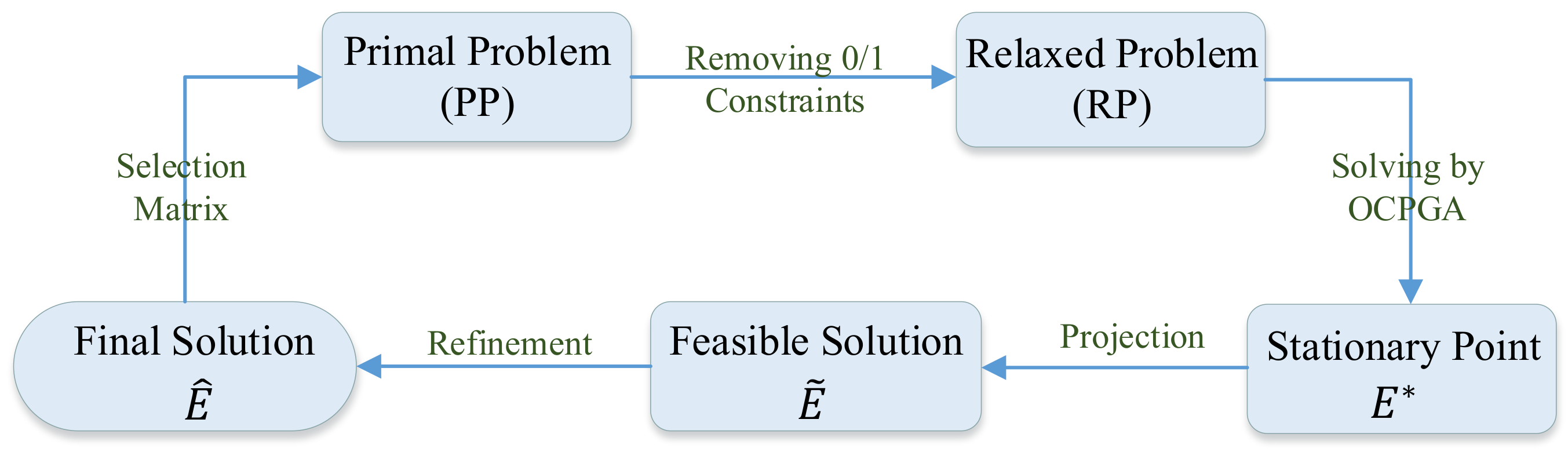
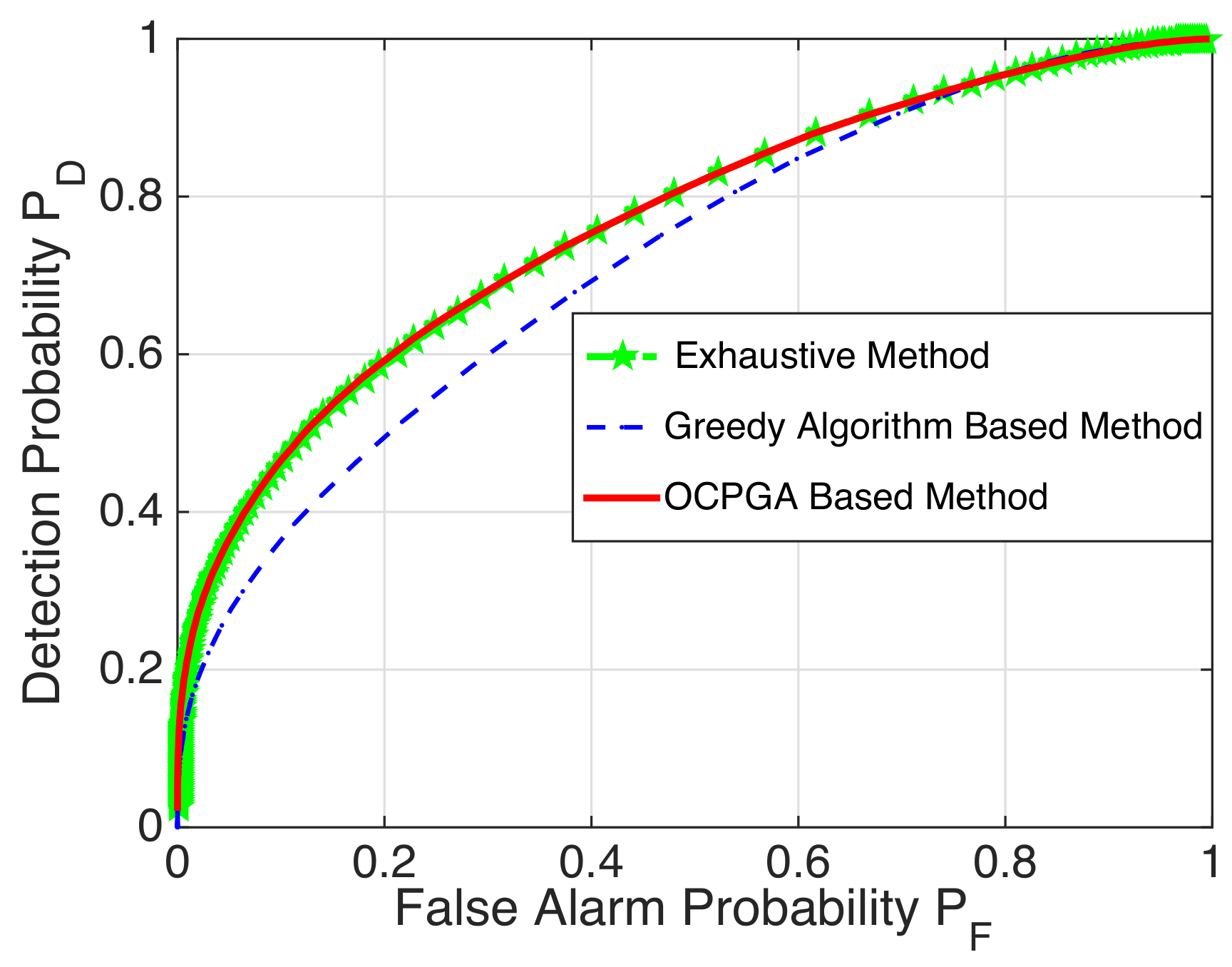
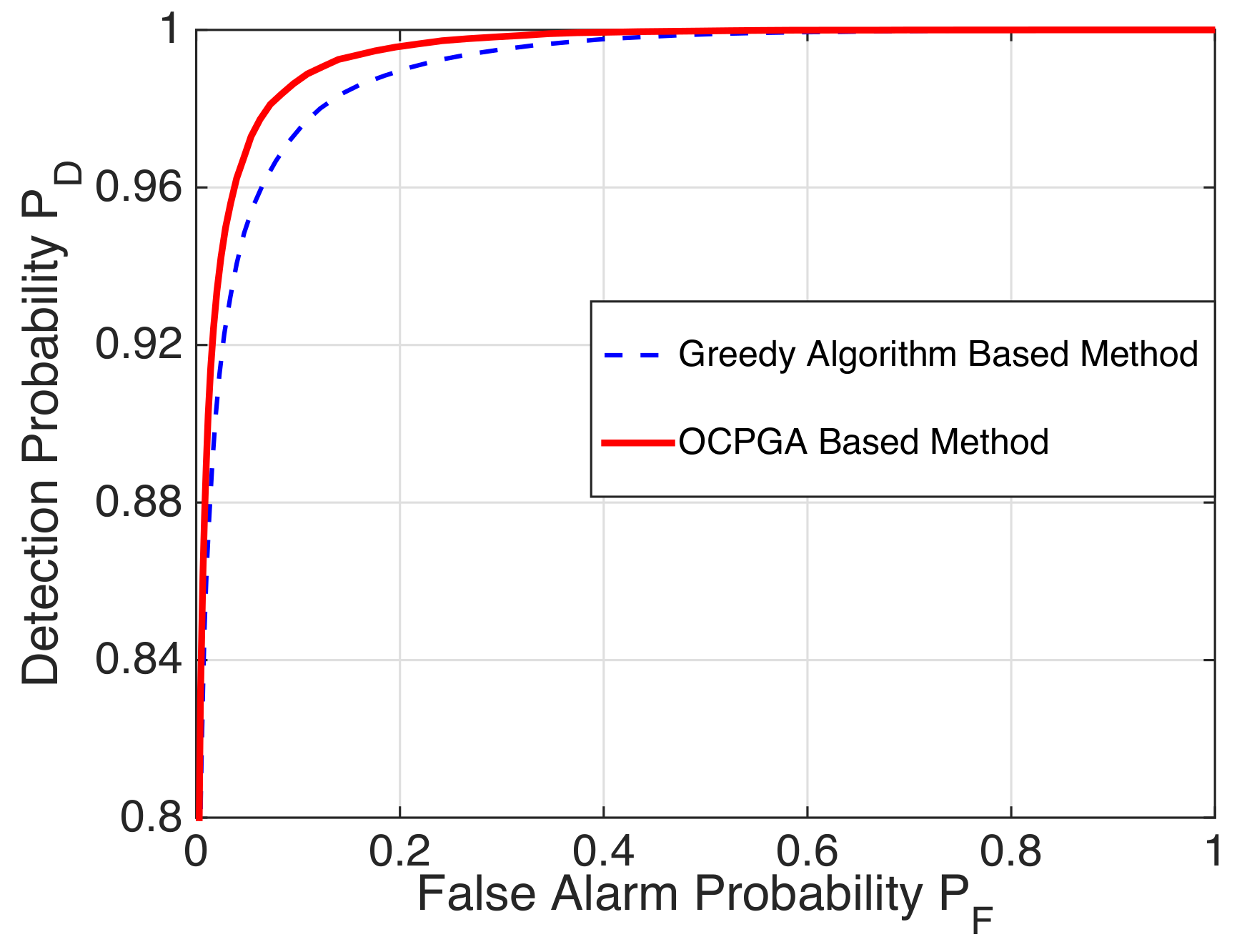
This paper considers the binary Gaussian distribution robust hypothesis testing under a Bayesian optimal criterion in the wireless sensor network (WSN). The distribution covariance matrix under each hypothesis is known, while the distribution mean vector under each hypothesis drifts in an ellipsoidal uncertainty set. Because of the limited bandwidth and energy, we aim at seeking a subset of p out of m sensors such that the best detection performance is achieved. In this setup, the minimax robust sensor selection problem is proposed to deal with the uncertainties of distribution means. Following a popular method, minimizing the maximum overall error probability with respect to the selection matrix can be approximated by maximizing the minimum Chernoff distance between the distributions of the selected measurements under null hypothesis and alternative hypothesis to be detected. Then, we utilize Danskin’s theorem to compute the gradient of the objective function of the converted maximization problem, and apply the orthogonal constraint-preserving gradient algorithm (OCPGA) to solve the relaxed maximization problem without 0/1 constraints. It is shown that the OCPGA can obtain a stationary point of the relaxed problem. Meanwhile, we provide the computational complexity of the OCPGA, which is much lower than that of the existing greedy algorithm. Finally, numerical simulations illustrate that, after the same projection and refinement phases, the OCPGA-based method can obtain better solutions than the greedy algorithm-based method but with up to 48.72 % shorter runtimes. Particularly, for small-scale problems, the OCPGA -based method is able to attain the globally optimal solution.
Keywords: wireless sensor network; robust sensor selection; hypothesis testing; Chernoff distance; Danskin’s theorem; orthogonal constraint-preserving gradient algorithm wireless sensor network; robust sensor selection; hypothesis testing; Chernoff distance; Danskin’s theorem; orthogonal constraint-preserving gradient algorithm