1. Introduction
The energy efficiency paradigm is gaining importance in the context of wireless communications and networks. Care of the environment on the hand, and the reduction of the operating expenditures by mobile network operators on the other hand, are complemented by common concerns, such as the growing demand for throughput and the fact that an increasing number of services offered are limited by battery capacity of mobile terminals. There are several ways of increasing network energy efficiency, ranging from typical resource allocation optimization [
1] to more fundamental changes, e.g., following the network design paradigms observed in the human brain [
2]. In order to correctly reflect the operation of the real network in terms of achieved energy efficiency, accurate models representing both the propagation environment and the devices themselves (including energy consumption) are needed. One of the key requirements in the design of energy-efficient communication systems is the estimation of power consumption in the network. In the literature, it is common to observe the utilization of simplistic power consumption models, e.g., a fixed and identical power consumption of transmitter and receiver [
3].
There are various approaches to power consumption modeling. One can identify three main types of power consumption models: (i) a high-level analytical model, (ii) a model that is the sum of the analytical models of the transmitter and receiver components, and finally (iii) a power consumption model that is based on measurements. The common disadvantage of all existing methods is that their accuracy and applicability are limited to only a single technological solution. If another architecture (or even the same architecture but another implementation from a different vendor) is to be used, the utilized model, or at least its parameters, might no longer be valid. Moreover, when one wants to assess the network energy consumption, it is necessary to consider a current, often rich, set of utilized transceivers in this network. There are currently two approaches to create such a model.
The first approach involves modeling the energy consumption of all separate components of wireless modules, such as an amplifier or an analog-to-digital converter or mixer, and then adding up the energy consumed by each of them. Unfortunately, this solution would require a very detailed knowledge of applied architecture and of all used modules. Most often it is not possible to access such information, and additionally, in the production of electronic systems, large variations in parameters between individual units can be observed.
The second approach in modeling of network energy consumption involves measuring each utilized transceiver power consumption separately. However, this is impossible to achieve, especially for large networks.
In this work, we propose a new approach. First, a model of energy consumption of a wireless transceiver is created that reflects a variability of implementations. It is parametrized by a set of measurements of WiFi cards (connected via USB). Checking more than a dozen of devices in different propagation conditions and different data rates allowed us to find the model coefficients for each of them. However, one may observe that the model parameters vary significantly among transceivers. This motivates us to construct a stochastic energy consumption model where each model coefficient is a random variable of a specific distribution and its parameters. For better reliability, correlations among model parameters are considered. Finally, a new stochastic transceiver power consumption model is presented and an initial verification of its usefulness in a multihop network is presented. The main novelty of the proposed model comes from the randomness of each device model’s coefficients, which allows us to characterize a whole population of wireless transceivers and a whole network energy consumption. The resultant network power consumption is much more detailed and easier to obtain than in two contemporary utilized approaches described above. This manuscript is an extension of a conference paper [
4] in which the authors presented a deterministic power consumption model for each of the considered transceivers. However, all important measurements and data modeling phases are presented in this manuscript as well for completeness of the presentation. The concept of stochastic modeling along with mathematical derivations and validation using simulations are exclusively presented in this paper.
The paper is structured as follows, first, an overview of existing power consumption models is presented. Next, the measurement setup is discussed, followed by the proposal of the new approach to power consumption modeling. In the consecutive chapter, a stochastic power consumption model is derived. Finally, the verification of the proposed model is made, followed by the drawn conclusions.
2. Related Works
The estimation of power consumption in the network is a crucial aspect in designing energy-efficient wireless communication systems. The main difficulty in the estimation of power consumption results from different types of technologies, standards, implementations, etc. As we mentioned above, in the literature three approaches to power consumption modeling can be distinguished: (i) a high-level analytical model, (ii) the estimation of the power consumed by each transmitter and receiver components, and (iii) estimating power consumption based on the measurements. The first approach has been applied in [
5,
6], where the authors considered a model consisting of the constant circuit power and the transmit power allocated at each subchannel. The former component includes the power consumed by the active (i.e., turned on) circuits of transmitters and receivers, whereas the transmit power was assumed to change dynamically according to varying channel conditions and modulation schemes. The constant circuits’ power does not accurately reflect many effects, e.g., signal processing power varying with bitrate. In [
7,
8,
9], circuit power was modeled as the linear function of the achieved data rate. This resulted from the fact that the power dissipation in a chip was modeled as the sum of a static term and dynamic term depending on the clock frequency, which was dynamically scaled with the data rate. These high-level power consumption models, thanks to their simplicity, are commonly used in the design of energy-efficient resource allocation algorithms. However, their disadvantage is low accuracy. In addition, the same power consumption model is used for each transceiver while considering network energy consumption. These models can be outperformed by the stochastic power consumption model proposed in this paper.
The second approach for power consumption modeling known from the literature focuses on the estimation of the power consumed by transmitter and receiver components. For example, the authors in [
10,
11,
12,
13] assumed that the total power used in the transmission is the sum of power consumed by the power amplifier (PA), the low noise amplifier (LNA), the analog-to-digital converter (ADC), and the applied signal decoders. A similar approach was also proposed in [
14], where the considered components for power consumption modeling included ADC, a digital-to-analog converter (DCA), reconstruction and anti-aliasing filters, mixers, a frequency synthesizer, PA, LNA, and a baseband amplifier. The effects of signal bandwidth, peak-to-average power ratio (PAPR), modulation order, transmission distance, and the signal center frequency on the Radio Frequency (RF) front-end energy consumption were considered and the exemplary power consumption values from the most commonly used designs were provided. In [
15], some power consumption values were listed in the context of long term evolution (LTE) technology. As for the encoding/decoding power, [
16,
17] revealed the number of operations needed to encode or decode the information bit for the common channel coding algorithms. If the information on the energy consumption per operation is known for a given processor, then the total power consumed by channel coding can be assessed. In [
18,
19,
20], the power consumption of baseband processing was estimated using Xilinx software toolboxes and, based on that, the analytical model was proposed. This approach guarantees high accuracy of power estimation, but is highly dependent on implementation, technology, and so on. While the resultant mathematical formulation can be quite complex, some components are negligible in comparison to others. Moreover, this model does not reflect the variability of power consumption among the transceivers used in the network. Our proposed stochastic power consumption model outperforms this model in these areas.
The last approach to estimate the power consumption of the wireless devices is to model it based on the measurements. In [
21,
22,
23], the authors measured the power consumption of a set of commercial devices in the number of configurations. In [
21], the power consumption behavior of the 802.11n and 802.11g access points was investigated and compared. The authors observed a similar power consumption pattern for both technologies, namely a linear behavior until the access point reached a saturation point. However, there were relevant differences in the amount of (i) power consumed for transmitting and receiving data and (ii) the traffic rate at which the access point saturated. In [
22], a simple first-order polynomial model for the energy utilization of a set of commercially, contemporary wireless transceivers in the context of various communication standards, such as UMTS, LTE, WiFi, and Bluetooth, was proposed and discussed. In [
23] power consumption of GSM and UMTS base stations has been measured. A first-order power consumption model in relation to the offered traffic was proposed. For this group of solutions the estimated power consumption model was realistic but only fit the measured device, and thus can be wrong for other technologies (e.g., LTE and IEEE 802.11) or even different designs (e.g., another vendor). Moreover, in some cases (e.g., smartphones) the measurements of the power consumed by wireless communication components can be difficult or even impossible to be carried out. The mathematical simplicity and accuracy of the model and ability to model a whole range of transceivers coming from various vendors is provided by the stochastic power consumption model proposed in this paper.
The last group of solutions is a mix of the approaches described above. For example in [
24,
25], the first two approaches were applied in a multi-user massive multiple-input and multiple-output (MIMO) scenario and the power consumption of elements specific to massive MIMO processing, such as the channel estimation, the load-dependent backhaul, and linear processing on the base station (e.g., zero-forcing) were modeled, separately. Although some elements were estimated in a high-level manner, some parameters were still dependent on the hardware implementation or constrained by a specific technologies or methods, e.g., power consumption of a decoder only in the case of LDPC codes.
3. Measurements Setup
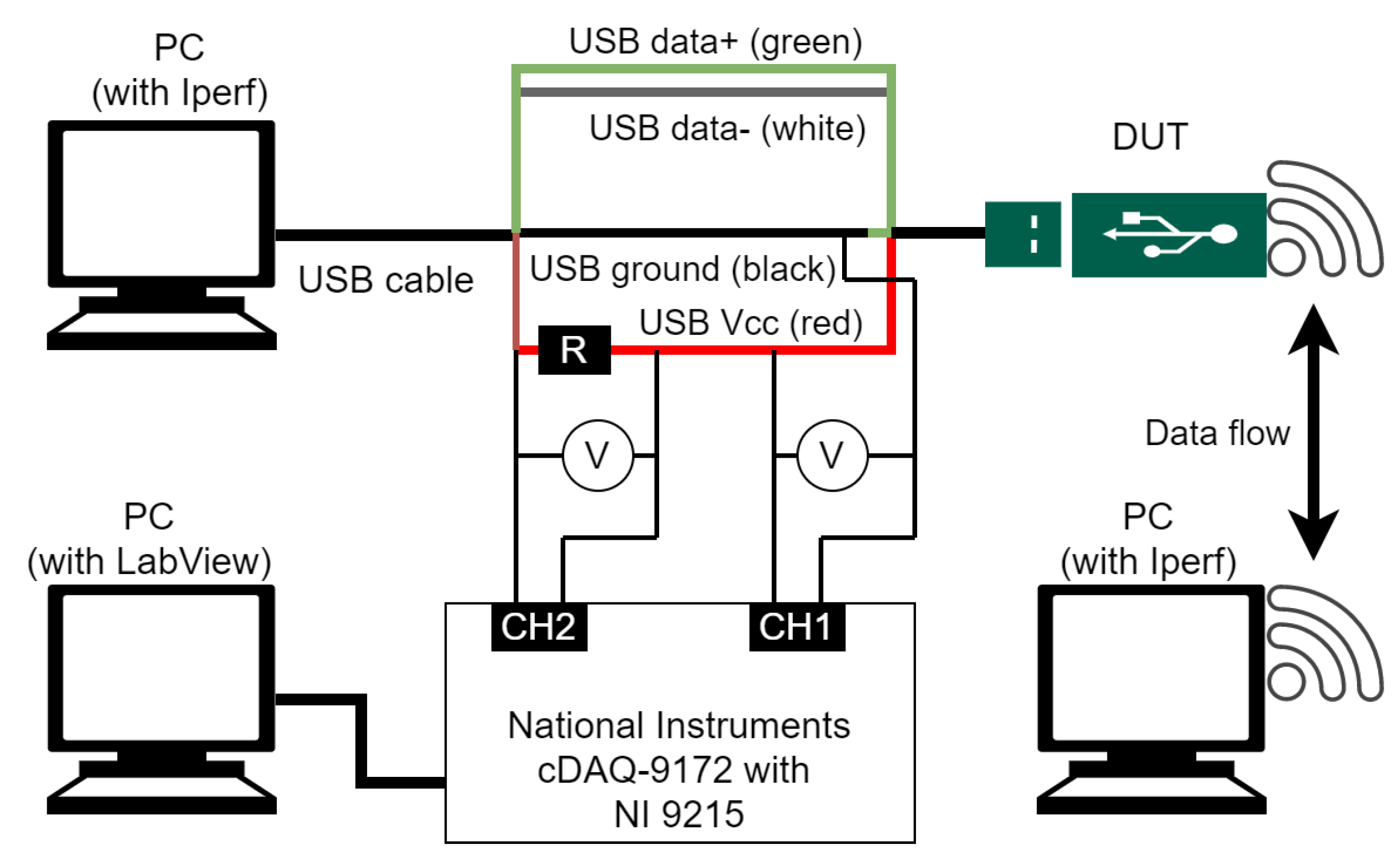
We first conducted the measurements of power consumption by using a number of off-the-shelf devices, which we used to define the generic power consumption model. The experiment stand shown in
Figure 1 was built to measure the power consumed by each individual wireless transceiver. Three computers were used; two connected wirelessly through the measured WiFi dongle (IEEE 802.11g standard), and the third one used to measure power consumption of the tested dongle. The dongle was connected to a computer via a USB cable with a measurement bridge that allowed to directly measure voltage delivered to the USB stick (Channel 1—CH1 in
Figure 1). Moreover, observation of the voltage on the shunt resistor of a known resistance (in this case 4.7 Ohms, denoted in the figure as
R) allowed for the derivation of the current flowing in the WiFi dongle (Channel 2—CH2 in
Figure 1). The National Instruments card NI 9215 was used to collect all measurements, and it was connected to a computer with LabView software operating on it. The traffic in the network was generated using Iperf software, allowing the setting of a precisely specified throughput in a network layer (using the UDP protocol). All measured devices are listed in
Table 1 along with the utilized WiFi chipset. Please note that some devices from different vendors are based on the same chipset. We measured the power consumption as a function of average rate and distance/pathloss in both WiFi dongle states, i.e., transmitting or receiving data. We also tested the power consumption in idle (USB dongle connected, no wireless traffic) and associated states (modem connected to the network).
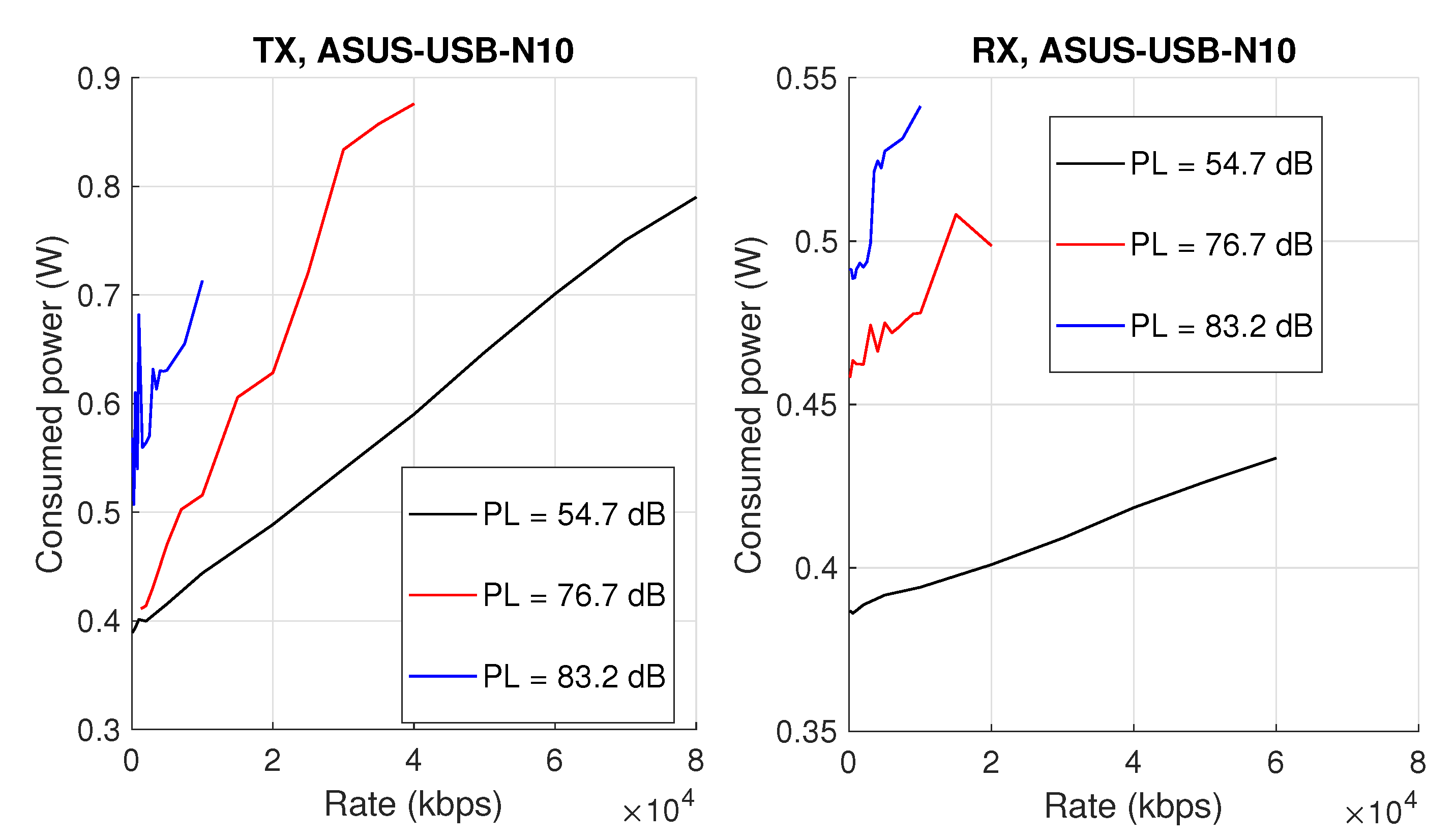
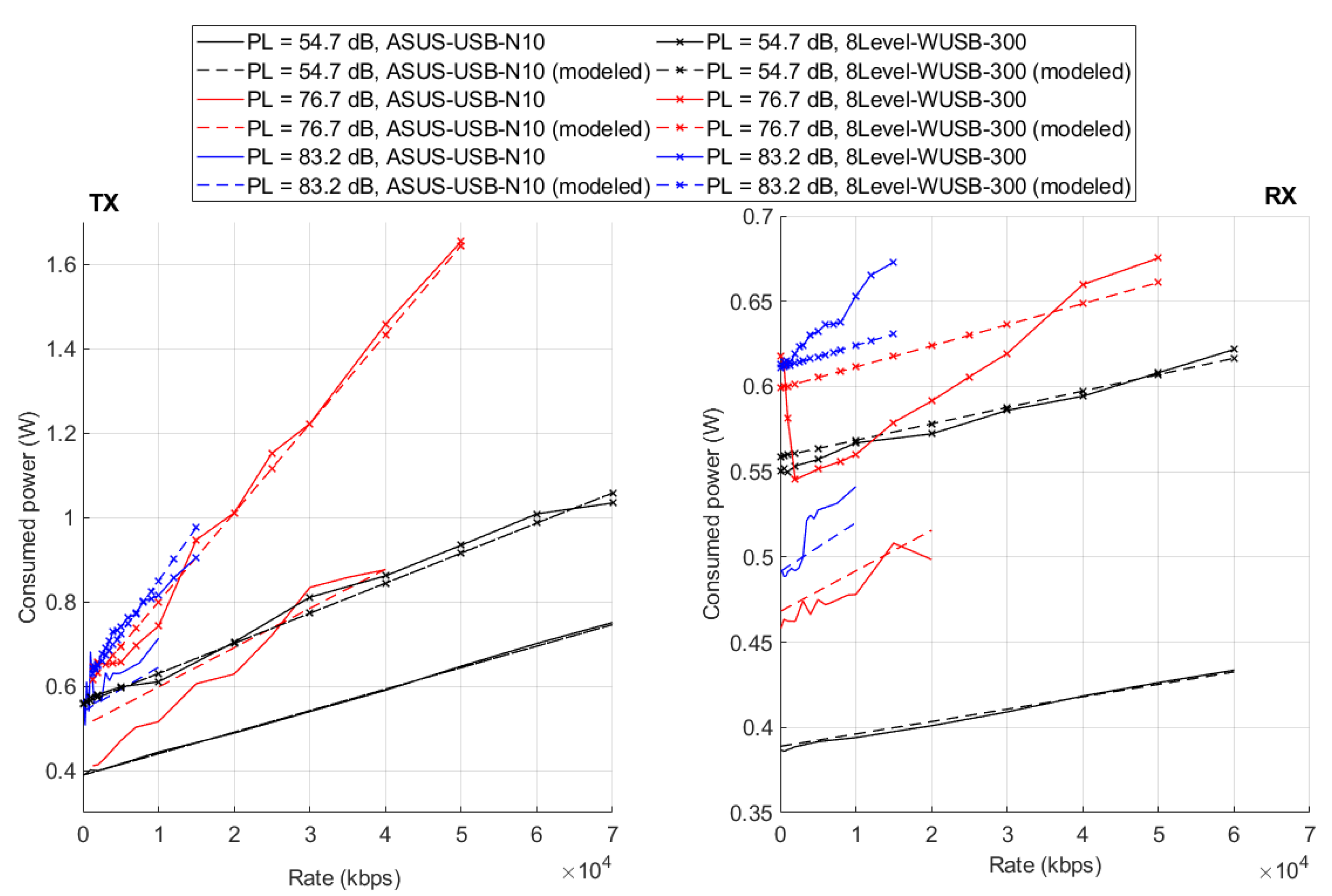
During the experiment, three different static (with no mobility) settings were considered: first, where both devices are located in the same room; second, where they are placed in neighboring rooms (one wall between transmitter and receiver); and third, where the two wirelessly connected computers are in non-adjacent rooms (i.e., two walls and one room between transmitter and receiver). The measured pathlosses corresponding to these three scenarios were: 54.7 dB, 76.7 dB, and 83.2 dB, respectively. These values were measured with a signal generator, spectrum analyzer, and omnidirectional antennas. Selected detailed results of certain measurements for a single device are shown in
Figure 2 for 54.7 dB, 76.7 dB, and 83.2 dB pathloss values. We started collecting samples when the connection was established and active transmission was ongoing. A single measurement consisted of around 750 kilo samples (15 s, 50 kilo samples per second).
4. Power Modeling
After the power measurements and the processing of collected data, we started creation of the power consumption model. Model fitting, statistical processing, and plots creation were done using Matlab. First, after the connection of the WiFi dongle to the computer, with no connection to any Access Point (AP) set, the model is in an idle state with power consumption modeled as a single positive number D. After association to the AP it is expected that the minimum power in the case of no IP transmission (no traffic in Layer 3) will be higher that D. The overhead will be denoted in our model by
C being a non-negative number. When transmission begins the power increase is expected to be proportional to the transmission rate [
7,
8,
9]. The power increase depends on the operation mode (receiving or transmitting mode). Typically, the transmitter (TX) mode power consumption will be dominated by the power consumed by a high-power power amplifier. On the receiver (RX) side, the reception algorithms appear to be the most power consuming. As such, the TX and RX rate’s influence on the consumed power is modeled separately. The utilized model for a single pathloss value is [
4]:
where
A and
B represent the transceiver-specific, positive coefficients for TX rate
(in kbps) and RX rate
(in kbps), respectively, and
P is the total consumed power in Watts.
The above modeling was done for the shortest path between TX and RX, as this guarantees the smallest wireless channel variation and smoothest power consumption characteristics, as visible in
Figure 2. Next, the model needs to be updated in order to consider the pathloss between the AP and WiFi dongle. Thus, in addition to the previously used measurements’ results for short distance communications, two additional setups were used: when the AP was distanced by 76.7 dB (behind one wall) and by 83.2 dB (behind two walls). The balance between model complexity (number of coefficients) and accuracy (measured by coefficient of determination) was obtained by the following power consumption model [
4]:
In the formula,
denotes the signum function, and
—the pathloss in dB between WiFi dongle and AP. Moreover, new, device-specific, coefficients
are included. Next, it is assumed that the parameters
are known for each WiFi dongle after the previous stage; thus only the values of
and
H have to be estimated. It is reasonable to assume that the consumed power increases with increasing pathloss, and the rationale behind this linear dependence in dB scale is derived in the
Appendix A. The parameters were optimized in order to minimize mean squared error using the interior-point method. The resultant coefficients are shown in
Table 2 along with mean values and standard deviation. Power consumption is compared for two selected transceivers in
Figure 3. While the model can quite reliably approximate the power consumption of each device, there was a significant difference in the power consumption between different devices.
5. Stochastic Power Consumption Model
It was noted in the previous section that the power consumption depends not only on the the utilized chipset but also on the vendor-specific design. As such these 14 measured devices can be treated as samples from the population of all existing WiFi dongles. Statistical modeling was carried out to find the most suitable distributions for all of the model’s coefficients. It was found that A and B can be modeled as squared log-normal variables, D as a log-normal random variable, C, E, F, and G as squared normal random variables, and G and H as absolute values of normal random variables. Additionally, these normal variables have to be scaled and correlated considering model coefficients’ dependence.
Let us denote the
matrix of all coefficients as:
Each of the constituting vertical vectors contains a given model parameter for 14 measured devices. A vector composed of mean values of all modified coefficients is:
where
denotes the expectation over the 14 available samples. Additionally, the covariance matrix of these variables is
. The covariance matrix is a positive semidefinite matrix so that Cholesky decomposition can be calculated giving
.
Generation of a single set of random coefficients starts from the generation of eight independent, standard normal random variable samples, which are stored in a vector
. The vector of correlated and scaled normal random variables
is:
Finally, random variables representing model parameters are:
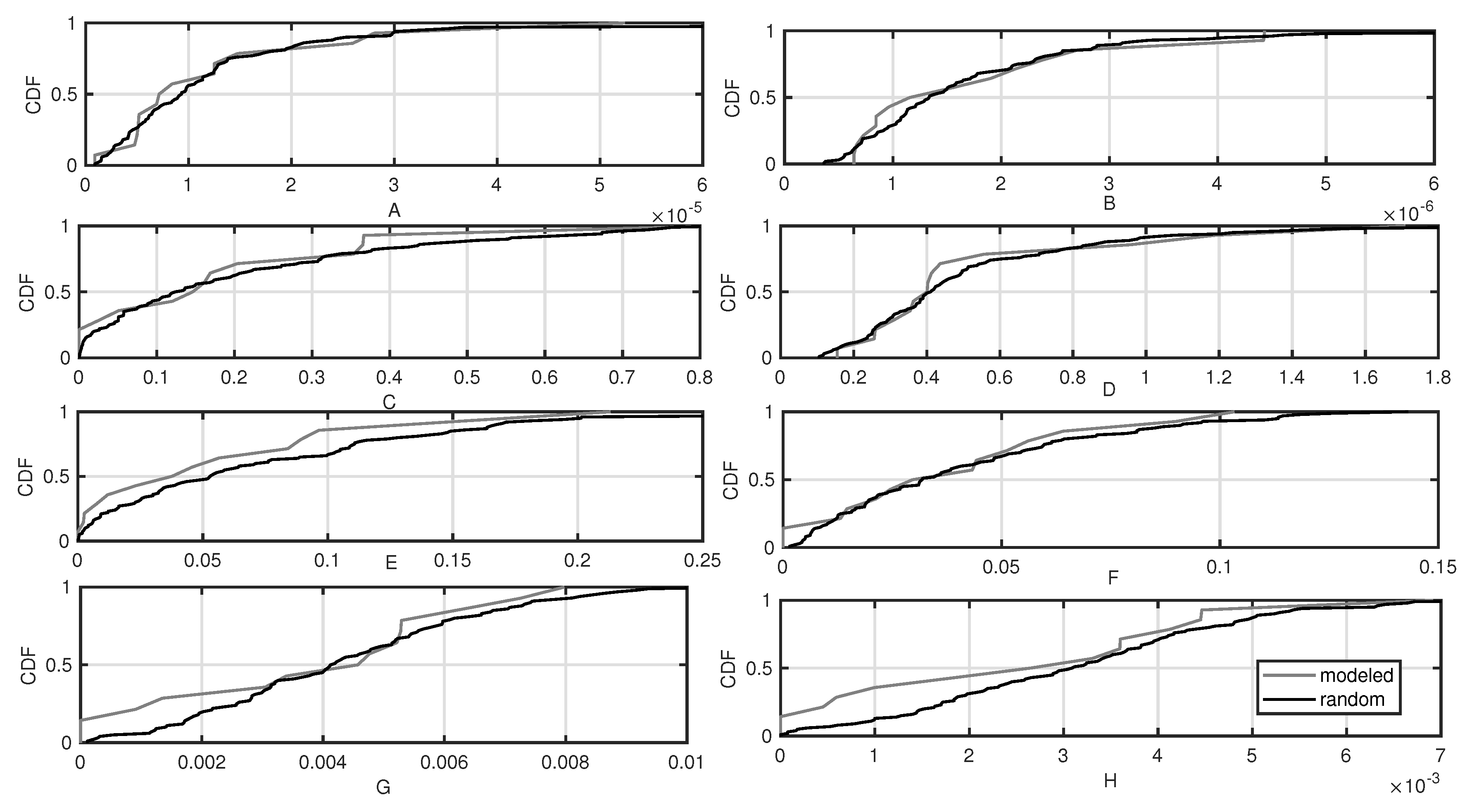
The coefficients that resulted from the measurements and modeling (“modeled”) were compared with 1000 coefficients generated randomly according to the scheme described above (“random”). In
Figure 4, the cumulative distribution functions (CDFs) of the coefficients are shown. It is visible that the assumed distributions quite reliably reflect the empirical data distributions.
6. Model Verification
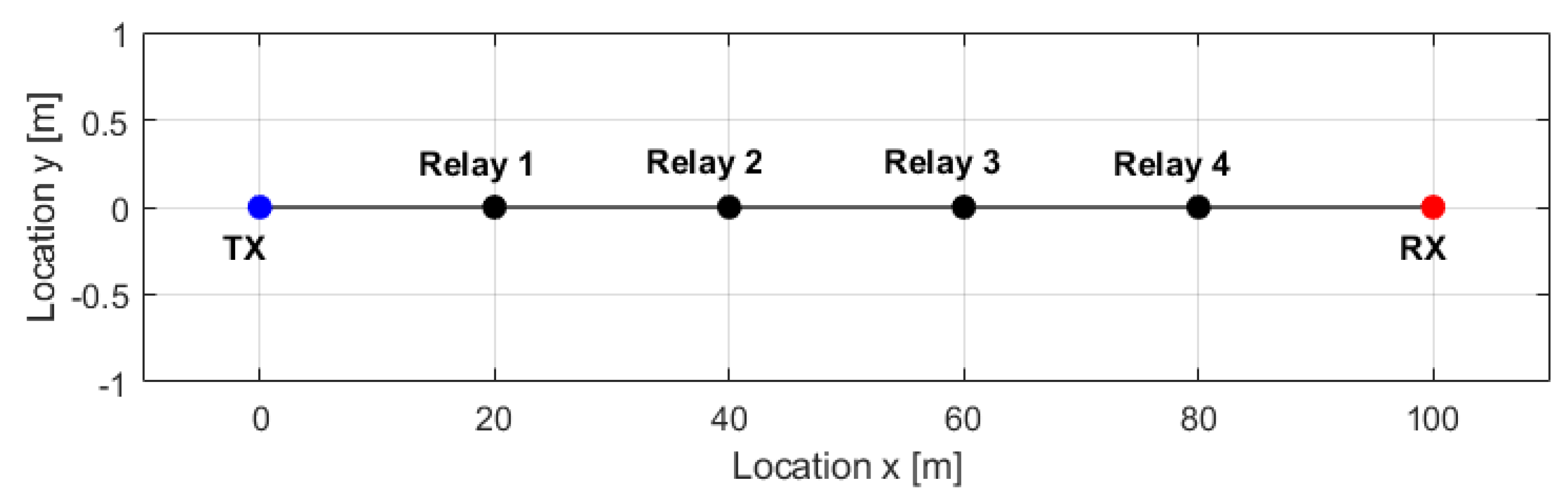
In order to check the usefulness of the proposed energy consumption model, we conducted computer simulations. The simulation scenario assumes that there is a transmitter that sends data at a constant rate to the receiver. Between them there can be relays. A line topology is assumed, as presented in
Figure 5. The frequency was set to 2.4 GHz, bitrate to 1 Mbps, and the pathloss model was WINNER-II (A1 scenario—in building—with line-of-sight propagation) [
26]. In such a multi-transceiver network, a single device power consumption is typically unknown. In addition it can vary as a result of varying market shares of a given vendor or even single transceivers. The proposed stochastic energy consumption model allows to characterize the resultant power consumption as a random variable. The distance between the first transmitter and the last receiver was fixed to 100 m. Each transceiver’s parameters were randomly generated according to the procedure presented in
Section 5 in 100,000 random trials.
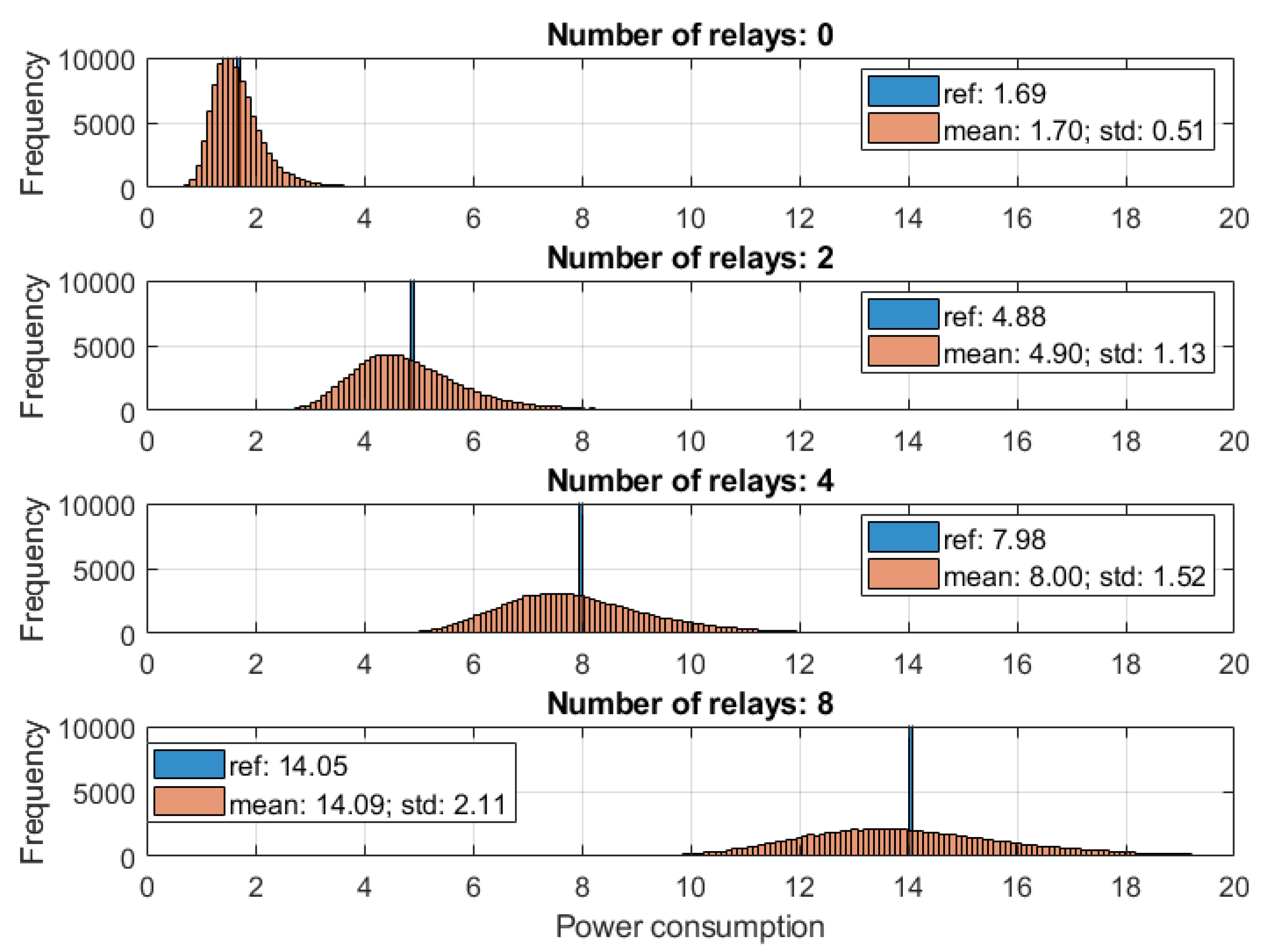
It was assumed that 0, 2, 4, or 8 relays are placed in between the transmitter and the receiver, equally distanced to the closest nodes. The power consumption histogram is compared in
Figure 6 for the proposed model and a reference solution (
ref in the figure). The reference model assumes that each of the devices (transmitter, receiver, and each of the relays) has the same
mean power consumption characteristics, i.e., values of coefficients from the row “Mean” in
Table 2 were used. It is shown that the energy consumption distribution gave much more information than a single value obtained by a reference model. The number of relays influenced not only the distribution variance but also its shape.