The ANEMONE: Theoretical Foundations for UX Evaluation of Action and Intention Recognition in Human-Robot Interaction



Abstract
1. Introduction
1.1. The Role and Relevance of Mutual Action and Intention Recognition between Humans and Robots in Human-Robot Interaction (HRI)
1.2. Motivations and Aim for ANEMONE
2. Method Development Approach for ANEMONE
- Scope: The scope concerns the clarity towards the intended investigators in regard of what kind of aspects and issues the method focuses on or not. We argue that this is especially important for the end-users/investigators when choosing appropriate UX evaluation methods and subsequently reflecting on the pros and cons of the obtained results, when applying a particular method, in this case ANEMONE.
- Validity: The evaluation method should provide support to the end-users by correctly identifying potential issues while interacting with a robot. The method should maximize the identification of relevant usability and UX problems, and at the same time, it should minimize identification of trivial or non-relevant UX problems. As pointed out by Blandford and Greene [94], this aspect is particularly important for evaluation methods, and therefore, we pay additional attention to this criterion.
- Reliability: This concept denotes to what extent different users applying the same method will obtain similar results, which is of major importance for ANEMONE
- Insights derived: This criterion is aligned to what extent a method’s obtained results provide credible insights in order to improve the interaction and design of a robot. In other words, will the outcome of the evaluation method of ANEMONE support the future development of fluency in the human-robot interaction from a UX perspective?
- Feasibility of encapsulating a theory: This concept considers the extent of feasibility of the underlying theoretical framework for the method, as well as serving as a means for encapsulating a certain theory. In our work, ANEMONE relies on activity theory (AT), UX evaluation methodology, and insights derived from embodied cognitive science.
- Purpose: What are the goals and objectives of the evaluation? What questions do we want to ask and be answered?
- Resources: What resources are available for the evaluation and what kind of constraints, e.g., time, knowledge, financial support, and skills, do we have to take into account?
- Ethics: What ethical concerns do we need to raise and handle properly?
- Relevant data collection techniques have to be identified and selected.
- The collected data must be analyzed via proper analysis approaches and/or techniques that should be identified and selected.
- Finally, the obtained findings should be properly reported.
3. Theoretical Lens and Methodological Foundations
3.1. Activity Theory—A Theoretical Lens
3.1.1. The Concept of Activity
3.1.2. Basic Principles
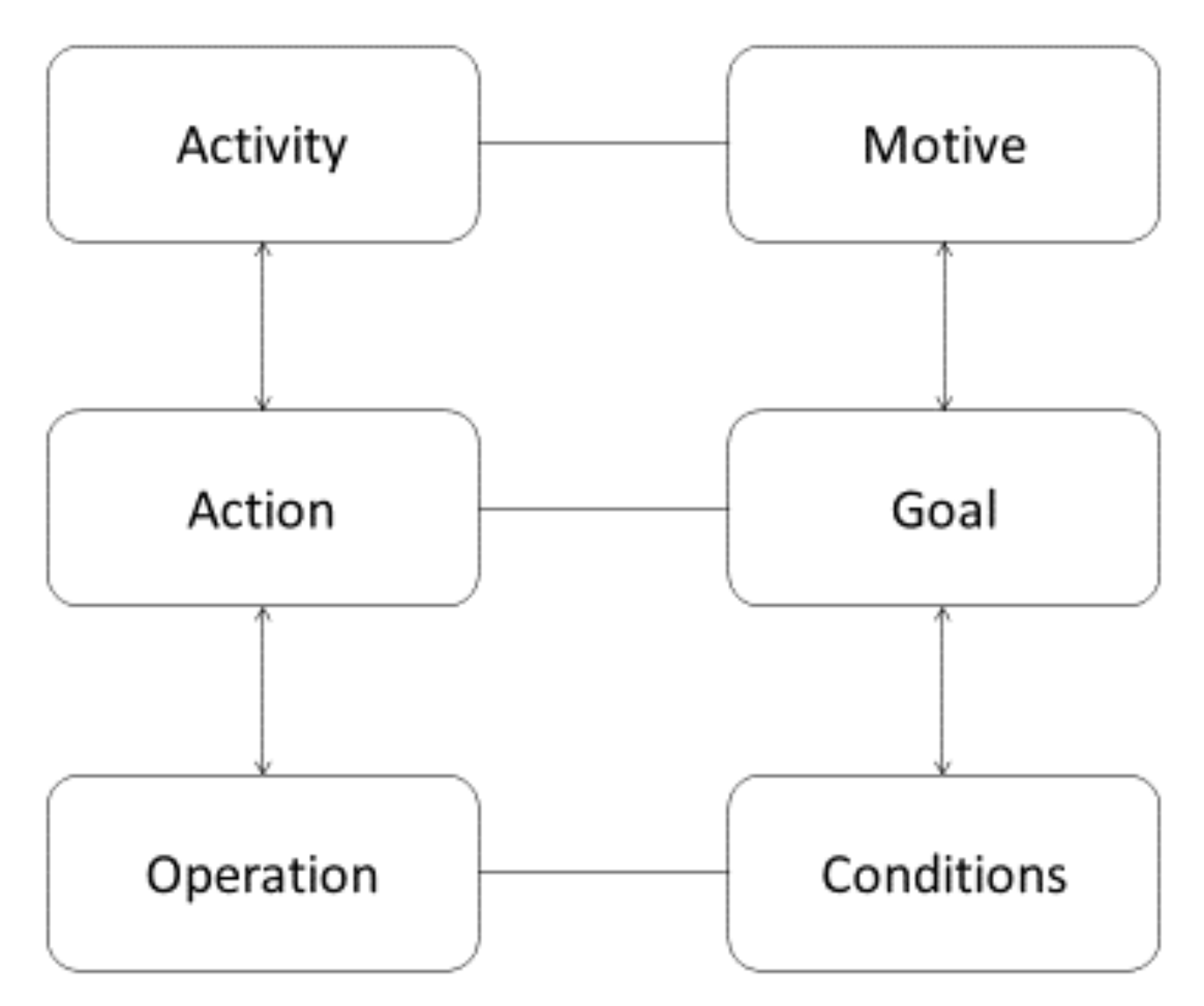
Hierarchical Structure of Activity
Object-Orientedness
Tool Mediation
Internalization-Externalization
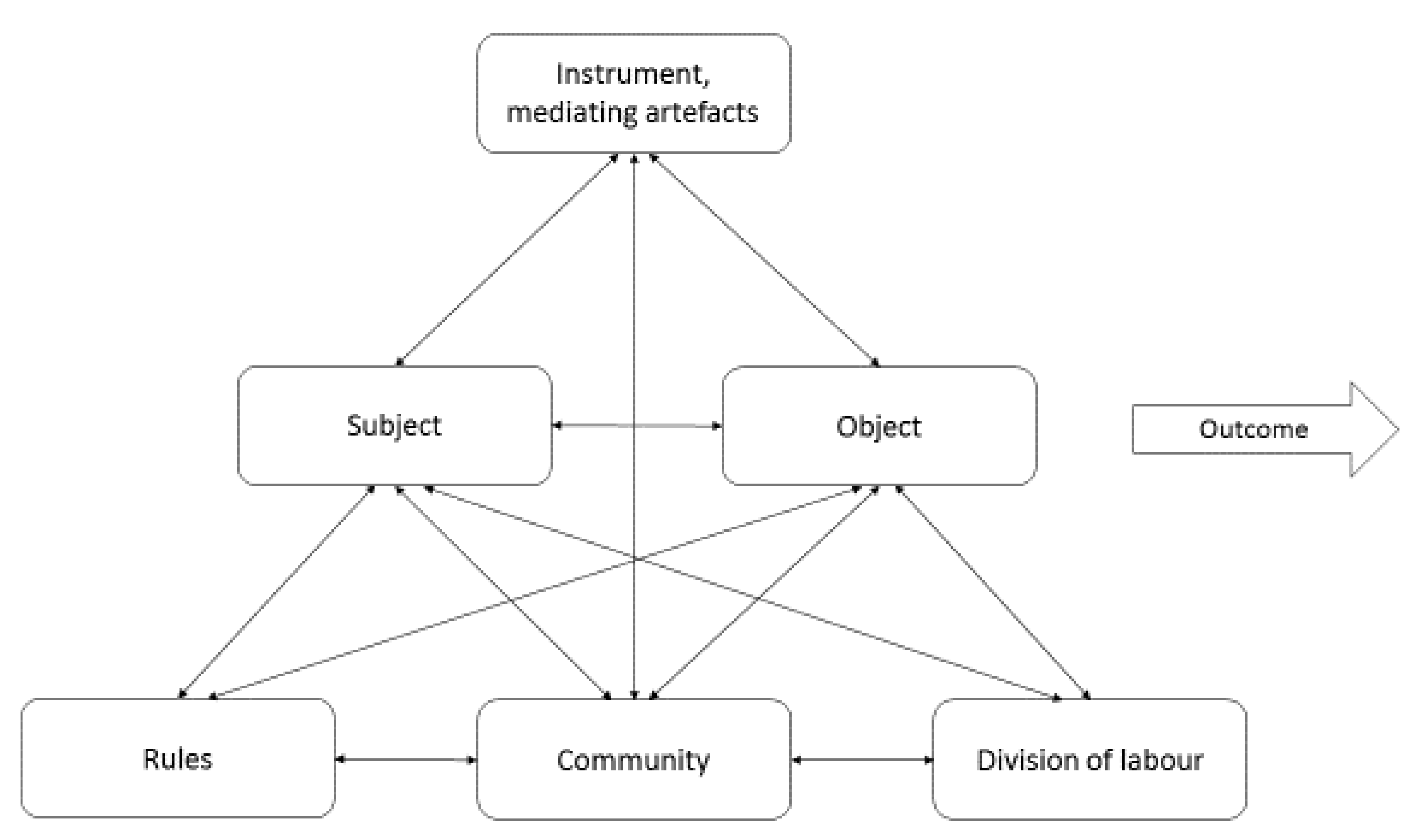
3.1.3. The Activity System Model
3.1.4. AT as an Analytical Lens
3.2. The Seven Stages of Action Model
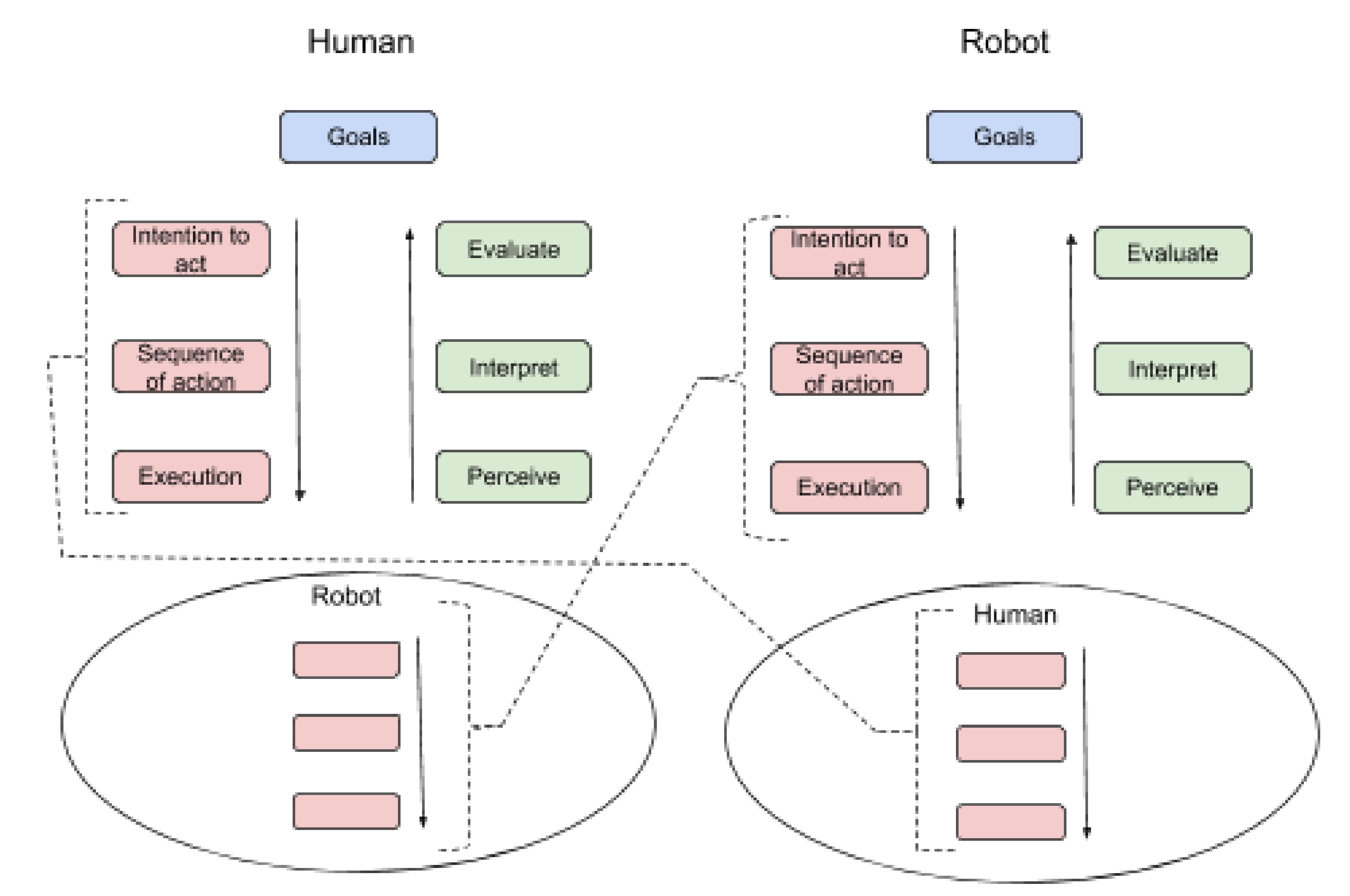
- Forming the goal: there is a gap between the current and the desired state that the person wants to overcome.
- Forming the intention to act: a plan to do something to overcome the gap is shaped and a direction for how to achieve it is outlined,
- Specifying the sequence of action: the details on how to carry out the chosen “strategy” is formulated.
- Executing the action: physically executing the specified sequence of action.
- Perceiving the state of the context (object): noticing the things that can be sensed.
- Interpreting the state of the context (object): conceiving what the sensed things mean.
- Evaluating the outcome in relation to the goals: comparing the new state with the desired one and assessing if the goal is fulfilled to enough extent.
3.3. UX Evaluation Methodology
3.4. Summary of AT as a Theoretical Lens, the Seven Stages of Action Model, and UX Evaluation Methodology
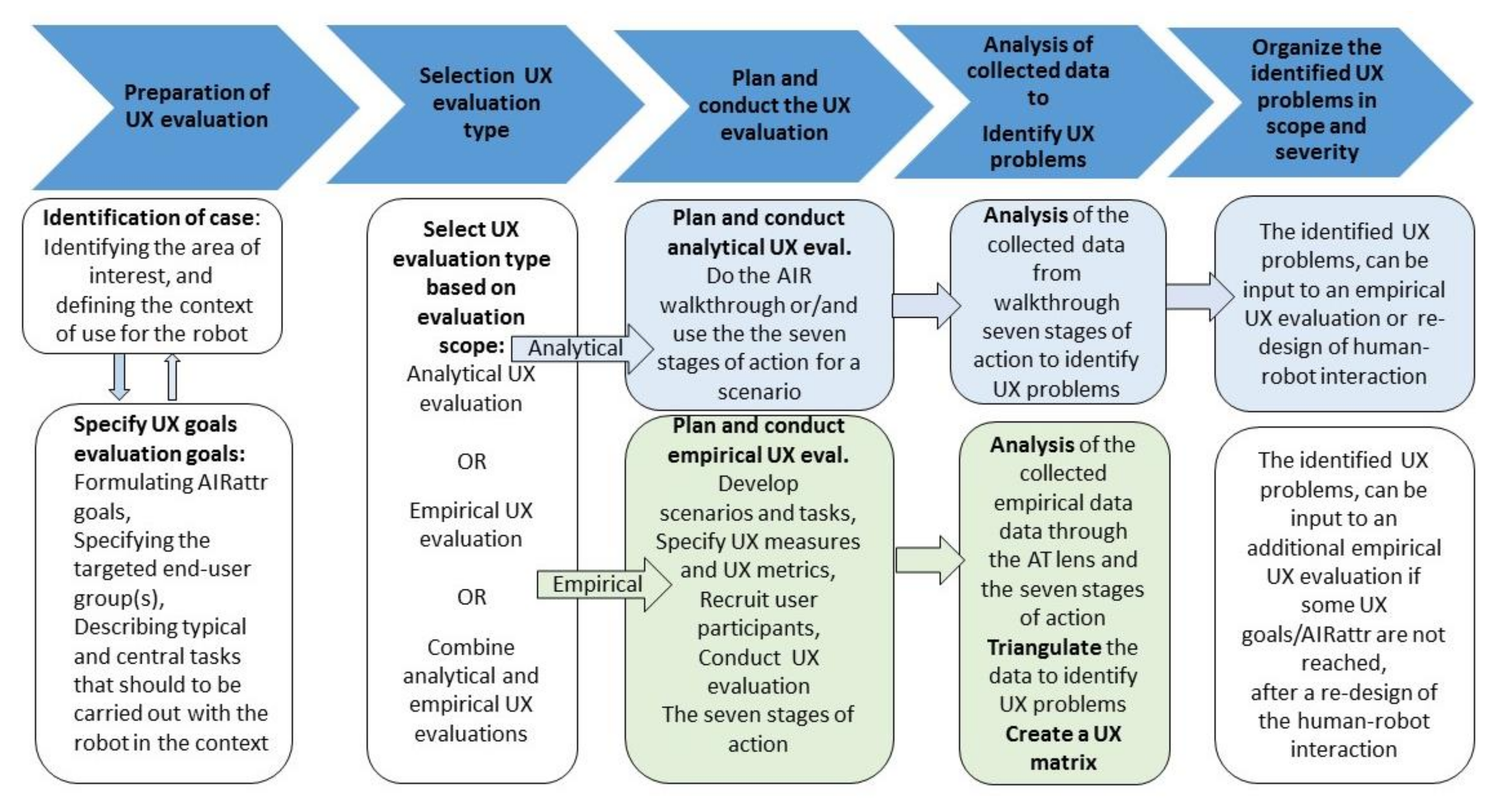
4. Description of ANEMONE and its Procedure
4.1. Phase 1: Preparation
4.1.1. Identifying of the Case: Identifying Area of Interest and Defining the Context
4.1.2. Specify UX and Evaluation Goals
- The robot needs to generate signifiers that humans can perceive.
- The meaning of the signifiers should be correctly understood by humans, in terms of predicting that the robot will do something and preferably also what it will do.
- The signifiers should be so obvious that the humans are certain of their interpretation of them.
- The meaning of the actions of the robot should be correctly understood by the humans.
- The actions should be so obvious that the humans are certain of their interpretation of them.
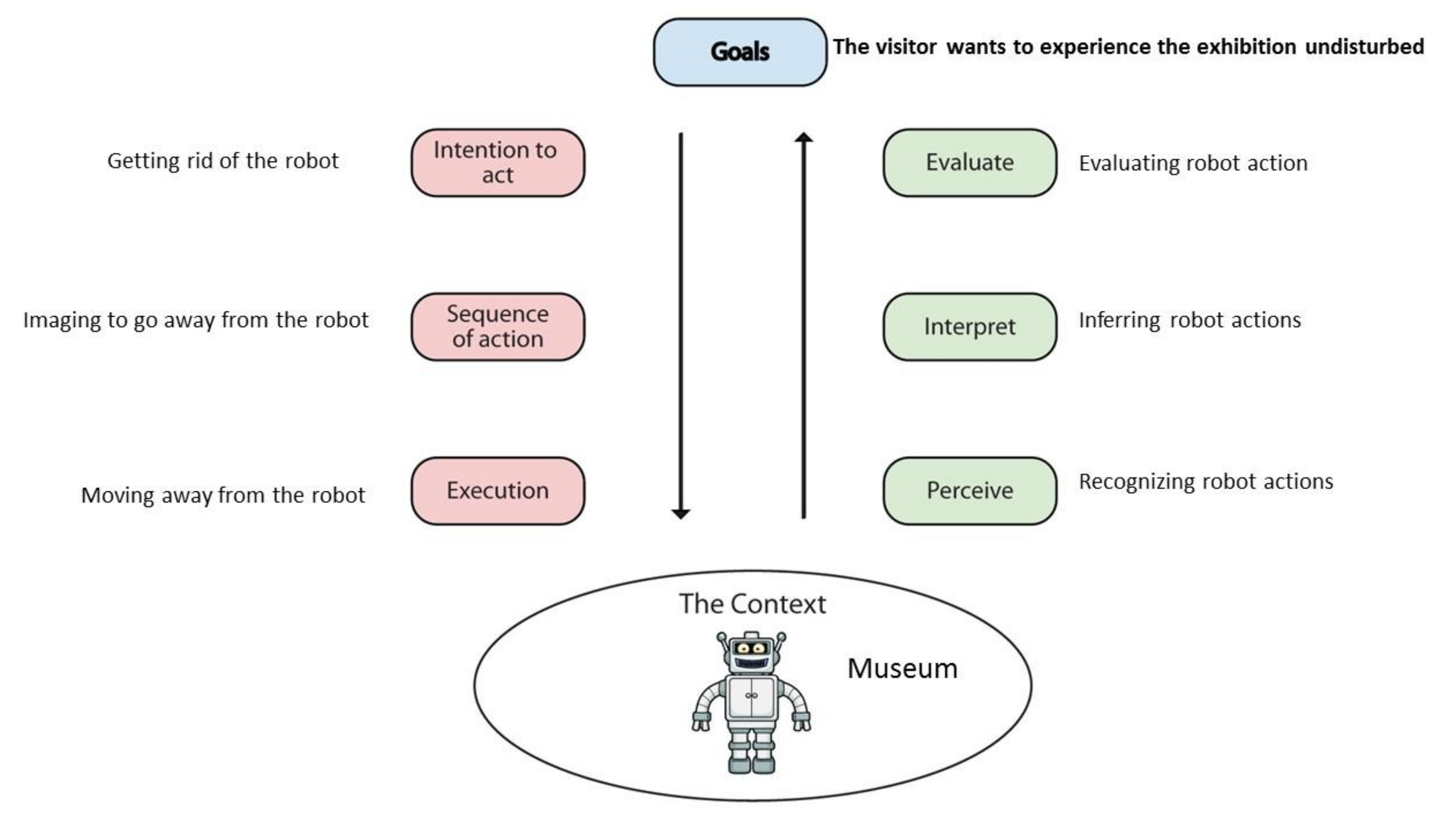
- Perceive the intention of the robot to perform an action, i.e., perceive the robot’s status in its context.
- Predict what sequence of actions will take place, i.e., interpret the robot’s status in its context.
- Assess the robot’s actions in relation their goals, i.e., evaluate the interpretation in relation the goals.
- Determine if any measures need to be taken in relation to the robot in order to reach the goals, i.e., forming intention to act.
- Specify a proper sequence of actions in relation the robot, i.e., understand and determine what it is possible to do in order to reach the goal.
- Perform the chosen sequence of actions in relation to the robot, i.e., execute the sequence of actions.
- Perceive the effects of the actions in relation to the robot’s status in its context, and interpret the effect, in order to evaluate the interpretation in relation the goals.
- Product goal: A social robot at a shopping mall with the higher-level aim to improve the number of visitors at the mall and increase the amount of money spent in the shops.
- End-user group: Busy adults wanting to quickly and comfortably run their shopping errands.
- Tasks: Helping visitors to find what they are looking for and give relevant special offers.
- Context: Robot is located in the main entrance of the building, which is often crowded and noisy.
- UX goal: The robot should be experienced as polite and non-intrusive in the sense that a visitor clearly should be able to see that the robot is available to provide service and that he/she should feel that he/she is in charge of the situation.
- AIRattr evaluation questions: Is it possible for the visitor to perceive that the robot turns its face and body towards him/her? Is it possible for the visitor to correctly interpret what the turning of the robot means? Is it possible for the visitor to assess if the robot’s actions may be helpful in relation to their goal?
4.2. Phase 2: Selection of UX Evaluation Type
4.2.1. UX Evaluation Scope
4.2.2. Characterization of Analytical and Empirical UX Evaluation
4.3. Phase 3: Plan and Conduct the UX Evaluation
4.3.1. Analytical UX Evaluation of Action and Intention Recognition
- Knowledge and experience of the end-user group, e.g., if the situation is well-known and if the task is familiar to the end-users.
- A scenario that portrays the context, the goal of the activity, and includes representative tasks.
- The robot that is either functioning or is complemented with a description of the relevant interactive aspects. A Wizard of Oz set-up or a film of the robot in action, although not recorded with an evaluative purpose, can also be used.
- Is it easy to perceive the intention of the robot to perform an action, i.e., perceive the robot’s status in its context?
- Is it easy to predict what sequence of actions that will take place, i.e., interpret the robot’s status in its context?
- Is it easy to assess the robot’s actions in the relation a person’s goals, i.e., evaluate the interpretation in relation the goals?
- Is it easy to determine if any measures need to be taken in relation to the robot in order to reach the goals, i.e., forming intention to act?
- Is it easy to specify proper sequence of actions in relation the robot, i.e., understand and determine what is possible to do in order to reach the goal?
- Is it easy to perform the chosen sequence of actions in relation to the robot, i.e., execute the sequence of actions?
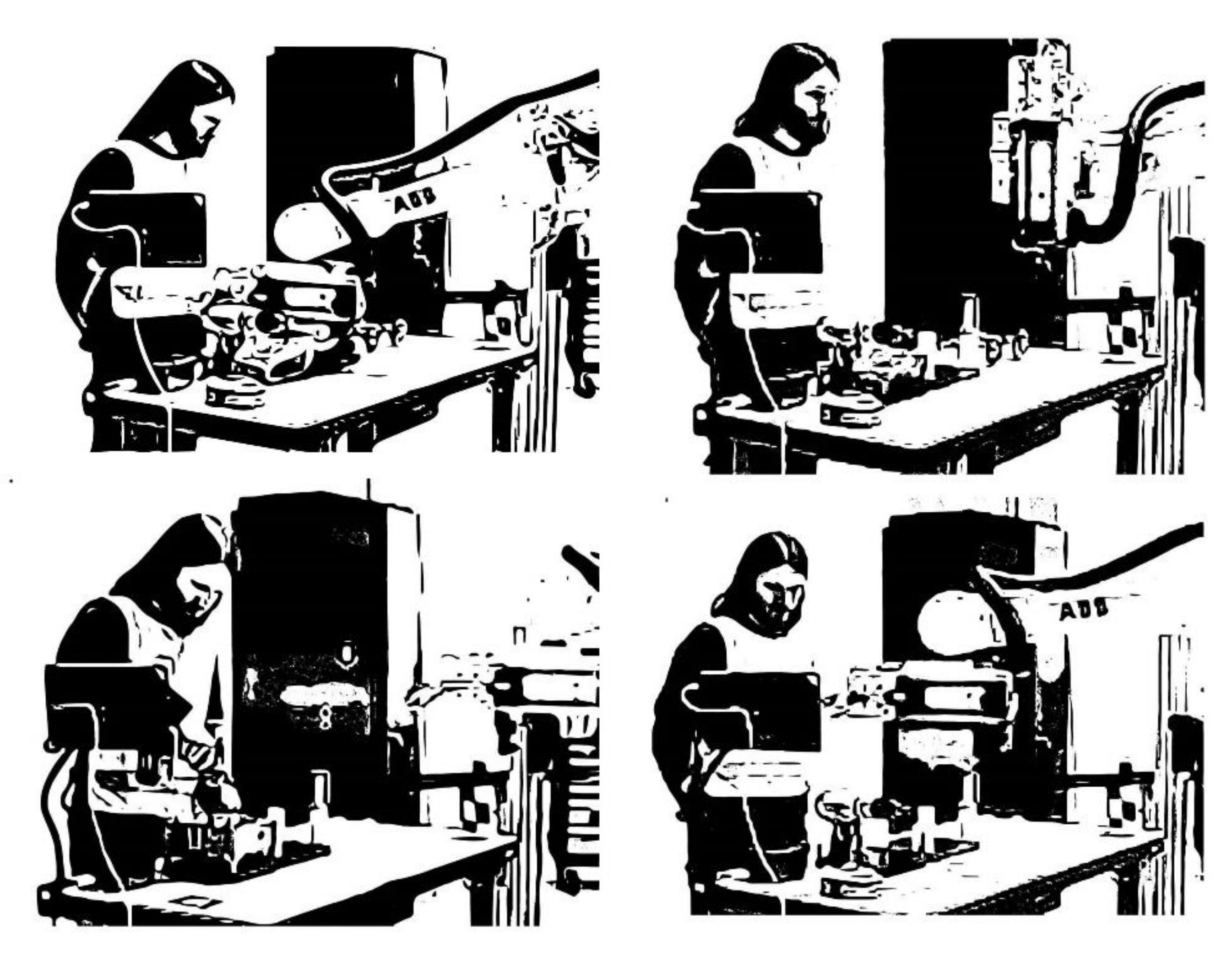
4.3.2. Empirical UX Evaluation of Action and Intention Recognition
- When you see the robot located near the door, what do you think that means? Why?
- When the robot moves towards you, what do you think that means? Why?
- Your reaction to the robot’s gestures was to move backwards, can you tell us the reason behind that reaction?
4.4. Phase 4: Analysis of Collected Data and Identifying UX Problems
4.4.1. Strategies for Analysis of the Collected Data and Identifying Problems
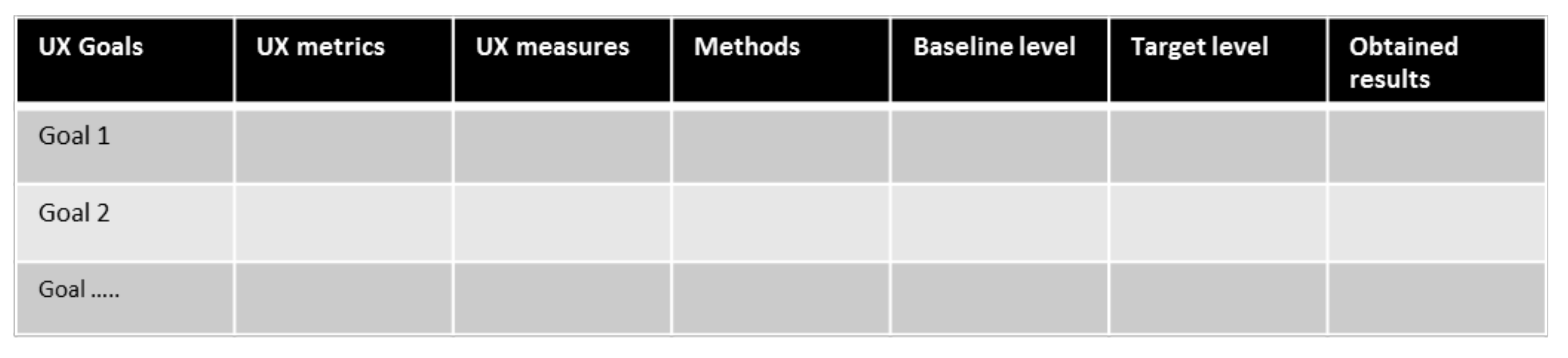
4.4.2. Analysis and UX Problem Identification of Action and Intention Recognition
4.5. Phase 5: Organizing the Identified UX Problems in Scope and Severity
5. Discussion
5.1. ANEMONE’s Alignment with AT: Pros and Cons
5.2. Pros and Cons of the ANEMONE Methodology
5.3. Future Work
Author Contributions
Funding
Acknowledgments
Conflicts of Interest
References
- Stephanidis, C.; Salvendy, G.; Antona, M.; Chen, J.Y.; Dong, J.; Duffy, V.G.; Guo, Y. Seven HCI Grand Challenges. Int. J. Hum. Comput. Interact. 2019, 35, 1229–1269. [Google Scholar] [CrossRef] [Scilit]
- Chen, M.; Nikolaidis, S.; Soh, H.; Hsu, D.; Srinivasa, S. Trust-aware decision making for human-robot collaboration: Model learning and planning. ACM Trans. Hum. Robot Interact. 2020, 9, 9. [Google Scholar] [CrossRef] [Scilit]
- Boden, M.; Bryson, J.; Caldwell, D.; Dautenhahn, K.; Edwards, L.; Kember, S.; Newman, P.; Parry, V.; Pegman, G.; Rodden, T.; et al. Principles of robotics: Regulating robots in the real world. Connect. Sci. 2017, 29, 124–129. [Google Scholar] [CrossRef] [Scilit]
- Kahn, P.H., Jr.; Ishiguro, H.; Friedman, B.; Kanda, T.; Freier, N.G.; Severson, R.L.; Miller, J. What is a Human? Toward psychological benchmarks in the field of human–robot interaction. Interact. Stud. 2007, 8, 363–390. [Google Scholar] [CrossRef] [Scilit]
- Benyon, D. Designing User Experience: A Guide to HCI, UX and Interaction Design, 4th ed.; Pearson: Harlow, England, UK, 2019. [Google Scholar]
- Thrun, S. Toward a framework for human-robot interaction. Hum. Comput. Interact. 2004, 19, 9–24. [Google Scholar]
- Bartneck, C.; Belpaeme, T.; Eyssel, F.; Kanda, T.; Keijsers, M.; Sabanovic, S. Human-Robot Interaction—An Introduction; Cambridge University Press: Cambridge, UK, 2020. [Google Scholar]
- Jost, C.; Le Pévédic, B.; Belpaeme, T.; Bethel, C.; Chrysostomou, D.; Crook, N.; Grandgeorge, M.; Mirnig, M. (Eds.) Human-Robot Interaction: Evaluation Methods and Their Standardization; Springer Series on Bio- and Neurosystems; Springer: Cham, Switzerland, 2020; Volume 12. [Google Scholar] [CrossRef] [Scilit]
- Goodrich, M.A.; Schultz, A.C. Human-robot interaction: A survey. Found. Trends Hum. Comput. Interact. 2007, 1, 203–275. [Google Scholar] [CrossRef] [Scilit]
- Dautenhahn, K. Human-Robot Interaction. In The Encyclopedia of Human-Computer Interaction, 2nd ed.; Soegaard, M., Dam, R.F., Eds.; The Interaction Design Foundation: Aarhus, Denmark, 2013; Available online: http://www.interaction-design.org/encyclopedia/human-robot_interaction.html (accessed on 10 June 2020).
- Fong, T.; Nourbakhsh, I.; Dautenhahn, K. A survey of socially interactive robots. Robot. Auton. Syst. 2003, 42, 143–166. [Google Scholar] [CrossRef] [Scilit]
- Rizzolatti, G.; Craighero, L. The mirror neuron system. Annu. Rev. Neurosci. 2004, 27, 169–192. [Google Scholar] [CrossRef] [Scilit]
- Tomasello, M.; Carpenter, M.; Call, J.; Behne, T.; Moll, H. Understanding and sharing intentions: The origins of cultural cognition. Behav. Brain Sci. 2005, 28, 675–691. [Google Scholar] [CrossRef] [Scilit] [PubMed]
- Gallagher, S. Action and Interaction; Oxford University Press: Oxford, UK, 2020. [Google Scholar]
- Lindblom, J. Embodied Social Cognition; Springer: Cham, Switzerland, 2015. [Google Scholar]
- Lindblom, J. A Radical reassessment of the body in social cognition. Front. Psychol. 2020, 11, 987. [Google Scholar] [CrossRef] [Scilit] [PubMed]
- Gazzola, V.; Rizzolatti, G.; Wicker, B.; Keysers, C. The anthropomorphic brain: The mirror neuron system responds to human and robotic actions. Neuroimage 2007, 35, 1674–1684. [Google Scholar] [CrossRef] [Scilit] [PubMed]
- Dominey, P.F.; Warneken, F. The basis of shared intentions in human and robot cognition. New Ideas Psychol. 2011, 29, 260–274. [Google Scholar] [CrossRef] [Scilit]
- Vignolo, A.; Noceti, N.; Rea, F.; Sciutti, A.; Odone, F.; Sandini, G. Detecting biological motion for human–robot interaction: A link between perception and action. Front. Robot. AI 2017, 4, 14. [Google Scholar] [CrossRef] [Scilit]
- Sciutti, A.; Noceti, N. Guest Editorial A Sense of Interaction in Humans and Robots: From Visual Perception to Social Cognition. IEEE Transact. Cognit. Dev. Syst. 2018, 10, 839–842. [Google Scholar] [CrossRef] [Scilit]
- Someshwar, R.; Edan, Y. Givers & receivers perceive handover tasks differently: Implications for human-robot collaborative system design. arXiv 2017, arXiv:1708.06207. [Google Scholar]
- Someshwar, R.; Kerner, Y. Optimization of waiting time in HR coordination. In Proceedings of the IEEE International Conference on Systems, Man, and Cybernetics, Manchester, UK, 13–16 October 2013; pp. 1918–1923. [Google Scholar]
- Someshwar, R.; Meyer, J.; Edan, Y. A timing control model for HR synchronization. IFAC Proc. Vol. 2012, 45, 698–703. [Google Scholar] [CrossRef] [Scilit]
- Sandini, G.; Sciutti, A. Humane Robots—from Robots with a Humanoid Body to Robots with an Anthropomorphic Mind. ACM Trans. Hum. Robot Interact. 2018, 7, 4, Article 7. [Google Scholar] [CrossRef] [Scilit]
- Lindblom, J.; Ziemke, T. Social situatedness of natural and artificial intelligence: Vygotsky and beyond. Adapt. Behav. 2003, 11, 79–96. [Google Scholar] [CrossRef] [Scilit]
- Vernon, D.; Thill, S.; Ziemke, T. The Role of Intention in Cognitive Robotics. In Toward Robotic Socially Believable Behaving Systems–Volume I. Intelligent Systems Reference Library; Esposito, A., Jain, L., Eds.; Springer: Cham, Switzerland, 2016; pp. 15–27. [Google Scholar]
- Ziemke, T. The body of knowledge: On the role of the living body in grounding embodied cognition. Biosystems 2016, 148, 4–11. [Google Scholar] [CrossRef] [Scilit]
- Ziemke, T.; Thill, S.; Vernon, D. Embodiment is a double-edged sword in human-robot interaction: Ascribed vs. intrinsic intentionality. In Proceedings of the Workshop on Cognition: A Bridge between Robotics and Interaction. 10th ACM/IEEE Human Robot Interaction Conference (HRI 2015), Portland, OR, USA, 2–5 March 2015; pp. 9–10. [Google Scholar]
- Lindblom, J.; Alenljung, B. Socially Embodied Human-Robot Interaction: Addressing Human Emotions with Theories of Embodied Cognition. In Synthesizing Human Emotion in Intelligent Systems and Robotics; Vallverdú, J., Ed.; IGI Global, USA: Hershey, PA, USA, 2015; pp. 169–190. [Google Scholar]
- Sciutti, A.; Sandini, G. Interacting with robots to investigate the bases of social interaction. IEEE Trans. Neural Syst. Rehabil. Eng. 2017, 25, 2295–2304. [Google Scholar] [CrossRef] [Scilit]
- Sciutti, A.; Bisio, A.; Nori, F.; Metta, G.; Fadiga, L.; Sandini, G. Robots can be perceived as goal-oriented agents. Interact. Stud. 2013, 14, 329–350. [Google Scholar] [CrossRef] [Scilit]
- Sciutti, A.; Ansuini, C.; Becchio, C.; Sandini, G. Investigating the ability to read others’ intentions using humanoid robots. Front. Psychol. 2015, 6, 1362. [Google Scholar] [CrossRef] [Scilit]
- Chatterjee, S.; Shriki, O.; Shalev, I.; Gilad, T.O. Postures of a robot arm-window to robot intentions? In Proceedings of the 2016 25th IEEE International Symposium on Robot and Human Interactive Communication (RO-MAN), New York, NY, USA, 26–31 August 2016; pp. 676–681. [Google Scholar]
- Thill, S.; Ziemke, T. Interaction as a bridge between cognition and robotics. In Proceedings of the “Cognition: A Bridge between Robotics and Interaction” Workshop in Conjunction with HRI2015, 10th ACM/IEEE International Conference on Human-Robot Interaction, Portland, QR, USA, 2–5 March 2015. [Google Scholar]
- Groom, V.; Nass, C. Can robots be teammates? Benchmarks in human–Robot teams. Interact. Stud. 2007, 8, 483–500. [Google Scholar] [CrossRef] [Scilit]
- Krüger, M.; Weibel, C.B.; Wersing, H. From Tools towards Cooperative assistants, Proceedings of the 5th International Conference on Human Agent Interaction, Bielefeld, Germany, 17–20 October 2017; ACM: New York, NY, USA, 2017; pp. 287–294. [Google Scholar]
- Phillips, E.; Schaefer, K.E.; Billings, D.R.; Jentsch, F.; Hancock, P.A. Human-animal teams as an analogue for future human-robot teams: Influencing design and fostering trust. J. Hum. Robot Interact. 2016, 5, 100–125. [Google Scholar] [CrossRef] [Scilit]
- Bianco, F.; Ognibene, D. From Psychological Intention Recognition Theories to Adaptive Theory of Mind for Robots: Computational Models, Proceedings of the HRI’20 Companion: Conference on ACM/IEEE International Conference on Human-Robot Interaction, Cambridge, UK, 23–26 March 2020; ACM: New York, NY, USA, 2020. [Google Scholar] [CrossRef] [Scilit]
- Jain, S.; Argall, B. Probabilistic human intent recognition for shared autonomy in assistive robotics. ACM Trans. Hum. Robot Interact. 2019, 9, 2. [Google Scholar] [CrossRef] [Scilit] [PubMed]
- Coppola, C.; Cosar, S.; Faria, D.R.; Bellotto, N. Social activity recognition on continuous RGB-D video sequences. Int. J. Soc. Robot. 2020, 12, 201–215. [Google Scholar] [CrossRef] [Scilit]
- Krüger, V.; Kragic, D.; Ude, A.; Geib, C. The meaning of action: A review on action recognition and mapping. Adv. Robot. 2007, 21, 1473–1501. [Google Scholar] [CrossRef] [Scilit]
- Fortunati, L.; Cavallo, F.; Sarrica, M. Multiple communication roles in human-robot interactions in public space. Int. J. Soc. Robot. 2018. [Google Scholar] [CrossRef] [Scilit]
- Salem, M.; Dautenhahn, K. Social signal processing in social robotics. In Social Signal Processing; Burgoon, J.K., Magnenat-Thalman, N., Pantic, M., Vinciarelli, A., Eds.; Cambridge University Press: Cambridge, UK, 2016; pp. 317–328. [Google Scholar]
- Venture, G.; Kulić, D. Robot Expressive Motions: A Survey of Generation and Evaluation Methods. ACM Trans. Hum. Robot Interact. 2019, 8, 17, Article 20. [Google Scholar] [CrossRef] [Scilit]
- Michalos, G.; Makris, S.; Tsarouchi, P.; Guasch, T.; Kontovrakis, D.; Chryssolouris, G. Design considerations for safe human-robot collaborative workplaces. Procedia CIRP 2015, 37, 248–253. [Google Scholar] [CrossRef] [Scilit]
- Tsarouchi, P.; Matthaiakis, A.S.; Makris, S.; Chryssolouris, G. On a human-robot collaboration in an assembly cell. Int. J. Comput. Integr. Manuf. 2017, 30, 580–589. [Google Scholar] [CrossRef] [Scilit]
- El Makrini, I.; Merckaert, K.; De Winter, J.; Lefeber, D.; Vanderborght, B. Task allocation for improved ergonomics in Human-Robot Collaborative Assembly. Interact. Stud. 2019, 20, 102–133. [Google Scholar] [CrossRef] [Scilit]
- Tsarouchi, P.; Michalos, G.; Makris, S.; Athanasatos, T.; Dimoulas, K.; Chryssolouris, G. On a human-robot workplace design and task allocation system. Int. J. Comput. Integr. Manuf. 2017, 30, 1272–1279. [Google Scholar] [CrossRef] [Scilit]
- Michalos, G.; Makris, S.; Spiliotopoulos, J.; Misios, I.; Tsarouchi, P.; Chryssolouris, G. ROBOPARTNER: Seamless human-robot cooperation for intelligent, flexible and safe operations in the assembly factories of the future. Procedia CIRP 2014, 23, 71–76. [Google Scholar] [CrossRef] [Scilit]
- Duarte, N.F.; Raković, M.; Tasevski, J.; Coco, M.I.; Billard, A.; Santos-Victor, J. Action anticipation: Reading the intentions of humans and robots. IEEE Robot. Autom. Lett. 2018, 3, 4132–4139. [Google Scholar] [CrossRef] [Scilit]
- Kiesler, S.; Goodrich, M.A. The Science of Human-Robot Interaction. ACM Trans. Hum. Robot Interact. 2018, 7, 9. [Google Scholar] [CrossRef] [Scilit]
- Brinck, I.; Balkenius, C. Recognition in Human-Robot Interaction: The Gateway to Engagement. In Proceedings of the 2019 Joint IEEE 9th International Conference on Development and Learning and Epigenetic Robotics (ICDL-EpiRob), Oslo, Norway, 19–22 August 2019; pp. 31–36. [Google Scholar]
- Vernon, D. Artificial Cognitive Systems: A Primer; MIT Press: Cambridge, MA, USA, 2014. [Google Scholar]
- Montebelli, A.; Messina Dahlberg, G.; Billing, E.; Lindblom, J. Reframing HRI education: Reformulating HRI educational offers to promote diverse thinking and scientific progress. J. Hum. Robot Interact. 2017, 6, 3–26. [Google Scholar] [CrossRef] [Scilit]
- Kolbeinsson, A.; Lagerstedt, E.; Lindblom, J. Foundation for a classification of collaboration levels for human-robot cooperation in manufacturing. Prod. Manuf. Res. 2019, 7, 448–471. [Google Scholar] [CrossRef] [Scilit]
- Mindell, D.A. Our Robots, Ourselves: Robotics and the Myths of Autonomy; Viking Adul: New York, NY, USA, 2015. [Google Scholar]
- Roy, S.; Edan, Y. Investigating joint-action in short-cycle repetitive handover tasks: The role of giver versus receiver and its implications for human–robot collaborative system design. Int. J. Soc. Robot 2018, 1–16. [Google Scholar] [CrossRef] [Scilit]
- Dennett, D. Intentional systems theory. In The Oxford Handbook of Philosophy of Mind; McLaughlin, B., Beckermann, A., Walter, S., Eds.; Oxford University Press: Oxford, UK, 2009; pp. 339–350. [Google Scholar]
- Chanseau, A.; Dautenhahn, K.; Koay, K.L.; Maha Salem, M. Who is in charge? Sense of control and robot anxiety in human-robot interaction. In Proceedings of the 25th IEEE International Symposium on Robot and Human Interactive Communication (RO-MAN), New York, NY, USA, 26–31 August 2016; pp. 743–748. [Google Scholar] [CrossRef] [Scilit]
- Alenljung, B.; Lindblom, J. User Experience of Socially Interactive Robots: Its Role and Relevance. In Synthesizing Human Emotion in Intelligent Systems and Robotics; Vallverdú, J., Ed.; IGI Global: Hershey, PA, USA, 2015; pp. 352–364. [Google Scholar] [CrossRef] [Scilit]
- Alenljung, B.; Lindblom, J.; Andreasson, R.; Ziemke, T. User Experience in Social Human-Robot Interaction. Int. J. Ambient Comput. Intell. (IJACI) 2017, 8, 12–31. [Google Scholar] [CrossRef] [Scilit]
- Alenljung, B.; Andreasson, R.; Billing, E.A.; Lindblom, J.; Lowe, R. User Experience of Conveying Emotions by Touch. In Proceedings of the 26th IEEE International Symposium on Robot and Human Interactive Communication (RO-MAN), Lisbon, Portugal, 28 August–1 September 2017; pp. 1240–1247. [Google Scholar] [CrossRef] [Scilit]
- Lindblom, J.; Andreasson, R. Current Challenges for UX Evaluation of Human-Robot Interaction. In Advances in Ergonomics of Manufacturing: Managing the Enterprise of the Future. Advances in Intelligent Systems and Computing; Schlick, C., Trzcieliński, S., Eds.; Springer: Cham, Switzerland, 2016; Volume 490, pp. 267–277. [Google Scholar] [CrossRef] [Scilit]
- Lindblom, J.; Alenljung, B.; Billing, E. Evaluating the User Experience of Human–Robot Interaction. In Human-Robot Interaction: Evaluation Methods and Their Standardization; Jost, C., le Pévédic, B., Belpaeme, T., Bethel, C., Chrysostomou, D., Crook, N., Grandgeorge, M., Eds.; Springer Series on Bio- and Neurosystems; Springer: Cham, Switzerland, 2020; Volume 12, pp. 231–256. [Google Scholar] [CrossRef] [Scilit]
- Wallström, J.; Lindblom, J. Design and Development of the USUS Goals Evaluation Framework. In Human-Robot Interaction: Evaluation Methods and Their Standardization; Jost, C.l.P.B., Belpaeme, T., Bethel, C., Chrysostomou, D., Crook, N., Grandgeorge, M., Eds.; Springer Series on Bio- and Neurosystems; Springer: Cham, Switzerland, 2020; Volume 12, pp. 177–201. [Google Scholar] [CrossRef] [Scilit]
- Lindblom, J.; Wang, W. Towards an evaluation framework of safety, trust, and operator experience in different demonstrators of human-robot collaboration. In Advances in Manufacturing Technology XXXII; Thorvald, P., Case, K., Eds.; IOS Press: Amsterdam, The Netherlands, 2018; pp. 145–150. [Google Scholar]
- Nordqvist, M.; Lindblom, J. Operators’ experience of trust in manual assembly with a collaborative robot. In Proceedings of the H6th International Conference on Human-Agent Interaction; Southampton, UK, 15–18 December 2018; Imai, M., Norman, T., Sklar, E., Komatsu, T., Eds.; ACM Digital Library: New York, NY, USA, 2018; pp. 341–343. [Google Scholar] [CrossRef] [Scilit]
- Dautenhahn, K. Some Brief Thoughts on the Past and Future of Human-Robot Interaction. ACM Trans. Hum. Robot Interact. 2018, 7, 4. [Google Scholar] [CrossRef] [Scilit]
- Hassenzahl, M.; Tractinsky, N. User experience – a research agenda. Behav. Inform. Techn. 2006, 25, 91–97. [Google Scholar] [CrossRef] [Scilit]
- ISO 9241-210:2019. International Organization for Standardization, ISO Central Secretariat, Chemin de Blandonnet 8, CP 401-1214 Vernier, Geneva, Switzerland. Available online: https://www.iso.org/obp/ui/#iso:std:iso:9241:-210:ed-1:v1:en (accessed on 12 June 2020).
- Hartson, R.; Pyla, P. The UX Book: Agile UX Design for Quality User Experience; Morgan Kaufmann: Amsterdam, The Netherlands, 2018. [Google Scholar]
- Hassenzahl, M. User Experience and Experience Design. In The Encyclopedia of Human-Computer Interaction, 2nd ed.; Soegaard, M., Dam, R.F., Eds.; The Interaction Design Foundation: Aarhus, Denmark, 2013; Available online: https://www.interaction-design.org/literature/book/the-encyclopedia-of-human-computer-interaction-2nd-ed/user-experience-and-experience-design (accessed on 12 June 2020).
- Hoffman, G. Evaluating fluency in human–robot collaboration. IEEE Trans. Hum. Mach. Syst. 2019, 49, 209–218. [Google Scholar] [CrossRef] [Scilit]
- Gervasi, R.; Mastrogiacomo, L.; Franceschini, F. A conceptual framework to evaluate human-robot collaboration. Int. J. Adv. Manuf. Technol. 2020, 108, 841–865. [Google Scholar] [CrossRef] [Scilit]
- Weiss, A.; Bernhaupt, R.; Tscheligi, M. The USUS evaluation framework for user-centered HRI. In New Frontiers in Human–Robot Interaction; Dautenhahn, K., Saunders, J., Eds.; John Benjamins: Amsterdam, The Netherlands, 2011; pp. 89–110. [Google Scholar]
- Rogers, Y. HCI Theory: Classical, Modern, and Contemporary; Morgan & Claypool: San Rafael, CA, USA, 2012. [Google Scholar]
- Bannon, L.J. From human factors to human actors: The role of psychology and human–computer interaction studies in system design. In Design at Work: Cooperative Design of Computer Systems; Greenbaum, J., Kyng, M., Eds.; Lawrence Erlbaum Associates: Hillsdale, MI, USA, 1991; pp. 25–44. [Google Scholar]
- Bannon, L.J. “20 years a-growing”: Revisiting from human factors to human actors. In Reframing Humans in Information Systems Development; Isomäki, H., Pekkola, S., Eds.; Springer: London, UK, 2011; pp. 181–188. [Google Scholar] [CrossRef] [Scilit]
- Savioja, P.; Liinasuo, M.; Koskinen, H. User experience: Does it matter in complex systems? Cogn. Technol. Work 2014, 16, 429–449. [Google Scholar] [CrossRef] [Scilit]
- Norros, L. Developing human factors/ergonomics as a design discipline. Appl. Ergon. 2014, 45, 61–71. [Google Scholar] [CrossRef] [Scilit]
- Grundgeiger, T.; Hurtienne, J.; Happel, O. Why and how to approach user experience in safety-critical domains: The example of health care. Hum. Factors 2020. [Google Scholar] [CrossRef] [Scilit]
- Leontiev, A.N. Activity, Consciousness, and Personality; Prentice-Hall: Englewood Cliffs, NJ, USA, 1978. [Google Scholar]
- Kuutti, K. Activity theory as a potential framework for human-computer interaction research. In Context and Consciousness; Nardi, B.A., Ed.; MIT Press: Cambridge, MA, USA, 1996; pp. 17–44. [Google Scholar]
- Kaptelinin, V.; Nardi, B.A. Acting with Technology: Activity Theory and Interaction Design; MIT Press: Cambridge, MA, USA, 2006. [Google Scholar]
- Kaptelinin, V. Activity Theory: Implications for Human-Computer Interaction. In Context and Consciousness; Nardi, B.A., Ed.; MIT Press: Cambridge, MA, USA, 1996; pp. 103–116. [Google Scholar]
- Kaptelinin, V. Activity Theory. In The Encyclopedia of Human-Computer Interaction, 2nd ed.; Soegaard, M., Dam, R.F., Eds.; The Interaction Design Foundation: Aarhus, Denmark, 2013; Available online: https://www.interaction-design.org/literature/book/the-encyclopedia-of-human-computer-interaction-2nd-ed/activity-theory (accessed on 8 June 2020).
- Weiss, A.; Bernhaupt, R.; Lankes, M.; Tscheligi, M. The USUS evaluation framework for human-robot interaction. In Proceedings of the Symposium on New Frontiers in Human-Robot Interaction, Edinburgh, UK, 8–9 April 2009; pp. 11–26. [Google Scholar]
- Law, E.L.C.; Sun, X. Evaluating user experience of adaptive digital educational games with Activity Theory. Int. J. Hum. Comput. Stud. 2012, 70, 478–497. [Google Scholar] [CrossRef] [Scilit]
- Kuutti, K. Where are the Ionians of user experience research? In Proceedings of the 6th Nordic conference on human-computer interaction: Extending boundaries, Reykjavik, Iceland, 16–10 October 2010; pp. 715–718. [Google Scholar] [CrossRef] [Scilit]
- Obrist, M.; Law, E.; Väänänen-Vainio-Mattila, K.; Roto, V.; Vermeeren, A.; Kuutti, K. UX research: What theoretical roots do we build on-if any? In Proceedings of the CHI’11 Extended Abstracts on Human Factors in Computing Systems, Vancouver, YVR, Canada, 7–12 May 2011; pp. 165–168. [Google Scholar] [CrossRef] [Scilit]
- Norman, D. The Design of Everyday Things; Basic Books: New York, NY, USA, 2013. [Google Scholar]
- Barnum, C.M. Usability Testing Essentials: Ready, Set Test! Morgan Kaufmann: Amsterdam, The Netherlands, 2011. [Google Scholar]
- Dumas, J.S.; Redish, J. A Practical Guide to Usability Testing; Ablex Publishing: Norwood, NJ, USA, 1999. [Google Scholar]
- Blandford, A.; Green, T. Methodological development. In Research Methods for Human-Computer Interaction; Cairns, P., Cox, A.L., Eds.; Cambridge University Press: New York, NY, USA, 2008; pp. 158–174. [Google Scholar] [CrossRef] [Scilit]
- Thorvald, P.; Lindblom, J.; Andreasson, R. On the development of a method for cognitive load assessment in manufacturing. Robot. Comput. Integr. Manuf. 2019, 59, 252–266. [Google Scholar] [CrossRef] [Scilit]
- Lings, B.; Lundell, B. On transferring a method into a usage situation. In Proceedings of the Information Systems Research. IFIP International Federation for Information Processing, Manchester, England, 15–17 July 2004; Kaplan, B., Truex, D.P., Wastell, D., Wood-Harper, A.T., DeGross, J.I., Eds.; Springer: Boston, MA, USA, 2004; Volume 143, pp. 535–553. [Google Scholar] [CrossRef] [Scilit]
- Nilsson, M. Capturing Semi-Automated Decision Making: The Methodology of CASADEMA. Ph.D. Thesis, Örebro University, Örebro, Sweden, 2010. URN: Urn: Nbn:se:oru:diva-12559. [Google Scholar]
- Bartneck, C.; Kulić, D.; Croft, E.; Zoghbi, S. Measurement Instruments for the Anthropomorphism, Animacy, Likeability, Perceived Intelligence, and Perceived Safety of Robots. Int. J. Soc. Robot. 2009, 1, 71–81. [Google Scholar] [CrossRef] [Scilit]
- Bailey, J.E.; Pearson, S.W. Development of a tool for measuring and analyzing computer user satisfaction. Manag. Sci. 1983, 29, 530–545. [Google Scholar] [CrossRef] [Scilit]
- Good, M.D.; Whiteside, J.A.; Wixon, D.R.; Jones, S.J. Building a user-derived interface. Commun. ACM 1984, 27, 1032–1043. [Google Scholar] [CrossRef] [Scilit]
- Johnson, G.I.; Clegg, C.W.; Ravden, S.J. Towards a practical method of user interface evaluation. Appl. Ergon. 1989, 20, 255–260. [Google Scholar] [CrossRef] [Scilit]
- Whiteside, J.A.; Bennett, J.; Holtzblatt, K. Usability engineering: Our experience and evolution. In Handbook of Human-Computer Interaction; Helander, M., Ed.; Elsevier Science: Amsterdam, The Netherlands, 1988; pp. 791–817. [Google Scholar]
- Clemmensen, T.; Kaptelinin, V.; Nardi, B. Making HCI theory work: An analysis of the use of activity theory in HCI research. Behav. Inf. Technol. 2016, 35, 608–627. [Google Scholar] [CrossRef] [Scilit]
- Kaptelinin, V.; Nardi, B.; Macaulay, C. The activity checklist: A tool for representing the ”space” of context. Interactions 1999, 6, 27–39. [Google Scholar] [CrossRef] [Scilit]
- Norman, D. Cognitive engineering. In User Centred System Design; Norman, D.A., Draper, S.W., Eds.; Lawrence Erlbaum: Hillsdale, NJ, USA, 1986; pp. 31–61. [Google Scholar]
- Leontiev, A.N. The problem of activity in psychology. In The Concept of Activity in Soviet Psychology; Wertsch, J.V., Ed.; M.E. Sharpe: Armonk, NY, USA, 1972/1981; pp. 37–71. [Google Scholar]
- Vygotsky, L.S. Mind in Society: The Development of Higher Psychological Processes; Harvard University Press: Cambridge, MA, USA, 1978. [Google Scholar]
- Nardi, B. Context and Consciousness: Activity Theory and Human-Computer Interaction; MIT Press: London, UK, 1996. [Google Scholar]
- Kaptelinin, V.; Nardi, B. Activity theory as a framework for human-technology interaction research. Mind. Cult. Act. 2018, 25, 3–5. [Google Scholar] [CrossRef] [Scilit]
- Chen, Y.; Hu, H. Internet of intelligent things and robot as a service. Simul. Model. Pract. Theory 2012, 34, 159–171. [Google Scholar] [CrossRef] [Scilit]
- Huang, C.M.; Mutlu, B. The repertoire of robot behavior: Enabling robots to achieve interaction goals through social behavior. J. Hum. Robot Interact. 2013, 2, 80–102. [Google Scholar] [CrossRef] [Scilit]
- Jones, V.; Jo, J.H.; Han, J. The future of robot-assisted learning in the home. Int. J. Pedagog. Learn. 2006, 2, 63–75. [Google Scholar] [CrossRef] [Scilit]
- Mazzoni, E.; Benvenuti, M. A robot-partner for preschool children learning English using socio-cognitive conflict. Educ. Technol. Soc. 2015, 18, 474–485. Available online: https://www.jstor.org/stable/jeductechsoci.18.4.474 (accessed on 25 June 2020).
- Kim, M.-G.; Oosterling, I.; Lourens, T.; Staal, W.; Buitelaar, J.; Glennon, J.; Smeekens, I.; Barakova, E. Designing robot-assisted pivotal response training in game activity for children with autism. In Proceedings of the IEEE International Conference on Systems, Man, and Cybernetics, San Diego, CA, USA, 5–8 October 2014; pp. 1101–1106. [Google Scholar] [CrossRef] [Scilit]
- Kulakov, A.; Stojanov, G. Structures, inner values, hierarchies and stages: Essential for developmental robot architectures. In Proceedings of the Second International Workshop on Epigenetic Robotics: Modeling Cognitive Development in Robotic Systems, Edinburgh, UK, 10–11 August 2002; Prince, C.G., Demiris, Y., Marom, Y., Kozima, H., Balkenius, C., Eds.; Lund University Cognitive Studies (LUCS): Lund, Sweden, 2002; Volume 94, pp. 63–69. [Google Scholar]
- Susi, T. The Puzzle of Social Activity–The Significance of Tools in Cognition and Cooperation. Ph.D. Thesis, University of Linköping, Linköping, Sweden, 2006. URN: Urn: Nbn:se:liu:diva-7283. [Google Scholar]
- Engeström, Y. Learning by Expanding: An Activity-Theoretical Approach to Developmental Research, 2nd ed.; Cambridge University Press: New York, NY, USA, 2015. [Google Scholar]
- Bødker, S. Through the Interface-A Human Activity Approach to User Interface Design; Lawrence Erlbaum Associates: Hillsdale, NJ, USA, 1991. [Google Scholar]
- Halverson, C. Activity Theory and Distributed Cognition: Or what does CSCW need to do with theories? Comput. Supported Coop. Work 2002, 11, 243–267. [Google Scholar] [CrossRef] [Scilit]
- Wertsch, J.V. (Ed.) Vygotsky and the Social Formation of Mind; Harvard University Press: Cambridge, MA, USA, 1985. [Google Scholar]
- Mwanza, D.; Engeström, Y. Managing content in e-learning environments. Br. J. Educ. Technol. 2005, 36, 453–463. [Google Scholar] [CrossRef] [Scilit]
- Mwanza, D. Where theory meets practice: A case for an activity theory based methodology to guide computer system design. In Proceedings of the INTERACT’ 2001: Eighth IFIP TC 13 Conference on Human-Computer Interaction, Tokyo, Japan, 9–13 July 2001; Hirose, M., Ed.; IOS Press: Oxford, UK, 2001; Available online: http://citeseerx.ist.psu.edu/viewdoc/summary?doi=10.1.1.17.6630 (accessed on 27 March 2020).
- Norman, D. Human-centered design considered harmful. Interactions 2005, 12, 14–19. [Google Scholar] [CrossRef] [Scilit]
- Norman, D. Cognitive Artifacts. In Designing Interaction: Psychology at the Human-Computer Interface; Carroll, J.M., Ed.; Cambridge University Press: Cambridge, UK, 1991; pp. 17–38. [Google Scholar]
- Norman, D. Things That Make Us Smart: Defending Human Attributes in the Age of the Machine; Perseus Publishing: Cambridge, MA, USA, 1993. [Google Scholar]
- Susi, T.; Lindblom, J.; Ziemke, T. Beyond the bounds of cognition. In Proceedings of the 25th Annual Meeting of the Cognitive Science Society, Boston, MA, USA, 2003; Alterman, R., Kirsch, D., Eds.; Lawrence Erlbaum: Mahwah, NJ, USA, 2003; pp. 1134–1139. [Google Scholar]
- Scholtz, J. Theory and evaluation of human robot interactions. In Proceedings of the 36th Annual Hawaii International Conference on System Sciences, Big Island, HI, USA, 6–9 January 2003. [Google Scholar] [CrossRef] [Scilit]
- Taha, T.; Miró, J.V.; Dissanayake, G. A POMDP framework for modelling human interaction with assistive robots. In Proceedings of the IEEE International Conference on Robotics and Automation 2011, Shanghai, China, 9–13 May 2011; pp. 544–549. [Google Scholar] [CrossRef] [Scilit]
- Hassenzahl, M.; Roto, V. Being and doing: A perspective on user experience and its measurement. Interfaces 2007, 72, 10–12. [Google Scholar]
- Partala, T.; Kallinen, A. Understanding the most satisfying and unsatisfying user experiences: Emotions, psychological needs, and context. Interact. Comput. 2012, 24, 25–34. [Google Scholar] [CrossRef] [Scilit]
- Anderson, J.; McRee, J.; Wilson, R. The Effective UI Team. Effective UI; O’Reilly: Sebastopol, CA, USA, 2010. [Google Scholar]
- Keizer, S.; Kastoris, P.; Foster, M.E.; Deshmukh, A.A.; Lemon, O. Evaluating a social multi-user interaction model using a Nao robot. In Proceedings of the 23rd IEEE International Symposium on Robot and Human Interactive Communication (RO-MAN), Edinburgh, UK, 25–29 August 2014; pp. 318–322. [Google Scholar] [CrossRef] [Scilit]
- Xu, Q.; Ng, J.; Tan, O.; Huang, Z.; Tay, B.; Park, T. Methodological issues in scenario-based evaluation of human–robot interaction. Int. J. Soc. Robot. 2015, 7, 279–291. [Google Scholar] [CrossRef] [Scilit]
- Bevan, N. What is the difference between the purpose of usability and user experience evaluation methods. In Proceedings of the Workshop User Experience Evaluation Methods in Product Development (UXEM 2009 at INTERACT 2009), Uppsala, Sweden, 25 August 2009. [Google Scholar]
- Khan, S.; Germak, C. Reframing HRI design opportunities for social robots: Lessons learnt from a service robotics case study approach using UX for HRI. Future Internet 2018, 10, 101. [Google Scholar] [CrossRef] [Scilit]
- Reich-Stiebert, N.; Eyssel, F.; Hohnemann, C. Involve the user! Changing attitudes toward robots by user participation in a robot prototyping process. Comput. Hum. Behav. 2019, 91, 290–296. [Google Scholar] [CrossRef] [Scilit]
- Bødker, S. Applying Activity theory to Video Analysis: How to make sense of video data in HCI. In Context and Consciousness; Nardi, B.A., Ed.; MIT Press: Cambridge, MA, USA, 1996; pp. 147–174. [Google Scholar]
- Schackel, B. Usability-Context, framework, definition, design and evaluation. Interact. Comput. 2009, 21, 339–346. [Google Scholar] [CrossRef] [Scilit]
- Thomas, B. ‘Quick and dirty’ usability tests. In Usability Evaluation in Industry; Jordan, P.W., Thomas, B., Weerdmeester, B.A., McClelland, I.L., Eds.; Taylor & Francis: London, UK, 1996; pp. 107–114. [Google Scholar]
- Blandford, A.E.; Hyde, J.K.; Green, T.R.G.; Connell, I. Scoping analytical usability evaluation methods: A case study. Hum. Comput. Interact. 2008, 23, 278–327. [Google Scholar] [CrossRef] [Scilit]
- Nielsen, J. Heuristic evaluation. In Usability Inspection Methods; Nielsen, J., Mack, R.L., Eds.; John Wiley & Sons: New York, USA, 1994; pp. 25–62. [Google Scholar]
- Wharton, C.; Rieman, J.; Lewis, C.; Polson, P. The cognitive walkthrough method: A practitioner’s guide. In Usability Inspection Methods; Nielsen, J., Mack, R.L., Eds.; John Wiley & Sons: New York, USA, 1994; pp. 105–140. [Google Scholar]
- Nielsen, J.; Mack, R.L. (Eds.) Usability Inspection Methods; John Wiley & Sons: New York, NY, USA, 1994. [Google Scholar]
- Weiss, A.; Wurhofer, D.; Bernhaupt, R.; Altmaninger, M.; Tscheligi, M. A methodological adaptation for heuristic evaluation of HRI. In Proceedings of the RO-MAN 2010: Proceedings of the 19th IEEE International Symposium on Robot and Human Interactive Communication, Viareggio, Italy, 13–15 September 2010; pp. 1–6. [Google Scholar]
- Vermeeren, A.P.O.S.; Law, E.L.-C.; Roto, V.; Obrist, M.; Hoonhout, J.; Väänänen-Vainio-Mattila, K. User experience evaluation methods: Current state and development needs. In Proceedings of the 6th Nordic Conference on Human-Computer Interaction: Extending Boundaries (NordiCHI ‘10), Reykjavik, Iceland, 16–20 October 2010; pp. 521–530. [Google Scholar] [CrossRef] [Scilit]
- Beagley, N.I. Field-based prototyping. In Usability Evaluation in Industry; Jordan, P.W., Thomas, B., Weerdmeester, B.A., McClelland, I.L., Eds.; Taylor & Francis: London, UK, 1996; pp. 95–104. [Google Scholar]
- Kujala, S.; Roro, V.; Väänenen-Vainio-Mattila, K.; Karaponos, E.; Sinnelä, A. UX Curve: A method for evaluating long-term user experience. Interact. Comput. 2011, 23, 473–483. [Google Scholar] [CrossRef] [Scilit]
- Nielsen, J.; Lyngbæk, U. Two field studies of hypermedia usability. In Hypertext: State of the Art; McAleese, R., Green, C., Eds.; Intellect: Oxford, UK, 1990; pp. 64–72. [Google Scholar]
- Duh, H.B.-L.; Tan, G.C.B.; Chen, V.H. Usability evaluation for mobile device: A comparison of laboratory and field test. In Proceedings of the 8th Conference on Human-Computer Interaction with Mobile Devices and Services (MobileHCI’06), Helsinki, Finland, 12–15 September 2006; pp. 181–186. [Google Scholar] [CrossRef] [Scilit]
- Kaikkonen, A.; Kekäläinen, A.; Cankar, M.; Kallio, T.; Kankainen, A. Usability testing of mobile applications: A comparison between laboratory and field testing. J. Usability Stud. 2005, 1, 4–16. [Google Scholar]
- Patton, M.Q. Qualitative Research & Evaluation Methods: Integrating Theory and Practice, 4th ed.; SAGE Publications: Thousand Oaks, CA, USA, 2015. [Google Scholar]
- Hassenzahl, M.; Burmester, M.; Koller, F. AttrakDiff: Ein fragebogen zur messung wahrgenommener hedonischer und pragmatischer qualität (AttrakDif: A questionnaire for the measurement of perceived hedonic and pragmatic quality). In Mensch & Computer; Berichte des German Chapter of the ACM, Szwillus, G., Ziegler, J., Eds.; Vieweg Teubner Verlag: Wiesbaden, Germany, 2003; Volume 57. [Google Scholar] [CrossRef] [Scilit]
- Brooke, J. SUS: A quick and dirty usability scale. In Usability Evaluation in Industry; Jordan, P.W., Thomas, B., Weerdmeester, B.A., McClelland, I.L., Eds.; Taylor & Francis: London, UK, 1996; pp. 189–194. [Google Scholar]
- Lewis, C.; Polson, P.; Wharton, C.; Rieman, J. Testing a walkthrough methodology for theory-based design of walk-up-and-use interfaces. In Proceedings of the ACM CHI’90 Conference, Seattle, WA, USA, 1–5 April 1990; pp. 235–242. [Google Scholar] [CrossRef] [Scilit]
- Lewis, J.R. Sample sizes for usability studies: Additional considerations. Hum. Factors 1994, 36, 368–378. [Google Scholar] [CrossRef] [Scilit] [PubMed]
- Virzi, R.A. Refining the Test Phase of Usability Evaluation: How Many Subjects Is Enough? Hum. Factors 1992, 34, 457–468. [Google Scholar] [CrossRef] [Scilit]
- Brown, B.; Weilenmann, A.; McMillan, D.; Lampinen, A. Five provocations for ethical HCI research. In Proceedings of the 2016 CHI Conference on Human Factors in Computing Systems, San Jose, CA, USA, 7–12 May 2016; pp. 852–863. [Google Scholar] [CrossRef] [Scilit]
- Association for Computing Machinery. ACM Code of Ethics and Professional Conduct. Association for Computing Machinery. 2018. Available online: https://www.acm.org/code-of-ethics (accessed on 25 May 2020).
- Rosson, M.B.; Carroll, J.M. Scenario-based design. In The Human-Computer Interaction Handbook: Fundamentals, Evolving Technologies and Emerging Applications, 3rd ed.; Jacko, J., Sears, A., Eds.; CRC Press: Boca Raton, FL, USA, 2012; pp. 1105–1124. [Google Scholar]
- Riek, L.D. Wizard of Oz studies in HRI: A systematic review and new reporting guidelines. J. Hum. Robot Interact. 2012, 1, 119–136. [Google Scholar] [CrossRef] [Scilit]
- Hornbæk, K. Current practice in measuring usability: Challenges to usability studies and research. Int. J. Hum. Comput. Stud. 2006, 64, 79–102. [Google Scholar] [CrossRef] [Scilit]
- Lavery, D.; Cockton, G.; Atkinson, M.P. Comparison of evaluation methods using structured usability problem reports. Behav. Inf. Technol. 1997, 16, 246–266. [Google Scholar] [CrossRef] [Scilit]
- Lincoln, Y.S.; Guba, E.G. Naturalistic Inquiry; SAGE Publications: Newbury Park, CA, USA, 1985. [Google Scholar]
- Andre, T.S.; Hartson, H.R.; Belz, S.M.; McCreary, F.A. The user action framework: A reliable foundation for usability engineering support tools. Int. J. Hum. Comput. Stud. 2001, 54, 107–136. [Google Scholar] [CrossRef] [Scilit]
- Dautenhahn, K. Socially intelligent robots: Dimensions of human-robot interaction. Philos. Trans. R. Soc. B 2007, 362, 679–704. [Google Scholar] [CrossRef] [Scilit]
- Dautenhahn, K. Methodology & themes of human-robot interaction: A growing research field. Int. J. Adv. Robot Syst. 2007, 4, 103–108. [Google Scholar] [CrossRef] [Scilit]
- Raeithel, A.; Velichkovsky, B.M. Joint Attention and Co-Construction of tasks: New ways to foster user-designer collaboration. In Context and consciousness; Nardi, B.A., Ed.; MIT Press: Cambridge, MA, USA, 1996; pp. 199–233. [Google Scholar]




| Phase 1: Preparation |
| 1.1 Identification of case: identifying the area of interest and defining the context |
| 1.2 Specify UX and evaluation goals |
| Phase 2: Selection of UX evaluation type |
| 2.1 Evaluation scope |
| 2.2. Characterization of analytical and empirical UX evaluation |
| Phase 3: Plan and conduct the UX evaluation |
| 3.1 Analytical UX evaluation of action and intention recognition |
| 3.2 Empirical UX evaluation of action and intention recognition |
| Phase 4: Analysis of collected data and identifying UX problems |
| 4.1 Strategies for analysis of the collected data and identifying problems |
| 4.2 Analysis and problem identification of action and intention recognition |
| Phase 5: Organizing the identified UX problems in scope and severity |
| Step | Focal Point(s) | Examples |
|---|---|---|
| 1 | Activity | The improvement of positive UX in human-robot interaction at the manufacturing floor where, e.g., the action and intention recognition between operator and robot has to be experienced as ‘smooth’ and ‘natural’ in order to be perceived trustworthy and safe for the operators during assembly of a part in an engine. |
| 2 | Objective | The motives that drive the operators to use available tools to convert the object of activity into valuable outcomes, e.g., positive UX, better product quality, and higher product quantity. |
| 3 | Actors (subjects) | Skilled manual assembly operators with no prior encounter of human-robot interaction in assembly. |
| 4 | Mediating artifact and tools | The collaborative robot itself is the main mediating artifact. Other relevant tools necessary to perform the assembly tasks (e.g., screw-drivers, tablets with instructions, components to be assembled) as well as previous knowledge and skills of the operators. |
| 5 | Rules | The implicit and explicit rules, norms, and procedures are relevant in the case at hand, e.g., safety regulations and other work-related rules, norms, and practices that regulate the use of collaborative robots on the manufacturing floor. The assembly has to be conducted at a fast pace (high saturation), with a low error rate, and with high production quality. Safety instructions have to be followed when working with the robot. Job rotation routines between different work stations. |
| 6 | Division of labor | The ways the responsibilities of value creation are distributed and divided among several actors (subjects) who participate in the community. What is the division of labor between the mediating artifact (i.e., robot) and the assembly worker in their collaboration? What division of labor is relevant among the persons involved in this case? The characteristics of task allocation and levels of collaboration between the operator and robot in the distribution of assembling at the work station, which can be scaled up to other operator and robot teams at additional work stations on the same line, and other personnel involved (line manager, plant manager etc.). |
| 7 | Community | The wide array of other relevant persons in this case that are involved in the activity, such as other operators and robot teams at additional work stations on the same line, and other personnel involved such as line managers, maintenance personnel, and line planners. |
| 8 | Outcomes | What is the expected outcome of the activity? A mounted part on a car engine which could be scaled up to the production of high quality products, e.g., car engines in high volumes. This production is performed with respect to, on the one hand, positive UX of the quality of human-robot interaction, job satisfaction and good working environment, well-being at work and, ideally, on the other hand, environmental, social, and economic sustainability of manufacturing systems. |
| Components of the Activity System | Questions to Ask During the Analysis |
|---|---|
| Actors (subjects) and mediating artifacts/tools | What mediating artifact(s) and tools does the user handle in order to achieve his/her objective(s) and how? |
| Tools and objects | What is the access to the mediating artifact and tools necessary to perform the activity? How is the spatial and temporal layout of the current workstation and the components to be assembled with a collaborative robot at the assembly line? |
| Mediating artifact/tools and community | How do the mediating artifact and other tools that are used affect the way the community achieves its objectives? |
| Rules and actors (subjects) | What rules, norms and regulations affect the way the activity is carried out and how? Do any potential conflicts exist between rules, norms, and practices and the user’s goals? |
| Rules and community | What kind of rules affect the way the community satisfies their objective and goals? It could be human factors and environmental issues like working hours allotted to work during nightshifts and energy consumption |
| Actors (subjects), mediating artifacts/tools and activity (hierarchal structure of activity) | How and when are the mediating artifact and tools handled by the users in order to achieve the activity? How are various mediating artifacts and tools integrated and used? Do any workarounds exist? |
© 2020 by the authors. Licensee MDPI, Basel, Switzerland. This article is an open access article distributed under the terms and conditions of the Creative Commons Attribution (CC BY) license (http://creativecommons.org/licenses/by/4.0/).
Share and Cite
Lindblom, J.; Alenljung, B. The ANEMONE: Theoretical Foundations for UX Evaluation of Action and Intention Recognition in Human-Robot Interaction. Sensors 2020, 20, 4284. https://doi.org/10.3390/s20154284
Lindblom J, Alenljung B. The ANEMONE: Theoretical Foundations for UX Evaluation of Action and Intention Recognition in Human-Robot Interaction. Sensors. 2020; 20(15):4284. https://doi.org/10.3390/s20154284
Chicago/Turabian StyleLindblom, Jessica, and Beatrice Alenljung. 2020. "The ANEMONE: Theoretical Foundations for UX Evaluation of Action and Intention Recognition in Human-Robot Interaction" Sensors 20, no. 15: 4284. https://doi.org/10.3390/s20154284
APA StyleLindblom, J., & Alenljung, B. (2020). The ANEMONE: Theoretical Foundations for UX Evaluation of Action and Intention Recognition in Human-Robot Interaction. Sensors, 20(15), 4284. https://doi.org/10.3390/s20154284