Photovoltaic Array Fault Diagnosis Based on Gaussian Kernel Fuzzy C-Means Clustering Algorithm


Abstract
:1. Introduction
2. Gaussian Kernel Fuzzy C-Means Clustering Method
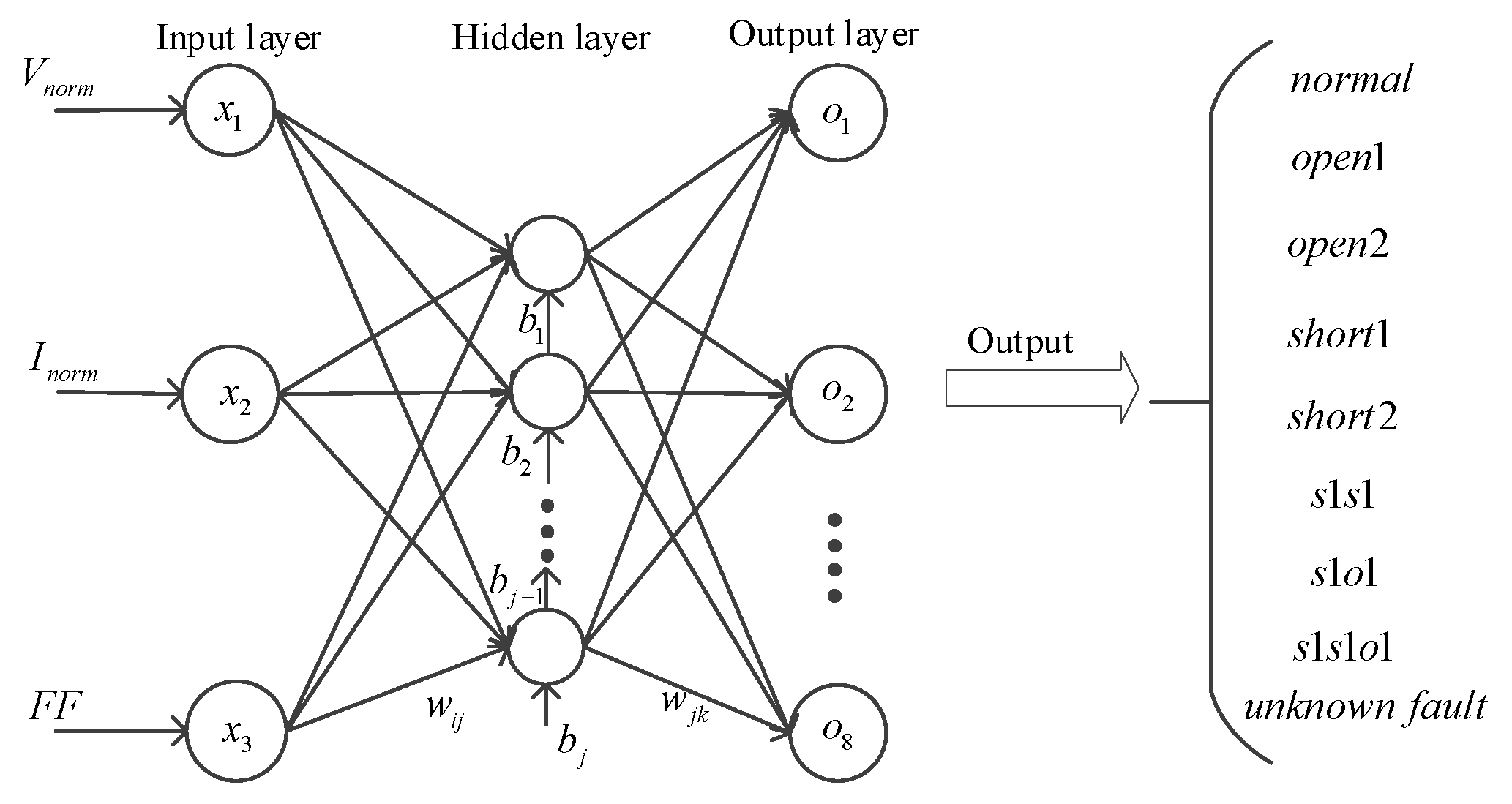
3. The Fault Diagnosis Algorithm Based on GKFCM
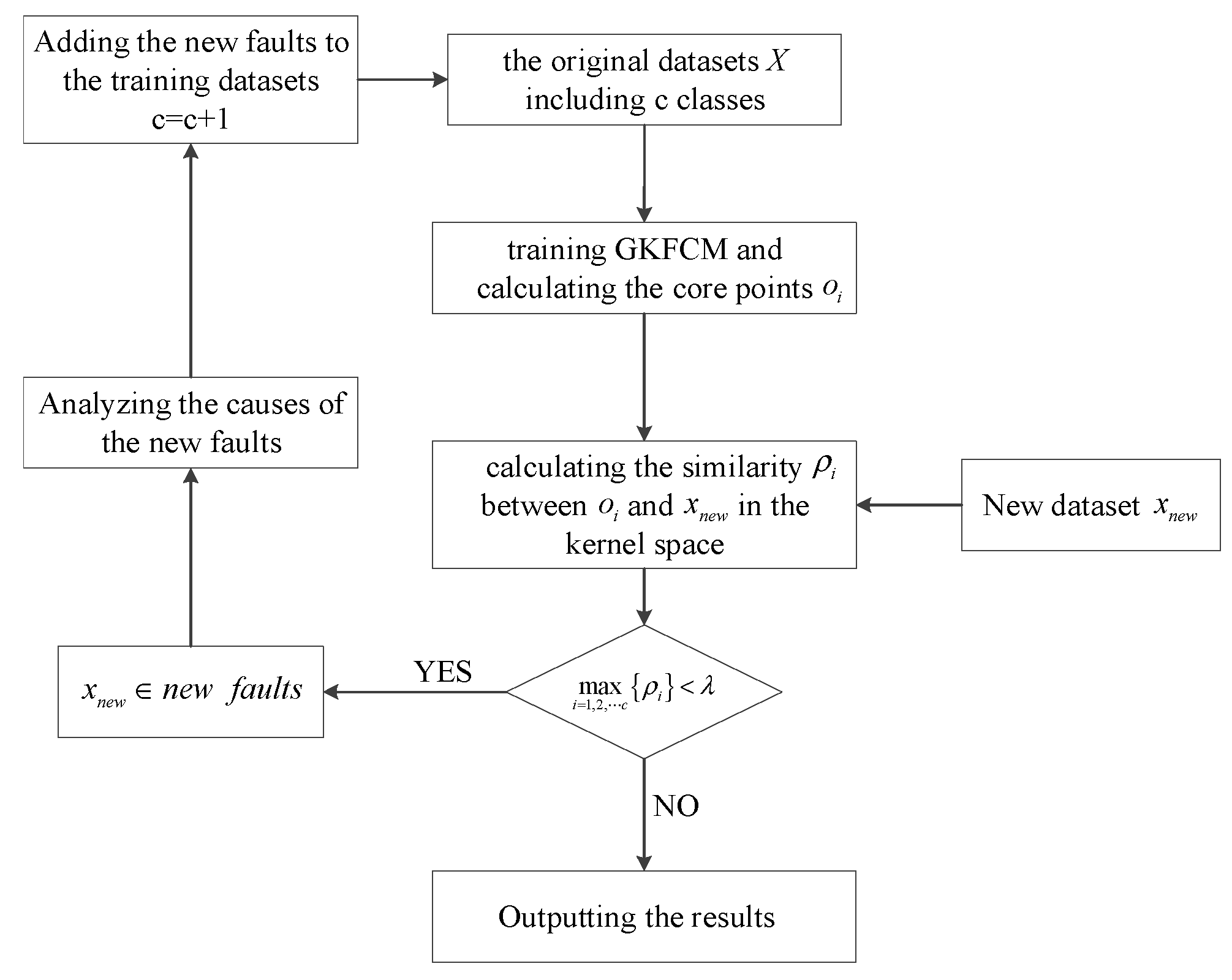
- Using the fault datasets including classes as the training datasets
- According to the Equation (7), the core points of the reference datasets are calculated and obtained when the classification error rate reaches the minimum level.
- Using the Equations (9) and (10) to determine the fault type of the new sample in the testing datasets.where is the similarity between and the dataset . The larger the value of , the higher the possibility of belonging to the corresponding fault type [15]. The Equation (8) is the judging criteria for the classification of the datasets in Support Vector Machine (SVM) and we use this principle to discriminate different fault datasets in this paper. is the category attribution threshold and the value is generally distributed between 0 and 0.5 [15,16].
- The previous step can not only determine the known faults in the training datasets but also judge the unknown fault types. If the belongs to an unknown fault, it will be classified as the class.
4. The Fault Diagnosis Method Based on GKFCM for the Photovoltaic Arrays
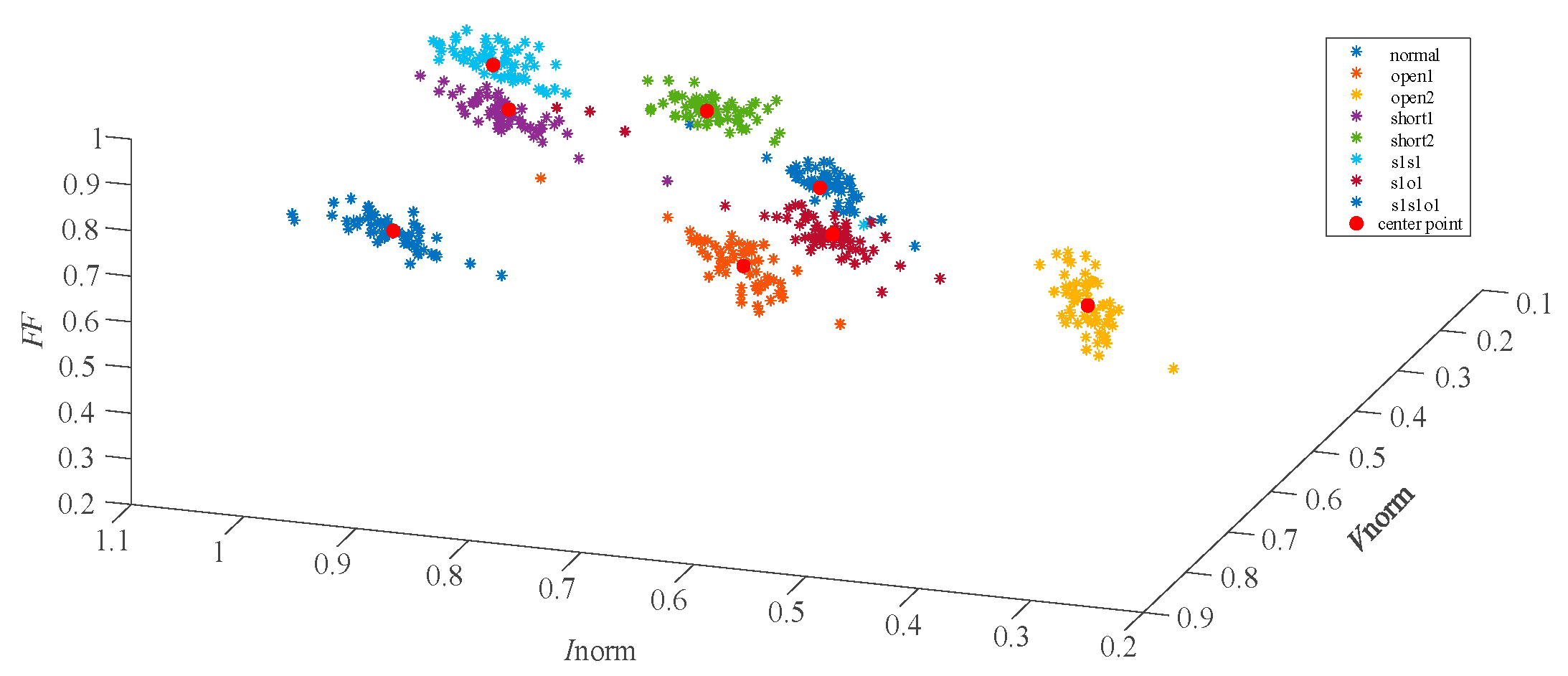
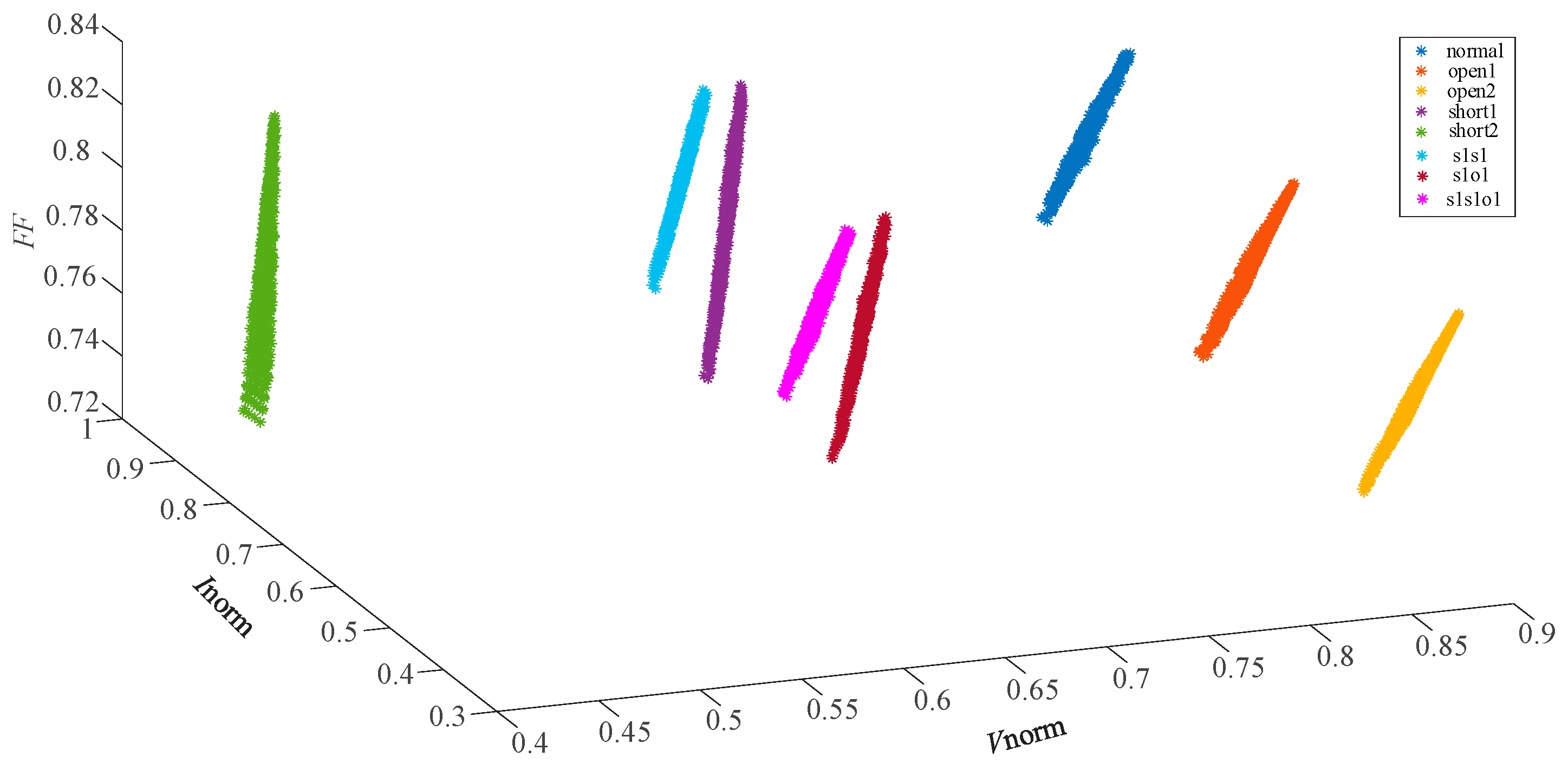
4.1. Selection of the Fault Feature Quantities
- The normalized PV voltage Vnormwhere is the open circuit voltage of the reference PV module. is the module number in each branch.
- The normalized PV current Inormwhere is the short circuit current of the reference PV module. is the branch number of the PV array.
- The Fill Factor (FF)where is the open circuit voltage of the PV array and is the short circuit current of the PV array.
4.2. Procedures of PV Array Fault Detection Approach Based on GKFCM
- Firstly, using the acquired datasets of 8 fault types to train the GKFCM. The core points are obtained when the classification error reaches the minimum level.
- Secondly, substituting the new fault dataset into the trained GKFCM and using the Equations (9) and (10) to judge the fault types of the new fault data .
- Lastly, judging the fault type based on the maximum similarity between the center points of the reference fault datasets and the new fault . If is not the known fault types included in the reference fault datasets, a new procedure is conducted to identify the fault type of . Then using it as a new fault type to train GKFCM to get a new training model.
5. The Simulation Experiment
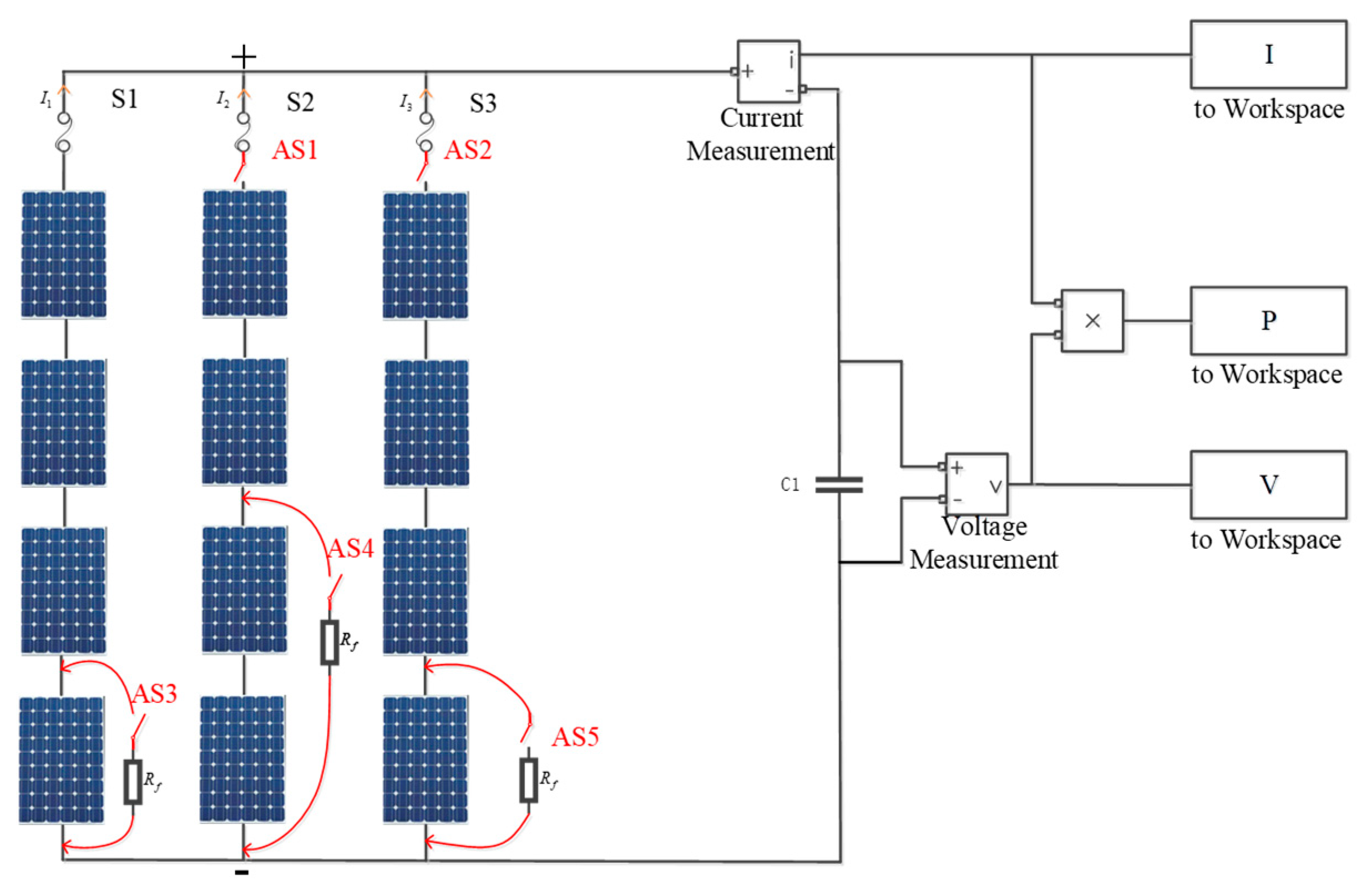
5.1. Model of the Photovoltaic Array
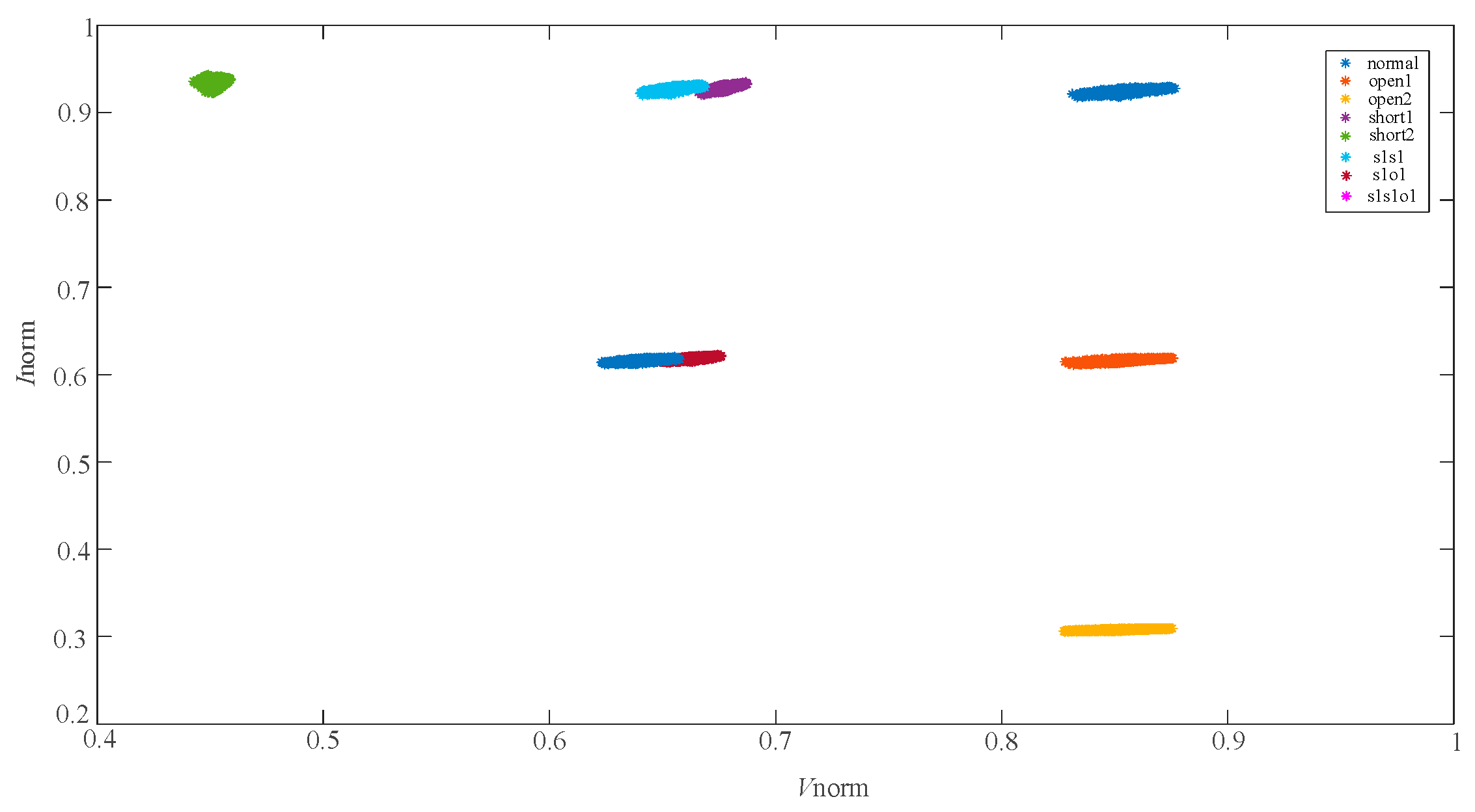
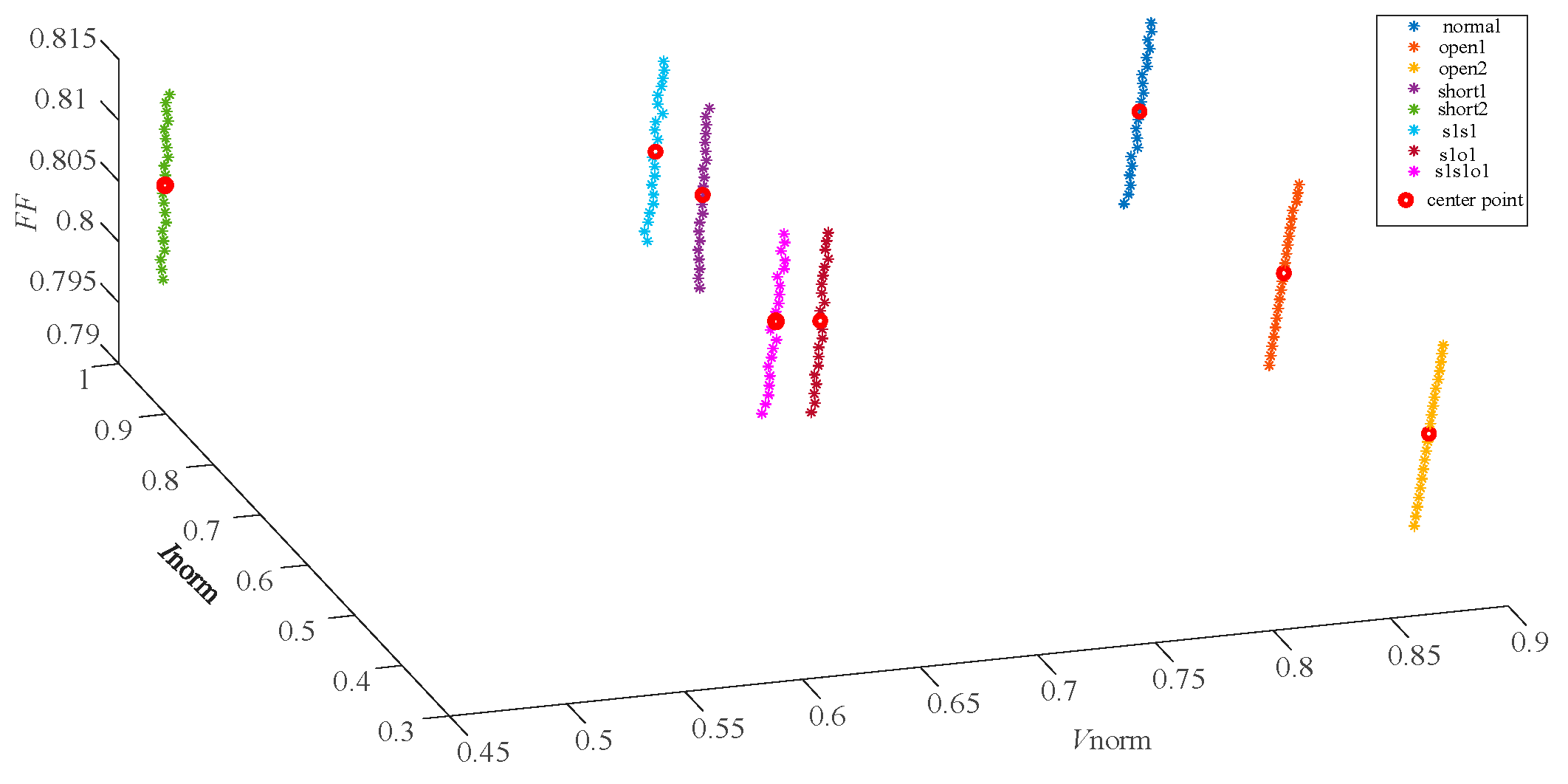
5.2. The Feature Characteristic Analysis of 8 Fault Types
5.3. Simulation Results
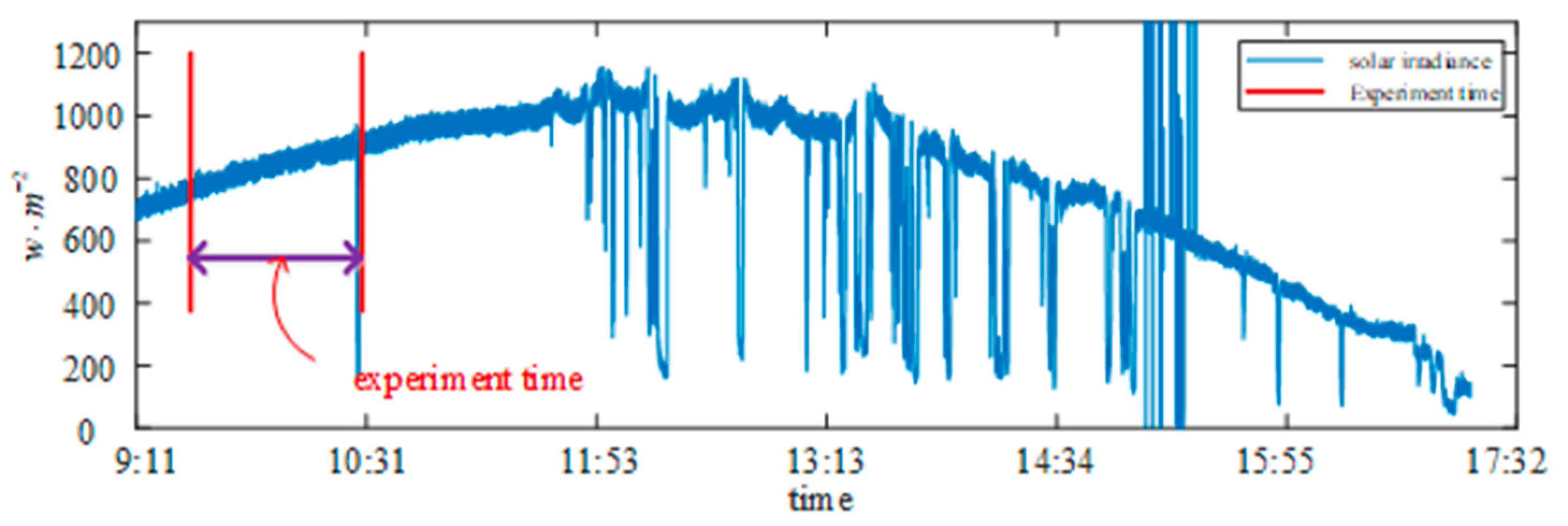
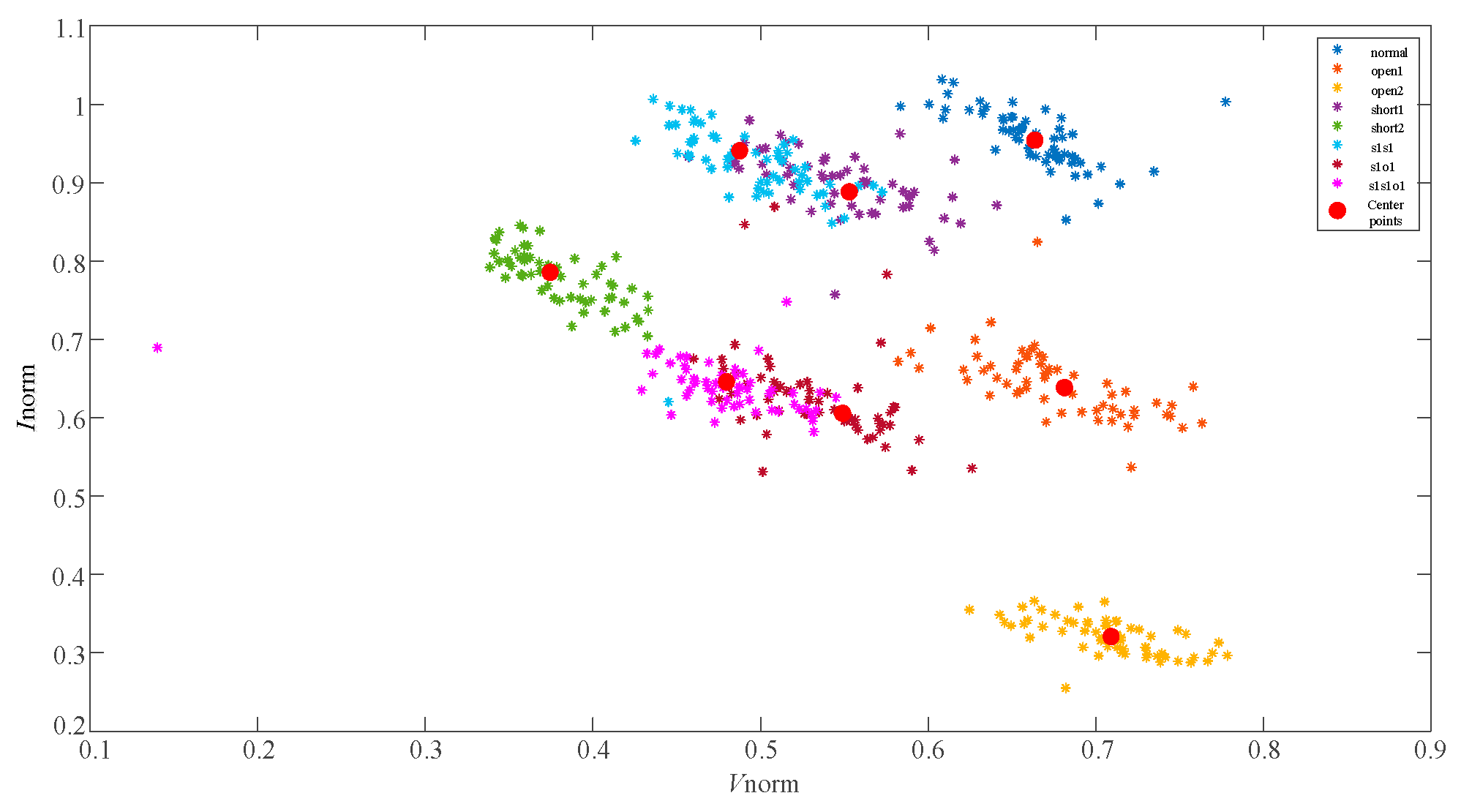
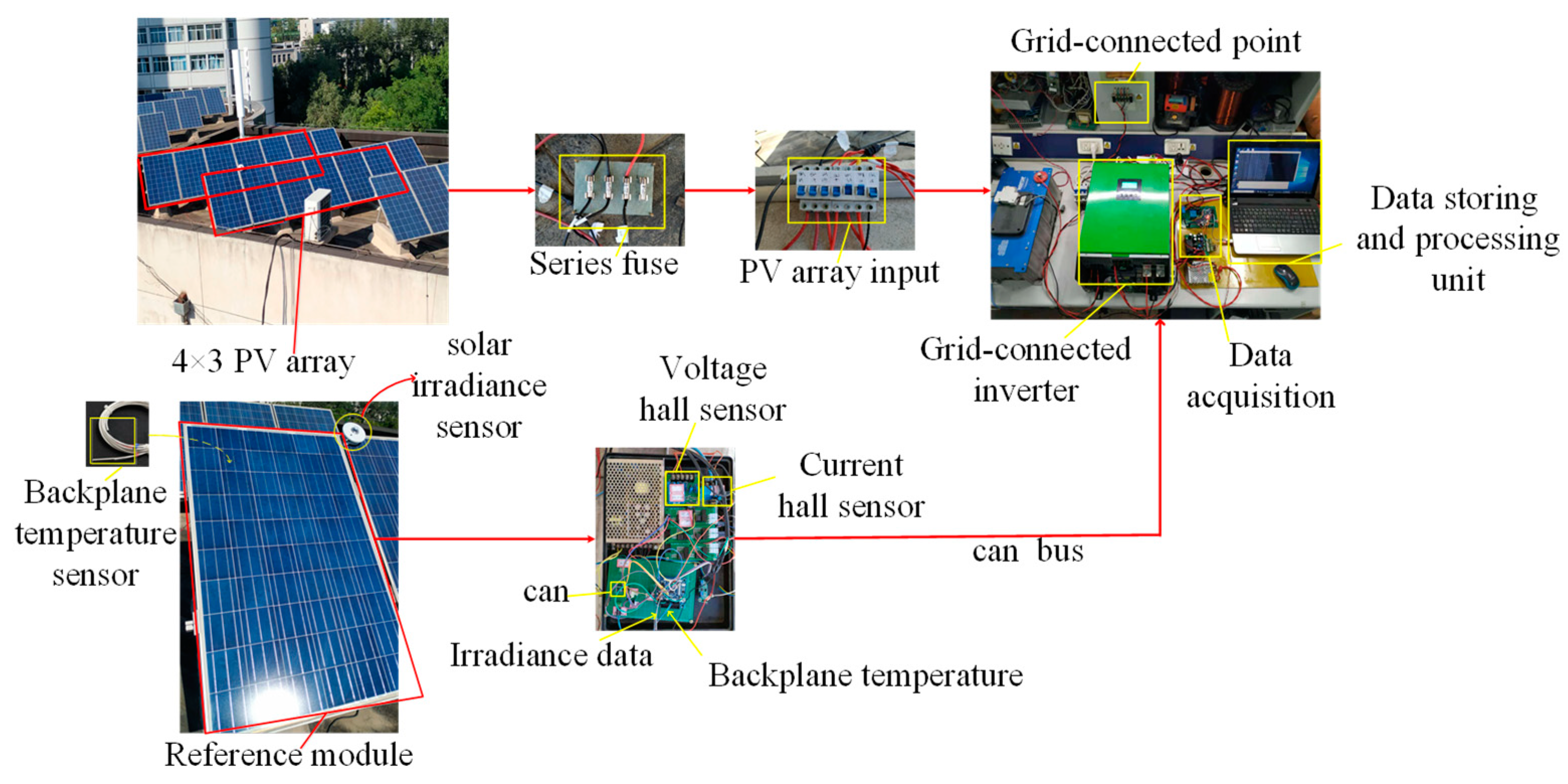
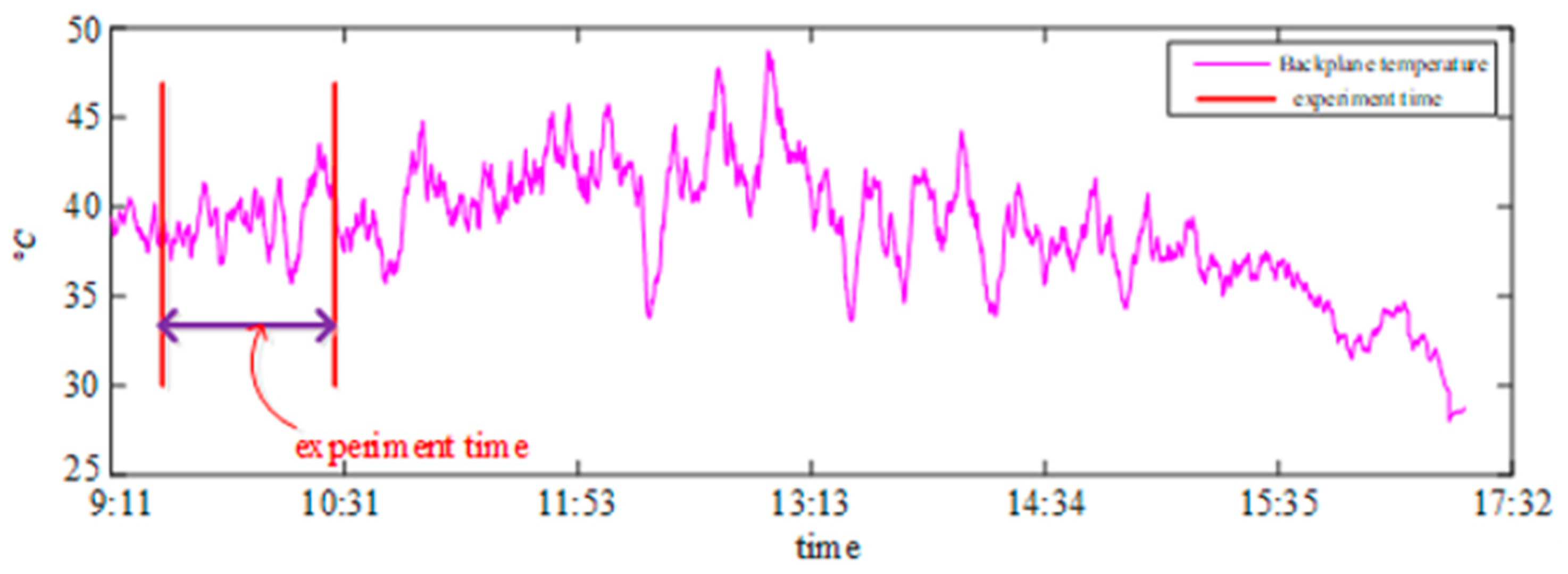
6. The Field Experiment
7. Conclusions
Author Contributions
Funding
Conflicts of Interest
References
- Takashima, T.; Yamaguchi, J.; Otani, K.; Kato, K.; Ishida, M. Experimental Studies of Failure Detection Methods in PV Module Strings. In Proceedings of the IEEE World Conference on Photovoltaic Energy Conference, Waikoloa, HI, USA, 7–12 May 2006. [Google Scholar]
- Takashima, T.; Yamaguchi, J.; Ishida, M. Disconnection detection using earth capacitance measurement in photovoltaic module string. Prostate 2008, 16, 669–677. [Google Scholar] [CrossRef]
- Hu, Y.; Cao, W.; Ma, J.; Finney, S.J.; Li, D. Identifying PV Module Mismatch Faults by a Thermography-Based Temperature Distribution Analysis. IEEE Trans. Device Mater. Reliab. 2014, 14, 951–960. [Google Scholar] [CrossRef]
- Gokmen, N.; Karatepe, E.; Silvestre, S.; Celik, B.; Ortega, P. An efficient fault diagnosis method for PV systems based on operating voltage-windows. Energy Convers. Manag. 2013, 73, 350–360. [Google Scholar] [CrossRef]
- Madeti, S.R.; Singh, S.N. Online fault detection and the economic analysis of grid-connected photovoltaic systems. Energy 2017, 134, 121–135. [Google Scholar] [CrossRef]
- Chouder, A.; Slivestre, S. Automatic supervision and fault detection of PV systems based on power losses analysis. Energy Convers. Manag. 2010, 51, 1929–1937. [Google Scholar] [CrossRef]
- Alam, M.K.; Khan, F.; Johnson, J.; Flicker, J. A Comprehensive Review of Catastrophic Faults in PV Arrays: Types, Detection, and Mitigation Techniques. IEEE J. Photovol. 2015, 5, 982–997. [Google Scholar] [CrossRef]
- Mellit, A.; Tina, G.M.; Kalogirou, S.A. Fault detection and diagnosis methods for photovoltaic systems: A review. Renew. Sustain. Energy Rev. 2018, 91, 1–17. [Google Scholar] [CrossRef]
- Lu, S.; Phung, B.T.; Zhang, D. A comprehensive review on DC arc faults and their diagnosis methods in photovoltaic systems. Renew. Sustain. Energy Rev. 2018, 89, 88–98. [Google Scholar] [CrossRef]
- Yao, X.; Herrera, L.; Ji, S.; Zou, K.; Wang, J. Characteristic Study and Time-Domain Discrete- Wavelet-Transform Based Hybrid Detection of Series DC Arc Faults. IEEE Trans. Power Electron. 2014, 29, 3103–3115. [Google Scholar] [CrossRef]
- Chen, S.; Li, X.; Xiong, J. Series Arc Fault Identification for Photovoltaic System Based on Time-Domain and Time-Frequency-Domain Analysis. IEEE J. Photovol. 2017, 7, 1105–1113. [Google Scholar] [CrossRef]
- He, C.; Mu, L.; Wang, Y. The Detection of Parallel Arc Fault in Photovoltaic Systems Based on a Mixed Criterion. IEEE J. Photovol. 2017, 7, 1–8. [Google Scholar] [CrossRef]
- Yi, Z.; Etemadi, A.H. Line-to-Line Fault Detection for Photovoltaic Arrays Based on Multiresolution Signal Decomposition and Two-Stage Support Vector Machine. IEEE Trans. Ind. Electron. 2017, 64, 8546–8555. [Google Scholar] [CrossRef]
- Yi, Z.; Etemadi, A. Fault Detection for Photovoltaic Systems Based on Multi-resolution Signal Decomposition and Fuzzy Inference Systems. IEEE Trans. Smart Grid 2016, 8, 1274–1283. [Google Scholar] [CrossRef]
- Chouay, Y.; Ouassaid, M. An intelligent method for fault diagnosis in photovoltaic systems. In Proceedings of the International Conference on Electrical and Information Technologies, Rabat, India, 15–18 November 2017. [Google Scholar]
- Wang, L.; Liu, J.; Guo, X.; Yang, Q.; Yan, W. Online fault diagnosis of photovoltaic modules based on multi-class support vector machine. In Proceedings of the Chinese Automation Congress, Jinan, China, 20–22 October 2017. [Google Scholar]
- Zhao, Y.; Ball, R.; Mosesian, J.; de Palma, J.F.; Lehman, B. Graph-Based Semi-supervised Learning for Fault Detection and Classification in Solar Photovoltaic Arrays. IEEE Trans. Power Electron. 2014, 30, 2848–2858. [Google Scholar] [CrossRef]
- Lin, P.; Lin, Y.; Chen, Z.; Wu, L.; Chen, L.; Cheng, S. A Density Peak-Based Clustering Approach for Fault Diagnosis of Photovoltaic Arrays. Int. J. Photoenergy 2017, 2017, 1–14. [Google Scholar] [CrossRef]
- Rui, B.; Ming, D.; Zhicheng, X.; Hu, G.; Danqi, Y. PV array fault diagnosis based on FCM. Acta Energiae Sol. Sin. 2016, 37, 730–736. [Google Scholar]
- Wang, J.; Rong, J.; Bo, T. Fault Diagnosis of Wind Turbine’s Gearbox based on EEMD and Fuzzy C Means Clustering. Acta Energiae Sol. Sin. 2015, 36, 319–324. [Google Scholar]
- Jingwei, L.; Meizhi, X. Kernelized Fuzzy Attribute C-means Clustering Algorithm. Fuzzy Sets Syst. 2008, 159, 2428–2445. [Google Scholar]
- Yiquan, W.; Yabing, H.; Shihua, W.; Yufei, Z.; Qiankun, X. Marine spill oil SAR image segmentation based on KFCM and improved CV model. Chin. J. Sci. Instrum. 2012, 33, 2812–2818. [Google Scholar]
- Jiang, Q.S.; Jia, M.P.; Hu, J.Z.; Xu, F.Y. A New Artificial Immunity Based Fuzzy Kernel Clustering Algorithm. China Mech. Eng. 2008, 5, 594–597. [Google Scholar]
- Baohai, H.; Yan, L.; Dongfeng, W. Steam Turbine Fault Diagnosis Based on KPCA and KFCM Ensemble. Electr. Power Autom. Equip. 2010, 7, 84–87. [Google Scholar]
- Li, Z.; Liu, Y.; Teng, W.; Yang, L. Fault diagnosis of Wind Power Gearbox Based on the KFCM trained by particle swarm optimization algorithm. J. Vibr. Meas. Diagn. 2017, 37, 484–488. [Google Scholar]
- Mei, F.; Mei, J.; Zheng, J.; Zhang, S.; Zhu, K. Application of Particle Swarm Fused KFCM and Classification Model of SVM for Fault Diagnosis of Circuit Breaker. Proc. CSEE 2013, 33, 134–141. [Google Scholar]
- Hariharan, R.; Chakkarapani, M.; Ilango, G.S.; Nagamani, C. A Method to Detect Photovoltaic Array Faults and Partial Shading in PV Systems. IEEE J. Photovol. 2016, 6, 1278–1285. [Google Scholar] [CrossRef]
- Ma, H.; Ekanayake, C.; Saha, T.K. Power transformer fault diagnosis under measurement originated uncertainties. IEEE Trans. Dielectr. Electr. Insul. 2012, 19, 1982–1990. [Google Scholar] [CrossRef]
- Ma, T.; Yang, H.; Lu, L. Development of a model to simulate the performance characteritics of crystalline silicon photovoltaic modules/strings/arrays. Sol. Energy 2014, 100, 31–41. [Google Scholar] [CrossRef]
- Ventura, C.; Tina, G.M. Utility scale photovoltaic plant indices and models for on-line monitoring and fault detection purposes. Electr. Power Syst. Res. 2016, 136, 43–56. [Google Scholar] [CrossRef]






| Description | Value |
|---|---|
| Maximum power () | 230.3 W |
| Maximum power point voltage in STC () | 31.00 V |
| Maximum power point current in STC () | 7.430 A |
| Open circuit voltage in STC () | 37.10 V |
| Short circuit current in STC () | 8.050 A |
| Temp. dependence of () | 0.04350 |
| Temp. dependence of () | −0.3515 |
| Number of cells in series () | 60.00 |
| Fault Types | Descriptions | Labels |
|---|---|---|
| Case 1 | no faults | normal |
| Case 2 | one string in open-circuit condition | open1 |
| Case 3 | two string in open-circuit condition | open2 |
| Case 4 | one module in short-circuit condition | short1 |
| Case 5 | two modules distributed in one string in short-circuit condition | short2 |
| Case 6 | two modules distributed in two different strings respectively in short-circuit condition | s1s1 |
| Case 7 | one module in short-circuit condition and another string in open-circuit condition | s1o1 |
| Case 8 | two modules distributed in two different strings respectively in short-circuit condition and the other string is in open-circuit condition | s1s1o1 |
| Datasets | Irradiance/W·m−2 | Temperature/°C |
|---|---|---|
| Training datasets | 200 | 0–20 |
| Testing datasets | 450–900 | 10–20 |
| Fault Types | Labels | Coordinates |
|---|---|---|
| case 1 | normal | (0.8691, 0.9268, 0.8053) |
| case 2 | open1 | (0.8685, 0.6178, 0.8049) |
| case 3 | open2 | (0.8682, 0.3089, 0.8044) |
| case 4 | short1 | (0.6843, 0.9316, 0.8020) |
| case 5 | short2 | (0.4569, 0.9368, 0.8071) |
| case 6 | s1s1 | (0.6639, 0.9292, 0.8061) |
| case 7 | s1o1 | (0.6718, 0.6200, 0.8048) |
| case 8 | s1s1o1 | (0.6524, 0.6174, 0.8052) |
| Fault Types | Sample Number for Identification | Identified Sample Number |
|---|---|---|
| normal | 110 | 110 |
| open1 | 110 | 110 |
| open2 | 110 | 110 |
| short1 | 110 | 110 |
| short2 | 110 | 110 |
| s1s1 | 110 | 110 |
| s1o1 | 110 | 110 |
| s1s1o1 | 110 | 110 |
| Description | Value |
|---|---|
| Maximum power () | 240.0 W |
| Maximum power point voltage in STC () | 37.60 V |
| Maximum power point current in STC () | 8.540 A |
| Open circuit voltage in STC () | 29.60 V |
| Short circuit current in STC () | 8.110 A |
| Temp. dependence of () | 0.1750 |
| Temp. dependence of () | −0.4882 |
| Number of cells in series () | 60.00 |
| Fault Types | Sample Number for Identification | Identified Sample Number |
|---|---|---|
| normal | 120 | 118 |
| open1 | 120 | 119 |
| open2 | 120 | 119 |
| short1 | 120 | 72 |
| short2 | 120 | 116 |
| s1s1 | 120 | 67 |
| s1o1 | 120 | 79 |
| s1s1o1 | 120 | 66 |
| unknown fault | 120 | 0 |
| Fault Types | Sample Number for Identification | Identified Sample Number |
|---|---|---|
| normal | 120 | 120 |
| open1 | 120 | 117 |
| open2 | 120 | 119 |
| short1 | 120 | 109 |
| short2 | 120 | 117 |
| s1s1 | 120 | 101 |
| s1o1 | 120 | 117 |
| s1s1o1 | 120 | 102 |
| unknown fault | 120 | 0 |
| Fault Types | Sample Number for Identification | Identified Sample Number |
|---|---|---|
| normal | 120 | 117 |
| open1 | 120 | 117 |
| open2 | 120 | 119 |
| short1 | 120 | 73 |
| short2 | 120 | 112 |
| s1s1 | 120 | 55 |
| s1o1 | 120 | 58 |
| s1s1o1 | 120 | 96 |
| unknown fault | 120 | all identified as normal |
| Fault Types | Sample Number for Identification | Identified Sample Number |
|---|---|---|
| normal | 120 | 118 |
| open1 | 120 | 117 |
| open2 | 120 | 119 |
| short1 | 120 | 115 |
| short2 | 120 | 116 |
| s1s1 | 120 | 104 |
| s1o1 | 120 | 117 |
| s1s1o1 | 120 | 101 |
| unknown fault | 120 | all identified as normal |
© 2019 by the authors. Licensee MDPI, Basel, Switzerland. This article is an open access article distributed under the terms and conditions of the Creative Commons Attribution (CC BY) license (http://creativecommons.org/licenses/by/4.0/).
Share and Cite
Liu, S.; Dong, L.; Liao, X.; Cao, X.; Wang, X. Photovoltaic Array Fault Diagnosis Based on Gaussian Kernel Fuzzy C-Means Clustering Algorithm. Sensors 2019, 19, 1520. https://doi.org/10.3390/s19071520
Liu S, Dong L, Liao X, Cao X, Wang X. Photovoltaic Array Fault Diagnosis Based on Gaussian Kernel Fuzzy C-Means Clustering Algorithm. Sensors. 2019; 19(7):1520. https://doi.org/10.3390/s19071520
Chicago/Turabian StyleLiu, Shengyang, Lei Dong, Xiaozhong Liao, Xiaodong Cao, and Xiaoxiao Wang. 2019. "Photovoltaic Array Fault Diagnosis Based on Gaussian Kernel Fuzzy C-Means Clustering Algorithm" Sensors 19, no. 7: 1520. https://doi.org/10.3390/s19071520
APA StyleLiu, S., Dong, L., Liao, X., Cao, X., & Wang, X. (2019). Photovoltaic Array Fault Diagnosis Based on Gaussian Kernel Fuzzy C-Means Clustering Algorithm. Sensors, 19(7), 1520. https://doi.org/10.3390/s19071520