Privacy-Preserving Multi-Receiver Certificateless Broadcast Encryption Scheme with De-Duplication

Abstract
1. Introduction
2. Related Works
3. Preliminaries
3.1. Bilinear Groups
- and denote two additional groups of the same prime p; denotes a multiplicative group. In addition, it is deemed to be hard for solving the discrete logarithm problem in group .
- denotes the generator of group , for .
- Let be a computable isomorphism map which satisfies ; and
- Let denote a computable bilinear map, which meets the following criteria:
- Bilinearity: For arbitrary and all , , we have ;
- Non-degeneracy: .
3.2. Security Assumptions
4. Basic System Model and Security Model
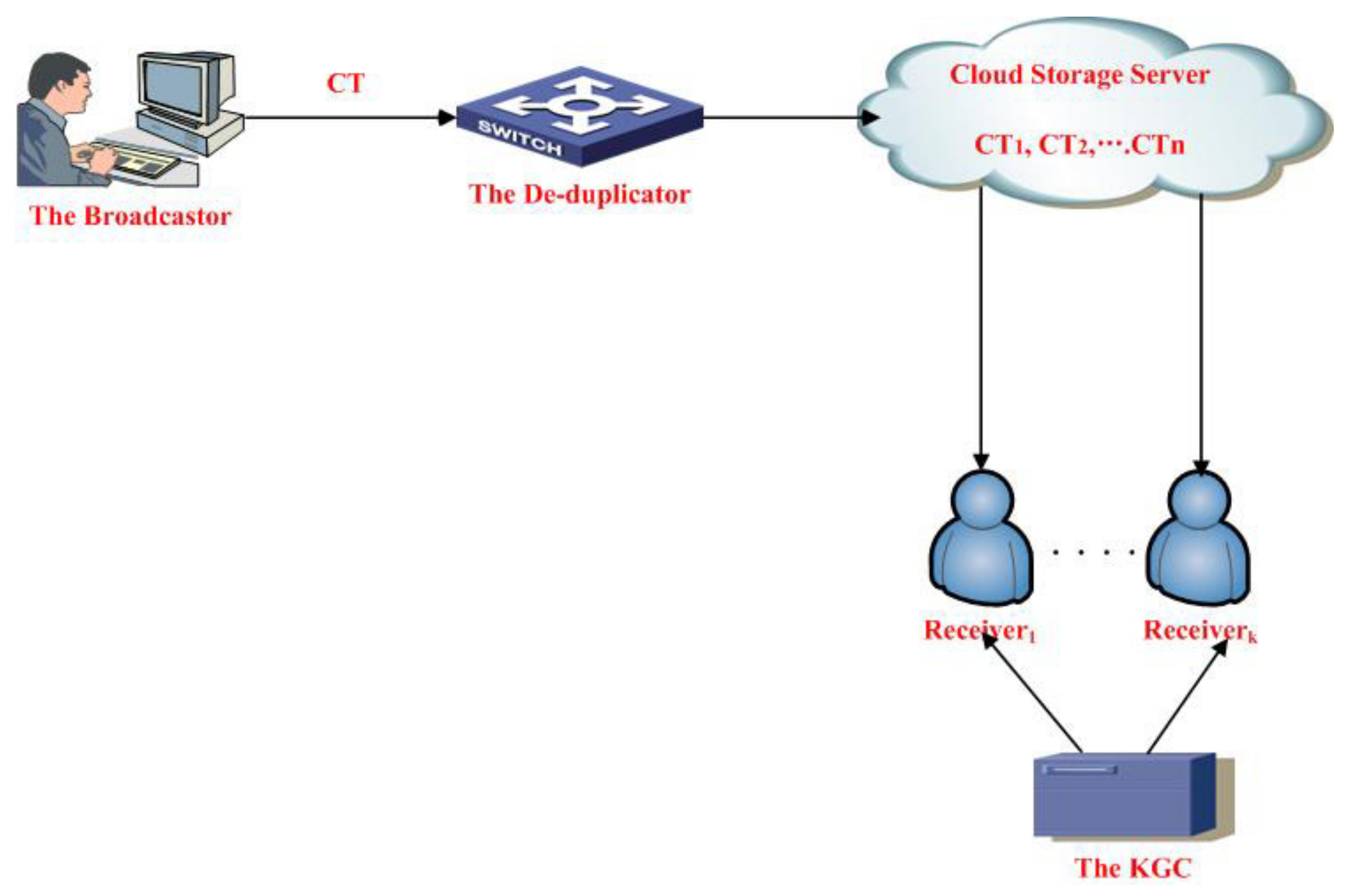
4.1. System Model
- KGC: it is a trustworthy entity that is responsible for producing a partial private key of the receiver.
- the Broadcaster: It is a sender of the message. It first selects a subset of the receivers and calculates the ciphertext of the transmitted message. Afterwards, it sends these ciphertexts to the de-duplicator.
- The de-duplicator: It is an honest-but-curious entity. It can be acted on by the cloud server. Its goal is to check whether the received ciphertext has its replica existing in the cloud.
- The Receiver: It is the receiver of the ciphertext, its goal is to decrypt the ciphertext. If and only if it is an authenticated receiver, then it can decrypt the ciphertext.
- System-setup . is a security parameter, and this algorithm is run by a Key Generation Center (KGC) which takes as input , return the public parameters and the master secret key of KGC. The public parameters should be published publicly.
- Extract partial-private key . In general, this algorithm is run by KGC. It takes as inputs public parameters , master key and a receiver’s identity , and outputs the partial-private key of the receiver.
- Set secret-value . The algorithm is run by the receiver. It takes as inputs public parameters and the identity of the receiver, and returns as the receiver’s secret value.
- Set private-key : This algorithm is run by the receiver, it takes as inputs the partial-private key and secret-value of the receiver, and outputs private key of the receiver.
- Set public-key : The algorithm is used to produce the public key of the receiver. It takes as inputs secret value of the receiver and public parameters , and outputs the corresponding public key .
- Encrypt . The broadcaster runs this algorithm by inputting a plaintext m, public parameters , a set of receivers’ identities/public keys, and outputs a ciphertext .
- Decrypt : The algorithm is run by the receiver. It takes as inputs a ciphertext C, public parameters and the private key of the receiver, returns a recovered message m or a symbol ⊥ that indicates decryption error.
- Equality-test : It is a deterministic algorithm, run by a de-duplicator which is an honest-but-curious entity, it takes public parameter , the de-duplicator’s secret key and two ciphertexts and as inputs, and returns 1 if and are from the identical plaintext, otherwise, returns 0.
4.2. Security Models
- Setup: Let λ be a security parameter, C be a Challenger. C invokes a algorithm to return public parameters and master secret key ; afterwards, C transmits to . If is the Type II adversary , then is also sent to . Otherwise, is secretly kept by the Challenger and then sends system public parameters to adversary who also receives the master secret key if it is of Type II. Otherwise, the master secret key is kept secret.
- Phase 1: In this phase, can adaptively make a series of queries:
- −
- Public key query oracle: Upon receiving public key query of the receiver , if it is the first query of the receiver, then C invokes Set public-key algorithm to produce public key and return to . Otherwise, it returns the matching public key in the list.
- −
- Extract partial-private key oracle: On receiving a partial private key query of the receiver , C inputs to invoke the Extract partial-private key algorithm and return if is the Type I ; otherwise, the oracle is not required if A is of Type II.
- −
- Extract secret-key oracle: Upon receiving the secret key query of the receiver from the adversary , C invokes the Set secret-value algorithm to produce secret value and return it to .
- −
- Decrypt oracle: On receiving the decrypting query of from , C invokes the Set secret-value algorithm and Extract partial-private key algorithm to obtain private key of the receiver ; then, it runs a Decryption algorithm to recover the corresponding plaintext.
Note that when is the Type I , it also needs to query Public-key-replace oracle in which the receiver’s public key is replaced with a new public key when inputting a receiver’s identity and its corresponding public key . - Challenge: The adversary submits two distinct equivalent-length messages and as well as a set of the receivers’ identities/public-keys . It is required that cannot query Extract partial-private-key oracle with the identity . The challenger C randomly samples a bit to compute the challenge ciphertext and returns it to adversary A.
- Phase 2: Adversary can continue to adaptively issue a new sequence of queries as in Phase 1. In addition, is not permitted to issue Decryption query, where .Meanwhile, in a Type I attack, is not allowed to issue Extract partial-private-key query and Public-key-replace query on identity , where .
- Guess: At last, a guess bit is returned by the adversary . wins this game if .
- Setup and Phase 1: In the two phases, they are the same as those in the above IND-CCA Game.
- Challenge: In this phase, produces two challenge sets and , where . In addition, it then submits a message and to C. In addition, the constraint conditions are as follows: (1) is not permitted to issue Extract partial-private-key queries on when is the Type I adversary ,(2) a is not permitted to issue Extract secret-key queries on when is the Type II adversary , where and . Then, C uniformly samples a bit to calculate the ciphertext and returns it to .
- Phase 2. In this phase, adaptively issues a new series of queries as in Phase 1 with the following constraint conditions :(1) is not permitted to issue Extract partial-private-key queries on , (2) Public-key-replace queries on are not allowed when is the Type I adversary , (3) Extract secret-key queries on are not allowed when is the Type II adversary , and (4) is not allowed to issue Decryption Query on , where .
- Guess: At last, a guess bit is outputted by . wins this game if .
5. Our Scheme
- For to n, it calculates , and then it produces the polynomialObviously, we find and for .
- It randomly chooses to compute
- Then, it selects and to compute and .
- Next, choose a random number , and then for , it calculates
- In addition, it computes .
- In addition, for each , it computes
- Compute and .
- Finally, the resultant ciphertext is as below:
- First, it computes .
- Then, it calculates
- It computes ;
- In addition, it obtains the decryption key .
- Finally, it obtains the plaintext and checks . If it holds, output TRUE.
Discussion
6. Security Analysis
- H-Hash Query: When receiving the H-hash query on from , B answers as below. If a record have appeared in a tuple in the H-list which is originally empty, it sends back ; otherwise, it generates , and randomly chooses . If , it sets , else it sets and adds in the H-list. It returns to
- -Query: On input, an identity , if exists in the -list, then it returns to ; otherwise, it picks to return and adds into the -list. Note that -list is originally empty.
- -Query: On input, , if is in the -list which being originally empty, it sends back to ; otherwise, it picks to return and adds into the -list.
- Public-key query: When makes a public key query with , if the 3-tuple appears in the PK-list which is initially empty. is returned to ; otherwise, B picks to set , and adds in the PK-list. Finally, it returns to .
- Extract partial-private key Query: Upon receiving a Partial-private key query of the identity , if the record had appeared in the H-list and , then B computes . Otherwise, abort it and output ⊥.
- Extract secret-value Query: When issues a query on an identity , if 3-tuple exists on the PK-list, then is returned to , otherwise, B randomly selects to compute and adds in the PK-list.
- Public-key-replace Query: When makes a public key replace query with , the corresponding tuple is replaced into a new tuple in the PK-list.
- Decryption Queries: On input, a ciphertext and an identity , where , B first issues a H-query with to obtain the tuple , if , it sets and make a Extract-secret-value query with , if is returned, B can make use of to decrypt and respond the Decryption Query. Otherwise, B does the following steps:
- For to {it retrieves from -list and decrypts to recover with to parse it into M and which can recover . (Note that we assume that the -query had been made before the adversary issues the decryption-query with ).ifbreak;}
- If , B sends back M to . Otherwise, it aborts it.
- iIt sets .
- For to l, it computes .
- Next, for to l, it constructs the polynomial
- B randomly chooses .
- For to l, it randomly chooses to compute .
- For , B computes
- B randomly chooses and to compute and , where , .
- It computes and . Note that in fact is also an instance of DDH problem when is an instance of DDH problem, since and .
- The resultant ciphertext is returned to .
- can not be made into Decryption queries.
- All is not allowed to issue Extract partial-private-key queries.
- For to {it retrieves from -list and decrypts to recover with ;ifbreak;}
- If , B sends back M to . If not, it aborts it.
- It uniformly samples to compute and as well as . Note that we have the relation which is the instance of the CDH problem if .
- For to l, it calculates ;
- Then, for to l, it builds the polynomial
- For to l, B computesNote that in the original encryption is set as but is unknown.
- For , it calculates
- It randomly selects to compute and , denotes the x-coordination of point Z.
- It computes .
- The ciphertext is
- It sets .
- B retrieves by issuing a H-query on , if holds, then it aborts it and outputs ⊥; if , then let and . Next, it issues -queries with to obtain .
- Compute , and for to l, it computes .
- Next, for , it constructs the polynomial
- B randomly chooses and for , it randomly chooses to compute ; and then it computes .
- For , B computes
- B randomly chooses and to compute and , where and is the x-coordination of point .
- B computes and .
- The ciphertext is to the adversary .
- can not issue Extract Partial-Private-Key Queries with , where .
- can not issue Public-Key Replace with , where .
- can not issue Decryption Queries with , where .
- First, it makes a Public-key Query on to obtain . If , output ⊥ and abort it. If , it means that .
- For , it calculates ;
- Then, for , it builds the polynomial
- For , B issues Public-key Queries with to obtain . If , B computesIf , it computes
- For , it computes
- It randomly selects and to compute and .
- It randomly chooses to compute and as well as .
- It computes .
- The resultant ciphertext is
- is not capable of issuing Public-key Query with , where .
- is not capable of issuing Decryption Query with , where .
7. Performance Analysis
8. Conclusions
Author Contributions
Funding
Conflicts of Interest
References
- Fiat, A.; Naor, M. Broadcast encryption. In Proceedings of the Annual International Cryptology Conference, Santa Barbara, CA, USA, 22–26 August 1993; pp. 480–491. [Google Scholar]
- Fan, L.; Lei, X.; Yang, N.; Duong, T.Q.; Karagiannidis, G.K. Secure multiple amplify-and-forward relaying with cochannel interference. IEEE J. Sel. Top. Signal Process. 2016, 10, 1494–1505. [Google Scholar] [CrossRef]
- Fan, L.; Lei, X.; Yang, N.; Duong, T.Q.; Karagiannidis, G.K. Secrecy cooperative networks with outdated relay selection over correlated fading channels. IEEE Trans. Veh. Technol. 2017, 66, 7599–7603. [Google Scholar] [CrossRef]
- Shen, J.; Zhou, T.; Chen, X.; Li, J.; Susilo, W. Anonymous and traceable group data sharing in cloud computing. IEEE Trans. Inf. Forensics Secur. 2017, 13, 912–925. [Google Scholar] [CrossRef]
- D’Orazio, C.J.; Choo, K.K.R.; Yang, L.T. Data exfiltration from Internet of Things devices: iOS devices as case studies. IEEE Internet Things J. 2016, 4, 524–535. [Google Scholar] [CrossRef]
- Do, Q.; Martini, B.; Choo, K.K.R. Cyber-physical systems information gathering: A smart home case study. Comput. Netw. 2018, 138, 1–12. [Google Scholar] [CrossRef]
- Zhang, J. Improvement of ID-based proxy re-signature scheme with pairing-free. Wireless Netw. 2019. [Google Scholar] [CrossRef]
- Bellare, M.; Boldyreva, A.; Desai, A.; Pointcheval, D. Key-privacy in public-key encryption. In International Conference on the Theory and Application of Cryptology and Information Security; Springer: Berlin/Heidelberg, Germany, 2001; pp. 566–582. [Google Scholar]
- Li, X.; Gu, D.; Ren, Y.; Ding, N.; Yuan, K. Efficient ciphertext-policy attribute based encryption with hidden policy. In Proceedings of the International Conference on Internet and Distributed Computing Systems, Wu Yi Shan, China, 21–23 November 2012; pp. 146–159. [Google Scholar]
- Camenisch, J.; Kohlweiss, M.; Rial, A.; Sheedy, C. Blind and anonymous identity-based encryption and authorised private searches on public key encrypted data. In Proceedings of the International Conference on Practice and Theory in Public Key Cryptography—PKC, Irvine, CA, USA, 18–20 March 2009; pp. 96–214. [Google Scholar]
- Barth, A.; Boneh, D.; Waters, B. Privacy in encrypted content distribution using private broadcast encryption. In International Conference on Financial Cryptography and Data Security; Springer: Berlin/Heidelberg, Germany, 2006; pp. 52–64. [Google Scholar]
- Fan, C.I.; Tseng, Y.F. Anonymous multi-receiver identity-based authenticated encryption with CCA security. Symmetry 2015, 7, 1856–1881. [Google Scholar] [CrossRef]
- Lai, J.; Mu, Y.; Guo, F.; Chen, R. Fully privacy-preserving ID-based broadcast encryption with authorization. Comput. J. 2017, 60, 1809–1821. [Google Scholar] [CrossRef]
- Fan, C.I.; Tsai, P.J.; Huang, J.J.; Chen, W.T. Anonymous multi-receiver certificate-based encryption. In Proceedings of the 2013 International Conference on Cyber-Enabled Distributed Computing and Knowledge Discovery, CyberC, Beijing, China, 10–12 October 2013; pp. 19–26. [Google Scholar]
- Katz, J.; Sahai, A.; Waters, B. Predicate encryption supporting disjunctions, polynomial equations, and inner products. In Proceedings of the Theory and Applications of Cryptographic Techniques International Conference on Advances in Cryptology, Istanbul, Turkey; 2008; pp. 146–162. [Google Scholar]
- Liu, Q.; Guo, Y.; Wu, J.; Wang, G. Effective query grouping strategy in clouds. J. Comput. Sci. Technol. 2017, 32, 1231–1249. [Google Scholar] [CrossRef]
- Liu, Z.; Huang, Y.; Li, J.; Cheng, X.; Shen, C. Divoram: Towards a practical oblivious ram with variable block size. Inf. Sci. 2018, 447, 1–11. [Google Scholar] [CrossRef]
- Jhaveri, R.H.; Patel, N.M.; Zhong, Y.; Sangaiah, A.K. Sensitivity analysis of an attack-pattern discovery based trusted routing scheme for mobile ad-hoc networks in industrial iot. IEEE Access 2018, 6, 23344–23355. [Google Scholar] [CrossRef]
- Cai, Z.; Yan, H.; Li, P.; Huang, Z.A.; Gao, C. Towards secure and flexible ehr sharing in mobile health cloud under static assumptions. Clust. Comput. 2017, 20, 2415–2422. [Google Scholar] [CrossRef]
- Li, J.; Chen, X.; Chow, S.S.; Huang, Q.; Wong, D.S.; Liu, Z. Multi-authority fine-grained access control with accountability and its application in cloud. J. Netw. Comput. Appl. 2018, 112, 89–96. [Google Scholar] [CrossRef]
- Wang, H.; Zheng, Z.; Wu, L.; Li, P. New directly revocable attribute-based encryption scheme and its application in cloud storage environment. Clust. Comput. 2017, 20, 2385–2392. [Google Scholar] [CrossRef]
- Li, J.; Li, J.; Chen, X.; Jia, C.; Lou, W. Identitybased encryption with outsourced revocation in cloud computing. IEEE Trans. Comput. 2015, 64, 425–437. [Google Scholar] [CrossRef]
- Yang, L.; Han, Z.; Huang, Z.; Ma, J. A remotely keyed file encryption scheme under mobile cloud computing. J. Netw. Comput. Appl. 2018, 106, 90–99. [Google Scholar] [CrossRef]
- Wu, Z.; Tian, L.; Li, P.; Wu, T.; Jiang, M.; Wu, C. Generating stable biometric keys for flexible cloud computing authentication using finger vein. Inf. Sci. 2016, 433, 431–447. [Google Scholar] [CrossRef]
- Zhang, J.; Bai, W.; Wang, Y. Non-Interactive ID-Based Proxy Re-Signature Scheme for IoT Based on Mobile Edge Computing. IEEE Access 2019, 7, 37865–37875. [Google Scholar] [CrossRef]
- Quick, D.; Kwang Raymond Choo, K. Pervasive social networking forensics: Intelligence and evidence from mobile device extracts. J. Netw. Comput. Appl. 2016, 86, 24–33. [Google Scholar] [CrossRef]
- Bakas, A.; Michalas, A. Modern family: A revocable hybrid encryption scheme based on attribute-based encryption, symmetric searchable encryption and SGX. In Proceedings of the 15th EAI International Conference on Security and Privacy in Communication Networks (SecureComm ’19), Orlando, FL, USA, 23–25 October 2019. [Google Scholar]
- Michalas, A. The lord of the shares: Combining attribute-based encryption and searchable encryption for flexible data sharing. In Proceedings of the 34th ACM/SIGAPP Symposium on Applied Computing (SAC), Limassol, Cyprus, 8–12 April 2019. [Google Scholar]
- Li, J.; Chen, X.; Li, M.; Li, J.; Lee, P.P.C.; Lou, W. Secure de-duplication with efficient and reliable convergent key management. IEEE Trans. Parallel Distrib. Syst. 2014, 25, 1615–1625. [Google Scholar] [CrossRef]
- Libert, B.; Paterson, K.G.; Quaglia, E.A. Anonymous broadcast encryption: Adaptive security and efficient constructions in the standard model. In International Workshop on Public Key Cryptography LNCS; Springer: Berlin/Heidelberg, Germany, 2012; Volume 7293, pp. 206–224. [Google Scholar]
- Fazio, N.; Perera, I.M. Outsider-anonymous broadcast encryption with sublinear ciphertexts. In International Workshop on Public Key Cryptography; Springer: Berlin/Heidelberg, Germany, 2012; pp. 225–242. [Google Scholar]
- Delerablee, C. Identity-based broadcast encryption with constant size ciphertexts and private keys. In International Conference on the Theory and Application of Cryptology and Information Security. ASIACRYPT 2007, Lecture Notes in Computer Science; Springer: Berlin/Heidelberg, Germany, 2007; Volume 4833, pp. 200–215. [Google Scholar]
- Galindo, D. Boneh-Franklin identity based encryption revisited. In International Colloquium on Automata, Languages, and Programming; ICALP 2005, LNCS 3580; Springer: Berlin/Heidelberg, Germany, 2005; pp. 791–802. [Google Scholar]
- Wang, H.; Zhang, Y.; Xiong, H.; Qin, B. Cryptanalysis and improvements of an anonymous multi-receiver identity-based encryption scheme. Inf. Secur. IET 2012, 6, 20–27. [Google Scholar] [CrossRef]
- Chien, H.Y. Improved Anonymous Multi-Receiver Identity-Based Encryption; Oxford University Press: Oxford, UK, 2012; Volume 55. [Google Scholar]
- Zhang, J.; Xu, Y.; Zou, J. Comment on Wang et al.’s anonymous multi-receiver id-based encryption scheme and its improved schemes. Int. J. Intell. Inf. Database Syst. 2013, 7, 400–413. [Google Scholar] [CrossRef]
- Hung, Y.H.; Huang, S.S.; Tseng, Y.M.; Tsai, T.T. Efficient anonymous multireceiver certificateless encryption. IEEE Syst. J. 2017, 11, 1–12. [Google Scholar] [CrossRef]
- Xu, P.; Li, J.; Wang, W.; Jin, H. Anonymous identity-based broadcast encryption with constant decryption complexity and strong security. In Proceedings of the 11th ACM on Asia Conference on Computer and Communications Security, Xi’an, China, 30 May–3 June 2016; pp. 223–233. [Google Scholar]
- Liang, K.; Chu, C.K.; Tan, X.; Wong, D.S.; Tang, C.; Zhou, J. Chosen-ciphertext secure multi-hop identity-based conditional proxy re-encryption with constant-size ciphertexts. Theor. Comput. Sci. 2014, 539, 87–105. [Google Scholar] [CrossRef]
- Boyen, X.; Haines, T. Forward-secure linkable ring signatures. In Australasian Conference on Information Security and Privacy; Springer: Cham, Switzerland, 2018; pp. 245–264. [Google Scholar]
- He, K.; Weng, J.; Liu, J.N.; Liu, J.K.; Liu, W.; Deng, R.H. Anonymous identity-based broadcast encryption with chosen-ciphertext security. In Proceedings of the 11th ACM on Asia Conference on Computer and Communications Security, Xi’an, China, 30 May–3 June 2016; pp. 247–255. [Google Scholar]
- Al-Riyami, S.S.; Paterson, K.G. Certificateless Public Key Cryptography. In Advances in Cryptology—ASIACRYPT 2003. Lecture Notes in Computer Science; Springer: Berlin/Heidelberg, Germany, 2003; Volume 2894, pp. 452–473. [Google Scholar]
- Yum, D.H.; Lee, P.J. Generic construction of certificateless encryption. In International Conference on Computational Science and Its Applications; Springer: Berlin/Heidelberg, Germany, 2004; pp. 802–811. [Google Scholar]
- Libert, B.; Quisquater, J.J. On constructing certificateless cryptosystems from identity based encryption. In International Workshop on Public Key Cryptography; Springer: Berlin/Heidelberg, Germany, 2006; pp. 474–490. [Google Scholar]
- Islam, S.H.; Khan, M.K.; Al-Khouri, A.M. Anonymous and provably secure certificateless multireceiver encryption without bilinear pairing. Secur. Commun. Netw. 2015, 8, 2214–2231. [Google Scholar] [CrossRef]
- Douceur, J.R.; Adya, A.; Bolosky, W.J.; Simon, P.; Theimer, M. Reclaiming space from duplicate files in a serverless distributed file system. In Proceedings of the 22nd International Conference on Distributed Computing Systems, Vienna, Austria, 2–5 July 2002; pp. 617–624. [Google Scholar]
- Bellare, M.; Keelveedhi, S.; Ristenpart, T. Message-locked encryption and secure de-duplication. In Annual International Conference on the Theory and Applications of Cryptographic Techniques; Springer: Berlin/Heidelberg, Germany, 2013; pp. 296–312. [Google Scholar]
- Bellare, M.; Keelveedhi, S. Interactive message-locked encryption and secure de-duplication. In IACR International Workshop on Public Key Cryptography; Springer: Berlin/Heidelberg, Germany, 2015; pp. 516–538. [Google Scholar]
- Li, J.; Li, Y.; Chen, X.; Lee, P.; Lou, W. A hybrid cloud approach for secure authorized de-duplication. IEEE Trans. Parallel Distrib. Syst. 2015, 26, 1206–1216. [Google Scholar] [CrossRef]
- Li, J.; Chen, X.; Huang, X.; Tang, S.; Xiang, Y.; Hassan, M.M.; Alelaiwi, A. Secure distributed de-duplication systems with improved reliability. IEEE Trans. Comput. 2015, 64, 3569–3579. [Google Scholar] [CrossRef]
- Li, X.; Li, J.; Huang, F. A secure cloud storage system supporting privacy-preserving fuzzy de-duplication. Soft Comput. 2016, 20, 1437–1448. [Google Scholar] [CrossRef]
- Boneh, D.; Di Crescenzo, G.; Ostrovsky, R.; Persiano, G. Public key encryption with keyword search. In Proceedings of the International Conference on the Theoryand Applications of Cryptographic Techniques, EUROCRYPT 2004, Interlaken, Switzerland, 2–6 May 2004; pp. 506–522. [Google Scholar]
- Cui, H.; Deng, R.H.; Li, Y.; Wu, G. Attribute-based storage supporting secure de-duplication of encrypted data in cloud. IEEE Trans. Big Data 2017. [Google Scholar] [CrossRef]


| Islam et al. Scheme [45] | Hung et al. Scheme [37] | Our Scheme | |
|---|---|---|---|
| Computational cost of encryption for n receivers | |||
| Complexity of encryption | |||
| Computational cost of decryption for each receiver | |||
| Complexity of decryption | |||
| De-duplication | No | No | Yes |
| Security | selective-CCA security | selective-CCA security | CCA-security |
© 2019 by the authors. Licensee MDPI, Basel, Switzerland. This article is an open access article distributed under the terms and conditions of the Creative Commons Attribution (CC BY) license (http://creativecommons.org/licenses/by/4.0/).
Share and Cite
Zhang, J.; Ou, P. Privacy-Preserving Multi-Receiver Certificateless Broadcast Encryption Scheme with De-Duplication. Sensors 2019, 19, 3370. https://doi.org/10.3390/s19153370
Zhang J, Ou P. Privacy-Preserving Multi-Receiver Certificateless Broadcast Encryption Scheme with De-Duplication. Sensors. 2019; 19(15):3370. https://doi.org/10.3390/s19153370
Chicago/Turabian StyleZhang, Jianhong, and Peirong Ou. 2019. "Privacy-Preserving Multi-Receiver Certificateless Broadcast Encryption Scheme with De-Duplication" Sensors 19, no. 15: 3370. https://doi.org/10.3390/s19153370
APA StyleZhang, J., & Ou, P. (2019). Privacy-Preserving Multi-Receiver Certificateless Broadcast Encryption Scheme with De-Duplication. Sensors, 19(15), 3370. https://doi.org/10.3390/s19153370