

Wearable Sensors and the Assessment of Frailty among Vulnerable Older Adults: An Observational Cohort Study

 , , ,
, , , 

Abstract
1. Introduction
2. Materials and Methods
2.1. Participants and Assessment
2.1.1. Participants Recruitment
2.1.2. Demographic and Clinical Characteristics
2.1.3. Frailty Assessment
2.2. Sensor Based Assessment
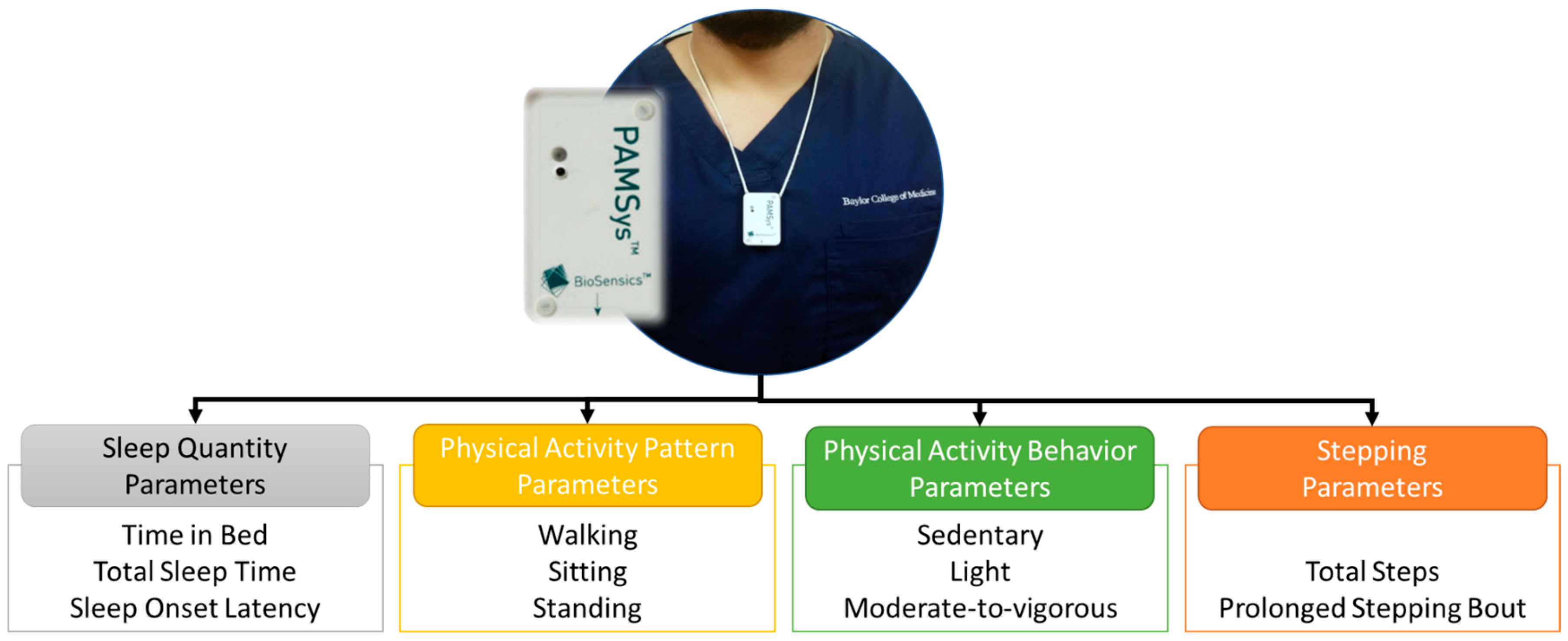
2.2.1. Physical Activity Behavior Parameters
2.2.2. Non-Wear Time and Valid Day of Monitoring
- Total activity: the sum of the all of the specific activity (Sed, Lgt, and MtV).
- Percentage activity: the total activity duration of a specific activity, divided by the total duration of wear time, excluding the nocturnal time in bed.
- Median activity: the 50th percentile of the bout of the specific activity.
- Health and Human Services (HHS) guideline, %: The percentage of participants who met the U.S. Department of HSS recommendations that an adult should have at least 300 min of moderate-to-vigorous activity per week [52]. To calculate this parameter, we estimated those who had at least 42 min (300 min/7 days = ~42 min) of moderate-to-vigorous physical activities per day.
2.2.3. Physical Activity Pattern and Stepping Parameters
- Posture, %: the duration of each posture (lying, sitting, standing, walking) in 24 h.
- Total steps: the total number of steps per day.
- Longest unbroken posture, s: the maximum duration of an unbroken bout for each posture.
- Median posture, s: the median duration of a bout for each posture.
- Longest unbroken stepping bout: the number of steps during the longest bout of stepping without interruption.
- Median stepping bout: the number of steps in the median bout of stepping without interruption.
2.2.4. Sleep Quantity Parameters
- Time in bed (TiB), hours: the total duration of a participant’s time in bed.
- Total sleep time (TST), hours: the total duration of nocturnal sleep.
- Sleep onset latency (SOL), min: the total interval of the time to fall asleep, from the beginning of TiB.
- Wake after sleep onset (WASO), min: the total duration of the time awake, after sleep onset until sleep offset.
- Sleep efficiency (SE), %: the percentage of TST to onset of sleep to last offset of sleep.
- Supine, %: the total duration of supine during TiB.
- Prone, %: the total duration of prone during TiB.
- Sides, %: the total duration of side lying (left or right) during TiB.
2.3. Statistical Analysis
3. Results
3.1. Demographic and Clinical Characteristics
3.2. Sleep Quantity Parameters
3.3. Physical Activity Pattern Parameters
3.4. Stepping Parameters
3.5. Physical Activity Behavior Parameters
3.6. Performance of Models for Discriminating Pre-Frail Status
4. Discussion
5. Limitations
6. Conclusions
Author Contributions
Funding
Acknowledgments
Conflicts of Interest
References
- Ortman, J.M.; Velkoff, V.A.; Hogan, H. An Aging Nation: The Older Population in the United States. Available online: http://bowchair.com/uploads/9/8/4/9/98495722/agingcensus.pdf (accessed on 25 April 2018).
- Papanikitas, A.; Spicer, J. Handbook of Primary Care Ethics; CRC Press: Boca Raton, FL, USA, 2017. [Google Scholar]
- Bandeen-Roche, K.; Seplaki, C.L.; Huang, J.; Buta, B.; Kalyani, R.R.; Varadhan, R.; Xue, Q.-L.; Walston, J.D.; Kasper, J.D. Frailty in older adults: A nationally representative profile in the United States. J. Gerontol. Ser. A 2015, 70, 1427–1434. [Google Scholar] [CrossRef] [PubMed]
- British Geriatrics Society. Fit for Frailty: Consensus Best Practice Guidance for the Care of Older People Living with Frailty in Community and Outpatient Settings; British Geriatrics Society: London, UK, 2015. [Google Scholar]
- Ensrud, K.E.; Ewing, S.K.; Cawthon, P.M.; Fink, H.A.; Taylor, B.C.; Cauley, J.A.; Dam, T.T.; Marshall, L.M.; Orwoll, E.S.; Cummings, S.R. A comparison of frailty indexes for the prediction of falls, disability, fractures, and mortality in older men. J. Am. Geriatr. Soc. 2009, 57, 492–498. [Google Scholar] [CrossRef] [PubMed]
- Rodriguez-Mañas, L.; Fried, L.P. Frailty in the clinical scenario. Lancet 2015, 385, e7–e9. [Google Scholar] [CrossRef]
- Xue, Q.-L. The frailty syndrome: Definition and natural history. Clin. Geriatr. Med. 2011, 27, 1–15. [Google Scholar] [CrossRef] [PubMed]
- Chen, X.; Mao, G.; Leng, S.X. Frailty syndrome: An overview. Clin. Interv. Aging 2014, 9, 433–441. [Google Scholar] [PubMed]
- Cohen, M.S.; Paul, E.; Nuschke, J.D.; Tolentino, J.C.; Mendez, A.V.C.; Mira, A.-E.A.; Baxter, R.A.; Stawicki, S.P. Patient Frailty: Key Considerations, Definitions and Practical Implications. In Challenges in Elder Care; InTech: Princeton, NJ, USA, 2016. [Google Scholar]
- Fried, L.P.; Tangen, C.M.; Walston, J.; Newman, A.B.; Hirsch, C.; Gottdiener, J.; Seeman, T.; Tracy, R.; Kop, W.J.; Burke, G. Frailty in older adults: Evidence for a phenotype. J. Gerontol. Ser. A 2001, 56, M146–M157. [Google Scholar] [CrossRef]
- Mitnitski, A.B.; Mogilner, A.J.; Rockwood, K. Accumulation of deficits as a proxy measure of aging. Sci. World J. 2001, 1, 323–336. [Google Scholar] [CrossRef] [PubMed]
- Dedeyne, L.; Deschodt, M.; Verschueren, S.; Tournoy, J.; Gielen, E. Effects of multi-domain interventions in (pre) frail elderly on frailty, functional, and cognitive status: A systematic review. Clin. Interv. Aging 2017, 12, 873–896. [Google Scholar] [CrossRef] [PubMed]
- Makizako, H.; Shimada, H.; Doi, T.; Tsutsumimoto, K.; Suzuki, T. Impact of physical frailty on disability in community-dwelling older adults: A prospective cohort study. BMJ Open 2015, 5, e008462. [Google Scholar] [CrossRef] [PubMed]
- Cameron, I.D.; Fairhall, N.; Gill, L.; Lockwood, K.; Langron, C.; Aggar, C.; Monaghan, N.; Kurrle, S. Developing interventions for frailty. Adv. Geriatr. 2015, 2015, 1–7. [Google Scholar] [CrossRef]
- Toosizadeh, N.; Joseph, B.; Heusser, M.R.; Jokar, T.O.; Mohler, J.; Phelan, H.A.; Najafi, B. Assessing upper-extremity motion: An innovative, objective method to identify frailty in older bed-bound trauma patients. J. Am. Coll. Surg. 2016, 223, 240–248. [Google Scholar] [CrossRef] [PubMed]
- Juma, S.; Taabazuing, M.-M.; Montero-Odasso, M. Clinical frailty scale in an acute medicine unit: A simple tool that predicts length of stay. Can. Geriatr. J. 2016, 19, 34–39. [Google Scholar] [CrossRef] [PubMed]
- Buchman, A.; Wilson, R.; Bienias, J.; Bennett, D. Change in frailty and risk of death in older persons. Exp. Aging Res. 2009, 35, 61–82. [Google Scholar] [CrossRef] [PubMed]
- Khezrian, M.; Myint, P.K.; McNeil, C.; Murray, A.D. A Review of Frailty Syndrome and Its Physical, Cognitive and Emotional Domains in the Elderly. Geriatrics 2017, 2, 36. [Google Scholar] [CrossRef]
- Da Câmara, S.M.A.; Alvarado, B.E.; Guralnik, J.M.; Guerra, R.O.; Maciel, Á.C.C. Using the Short Physical Performance Battery to screen for frailty in young-old adults with distinct socioeconomic conditions. Geriatr. Gerontol. Int. 2013, 13, 421–428. [Google Scholar] [CrossRef] [PubMed]
- Kiely, D.K.; Cupples, L.A.; Lipsitz, L.A. Validation and comparison of two frailty indexes: The MOBILIZE Boston Study. J. Am. Geriatr. Soc. 2009, 57, 1532–1539. [Google Scholar] [CrossRef] [PubMed]
- Melzer, D.; Lan, T.-Y.; Tom, B.D.; Deeg, D.J.; Guralnik, J.M. Variation in thresholds for reporting mobility disability between national population subgroups and studies. J. Gerontol. Ser. A 2004, 59, 1295–1303. [Google Scholar] [CrossRef][Green Version]
- Tudor-Locke, C.E.; Myers, A.M. Challenges and opportunities for measuring physical activity in sedentary adults. Sports Med. 2001, 31, 91–100. [Google Scholar] [CrossRef] [PubMed]
- Joseph, B.; Toosizadeh, N.; Jokar, T.O.; Heusser, M.R.; Mohler, J.; Najafi, B. Upper-extremity function predicts adverse health outcomes among older adults hospitalized for ground-level falls. Gerontology 2017, 63, 299–307. [Google Scholar] [CrossRef] [PubMed]
- Schwenk, M.; Mohler, J.; Wendel, C.; Fain, M.; Taylor-Piliae, R.; Najafi, B. Wearable sensor-based in-home assessment of gait, balance, and physical activity for discrimination of frailty status: Baseline results of the Arizona frailty cohort study. Gerontology 2015, 61, 258–267. [Google Scholar] [CrossRef] [PubMed]
- Zhou, H.; Sabbagh, M.; Wyman, R.; Liebsack, C.; Kunik, M.E.; Najafi, B. Instrumented trail-making task to differentiate persons with no cognitive impairment, amnestic mild cognitive impairment, and Alzheimer disease: A proof of concept study. Gerontology 2017, 63, 189–200. [Google Scholar] [CrossRef] [PubMed]
- Lee, H.; Joseph, B.; Enriquez, A.; Najafi, B. Toward Using a Smartwatch to Monitor Frailty in a Hospital Setting: Using a Single Wrist-Wearable Sensor to Assess Frailty in Bedbound Inpatients. Gerontology 2017. [Google Scholar] [CrossRef] [PubMed]
- Toosizadeh, N.; Mohler, J.; Najafi, B. Assessing upper extremity motion: An innovative method to identify frailty. J. Am. Geriatr. Soc. 2015, 63, 1181–1186. [Google Scholar] [CrossRef] [PubMed]
- Del Pozo-Cruz, B.; Mañas, A.; Martín-García, M.; Marín-Puyalto, J.; García-García, F.J.; Rodriguez-Mañas, L.; Guadalupe-Grau, A.; Ara, I. Frailty is associated with objectively assessed sedentary behaviour patterns in older adults: Evidence from the Toledo Study for Healthy Aging (TSHA). PLoS ONE 2017, 12, e0183911. [Google Scholar] [CrossRef] [PubMed]
- Galan-Mercant, A.; Cuesta-Vargas, A. Clinical frailty syndrome assessment using inertial sensors embedded in smartphones. Physiol. Meas. 2015, 36, 1929–1944. [Google Scholar] [CrossRef] [PubMed]
- Haider, S.; Luger, E.; Kapan, A.; Titze, S.; Lackinger, C.; Schindler, K.E.; Dorner, T.E. Associations between daily physical activity, handgrip strength, muscle mass, physical performance and quality of life in prefrail and frail community-dwelling older adults. Qual. Life Res. 2016, 25, 3129–3138. [Google Scholar] [CrossRef] [PubMed]
- Theou, O.; Jakobi, J.M.; Vandervoort, A.A.; Jones, G.R. A comparison of physical activity (PA) assessment tools across levels of frailty. Arch. Gerontol. Geriatr. 2012, 54, e307–e314. [Google Scholar] [CrossRef] [PubMed]
- Blodgett, J.; Theou, O.; Kirkland, S.; Andreou, P.; Rockwood, K. The association between sedentary behaviour, moderate–vigorous physical activity and frailty in NHANES cohorts. Maturitas 2015, 80, 187–191. [Google Scholar] [CrossRef] [PubMed]
- Ensrud, K.E.; Blackwell, T.L.; Ancoli-Israel, S.; Redline, S.; Cawthon, P.M.; Paudel, M.L.; Dam, T.-T.L.; Stone, K.L. Sleep disturbances and risk of frailty and mortality in older men. Sleep Med. 2012, 13, 1217–1225. [Google Scholar] [CrossRef] [PubMed]
- Ensrud, K.E.; Blackwell, T.L.; Redline, S.; Ancoli-Israel, S.; Paudel, M.L.; Cawthon, P.M.; Dam, T.T.L.; Barrett-Connor, E.; Leung, P.C.; Stone, K.L. Sleep Disturbances and Frailty Status in Older Community-Dwelling Men. J. Am. Geriatr. Soc. 2009, 57, 2085–2093. [Google Scholar] [CrossRef] [PubMed]
- Lang, P.O.; Michel, J.P.; Zekry, D. Frailty syndrome: A transitional state in a dynamic process. Gerontology 2009, 55, 539–549. [Google Scholar] [CrossRef] [PubMed]
- Mohler, M.J.; Fain, M.J.; Wertheimer, A.M.; Najafi, B.; Nikolich-Zugich, J. The Frailty syndrome: Clinical measurements and basic underpinnings in humans and animals. Exp. Gerontol. 2014, 54, 6–13. [Google Scholar] [CrossRef] [PubMed]
- Mohler, J.; Najafi, B.; Fain, M.; Ramos, K.S. Precision Medicine: A Wider Definition. J. Am. Geriatr. Soc. 2015, 63, 1971–1972. [Google Scholar] [CrossRef] [PubMed]
- Tombaugh, T.N.; McIntyre, N.J. The mini-mental state examination: A comprehensive review. J. Am. Geriatr. Soc. 1992, 40, 922–935. [Google Scholar] [CrossRef] [PubMed]
- Yardley, L.; Beyer, N.; Hauer, K.; Kempen, G.; Piot-Ziegler, C.; Todd, C. Development and initial validation of the Falls Efficacy Scale-International (FES-I). Age Ageing 2005, 34, 614–619. [Google Scholar] [CrossRef] [PubMed]
- Lewinsohn, P.M.; Seeley, J.R.; Roberts, R.E.; Allen, N.B. Center for Epidemiologic Studies Depression Scale (CES-D) as a screening instrument for depression among community-residing older adults. Psychol. Aging 1997, 12, 277–287. [Google Scholar] [CrossRef] [PubMed]
- Razjouyan, J.; Lee, H.; Parthasarathy, S.; Mohler, J.; Sharafkhaneh, A.; Najafi, B. Improving Sleep Quality Assessment Using Wearable Sensors by Including Information From Postural/Sleep Position Changes and Body Acceleration: A Comparison of Chest-Worn Sensors, Wrist Actigraphy, and Polysomnography. J. Clin. Sleep Med. 2017, 13, 1301–1310. [Google Scholar] [CrossRef] [PubMed]
- Aminian, K.; Najafi, B.; Büla, C.; Leyvraz, P.-F.; Robert, P. Spatio-temporal parameters of gait measured by an ambulatory system using miniature gyroscopes. J. Biomech. 2002, 35, 689–699. [Google Scholar] [CrossRef]
- Aminian, K.; Najafi, B. Capturing human motion using body-fixed sensors: Outdoor measurement and clinical applications. Comput. Anim. Virtual Worlds 2004, 15, 79–94. [Google Scholar] [CrossRef]
- Najafi, B.; Armstrong, D.G.; Mohler, J. Novel wearable technology for assessing spontaneous daily physical activity and risk of falling in older adults with diabetes. J. Diabetes Sci. Technol. 2013, 7, 1147–1160. [Google Scholar] [CrossRef] [PubMed]
- Troiano, R.P.; Berrigan, D.; Dodd, K.W.; Masse, L.C.; Tilert, T.; McDowell, M. Physical activity in the United States measured by accelerometer. Med. Sci.Sports Exerc. 2008, 40, 181–188. [Google Scholar] [CrossRef] [PubMed]
- US Department of Health and Human Services. Physical Activity Guideline. Available online: http://www.health.gov/paguidelines (accessed on 25 April 2018).
- Vähä-Ypyä, H.; Vasankari, T.; Husu, P.; Mänttäri, A.; Vuorimaa, T.; Suni, J.; Sievänen, H. Validation of cut-points for evaluating the intensity of physical activity with accelerometry-based mean amplitude deviation (MAD). PLoS ONE 2015, 10, e0134813. [Google Scholar] [CrossRef] [PubMed]
- Rioul, O.; Vetterli, M. Wavelets and signal processing. IEEE Signal Process. Mag. 1991, 8, 14–38. [Google Scholar] [CrossRef]
- Ogden, T. Essential Wavelets for Statistical Applications and Data Analysis; Springer: Berlin, Germany, 2012. [Google Scholar]
- Dunlop, D.D.; Song, J.; Semanik, P.A.; Chang, R.W.; Sharma, L.; Bathon, J.M.; Eaton, C.B.; Hochberg, M.C.; Jackson, R.D.; Kwoh, C.K. Objective physical activity measurement in the osteoarthritis initiative: Are guidelines being met? Arthrit. Rheumatol. 2011, 63, 3372–3382. [Google Scholar] [CrossRef] [PubMed]
- De Bruin, E.D.; Najafi, B.; Murer, K.; Uebelhart, D.; Aminian, K. Quantification of everyday motor function in a geriatric population. J. Rehabil. Res. Dev. 2007, 44, 417–428. [Google Scholar] [CrossRef] [PubMed]
- Pate, R.R.; Pratt, M.; Blair, S.N.; Haskell, W.L.; Macera, C.A.; Bouchard, C.; Buchner, D.; Ettinger, W.; Heath, G.W.; King, A.C. Physical activity and public health: A recommendation from the Centers for Disease Control and Prevention and the American College of Sports Medicine. JAMA 1995, 273, 402–407. [Google Scholar] [CrossRef] [PubMed]
- Najafi, B.; Aminian, K.; Paraschiv-Ionescu, A.; Loew, F.; Bula, C.J.; Robert, P. Ambulatory system for human motion analysis using a kinematic sensor: Monitoring of daily physical activity in the elderly. IEEE Trans. Biomed. Eng. 2003, 50, 711–723. [Google Scholar] [CrossRef] [PubMed]
- Jović, A.; Brkić, K.; Bogunović, N. A review of feature selection methods with applications. In Proceedings of the 2015 38th International Convention on Information and Communication Technology, Electronics and Microelectronics (MIPRO), Opatija, Croatia, 25–29 May 2015; pp. 1200–1205. [Google Scholar]
- Chatfield, K.; Simonyan, K.; Vedaldi, A.; Zisserman, A. Return of the devil in the details: Delving deep into convolutional nets. arXiv, 2014; arXiv:1405.3531. [Google Scholar]
- Singhi, S.K.; Liu, H. Feature subset selection bias for classification learning. In Proceedings of the 23rd International Conference on Machine Learning, Haifa, Israel, 27–29 June 2010; pp. 849–856. [Google Scholar]
- Guyon, I.; Elisseeff, A. An introduction to variable and feature selection. J. Mach. Learn. Res. 2003, 3, 1157–1182. [Google Scholar]
- Refaeilzadeh, P.; Tang, L.; Liu, H. Cross-validation. In Encyclopedia of Database Systems; Springer: Berlin, Germany, 2009; pp. 532–538. [Google Scholar]
- Arlot, S.; Celisse, A. A survey of cross-validation procedures for model selection. Stat. Surv. 2010, 4, 40–79. [Google Scholar] [CrossRef]
- Parvaneh, S.; Mohler, J.; Toosizadeh, N.; Grewal, G.S.; Najafi, B. Postural Transitions during Activities of Daily Living Could Identify Frailty Status: Application of Wearable Technology to Identify Frailty during Unsupervised Condition. Gerontology 2017, 63, 479–487. [Google Scholar] [CrossRef] [PubMed]
- Schwenk, M.; Howe, C.; Saleh, A.; Mohler, J.; Grewal, G.; Armstrong, D.; Najafi, B. Frailty and technology: A systematic review of gait analysis in those with frailty. Gerontology 2014, 60, 79–89. [Google Scholar] [CrossRef] [PubMed]
- Shumway-Cook, A.; Brauer, S.; Woollacott, M. Predicting the probability for falls in community-dwelling older adults using the Timed Up & Go Test. Phys. Ther. 2000, 80, 896–903. [Google Scholar] [PubMed]
- Rudolfer, S.M.; Paliouras, G.; Peers, I.S. A comparison of logistic regression to decision tree induction in the diagnosis of carpal tunnel syndrome. Comput. Biomed. Res. 1999, 32, 391–414. [Google Scholar] [CrossRef] [PubMed]
- Lee, H.; Joseph, B.; Najafi, B. Optimized Upper Extremity Frailty Parameters for Assessing Frailty in Trauma Patients. Innov. Aging 2017, 1, 618. [Google Scholar] [CrossRef][Green Version]
- Tremblay, M.S.; Kho, M.E.; Tricco, A.C.; Duggan, M. Process description and evaluation of Canadian Physical Activity Guidelines development. Int. J. Behav. Nutr. Phys. Act. 2010, 7, 42. [Google Scholar] [CrossRef] [PubMed]
- Hassapidou, M.; Papadopoulou, S.K.; Vlahavas, G.; Kapantais, E.; Kaklamanou, D.; Pagkalos, I.; Kaklamanou, M.; Tzotzas, T. Association of physical activity and sedentary lifestyle patterns with obesity and cardiometabolic comorbidities in Greek adults: Data from the National Epidemiological Survey. Hormones 2013, 12, 265–274. [Google Scholar] [CrossRef] [PubMed]
- Thorp, A.A.; Healy, G.N.; Winkler, E.; Clark, B.K.; Gardiner, P.A.; Owen, N.; Dunstan, D.W. Prolonged sedentary time and physical activity in workplace and non-work contexts: A cross-sectional study of office, customer service and call centre employees. Int. J. Behav. Nutr. Phys. Act. 2012, 9, 128. [Google Scholar] [CrossRef] [PubMed]
- Peterson, M.J.; Giuliani, C.; Morey, M.C.; Pieper, C.F.; Evenson, K.R.; Mercer, V.; Cohen, H.J.; Visser, M.; Brach, J.S.; Kritchevsky, S.B. Physical activity as a preventative factor for frailty: The health, aging, and body composition study. J. Gerontol. 2009, 64, 61–68. [Google Scholar] [CrossRef] [PubMed]
- Roland, K.P.; MD Cornett, K.; Theou, O.; Jakobi, J.M.; Jones, G.R. Physical activity across frailty phenotypes in females with Parkinson’s disease. J. Aging Res. 2012, 2012, 1–8. [Google Scholar] [CrossRef] [PubMed]
- Ruan, Q.; Yu, Z.; Chen, M.; Bao, Z.; Li, J.; He, W. Cognitive frailty, a novel target for the prevention of elderly dependency. Ageing Res. Rev. 2015, 20, 1–10. [Google Scholar] [CrossRef] [PubMed]
- Kelaiditi, E.; Canevelli, M.; Andrieu, S.; Del Campo, N.; Soto, M.E.; Vellas, B.; Cesari, M. Impact of Cholinergic Treatment Use Study, D.S.A.G. Frailty Index and Cognitive Decline in Alzheimer's Disease: Data from the Impact of Cholinergic Treatment USe Study. J. Am. Geriatr. Soc. 2016, 64, 1165–1170. [Google Scholar] [CrossRef] [PubMed]
- Kelaiditi, E.; Cesari, M.; Canevelli, M.; van Kan, G.A.; Ousset, P.J.; Gillette-Guyonnet, S.; Ritz, P.; Duveau, F.; Soto, M.E.; Provencher, V.; et al. Cognitive frailty: Rational and definition from an (I.A.N.A./I.A.G.G.) international consensus group. J. Nutr. Health Aging 2013, 17, 726–734. [Google Scholar] [CrossRef] [PubMed]
- Zhou, H.; Lee, H.; Lee, J.; Schwenk, M.; Najafi, B. Motor Planning Error: Toward Measuring Cognitive Frailty in Older Adults Using Wearables. Sensors 2018, 18, 926. [Google Scholar] [CrossRef] [PubMed]
- Bussmann, J.B.; van den Berg-Emons, R.J. To total amount of activity and beyond: Perspectives on measuring physical behavior. Front. Psychol. 2013, 4, 463. [Google Scholar] [CrossRef] [PubMed]
- Moufawad El Achkar, C.; Lenoble-Hoskovec, C.; Paraschiv-Ionescu, A.; Major, K.; Bula, C.; Aminian, K. Physical Behavior in Older Persons during Daily Life: Insights from Instrumented Shoes. Sensors 2016, 16, 1225. [Google Scholar] [CrossRef] [PubMed]
- Paraschiv-Ionescu, A.; Perruchoud, C.; Buchser, E.; Aminian, K. Barcoding human physical activity to assess chronic pain conditions. PLoS ONE 2012, 7, e32239. [Google Scholar] [CrossRef] [PubMed]

| Parameter | Non-Frail (N) | Pre-Frail (P) | Frail (F) | N vs. P (p-Value) | P vs. F (p-Value) |
|---|---|---|---|---|---|
| Number of participants | 42 | 78 | 33 | ||
| Age, years | 74.02 ± 7.37 | 75.25 ± 11.53 | 78.03 ± 11.20 | 0.527 | 0.191 |
| BMI, kg/m2 | 25.21 ± 5.64 | 29.76 ± 6.88 | 31.18 ± 7.01 | 0.000 | 0.289 |
| Depression (CES-D) | 6.62 ± 5.64 | 8.75 ± 7.14 | 12.89 ± 6.33 | 0.083 | 0.002 |
| Concern for fall (SFES-I) | 20.69 ± 4.22 | 23.43 ± 11.14 | 29.69 ± 15.89 | 0.182 | 0.006 |
| Gender (female), % | 82% | 54% | 51% | 0.001 | 0.247 |
| Number of prescribed medication, N | 2.5 ± 1.8 | 4.1 ± 3.8 | 6.0 ± 3.4 | 0.530 | 0.520 |
| Number of over the counter medication, N | 3.0 ± 2.5 | 2.7 ± 2.2 | 2.5 ± 2.5 | 0.150 | 0.080 |
| Number of comorbidities, N | 2.3 ± 1.8 | 3.7 ± 2.2 | 4.7 ± 1.7 | 0.710 | 0.490 |
| Fall history: | |||||
| 0 falls | 71% | 69% | 69% | 0.177 | 0.425 |
| 1–3 falls | 24% | 30% | 23% | 0.090 | 0.800 |
| >3 falls | 4% | 1% | 9% | 0.368 | 0.020 |
| Parameters | Non-Frail (N) † | Pre-Frail (P) † | Frail (F) † | p-Value (Effect Size ‡) | |
|---|---|---|---|---|---|
| N vs. P | P vs. F | ||||
| Sleep Quantity | |||||
| Time in bed, min | 494.3 ± 114.4 | 434.7 ± 125.3 | 402.4 ± 127.6 | 0.010 (0.50) | 0.209 (0.26) |
| Sleep onset latency, min | 16.9 ± 7.5 | 18.5 ± 7.9 | 20.0 ± 8.4 | 0.290 (0.20) | 0.369 (0.18) |
| Total sleep time, min | 367.5 ± 86.2 | 321.9 ± 116.5 | 300.9 ± 119.4 | 0.027 (0.45) | 0.360 (0.18) |
| Wake after sleep onset, min | 103.7 ± 48.0 | 89.4 ± 41.7 | 75.5 ± 43.0 | 0.081 (0.32) | 0.129 (0.33) |
| Sleep efficiency, % | 78.4 ± 9.3 | 77.5 ± 10.9 | 79.6 ± 11.6 | 0.650 (0.09) | 0.333 (0.19) |
| Sleep supine position, % | 43.6 ± 21.0 | 41.2 ± 23.2 | 47.5 ± 31.4 | 0.594 (0.11) | 0.222 (0.23) |
| Sleep prone position, % | 14.7 ± 17.5 | 12.3 ± 16.7 | 18.8 ± 23.3 | 0.484 (0.14) | 0.091 (0.32) |
| Sleep side position, % | 34.6 ± 17.1 | 34.6 ± 24.2 | 19.7 ± 21.1 | 0.994 (0.00) | 0.001 (0.65) |
| Physical Activity Pattern | |||||
| Total sit, % | 43.3 ± 15.6 | 46.9 ± 17.1 | 45.7 ± 17.1 | 0.253 (0.22) | 0.734 (0.07) |
| Total stand, % | 16.9 ± 5.8 | 13.6 ± 5.8 | 11.3 ± 5.7 | 0.003 (0.57) | 0.060 (0.40) |
| Total walk, % * | 8.7 ± 3.9 | 5.1 ± 3.3 | 3.2 ± 3.2 | 0.000 (1.02) | 0.012 (0.57) |
| Total Lye, % | 30.9 ± 15.6 | 34.3 ± 20.4 | 39.7 ± 20.9 | 0.348 (0.19) | 0.188 (0.26) |
| Longest unbroken sitting bout, s | 5356.7 ± 3499.1 | 5351.3 ± 3042.0 | 5576.5 ± 3927.4 | 0.993 (0.00) | 0.749 (0.06) |
| Median sitting bout, s | 96.2 ± 72.9 | 89.6 ± 105.2 | 81.1 ± 92.0 | 0.712 (0.07) | 0.666 (0.09) |
| Longest unbroken standing bout, s | 385.3 ± 387.3 | 550.6 ± 723.8 | 553.2 ± 360.5 | 0.132 (0.28) | 0.983 (0.00) |
| Median standing bout, s | 15.0 ± 3.2 | 13.3 ± 7.5 | 13.3 ± 11.7 | 0.247 (0.29) | 0.983 (0.00) |
| Longest unbroken walking bout, s * | 351.3 ± 347.9 | 187.9 ± 223.9 | 110.3 ± 132.4 | 0.001 (0.56) | 0.002 (0.42) |
| Median walking bout, s * | 9.7 ± 1.0 | 9.0 ± 1.5 | 8.3 ± 1.9 | 0.020 (0.51) | 0.018 (0.43) |
| Stepping Parameters | |||||
| Total step, N/1000 * | 12.2 ± 6.1 | 6.7 ± 4.2 | 4.3 ± 4.3 | 0.000 (1.04) | 0.018 (0.57) |
| Longest unbroken stepping bout, N * | 694.3 ± 743.0 | 322.9 ± 411.0 | 162.5 ± 184.2 | 0.000 (0.62) | 0.006 (0.57) |
| Median stepping bout, N | 13.5 ± 2.2 | 10.8 ± 4.7 | 8.8 ± 5.2 | 0.001 (0.75) | 0.113 (0.38) |
| Physical Activity Behavior | |||||
| Median Sedentary bout, s | 323.8 ± 2044.6 | 491.1 ± 4243.4 | 29.7 ± 16.7 | 0.783 (0.05) | 0.497 (0.15) |
| Total sedentary, h * | 9.6 ± 2.6 | 11.7 ± 3.2 | 13.2 ± 4.2 | 0.001 (0.73) | 0.029 (0.40) |
| Total sedentary, % | 70.4 ± 12.7 | 81.1 ± 8.9 | 84.9 ± 7.0 | 0.000 (0.98) | 0.066 (0.47) |
| Median light bout, s * | 10.8 ± 2.2 | 9.6 ± 2.8 | 8.3 ± 2.5 | 0.011 (0.50) | 0.013 (0.51) |
| Total light, h | 3.2 ± 1.3 | 2.4 ± 1.2 | 2.1 ± 0.9 | 0.001 (0.62) | 0.206 (0.29) |
| Total light, prc | 23.7 ± 9.9 | 16.7 ± 7.7 | 13.9 ± 6.2 | 0.000 (0.79) | 0.105 (0.39) |
| Median MtV, s | 6.8 ± 1.9 | 6.8 ± 2.4 | 6.3 ± 1.8 | 0.990 (0.00) | 0.267 (0.24) |
| Total MtV, min * | 47.7 ± 30.7 | 19.6.3 ± 20.5 | 11.2 ± 14.6 | 0.000 (1.08) | 0.047 (0.47) |
| Total MtV, % * | 6.0 ± 4.0 | 2.2 ± 2.4 | 1.2 ± 1.5 | 0.000 (1.13) | 0.066 (0.50) |
| HHS guideline, % (N) | 50.0 | 16.0 | 3.1 | 0.000 (-) | 0.109 (-) |
| Sensitivity †, % | Specificity †, % | Accuracy †, % | AUC | |
|---|---|---|---|---|
| Physical activity behaviors | ||||
| Total sedentary, h * | 91.9 ± 3.8 | 66.7 ± 4.4 | 76.3 ± 1.9 | 0.91 ± 0.03 |
| Median light bout, s | 100.0 ± 0.0 | 0.0 ± 0.0 | 51.9 ± 0.2 | 0.50 ± 0.00 |
| Total MtV, min * | 85.4 ± 3.3 | 77.8 ± 4.9 | 78.8 ± 1.7 | 0.92 ± 0.02 |
| physical activity patterns | ||||
| Total walk, % * | 86.1 ± 4.5 | 73.7 ± 6.7 | 78.0 ± 1.9 | 0.90 ± 0.02 |
| Longest unbroken walking bout, s * | 84.2 ± 5.6 | 67.9 ± 6.8 | 73.0 ± 1.6 | 0.87 ± 0.02 |
| Median walking bout, s | 85.3 ± 8.1 | 32.4 ± 13.2 | 59.0 ± 2.2 | 0.64 ± 0.02 |
| stepping parameters | ||||
| Total step, N/1000 * | 88.9 ± 3.0 | 74.0 ± 3.4 | 78.7 ± 1.2 | 0.89 ± 0.02 |
| Longest unbroken stepping bout, N * | 85.0 ± 5.7 | 75.8 ± 4.3 | 75.3 ± 1.9 | 0.88 ± 0.03 |
| Models | Sensitivity †, % | Specificity †, % | Accuracy †, % | AUC † |
|---|---|---|---|---|
| Step Model | 88.6 ± 3.8 | 77.5 ± 1.3 | 79.7 ± 0.5 | 0.87 ± 0.02 |
| Physical Activity Pattern Model | 88.6 ± 3.3 | 74.2 ± 1.7 | 80.6 ± 0.4 | 0.85 ± 0.02 |
| Physical Activity Behavior Model | 87.1 ± 6.1 | 77.9 ± 2.0 | 80.4 ± 0.6 | 0.85 ± 0.03 |
| Combined Model | 91.8 ± 4.2 | 81.4 ± 2.2 | 84.7 ± 0.4 | 0.88 ± 0.03 |
© 2018 by the authors. Licensee MDPI, Basel, Switzerland. This article is an open access article distributed under the terms and conditions of the Creative Commons Attribution (CC BY) license (http://creativecommons.org/licenses/by/4.0/).
Share and Cite
Razjouyan, J.; Naik, A.D.; Horstman, M.J.; Kunik, M.E.; Amirmazaheri, M.; Zhou, H.; Sharafkhaneh, A.; Najafi, B. Wearable Sensors and the Assessment of Frailty among Vulnerable Older Adults: An Observational Cohort Study. Sensors 2018, 18, 1336. https://doi.org/10.3390/s18051336
Razjouyan J, Naik AD, Horstman MJ, Kunik ME, Amirmazaheri M, Zhou H, Sharafkhaneh A, Najafi B. Wearable Sensors and the Assessment of Frailty among Vulnerable Older Adults: An Observational Cohort Study. Sensors. 2018; 18(5):1336. https://doi.org/10.3390/s18051336
Chicago/Turabian StyleRazjouyan, Javad, Aanand D. Naik, Molly J. Horstman, Mark E. Kunik, Mona Amirmazaheri, He Zhou, Amir Sharafkhaneh, and Bijan Najafi. 2018. "Wearable Sensors and the Assessment of Frailty among Vulnerable Older Adults: An Observational Cohort Study" Sensors 18, no. 5: 1336. https://doi.org/10.3390/s18051336
APA StyleRazjouyan, J., Naik, A. D., Horstman, M. J., Kunik, M. E., Amirmazaheri, M., Zhou, H., Sharafkhaneh, A., & Najafi, B. (2018). Wearable Sensors and the Assessment of Frailty among Vulnerable Older Adults: An Observational Cohort Study. Sensors, 18(5), 1336. https://doi.org/10.3390/s18051336

