Multiple-Wearable-Sensor-Based Gait Classification and Analysis in Patients with Neurological Disorders

 , ,
, ,
Abstract
1. Introduction
2. Materials and Methods
2.1. Subjects
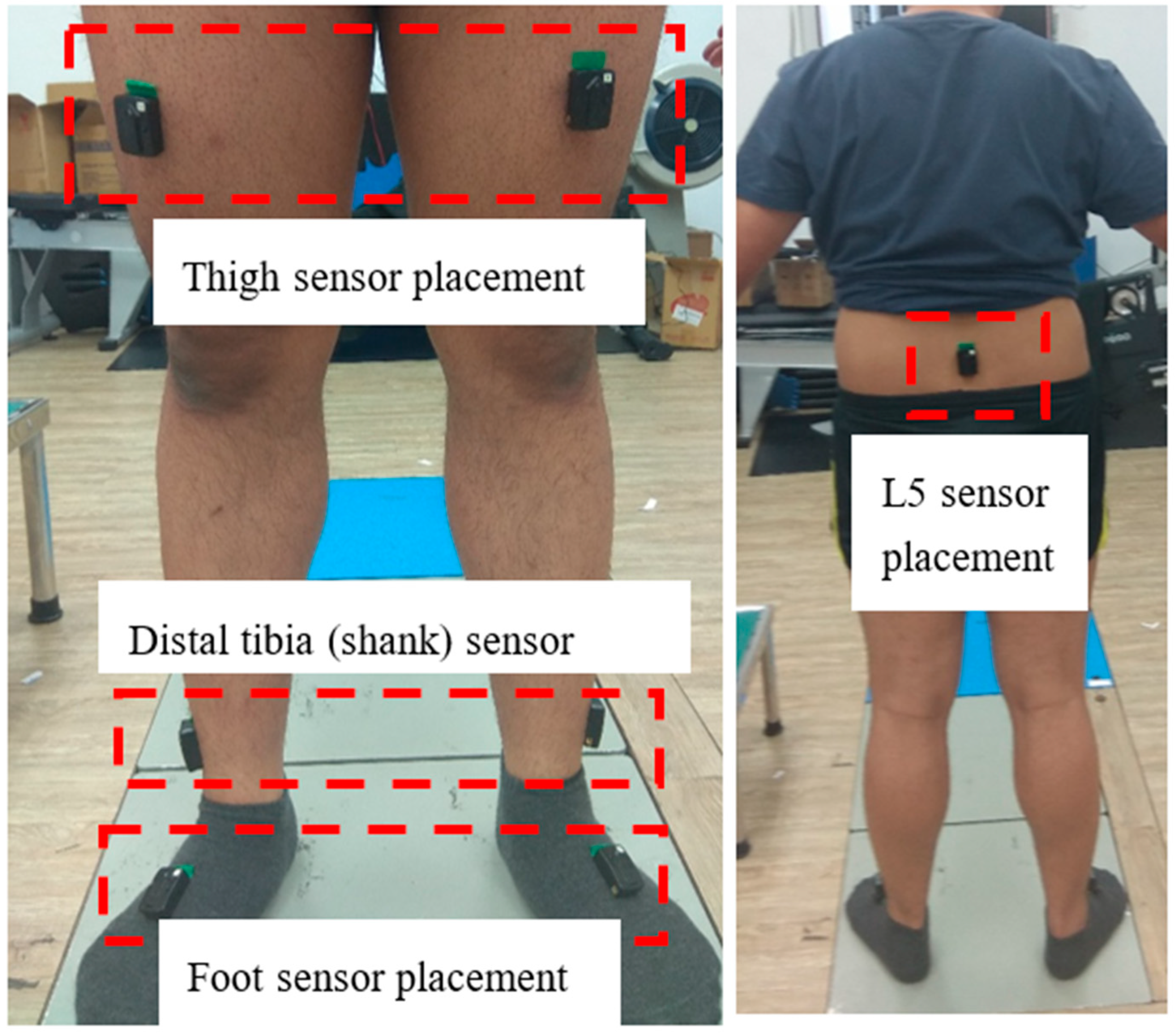
2.2. Equipment
2.3. Experimental Protocol
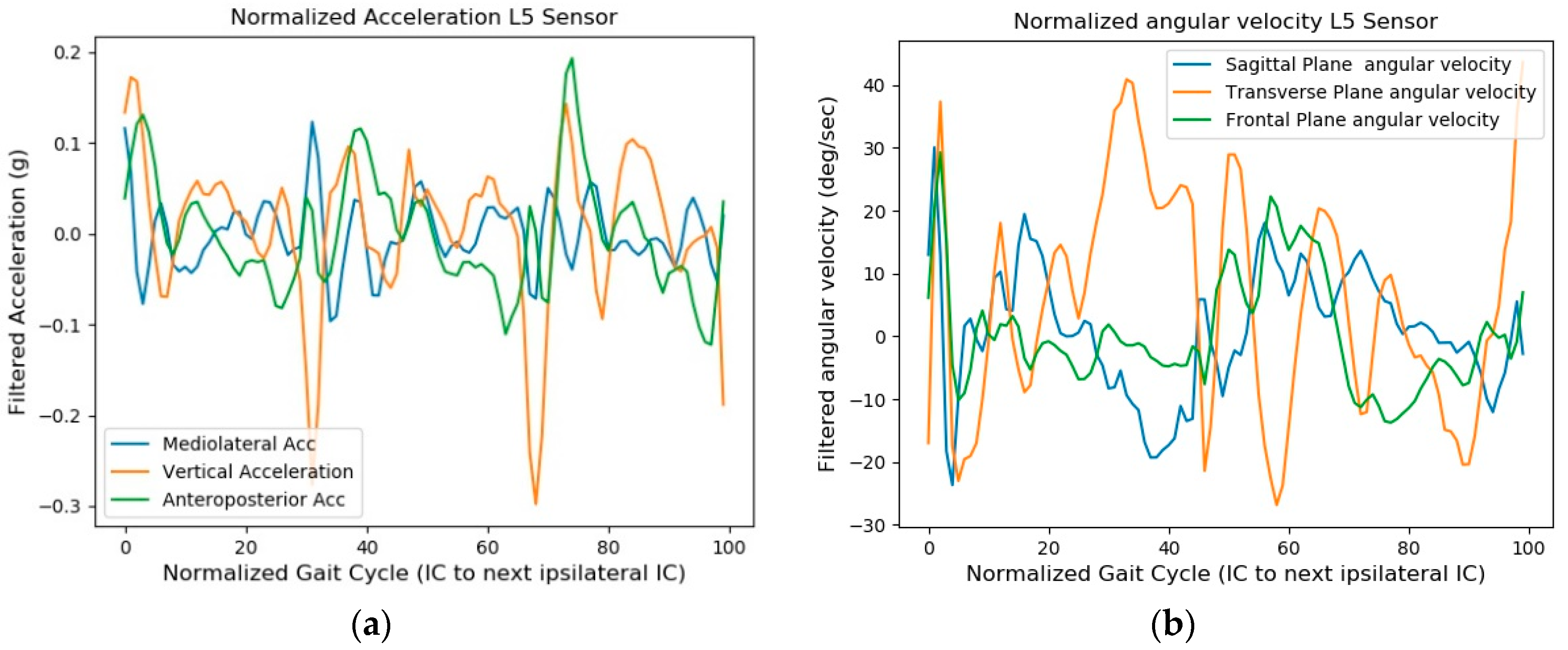
2.4. Data Processing
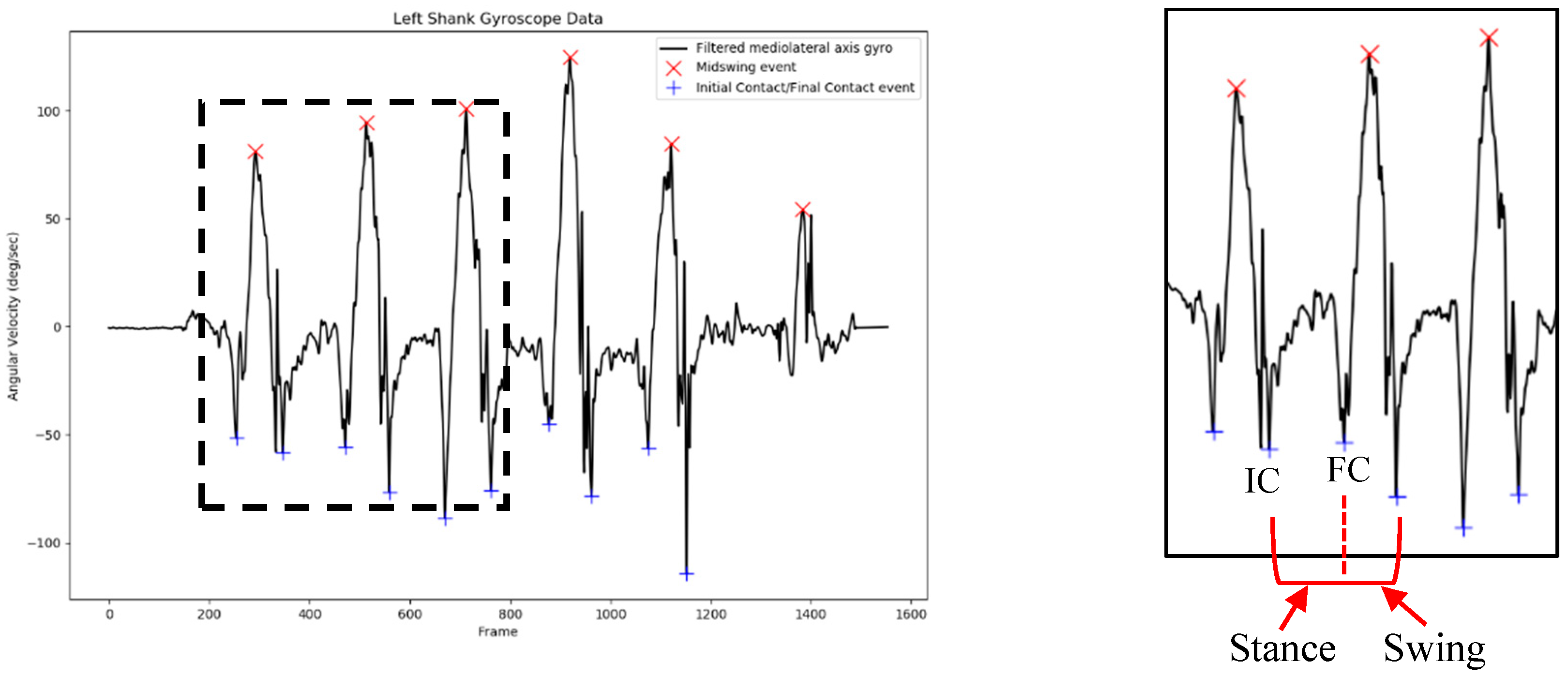
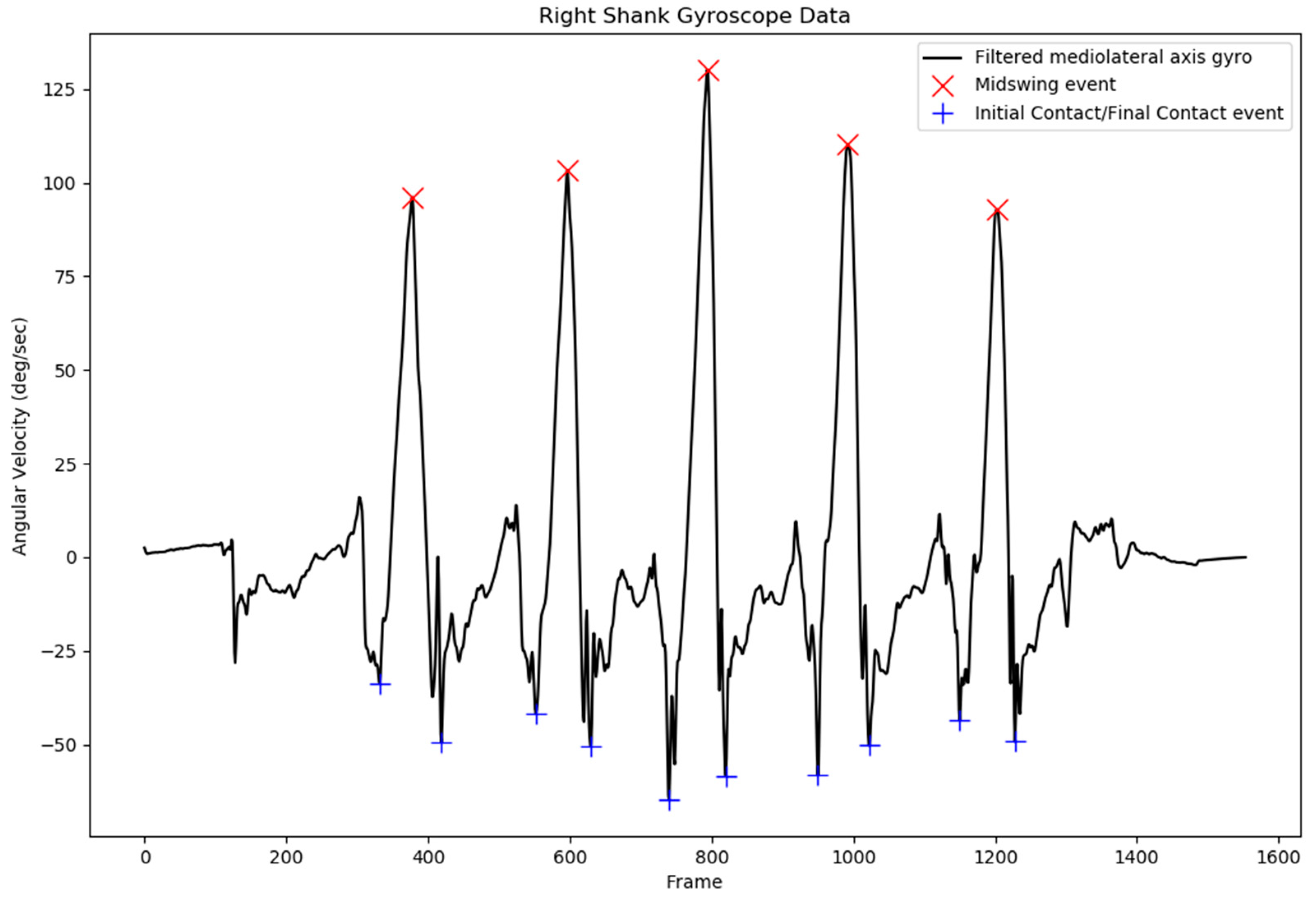
2.5. Gait Event Detection
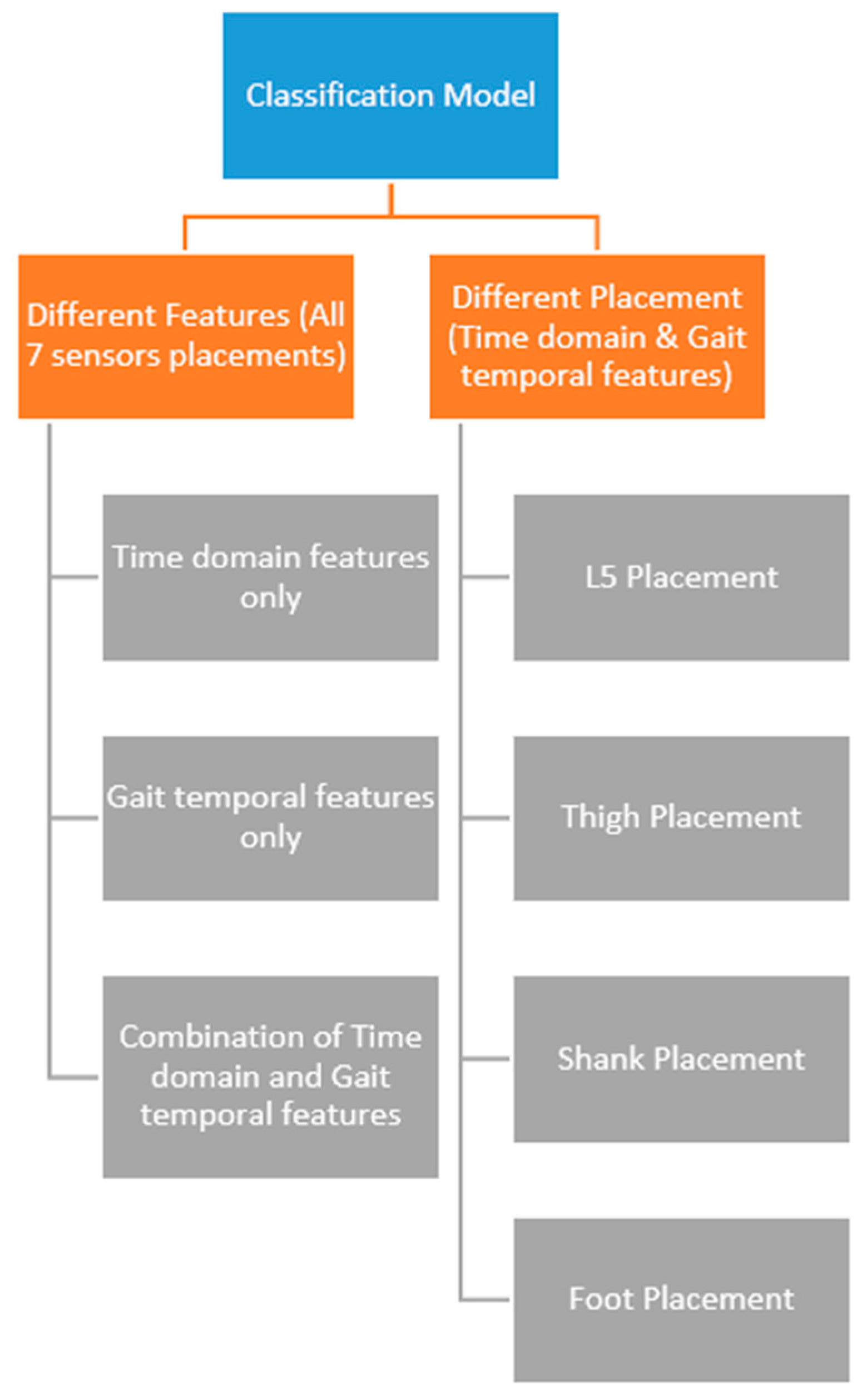
2.6. Classification
- Random forest (RF) classifier: A random forest is a supervised learning algorithm that combines decision trees and generally involves training with the bagging method. The number of trees used in this study was 1000.
- Adaboost classifier: This method was first introduced by Freund and Schapire [31]. The core principle of Adaboost is to fit a sequence of weak learners on repeatedly modified versions of data. In this study, the maximum number of estimators—at which boosting was terminated—was set to 150.
- Decision tree (DT): A decision tree is a tree-like graph that illustrates all possible decision alternatives and corresponding outcomes. It is composed of nodes where tests on specific attributes have been performed as well as leaf nodes indicating the value of the target attribute.
- Gaussian naïve Bayes (GNB): GNB is a supervised learning method that is based on applying the Bayes theorem with the naïve assumption of independence between each pair of features [32].
- Neural network with multilayer perceptron (MLP): MLP is a neural network capable of understanding a rich variety of nonlinear problems and uses backpropagation to classify instances [33]. The size of the hidden layer used in this study was 2000, with the Adam solver and an adaptive learning rate.
3. Results
4. Discussion and Future Works
4.1. Discussion
4.2. Study Limitations and Future Works
5. Conclusions
Author Contributions
Funding
Acknowledgments
Conflicts of Interest
Correction Statement
Appendix A

| Model Name | Result of Selected Features |
|---|---|
| Time domain features only | Variance of left foot acceleration Z, Mean of left foot acceleration Y, Mean of left shank acceleration X, Mean and kurtosis of left thigh acceleration X, Skewness of left shank acceleration Z, Skewness of left thigh acceleration X, Variance of right foot acceleration X, Mean of right foot acceleration Z, Kurtosis of L5 acceleration X, Kurtosis of right thigh acceleration X, Skewness of right foot acceleration X, Skewness of right thigh acceleration X, Variance of left foot gyroscope X, Y, and Z, Variance of left shank gyroscope X and Y, Variance of left thigh gyroscope Y, Kurtosis of L5 gyroscope Z, Kurtosis of left shank gyroscope X, Skewness of left foot gyroscope Y, Skewness of left thigh gyroscope Y and Z, Variance of right shank gyroscope X, Y, and Z, Variance of right thigh gyroscope X and Y, Mean of right foot gyroscope Y, Mean of right shank gyroscope Y, Kurtosis of right foot gyroscope X and Y, Kurtosis of right shank gyroscope X, Kurtosis of right thigh gyroscope Z, Skewness of right foot gyro X and Z, Skewness of right shank gyroscope X and Y. |
| Gait temporal features only | Right stance percentage, Right swing time, Right swing percentage, Swing ratio |
| Combination features (gait temporal and time domain frequency) | Right stance percentage, Right swing time, Right swing percentage, Swing ratio, Variance of left foot acceleration Z, Mean of left foot acceleration Y, Mean of left shank acceleration X, Mean and kurtosis of left thigh acceleration X, Skewness of left shank acceleration Z, Skewness of left thigh acceleration X, Variance of right foot acceleration X, Mean of right foot acceleration Z, Kurtosis of L5 acceleration X, Kurtosis of right thigh acceleration X, Skewness of right foot acceleration X, Skewness of right thigh acceleration X, Variance of left foot gyroscope X, Y, and Z, Variance of left shank gyroscope X and Y, Variance of left thigh gyroscope Y, Kurtosis of L5 gyroscope Z, Kurtosis of left shank gyroscope X, Skewness of left foot gyroscope Y, Skewness of left thigh gyroscope Y and Z, Variance of right shank gyroscope X, Y, and Z, Variance of right thigh gyroscope X and Y, Mean of right foot gyroscope Y, Mean of right shank gyroscope Y, Kurtosis of right foot gyroscope X and Y, Kurtosis of right shank gyroscope X, Kurtosis of right thigh gyroscope Z, Skewness of right foot gyro X and Z, Skewness of right shank gyroscope X and Y. |
| L5 sensor placement | Variance of gyroscope X and Z, Kurtosis of gyroscope Z, Mean of acceleration Z, Kurtosis of acceleration X, Right stride time, Right stance time, Right swing time and percentage, First Double Limb Support time and percentage, Stride and Swing ratio. |
| Foot sensor placement | Variance of left foot gyroscope Y, Skewness of left foot gyroscope Y, Variance of right foot acceleration X, Mean of right foot acceleration Z, Skewness of right foot acceleration X, Kurtosis of right foot gyroscope X, Mean of right foot gyroscope Y, Skewness of right foot gyroscope Z, Right stance percentage, Right swing time and percentage, Stride and Swing ratio. |
| Shank sensor placement | Skewness of left shank acceleration Z, Variance of left shank gyroscope X, Variance of right shank gyroscope X and Y Mean of right shank gyroscope Y, Kurtosis of right shank gyroscope X, Skewness of right shank gyroscope X and Y, Right stance percentage, Right swing time and percentage, Stride and Swing ratio. |
| Thigh sensor placement | Variance of left thigh gyroscope Y, Skewness of left thigh gyroscope Y, Skewness of right thigh acceleration X, Variance of right thigh gyroscope X and Y, Kurtosis of right thigh gyroscope Z, Right stance percentage, Right swing time and percentage, Stride and Swing ratio. |
References
- Din, S.D.; Godfrey, A.; Rochester, L. Validation of an accelerometer to quantify a comprehensive battery of gait characteristics in healthy older adults and Parkinson’s disease: Toward clinical and at home use. IEEE J. Biomed. Health Inform. 2016, 20, 838–847. [Google Scholar] [CrossRef] [Scilit] [PubMed]
- Trojaniello, D.; Cereatti, A.; Della Croce, U. Accuracy, sensitivity and robustness of five different methods for the estimation of gait temporal parameters using a single inertial sensor mounted on the lower trunk. Gait Posture 2014, 40, 487–492. [Google Scholar] [CrossRef] [Scilit] [PubMed]
- Godfrey, A.; Del Din, S.; Barry, G.; Mathers, J.C.; Rochester, L. Within trial validation and reliability of a single tri-axial accelerometer for gait assessment. In Proceedings of the 2014 36th Annual International Conference of the IEEE Engineering in Medicine and Biology Society (EMBC), Chicago, IL, USA, 26–30 August 2014; pp. 5892–5895. [Google Scholar]
- Sinclair, J.; Hobbs, S.J.; Protheroe, L.; Edmundson, C.J.; Greenhalgh, A. Determination of gait events using an externally mounted shank accelerometer. J. Appl. Biomech. 2013, 29, 118–122. [Google Scholar] [CrossRef] [Scilit] [PubMed]
- Aminian, K.; Najafi, B.; Büla, C.; Leyvraz, P.-F.; Robert, P. Spatio-temporal parameters of gait measured by an ambulatory system using miniature gyroscopes. J. Biomech. 2002, 35, 689–699. [Google Scholar] [CrossRef] [Scilit]
- Brunelli, S.; Paolucci, S.; Traballesi, M. Assessment of gait stability, harmony, and symmetry in subjects with lower-limb amputation evaluated by trunk accelerations. J. Rehab. Res. Dev. 2014, 51, 623–634. [Google Scholar]
- Iosa, M.; Marro, T.; Paolucci, S.; Morelli, D. Stability and harmony of gait in children with cerebral palsy. Rese. Dev. Disabil. 2012, 33, 129–135. [Google Scholar] [CrossRef] [Scilit] [PubMed]
- Salatino, G.; Bergamini, E.; Marro, T.; Gentili, P.; Iosa, M.; Morelli, D.; Vannozzi, G. Gait stability assessment in down and prader-willi syndrome children using inertial sensors. Gait Posture 2016, 49, S16. [Google Scholar] [CrossRef] [Scilit]
- Weiss, A.; Herman, T.; Giladi, N.; Hausdorff, J.M. Objective assessment of fall risk in Parkinson’s disease using a body-fixed sensor worn for 3 days. PLoS ONE 2014, 9, e96675. [Google Scholar] [CrossRef] [Scilit] [PubMed]
- Sejdic, E.; Lowry, K.A.; Bellanca, J.; Redfern, M.S.; Brach, J.S. A comprehensive assessment of gait accelerometry signals in time, frequency and time-frequency domains. IEEE Trans. Neural Syst. Rehab. Eng. 2014, 22, 603–612. [Google Scholar] [CrossRef] [Scilit] [PubMed]
- Zheng, H.; Yang, M.; Wang, H.; McClean, S. Machine learning and statistical approaches to support the discrimination of neuro-degenerative diseases based on gait analysis. In Intelligent Patient Management; Springer: Berlin/Heidelbersg, Germany, 2009; pp. 57–70. [Google Scholar]
- Mannini, A.; Trojaniello, D.; Cereatti, A.; Sabatini, A.M. A machine learning framework for gait classification using inertial sensors: Application to elderly, post-stroke and huntington’s disease patients. Sensors 2016, 16, 134. [Google Scholar] [CrossRef] [Scilit] [PubMed]
- Zhang, J.; Lockhart, T.E.; Soangra, R. Classifying lower extremity muscle fatigue during walking using machine learning and inertial sensors. Ann. Biomed. Eng. 2014, 42, 600–612. [Google Scholar] [CrossRef] [Scilit] [PubMed]
- Iosa, M.; Bini, F.; Marinozzi, F.; Fusco, A.; Morone, G.; Koch, G.; Martino Cinnera, A.; Bonnì, S.; Paolucci, S. Stability and harmony of gait in patients with subacute stroke. J. Med. Biol. Eng. 2016, 36, 635–643. [Google Scholar] [CrossRef] [Scilit] [PubMed]
- Iosa, M.; Picerno, P.; Paolucci, S.; Morone, G. Wearable inertial sensors for human movement analysis. Exp. Rev. Med. Dev. 2016, 13, 641–659. [Google Scholar] [CrossRef] [Scilit] [PubMed]
- Steele, B.G.; Holt, L.; Belza, B.; Ferris, S.; Lakshminaryan, S.; Buchner, D.M. Quantitating physical activity in copd using a triaxial accelerometer. CHEST J. 2000, 117, 1359–1367. [Google Scholar] [CrossRef] [Scilit]
- Long, X.; Yin, B.; Aarts, R.M. Single-accelerometer-based daily physical activity classification. In Proceedings of the 2009 Annual International Conference of the IEEE Engineering in Medicine and Biology Society, Minneapolis, MN, USA, 3–6 September 2009; pp. 6107–6110. [Google Scholar]
- Coley, B.; Najafi, B.; Paraschiv-Ionescu, A.; Aminian, K. Stair climbing detection during daily physical activity using a miniature gyroscope. Gait Posture 2005, 22, 287–294. [Google Scholar] [CrossRef] [Scilit] [PubMed]
- Taraldsen, K.; Chastin, S.F.M.; Riphagen, I.I.; Vereijken, B.; Helbostad, J.L. Physical activity monitoring by use of accelerometer-based body-worn sensors in older adults: A systematic literature review of current knowledge and applications. Maturitas 2012, 71, 13–19. [Google Scholar] [CrossRef] [Scilit] [PubMed]
- Rowlands, A.V.; Thomas, P.W.; Eston, R.G.; Topping, R. Validation of the RT3 triaxial accelerometer for the assessment of physical activity. Med. Sci. Sport. Exer. 2004, 36, 518–524. [Google Scholar] [CrossRef] [Scilit]
- Plasqui, G.; Westerterp, K.R. Physical activity assessment with accelerometers: An evaluation against doubly labeled water. Obesity 2007, 15, 2371–2379. [Google Scholar] [CrossRef] [Scilit] [PubMed]
- Mannini, A.; Sabatini, A.M. Machine learning methods for classifying human physical activity from on-body accelerometers. Sensors 2010, 10, 1154–1175. [Google Scholar] [CrossRef] [Scilit] [PubMed]
- Khandelwal, S.; Wickström, N. Novel methodology for estimating initial contact events from accelerometers positioned at different body locations. Gait Posture 2018, 59, 278–285. [Google Scholar] [CrossRef] [Scilit] [PubMed]
- Anwary, A.R.; Yu, H.; Vassallo, M. Optimal foot location for placing wearable imu sensors and automatic feature extraction for gait analysis. IEEE Sens. J. 2018, 18, 2555–2567. [Google Scholar] [CrossRef] [Scilit]
- Salarian, A.; Burkhard, P.R.; Vingerhoets, F.J.G.; Jolles, B.M.; Aminian, K. A novel approach to reducing number of sensing units for wearable gait analysis systems. IEEE Trans. Biomed. Eng. 2013, 60, 72–77. [Google Scholar] [CrossRef] [Scilit] [PubMed]
- Carcreff, L.; Gerber, C.N.; Paraschiv-Ionescu, A.; De Coulon, G.; Newman, C.J.; Armand, S.; Aminian, K. What is the best configuration of wearable sensors to measure spatiotemporal gait parameters in children with cerebral palsy? Sensors 2018, 18, 394. [Google Scholar] [CrossRef] [Scilit] [PubMed]
- Vienne, A.; Barrois, R.P.; Buffat, S.; Ricard, D.; Vidal, P.-P. Inertial sensors to assess gait quality in patients with neurological disorders: A systematic review of technical and analytical challenges. Front. Psychol. 2017, 8, 817. [Google Scholar] [CrossRef] [Scilit] [PubMed]
- Kavanagh, J.J.; Morrison, S.; James, D.A.; Barrett, R. Reliability of segmental accelerations measured using a new wireless gait analysis system. J. Biomech. 2006, 39, 2863–2872. [Google Scholar] [CrossRef] [Scilit] [PubMed]
- Salarian, A.; Russmann, H.; Vingerhoets, F.J.; Dehollain, C.; Blanc, Y.; Burkhard, P.R.; Aminian, K. Gait assessment in parkinson’s disease: Toward an ambulatory system for long-term monitoring. IEEE Trans. Biomed. Eng. 2004, 51, 1434–1443. [Google Scholar] [CrossRef] [Scilit] [PubMed]
- Patterson, K.K.; Gage, W.H.; Brooks, D.; Black, S.E.; McIlroy, W.E. Evaluation of gait symmetry after stroke: A comparison of current methods and recommendations for standardization. Gait Posture 2010, 31, 241–246. [Google Scholar] [CrossRef] [Scilit] [PubMed]
- Freund, Y.; Schapire, R.E. A decision-theoretic generalization of on-line learning and an application to boosting. J. Comput. Syst. Sci. 1997, 55, 119–139. [Google Scholar] [CrossRef] [Scilit]
- Zhang, H. The optimality of naive bayes. In Proceedings of the Seventeenth International Florida Artificial Intelligence Research Society Conference, Miami Beach, FL, USA, 12–14 May 2004. [Google Scholar]
- Bishop, C.; Bishop, C.M. Neural Networks for Pattern Recognition; Oxford University Press: Oxford, UK, 1995. [Google Scholar]
- Begg, R.K.; Palaniswami, M.; Owen, B. Support vector machines for automated gait classification. IEEE Trans. Biomed. Eng. 2005, 52, 828–838. [Google Scholar] [CrossRef] [Scilit] [PubMed]
- Pogorelc, B.; Bosnić, Z.; Gams, M. Automatic recognition of gait-related health problems in the elderly using machine learning. Multimedia Tools Appl. 2012, 58, 333–354. [Google Scholar] [CrossRef] [Scilit]
- De Vroey, H.; Staes, F.; Weygers, I.; Vereecke, E.; Vanrenterghem, J.; Deklerck, J.; Van Damme, G.; Hallez, H.; Claeys, K. The implementation of inertial sensors for the assessment of temporal parameters of gait in the knee arthroplasty population. Clin. Biomech. 2018, 54, 22–27. [Google Scholar] [CrossRef] [Scilit] [PubMed]
- Jasiewicz, J.M.; Allum, J.H.J.; Middleton, J.W.; Barriskill, A.; Condie, P.; Purcell, B.; Li, R.C.T. Gait event detection using linear accelerometers or angular velocity transducers in able-bodied and spinal-cord injured individuals. Gait Posture 2006, 24, 502–509. [Google Scholar] [CrossRef] [Scilit] [PubMed]
- Daliri, M.R. Automatic diagnosis of neuro-degenerative diseases using gait dynamics. Measurement 2012, 45, 1729–1734. [Google Scholar] [CrossRef] [Scilit]

| Seven Sensor Placements (Time Domain Features) | |||||
|---|---|---|---|---|---|
| Model Name | 5-Fold Cross-Validation | Testing Accuracy (%) | Average Precision | Average Recall | |
| Mean Accuracy (%) | Standard Deviation | ||||
| Random Forest | 81.08425 | 10.78727 | 82.6087 | 0.83 | 0.83 |
| Multilayer Perceptron | 78.41758 | 11.86194 | 84.78261 | 0.86 | 0.85 |
| Naïve Bayes | 86.90842 | 5.415183 | 84.78261 | 0.85 | 0.85 |
| Adaboost | 83.84615 | 10.60653 | 76.08696 | 0.81 | 0.80 |
| Decision Tree | 79.64103 | 10.87058 | 76.08696 | 0.76 | 0.76 |
| Seven Sensor Placements (Gait Temporal Features) | |||||
|---|---|---|---|---|---|
| Model Name | 5-Fold Cross-Validation | Testing Accuracy (%) | Average Precision | Average Recall | |
| Mean Accuracy (%) | Standard Deviation | ||||
| Random Forest | 58.95238 | 11.24712 | 76.08696 | 0.76 | 0.76 |
| Multilayer Perceptron | 68.15385 | 11.58815 | 63.04348 | 0.68 | 0.63 |
| Naïve Bayes | 68.98168 | 11.92694 | 71.73913 | 0.76 | 0.72 |
| Adaboost | 55.98535 | 11.97776 | 65.21739 | 0.68 | 0.67 |
| Decision Tree | 51.49451 | 14.74979 | 60.86957 | 0.61 | 0.61 |
| Seven Sensor Placements (Combination of Time Domain & Gait Temporal Features) | |||||
|---|---|---|---|---|---|
| Model Name | 5-Fold Cross-Validation | Testing Accuracy (%) | Average Precision | Average Recall | |
| Mean Accuracy (%) | Standard Deviation | ||||
| Random Forest | 80.87912 | 11.62656 | 84.78261 | 0.83 | 0.83 |
| Multilayer Perceptron | 71.05495 | 13.12726 | 84.78261 | 0.88 | 0.85 |
| Naïve Bayes | 88.22711 | 3.997853 | 84.78261 | 0.85 | 0.85 |
| Adaboost | 79.75092 | 8.194112 | 82.6087 | 0.85 | 0.85 |
| Decision Tree | 78.1978 | 4.665143 | 80.43478 | 0.84 | 0.80 |
| L5 Sensor Placement (Combination of Time Domain & Gait Temporal Features) | |||||
|---|---|---|---|---|---|
| Model Name | 5-Fold Cross-Validation | Testing Accuracy (%) | Average Precision | Average Recall | |
| Mean Accuracy (%) | Standard Deviation | ||||
| Random Forest | 66.43956 | 10.10788 | 80.43478 | 0.81 | 0.80 |
| Multilayer Perceptron | 65.68498 | 19.98486 | 50 | 0.68 | 0.61 |
| Naïve Bayes | 75.02564 | 10.49391 | 73.91304 | 0.81 | 0.78 |
| Adaboost | 66.21978 | 10.95326 | 80.43478 | 0.80 | 0.80 |
| Decision Tree | 63.56777 | 5.392539 | 65.21739 | 0.78 | 0.78 |
| Foot Sensor Placement (Combination of Time Domain & Gait Temporal Features) | |||||
|---|---|---|---|---|---|
| Model Name | 5-Fold Cross-Validation | Testing Accuracy (%) | Average Precision | Average Recall | |
| Mean Accuracy (%) | Standard Deviation | ||||
| Random Forest | 70.31502 | 17.46668 | 82.6087 | 0.83 | 0.83 |
| Multilayer Perceptron | 56.60073 | 5.390239 | 60.86957 | 0.68 | 0.61 |
| Naïve Bayes | 79.01099 | 13.31621 | 78.26087 | 0.81 | 0.78 |
| Adaboost | 67.53846 | 12.53356 | 80.43478 | 0.80 | 0.80 |
| Decision Tree | 67.45788 | 15.14377 | 78.26087 | 0.78 | 0.78 |
| Shank Sensor Placement (Combination of Time Domain & Gait Temporal Features) | |||||
|---|---|---|---|---|---|
| Model Name | 5-Fold Cross-Validation | Testing Accuracy (%) | Average Precision | Average Recall | |
| Mean Accuracy (%) | Standard Deviation | ||||
| Random Forest | 81.0696 | 5.926482 | 82.6087 | 0.83 | 0.83 |
| Multilayer Perceptron | 81.27473 | 7.196452 | 80.43478 | 0.86 | 0.80 |
| Naïve Bayes | 83.94139 | 7.054515 | 82.6087 | 0.83 | 0.83 |
| Adaboost | 75.23077 | 4.176749 | 76.08696 | 0.76 | 0.76 |
| Decision Tree | 72.37363 | 5.568556 | 89.13043 | 0.90 | 0.89 |
| Thigh Sensor Placement (Combination of Time Domain & Gait Temporal Features) | |||||
|---|---|---|---|---|---|
| Model Name | 5-Fold Cross-Validation | Testing Accuracy (%) | Average Precision | Average Recall | |
| Mean Accuracy (%) | Standard Deviation | ||||
| Random Forest | 77.91209 | 13.57666 | 80.43478 | 0.83 | 0.83 |
| Multilayer Perceptron | 52.20513 | 1.810191 | 54.34783 | 0.30 | 0.54 |
| Naïve Bayes | 79.64103 | 5.478678 | 82.6087 | 0.85 | 0.83 |
| Adaboost | 69.39194 | 6.124936 | 80.43478 | 0.79 | 0.78 |
| Decision Tree | 64.08791 | 7.802167 | 69.56522 | 0.70 | 0.70 |
| Classification Method (Algorithm Used): | Testing Accuracy (%) | Average Precision | Average Recall |
|---|---|---|---|
| Shank-placement-feature-based model (DT) | 89.13 | 0.90 | 0.89 |
| Thigh-placement-feature-based model (RF) | 80.43 | 0.83 | 0.83 |
| Time-domain-feature-based model (MLP) | 84.78 | 0.86 | 0.85 |
| Model based on gait temporal parameter features (RF) | 76.08 | 0.76 | 0.76 |
| Combination-feature-based model (MLP) | 84.78 | 0.88 | 0.85 |
© 2018 by the authors. Licensee MDPI, Basel, Switzerland. This article is an open access article distributed under the terms and conditions of the Creative Commons Attribution (CC BY) license (http://creativecommons.org/licenses/by/4.0/).
Share and Cite
Hsu, W.-C.; Sugiarto, T.; Lin, Y.-J.; Yang, F.-C.; Lin, Z.-Y.; Sun, C.-T.; Hsu, C.-L.; Chou, K.-N. Multiple-Wearable-Sensor-Based Gait Classification and Analysis in Patients with Neurological Disorders. Sensors 2018, 18, 3397. https://doi.org/10.3390/s18103397
Hsu W-C, Sugiarto T, Lin Y-J, Yang F-C, Lin Z-Y, Sun C-T, Hsu C-L, Chou K-N. Multiple-Wearable-Sensor-Based Gait Classification and Analysis in Patients with Neurological Disorders. Sensors. 2018; 18(10):3397. https://doi.org/10.3390/s18103397
Chicago/Turabian StyleHsu, Wei-Chun, Tommy Sugiarto, Yi-Jia Lin, Fu-Chi Yang, Zheng-Yi Lin, Chi-Tien Sun, Chun-Lung Hsu, and Kuan-Nien Chou. 2018. "Multiple-Wearable-Sensor-Based Gait Classification and Analysis in Patients with Neurological Disorders" Sensors 18, no. 10: 3397. https://doi.org/10.3390/s18103397
APA StyleHsu, W.-C., Sugiarto, T., Lin, Y.-J., Yang, F.-C., Lin, Z.-Y., Sun, C.-T., Hsu, C.-L., & Chou, K.-N. (2018). Multiple-Wearable-Sensor-Based Gait Classification and Analysis in Patients with Neurological Disorders. Sensors, 18(10), 3397. https://doi.org/10.3390/s18103397