Sparsity Adaptive Matching Pursuit Detection Algorithm Based on Compressed Sensing for Radar Signals


Abstract
:1. Introduction
2. The Signal Detection Theory Based on CS
2.1. The CS Theory
2.2. The Detection Principle Based on CS
3. The OMP Detection Algorithm Based on CS
- Select the column from the matrix that has the largest correlation with the residual:where is the selected column from matrix during the iteration, , and represents the i-th column of matrix .
- Update the selected column set
- By solving the least squares problem, the sparse coefficient estimated is updated by
- Update residual
- Update the iteration times . if , go to step 1 to continue the iteration; otherwise, go to step 6.
- If , select ; otherwise, select .
4. Sparsity Adaptive Radar Signal Detection Algorithm
- The selected I columns from matrix , which have the highest correlation with the residual, are determined bywhere stands for the index set of the selected I column, , and represents the i-th column of matrix .
- Construct the list of candidate support set
- Select I columns from that have the highest correlation with the residual and construct the new support set
- By solving the least squares problem, the sparse coefficient estimated is updated by
- Update residual
- Judge whether or not the iteration stopping condition is satisfied based on the energy difference of sparse coefficient. Step 7 is executed if the stop condition is not satisfied; otherwise, quit the iteration and go to step 8.
- Determine whether is true. If it is true, update the iteration number of stage and the support set size , and then go to step 1 to continue the iteration. Otherwise, update the support set , residual , and the iteration times , and then go to step 1 to continue the iteration.
- If , select ; otherwise, select .
5. Experimental Results and Analysis
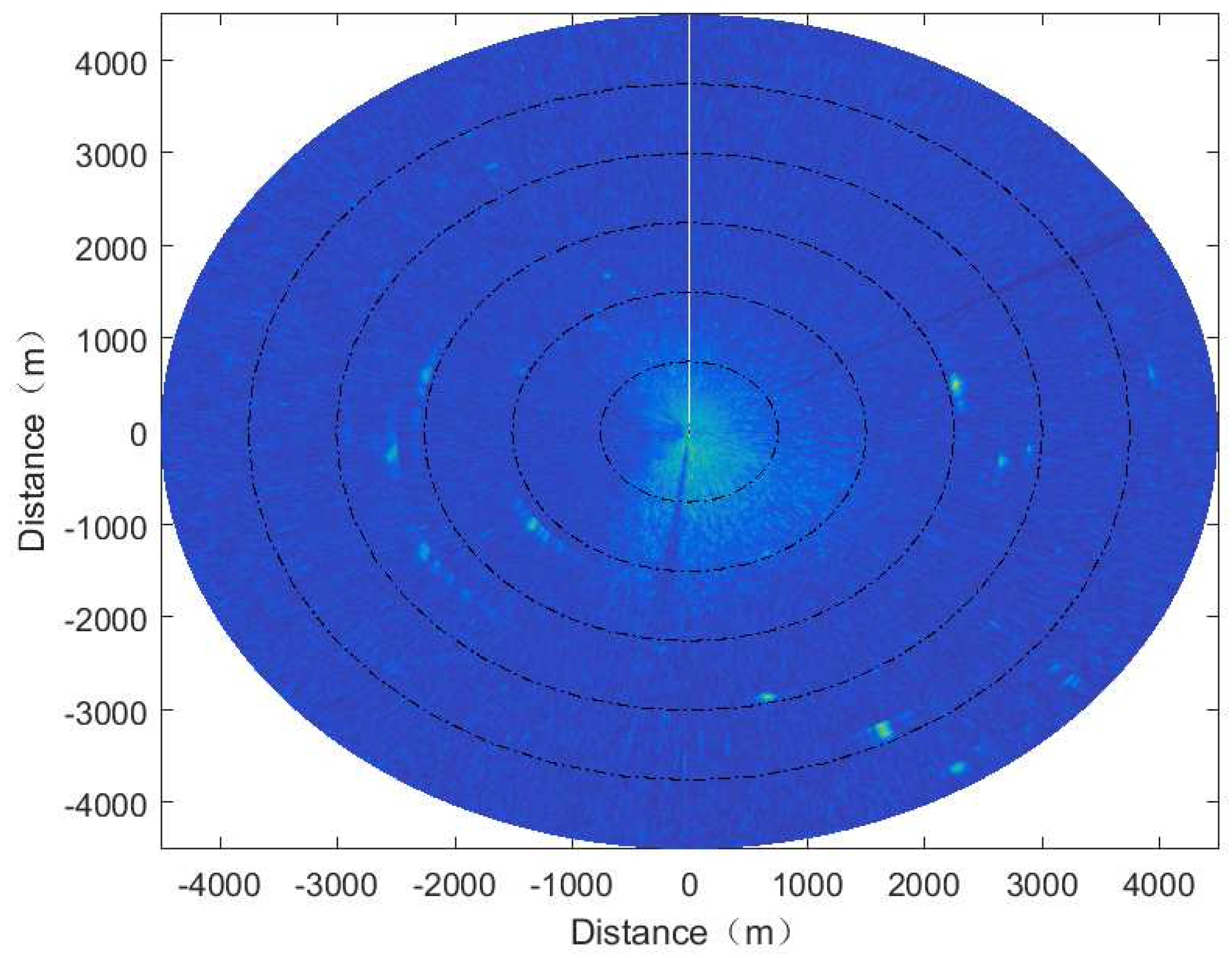
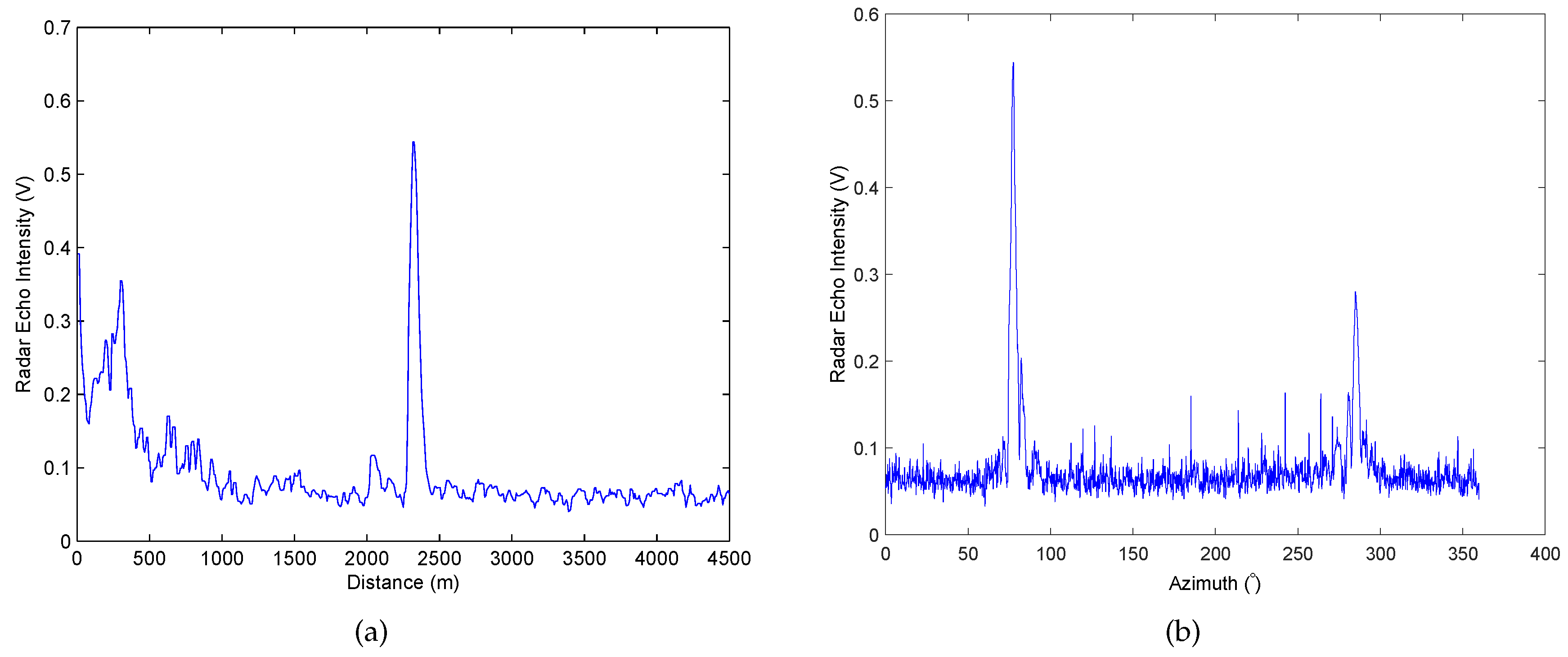
5.1. The Experimental Data
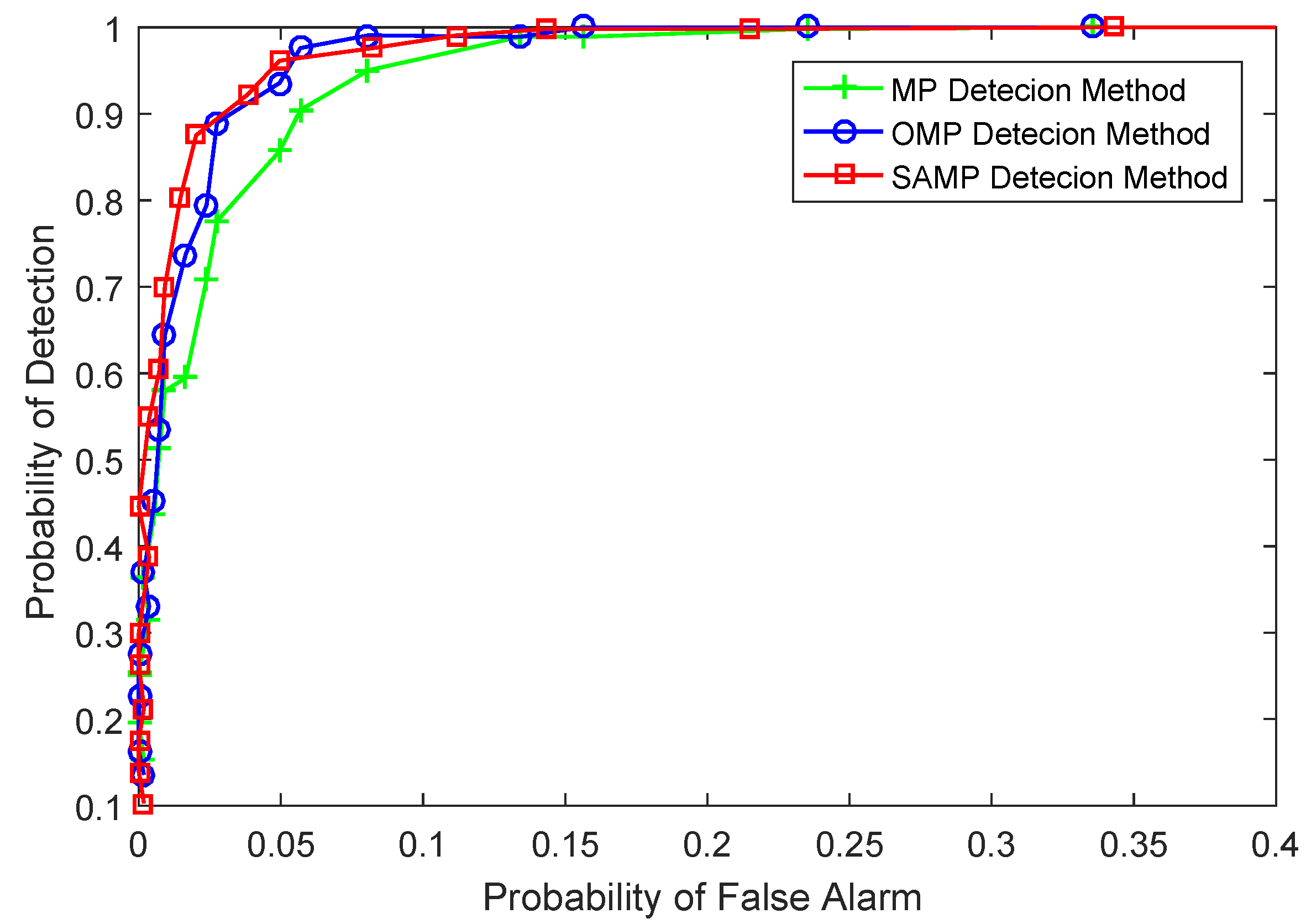
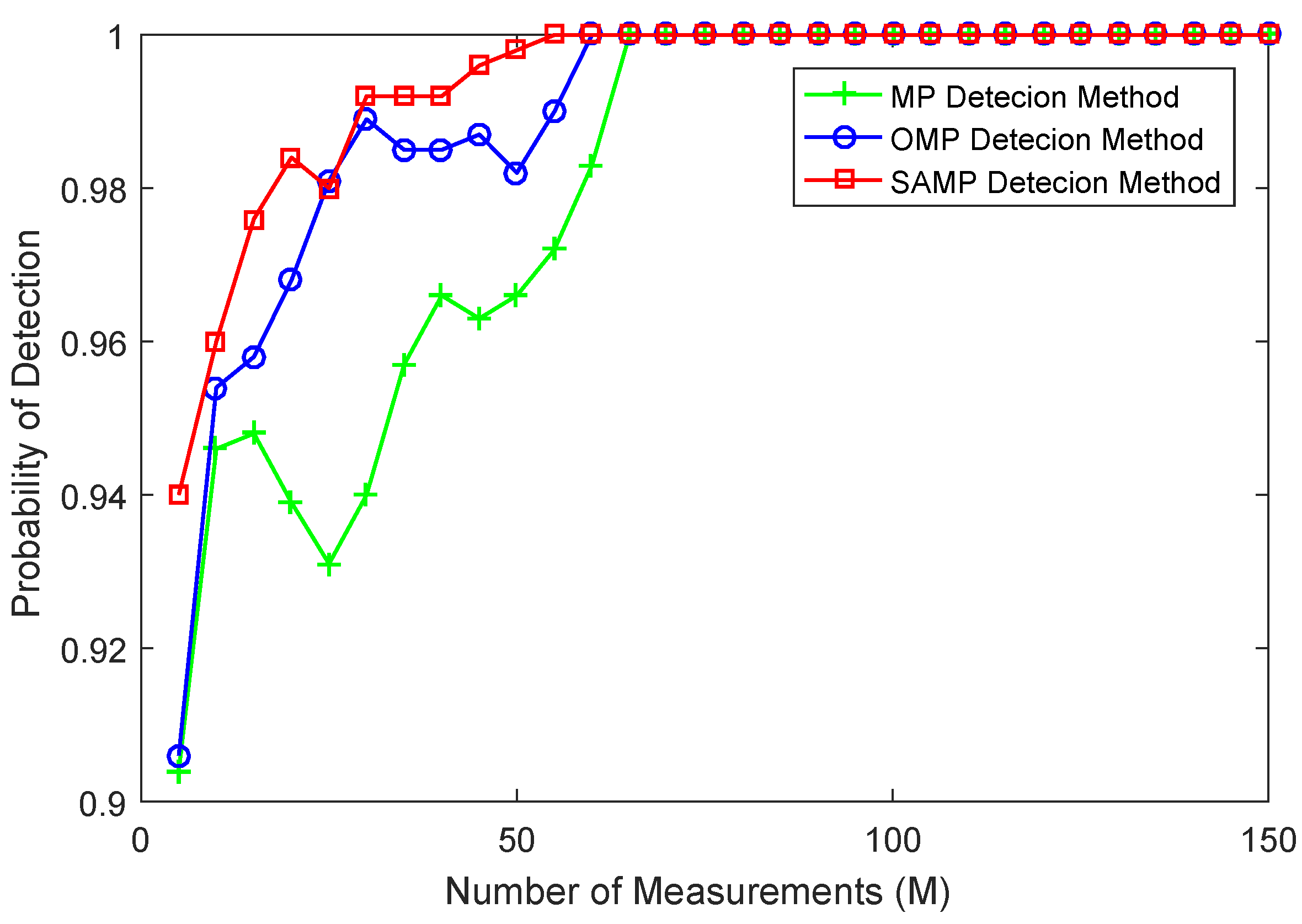
5.2. Experimental Results
6. Discussion
7. Conclusions
Acknowledgments
Author Contributions
Conflicts of Interest
References
- Zhang, J.; Yang, K.; Liu, F.; Zhang, Y. Information-Theoretic Characterization and Undersampling Ratio Determination for Compressive Radar Imaging in a Simulated Environment. Entropy 2015, 17, 5171–5198. [Google Scholar] [CrossRef]
- Zhang, J.; Yang, K. Informational Analysis for Compressive Sampling in Radar Imaging. Sensors 2015, 15, 7136–7155. [Google Scholar] [CrossRef] [PubMed]
- Candes, E.J.; Wakin, M.B. An introduction to compressive sampling: A sensing/sampling paradigm that goes against the common knowledge in data acquisition. IEEE Signal Process. Mag. 2008, 25, 21–30. [Google Scholar] [CrossRef]
- Liu, J. Noise driven compressed sensing method for space time signal processing. IEICE Electron. Express 2013, 10, 1–12. [Google Scholar]
- Li, Z.Z.; Chen, J.; Hou, Q.; Fu, H.X.; Dai, Z.; Jin, G.; Li, R.Z.; Liu, C.J. Sparse Representation for Infrared Dim Target Detection via a Discriminative Over-Complete Dictionary Learned Online. Sensors 2014, 14, 9451–9470. [Google Scholar] [CrossRef] [PubMed]
- Burns, B.L.; Wilson, N.E.; Thomas, M.A. Group Sparse Reconstruction of Multi-Dimensional Spectroscopic Imaging in Human Brain in vivo. Algorithms 2014, 7, 276–294. [Google Scholar] [CrossRef]
- Liu, Y.; Tao, T. A CS Recovery Algorithm for Model and Time Delay Identification of MISO-FIR Systems. Algorithms 2015, 8, 743–753. [Google Scholar] [CrossRef]
- Guo, B.; Li, Q.; Huang, X.; Wang, C. An Improved Method for Power-Line Reconstruction from Point Cloud Data. Remote Sen. 2016, 8, 36. [Google Scholar] [CrossRef]
- Yun, T.; An, F.; Li, W.; Sun, Y.; Cao, L.; Xue, L. A Novel Approach for Retrieving Tree Leaf Area from Ground-Based LiDAR. Remote Sen. 2016, 8, 942. [Google Scholar] [CrossRef]
- Wang, J.; Kwon, S.; Li, P.; Shim, B. Recovery of Sparse Signals via Generalized Orthogonal Matching Pursuit: A New Analysis. IEEE Trans. Signal Process. 2016, 64, 1076–1089. [Google Scholar] [CrossRef]
- Needell, D.; Vershynin, D. Uniform uncertainty principle and signal recovery via regularized orthogonal matching pursuit. Found. Comput. Math. 2009, 9, 317–334. [Google Scholar] [CrossRef]
- Duarte, M.F.; Davenport, M.A.; Wakin, M.B.; Baraniuk, R.G. Sparse signal detection from incoherent projections. In Proceedings of the IEEE International Conference on Acoustics, Speech, and Signal Processing, Toulouse, France, 14–19 May 2006. [Google Scholar]
- Kim, S. Sea-Based Infrared Scene Interpretation by Background Type Classification and Coastal Region Detection for Small Target Detection. Sensors 2015, 15, 24487–24513. [Google Scholar] [CrossRef] [PubMed]
- Luo, Y.; Gui, G.; Cong, X.; Wan, Q. Sparse Estimation Based on a New Random Regularized Matching Pursuit Generalized Approximate Message Passing Algorithm. Entropy 2016, 18, 207. [Google Scholar] [CrossRef]
- Haupt, J.; Nowak, R. Compressed sampling for signal detection. In Proceedings of the IEEE International Conference on Acoustics, Speech, and Signal Processing, Honolulu, HI, USA, 15–20 April 2007. [Google Scholar]
- Davenport, M.A.; Boufounos, P.T.; Wakin, M.B.; Baraniuk, R.G. Signal processing with compressive measurements. IEEE J. Sel. Top. Signal Process. 2010, 4, 445–460. [Google Scholar] [CrossRef]
- Qin, S.; Chen, D.; Huang, X.; Yu, L. A compressive signal detection scheme based on sparsity. Int. J. Signal Process. Image Process. Pattern Recognit. 2014, 7, 121–130. [Google Scholar] [CrossRef]
- Wimalajeewa, T.; Chen, H.; Varshney, P.K. Performance limits of compressive sensing-based signal classification. IEEE Trans. Signal Process. 2012, 60, 2758–2770. [Google Scholar] [CrossRef]
- Liu, B.; Fu, P.; Meng, S. Compressive sensing signal detection algorithm based on orthogonal matching pursuit. Chin. J. Sci. Instrum. 2010, 31, 1959–1964. [Google Scholar]
- Fletcher, A.K.; Rangan, S.; Goyal, V.K. Ranked Sparse Signal Support Detection. IEEE Trans. Signal Process. 2012, 60, 5919–5931. [Google Scholar] [CrossRef]
- Zhang, J.; Zhu, D.; Zhang, G. Adaptive compressed sensing radar oriented toward cognitive detection in dynamic sparse target scene. IEEE Trans. Signal Process. 2012, 60, 1718–1729. [Google Scholar] [CrossRef]
- Liu, B.; Fu, P.; Meng, S.; Guo, L. Compressive sensing signal detection algorithm based on location information of sparse coefficients. Int. J. Digit. Content Technol. Appl. 2010, 4, 79–85. [Google Scholar]
- Do, T.T.; Gan, L.; Nguyen, N.; Tran, T.D. Sparsity adaptive matching pursuit algorithm for practical compressed sensing. In Proceedings of the 2008 42nd Asilomar Conference on Signals, Systems and Computers, Pacific Grove, CA, USA, 26–29 October 2008. [Google Scholar]
- Wei, Y.; Zhang, J.-K.; Lu, Z. A Novel Successive Cancellation Method to Retrieve Sea Wave Components from Spatio-Temporal Remote Sensing Image Sequences. Remote Sens. 2016, 8, 607. [Google Scholar] [CrossRef]
- Wei, Y.; Lu, Z.; Zhang, J.-K. A Novel Method to Retrieve Sea Wave Components from Radar Image Sequence. In Proceedings of the 2016 IEEE International Conference on Mechatronics and Automation, Harbin, China, 7–10 August 2016. [Google Scholar]
- Wei, Y.; Lu, Z.; Huang, Y. Wave Parameters Inversion from X-Band Marine Radar Image Sequence Based on the Novel Dispersion Relation Band-Pass Filter on the Moving Platform. J. Comput. Theor. Nanosci. 2016, 13, 5470–5477. [Google Scholar] [CrossRef]
- Zhu, Z.; Zhang, Z.; Liu, F.; Li, B.; Zhou, C. The One-dimensional Range Imaging of Linear Target Based on Compressive Sensing. J. Electron. Inf. Technol. 2013, 35, 568–574. [Google Scholar] [CrossRef]
- Gao, J.; Deng, B.; Su, W.; Qin, Y.; Li, X. Range-azimuth Sar Imaging Based on Bayesian Compressive Sensing. In Proceedings of the International Conference on Signal Processing, Hangzhou, China, 19–23 October 2014. [Google Scholar]



| Radar Parameters | The Performance |
|---|---|
| Electromagnetic Wave Frequency | 9.3 GHz |
| Antenna Angular Speed | 22 r.p.m. |
| Antenna Height | 25 m |
| Polarization | HH |
| Range Resolution | 7.5 m |
| Horizontal Beam Width | 0.9° |
| Vertical Beam Width | 21° |
| Pulse Repetition Frequency | 2000 Hz |
| Pulse Width | 0.7° |
| M | SNR (dB) | MP | OMP | SAMP | ||||
|---|---|---|---|---|---|---|---|---|
| T (s) | T (s) | T (s) | ||||||
| 50 | 6 | 0.2 | 0.916 | 0.0702 | 0.974 | 0.0711 | 0.997 | 0.0327 |
| 100 | 6 | 0.2 | 1 | 0.0734 | 0.980 | 0.0744 | 1 | 0.0329 |
| 50 | 6 | 0.25 | 0.756 | 0.0726 | 0.81 | 0.0708 | 0.934 | 0.0328 |
| 100 | 6 | 0.25 | 0.702 | 0.0733 | 0.93 | 0.0744 | 0.960 | 0.0333 |
| 50 | 10 | 0.2 | 1 | 0.0705 | 1 | 0.0709 | 1 | 0.0327 |
| 100 | 10 | 0.2 | 1 | 0.0734 | 1 | 0.0738 | 1 | 0.0332 |
| 50 | 10 | 0.25 | 0.996 | 0.0715 | 0.996 | 0.0708 | 1 | 0.0326 |
| 100 | 10 | 0.25 | 0.998 | 0.0728 | 1 | 0.0735 | 1 | 0.0332 |
| M | SNR (dB) | ||||
|---|---|---|---|---|---|
| 50 | 6 | 0.25 | 0.0346 | 0.0327 | 0.0324 |
| 50 | 10 | 0.25 | 0.0346 | 0.0326 | 0.0324 |
| 100 | 6 | 0.25 | 0.0596 | 0.0333 | 0.0325 |
| 100 | 10 | 0.25 | 0.0596 | 0.0333 | 0.0325 |
© 2017 by the authors. Licensee MDPI, Basel, Switzerland. This article is an open access article distributed under the terms and conditions of the Creative Commons Attribution (CC BY) license (http://creativecommons.org/licenses/by/4.0/).
Share and Cite
Wei, Y.; Lu, Z.; Yuan, G.; Fang, Z.; Huang, Y. Sparsity Adaptive Matching Pursuit Detection Algorithm Based on Compressed Sensing for Radar Signals. Sensors 2017, 17, 1120. https://doi.org/10.3390/s17051120
Wei Y, Lu Z, Yuan G, Fang Z, Huang Y. Sparsity Adaptive Matching Pursuit Detection Algorithm Based on Compressed Sensing for Radar Signals. Sensors. 2017; 17(5):1120. https://doi.org/10.3390/s17051120
Chicago/Turabian StyleWei, Yanbo, Zhizhong Lu, Gannan Yuan, Zhao Fang, and Yu Huang. 2017. "Sparsity Adaptive Matching Pursuit Detection Algorithm Based on Compressed Sensing for Radar Signals" Sensors 17, no. 5: 1120. https://doi.org/10.3390/s17051120
APA StyleWei, Y., Lu, Z., Yuan, G., Fang, Z., & Huang, Y. (2017). Sparsity Adaptive Matching Pursuit Detection Algorithm Based on Compressed Sensing for Radar Signals. Sensors, 17(5), 1120. https://doi.org/10.3390/s17051120