1. Introduction
The opening of the Suez Canal, combined with ongoing climate change, has dramatically accelerated the introduction and establishment of non-native marine species in the Mediterranean Sea, making the region one of the world’s major hotspots for biological invasions [
1,
2,
3]. Rising seawater temperatures, increasing tropicalization, and intensified maritime connectivity have facilitated the successful colonization of numerous Indo-Pacific species, particularly within the eastern Mediterranean basin [
2]. In recent decades, a substantial increase in invasive marine species records has been documented along the Mediterranean coastline, reflecting the growing ecological influence of Lessepsian migration in the region [
4,
5,
6,
7]. The expansion of invasive species may generate considerable ecological, economic, and public health impacts through competition with native species, habitat alteration, trophic interactions, and the introduction of venomous or otherwise harmful organisms into coastal ecosystems [
8,
9,
10]. Consequently, understanding the current distribution, abundance, and potential future spread of invasive species has become a critical requirement for effective fisheries management, conservation planning, and ecosystem-based marine governance. Accurate assessments of species occurrence and habitat suitability are particularly important for developing early-warning systems and implementing appropriate mitigation strategies.
The striped eel catfish,
Plotosus lineatus (Thunberg, 1787), is a venomous Indo-Pacific species belonging to the family Plotosidae. The species was first recorded in the Mediterranean Sea by Golani [
11] from the Israeli coast and subsequently reported from Egypt [
12], Syria [
13], Türkiye [
14], Cyprus [
15], and Tunisia, representing its westernmost Mediterranean occurrence to date [
16]. The rapid geographic expansion of
P. lineatus across the eastern and central Mediterranean indicates a strong invasive potential and suggests that the species is successfully adapting to Mediterranean environmental conditions.
P. lineatus generally inhabits shallow coastal environments, rocky substrates, and coral reef-associated habitats at depths ranging from approximately 20 to 50 m [
17,
18]. In addition to its ecological significance as a non-native predator, the species represents a potential public health concern because its dorsal and pectoral fin spines contain venomous toxins capable of causing painful injuries to swimmers, divers, fishers, and coastal users [
19,
20]. As the abundance and distribution of the species continue to increase, interactions with fisheries and human activities are likely to become more frequent throughout the Mediterranean region.
Following the first confirmed occurrence of
P. lineatus in the Mediterranean [
11], additional observations have suggested that the species may now be expanding more rapidly throughout the northeastern Mediterranean. However, despite the growing number of regional records, comprehensive large-scale assessments of its present and future distribution under climate change scenarios remain limited. In this aspect, species distribution models (SDMs) have become increasingly important tools for relating species occurrence data to environmental gradients and predicting potential distributions under present and future climate scenarios [
21,
22,
23,
24]. SDMs are particularly valuable for native endangered [
25,
26] and invasive species [
24] research because they enable the identification of environmentally suitable habitats, invasion hotspots, and potential dispersal pathways before large-scale establishment occurs. Such predictive approaches can provide critical support for conservation planning, fisheries management, and ecosystem-based adaptation strategies by allowing managers and policymakers to implement preventive measures prior to extensive biological invasions.
In the present study, ensemble species distribution models were used to evaluate the current and future distribution of P. lineatus in the Mediterranean Sea under climate change scenarios. Specifically, the aims of this study were to: (1) predict the current geographic distribution of P. lineatus across the Mediterranean basin, (2) assess potential future shifts in habitat suitability under projected climate conditions, and (3) identify the key environmental drivers shaping the distribution of the species. By integrating multiple high-performing modeling algorithms and environmental predictors, this study provides a comprehensive assessment of the invasion potential of P. lineatus and offers ecologically relevant information for regional monitoring and management strategies.
2. Materials and Methods
2.1. Occurrence Data
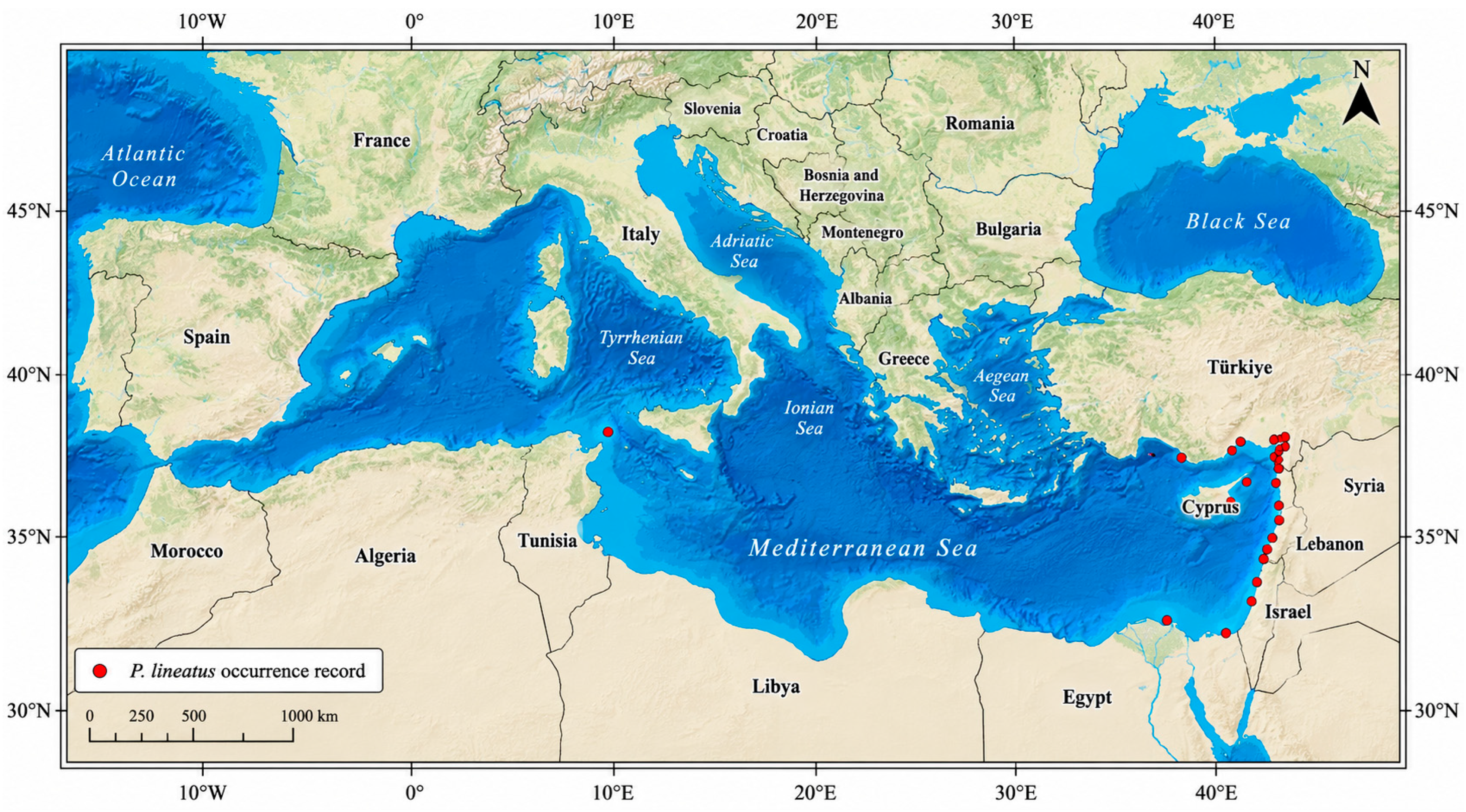
Georeferenced occurrence records of the striped eel catfish
P. lineatus in the Mediterranean Sea (
Figure 1) were compiled primarily from published studies documenting confirmed records of the species [
27,
28,
29,
30,
31]. Additional occurrence records available through biodiversity databases, including OBIS, were also examined for comparison and validation. All records were subjected to a rigorous data-screening procedure prior to modelling. Duplicate records, occurrences with missing or uncertain geographic coordinates, and records with geographically or ecologically implausible locations were excluded. In particular, several database-derived records were located outside the Mediterranean Sea or on land and could not be reliably verified against their original sources. The two OBIS records falling within the Mediterranean region corresponded to records already documented in the published literature and therefore did not constitute independent additional occurrences.
Following data validation, a spatial thinning procedure was applied to identify potential spatial clustering among occurrence records and to evaluate possible sampling bias, following Boria et al. [
32]. A minimum thinning distance of 5 km was applied to identify spatially redundant records prior to model calibration. This threshold was selected to minimize the influence of local-scale sampling redundancy while retaining the maximum number of independently verified occurrence records. However, because no occurrence records were located within the specified 5-km threshold, all 24 verified occurrence records were retained for subsequent analyses. Thus, spatial thinning confirmed the absence of redundant spatially clustered records within the available dataset rather than reducing the number of occurrence records or substantially correcting sampling bias.
2.2. Environmental Variables
All environmental predictors were obtained from the Bio-ORACLE v3 database at a spatial resolution of 5 arcmin (approximately 9.2 km at the equator). Current environmental layers represented the 2000–2020 baseline period, whereas future layers corresponded to the CMIP6 SSP2-4.5 projection averaged over 2020–2100 [
33,
34]. A comprehensive suite of environmental predictors representing major oceanographic and biogeochemical processes was initially compiled. Variable selection specifically targeted ecologically relevant components associated with nutrient availability, ocean circulation, seawater chemistry, thermal structure, and light conditions, all of which are known to influence the distribution and establishment success of marine invasive species.
Current environmental layers represented baseline environmental conditions for the 2000–2020 period, whereas future environmental predictors were obtained from Bio-ORACLE v3 under the CMIP6 SSP2-4.5 greenhouse gas emission scenario. The future environmental layers provided by Bio-ORACLE v3 represent long-term averaged future environmental conditions rather than discrete future time periods or individual projection years. Accordingly, the modelling framework was designed to compare current habitat suitability with habitat suitability projected under long-term future environmental conditions, rather than to reconstruct temporal changes or expansion trajectories through time. Consequently, the future habitat suitability maps should be interpreted as representing differences between current and long-term projected environmental conditions under the selected climate scenario, rather than predictions for a specific future year or decade. Because the analysis was based on a single CMIP6 SSP2-4.5 projection dataset, uncertainty associated with alternative climate scenarios or global climate models was not explicitly quantified, and this limitation was considered when interpreting the future projections. Prior to model calibration, multicollinearity among predictors was assessed using both pairwise Pearson correlation coefficients and Variance Inflation Factor (VIF) analyses. Variables showing high pairwise correlation (|r| > 0.7) were removed, and only predictors with acceptable VIF values (<10) were retained to improve model stability, reduce overfitting, and enhance ecological interpretability, following the recommendations of Dormann et al. [
35,
36].
Variable importance was calculated using the getVarImp() function implemented in the sdm package1.2-59, which computes model-specific relative variable importance separately for each modelling algorithm. Variable importance was not calculated from the final ensemble prediction. Relative importance values were summarized as the mean across the bootstrap replicates, and variability among replicates was expressed as the standard deviation.
2.3. Species Distribution Modeling
The modelling workflow was designed to capture both linear and non-linear species–environment relationships while accounting for complex ecological responses influencing the establishment and spread of P. lineatus in the Mediterranean Sea. Species distribution models (SDMs) were developed using an ensemble modelling framework in which nine modelling algorithms were initially evaluated: Random Forest (RF), Multi-Layer Perceptron Neural Networks (MLP), Classification and Regression Trees (CART), BIOCLIM.DISTO, Recursive Partitioning and Regression Trees (RPART), Support Vector Machines (SVM), Boosted Regression Trees (BRT), BIOCLIM, and Maximum Entropy (MaxEnt). Machine-learning approaches, including RF, BRT, SVM, and MLP, were included to capture complex and non-linear species–environment relationships, whereas tree-based and envelope-based approaches provided complementary representations of habitat suitability.
A total of 1500 pseudoabsence points were randomly generated using the gRandom algorithm implemented in the sdm package. Because pseudoabsence points were generated directly from the environmental predictor rasters, sampling was inherently restricted to marine grid cells within the Mediterranean Sea, and terrestrial areas were automatically excluded. The same pseudoabsence dataset was used throughout model calibration for all modelling algorithms, whereas bootstrap resampling generated different training and testing subsets during model validation. Model calibration was performed using a bootstrap resampling procedure with 10 independent replicates, allowing model performance to be evaluated across multiple bootstrap resampling iterations rather than relying on a single random partition. In each replicate, approximately 70% of the occurrence and pseudoabsence data (corresponding to approximately 17 occurrence records) were randomly selected for model calibration, whereas the remaining 30% (approximately 7 occurrence records) were used for model evaluation. Bootstrap resampling generated a new calibration and evaluation dataset for each replicate, thereby reducing the influence of a single random partition on model performance assessment.
Six modelling algorithms were implemented, including Random Forest (RF), Multilayer Perceptron (MLP), Classification and Regression Trees (CART), Support Vector Machines (SVM), Boosted Regression Trees (BRT), and Maximum Entropy (MaxEnt). Model performance was evaluated using the Area Under the Receiver Operating Characteristic Curve (AUC), the True Skill Statistic (TSS), Pearson’s correlation coefficient (COR), and deviance. To quantify variation among bootstrap replicates, the mean and standard deviation of AUC and TSS were calculated across the ten model runs.
2.4. Model Selection and Evaluation
Models achieving the predefined performance criteria (AUC ≥ 0.90 and TSS ≥ 0.80) were retained for ensemble modelling. Based on these criteria, all six algorithms (RF, MLP, CART, SVM, BRT, and MaxEnt) were incorporated into the final ensemble model. The selected models were combined using an unweighted ensemble approach, in which each algorithm contributed equally to the final prediction. The ensemble model was subsequently used to predict the current habitat suitability and future potential distribution of
Plotosus lineatus under the CMIP6 SSP2-4.5 climate scenario. Ensemble forecasting reduces dependence on any single modelling algorithm, minimizes algorithm-specific uncertainty, and provides more robust habitat suitability predictions than individual models [
37]. Model performance was primarily assessed using the threshold-independent Area Under the Receiver Operating Characteristic Curve (AUC) and the threshold-dependent True Skill Statistic (TSS), which are among the most widely used evaluation metrics in species distribution modelling [
38,
39].
3. Results
3.1. Occurrence Records and Data Validation
A total of 24 occurrence records of P. lineatus were identified and independently verified from published literature. Additional records retrieved from biodiversity databases, including OBIS, were screened for geographic and ecological plausibility. The two OBIS records located within the Mediterranean region corresponded to occurrence records already documented in the published literature and therefore did not represent independent additional records. The remaining database records were excluded because many contained geographically erroneous or ecologically implausible coordinates, including records located on land or outside the Mediterranean basin. Following validation, the 24 independently verified literature-based records were subjected to spatial thinning to reduce spatial clustering and spatial autocorrelation. After spatial thinning, 24 occurrence records were retained for the final modelling analysis.
3.2. Environmental Variable Selection and Multicollinearity Analysis
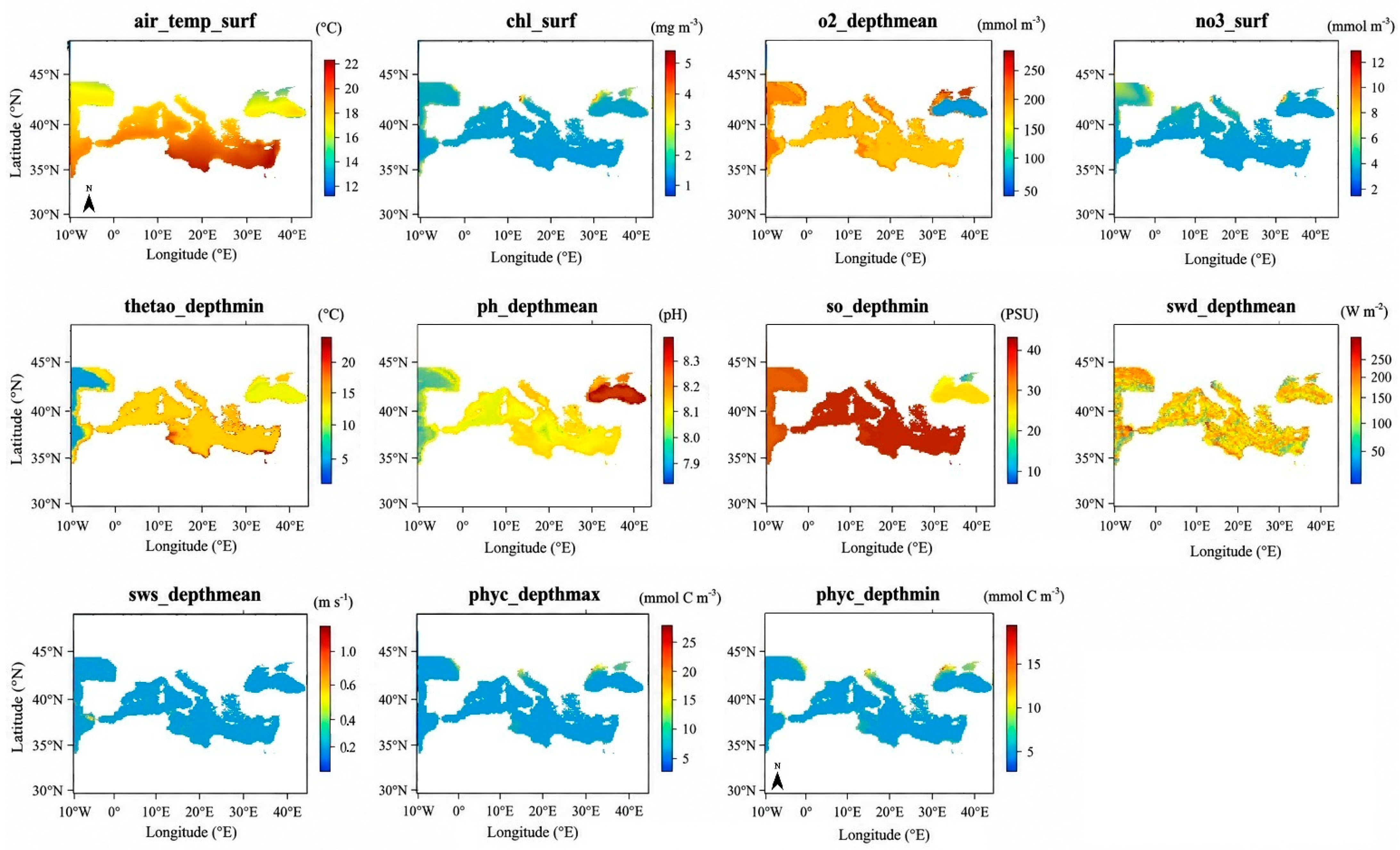
A total of 21 environmental layers derived from the Bio-ORACLE v3 and MARSPEC databases were initially considered for model development. To improve model stability and reduce redundancy among predictors, multicollinearity was evaluated using Pearson correlation analysis followed by Variance Inflation Factor (VIF) analysis. Variables exhibiting strong collinearity were excluded from subsequent analyses. Following Pearson correlation filtering (|r| < 0.7) and subsequent VIF-based selection, 11 environmental variables, all obtained from the Bio-ORACLE v3 database, were retained for both current and future species distribution projections (
Figure 2), with all selected predictors showing acceptable collinearity levels (VIF < 10) (
Table 1). Although environmental variables from both databases were initially evaluated, none of the MARSPEC variables were retained in the final predictor set following the variable selection procedure. The retained predictors represented multiple ecological dimensions potentially affecting the invasion dynamics and habitat suitability of
P. lineatus.
3.3. Model Performance
The predictive performance of the nine modelling algorithms was evaluated using 10 bootstrap replicates, and model performance was summarized as the mean ± standard deviation (SD) of the Area Under the Receiver Operating Characteristic Curve (AUC) and the True Skill Statistic (TSS) (
Table 2). Six algorithms (RF, MLP, CART, SVM, BRT, and MaxEnt) met the predefined performance criteria (AUC ≥ 0.90 and TSS ≥ 0.90) and were retained for ensemble modelling. Among these, Random Forest (RF) and Boosted Regression Trees (BRT) achieved the highest predictive performance (RF: AUC = 1.000 ± 0.001, TSS = 0.999 ± 0.003; BRT: AUC = 0.998 ± 0.003, TSS = 0.995 ± 0.007). MaxEnt also showed excellent predictive ability (AUC = 0.990 ± 0.019; TSS = 0.964 ± 0.055), whereas MLP, CART, and SVM exhibited slightly greater variability among bootstrap replicates while maintaining high predictive performance. In contrast, BIOCLIM.DISTO, RPART, and BIOCLIM failed to satisfy the predefined performance thresholds and were therefore excluded from the final ensemble model. The six selected algorithms were subsequently combined using an unweighted ensemble approach to generate the current habitat suitability map and future distribution projections of
Plotosus lineatus under the CMIP6 SSP2-4.5 climate scenario.
3.4. Variable Importance and Response Curves
The ensemble species distribution model revealed substantial differences in the relative contribution of environmental predictors shaping the current and future habitat suitability of
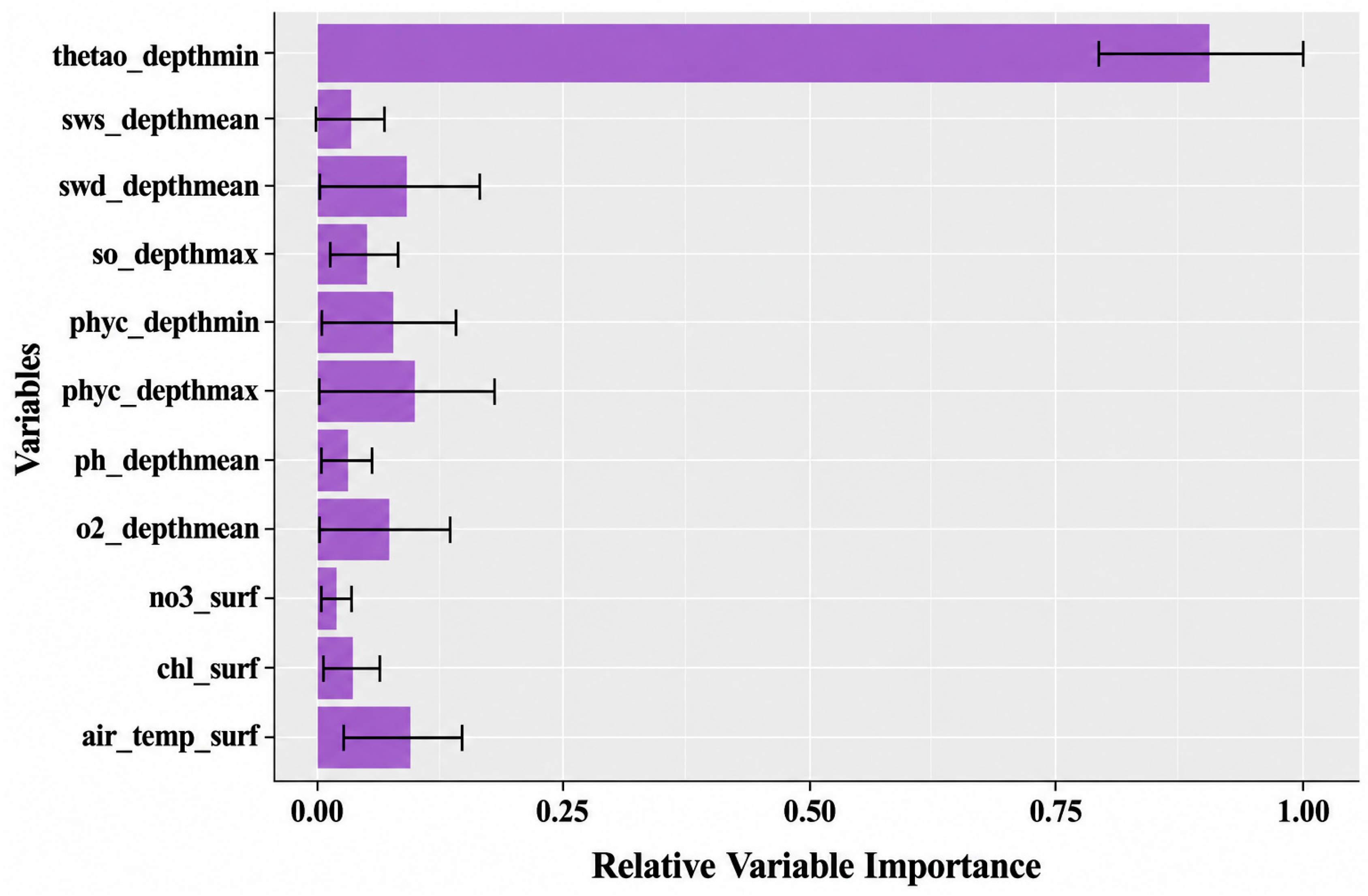
P. lineatus in the Mediterranean Sea. Relative variable importance values (
Figure 3), calculated as the mean model-specific importance across the bootstrap replicates, indicated that minimum seawater temperature (thetao_depthmin) was by far the most influential predictor. This variable exhibited a markedly higher contribution than all other environmental predictors, whereas the remaining variables showed comparatively low and relatively similar importance values. Error bars representing the standard deviation among bootstrap replicates indicated that the ranking of predictor importance remained generally consistent across model runs.
The dominance of thetao_depthmin highlights the critical role of lower thermal thresholds in constraining the establishment and potential expansion of P. lineatus, a thermophilic Indo-Pacific species whose distribution is strongly associated with warm marine environments. The high importance of minimum seawater temperature suggests that winter thermal conditions represent the principal environmental constraint governing the current and projected habitat suitability of the species in the Mediterranean Sea.
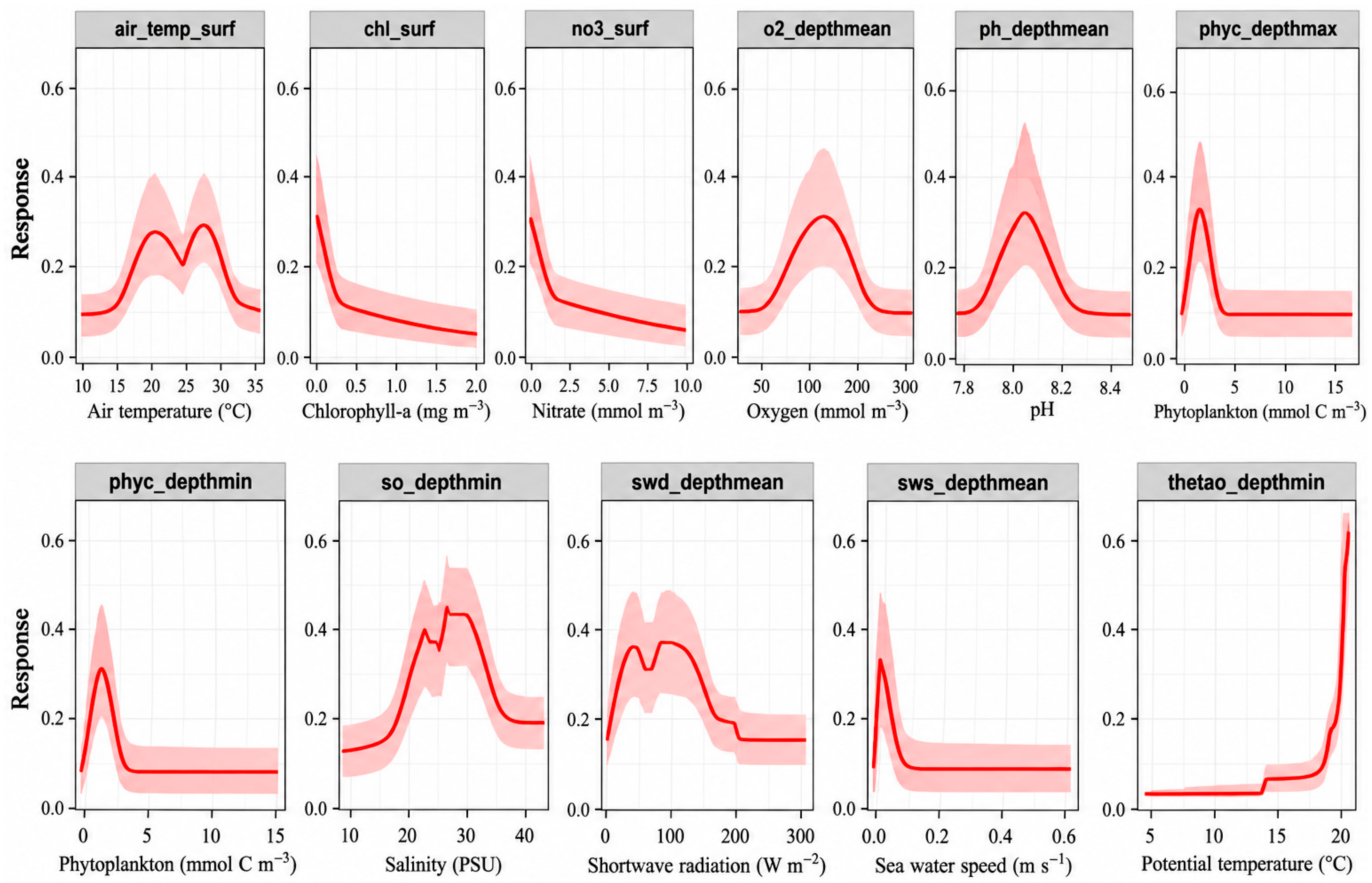
The response curve analysis revealed predominantly non-linear ecological relationships between habitat suitability and environmental gradients (
Figure 4). Response curves further demonstrated a sharp increase in habitat suitability at higher minimum temperature values, indicating that projected ocean warming may substantially facilitate the future expansion of the species, particularly toward the central and western Mediterranean regions. The variability observed among bootstrap replicates was generally low for the most influential environmental predictors, indicating consistent model responses across repeated calibrations. Nevertheless, these intervals reflect uncertainty among model replicates and should not be interpreted as confidence in the underlying ecological relationships.
Secondary but ecologically relevant predictors included seawater pH (ph_depthmean), dissolved oxygen (o2_depthmean), chlorophyll-a concentration (chl_surf), nitrate concentration (no3_surf), and light availability (swd_depthmean). These variables collectively reflect the importance of productivity, ecosystem metabolism, and water chemistry in determining suitable habitats for P. lineatus. Moderate contributions from phytoplankton biomass variables (phyc_depthmax and phyc_depthmin) additionally suggest that areas characterized by elevated primary productivity may provide favorable trophic conditions supporting population establishment. Oceanographic dynamics also contributed to habitat suitability patterns. Surface current velocity (sws_depthmean) and salinity-related variables exhibited relatively lower importance compared to thermal predictors; however, their inclusion likely captured dispersal connectivity and regional hydrodynamic processes influencing larval transport and colonization potential.
3.5. Current Distribution Pattern of Plotosus lineatus
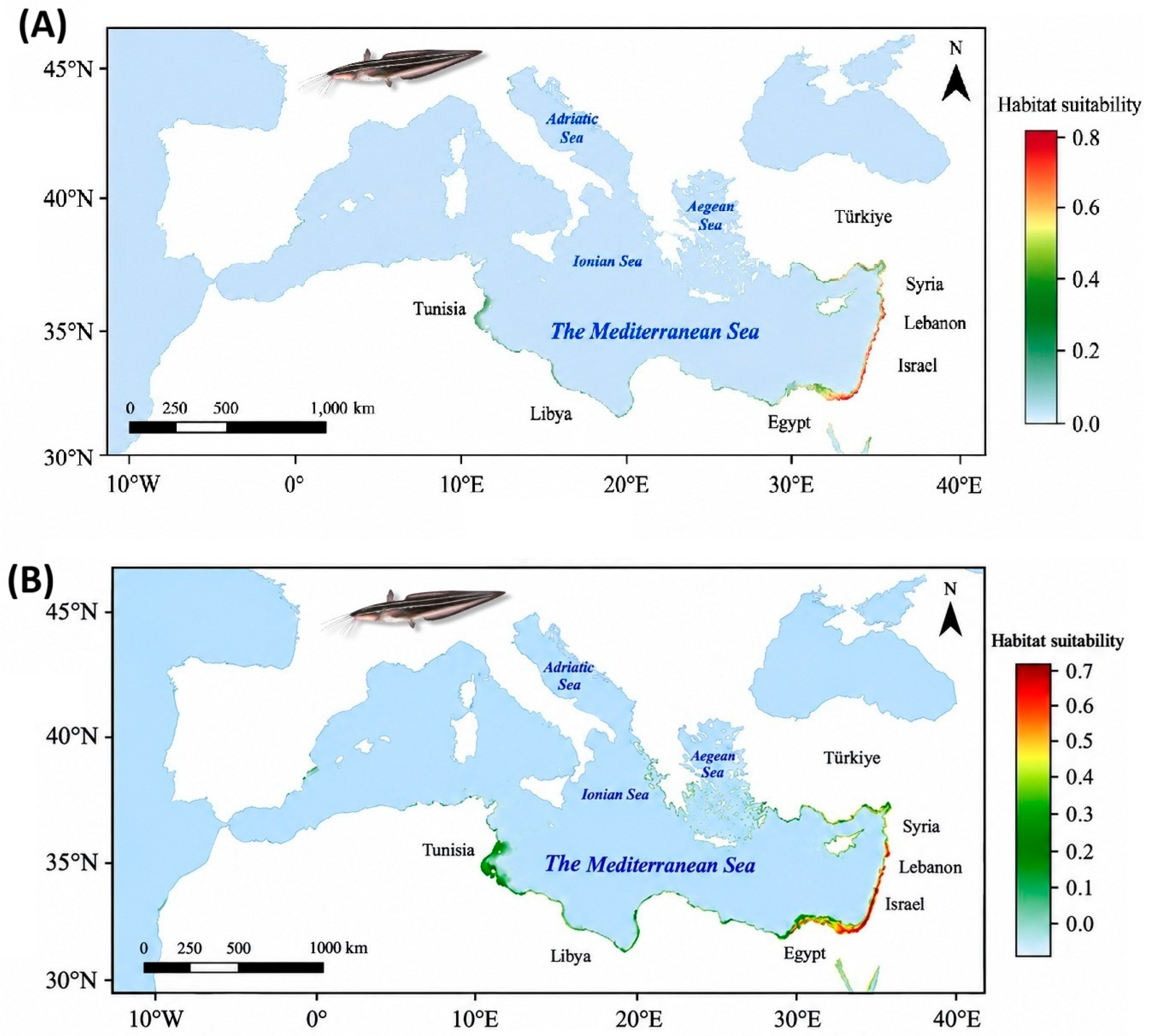
The AUC-unweighted ensemble habitat suitability model revealed a highly heterogeneous distribution pattern for
P. lineatus across the Mediterranean Sea (
Figure 5A). Predicted suitability was strongly concentrated in the eastern Mediterranean basin, particularly along the Levantine coast, where the highest habitat suitability values were observed. Coastal regions of southern Türkiye, Cyprus, Lebanon, Israel, and northern Egypt exhibited the most favorable environmental conditions for the establishment and persistence of the species.
The highest suitability values were especially concentrated along the southeastern Mediterranean coastline, indicating that this region currently represents the primary invasion hotspot for P. lineatus. These findings are consistent with the thermophilic ecological characteristics of the species and its Indo-Pacific origin, as the eastern Mediterranean is characterized by warmer seawater temperatures and environmental conditions resembling those of its native range.
In contrast, habitat suitability progressively declined toward the central and western Mediterranean basins. Although low-to-moderate suitability patches were detected along parts of the North African coastline and certain coastal parts of the central Mediterranean. The presence of suitable habitats in the Tunisian coast is consistent with recent occurrence records and may indicate an ongoing westward expansion of P. lineatus into the central Mediterranean. These coastal areas could function as important dispersal corridors under future warming conditions.
3.6. Future Distribution Pattern of P. lineatus
Future ensemble projections based on averaged environmental conditions for the 2020–2100 period under the SSP2-4.5 climate scenario indicated a clear expansion of suitable habitats for
P. lineatus across the Mediterranean Sea (
Figure 5B). These projections reflect shifts in environmentally suitable conditions throughout the 2020–2100 interval rather than predictions for a specific future year. While the eastern Mediterranean remained the primary hotspot with the highest suitability values, long-term habitat suitability increased noticeably toward the central Mediterranean basin. Suitable habitat expansion was particularly evident along the southern Italian coastline and the Aegean coasts of Greece. The emergence of environmentally favorable conditions in these regions suggests that ongoing warming trends may facilitate the northward and westward spread of
P. lineatus across the central Mediterranean in the coming decades.
Suitable coastal habitats became more continuous along the North African coastline, particularly extending through Libya and Tunisia and South Italy coasts, suggesting an increased risk of westward dispersal under future warming conditions. Moderate suitability was also projected in parts of the Aegean and Ionian Seas, indicating a potential northward expansion of the species.
4. Discussion
4.1. The Primary Drivers of Distribution
The present study demonstrated that minimum seawater temperature is the dominant environmental factor controlling the distribution of
P. lineatus in the Mediterranean Sea. The exceptionally high contribution of thetao_depthmin in the ensemble model suggests that winter thermal thresholds represent the principal ecological barrier limiting the establishment and spread of this thermophilic Indo-Pacific species. This finding is consistent with previous studies indicating that Mediterranean warming strongly facilitates the expansion of Lessepsian fishes and other warm-affinity invasive species [
21,
27,
40].
The response curve analysis further revealed a marked increase in habitat suitability above specific minimum temperature thresholds, indicating the existence of thermal tipping points governing invasion success. Such non-linear responses are ecologically important because they imply that relatively small increases in winter seawater temperatures may disproportionately enhance the establishment probability of
P. lineatus in previously unsuitable regions. Similar threshold-dependent thermal responses have been reported for other invasive marine fishes undergoing climate-driven range expansion [
41].
In addition to thermal conditions, several productivity-related variables contributed significantly to habitat suitability. Chlorophyll-a concentration and phytoplankton biomass variables likely reflect food availability and trophic productivity in shallow coastal ecosystems.
P. lineatus is an opportunistic benthic predator capable of exploiting diverse prey resources, including crustaceans, mollusks, and small fishes, which may facilitate establishment in productive coastal habitats. Previous studies have similarly demonstrated that chlorophyll-a concentration is an important predictor of habitat suitability and spatial distribution for marine fishes because it reflects primary productivity and prey availability within coastal food webs [
22,
42].
Dissolved oxygen and seawater pH also showed moderate importance within the ensemble model, suggesting that broader biogeochemical conditions may influence physiological tolerance and habitat quality for the species. In marine ecosystems, dissolved oxygen availability is strongly associated with metabolic performance, aerobic capacity, and species persistence, particularly under warming conditions where oxygen limitation may intensify [
43,
44]. The contribution of oxygen-related variables in the present model therefore suggests that oxygen dynamics may partially constrain the long-term establishment success of
P. lineatus, especially in semi-enclosed and environmentally stressed Mediterranean habitats.
Oceanographic variables associated with surface circulation displayed relatively lower contributions within the ensemble model but remain ecologically important for understanding dispersal dynamics and secondary range expansion. Larval transport mediated by regional current systems may enhance connectivity among Mediterranean coastal habitats and facilitate the spread of
P. lineatus following initial establishment. In the eastern Mediterranean, Atlantic-origin water masses entering through the Strait of Gibraltar circulate toward the northeastern Mediterranean, reaching the Turkish and Syrian coasts before flowing westward along the Mersin and Antalya coastlines. Such circulation patterns may promote passive larval dispersal and contribute to the progressive expansion of
P. lineatus across the Levantine Basin [
3].
4.2. Current Distribution
The current habitat suitability model identified the Levantine Basin as the primary invasion hotspot for
P. lineatus, with highly suitable habitats concentrated along the coasts of Israel, Lebanon, Syria, Cyprus, and southern Türkiye. This spatial pattern corresponds closely with the documented invasion history of the species following its first Mediterranean occurrence reported by Golani [
11]. The high suitability of the eastern Mediterranean likely reflects the region’s elevated sea surface temperatures and oligotrophic conditions, which increasingly resemble the environmental characteristics of the species’ native Indo-Pacific range. The rapid establishment success of
P. lineatus in the Levant has previously been associated with the warming trend observed in the eastern Mediterranean during recent decades [
27].
The model also predicted moderate habitat suitability along the North African coastline, particularly in Libya and Tunisia. The suitability detected around Tunisia is especially noteworthy because recent occurrence records from Tunisian waters may indicate an ongoing westward expansion into the central Mediterranean basin. Similar westward dispersal dynamics have been documented for numerous Lessepsian fishes under ongoing Mediterranean warming scenarios [
45].
4.3. Future Expansion Under Climate Change
Future projections under the SSP2-4.5 scenario revealed a substantial increase in habitat suitability throughout the central Mediterranean basin. In particular, the emergence of suitable habitats along southern Italy and the Aegean coasts of Greece suggests that projected ocean warming may progressively remove the thermal barriers currently restricting the distribution of
P. lineatus. The future model additionally showed a more continuous pattern of suitable coastal habitats extending westward from the Levantine Basin through North Africa toward the central Mediterranean. These connected suitability corridors may facilitate gradual dispersal and secondary colonization events in coming decades. The predicted northward and westward expansion pattern is consistent with the ongoing “tropicalization” of the Mediterranean Sea, characterized by increasing dominance of thermophilic species under climate warming [
46].
Although habitat suitability remained comparatively lower in the western Mediterranean, the projected expansion pattern suggests that continued warming may eventually enable further colonization beyond the central basin. Such distributional shifts are increasingly reported for marine invasive species responding to changing climatic conditions across the Mediterranean ecosystem.
4.4. Ecological and Socioeconomic Implications
The continued expansion of P. lineatus may have important ecological and socioeconomic consequences for Mediterranean coastal ecosystems. As a venomous benthic species with strong schooling behavior during juvenile stages, P. lineatus may exert pressure on native coastal communities through predation and competition. Dense juvenile aggregations could potentially alter benthic trophic interactions in shallow habitats.
Furthermore, the venomous dorsal and pectoral spines of the species pose increasing risks to fishers, divers, and coastal recreational users. Human envenomation cases associated with
P. lineatus have already been reported from the eastern Mediterranean [
19,
20], suggesting that future expansion may generate additional public health and fisheries-related concerns in newly colonized areas.
4.5. Limitations and Future Perspectives
The ensemble framework used in this study improved predictive reliability by integrating multiple high-performing algorithms while excluding poorly performing models using strict AUC and TSS thresholds. Ensemble approaches are increasingly considered among the most robust methods for forecasting marine biological invasions because they reduce uncertainties associated with individual algorithms [
37].
Nevertheless, several limitations should be acknowledged. The models used in the present study are primarily correlative and therefore do not explicitly incorporate biotic interactions, evolutionary adaptation, anthropogenic transport pathways, or dispersal limitations, all of which may substantially influence invasion dynamics and future distribution patterns. Such limitations are widely recognized in species distribution modelling studies, particularly under climate change scenarios where ecological niches may shift over time [
47,
48]. In addition, dispersal barriers and human-mediated transport processes may strongly affect the realized spread of invasive marine species beyond environmentally suitable areas [
49].
Furthermore, a limitation of the present study is the relatively small number of spatially filtered occurrence records (
n = 24) available for model calibration. Nevertheless, previous studies have shown that reliable species distribution models can be developed using relatively small occurrence datasets, provided that occurrence records are carefully filtered, environmental predictors are biologically relevant, and appropriate model validation procedures are employed [
50,
51,
52]. To improve the robustness of model evaluation, bootstrap resampling was performed using 10 independent replicates, and model performance was summarized using the mean and standard deviation of AUC and TSS across all replicates. In addition, spatial thinning using a 5-km minimum distance confirmed that the available occurrence records were not spatially redundant, although future studies incorporating larger occurrence datasets would allow the application of spatially structured cross-validation. Although the ensemble model exhibited consistently high predictive performance, the predicted habitat suitability should nevertheless be interpreted with appropriate caution because additional occurrence records may further improve model calibration and reduce prediction uncertainty.
Another limitation of the present study is that future habitat suitability was evaluated using a single climate projection (CMIP6 SSP2-4.5) obtained from Bio-ORACLE v3. Moreover, the future environmental predictors represent long-term averaged future environmental conditions rather than discrete future periods or individual projection years. Consequently, the projected habitat suitability should be interpreted as a comparison between current environmental conditions and projected long-term future environmental conditions under the selected climate scenario, rather than as a temporal trajectory of habitat expansion. Because only a single greenhouse gas emission scenario was evaluated, the predicted habitat expansion presented here should be interpreted as being specific to the selected climate scenario rather than representing all possible future climate pathways.
Future studies integrating physiological tolerance experiments, genomic adaptation analyses, larval dispersal modelling, and mechanistic ecological approaches would likely provide a more comprehensive understanding of the invasion potential and projected habitat expansion of P. lineatus in the Mediterranean Sea. Moreover, incorporating multiple CMIP6 emission scenarios (e.g., SSP1-2.6 and SSP5-8.5), together with time-specific climate projections, would provide a more comprehensive assessment of uncertainty associated with future changes in the potential distribution of P. lineatus.