Article

Rhizosphere Fungal Communities of Staple Bamboo Species Consumed by Giant Pandas in the Longxi–Hongkou National Nature Reserve, Southern Minshan Mountains

1
School of Water Conservancy Engineering, Yunnan Water Resources and Hydropower Vocational College, Kunming 650499, China
2
College of Mathematics and Computer Science, Zhejiang A&F University, Hangzhou 311300, China
*
Author to whom correspondence should be addressed.
Diversity 2026, 18(9), 567; https://doi.org/10.3390/d18090567
Submission received: 11 August 2026 / Revised: 12 September 2026 / Accepted: 13 September 2026 / Published: 15 September 2026

Abstract

Staple-food bamboos are fundamental to giant panda habitats, with rhizosphere fungi influencing bamboo growth and soil processes. Using Illumina MiSeq high-throughput sequencing, we characterized the rhizosphere fungal communities of four staple-food bamboo species (Chimonobambusa purpurea, Indocalamus longiauritus, Chimonobambusa szechuanensis, and Phyllostachys nidularia) in the Longxi–Hongkou National Nature Reserve, southern Minshan Mountains. Across samples, 13 phyla, 49 classes, 113 orders, 245 families, and 485 genera were detected. Unique fungal operational taxonomic units (OTUs) accounted for 66.83–79.24% of OTUs within bamboo samples, whereas only 14 OTUs (0.50% of the pooled OTU union) were shared by all four species. Fungal diversity and richness varied among hosts, with C. szechuanensis exhibiting the highest Shannon, Simpson, and Chao1 values. Dominant genera also differed among bamboo species: Archaeorhizomyces in I. longiauritus, Cryptococcus in P. nidularia, Tetracladium in C. purpurea, and Lactarius in C. szechuanensis. The high abundance of Mortierella in the rhizosphere of C. purpurea is consistent with certain previously reported plant-beneficial taxa, suggesting potential ecological relevance that warrants further validation; the high abundance of Gibberella in P. nidularia identifies a taxon of interest for subsequent disease monitoring and species-level identification. However, these findings require further verification through cultivation, functional analysis, and pathogenicity tests.

1. Introduction

Giant panda conservation relies heavily on protecting critical areas. Habitat fragmentation, excessive human disturbance, and reduction in edible bamboo resources continue to threaten wild giant panda populations. Habitat degradation represents an important driver of habitat fragmentation and population isolation [1,2]. Soil microorganisms can contribute to the restoration of degraded land by improving soil hydraulic properties, including infiltration and water-holding capacity, and by reducing soil water repellency, thereby supporting ecosystem recovery [3]. Nevertheless, most research on giant panda habitats has focused on macroscopic aspects such as habitat characteristics, selection mechanisms, driving factors, monitoring, and habitat quality assessment [4,5]. In contrast, less attention has been paid to the composition and diversity of the habitat soil microbiota.
Although the giant panda belongs to the order Carnivora, it has evolved a highly specialized diet dominated by subalpine bamboo. Staple-food bamboos are species actively and persistently consumed by giant pandas under natural conditions [6]. They are major components of giant panda habitats and provide the material basis for panda survival and reproduction [7]. The preference of giant pandas for particular bamboo species reflects their long-term adaptation and co-evolutionary interactions with their environment [8]. Soil microorganisms are sensitive to environmental changes; their diversity and metabolic activity serve as indicators of bamboo forest ecosystem conditions. Rhizosphere microorganisms can directly affect nutrient acquisition in bamboo, including nitrogen and phosphorus uptake, disease resistance, and environmental adaptation [9]. Therefore, characterizing the rhizosphere microbial communities of staple-food bamboos can improve our understanding of soil–bamboo–microbe interactions and provide a microbial perspective for conserving bamboo resources and maintaining ecological balance in giant panda habitats. Previous studies have primarily examined the morphology and site conditions of staple bamboo species [10], as well as their population dynamics [11], habitat characteristics [12], nutritional and amino acid composition [13], relationships between bamboo nutrition and microbial communities [14], and the effects of climate change on bamboo and their distributions [15]. Other studies have investigated the effects of thinning on soil bacterial diversity in pure stands of Chimonobambusa szechuanensis [16] and the environmental drivers of phyllosphere bacterial communities in giant panda staple-food bamboos [17]. However, the rhizosphere fungal community structure and diversity among staple-food bamboos in the Longxi–Hongkou National Nature Reserve at the southern part of the Minshan Mountains remain poorly characterized. Here, we used Illumina MiSeq sequencing to compare rhizosphere fungal communities associated with four staple-food bamboo species and explored the relationships between dominant fungal taxa and soil environmental factors. Based on differences in root system traits and rhizosphere environments among staple bamboo species, this study focused on two questions: (1) whether the rhizosphere fungal diversity and community composition of the four staple bamboo species exhibit host-associated differences, and (2) whether the compositional patterns of major fungal taxa show detectable associations with soil factors such as pH, total nitrogen (TN), total phosphorus (TP), total potassium (TK), and soil organic carbon (SOC). By addressing these questions, this study aimed to provide baseline data on the rhizosphere fungal diversity of staple bamboos for giant pandas in the southern Minshan Mountains and provide a foundation for subsequent mechanistic investigations.

2. Results

2.1. Alpha Diversity and Operational Taxonomic Unit (OTU) Distribution

Following quality control of the MiSeq data, the number of valid reads differed among the four bamboo rhizosphere groups (Table 1). Phyllostachys nidularia had the highest number of valid reads (83,149), followed by C. szechuanensis (80,800), and Chimonobambusa purpurea had the lowest number (79,347). Shannon and Simpson diversity indices were highest in the rhizosphere soil of C. szechuanensis (7.00 and 0.98, respectively). The corresponding values were 6.60 and 0.97 for P. nidularia and 5.91 and 0.94 for C. purpurea. The Chao1 richness estimator was also highest for C. szechuanensis (978.11), followed by P. nidularia (820.74), and was lowest for Indocalamus longiauritus (651.00). Because the three field plots for each bamboo species were pooled prior to DNA extraction and sequencing, these sequencing-derived comparisons were presented descriptively rather than as independent plot-level inferential tests.
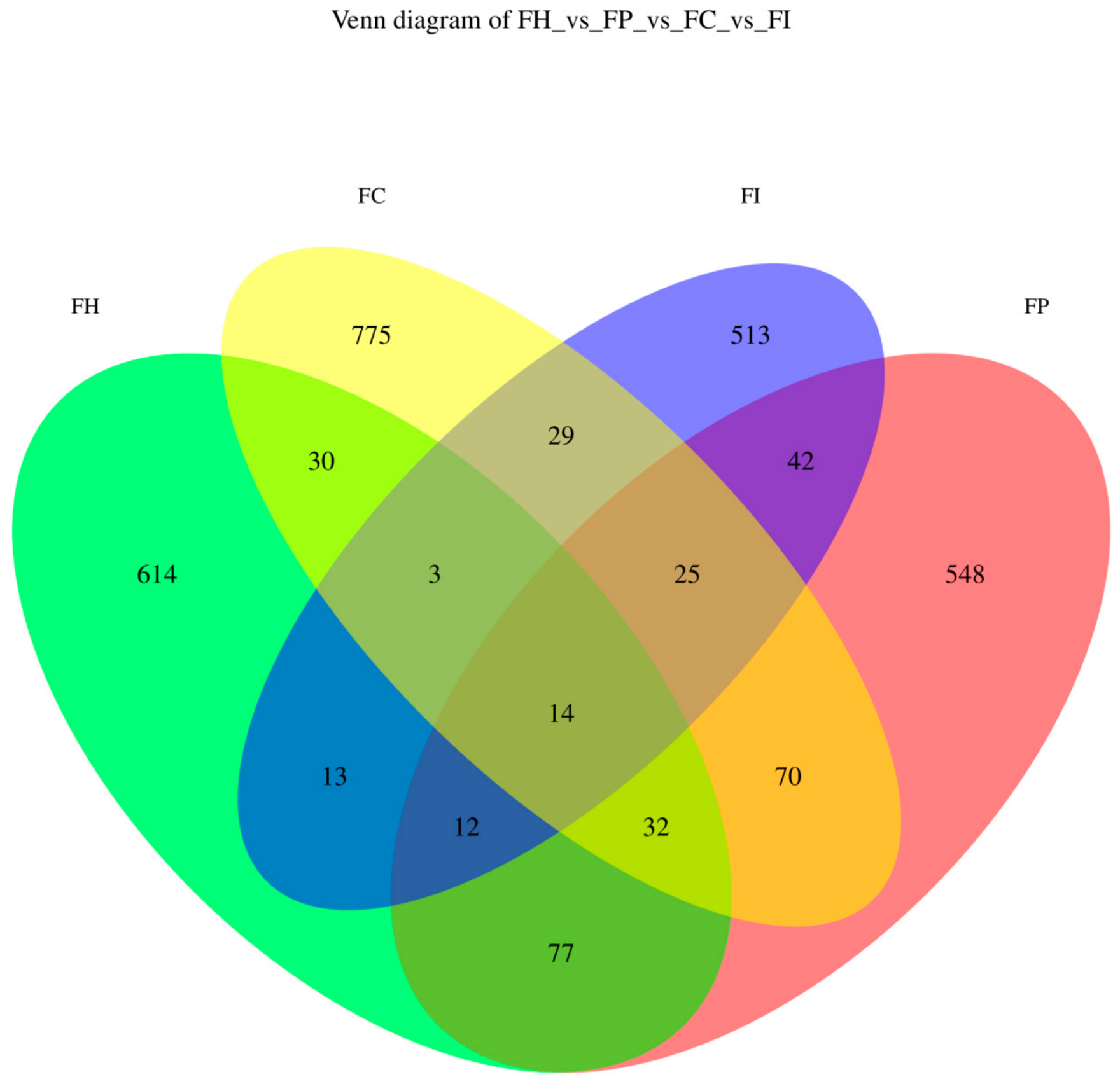
A total of 2797 fungal OTUs were reported across the four rhizosphere groups. Only 14 OTUs were shared among the four bamboo species, representing 0.50% of the pooled OTU union (Figure 1). C. purpurea contained 795 OTUs, of which 614 were unique (77.23% of the OTUs detected in the sample). C. szechuanensis contained 978 OTUs, with 775 unique OTUs (79.24%); I. longiauritus contained 651 OTUs and 513 unique OTUs (78.80%); and P. nidularia contained 820 OTUs, with 548 unique OTUs (66.83%). The percentages of unique OTUs were calculated using the total OTUs within each corresponding bamboo sample as the denominator.
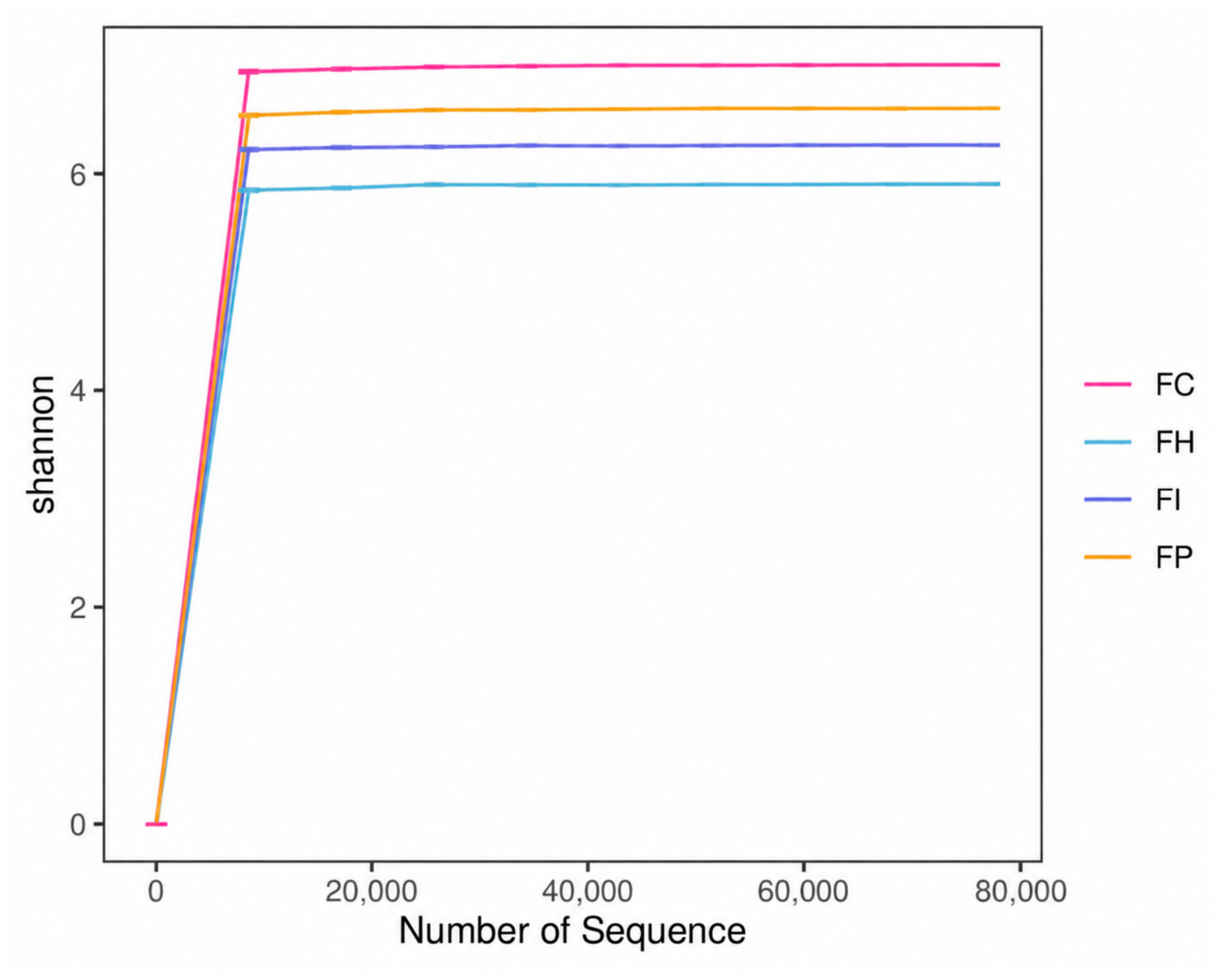
Rarefaction curves reflect sampling depth and allow the assessment of whether the sequencing effort is adequate to capture all taxa. The rarefaction curves for each sample (Figure 2) showed a tendency to plateau with increasing sequencing depth, suggesting that the sequencing data were sufficient to accurately characterize the rhizosphere soil fungal communities associated with the four staple bamboo species consumed by giant pandas.

2.2. Fungal Community Composition

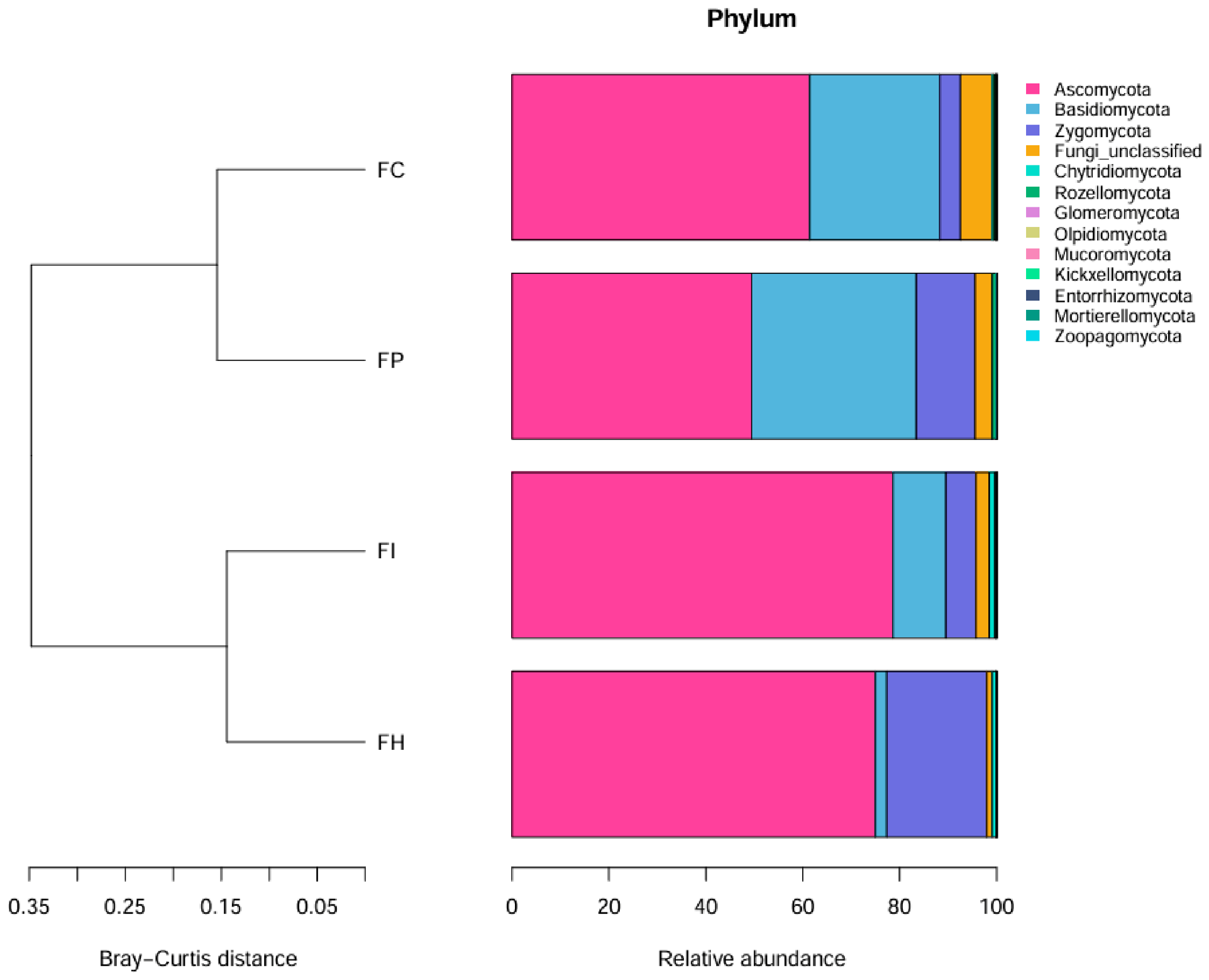
Across the four bamboo rhizosphere groups, 13 fungal phyla, 49 classes, 113 orders, 245 families, and 485 genera were identified. At the phylum level, Ascomycota was the dominant group in all four rhizosphere soils (Figure 3). Its relative abundance was highest in I. longiauritus (78.62%), followed by C. purpurea (74.98%) and P. nidularia. Basidiomycota was the second most abundant phylum (2.40–34.01%), with the highest relative abundance in P. nidularia (34.01%), followed by C. szechuanensis (26.81%) and the lowest in C. purpurea (2.40%). Zygomycota represented the third most abundant phylum-level category (4.35–20.58%), its relative abundance was highest in C. purpurea (20.58%), followed by P. nidularia (12.11%), and lowest in C. szechuanensis (4.35%).
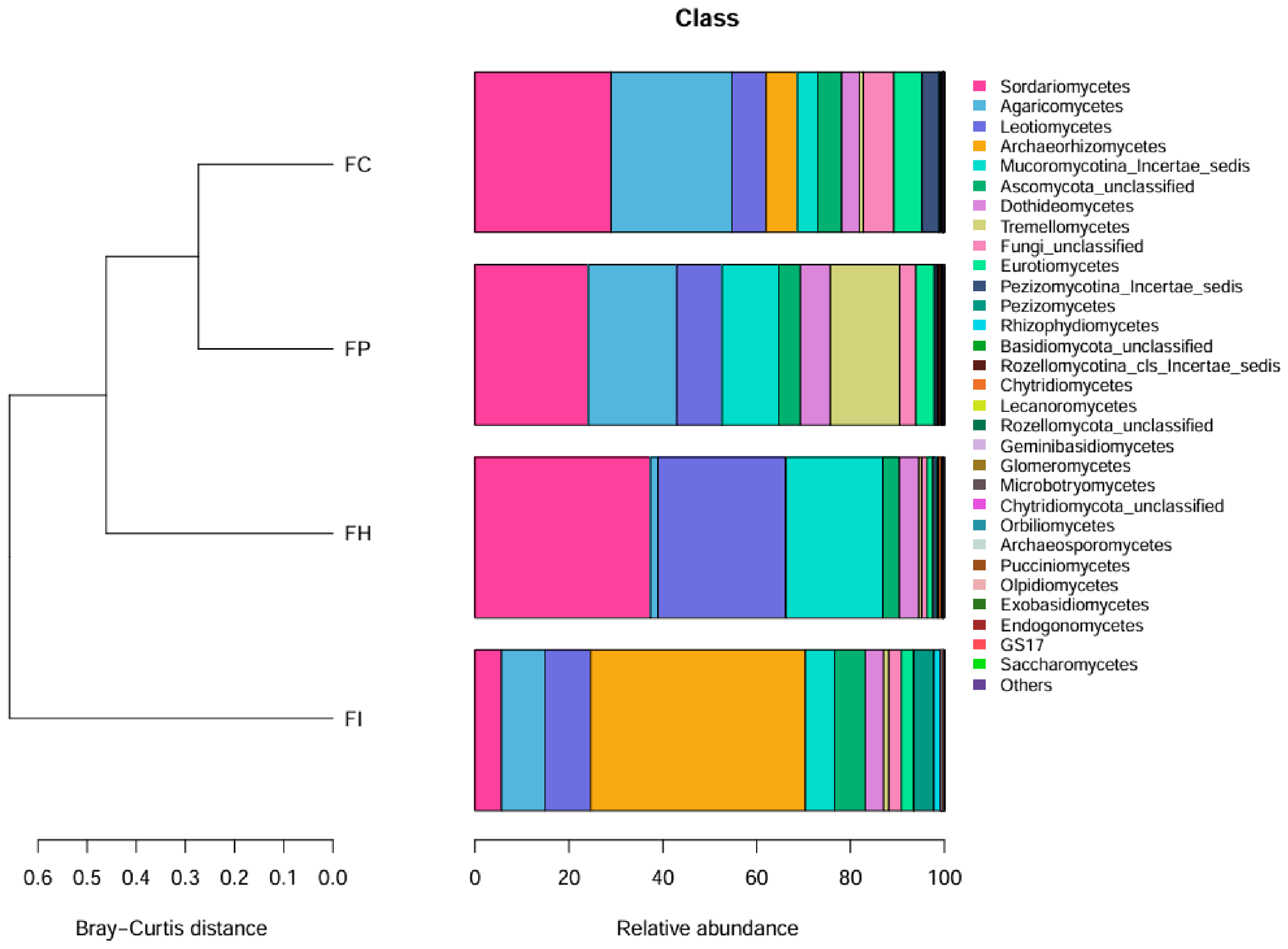
At the class level, the dominant taxa differed markedly among bamboo hosts (Figure 4). In the C. purpurea rhizosphere, Sordariomycetes (37.42%) was the most abundant class, followed by Leotiomycetes (27.17%), Dothideomycetes (4.18%), Eurotiomycetes (1.19%), and Agaricomycetes (1.52%), which also exceeded 1% relative abundance. In P. nidularia, Sordariomycetes (24.11%), Agaricomycetes (18.84%), Tremellomycetes (14.72%), and Leotiomycetes (9.65%) were dominant, with Dothideomycetes (6.34%) and Eurotiomycetes (3.91%) exceeding 1%. The major classes in C. szechuanensis were Sordariomycetes (29.01%), Agaricomycetes (25.71%), Leotiomycetes (7.29%), and Archaeorhizomycetes (6.68%), followed by Eurotiomycetes (5.99%) and Dothideomycetes (3.73%). In I. longiauritus, Archaeorhizomycetes (45.78%) was the dominant class, followed by Leotiomycetes (9.72%), Agaricomycetes (9.28%), Sordariomycetes (5.62%), Pezizomycetes (4.34%), and Eurotiomycetes (2.61%), which were also present at >1% relative abundance. Sordariomycetes were most abundant in C. purpurea and least abundant in I. longiauritus, whereas Agaricomycetes were most abundant in C. szechuanensis and least abundant in C. purpurea. Leotiomycetes were the most abundant in C. purpurea and least abundant in C. szechuanensis, whereas Archaeorhizomycetes showed the opposite pattern, with the highest abundance in I. longiauritus. These class-level patterns were presented as descriptive differences among the pooled bamboo samples.
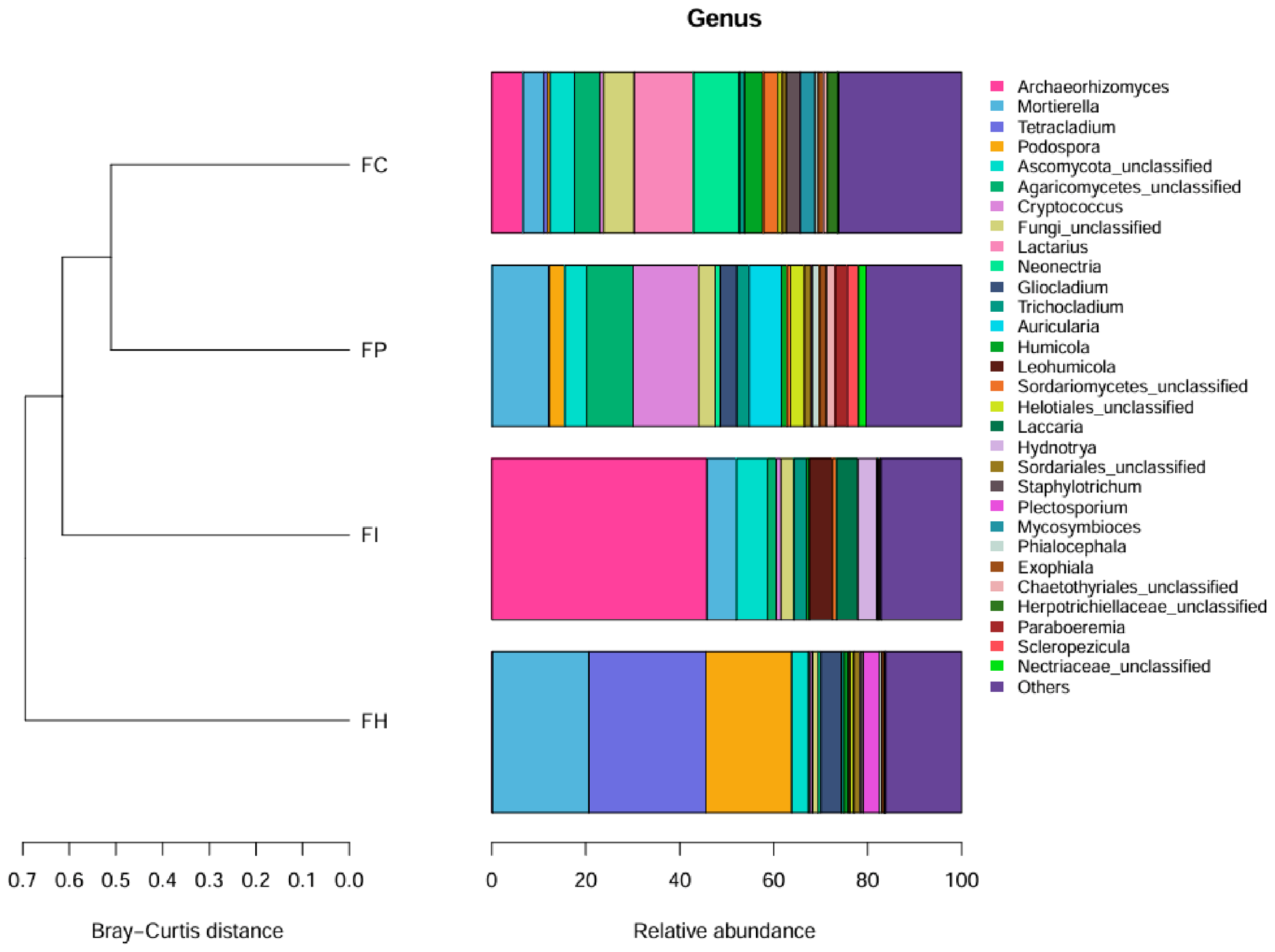
Genus-level community composition differed among the four bamboo species (Figure 5). In C. purpurea, Tetracladium (24.89%) was the most abundant genus, followed by Mortierella (20.58%), Podospora (18.21%), and Gliocladium (4.39%). Plectosporium (3.32%) and Volutella (1.86%) also exceeded 1%. In P. nidularia, Cryptococcus (13.94%) was dominant, followed by Mortierella (12.09%), Auricularia (6.84%), and Podospora (3.27%); Trichocladium (2.68%), Paraboeremia (2.50%), Scleropezicula (2.42%), Humicola (1.15%), and Neonectria (1.08%) were also present at >1%. In C. szechuanensis, Lactarius (12.62%) was the most abundant, followed by Neonectria (9.75%), Archaeorhizomyces (6.68%), and Mortierella (4.35%); Humicola (3.88%), Mycosymbioces (3.07%), and Staphylotrichum (2.90%) also exceeded 1%. In I. longiauritus, Archaeorhizomyces (45.78%) was the dominant genus, followed by Mortierella (6.23%), Leohumicola (4.89%), and Laccaria (4.51%); Hydnotrya (4.01%) and Trichocladium (2.57%) were also present at >1%. These genus-level patterns were interpreted descriptively because the three field plots for each bamboo species were pooled prior to sequencing.

2.3. Soil Properties and the Relationships Between Fungal Communities and Soil Environmental Factors

2.3.1. Soil Properties

The physicochemical properties of the rhizosphere soil of the four are summarized in Table 2. Soil pH, TN, TP, TK, and TOC ranged from 4.46 to 5.29, 5.59 to 6.80 g/kg, 0.36 to 0.52 g/kg, 2.15 to 3.16 mg/g, and 62.35 to 82.81 g/kg, respectively. Because the soil collected from the three field plots for each bamboo species was combined before measurement, these values were presented descriptively and were not interpreted as independent plot-level biological comparisons.

2.3.2. Relationships Between Fungal Communities and Soil Environmental Factors

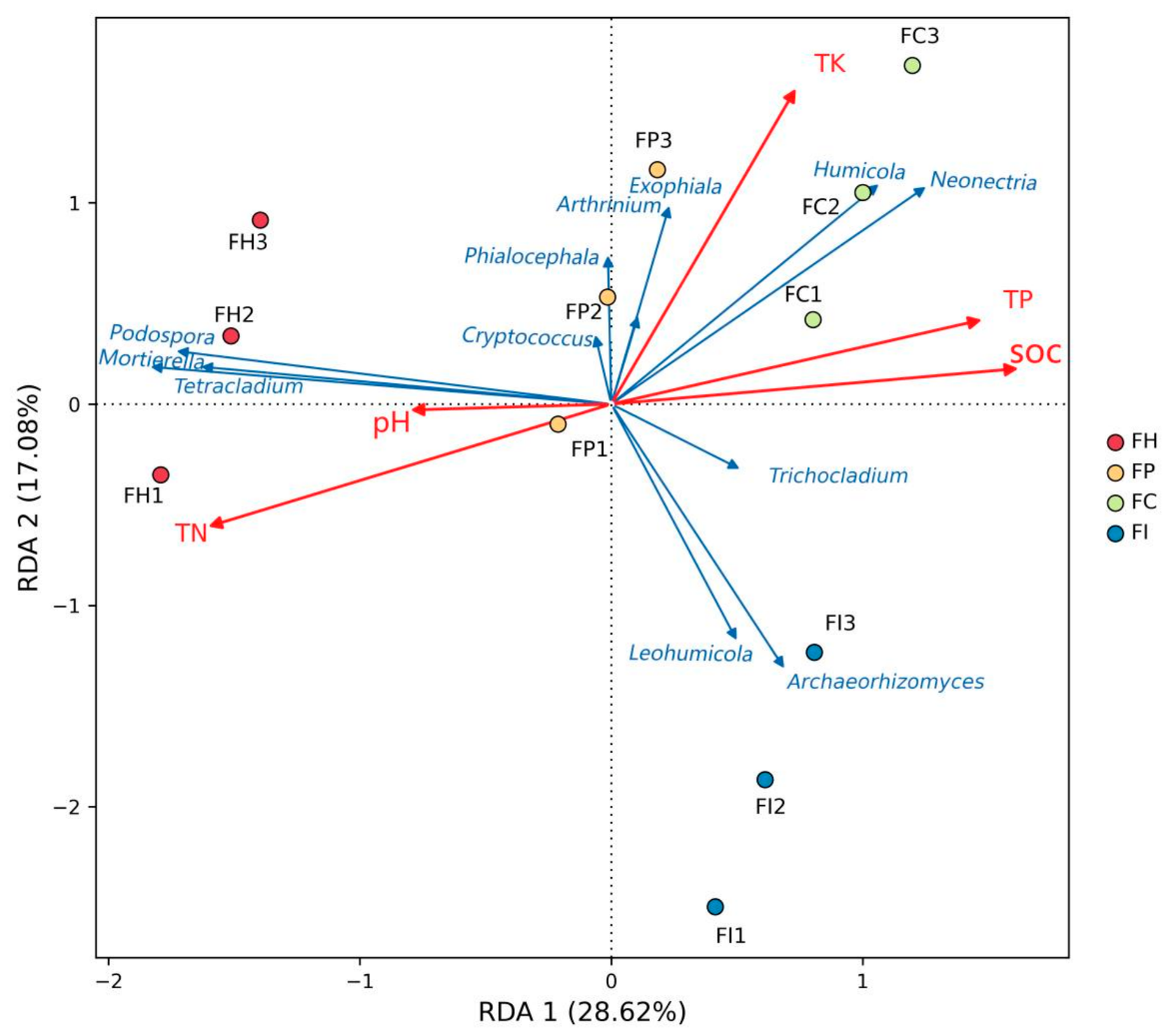
Redundancy analysis (RDA) was used for exploratory visualization of co-patterns between genus-level fungal community composition and measured soil environmental factors (Figure 6). The first ordination axis explained 28.62% of the variation and the second axis explained 17.08%, giving a cumulative explained variation of 45.70%. Mortierella and Podospora were oriented in the same direction as soil pH and TN. In contrast, Neonectria, Humicola, and Phialocephala were oriented toward TK, TP, and SOC. Genera including Trichocladium, Leohumicola, and Archaeorhizomyces showed opposite directional patterns relative to TK and pH. Because the three field plots for each bamboo species were pooled before sequencing, RDA was interpreted descriptively, and no causal or independent plot-level significance inferences were made.

3. Discussion

Rhizosphere fungi can influence bamboo growth and the rhizosphere environment through their involvement in organic matter decomposition, nutrient transformation, and plant–microbe interactions. Previous studies have shown that soil microorganisms are associated with nutrient accumulation in giant pandas’ staple bamboo species [18]. Therefore, the host-associated fungal differences observed in this study serve as a basis for understanding the rhizospheric ecological processes in bamboo. However, their specific functions require further experimental validation.
Only 13 fungal phyla were annotated in the rhizosphere soils examined in the present study, with three phyla accounting for most of the community. This pattern may reflect the relatively high elevation and nutrient-limited conditions of the study area [19]. Ascomycota dominated all four bamboo rhizospheres, which is consistent with observations from other cold or resource-limited soils. Members of Ascomycota include many saprotrophs that participate in the decomposition of soil organic matter and in nutrient cycling. The relative abundance of Ascomycota was particularly high in I. longiauritus (78.62%) and C. purpurea (74.98%), and lowest in P. nidularia (49.48%). Differences in bamboo stature, biomass, root distribution, canopy development, and litter input may contribute to distinct rhizosphere microenvironments. In particular, differences in the quantity and quality of lignified residues can influence fungal decomposer communities [20].
The four bamboo species also exhibited marked differences in the fungal OTU composition. Unique OTUs accounted for 66.83–79.24% of the OTUs detected within the corresponding bamboo samples, whereas only 14 OTUs (0.50% of the pooled OTU union) were shared among all four bamboo hosts. Staple-food bamboos commonly spread clonally through rhizomes and form spatially distinct patches, which can generate differences in rhizosphere conditions, such as nutrient availability and pH, thereby promoting fungal spatial heterogeneity [21]. As a perennial plant, bamboo is continuously exposed to soilborne pathogens. Host-specific root exudates may recruit functionally distinct beneficial or antagonistic microorganisms that contribute to host-associated fungal assemblages [22]. Genetic differences among bamboo species may influence root-associated microbial selection [23].
Mortierella was among the dominant genera, with relative abundances ranging from 4.35% to 20.58%. It was most abundant in the rhizosphere of C. purpurea (20.58%), followed by P. nidularia (12.09%) and least abundant in C. szechuanensis (4.35%). As some Mortierella taxa have been reported to possess plant-beneficial or biocontrol-related functions, their enrichment in C. purpurea may be ecologically relevant and merit further functional validation. Gibberella was also detected (0.01–0.97%), with the highest relative abundance in P. nidularia (0.97%), and was not detected in I. longiauritus. Because this genus includes plant pathogenic taxa, the relatively high abundance observed in P. nidularia supports closer disease surveillance. However, species-level identification and pathogenicity tests are required before inferring disease risk.
The rhizosphere microbiome is an important component of giant panda habitat. Habitat management strategies aimed at supporting bamboo regeneration and food resource stability could benefit from long-term monitoring of the rhizosphere community structure and key indicator taxa. Ecological corridors may also help reconnect fragmented habitat patches and facilitate biological exchanges at the landscape scale. Overall, the four staple-food bamboos in the Longxi–Hongkou National Nature Reserve supported distinct rhizosphere fungal communities. Across all groups, 13 phyla, 49 classes, 113 orders, 245 families, and 485 genera were detected. Diversity and richness were highest in C. szechuanensis, whereas the dominant genera differed among bamboo hosts. The high relative abundance of Mortierella in C. purpurea and the high abundance of Gibberella in P. nidularia provide testable targets for future work on beneficial fungal functions and bamboo disease risk. These baseline data provide a microbial perspective for future conservation and habitat management studies in the southern Minshan Mountains.
This study employed ITS2 amplicon sequencing, which provides taxonomic resolution at the genus level and precludes direct inferences regarding functional traits at the species or strain level. RDA was used to visualize the correlations between community composition and soil physicochemical factors and did not establish causation. In addition, the three field plots for each bamboo species were pooled prior to DNA extraction and sequencing; therefore, plot-level variation could not be evaluated from the four final sequencing libraries. Accordingly, interpretations of putatively beneficial fungi, pathogenic fungi, and their associated ecological roles should be considered testable hypotheses. Further validation using independently sequenced field replicates, culture-dependent approaches, functional characterization, metatranscriptomic analysis, and pathogenicity bioassays is warranted in future investigations.

4. Conclusions

The four staple-food bamboo rhizosphere samples showed distinct fungal community profiles, with C. szechuanensis showing the highest observed diversity and richness, and marked differences in dominant fungal taxa among hosts. Mortierella in C. purpurea and Gibberella in P. nidularia are taxa of ecological interest warranting further functional and pathogenic validation. Because the rhizosphere soils from the three field plots were pooled to form one final sample per bamboo species, the present findings should be interpreted as comparisons among pooled composite samples rather than as estimates of plot-level variation. These results provide baseline information for future studies using independently sequenced field replicates.

5. Methods

5.1. Study Area

The study was conducted in the Longxi–Hongkou National Nature Reserve in the south-central Longmen Mountains, in the southern part of the Minshan Mountains (103°32′–103°43′ E, 31°04′–31°22′ N; 1500–4582 m a.s.l.). The reserve lies in northern Dujiangyan, Sichuan Province, China, and forms part of a locally isolated giant panda habitat block separated by roads and farmland. Together with protected areas in Beichuan, Mianzhu, and Pengzhou, it contributes to a regional giant panda population and occupies a transition zone between the Minshan and Qionglai mountain populations. The reserve is also part of the Giant Panda National Park. Geologically, the area lies on the northwestern margin of the Sichuan Basin within the Longmen fold belt, representing a transition from the Sichuan Basin to the Qinghai–Tibet Plateau. The study region covers an area of approximately 330 km2. Mean annual temperature is approximately 10 °C, with reported extremes of 25 °C and −10 °C. The annual precipitation is 1600–1900 mm, the annual sunshine duration is approximately 800–1000 h, and the mean annual relative humidity exceeds 80%. The vegetation shows pronounced elevational zonation, including evergreen broad-leaved forests, deciduous broad-leaved forests, mixed coniferous-broad-leaved forests, coniferous forests, alpine shrublands, alpine meadows, and alpine scree ecosystems. This region is an important giant panda habitat in Sichuan Province [24,25].

5.2. Sample Collection

Field sampling was conducted in May 2025. Four staple-food bamboo species were selected: C. purpurea (FH), I. longiauritus (FI), C. szechuanensis (FC), and P. nidularia (FP). These four species were selected because they represent the staple bamboo actively consumed by giant pandas in the wild within this region. Investigating these species enables a more thorough assessment of dietary bamboo composition and resource availability for the giant panda population in this area [11,26,27].
For each bamboo species, three 10 × 10 m plots were established, yielding 12 plots. One 1 × 1 m sampling quadrat was established within each plot, and adjacent quadrats were separated by >100 m. Within each quadrat, 10 healthy bamboo plants showing typical giant panda feeding traces were randomly selected. Surface litter and loose debris around the base of each bamboo culm were carefully removed using a sterile hand trowel. Fine roots (diameter ≤ 2 mm) were collected from the 0 to 20 cm soil layer around the bamboo clump. Loosely adhering soil was gently shaken off, and the soil remaining firmly attached to the root surface was collected using a sterile brush and defined as the rhizosphere soil [28]. Rhizosphere soil from the 10 plants within each plot was thoroughly homogenized and passed through a 2 mm sieve to remove gravel and coarse roots, generating one plot-level composite sample. For each bamboo species, three plot-level composite samples were combined and thoroughly homogenized to generate a final species-level composite sample. Thus, the 12 field plots yielded four composite samples, one for each bamboo species. Each composite sample was divided into two portions using the quartering method. One portion (approximately 5 g) was stored at a low temperature in a sterile polyethylene bag and transported to the laboratory to measure pH, TN, TP, TK, and SOC. The second portion (approximately 5 g) was immediately frozen on dry ice and stored at −80 °C after return to the laboratory for high-throughput sequencing.

5.3. Soil Physicochemical Properties

Soil samples were air-dried and passed through a 0.25 mm sieve before physicochemical analyses. SOC was measured through potassium dichromate oxidation with external heating (HJ 615-2011) [29,30]. TN was measured using the Kjeldahl method, TP by digestion followed by molybdenum–antimony colorimetry, and TK through NaOH fusion followed by flame photometry [31]. Soil pH was measured potentiometrically at a soil-to-water ratio of 1:2.5 [32].

5.4. DNA Extraction, PCR Amplification, and Sequencing

For each of the four final species-level composite samples, 0.1 g of thoroughly homogenized rhizosphere soil was used for total DNA extraction using an E.Z.N.A. Soil DNA Kit (D5625; Omega Bio-tek, Inc., Norcross, GA, USA). DNA quality and concentration were evaluated using 1% agarose gel electrophoresis. The fungal ITS2 region was amplified using the primer pair 5′-GTGARTCATCGAATCTTTG-3′ and 5′-TCCTCCGCTTATTGATATGC-3′. The PCR cycling program consisted of an initial denaturation at 98 °C for 30 s, followed by 35 cycles of denaturation at 98 °C for 10 s, annealing at 54 °C for 30 s, and extension at 72 °C for 45 s, with a final extension at 72 °C for 10 min. PCR products were recovered from 2% agarose gels and purified using AMPure XT beads (Beckman Coulter Genomics, Danvers, MA, USA). One sequencing library was generated for each bamboo species, resulting in four final libraries, which were sequenced on an Illumina MiSeq PE300 platform(Illumina, Inc., San Diego, CA, USA) by Hangzhou Lianchuan Biotechnology Co., Ltd. [33] (Hangzhou, China).

5.5. Sequence Processing

The raw sequencing data (FASTQ format) were first subjected to quality control by Hangzhou Lianchuan Biotechnology Co., Ltd., using the standard pipeline of the sequencing provider. Cutadapt (v1.9) was used to remove sequencing primers and adapter sequences, and Fast QC (v0.11.9) was used for quality assessment. Only high-quality sequences within the expected amplicon-length range were retained; reads were required to have more than 70% of bases with a quality score of Q ≥ 20, and reads containing an excessive proportion of ambiguous bases (N) or reads that were too short were discarded.
After quality filtering, DADA2 in QIIME 2 was used for denoising and chimera screening [34]. The resulting high-quality sequences were subsequently clustered into OTUs using VSEARCH v2.3.4, according to the sequence similarity criteria used in the original analysis pipeline, and representative sequences were selected for downstream taxonomic analysis. OTU abundance tables were used to calculate Shannon, Simpson, Chao1, Good’s coverage, Bray–Curtis dissimilarity, and Venn distribution.
For taxonomic annotation, the feature classifier plugin in QIIME 2 was used with a consensus BLAST (v2.13) approach. The reference databases used were SILVA version 138.1 and UNITE version 9.0, and the consensus confidence threshold was set to 0.7. At each taxonomic rank, assignments below this confidence threshold were truncated to the preceding reliably classified rank rather than forced to a lower-confidence label. The taxonomic nomenclature was checked against the original database annotation output.

5.6. Statistical Analysis

As the three field plots for each bamboo species were pooled before DNA extraction, sequencing, and soil property measurements, each bamboo species was represented by one final composite sample. Sequencing and primary bioinformatics processing were performed by Hangzhou Lianchuan Biotechnology Co., Ltd. (Hangzhou, China), with VSEARCH (v2.3.4) used in the sequence-processing workflow, and sequence-derived diversity metrics were calculated using QIIME 2. Graphical outputs were generated using the R software (v3.5.2). Therefore, the pooled composite, rather than the individual field plots, was the analytical unit for the between-species comparisons presented in this revision. OTU counts, alpha diversity indices, relative taxonomic abundances, Bray–Curtis clustering, soil physicochemical values, and RDA were interpreted descriptively. Mean ± standard deviation values were retained where replicate laboratory measurements were available; these replicate measurements were not treated as independent field biological replicates. Accordingly, inferential p-values, post hoc significance lettering, and effect size claims based on the pooled samples were not used. RDA was retained as an exploratory visualization and was not interpreted as a causal or independently replicated significance test.

Author Contributions

Conceptualization, H.C. and N.S.; methodology, H.C.; investigation, G.S.; software and visualization, T.C.; formal analysis, H.C. and T.C.; writing—original draft preparation, H.C.; writing—review and editing, N.S.; supervision, N.S. All authors have read and agreed to the published version of the manuscript.

Funding

This work was supported by the Scientific Research Fund of the Yunnan Provincial Department of Education (Grant No. 2026J1853) and the Open Research Fund of the Smart Water Conservancy Engineering Research Center, Yunnan Water Resources and Hydropower Vocational College (Project No. 2026YSZSYS003).

Data Availability Statement

The original contributions of this study are included in this article. Further inquiries can be directed to the corresponding author.

Conflicts of Interest

The authors declare no conflict of interest.

References

  1. Chen, Y.M.; Ma, Y.W.; Pan, J.F.; Chen, Y. Research progress on disturbance factors in giant panda habitats. J. Southwest For. Univ. (Soc. Sci.) 2022, 6, 104–110. (In Chinese) [Google Scholar]
  2. Xiang, X.; Ma, Y.W.; Yu, L.L.; Li, J. Research progress on giant panda habitats in China. Sichuan For. Sci. Technol. 2018, 39, 31–35. (In Chinese) [Google Scholar] [CrossRef]
  3. Coban, O.; De Deyn, G.B.; van der Ploeg, M. Soil microbiota as game-changers in restoration of degraded lands. Science 2022, 375, abe0725. [Google Scholar] [CrossRef] [Scilit] [PubMed]
  4. Mu, X.X.; Sun, H.O.; Lei, K.M.; Kuang, P.G.; Zhang, Y.; Wang, G.L.; Wang, J.P.; Zeng, T. Priority conservation areas for giant panda habitat in Jiuzhaigou based on habitat-suitability assessment and geological-disaster impacts. Sichuan For. Sci. Technol. 2024, 45, 44–49. (In Chinese) [Google Scholar]
  5. Sun, F.X.; Dang, K.L.; Chen, J.X. Giant panda habitat selection and forest communities in the Qinling Mountains. Sci. Silvae Sin. 2013, 49, 147–153. (In Chinese) [Google Scholar]
  6. Li, M.X.; Liu, S.L.; Zhang, X.R.; Wang, X.Y.; Hou, Z.M.; Wu, Q.; Chen, Q.B. Research progress on the effects of disturbance on giant panda staple-food bamboo. World Bamboo Ratt. 2023, 21, 88–96. (In Chinese) [Google Scholar]
  7. Cai, Y.K.; Zhu, K.; Chen, W.D.; Wang, Y.L. Bibliometric analysis of giant panda staple-food bamboo research based on a knowledge graph. Environ. Sci. Manag. 2021, 46, 55–59. (In Chinese) [Google Scholar]
  8. Shi, J.Y.; Chen, Q.B.; Huang, J.Y.; Zhou, D.Q.; Ma, L.S.; Yao, J. Biodiversity and important values of giant panda staple-food bamboos. World Bamboo Ratt. 2020, 18, 10–19. (In Chinese) [Google Scholar]
  9. Tao, X.; Xiao, Q.J.; Shao, H.H.; Tu, W.G.; Li, L.; Zhang, Y.B.; Jiang, H. Effects of thinning and ground cover plants on soil bacterial community composition and diversity in Picea asperata plantations within giant panda habitats. J. Plant Ecol. 2024, 17, rtae069. [Google Scholar] [CrossRef] [Scilit]
  10. Yuan, Y.; Yang, Y.; Dai, Q.L.; Long, J.J.; Wang, J.; Hong, M.S. Morphological characteristics and site conditions of giant panda staple-food bamboos in Sichuan Liziping National Nature Reserve. Sichuan For. Sci. Technol. 2021, 42, 8–14. (In Chinese) [Google Scholar]
  11. Peng, K.; Chen, X.; Zhang, X.; Fang, C.; Yang, B. Population characteristics and influencing factors of giant panda staple-food bamboos in Sichuan Baishuihe Nature Reserve. Sichuan For. Sci. Technol. 2020, 41, 94–104. (In Chinese) [Google Scholar] [CrossRef]
  12. Liu, X.M.; Chang, Y.P.; Wang, H.; Zhao, C.Y.; Yang, W.Y. Habitat characteristics of giant pandas in Baishuijiang National Nature Reserve. J. Gansu Agric. Univ. 2024, 59, 245–252. (In Chinese) [Google Scholar] [CrossRef]
  13. Wang, D.L.; Guo, Q.X.; Wang, X.R.; Liang, C.P.; Zhang, Y.B. Effects of different altitudes on the nutrient and amino acid contents of bamboo (Fargesia denudata), staple food of the giant panda, in Minshan, Sichuan, China. Acta Ecol. Sin. 2017, 37, 6440–6447. (In Chinese) [Google Scholar] [CrossRef] [Scilit][Green Version]
  14. Jin, L.; He, Y.G.; Yang, X.J.; Deng, W.W.; Yang, L.; Jiang, C.Y.; Li, B.; Li, C.W.; Zhou, Y.; Zeng, W.; et al. Nutritional composition and microbial community structure of giant panda staple-food bamboos in Wolong National Nature Reserve. Chin. J. Appl. Environ. Biol. 2021, 27, 1210–1217. (In Chinese) [Google Scholar] [CrossRef]
  15. Yan, T.T.; Ran, J.H.; Zhao, C.H.; Zhong, X.; Liang, M.Y. Climate-change impacts on bamboo distribution and giant panda habitat in Qionglai mountains. Acta Ecol. Sin. 2017, 37, 2360–2367. (In Chinese) [Google Scholar] [CrossRef] [Scilit][Green Version]
  16. Jiang, H.; Tu, W.G.; Wang, Y.J.; Li, L.; Fu, M.X.; Zhang, Y.B. Effects of thinning on soil bacterial community diversity in pure Chimonobambusa szechuanensis stands within giant panda habitat. Mt. Res. 2023, 41, 19–27. (In Chinese) [Google Scholar] [CrossRef]
  17. Long, J.; Luo, W.; Xie, J.; Yuan, Y.; Wang, J.; Kang, L.; Li, Y.; Zhang, Z.; Hong, M. Environmental factors influencing phyllosphere bacterial communities in giant pandas’ staple food bamboos. Front. Microbiol. 2021, 12, 748141. [Google Scholar] [CrossRef] [Scilit] [PubMed]
  18. Ma, Y.; Hou, Q.; Wang, L.; Wang, M.; Ma, X.; Huang, G.; Wu, Q.; Wei, F.; Yang, Z.; Nie, Y. Roles of soil microbes in shaping the nutrient accumulation of dietary bamboo of giant pandas. Oikos 2026, 2026, e11254. [Google Scholar] [CrossRef] [Scilit]
  19. Mo, L.; Yang, H.; Hou, R.; Wu, W.; Song, X.Q.; Yang, H.; Yang, Z.S.; Zheng, W.C.; Qi, D.W. Forest degradation caused by dwarf bamboo overabundance reduces soil C, N and P stocks in giant panda habitat. CATENA 2023, 231, 107377. [Google Scholar] [CrossRef] [Scilit]
  20. Ferreira de Araujo, A.S.; Bezerra, W.M.; Dos Santos, V.M.; Nunes, L.A.P.L.; de Lyra, M.D.; do Vale Barreto Figueiredo, M.; Melo, V.M.M. Fungal diversity in soils across a gradient of preserved Brazilian Cerrado. J. Microbiol. 2017, 55, 273–279. [Google Scholar] [CrossRef] [Scilit] [PubMed]
  21. Liu, J.M.; Xiong, X.; Li, P.; Liu, J.J.; Li, L.X.; Luo, C. Rhizosphere soil fungal diversity of Fargesia microphylla. Mycosystema 2017, 36, 260–266. (In Chinese) [Google Scholar]
  22. Yao, S.X.; Liang, A.H.; Lu, S.F.; Pan, Z.H.; Li, Q.Q.; Pan, Y.M. Bacterial community characteristics of rhizosphere and bulk soils of Bambusa pervariabilis along the Longjiang River riparian zone. Guangxi Sci. 2023, 30, 455–467. (In Chinese) [Google Scholar]
  23. Huang, Y.L.; Shu, Y.; Liu, Y.; Wang, F.M.; Tan, J.C.; Zhu, D.P.; Liu, K.; Fang, T.T.; Yuan, S.B.; Wang, L. Soil microbial diversity in Bashania fargesii forests within giant panda habitat in Shaanxi Foping National Nature Reserve. Sichuan J. Zool. 2025, 44, 326–338. (In Chinese) [Google Scholar]
  24. Zhang, J.D.; Xu, W.H.; Ouyang, Z.Y.; Wang, X.Z.; Gu, X.D.; Yang, Z.S. Survey of wildlife and habitats after the Wenchuan earthquake: Longxi–Hongkou and Qianfoshan nature reserves. Acta Ecol. Sin. 2008, 28, 5842–5847. (In Chinese) [Google Scholar]
  25. Yu, X.; Luo, X.H.; Zhou, Y.S.; Lan, G.W.; Chen, C.; Hou, R.; Jiang, Z.Y.; Hu, D.M.; Qi, D.W.; Zhang, Z.H. Distribution of giant panda habitat at the southern end of the Minshan Mountains. Sichuan J. Zool. 2020, 39, 177–182. (In Chinese) [Google Scholar] [CrossRef]
  26. Xian, Y.K.; Dong, C.; Yang, B.; Wu, W.; Zhang, Y.H.; Liu, Z.X.; Ma, L.M.; Zhang, G.Q. Study on odors and components from two kinds of fresh bamboo leaves ingested by captive giant pandas and red pandas. Feed Rev. 2022, 6, 59–68. (In Chinese) [Google Scholar]
  27. Wei, M.; Wu, J.X.; Shi, J.Y.; Zhou, D.Q.; Ma, L.S.; Yao, J. A new cultivar of staple-food bamboo for giant panda, Phyllostachys Nidularia “Heigan Houzhu”. World Bamboo Ratt. 2019, 17, 47–49. (In Chinese) [Google Scholar]
  28. Chen, H.S.; Liu, S.P.; Yang, W.Q.; Liang, G.Q. Characteristics and diversity of rhizosphere soil bacterial communities of dominant wetland plants along the lower Yarlung Zangbo River. Acta Ecol. Sin. 2022, 42, 1527–1537. (In Chinese) [Google Scholar] [CrossRef] [Scilit]
  29. Han, S.; Liang, Y.; Zhang, D.S.; Wang, Y. Combined effects of biochar and arbuscular mycorrhizal fungi on soil organic carbon content and stability. J. Agro-Environ. Sci. 2026, 45, 127–138. (In Chinese) [Google Scholar]
  30. HJ 615-2011; Soil—Determination of Organic Carbon—Potassium Dichromate Oxidation Spectrophotometric Method. China Environmental Science Press: Beijing, China, 2011.
  31. Lu, R.K. Methods of Soil Agricultural Chemical Analysis; China Agricultural Science and Technology Press: Beijing, China, 2000. (In Chinese) [Google Scholar]
  32. Bao, S.D. Soil Agrochemical Analysis; China Agriculture Press: Beijing, China, 2000. (In Chinese) [Google Scholar]
  33. Chen, H.S.; Jiang, J.Y.; Pan, X.P.; Liu, S.P.; Cai, L.S. Effects of kiwifruit root rot on rhizosphere soil fungal community structure. J. Sichuan Agric. Univ. 2023, 41, 631–639. (In Chinese) [Google Scholar] [CrossRef]
  34. Callahan, B.J.; McMurdie, P.J.; Rosen, M.J.; Han, A.W.; Johnson, A.J.A.; Holmes, S.P. DADA2: High-resolution sample inference from Illumina amplicon data. Nat. Methods 2016, 13, 581–583. [Google Scholar] [CrossRef] [Scilit] [PubMed]
Figure 1. Venn diagram of fungal OTUs in the rhizosphere soils of four giant panda staple-food bamboo species. FH, Chimonobambusa purpurea; FI, Indocalamus longiauritus; FC, Chimonobambusa szechuanensis; FP, Phyllostachys nidularia. Each bamboo species was represented by one pooled sequencing library generated from rhizosphere soils collected at three field plots.
Diversity 18 00567 g001
Figure 2. Rarefaction curves of fungal communities in rhizosphere soils from different bamboo species. FH, Chimonobambusa purpurea; FI, Indocalamus longiauritus; FC, Chimonobambusa szechuanensis; FP, Phyllostachys nidularia.
Diversity 18 00567 g002
Figure 3. Phylum-level fungal community composition in the rhizosphere soils of the four staple-food bamboo species. Bars show relative abundance, and the dendrogram shows Bray–Curtis dissimilarity among bamboo groups. FH, Chimonobambusa purpurea; FI, Indocalamus longiauritus; FC, Chimonobambusa szechuanensis; FP, Phyllostachys nidularia. Each species corresponds to one pooled sequencing library generated from the three field plots.
Diversity 18 00567 g003
Figure 4. Class-level fungal community composition in the rhizosphere soils of the four staple-food bamboo species. Bars show relative abundance, and the dendrogram shows Bray–Curtis dissimilarity among bamboo groups. FH, Chimonobambusa purpurea; FI, Indocalamus longiauritus; FC, Chimonobambusa szechuanensis; FP, Phyllostachys nidularia. Each species corresponds to one pooled sequencing library generated from the three field plots.
Diversity 18 00567 g004
Figure 5. Genus-level fungal community composition in the rhizosphere soils of the four staple-food bamboo species. Bars show relative abundance, and the dendrogram shows Bray–Curtis dissimilarity among bamboo groups. FH, Chimonobambusa purpurea; FI, Indocalamus longiauritus; FC, Chimonobambusa szechuanensis; FP, Phyllostachys nidularia. Each species corresponds to one pooled sequencing library generated from the three field plots.
Diversity 18 00567 g005
Figure 6. Exploratory redundancy analysis (RDA) of genus-level rhizosphere soil fungal community composition and soil environmental factors. RDA1 and RDA2 explained 28.62% and 17.08% of the variation, respectively. FH, Chimonobambusa purpurea; FI, Indocalamus longiauritus; FC, Chimonobambusa szechuanensis; FP, Phyllostachys nidularia; TN, total nitrogen; TP, total phosphorus; TK, total potassium; SOC, soil organic carbon. The ordination is interpreted descriptively because field plots were pooled before sequencing.
Diversity 18 00567 g006
Table 1. Alpha-diversity metrics and sequencing depth for rhizosphere fungal communities associated with four staple-food bamboo species.
Plant SpeciesOTUsShannon IndexSimpson IndexValid ReadsChao1 IndexGood’s Coverage
FH795 ± 16.315.91 ± 0.350.94 ± 0.0279,347 ± 15.23795.00 ± 20.110.92
FP820 ± 13.216.60 ± 0.610.97 ± 0.1183,149 ± 18.32820.74 ± 15.610.95
FC978 ± 18.327.00 ± 0.250.98 ± 0.0680,800 ± 11.38978.11 ± 12.310.97
FI651 ± 11.526.26 ± 0.210.96 ± 0.0379,485 ± 10.61651.00 ± 10.160.93
Note: Values are reported as mean ± standard deviation, where replicate technical measurements are available. For each bamboo species, three field plots were pooled to generate one final sequencing library; therefore, no between-species inferential p-values or multiple comparison letters were reported. FH, Chimonobambusa purpurea; FI, Indocalamus longiauritus; FC, Chimonobambusa szechuanensis; FP, Phyllostachys nidularia.
Table 2. Rhizosphere soil properties of four staple-food bamboo species.
Plant SpeciespHTotal Nitrogen
TN (g/kg)
Total Phosphorus
TP (g/kg)
Total Potassium
TK (mg/g)
Total Organic Carbon
TOC (g/kg)
FH5.03 ± 0.136.73 ± 0.310.46 ± 0.312.15 ± 0.3382.81 ± 1.63
FP5.29 ± 0.366.14 ± 0.270.36 ± 0.193.02 ± 0.2666.71 ± 0.73
FC4.46 ± 0.356.80 ± 0.360.52 ± 0.212.92 ± 0.1573.41 ± 1.72
FI4.52 ± 0.215.59 ± 0.220.45 ± 0.283.16 ± 0.4162.35 ± 1.31
Note: Numbers after “±” are standard deviations of replicate laboratory measurements of the pooled composite sample. Because the three field plots for each bamboo species were combined before the soil property measurements, no between-species inferential significance letters were reported. FH, Chimonobambusa purpurea; FI, Indocalamus longiauritus; FC, Chimonobambusa szechuanensis; FP, Phyllostachys nidularia.
Disclaimer/Publisher’s Note: The statements, opinions and data contained in all publications are solely those of the individual author(s) and contributor(s) and not of MDPI and/or the editor(s). MDPI and/or the editor(s) disclaim responsibility for any injury to people or property resulting from any ideas, methods, instructions or products referred to in the content.