Article

Statistical Relationships Between Morphometric Traits and Live Body Weight in the Endangered Freshwater Pearl Mussel (Margaritifera dahurica): Implications for Non-Destructive Selection

Jilin Academy of Fishery Sciences, Changchun 130033, China
*
Author to whom correspondence should be addressed.
Diversity 2026, 18(7), 405; https://doi.org/10.3390/d18070405
Submission received: 18 June 2026 / Revised: 24 June 2026 / Accepted: 27 June 2026 / Published: 2 July 2026
(This article belongs to the Special Issue Ecology and Conservation of Freshwater Bivalves)

Abstract

To establish non-destructive morphometric predictors of live body weight in the endangered freshwater pearl mussel (Margaritifera dahurica), 100 wild adult individuals were randomly selected. Four phenotypic parameters, including shell height (SH), shell length (SL), shell width (SW), and body weight (BW), were measured, and the interrelationships among these traits were statistically analyzed using correlation and path analyses. The results indicated that the phenotypic correlations among all traits of M. dahurica reached a highly significant level. Shell length exhibited the greatest direct effect on body weight, with a path coefficient of 0.718. The statistical associations of shell height and shell width with body weight were primarily mediated through indirect pathways via shell length. Shell length, shell width, and shell height were identified as the key morphometric predictors of body weight, yielding a total coefficient of determination of 0.879. Shell length possessed the highest comprehensive coefficient of determination (0.911), making it an ideal target trait for selective breeding. Using stepwise regression analysis, the optimal multiple linear regression equation of morphological traits on body weight was established as Log_BW = −0.814 + 2.482Log_SL + 0.522Log_SW. Rather than directly driving genetic breeding, these findings provide a grounded, non-destructive method for predicting live body mass, facilitating rapid biomass monitoring and founder broodstock assessment in M. dahurica.

1. Introduction

The freshwater pearl mussel (Margaritifera dahurica) belongs to the class Bivalvia, order Unionoida, family Margaritiferidae. It is distributed in the river basins of the Russian Far East [1,2], the eastern rivers of Mongolia [3], and the Heilongjiang and Suifen river basins and their tributaries in China [4]. Historically, M. dahurica was a primary source of “Eastern Pearls”—high-quality tributes to the imperial court. Margaritifera dahurica has extremely high requirements for habitat quality and can only survive under narrow environmental conditions [5]. Most freshwater pearl mussel species have been listed as endangered or vulnerable by the International Union for Conservation of Nature (IUCN) [6,7,8,9]. In China, the primary causes of its population decline are habitat destruction and water pollution, compounded by the intrinsically low reproductive rate of the mussel populations and various other natural factors. Furthermore, pearl harvesting and the pearl trade are among the factors that have driven pearl mussel populations to the brink of extinction [10,11]. This species was listed as a Class II State-Protected Wild Animal in China in 2021. Current research on Margaritifera dahurica primarily focuses on areas such as phylogeny [12], taxonomy and distribution [1,13], its unique parasitic reproductive mechanism [14], environmental evolution indicators [15], and endangered species conservation [16]. However, no studies have been found applying path analysis to evaluate the statistical covariation between morphometric traits and body weight in M. dahurica.
In shellfish genetic breeding, body weight is a pivotal selection trait, with morphological parameters—such as shell length, height, and width—serving as key quantitative criteria for selective breeding [17]. Research on Hyriopsis cumingii indicates that the shell size and growth rate of the host mussel are significantly correlated with the weight and luster of the resulting nucleated pearls [18]. In genetic breeding and phenotypic correlation research on shellfish, correlation and path analysis are frequently preferred. This is primarily because path analysis possesses a unique advantage in resolving multicollinearity, coupled with the high accessibility of phenotypic data and the stability of shell morphology [19,20]. Thus, correlation and path analyses of these quantitative traits are essential for establishing effective breeding programs. During a recent fishery resource survey, the Jilin Provincial Academy of Fishery Sciences identified and sampled wild M. dahurica populations from the Mudanjiang River basin in Dunhua. This study employs correlation and path analyses to elucidate the relationship between shell morphological traits and body weight, aiming to supplement biological data and provide a theoretical foundation for the conservation and selective breeding of this endangered species.

2. Materials and Methods

2.1. Materials

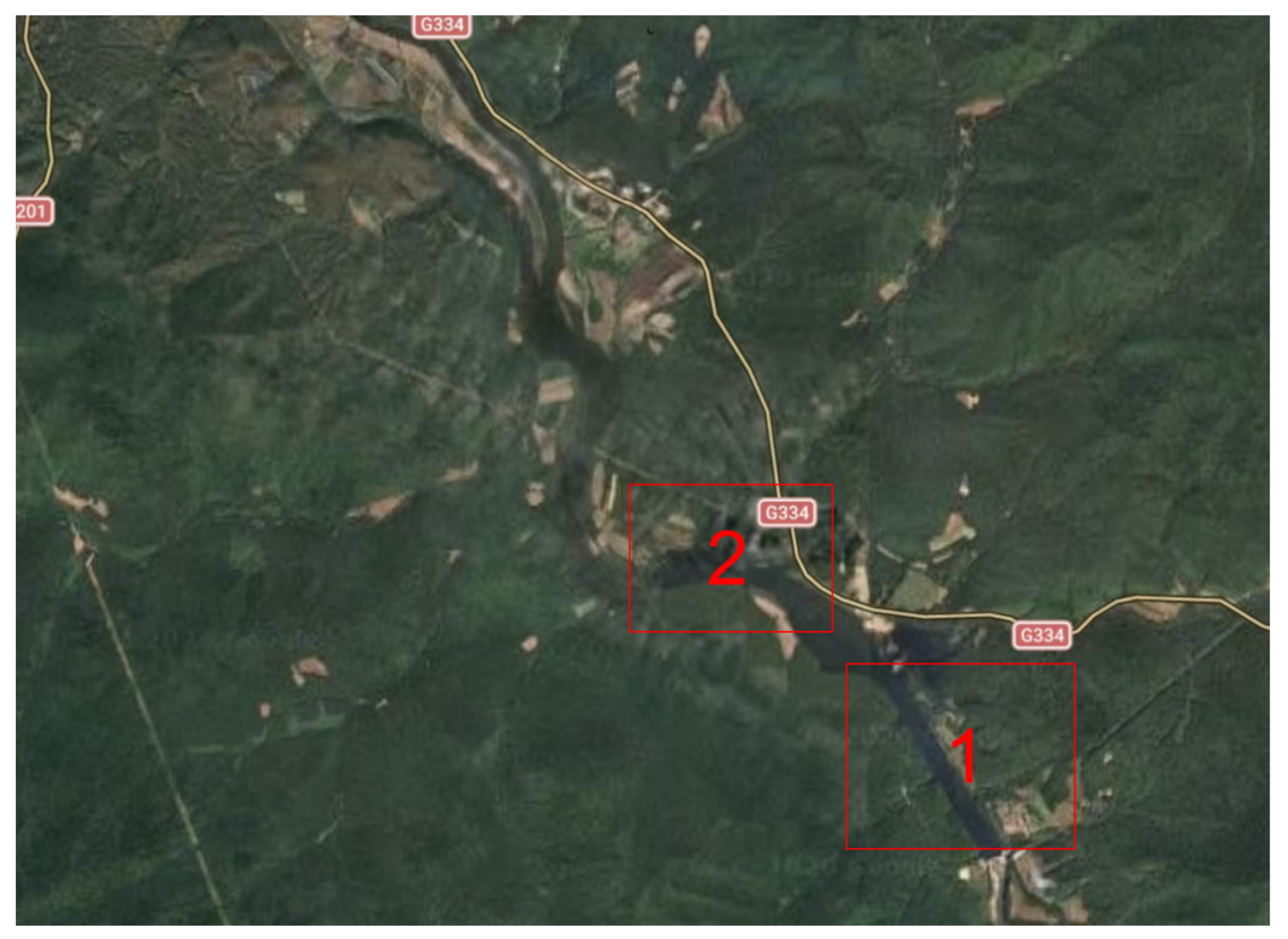
On 28 June 2025, samples were collected from the Fuer River, upstream of the Zhenzhumen Reservoir in Dunhua City, Jilin Province (Figure 1). Five sampling sites were randomly established, and 40 samples were randomly collected at each site, yielding a total of 200 samples. After collection, the samples were transported to the Ecological Aquaculture Laboratory of the Jilin Provincial Academy of Fishery Sciences. At the time of collection, the natural water temperature was approximately 18 °C. Upon transfer to the laboratory, to counteract the ambient indoor temperature of 24 °C and replicate their natural habitat, the mussels were temporarily maintained in temperature-controlled holding tanks. The actual water temperature was strictly maintained at 17 ± 1 °C under natural light conditions, without feeding during this period.

2.2. Methods

2.2.1. Morphological Measurements

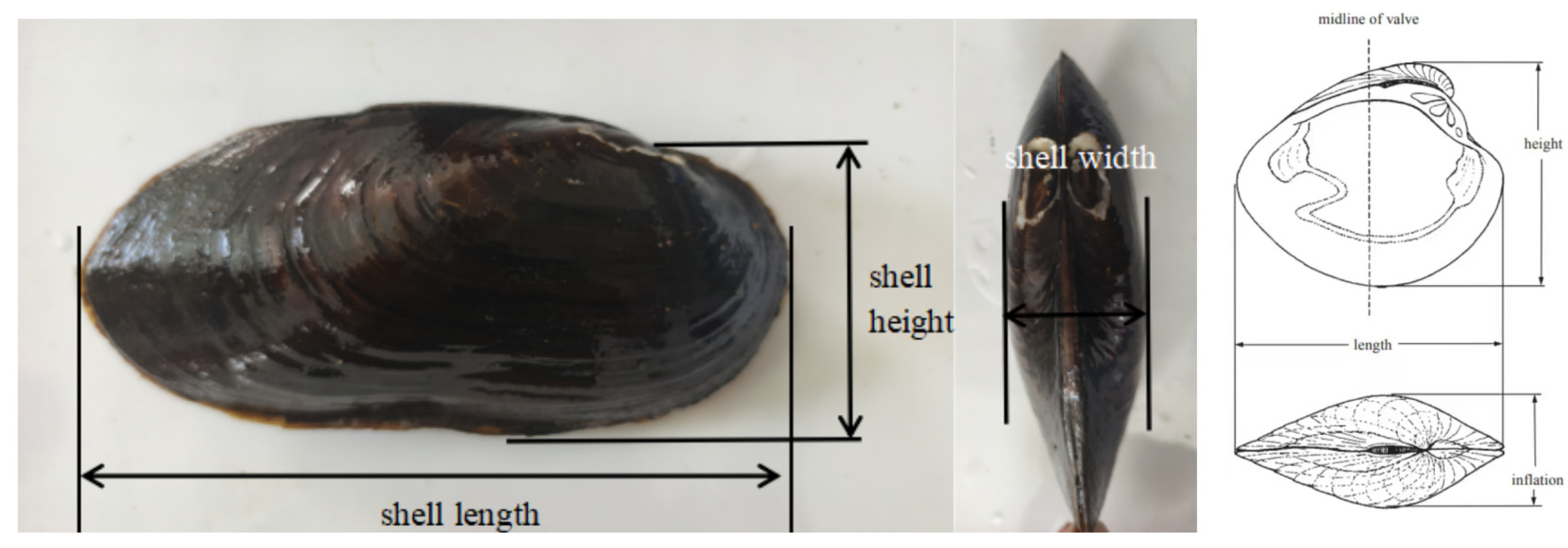
After temporary maintenance in the laboratory for one week, 100 healthy individuals with intact, tightly closed shells and no visible parasites were randomly selected for analysis on 3 July 2025. After removing surface debris and epibionts, the surface moisture of the samples was blotted dry with absorbent paper. To ensure methodological transparency and adherence to standardized malacological protocols, the morphometric parameters of the bivalves were defined and measured along three primary anatomical axes. Shell length (SL) was defined as the maximum linear distance along the anterior–posterior axis. Shell height (SH) was determined as the maximum linear distance along the dorso-ventral axis, measured strictly perpendicular to the shell length, extending from the umbo to the ventral margin. Finally, shell width (SW), also referred to as shell thickness, was defined as the maximum lateral dimension across both the left and right valves when the bivalve is in a completely closed state. All dimensional measurements were obtained using a digital caliper (PD-151, Pro’sKit, Shenzhen, China, resolution: 0.01 mm) to the nearest 0.01 mm. Shell height (SH), shell length (SL), and shell width (SW) were measured using a digital vernier caliper (PD-151, Pro’sKit, Shenzhen, China, resolution: 0.01 mm). Body weight (BW) was determined using an electronic balance (HC311, Huachao, Zhejiang, China, resolution: 0.01 g) (Figure 2).

2.2.2. Statistical Analysis

Path analysis was conducted based on Wright’s classical path coefficient method [21]. Because path analysis is not a standalone procedure in base SPSS, the direct path coefficients were derived from the standardized partial regression coefficients (Beta) using the Multiple Linear Regression module in SPSS 25.0. The indirect path coefficients were calculated by multiplying the Pearson correlation coefficient between two independent variables by the direct path coefficient of the mediating variable.
The indirect effect (IE) of trait i on body weight via trait j was calculated using the following equation:
IE = rij Pj
where rij represents the Pearson correlation coefficient between trait i and trait j, and Pj denotes the direct path coefficient of trait j on body weight.
To address potential multicollinearity among the morphometric predictor variables (e.g., shell length, shell height, shell width), collinearity diagnostics were performed prior to path analysis. Prior to analysis, the morphometric data were log10-transformed to linearize the allometric growth relationships and approximate normality. Although the Shapiro–Wilk test is highly sensitive at larger sample sizes (N = 100), visual inspection of Q-Q plots, along with skewness and kurtosis values falling within the acceptable range (±2), confirmed that the transformed data approximated a normal distribution. Furthermore, linear regression and path analysis are highly robust to minor violations of normality given an adequate sample size.
It is important to note that the a priori assumption guiding the structure of the path analysis was based strictly on operational predictability rather than biological causality. While shell dimensions and body mass are biologically parallel manifestations of general dimensional variability, external shell measurements were defined a priori as the predictor variables, and live body mass as the response variable. This directed structure accurately reflects the practical workflow of non-destructive broodstock evaluation, where accessible external traits are utilized to estimate integral biomass.

3. Results

3.1. Descriptive Statistics and Normality Testing

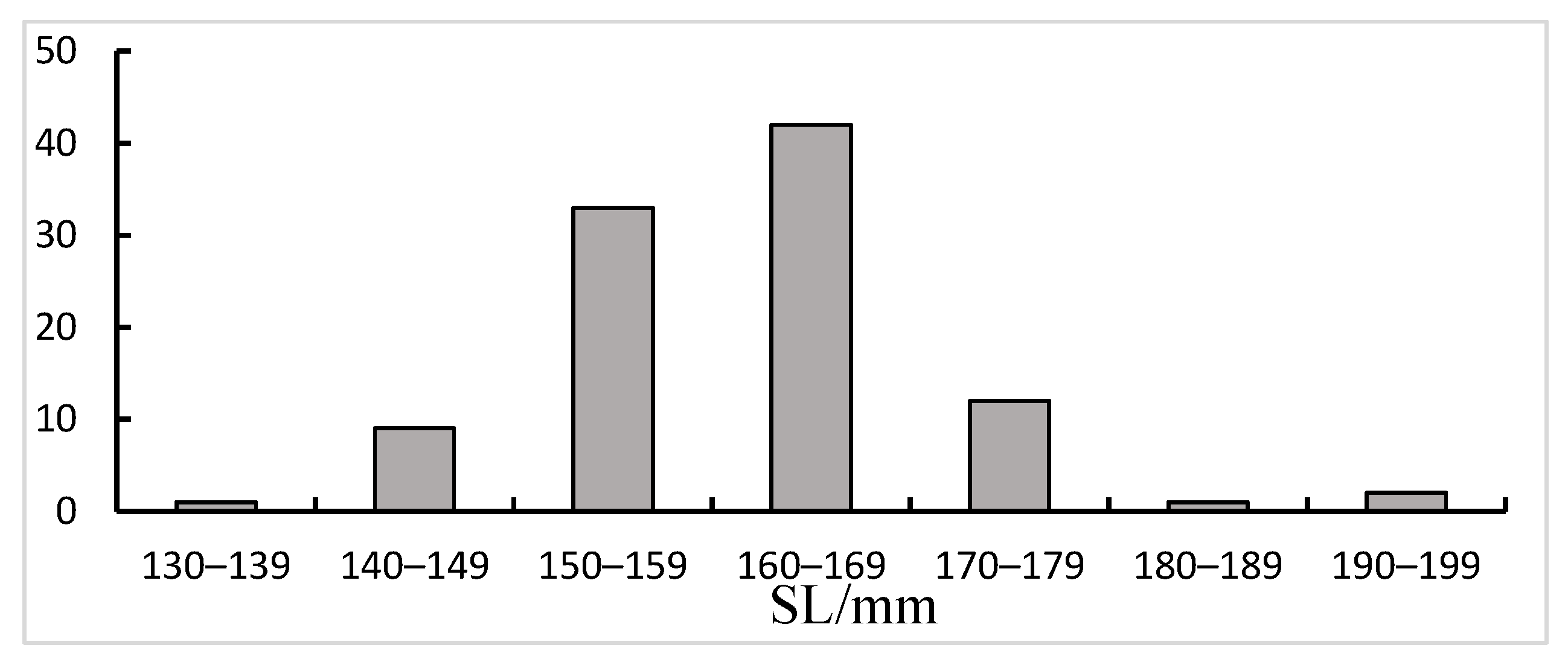
Prior to data transformation, the original morphometric measurements of the sampled M. dahurica (N = 100) were assessed to define the population’s physical dimensions. The untransformed shell length (SL) ranged from 139 to 194 mm (Mean ± SD: 161 ± 9 mm). Shell height (SH) ranged from 610 to 820 mm (72 ± 4 mm), and shell width (SW) ranged from 26 to 41 mm (32 ± 3 mm). The integral live body weight (BW) varied between 182.8 and 509.0 g (279.8 ± 57.9 g). The size-frequency distribution based on the original shell length is illustrated in Figure 3, demonstrating the size structure of the evaluated cohort.
Table 1 presents the descriptive statistics for the 100 samples following log10 transformation. All morphometric data were logarithmically transformed to satisfy the assumptions of the subsequent linear regression and to linearize the allometric growth relationships. Despite the significant results of the Shapiro–Wilk test—a consequence of its high sensitivity to large sample sizes—the skewness and kurtosis values for all transformed variables fell strictly within the acceptable range of −2.0 to +2.0 (Table 1). This confirms that the data followed an approximately normal distribution, fully satisfying the prerequisites for parametric analyses. The CV was lowest for shell length (2.48%) and highest for shell width (8.00%).

3.2. Correlation Analysis Among Phenotypic Traits

As shown in Table 2, all shell morphometric traits exhibited highly significant positive correlations with body weight (p < 0.01). Notably, shell length (Log_SL) demonstrated the highest correlation coefficient with body weight (Log_BW) (r = 0.911). Furthermore, collinearity diagnostics revealed that the Variance Inflation Factor (VIF) values for all independent variables ranged from 1.536 to 1.950, which are well below the conservative threshold of 5, with all tolerance values exceeding 0.1. This indicates the absence of severe multicollinearity among the independent variables, thereby justifying the subsequent path analysis.

3.3. Path Analysis of Morphological Traits on Body Weight

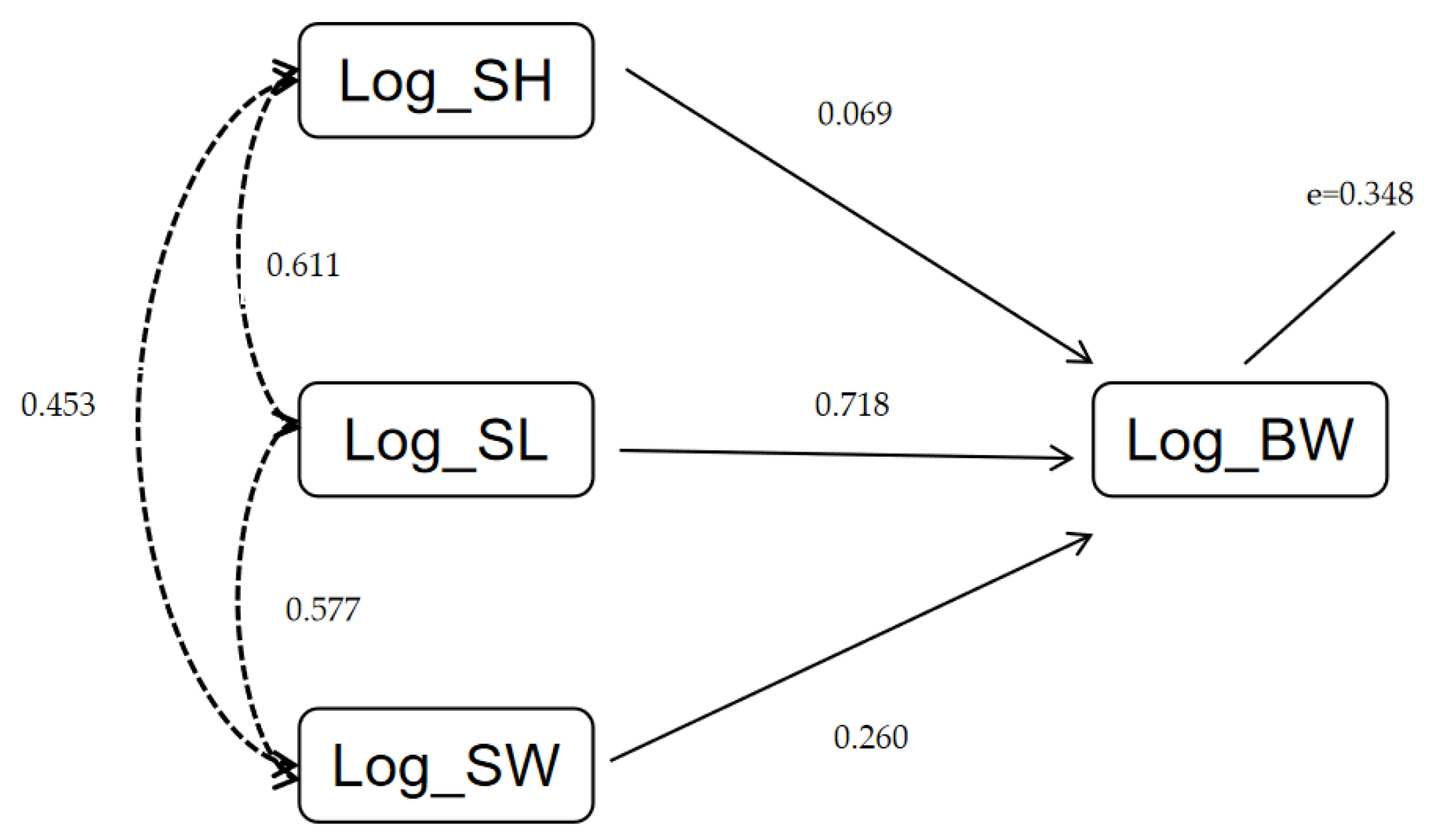
Table 3 presents the path analysis results regarding the effects of the log-transformed shell morphometric traits on body weight. The results indicate that among all morphological metrics, shell length (Log_SL) exhibited the highest positive direct effect on body weight (Pi = 0.718), identifying it as the most critical morphological determinant of body weight variation. The specific driving pathways of each trait on body weight and the residual term are illustrated in Figure 4. Although Log_SH and Log_SW also demonstrated extremely high total correlations with body weight, their direct effects were relatively small (0.069 and 0.260, respectively). Path analysis revealed that these two traits were statistically associated with body weight primarily through substantial indirect effects via their strong positive correlation with shell length (total indirect effects of 0.557 and 0.356, respectively). Taken together, shell length may represent a useful phenotypic indicator for future breeding and conservation programs of Margaritifera dahurica.

3.4. Establishment of the Optimal Regression Mode

Through stepwise regression analysis, morphometric traits that lacked statistical significance or exhibited severe multicollinearity were excluded. Shell length (SL) and shell width (SW) were identified as the optimal predictors. Consequently, the best-fit multiple regression equation for estimating the body weight (BW) of Margaritifera dahurica was established as follows:
Log_BW = −0.814 + 2.482Log_SL + 0.522Log_SW
The overall regression model was highly significant (p < 0.001) (Specific data are presented in Table 4 and Table 5.) with an adjusted R2 of 0.877. This implies that in practical selective breeding and production management, individual body weight can be accurately estimated using this equation simply by measuring shell length and width.

4. Discussion

The sampled population in this study consisted of 100 individuals with shell lengths ranging from 139 to194 mm. According to previous taxonomic and ecological studies on Margaritiferidae, Margaritifera dahurica is a large-sized, long-lived freshwater mussel, with typical fully grown adults exceeding 100 mm in shell length [1]. Studies on the growth models of pearl mussels indicate that while juveniles exhibit rapid and drastic allometric growth, mature adults show a significantly decelerated growth rate with relatively stable morphological proportions [22,23]. Therefore, the size range of our selected specimens ensures that all individuals are mature adults, effectively minimizing the confounding effects of ontogenetic morphological shifts that typically occur during the juvenile stages.
The correlation between phenotypic and quantitative traits is a fundamental aspect of quantitative genetics, providing the theoretical basis for selective breeding programs [24,25]. In the present study, the CV for the body weight of Margaritifera dahurica was substantially higher than that of its morphometric traits, providing abundant raw material for selection [26]. However, a high phenotypic CV does not necessarily indicate high heritability, as phenotypic variance is a combination of genetic and environmental components. The observed weight variability in M. dahurica may be partially driven by environmental variance associated with microhabitat differences (e.g., river currents, local food availability, and sedimentation) rather than purely additive genetic effects. Despite this, the high variability in weight relative to shell dimensions is consistent with findings in other economically important freshwater unionids, such as Hyriopsis cumingii [27] and Anodonta woodiana [28], highlighting a common growth pattern among freshwater mussels. Although shell length, height, and width were all significantly correlated with body weight, their varying predictive contributions underscore the necessity of employing multivariate analysis to identify the most effective non-destructive selection indices [26,29]. Ultimately, while our phenotypic data suggest promising genetic improvement potential, rigorous quantitative genetic studies estimating narrow-sense heritability (h2) are strongly recommended to partition these variance components and validate the true genetic basis.
Path analysis, by partitioning correlation coefficients into direct and indirect effects, serves as an effective mathematical filter to partition the shared statistical variance—a critical step when significant multicollinearity exists among phenotypic parallel indicators [30,31,32,33]. Our results indicated that the direct effects on body weight followed the hierarchy of shell length > shell width > shell height. Specifically, shell length exhibited the maximum direct effect (0.718), identifying it as the predominant predictor of weight, while the statistical associations of shell height and width with body weight were primarily indirect. This hierarchical structure suggests that shell length is the most reliable external predictor for growth performance in M. dahurica [34,35]. Identifying such a reliable proxy is highly valuable for conservation and breeding programs, as direct live weighing requires removing the mussels from the water and wiping them dry. Although explicit mortality rates were not quantified in the current study, previous research on freshwater bivalves indicates that emersion (air exposure) and handling induce significant physiological stress, characterized by prolonged valve closure, altered heart rates, and increased metabolic energy expenditure [36,37]. Therefore, utilizing shell length—which can be rapidly measured underwater or via image analysis—substantially minimizes emersion time and handling-induced stress, offering a highly practical and non-destructive selection index.
The total coefficient of determination exceeding the critical threshold of 0.850 confirms that the key morphological traits most effectively predicting the live body weight of M. dahurica have been successfully identified [35]. For pearl mussels, breeding programs typically aim to enhance pearl-producing performance. The designation of live body weight as a proxy for this performance is strongly supported by empirical studies on related freshwater unionids (e.g., Hyriopsis cumingii), demonstrating that heavier host mussels possess larger mantle tissue areas that directly correlate with pearl size and nacre thickness [18]. Given that the “Eastern Pearls” produced by M. dahurica are of high historical and commercial value but require extended cultivation periods, selecting for non-destructive, intuitive phenotypic traits is essential [17,26].
Within a quantitative genetics framework, body weight is designated as the ultimate target breeding trait primarily due to its foundational economic and biological value, with its high phenotypic variability providing the necessary raw material for selection. Because our path analysis identified shell length as having the highest direct predictive effect (0.911), it should serve as the primary operational indirect selection criterion. Based on these findings, we propose a practical, non-destructive selection protocol for M. dahurica hatcheries. Prior to reproductive maturity or surgical pearl operation (typically at 3–5 years of age), large-scale grading can be conducted using shell length as the sole primary index. Applying a selection intensity of the top 10–20% for shell length will efficiently isolate individuals with superior weight profiles. This rapid, single-metric screening protocol minimizes labor and handling stress while maximizing the retention of elite broodstock, offering an immediate practical tool for conservation. However, it is crucial to recognize that while this phenotypic evaluation provides a vital foundational index, achieving the expected response to selection relies heavily on the underlying genetic parameters—specifically, a strong genetic correlation (rg) between shell length and body weight. Because the present study assessed a wild population lacking pedigree records, direct estimation of variance components was not feasible. Drawing from extensive quantitative genetic studies in related bivalve species, morphological growth traits generally exhibit moderate to high narrow-sense heritabilities (h2 typically ranging from 0.20 to 0.50) and strong positive genetic correlations (rg > 0.70) [38,39]. Assuming a comparable genetic architecture in M. dahurica, we propose that selecting for shell length will likely yield a robust, correlated genetic response in total body weight. Nevertheless, to definitively validate and optimize this indirect selection strategy, it is imperative that future breeding programs establish pedigreed families (e.g., full-sib and half-sib designs) to empirically estimate these precise quantitative genetic parameters.
From a fundamental biological perspective, the morphometric indices and body mass of M. dahurica represent parallel, interrelated manifestations of the organism’s overall dimensional variability, governed by the principles of allometric growth. As the organism develops, these dimensions scale concurrently rather than acting as a system of mechanistic causes and consequences. However, from an applied aquaculture and conservation perspective, this allometric scaling inherently produces severe multicollinearity among structural traits. To identify practical selection metrics, the a priori assumption guiding our path model was based strictly on operational predictability rather than biological causality. We conceptually defined accessible external shell measurements as the operational predictors, and integral live body mass as the ultimate evaluation target. Consequently, path analysis was employed purely as a variance-partitioning statistical tool. By effectively resolving the multicollinearity inherent in allometric data, this operational approach successfully isolated shell length as the most robust, independent, and practical non-destructive predictive proxy for live broodstock evaluation.

5. Conclusions

The discovery and analysis of M. dahurica resources in the Mudanjiang River basin of Jilin Province provide a vital foundation for both biodiversity conservation and the revitalization of the high-end freshwater pearl industry. As a National Class II Protected Wild Animal, the preservation and strategic evaluation of its germplasm resources are paramount. Based on our phenotypic path analysis, we propose a practical, non-destructive selective breeding framework: to improve live body weight—and potentially subsequent pearl yield—breeding programs should prioritize shell length as the primary indirect selection index, supplemented by shell width. However, to successfully transition from phenotypic observation to definitive genetic improvement, future studies must evaluate the narrow-sense heritability (h2) of these target traits and their underlying genetic correlations (rg). Integrating these quantitative genetic parameters will be crucial for validating this selection protocol, ultimately facilitating the sustainable development, resource restoration, and scientific management of this precious freshwater mussel in Northeast China.

Author Contributions

H.L.: Writing—review and editing. L.L.: Methodology. P.L.: Writing—review and editing, Supervision, Project administration, Investigation, Funding acquisition, Conceptualization. G.L.: Investigation. Y.L. (Yuting Liu): Data curation. Y.L. (Yukui Lang): Data curation. S.P.: Data curation. J.G.: Investigation. All authors have read and agreed to the published version of the manuscript.

Funding

This work was supported by the Science and Technology Development Program of Jilin Province [grant numbers 20260202061NC]. The authors declare that they have no conflicts of interest related to this study. The results of this study are presented clearly, honestly, and without fabrication, falsification, or inappropriate data manipulation.

Institutional Review Board Statement

Not applicable.

Data Availability Statement

The original contributions presented in this study are included in the article. Further inquiries can be directed to the corresponding author.

Conflicts of Interest

The authors declare no conflict of interest.

References

  1. Vikhrev, I.V.; Makhrov, A.A.; Bolotov, I.N.; Aksenova, O.V.; Aspholm, P.E.; Gofarov, M.Y.; Klishko, O.K.; Kolosova, Y.S.; Kondakov, A.V.; Lyubas, A.A.; et al. Taxonomy and distribution of freshwater pearl mussels (Unionoida: Margaritiferidae) of the Russian Far East. PLoS ONE 2015, 10, e0122408. [Google Scholar] [CrossRef]
  2. Bogatov, V.V.; Prozorova, L.A.; Starobogatov, Y.I. The family Margaritiferidae (Mollusca: Bivalvia) in Russia. Ruthenica 2003, 13, 41–52. [Google Scholar]
  3. Dashi-Dorgi, A. To the Knowledge of the Waterbodies and Hydrofauna of the Eastern and Northern Mongolia (Amur and Selenga Rivers Basin on the Territory of the Mongolia People Republic). Ph.D. Thesis, Irkutsk State University, Irkutsk, Russia, 1953. [Google Scholar]
  4. Bogutskaya, N.G.; Naseka, A.M.; Shedko, S.V.; Vasil’eva, E.D.; Chereshnev, I.A. The fishes of the Amur River: Updated check-list and zoogeography. Ichthyol. Explor. Freshw. 2008, 19, 301–366. [Google Scholar]
  5. Geist, J. Strategies for the conservation of endangered freshwater pearl mussels (Margaritifera margaritifera L.): A synthesis of conservation genetics and ecology. Hydrobiologia 2010, 644, 69–88. [Google Scholar] [CrossRef]
  6. Ziuganov, V.; Zotin, A.; Nezlin, L.; Tretiakov, V. The Freshwater Pearl Mussels and Their Relationships with Salmonid Fish; VNIRO, Russian Federal Institute of Fisheries and Oceanography: Moscow, Russia, 1994. [Google Scholar]
  7. Machordom, A.; Araujo, R.; Erpenbeck, D.; Ramos, M.A. Phylogeography and conservation genetics of endangered European Margaritiferidae (Bivalvia: Unionoidea). Biol. J. Linn. Soc. 2003, 78, 235–252. [Google Scholar] [CrossRef]
  8. Araujo, R.; Toledo, C.; Van Damme, D.; Ghamizi, M.; Machordom, A. Margaritifera marocana (Pallary, 1918): A valid species inhabiting Moroccan rivers. J. Molluscan Stud. 2009, 75, 95–101. [Google Scholar]
  9. Bogan, A.E. Freshwater bivalve extinctions (Mollusca: Unionoida): A search for causes. Am. Zool. 1993, 33, 599–609. [Google Scholar] [CrossRef]
  10. Bespalaya, Y.V.; Bolotov, I.N.; Machrov, A.A.; Vichrev, I.V. Historical geography of the pearl hunting in rivers of southern White Sea coast. Proc. Russ. Acad. Sci. 2012, 1, 96–105. [Google Scholar]
  11. Kochetova, N.I.; Paramonova, I.M. They Need to Live. Mollusca, Annelida; Agropromizdat: Moscow, Russia, 1998. [Google Scholar]
  12. Yang, S.; Mi, Z.; Tao, G.; Liu, X.; Wei, M.; Wang, H. The complete mitochondrial genome sequence of Margaritiana dahurica Middendorff. Mitochondrial DNA 2015, 26, 716–717. [Google Scholar] [PubMed]
  13. Huff, S.W.; Campbell, D.; Gustafson, D.L.; Lydeard, C.; Altaba, C.R.; Giribet, G. Investigations into the phylogenetic relationships of freshwater pearl mussels (Bivalvia: Margaritiferidae) based on molecular data: Implications for their taxonomy and biogeography. J. Molluscan Stud. 2004, 70, 379–388. [Google Scholar] [CrossRef]
  14. Vikhrev, I.V.; Makhrov, A.A.; Artamonova, V.S.; Ermolenko, A.V.; Gofarov, M.Y.; Kabakov, M.B.; Kondakov, A.V.; Chukhchin, D.G.; Lyubas, A.A.; Bolotov, I.N. Fish hosts, glochidia features and life cycle of the endemic freshwater pearl mussel Margaritifera dahurica from the Amur Basin. Sci. Rep. 2019, 9, 8339. [Google Scholar] [CrossRef]
  15. Kondratyeva, L.M.; Andreeva, D.V.; Golubeva, E.M. Shells of Pearlmussels, Margaritifera dahurica (Bivalvia: Margaritiferidae), as a biogeochemical indicator of the background (Holocene) and current major and trace elements content in riverine waters of Transbaikalia (southeast Siberia). Ecol. Indic. 2022, 134, 108482. [Google Scholar] [CrossRef]
  16. Klishko, O.K.; Bogan, A.E. The conservation status of the freshwater Pearl Mussel Margarititifera dahurica in Far Eastern Russia. Ellipsaria 2013, 15, 31–33. [Google Scholar]
  17. Kvingedal, R.; Evans, B.S.; Lind, C.E.; Taylor, J.J.; Dupont-Nivet, M.; Jerry, D.R. Population and family growth response to different rearing location, heritability estimates and genotype × environment interaction in the silver-lip pearl oyster (Pinctada maxima). Aquaculture 2010, 304, 1–6. [Google Scholar]
  18. Jin, C.; Bai, Z.; Li, J.; Li, Q. Correlation and path analysis between the quality of nucleated pearls from the mantle of Hyriopsis cumingii and the growth traits of host mussels. Aquacult. Int. 2015, 23, 1445–1456. [Google Scholar]
  19. Wen, H.B.; Cao, Z.M.; Gu, R.B. Correlation and path analysis of morphological traits and body weight of the freshwater clam Corbicula fluminea. J. Hydroecol. 2011, 32, 105–109. [Google Scholar]
  20. Tang, S.; Wang, G.; Li, J. Correlation and path analysis of morphological traits and body weight in the reciprocal hybrids of Hyriopsis cumingii and Hyriopsis schlegelii. J. Fish. China 2014, 38, 683–689. [Google Scholar]
  21. Wright, S. Correlation and causation. J. Agric. Res. 1921, 20, 557–585. [Google Scholar]
  22. Zotin, A.A. Growth and lifespan of the freshwater pearl mussel Margaritifera margaritifera. Biol. Bull. 2007, 34, 66–72. [Google Scholar]
  23. Bauer, G. Variation in the life span and size of the freshwater pearl mussel. J. Anim. Ecol. 1992, 61, 425–436. [Google Scholar] [CrossRef]
  24. Ranjan, R.; Nisa, W.U.; Das, A.K.; Nisa, V.U.; Thapa, S.; Garg, T.; Sandhu, S.K.; Vikal, Y. Statistical and quantitative genetics studies. In Springer Protocols Handbooks; Springer: Berlin/Heidelberg, Germany, 2024; pp. 95–123. [Google Scholar]
  25. Ali, W.; Grzybowski, M.; Torres-Rodríguez, J.V.; Li, F.; Shrestha, N.; Mathivanan, R.K.; de Bernardeaux, G.; Hoang, K.; Mural, R.V.; Roston, R.L. Quantitative genetics of photosynthetic trait variation in maize. J. Exp. Bot. 2025, 76, 4141–4153. [Google Scholar] [CrossRef] [PubMed]
  26. Yuan, L.; Li, J.; Bai, Z.; Wang, G.; Duan, H.; Li, Y.; Wang, Z.; Li, S.; Hu, Y. Correlation and path analysis of morphological traits and body weight of Cristaria plicata. J. Fish. China 2010, 34, 752–759. [Google Scholar]
  27. Li, J.; Wang, G.; Bai, Z. Morphological traits and body weight of Hyriopsis cumingii from different populations: Correlation and path analysis. J. Fish. China 2011, 35, 1801–1808. [Google Scholar]
  28. Chen, X. Correlation and path analysis of quantitative traits of Anodonta woodiana. Freshw. Fish. 2016, 46, 16–21. [Google Scholar]
  29. Hu, B. Correlation and path analysis of morphological traits and body weight of Hyriopsis schlegelii. Freshw. Fish. 2011, 41, 23–27. [Google Scholar]
  30. Bello, O.B.; Abdulmaliq, S.Y.; Afolabi, M.S.; Ige, S. Correlation and path coefficient analysis of yield and agronomic characters among open pollinated maize varieties and their F1 hybrids in a diallel cross. J. Biotechnol. 2010, 9, 2633–2639. [Google Scholar]
  31. Khalil, M.H.; Shebl, M.K.; Kosba, M.A.; El-Sabrout, K.; Zaki, N. Estimate the contribution of incubation parameters influence egg hatchability using multiple linear regression analysis. Vet. World 2016, 9, 806–810. [Google Scholar] [CrossRef] [PubMed]
  32. Akter, A.; Hasan, M.J.; Latif, M.A.; Kulsum, M.U.; Biswas, P.L.; Rahman, M.H.; Majumder, R.R.; Lipi, L.F.; Quddus, M.R.; Akter, F.; et al. Genetic variability, heritability, correlation and path coefficient studies for yield and yield components of some promising rice hybrids. Rice J. 2019, 23, 27–34. [Google Scholar]
  33. Debowski, P.; Dobosz, S.; Robak, S.; Usydus, Z. Fat level in body of juvenile Atlantic salmon (Salmo salar L.), and sea trout (Salmo trutta M. trutta L.), and method of estimation from morphometric data. Arch. Ryb. Pol. 1999, 7, 237–243. [Google Scholar]
  34. Shen, X. Correlation and path analysis of morphological traits and body weight in the freshwater mussel Lamprotula leai. Freshw. Fish. 2014, 44, 101–105. [Google Scholar]
  35. Zhang, G.l. Correlation and path analysis of morphological traits and body weight of the freshwater mussel Solenaia oleivora. J. Hydroecol. 2017, 39, 88–93. [Google Scholar]
  36. Chen, L.Y.; Heath, D.D.; Neff, B.D. Effects of handling and transportation stress on the unionid mussel Margaritifera margaritifera. J. Molluscan Stud. 2001, 67, 405–411. [Google Scholar]
  37. Chen, Z. Physiological and biochemical responses of freshwater mussel (Hyriopsis cumingii) to air exposure. Aquacult. Res. 2020, 51, 4880–4889. [Google Scholar]
  38. Dong, S.; Bai, Z.; Duan, H.; Lin, J.; Yin, H.; Li, J. Estimates of genetic parameters and genotype by environment interactions for shell nacre color and growth traits in the purple freshwater pearl mussel Hyriopsis cumingii. Aquaculture 2017, 473, 222–227. [Google Scholar]
  39. Wang, C.; Li, J.; Bai, Z.; Duan, H. Estimation of genetic parameters for growth traits in the first and second years of the freshwater pearl mussel Hyriopsis cumingii. Aquac. Res. 2014, 45, 1085–1090. [Google Scholar]
Figure 1. Map of the sampling area. 1—Jilin Province, Dunhua City, Zhenzhumen Reservoir. 2—Fuer River, upstream of Zhenzhumen Reservoir.
Diversity 18 00405 g001
Figure 2. Schematic diagram for measuring shell morphology and characteristics of pearl oysters.
Diversity 18 00405 g002
Figure 3. Size-frequency distribution of shell length for the sampled Margaritifera dahurica (N = 100).
Diversity 18 00405 g003
Figure 4. Path diagram showing the direct and indirect effects of log-transformed shell morphometric traits on the body weight of Margaritifera dahurica. (Note: Solid single-headed arrows represent direct path coefficients (beta), bidirectional dashed arrows represent Pearson correlation coefficients (r), and e represents the residual term.)
Diversity 18 00405 g004
Table 1. Descriptive statistics and Kolmogorov–Smirnov normality test results for the log10-transformed morphometric traits and body weight of Margaritifera dahurica (N = 100).
TraitsMinMaxMean ± SDSkewnessKurtosisCV%K-S Statistic (D)p-Value
Log_SH0.790.910.86 ± 0.03−0.270.203.490.1270.000
Log_SL1.141.291.21 ± 0.030.240.482.480.0780.140
Log_SW0.410.610.50 ± 0.040.500.468.000.1450.000
Log_BW2.262.712.44 ± 0.080.551.193.280.1190.001
All original morphometric and mass data were log10-transformed to normalize the variance and align with allometric scaling principles prior to analysis. The Kolmogorov–Smirnov (K-S) test was employed to assess the normality of the data distributions. The K-S Statistic (D) represents the maximum absolute difference between the empirical and theoretical cumulative distributions.
Table 2. Phenotypic Correlation Coefficients Among Traits.
TraitsLog_SHLog_SLLog_SWLog_BW
Log_SH10.611 **
[0.471, 0.721]
0.453 **
[0.282, 0.596]
0.626 **
[0.489, 0.732]
Log_SL 10.577 **
[0.429, 0.694]
0.911 **
[0.870, 0.940]
Log_SW 10.707 **
[0.593, 0.793]
Log_BW 1
** p < 0.0083 (significant after Bonferroni correction for multiple comparisons, alpha = 0.05/6). Values in brackets represent the 95% confidence intervals for the Pearson correlation coefficients, calculated using Fisher’s Z-transformation.
Table 3. Path Analysis of the Effects of Morphological Traits on Body Weight in Margaritifera dahurica.
TraitsCorrelation Coefficient (rij)Direct Effect (Pi)Indirect Effect (rij Pj)
Log_SHLog_SLLog_SW
Log_SH0.626 **0.0690.557-0.4390.118
Log_SL0.911 **0.7180.1920.042-0.150
Log_SW0.707 **0.2600.3560.0310.325-
** Highly significant correlation (p < 0.01) and shell length was closely linked to the weight trait.
Table 4. Coefficients of Determination for Morphological Traits Affecting Body Weight.
Source of VariationSum of Squares (SS)Degree of Freedom (df)Mean Square (MS)F Valuep-Value
Regression0.61120.305353.3530.000
Residual0.084970.001
Total0.69599
Table 5. Significance Test for Partial Regression Coefficients of Traits in Margaritifera dahurica.
ModelUnstandardized
Coefficients
Standardized
Coefficients
tp-Value95% CI for B
BSELower BoundUpper Bound
(Constant)−0.8140.151 −5.3820.000−1.114−0.514
Log_SL2.4820.1420.75517.4760.0002.2002.764
Log_SW0.5220.0830.2816.2700.0000.3570.687
Disclaimer/Publisher’s Note: The statements, opinions and data contained in all publications are solely those of the individual author(s) and contributor(s) and not of MDPI and/or the editor(s). MDPI and/or the editor(s) disclaim responsibility for any injury to people or property resulting from any ideas, methods, instructions or products referred to in the content.