
Review

Responses of a Dominant Wetland Grass, Cynodon dactylon, to Flooding and Drought Stress in the Drawdown Zone of the Three Gorges Reservoir, China: A Trait-Based Meta-Analysis

1
Normal School, Hubei University, Wuhan 430062, China
2
State Key Laboratory of Geodesy and Earth’s Dynamics, Innovation Academy for Precision Measurement Science and Technology, Chinese Academy of Sciences, Wuhan 430077, China
*
Authors to whom correspondence should be addressed.
Diversity 2026, 18(7), 395; https://doi.org/10.3390/d18070395 (registering DOI)
Submission received: 26 May 2026 / Revised: 26 June 2026 / Accepted: 26 June 2026 / Published: 29 June 2026
(This article belongs to the Special Issue Wetland Biodiversity and Ecosystem Conservation—Second Edition)

Abstract

Plant communities in reservoir drawdown zones experience highly altered hydrological regimes, and responses of locally dominant species shape the biodiversity and restoration trajectories of these artificial wetlands. The water-level fluctuation zone (WLFZ) of the Three Gorges Reservoir (TGR) is exposed to alternating flooding and drought, which strongly constrains both its vegetation and the biodiversity that depends on it. Cynodon dactylon dominates the herbaceous cover of the TGR WLFZ, but evidence on its stress responses remains fragmented across single-site studies. Following a PRISMA 2020 literature search and screening procedure, we synthesized 169 effect sizes from 12 qualifying experimental studies, covering biomass and morphological traits, photosynthetic gas-exchange parameters, chlorophyll content, and oxidative-stress indicators. Effect sizes were calculated as natural log response ratios (lnRR) and pooled with random-effects models; shallow and deep flooding were compared using subgroup analyses with bootstrap 95% confidence intervals. Flooding effects varied with water depth. Shallow flooding increased total biomass (+47.2%), whereas deep flooding reduced plant height (−46.5%) and root length (−22.3%). Plant height showed significant between-group heterogeneity (Qbetween = 5.60, p = 0.045), indicating sensitivity to submergence depth. Flooding also increased malondialdehyde content (MDA) by 31.7%, whereas peroxidase activity (POD), superoxide dismutase activity (SOD), and photosynthetic gas-exchange parameters showed no consistent responses. Drought effects on total biomass, plant height, and total chlorophyll were non-significant, although inference was limited by a few drought-related entries. Deep flooding, therefore, appears to be a stronger constraint than drought for Cynodon dactylon in the TGR WLFZ, mainly through morphological suppression and increased oxidative damage. Given the dominant role of this species in the herbaceous layer, its depth-dependent decline is relevant both for biodiversity conservation in this artificial wetland and for elevation-based restoration planning.

1. Introduction

Plant communities in reservoir drawdown zones experience highly altered hydrological regimes. In these systems, the depth and timing of seasonal water-level changes are major drivers of species cover, community composition, and biodiversity patterns. After the construction of the Three Gorges Reservoir (TGR) in 2003, the upstream water level has fluctuated annually between 145 m and 175 m, forming a water-level fluctuation zone (WLFZ) with a vertical range of 30 m and an extent of approximately 348.9 km2 [1,2]. Unlike natural rivers, the TGR WLFZ experiences a counter-seasonal water-level regime. The reservoir is impounded to 175 m toward the end of the flood season (September–October) and is then lowered to 145 m before the next flooding season (May–June). Vegetation in the WLFZ is therefore exposed to summer drought and winter flooding, producing repeated flood-drought cycles [3]. This hydrological pattern is a key driver of riparian ecosystem structure and function. Consequently, studies on the ecological restoration of the WLFZ have become an important topic regarding the environmental impacts of the Three Gorges Project [4,5,6,7].
The extreme hydrological conditions in the WLFZ create a challenging environment for vegetation establishment and persistence. Extended winter flooding can cause vegetation degradation and mortality [8], whereas high temperature and summer drought can inhibit the regrowth of plants damaged during the previous inundation period [9]. Previous studies indicate that vegetation in the TGR WLFZ is sensitive to both flooding duration and flooding depth. Moderate flooding may support community assembly and biomass accumulation in some elevation belts, but longer or deeper flooding generally reduces species diversity, strengthens community zonation, and makes vegetation recovery more difficult [4,7]. Therefore, screening plant species that tolerate variable water levels and clarifying their responses to alternating flooding and drought are important for vegetation restoration and biodiversity management in the WLFZ [10].
Cynodon dactylon (L.) Pers. (hereafter C. dactylon), commonly known as bermudagrass, is a perennial stoloniferous grass of the family Poaceae. It has well-developed stolons and rhizomes, high clonal reproduction, and strong stress resistance. Its C4 photosynthetic pathway confers relatively high water-use efficiency [11], which is advantageous in reservoir environments characterized by high temperature, strong solar radiation, and periodic water shortage. Together with its broad geographic distribution and well-characterized morphological–physiological plasticity, these features make C. dactylon a useful model species for studying plant adaptation to fluctuating hydrological regimes and a candidate species for vegetation restoration in reservoir WLFZs [12,13]. Field surveys and permanent-plot observations show that C. dactylon is one of the most ubiquitous herbaceous species, with high cover in the mid-to-upper TGR WLFZ through both natural colonization and artificial restoration [14,15,16,17]. Beyond its species-level tolerance, dense clonal mats of C. dactylon can stabilize shorelines, reduce erosion and wave disturbance, trap sediment, and create herbaceous habitat structure. These ecosystem functions link the stress tolerance of C. dactylon directly to biodiversity conservation and restoration planning in artificial wetlands.
However, the distribution of C. dactylon in the WLFZ is uneven, and its establishment success and growth performance vary greatly along the elevation gradient. C. dactylon exhibits vigorous growth and extensive coverage in the upper elevation belt of the WLFZ (170–175 m), while prolonged deep submergence in the middle-to-lower elevation belt (155–165 m) markedly reduces its cover and survival [13,18]. This indicates that depth and duration of submergence are major environmental factors restricting its distribution [3]. Seasonal droughts during the drawdown period (June to September) also limited the recovery and growth of C. dactylon during the exposure phase [15]. Thus, C. dactylon in the WLFZ is shaped not only by flooding, but also by the seasonal alternation between inundation and drought.
Numerous studies have examined vegetation responses in the TGR WLFZ and the adaptability of C. dactylon. At community and morphological levels, C. dactylon often remains dominant in the 145–165 m elevation belt. In some lower-elevation areas, the species can resume growth after more than 200 days of winter flooding once the zone is exposed in summer. Along the elevation gradient, biomass frequently shows a “mid-elevation bulge”, whereas morphological traits such as plant height, stolon length, and root length tend to decrease with longer submergence duration [7,16]. Recent studies also show that prolonged submergence suppresses root development in C. dactylon, but its fibrous root system can reduce bank erosion, stabilize sediment, and attenuate wave action, thereby contributing to shoreline protection and habitat maintenance [17,19,20].
Regarding flooding-adaptation mechanisms, controlled experiments have shown that shallow and deep submergence affect biomass allocation and root morphology in different ways. Deep submergence causes larger decreases in total root length, root surface area, and root volume, but it can also promote root aerenchyma formation, which facilitates oxygen diffusion from shoots to roots and may alleviate hypoxic stress [21]. Other studies suggest that, after long-term submergence, C. dactylon may improve nitrogen acquisition through endosymbiotic nitrogen-fixing microorganisms [16]. However, nitrate reductase activity and related nitrogen-assimilation enzymes remain insufficiently quantified in the available treatment-control datasets, and this gap prevents their inclusion as quantitative response indicators in the present meta-analysis. Regarding drought responses, existing studies have mainly focused on cultivar differences and physiological regulatory mechanisms. Differential responses of distinct C. dactylon genotypes to drought in net photosynthetic rate, stomatal conductance, transpiration rate, chlorophyll content, MDA, and SOD involve coordinated changes across growth, photosynthetic, and antioxidant traits [22]. Studies based on remote sensing in the TGR WLFZ also show that although flooding is a key driver of spatial diversity in aboveground biomass at large scales, high temperatures and drought extremes can exacerbate local instability of vegetation recovery [23].
Current investigations on C. dactylon provide a solid foundation for understanding its ecological adaptability in the TGR WLFZ. However, three limitations remain. First, most existing research is based on single-site observations, single controlled trials, or single-indicator analyses; consequently, results are heterogeneous and a cross-study quantitative synthesis is needed. Second, flooding and drought have usually been considered separately, and systematic assessment of their similarities and differences for shared response variables is still limited. Third, the current understanding of C. dactylon response mechanisms is often based on individual morphological or physiological indicators, whereas an integrated framework combining biomass, morphology, photosynthesis, and physiological–biochemical indicators remains lacking.
Meta-analysis is a quantitative method for synthesizing results from multiple independent studies and estimating pooled effect sizes. It provides information on the direction, magnitude, and significance of treatment effects, while heterogeneity analysis can help identify sources of variation among effect sizes. This approach has been widely used in ecology and environmental science [24,25]. Based on the above research status and gaps, we conducted a targeted, trait-based meta-analysis of published experimental data on the physiological and ecophysiological characteristics of C. dactylon under flooding and drought stress in the TGR WLFZ. Specifically, the objectives of this study were to: (1) quantify the effects and significance of flooding and drought stress on biomass, morphology, and physiological–biochemical indicators in C. dactylon; (2) reveal differences in the response characteristics of C. dactylon to different submergence depths through subgroup analyses and heterogeneity tests; and (3) compare responses between flooding and drought stress, thereby providing a scientific basis for understanding how a dominant WLFZ grass responds to alternating hydrological stresses and for guiding biodiversity conservation, species selection, and elevation-based planting schemes during TGR WLFZ restoration.

2. Materials and Methods

2.1. Data Screening and Target Variables

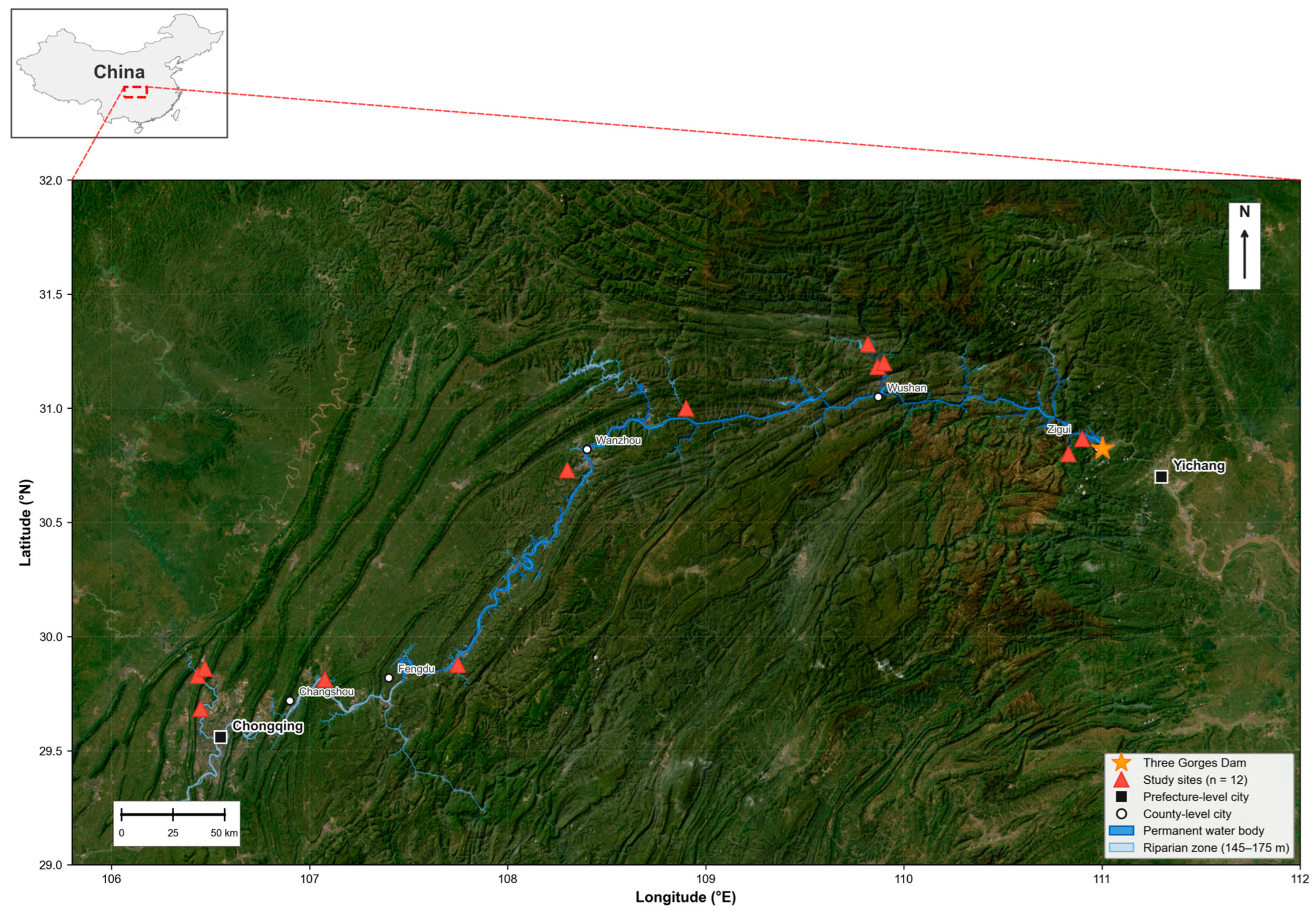
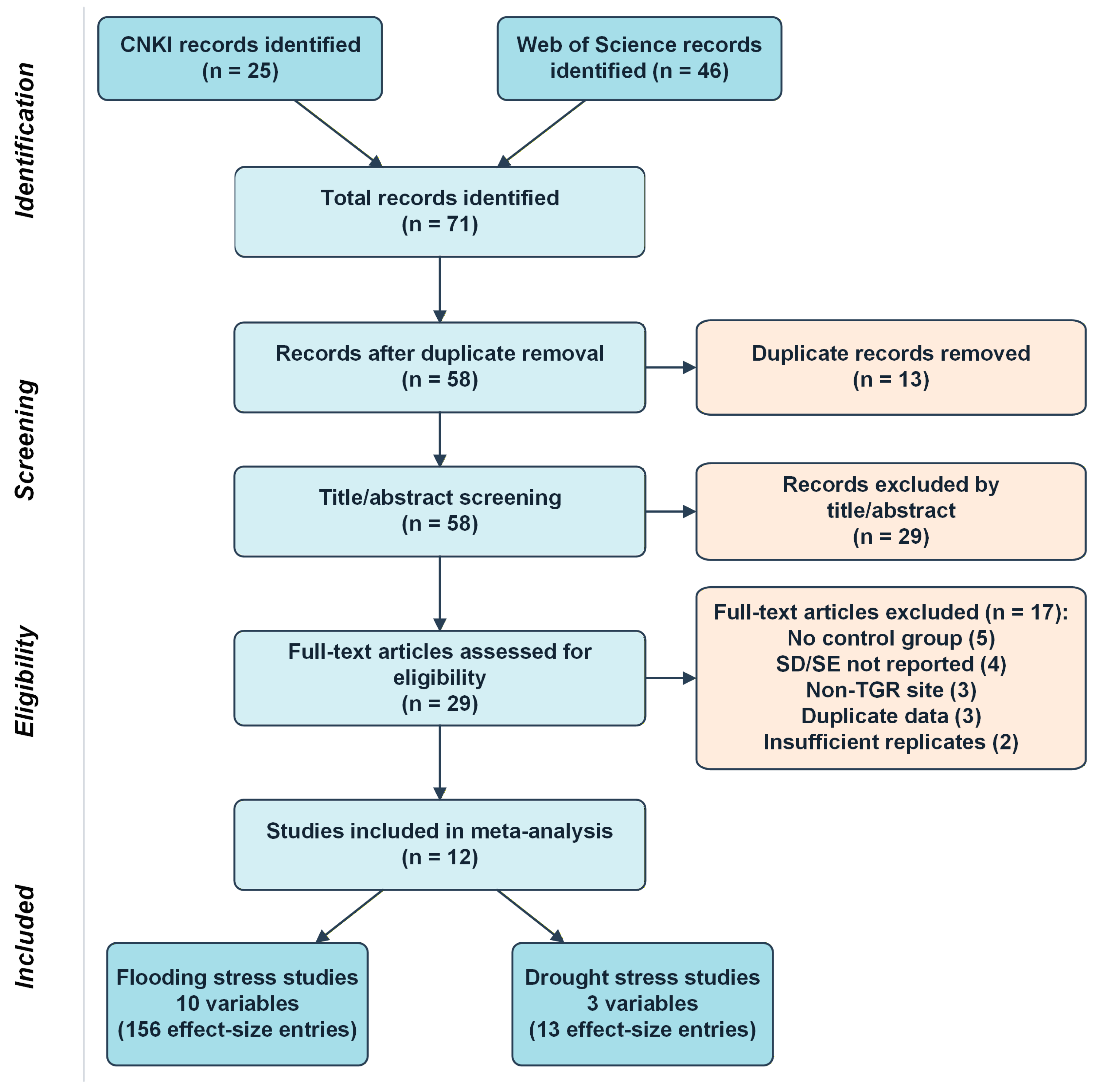
Our study focuses on C. dactylon in the TGR WLFZ. The literature-screening workflow is presented in Figure 1. A systematic search across both Chinese and international databases was conducted for experimental studies published between 2003 and 2025 that assessed the effects of flooding and drought stress on physiological or ecological traits in C. dactylon. In total, 25 records were retrieved from the China National Knowledge Infrastructure (CNKI, https://www.cnki.net/, accessed on 20 June 2026), a major Chinese academic literature database, and 46 records were retrieved from Web of Science (http://www.webofknowledge.com, accessed on 20 June 2026). For CNKI, we used Chinese-language equivalents of the following search concepts: “Three Gorges Reservoir Area” AND “water-level fluctuation zone” AND “Cynodon dactylon” AND (“flooding” OR “drought” OR “wet–dry alternation”) AND (“response” OR “impact”). The English search strings were as follows: (“Three Gorges Reservoir” OR “Three Gorges Dam”) AND (“fluctuating belt” OR “riparian zone” OR “water-level fluctuation zone”) AND “Cynodon dactylon” AND (“flooding” OR “submergence” OR “waterlogging” OR “drought” OR “wet-dry alternation”) AND (“response” OR “impact”). Studies were screened using the following criteria: (1) experimental sites were located within the TGR WLFZ; (2) the study described the study area, treatment duration, control group, stress treatment group, and at least three replicates; (3) at least one target variable from biomass, morphology, or physiological–biochemical categories was reported with means and SD/SE, sample size, or values that could be digitized from figures or tables; and (4) for duplicate publications, only the most comprehensive dataset was retained. The 71 records identified at the search stage were treated as the screening pool rather than as an automatic citation list. Each record was assessed for topical relevance and extractable treatment-control data, and only the studies meeting the eligibility criteria were retained for quantitative synthesis. Because this review intentionally focused on one dominant species in one reservoir WLFZ and required treatment-control data, the number of independent studies was limited. We therefore interpreted the results cautiously and supported inference using random-effects models, subgroup analyses, and bootstrap confidence intervals. Following article-by-article verification, 12 studies were retained from 71 screened records, yielding 169 effect sizes for the main database. The included sites span different elevation segments of the WLFZ from Chongqing to Yichang (Figure 2).
The first stage of the study extracted raw data from the primary text, tables, and figures of published articles. The main fields extracted included the mean (), sample size (n), and standard deviation (SD) or standard error (SE). Data from the control and treatment groups were required for each target variables. In studies that only reported SE, we used Equation (1) to convert SE to SD. When both SD and SE were missing, SD was approximated as one-tenth of the mean. All graphical data were manually digitized with Get Data Graph Digitizer (http://getdata-graph-digitizer.com/, accessed on 20 June 2026).
S D = S E n
The target variables were classified into three categories: biomass, morphological, and physiological–biochemical. These categories comprised 11 indicators: (1) biomass indicator—total biomass; (2) morphological indicators—plant height and root length; and (3) physiological–biochemical indicators—net photosynthetic rate (Pn), stomatal conductance (Gs), transpiration rate (Tr), intercellular CO2 concentration (Ci), malondialdehyde content (MDA), peroxidase activity (POD), superoxide dismutase activity (SOD), and total chlorophyll content. Nitrate reductase activity was not analyzed because the eligible studies did not provide enough extractable treatment-control comparisons for this enzyme. Owing to the paucity of drought-related publications, only three indicators—total biomass, plant height, and total chlorophyll—yielded valid data under drought treatment.

2.2. Effect-Size Calculation and Model Specification

The natural log response ratio (lnRR) was adopted as the effect-size metric in this study [26] to quantify the effects of flooding and drought stress on C. dactylon indicators. Treating the flooding or drought treatment group as the treatment and the untreated group as the control (CK), the calculation was:
ln R R = ln ( X ¯ t X ¯ c )
where t and c are the means of the treatment and control groups, respectively; lnRR > 0 indicates a positive effect of the stress on the indicator; lnRR = 0 indicates no significant effect; lnRR < 0 indicates an inhibitory effect.
To comprehensively evaluate the overall response of each indicator to environmental stress, the pooled effect size (E++) was calculated as the weighted mean of lnRR values across studies (lnRR++):
E + + = ln R R + + = i = 1 k ω i ln R R i i = 1 k ω i
where ωi denotes the weight assigned to the i-th effect size, which is defined as the inverse of its variance (ωi = 1/Vi); and k is the number of effect-size entries pooled for that indicator.
To express the magnitude of change more intuitively, the pooled effect size E++ was converted to the weighted mean percentage change A (unit: %):
A = ( exp ln R R + + 1 ) × 100 %
Owing to the heterogeneity among the included studies in material provenance, treatment conditions, and measurement stages, a random-effects model (REM) was selected a priori for effect-size pooling. The pooled effect size E++ and its 95% confidence interval (95% CI) for each indicator were estimated using MetaWin 2.1 (Sinauer Associates, Sunderland, MA, USA) [27].

2.3. Subgroup Strategy and Significance Criteria

To further disentangle the differential effects of different flooding intensities, subgroup analyses were conducted. Following the flooding-intensity definitions commonly adopted in the included studies [18,28,29,30] and considering elevation, submergence depth, and submergence duration, the included studies were divided into two subgroups: shallow flooding (SF) and deep flooding (DF). Due to the limited number of drought-related studies, no subgroup analysis was performed for drought stress. We did not conduct linear regression or meta-regression using water availability as a continuous predictor because the primary studies used heterogeneous definitions of flooding and drought, reported different combinations of depth, duration, elevation, and soil–water status, and often did not provide harmonized continuous measurements. With only 12 eligible studies, a continuous regression model would have had low statistical power and high risk of overinterpretation. The categorical SF/DF subgroup strategy was therefore selected as the most transparent and robust approach for the present evidence base.
Heterogeneity was assessed using the Cochran Q statistic. The significance of total heterogeneity (Qtotal) was tested against a χ2 distribution (df = k − 1); p < 0.05 indicated significant among-study heterogeneity, further supporting the use of a random-effects model. Effect-size differences between the SF and DF subgroups were evaluated via between-group heterogeneity (Qbetween). Because the number of subgroups was small (only two in this study), the χ2 approximation may be inaccurate. The significance of Qbetween was therefore assessed using MetaWin’s built-in randomization test (999 iterations). A p-value less than 0.05 was considered indicative of a statistically significant between-group difference, thereby enhancing test robustness under small-sample conditions [31].
To further enhance the robustness of statistical inference, this study additionally reported bootstrap percentile confidence intervals based on 999 resamples (bootstrap 95% confidence interval, hereafter “Bootstrap CI”). Bootstrap CI was used as the main significance metric: (1) if neither the parametric 95% CI nor the Bootstrap CI included zero, the effect was deemed statistically significant (denoted as **); (2) if only the Bootstrap CI excluded zero, the indicator was considered significant at the bootstrap level, suggesting a notable response trend (denoted as *B); and (3) all other cases were judged as non-significant (ns). When the parametric CI and Bootstrap CI led to conflicting conclusions, we reported the result as bootstrap-level significance rather than full statistical significance.

2.4. Robustness Assessment

To further verify the robustness of the meta-analysis results, funnel plots for all main indicators were provided (standard errors (SE) on the y-axis and effect sizes on the x-axis), with pseudo-95% confidence boundaries centered on the pooled effect size [32]. Egger’s linear regression test [33] was used to assess funnel-plot asymmetry quantitatively for the indicators with k ≥ 10 effect-size entries. For k < 10, only qualitative inspection was performed because of low statistical power. We generated funnel plots and conducted Egger’s tests in R 4.5.3 (R Foundation for Statistical Computing, Vienna, Austria) using the metafor package [34], which we also used to create the forest plots.
Importantly, funnel-plot asymmetry does not necessarily indicate publication bias. It may instead arise from genuine heterogeneity, such as structural differences among subgroups or individual studies that differ markedly from the rest [35]. Accordingly, this study takes these results as evidence of small-study effects rather than of publication bias.

3. Results

3.1. Response Characteristics of C. dactylon Under Flooding Stress

A total of 10 variables were analyzed under flooding stress. Biomass and morphological traits showed a depth-dependent pattern: total biomass tended to increase under shallow flooding, whereas plant height and root length declined most strongly under deep flooding. Physiological–biochemical responses were more variable; MDA increased consistently, whereas photosynthetic gas-exchange parameters and antioxidant enzyme activities showed no consistent pooled response (Table 1 and Table 2).

3.1.1. Biomass and Morphological Traits

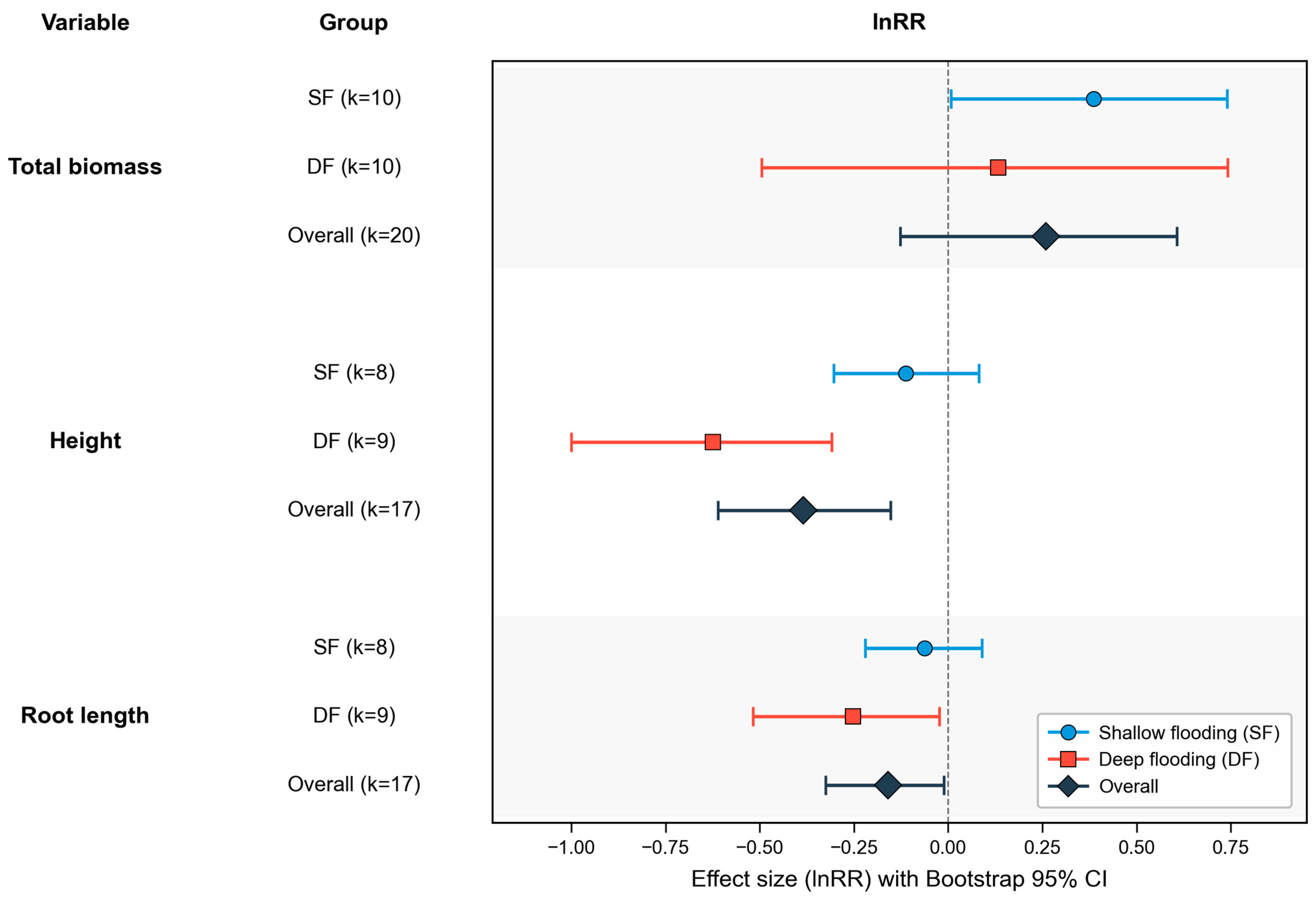
The pooled effect size (E++) for total biomass of C. dactylon was 0.259, corresponding to a +29.6% change, and the 95% CI spanned zero (−0.064 to 0.583), indicating that the overall flooding effect was not statistically significant (Table 1; Figure 3). In the subgroup analysis, shallow flooding increased total biomass by 47.2% (SF: E++ = 0.387), with a Bootstrap CI that excluded zero (0.007 to 0.740), indicating bootstrap-level significance. The effect under deep flooding was smaller and non-significant (DF: E++ = 0.133, +14.2%). Between-group heterogeneity was not significant (Qbetween = 0.672, p = 0.537; Table 2). These results indicate that moderate flooding can enhance biomass production within a limited submergence range, but the promoting effect declines as flooding depth increases.
Plant height was the most sensitive morphological response to flooding. Overall, flooding reduced plant height by 31.9% (E++ = −0.385), and both the 95% CI (−0.614 to −0.156) and the Bootstrap CI (−0.611 to −0.153) excluded zero. The decline was particularly pronounced under deep flooding (DF: E++ = −0.625, −46.5%; both 95% CI and Bootstrap CI excluded zero), whereas shallow flooding caused a smaller, non-significant reduction (SF: E++ = −0.113, −10.7%; Figure 3). Plant height was the only variable with significant between-group heterogeneity (Qbetween = 5.604, p = 0.045; Table 2), suggesting that shallow and deep submergence have fundamentally different effects on aboveground elongation.
Root length also decreased under flooding. The pooled effect size was E++ = −0.160 (−14.8%), with a 95% CI that included zero (−0.375 to 0.056) but a Bootstrap CI that excluded zero (−0.325 to −0.012), indicating bootstrap-level significance. The decline was stronger under deep flooding (DF: E++ = −0.252, −22.3%; bootstrap-level significance) than under shallow flooding (SF: E++ = −0.063, −6.1%; non-significant; Figure 3). Between-group heterogeneity was not significant (Qbetween = 0.864, p = 0.362; Table 2). These results show that deeper flooding progressively restricts root growth, potentially impairing nutrient uptake and soil anchorage.
In general, the growth response of C. dactylon to flooding is depth-dependent: shallow flooding may have a slight positive water-supplementation effect, whereas deep flooding more strongly inhibits the growth of above- and below-ground organs.
Table 1. Summary of meta-analysis results for indicators of C. dactylon under flooding stress.
VariableGroupkE++95% CIBootstrap CIChangeSignificance
Total biomassSF100.387[−0.109, 0.882][0.007, 0.740]+47.2%*B
DF100.133[−0.362, 0.627][−0.495, 0.742]+14.2%ns
Overall200.259[−0.064, 0.583][−0.127, 0.608]+29.6%ns
HeightSF8−0.113[−0.486, 0.260][−0.303, 0.082]−10.7%ns
DF9−0.625[−0.966, −0.283][−1.000, −0.309]−46.5%**
Overall17−0.385[−0.614, −0.156][−0.611, −0.153]−31.9%**
Root lengthSF8−0.063[−0.407, 0.281][−0.220, 0.090]−6.1%ns
DF9−0.252[−0.580, 0.076][−0.518, −0.023]−22.3%*B
Overall17−0.160[−0.375, 0.056][−0.325, −0.012]−14.8%*B
PnSF40.011[−0.835, 0.856][−0.633, 0.538]+1.1%ns
DF30.281[−1.017, 1.580][0.027, 0.597]+32.5%*B
Overall70.129[−0.359, 0.617][−0.270, 0.457]+13.7%ns
GsSF40.025[−0.655, 0.705][−0.341, 0.283]+2.5%ns
DF30.176[−0.878, 1.230][−0.079, 0.507]+19.3%ns
Overall70.090[−0.304, 0.484][−0.136, 0.316]+9.5%ns
TrSF40.200[−1.058, 1.459][−0.232, 0.857]+22.2%ns
DF20.514[−6.580, 7.609][−0.081, 1.102]+67.2%ns
Overall60.305[−0.524, 1.135][−0.118, 0.779]+35.7%ns
CiSF40.097[−0.363, 0.557][−0.175, 0.381]+10.2%ns
DF3−0.005[−0.696, 0.685][−0.088, 0.092]−0.5%ns
Overall70.051[−0.212, 0.314][−0.123, 0.239]+5.2%ns
MDASF100.331[0.003, 0.660][0.108, 0.610]+39.3%**
DF150.233[−0.038, 0.503][0.010, 0.588]+26.2%*B
Overall250.275[0.079, 0.472][0.099, 0.490]+31.7%**
PODSF100.016[−0.458, 0.490][−0.267, 0.291]+1.6%ns
DF150.112[−0.251, 0.475][−0.203, 0.381]+11.9%ns
Overall250.074[−0.198, 0.346][−0.166, 0.270]+7.7%ns
SODSF100.009[−0.441, 0.460][−0.493, 0.494]+1.0%ns
DF15−0.092[−0.472, 0.288][−0.270, 0.103]−8.8%ns
Overall25−0.047[−0.320, 0.226][−0.278, 0.195]−4.6%ns
Note: SF = shallow flooding; DF = deep flooding (grouping criteria are defined in Section 2.3). Pn—net photosynthetic rate; Gs—stomatal conductance; Tr—transpiration rate; Ci—intercellular CO2 concentration. Results: ** = 95% CI does not include zero; *B = bootstrap-level significance: the Bootstrap 95% CI does not include zero; ns = not statistically significant.
Table 2. Between-group (SF vs. DF) heterogeneity test results for indicators of C. dactylon under flooding stress.
VariableQbetweenp (Rand.)QtotaldfSignificance
Total biomass0.6720.53729.31319p = 0.537 ns
Height5.6040.04521.61016p = 0.045 *
Root length0.8640.36210.75716p = 0.362 ns
Pn0.4540.6216.2246p = 0.621 ns
Gs0.2160.6043.8396p = 0.604 ns
Tr0.2110.8123.5595p = 0.812 ns
Ci0.2250.6984.8126p = 0.698 ns
MDA0.2640.65723.98924p = 0.657 ns
POD0.1270.72517.08924p = 0.725 ns
SOD0.1440.72221.02624p = 0.722 ns
Note: Qbetween = between-group heterogeneity statistic; p (Rand.), p-value from the test of Qbetween; Qtotal = Cochran’s total heterogeneity statistic; df = degrees of freedom; * p < 0.05 (significant between-group difference); ns = not significant.

3.1.2. Physiological and Biochemical Traits

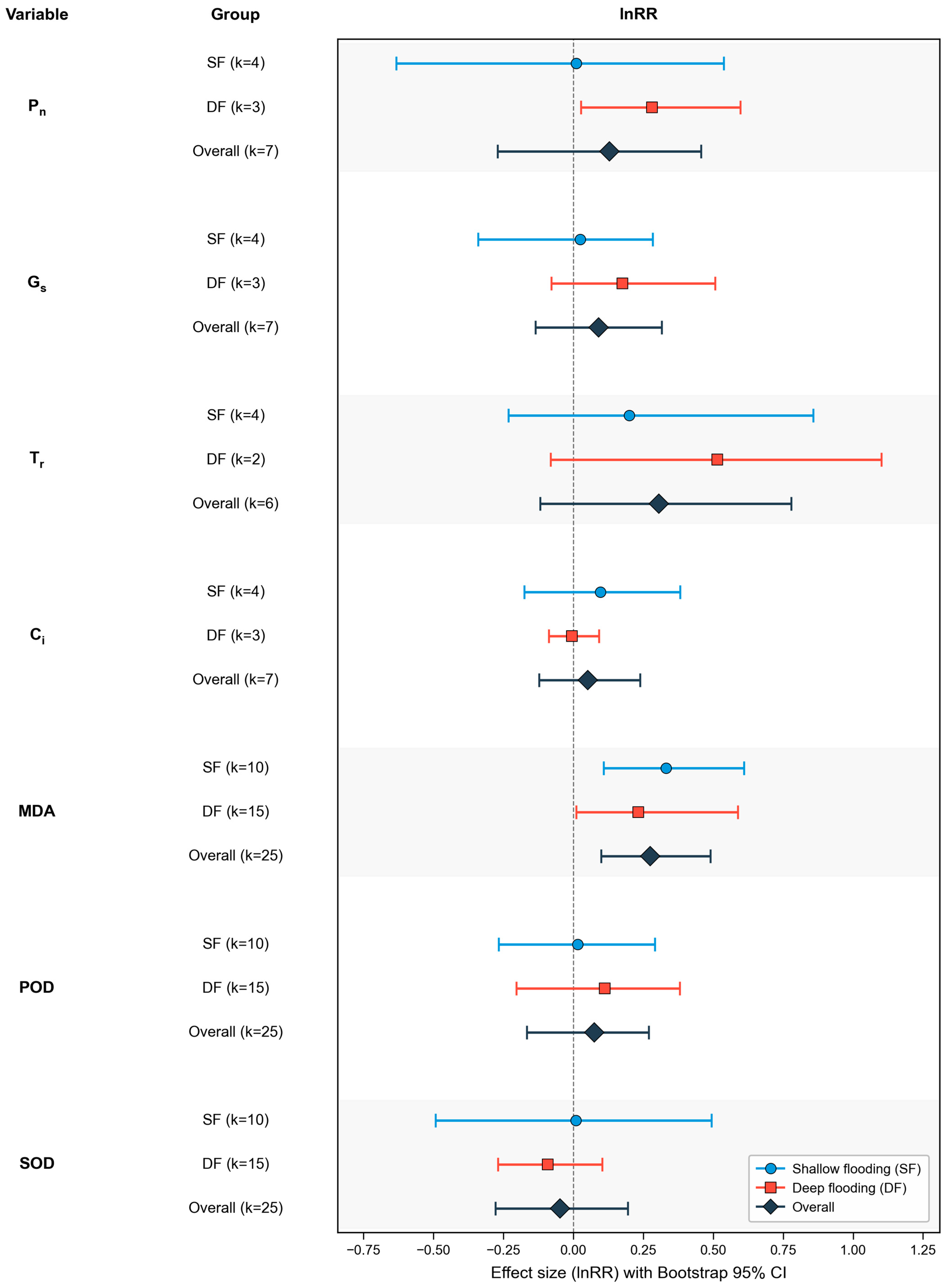
Photosynthetic gas-exchange parameters showed weak and uncertain responses to flooding. Pn, Gs, Tr, and Ci had positive pooled effect sizes (E++) of 0.129 (+13.7%), 0.090 (+9.5%), 0.305 (+35.7%), and 0.051 (+5.2%), respectively, but all 95% CIs and Bootstrap CIs contained zero (Table 1; Figure 4). At the subgroup level, the Bootstrap CI for Pn under deep flooding (0.027 to 0.597) excluded zero, suggesting a possible compensatory photosynthetic response after deep flooding. However, between-group heterogeneity was not significant for any photosynthetic parameter (Table 2), and these results should therefore be interpreted cautiously.
MDA showed the most pronounced biochemical response to flooding. Overall, MDA increased by 31.7% (E++ = 0.275), and both the 95% CI (0.079 to 0.472) and the Bootstrap CI (0.099 to 0.490) excluded zero (Table 1; Figure 4). These findings indicate that flooding increased membrane lipid peroxidation in C. dactylon. Subgroup analyses showed a substantial increase under shallow flooding (SF: E++ = 0.331, +39.3%; both 95% CI and Bootstrap CI significant) and an upward trend under deep flooding (DF: E++ = 0.233, +26.2%; Bootstrap CI: 0.010 to 0.588). Between-group heterogeneity was not statistically significant (Qbetween = 0.264, p = 0.657; Table 2).
POD and SOD did not show consistent pooled responses to flooding. The pooled effect size for POD was E++ = 0.074 (+7.7%), and its Bootstrap CI included zero (−0.166 to 0.270). The pooled effects for SF and DF were also non-significant (SF: E++ = 0.016, +1.6%; DF: E++ = 0.112, +11.9%), and between-group heterogeneity was not significant (Qbetween = 0.127, p = 0.725; Table 2). SOD was likewise non-significant overall (E++ = −0.047, −4.6%; Bootstrap CI: −0.278 to 0.195), with no consistent directional change in either subgroup (Table 1; Figure 4). These results indicate that the current evidence does not support a synchronized upregulation of the antioxidant enzyme system under flooding; instead, flooding effects are more clearly expressed as increased oxidative damage, as indicated by MDA.

3.2. Response Characteristics of C. dactylon Under Drought Stress

Three indicators were available under drought stress. Total biomass showed a negative but non-significant trend, plant height showed a smaller non-significant reduction, and total chlorophyll remained nearly unchanged. These results indicate that drought responses were weaker and less certain than flooding responses, partly because drought-related effect-size entries were few (Table 3 and Table 4).

3.2.1. Biomass and Morphological Traits

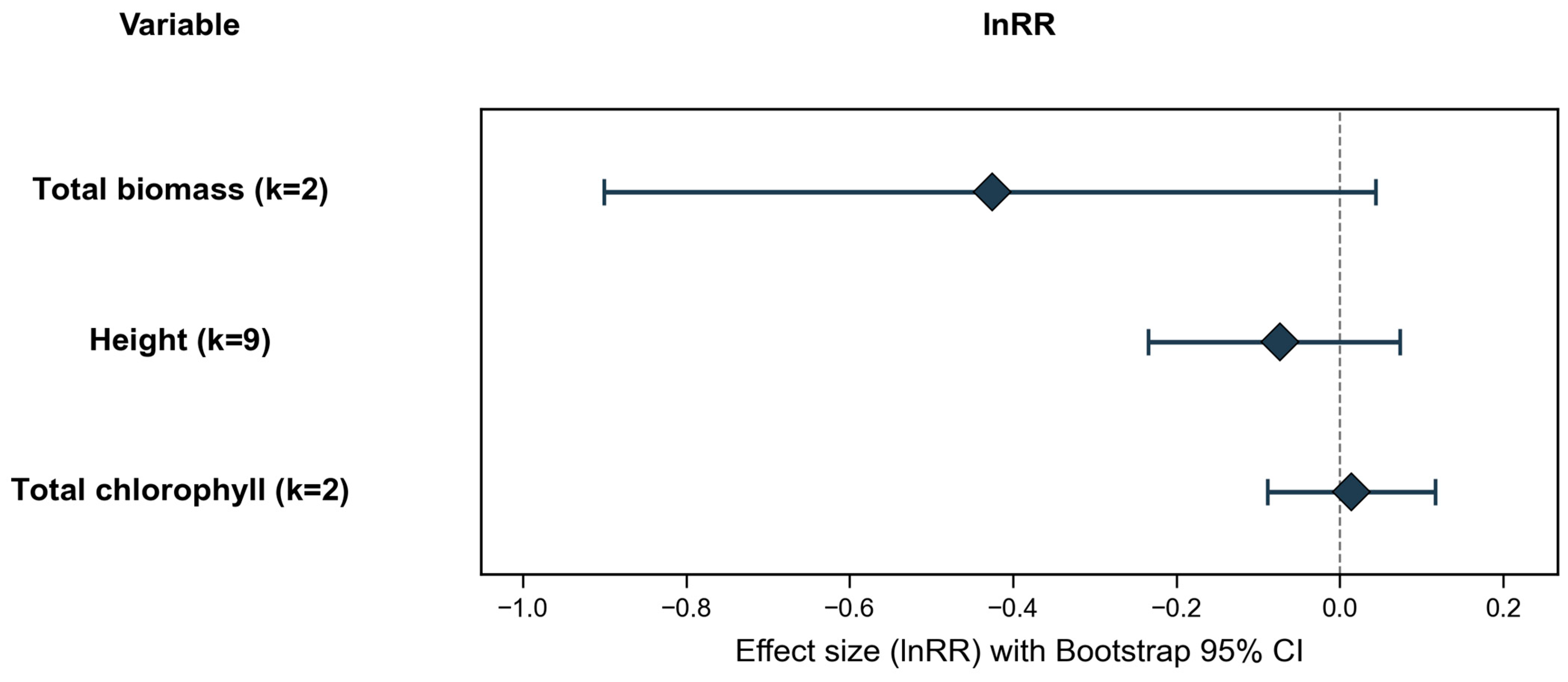
Under drought stress, the pooled effect size for total biomass was E++ = −0.425 (−34.6%), indicating a negative trend. However, the 95% CI was very wide (−6.425 to 5.575), and the Bootstrap CI also included zero; therefore, the effect was not statistically significant (Table 3; Figure 5). These results suggest that drought may impede biomass accumulation in C. dactylon, although this inference remains tentative because the indicator was based on only two effect sizes. The heterogeneity test suggested no detectable among-study heterogeneity (Qtotal = 1.000, p = 0.317; Table 4).
Plant height also showed a negative response to drought (E++ = −0.073, −7.1%), although the 95% CI (−0.304 to 0.157) and the Bootstrap CI (−0.234 to 0.074) included zero, indicating a non-significant effect (Table 3). The heterogeneity test indicated good consistency among the included studies (Qtotal = 4.473, p = 0.812; Table 4). The drought-induced reduction in plant height was substantially smaller than that under flooding, suggesting that C. dactylon may have some morphological buffering capacity against water deficit under the current experimental conditions. This interpretation, however, is limited by the small sample size.

3.2.2. Physiological and Biochemical Traits

Among the physiological and biochemical indicators, the pooled effect size for total chlorophyll content was nearly zero (E++ = 0.014, +1.4%), with both the 95% CI and Bootstrap CI encompassing zero (Table 3; Figure 5). The heterogeneity test showed no detectable among-study heterogeneity (Qtotal = 1.000, p = 0.317; Table 4), suggesting that the available samples do not show a consistent signal of chlorophyll depletion. Given that only two effect sizes were available (k = 2), the present evidence remains insufficient to determine whether drought consistently affects chlorophyll content in C. dactylon.

3.3. Comparative Responses of C. dactylon Under Different Stresses

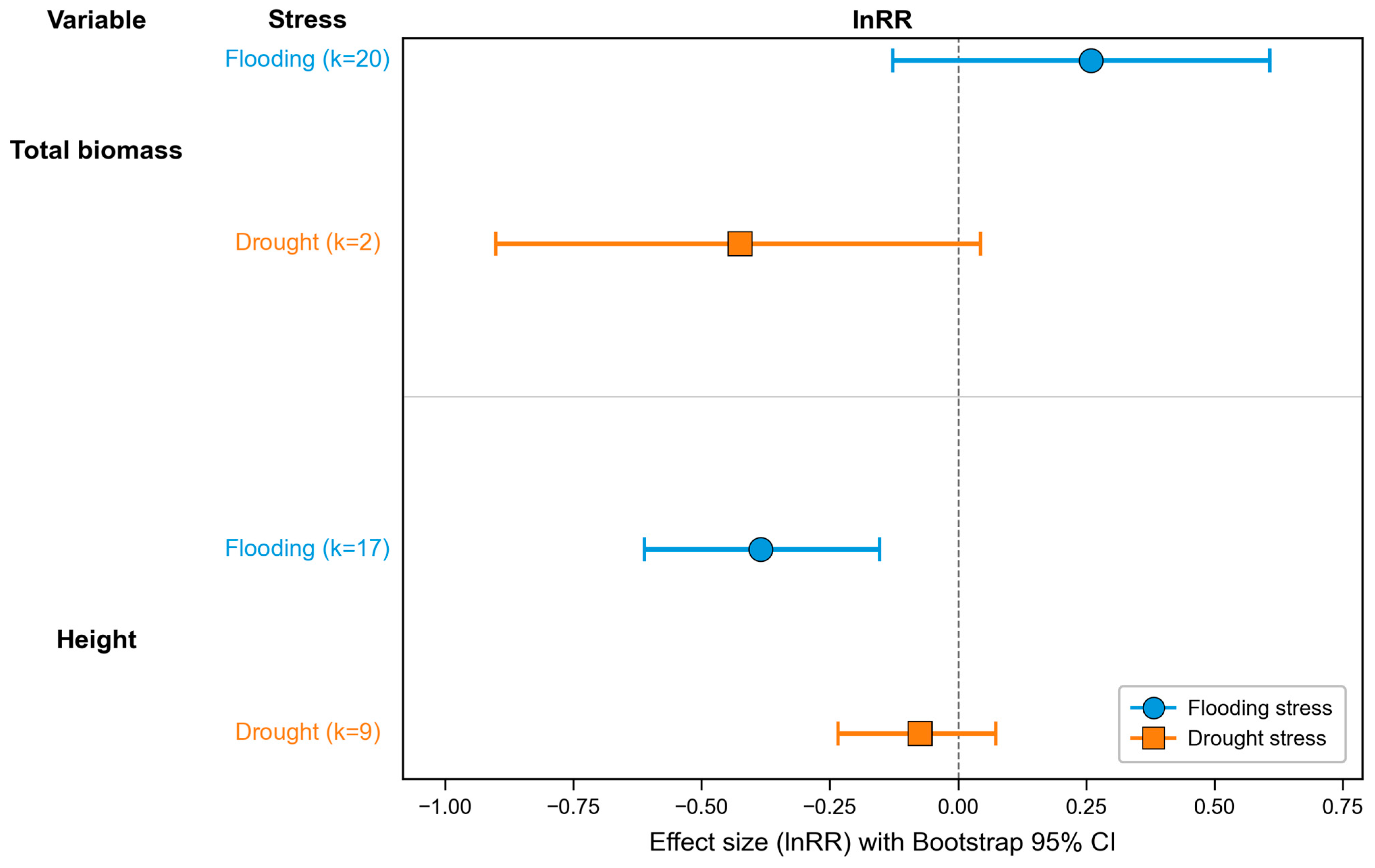
We compared the pooled flooding and drought effect sizes for the indicators shared by both stress types (Figure 6). The direction and magnitude of the effects differed markedly for total biomass and plant height.
Under flooding stress, total biomass tended to increase (+29.6%), particularly under shallow flooding (+47.2%). In contrast, total biomass decreased under drought stress (−34.6%). These opposite directions suggest distinct stress pathways during the impoundment and drawdown phases of the WLFZ. Moderate water supplementation under shallow flooding may promote vegetative growth, whereas drought during the exposed period can limit water uptake and reduce growth.
Both flooding and drought reduced plant height, but the magnitudes differed strongly: −31.9% under flooding (significant) and −7.1% under drought (non-significant). Deep flooding caused a greater reduction in plant height (−46.5%) than shallow flooding (−10.7%), indicating a depth-dependent response. Thus, plant height is particularly responsive to flooding depth and can serve as a morphological indicator of flooding-stress intensity.
Taken together, the reduction in root length, the marked rise in MDA, and the non-significant pooled effects for POD and SOD indicate that flooding, particularly deep submergence, affects C. dactylon mainly through morphological suppression and oxidative damage. Drought showed negative trends in biomass and plant height, but the limited number of drought-related entries means that these effects should be interpreted as directional rather than definitive.

3.4. Publication Bias Assessment

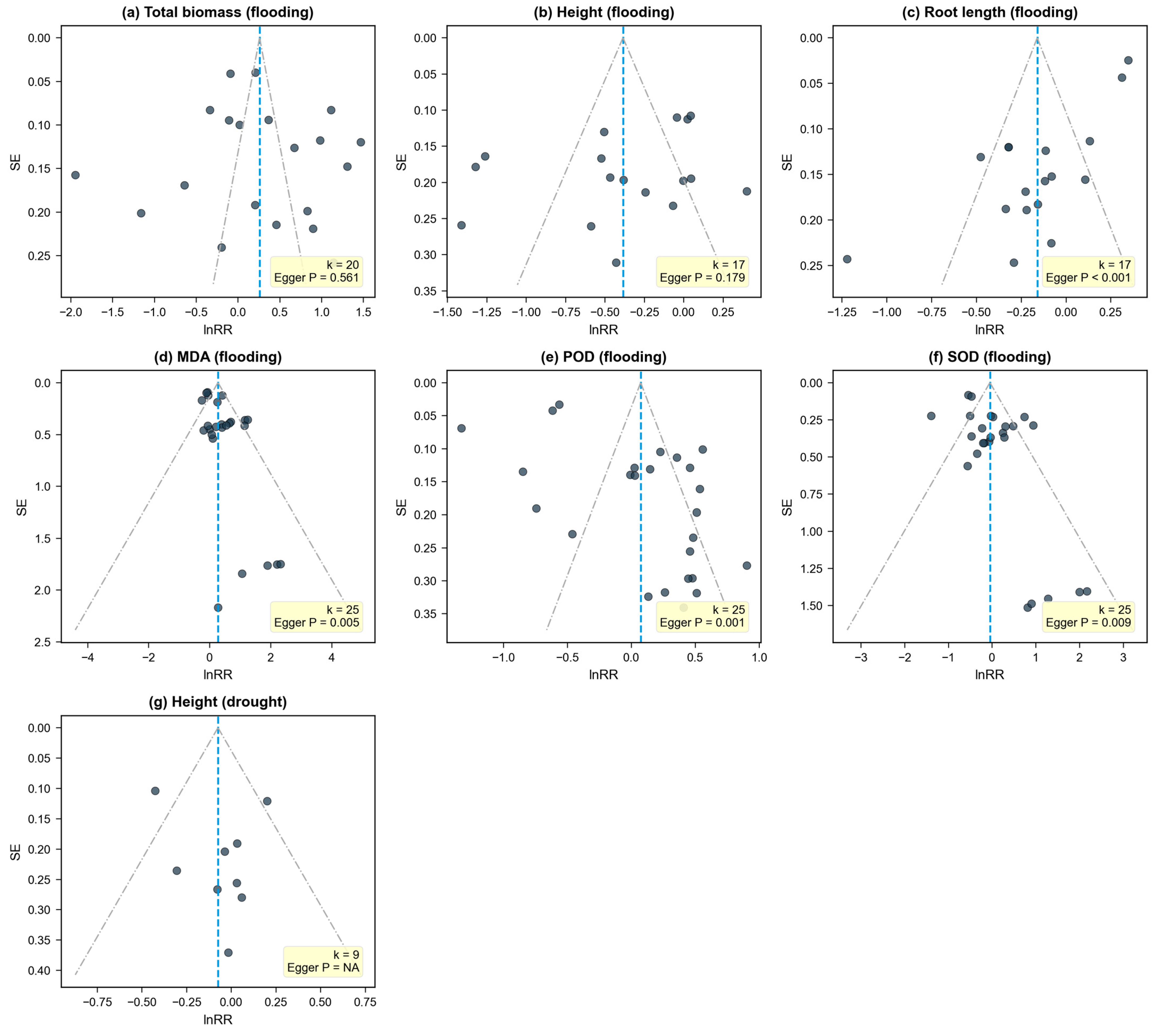
Under flooding stress, the funnel plots showed visual symmetry for total biomass and plant height (Egger p-values: 0.561 and 0.179, respectively), with no apparent small-study effects (Table 5; Figure 7). Hence, the main conclusions are unlikely to be substantially affected by publication bias. The funnel plot for root length showed significant asymmetry (Egger p < 0.001), but this asymmetry was mainly attributable to a few high-precision positive-effect points on the right rather than to an excessive cluster of small-sample negative-effect studies on the left. This pattern is therefore more likely to reflect between-study heterogeneity, such as differences in submergence depth, duration, or substrate, and the influence of a few high-precision studies than the selective publication of negative results. The funnel-plot analysis therefore does not weaken the overall conclusion that flooding inhibits root length.
All funnel plots of MDA, POD, and SOD under flooding stress exhibited different degrees of asymmetry. For MDA, the Egger p value was 0.005, and the asymmetry appeared to be largely associated with low-precision studies showing large positive effects in the lower-right quadrant. Thus, the direction of MDA elevation remains credible, but the pooled effect size may be overestimated. For POD, asymmetry was more pronounced (Egger p = 0.001), with high-precision negative-effect points on the left and low-precision positive-effect points on the right. This pattern indicates that POD responses vary across study contexts and should not be interpreted as consistent upregulation. The Egger p-value for SOD was 0.009, with the funnel plot showing rightward dispersion. This pattern suggests that SOD responses are context-dependent and provides limited support for a stable upregulation signal.
Under drought stress, the funnel plot for plant height (Figure 7g) exhibited no obvious skewness. However, because the number of effect-size entries (k = 9) was below the commonly recommended threshold for Egger’s test (k ≥ 10), statistical power was limited, so Egger’s test was not performed. This panel is provided only for qualitative visual reference and is not used for formal publication-bias inference. For the other indicators with k < 10 (i.e., Pn, Gs, Tr, Ci under flooding, and total biomass and total chlorophyll under drought), formal publication-bias inference was not conducted owing to insufficient test power.

4. Discussion

4.1. Effects of Flooding on the Biomass and Morphology of C. dactylon and Their Ecological Adaptive Significance

Our results show that total biomass of C. dactylon increased by up to 47.2% under shallow flooding (bootstrap-level significance; Table 1), whereas plant height decreased significantly and root length contracted under flooding stress. The decoupling between biomass and longitudinal-growth responses likely reflects morphological remodeling in C. dactylon under flooding. Plants in the WLFZ may build total biomass during the rising-water period by increasing tiller number, lateral branch density, and individual fresh weight. Under deep flooding, by contrast, longitudinal elongation is further suppressed by hypoxia, yielding a more compact plant architecture [36]. This pattern of suppressed elongation and conserved energy under deep flooding falls within the functional–ecological category of a quiescence strategy [37], in which plants slow vertical growth during submergence to preserve energy reserves and resume growth rapidly upon emergence, as opposed to the escape strategy of rapid elongation toward the water surface [38].
The strong decline in plant height and its dependence on flooding depth deserve particular attention. In the deep-flooding subgroup, plant height decreased by 46.5%, compared with 10.7% under shallow flooding. The between-group heterogeneity test confirmed this difference (Qbetween = 5.604, p = 0.045; Table 2), indicating a clear dose–response relationship between plant height and submergence depth. Under deep flooding, stems are fully submerged, and low oxygen and light availability can restrict internode elongation [39]. Under shallow flooding, by contrast, stem portions above the water surface can continue photosynthesis and gas exchange, so elongation is less constrained. Plant height, therefore, provides a simple and sensitive morphological proxy for flooding-stress intensity in the WLFZ [14], with potential use in vegetation monitoring.
Root length also declined under flooding stress (bootstrap-level significance; Table 1), but the magnitude of this decline (−14.8%) was smaller than that for plant height. This pattern may indicate some acclimation of the root system to anaerobic conditions in C. dactylon. Previous studies suggest that flooding-induced aerenchyma formation contribute to shoot-to-root oxygen transport in C. dactylon and thus help mitigate rhizosphere hypoxia [22,40]. This anatomical adaptation may account for the less severe reduction in root length. The root length reduction in the SF subgroup was negligible (−6.1%; Table 1), confirming that moderate flooding has little effect on the C. dactylon root system.

4.2. Effects of Flooding on Photosynthetic Parameters

The finding that all four photosynthetic parameters (Pn, Gs, Tr, Ci) exhibited positive trends under flooding stress, but with non-significant pooled effects, can be explained in various ways. First, some of the included studies may have measured photosynthetic indicators during the post-drawdown recovery period rather than during flooding itself; in this stage, plants may exhibit compensatory photosynthetic enhancement [41], leading to a positive pooled effect. This hypothesis, however, requires verification by future studies that distinguish between flooding-period and recovery-period measurements. Second, under shallow flooding, leaves above the water surface continue to photosynthesize normally and may even show increased photosynthetic efficiency owing to ample soil–water supply. Third, the number of effect-size entries for photosynthetic parameters is relatively small (k = 6–7), resulting in insufficient statistical power and wide confidence intervals [24].
Notably, under deep flooding, the net photosynthetic rate (Pn) showed a bootstrap-significant increase of 32.5% (Table 1), a trend at odds with the conventional expectation that “flooding inhibits photosynthesis”. This may be related to both compensatory mechanisms during the recovery period and the relative stability of the C4 photosynthetic system under stress [11,42]. Together with the small, non-significant changes in stomatal conductance (+9.5%; Table 1) and intercellular CO2 concentration (+5.2%; Table 1), the present evidence suggests that the response of the photosynthetic gas-exchange system of C. dactylon under flooding stress is directionally inconsistent rather than uniformly inhibitory. Future studies should distinguish between flooding-period and recovery-period measurements and increase sample sizes to obtain more precise effect estimates.

4.3. Oxidative Stress and Antioxidant Defenses During Flooding

Flooding significantly increased MDA content in C. dactylon (+31.7%, Table 1), suggesting damage to cell membranes. MDA is produced during the peroxidation of unsaturated membrane lipids, and its accumulation is commonly used as an indicator of oxidative injury. The increase observed here suggests enhanced ROS production and accelerated membrane-lipid degradation under hypoxic conditions [43]. Subgroup analysis showed that MDA increased substantially under shallow flooding (SF: +39.3%; both the 95% CI and Bootstrap CI excluded 0) and also tended to increase under deep flooding (DF: +26.2%; bootstrap-level significance). However, the between-group difference was not significant, demonstrating that even shallow flooding is sufficient to cause severe membrane oxidative damage.
Compared with the control, neither POD activity (E++ = 0.074, +7.7%) nor SOD activity (E++ = −0.047, −4.6%) changed significantly (Table 1). This result should not be interpreted as evidence that antioxidant enzymes are biologically irrelevant; rather, it means that the compiled studies did not support a consistent direction of response. Funnel-plot assessment indicated substantial inter-study heterogeneity for POD (Egger p = 0.001) and SOD (Egger p = 0.009; Section 3.4). Several mechanisms may explain this pattern. First, enzyme activity can be transient: early activation may be followed by late depletion or recovery, so studies sampled at different flooding durations or post-drawdown stages may yield opposite directions [44]. Second, MDA accumulation indicates that ROS production may have exceeded the scavenging capacity of POD and SOD under some conditions. Third, C. dactylon may rely partly on other antioxidant pathways, including catalase (CAT) and non-enzymatic antioxidants in the ascorbate-glutathione cycle [45]. These mechanisms can explain why MDA increased consistently whereas POD and SOD did not show uniform upregulation.
Taken together, the results for MDA, POD, and SOD suggest that flooding increased membrane lipid peroxidation in C. dactylon without a parallel increase in antioxidant enzyme activity. ROS production during flooding may have exceeded the scavenging capacity of the enzymatic antioxidant system, allowing oxidative damage to accumulate [43] and potentially increasing sensitivity to prolonged deep flooding. These patterns point to the need for further work on ROS signaling and non-enzymatic antioxidant networks in WLFZ plants [10,45].

4.4. Effects of Drought Stress and Comparison with Flooding Stress

Although the pooled effect sizes for the three indicators under drought stress were not significant, their directional trends remain ecologically meaningful. Total biomass showed a decreasing trend under drought (−34.6%; Table 3), opposite in direction to the positive trend under flooding stress (+29.6%; Table 1). This directional difference may reflect two distinct stress pathways during the impoundment and drawdown phases of the WLFZ [6], although the inference requires further verification because of limited sample size and non-significant confidence intervals. The effect of drought on plant height (−7.1%; Table 3) was much weaker than that of flooding (−31.9%; Table 1), consistent with the relatively strong drought tolerance of C. dactylon as a C4 warm-season grass with high water-use efficiency, a well-developed rhizome system, and capacity for deep-root water uptake [11,46]. The available evidence did not indicate a clear change in total chlorophyll (+1.4%; Table 3). However, only two studies were included for this indicator, so the present information is insufficient to determine the true response of the C. dactylon chlorophyll system to drought.
The main limitation of the drought-stress analysis is the very small number of effect-size entries (only k = 2 for both total biomass and total chlorophyll), which severely constrains statistical inference [24]. Future work should strengthen drought-related experimental research, particularly by measuring oxidative stress markers such as MDA, POD, and SOD, and nitrogen-assimilation indicators such as nitrate reductase activity, to enable more comprehensive comparison with flooding stress [47].

4.5. Implications for Ecological Restoration and Research Limitations

The quantitative results of this study clarify how a dominant WLFZ grass responds to alternating flooding and drought, and they provide guidance for both vegetation restoration and biodiversity management in the TGR WLFZ. C. dactylon shows good ecological adaptation to shallow flooding: biomass tends to increase, the photosynthetic system remains relatively stable, and root-length reduction is limited. It can therefore be considered a priority herbaceous restoration species for the upper elevation belt of the WLFZ (170–175 m) [13]. Its dense clonal cover can also help stabilize sediments, reduce bank erosion, attenuate wave disturbance, and maintain herbaceous habitat structure, thereby supporting ecosystem services relevant to biodiversity conservation. However, the substantial inhibition of morphological growth and the intensified membrane-oxidative damage under deep flooding must be fully considered. In the middle-to-lower elevation belt (155–165 m), C. dactylon should be combined appropriately with deep-flooding-tolerant tree and shrub species, such as Distylium chinense and Salix variegata, to form a multi-layered tree–shrub–herb vegetation structure [6,12]. Although the overall drought effect during the drawdown period appears relatively mild, survival during years of extreme drought or high-temperature exposure still requires attention [15]. Supplementary measures, such as mulching to retain moisture, may be applied where necessary.
These applied implications are reinforced by the stress-memory framework recently proposed by Zhu and Jiang [48]. Their study showed that C. dactylon dominance, functional traits, landscape pattern, and the soil seed bank jointly characterize adaptive accumulation across successional stages and inundation gradients. Although their work was conducted in the Jinsha River Basin and therefore did not meet the quantitative inclusion criteria of this TGR-focused meta-analysis, it supports our interpretation that repeated hydrological disturbance can generate accumulated adaptive responses. At the same time, our results add a quantitative caution: deep flooding in the TGR WLFZ still imposes morphological suppression and oxidative damage. The broader geomorphological and environmental context of the TGR WLFZ is also consistent with the view that this zone is a unique geomorphological unit and a key environmental-management issue [49,50].
Several caveats should be noted. First, drought effects were estimated from only a few entries (k = 2 for biomass and chlorophyll), and physiological and biochemical indicators were not available for drought, limiting direct comparison with flooding. Second, the flooding dataset varied in depth, duration, elevation, and sampling stage. Some pooled effects may combine immediate stress responses with post-drawdown recovery because not all studies clearly separated measurements taken during flooding from those taken after re-exposure. Third, because water availability was not reported as a harmonized continuous variable across studies, linear regression or meta-regression would be underpowered and potentially misleading at the current sample size. Finally, although the database search identified 71 records, many were not directly relevant to the specific trait-based, treatment-control synthesis of C. dactylon in the TGR WLFZ. We therefore retained and cited references according to their relevance rather than citing all screened records indiscriminately. Future work would benefit from more drought experiments, clearer separation between flood-period and recovery-period measurements, standardized reporting of submergence depth, flood duration, soil–water status, and recovery phase, and expanded measurement of root functional traits, antioxidant networks, nitrate reductase activity, and other nutrient-acquisition indicators.

5. Conclusions

This meta-analysis quantitatively synthesized the effects of flooding and drought on the physiological and ecological traits of C. dactylon in the WLFZ of the TGR. The main findings are as follows.
(1)
Flooding responses in C. dactylon were clearly depth-dependent. Shallow flooding tended to increase total biomass, whereas deep flooding reduced plant height and root length, indicating stronger morphological suppression as flooding depth increased. Plant height was the only trait with significant between-group heterogeneity, making it the most useful morphological proxy for flooding-stress severity.
(2)
Flooding increased malondialdehyde content (MDA), consistent with intensified membrane lipid peroxidation. By contrast, peroxidase activity (POD), superoxide dismutase activity (SOD), and the four photosynthetic gas-exchange parameters (Pn, Gs, Tr, Ci) showed no significant overall changes. These results suggest that the physiological effect of flooding on C. dactylon was expressed mainly as oxidative damage rather than as coordinated upregulation of antioxidant enzymes.
(3)
Drought effects on total biomass, plant height, and total chlorophyll were not significant. The reduction in plant height under drought was much smaller than under flooding, consistent with the relatively strong drought tolerance of C. dactylon as a C4 warm-season grass. However, the small number of drought-related entries limits this result to a directional inference.
(4)
Across the two stresses, flooding—and especially deep flooding—had a stronger and more consistent effect on C. dactylon than drought, mainly through morphological suppression and oxidative damage. Because C. dactylon dominates the herbaceous cover of the TGR WLFZ, its sensitivity to deep flooding is not only a restoration concern but also a biodiversity concern for this artificial wetland. C. dactylon is therefore better suited to shallow-flooded upper-elevation areas (170–175 m), whereas in deep-flooded middle-to-lower belts (155–165 m) it should be combined with deep-flooding-tolerant woody species such as Distylium chinense and Salix variegata to build a more stable tree–shrub–herb vegetation structure.

Author Contributions

Conceptualization, Y.H. and J.Z.; methodology, Y.H.; software, Y.H.; validation, Y.H., J.Z. and C.W.; formal analysis, Y.H. and C.W.; investigation, Y.H. and C.W.; resources, Y.H. and C.W.; data curation, Y.H. and J.Z.; writing—original draft preparation, Y.H.; writing—review and editing, J.Z. and C.W.; visualization, Y.H.; supervision, J.Z. and C.W.; project administration, J.Z. and C.W.; funding acquisition, Y.H., J.Z. and C.W. All authors have read and agreed to the published version of the manuscript.

Funding

This research was funded by the National Natural Science Foundation of China (42174103). Y.H. was supported by the Hubei Provincial Natural Science Foundation of China (2023AFB1098) and the Hubei Provincial Education Science Planning Project (2025GB133).

Data Availability Statement

The data that support the findings of this paper are available from the corresponding author upon justifiable request.

Conflicts of Interest

The authors declare no conflicts of interest.

References

  1. Lü, M.Q.; Wu, S.J.; Chen, C.D.; Jiang, Y.; Wen, Z.F.; Chen, J.L.; Wang, Y.; Wang, X.X.; Huang, P. A review of studies on water level fluctuating zone (WLFZ) of the Three Gorges Reservoir (TGR) based on bibliometric perspective. Acta Ecol. Sin. 2015, 35, 3504–3518. [Google Scholar] [CrossRef][Green Version]
  2. New, T.; Xie, Z. Impacts of large dams on riparian vegetation: Applying global experience to the case of China’s Three Gorges Dam. Biodivers. Conserv. 2008, 17, 3149–3163. [Google Scholar] [CrossRef]
  3. Ye, C.; Zhang, K.; Deng, Q.; Zhang, Q. Plant communities in relation to ‘flooding and soil characteristics in the water level fluctuation zone of the Three Gorges Reservoir, China. Environ. Sci. Pollut. Res. 2013, 20, 1794–1802. [Google Scholar] [CrossRef] [PubMed]
  4. Chen, Z.; Yuan, X.; Roß-Nickoll, M.; Hollert, H.; Schäffer, A. Moderate inundation stimulates plant community assembly in the drawdown zone of China’s Three Gorges Reservoir. Environ. Sci. Eur. 2020, 32, 79. [Google Scholar] [CrossRef]
  5. Wang, Q.; Yuan, X.Z.; Liu, H.; Zhang, Y.W.; Chen, Z.L.; Li, B. Effect of initial impoundment on the vegetation and species diversity in water-level fluctuation zone of the Three Gorges Reservoir. J. Nat. Resour. 2011, 26, 1680–1693. [Google Scholar] [CrossRef]
  6. He, X.; Bao, Y. Research advances on soil erosion and ecological restoration in the riparian zone of the Three Gorges Reservoir. Sci. Soil Water Conserv. 2019, 17, 160–168. [Google Scholar] [CrossRef]
  7. Yi, X.; Huang, Y.; Jiang, Y.; Ma, M.; Chen, Q.; Wu, S. Flooding depth and flooding duration with the zonation of riparian plant communities in the Three Gorges Reservoir of China. Water 2023, 15, 3228. [Google Scholar] [CrossRef]
  8. Jian, Z.; Ma, F.; Guo, Q.; Qin, A.; Xiao, W. Long-term responses of riparian plants’ composition to water level fluctuation in China’s Three Gorges Reservoir. PLoS ONE 2018, 13, e0207689. [Google Scholar] [CrossRef] [PubMed]
  9. Rao, J.; Duan, D.Q.; Tang, Q.; Ma, M.G.; Wei, J.; He, X.B. Vegetation differentiation along elevation gradient in the water level fluctuation zone of the Three Gorges Reservoir and its response to habitat stressing. Acta Ecol. Sin. 2023, 43, 6649–6660. [Google Scholar]
  10. Deng, B.; Wang, X.F.; Liao, J. Ecophysiological responses of herbaceous and woody plants to environmental stresses in the water-level-fluctuation zone of the Three Gorges Reservoir: A meta-analysis. Chin. J. Plant Ecol. 2024, 48, 623–637. [Google Scholar] [CrossRef]
  11. Sage, R.F.; Zhu, X.G. Exploiting the engine of C4 photosynthesis. J. Exp. Bot. 2011, 62, 2989–3000. [Google Scholar] [CrossRef] [PubMed]
  12. Sun, R.; Yuan, X.Z.; Liu, H.; Chen, Z.L.; Zhang, Y.W. Floristic composition and species diversity of plant communities along an environment gradient in drawdown area of Three Gorges Reservoir after its initial impounding to the water level of 156 m. Chin. J. Ecol. 2011, 30, 208–214. [Google Scholar]
  13. Tan, S.; Zhu, M.; Zhang, Q. Physiological responses of bermudagrass (Cynodon dactylon) to submergence. Acta Physiol. Plant. 2010, 32, 133–140. [Google Scholar] [CrossRef]
  14. Guo, Y.; Yang, S.; Shen, Y.F.; Xiao, W.F.; Cheng, R.M. Study on the natural distribution characteristics and community species diversity of existing plants in the Three Gorges Reservoir. Acta Ecol. Sin. 2019, 39, 4255–4265. [Google Scholar] [CrossRef]
  15. Li, S.; Wang, Y.; Hu, L.; Zhao, J.; Liao, X.; Xie, T.; Wen, J.; Bao, Y.; Li, L. Nitrogen fixation of Cynodon dactylon: A possible strategy coping with long-term flooding in the Three Gorges Reservoir. Sci. Total Environ. 2023, 866, 161422. [Google Scholar] [CrossRef] [PubMed]
  16. Li, X.; Li, S.; Xie, Y.; Wei, Z.; Li, Z. What drives the morphological traits of stress-tolerant plant Cynodon dactylon in a riparian zone of the Three Gorges Reservoir, China. Water 2023, 15, 3183. [Google Scholar] [CrossRef]
  17. Yi, X.; Huang, Y.; Xing, Q.; Chen, Q.; Wu, S. Cynodon dactylon and sediment interaction in the Three Gorges Reservoir: Insights from a three-year study. Land 2024, 13, 1373. [Google Scholar] [CrossRef]
  18. Hong, M.; Guo, Q.S.; Nie, B.H.; Kang, Y.; Pei, S.X.; Jin, J.Q.; Wang, X.F. Responses of Cynodon dactylon population in hydro-fluctuation belt of Three Gorges Reservoir area to flooding-drying habitat change. Chin. J. Appl. Ecol. 2011, 22, 2829–2835. [Google Scholar]
  19. Ju, Z.; Fang, K.; Wang, Y.; Hu, B.; Long, Y.; Shi, Z.; Zhou, P. Effects of flooding duration on plant root traits and soil erosion resistance in water-level fluctuation zones: A case study from the Three Gorges Reservoir, China. Water 2025, 17, 2531. [Google Scholar] [CrossRef]
  20. Xiao, H.; Liu, D.; Gao, F.; Xiang, R.; Zhang, W.; Liu, Z.; Ye, C.; Zhang, L.; Xia, Z. Evaluating the influence of Cynodon dactylon on the wave force and wave erosion in the water-level fluctuation zone of the Three Gorges Reservoir Area. Ecol. Eng. 2024, 202, 107233. [Google Scholar] [CrossRef]
  21. Yuan, Z.; Ni, X.; Chen, C.; Zhang, S.; Chen, X.; Yang, Z.; Li, C. Effects of different water conditions on the biomass, root morphology and aerenchyma formation in bermudagrass (Cynodon dactylon (L.) Pers.). BMC Plant Biol. 2022, 22, 266. [Google Scholar] [CrossRef] [PubMed]
  22. Noor, M.; Fan, J.; Kaleem, M.; Akhtar, M.T.; Jin, S.; Nazir, U.; Zhang, C.J.; Yan, X. Assessment of the changes in growth, photosynthetic traits and gene expression in Cynodon dactylon against drought stress. BMC Plant Biol. 2024, 24, 235. [Google Scholar] [CrossRef] [PubMed]
  23. Rao, J.; Tang, Q.; Duan, D.; Xu, Y.; Wei, J.; Bao, Y.; He, X.; Collins, A.L. UAV-based modelling of vegetation recovery under extreme habitat stresses in the water level fluctuation zone of the Three Gorges Reservoir, China. Sci. Total Environ. 2024, 934, 173185. [Google Scholar] [CrossRef] [PubMed]
  24. Borenstein, M.; Hedges, L.V.; Higgins, J.P.T.; Rothstein, H.R. Introduction to Meta-Analysis, 2nd ed.; John Wiley & Sons: Hoboken, NJ, USA, 2021; Available online: https://www.wiley.com/en-us/Introduction+to+Meta+Analysis,+2nd+Edition-p-9781119558354 (accessed on 20 June 2026).
  25. Gurevitch, J.; Koricheva, J.; Nakagawa, S.; Stewart, G. Meta-analysis and the science of research synthesis. Nature 2018, 555, 175–182. [Google Scholar] [CrossRef] [PubMed]
  26. Hedges, L.V.; Gurevitch, J.; Curtis, P.S. The meta-analysis of response ratios in experimental ecology. Ecology 1999, 80, 1150–1156. [Google Scholar] [CrossRef]
  27. Rosenberg, M.S.; Adams, D.C.; Gurevitch, J. MetaWin, Version 2, Statistical Software for Meta-Analysis. Sinauer Associates: Sunderland, MA, USA, 2000. Available online: https://www.rosenberglab.net/Rosenberg2000MetaWin2.html (accessed on 20 June 2026).
  28. Li, Q. Influence of sand burial and drought on growth recovery of Cynodon dactylon in a water-level-fluctuating zone of the Three Gorges Reservoir. Acta Ecol. Sin. 2016, 36, 200–208. [Google Scholar] [CrossRef]
  29. Tan, S.D.; Zhu, M.Y.; Dang, H.S.; Wang, Y.; Zhang, Q.F. Physiological responses of Bermudagrass (Cynodon dactylon (L.) Pers.) to deep submergence stress in the Three Gorges Reservoir Area. Acta Ecol. Sin. 2009, 29, 3685–3691. [Google Scholar] [CrossRef]
  30. Zhu, Z.; Chen, Z.; Li, L.; Shao, Y. Response of dominant plant species to periodic flooding in the riparian zone of the Three Gorges Reservoir (TGR), China. Sci. Total Environ. 2020, 747, 141101. [Google Scholar] [CrossRef] [PubMed]
  31. Adams, D.C.; Gurevitch, J.; Rosenberg, M.S. Resampling tests for meta-analysis of ecological data. Ecology 1997, 78, 1277–1283. [Google Scholar] [CrossRef]
  32. Light, R.J.; Pillemer, D.B. Summing Up: The Science of Reviewing Research; Harvard University Press: Cambridge, MA, USA, 1984; Available online: https://www.hup.harvard.edu/books/9780674854314 (accessed on 20 June 2026).
  33. Egger, M.; Davey Smith, G.; Schneider, M.; Minder, C. Bias in meta-analysis detected by a simple, graphical test. BMJ 1997, 315, 629–634. [Google Scholar] [CrossRef] [PubMed]
  34. Viechtbauer, W. Conducting meta-analyses in R with the metafor package. J. Stat. Softw. 2010, 36, 1–48. [Google Scholar] [CrossRef]
  35. Sterne, J.A.C.; Sutton, A.J.; Ioannidis, J.P.A.; Terrin, N.; Jones, D.R.; Lau, J.; Carpenter, J.; Rucker, G.; Harbord, R.M.; Schmid, C.H.; et al. Recommendations for examining and interpreting funnel plot asymmetry in meta-analyses of randomised controlled trials. BMJ 2011, 343, d4002. [Google Scholar] [CrossRef] [PubMed]
  36. Striker, G.G. Flooding stress on plants: Anatomical, morphological and physiological responses. In Botany; Mworia, J.K., Ed.; InTech: Rijeka, Croatia, 2012; pp. 3–28. Available online: https://www.intechopen.com/chapters/32711 (accessed on 20 June 2026).
  37. Bailey-Serres, J.; Voesenek, L.A.C.J. Flooding stress: Acclimations and genetic diversity. Annu. Rev. Plant Biol. 2008, 59, 313–339. [Google Scholar] [CrossRef] [PubMed]
  38. Voesenek, L.A.C.J.; Bailey-Serres, J. Flood adaptive traits and processes: An overview. New Phytol. 2015, 206, 57–73. [Google Scholar] [CrossRef] [PubMed]
  39. Colmer, T.D.; Voesenek, L.A.C.J. Flooding tolerance: Suites of plant traits in variable environments. Funct. Plant Biol. 2009, 36, 665–681. [Google Scholar] [CrossRef] [PubMed]
  40. Justin, S.H.F.W.; Armstrong, W. The anatomical characteristics of roots and plant response to soil flooding. New Phytol. 1987, 106, 465–495. [Google Scholar] [CrossRef]
  41. Wang, H.F.; Zeng, B.; Li, Y.; Qiao, P.; Ye, X.Q.; Luo, F.L. Effects of long-term submergence on survival and recovery growth of four riparian plant species in Three Gorges Reservoir region, China. Chin. J. Plant Ecol. 2008, 32, 977–984. [Google Scholar] [CrossRef]
  42. Pei, S.X.; Hong, M.; Guo, Q.S.; Qin, A.L.; Zhu, L.; Zhu, N.N. Photosynthetic characteristics of Cynodon dactylon in hydro-fluctuation belt of Three Gorges Reservoir at the end of flooding. Chin. J. Ecol. 2014, 33, 3222–3229. [Google Scholar] [CrossRef]
  43. Gill, S.S.; Tuteja, N. Reactive oxygen species and antioxidant machinery in abiotic stress tolerance in crop plants. Plant Physiol. Biochem. 2010, 48, 909–930. [Google Scholar] [CrossRef] [PubMed]
  44. Blokhina, O.; Virolainen, E.; Fagerstedt, K.V. Antioxidants, oxidative damage and oxygen deprivation stress: A review. Ann. Bot. 2003, 91, 179–194. [Google Scholar] [CrossRef] [PubMed]
  45. Mittler, R. Oxidative stress, antioxidants and stress tolerance. Trends Plant Sci. 2002, 7, 405–410. [Google Scholar] [CrossRef] [PubMed]
  46. Liu, Y.F.; Liu, Z.X. Adaptability test of Cynodon dactylon (L.) Pers. in the ebb and flow zone of the Three Gorges Reservoir under extreme conditions. J. Southwest Agric. Univ. (Nat. Sci. Ed.) 2005, 27, 661–663. [Google Scholar]
  47. Zhao, Q.; Feng, Y.; Shao, Y.; Huang, J.; Chen, Z. Response mechanism of Cynodon dactylon to flooding stress based on integrating metabonomics and transcriptomics analysis. Environ. Exp. Bot. 2024, 225, 105846. [Google Scholar] [CrossRef]
  48. Zhu, R.S.; Jiang, W.W. Stress memory in Cynodon dactylon (L.) Pers during succession in drawdown zones: Implications for vegetation restoration and sustainable management. Sustainability 2026, 18, 5160. [Google Scholar] [CrossRef]
  49. Bao, Y.H.; Gao, P.; He, X.B. The water-level fluctuation zone of Three Gorges Reservoir—A unique geomorphological unit. Earth-Sci. Rev. 2015, 150, 14–24. [Google Scholar] [CrossRef]
  50. Xu, X.B.; Tan, Y.; Yang, G.S. Environmental impact assessments of the Three Gorges Project in China: Issues and interventions. Earth-Sci. Rev. 2013, 124, 115–125. [Google Scholar] [CrossRef]
Figure 1. Literature screening flowchart following the PRISMA 2020 guidelines.
Diversity 18 00395 g001
Figure 2. Spatial distribution of the 12 experimental sites included in the meta-analysis of the flooding/drought responses of Cynodon dactylon in the WLFZ of the TGR, China. Site locations were manually extracted from the “Study area” sections or embedded maps of the 12 studies. The national boundary of China was obtained from the 1:4,000,000 administrative dataset of the National Geomatics Center of China; inundation extents at 135 m and 175 m were extracted from 30 m-resolution DEM data provided by the Geospatial Data Cloud site of the Chinese Academy of Sciences (http://www.gscloud.cn/, accessed on 20 June 2026); and the base map was derived from Esri World Imagery (https://services.arcgisonline.com/ArcGIS/rest/services/World_Imagery/MapServer, accessed on 20 June 2026; sources: Esri, Maxar, Earthstar Geographics, and the GIS User Community).
Diversity 18 00395 g002
Figure 3. Effect sizes (lnRR) and Bootstrap 95% CIs for biomass and morphological indicators (total biomass, plant height, root length) of C. dactylon under flooding stress. The results are shown for shallow flooding (SF), deep flooding (DF), and the overall group. Dots represent pooled effect sizes (E++), and horizontal lines show the bootstrap 95% CI. The null-effect reference at lnRR = 0 is represented by the vertical dashed line. Bootstrap-significant CIs are those that do not cross zero.
Diversity 18 00395 g003
Figure 4. Effect sizes (lnRR) and Bootstrap 95% CIs for physiological–biochemical indicators (Pn, Gs, Tr, Ci, MDA, POD, and SOD) of C. dactylon under flooding stress.
Diversity 18 00395 g004
Figure 5. Effect size (lnRR) and Bootstrap 95% CI for the three main indicators (total biomass, plant height, and total chlorophyll) of C. dactylon responses to drought stress.
Diversity 18 00395 g005
Figure 6. Comparison of effect sizes (lnRR) and Bootstrap 95% CIs for the common indicators (total biomass, plant height) under flooding and drought stresses.
Diversity 18 00395 g006
Figure 7. Funnel plots of effect sizes (lnRR) for the main indicators under flooding and drought stresses; (af) under flooding; (g) under drought. The x-axis shows each study’s effect size (lnRR), and the y-axis shows the corresponding standard error (SE). The blue dashed line indicates the pooled effect size (E++), and the gray dash-dotted lines on either side represent the pseudo-95% confidence boundaries centered on the pooled effect size. For k ≥ 10, Egger’s test was performed, and the p-value is shown in the lower-right corner of the panel. For panels with k < 10 (e.g., Figure 7g, k = 9), Egger’s test was omitted due to insufficient statistical power.
Diversity 18 00395 g007
Table 3. Summary of meta-analysis results for indicators of C. dactylon under drought stress.
VariablekE++95% CIBootstrap CIChangeSignificance
Total biomass2−0.425[−6.425, 5.575][−0.901, 0.043]−34.6%ns
Height9−0.073[−0.304, 0.157][−0.234, 0.074]−7.1%ns
Total chlorophyll20.014[−1.295, 1.323][−0.089, 0.117]+1.4%ns
Note: Subgroup analyses were not performed because the number of effect-size entries was insufficient (k = 2–9); ns = not statistically significant.
Table 4. Heterogeneity test results for indicators of C. dactylon under drought stress.
VariableQtotaldfp2)
Total biomass1.00010.317
Height4.47380.812
Total chlorophyll1.00010.317
Note: Qtotal = Cochran’s total heterogeneity statistic; df = degrees of freedom (k − 1); p2) = p-value for the heterogeneity test based on the χ2 distribution; p < 0.05 indicates significant heterogeneity among studies. Owing to the limited number of effect-size entries under drought stress (k = 2–9), no subgroup analysis was performed.
Table 5. Results of Egger’s regression test and funnel-plot interpretations for the main indicators of C. dactylon under flooding and drought stresses.
StressIndicatorkEgger pFunnel-Plot CharacteristicsInterpretation
FloodingTotal biomass200.561Generally symmetricalNo evidence of small-study effects; main conclusion robust
FloodingPlant height170.179Slight, non-significant asymmetryAsymmetry is insufficient to alter the “reduced plant height” conclusion
FloodingRoot length17<0.001A few high-precision positive-effect points on the rightPossible small-study effects, but the “reduced root length” conclusion remains
FloodingMDA250.005Rightward dispersion with low-precision large positive effects“MDA elevation” direction tenable, but the pooled effect size may be overestimated
FloodingPOD250.001High-precision negative effects on the left coexist with low-precision positive effects on the rightDirection of POD response varies across studies; it does not support consistent upregulation
FloodingSOD250.009Rightward dispersionWeakens the evidence for “consistent upregulation of SOD”
DroughtPlant height9NA *No obvious skewnessInsufficient effect-size entries; no formal publication-bias assessment performed
Note: * Egger’s test was not performed when k < 10 because statistical power was insufficient. Only a qualitative inspection is reported.
Disclaimer/Publisher’s Note: The statements, opinions and data contained in all publications are solely those of the individual author(s) and contributor(s) and not of MDPI and/or the editor(s). MDPI and/or the editor(s) disclaim responsibility for any injury to people or property resulting from any ideas, methods, instructions or products referred to in the content.