Sedimentary Phytopigments in the St. Anna Trough and Adjacent Waters: Spatial Patterns and Environmental Drivers




Abstract
1. Introduction
2. Materials and Methods
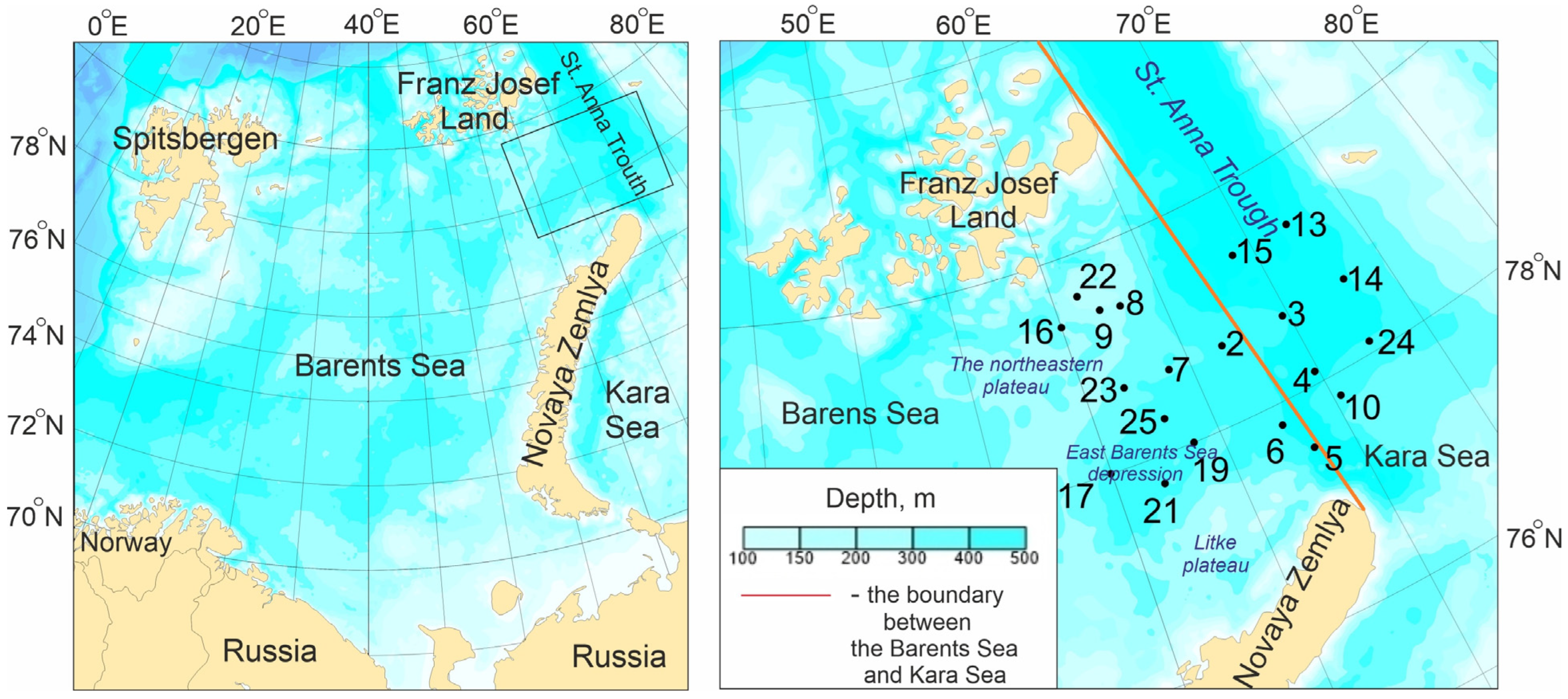
2.1. Study Area
2.2. Environmental Data
2.3. Phytopigment Analysis
2.4. Statistical Analysis
3. Results
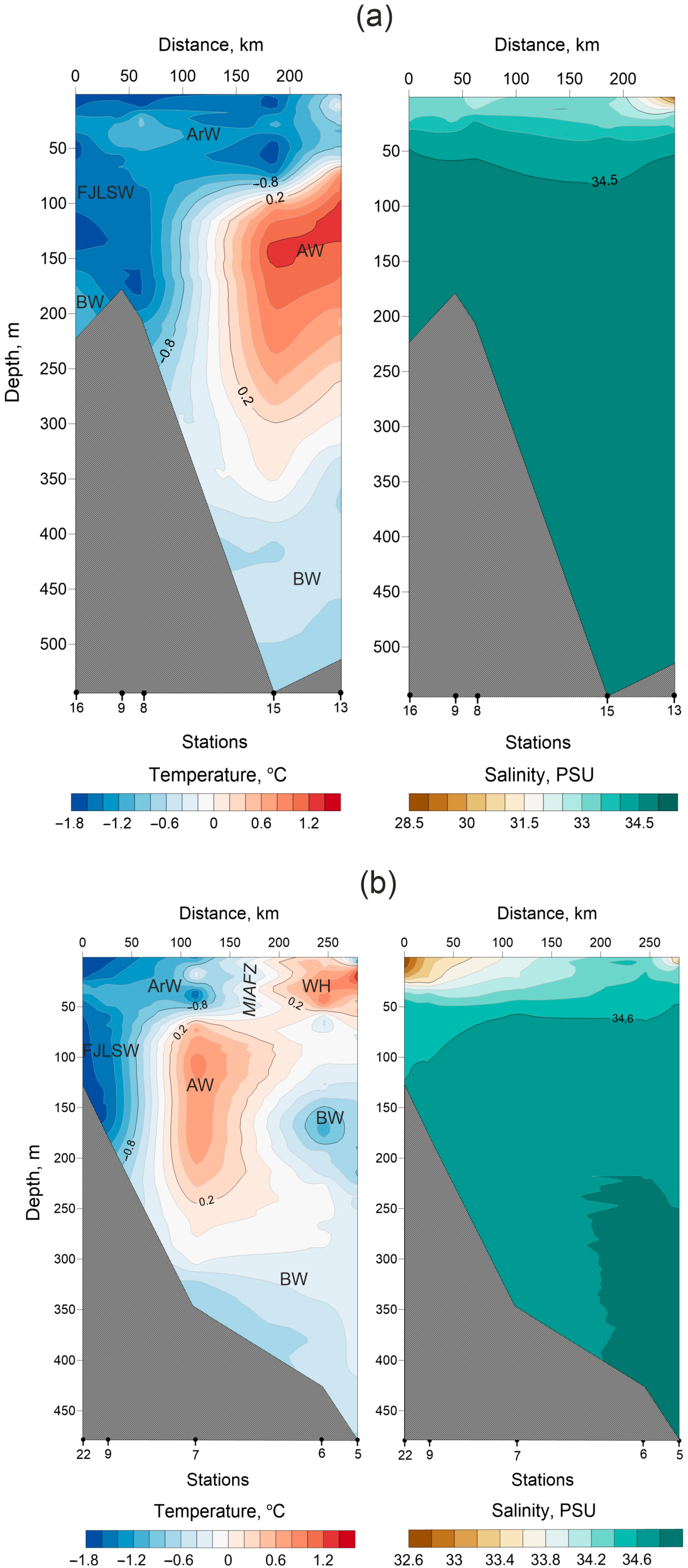
3.1. Environmental Conditions
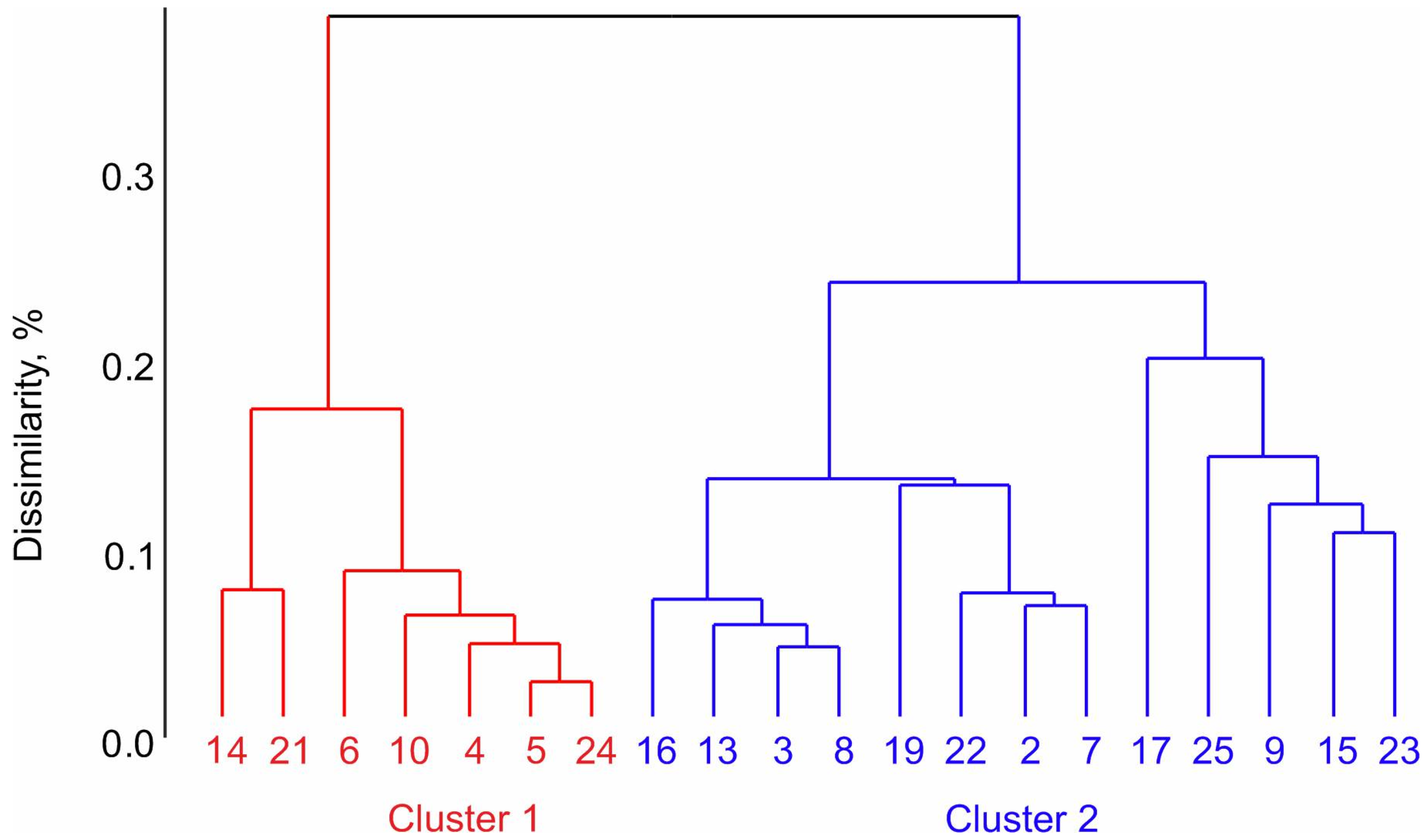
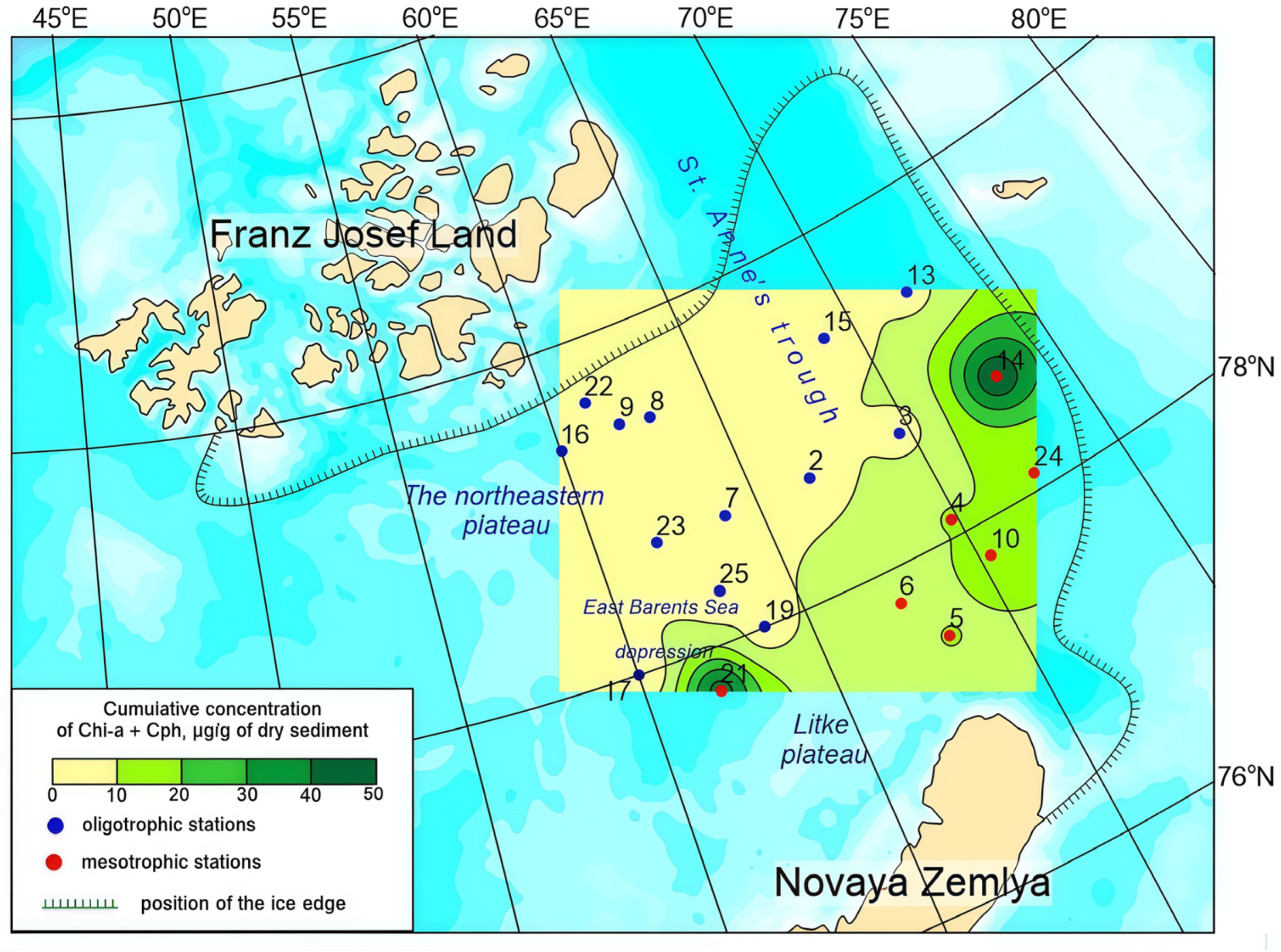
3.2. Sedimentary Pigments
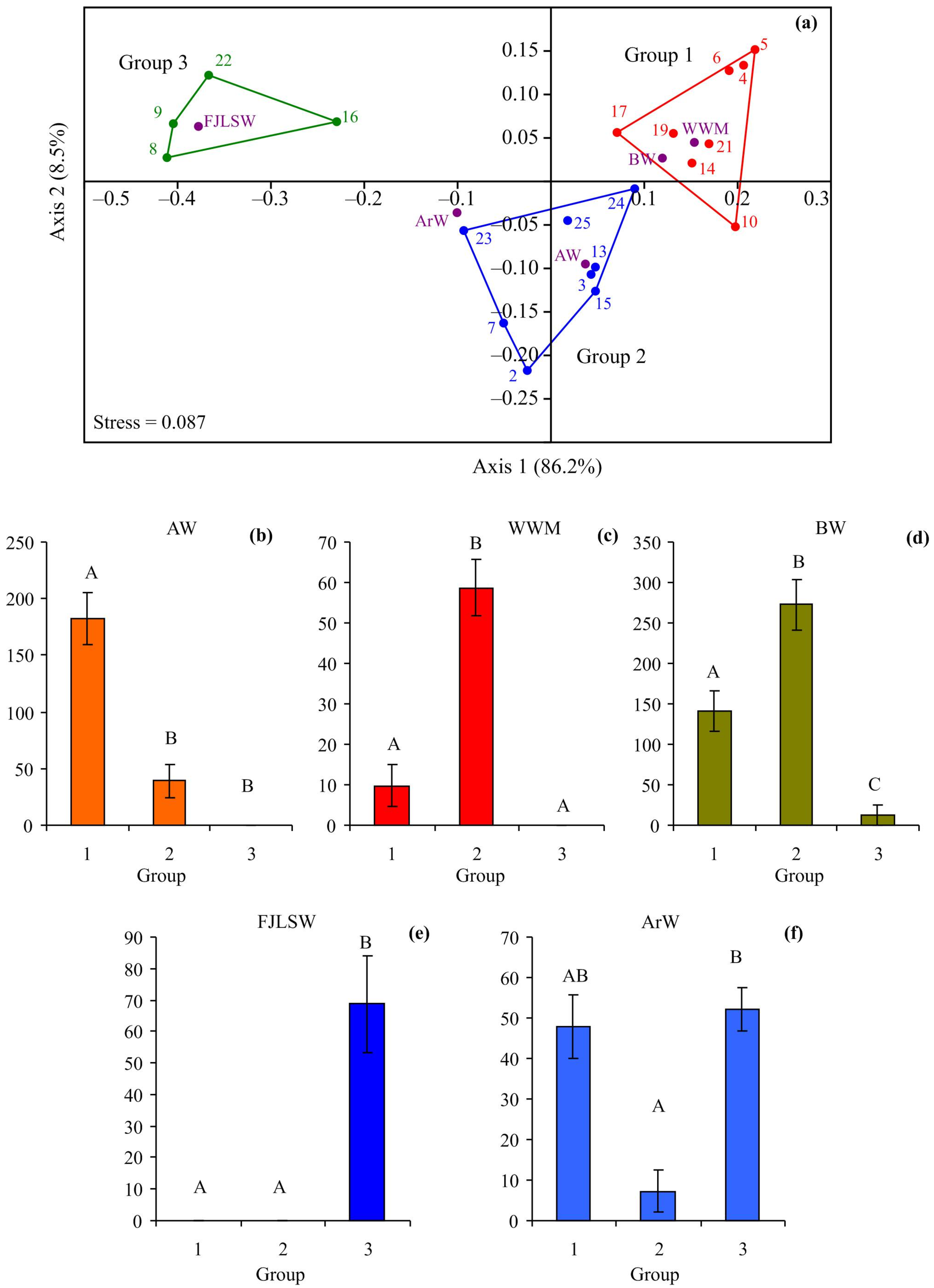
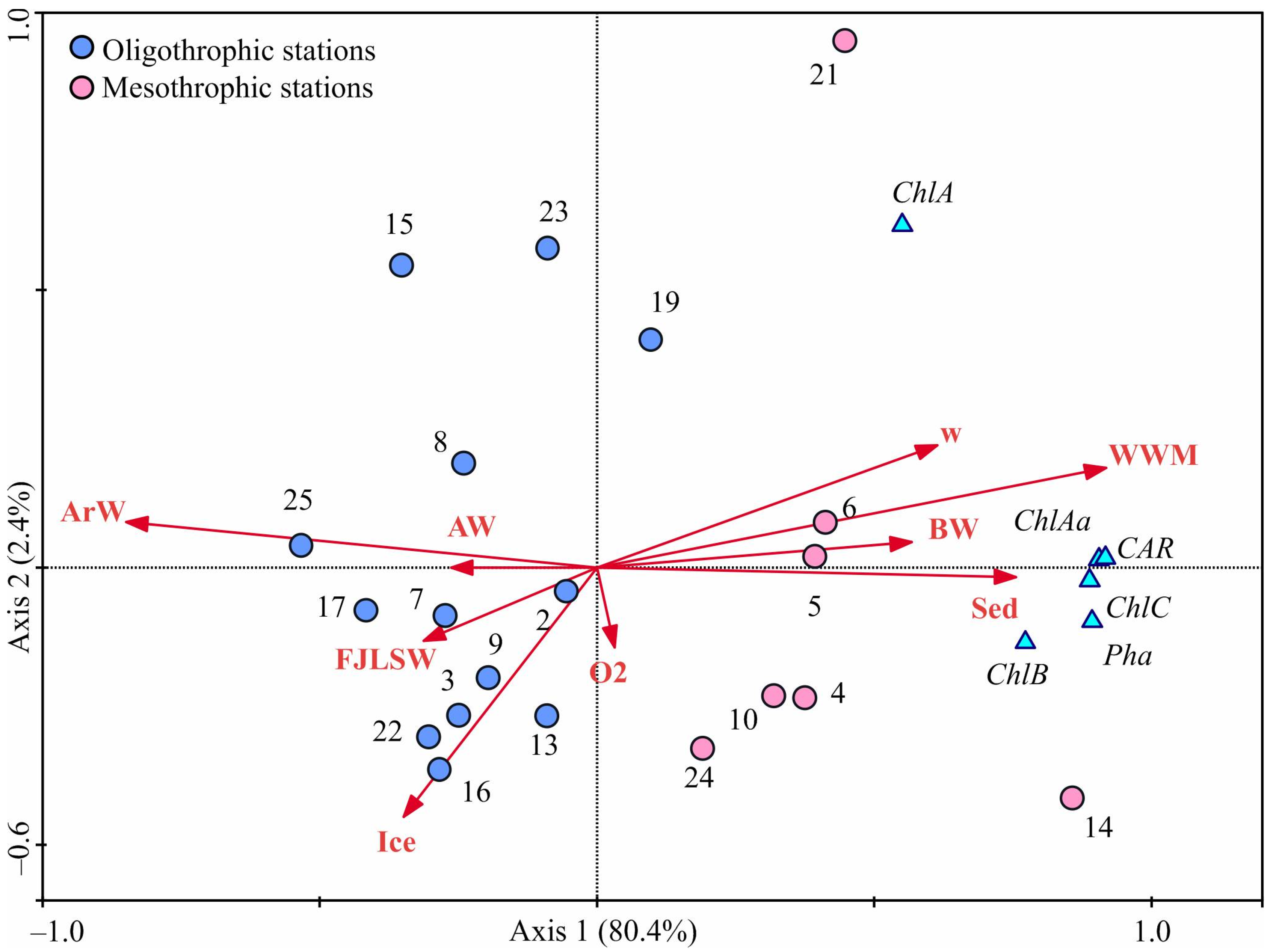
3.3. Environmental Drivers of Phytopigment Content
4. Discussion
4.1. Environmental Conditions
4.2. Phytopigment Variations in Bottom Sediments
4.3. Influence of Environmental Factors on the Spatial Distribution of Sedimentary Pigments
4.4. Sedimentary Pigments as Indicators of Environmental Change
5. Conclusions
Supplementary Materials
Author Contributions
Funding
Institutional Review Board Statement
Data Availability Statement
Acknowledgments
Conflicts of Interest
References
- MacIntyre, H.L.; Geider, R.J.; Miller, D.C. Microphytobenthos: The ecological role of the “secret garden” of unvegetated, shallow-water marine habitats. I. Distribution, abundance and primary production. Estuaries Coasts 1996, 19, 186–201. [Google Scholar] [CrossRef] [PubMed]
- Louda, J.W.; Li, J.; Liu, L.; Winfree, M.N.; Baker, E.W. Chlorophyll-a degradation during cellular senescence and death. Org. Geochem. 1998, 29, 1233–1251. [Google Scholar] [CrossRef]
- Louda, J.W.; Liu, L.; Baker, E.W. Senescence- and death-related alternation of chlorophylls and carotenoids in marine phytoplankton. Org. Geochem. 2002, 33, 1635–1653. [Google Scholar] [CrossRef]
- Margalef, R. Valeur indicatrice de la composition des pigments du phytoplankton sur la productivité, composition taxonomique et propriétés dynamiques des populations. Comm. Int. Explor. Sci. Mer Medit. Rapp. Proc. Verb. 1960, 15, 277–281. [Google Scholar]
- Sirenko, L.A. Information value of chlorophyll index. Hydrobiol. J. 1988, 24, 49–53. (In Russian) [Google Scholar]
- Möller, W.A.A.; Scharf, B.W. The content of chlorophyll in the sediment of the volcanic maar lakes in the Eifel region (Germany) as an indicator of eutrophication. Hydrobiologia 1986, 143, 327–329. [Google Scholar] [CrossRef]
- Jeffrey, S.W.; Vesk, M. Introduction to marine phytoplankton and their pigment signatures. In Phytoplankton Pigments in Oceanography; Jeffrey, S.W., Mantoura, R.F.C., Wright, S.W., Eds.; SCOR UNESCO Publishing: Paris, France, 1997; pp. 37–84. [Google Scholar]
- Leavitt, P.R.; Vinebrooke, R.D.; Donald, D.B.; Smol, J.P.; Schindler, D.W. Past ultraviolet radiation environments in lakes derived from fossil pigments. Nature 1997, 388, 457–459. [Google Scholar] [CrossRef]
- Pirtle-Levy, R.; Grebmeier, J.M.; Cooper, L.W.; Larsen, I.L. Chlorophyll a in Arctic sediments implies long persistence of algal pigments. Deep Sea Res. Part II Top. Stud. Oceanogr. 2009, 56, 1326–1338. [Google Scholar] [CrossRef]
- Makarevich, P.R.; Vodopyanova, V.V.; Oleinik, A.A. Floral communities in the pelagic zone of Kola Bay. In Structure and Functional Characteristics; Dzhenyuk, S.L., Ed.; SSC RAS Publishers: Rostov-on-Don, Russia, 2015; 192p. [Google Scholar]
- Makarevich, P.R.; Larionov, V.V.; Vodopyanova, V.V.; Bulavina, A.S.; Ishkulova, T.G.; Venger, M.P.; Pastukhov, I.A.; Vashchenko, A.V. Phytoplankton of the Barents Sea at the Polar Front in Spring. Oceanology 2021, 61, 930–943. [Google Scholar] [CrossRef]
- Makarevich, P.R.; Vodopyanova, V.V.; Bulavina, A.S. Dynamics of the spatial chlorophyll-a distribution at the polar front in the marginal ice zone of the Barents Sea during spring. Water 2022, 14, 101. [Google Scholar] [CrossRef]
- Makarevich, P.R.; Vodopyanova, V.V.; Bulavina, A.S.; Vashchenko, P.S.; Namyatov, A.A.; Pastukhov, I.A. Localization of early spring phytoplankton “bloom” centers in the Barents Sea pelagic zone. Mar. Biol. J. 2024, 9, 51–69. [Google Scholar] [CrossRef]
- Vodopyanova, V.V.; Dvoretsky, V.G.; Bulavina, A.S. Spatial and seasonal variability of the chlorophyll a concentration in the Barents Sea. Biol. Bull. Russ. Acad. Sci. 2024, 51, 410–420. [Google Scholar] [CrossRef]
- Vodopyanova, V.V.; Bulavina, A.S.; Druzhkova, E.I.; Pastukhov, I.A.; Berchenko, I.V.; Vashchenko, A.V.; Venger, M.P. Vertical distribution of some components of the Barents Sea plankton communities under seasonal pycnocline conditions. Biol. Bull. Russ. Acad. Sci. 2025, 52, 10. [Google Scholar] [CrossRef]
- Koreneva, T.G.; Sigareva, L.E. Pigments in the bottom sediments of Aniva Bay (Sea of Okhotsk). Geosyst. Transit. Zones 2022, 6, 60–73. (In Russian) [Google Scholar] [CrossRef]
- Paerl, H.W.; Valdes, L.M.; Pinckney, J.L.; Piehler, M.F.; Dyble, J.; Moisander, P.H. Phytoplankton photopigments as indicators of estuarine and coastal eutrophication. BioScience 2003, 53, 953–964. [Google Scholar] [CrossRef]
- Reuss, N.; Conley, D.J.; Bianchi, T.S. Preservation conditions and the use of sediment pigments as a tool for recent ecological reconstruction in four Northern European estuaries. Mar. Chem. 2005, 95, 283–302. [Google Scholar] [CrossRef]
- Chen, J.; Oseji, O.; Mitra, M.; Waguespack, Y.; Chen, N. Phytoplankton pigments in Maryland coastal bay sediments as biomarkers of sources of organic matter to benthic community. J. Coast. Res. 2016, 732, 68–775. [Google Scholar] [CrossRef]
- Itoh, N.; Tani, Y.; Soma, M. Sedimentary photosynthetic pigments of algae and phototrophic bacteria in Lake Hamana, Japan: Temporal changes of anoxia in its five basins. Limnology 2003, 4, 139–148. [Google Scholar] [CrossRef]
- Leavitt, P.R.; Hodgson, D.A. Sedimentary pigments. In Tracking Environmental Change Using Lake Sediments; Smol, J.P., Birks, H.J., Last, W.M., Eds.; Kluwer Academic Publisher: Dordrecht, The Netherlands, 2001; Volume 3, pp. 295–325. [Google Scholar]
- Kowalewska, G. Algal pigments in sediments as a measure of eutrophication in the Baltic environment. Quat. Int. 2005, 130, 141–151. [Google Scholar] [CrossRef]
- Vinberg, G.G. The current state and tasks of studying the primary production of reservoirs. In Primary Production of the Seas and Inland Waters; Publishing House of Higher, Secondary and Professional Education: Minsk, Belarus, 1961; pp. 11–24. (In Russian) [Google Scholar]
- Welshmeyer, N.A.; Lorenzen, C.J. Chlorophyll budgets: Zooplankton grazing and phytoplankton growth in a temperate fjord and the Central Pacific Gyres. Limnol. Oceanogr. 1985, 30, 1–21. [Google Scholar] [CrossRef]
- Sun, M.Y.; Aller, R.C.; Lee, C. Spatial and temporal distributions of sedimentary chloropigments as indicators of benthic processes in Long Island Sound. J. Mar. Res. 1994, 52, 149–176. [Google Scholar] [CrossRef]
- Zhou, H.; Zeng, R.; Cong, B.; Jiang, Q.; Zhang, Z. Spatiotemporal distribution of sedimentary chloropigments and organic carbon in a shelf sea ecosystem, with a focus on the cold water mass. Mar. Dev. 2024, 2, 25. [Google Scholar] [CrossRef]
- Meyers, P.A. Organic geochemical proxies of paleoceanographic, paleolimnologic, and paleoclimatic processes. Org. Geochem. 1997, 27, 213–250. [Google Scholar] [CrossRef]
- Miller, D.C.; Geider, H.L.; MacIntyre, H.L. The ecological role of the “secret garden” of unvegetated, shallow-water marine habitats. II. Role in sediment stability and shallow-water food webs. Estuaries 1996, 19, 202–212. [Google Scholar] [CrossRef]
- Rauser-Chernousova, D.M. On the quantitative determination of chlorophyll in modern and fossil marine sediments. Bull. MOIP Geol. 1930, 3, 285–300. (In Russian) [Google Scholar]
- Sun, M.Y.; Aller, R.C. Early diagenesis of chlorophyll-a in Long Island Sound: A measure of carbon flux and particle reworking. J. Mar. Res. 1991, 49, 379–401. [Google Scholar] [CrossRef]
- Bianchi, T.S.; Findlay, S.; Dawson, R. Organic matter sources in the water column and sediments of the Hudson River Estuary: The use of plant pigments as tracers. Estuar. Coast. Shelf Sci. 1993, 36, 359–376. [Google Scholar] [CrossRef]
- Ambrose, W.G.; Renaud, P.E. Benthic response to water column productivity patterns: Evidence for benthic-pelagic coupling in the northeast water polynya. J. Geophys. Res. Ocean. 1995, 100, 4411–4421. [Google Scholar] [CrossRef]
- Kowalewska, G.; Witkowski, A.; Toma, B. Chlorophylls c in bottom sediments as markers of diatom biomass in the southern Baltic Sea. Oceanologia 1996, 38, 227–249. [Google Scholar]
- Kowalewska, G.; Winterhalter, B.; Talbot, H.M.; Maxwell, J.R.; Konat, J. Chlorins in sediments of the Gotland Deep (Baltic Sea). Oceanologia 1999, 41, 81–97. [Google Scholar]
- Kowalewska, G. Chlorophyll a and its derivatives in recent sediments of the southern Baltic Sea collected in the years 1992–1996. Oceanologia 1997, 39, 413–432. [Google Scholar]
- Zapata, M.; Jeffrey, S.W.; Wright, S.W.; Rodriguez, F.; Garrido, J.L.; Clemenston, L. Photosynthetic pigments in 37 species (65 strains) of Haptophyta: Implications for oceanography and chemotaxonomy. Mar. Ecol. Prog. Ser. 2004, 270, 83–102. [Google Scholar] [CrossRef]
- Szymczak-Żyła, M.; Kowalewska, G.; Louda, J.W. Chlorophyll-a and derivatives in recent sediments as indicators of productivity and depositional conditions. Mar. Chem. 2011, 125, 39–48. [Google Scholar] [CrossRef]
- Dvoretsky, V.G.; Dvoretsky, A.G. Epiplankton in the Barents Sea: Summer variations of mesozooplankton biomass, community structure and diversity. Cont. Shelf Res. 2013, 52, 1–11. [Google Scholar] [CrossRef]
- Dvoretsky, V.G.; Dvoretsky, A.G. Structure of mesozooplankton community in the Barents Sea and adjacent waters in August 2009. J. Nat. Hist. 2013, 47, 2095–2114. [Google Scholar] [CrossRef]
- Krajewska, M.; Rajewska, M.; Szymczak-Żyła, M.; Kowalewska, G. Algal pigments in Hornsund (Svalbard) sediments as biomarkers of Arctic productivity and environmental conditions. Polar Res. 2017, 38, 423–443. [Google Scholar] [CrossRef][Green Version]
- Hansen, J.L.S.; Josefson, A.B. Accumulation of algal pigments and live planktonic diatoms in aphotic sediments during the spring bloom in the transition zone of the North and Baltic Seas. Mar. Ecol. Prog. Ser. 2003, 248, 41–54. [Google Scholar] [CrossRef]
- Smayda, T.J. Normal and accelerated sinking of phytoplankton in the sea. Mar. Geol. 1971, 11, 105–122. [Google Scholar] [CrossRef]
- Billett, D.S.M.; Lampitt, R.S.; Rice, A.L.; Mantoura, R.C.F. Seasonal sedimentation of phytoplankton to the deep-sea benthos. Nature 1983, 302, 520–522. [Google Scholar] [CrossRef]
- Alldredge, A.L.; Gotschalk, G.C. Direct observation of mass flocculation of diatom blooms: Characteristics, settling velocities and formation of diatom aggregates. Deep Sea Res. Part A. Oceanogr. Res. Pap. 1989, 26, 159–171. [Google Scholar] [CrossRef]
- Zernova, V.V.; Nöthig, E.M.; Shevchenko, V.P. Vertical microalgae fluxes at the mooring station LOMO-2 over the Lomonosov Ridge in the period from September 15, 1995, till August 16, 1996. Oceanology 2000, 40, 801–808. [Google Scholar] [CrossRef]
- Sakshaug, E. Primary and secondary production in the Arctic Seas. In The Organic Carbon Cycle in the Arctic Ocean; Stein, R., Macdonald, R.W., Eds.; Springer: Berlin/Heidelberg, Germany, 2004; pp. 57–81. [Google Scholar]
- Boles, E.; Provost, C.; Garcon, V.; Bertosio, C.; Athanase, M.; Koenig, Z.; Sennéchael, N. Under-ice phytoplankton blooms in the central Arctic Ocean: Insights from the first biogeochemical IAOOS platform drift in 2017. J. Geophys. Res. Ocean. 2020, 125, e2019JC015608. [Google Scholar] [CrossRef]
- Assmy, P.; Fernández-Méndez, M.; Duarte, P.; Meyer, A.; Randelhoff, A.; Mundy, C.J.; Olsen, L.M.; Kauko, H.M.; Bailey, A.; Chierici, M.; et al. Leads in Arctic pack ice enable early phytoplankton blooms below snow-covered sea ice. Sci. Rep. 2017, 7, 40850. [Google Scholar] [CrossRef] [PubMed]
- Dvoretsky, V.G.; Vodopianova, V.V.; Bulavina, A.S. Effects of climate change on chlorophyll a in the Barents Sea: A long-term assessment. Biology 2023, 12, 119. [Google Scholar] [CrossRef] [PubMed]
- Dvoretsky, A.G.; Dvoretsky, V.G. Fluctuations of net primary production along a standard transect in the Barents Sea and their relationships with environmental factors. Environ. Res. 2026, 288, 123177. [Google Scholar] [CrossRef]
- Round, F.E.; Crawford, R.M.; Mann, D.G. The Diatoms: Biology and Morphology of the Genera; Cambridge University Press: Cambridge, UK, 1990; 747p. [Google Scholar]
- Mosharov, S.A.; Demidov, A.B.; Simakova, U.V. Peculiarities of the primary production process in the Kara Sea at the end of the vegetation season. Oceanology 2016, 56, 84–94. [Google Scholar] [CrossRef]
- Mosharov, S.A.; Sergeeva, V.M.; Kremenetskiy, V.V.; Sazhin, A.F.; Stepanova, S.V. Assessment of phytoplankton photosynthetic efficiency based on measurement of fluorescence parameters and radiocarbon uptake in the Kara Sea. Estuar. Coast. Shelf Sci. 2019, 218, 59–69. [Google Scholar] [CrossRef]
- Shevchenko, V.P.; Ivanov, G.I.; Zernova, V.V. Vertical particle fluxes in the St. Anna Trough and in the eastern Barents Sea in August–September 1994. Ber. Polarforsch. 1999, 342, 46–54. [Google Scholar]
- Witkowski, A.; Lange-Bertalot, H.; Metzeltin, D. Diatom Flora of Marine Coasts I; A.R.G. Gantner Verlag: Ruggell, Liechtenstein, 2000; 925p. [Google Scholar]
- Ryabushko, L.I.; Balicheva, D.S.; Strijak, A.V. Diatom epiphyton of some green algae and periphyton of anthropogenic substrates of Crimean coastal the Black Sea. Algologia 2013, 23, 419–437. (In Russian) [Google Scholar] [CrossRef]
- Itakura, S.; Imai, I.; Itoh, K. “Seed bank” of coastal planktonic diatoms in bottom sediments of Hiroshima Bay, Seto Inland Sea, Japan. Mar. Biol. 1997, 128, 497–508. [Google Scholar] [CrossRef]
- Lewis, J.; Harris, A.S.D.; Jones, K.J.; Edmonds, R.L. Long-term survival of marine planktonic diatoms and dinoflagellates in stored sediment samples. J. Plankton Res. 1999, 21, 343–354. [Google Scholar] [CrossRef]
- Sun, M.Y.; Lee, C.; Aller, R.C. Laboratory studies of oxic and anoxic degradation of chlorophyll-a in Long Island Sound sediments. Geochim. Cosmochim. Acta 1993, 57, 147–157. [Google Scholar] [CrossRef]
- Graf, G.; Gerlach, S.A.; Linke, P.; Queisser, W.; Ritzrau, W.; Scheltz, A.; Thomsen, L.; Witte, U. Benthic-pelagic coupling in the Greenland-Norwegian Sea and its effect on the geological record. Geol. Rundsch. 1995, 84, 49–58. [Google Scholar] [CrossRef]
- Hansen, J.L.S.; Josefson, A.B. Pools of chlorophyll and live planktonic diatoms in aphotic marine sediments. Mar. Biol. 2001, 139, 289–299. [Google Scholar] [CrossRef]
- Morata, N.; Renaud, P.E. Sedimentary pigments in the western Barents Sea: A reflection of pelagic-benthic coupling? Deep Sea Res. Part II Top. Stud. Oceanogr. 2008, 55, 2381–2389. [Google Scholar] [CrossRef]
- Dvoretsky, A.G.; Dvoretsky, V.G. Filling knowledge gaps in Arctic marine biodiversity: Environment, plankton, and benthos of Franz Josef Land, Barents Sea. Ocean Coast. Manag. 2024, 249, 106987. [Google Scholar] [CrossRef]
- Dvoretsky, V.G.; Dvoretsky, A.G. Local variability of Arctic mesozooplankton biomass and production: A case summer study. Environ. Res. 2024, 241, 117416. [Google Scholar] [CrossRef]
- Dvoretsky, V.G.; Dvoretsky, A.G. Spatial pattern of spring mesozooplankton in the Marginal Ice Zone (northern Barents Sea). Animals 2026, 16, 1213. [Google Scholar] [CrossRef]
- Evseeva, O.Y.; Dvoretsky, A.G. Littoral bryozoan communities in the high Arctic: A latitudinal comparison. Sci. Nat. 2026, 113, 4. [Google Scholar] [CrossRef]
- Frolova, E.A.; Lyubina, O.S.; Dikayeva, D.R.; Ahmetchina, O.Y.; Frolov, A.A. Effect of climatic changes on the zoobenthos of the Barents Sea (on the example of several abundant species). Dokl. Biol. Sci. 2007, 416, 349–351. [Google Scholar] [CrossRef]
- Noskovich, A.E.; Dvoretsky, A.G. Bivalves as indicators of interannual temperature variability in the Kola Transect (Barents Sea). Mar. Pollut. Bull. 2026, 227, 119419. [Google Scholar] [CrossRef]
- Noskovich, A.E.; Dvoretsky, A.G. Spatial and temporal variations in functional diversity of bivalve molluscs in the southern Barents Sea. Aquat. Conserv. Mar. Freshw. Ecosyst. 2026, 36, e70385. [Google Scholar] [CrossRef]
- Klenova, M.V. Geology of the Barents Sea; Academy of Sciences Publishers: Moscow, USSR, 1960; 368p. (In Russian) [Google Scholar]
- Zenkevitch, L. Biology of the Seas of the USSR; Wiley-InterScience: New York, NY, USA, 1963; 955p. [Google Scholar]
- Kubryakov, A.; Stanichny, S.; Zatsepin, A. River plume dynamics in the Kara Sea from altimetry-based lagrangian model, satellite salinity and chlorophyll data. Remote Sens. Environ. 2016, 176, 177–187. [Google Scholar] [CrossRef]
- Gloersen, P.; Campbell, W.; Cavalieri, D.; Comiso, J.C.; Parkinson, C.L.; Zwally, H.J. Arctic and Antarctic Sea Ice 1978–1987: Satellite Passive-Microwave Observations and Analysis; NASA SP-511; National Aeronautics and Space Administration: Washington, DC, USA, 1992. [Google Scholar]
- Matishov, G.G.; Dzhenyuk, S.L.; Denisov, V.V.; Zhichkin, A.P.; Moiseev, D.V. Taking into account of the Barents Sea climate secular dynamics in course of marine activity planning. Trans. Kola Sci. Cent. 2013, 1, 56–71. (In Russian) [Google Scholar]
- Matishov, G.G.; Berdnikov, S.V.; Zhichkin, A.P. Atlas of Climatic Changes in Large Marine Ecosystems of the Northern Hemisphere (1873–2013); Region 1. The Eastern Arctic Seas; Region 2. The Black Sea, the Sea of Azov, and the Caspian Sea; SSC RAS: Rostov, Russia, 2014. (In Russian) [Google Scholar]
- Dvoretsky, V.G.; Dvoretsky, A.G. Effects of water temperature on zooplankton abundance and biomass in the southwestern Barents Sea: Implications for Arctic monitoring and management. Ocean Coast. Manag. 2025, 261, 107506. [Google Scholar] [CrossRef]
- Dvoretsky, V.G.; Dvoretsky, A.G. Summer zooplankton assemblages in the Barents Sea: Spatial variations and effects of environmental conditions as revealed from in situ and satellite data. Prog. Oceanogr. 2025, 231, 103417. [Google Scholar] [CrossRef]
- Polyakov, I.V.; Alkire, M.B.; Bluhm, B.A.; Brown, K.A.; Carmack, E.C.; Chierici, M.; Danielson, S.L.; Ellingsen, I.; Ershova, E.A.; Gårdfeldt, K.; et al. Borealization of the Arctic Ocean in Response to Anomalous Advection From Sub-Arctic Seas. Front. Mar. Sci. 2020, 7, 491. [Google Scholar] [CrossRef]
- Lis, N.A.; Egorova, E.S. Climatic variability of the ice extent of the Barents Sea and its individual area. Arct. Antarct. Res. 2022, 68, 234–247. (In Russian) [Google Scholar] [CrossRef]
- Trofimov, A.G.; Karsakov, A.L.; Ivshin, V.A. Climate changes in the Barents Sea over the last half century. Tr. VNIRO 2018, 173, 79–91. (In Russian) [Google Scholar] [CrossRef]
- Lim, S.M.; Payne, C.M.; van Dijken, G.L.; Arrigo, K.R. Increases in Arctic sea ice algal habitat, 1985–2018. Elem. Sci. Anth. 2022, 10, 1. [Google Scholar] [CrossRef]
- Frolova, A.V.; Morozov, E.A.; Pozdnyakov, D.V. The Arctic Ocean Primary Production in Response to Amplification of Climate Change: Insights from 2003–2022 Satellite Data. Izv. Atmos. Ocean. Phys. 2023, 59, 1450–1458. [Google Scholar] [CrossRef]
- Lewis, K.M.; van Dijken, G.L.; Arrigo, K.R. Changes in phytoplankton concentration now drive increased Arctic Ocean primary production. Science 2020, 369, 198–202. [Google Scholar] [CrossRef]
- Kudryavtseva, E.A.; Kravchishina, M.D.; Pautova, L.A.; Rusanov, I.I.; Silkin, V.A.; Glukhovets, D.I.; Torgunova, N.I.; Netsvetaeva, O.P.; Politova, N.V.; Klyuvitkin, A.A.; et al. Size structure of primary producers in the marginal ice zone of the European Arctic in summer. Dokl. Earth Sci. 2022, 507, S313–S318. [Google Scholar] [CrossRef]
- Zhulay, I.; Iken, K.; Renaud, P.E.; Kosobokova, K.; Bluhm, B.A. Reduced efficiency of pelagic–benthic coupling in the Arctic deep sea during lower ice cover. Sci. Rep. 2023, 13, 6739. [Google Scholar] [CrossRef]
- Bienhold, C.; Schourup-Kristensen, V.; Krumpen, T.; Nöthig, E.M.; Wenzhöfer, F.; Korhonen, M.; Vredenborg, M.; Hehemann, L.; Boetius, A. Effects of sea ice retreat and ocean warming on the Laptev Sea continental slope ecosystem (1993 vs 2012). Front. Mar. Sci. 2022, 9, 1004959. [Google Scholar] [CrossRef]
- Yastrebova, L.A. Chlorophyll in marine sediments. In Works on the Geology of the Sea: Proceedings of VNIRO; United Scientific and Technical Publishing House of NKTP USSR: Moscow/Leningrad, USSR, 1938; Volume 5, pp. 189–224. (In Russian) [Google Scholar]
- Klenova, M.V.; Yastrebova, L.A. Chlorophyll in sediments as an indicator of the gas regime of the basin. In Works on the Geology of the Sea: Proceedings of VNIRO; United Scientific and Technical Publishing House of NKTP USSR: Moscow/Leningrad, USSR, 1938; Volume 5, pp. 65–70. (In Russian) [Google Scholar]
- Morata, N.; Renaud, P.E.; Brugel, S.; Hobson, K.A.; Johnson, B.J. Spatial and seasonal variations in the pelagic–benthic coupling of the southeastern Beaufort Sea revealed by sedimentary biomarkers. Mar. Ecol. Prog. Ser. 2008, 371, 47–63. [Google Scholar] [CrossRef]
- Renaud, P.E.; Morata, N.; Carroll, M.; Denisenko, S.G.; Reigstad, M. Pelagic–benthic coupling in the western Barents Sea: Processes and time scales. Deep Sea Res. Part II Top. Stud. Oceanogr. 2008, 55, 2372–2380. [Google Scholar] [CrossRef]
- Cochrane, S.K.J.; Denisenko, S.G.; Renaud, P.E.; Emblow, C.S.; Ambrose, W.G.; Ellingsen, I.H.; Skarðhamar, J. Benthic macrofauna and productivity regimes in the Barents Sea: Ecological implications in a changing Arctic. J. Sea Res. 2009, 61, 222–233. [Google Scholar] [CrossRef]
- Pfannkuche, O.; Thiel, H. Meiobenthic stocks and benthic activity on the NE-Svalbard shelf and in the Nansen Basin. Polar Biol. 1987, 7, 253–266. [Google Scholar] [CrossRef]
- Korsun, S.; Hald, M.; Panteleeva, N.; Tarasov, G. Biomass of foraminifera in the St. Anna Trough, Russian arctic continental margin. Sarsia 1998, 83, 419–431. [Google Scholar] [CrossRef]
- Kirillov, S.A.; Dmitrenko, I.A.; Ivanov, V.V.; Aksenov, E.O.; Makhotin, M.S.; de Quevas, B.A. The influence of atmospheric circulation on the dynamics of the intermediate water layer in the eastern part of the St. Anna Trough. Dokl. Earth Sci. 2012, 444, 630–633. [Google Scholar] [CrossRef]
- Schauer, U.; Loeng, H.; Rudels, B.; Ozhigin, V.K.; Dieck, W. Atlantic Water flow through the Barents and Kara Seas. Deep Sea Res. Part I Oceanogr. Res. Pap. 2002, 49, 2281–2298. [Google Scholar] [CrossRef]
- Lien, V.S.; Trofimov, A.G. Formation of Barents Sea branch water in the northeastern Barents Sea. Polar Res. 2013, 32, 18905. [Google Scholar] [CrossRef]
- Makhotin, M.; Ivanov, V. Circulation of the Atlantic water in the Barents Sea based on hydrological survey data and numerical simulation. Proc. Hydrometcent. Russ. 2016, 361, 169–191. (In Russian) [Google Scholar]
- Osadchiev, A.; Viting, K.; Frey, D.; Demeshko, D.; Dzhamalova, A.; Nurlibaeva, A.; Gordey, A.; Krechik, V.; Spivak, E.; Semiletov, I.; et al. Structure and circulation of Atlantic Water masses in the St. Anna Trough in the Kara Sea. Front. Mar. Sci. 2022, 9, 915674. [Google Scholar] [CrossRef]
- Zabudkina, Z.; Osadchiev, A.; Ivanov, V.; Makhotin, M.; Merkulov, V. Interannual variability of the Barents Sea branch water in the northeastern part of the Barents Sea and the St. Anna Trough. Front. Mar. Sci. 2025, 12, 1569186. [Google Scholar] [CrossRef]
- Dmitrenko, I.A.; Rudels, B.; Kirillov, S.A.; Aksenov, Y.O.; Lien, V.S.; Ivanov, V.V.; Schauer, U.; Polyakov, I.V.; Coward, A.; Barber, D.G. Atlantic water flow into the Arctic Ocean through the St. Anna Trough in the northern Kara Sea. J. Geophys. Res. Ocean. 2015, 120, 5158–5178. [Google Scholar] [CrossRef]
- Ivanov, V.V.; Frolov, I.E.; Filchuk, K.V. Transformation of Atlantic water in the north-eastern Barents Sea in winter. Probl. Arkt. Antarkt. 2020, 66, 246–264. [Google Scholar] [CrossRef]
- Konik, A.A.; Zimin, A.V.; Atadzhanova, O.A. Quantitative estimations of the variability of characteristics of the temperature of the sea surface in the front of the frontal zone of the Kara Sea. Fundam. Appl. Hydrophys. 2019, 12, 54–61. (In Russian) [Google Scholar] [CrossRef]
- Tarasov, G.A.; Ivanov, G.; Kukina, N.A.; Matishov, G.G. Granulometrical structure of surface sediments in the St. Anna Trough area. Ber. Polarforsch. 1999, 342, 124–133. [Google Scholar]
- Krylov, A.A.; Ivanov, G.I.; Sergeeva, E.I. Recent sedimentation in the St. Anna Trough (Kara Sea). Oceanology 2005, 45, 107–115. (In Russian) [Google Scholar]
- Ivanov, G.I.; Svertilov, A.A.; Kholmyanskii, M.A. Physicomechanical properties of the water-sediment barrier zone. Oceanology 2012, 52, 810–816. [Google Scholar] [CrossRef]
- Shevchenko, V.P.; Ivanov, G.I.; Shanin, S.S.; Romankevich, E.A. Distribution of total suspended matter and particulate organic carbon in the St. Anna Trough and in the Barents Sea. Ber. Polarforsch. 1999, 342, 55–67. [Google Scholar]
- Glyaznetsova, Y.S.; Nemirovskaya, I.A. Features of bitumoid distribution in bottom sediments of the Barents Sea. Oceanology 2020, 60, 831–839. [Google Scholar] [CrossRef]
- Sukhanova, I.N.; Flint, M.V.; Druzhkova, E.I.; Sazhin, A.F.; Sergeeva, V.M. Phytoplankton in the Northwestern Kara Sea. Oceanology 2015, 55, 547–560. [Google Scholar] [CrossRef]
- Loeng, H.; Ozhigin, V.; Ådlandsvik, B.; Sagen, H. Current measurements in the northeastern Barents Sea. ICES J. Mar. Sci. 1993, 40, 22. [Google Scholar]
- Loeng, H.; Ozhigin, V.; Ådlandsvik, B. Water fluxes through the Barents Sea. ICES J. Mar. Sci. 1997, 54, 310–317. [Google Scholar] [CrossRef]
- Maksimovskaya, T.M.; Ilyin, G.V. Hydrological studies in the north-eastern part of the Barents Sea in 2019 and 2020. Trans. Kola Sci. Cent. 2021, 9, 75–81. (In Russian) [Google Scholar] [CrossRef]
- Loeng, H. Features of the physical oceanographic conditions in the Barents Sea. Polar Res. 1991, 10, 5–18. [Google Scholar] [CrossRef]
- Lind, S.; Ingvaldsen, R.B. Variability and impacts of Atlantic Water entering the Barents Sea from the north. Deep Sea Res. Part I Oceanogr. Res. Pap. 2012, 62, 70–88. [Google Scholar] [CrossRef]
- Pfirman, S.L.; Bauch, D.; Gammelsrød, T. The northern Barents Sea: Water mass distribution and modification. In The Polar Oceans and Their Role in Shaping the Global Environment; Geophysical Monograph 85; American Geophysical Union: Hoboken, NJ, USA, 1994; pp. 77–94. [Google Scholar] [CrossRef]
- Walsh, D.; Polyakov, I.; Timokhov, L.; Carmack, E. Thermohaline structure and variability in the eastern Nansen Basin as seen from historical data. J. Mar. Res. 2007, 65, 685–714. [Google Scholar] [CrossRef]
- Mamaev, O.I. Thermohaline Analysis of the World Ocean Waters; Hydrometeoizdat: Leningrad, USSR, 1987; 296p. (In Russian) [Google Scholar]
- Istoshin, Y.V. Marine Hydrometry; Hydrometeorological Publishing House: Leningrad, USSR, 1967; 407p. (In Russian) [Google Scholar]
- Murdmaa, I.O. Oceanic facies. In Ocean Geology: Sedimentation and Magmatism of the Ocean; Monin, A.S., Lisitsyn, A.P., Eds.; Nauka: Moscow, Russia, 1976; pp. 269–306. (In Russian) [Google Scholar]
- Pavlova, L.V.; Dvoretsky, A.G.; Frolov, A.A.; Zimina, O.L.; Evseeva, O.Y.; Dikaeva, D.R.; Rumyantseva, Z.Y.; Panteleeva, N.N. Impact of sea ice loss on benthic communities of the Makarov Strait (northeastern Barents Sea). Animals 2023, 13, 2320. [Google Scholar] [CrossRef]
- Vohra, D.F. Determination of Photosynthetic Pigments in Sea-Water. In Monographs on Oceanographic Methodology; UNESCO: Paris, France, 1966; Volume 1. [Google Scholar]
- Bykova, E.A.; Labunskaya, E.A.; Krasnova, E.D.; Voronov, D.A.; Kapatcinskaya, A.A.; Shushkevich, U.I.; Tyurina, T.M.; Chergintcev, D.A.; Podolyan, A.O. The thin layer chromatography method in analyses of pigment composition in planktonic algae, forming colored layers in meromictic lakes of the White Sea aquatory. In Geology of Seas and Oceans: Proceedings of XXII International Conference on Marine Geology; IO RAS: Moscow, Russia, 2017; Volume III, pp. 175–178. (In Russian) [Google Scholar]
- Aminot, A.; Rey, F. Standard Procedure for the Determination of Chlorophyll a by Spectroscopic Methods; ICES Techniques in Marine Environmental Sciences; International Council for the Exploration of the Sea: Copenhagen, Denmark, 2000. [Google Scholar]
- GOST 17.1.4.02-90; Water: Methodology for Spectrophotometric Determination of Chlorophyll a; State Water Quality Control. IPK Izd. Standartov: Moscow, Russia, 2001; pp. 551–563.
- Elizarova, V.A. Content of photosynthetic pigments in a unit of phytoplankton biomass. Proc. Inst. Biol. Inland Waters 1974, 28, 46–64. [Google Scholar]
- Raymont, J. Plankton and Productivity in the Oceans; Volume 1: Phytoplankton; Light and Food Industry: Moscow, Russia, 1983; 568p. (In Russian) [Google Scholar]
- Margalef, R. Correlations entre certains caractères synthétiques des populations de phytoplankton. Hydrobiologia 1961, 18, 155–164. [Google Scholar] [CrossRef]
- Boulion, V.V. The content of pheopigments in plankton (review). Hydrobiol. J. 1978, 14, 62–69. [Google Scholar]
- Boulion, V.V. Primary Production of Plankton in Inland Water Bodies; Nauka: Leningrad, USSR, 1983; 150p. (In Russian) [Google Scholar]
- Dmitrovich, N.P.; Kozlova, T.V. Influence of physiological state of microalgae on the ratio of different pigments in their cells. Bull. Poles. State Univ. Ser. Nat. Sci. 2015, 1, 40–43. (In Russian) [Google Scholar]
- Odum, E.P. Fundamentals of Ecology, 2nd ed.; Saunders: Philadelphia, PA, USA, 1959; Available online: https://archive.org/details/fundamentalsofec00odum/page/n9/mode/2up?view=theater (accessed on 11 January 2024).
- Jeffrey, S.W. A report on green algal pigments in the central North Pacific Ocean. Mar. Biol. 1976, 37, 33–37. [Google Scholar] [CrossRef]
- Jeffrey, S.W.; Mantoura, R.F.C.; Wright, S.W. (Eds.) Phytoplankton Pigments in Oceanography: Guidelines to Modern Methods; UNESCO Publishing: Paris, France, 1997. [Google Scholar]
- Hoagland, K.D.; Rosowski, J.R.; Gretz, M.R.; Roemer, S.C. Diatom extracellular polymeric substances: Function, fine structure, chemistry, and physiology. J. Phycol. 1993, 29, 537–566. [Google Scholar] [CrossRef]
- Pfennig, N. Photosynthetic bacteria. Annu. Rev. Microbiol. 1967, 21, 285–324. [Google Scholar] [CrossRef]
- Desphande, B.N.; Tremblay, R.; Pienitz, R.; Vincent, W.F. Sedimentary pigments as indicators of cyanobacterial dynamics in a hypereutrophic lake. J. Paleolimnol. 2014, 52, 171–184. [Google Scholar] [CrossRef]
- Andreeva, A.N. Monitoring of cyanobacteria composition in bottom sediments of the Black and Azov seas along the Crimean coast. Environ. Control Syst. 2021, 1, 107–117. Available online: https://search.crossref.org/?q=10.33075%2F2220-5861-2021-1-107-117&from_ui=yes (accessed on 20 February 2026). (In Russian)
- Andreeva, N.A.; Melnikov, V.V.; Snarskaya, D.D. The Role of Cyanobacteria in Marine Ecosystems. Russ. J. Mar. Biol. 2020, 46, 154–165. [Google Scholar] [CrossRef]
- Wickelmaier, F. An Introduction to Multidimensional Scaling. Adv. Multivar. Methods 2003, 46, 1–26. [Google Scholar]
- Bray, J.R.; Curtis, J.T. An ordination of the upland forest communities of southern Wisconsin. Ecol. Monogr. 1957, 27, 325–349. [Google Scholar] [CrossRef] [PubMed]
- Ter Braak, C.J.F. Canonical correspondence analysis: A new eigenvector technique for multivariate direct gradient analysis. Ecology 1986, 67, 1167–1179. [Google Scholar] [CrossRef]
- ter Braak, C.J.F.; Smilauer, P. CANOCO Reference Manual and CanoDraw for Windows User’s Guide: Software for Canonical Community Ordination, Version 4.5; Microcomputer Power: Ithaca, NY, USA, 2002.
- Legendre, P.; Legendre, L. Numerical Ecology, 2nd ed.; Elsevier: Amsterdam, The Netherlands, 1998; 854p. [Google Scholar]
- Lepš, J.; Šmilauer, P. Multivariate Analysis of Ecological Data Using CANOCO; Cambridge University Press: Cambridge, UK, 2003. [Google Scholar] [CrossRef]
- Sahling, I.V.; Vazyulya, S.V.; Glukhovets, D.I.; Sheberstov, S.V.; Burenkov, V. Atlas of Bio-Optical Characteristics of the Russian Seas According to Satellite Ocean Color Scanners; Ocean Optics Laboratory, SIO RAS: Moscow, Russia, 2024; Available online: https://optics.ocean.ru/Atlas_2023/Kara_Sea_2024.pdf (accessed on 16 February 2026).
- Dvoretsky, V.G.; Dvoretsky, A.G. Summer macrozooplankton assemblages of Arctic shelf: A latitudinal study. Cont. Shelf Res. 2019, 188, 103967. [Google Scholar] [CrossRef]
- Sergeeva, V.M.; Sukhanova, I.N.; Druzhkova, E.I.; Mosharov, S.A.; Kremenetskiy, V.V.; Polukhin, A.A. Structure and distribution of the phytoplankton community in the deep region of the Northern Kara Sea. Oceanology 2016, 56, 107–113. [Google Scholar] [CrossRef]
- Sergeeva, V.M.; Sukhanova, I.N.; Flint, M.V.; Polukhin, A.A.; Kremenetskiy, V.V.; Fedorov, A.V.; Sakharova, E.G.; Georgieva, E.U.; Lange, E.K.; Shchuka, S.A. Phytoplankton of the St. Anna Trough: Influence of abiotic factors. Oceanology 2020, 60, 458–472. [Google Scholar] [CrossRef]
- Reigstad, M.; Carroll, J.; Slagstad, D.; Ellingsen, I.; Wassmann, P. Intra-regional comparison of productivity, carbon flux and ecosystem composition within the northern Barents Sea. Prog. Oceanogr. 2011, 90, 33–46. [Google Scholar] [CrossRef]
- Demidov, A.B.; Sheberstov, S.V.; Gagarin, V.I.; Khlebopashev, P.V. Seasonal variation of the satellite-derived phytoplankton primary production in the Kara Sea. Oceanology 2017, 57, 91–104. [Google Scholar] [CrossRef]
- Demidov, A.B.; Sheberstov, S.V.; Gagarin, V.I. Estimation of annual Kara Sea primary production. Oceanology 2018, 58, 369–380. [Google Scholar] [CrossRef]
- Druzhkov, N.V.; Druzhkova, E.I. The composition and distribution of the microplankton community in the St. Anna Trough area. Ber. Polarforsch. 1999, 342, 68–76. [Google Scholar]
- Dvoretsky, V.G.; Venger, M.P.; Vashchenko, A.V.; Maksimovskaya, T.M.; Ishkulova, T.G.; Vodopianova, V.V. Pelagic bacteria and viruses in a high Arctic region: Environmental control in the autumn period. Biology 2022, 11, 845. [Google Scholar] [CrossRef] [PubMed]
- Namyatov, A.; Makarevich, P.; Pastukhov, I.A.; Vodopyanova, V.V. Evaluation of the abiotic components of the nutrient balance in the Barents Sea and its influence on primary production. Water 2025, 17, 3358. [Google Scholar] [CrossRef]
- Grebmeier, J.M.; Barry, J.P. The influence of oceanographic processes on pelagic-benthic coupling in polar regions: A benthic perspective. J. Mar. Syst. 1991, 2, 495–518. [Google Scholar] [CrossRef]
- Grebmeier, J.M.; Bluhm, B.A.; Cooper, L.W.; Danielson, S.L.; Arrigo, K.R.; Blanchard, A.L.; Clarke, J.T.; Day, R.H.; Frey, K.E.; Gradinger, R.R.; et al. Ecosystem characteristics and processes facilitating persistent macrobenthic biomass hotspots and associated benthivory in the Pacific Arctic. Prog. Oceanogr. 2015, 136, 92–114. [Google Scholar] [CrossRef]
- Vetrov, A.A.; Romankevich, E.A. Distribution, fluxes and balance of particulate organic carbon in the Arctic ocean. Oceanology 2019, 59, 491–499. [Google Scholar] [CrossRef]
- Bulavina, A.S.; Vodopianova, V.V.; Zakharenko, V.S.; Makarevich, P.R. Methane migration, sea ice melting and spatial distribution of chlorophyll-a in the Barents Sea. IOP Conf. Ser. Earth Environ. Sci. 2022, 1112, 012019. [Google Scholar] [CrossRef]
- Ginsburg, G.D.; Gramberg, I.S.; Soloviev, V.A. Geology of submarine gas hydrates. Sov. Geol. 1990, 11, 12–19. (In Russian) [Google Scholar]
- Smirnov, Y.Y.; Matveeva, T.V.; Chazov, A.O. Cryogenic gas hydrates on the Arctic shelves: Forecast features and resource assessments. Georesources 2025, 27, 64–76. [Google Scholar] [CrossRef]
- Bondur, V.G.; Kuznetsova, T.V. Detecting gas seeps in Arctic water areas using remote sensing data. Izv. Atmos. Ocean. Phys. 2015, 51, 1060–1072. [Google Scholar] [CrossRef]
- Makarevich, P.; Druzhkova, E.; Larionov, V. Primary producers of the Barents Sea. In Diversity of Ecosystems; Mahamane, A., Ed.; InTech: Rijeka, Croatia, 2012; pp. 367–392. [Google Scholar] [CrossRef]
- Demidov, A.B.; Sergeeva, V.M.; Gagarin, V.I.; Eremeeva, E.V.; Vorobieva, O.V.; Belevich, T.A.; Artemiev, V.A.; Polukhin, A.A.; Grigoriev, A.V.; Khrapko, A.N.; et al. Size-fractionated primary production and chlorophyll in the Kara Sea during the first-year ice retreat. Oceanology 2022, 62, 346–357. [Google Scholar] [CrossRef]
- Lovejoy, C.; Vincent, W.F.; Bonilla, S.; Roy, S.; Martineau, M.J.; Terrado, R. Distribution, phylogeny and growth of cold-adapted picoprasinophytes in arctic seas. J. Phycol. 2007, 43, 78–89. [Google Scholar] [CrossRef]
- Belevich, T.A.; Milyutina, I.A.; Troitsky, A.V. Seasonal variability of photosynthetic microbial eukaryotes (<3 μm) in the Kara Sea revealed by 18S rDNA metabarcoding of sediment trap fluxes. Plants 2021, 10, 2394. [Google Scholar] [CrossRef] [PubMed]
- McTigue, N.D.; Bucolo, P.; Liu, Z.; Dunton, K.H. Pelagic-benthic coupling, food webs, and organic matter degradation in the Chukchi Sea: Insights from sedimentary pigments and stable carbon isotopes. Limnol. Oceanogr. 2015, 60, 429–445. [Google Scholar] [CrossRef]
- Bodur, Y.V.; Renaud, P.E.; Lins, L.; Da Costa Monteiro, L.; Ambrose, W.G.; Felden, J.; Krumpen, T.; Wenzhöfer, F.; Włodarska-Kowalczuk, M.; Braeckman, U. Weakened pelagic-benthic coupling on an Arctic outflow shelf (Northeast Greenland) suggested by benthic ecosystem changes. Elem. Sci. Anth. 2024, 12, 1. [Google Scholar] [CrossRef]
- Sakshaug, E.; Slagstad, D. Light and productivity of phytoplankton in polar marine ecosystems: A physiological view. Polar Res. 1991, 10, 69–86. [Google Scholar] [CrossRef]
- Rudels, B.; Larsson, A.M.; Sehlstedt, P.I. Stratification and water mass formation in the Arctic Ocean: Some implications for the nutrient distribution. Polar Res. 1991, 10, 19–32. [Google Scholar] [CrossRef]
- Randelhoff, A.; Sundfjord, A. Short commentary on marine productivity at Arctic shelf breaks: Upwelling, advection, and vertical mixing. Ocean Sci. 2018, 14, 293–300. [Google Scholar] [CrossRef]
- Dvoretsky, V.G.; Dvoretsky, A.G. Life-history traits of a small cosmopolitan copepod (Oithona similis) in the Barents Sea: A review. Biology 2026, 15, 27. [Google Scholar] [CrossRef]
- Hegseth, E.N. Primary production of the northern Barents Sea. Polar Res. 1998, 17, 113–123. [Google Scholar] [CrossRef][Green Version]
- Sandven, H.; Granskog, M.A.; Opdal, A.F.; Connan-McGinty, S.; Hamre, B.; McKee, D. Increased light availability in the Northern Barents Sea driven by sea ice loss. J. Geophys. Res. Ocean. 2025, 130, e2025JC022370. [Google Scholar] [CrossRef]
- Frey, K.E.; Comiso, J.C.; Cooper, L.W.; Grebmeier, J.M.; Stock, L.V. Arctic Ocean primary productivity: The response of marine algae to climate warming and sea ice decline. Arct. Rep. Card NOAA 2021. [Google Scholar] [CrossRef]
- Silva, E.; Counillon, F.; Brajard, J.; Korosov, A.; Pettersson, L.H.; Samuelsen, A.; Keenlyside, N. Twenty-one years of phytoplankton bloom phenology in the Barents, Norwegian, and North Seas. Front. Mar. Sci. 2021, 8, 746327. [Google Scholar] [CrossRef]
- Stevenson, M.A.; Airs, R.L.; Abbott, G.D. Unprecedented sea-ice minima enhances algal production deposited at the Arctic seafloor. Environ. Res. Lett. 2023, 18, 114046. [Google Scholar] [CrossRef]
- Grahl, C.; Boetius, A.; Nöthig, E.M. Pelagic-benthic coupling in the Laptev Sea affected by ice cover. In Land-Ocean Systems in the Siberian Arctic: Dynamics and History; Kassens, H., Bauch, H.A., Dmitrenko, I., Eicken, H., Hubberten, H.W., Melles, M., Thiede, J., Timokhov, L.A., Eds.; Lecture Notes in Earth Science; Springer: Berlin/Heidelberg, Germany, 1999; pp. 143–152. [Google Scholar]
- Schewe, I.; Soltwedel, T. Benthic response to ice-edge-induced particle flux in the Arctic Ocean. Polar Biol. 2003, 26, 610–620. [Google Scholar] [CrossRef]
- Kanneworff, E.; Christensen, H. Benthic community respiration in relation to sedimentation of phytoplankton in the Øresund. Ophelia 1986, 26, 269–284. [Google Scholar] [CrossRef]
- Clough, L.M.; Renaud, P.E.; Ambrose, W.G. Impacts of water depth, sediment pigment concentration, and benthic macrofaunal biomass on sediment oxygen demand in the western Arctic Ocean. Can. J. Fish. Aquat. Sci. 2005, 62, 1756–1765. [Google Scholar] [CrossRef]
- Koreneva, T.G.; Sigareva, L.E. The distribution of chlorophyll a in the bottom sediments of Aniva Bay (Sea of Okhotsk). Russ. J. Mar. Biol. 2019, 45, 341–349. [Google Scholar] [CrossRef]
- Wassmann, P.; Reigstad, M.; Haug, T.; Rudels, B.; Carroll, M.L.; Hop, H.; Gabrielsen, G.W.; Falk-Petersen, S.; Denisenko, S.G.; Arashkevich, E.; et al. Food webs and carbon flux in the Barents Sea. Prog. Oceanogr. 2006, 71, 232–287. [Google Scholar] [CrossRef]
- Dvoretsky, V.G.; Venger, M.P.; Vashchenko, A.V.; Vodopianova, V.V.; Pastukhov, I.A.; Maksimovskaya, T.M. Marine plankton during the polar night: Environmental predictors of spatial variability. Biology 2023, 12, 368. [Google Scholar] [CrossRef]
- Not, F.; Massana, R.; Latasa, M.; Marie, D.; Colson, C.; Eikrem, W.; Pedros-Alio, C.; Vaulot, D.; Simon, N. Late summer community composition and abundance of photosynthetic picoeukaryotes in Norwegian and Barents Sea. Limnol. Oceanogr. 2005, 50, 1677–1686. [Google Scholar] [CrossRef]




| Water Mass | T, °C | S, psu | Depth in Water Column, m | Stations | |
|---|---|---|---|---|---|
| Seasonal water masses | |||||
| Warm water masses (WWM) | Warm mixed surface layer (WMSW) | 0.7…1.27 | 34.51…34.65 | 0…60–70 | 19, 21 |
| Warm halocline (WH)/Subsurface Summer Warm waters (SSWW) | 0.10…3.04 | 31.6…34.69 | 0…55 | 6 | |
| 10…30–50 | 2, 24 | ||||
| 10–17…70–80 | 4, 5, 10, 14 | ||||
| 30–40…45–50 | 7, 17 | ||||
| Cold halocline (CH)/Arctic Water (ArW) | −1.40…−0.2 | 33.04…34.6 | 8–15…40–60 | 3, 7, 8, 16, 23, 25 | |
| 20–30…60–80 | 2, 9, 13, 15, 22 | ||||
| 53–60…70–80 | 17, 19, 24 | ||||
| Main water masses | |||||
| Intermediate Atlantic water (AW) | 0.01…1.44 | 34.70…34.86 | 60…200/270 | 2, 3, 7, 13, 14, 15, 23, 25 | |
| 80/100…120/180 | 10, 23, 24 | ||||
| 75/95…120/130 | 17, 19, 21 | ||||
| Barents Sea water including cold dense waters (BW) | −1.30…0.09 | 34.60…34.90 | 70…bottom | 4, 5, 6, 21 | |
| 165…bottom | 16 | ||||
| 120…bottom | 17 | ||||
| 160/170…bottom | 7, 10, 15, 18, 24 | ||||
| 200…bottom | 14, 23, 25 | ||||
| 240…bottom | 2 | ||||
| 300…bottom | 3, 13 | ||||
| Franz Josef Land shelf waters (FJLSW) | −1.68…−1.06 | 34.48…34.77 | 40–60…bottom | 8, 9, 22 | |
| 55…165 | 16 | ||||
| Variable | X ± SE (Min–Max) | X ± SE (Min–Max) | Test | df | F(H) | p |
|---|---|---|---|---|---|---|
| Cluster 1 | Cluster 2 | |||||
| ChlA | 2.1 ± 1.11 (0.36–8.64) | 0.47 ± 0.1 (0.03–1.39) | KWT | 1 | 5.46 | 0.0194 |
| ChlAa | 18.59 ± 4.08 (10.21–34.97) | 2.8 ± 0.32 (0.88–4.92) | KWT | 1 | 13.00 | 0.0003 |
| Pha | 28.19 ± 5.96 (14.43–55.98) | 3.98 ± 0.53 (1.42–7.25) | KWT | 1 | 13.00 | 0.0003 |
| ChlB | 3.15 ± 0.28 (2.16–3.98) | 1.11 ± 0.18 (0.36–2.02) | KWT | 1 | 13.00 | 0.0003 |
| ChlC | 4.88 ± 0.82 (3.16–8.71) | 1.13 ± 0.16 (0.53–2.39) | KWT | 1 | 13.00 | 0.0003 |
| CAR | 29.63 ± 6.16 (14.16–54.57) | 4.34 ± 0.41 (2.13–6.97) | KWT | 1 | 13.00 | 0.0003 |
| H | 410 ± 27 (296–500) | 337 ± 37 (125–555) | ANOVA | 1, 18 | 1.85 | 0.1904 |
| T | −0.4 ± 0.1 (−0.6…−0.2) | −0.9 ± 0.1 (−1.7…−0.5) | KWT | 1 | 10.69 | 0.0011 |
| S | 34.81 ± 0 (34.81–34.82) | 34.75 ± 0.02 (34.6–34.81) | KWT | 1 | 12.43 | 0.0004 |
| w | 66 ± 2.3 (58.8–74.7) | 60.1 ± 1.3 (52.7–67.3) | ANOVA | 1, 18 | 6.14 | 0.0233 |
| Ice | 186 ± 16 (126–252) | 231 ± 14 (133–280) | ANOVA | 1, 18 | 4.25 | 0.0539 |
| O2 | 7.96 ± 0.41 (6.74–10.06) | 7.79 ± 0.22 (6.23–8.78) | ANOVA | 1, 18 | 0.16 | 0.6955 |
| Dia | 88 ± 9 (56–133) | 119 ± 7 (77–147) | ANOVA | 1, 18 | 6.62 | 0.0191 |
| ArW | 2.9 ± 2.9 (0–20) | 48.5 ± 5.1 (18–94) | KWT | 1 | 12.78 | 0.000 |
| WWM | 62.1 ± 4.7 (39–75) | 8.7 ± 4.8 (0–60) | KWT | 1 | 12.48 | 0.0011 |
| FJLSW | 0 ± 0 (0–0) | 21.2 ± 10.1 (0–97) | KWT | 1 | 2.52 | 0.1132 |
| AW | 46.3 ± 19.1 (0–116) | 111.6 ± 28.8 (0–260) | KWT | 1 | 1.68 | 0.1954 |
| BW | 270.1 ± 37.3 (125–410) | 113 ± 26.8 (0–253) | ANOVA | 1. 18 | 11.89 | 0.0032 |
| Sed | 3.3 ± 0.2 (3–4) | 1.5 ± 0.3 (1–4) | KWT | 1 | 10.15 | 0.0014 |
| Variable | EV | F | p |
|---|---|---|---|
| WWM | 60.5 | 34.65 | 0.001 |
| Ice | 9.8 | 5.28 | 0.038 |
| w | 2.9 | 1.55 | 0.221 |
| ArW | 1.8 | 0.99 | 0.343 |
| Sed | 1.1 | 0.58 | 0.516 |
| FJLSW | 0.5 | 0.26 | 0.678 |
| O2 | 0.3 | 0.13 | 0.793 |
| AW | 0.3 | 0.16 | 0.775 |
| BW | 0.2 | 0.09 | 0.868 |
| Thickness of Warm Water Masses (WWM) | Duration of the Sea-Ice Period | |||||||||
|---|---|---|---|---|---|---|---|---|---|---|
| Variable | B | SE | t | EV | p | B | SE | t | EV | p |
| ChlA | 85.84 | 26.84 | 3.20 | 36.2 | 0.005 | −107.55 | 49.69 | −2.16 | 20.6 | 0.044 |
| ChlAa | 67.53 | 10.63 | 6.35 | 69.1 | 0.000 | −42.09 | 30.18 | −1.39 | 9.7 | 0.180 |
| Pha | 59.53 | 10.10 | 5.89 | 65.9 | 0.000 | −36.06 | 27.41 | −1.32 | 8.8 | 0.205 |
| ChlB | 97.07 | 30.55 | 3.18 | 35.9 | 0.005 | −18.11 | 63.21 | −0.29 | 0.5 | 0.778 |
| ChlC | 94.77 | 19.06 | 4.97 | 57.9 | 0.000 | −43.79 | 47.64 | −0.92 | 4.5 | 0.370 |
| CAR | 68.46 | 8.93 | 7.66 | 76.5 | 0.000 | −47.98 | 28.45 | −1.69 | 13.6 | 0.109 |
| Chl-a | Chl′-a | Phe-a | Chl-b | Chl-c1,2 | Car | |
|---|---|---|---|---|---|---|
| Depth | 0.365 | 0.304 | 0.202 | 0.253 | 0.284 | 0.165 |
| T | 0.599 | 0.767 | 0.676 | 0.538 | 0.646 | 0.728 |
| S | 0.609 | 0.777 | 0.687 | 0.614 | 0.678 | 0.710 |
| O2 | −0.045 | −0.170 | −0.116 | 0.125 | −0.039 | −0.171 |
| w | 0.504 | 0.445 | 0.445 | 0.571 | 0.657 | 0.417 |
| Sed | 0.428 | 0.648 | 0.594 | 0.457 | 0.503 | 0.672 |
| Sim | −0.427 | −0.336 | −0.270 | −0.197 | −0.230 | −0.345 |
| WWM | 0.553 | 0.662 | 0.586 | 0.486 | 0.580 | 0.714 |
| AW | −0.085 | −0.140 | −0.163 | −0.217 | −0.158 | −0.252 |
| BW | 0.286 | 0.288 | 0.218 | 0.224 | 0.217 | 0.247 |
| ArW | −0.455 | −0.590 | −0.521 | −0.478 | −0.501 | −0.549 |
| Area | Year, Season | Depth, m | Chl-a + Phe-a, μg g−1 d.w. | Source |
|---|---|---|---|---|
| Central and southern parts of the Barents Sea | August 2003 | 79–459 | 0.18–10.15 * | [91] |
| Northwestern part and continental slope of the Barents Sea | July 2003 | 198–352 | 0.8–4.3 ** | [62] |
| August 2004 | 195–503 | 0.3–2.2 ** | ||
| May 2005 | 206–340 | 0.8–3.0 ** | ||
| Northeast Greenland | September-October 2017 | 140–645 | 0.3–4.3 **** | [166] |
| Chukchi Sea | July August 2010 | 22–53 | 0.6–89.5 ** | [165] |
| Aniva Bay (Sea of Okhotsk) | October-November 2013 | 16–100 | 4.4–19.5 **** | [16] |
| Kola Bay (southern Barents Sea) | Summer months of 1933 | 3–88 | 3.0–39.5 *** | [87] |
| Motovsky Bay (southern Barents Sea) | June 1931 | 18–271 | 2.7–37.4 | [88] |
| Eastern shelf of the Barents Sea | August-September 1931 | 103–319 | 2.7–6.3 ** | [87] |
| Southeastern Barents Sea (Pechora Sea) | June 2023 | 37–87 | 5.39–39.96 * | Our unpublished data |
| St. Anna Trough (northwestern part) | August 1931 | 195–375 | 0–0 ** | [87] |
| St. Anna Trough (southwestern part) | 197 | 2.3 ** | ||
| St. Anna Trough (northern part) | October-November 2023 | 125–515 | 1.48–7.93 * | Present study |
| St. Anna Trough (southern part) | 296–500 | 14.43–55.98 * |
Disclaimer/Publisher’s Note: The statements, opinions and data contained in all publications are solely those of the individual author(s) and contributor(s) and not of MDPI and/or the editor(s). MDPI and/or the editor(s) disclaim responsibility for any injury to people or property resulting from any ideas, methods, instructions or products referred to in the content. |
© 2026 by the authors. Licensee MDPI, Basel, Switzerland. This article is an open access article distributed under the terms and conditions of the Creative Commons Attribution (CC BY) license.
Share and Cite
Pavlova, L.V.; Vodopyanova, V.V.; Dvoretsky, A.G.; Moiseev, D.V. Sedimentary Phytopigments in the St. Anna Trough and Adjacent Waters: Spatial Patterns and Environmental Drivers. Diversity 2026, 18, 355. https://doi.org/10.3390/d18060355
Pavlova LV, Vodopyanova VV, Dvoretsky AG, Moiseev DV. Sedimentary Phytopigments in the St. Anna Trough and Adjacent Waters: Spatial Patterns and Environmental Drivers. Diversity. 2026; 18(6):355. https://doi.org/10.3390/d18060355
Chicago/Turabian StylePavlova, Lyudmila V., Veronika V. Vodopyanova, Alexander G. Dvoretsky, and Denis V. Moiseev. 2026. "Sedimentary Phytopigments in the St. Anna Trough and Adjacent Waters: Spatial Patterns and Environmental Drivers" Diversity 18, no. 6: 355. https://doi.org/10.3390/d18060355
APA StylePavlova, L. V., Vodopyanova, V. V., Dvoretsky, A. G., & Moiseev, D. V. (2026). Sedimentary Phytopigments in the St. Anna Trough and Adjacent Waters: Spatial Patterns and Environmental Drivers. Diversity, 18(6), 355. https://doi.org/10.3390/d18060355