Cryptic Genetic Diversity in Deer: The Evolution of the White-Tailed Deer (Cervidae, Artiodactyla) in the Neotropics

Abstract
1. Introduction
| Authors | Taxonomy | Geographical Regions |
|---|---|---|
| Spillman [18] | One species (without specific name) One species (without specific name) | Colombia, Venezuela, Guyanas North and Central America |
| Méndez-Arocha [19] | O. cariacou | South America |
| O. c. gymnotis | Major part of Venezuela | |
| O. c. lasiotis | Venezuelan Mérida Andes | |
| O. c. margaritae | Venezuelan Margarita Island | |
| Cabrera [20] | O. suacuapara | Northern South American lowlands |
| O. columbicus | Colombian and Venezuelan Andes | |
| O. peruvianus | Ecuadorian and Peruvian Andes | |
| Cabrera [9] | O. v. cariacou | East Guyana, Surinam, French Guiana, northern Brazil |
| O. v. curassavicus | Netherland Antilles, Curazao Island | |
| O. v. goudotii | Venezuelan Mérida highlands and Colombian Cordilleras | |
| O. v. margaritae | Venezuelan Margarita Island | |
| O. v. peruvianus | Peru excluding the Amazon area | |
| O. v. tropicalis | Colombian and Ecuadorian Pacific region | |
| O. v. ustus | Ecuadorian Andean cordilleras and possibly southern Colombian Andes | |
| Smith [12] | As per Cabrera [9], with several changes, as follows: O. v. goudotii O. v. peruvianus | Distribution considerably larger: northern Brazilian Amazon state, west of Negro River, central and western Venezuela, Llanos to the north and south of the Apuré River in Venezuela, the western half of Amazonas state in Venezuela, all of Colombia, except for the Pacific region, and the Ecuadorian and northern Peruvian Amazon Included northern Bolivia |
| Brokx [26] | As per Cabrera [9], with several changes, as follows: O. v. goudotii O. v. apurensis O. v. gymnotis O. v. peruvianus | Intermediate distribution between Cabrera [9] and Smith [12] Southern Apuré River (Venezuela) and Eastern Colombian Llanos Surinam, Guyana, north of Negro River in Brazilian Amazon, Venezuelan states of Amazonas and Bolivar and Venezuelan Llanos north of Orino and Apuré rivers Including northern Bolivia |
| Tate [27] | As per Cabrera [9], with several changes, as follows: O. v. gymnotis O. v. tropicalis | Surinam, Guyana, savanna of Venezuela and Colombian Eastern Llanos Related to the Panamanian subspecies O. v. chiriquensis |
| Molina and Molinari [28] | O. margaritae | Venezuelan Margarita Island |
| O. lasiotis | Venezuelan Andes of Mérida | |
| O. cariacou, with possible subspecies | Rest of Venezuela |
2. Material and Methods
2.1. Samples
2.2. Mitochondrial DNA
2.3. Phylogenetic and Population Genetic Analyses
2.3.1. Phylogenetic Trees, Haplotype Networks, and Divergence Times
2.3.2. Genetic Heterogeneity Statistics
2.3.3. Genetic Diversity Statistics and Possible Demographic Changes in the White-Tailed Deer Using the MtCyt-b Gene
3. Results
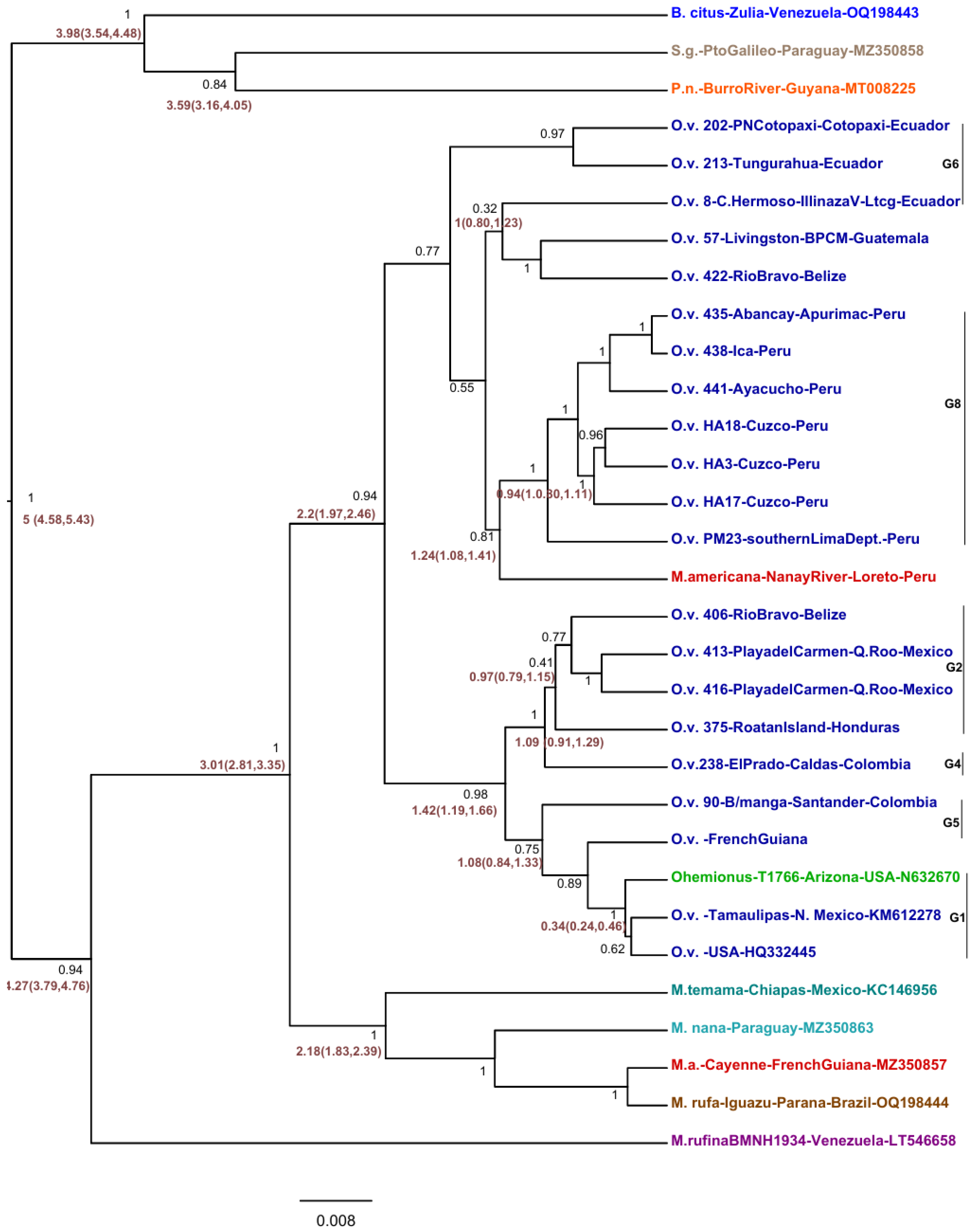
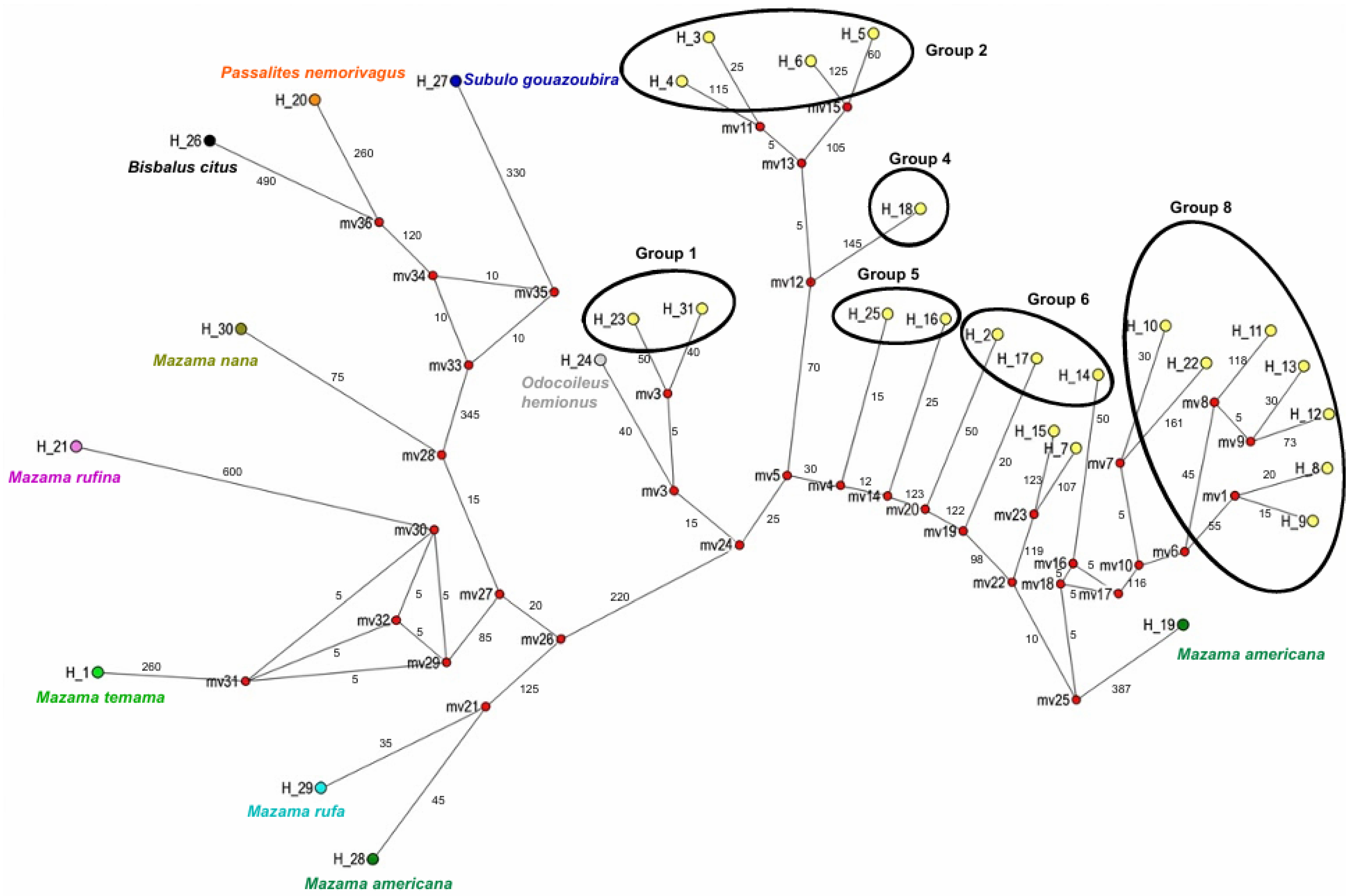
3.1. Phylogenetic Trees and Haplotype Networks with the mtCyt-b Gene
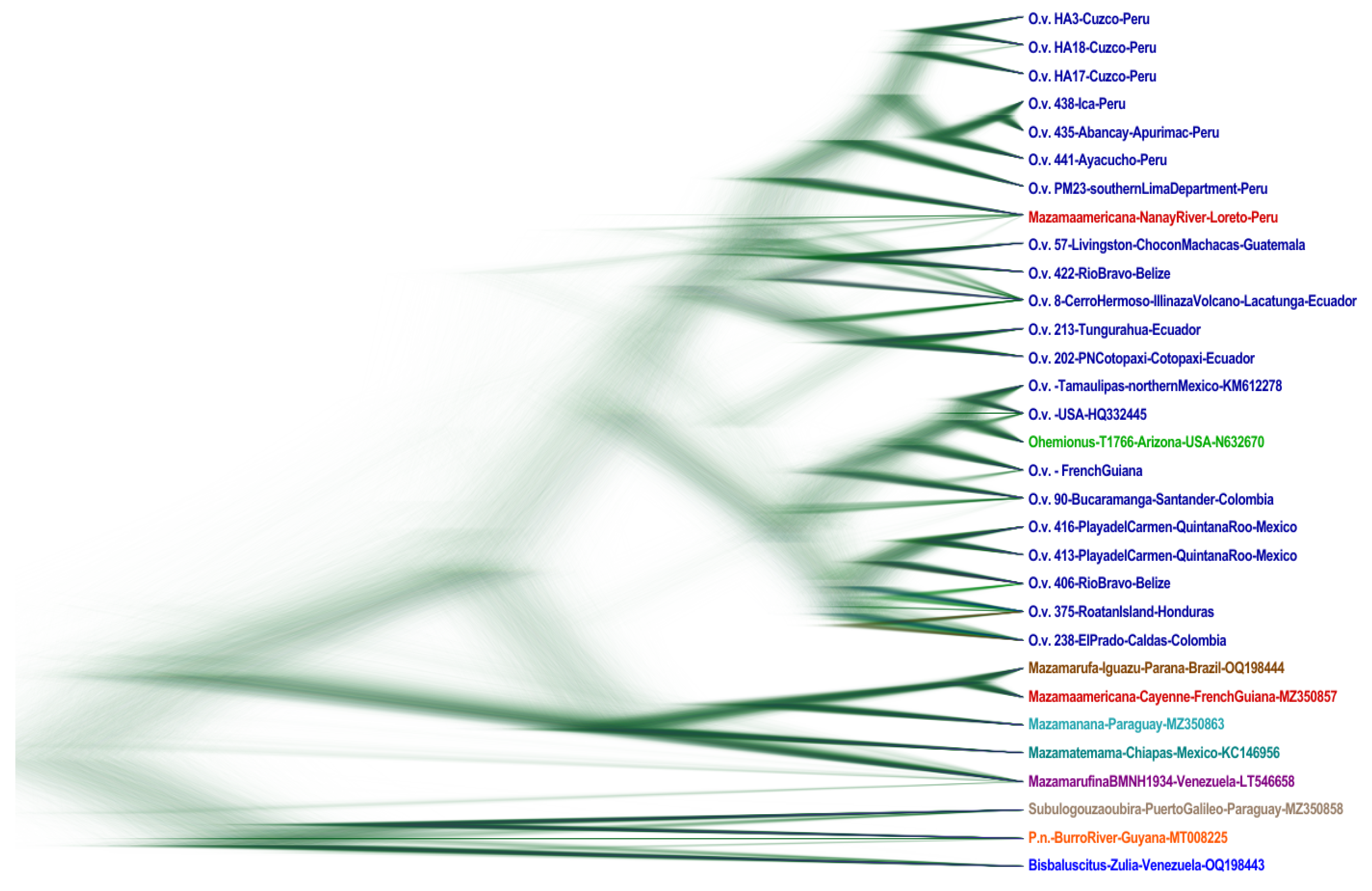
3.2. Phylogenetic Trees and Haplotype Networks with Mitogenomes
3.3. Divergence Times
3.4. Genetic Heterogeneity Within White-Tailed Deer
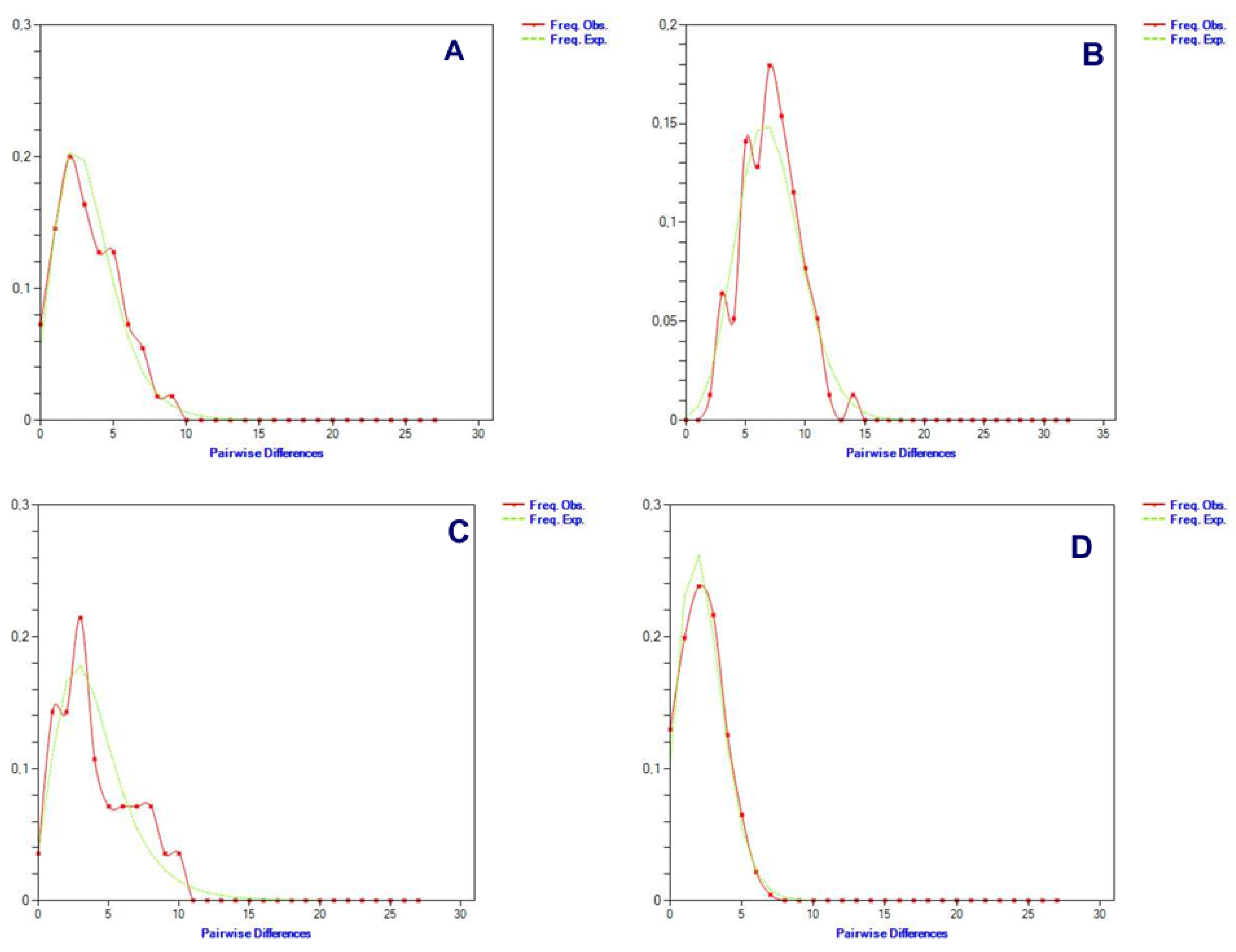
3.5. Genetic Diversity and Possible Demographic Changes in White-Tailed Deer Using the mtCyt-b Gene
4. Discussion
4.1. Evolution and Systematics of the White-Tailed Deer
4.1.1. The Phylogenetic Relationships Between O. hemionus and M. pandora with Reference to O. virginianus
4.1.2. The Strange Cases of P. nemorivagus from the Tocantins River and of a Mazama americana Highly Related to a Peruvian Group of O. virginianus
4.1.3. The Importance of Sampling as Many O. virginianus Specimens as Possible in Neotropical Countries and Determining the Possible Geographic Origin of This Species
4.1.4. The Genetically Differentiated Groups of O. virginianus and What Correspondence Exists with the Traditionally Proposed Subspecies
4.2. Genetic Heterogeneity Among the Different Geographical Groups of O. virginianus and Possible Different Species in the White-Tailed Deer
4.3. Temporal Divergence Among O. virginianus Groups
4.4. Possible Demographic Changes in the Evolution of the Neotropical O. virginianus
4.5. The Importance of Mitochondrial DNA for the Systematics of O. virginianus
5. Conclusions
Author Contributions
Funding
Institutional Review Board Statement
Informed Consent Statement
Data Availability Statement
Acknowledgments
Conflicts of Interest
References
- Huffman, B. Ultimate Ungulate Page. 2008. Available online: http://www.ultimateungulate.com (accessed on 29 June 2024).
- Fulbright, T.E.; Ortega-Santos, J.A. Ecología y Manejo de Venado Cola Blanca; Texas A&M University Press: College Station, TX, USA, 2007. [Google Scholar]
- Bernegossi, A.M.; Borges, C.H.S.; Sandoval, E.D.P.; Cernohorska, H.; Svatava, K.; Vozdova, M.; Caparroz, R.; González, S.; Duarte, J.M.B. Resurrection of the genus Subulo Smith, 1827 for the gray brocket deer, with designation of a neotype. J. Mammal. 2023, 104, 619–633. [Google Scholar] [CrossRef]
- Morales-Donoso, J.A.; Vacari, G.Q.; Bernegossi, A.M.; Sandoval, E.D.P.; Peres, P.H.F.; Galindo, D.J.; de Thoisy, B.; Vozdova, M.; Kubickova, S.; Duarte, J.M.B. Revalidation of Passalites Gloger, 1841 for the Amazon brown brocket deer P. nemorivagus (Cuvier, 1817) (Mammalia, Artiodactyla, Cervidae). ZooKeys 2023, 1167, 241–264. [Google Scholar] [CrossRef]
- Sandoval, E.D.P.; Jędrzejewski, W.; Molinari, J.; Vozdova, M.; Cernohorska, H.; Kubickova, S.; Bernegossi, A.M.; Caparroz, R.; Duarte, J.M.B. Description of Bisbalus, a new genus for the gray brocket, Mazama cita Osgood, 1912 (Mammalia, Cervidae), as a step to solve the neotropical deer puzzle. Taxonomy 2024, 4, 10–26. [Google Scholar] [CrossRef]
- Weber, M.; Gonzalez, S. Latin American Deer Diversity and Conservation: A Review of Status and Distribution. Ecoscience 2003, 10, 443–454. [Google Scholar] [CrossRef]
- Ruiz-García, M.; Vega, J.; Pinedo-Castro, M.; Shostell, J.M. The Nariño Cat, the Tigrinas and Their Problematic Systematics and Phylogeography: The Real Story. Animals 2025, 15, 1891. [Google Scholar] [CrossRef] [PubMed]
- Ruiz-García, M. Estrategias de análisis genético-poblacionales y filogenéticos utilizando marcadores bioquímicos y moleculares (alozimas, mtDNA y microsatélites) aplicados a la conservación de mamíferos silvestres. In Polimorfismos Aplicados en Enfermedades Metabólicas y Evolución; Moreno Durán, C.H., Ed.; Universidad Distrital Francisco José de Caldas: Bogotá, Colombia, 2001; pp. 5–46. [Google Scholar]
- Cabrera, A. Catálogo de los mamíferos de América del Sur. Rev. Mus. Argent. Cienc. Nat. 1960, 4, 309–732. [Google Scholar]
- Zimmermann, E.A.W. Geographische Geschichte des Menschen und der Vierfiissigen Thiere; Weygandschen Buchhandlung: Leipzig, Germany, 1780; pp. 1–432. [Google Scholar]
- Boddaert, P. Elenchus Animalium; Sistens Quadrupedia Hue Usque Nota, Eorumque Varietates; C. R. Hake: Rotterdam, The Netherlands, 1784; pp. 1–174. [Google Scholar]
- Smith, W.P. Odocoileus virginianus. Mamm. Species 1991, 388, 1–13. [Google Scholar] [CrossRef]
- Lydekker, R. Catalogue of the Ungulate Mammals in the British Museum (Natural History); British Museum: London, UK, 1915. [Google Scholar]
- Hershkovitz, P. The technical name of the Virginia deer. Proc. Biol. Soc. Wash. 1948, 61, 41–48. [Google Scholar]
- Wilson, D.E.; Reeder, D.M. Mammal Species of the World: A Taxonomic and Geographic Reference; Johns Hopkins University Press: Baltimore, MD, USA, 2005. [Google Scholar]
- Mattioli, S. Family Cervidae (Deer). In Handbook of the Mammals of the World. 2. Hoofed Mammals; Wilson, D., Mittermeier, R., Eds.; Lynx Editions: Barcelona, Spain, 2011; pp. 350–443. [Google Scholar]
- Ambriz-Morales, P.; De La Rosa, X.F.; Sifuente, A.M.; Parra, M.; Villa, A.; Chassin, O.; Arellano, W. The complete mitocondrial genomes of nine subspecies of mexican White tailed deer. J. Mammal. 2015, 97, 234–245. [Google Scholar] [CrossRef]
- Spillmann, F. Die saugetiere Ecuadors in Wandel der Zeit. Erster Teil; Universidad Central: Quito, Ecuador, 1931; pp. 1–112. [Google Scholar]
- Méndez-Arocha, J.L. El nombre científico de los venados caramudos o caramerudos venezolanos. Mem. Soc. Cienc. Nat. La Salle 1955, 15, 133–136. [Google Scholar]
- Cabrera, A.; Yepes, J. Mamíferos Sud Americanos; Ediar S.A. Editores: Buenos Aires, Argentina, 1960. [Google Scholar]
- Sauer, P.R. Physical characteristics. In White-Tailed Deer—Ecology and Management; Halls, L.K., Ed.; Stackpole Books: Harrisburg, PA, USA, 1984; pp. 73–90. [Google Scholar]
- Hershkovitz, P. The metatarsal glands in white-tailed deer and related forms of the Neotropical region. Mammalia 1958, 22, 537–546. [Google Scholar] [CrossRef]
- Baker, R.H. Origin, classification and distribution. In White-Tailed Deer—Ecology and Management; Halls, L.K., Ed.; Stackpole Books: Harrisburg, PA, USA, 1984; pp. 1–18. [Google Scholar]
- Cabrera, A. Sobre los Odocoileus de Colombia. Bol. R. Soc. Esp. Hist. Nat. 1918, 18, 300–307. [Google Scholar]
- Cartelle, C. Tempo passado. Mamíferos do Pleistoceno em Minas Gerais; Editora Palco, ACESITA: Belo Horizonte, Brazil, 1994; pp. 1–131. [Google Scholar]
- Brokx, P.A. South America. In White-Tailed Deer—Ecology and Management; Halls, L.K., Ed.; Stackpole Books: Harrisburg, PA, USA, 1984; pp. 525–546. [Google Scholar]
- Tate, G. The mammals of the Guiana region. Bull. Am. Mus. Nat. Hist. 1939, 76, 151–229. [Google Scholar]
- Molina, M.; Molinari, J. Taxonomy of Venezuelan white-tailed deer (Odocoileus, Cervidae, Mammalia), based on cranial and mandibular traits. Can. J. Zool. 1999, 77, 632–645. [Google Scholar] [CrossRef]
- Molinari, J. Variación geográfica en los venados de cola blanca (Cervidae, Odocoileus) de Venezuela, con énfasis en O. margaritae, la especie enana de la Isla de Margarita. Mem. Fund. La Salle Cienc. Nat. 2007, 167, 29–72. [Google Scholar]
- Moscarella, R.A.; Aguilera, M.; Escalante, A.A. Phylogeography, population structure, and implications for conservation of white-tailed deer (Odocoileus virginianus) in Venezuela. J. Mammal. 2003, 84, 1300–1315. [Google Scholar] [CrossRef]
- Ruiz-García, M.; Randi, E.; Martínez-Agüero, M.; Alvarez, D. Relaciones filogenéticas entre géneros de ciervos neotropicales (Artiodactyla: Cervidae) mediante secuenciación de ADN mitocondrial y marcadores microsatélitales. Rev. Biol. Trop. 2007, 55, 723–741. [Google Scholar] [CrossRef] [PubMed]
- Gutiérrez, E.E.; Helgen, K.M.; McDonough, M.M.; Bauer, F.; Hawkins, M.T.R.; Escobedo-Morales, L.A.; Patterson, B.D.; Maldonado, J.E. A Gene-Tree Test of the Traditional Taxonomy of American Deer: The Importance of Voucher Specimens, Geographic Data, and Dense Sampling. ZooKeys 2017, 697, 87–131. [Google Scholar] [CrossRef]
- Escobedo-Morales, L.A.; Castañeda-Rico, S.; Mandujano, S.; León-Paniagua, L.; Maldonado, J.E. First description of the mitochondrial genomes of the Central American brocket deer Mazama temama (Kerr, 1792) and the Yucatán Peninsula brocket deer Odocoileus pandora Merriam, 1901. Mol. Biol. Rep. 2023, 50, 4851–4863. [Google Scholar] [CrossRef] [PubMed]
- Sandoval, E.D.P.; Rola, L.D.; Morales-Donoso, J.A.; Gallina, S.; Reyna-Hurtado, R.; Duarte, J.M.B. Integrative analysis of Mazama temama (Artiodactyla: Cervidae) and designation of a neotype for the species. J. Mammal. 2022, 103, 447–458. [Google Scholar] [CrossRef]
- Duarte, J.M.B.; González, S.; Maldonado, J.E. The Surprising Evolutionary History of South American Deer. Mol. Phylogenet. Evol. 2008, 49, 17–22. [Google Scholar] [CrossRef] [PubMed]
- Gilbert, C.; Ropiquet, A.; Hassanin, A. Mitochondrial and nuclear phylogenies of Cervidae (Mammalia, Ruminantia): Systematics, morphology, and biogeography. Mol. Phylogenet. Evol. 2006, 40, 101–117. [Google Scholar] [CrossRef] [PubMed]
- Randi, E.; Mucci, N.; Pierpaoli, M.; Douzery, E. New phylogenetic perspectives on the Cervidae (Artiodactyla) are provided by the mitochondrial cytochrome b gene. Proc. R. Soc. Lond. Ser. B Biol. Sci. 1998, 265, 793–801. [Google Scholar] [CrossRef]
- Luo, R.; Liu, B.; Xie, Y.; Li, Z.; Huang, W.; Yuan, J.; He, G.; Chen, Y.; Pan, Q.; Liu, Y.; et al. SOAPdenovo2: An empirically improved memory-efficient short read de novo assembler. Gigascience 2012, 1, 18. [Google Scholar] [CrossRef]
- Bankevich, A.; Nurk, S.; Antipov, D.; Gurevich, A.A.; Dvorkin, M.; Kulikov, A.S.; Lesin, V.M.; Nikolenko, S.I.; Pham, S.; Prjibelski, A.D.; et al. SPAdes: A new genome assembly algorithm and its applications to single-cell sequencing. J. Comput. Biol. 2012, 19, 455–477. [Google Scholar] [CrossRef]
- Li, H.; Durbin, R. Fast and accurate shortread alignment with Burrows Wheeler transform. Bioinformatics 2009, 25, 1754–1760. [Google Scholar] [CrossRef]
- Li, H.; Handsaker, B.; Wysoker, A.; Fennell, T.; Ruan, J.; Homer, N.; Marth, G.; Abecasis, G.; Durbin, R.; Proc, G.P.D. The Sequence Alignment/Map format and SAMtools. Bioinformatics 2009, 25, 2078–2079. [Google Scholar] [CrossRef]
- Allio, R.; Schomaker-Bastos, A.; Romiguier, J.; Prosdocimi, F.; Nabholz, B.; Delsuc, F. MitoFinder: Efficient automated large-scale extraction of mitogenomic data in target enrichment phylogenomics. Mol. Ecol. Resour. 2020, 20, 892–905. [Google Scholar] [CrossRef]
- Altschul, S.F.; Madden, T.L.; Schaffer, A.A.; Zhang, J.H.; Zhang, Z.; Miller, W.; Lipman, D.J. Gapped BLAST and PSI-BLAST: A new generation of protein database search programs. Nucleic Acids Res. 1997, 25, 3389–3402. [Google Scholar] [CrossRef]
- Okonechnikov, K.; Golosova, O.; Fursov, M.; The UGENE Team. Unipro UGENE: A unified bioinformatics toolkit. Bioinformatics 2012, 28, 1166–1167. [Google Scholar] [CrossRef] [PubMed]
- Darriba, D.; Taboada, G.L.; Doallo, R.; Posada, D. jModelTest2: More models, new heuristics and parallel computing. Nat. Methods 2012, 9, 772. [Google Scholar] [CrossRef] [PubMed]
- Tanabe, A.S. Kakusan4 and Aminosan: Two programs for comparing nonpartitioned, proportional and separate models for combined molecular phylogenetic analyses of multilocus sequence data. Mol. Ecol. Res. 2011, 11, 914–921. [Google Scholar] [CrossRef] [PubMed]
- Kumar, S.; Stecher, G.; Li, M.; Tamura, K. MEGA X: Molecular Evolutionary Genetics Analysis across computing platforms. Mol. Biol. Evol. 2018, 35, 1547–1549. [Google Scholar] [CrossRef]
- Schwarz, G.E. Estimating the dimension of a model. Ann. Stat. 1978, 6, 461–464. [Google Scholar] [CrossRef]
- Akaike, H. Information theory and an extension of the maximum likelihood principle. In Second International Symposium on Information Theory; Petrov, B.N., Csaki, F., Eds.; Akadémiai Kiadó: Budapest, Hungary, 1973; pp. 267–281. [Google Scholar]
- Posada, D.; Crandall, K.A. Modeltest: Testing the model of DNA substitution. Bioinformatics 1998, 14, 817–818. [Google Scholar] [CrossRef]
- Stamatakis, A. RAxML version 8: A tool for phylogenetic analysis and post-analysis of large phylogenies. Bioinformatics 2014, 30, 1312–1313. [Google Scholar] [CrossRef]
- Drummond, A.J.; Rambaut, A.; Suchar, M.A. Computer Program and Documentation, version 1.10.4; BEAST; University of Oxford: Oxford, UK, 2018. Available online: http://beast.bio.ed.ac.uk/ (accessed on 18 December 2023).
- Rambaut, A.; Drummond, A.J.; Xie, D.; Baele, G.; Suchard, M.A. Posterior summarization in bayesian phylogenetics using Tracer 1.7. Syst. Biol. 2018, 67, 901–904. [Google Scholar] [CrossRef] [PubMed]
- Rambaut, A.; Drummond, A.J. Computer Program and Documentation, version 1.10.4; LogCombiner; University of Oxford: Oxford, UK, 2018. Available online: http://beast.bio.ed.ac.uk/ (accessed on 13 December 2021).
- Rambaut, A.; Drummond, A.J. Computer Program and Documentation, version 1.10.4; TreeAnnotator; University of Oxford: Oxford, UK, 2018. Available online: http://beast.bio.ed.ac.uk/ (accessed on 29 July 2024).
- Drummond, A.J.; Suchard, M.A.; Xie, D.; Rambaut, A. Bayesian phylogenetics with BEAUti and the BEAST 1. 7. Mol. Biol. Evol. 2012, 29, 1969–1973. [Google Scholar] [CrossRef]
- Rambaut, A. Computer Program and Documentation, version 1.4.0; FigTree; University of Oxford: Oxford, UK, 2012. Available online: http://tree.bio.ed.ac.uk/software/figtree/ (accessed on 11 September 2024).
- Bouckaert, R. DensiTree Manual: Making Sense of Sets of Trees. Version 2.01. Available online: http://beast.bio.ed.ac.uk/ (accessed on 18 December 2023).
- Pennington, R.T.; Dick, C.W. Diversification of the Amazonian flora and its relation to key geological and environmental events: A molecular perspective. In Amazonia, Landscape and Species Evolution: A Look into the Past; Hoorn, C., Wesselingh, F., Eds.; Wiley-Blackwell: Oxford, UK, 2010; pp. 373–385. [Google Scholar]
- Bandelt, H.-J.; Forster, P.; Rohl, A. Median-joining networks for inferring intraspecific phylogenies. Mol. Biol. Evol. 1999, 16, 37–48. [Google Scholar] [CrossRef]
- Morral, N.; Bertrantpetit, J.; Estivill, X.; Nunes, V.; Casals, T.; Giménez, J.; Reis, A.; Varon-Mateeva, R.; Macek, M., Jr.; Kalaydjieva, L.; et al. The origin of the major cystic fibrosis mutation (delta F508) in European populations. Nat. Genet. 1994, 7, 169–175. [Google Scholar] [CrossRef]
- Posada, D.; Crandall, K.A. Intraspecific gene genealogies: Trees grafting into networks. Trends Ecol. Evol. 2001, 16, 37–45. [Google Scholar] [CrossRef]
- Hudson, R.; Boss, D.D.; Kaplan, N.L. A statistical test for detecting population subdivision. Mol. Phylogenet. Evol. 1992, 9, 138–151. [Google Scholar]
- Wright, S. The interpretation of population structure by F-statistics with special regard to systems of mating. Evolution 1965, 19, 395–420. [Google Scholar] [CrossRef]
- Librado, P.; Rozas, J. DnaSP v5: A software for comprehensive analysis of DNA polymorphism data. Bioinformatics 2009, 25, 1451–1452. [Google Scholar] [CrossRef]
- Excoffier, L.; Lischer, H.E. Arlequin suite ver 3.5: A new series of programs to perform population genetics analyses under Linux and Windows. Mol. Ecol. Res. 2010, 10, 564–567. [Google Scholar] [CrossRef] [PubMed]
- Weir, B.S.; Cockerham, C.C. Estimating F-statistics for the analysis of population structure. Evolution 1984, 38, 1358–1370. [Google Scholar] [CrossRef]
- Fu, Y.; Li, W. Statistical Tests of Neutrality of Mutations. Genetics 1993, 133, 693–709. [Google Scholar] [CrossRef] [PubMed]
- Fu, Y.-X. Statistical tests of neutrality against population growth, hitchhiking and background selection. Genetics 1997, 147, 915–925. [Google Scholar] [CrossRef] [PubMed]
- Tajima, F. Statistical method for testing the neutral mutation hypothesis by DNA polymorphism. Genetics 1989, 123, 585–595. [Google Scholar] [CrossRef]
- Ramos-Onsins, S.E.; Rozas, J. Statistical properties of new neutrality tests against population growth. Mol. Biol. Evol. 2002, 19, 2092–2100. [Google Scholar] [CrossRef]
- Rogers, A.R.; Harpending, H.C. Population growth makes waves in the distribution of pairwise genetic differences. Mol. Biol. Evol. 1992, 9, 552–569. [Google Scholar] [CrossRef]
- Carr, S.M.; Ballinger, S.W.; Derr, J.N.; Blankenship, L.H.; Bickham, J.W. Mitochondrial DNA analysis of hybridization between sympatric white-tailed deer and mule deer in West Texas. Proc. Nat. Acad. Sci. USA 1986, 83, 9576–9580. [Google Scholar] [CrossRef]
- Stubblefield, S.S.; Warren, R.J.; Murphy, B.R. Hybridization of free-ranging white-tailed and mule deer in Texas. J. Wildl. Manag. 1986, 50, 688. [Google Scholar] [CrossRef]
- Cronin, M.; Vyse, E.; Cameron, D. Genetic relationships between mule deer and white-tailed deer in Montana. J. Wildl. Manag. 1988, 52, 228–237. [Google Scholar] [CrossRef]
- Key, C.E.; Boe, E. Hybrids of white-tailed and mule deer in western Wyoming. Great Basin Nat. 1992, 52, 290–292. [Google Scholar]
- Cathey, J.C.; Bickham, J.W.; Patton, J.C. Introgressive hybridization and nonconcordant evolutionary history of maternal and paternal lineages in North American deer. Evolution 1998, 52, 1224–1229. [Google Scholar] [CrossRef]
- Hornbeck, G.; Mahoney, J. Introgressive hybridization of mule deer and white-tailed deer in southwestern Alberta. Wildl. Soc. Bull. 2000, 28, 1012–1015. [Google Scholar]
- Bradley, R.D.; Bryant, F.C.; Bradley, L.C.; Haynie, M.L.; Baker, R.J. Implications of hybridization between white-tailed deer and mule deer. Southwest. Nat. 2003, 48, 654–660. [Google Scholar] [CrossRef]
- Hopken, M.W.; Lum, T.M.; Meyers, P.M.; Piaggio, A.J. Molecular assessment of translocation and management of an endangered subspecies of white-tailed deer (Odocoileus virginianus). Conserv. Genet. 2015, 16, 635–647. [Google Scholar] [CrossRef]
- Whitehead, G.K. The Whitehead Encyclopedia of Deer; Swan Hill Press: Shrewsbury, UK, 1994; pp. 1–493. [Google Scholar]
- Wallmö, O.C. Mule and black-tailed deer distribution and habitats. In Mule and Black Tailed Deer of North America; O.C. Wallmö, O.C., Ed.; University Nebraska: Lincoln, NE, USA, 1981. [Google Scholar]
- Derr, J.N.; Hale, D.W.; Ellesworth, D.L.; Bickham, J.W. Fertility in an F1 male hybrid of white-tailed deer (Odocoileus virginianus) x mule deer (O. hemionus). J. Reprod. Fertil. 1991, 93, 111–117. [Google Scholar] [CrossRef]
- Cowan, I.M. Hybridization between the black-tail deer and the white-tail deer. J. Mammal. 1962, 43, 539–541. [Google Scholar] [CrossRef]
- Wishart, W.D. Hybrids of white-tailed and mule deer in Alberta. J. Mammal. 1980, 61, 716–720. [Google Scholar] [CrossRef]
- Hughes, G.A. A Molecular Genetic Analysis of Hibridization Between Two Species of Deer (Odocoileus) in Western Canada. Master’s Thesis, Memorial University of Newfoundland, St. John, NL, Canada, 1990; pp. 1–93. [Google Scholar]
- Cronin, M. Mitochondrial DNA phylogeny of deer (Cervidae). J. Mammal. 1991, 72, 553–556. [Google Scholar] [CrossRef]
- Ballinger, S.W.; Blankenship, L.H.; Bickham, J.W.; Carr, S.M. Allozyme and mitochondrial DNA analysis of a hybrid zone between white-tailed deer and mule deer (Odocoileus) in West Texas. Biochem. Genet. 1992, 30, 1–11. [Google Scholar] [CrossRef]
- Carr, S.M.; Hughes, G.A. Direction of introgressive hybridization between species of North American deer (Odocoileus) as inferred from mitochondrial Cytochrome-b sequences. J. Mammal. 1993, 74, 331–342. [Google Scholar] [CrossRef]
- Hershkovitz, P. The recent mammals of the Neotropical Region: A zoogeographic and ecological review. In Evolution, Mammals, and Southern Continents; Keast, A., Erk, F.C., Glass, B., Eds.; State University of New York Press: Albany, NY, USA, 1972; pp. 311–431. [Google Scholar]
- Mandujano, S.; Delfín-Alfonso, C.A.; Gallina, S. Comparison of geographic distribution models of white-tailed deer Odocoileus virginianus (Zimmermann, 1780) subspecies in Mexico: Biological and management implications. Therya 2010, 1, 41–68. [Google Scholar] [CrossRef]
- Galindo, C.; Weber, M. El Venado de la Sierra Madre Occidental: Ecología, Manejo y Conservación; Edicusa-Conabio, Ediciones Culturales, S.A. de C.V.: México City, Mexico, 1998. [Google Scholar]
- Logan-López, K.; Cienfuegos-Rivas, E.; Sifuentes-Rincón, A.; González-Paz, M.; Clemente Sánchez, F.; Mendoza-Martínez, G.; Tarango-Arámbula, L. Patrones de variación genética en cuatro subespecies de venado cola blanca del noreste de México. Agrociencia 2007, 41, 13–21. [Google Scholar]
- De La Rosa-Reyna, X.F.; Calderón-Lobato, R.D.; Parra-Bracamonte, G.M.; Sifuentes-Rincón, A.M.; DeYoung, R.W.; García-De León, F.J.; Arellano-Vera, W. Genetic diversity and structure among subspecies of white-tailed deer in Mexico. J. Mammal. 2012, 93, 1158–1168. [Google Scholar] [CrossRef]
- Logan, K.; DeYoung, R.W.; Ortega-Santos, A.; Hewitt, D.; Williford, D.; Heffelfinger, J.R. Phylogeographic structure of white-tailed deer subspecies in Mexico. In Proceedings of the Memories of 35th Annual Meeting of the Southeast Deer Study Group, Sandestin, FL, USA, 26–28 February 2012. [Google Scholar]
- Sheffield, S.R.; Morgan, R.P.; Feldhamer, G.A.; Harman, D.M. Genetic variation in white tailed deer (Odocoileus virginianus) populations in western Maryland. J. Mammal. 1985, 66, 243–255. [Google Scholar] [CrossRef]
- Serna-Lagunes, R. Filogeografía de Ocho Subespecies de Odocoileus virginianus (Zimmermann, 1780) del Pacífico Mexicano. Tesis de Doctorado en Ciencias, Colegio de Postgraduados, Texcoco, Mexico, 2016. [Google Scholar]
- Trouessart, E.L. Mammiferes de la Mission de l’Equateur, d’apres les Collections Formees par Rivet. Zoology. A1-A31. Mission du Service Geographique de l’Armee pour la Mesure d’un Arc Meridian Equatorial en Amerique du Sud; Gauthier-Villars: Paris, France, 1910; pp. 1–32. [Google Scholar]
- Osgood, W.H. Mammals from the coast and islands of northern South America. Field Mus. Nat. Hist. Zool. Ser. 1910, 10, 23–32. [Google Scholar]
- Gutiérrez, E.E.; Maldonado, J.E.; Radosavljevic, A.; Molinari, J.; Patterson, B.D.; Martínez, C.J.M.; Rutter, A.R.; Hawkins, M.T.R.; Garcia, F.J.; Helgen, K.M. The Taxonomic Status of Mazama bricenii and the Significance of the Táchira Depression for Mammalian Endemism in the Cordillera de Mérida, Venezuela. PLoS ONE 2015, 10, e0129113. [Google Scholar] [CrossRef]
- Ruiz-García, M.; Jaramillo, M.F.; Shostell, J.M. The phylogeographic structure of the mountain coati (Nasuella olivacea; Procyonidae, Carnivora) in Colombia and Ecuador, and phylogenetic relationships with the other coati species (Nasua nasua and Nasua narica) by means of mitochondrial DNA. Mamm. Biol. 2020, 100, 521–548. [Google Scholar] [CrossRef]
- Sandoval, E.D.P.; Hernández Guevara, J.E.; Bernegossi, A.M.; Peres, P.H.F.; Caparroz, R.; Duarte, J.M.B. Mazama tschudii (Wagner, 1855), forgotten by science, re-emerges as a new genetic lineage of Neotropical deer with a proposed neotype (Artiodactyla, Cervidae). ZooKeys 2025, 1265, 25–47. [Google Scholar] [CrossRef]
- Abril, V.V.; Carnelossi, E.A.G.; González, S.; Duarte, J.M.B. Elucidating the Evolution of the Red Brocket Deer Mazama americana Complex (Artiodactyla; Cervidae). Cytogenet. Genome Res. 2010, 128, 177–187. [Google Scholar] [CrossRef]
- Cursino, M.S.; Salviano, M.B.; Abril, V.V.; Zanetti, E.; Dos, S.; Duarte, J.M. The Role of Chromosome Variation in the Speciation of the Red Brocket Deer Complex: The Study of Reproductive Isolation in Females. BMC Evol. Biol. 2014, 14, 40. [Google Scholar] [CrossRef]
- Wurster, D.H.; Benirschke, K. Chromosome studies in some deer, the springbok, and the pronghorn, with notes on placentation in deer. Cytologia 1967, 32, 273–285. [Google Scholar]
- Gallagher, D.S.; Derr, J.N.; Womack, J.E. Chromosome Conservation Among the Advanced Pecorans and Determination of the Primitive Bovid Karyotype. J. Hered. 1994, 85, 204–210. [Google Scholar] [CrossRef] [PubMed]
- Fontana, F.; Rubini, M. Chromosomal Evolution in Cervidae. BioSystems 1990, 24, 157–174. [Google Scholar] [CrossRef]
- Barragán-Fonseca, K.B.; Jiménez-Robayo, L.; Sánchez-Isaza, C. Caracterización cromosómica del venado cola blanca en Colombia. In Ecología, Uso, Manejo y Conservación del Venado de Cola Blanca en Colombia; López-Arévalo, H.F., Ed.; Biblioteca José Jerónimo Triana N° 33; Instituto de Ciencias Naturales, Universidad Nacional de Colombia: Bogotá, Colombia, 2020; pp. 85–94. [Google Scholar]
- Hsu, T.; Benirschke, K. An Atlas of Mammalian Chromosomes; Springer: New York, NY, USA, 1967; Volume 3. [Google Scholar]
- Yang, F.; O’Brien, P.C.M.; Wienberg, J.; Neitzel, H.; Lin, C.C.; Ferguson-Smith, M.A. Chromosomal evolution of the Chinese muntjac (Muntiacus reevesi). Chromosoma 1997, 106, 37–43. [Google Scholar] [CrossRef]
- Escobedo-Morales, L.A.; Mandujano, S.; Eguiarte, L.E.; Rodríguez-Rodríguez, M.A.; Maldonado, J.E. First phylogenetic analysis of Mesoamerican brocket deer Mazama pandora and Mazama temama (Cetartiodactyla: Cervidae) based on mitochondrial sequences: Implications for Neotropical deer evolution. Mamm. Biol. 2016, 81, 303–313. [Google Scholar] [CrossRef]
- Kurtén, B.; Anderson, E. Pleistocene Mammals of North America; Columbia University Press: New York, NY, USA, 1980; pp. 1–442. [Google Scholar]
- Barrio, J.; Gutiérrez, E.E.; D’Elia, G. The first living cervid species described in the 21st century and revalidation of Pudella (Artiodactyla). J. Mammal. 2024, 105, 577–588. [Google Scholar] [CrossRef]
- Escobedo-Morales, L.A.; León-Paniagua, L.; Castañeda-Rico, S.; Martínez-Meyer, E.; Mandujano, S.; Maldonado, J.E. Mitochondrial genome and ultraconserved elements reveal a species complex within the Central American brocket deer Mazama temama (Artiodactyla: Cervidae). Mol. Phylogenet. Evol. 2025, 211, 108400. [Google Scholar] [CrossRef]
- Helgen, K.M.; Pinto, C.M.; Kays, R.; Helgen, L.; Tsuchiya, M.; Quinn, A.; Wilson, D.; Maldonado, J. Taxonomic revision of the olingos (Bassaricyon), with description of a new species, the Olinguito. ZooKeys 2013, 324, 1–83. [Google Scholar] [CrossRef] [PubMed]
- Ruiz-García, M.; Pinedo-Castro, M.; Shostell, J.M. Morphological and genetics support for a hitherto undescribed spotted cat species (Genus Leopardus; Felidae, Carnivora) from the Southern Colombian Andes. Genes 2023, 14, 1266. [Google Scholar] [CrossRef] [PubMed]
- Slon, V.; Mafessoni, F.; Vernot, B.; de Filippo, C.; Grote, S.; Viola, B.; Hajdinjak, M.; Peyrégne, S.; Nagel, S.; Brown, S.; et al. The genome of the offspring of a Neanderthal mother and a Denisovan father. Nat. Res. Lett. 2018, 561, 113–116. [Google Scholar] [CrossRef] [PubMed]
- De Queiroz, K.; Donoghue, M.J. Phylogenetic systematics and the species problem. Cladistics 1988, 4, 317–338. [Google Scholar] [CrossRef]
- Cracraft, J. Speciation and its ontology: The empirical consequences of alternative species concepts for understanding patterns and process of differentiation. In Speciation and Its Consequences; Otte, D., Endler, J.A., Eds.; Sinauer Associates: Sunderland, MA, USA, 1989; pp. 28–59. [Google Scholar]
- Mayr, E. Systematics and the Origin of Species; Columbia University Press: New York, NY, USA, 1942. [Google Scholar]
- Mayr, E. Animal Species and Evolution; Harvard University Press: Cambridge, MA, USA, 1963. [Google Scholar]
- Mayr, E. What Makes Biology Unique? Considerations on the Autonomy of a Scientific Discipline; The Press Syndicate of the University of Cambridge: Cambridge, MA, USA, 2004. [Google Scholar]


| Genetic Heterogeneity and Gene Flow Statistics | Values | Probabilities |
|---|---|---|
| χ2 | 640.000 df = 440 | 0.00001 * |
| HST | 0.156 | 0.00001 * |
| KST | 0.653 | 0.00001 * |
| KST * | 0.452 | 0.00001 * |
| ZS | 507.379 | 0.00001 * |
| ZS * | 5.651 | 0.00001 * |
| Snn | 0.951 | 0.00001 * |
| γST | 0.694 | 0.001 * |
| θ | 0.642 | 0.001 * |
| Nm (γST) | 0.22 | |
| Nm (θ) | 0.28 |
| Group 2 | Group 4 | Group 5 | Group 3 | Group 1 | Group 8 | Group 7 | Ecuadorian coast | Group 6 | |
| Group 2 | - | 1.4 | 2.5 | 2.8 | 1.8 | 2.5 | 2.7 | 2.4 | 2.2 |
| Group 4 | 0.485 ** (0.370) ** | - | 0.8 | 2.7 | 1.7 | 1.9 | 1.8 | 1.8 | 1.5 |
| Group 5 | 0.753 * (0.630) * | 0.401 ** (0.356) ** | - | 2.1 | 0.9 | 1.1 | 1.1 | 1.0 | 0.8 |
| Group 3 | 0.779 * (0.433) ** | 0.696 * (0.525) * | 0.809 * (0.578) * | - | 1.3 | 1.9 | 1.7 | 1.6 | 1.4 |
| Group 1 | 0.562 * (0.429) ** | 0.490 ** (0.423) ** | 0.460 ** (0.396) ** | 0.552 * (0.395) ** | - | 1.0 | 1.1 | 0.9 | 0.6 |
| Group 8 | 0.766 * (0.661) * | 0.621 * (0.546) * | 0.727 * (0.579) * | 0.815 * (0.538) * | 0.488 ** (0.414) ** | - | 1.1 | 0.9 | 0.6 |
| Group 7 | 0.752 * (0.611) * | 0.594 * (0.523) * | 0.659 * (0.534) * | 0.754 * (0.559) * | 0.496 * (0.435) ** | 0.688 * (0.555) * | - | 0.8 | 0.5 |
| Ecuadorian coast | 0.784 * (0.478) ** | 0.632 * (0.496) ** | 0.740 * (0.484) ** | 0.827 * (0.830) * | 0.493 * (0.377) ** | 0.720 * (0.434) ** | 0.624 * (0.448) ** | - | 0.3 |
| Group 6 | 0.771 * (0.676) * | 0.600 * (0.574) * | 0.691 * (0.578) * | 0.810 * (0.634) * | 0.410 ** (0.404) ** | 0.678 * (0.547) * | 0.574 * (0.479) ** | 0.576 * (0.333) ** | - |
| Group 6 | Group 2 | Differentiated Guatemala–Belize Group | Group 8 | Group 1 | |
| Group 6 | - | 2.0 | 1.4 | 1.3 | 2.5 |
| Group 2 | 0.459 * (0.410) * | - | 2.2 | 3.2 | 1.2 |
| differentiated Guatemala–Belize group | 0.360 * (0.450) * | 0.455 * (0.411) * | - | 1.4 | 2.9 |
| Group 8 | 0.387 * (0.331) * | 0.595 * (0.502) * | 0.380 * (0.334) * | - | 3.5 |
| Group 1 | 0.609 * (0.589) * | 0.417 * (0.345) * | 0.617 * (0.667) * | 0.712 * (0.557) * | - |
| N | NH | Hd | π | θ | D | D* | F* | FS | r | R2 | |
| Group 4 | 5 | 4 | 0.900 ± 0.161 | 0.0183 ± 0.0069 | 13.440 ± 7.034 | NS | NS | NS | NS | NS | NS |
| Group 5 | 11 | 8 | 0.927 ± 0.066 | 0.0050 ± 0.011 | 4.438 ± 2.073 | NS | NS | NS | p = 0.045 * | p = 0.0018 ** | NS |
| Group 6 | 17 | 5 | 0.426 ± 0.147 | 0.0016 ± 0.0009 | 2.662 ± 1.247 | p = 0.0004 ** | p = 0.0001 ** | p = 0.0022 ** | NS | NS | NS |
| Odocoileus virginianus-Ecuadorian coast | 3 | 2 | 0.667 ± 0.314 | 0.0020 ± 0.0001 | 1.333 ± 1.098 | - | - | - | - | - | - |
| Group 1 | 4 | 4 | 1.000 ± 0.126 | 0.0160 ± 0.0026 | 10.080 ± 5.361 | NS | NS | NS | NS | NS | NS |
| Group 3 | 2 | 2 | 1.000 ± 0.500 | 0.0046 ± 0.0023 | 3.000 ± 2.449 | - | - | - | - | - | - |
| Group 2 | 13 | 13 | 1.000 ± 0.030 | 0.0108 ± 0.0010 | 9.023 ± 3.726 | NS | NS | NS | p = 0.0013 ** | p = 0.0216 * | p = 0.0069 ** |
| Group 7 | 8 | 7 | 0.964 ± 0.077 | 0.0062 ± 0.0017 | 5.785 ± 2.822 | p = 0.0468 * | p = 0.0337 * | NS | p = 0.0481 * | p = 0.0092 ** | p = 0.0412 * |
| Group 8 | 22 | 11 | 0.870 ± 0.053 | 0.0035 ± 0.0006 | 3.566 ± 1.562 | NS | NS | NS | p = 0.0049 ** | p = 0.0097 ** | p = 0.0211 * |
Disclaimer/Publisher’s Note: The statements, opinions and data contained in all publications are solely those of the individual author(s) and contributor(s) and not of MDPI and/or the editor(s). MDPI and/or the editor(s) disclaim responsibility for any injury to people or property resulting from any ideas, methods, instructions or products referred to in the content. |
© 2026 by the authors. Licensee MDPI, Basel, Switzerland. This article is an open access article distributed under the terms and conditions of the Creative Commons Attribution (CC BY) license.
Share and Cite
Ruiz-García, M.; Arias-Vásquez, J.; Luna, A.; Castellanos, A.; Brito, J.; Galindo, P.C.; Sulca, Y.O.A.; Catzeflis, F.; Shostell, J.M. Cryptic Genetic Diversity in Deer: The Evolution of the White-Tailed Deer (Cervidae, Artiodactyla) in the Neotropics. Diversity 2026, 18, 351. https://doi.org/10.3390/d18060351
Ruiz-García M, Arias-Vásquez J, Luna A, Castellanos A, Brito J, Galindo PC, Sulca YOA, Catzeflis F, Shostell JM. Cryptic Genetic Diversity in Deer: The Evolution of the White-Tailed Deer (Cervidae, Artiodactyla) in the Neotropics. Diversity. 2026; 18(6):351. https://doi.org/10.3390/d18060351
Chicago/Turabian StyleRuiz-García, Manuel, Jessica Arias-Vásquez, Angie Luna, Armando Castellanos, Jorge Brito, Percy Colos Galindo, Yuri Oliver Ayala Sulca, François Catzeflis, and Joseph Mark Shostell. 2026. "Cryptic Genetic Diversity in Deer: The Evolution of the White-Tailed Deer (Cervidae, Artiodactyla) in the Neotropics" Diversity 18, no. 6: 351. https://doi.org/10.3390/d18060351
APA StyleRuiz-García, M., Arias-Vásquez, J., Luna, A., Castellanos, A., Brito, J., Galindo, P. C., Sulca, Y. O. A., Catzeflis, F., & Shostell, J. M. (2026). Cryptic Genetic Diversity in Deer: The Evolution of the White-Tailed Deer (Cervidae, Artiodactyla) in the Neotropics. Diversity, 18(6), 351. https://doi.org/10.3390/d18060351