Article

Ecosystem Services of the Endangered Fan Mussel Pinna nobilis in Greek Coastal Waters: Implications of Population Collapse for Coastal Ecosystem Functioning


by
Konstantinos Tsolakos
*,
John A. Theodorou
and
George Katselis
Department of Fisheries and Aquaculture, School of Agricultural Sciences, University of Patras, 30200 Mesolongi, Greece
*
Author to whom correspondence should be addressed.
Diversity 2026, 18(5), 308; https://doi.org/10.3390/d18050308
Submission received: 3 April 2026 / Revised: 7 May 2026 / Accepted: 13 May 2026 / Published: 20 May 2026
(This article belongs to the Section Biodiversity Conservation)

Abstract

The protected fan mussel Pinna nobilis (Linnaeus, 1758) is a key ecosystem-engineering species in Mediterranean coastal ecosystems, historically providing important regulating ecosystem services—particularly nutrient removal and shell-based carbon storage—as well as the ecological function of large-scale biofiltration. Prior to the mass mortality event in 2016, the Greek population was estimated at approximately 2.66 × 10⁹ individuals. This is associated with an annual gross shell carbon storage of 13,689–108,139 t “C”, together with 304.7–2988.3 t “N” and 49.7–450.5 t “P” retained in shell material, valued at EUR 8.14–76.6 million yr−1 using replacement-cost proxies. These values represent a gross shell carbon storage rather than a net ecosystem carbon sequestration, due to the fact that metabolic fluxes and remineralization may partially offset long-term retention. Furthermore, P. nobilis performed a substantial biofiltration function, filtering 6.07 × 10¹¹–6.85 × 10¹² m3 of seawater per year (2.89–32.53 turnovers of the 30 m coastal zone). The mass mortality event led the population to a decline by >81%, reducing the value of nutrient retention and gross shell carbon storage to EUR 1.31–13.47 million yr−1 and filtration capacity to 1.15 × 10¹¹–1.30 × 10¹² m3 yr−1. Using an illustrative order-of-magnitude replacement-cost approach, we estimate that by reproducing the lost biofiltration function through engineered systems, we would require approximately EUR 1–5.2 billion annually which indicates the magnitude of natural capital lost and the utmost importance of P. nobilis recovery for Greek coastal ecosystems.

1. Introduction

The ecosystem services provided by bivalve molluscs have received most of the studies compared to farmed species while, wild populations, despite their occasional exploitation by small-scale fisheries, were given comparatively much less attention [1,2,3,4,5]. Bivalves’ role is to operate as ecosystem engineers, exhibiting both autogenic characteristics, modifying their environment through the formation of physical structures and allogenic traits by transforming living or non-living materials from one state to another [6]. Among the most significant ecosystem services provided by bivalves as filter feeders are the regulating services being particularly a nutrient remediation and contributing factor to the carbon cycle. The estimated global value of these services ranges from $2.95 billion to $9.99 billion per year [3].
For the purposes of this study, we calculate gross shell-based carbon storage rather than net ecosystem carbon sequestration considering that metabolic fluxes, respiration, and remineralization can partially offset long-term carbon retention.
Ecosystem services are typically categorized into four main types: regulating, supporting, provisioning, and cultural services. Regulating services refer to the role that the ecosystems play in controlling physical, chemical as well as biological processes modulating biotic and abiotic parameters that shape the environment in which people live. Supporting services, although not directly delivering benefits to humans, are critical in maintaining ecosystem functions. They contribute to the formation of structurally complex habitats and underpin numerous ecological processes. In particular, bivalve populations can significantly alter both benthic and pelagic communities across multiple trophic levels, influencing energy flow and nutrient cycling at the scale of entire coastal ecosystems [2,3,7,8,9].
However, even though supporting services represent intermediate ecological functions that lead to final services, they are not explicitly included in the Common International Classification of Ecosystem Services (CICES) developed by the European Environment Agency [10].
In this study, water filtration is treated primarily as a biophysical ecosystem function that supports regulating services such as nutrient removal, whereas shell-based nutrient and carbon retention are treated as final regulating ecosystem services. Economic values presented later are interpreted as illustrative replacement-cost proxies rather than direct market values.
In the context of bivalve molluscs, regulating services include carbon sequestration nutrient removal, coastal erosion protection, and shoreline stabilization as well as disease and pathogen regulation and removal of toxins. Supporting services include water filtration, modification of sediment properties, recycling of biogeochemical elements in the water column, habitat provision, and the enhancement of local biodiversity [2,3,6,11,12,13,14,15,16].
Provisioning services on the other hand are related to the tangible goods derived from bivalves, such as food and materials for human use. Cultural services encompass non-material benefits including recreational activities, educational value, cultural heritage, and esthetic appreciation [2,3].
The species Pinna nobilis (Linnaeus, 1758), commonly known as the noble pen shell or fan mussel, is the largest endemic bivalve in the Mediterranean Sea, reaching a maximum shell length of up to 120 cm [17] and a lifespan of 45–50 years [18]. It exhibits the fastest shell growth rate reported among all bivalve species [19]. P. nobilis has garnered significant scientific interest due to its ecological importance and historical commercial value [20]. This interest has been intensified in recent years following a mass mortality event observed along the Spanish coastline in autumn 2016 [21], which subsequently spread across the Mediterranean [22,23]. As a result, the species has experienced a dramatic population decline leading to being characterized as Critically Endangered on the IUCN Red List of Threatened Species [24] since the infection created or generated by pathogens appears to be irreversible in the areas where they have occurred [25,26,27,28,29].
The ecological significance of Pinna nobilis has been particularly highlighted as an important benthic filter-feeding organism. Pinna nobilis contributes to water clarity by filtering large amounts of suspended particulate matter and retaining a high proportion of organic material [20,30,31,32]. According to Alomar et al. [32], it also serves as a reliable indicator of changes in marine ecosystems, as it can provide insights into their interactions with anthropogenic activities, enabling the detection of potential disturbances at an early stage.
Although the species occurs on a variety of substrates [33], it shows a marked preference for the seagrass meadows of Posidonia oceanica, which strongly influence its distribution patterns [34,35,36]. It can also inhabit in bare sandy bottoms [37,38]. Pinna nobilis remains permanently anchored to the substrate, with approximately one-third of its length buried in the seabed [39]. By providing a hard surface for colonization, it increases seabed heterogeneity, enhances the structural complexity of benthic communities, and contributes to higher local biodiversity in marine benthic habitats [40].
Moreover, Pinna nobilis provides a biogenic hard substrate within otherwise soft-bottom habitats offering settlement surfaces for a variety of benthic organisms and enhancing local biodiversity [20,40]. Although P. nobilis has never been exploited as a commercial shellfish resource, it was historically collected and traded mostly through recreational harvest, as a premium bait and as a decorative artifact [41]. The species is also noted for its value to recreational diving (by attracting divers to its aggregations) [42].
Currently, a growing number of conservation initiatives and scientific studies aim to facilitate the recovery of Pinna nobilis populations [43,44] by acknowledging the critical ecological role of the species and the valuable ecosystem services it provides. Recent conservation initiatives in Greece, such as the PINNA-SOS project, highlighted the option of integrating ecosystem-based approaches and stakeholder engagement into recovery strategies for Pinna nobilis.
In this study, shell-based carbon storage refers exclusively to the biogenic carbon incorporated into calcium carbonate (CaCO3) shells during individual growth. It does not represent net ecosystem carbon sequestration as it cannot be taken into account for respiration, remineralization processes, or system-level carbon fluxes within the benthic–pelagic environment.
The objective of this study is to calculate key ecosystem services provided by Pinna nobilis in Greek coastal waters under pre-collapse conditions, shell-based nutrient and carbon retention, as well as to evaluate the implications of its recent population collapse for coastal ecosystem functioning.

2. Materials and Methods

This study includes spatial mapping, population modeling, and ecosystem service in order to calculate the scale of biofiltration and nutrient sequestration historically provided by Pinna nobilis in Greek coastal waters. The analysis proceeds in three steps: (i) delineation of the species’ potential habitat (0–30 m depth zone), (ii) reconstruction of a pre-mortality population structure using a size- and age-based demographic model, and (iii) quantification and valuation of selected ecosystem services based on biophysical rates and replacement-cost proxies.
The water filtration is treated as an ecological function that underpins regulating services, while nutrient sequestration in shells is treated as a final ecosystem service. Economic estimates are therefore interpreted as illustrative, order-of-magnitude replacement costs rather than policy-ready valuations. Filtration is also considered here as a biophysical function whose economic significance is estimated indirectly through theoretical replacement costs rather than direct market valuation.

2.1. Definition of the Potential Habitat of the Species

The depth of distribution of the species extends up to 50–60 m [45,46], but it is primarily found in the zone up to 20–30 m [20], which constitutes the potential habitat of the species. To map the 0–30 m zone, bathymetric estimation in the area was carried out using available georeferenced bathymetry images from the node https://emodnet.ec.europa.eu/geonetwork/emodnet/eng/catalog.search#/home(accessed on 11 February 2024). The images used are EMODnet Digital Bathymetry (DTM 2018)—Tile F6 and EMODnet Digital Bathymetry (DTM 2018)—Tile F7, which cover the bathymetry of the Ionian and Aegean Seas, respectively, with a resolution of 115 × 115 m.
The potential habitat zone of the species was delineated by clipping each raster image at the 30 m isobath, followed by the integration of the remaining terrestrial area (i.e., the differential extent between the 0–30 m bathymetric zone of the image and the landmask, derived from the terrestrial background using the EEA coastline dataset: https://www.eea.europa.eu/data-and-maps/data/eea-coastline-for-analysis-1/gis-data/europe-coastline-shapefile (accessed on 11 February 2024)). Prior to this integration, Inverse Distance Weighting (IDW) interpolation was performed to estimate bathymetric values beyond the initial extent of the two source datasets. Subsequently, the 0–30 m bathymetric zone was extracted and utilized as the final spatial product in the present study.

2.2. Population Estimation of the Species

To estimate fan mussel population structure, in a closed population subject to constant total mortality (Z) at all ages, the number of live individuals per age (Nt) and dead individuals per age (Ndt) are given by the relationships:
N t = N o e Z · t ,
N d t = N t N t + 1 = N 0   ( e Z t e Z ( t + 1 ) ) ,
where t is the age and N0 is the number of individuals at age t = 0.
The total number of living individuals (N) in a given space A, for the ages t1 to tx (t1 < tx), is referred to as the abundance (Dt1,tx) equal to
D t 1 , t x = t 1 t x ( N 0 · e Z t ) ( d t ) ,
from which it follows that
N 0 = Z · D t 1 , t x ( e Z · t 1 e Z · t x )

2.3. Estimation of Nutrient Sequestration and Filtration Capacity

The total weight of shells for ages t1 to tx (where t1 < tx) (Wst1,tx), for the above population, is equal to
W s t 1 , t x = ( N 0 · c ) · t 1 t x ( e Z t · ( L · ( 1 e k ( t t 0 ) ) ) b + ( e Z t e Z ( t + 1 ) ) · ( L · ( 1 e k ( t t 0 ) ) ) b ) d t ,
where c and b are the parameters of the relationship shell length (Ls)–weight (Ws):
W s = c · L s b ,
Calculate the parameters of the von Bertalanffy equation of shell length and age.
To estimate the total amount of nutrients sequestered in the shell, the total amount of each nutrient j contained in the fan mussel shells in territory tWj is equal to
t W j = A s · P j · W s t 1 , t x 100 A
where P is the weight percentage of nutrient j and As is the total area of the coastal distribution zone of the fan mussel.
The economic footprint of sequestered nutrients j to the species shell is equal to
E c o n j = q j · t W j ,
where q is the price in € per unit weight tWj.
The total amount of water filtration (F) is equal to
F = ( N 0 · r · f · A s A ) · t 1 t x ( e Z t · ( c · ( L · ( 1 e k ( t t 0 ) ) ) b ) v ) d t ,
where f is the filtration rate in water volume per year and tissue weight (m3/year); r and v are the parameters of the tissue weight (Wt)–shell weight (Ws) ratio:
W t = r · W s v ,
Finally, the total water volume (Vs) of the coastal zone As was estimated as
V s = d p · A s ,
where dp is the mean depth of the survey zone.
The values tWj and F refer to quantities per unit of time.
Although nutrient and carbon incorporation into shells accumulates over the lifetime of each individual, annualized population-level estimates were derived by modeling a stable age structure (0–30 years). Under this steady-state demographic configuration, yearly increments in shell growth across all age classes collectively represent the annual flux of incorporated elements at the population scale.

2.4. Calibration of the Model

In the present study, the t1 and tx values were considered at 1 and 30 years [39,47], the relationship of shell length (Ls;cm)–weight (Ws;gr) was Ws = 0.0381Ls2.5128, r2 = 0.81, n = 70, SΕes = 0.17 (unpublished data collected from three regions: Thermaic gulf, Euboic gulf and gulf of Argostoli); the ratio of tissue weight (Wt;gr)–weight (Ws;gr) of shell was Wt = 0.1861Ws0.9954, r2 = 0.80, n = 31, SΕes = 0.22 (data from Catanese et al. [48], f = 52.5 m3year−1gr−1) (cited in Čelebičić et al. [49]); the coastal distribution zone of the species was up to 30 m [20], dp = 15 m; total mortality Z was equal to natural mortality (Μ;y−1) due to the non-fishing mortality of the species and is calculated with the relation Μ = 10(−0.0066−0.279xLog(l∞)+0.6543xLog(k)+0.4634xLog(TEM)) [50] with a value of ΤΕΜ = 17 °C; the D = 9.78 ± 4.5 ind.10−2 m2 (mean ± SE) [20]; L∞ = 60.05 ± 2.30 cm (mean ± SE); k = 10φ−2log(L∞), where φ = 2.84 ± 0.041 (mean ± SE) (synthesis of 26 published studies—see Table S1, Supplementary Materials); PCarbon = 11.72 ± 0.19%; Pnitrogen = 0.32 ± 0.09% and Pphosphorus = 0.04 ± 0.01% (mean ± SD) [3]; qcarbon = 63.65 €/tn; five-year average price from 3/2019 to 3/2024 (https://tradingeconomics.com/commodity/carbon (accessed on 20 March 2024)); qnitrogen = 17,000 €/tn [51] and qphoshphorus = 42,000 €/tn [52].
From a simulation of 20,000 iterations in Microsoft Excel version 2403 (Microsoft 365 MSO Build 16.0.17425.20176, 64 bit; Microsoft Corporation, Redmond, WA, USA), values of tWj and f were obtained. In each iteration, the value M was taken randomly from a uniform distribution (RANDOM) from the interval [0.5 M–2 M], the D, Loo and φ values were randomly sampled from a normal distribution (NORMAL) with corresponding mean values and standard deviation equal to the SE mentioned above, with probability limits of 0.025–0.975, and the Pj values were sampled from a normal distribution (NORMAL) with mean value and standard deviation mentioned above, with probability limits of 0.025–0.975. A random value derived from a normal distribution (NORMAL) with a mean value of zero and a standard deviation equal to SEest was added to the Ws and Wt values, in the probability limits of 0.025–0.975.
Finally, a database with confirmed presence of species that included 584 records (Zotou et al. [22]: 258 records, www. iNaturalist.org: 112 records, and unpublished data: 133 records) was used. Additional occurrence data and spatial validation were cross-checked with recent national-scale assessments of Pinna nobilis distribution in Greek waters [53].

2.5. Model Assumptions and Uncertainties

The model relies on several simplifying assumptions that were explicitly addressed through Monte Carlo simulations. First, natural mortality (M) was assumed constant across age classes, although in reality it may vary with size and environmental conditions. To account for this, M was sampled from a broad uniform range (0.5–2× the mean value).
Second, population growth followed a von Bertalanffy model with parameters drawn from normal distributions reflecting observed variability among sites, thereby capturing uncertainty in habitat suitability and growth performance.
Third, the spatial extent of the population was confined to the 0–30 m depth zone within Greek coastal waters. Given the confirmed presence of P. nobilis across this range, spatial uncertainty is considered relatively low.
Overall, these assumptions likely broaden the range of predicted values but do not alter the central conclusion that the magnitude of lost ecosystem services is substantial. The core model parameters underpinning these estimates are summarized in Table 1.

3. Results

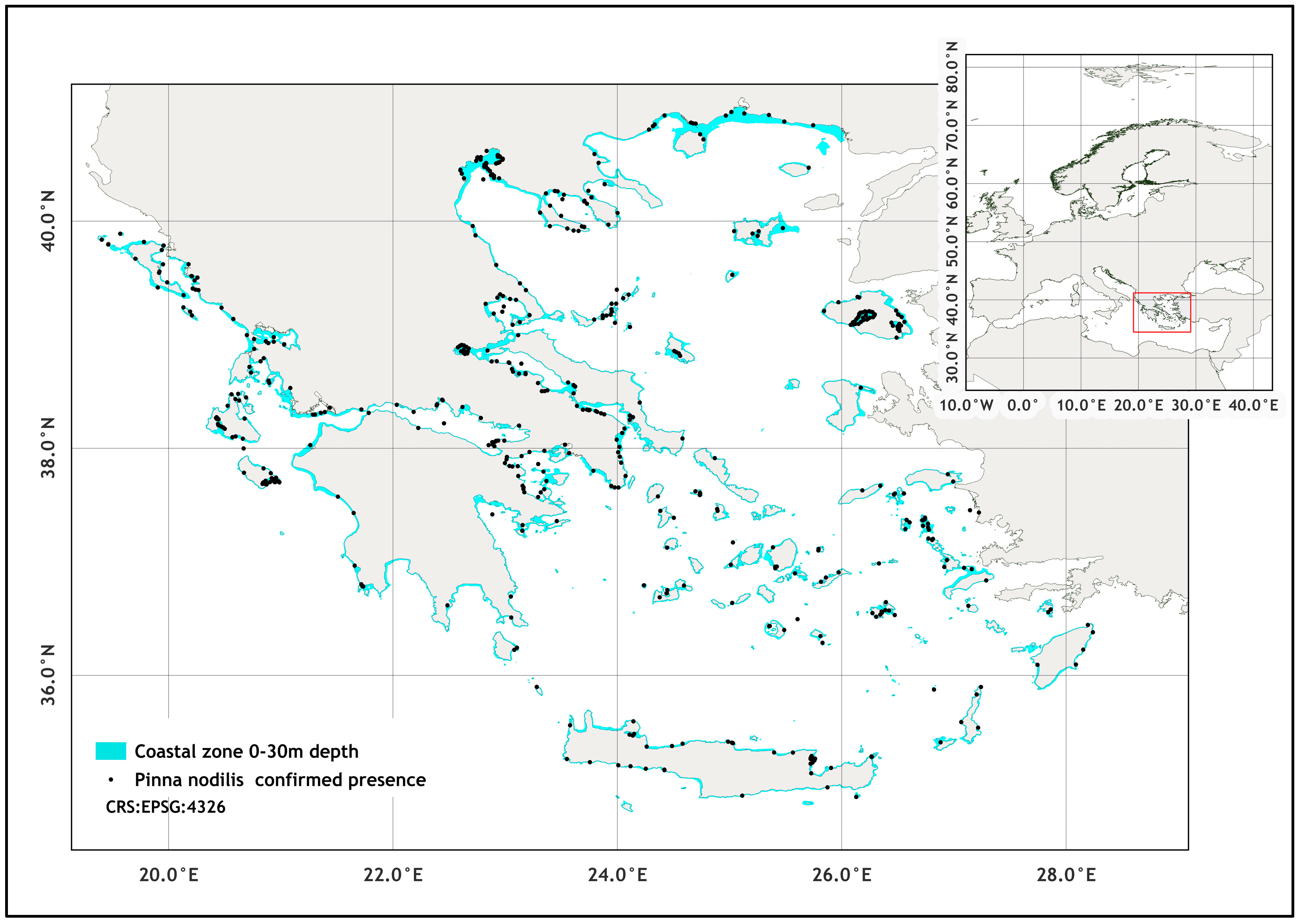
The 0–30 m depth zone and the distribution of Pinna nobilis occurrence records were mapped (Figure 1). Τhe area of the 0–30 m zone is 14,015 km2 and the water volume is 210.7 × 10⁹ m3.
The number of dead individuals is estimated at 1258.4 × 106 ± 452.9 × 10⁶, the total weight of the dead shells is estimated at 148,083.4 ± 35,022.6 tons, the amount of carbon sequestered in the shells is estimated at 17,370.3 ± 4108.8 tons, nitrogen at 482.2 ± 133.9 tons and phosphorus at 59.9 ± 16.2 tons (Table 2).
The total number of Pinna nobilis individuals is estimated at 2663.5 × 106 ± 643.2 × 10⁶ individuals. The total weight of the shells is estimated at 410,430.1 ± 102,962.2 tons, the amount of carbon sequestered in the shells at 48,148.6 ± 12,094.0 tons, nitrogen at 1333.4 ± 389.6 tons and phosphorus at 166.8 ± 47.2 tons (Table 2).
The variability and distribution of the estimated model outputs, including population size, shell biomass, and sequestered carbon (C), nitrogen (N), and phosphorus (P), are presented in Supplementary Figure S1, where both live (L), dead (D), and total components are illustrated. These distributions reflect the uncertainty associated with parameter variability and highlight the internal structure of the modeled population.
The total amount of water filtered by the living individuals of the presumed population of the Pinna nobilis species per year in the territory is estimated to be 2587.4 × 109 ± 812.9 × 10⁹ m3, which drops to 491.6 × 10⁹ ± 154.5 × 10⁹ m3 after the massive death of the species (Table 3).

4. Discussion

This paper examines the ecosystem services associated with the protected fan mussel Pinna nobilis, in the Greek marine territory. As such, this was accomplished by focusing on the regulating ecosystem services of carbon and nutrient (nitrogen and phosphorus) sequestration in the species’ shells, along with the supporting ecosystem service of water filtration. The evaluation is based on a model that incorporates population age structure, abundance, and weight gain per individual and age, for a hypothetical Pinna nobilis population with a maximum age of 30 years.
It is observed that the population of Pinna nobilis in the Greek marine territory sequesters an average of 13,689.4–108,139.0 tons of carbon (C), 304.7–2988.3 tons of nitrogen (N), and 49.7–450.5 tons of phosphorus (P) annually. This corresponds to a range of 8.14–76.6 million euros per year in regulating ecosystem services. Additionally, on an annual basis, the species provides a water filtration service, filtering between 606.9 and 6852.2 × 109 m3. This means that the mussels can filter the 30 m deep coastal zone between 2.89 and 32.53 times per year.
However, following the mass mortality event in the Mediterranean in 2016, it is estimated that the population in the Greek maritime territory has declined by 81.1% [22]. As a result, the provision of these ecosystem services has decreased accordingly, with the current value of regulating ecosystem services ranging from 1.31 to 13.47 million euros per year. The remaining population is estimated to be filtering 115.3–1301.9 × 109 m3 annually, with the capacity to filter the 30 m deep coastal zone between 0.55 and 6.18 times per year. Recent studies referred to the mortality rate in 2022 being exceeded by 95%, with living specimens found only at two sites [43]. This indicates that the current ecosystem services provided by Pinna nobilis are likely even lower than the aforementioned evaluations and are geographically restricted.
Another way to understand the large scale of the lost biofiltration service is through evaluating the theoretical replacement cost with the water treatment being carried out by engineered systems. Proxies from seawater-treatment technologies (e.g., reverse osmosis and sand/membrane filtration) and operating costs drawn from scientific and policy reviews of seawater-treatment systems are commonly in the range of approximately €0.4–2.0 per m3, depending on technology, scale, and site [54,55,56,57].
Applying this range to the estimated pre-mortality filtration volume of P. nobilis in Greece (≈2.59 × 10¹² m3 yr−1) produces a notional replacement cost of approximately €1.0–5.2 billion yr−1. On the other hand, the reduced post-mortality filtration volume (≈4.92 × 10¹¹ m3 yr−1) corresponds to €0.2–1.0 billion yr−1. An additional framework commonly applied in shellfish ecosystem service studies is the replacement cost per unit of nutrient removed (e.g., €/kg N), as used by Petersen et al. [51] and others, which produces values of a comparable order of magnitude for nutrient mitigation. The above is further supported by recent EU-level policy assessments, which explicitly acknowledge Mediterranean mussel farming in Greece as a potential Other Effective Area-Based Conservation Measure (OECM) which contributes to the recovery of P. nobilis by using the scientific results of the PINNA-SOS project as a demonstrative case study [54]. A recent research has shown a high willingness among fishers, aquaculture operators and other coastal stakeholders to become engaged in PINNA-SOS-related recovery actions, giving emphasis to the social feasibility and practical relevance of ecosystem-based conservation approaches [44]. Furthermore, latest advances in spatial ecology have identified key sink–source connectivity patterns for P. nobilis populations in the Mediterranean that provide a robust framework for targeted restocking, spatial planning and long-term recovery strategies [58]. All these perspectives together emphasize that the natural filtration service provided by P. nobilis represents an irreplaceable form of natural capital constituting the substitution through technological solutions being prohibitively expensive, energy-intensive and environmentally burdensome. These conclusions are also consistent with recent Mediterranean-wide studies documenting the collapse of P. nobilis populations and underlining that their decline entails not only biodiversity loss but also the degradation of key ecosystem functions and services [59]. Any replacement-cost estimates should be interpreted as illustrative values rather than operational budgets for engineered water treatment with the intention to convey the scale of lost natural capital rather than to prescribe specific policy expenditures. Those estimates were made on the basis of current technological and economic assumptions which may vary with future developments even though the underlying biophysical function remain unchanged.
It is important to emphasize that these economic estimates do not assign an intrinsic market value to the biological function itself. The biophysical process of nutrient incorporation and filtration remains independent of its economic framing. On the other hand, using the replacement-cost approach means that the approximate cost that would be incurred under current technological and policy conditions if society would attempt to replicate part of this function through engineered systems. Consequently, changes in pricing assumptions would modify the economic proxy, but not the underlying ecological magnitude of the service provided.
Additional insights into the economic burden of anthropogenic nutrient removal can be drawn from studies evaluating advanced nutrient-reduction technologies in coastal wastewater facilities. Wu et al. [60] carried out a techno-economic assessment of nutrient management strategies in a coastal Water Resource Recovery Facility (WRRF). He reported that by achieving enhanced nitrogen removal through WRRF upgrades, there is a cost incurrence of approximately 0.31 USD per m3 of treated water. Even biological alternatives, such as nutrient bioextraction via macroalgal aquaculture, exhibited costs ranging from 0.26 to 0.499 USD per m3, depending on the end-use of the harvested biomass. These values show that engineered or managed biological systems for nutrient removal remain financially demanding, reinforcing the notion that replacing the natural nutrient removal function historically provided by P. nobilis would require a substantial and continuous non-cost-effective investment. In this context, the loss of the species represents not only a decline in biodiversity but also the disappearance of a critical, cost-efficient ecosystem service that cannot be substituted without significant economic and environmental costs.
The estimates rely on several assumptions, which may introduce uncertainties due to the following: (a) natural mortality is to be constant across all age classes; (b) the increase in shell length follows the von Bertalanffy growth model, with coefficients similar to those expected from variations in habitat suitability; and (c) the species’ range is to be confined to the 0–30 m depth zone within Greek territorial waters. Moreover, a significant number of uncertainties have also been reported through multiple prediction iterations, incorporating various combinations of the input variables, effectively addressing the uncertainties arising from the above assumptions (a) and (b). For instance, natural mortality input values ranged from 0.5 to 2.0 times the average value in order to address the potential model inaccuracies or the non-stationary nature of natural mortality across ages.
A similar approach was applied to the von Bertalanffy coefficients by incorporating a wide range of parameter values into the model to capture their heterogeneity and the resulting variability in habitat suitability for the species.
Although these uncertainties have been considered and incorporated into the model, they nevertheless increase the variation range of the final predicted values. Lastly, uncertainties stemming from the species’ range are likely minimal, given the confirmed presence of Pinna nobilis throughout its expected distribution (Figure 1).

Definition Habitat and Uncertainty Considerations

Although the model incorporates parameter uncertainty through Monte Carlo simulations, several structural assumptions still remain. Firstly, it was assumed that natural mortality was constant across age classes, whereas mortality likely varies with size, habitat quality, and environmental stressors. Second, population density estimates derived from surveyed sites were extrapolated across the 0–30 m depth zone of the Greek coast, giving a window of local deviations from average density. Third, the model analyzes a closed population, which may not fully capture larval connectivity among Mediterranean subregions. Finally, fishing mortality was assumed negligible because P. nobilis is legally protected in Greece and not commercially exploited.
A key structural uncertainty is attributed to not only to the 0–30 m depth delimitation, but mainly to the substrate suitability within this zone. Although the species’ bathymetric range is well-established, the availability of suitable soft substrates for settlement and anchoring is spatially heterogeneous. Rocky bottoms and other unsuitable substrates may therefore reduce the effectively habitable area compared to the total mapped coastal zone. As a result, population-level estimates may represent an upper-bound scenario under optimal habitat availability.
Even though these assumptions introduce an uncertainty into absolute numerical estimates, they do not alter the central conclusion that the magnitude of lost ecosystem services following the collapse of P. nobilis is substantial and ecologically significant.
In addition to the aforementioned aspects, it is important to mention that bivalves through the biological process of cellular respiration release carbon dioxide back into the aquatic environment. In some cases, this may result in a negative net carbon balance, thus diminishing their overall contribution to carbon sequestration [61]. Furthermore, CO2 is also generated during the decomposition of bivalve feces and pseudofeces, a process that must be accounted for in carbon budget evaluations. Equally important is the need to assess ecosystem-level impacts such as changes in phytoplankton dynamics and benthic–pelagic coupling so as to provide a comprehensive evaluation of the role of bivalves in the carbon cycle [15,62].
Previous studies suggest that several bivalve species may act as near-neutral carbon sinks, due to respiratory CO2 release and biogenic calcification which may offset carbon incorporation into shells (e.g., [15,61,63]). Therefore, the values reported in this study represent gross shell carbon storage rather than net ecosystem carbon sequestration. In contrast, nitrogen and phosphorus are not directly affected by respiratory processes but are involved in excretion and biogeochemical cycling pathways. Nevertheless, even under a carbon-neutral balance, Pinna nobilis provides substantial ecosystem services, particularly through large-scale water filtration and nutrient regulation, which remain highly relevant for coastal ecosystem functioning.
Overall, the collapse of the P. nobilis population represents a profound loss not only for biodiversity but also for coastal ecosystem functioning. The natural filtration and nutrient removal services once provided at large scales by this species cannot be realistically replaced without substantial economic and environmental costs. These findings highlight the urgent need to integrate non-commercial, ecosystem-engineering species, such as P. nobilis, into marine spatial planning and conservation policy frameworks.

5. Conclusions

The collapse of the Pinna nobilis population in Greek coastal waters has resulted in a profound reduction to both regulating and supporting ecosystem services. The magnitude of nutrient sequestration and biofiltration historically delivered by this species cannot be realistically substituted by engineered or managed biological systems without incurring substantial economic, energetic and environmental costs. These findings underline the importance of explicitly incorporating non-commercial, ecosystem-engineering species into marine conservation strategies, spatial planning and blue-economy assessments.
Recent scientific and policy evidence further demonstrates that stakeholder-supported, ecosystem-based and spatially explicit conservation measures, including Other Effective Area-Based Conservation Measures (OECMs) linked to aquaculture activities, can play a key role in the recovery of Pinna nobilis populations.
Protecting and restoring P. nobilis populations should therefore be considered not only a biodiversity priority but also a cost-effective investment in maintaining coastal ecosystem functioning and the natural capital that underpins water quality, nutrient cycling and ecological resilience.

Supplementary Materials

The following supporting information can be downloaded at https://www.mdpi.com/article/10.3390/d18050308/s1, Figure S1: Frequency distributions of the estimated number of individuals of Pinna nobilis, shell biomass, and sequestered carbon (C), nitrogen (N), and phosphorus (P), presented by category (live: L; dead: D) and as total values across the study area; Table S1: Literature-derived von Bertalanffy growth parameters (L∞, k, φ) for Pinna nobilis in the Mediterranean Sea. Values marked with an asterisk (*) were excluded from the calculation of mean values and standard deviations used in the population model. References [19,39,47,64,65,66,67,68] are cited in the Supplementary Material.

Author Contributions

Conceptualization, J.A.T., G.K.; methodology, K.T., G.K.; software, K.T., G.K.; validation, K.T., J.A.T. and G.K.; formal analysis, K.T., G.K.; investigation, K.T., G.K.; resources, K.T., J.A.T., G.K.; data curation, K.T.; writing—original draft preparation, G.K., K.T.; writing—review and editing, K.T., J.A.T., G.K.; visualization, K.T., G.K.; supervision, G.K.; project administration, G.K., J.A.T.; funding acquisition, J.A.T. All authors have read and agreed to the published version of the manuscript.

Funding

This study is part of the EU-Greece EMFF 2014–2020 program titled “Innovative actions for monitoring-recovery-assistance in recruiting the endangered species Pinna nobilis” with project code: 5052394.

Institutional Review Board Statement

Not applicable.

Data Availability Statement

The original contributions presented in this study are included in the article/Supplementary Materials. Further inquiries can be directed to the corresponding author.

Acknowledgments

The publication fees of this manuscript have been financed by the Research Council of the University of Patras. Special thanks to my brother, Grigorios Tsolakos, a graduate of the University of Plymouth and the University of Cardiff, for assisting in drafting this manuscript.

Conflicts of Interest

The authors declare no conflicts of interest.

Abbreviations

The following abbreviations are used in this manuscript:
CICESCommon International Classification of Ecosystem Services
OECMOther Effective Area-Based Conservation Measure
WRRFWater Resource Recovery Facility

References

  1. Filgueira, R.; Strohmeier, T.; Strand, Ø. Regulating services of bivalve molluscs in the context of the carbon cycle and implications for ecosystem valuation. In Goods and Services of Marine Bivalves; Smaal, A.C., Ferreira, J.G., Grant, J., Petersen, J.K., Strand, Ø., Eds.; Springer International Publishing: Cham, Switzerland, 2018; pp. 231–251. [Google Scholar]
  2. Carss, D.N.; Brito, A.C.; Chainho, P.; Ciutat, A.; de Montaudouin, X.; Otero, R.M.F.; Filgueira, M.I.; Garbutt, A.; Goedknegt, M.A.; Lynch, S.A.; et al. Ecosystem services provided by a non-cultured shellfish species: The common cockle Cerastoderma edule. Mar. Environ. Res. 2020, 158, 104931. [Google Scholar] [CrossRef] [PubMed]
  3. van der Schatte Olivier, A.; Jones, L.; Vay, L.L.; Christie, M.; Wilson, J.; Malham, S.K. A global review of the ecosystem services provided by bivalve aquaculture. Rev. Aquac. 2020, 12, 3–25. [Google Scholar] [CrossRef]
  4. Alonso, A.A.; Álvarez-Salgado, X.A.; Antelo, L.T. Assessing the impact of bivalve aquaculture on the carbon circular economy. J. Clean. Prod. 2021, 279, 123873. [Google Scholar] [CrossRef]
  5. Moore, D.; Heilweck, M.; Petros, P. Cultivate shellfish to remediate the atmosphere. In Aquaculture: Ocean Blue Carbon Meets UN-SDGS; Springer International Publishing: Cham, Switzerland, 2022; pp. 35–63. [Google Scholar]
  6. Ysebaert, T.; Walles, B.; Haner, J.; Hancock, B. Habitat modification and coastal protection by ecosystem-engineering reef-building bivalves. In Goods and Services of Marine Bivalves; Smaal, A.C., Ferreira, J.G., Grant, J., Petersen, J.K., Strand, Ø., Eds.; Springer International Publishing: Cham, Switzerland, 2018; pp. 253–273. [Google Scholar]
  7. Cranford, P.J.; Strain, P.M.; Dowd, M.; Hargrave, B.T.; Grant, J.; Archambault, M.C. Influence of mussel aquaculture on nitrogen dynamics in a nutrient enriched coastal embayment. Mar. Ecol. Prog. Ser. 2007, 347, 61–78. [Google Scholar] [CrossRef]
  8. Economics, N.; Schug, I.; Baxter, D.M.; Wellman, K. Valuation of Ecosystem Services from Shellfish Restoration, Enhancement and Management: A Review of the Literature; Prepared for Pacific Shellfish Institute; Northern Economics Inc.: Anchorage, AK, USA, 2009. [Google Scholar]
  9. Haines-Young, R.; Potschin, M. Common international classification of ecosystem services (CICES, Version 4.1). Eur. Environ. Agency 2012, 33, 107. [Google Scholar]
  10. Haines-Young, R.; Potschin-Young, M.B. Revision of the common international classification for ecosystem services (CICES V5. 1): A policy brief. One Ecosyst. 2018, 3, e27108. [Google Scholar] [CrossRef]
  11. Hattam, C.; Atkins, J.P.; Beaumont, N.; Börger, T.; Böhnke-Henrichs, A.; Burdon, D.; De Groot, R.; Hoefnagel, E.; Nunes, P.A.; Piwowarczyk, J.; et al. Marine ecosystem services: Linking indicators to their classification. Ecol. Indic. 2015, 49, 61–75. [Google Scholar] [CrossRef]
  12. Ferreira, J.G.; Bricker, S.B. Goods and services of extensive aquaculture: Shellfish culture and nutrient trading. Aquac. Int. 2016, 24, 803–825. [Google Scholar] [CrossRef]
  13. Filgueira, R.; Byron, C.J.; Comeau, L.A.; Costa-Pierce, B.; Cranford, P.J.; Ferreira, J.G.; Grant, J.; Guyondet, T.; Jansen, H.M.; Landry, T.; et al. An integrated ecosystem approach for assessing the potential role of cultivated bivalve shells as part of the carbon trading system. Mar. Ecol. Prog. Ser. 2015, 518, 281–287. [Google Scholar] [CrossRef]
  14. Petersen, J.K.; Holmer, M.; Termansen, M.; Hasler, B. Nutrient extraction through bivalves. In Goods and Services of Marine Bivalves; Smaal, A.C., Ferreira, J.G., Grant, J., Petersen, J.K., Strand, Ø., Eds.; Springer International Publishing: Cham, Switzerland, 2018; pp. 179–208. [Google Scholar]
  15. Smaal, A.C.; Ferreira, J.G.; Grant, J.; Petersen, J.K.; Strand, Ø. Goods and Services of Marine Bivalves; Springer International Publishing: Cham, Switzerland, 2019; p. 591. [Google Scholar]
  16. Brian, J.I.; Aldridge, D.C. A rapid, non-destructive method for sampling castrating parasites in endangered bivalve molluscs. Aquat. Conserv. Mar. Freshw. Ecosyst. 2021, 31, 729–735. [Google Scholar] [CrossRef]
  17. Zavodnik, D.; Hrs-Brenko, M.; Legac, M. Les Espèces Marines à Proteger en Mediterranee; Boudouresque, C.F., Avon, M., Gravez, V., Eds.; GIS Posidonie Publications: Marseille, France, 1991; pp. 169–178. [Google Scholar]
  18. Rouanet, E.; Trigos, S.; Vicente, N. From youth to death of old age: The 50-year story of a Pinna nobilis fan mussel population at Port-Cros Island (Port-Cros National Park, Provence, Mediterranean Sea). Sci. Rep. Port-Cros Natl. Park 2015, 29, 209–222. [Google Scholar]
  19. Richardson, C.A.; Peharda, M.; Kennedy, H.; Kennedy, P.; Onofri, V. Age, growth rate and season of recruitment of Pinna nobilis (L) in the Croatian Adriatic determined from Mg: Ca and Sr: Ca shell profiles. J. Exp. Mar. Biol. Ecol. 2004, 299, 1–16. [Google Scholar] [CrossRef]
  20. Basso, L.; Vazquez-Luis, M.; Garcia-March, J.R.; Deudero, S.; Alvarez, E.; Vicente, N.; Duarte, M.C.; Hendriks, I.E. The pen shell, Pinna nobilis: A review of population status and recommended research priorities in the Mediterranean Sea. Adv. Mar. Biol. 2015, 71, 109–160. [Google Scholar]
  21. Vazquez-Luis, M.; Alvarez, E.; Barrajon, A.; Garcia-March, J.R.; Grau, A.; Hendriks, I.E.; Jimenez, S.; Kersting, D.; Moreno, D.; Perez, M.; et al. SOS Pinna nobilis: A mass mortality event in western Mediterranean Sea. Front. Mar. Sci. 2017, 4, 220. [Google Scholar] [CrossRef]
  22. Zotou, M.; Gkrantounis, P.; Karadimou, E.; Tsirintanis, K.; Sini, M.; Poursanidis, D.; Azzolin, M.; Dailianis, T.; Kytinou, E.; Issaris, Y.; et al. Pinna nobilis in the Greek seas (NE Mediterranean): On the brink of extinction? Mediterr. Mar. Sci. 2020, 21, 575–591. [Google Scholar] [CrossRef]
  23. Lattos, A.; Giantsis, I.A.; Karagiannis, D.; Michaelidis, B. First detection of the invasive Haplosporidian and Mycobacteria parasites hosting the endangered bivalve Pinna nobilis in Thermaikos Gulf, North Greece. Mar. Environ. Res. 2020, 155, 104889. [Google Scholar] [CrossRef] [PubMed]
  24. Kersting, D.; Benabdi, M.; Cˇižmek, H.; Grau, A.; Jimenez, C.; Katsanevakis, S.; Ozturk, B.; Tuncer, S.; Tunesi, L.; Vazquez-Luis, M.; et al. Pinna nobilis. The IUCN Red List of Threatened Species 2019//IUCN Red List of Threatened Species. IUCN 2019, e.T160075998A160081499. [Google Scholar] [CrossRef]
  25. Lattos, A.; Giantsis, I.A.; Karagiannis, D.; Theodorou, J.A.; Michaelidis, B. Gut symbiotic microbial communities in the IUCN critically endangered Pinna nobilis suffering from mass mortalities, revealed by 16S rRNA amplicon NGS. Pathogens 2020, 9, 1002. [Google Scholar] [CrossRef]
  26. Lattos, A.; Feidantsis, K.; Giantsis, I.A.; Theodorou, J.A. Seasonality in Synergism with Multi-Pathogen Presence Leads to Mass Mortalities of the Highly Endangered Pinna nobilis in Greek Coastlines: A Pathophysiological Approach. Microorganisms 2023, 11, 1117. [Google Scholar] [CrossRef] [PubMed]
  27. Lattos, A.; Bitchava, K.; Giantsis, I.A.; Theodorou, J.A.; Batargias, C.; Michaelidis, B. The implication of vibrio bacteria in the winter mortalities of the critically endangered Pinna nobilis. Microorganisms 2021, 9, 922. [Google Scholar] [CrossRef]
  28. Lattos, A.; Feidantsis, K.; Georgoulis, I.; Giantsis, I.A.; Karagiannis, D.; Theodorou, J.A.; Staikou, A.; Michaelidis, B. Pathophysiological responses of Pinna nobilis individuals enlightens the etiology of mass mortality situation in the mediterranean populations. Cells 2021, 10, 2838. [Google Scholar] [CrossRef]
  29. Carella, F.; Palić, D.; Šarić, T.; Župan, I.; Gorgoglione, B.; Prado, P.; Andree, K.B.; Giantsis, I.A.; Michaelidis, B.; Lattos, A.; et al. Multipathogen infections and multifactorial pathogenesis involved in noble pen shell (Pinna nobilis) mass mortality events: Background and current pathologic approaches. Vet. Pathol. 2023, 60, 560–577. [Google Scholar] [CrossRef]
  30. Davenport, J.; Ezgeta-Bali’c, D.; Peharda, M.; Skeji’c, S.; Ninˇcevi’c-Gladan, Ž.; Matijevi’c, S. Size-differential feeding in Pinna nobilis L. (Mollusca: Bivalvia): Exploitation of detritus, phytoplankton and zooplankton. Estuar. Coast. Shelf Sci. 2011, 92, 246–254. [Google Scholar] [CrossRef]
  31. Trigos, S.; García-March, J.R.; Vicente, N.; Tena, J.; Torres, J. Utilization of muddy detritus as organic matter source by the fan mussel Pinna nobilis. Mediterr. Mar. Sci. 2014, 15, 667–674. [Google Scholar] [CrossRef]
  32. Alomar, C.; Vazquez-Luis, M.; Magraner, K.; Lozano, L.; Deudero, S. Evaluating stable isotopic signals in bivalve Pinna nobilis under different human pressures. J. Exp. Mar. Biol. Ecol. 2015, 467, 77–86. [Google Scholar] [CrossRef]
  33. Theodorou, J.A.; James, R.; Tzovenis, I.; Hellio, C. The recruitment of the endangered fan mussel Pinna nobilis (Linnaeus, 1758) on the ropes of a Mediterranean mussel long line farm. J. Shellfish Res. 2015, 34, 409–414. [Google Scholar] [CrossRef]
  34. Prado, P.; Caiola, N.; Ibáñez, C. Habitat use by a large population of Pinna nobilis in shallow waters. Sci. Mar. 2014, 78, 555–565. [Google Scholar] [CrossRef]
  35. Chiaroni, E. Cohort Structure and Habitat Association of the Pinna nobilis Population in Northern Corsica at STARESO. Bachelor’s Thesis, University of California, Santa Cruz, CA, USA, 2016. [Google Scholar]
  36. Coppa, S.; Quattrocchi, G.; Cucco, A.; de Lucia, G.A.; Vencato, S.; Camedda, A.; Domenici, P.; Conforti, A.; Satta, A.; Tonielli, R.; et al. Self-organisation in striped seagrass meadows affects the distributional pattern of the sessile bivalve Pinna nobilis. Sci. Rep. 2019, 9, 7220. [Google Scholar] [CrossRef]
  37. Katsanevakis, S. Population ecology of the endangered fan mussel Pinna nobilis in a marine lake. Endanger. Species Res. 2005, 1, 51–59. [Google Scholar] [CrossRef]
  38. Katselis, G.; Hellio, C.; Tzovenis, I.; Tagalis, D.; James, R.; Theodorou, J.A. Density and size structure of the endangered fan mussel Pinna nobilis (Linnaeus 1758), in the shallow water zone of Maliakos Gulf, Greece. Acta Adriat. 2017, 58, 63–76. [Google Scholar] [CrossRef]
  39. Galinou-Mitsoudi, S.; Vlahavas, G.; Papoutsi, O. Population study of the protected bivalve Pinna nobilis (Linnaeus, 1758) in Thermaikos Gulf (north Aegean Sea). J. Biol. Res. 2006, 5, 47–53. [Google Scholar]
  40. Rabaoui, L.; Belgacem, W.; Ismail, D.B.; Mansour, L.; Tlig-Zouari, S. Engineering effect of Pinna nobilis shells on benthic communities. Oceanologia 2015, 57, 271–279. [Google Scholar] [CrossRef]
  41. Katsanevakis, S.; Poursanidis, D.; Issaris, Y.; Panou, A.; Petza, D.; Vassilopoulou, V.; Chaldaiou, I.; Sini, M. “Protected” marine shelled molluscs: Thriving in Greek seafood restaurants. Mediterr. Mar. Sci. 2011, 12, 429–438. [Google Scholar] [CrossRef]
  42. Marrocco, V.; Sicuro, A.; Zangaro, F.; Pinna, M. First record of the protected species Pinna nobilis (Linnaeus, 1758) in the Aquatina Lagoon (NATURA 2000 site IT9150003, South-East Italian coastline). Nat. Conserv. 2018, 28, 51–59. [Google Scholar] [CrossRef]
  43. Papadakis, O.; Mamoutos, I.; Ramfos, A.; Catanese, G.; Papadimitriou, E.; Theodorou, J.; Batargias, C.; Papaioannou, C.; Kamilari, M.; Tragou, E.; et al. Status, distribution, and threats of the last surviving fan mussel populations in Greece. Mediterr. Mar. Sci. 2023, 24, 679–708. [Google Scholar] [CrossRef]
  44. Theodorou, J.A.; Katselis, G.; Anagnopoulos, O.; Bourdaniotis, N.; Michaelidis, B.; Moutopoulos, D.K. The Willingness to Assess and Contribute to Pinna-SOS Recovery Actions of Marine Fishers/Farmers and Stakeholders. Fishes 2024, 9, 297. [Google Scholar] [CrossRef]
  45. Butler, A.; Vicente, N.; de Gaulejac, B. Ecology of the pterioid bivalves Pinna bicolor Gmelin and Pinna nobilis L. Mar. Life 1993, 3, 37–45. [Google Scholar]
  46. Garcia-March, J.R.; Sanchis Solsona, M.A.; Garcia-Carrascosa, A.M. Shell gaping behaviour of Pinna nobilis L.; 1758: Circadian and circalunar rhythms revealed by in situ monitoring. Mar. Biol. 2008, 153, 689–698. [Google Scholar] [CrossRef]
  47. Garcia-March, J.R.; Hernandis, S.; Vazquez-Luis, M.; Prado, P.; Deudero, S.; Vicente, N.; Tena-Medialdea, J. Age and growth of the endangered fan mussel Pinna nobilis in the western Mediterranean Sea. Mar. Environ. Res. 2020, 153, 104795. [Google Scholar] [CrossRef]
  48. Catanese, G.; Grau, A.; Valencia, J.M.; Garcia-March, J.R.; Vazquez-Luis, M.; Alvarez, E.; Deudero, S.; Darriba, S.; Carballal, M.J.; Villalba, A. Haplosporidium pinnae sp. nov.; a haplosporidan parasite associated with mass mortalities of the fan mussel, Pinna nobilis, in the Western Mediterranean Sea. J. Invertebr. Pathol. 2018, 157, 9–24. [Google Scholar] [CrossRef]
  49. Čelebičić, M.; Trakić, S.; Đug, S.; Viteškić, V. After the Pinna nobilis L. mass mortality event in Bosnia and Herzegovina–a proposal for remediation of biofiltration services in marine ecosystem. Veterinaria 2021, 70, 351–363. [Google Scholar]
  50. Pauly, D. On the interrelationships between natural mortality, growth parameters, and mean environmental temperature in 175 fish stocks. ICES J. Mar. Sci. 1980, 39, 175–192. [Google Scholar] [CrossRef]
  51. Petersen, J.K.; Hasler, B.; Timmermann, K.; Nielsen, P.; Tørring, D.B.; Larsen, M.M.; Holmer, M. Mussels as a tool for mitigation of nutrients in the marine environment. Mar. Pollut. Bull. 2014, 82, 137–143. [Google Scholar] [CrossRef] [PubMed]
  52. Molinos-Senante, M.; Hernández-Sancho, F.; Sala-Garrido, R.; Garrido-Baserba, M. Economic feasibility study for phosphorus recovery processes. Ambio 2011, 40, 408–416. [Google Scholar] [CrossRef] [PubMed]
  53. Tsolakos, K.; Theodorou, J.; Katselis, G. Estimation of Pinna nobilis L. ecosystem services in Greece. In Proceedings of the 5th International Congress on Applied Ichthyology, Oceanography & Aquatic Environment (Hydromedit 2024), Mytilene, Greece, 30 May–2 June 2024; pp. 443–447. Available online: https://hydromedit.gr/3d-flip-book/proceedings/ (accessed on 26 September 2024).
  54. Borriello, A.; Calvo, S.A.; Codina, L.L.; Curtale, R.; Feyen, L.; Gaborieau, N.; Garaffa, R.; Ghiani, M.; Guillen, J.; Mc Govern, L.; et al. The EU Blue Economy Report 2024; Publications Office of the European Union: Luxembourg, 2024. [Google Scholar]
  55. Ghaffour, N.; Missimer, T.M.; Amy, G.L. Technical review and evaluation of the economics of water desalination: Current and future challenges for better water supply sustainability. Desalination 2013, 309, 197–207. [Google Scholar] [CrossRef]
  56. Lattemann, S.; Höpner, T. Environmental impact and impact assessment of seawater desalination. Desalination 2008, 220, 1–15. [Google Scholar] [CrossRef]
  57. Kim, J.; Park, K.; Yang, D.R.; Hong, S. A comprehensive review of energy consumption of seawater reverse osmosis desalination plants. Appl. Energy 2019, 254, 113652. [Google Scholar] [CrossRef]
  58. Feria-Rodríguez, A.; March, D.; Mourre, B.; Hendriks, I.E.; Vázquez-Luis, M. Sink-source connectivity for restocking of Pinna nobilis in the western Mediterranean Sea. Mar. Environ. Res. 2024, 197, 106428. [Google Scholar] [CrossRef]
  59. Azzena, I.; Locci, C.; Pascale, N.; Deplano, I.; Senigaglia, R.; Scarpa, F.; Casu, M.; Sanna, D. Pinna nobilis, the Vanishing Giant: A Comprehensive Review on the Decline of a Mediterranean Icon. Animals 2025, 15, 2044. [Google Scholar] [CrossRef]
  60. Wu, J.; Rogers, S.W.; Schaummann, R.; Higgins, C.; Price, N. Bioextractive aquaculture as an alternative nutrient management strategy for water resource recovery facilities. Water Res. 2022, 212, 118092. [Google Scholar] [CrossRef]
  61. Munari, C.; Rossetti, E.; Mistri, M. Shell formation in cultivated bivalves cannot be part of carbon trading systems: A study case with Mytilus galloprovincialis. Mar. Environ. Res. 2013, 92, 264–267. [Google Scholar] [CrossRef]
  62. Zhou, X.; Li, H.; Liang, J.; Liu, H.; Wang, X.; Gao, L.; Chen, L.; Li, Y.; Guo, Y.; Liang, S. The role of marine bivalves in the oceanic carbon cycle: Physiological processes, carbon budgets and ecosystem perspectives. Reg. Stud. Mar. Sci. 2024, 78, 103815. [Google Scholar] [CrossRef]
  63. Álvarez-Salgado, X.A.; Fernández-Reiriz, M.J.; Fuentes-Santos, I.; Antelo, L.T.; Alonso, A.A.; Labarta, U. CO2 budget of cultured mussels metabolism in the highly productive Northwest Iberian upwelling system. Sci. Total Environ. 2022, 849, 157867. [Google Scholar] [CrossRef] [PubMed]
  64. Richardson, C.A.; Kennedy, H.; Duarte, C.M.; Kennedy, D.P.; Proud, S.V. Age and growth of the fan mussel Pinna nobilis from south-east Spanish Mediterranean seagrass (Posidonia oceanica) meadows. Mar. Biol. 1999, 133, 205–212. [Google Scholar] [CrossRef]
  65. García-March, J.R.; Manuel García-Carrascosa, A.; Luis Pena, A. In situ measurement of Pinna nobilis shells for age and growth studies: A new device. Mar. Biol. 2002, 23, 207–217. [Google Scholar] [CrossRef]
  66. Moreteau, J.C.; Vicente, N. Evolution d’une population de Pinna nobilis L. (Mollusca, Bivalvia). Malacologia 1982, 22, 341–345. [Google Scholar]
  67. Siletic, T.; Peharda, M. Population study of the fan shell Pinna nobilis L. in Malo and Veliko Jezero of the Mljet National Park (Adriatic Sea). Sci. Mar. 2003, 67, 91–98. [Google Scholar] [CrossRef]
  68. Demirci, A.; Acarli, S. Estimation growth parameters of endangered the fan mussel species (Pinna nobilis L.) by using different growth models from Izmir Bay, Aegean Sea, Turkey. Fresenius Environ. Bull. 2019, 28, 7368–7374. [Google Scholar]
Figure 1. Depth 0–30 m coastal zone of Greece (CRS: WGS84) and confirmed presence records of Pinna nobilis. Occurrence records compiled from Zotou et al. [22], iNaturalist.org, unpublished data, and Tsolakos et al. [53]. Map orientation and scale are provided by the coordinate axes (WGS84, units in meters). Map produced by the authors.
Diversity 18 00308 g001
Table 1. Core parameters used in the population and ecosystem service model.
ParameterSymbolUnitValueSource
Age ranget1–txyears1–30[39,47]
Mean densityDind·m−29.78 ± 4.5 (SE)[20]
Asymptotic shell lengthL∞cm60.05 ± 2.30 (SE)Literature synthesis (see Table S1)
Growth performance indexΦ2.84 ± 0.041 (SE)Literature synthesis (see Table S1)
Natural mortalityMyr−1Derived (Pauly equation; TEM = 17 °C)[50]
Shell length–weightc, b0.0381; 2.5128Unpublished
Tissue–shell relationshipr, v0.1861; 0.9954[48]
Filtration ratefm3·yr−1·g−152.5[49]
Mean depthdpm15[20]
Shell C contentP_C%11.72 ± 0.19[3]
Shell N contentP_N%0.32 ± 0.09[3]
Shell P contentP_P%0.04 ± 0.01[3]
Carbon priceq_C€·tn−163.65TradingEconomics
Nitrogen priceq_N€·tn−117,000[51]
Phosphorus priceq_P€·tn−142,000[52]
Monte Carlo runsiterations20,000This study
Table 2. Model estimates (mean ± SD, minimum, maximum) of Pinna nobilis population size (Ind), shell biomass (ShW), and shell-incorporated carbon (CW), nitrogen (NW), and phosphorus (PW) in the Greek coastal zone (0–30 m depth). AMD: after mass death.
CategoryInd (×106)ShW (tn)CW (tn)NW (tn)PW (tn)
Live     
mean ± SD1415.5 ± 299.2263,612.3 ± 83,642.630,925.1 ± 9825.2859.4 ± 303.3107.0 ± 37.1
min–max504.6–2532.770,210.2–671,038.38333.6–79,384.8203.8–2365.930.3–337.6
Dead     
mean ± SD1258.4 ± 452.9148,083.4 ± 35,022.617,370.3 ± 4108.8482.2 ± 133.959.9 ± 16.2
min–max328.8–3758.050,415.5–312,211.85997.0–36,964.4151.1–1097.018.5–157.9
Total (pre-mortality)     
mean ± SD2663.5 ± 643.2410,430.1 ± 102,962.248,148.6 ± 12,094.01333.4 ± 389.6166.8 ± 47.2
min–max745.3–5666.1118,413.3–929,623.913,689.4–108,139.0304.7–2988.349.7–450.5
Table 3. Model estimates (mean ± SD, minimum, maximum) of the annual economic value (Econ) of carbon, nitrogen, and phosphorus sequestration, total water filtration volume (F), and filtration turnover times (FTY) of Pinna nobilis in the Greek coastal zone (0–30 m depth). AMD: after mass death.
CategoryEcon_C (M€/yr)Econ_N (M€/yr)Econ_P
(M€/yr)
Total Econ (M€/yr)Filtration
(×109 m3/yr)
FTY (times/yr)
Total (pre-mortality)      
mean ± SD3.06 ± 0.7722.7 ± 6.57.01 ± 1.9832.74 ± 8.932587.4 ± 812.912.28 ± 3.86
min–max0.87–6.885.18–50.802.09–18.928.14–76.60606.9–6852.22.89–32.53
After mass mortality (AMD)      
mean ± SD6.22 ± 1.68491.6 ± 154.52.33 ± 0.73
min–max1.31–13.47115.3–1301.90.55–6.18
Disclaimer/Publisher’s Note: The statements, opinions and data contained in all publications are solely those of the individual author(s) and contributor(s) and not of MDPI and/or the editor(s). MDPI and/or the editor(s) disclaim responsibility for any injury to people or property resulting from any ideas, methods, instructions or products referred to in the content.