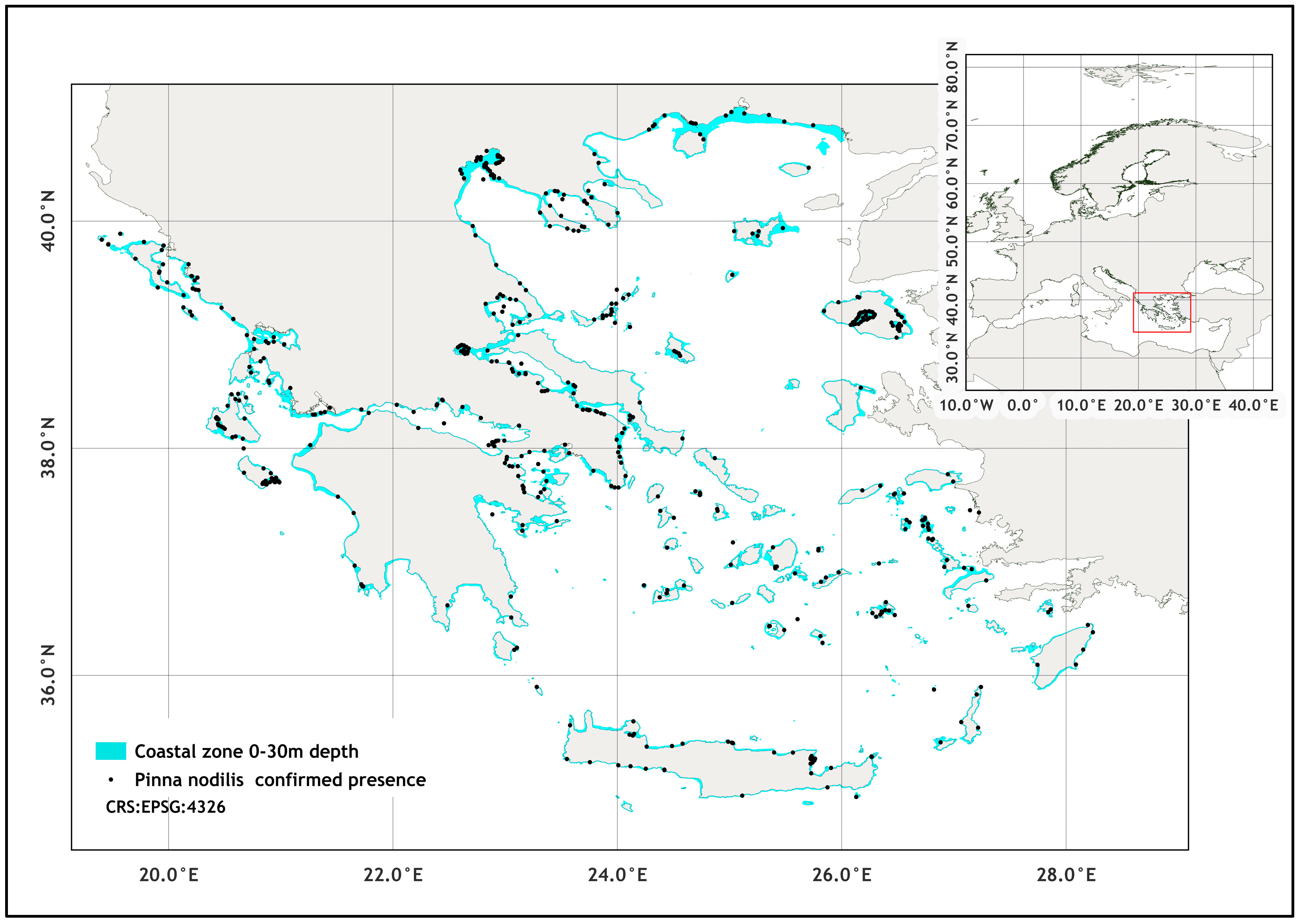

Ecosystem Services of the Endangered Fan Mussel Pinna nobilis in Greek Coastal Waters: Implications of Population Collapse for Coastal Ecosystem Functioning




Abstract
1. Introduction
2. Materials and Methods
2.1. Definition of the Potential Habitat of the Species
2.2. Population Estimation of the Species
2.3. Estimation of Nutrient Sequestration and Filtration Capacity
2.4. Calibration of the Model
2.5. Model Assumptions and Uncertainties
3. Results
4. Discussion
Definition Habitat and Uncertainty Considerations
5. Conclusions
Supplementary Materials
Author Contributions
Funding
Institutional Review Board Statement
Data Availability Statement
Acknowledgments
Conflicts of Interest
Abbreviations
| CICES | Common International Classification of Ecosystem Services |
| OECM | Other Effective Area-Based Conservation Measure |
| WRRF | Water Resource Recovery Facility |
References
- Filgueira, R.; Strohmeier, T.; Strand, Ø. Regulating services of bivalve molluscs in the context of the carbon cycle and implications for ecosystem valuation. In Goods and Services of Marine Bivalves; Smaal, A.C., Ferreira, J.G., Grant, J., Petersen, J.K., Strand, Ø., Eds.; Springer International Publishing: Cham, Switzerland, 2018; pp. 231–251. [Google Scholar]
- Carss, D.N.; Brito, A.C.; Chainho, P.; Ciutat, A.; de Montaudouin, X.; Otero, R.M.F.; Filgueira, M.I.; Garbutt, A.; Goedknegt, M.A.; Lynch, S.A.; et al. Ecosystem services provided by a non-cultured shellfish species: The common cockle Cerastoderma edule. Mar. Environ. Res. 2020, 158, 104931. [Google Scholar] [CrossRef] [Scilit] [PubMed]
- van der Schatte Olivier, A.; Jones, L.; Vay, L.L.; Christie, M.; Wilson, J.; Malham, S.K. A global review of the ecosystem services provided by bivalve aquaculture. Rev. Aquac. 2020, 12, 3–25. [Google Scholar] [CrossRef] [Scilit]
- Alonso, A.A.; Álvarez-Salgado, X.A.; Antelo, L.T. Assessing the impact of bivalve aquaculture on the carbon circular economy. J. Clean. Prod. 2021, 279, 123873. [Google Scholar] [CrossRef] [Scilit]
- Moore, D.; Heilweck, M.; Petros, P. Cultivate shellfish to remediate the atmosphere. In Aquaculture: Ocean Blue Carbon Meets UN-SDGS; Springer International Publishing: Cham, Switzerland, 2022; pp. 35–63. [Google Scholar]
- Ysebaert, T.; Walles, B.; Haner, J.; Hancock, B. Habitat modification and coastal protection by ecosystem-engineering reef-building bivalves. In Goods and Services of Marine Bivalves; Smaal, A.C., Ferreira, J.G., Grant, J., Petersen, J.K., Strand, Ø., Eds.; Springer International Publishing: Cham, Switzerland, 2018; pp. 253–273. [Google Scholar]
- Cranford, P.J.; Strain, P.M.; Dowd, M.; Hargrave, B.T.; Grant, J.; Archambault, M.C. Influence of mussel aquaculture on nitrogen dynamics in a nutrient enriched coastal embayment. Mar. Ecol. Prog. Ser. 2007, 347, 61–78. [Google Scholar] [CrossRef] [Scilit]
- Economics, N.; Schug, I.; Baxter, D.M.; Wellman, K. Valuation of Ecosystem Services from Shellfish Restoration, Enhancement and Management: A Review of the Literature; Prepared for Pacific Shellfish Institute; Northern Economics Inc.: Anchorage, AK, USA, 2009. [Google Scholar]
- Haines-Young, R.; Potschin, M. Common international classification of ecosystem services (CICES, Version 4.1). Eur. Environ. Agency 2012, 33, 107. [Google Scholar]
- Haines-Young, R.; Potschin-Young, M.B. Revision of the common international classification for ecosystem services (CICES V5. 1): A policy brief. One Ecosyst. 2018, 3, e27108. [Google Scholar] [CrossRef] [Scilit]
- Hattam, C.; Atkins, J.P.; Beaumont, N.; Börger, T.; Böhnke-Henrichs, A.; Burdon, D.; De Groot, R.; Hoefnagel, E.; Nunes, P.A.; Piwowarczyk, J.; et al. Marine ecosystem services: Linking indicators to their classification. Ecol. Indic. 2015, 49, 61–75. [Google Scholar] [CrossRef] [Scilit]
- Ferreira, J.G.; Bricker, S.B. Goods and services of extensive aquaculture: Shellfish culture and nutrient trading. Aquac. Int. 2016, 24, 803–825. [Google Scholar] [CrossRef] [Scilit]
- Filgueira, R.; Byron, C.J.; Comeau, L.A.; Costa-Pierce, B.; Cranford, P.J.; Ferreira, J.G.; Grant, J.; Guyondet, T.; Jansen, H.M.; Landry, T.; et al. An integrated ecosystem approach for assessing the potential role of cultivated bivalve shells as part of the carbon trading system. Mar. Ecol. Prog. Ser. 2015, 518, 281–287. [Google Scholar] [CrossRef] [Scilit]
- Petersen, J.K.; Holmer, M.; Termansen, M.; Hasler, B. Nutrient extraction through bivalves. In Goods and Services of Marine Bivalves; Smaal, A.C., Ferreira, J.G., Grant, J., Petersen, J.K., Strand, Ø., Eds.; Springer International Publishing: Cham, Switzerland, 2018; pp. 179–208. [Google Scholar]
- Smaal, A.C.; Ferreira, J.G.; Grant, J.; Petersen, J.K.; Strand, Ø. Goods and Services of Marine Bivalves; Springer International Publishing: Cham, Switzerland, 2019; p. 591. [Google Scholar]
- Brian, J.I.; Aldridge, D.C. A rapid, non-destructive method for sampling castrating parasites in endangered bivalve molluscs. Aquat. Conserv. Mar. Freshw. Ecosyst. 2021, 31, 729–735. [Google Scholar] [CrossRef] [Scilit]
- Zavodnik, D.; Hrs-Brenko, M.; Legac, M. Les Espèces Marines à Proteger en Mediterranee; Boudouresque, C.F., Avon, M., Gravez, V., Eds.; GIS Posidonie Publications: Marseille, France, 1991; pp. 169–178. [Google Scholar]
- Rouanet, E.; Trigos, S.; Vicente, N. From youth to death of old age: The 50-year story of a Pinna nobilis fan mussel population at Port-Cros Island (Port-Cros National Park, Provence, Mediterranean Sea). Sci. Rep. Port-Cros Natl. Park 2015, 29, 209–222. [Google Scholar]
- Richardson, C.A.; Peharda, M.; Kennedy, H.; Kennedy, P.; Onofri, V. Age, growth rate and season of recruitment of Pinna nobilis (L) in the Croatian Adriatic determined from Mg: Ca and Sr: Ca shell profiles. J. Exp. Mar. Biol. Ecol. 2004, 299, 1–16. [Google Scholar] [CrossRef] [Scilit]
- Basso, L.; Vazquez-Luis, M.; Garcia-March, J.R.; Deudero, S.; Alvarez, E.; Vicente, N.; Duarte, M.C.; Hendriks, I.E. The pen shell, Pinna nobilis: A review of population status and recommended research priorities in the Mediterranean Sea. Adv. Mar. Biol. 2015, 71, 109–160. [Google Scholar]
- Vazquez-Luis, M.; Alvarez, E.; Barrajon, A.; Garcia-March, J.R.; Grau, A.; Hendriks, I.E.; Jimenez, S.; Kersting, D.; Moreno, D.; Perez, M.; et al. SOS Pinna nobilis: A mass mortality event in western Mediterranean Sea. Front. Mar. Sci. 2017, 4, 220. [Google Scholar] [CrossRef] [Scilit]
- Zotou, M.; Gkrantounis, P.; Karadimou, E.; Tsirintanis, K.; Sini, M.; Poursanidis, D.; Azzolin, M.; Dailianis, T.; Kytinou, E.; Issaris, Y.; et al. Pinna nobilis in the Greek seas (NE Mediterranean): On the brink of extinction? Mediterr. Mar. Sci. 2020, 21, 575–591. [Google Scholar] [CrossRef] [Scilit]
- Lattos, A.; Giantsis, I.A.; Karagiannis, D.; Michaelidis, B. First detection of the invasive Haplosporidian and Mycobacteria parasites hosting the endangered bivalve Pinna nobilis in Thermaikos Gulf, North Greece. Mar. Environ. Res. 2020, 155, 104889. [Google Scholar] [CrossRef] [Scilit] [PubMed]
- Kersting, D.; Benabdi, M.; Cˇižmek, H.; Grau, A.; Jimenez, C.; Katsanevakis, S.; Ozturk, B.; Tuncer, S.; Tunesi, L.; Vazquez-Luis, M.; et al. Pinna nobilis. The IUCN Red List of Threatened Species 2019//IUCN Red List of Threatened Species. IUCN 2019, e.T160075998A160081499. [Google Scholar] [CrossRef] [Scilit]
- Lattos, A.; Giantsis, I.A.; Karagiannis, D.; Theodorou, J.A.; Michaelidis, B. Gut symbiotic microbial communities in the IUCN critically endangered Pinna nobilis suffering from mass mortalities, revealed by 16S rRNA amplicon NGS. Pathogens 2020, 9, 1002. [Google Scholar] [CrossRef] [Scilit]
- Lattos, A.; Feidantsis, K.; Giantsis, I.A.; Theodorou, J.A. Seasonality in Synergism with Multi-Pathogen Presence Leads to Mass Mortalities of the Highly Endangered Pinna nobilis in Greek Coastlines: A Pathophysiological Approach. Microorganisms 2023, 11, 1117. [Google Scholar] [CrossRef] [Scilit] [PubMed]
- Lattos, A.; Bitchava, K.; Giantsis, I.A.; Theodorou, J.A.; Batargias, C.; Michaelidis, B. The implication of vibrio bacteria in the winter mortalities of the critically endangered Pinna nobilis. Microorganisms 2021, 9, 922. [Google Scholar] [CrossRef] [Scilit]
- Lattos, A.; Feidantsis, K.; Georgoulis, I.; Giantsis, I.A.; Karagiannis, D.; Theodorou, J.A.; Staikou, A.; Michaelidis, B. Pathophysiological responses of Pinna nobilis individuals enlightens the etiology of mass mortality situation in the mediterranean populations. Cells 2021, 10, 2838. [Google Scholar] [CrossRef] [Scilit]
- Carella, F.; Palić, D.; Šarić, T.; Župan, I.; Gorgoglione, B.; Prado, P.; Andree, K.B.; Giantsis, I.A.; Michaelidis, B.; Lattos, A.; et al. Multipathogen infections and multifactorial pathogenesis involved in noble pen shell (Pinna nobilis) mass mortality events: Background and current pathologic approaches. Vet. Pathol. 2023, 60, 560–577. [Google Scholar] [CrossRef] [Scilit]
- Davenport, J.; Ezgeta-Bali’c, D.; Peharda, M.; Skeji’c, S.; Ninˇcevi’c-Gladan, Ž.; Matijevi’c, S. Size-differential feeding in Pinna nobilis L. (Mollusca: Bivalvia): Exploitation of detritus, phytoplankton and zooplankton. Estuar. Coast. Shelf Sci. 2011, 92, 246–254. [Google Scholar] [CrossRef] [Scilit]
- Trigos, S.; García-March, J.R.; Vicente, N.; Tena, J.; Torres, J. Utilization of muddy detritus as organic matter source by the fan mussel Pinna nobilis. Mediterr. Mar. Sci. 2014, 15, 667–674. [Google Scholar] [CrossRef] [Scilit]
- Alomar, C.; Vazquez-Luis, M.; Magraner, K.; Lozano, L.; Deudero, S. Evaluating stable isotopic signals in bivalve Pinna nobilis under different human pressures. J. Exp. Mar. Biol. Ecol. 2015, 467, 77–86. [Google Scholar] [CrossRef] [Scilit]
- Theodorou, J.A.; James, R.; Tzovenis, I.; Hellio, C. The recruitment of the endangered fan mussel Pinna nobilis (Linnaeus, 1758) on the ropes of a Mediterranean mussel long line farm. J. Shellfish Res. 2015, 34, 409–414. [Google Scholar] [CrossRef] [Scilit]
- Prado, P.; Caiola, N.; Ibáñez, C. Habitat use by a large population of Pinna nobilis in shallow waters. Sci. Mar. 2014, 78, 555–565. [Google Scholar] [CrossRef] [Scilit]
- Chiaroni, E. Cohort Structure and Habitat Association of the Pinna nobilis Population in Northern Corsica at STARESO. Bachelor’s Thesis, University of California, Santa Cruz, CA, USA, 2016. [Google Scholar]
- Coppa, S.; Quattrocchi, G.; Cucco, A.; de Lucia, G.A.; Vencato, S.; Camedda, A.; Domenici, P.; Conforti, A.; Satta, A.; Tonielli, R.; et al. Self-organisation in striped seagrass meadows affects the distributional pattern of the sessile bivalve Pinna nobilis. Sci. Rep. 2019, 9, 7220. [Google Scholar] [CrossRef] [Scilit]
- Katsanevakis, S. Population ecology of the endangered fan mussel Pinna nobilis in a marine lake. Endanger. Species Res. 2005, 1, 51–59. [Google Scholar] [CrossRef] [Scilit]
- Katselis, G.; Hellio, C.; Tzovenis, I.; Tagalis, D.; James, R.; Theodorou, J.A. Density and size structure of the endangered fan mussel Pinna nobilis (Linnaeus 1758), in the shallow water zone of Maliakos Gulf, Greece. Acta Adriat. 2017, 58, 63–76. [Google Scholar] [CrossRef] [Scilit]
- Galinou-Mitsoudi, S.; Vlahavas, G.; Papoutsi, O. Population study of the protected bivalve Pinna nobilis (Linnaeus, 1758) in Thermaikos Gulf (north Aegean Sea). J. Biol. Res. 2006, 5, 47–53. [Google Scholar]
- Rabaoui, L.; Belgacem, W.; Ismail, D.B.; Mansour, L.; Tlig-Zouari, S. Engineering effect of Pinna nobilis shells on benthic communities. Oceanologia 2015, 57, 271–279. [Google Scholar] [CrossRef] [Scilit]
- Katsanevakis, S.; Poursanidis, D.; Issaris, Y.; Panou, A.; Petza, D.; Vassilopoulou, V.; Chaldaiou, I.; Sini, M. “Protected” marine shelled molluscs: Thriving in Greek seafood restaurants. Mediterr. Mar. Sci. 2011, 12, 429–438. [Google Scholar] [CrossRef] [Scilit]
- Marrocco, V.; Sicuro, A.; Zangaro, F.; Pinna, M. First record of the protected species Pinna nobilis (Linnaeus, 1758) in the Aquatina Lagoon (NATURA 2000 site IT9150003, South-East Italian coastline). Nat. Conserv. 2018, 28, 51–59. [Google Scholar] [CrossRef] [Scilit]
- Papadakis, O.; Mamoutos, I.; Ramfos, A.; Catanese, G.; Papadimitriou, E.; Theodorou, J.; Batargias, C.; Papaioannou, C.; Kamilari, M.; Tragou, E.; et al. Status, distribution, and threats of the last surviving fan mussel populations in Greece. Mediterr. Mar. Sci. 2023, 24, 679–708. [Google Scholar] [CrossRef] [Scilit]
- Theodorou, J.A.; Katselis, G.; Anagnopoulos, O.; Bourdaniotis, N.; Michaelidis, B.; Moutopoulos, D.K. The Willingness to Assess and Contribute to Pinna-SOS Recovery Actions of Marine Fishers/Farmers and Stakeholders. Fishes 2024, 9, 297. [Google Scholar] [CrossRef] [Scilit]
- Butler, A.; Vicente, N.; de Gaulejac, B. Ecology of the pterioid bivalves Pinna bicolor Gmelin and Pinna nobilis L. Mar. Life 1993, 3, 37–45. [Google Scholar]
- Garcia-March, J.R.; Sanchis Solsona, M.A.; Garcia-Carrascosa, A.M. Shell gaping behaviour of Pinna nobilis L.; 1758: Circadian and circalunar rhythms revealed by in situ monitoring. Mar. Biol. 2008, 153, 689–698. [Google Scholar] [CrossRef] [Scilit]
- Garcia-March, J.R.; Hernandis, S.; Vazquez-Luis, M.; Prado, P.; Deudero, S.; Vicente, N.; Tena-Medialdea, J. Age and growth of the endangered fan mussel Pinna nobilis in the western Mediterranean Sea. Mar. Environ. Res. 2020, 153, 104795. [Google Scholar] [CrossRef] [Scilit]
- Catanese, G.; Grau, A.; Valencia, J.M.; Garcia-March, J.R.; Vazquez-Luis, M.; Alvarez, E.; Deudero, S.; Darriba, S.; Carballal, M.J.; Villalba, A. Haplosporidium pinnae sp. nov.; a haplosporidan parasite associated with mass mortalities of the fan mussel, Pinna nobilis, in the Western Mediterranean Sea. J. Invertebr. Pathol. 2018, 157, 9–24. [Google Scholar] [CrossRef] [Scilit]
- Čelebičić, M.; Trakić, S.; Đug, S.; Viteškić, V. After the Pinna nobilis L. mass mortality event in Bosnia and Herzegovina–a proposal for remediation of biofiltration services in marine ecosystem. Veterinaria 2021, 70, 351–363. [Google Scholar]
- Pauly, D. On the interrelationships between natural mortality, growth parameters, and mean environmental temperature in 175 fish stocks. ICES J. Mar. Sci. 1980, 39, 175–192. [Google Scholar] [CrossRef] [Scilit]
- Petersen, J.K.; Hasler, B.; Timmermann, K.; Nielsen, P.; Tørring, D.B.; Larsen, M.M.; Holmer, M. Mussels as a tool for mitigation of nutrients in the marine environment. Mar. Pollut. Bull. 2014, 82, 137–143. [Google Scholar] [CrossRef] [Scilit] [PubMed]
- Molinos-Senante, M.; Hernández-Sancho, F.; Sala-Garrido, R.; Garrido-Baserba, M. Economic feasibility study for phosphorus recovery processes. Ambio 2011, 40, 408–416. [Google Scholar] [CrossRef] [Scilit] [PubMed]
- Tsolakos, K.; Theodorou, J.; Katselis, G. Estimation of Pinna nobilis L. ecosystem services in Greece. In Proceedings of the 5th International Congress on Applied Ichthyology, Oceanography & Aquatic Environment (Hydromedit 2024), Mytilene, Greece, 30 May–2 June 2024; pp. 443–447. Available online: https://hydromedit.gr/3d-flip-book/proceedings/ (accessed on 26 September 2024).
- Borriello, A.; Calvo, S.A.; Codina, L.L.; Curtale, R.; Feyen, L.; Gaborieau, N.; Garaffa, R.; Ghiani, M.; Guillen, J.; Mc Govern, L.; et al. The EU Blue Economy Report 2024; Publications Office of the European Union: Luxembourg, 2024. [Google Scholar]
- Ghaffour, N.; Missimer, T.M.; Amy, G.L. Technical review and evaluation of the economics of water desalination: Current and future challenges for better water supply sustainability. Desalination 2013, 309, 197–207. [Google Scholar] [CrossRef] [Scilit]
- Lattemann, S.; Höpner, T. Environmental impact and impact assessment of seawater desalination. Desalination 2008, 220, 1–15. [Google Scholar] [CrossRef] [Scilit]
- Kim, J.; Park, K.; Yang, D.R.; Hong, S. A comprehensive review of energy consumption of seawater reverse osmosis desalination plants. Appl. Energy 2019, 254, 113652. [Google Scholar] [CrossRef] [Scilit]
- Feria-Rodríguez, A.; March, D.; Mourre, B.; Hendriks, I.E.; Vázquez-Luis, M. Sink-source connectivity for restocking of Pinna nobilis in the western Mediterranean Sea. Mar. Environ. Res. 2024, 197, 106428. [Google Scholar] [CrossRef] [Scilit]
- Azzena, I.; Locci, C.; Pascale, N.; Deplano, I.; Senigaglia, R.; Scarpa, F.; Casu, M.; Sanna, D. Pinna nobilis, the Vanishing Giant: A Comprehensive Review on the Decline of a Mediterranean Icon. Animals 2025, 15, 2044. [Google Scholar] [CrossRef] [Scilit]
- Wu, J.; Rogers, S.W.; Schaummann, R.; Higgins, C.; Price, N. Bioextractive aquaculture as an alternative nutrient management strategy for water resource recovery facilities. Water Res. 2022, 212, 118092. [Google Scholar] [CrossRef] [Scilit]
- Munari, C.; Rossetti, E.; Mistri, M. Shell formation in cultivated bivalves cannot be part of carbon trading systems: A study case with Mytilus galloprovincialis. Mar. Environ. Res. 2013, 92, 264–267. [Google Scholar] [CrossRef] [Scilit]
- Zhou, X.; Li, H.; Liang, J.; Liu, H.; Wang, X.; Gao, L.; Chen, L.; Li, Y.; Guo, Y.; Liang, S. The role of marine bivalves in the oceanic carbon cycle: Physiological processes, carbon budgets and ecosystem perspectives. Reg. Stud. Mar. Sci. 2024, 78, 103815. [Google Scholar] [CrossRef] [Scilit]
- Álvarez-Salgado, X.A.; Fernández-Reiriz, M.J.; Fuentes-Santos, I.; Antelo, L.T.; Alonso, A.A.; Labarta, U. CO2 budget of cultured mussels metabolism in the highly productive Northwest Iberian upwelling system. Sci. Total Environ. 2022, 849, 157867. [Google Scholar] [CrossRef] [Scilit] [PubMed]
- Richardson, C.A.; Kennedy, H.; Duarte, C.M.; Kennedy, D.P.; Proud, S.V. Age and growth of the fan mussel Pinna nobilis from south-east Spanish Mediterranean seagrass (Posidonia oceanica) meadows. Mar. Biol. 1999, 133, 205–212. [Google Scholar] [CrossRef] [Scilit]
- García-March, J.R.; Manuel García-Carrascosa, A.; Luis Pena, A. In situ measurement of Pinna nobilis shells for age and growth studies: A new device. Mar. Biol. 2002, 23, 207–217. [Google Scholar] [CrossRef] [Scilit]
- Moreteau, J.C.; Vicente, N. Evolution d’une population de Pinna nobilis L. (Mollusca, Bivalvia). Malacologia 1982, 22, 341–345. [Google Scholar]
- Siletic, T.; Peharda, M. Population study of the fan shell Pinna nobilis L. in Malo and Veliko Jezero of the Mljet National Park (Adriatic Sea). Sci. Mar. 2003, 67, 91–98. [Google Scholar] [CrossRef] [Scilit]
- Demirci, A.; Acarli, S. Estimation growth parameters of endangered the fan mussel species (Pinna nobilis L.) by using different growth models from Izmir Bay, Aegean Sea, Turkey. Fresenius Environ. Bull. 2019, 28, 7368–7374. [Google Scholar]


| Parameter | Symbol | Unit | Value | Source |
|---|---|---|---|---|
| Age range | t1–tx | years | 1–30 | [39,47] |
| Mean density | D | ind·m−2 | 9.78 ± 4.5 (SE) | [20] |
| Asymptotic shell length | L∞ | cm | 60.05 ± 2.30 (SE) | Literature synthesis (see Table S1) |
| Growth performance index | Φ | – | 2.84 ± 0.041 (SE) | Literature synthesis (see Table S1) |
| Natural mortality | M | yr−1 | Derived (Pauly equation; TEM = 17 °C) | [50] |
| Shell length–weight | c, b | – | 0.0381; 2.5128 | Unpublished |
| Tissue–shell relationship | r, v | – | 0.1861; 0.9954 | [48] |
| Filtration rate | f | m3·yr−1·g−1 | 52.5 | [49] |
| Mean depth | dp | m | 15 | [20] |
| Shell C content | P_C | % | 11.72 ± 0.19 | [3] |
| Shell N content | P_N | % | 0.32 ± 0.09 | [3] |
| Shell P content | P_P | % | 0.04 ± 0.01 | [3] |
| Carbon price | q_C | €·tn−1 | 63.65 | TradingEconomics |
| Nitrogen price | q_N | €·tn−1 | 17,000 | [51] |
| Phosphorus price | q_P | €·tn−1 | 42,000 | [52] |
| Monte Carlo runs | – | iterations | 20,000 | This study |
| Category | Ind (×106) | ShW (tn) | CW (tn) | NW (tn) | PW (tn) |
|---|---|---|---|---|---|
| Live | |||||
| mean ± SD | 1415.5 ± 299.2 | 263,612.3 ± 83,642.6 | 30,925.1 ± 9825.2 | 859.4 ± 303.3 | 107.0 ± 37.1 |
| min–max | 504.6–2532.7 | 70,210.2–671,038.3 | 8333.6–79,384.8 | 203.8–2365.9 | 30.3–337.6 |
| Dead | |||||
| mean ± SD | 1258.4 ± 452.9 | 148,083.4 ± 35,022.6 | 17,370.3 ± 4108.8 | 482.2 ± 133.9 | 59.9 ± 16.2 |
| min–max | 328.8–3758.0 | 50,415.5–312,211.8 | 5997.0–36,964.4 | 151.1–1097.0 | 18.5–157.9 |
| Total (pre-mortality) | |||||
| mean ± SD | 2663.5 ± 643.2 | 410,430.1 ± 102,962.2 | 48,148.6 ± 12,094.0 | 1333.4 ± 389.6 | 166.8 ± 47.2 |
| min–max | 745.3–5666.1 | 118,413.3–929,623.9 | 13,689.4–108,139.0 | 304.7–2988.3 | 49.7–450.5 |
| Category | Econ_C (M€/yr) | Econ_N (M€/yr) | Econ_P (M€/yr) | Total Econ (M€/yr) | Filtration (×109 m3/yr) | FTY (times/yr) |
|---|---|---|---|---|---|---|
| Total (pre-mortality) | ||||||
| mean ± SD | 3.06 ± 0.77 | 22.7 ± 6.5 | 7.01 ± 1.98 | 32.74 ± 8.93 | 2587.4 ± 812.9 | 12.28 ± 3.86 |
| min–max | 0.87–6.88 | 5.18–50.80 | 2.09–18.92 | 8.14–76.60 | 606.9–6852.2 | 2.89–32.53 |
| After mass mortality (AMD) | ||||||
| mean ± SD | – | – | – | 6.22 ± 1.68 | 491.6 ± 154.5 | 2.33 ± 0.73 |
| min–max | – | – | – | 1.31–13.47 | 115.3–1301.9 | 0.55–6.18 |
Disclaimer/Publisher’s Note: The statements, opinions and data contained in all publications are solely those of the individual author(s) and contributor(s) and not of MDPI and/or the editor(s). MDPI and/or the editor(s) disclaim responsibility for any injury to people or property resulting from any ideas, methods, instructions or products referred to in the content. |
© 2026 by the authors. Licensee MDPI, Basel, Switzerland. This article is an open access article distributed under the terms and conditions of the Creative Commons Attribution (CC BY) license.
Share and Cite
Tsolakos, K.; Theodorou, J.A.; Katselis, G. Ecosystem Services of the Endangered Fan Mussel Pinna nobilis in Greek Coastal Waters: Implications of Population Collapse for Coastal Ecosystem Functioning. Diversity 2026, 18, 308. https://doi.org/10.3390/d18050308
Tsolakos K, Theodorou JA, Katselis G. Ecosystem Services of the Endangered Fan Mussel Pinna nobilis in Greek Coastal Waters: Implications of Population Collapse for Coastal Ecosystem Functioning. Diversity. 2026; 18(5):308. https://doi.org/10.3390/d18050308
Chicago/Turabian StyleTsolakos, Konstantinos, John A. Theodorou, and George Katselis. 2026. "Ecosystem Services of the Endangered Fan Mussel Pinna nobilis in Greek Coastal Waters: Implications of Population Collapse for Coastal Ecosystem Functioning" Diversity 18, no. 5: 308. https://doi.org/10.3390/d18050308
APA StyleTsolakos, K., Theodorou, J. A., & Katselis, G. (2026). Ecosystem Services of the Endangered Fan Mussel Pinna nobilis in Greek Coastal Waters: Implications of Population Collapse for Coastal Ecosystem Functioning. Diversity, 18(5), 308. https://doi.org/10.3390/d18050308