Article

Physiological Responses of Cystoseira compressa in Relation to the Presence of the Invasive Macroalga Batophora occidentalis Under Differing Habitat Conditions in a Mediterranean Coastal Lagoon


by
Antoni Sureda
1,2,3,*,
Jessica Lombardo
1,
Maria del Mar Ribas-Taberner
1,2,
Maria Magdalena Quetglas-Llabrés
1,2,
Llorenç Gil
4,5,
Silvia Tejada
2,3,6,
Samuel Pinya
2,4 and
Montserrat Compa
4
1
Research Group in Community Nutrition and Oxidative Stress (NUCOX), Institut Universitari d’Investigació en Ciències de la Salut (IUNICS), University of the Balearic Islands, 07122 Palma, Balearic Islands, Spain
2
Health Research Institute of Balearic Islands (IdISBa), 07120 Palma, Balearic Islands, Spain
3
CIBER Fisiopatología de la Obesidad y Nutrición (CIBEROBN), Instituto de Salud Carlos III (ISCIII), 28029 Madrid, Spain
4
Interdisciplinary Ecology Group, Department of Biology, University of the Balearic Islands, 07122 Palma, Balearic Islands, Spain
5
Botany on Mediterranean Islands Group, University of the Balearic Islands, 07122 Palma, Balearic Islands, Spain
6
Laboratory of Neurophysiology, Institut Universitari d’Investigació en Ciències de la Salut (IUNICS), University of the Balearic Islands, 07122 Palma, Balearic Islands, Spain
*
Author to whom correspondence should be addressed.
Diversity 2026, 18(5), 285; https://doi.org/10.3390/d18050285
Submission received: 25 March 2026 / Revised: 6 May 2026 / Accepted: 7 May 2026 / Published: 10 May 2026
(This article belongs to the Special Issue Responses and Adaptations of Marine Species to Global Change)

Abstract

The spread of the green macroalga Batophora occidentalis into shallow, sheltered Mediterranean systems may alter habitat structure and impose sublethal stress on resident habitat-forming species. We assessed whether the presence of B. occidentalis in the s’Estany des Peix lagoon (Formentera, Balearic Islands) is associated with physiological alterations in the perennial brown alga Cystoseira compressa. Samples of C. compressa were collected from areas with high (n = 8) and low (n = 8) abundance of B. occidentalis, and benthic cover was surveyed using 40 × 40 cm quadrats (n = 8 per area). Thermal monitoring indicated greater short-term variability inside the lagoon compared to the outer mouth. Biochemical assays showed that individuals from invaded patches exhibited significantly elevated antioxidant enzyme activities (superoxide dismutase and catalase), higher glutathione S-transferase activity and increased total polyphenol content, together with greater reactive oxygen species production. In contrast, malondialdehyde levels did not differ between areas, suggesting that enhanced antioxidant and detoxification responses may prevent detectable lipid peroxidation under the conditions studied. Habitat characteristics, notably higher availability of rocky substrate in invaded sectors, likely facilitate B. occidentalis establishment and modulate the interaction outcome. In conclusion, the coexistence with B. occidentalis was associated with a moderate oxidative challenge in C. compressa, within the environmental context of the invaded areas, and we recommend long-term studies to determine whether these sublethal responses translate into demographic effects.

1. Introduction

Biological invasions are recognised as one of the major drivers of biodiversity loss and ecosystem alteration in marine environments worldwide. The Mediterranean Sea, in particular, is considered a hotspot of marine bioinvasions due to its intense maritime traffic, aquaculture activities, coastal urbanisation and warming trends associated with climate change [1]. The semi-enclosed nature of the basin, together with the opening of the Suez Canal and the continuous introduction of species through shipping and other anthropogenic vectors, has facilitated the establishment and spread of numerous non-indigenous species. Many of these species have successfully colonised shallow coastal habitats, where they may outcompete native organisms, modify trophic interactions and alter habitat structure [2]. In this sense, confined coastal systems such as lagoons are especially vulnerable to invasion due to restricted water circulation and limited exchange with open coastal waters, which can intensify environmental fluctuations and the local impact of introduced species [3]. In the Mediterranean, invasive macroalgae represent a significant ecological concern. Several species have shown rapid expansion and the ability to form dense stands, leading to reductions in native algal diversity and changes in community composition [4].
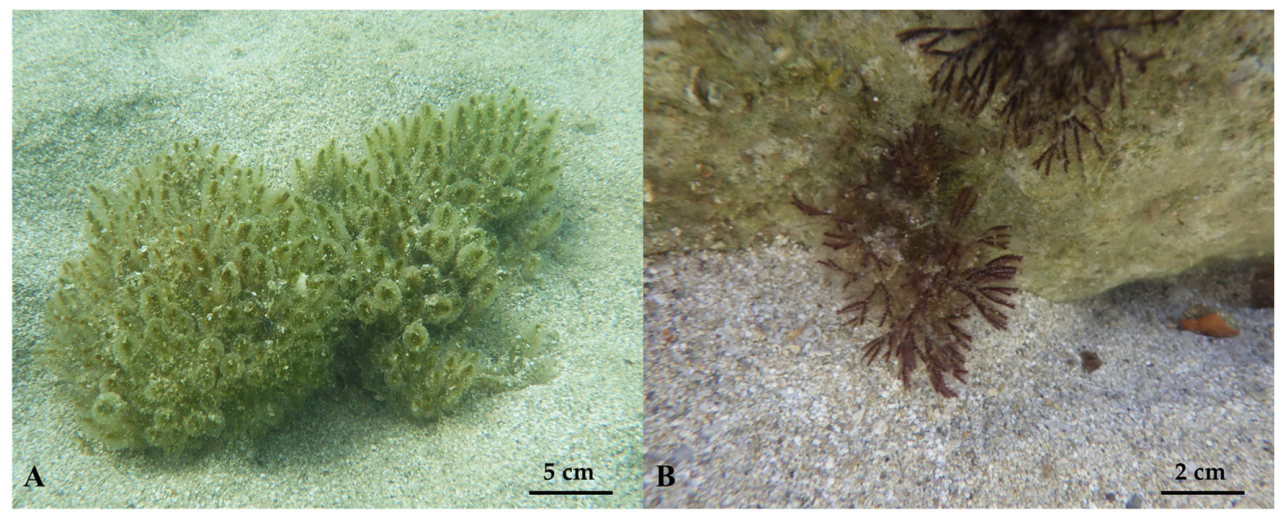
Among these emerging invaders, Batophora occidentalis (Harvey) S. Berger & Kaever ex M.J.Wynne, 1998, has recently been reported as an expanding component of shallow, sheltered coastal assemblages in parts of the western Mediterranean (Figure 1) [5,6]. This green macroalga, originally distributed in tropical and subtropical regions, appears to be well adapted to warm, low-hydrodynamic environments, where it can form relatively dense and persistent patches. Its proliferation in confined systems such as lagoons and semi-enclosed embayments raises ecological concern, as these habitats often host simplified but highly structured benthic communities dominated by a few key macroalgal species. When dense stands of B. occidentalis establish, they may interfere with resident macroalgae through physical interactions such as shading and space occupation, as reported for epiphytic associations in macroalgae [7]. In addition to direct competition for space, changes in canopy structure and local microenvironmental conditions (e.g., light penetration, water flow, oxygen dynamics) may further influence native species performance. Moreover, as reported for several invasive macroalgae, the potential release of allelochemical compounds cannot be excluded, potentially negatively affecting neighbouring organisms through physiological stress or interference with cellular processes [8].
Cystoseira compressa (syn. Ericaria compressa) (Esper) Gerloff & Nizamuddin, 1975, is a perennial brown alga widely distributed along Mediterranean rocky shores and shallow lagoons [9]. Documented threats to Cystoseira species include coastal development and habitat loss, pollution and eutrophication, and competition with opportunistic algae [10]. Even in the absence of evident declines in cover, sublethal biochemical stress responses may indicate early impairment of its ecological performance and resilience. Therefore, evaluating potential physiological alterations associated with the expansion of B. occidentalis is essential to determine whether this interaction entails early, non-visible impacts on C. compressa populations.
At the cellular level, such stress responses are frequently mediated by alterations in redox balance. Exposure to stressful conditions commonly results in enhanced metabolic activity and a concomitant increase in the generation of reactive oxygen species (ROS) [11]. At controlled levels, ROS play important roles as signalling molecules in normal cellular pathways [12]. However, excessive ROS accumulation can disrupt redox balance, leading to oxidative modification of lipids, proteins, and nucleic acids, ultimately causing cellular damage [13]. If sustained over time, this oxidative imbalance may impair key physiological processes, thereby reducing overall organismal performance. To maintain redox equilibrium, organisms rely on an integrated antioxidant defence system composed of enzymatic components, such as superoxide dismutase and catalase, and non-enzymatic molecules that neutralise or limit ROS formation [14]. Therefore, variations in oxidative stress markers and antioxidant activity provide sensitive early-warning indicators of sublethal stress before visible ecological effects become apparent.
Despite growing reports on the distribution of B. occidentalis, there is limited empirical evidence on the indirect physiological impacts that this invader may impose on native, habitat-forming macroalgae. Integrating environmental monitoring, community-level measurements of benthic cover, and biochemical biomarkers in resident algae offers a mechanistic route to assess whether and how the presence of an invasive alga translates into stress at the organismal level. With this background, the aim of the study was to examine the effects of B. occidentalis on C. compressa in s’Estany des Peix (Formentera, Balearic Islands), evaluating biomarkers of oxidative stress and detoxification.

2. Materials and Methods

2.1. Area of Study and Sampling

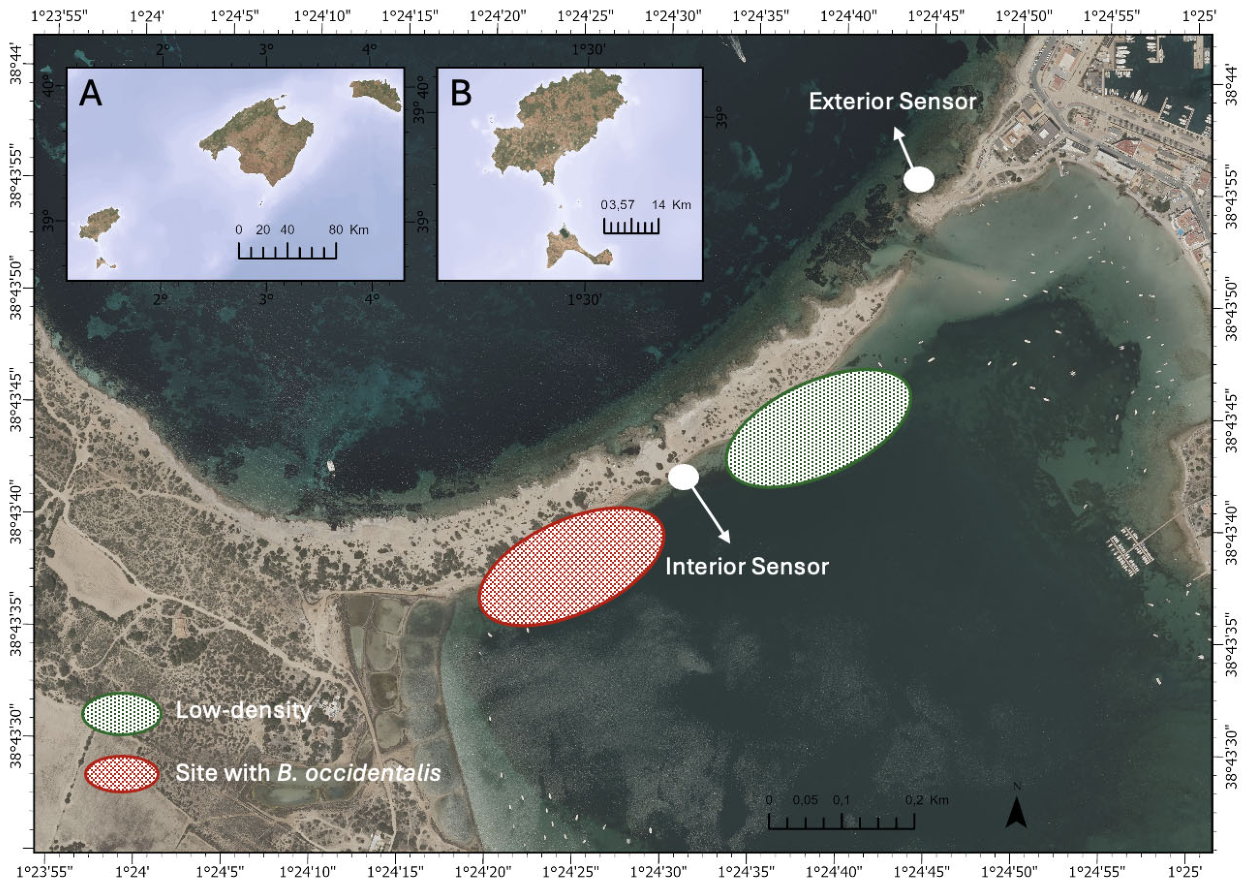
S’Estany des Peix is a shallow coastal lagoon located on the northern coast of Formentera Island, immediately west of the port of La Savina (Figure 2). The lagoon is almost enclosed, with a single narrow natural opening to the sea known as Sa Boca, which allows the exchange of water with the Mediterranean and the mooring of small, shallow-draught vessels. This configuration results in calm, low-hydrodynamic conditions and limited wave exposure. The surface area of the lagoon is approximately 1–1.1 km2, with maximum depths rarely exceeding 3–4 m in the central basin, and salinity levels similar to or slightly higher than adjacent coastal waters due to restricted flushing and high evaporation rates. The lagoon supports a diverse benthic community dominated by photophilous macroalgae and seagrass meadows, with characteristic taxa such as Acetabularia acetabulum (Linnaeus, 1758), Dasycladus vermicularis (Donati, 1753), Caulerpa prolifera (Lamouroux, 1809) and Halimeda tuna (Ellis & Solander, 1786) occupying shallow rocky and sandy substrates. S’Estany des Peix lies within the Ses Salines d’Eivissa i Formentera Natural Park and is part of the Natura 2000 network (ES0000084) and a designated Ramsar site (Site no. 641), reflecting its ecological importance for coastal habitats and associated biodiversity.
The study area was located in the northwestern sector of the lagoon (Figure 2), where enough C. compressa specimens were observed. In this area, a temperature sensor (HOBO® Tidbit® MX, Interworld Highway, LLC., Long Branch, NJ, USA) was deployed at approximately 30 cm depth to monitor thermal variation over a one-year period, with recording measurements at 5 min intervals. A second sensor was installed at the same depth at the outer mouth of the lagoon to serve as a temperature control site. According to the manufacturer, the internal temperature sensor has an accuracy of ±0.20 °C within the 0–70 °C range, and a resolution of 0.01 °C. Daily mean temperatures from the data were plotted over time for both sensors and a locally estimated scatterplot smoothing (LOESS) smoothing curve was included to highlight the temporal trends. To quantify the variability in the temperature throughout the time period, the standard deviation, variance, coefficient of variation and daily temperature ranges were calculated. Furthermore, extreme thermal events for the time period were analysed separately at each location (exterior and interior of the lagoon) as temperatures above the 95th percentile for extreme high events or below the 5th percentile for extreme low events of the full temperature record. The frequency of the extreme events and the duration of consecutive extreme events were then calculated. Temperature data were used to provide contextual information on the thermal regime experienced by the studied populations. Cystoseira compressa samples were collected on 8 June 2025 between 9 and 10 a.m. by free diving and randomly selected close to shore in the upper infralittoral zone. In both study areas, individuals were consistently collected from shallow rocky substrates along the lagoon margin at comparable depths (approximately 10–20 cm), ensuring similar microhabitat conditions. The two sampling areas were in close proximity within the same lagoon system, thus experiencing similar climatic conditions. Small thallus sections were collected from an area with a high abundance of B. occidentalis, where individuals co-occurred with the invasive species (invaded area, n = 8). A second group of individuals was collected from an area with a very low presence of the invader (low-density area of B. occidentalis (~5%), n = 8). In addition, samples of B. occidentalis were collected to explore potential differences in biochemical status under different ecological contexts. A total of 16 independent thalli were sampled, including individuals growing in isolation (n = 8) and individuals co-occurring with C. compressa (n = 8). Samples were immediately frozen and maintained at −80 °C until biochemical analysis. Permission for sampling collection was obtained from the Direcció General de Medi Natural i Gestió Forestal, Balearic Government (Exp. SEN908/24).
Benthic cover was assessed in both study areas (invaded and low-invaded by B. occidentalis) using a 40 × 40 cm quadrat (n = 8 per area). Quadrats were deployed in each area and randomly distributed along approximately 200 m of shoreline, ensuring a relatively homogeneous spatial coverage and avoiding spatial clustering. The percentage cover of each macroalgal and seagrass species, as well as abiotic components (rock and sand), was visually estimated. Cover values were expressed as a percentage of the total quadrat area.

2.2. Biochemical Analysis

Algal samples were rinsed with distilled water and homogenised on ice in 50 mM Tris–HCl buffer (pH 7.5) containing 1 mM ethylenediaminetetraacetic acid (EDTA) at a 1:5 (w/v) ratio, using an ULTRA-TURRAX® disperser (IKA Werke GmbH & Co. KG, Staufen, Germany). The homogenates were centrifuged at 9000× g for 10 min at 4 °C, and the resulting supernatants were collected for subsequent biochemical determinations. All assays were performed in duplicate.
Catalase (CAT) activity was assessed spectrophotometrically at 240 nm following Aebi (1984) procedure [15]. Activity was calculated from the initial rate of H2O2 decomposition (ΔA240 min−1) using the molar extinction coefficient (ε = 39.4 M−1 cm−1). Superoxide dismutase (SOD) activity was determined at 550 nm according to Flohé and Ötting (1984) [16] and calculated using the molar extinction coefficient of cytochrome c (ε = 28.1 mM−1 cm−1), while glutathione S-transferase (GST) activity was measured at 340 nm based on the method described by Habig et al. (1974) [17], and calculated with the molar extinction coefficient of the conjugate (ε = 9.6 mM−1 cm−1). Enzymatic activities were recorded at 25 °C using a Shimadzu UV-2600 spectrophotometer (Shimadzu Corporation, Duisburg, Germany) and normalised to protein content (mg protein−1). Total polyphenol content in C. compressa homogenates was quantified using a modified Folin–Ciocalteu procedure [18], based on a calibration curve prepared with gallic acid in the range 0–1 mg mL−1. Malondialdehyde (MDA) levels were determined using a commercial colourimetric kit (Merck Life Science S.L.U., Madrid, Spain), according to the manufacturer’s instructions; concentrations were calculated from a standard curve prepared in the range 0–20 mM. The assay relies on the reaction of MDA with a chromogenic compound, and absorbance was read at 586 nm in a PowerWaveXS microplate reader (Bio-Tek Instruments, Agilent Technologies, Madrid, Spain). ROS production was evaluated using the fluorescent probe 2′,7′-dichlorofluorescein diacetate (DCFH-DA). Fluorescence (Ex 480 nm; Em 530 nm) was monitored for 1 h at 25 °C using an FLx800 microplate fluorescence reader (Bio-Tek Instruments, Agilent Technologies, Madrid, Spain) [19]. Results were expressed as relative fluorescence units (RFU) normalised to protein content. CAT, SOD, GST, and MDA were also determined in B. occidentalis samples. Total protein content was quantified by the Bradford method (Bio-Rad® Protein Assay, Bio-Rad Laboratories, Alcobendas, Spain), using bovine serum albumin as standard (0–0.5 mg mL−1), and all biochemical parameters were normalised to total protein concentration.

2.3. Statistical Analysis

Statistical analyses were conducted using the Statistical Package for the Social Sciences (IBM SPSS Statistics v29.0; IBM Corp., Armonk, NY, USA). Data normality was evaluated using the Shapiro–Wilk test, and variance homogeneity was assessed with Levene’s test. Differences between groups were analysed using an unpaired t-test, with the high or low presence of the invasive species as the grouping factor. Results are presented as median and interquartile range (Q1–Q3), and graphically as boxplots indicating the median (central line), interquartile range (box), and range (whiskers), with individual values as jitter dots. A p-value < 0.05 was considered statistically significant.
Samples correspond to independent individuals of C. compressa collected within each area. However, as individuals were obtained from two spatially defined zones (high or low presence of the invasive species), the design reflects a comparison between environmental contexts rather than fully replicated sites. Therefore, results should be interpreted as associations between local conditions and physiological responses.

3. Results

3.1. Environmental Conditions and Benthic Cover

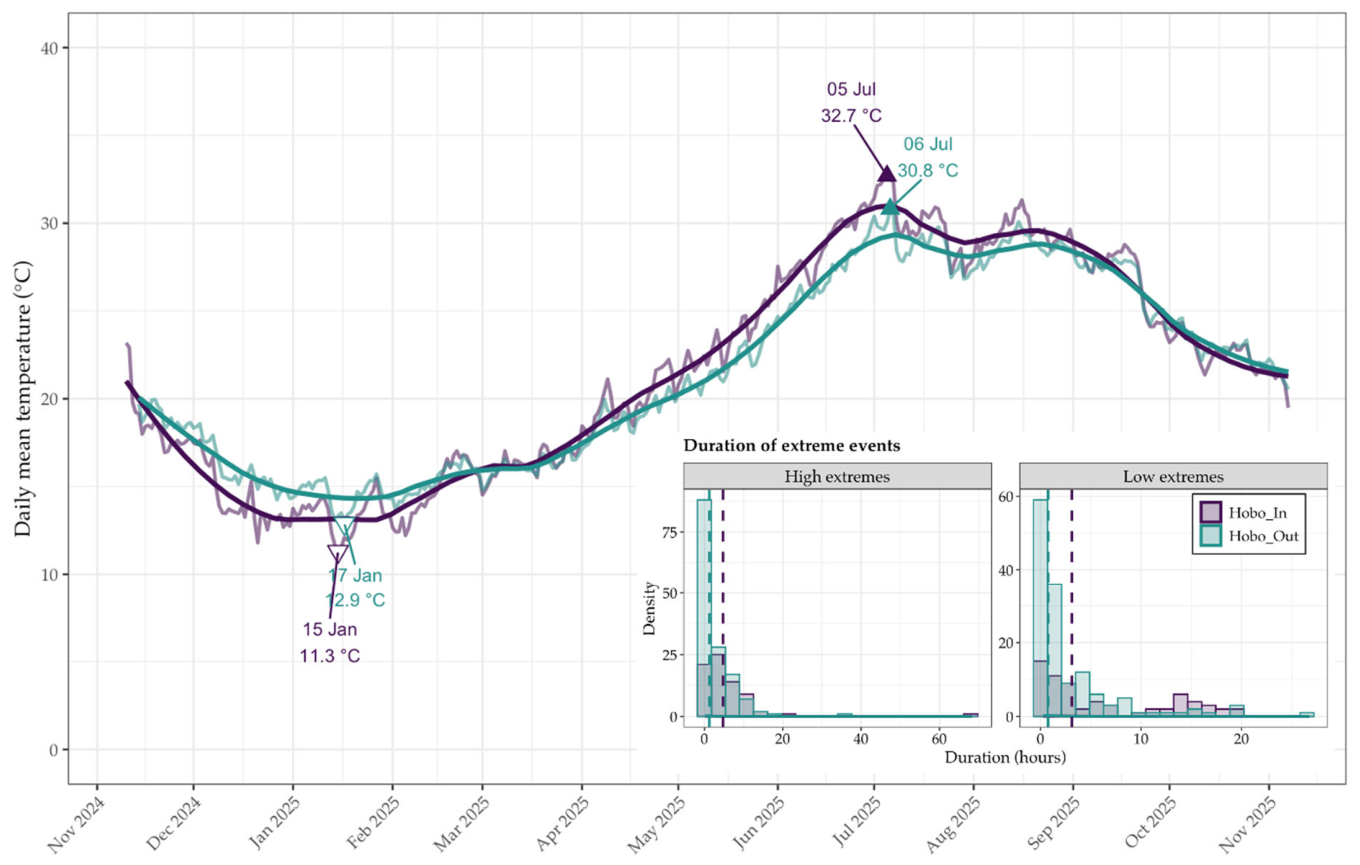
The temperature records obtained from the two loggers revealed marked differences in thermal variability between the inner lagoon and the outer mouth. Temperature fluctuations (daily and episodic maxima/minima) were consistently greater at the sensor deployed inside the lagoon than at the outer site, indicating a more variable and thermally dynamic environment within the lagoon basin (Table S1). Specifically, the inner lagoon exhibited greater thermal variability, with daily mean temperatures ranging from 11.3 to 32.7 °C (overall mean: 21.60 ± 6.20 °C), whereas the outer site ranged from 12.9 to 30.8 °C (overall mean: 21.50 ± 5.37 °C) during the monitoring period (Figure 3, Table S1). Despite similar mean temperatures, the inner lagoon showed broader temperature distributions and more frequent daily fluctuations (Figure S1). Extreme thermal events, defined using the 95th and 5th percentiles, totalled 217 high and 207 low events (Figure S2). These events were also more persistent inside the lagoon, lasting from 0.25 to 68.20 h, compared to 0.25 to 37.5 h at the outer site (Table S1, Figure S3). Overall, the temperature time series revealed strong seasonal patterns at both locations, with similar mean temperatures. However, the interior of the lagoon exhibited greater thermal variability, reflected in broader temperature distributions and higher daily temperature ranges and standard deviations. It is important to note that both sampling sites (low-density area and exposed) are located within the inner lagoon and therefore experience comparable thermal conditions. The comparison with the external site is provided solely to illustrate the broader thermal context of the lagoon system.
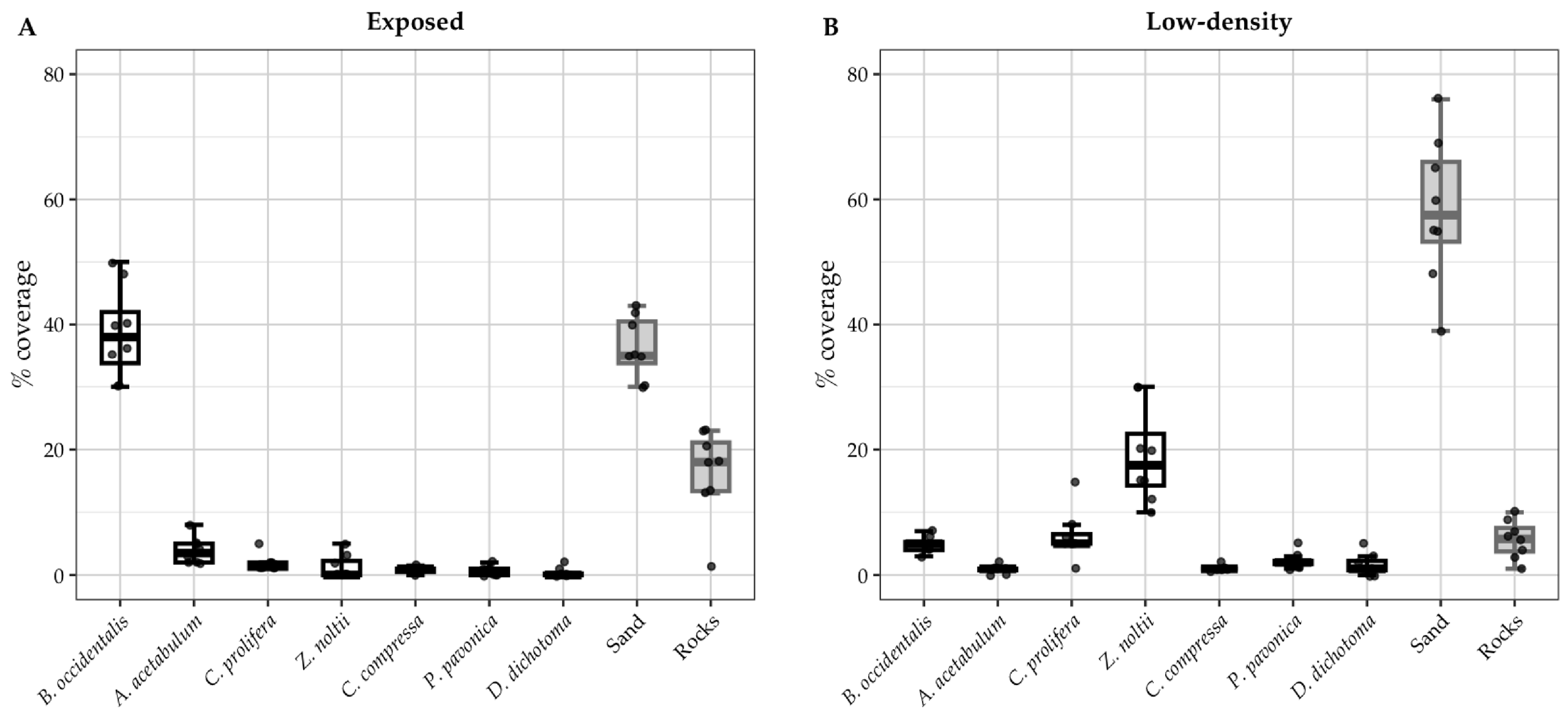
Benthic cover surveys (40 × 40 cm quadrats, n = 8 per area) showed clear differences in substrate and community composition between the two zones. The area with higher B. occidentalis abundance (38.6 ± 2.6 vs. 4.9 ± 0.4% (standard error of the mean; SEM)) presented a greater proportion of rocky substrate, providing stable attachment surfaces suitable for the establishment of this macroalga (Figure 4). In contrast, the second area was characterized by a higher proportion of sandy bottom, where unconsolidated sediment limits the availability of firm substrate for algal attachment. The sandy-dominated zone also showed greater representation of Zostera noltii, consistent with the preference of seagrasses for sedimentary environments.

3.2. Biomarker Responses in Cystoseira compressa

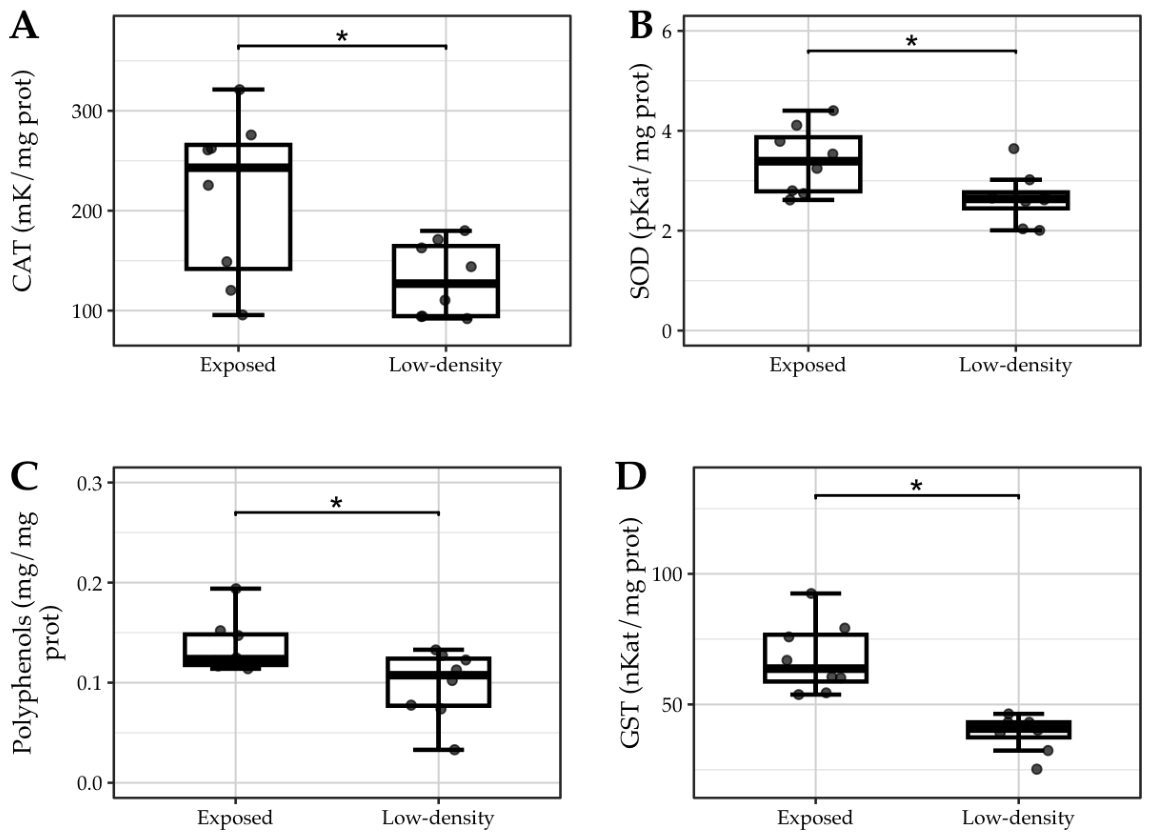
Biochemical biomarkers were quantified in C. compressa sampled from invaded (exposed) and non-invaded (low-density area) areas (Figure 5 and Figure 6). Antioxidant enzyme activities, CAT and SOD activity measured in individuals from invaded sites were significantly elevated relative to low-density area individuals (t-test; p = 0.027 CAT; p = 0.026 SOD), indicating an up-regulation of ROS-degrading capacity in exposed individuals (Figure 5). Total polyphenol content, taken as a proxy for non-enzymatic antioxidant capacity, was also significantly higher in C. compressa collected from invaded patches than in the low-density area (t-test; p = 0.027). Similarly, glutathione S-transferase (GST) activity, an indicator of phase II detoxification, was significantly higher in the exposed individuals (t-test; p < 0.01), pointing to activation of conjugation/detoxification pathways in C. compressa from the invaded area.
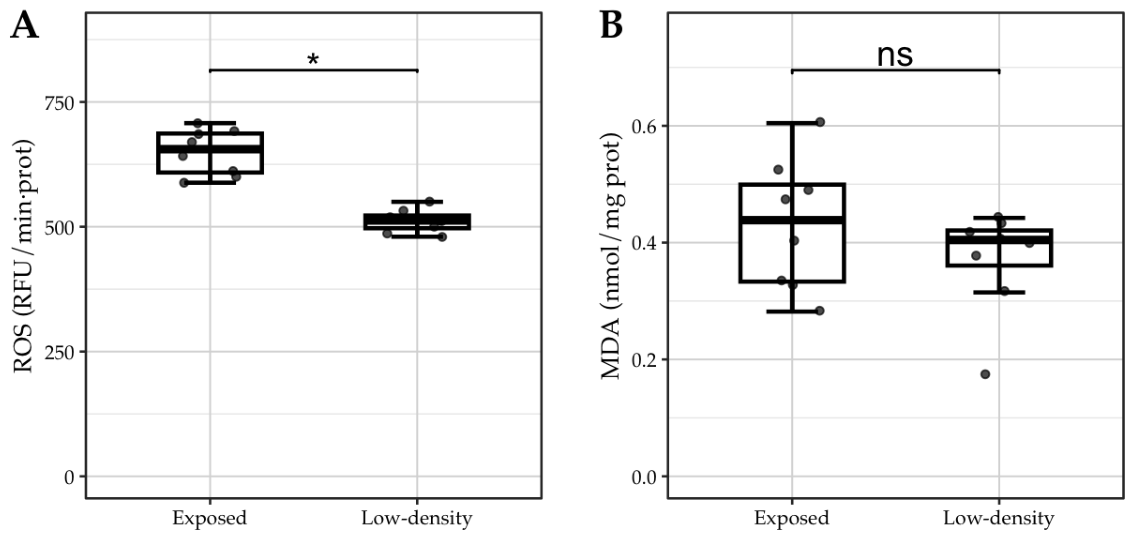
Markers of oxidative damage in C. compressa are presented in Figure 6. ROS production was significantly greater in exposed individuals than in the low-density area (t-test; p < 0.01), indicating increased oxidative pressure under those conditions. In contrast, MDA levels did not differ significantly between treatments (t-test, p = 0.258), suggesting that, despite the elevated ROS production observed in exposed individuals, the antioxidant response was enough to prevent an increase in lipid peroxidation.
A comparative analysis of biochemical parameters in B. occidentalis did not reveal significant differences between individuals growing in isolation and those co-occurring with C. compressa, indicating a similar physiological status across both conditions (Table 1).

4. Discussion

The present study shows that Cystoseira compressa individuals inhabiting areas with high abundance of Batophora occidentalis exhibit a consistent up-regulation of antioxidant and detoxification responses, including increased SOD, CAT, and GST activities, higher polyphenol content, and elevated ROS production, while lipid peroxidation (MDA) remains unchanged. These results indicate a moderate oxidative challenge in individuals from invaded patches, where increased oxidative pressure is counterbalanced by enhanced protective mechanisms [20]. These physiological differences were observed between two areas within the same lagoon that experience comparable thermal regimes but differ in local habitat characteristics, particularly substrate composition and benthic cover. Therefore, the observed responses are interpreted as associations within contrasting environmental contexts rather than direct effects of the invasive species alone. At a broader scale, temperature records revealed that the lagoon is characterised by high thermal variability compared to the outer site, providing environmental context for the conditions under which these interactions occur.
Although the two sampling areas are located in close proximity within the same lagoon and share similar climatic conditions, the comparison is based on a single invaded and a single low-density area. Therefore, the presence of B. occidentalis is partially confounded with local environmental characteristics, such as differences in substrate composition. While the consistent sampling of C. compressa from shallow rocky substrates reduces microhabitat variability, the observed physiological differences should be interpreted as associations within contrasting environmental contexts rather than as direct causal effects of the invasive species alone.
Temperature records demonstrated that the inner lagoon sector experienced greater thermal variability and higher short-term extremes compared to the outer site. However, it should be noted that both the affected and low-density sampling sites are located within the inner lagoon and are therefore exposed to comparable thermal regimes. These thermal conditions are characteristic of shallow and semi-enclosed systems where reduced water exchange and limited depth amplify diel heating and cooling cycles [21]. Environmental conditions may be linked to physiological stress in resident species and to the presence of opportunistic or invasive taxa. In the present study, temperature data were used to provide environmental context and to characterise the thermal regime of the lagoon, rather than to test its direct effects on the biological responses measured. Nevertheless, the thermal range recorded in this study falls within the tolerance spectrum described for B. occidentalis in its native tropical and subtropical distribution, where it commonly inhabits very shallow environments exposed to pronounced daily temperature oscillations [6,22]. Therefore, thermal variability alone is unlikely to represent a limiting factor for its expansion in the present system. In addition, the persistence of B. occidentalis since its arrival in 2020 suggests that this species is able to tolerate the range of thermal conditions observed within the lagoon. Overall, temperature variability is interpreted as part of the environmental context rather than as a direct driver of the observed physiological responses.
In contrast, physical habitat structure appears to be more directly associated with the observed distribution patterns. The two zones differed markedly in benthic composition. The site with higher B. occidentalis abundance was characterised by a greater proportion of rocky substrate, whereas the comparison area presented a higher contribution of sandy bottom and greater representation of Zostera noltii [23]. Given that B. occidentalis requires consolidated substrate for attachment, the higher availability of rocky surfaces may facilitate its establishment and persistence in that sector. Substrate availability is widely recognised as a key factor structuring macroalgal assemblages, particularly in shallow systems where attachment stability strongly influences colonisation success [24]. Conversely, sediment-dominated areas provide fewer stable attachment points for attached macroalgae but are suitable for seagrass development [25]. Considering this, the establishment of B. occidentalis on rocky substrates suggests a potential for interaction with native habitat-forming species such as C. compressa, potentially involving competition for space and modifications of benthic structure, although the extent to which these processes directly drive the observed physiological responses cannot be disentangled from underlying habitat differences.
When considered collectively, these findings suggest that while the invaded lagoon sector is thermally more variable, substrate availability and shallow, low-energy conditions appear to be associated with the spatial distribution of B. occidentalis within the system. Thus, temperature should be interpreted primarily as part of the environmental context rather than as a direct driver of the observed physiological differences. Similar environmental settings have been reported to favour the establishment of several invasive macroalgae in Mediterranean lagoons and sheltered coastal habitats, where limited hydrodynamics and suitable hard substrates facilitate persistence and local proliferation [26,27]. These structural differences define distinct habitat contexts within which the physiological responses of C. compressa were assessed.
Consistent with these environmental contrasts, individuals of C. compressa from invaded areas showed significantly higher SOD and CAT activities compared to those from the low-density area. SOD catalyses the dismutation of superoxide radicals into hydrogen peroxide, while CAT decomposes hydrogen peroxide into water and oxygen. The simultaneous increase in both enzymes suggests coordinated activation of the primary enzymatic antioxidant defence system. Such coordinated responses are widely recognised as a central mechanism by which marine organisms maintain intracellular redox balance under stressful environmental conditions [20]. In addition, total polyphenol content was higher in individuals from the invaded area, reflecting an increase in non-enzymatic antioxidant capacity. In macroalgae, polyphenolic compounds represent an important component of the antioxidant system and may contribute to ROS scavenging as well as protection against environmental stressors [28].
GST activity was also significantly elevated in specimens from invaded patches. As GST participates in conjugation reactions involved in detoxification processes, its increase indicates enhanced metabolic processing of reactive or potentially harmful compounds. Specifically, this enzyme plays a key role in phase II detoxification by catalysing the conjugation of electrophilic compounds with glutathione, facilitating their elimination and limiting oxidative damage [29]. Similar increases in antioxidant and detoxification enzymes have been described in Mediterranean macroalgae exposed to environmental stressors such as pollution, temperature fluctuations, or high irradiance, suggesting that these biomarkers are sensitive indicators of physiological disturbance in coastal ecosystems [30].
Importantly, ROS production was significantly greater in thalli collected from invaded zones, indicating a shift toward a more oxidising intracellular environment. The concurrent elevation of ROS and antioxidant defences suggests that oxidative pressure was higher in this habitat. This pattern, characterised by enhanced ROS generation accompanied by up-regulation of antioxidant defences, is consistent with an early physiological response to environmental stress, where protective mechanisms are activated to maintain cellular homeostasis before oxidative damage becomes evident [31].
Similar patterns have been described in other macroalgae and related organisms, where ROS elevation co-occurs with increased antioxidant defences and is interpreted as an adaptive response that mitigates cellular damage (e.g., increased SOD/CAT with stable lipid oxidation markers in seaweed stress studies) [32,33]. Despite increased ROS production and upregulated antioxidant responses, MDA levels did not differ significantly between zones. This absence of significant change in lipid peroxidation indicates that membrane oxidative damage was not detectably enhanced under the conditions examined. The data therefore suggest that antioxidant and detoxification mechanisms may have been sufficient to prevent measurable accumulation of lipid peroxidation products at the time of sampling. Similar patterns have been described in other macroalgae and related organisms, where ROS elevation co-occurs with increased antioxidant defences and stable lipid oxidation markers [34,35]. Indeed, algae possess robust enzymatic and non-enzymatic antioxidant systems capable of balancing ROS production and preventing oxidative damage to lipids, proteins, and DNA under moderate stress [36]. The combination of elevated ROS and stable MDA values in our study, therefore, supports the interpretation of a moderate or controlled oxidative imbalance rather than advanced cellular damage.
The absence of detectable biochemical differences in B. occidentalis between isolated individuals and those co-occurring with C. compressa suggests that the invader maintains a similar physiological status regardless of co-occurrence with the native species. This pattern may reflect the ecological strategy of B. occidentalis, which can grow epiphytically and attach to a wide range of substrates, including other macroalgae. Such flexibility may reduce its sensitivity to local biotic interactions and contribute to its persistence under varying environmental conditions. Similar responses have been described in Mediterranean macroalgal assemblages, where native species exhibit increased oxidative stress markers when co-occurring with invasive algae such as Halimeda incrassata (J Ellis) JV Lamoroux, suggesting that these interactions may be associated with sublethal physiological stress under natural conditions [27,33].
However, several limitations should be considered when interpreting these findings. The cross-sectional design of the study does not allow assessment of longer-term effects to determine whether sustained stress eventually leads to measurable oxidative damage. In addition, although individual organisms were treated as independent observational units, the lack of spatial replication at the site level may influence the strength of statistical inference. Future studies incorporating multiple invaded and low-density areas would be required to robustly assess causal relationships. In addition, controlled laboratory or mesocosm experiments would be valuable to disentangle the direct effects of B. occidentalis from environmental factors and to test causal mechanisms underlying the observed biochemical responses.

5. Conclusions

In conclusion, the present study demonstrates that habitat-specific environmental conditions, particularly substrate availability and shallow, low-energy settings (areas with reduced hydrodynamic exposure and limited water movement), appear to be associated with the distribution of B. occidentalis in lagoon systems. Cystoseira compressa inhabiting invaded areas exhibited an up-regulation of enzymatic and non-enzymatic antioxidant defences, as well as detoxification mechanisms, effectively maintaining cellular redox balance despite increased oxidative pressure. These responses are consistent with the environmental conditions characterising the invaded areas. These findings highlight the capacity of macroalgae to respond adaptively to local environmental stressors and highlight the interplay between habitat structure and physiological resilience in shaping species interactions and ecosystem dynamics. Overall, this study emphasises the need for continued long-term ecological monitoring of not only s’Estany des Peix in the Balearic Islands, but also other Mediterranean lagoons with similar characteristics, to track the spread and ecological associations of B. occidentalis and its potential implications for habitat-forming macroalgae. However, given the spatially constrained design, these findings should be interpreted as indicative of associations, and further studies including multiple replicated sites or controlled experimental approaches would be necessary to confirm causal relationships. The lack of detectable physiological differences in B. occidentalis across conditions suggests that its performance is not negatively affected by co-occurrence with C. compressa, which may contribute to its persistence and spread within the lagoon.

Supplementary Materials

The following supporting information can be downloaded at: https://www.mdpi.com/article/10.3390/d18050285/s1, Raw data about coverage and biomarkers. Table S1: Summary of thermal conditions and duration of extreme temperature events at each location; Figure S1: Thermal variability for the exterior and interior locations of s’Estany des Peix; Figure S2: Extreme thermal events defined as temperatures exceeding the 95th percentile or below the 5th percentile; Figure S3: Duration of the consecutive extreme events.

Author Contributions

Conceptualization, A.S., S.T., L.G., S.P. and M.C.; methodology, A.S., J.L., M.d.M.R.-T., M.M.Q.-L., L.G., S.T., S.P., M.C.; formal analysis, A.S. and M.C.; investigation, A.S., J.L., M.d.M.R.-T., M.M.Q.-L., L.G., S.T., S.P., M.C.; writing—original draft preparation, A.S. and M.C.; writing—review and editing, A.S., J.L., M.d.M.R.-T., M.M.Q.-L., L.G., S.T., S.P., M.C.; project administration, A.S.; funding acquisition, A.S. and S.P. All authors have read and agreed to the published version of the manuscript.

Funding

This research was funded by the Government of the Balearic Islands through the Direcció General d’Universitats, Recerca i Ensenyaments Artístics Superiors and the European Union—Next Generation EU (BIOPRO2024-004). Views and opinions expressed are however those of the author(s) only and do not necessarily reflect those of the European Union or the European Research Council Executive Agency. Neither the European Union nor the granting authority can be held responsible for them. Maria del Mar Ribas-Taberner was supported by a PFIS Grant (CAIB_PFIS_2024, Govern de les Illes Balears, Spain), co-financed by the European Union’s ESF+ Programme 2021–2027. M.M.Q.-L. was funded by the INVESTIGA@UIB programme, granted by the University of the Balearic Islands (UIB) and co-financed by the annual Sustainable Tourism Tax Programme for 2023 (ITS2023-086, Programa de Foment de la Recerca). M.C. is the recipient of a postdoctoral contract Vicenç Mut co-financed by the Regional Government of the Balearic Islands and the European Social Fund (FSE+) (POSTDOC2024_54).

Institutional Review Board Statement

Not applicable.

Data Availability Statement

The raw data supporting the conclusions of this article are included as Supplementary Materials. Researchers interested in more specific dataset may contact the corresponding author at: antoni.sureda@uib.es. The temperature dataset used during the current study has been deposited in the Zenodo repository and is publicly available at: https://doi.org/10.5281/zenodo.19855038.

Conflicts of Interest

The authors declare no conflicts of interest.

Abbreviations

The following abbreviations are used in this manuscript:
DCFH-DA2,7-dichlorofluorescin diacetate
CATCatalase
GSTGlutathione S-transferase
MDAMalondialdehyde
ROSReactive oxygen species
SEMStandard error of the mean
SODSuperoxide dismutase
SPSSStatistical Package for the Social Sciences

References

  1. Tsirintanis, K.; Azzurro, E.; Crocetta, F.; Dimiza, M.; Froglia, C.; Gerovasileiou, V.; Langeneck, J.; Mancinelli, G.; Rosso, A.; Stern, N.; et al. Bioinvasion impacts on biodiversity, ecosystem services, and human health in the Mediterranean Sea. Aquat. Invasions 2022, 17, 308–352. [Google Scholar] [CrossRef]
  2. Bosch-Belmar, M.; Tantillo, M.F.; Sarà, G. Impacts of increasing temperature due to global warming on key habitat-forming species in the Mediterranean sea: Unveiling negative biotic interactions. Glob. Ecol. Conserv. 2024, 50, e02844. [Google Scholar] [CrossRef]
  3. Lacoste, É.; Jones, A.; Callier, M.; Klein, J.; Lagarde, F.; Derolez, V. A Review of Knowledge on the Impacts of Multiple Anthropogenic Pressures on the Soft-Bottom Benthic Ecosystem in Mediterranean Coastal Lagoons. Estuaries Coasts 2023, 46, 2190–2207. [Google Scholar] [CrossRef]
  4. Borriglione, M.; Ruitton, S.; Blanfuné, A.; Perret-Boudouresque, M.; Thouroude, B.; Verlaque, M.; Boudouresque, C.F.; Thibaut, T. Non-Indigenous Species of Macroalgae in French Mediterranean Marine Protected Areas: Distribution and Trends. J. Mar. Sci. Eng. 2025, 13, 374. [Google Scholar] [CrossRef]
  5. Forteza, V.; Castelló, M.; Ballesteros, E. Invasion of Batophora J. Agardh, 1854 (Chlorophyta: Dasycladales) in Formentera, Balearic Islands. Boll. Soc. Hist. Nat. Balear. 2024, 67, 67–74. [Google Scholar]
  6. Terradas-Fernández, M.; Valverde-Urrea, M.; López-Moya, F.; Fernández-Torquemada, Y. On the Presence and Ubiquity of the Exotic Batophora (J. Agardh) in the Mar Menor Lagoon (SE Spain). Water 2022, 14, 2909. [Google Scholar] [CrossRef]
  7. Leonardi, P.I.; Miravalles, A.B.; Faugeron, S.; Flores, V.; Beltrán, J.; Correa, J.A. Diversity, phenomenology and epidemiology of epiphytism in farmed Gracilaria chilensis (Rhodophyta) in northern Chile. Eur. J. Phycol. 2006, 41, 247–257. [Google Scholar] [CrossRef]
  8. Hartmann, A.; Ganzera, M.; Karsten, U.; Skhirtladze, A.; Stuppner, H. Phytochemical and Analytical Characterization of Novel Sulfated Coumarins in the Marine Green Macroalga Dasycladus vermicularis (Scopoli) Krasser. Molecules 2018, 23, 2735. [Google Scholar] [CrossRef]
  9. Neiva, J.; Bermejo, R.; Medrano, A.; Capdevila, P.; Milla-Figueras, D.; Afonso, P.; Ballesteros, E.; Sabour, B.; Serio, D.; Nóbrega, E.; et al. DNA barcoding reveals cryptic diversity, taxonomic conflicts and novel biogeographical insights in Cystoseira s.l. (Phaeophyceae). Eur. J. Phycol. 2023, 58, 351–375. [Google Scholar] [CrossRef]
  10. Fehér, D.; Bianchelli, S.; Verdura, J.; Danovaro, R.; Anthony, B.P. Changes in threats to macroalgal forests (Cystoseira sensu lato) at three restoration sites in the Mediterranean Sea. Aquat. Conserv. 2024, 34, e4048. [Google Scholar] [CrossRef]
  11. Zhu, J.; Cai, Y.; Wakisaka, M.; Yang, Z.; Yin, Y.; Fang, W.; Xu, Y.; Omura, T.; Yu, R.; Zheng, A.L.T. Mitigation of oxidative stress damage caused by abiotic stress to improve biomass yield of microalgae: A review. Sci. Total Environ. 2023, 896, 165200. [Google Scholar] [CrossRef]
  12. Mittler, R.; Zandalinas, S.I.; Fichman, Y.; van Breusegem, F. Reactive oxygen species signalling in plant stress responses. Nat. Rev. Mol. Cell Biol. 2022, 23, 663–679. [Google Scholar] [CrossRef]
  13. Song, C.; Sun, C.; Liu, B.M.; Xu, P. Oxidative Stress in Aquatic Organisms. Antioxidants 2023, 12, 1223. [Google Scholar] [CrossRef]
  14. Monroy-García, I.N.; Torres-Romero, S.; Castro-Ochoa, L.D.; Mendoza-Acosta, A.; Viveros-Valdez, E.; Ayala-Zavala, F. Bioactive Compounds from Marine Macroalgae: A Natural Defense Against Oxidative Stress-Related Diseases. Stresses 2025, 5, 22. [Google Scholar] [CrossRef]
  15. Aebi, H. Catalase In Vitro. Methods Enzymol. 1984, 105, 121–126. [Google Scholar] [CrossRef] [PubMed]
  16. Flohé, L.; Ötting, F. Superoxide Dismutase Assays. Methods Enzymol. 1984, 105, 93–104. [Google Scholar] [CrossRef] [PubMed]
  17. Habig, W.H.; Pabst, M.J.; Jakoby, W.B. Glutathione S-transferases. The first enzymatic step in mercapturic acid formation. J. Biol. Chem. 1974, 249, 7130–7139. [Google Scholar] [CrossRef]
  18. Singleton, V.L.; Orthofer, R.; Lamuela-Raventós, R.M. Analysis of total phenols and other oxidation substrates and antioxidants by means of Folin–Ciocalteu reagent. Methods Enzymol. 1999, 299, 152–178. [Google Scholar] [CrossRef]
  19. Pinya, S.; Renga, E.; Fernández, G.; Mateu-Vicens, G.; Tejada, S.; Capó, X.; Sureda, A. Physiological biomarkers in loggerhead turtles (Caretta caretta) as a tool for monitoring sanitary evolution in marine recovery centres. Sci. Total Environ. 2021, 757, 143930. [Google Scholar] [CrossRef] [PubMed]
  20. Regoli, F.; Giuliani, M.E. Oxidative pathways of chemical toxicity and oxidative stress biomarkers in marine organisms. Mar. Environ. Res. 2014, 93, 106–117. [Google Scholar] [CrossRef]
  21. Bennett, S.; Vaquer-Sunyer, R.; Jordá, G.; Forteza, M.; Roca, G.; Marbà, N. Thermal Performance of Seaweeds and Seagrasses Across a Regional Climate Gradient. Front. Mar. Sci. 2022, 9, 733315. [Google Scholar] [CrossRef]
  22. Quan-Yong, L.; Jiménez-Flores, S.G.; Espinoza-Avalos, J. Flora béntica y reproducción de las algas Batophora spp. (Chlorophyta: Dasycladaceae) de una laguna costera contaminada (Bahía de Chetumal, México). Rev. Biol. Trop. 2006, 54, 341. [Google Scholar] [CrossRef]
  23. Macreadie, P.I.; Jarvis, J.; Trevathan-Tackett, S.M.; Bellgrove, A. Seagrasses and Macroalgae: Importance, Vulnerability and Impacts. In Climate Change Impacts on Fisheries and Aquaculture; Phillips, B.F., Pérez-Ramírez, M., Eds.; Wiley: Hoboken, NJ, USA, 2017; pp. 729–770. [Google Scholar] [CrossRef]
  24. Navarro-Barranco, C.; Gribben, P.E.; Ledet, J.; Poore, A.G.B. Habitat-complexity regulates the intensity of facilitation along an environmental stress gradient. Oikos 2022, 2022, e08818. [Google Scholar] [CrossRef]
  25. Krause-Jensen, D.; Duarte, C.M. Substantial role of macroalgae in marine carbon sequestration. Nat. Geosci. 2016, 9, 737–742. [Google Scholar] [CrossRef]
  26. Katsanevakis, S.; Wallentinus, I.; Zenetos, A.; Leppäkoski, E.; Çinar, M.E.; Oztürk, B.; Grabowski, M.; Golani, D.; Cardoso, A.C. Impacts of invasive alien marine species on ecosystem services and biodiversity: A pan-European review. Aquat. Invasions 2014, 9, 391–423. [Google Scholar] [CrossRef]
  27. Piazzi, L.; Ceccherelli, G. Persistence of biological invasion effects: Recovery of macroalgal assemblages after removal of Caulerpa racemosa var. cylindracea. Estuar. Coast. Shelf Sci. 2006, 68, 455–461. [Google Scholar] [CrossRef]
  28. Sureda, A.; Tejada, S.; Capó, X.; Melià, C.; Ferriol, P.; Pinya, S.; Mateu-Vicens, G. Oxidative stress response in the seagrass Posidonia oceanica and the seaweed Dasycladus vermicularis associated to the invasive tropical green seaweed Halimeda incrassata. Sci. Total Environ. 2017, 601–602, 918–925. [Google Scholar] [CrossRef] [PubMed]
  29. Mazari, A.M.A.; Zhang, L.; Ye, Z.-W.; Zhang, J.; Tew, K.D.; Townsend, D.M. The Multifaceted Role of Glutathione S-Transferases in Health and Disease. Biomolecules 2023, 13, 688. [Google Scholar] [CrossRef]
  30. Kumar, A.; AbdElgawad, H.; Castellano, I.; Lorenti, M.; Delledonne, M.; Beemster, G.T.S.; Asard, H.; Buia, M.C.; Palumbo, A. Physiological and Biochemical Analyses Shed Light on the Response of Sargassum vulgare to Ocean Acidification at Different Time Scales. Front. Plant Sci. 2017, 8, 570. [Google Scholar] [CrossRef]
  31. Benedetti, M.; Giuliani, M.E.; Mezzelani, M.; Nardi, A.; Pittura, L.; Gorbi, S.; Regoli, F. Emerging environmental stressors and oxidative pathways in marine organisms: Current knowledge on regulation mechanisms and functional effects. Biocell 2022, 46, 37–49. [Google Scholar] [CrossRef]
  32. de Freitas, F.R.; Barboza, L.V.; Kühl, V.C.P.; Castro, Í.B.; Lima Neto, M.C. Ocean acidification impairs growth and induces oxidative stress in the macroalgae Ulva fasciata and Petalonia fascia. Mar. Environ. Res. 2025, 211, 107429. [Google Scholar] [CrossRef]
  33. Zandi, P.; Schnug, E. Reactive Oxygen Species, Antioxidant Responses and Implications from a Microbial Modulation Perspective. Biology 2022, 11, 155. [Google Scholar] [CrossRef]
  34. Cerrato, M.; Mir-Rosselló, P.; Ferriol, P.; Gil, L.; Monserrat-Mesquida, M.; Tejada, S.; Pinya, S.; Sureda, A. Oxidative Stress Response in the Seaweed Padina pavonica Associated with the Invasive Halimeda incrassata and Penicillus capitatus. Water 2023, 15, 557. [Google Scholar] [CrossRef]
  35. Lombardo, J.; Tejada, S.; Compa, M.; Forteza, V.; Gil, L.; Pinya, S.; Sureda, A. Oxidative stress response in native algae exposed to the invasive species Batophora occidentalis in S’Estany des Peix, Formentera (Balearic Islands). Front. Mar. Sci. 2025, 12, 1586402. [Google Scholar] [CrossRef]
  36. Rezayian, M.; Niknam, V.; Ebrahimzadeh, H. Oxidative damage and antioxidative system in algae. Toxicol. Rep. 2019, 6, 1309–1313. [Google Scholar] [CrossRef] [PubMed]
Figure 1. Representative images of (A) Batophora occidentalis and (B) Cystoseira compressa from s’Estany des Peix (Formentera, Balearic Islands, Spain).
Diversity 18 00285 g001
Figure 2. Map of the Balearic Islands (A) and, more specifically the Pityusic Islands (Ibiza and Formentera) (B). A detailed map of the study area is also shown, with white circles indicating the locations of temperature sensors (interior and exterior), and sampling points of Cystoseira compressa in the presence of Batophora occidentalis (red oval) and in areas of low-density of B. occidentalis (green oval).
Diversity 18 00285 g002
Figure 3. Seasonal temperature dynamics and the magnitude, timing and duration of thermal extremes recorded at two monitoring stations in s’Estany des Peix lagoon (Formentera, Balearic Islands). One logger was deployed inside the lagoon basin (purple) and the second at the outer mouth connecting the lagoon with the open Mediterranean Sea (green). Jagged lines indicate the daily mean temperature, whereas locally estimated scatterplot smoothing (LOESS) smoothing curve indicates temporal trends in thermal variability. The inset panels show the binned duration of extreme high and low temperature events, with dashed vertical lines indicating the mean duration of events at each location.
Diversity 18 00285 g003
Figure 4. Benthic cover composition in areas with high abundance of Batophora occidentalis (exposed area) (A) and in areas where the invasive species was absent or scarce (low-density area) (B). Percent cover of major benthic components (macroalgae, seagrasses, rock, and sand) was estimated using 40 × 40 cm quadrats (n = 8 per area). Data are presented as boxplots indicating the median (central line), interquartile range (box), and range (whiskers), with individual values overlaid (n = 8).
Diversity 18 00285 g004
Figure 5. Antioxidant and detoxification biomarkers were measured in Cystoseira compressa collected from areas with the presence of Batophora occidentalis (exposed) and from areas where the invasive species was absent (low-density area). Enzymatic activities of catalase (CAT) (A), superoxide dismutase (SOD) (B), and glutathione S-transferase (GST) (D), together with total polyphenol content (C), are shown. Data are presented as boxplots indicating the median (central line), interquartile range (box), and range (whiskers), with individual values overlaid (n = 8). * indicates significant differences between groups (p < 0.05; unpaired t-test).
Diversity 18 00285 g005
Figure 6. Oxidative damage biomarkers were measured in Cystoseira compressa collected from areas with the presence of Batophora occidentalis (exposed) and from areas where the invasive species was absent (low-density area). Reactive oxygen species (ROS) production (A) and malondialdehyde (MDA) levels (B), used as indicators of oxidative pressure and lipid peroxidation, respectively, are shown. Data are presented as boxplots indicating the median (central line), interquartile range (box), and range (whiskers), with individual values overlaid (n = 8). * indicates significant differences between groups (p < 0.05; unpaired t-test) and ns indicates non-significant.
Diversity 18 00285 g006
Table 1. Antioxidant, detoxification and malondialdehyde biomarkers were measured in Batophora occidentalis collected from areas coexisting with Cystoseira compressa (exposed) and from areas where the invasive species was isolated (low-density area). Enzymatic activities of catalase (CAT), superoxide dismutase (SOD), and glutathione S-transferase (GST), and malondialdehyde (MDA) levels, are shown. Data are presented as median and interquartile range (Q1–Q3) (n = 8). No significant differences were observed between groups (p > 0.05; unpaired t-test).
BiomarkerExposed
(Median Q1–Q3)
Low-Density Area
(Median Q1–Q3)
CAT (mK/mg protein)147.8 (127.6–215.7)165.3 (121.3–205.6)
SOD (pKat/mg protein)5.55 (5.31–5.85)5.47 (5.26–5.95)
GST (nKat/mg protein)216.4 (204.5–283.8)213.9 (188.5–263.2)
MDA (nmol/mg protein)1.14 (0.95–1.36)1.27 (0.89–1.38)
Disclaimer/Publisher’s Note: The statements, opinions and data contained in all publications are solely those of the individual author(s) and contributor(s) and not of MDPI and/or the editor(s). MDPI and/or the editor(s) disclaim responsibility for any injury to people or property resulting from any ideas, methods, instructions or products referred to in the content.