Article

Genetic Diversity and Connectivity of Brownstripe Red Snapper (Lutjanus vitta) Around Petroleum Platforms and Coastal Areas in the Gulf of Thailand Analyzed by Mitochondrial Control Region Polymorphism


1
Aquatic Resources Research Institute, Chulalongkorn University, Bangkok 10330, Thailand
2
Aquatic Molecular Genetics and Biotechnology Research Team, National Center for Genetic Engineering and Biotechnology (BIOTEC), National Science and Technology Development Agency (NSTDA), Khlong Nueng, Khlong Luang, Pathum Thani 12120, Thailand
3
Interdisciplinary Graduate Program in Maritime Administration (MARAD), Graduate School, Chulalongkorn University, Bangkok 10330, Thailand
4
Sub-Committee for Advice and Knowledge Management for the National Maritime Interests (SAKAM), Office of the National Security Council, No.1, Government House, Phitsanulok Road, Dusit, Bangkok 10300, Thailand
*
Authors to whom correspondence should be addressed.
These authors contributed equally to this work.
Diversity 2026, 18(4), 235; https://doi.org/10.3390/d18040235
Submission received: 12 March 2026 / Revised: 16 April 2026 / Accepted: 17 April 2026 / Published: 20 April 2026
(This article belongs to the Section Marine Diversity)

Abstract

Genetic diversity and population connectivity of brownstripe red snapper (Lutjanus vitta) from different petroleum platforms located in the north (N1, N2, N3, and N4), central, and south regions and two coastal locations, Songkhla and Samaesarn (Gulf of Thailand), were examined using the control region (CR) polymorphism. In total, 59 haplotypes of CR were found, and 42 of these were private haplotypes (found in only one geographic location). The haplotype no./sample size (NH/N) found in the central (0.800), south (0.741), and north (0.733) platforms was greater than that in the coastal populations (0.643 in Samaesarn and 0.682 in Songkhla). Haplotype diversity of north, central, and south platforms and coastal populations were comparable (Hd = 0.943–0.982). Nucleotide diversity within populations was estimated. The lowest and highest nucleotide diversity was observed in the north (1.293%) and south (2.850%) platforms. Larger genetic divergence was found between north–central (0.096%) and north–south platforms (0.069%) than between coastal populations (0.007%). A lack of nucleotide divergence was found between central–south platforms and between platforms and coastal populations (north–Samaesarn, central–Songkhla, and south–Songkhla). The FST estimate did not reveal significant population differentiation between all pairwise comparisons (p > 0.01 after the sequential Bonferroni’s adjustment). AMOVA confirmed a lack of intraspecific population structure of L. vitta in the Gulf of Thailand (p > 0.05). Genetic connectivity between fish from different sampling sites was noticed based on haplotype network, phylogenetic analysis, and population structure analysis. Demographic statistics revealed that L. vitta went through a sudden population expansion.

1. Introduction

Among 110 species of snapper reported globally, the brownstripe red snapper, Lutjanus vitta (Quoy and Gaimard, 1824), is highly commercially important. It is distributed in the Indo-West Pacific regions [1,2]. It inhabits seas ranging from 40 to 120 m in depth [3]. In Thailand, L. vitta is found in the east coast (Chonburi, Rayong, Chanthaburi, Prachuap Khiri Khan, Chumphon, Surat Thani, and Nakhon Si Thammarat) and the west coast (Trang and Phuket) of peninsular Thailand. This species has been overexploited in some areas of the Philippines [4] and Malaysia [5].
Estimation of the level of evolutionary connectivity between different geographic localities of ecologically important species is important for marine biodiversity protection, in particular, for the delineation of marine protected areas (MPAs). Owing to year-round spawning patterns and dispersal of eggs and planktonic larvae, the lack of population differentiation has been reported in various Lutjanus species. For example, only a single panmictic genetic population was found on L. kasmira (Forsskål, 1775) from 16 localities of the western Indian Ocean across over 4000 km, analyzed with both mitochondrial cytochrome b sequencing and eight microsatellite loci genotyping [6]. Similar circumstances of high genetic diversity and a lack of intraspecific population structure at macrogeographic scales have been reported for various Lutjanus species, including crimson snapper, L. erythropterus [7,8]; red snapper, L. campechanus [9]; southern red snapper, L. purpureus [10]; mangrove red snapper, L. argentimaculatus [11,12]; lane snapper, L. synagris [13]; red snapper, L. gibbus [14]; yellowfin snapper, L. xanthopinnis [15]; Brazilian snapper, L. alexandrei [16]; and dog snapper, L. jocu [17,18].
Typically, the non-coding control region (CR) of mtDNA has more potential for the determination of genetic diversity and population differentiation of fish than coding mtDNA, like cytochrome oxidase subunit I (COI) and cytochrome b (cytb) [19,20,21]. COI is commonly used as a DNA barcode for fish [22]. Although both mtDNA regions have been applied for population genetic studies, they are suitable for phylogeographic, species boundary, and interspecific phylogenetic relationship studies, particularly when species with limited genetic diversity are examined [22,23]. In Lutjanidae, a high level of haplotype and nucleotide diversity (Hd = 0.990–0.997 and π = 2.6–3.9%) based on CR polymorphism was previously reported in L. purpureus [10], L. jocu and L. analis [17], and L. alexandrei [16], while a lower level of COI (Hd = 0.650–0.76 in L. bengalensis, L. kasmira, L. gibbus, and L. fulviflamma [24]) and cytb (Hd = 0.711–0.952 in L. johnii [21]) diversity were reported. Therefore, CR was chosen for the evaluation of the genetic diversity and connectivity of L. vitta in this study.
The population genetic survey of L. vitta is rather limited. Recently, genetic diversity and population connectivity of L. vitta on the east coast of the Malaysian Peninsula (Kelantan, Terengganu, Pahang, and Jahor) were examined using the mtDNA control region (CR). A high level of haplotype diversity but limited nucleotide diversity was found. Low degrees of population differentiation were found, suggesting a panmictic genetic pattern of L. vitta in Malaysian waters [5].
In the Gulf of Thailand, more than four hundred petroleum platforms are installed. Offshore petroleum platforms have emerged as ecological drivers of novel habitat formation. These platforms create a hard substrate in open waters and are subsequently colonized by a variety of sessile and mobile organisms, resulting in the formation of artificial reefs. These act as biodiversity hotspots and stepping stones that facilitate dispersal and genetic connectivity among populations of potentially mobile species [25,26,27].
The presence of offshore platforms is associated with high mobility of Lutjanus species. Genetic differentiation is highly dependent on the migratory ability of the target species. Following the operational retirement, many petroleum platforms in the Gulf of Thailand will be decommissioned within the coming decade. Therefore, the information on their importance in genetic connectivity and the service of commercially important species is important for decision-making on management of the decommissioning programs [27].
Typically, population genetic studies of various Lutjanus species are reported based on the coastal populations of a particular area [7,8,9,10,11]. Therefore, the information on genetic connectivity between coastal populations and the offshore environment is lacking. In this study, genetic diversity and connectivity of brownstripe red snapper collected from petroleum platforms located in the north, central, and south areas within the Gulf of Thailand and coastal populations from both the upper (Samaesarn) and lower (Songkhla) Gulf of Thailand were examined based on CR polymorphism.

2. Materials and Methods

2.1. Sources of Specimens

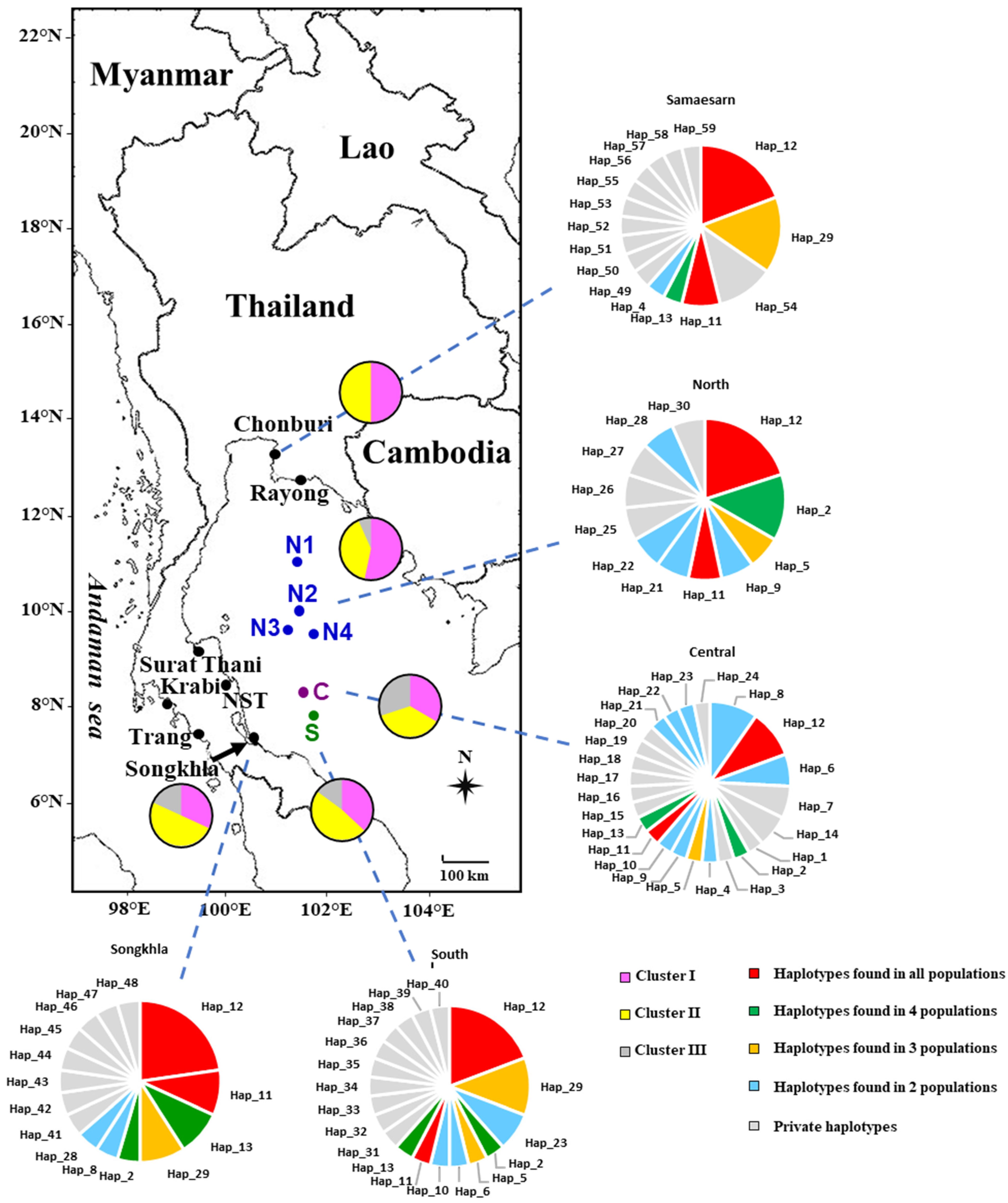
Although L. vitta is found singly or in schools of up to 30 individuals, adults are usually caught solitary [3,5]. Accordingly, wild L. vitta in this study was collected using traditional hook and line fishing gear by the staff of STS Green Company Limited (Pathum Thani, Thailand) and Tetra Tech Company Limited (Bangkok, Thailand). Fish were sampled from several petroleum platforms located in the northern (N1, N2, N3, and N4; N = 5, 2, 3, and 4), central (N = 30), and southern platforms (N = 27) and from coastal populations (Samaesarn, Chonburi province, and Songkhla province; N = 28 and 22, respectively) (Figure 1). Whole fish were kept at −20 °C before being sent to the Aquatic Resources Research Institute (ARRI), Chulalongkorn University. Dorsal spines were dissected from each fish and kept at −20 °C until further analysis.

2.2. Genomic DNA Extraction

Genomic DNA was extracted from a dorsal spine of each fish using a GF-1 Tissue DNA Extraction Kit following the protocol recommended by the manufacturer (Vivantis, Technologies, Selangor, Subang Jaya, Malaysia). The extracted DNA was electrophoretically analyzed by agarose gel electrophoresis (1.0%). DNA concentrations were estimated using a Nanodrop 2000 spectrophotometer (Thermo Fisher Scientific Inc., Waltham, MA, USA) and stored at 4 °C until further analysis.

2.3. DNA Extraction, PCR, and DNA Sequencing

Specimens of L. vitta (N = 122) were collected from different geographic locations. Genomic DNA was extracted from each fish and genotyped using the control region (CR) primers (Dloop-A: 5′- TTCCACCTCTAACTCCCAAAGCTAG-3′ and CRE-R: 5′- CCTGAAGTAGGAACCAGATG -3′) [28]. The amplified product was analyzed by agarose gel electrophoresis. The PCR product from each fish was purified using a QIAquick PCR Purification Kit (Qiagen, Hilden, Germany). The obtained product was sequenced in both directions (Macrogen Inc., Seoul, Republic of Korea).

2.4. Data Analysis

CR sequences were searched against previously deposited sequences in GenBank using BlastN [29]. Owing to a limited number of fish collected from the N1–N4 platforms (N = 5, 2, 4, and 4, respectively) that may severely bias population genetic results, specimens from these platforms were combined and applied for subsequent analysis. The nucleotide sequence of CR of each fish was edited (GenBank accession no. PZ268469–PZ268596) and multiple-aligned by ClustalX 2.1 [30]. Haplotypes were generated from identical sequences. Nucleotide sequence divergence between pairs of mitotypes was calculated. Haplotype diversity (Hd) and nucleotide diversity (π) within samples and pairwise nucleotide diversity and divergence between populations were calculated [31] using DnaSP6 [32]. Relationships between CR haplotypes were analyzed based on the TCS inference method [33] with the PopART software v1.7 [34]. A neighbor-joining tree [35] was constructed from nucleotide divergence between pairs of CR sequences and between wild populations of L. vitta using MEGA11 [36] and Phylip v.3.6 [37] and appropriately illustrated using FIGTREE 1.4.4 [38]. Analysis of molecular variance (AMOVA) [39] and F-statistics [40] were applied to test for statistically significant differences between hierarchical groups (between individuals within populations, between populations within coastal regions, and between coastal regions) or pairs of samples using Arlequin 3.5.2.2 [41]. The number of female migrants between pairs of geographic samples per generation (Nefm) was calculated using Nefm = (1 − FST)/2FST [42]. Neutrality tests were performed following Tajima’D and Fu’s Fs [43,44] using Arlequin v.3.5.2.2 [41]. Mismatch sequence analysis was performed between pairs to evaluate the demographic history of the overall L. vitta population compared to the expected distribution for a stable population [32,41].

3. Results

3.1. Genetic Diversity of L. vitta Based on CR Polymorphism

High haplotype diversity with moderate levels of nucleotide diversity was found for L. vitta in this study (Table 1). The number of haplotypes observed in northern, central, and southern platforms was 11, 24, and 20, respectively. In the coastal population, 15 and 18 haplotypes were observed in Songkhla (lower Gulf of Thailand) and Samaesarn (upper Gulf of Thailand) (Table 1 and Supplementary Table S1).
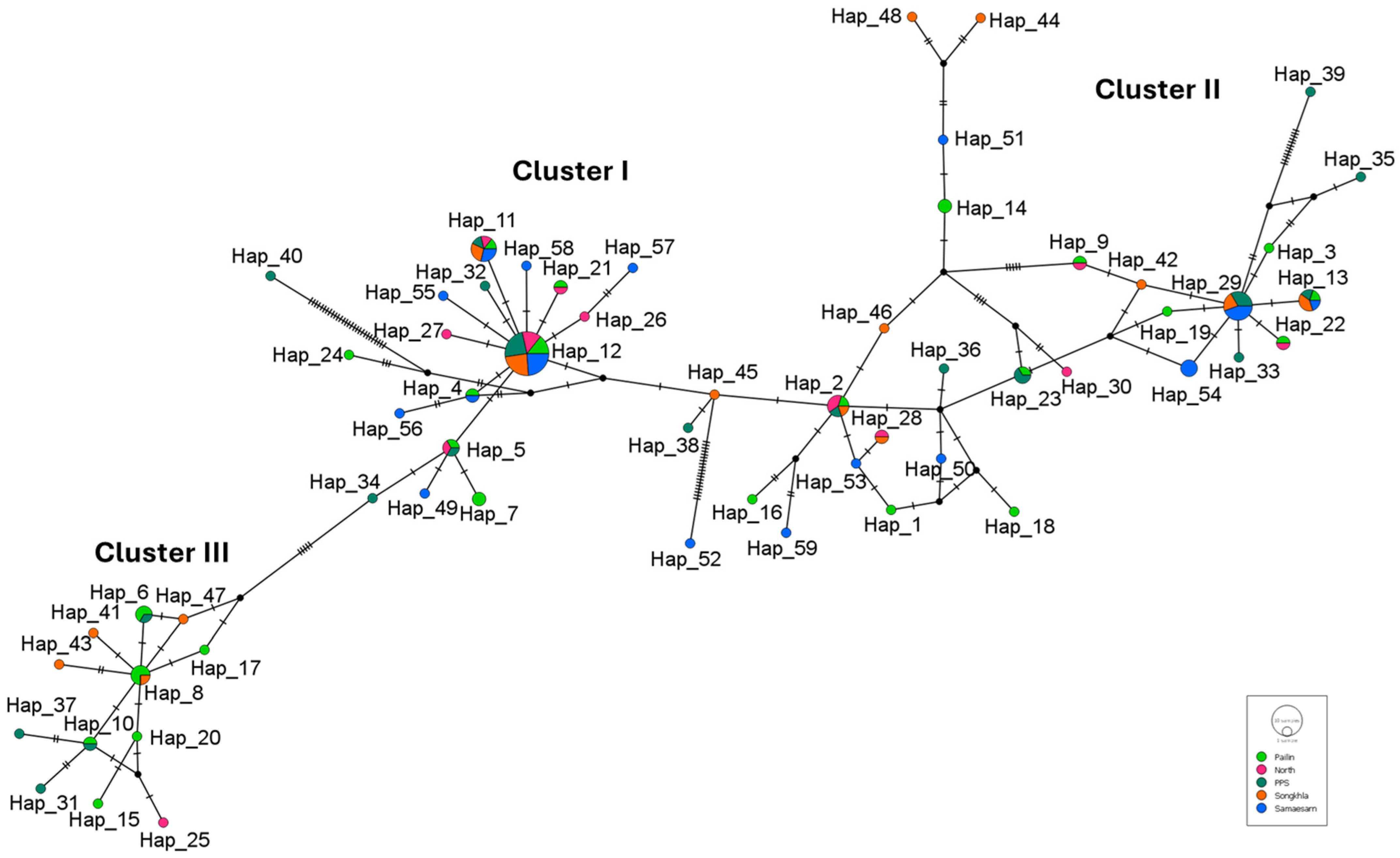
In total, 59 haplotypes of CR were found across overall populations, and 42 of these were private haplotypes (found in only one geographic location). Three haplotypes were found in >5% of the samples examined. They were haplotype 12 (found in 15/122 individuals, accounting for 12.30%), haplotype 29 (9/122, 7.38%), and haplotype 11 (7/122, 5.74%). Haplotypes 11 and 12 were found in all geographic populations, while haplotype 29 was not found in fish from north and central platforms (Figure 2).
Limited sample sizes were found from all platforms from the north areas (N = 5, 2, 4, and 4 for N1–N4, respectively). In addition, nucleotide divergence between N1 and other platforms was −0.00260–0.00304, while interpopulation divergence between N3 and N4 was −0.00088. An equal divergence of 0.00057 was found between N2–N3 and N2–N4. Therefore, fish from these petroleum platforms were combined as the north population. In this study, seventeen non-private haplotypes were found. Of these, nine (52.94%, N = 15), fourteen (82.35%, N = 30), and nine (52.94%, N = 27) non-private haplotypes were identified in the northern, central, and southern platforms. This suggested a low level of haplotype detection bias owing to a small sample size of the northern platforms.
Relatively high haplotype and nucleotide diversity were observed for the overall samples. Levels of haplotype diversity of the northern, central, and southern platforms and coastal populations (Samaesarn and Songkhla) were roughly identical. Nucleotide diversity within populations was estimated, and the lowest nucleotide diversity was observed in the northern platform, while the highest nucleotide diversity was found in the southern platform. Moderate levels of nucleotide diversity were found in the remaining populations (Table 1).
Owing to different sample sizes between populations, the ratio of the number of haplotypes/sample size (NH/N) was considered. The greatest value of this ratio was found in the central platform, followed by the southern and northern platforms. Lower values were observed in the coastal populations (0.643 in Samaesarn and 0.682 in Songkhla). High numbers of private haplotypes were found in the central and south platforms, and Samaesarn (11 haplotypes for each population). A lower number of private haplotypes were found in Songkhla (8 haplotypes). Only two private haplotypes were found in fish from the north platforms.
A TCS haplotype network was constructed and showed the absence of phylogeographic structuring (Figure 2). The haplotype network revealed relationships between identified CR haplotypes and indicated that the private haplotypes are not ancestral haplotypes, but they were derived from non-private haplotypes of each cluster. The network could be roughly separated into three clusters. Clusters I and II were composed of 17 (N = 49, accounting for 40.16% of examined fish) and 30 (N = 55, 45.08%) haplotypes from all fish populations, while cluster III contained 12 haplotypes (N = 18, 14.75%) originating from northern, central, and southern petroleum platforms and Songkhla but not from the Samaesarn populations.
Pie charts illustrating haplotype distribution frequencies identified in each geographic population are shown in Figure 1. Distribution frequencies of clusters I, II, and III haplotypes in Songkhla and the southern platforms were similar (0.3182, 0.5000, and 0.1818 compared with 0.3704, 0.4815, and 0.1481, respectively), while those in the central and northern platforms were 0.3333, 0.3367, and 0.3000, and 0.5333, 0.2000, and 0.0667, respectively. Cluster III haplotypes were not found in Samaesarn (upper Gulf of Thailand). This population possessed an equal frequency of clusters I (0.5000) and II (0.5000) haplotypes (Figure 1).

3.2. Nucleotide Divergence and Phylogenetic Analysis

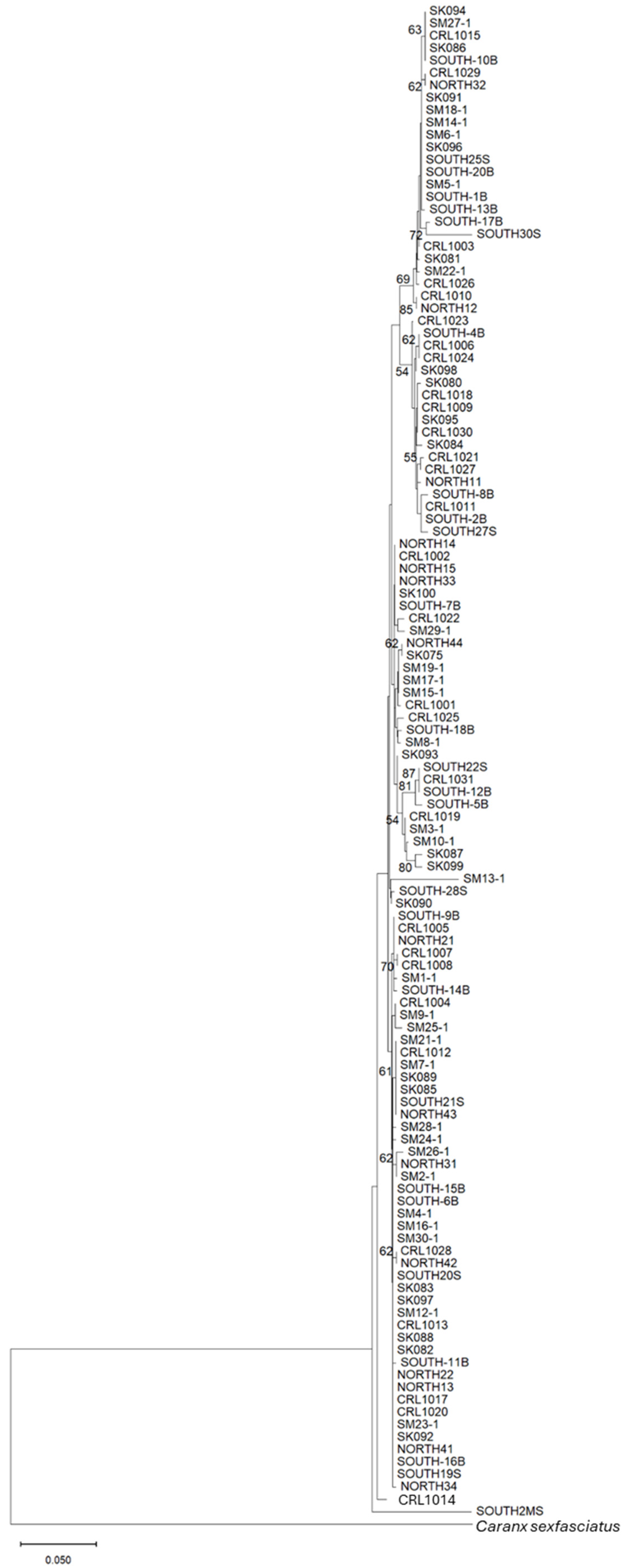
A phylogenetic tree based on CR polymorphism revealed a lineage separation of three clusters of sequences. However, the separation did not reveal the genetic break between lineages, and each haplotype lineage was composed of fish from all populations (Figure 3). This circumstance revealed population admixture in L. vitta from different geographic locations.
Nucleotide divergence between populations was calculated, and south-Samaesarn (0.107%) and north–central platforms (0.096%) revealed larger genetic differences than other paired comparisons. North–Samaesarn, central–south, central–Songkhla, and south–Songkhla did not reveal a difference in interpopulation divergence (Table 2).
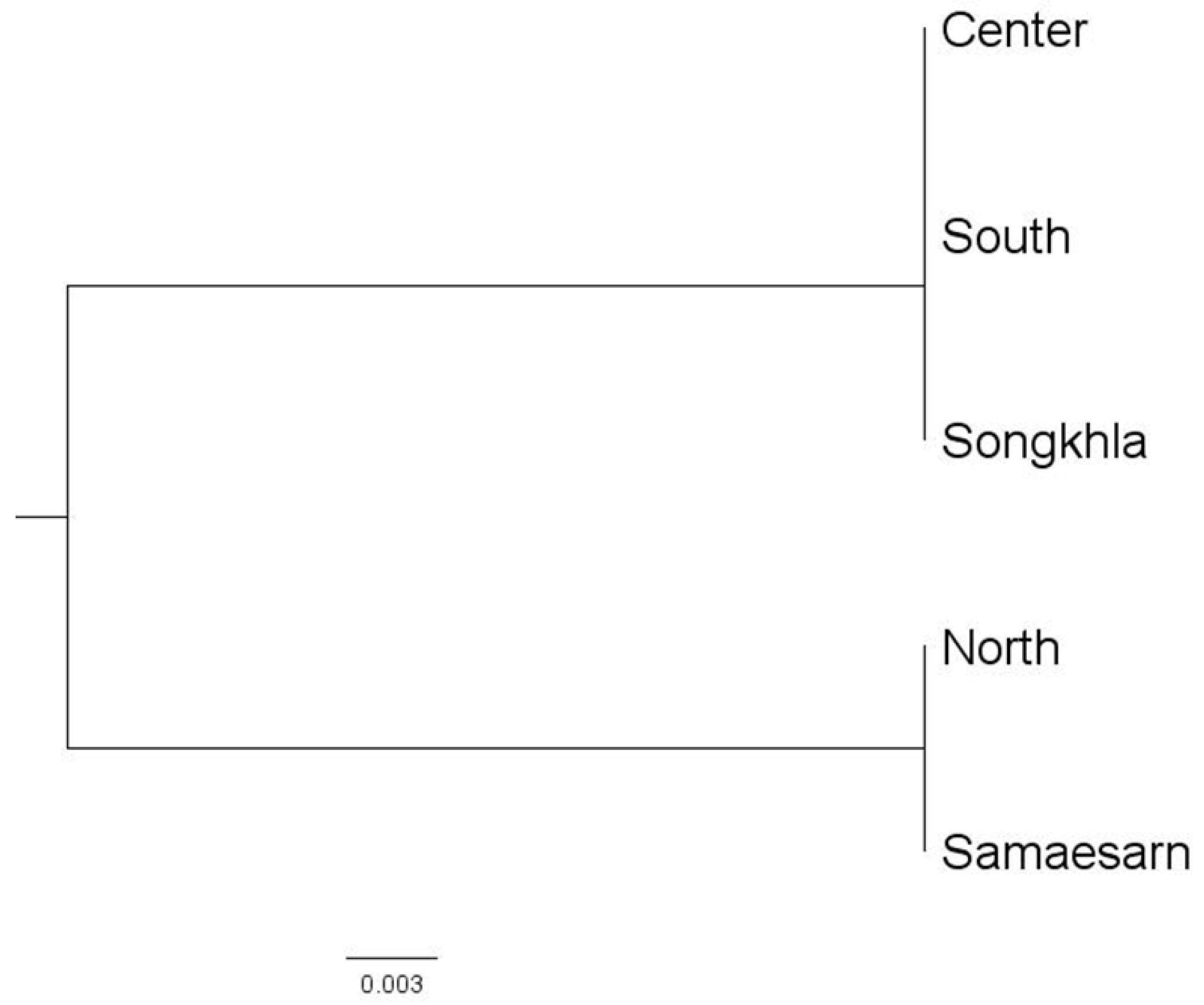
A phylogenetic tree at the population level was constructed from interpopulation divergence. It indicated close relationships between the northern and Samaesarn (Group A) and central, southern platforms and Songkhla (Group B) (Figure 4).

3.3. Intraspecific Population Structure of L. vitta Based on CR Sequence Polymorphism

FST was estimated to evaluate the population structure of L. vitta. Based on reasonably large sample sizes (N = 122), significant population differentiation was marginally observed between the central platform and Samaesarn (p = 0.0304). The lack of population subdivision was found in all pairwise comparisons after the sequential Bonferroni’s adjustment (p > 0.01, Table 3).
When hierarchical groups were divided according to geographic locations, including upper (central and north) platforms, lower (south) platforms, Samaesarn (Chonburi, eastern Thailand), and Songkhla (southern Thailand), AMOVA did not reveal significant differences between variance components among individuals within geographic populations (percentage of variation = 99.16%, FST = 0.0084, p = 0.1740), among populations within groups (3.46%, FSC = 0.0337, p = 0.0811), and among hierarchical groups (−2.62.78%, FCT = −0.02625, p = 0.8935; Table 4). Similar results were found when hierarchical groupings were classified according to phylogenetic clusters (north–Samaesarn and central–south–Songkhla) and between platforms (northern–central–southern) and coastal (Samaesarn–Songkhla) populations. The results further confirmed a consequent effect on genetic admixture from different populations following interpopulation connectivity.

3.4. Gene Flow Levels Between Populations of L. vitta

Levels of gene flow were calculated from FST statistics, and results clearly indicated that L. vitta is a high gene flow species. Gene flow levels between pairs of populations varied between 8.74 and very large numbers of female migrants per generation (Table 3). For overall populations, the average gene flow was 41.87 female migrants per generation (FST = 0.0118).

3.5. Neutrality Test and Mismatch Distribution Analysis

Demographic analysis based on Tajima’D and Fu’s Fs tests was not statistically significant in the north and south platforms, and in both coastal populations (Samaesarn and Songkhla) (p > 0.05). Nevertheless, Fu’s Fs statistics were significant for the central platform (p < 0.05). In contrast, Tajima’D did not reveal statistical significance in this population (p > 0.05) (Table 1). However, significant negative Tajima’D and Fu’s Fs statistics were found for the overall population (p < 0.05).
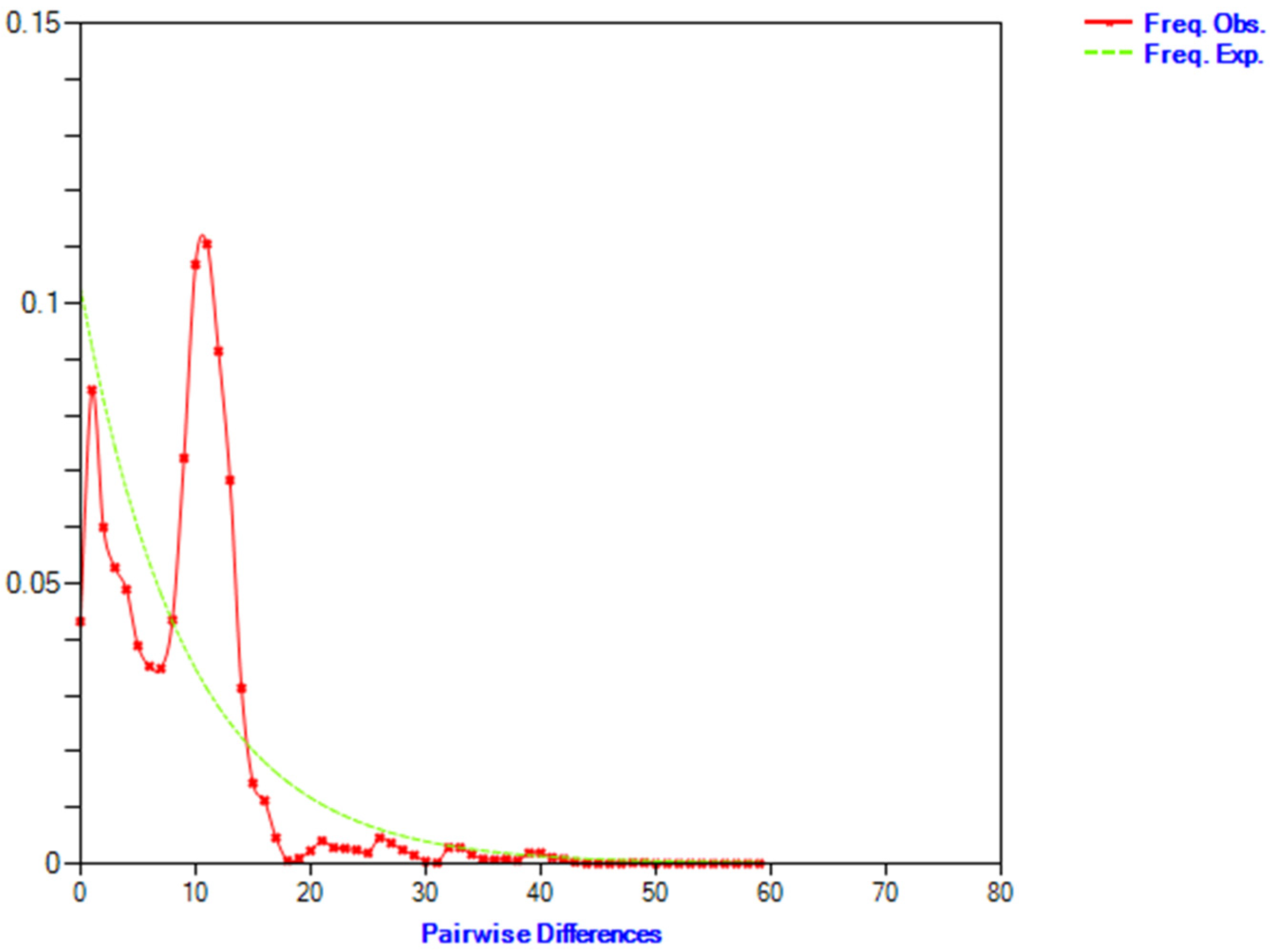
Based on FST and AMOVA, a lack of intraspecific population structure of inshore and offshore (petroleum platforms) L. vitta in the Gulf of Thailand was found. Accordingly, demographic analysis of the overall population was further considered. Although the mismatch distribution curve of CR showed a bimodal curve (Figure 5), the mismatch observed mean and variance under the sudden expansion model were 8.724 and 40.485 with tau (τ) = 11.465, θ0 = 0.000, and θ1 = 17.461. The Harpending’s raggedness index value (HRI) was 0.0073 (p > 0.05), where the sum of squared deviation (SSD) = 0.0069 (p > 0.05). This indicated that the overall population of L. vitta in the Gulf of Thailand is under temporal expansion after a recent bottleneck.
When the studied samples were classified according to the TCS network, both neutrality tests were negatively significant in clusters 1 and 3 (p < 0.05). However, Fu’s Fs (−9.5948, p < 0.05) but not Tajima’s D (−1.2637, p > 0.05) was statistically significant for the cluster 2 group. Demographic expansion was found in L. vitta with clusters 2 and 3 haplotypes (τ = 6.808 and 2.242, HRI = 0.0102 and 0.0655, p > 0.05, and SSD = 0.0165 and 0.0049, p > 0.05, respectively). Similarly, the population expansion was also found in L. vitta exhibiting cluster I haplotypes with a lower τ value of = 0.551 and non-significant HRI and SSD of 0.0706 and 0.0152 (p > 0.05). This suggested a more recent expansion of fish with cluster I haplotypes than those with clusters 3 and 2, respectively.
Based on all analyses, genetic connectivity between fish from different sampling sites is observed. For phylogenetic analysis at the individual level, fish from all populations were found within major clusters I and II. At the population level, two genetic clusters of platform-coastal populations were found. Population structure analysis and gene flow estimation further support the genetic connectivity of L.vitta in the Gulf of Thailand.

4. Discussion

4.1. Genetic Diversity of L. vitta Around Petroleum Platform and Coastal Areas in the Gulf of Thailand

The information on genetic diversity and population subdivisions within commercially (or ecologically) important species is crucial for fisheries management and is applicable for stock enhancement programs [45,46]. Generally, population genetic studies of Lutjanus species have been reported using the coastal population from various geographic locations. The lack of genetic differentiation is commonly found in the congeneric Lutjanus species [5,7,9,10,11,16,17,47].
Recently, levels of genetic diversity and a lack of population differentiation of L. vitta from the east coast of peninsular Malaysia (Tok Bali, Kelantan; Pulau Kambing, Terengganu; Kuantan, Pahang; and Mersing, Johor) were reported. High haplotype diversity (Hd = 0.956–1.000) but low nucleotide diversity (π = 0.8–1.4%) was found across four examined populations (N = 58). Population differentiation was not statistically significant for all pairwise comparisons (p > 0.05). Likewise, a low level of nucleotide diversity was also observed in mangrove red snapper L. argentimaculatus (Hd = 0.929 and π = 0.3%) [11] and lane snapper L. synagris populations from Honduras (Hd = 0.977 and π = 0.923–1.273%, mean = 1.106%) [48].
In the present study, the contribution of petroleum platforms to the genetic connectivity of L. vitta was examined by comparing population genetic analysis of fish from both the petroleum platforms and coastal regions. High haplotype (Hd = 0.943–0.982) and nucleotide diversity within platform populations (π = 1.293–2.850%) were observed. The intrapopulation divergence of coastal populations was 1.852 and 1.968% for Samaesarn (upper Gulf of Thailand) and Songkhla (farther south of peninsular Thailand).
A similar level of genetic diversity was observed in the red snapper L. campechanus (Hd = 0.946 and π = 2.1%) [9], but a greater level of haplotype and nucleotide diversity (Hd = 0.990–0.997 and π = 2.6–3.9%,) was previously reported in L. purpureus [10,49], L. jocu and L. analis [17], and L. alexandrei [16].
Intrapopulation nucleotide diversity of fish from the south platform (2.850%) was clearly greater than that from other petroleum (1.293% for north and 1.922% for central) platforms and coastal regions (1.852% for Samaesarn and 1.968% for Songkhla). This implies that the south platform is probably the major breeding aggregation of L. vitta from different geographic locations.

4.2. A Lack of Population Differentiation of L. vitta in the Gulf of Thailand

A panmixia of L. vitta from the east coast of Peninsular Malaysia was previously reported [5]. Likewise, intraspecific population structure was not found between paired populations in the present study. However, a marginal non-significant result was observed between the central platform and Samaesarn. This circumstance is supported by the highest nucleotide divergence between Samaesarn and the central populations (0.107) compared with the paired coastal populations (π = 0.000–0.046). Although significant population differentiation was not observed between each of the petroleum platforms based on FST estimates, the second (0.096%) and third (0.069%) ranks of interpopulation nucleotide divergence were found between petroleum platforms (north–central and north–south). High genetic diversity of L. vitta from the Malaysian waters and Gulf of Thailand in all sampling locations and non-significant values of FST and AMOVA critically suggest the availability of a single (panmictic) genetic stock of L. vitta in the eastern side of GOT-Thai Malaysian peninsular areas.
Migration ability of adults to the breeding grounds affects the genetic homogeneity of various fish species [5,50]. In this study, fish from the north petroleum platform showed a close relationship with the Samaesarn population owing to a lack of interpopulation nucleotide divergence. Similarly, a lack of nucleotide divergence was found between central–south–Songkhla populations. A phylogenetic tree of individual fish indicated mixed L. vitta from different geographic populations, while a UPGMA dendrogram constructed from interpopulation nucleotide divergence implied high connectivity between north–Samaesarn and between central–south–Songkhla. The circumstance suggested the importance of the availability of petroleum platforms in the migration of high-mobility species like L. vitta.
Biogeographic and phylogenetic patterns suggested that L. vitta from the Gulf of Thailand may experience an ancient separation, but degrees of population differentiation were not sufficiently differentiated. This was contradictory to previous studies in other species having lower mobility potential, such as the giant tiger shrimp (Penaeus monodon) [51], blue swimming crab (Portunus pelagicus) [52], and banana shrimp (Ferneropenaeus merguiensis) [53] in a similar geographic scale.
Genetic connectivity and historical population expansion have been reported in various species of Lutjanidae. Typically, high genetic diversity and historical experiences of population expansion were found. Like other species, intraspecific population structure was analyzed by both mtDNA, CR, and cytb and nuclear DNA; delta 6 desaturase (D6D) intron 8 and Ribosomal Protein S7 (Rps7) intron 1 revealed a single genetic stock with historical population expansion of L. jocu along the Brazilian coast [25].
The pattern of panmictic population structure observed through neutral markers could result from the interaction of several factors, such as connectivity between populations, demographic history, and population size [54,55], together with biological factors such as larval dispersal [56]. Life history characteristics of L. vitta are similar to those of other Lutjanus species. The lack of genetic heterogeneity in various Lutjanus species probably resulted from high potential larval dispersal in these fish, as their pelagic larval phase is about 30 days [7,9,10,12,16,49,57]. Lutjanidae larvae could swim two to four times faster than the average current speed, reflecting the ability to disperse at a long distance for the spatio-temporal patterns of settlement [6,58].
Our parallel study based on genome-wide SNPs is also performed using specific locus amplified fragment sequencing (SLAF-Seq) of the same sample set (N = 137). Similar results on the lack of intraspecific population structure based on pairwise FST and AMOVA analyses were observed. Population admixture analysis provided the most optimal predefined population (k) value = 1. The circumstance from both maternal (this study) and biparental [59] markers critically supports a large panmictic gene pool of L. vitta in the Gulf of Thailand.
Like L. vitta from the east of the Malaysian peninsula, population expansion was also noticed for L. vitta in the Gulf of Thailand based on the sudden expansion model. In the present study, non-significant Tajima’s D and Fu’s Fs values were observed in the examined population, except for the central platform (Fu’s Fs test). The results of both neutrality tests were statistically significant for the overall population. Although the mismatch distribution analysis of the overall population revealed the bimodal distribution pattern, suggesting population stability, the TCS haplotype network showed mixing of haplotypes with many unique haplotypes. In addition, HRI and SSD of the overall population and each cluster group from the TCS network were not statistically significant. These collectively suggested a recent demographic expansion of L. vitta in the Gulf of Thailand. Apparently, the circumstance is supported by its spawning potential, as an individual L. vitta could spawn nearly 150 times in a year [60]. Similarly, non-significant structuring and neutrality tests (negative values of both Tajima’s D and Fu’s Fs) of L. xanthopinnis populations from the South China Sea following D-loop and cytb analysis were previously reported [15]. Accordingly, different Lutjanus species distributed on approximately the same geographic scale may experience similar bottleneck/expansion events.
In L. synagris, population differentiation was found at the macrogeographic scale in the Western Atlantic. Strong population structure was found between L. synagris from the Gulf of Mexico, Florida, Honduras, and Colombia (population group 1) and Puerto Rico and Brazil (population group 2). Like L. vitta, highly significant neutrality indices were observed in the combined Mexico–Florida–Honduras–Colombia population and Puerto Rico–Brazil population (p < 0.01) [48]. Similar circumstances were also reported in L. erythropterus in East Asia [7]. Population bottleneck-expansion was also observed in L. campechanus from the Gulf of Mexico and Atlantic Coast of Florida [9].

4.3. Applications of Genetic Connectivity on Fisheries and Petroleum Platform Management

Sustainable fisheries can be achieved through the maintenance of natural stocks of economically/ecologically important species. The basic information on levels of connectivity between geographic populations of a particular species is crucial for effective fisheries management for policy decisions on the suitable numbers of stocks that should be managed and for evaluation of fishing efforts on fish population structure and their ecology [45,56,61,62,63]. This could eventually be applied to the construction of marine protected areas (MPAs) for natural resources in the Gulf of Thailand. The use of highly mobile species like L. vitta allows the protection of other important species having a narrower distribution geographically [64,65].
From the fisheries management point of view, L. vitta is recognized as a panmictic species. High gene flow levels between natural populations should be maintained. Results from the present study implied for the first time that L. vitta from different coastal populations has emigrated from the coastal to offshore areas (i.e., from Samaesarn and Songkhla to various petroleum platforms as the congregating home) before mass-immigrating to the opposite coastal areas. Biased contributions in each coastal population (i.e., no cluster III haplotypes in Samaesarn but not other populations) may have promoted weak degrees of genetic difference between the south platform and Samaesarn.
Understanding the dispersion ability and connectivity of geographically different populations of L. vitta provided a picture to consider an area for its protection (Núnez-Vallecillo et al., 2024) [48]. Small-scale management actions on critical areas and habitats (e.g., aggregating sites, spawning sites, and growth sites) [48,66]. Therefore, appropriate management and protection of petroleum platforms in the Gulf of Thailand may be advantageous to the conservation of L. vitta in the area.
Adult L. vitta are usually found in the vicinity of coral reefs, as well as areas with flat bottoms. This species forms spawning aggregations [4,67,68]. There has been increasing evidence that petroleum platforms have an impact with respect to ecological biodiversity [26,27,69]. Recently, fish associated with seven platforms and five reference sites located in the central Gulf of Thailand were surveyed with a remotely operated vehicle (ROV). In total, 46 fish species (43 species at platforms and 5 species at reference sites), composed of 15,857 fish, were recorded (15,791 at platforms and 66 at reference sites). The basic information allowed understanding the role of petroleum platforms in the marine environment and fish communities, which provide habitat for coral reef-associated fish [70].
Many petroleum platforms in the Gulf of Thailand will be decommissioned after their operational life [71]. By law, the complete removal of petroleum platforms from the seafloor following the production life is required. For the construction of an appropriate plan for the decommissioning of the petroleum platforms in the Gulf of Thailand, genetic diversity and intraspecific population subdivisions of key species could be applied.
To our knowledge, this is the first study on the population genetics of Lutjanus species originating from both coastal populations and the petroleum platforms. Petroleum platform jackets exhibit reef effects that provide habitats for shelter, feeding, and nursing opportunities to a broad range of species [27,72,73]. The complete removal of expired platforms results in the loss of natural biotic diversity [74]. Based on haplotype distribution, nucleotide divergence, and FST analysis, partial removal (top section removed from the marine environment) of north, central, and south platforms in the present study would theoretically retain forty of fifty-nine identified haplotypes (67.80%) of L. vitta from the Gulf of Thailand. This circumstance only left nineteen singletons (found in only one individual of a particular population) in Samaesarn and Songkhla. Complete decommissioning of N1, N2, N3, and N4 of the north platform does not severely affect haplotype diversity, as only two private haplotypes were not detected. This partial removal activity greatly facilitates the detection of many haplotypes to stabilize the gene pool of L. vitta in the Gulf of Thailand.
In this study, high genetic diversity of the offshore petroleum platforms and coastal populations of L. vitta in Gulf of Thailand was found. The information is important for fisheries management of this species. Data were able to apply for conservation of its gene pool and for illustrating an example of the decommissioned plan to minimize the loss of genetic diversity and population connectivity of L. vitta in eastern peninsular Thailand. Importantly, integrated information on oceanography, genetics, and ecology should be appropriately synthesized for policy decisions on the protection of natural resources in the Gulf of Thailand.

Supplementary Materials

The following supporting information can be downloaded at: https://www.mdpi.com/article/10.3390/d18040235/s1, Table S1: Haplotype distribution of wild L. vitta in Gulf of Thailand.

Author Contributions

Conceptualization, B.K., S.S., P.P., A.S. and P.J.; methodology, S.K. and B.K.; formal analysis, S.P., S.J., P.P., S.T., A.S. and W.I.; investigation, S.P., S.J., T.T. and W.I.; data curation, S.T. and S.K.; writing—original draft preparation, B.K., S.S. and P.P.; writing—review and editing, S.K.; supervision, S.K. and P.J.; funding acquisition, P.P. and P.J. All authors have read and agreed to the published version of the manuscript.

Funding

This research was funded by the Petroleum and Energy Institute of Thailand.

Institutional Review Board Statement

Not applicable.

Data Availability Statement

The data presented in this study are openly available in GenBank (https://www.ncbi.nlm.nih.gov/; accession no. PZ268469–PZ268596).

Acknowledgments

We thank the Department of Mineral Fuels, Ministry of Energy, for legal permission to collect and analyze. In addition, the authors would also like to thank the National Center for Genetic Engineering and Biotechnology (BIOTEC), the National Science and Technology Development Agency (NSTDA), and Aquatic Resources Research Institute (ARRI), Chulalongkorn University, for providing facilities.

Conflicts of Interest

The authors declare that they have no known competing financial interests or personal relationships that could have appeared to influence the work reported in this paper. The sponsors had no role in the design, execution, interpretation, or writing of the study.

References

  1. Allen, G.R. FAO Species Catalogue: Vol. 6. Snappers of the World: An Annotated and Illustrated Catalogue of Lutjanid Species Known to Date; FAO Fisheries Synopsis NO. 125; FAO: Rome, Italy, 1985. [Google Scholar]
  2. Myers, R.F. Micronesian Reef Fishes: A Comprehensive Guide to the Coral Reef Fishes of Micronesia, 3rd ed.; Coral Graphics: Barrigada, Guam, 1999; p. 330. [Google Scholar]
  3. Davis, T.L.O.; West, G.J. Growth and mortality of Lutjanus vitta (Quoy and Gaimard) from the North West Shelf of Australia. Fish. Bull. 1992, 90, 395–404. [Google Scholar]
  4. Palla, H.P.; Gonzales, B.J.; Sotto, F.B.; Ilano, A.S.; Tachihara, K. Age, growth and mortality of brown stripe snapper Lutjanus vitta (Quoy and Gaimard 1824) from West Sulu Sea, Philippines. Asian Fish. Sci. 2016, 29, 28–42. [Google Scholar] [CrossRef]
  5. Habib, A.; Ahmad, N.A.H.; Ariffin, N.A.; Seah, Y.G.; Alam, M.M.M.; Jaafar, T.N.A.M.; Fadli, N.; Nor, S.A.M.; Rahman, M.M. Mitochondrial control region sequences show high genetic connectivity in the brownstripe snapper, Lutjanus vitta (Quoy and Gaimard, 1824) from the east coast of Peninsular Malaysia. J. Genet. 2024, 103, 35. [Google Scholar] [CrossRef] [PubMed]
  6. Muths, D.; Gouws, G.; Mwale, M.; Tessier, E.; Bourjea, J. Genetic connectivity of the reef fish Lutjanus kasmira at the scale of the western Indian Ocean. Can. J. Fish. Aquat. Sci. 2012, 69, 842–853. [Google Scholar] [CrossRef]
  7. Zhang, J.; Cai, Z.; Huang, L. Population genetic structure of crimson snapper Lutjanus erythropterus in East Asia, revealed by analysis of the mitochondrial control region. ICES J. Mar. Sci. 2006, 63, 693–704. [Google Scholar] [CrossRef]
  8. Zamroni, A.; Taufik, M.; Ernawati, T.; Nurdin, E.; Lestari, P.; Fauzi, M. Divergent genetic diversity reveals contrasting demographic histories in two commercially important snappers. Ecol. Genet. Genom. 2025, 37, 100414. [Google Scholar] [CrossRef]
  9. Garber, A.F.; Tringali, M.D.; Stuck, K.C. Population structure and variation in red snapper (Lutjanus campechanus) from the Gulf of Mexico and Atlantic coast of Florida as determined from mitochondrial DNA control region sequence. Mar. Biotech. 2004, 6, 175–185. [Google Scholar] [CrossRef]
  10. Gomes, G.; Sampaio, I.; Schneider, H. Population structure of Lutjanus purpureus (Lutjanidae-Perciformes) on the Brazilian coast: Further existence evidence of a single species of red snapper in the western Atlantic. Acad. Bras. Cienc. 2012, 84, 979–999. [Google Scholar] [CrossRef]
  11. Gopalakrishnan, A.; Vineesh, N.; Ismail, S.; Menon, M.; Akhilesh, K.V.; Jeena, N.S.; Paulton, M.P.; Vijayagopal, P. Mitochondrial signatures revealed panmixia in Lutjanus argentimaculatus (Forsskål 1775). J. Genet. 2018, 97, 179–187. [Google Scholar] [CrossRef]
  12. Vineesh, N.; Shihab, I.; Akhilesh, K.V.; Sajeela, K.A.; Muktha, M.; Gopalakrishnan, A. Is Lutjanus argentimaculatus genetically connected along the Arabian Sea and Bay of Bengal? A study using microsatellite markers. Aquaculture 2023, 562, 738863. [Google Scholar] [CrossRef]
  13. Silva, D.; Martins, K.; Oliveira, J.; da Silva, R.; Sampaio, I.; Schneider, H.; Gomes, G. Genetic differentiation in populations of lane snapper (Lutjanus synagris–Lutjanidae) from Western Atlantic as revealed by multilocus analysis. Fish. Res. 2018, 198, 138–149. [Google Scholar] [CrossRef]
  14. Pranata, B.; Sala, R.; Kusuma, A.B.; Toha, A.H.A.; Purbani, D.C.; Mokodongan, D.F.; Adi, S. Genetic diversity and connectivity of red snapper Lutjanus gibbus in the Papua waters, Indonesia. Biodiversitas 2024, 25, 276–286. [Google Scholar] [CrossRef]
  15. Rahman, M.M.; Ariffin, N.A.; Seah, Y.G.; Nor, S.A.M.; Mat Jaafar, T.N.A.; Nur, N.F.M.; Habib, A. Mitochondrial markers revealed genetic panmixia in the data-deficient yellowfin snapper, Lutjanus xanthopinnis (Actinopterygii: Eupercaria: Lutjanidae), from a hotspot of the southern region of the South China Sea. Acta Ichthyol. Piscat. 2024, 54, 189–201. [Google Scholar] [CrossRef]
  16. Veneza, I.; da Silva, R.; Ferreira, C.; Mendonça, P.; Sampaio, I.; Evangelista-Gomes, G. Genetic connectivity and population expansion inferred from multilocus analysis in Lutjanus alexandrei (Lutjanidae-Perciformes), an endemic snapper from Northeastern Brazilian coast. Peer J. 2023, 11, e15973. [Google Scholar] [CrossRef]
  17. Souza, A.S.; Dias Júnior, E.A.; Perez, M.F.; Cioffi, M.B.; Bertollo, L.A.C.; Garcia-Machado, E.; Vallinoto, M.N.S.; Pedro Manoel, G.P., Jr.; Molina, W.F. Phylogeography and historical demography of two sympatric Atlantic snappers: Lutjanus analis and L. jocu. Front. Mar. Sci. 2019, 6, 545. [Google Scholar] [CrossRef]
  18. Lutz, Í.; Martins, K.; Cardoso, B.; Miranda, A.; Costa, J.; Silva, I.; Martins, T.; Matos, S.; Santana, P.; Mendes, C.; et al. Connectivity and high genetic diversity in populations of the dog snapper Lutjanus jocu (Lutjanidae: Perciformes) from the South Western Atlantic, recovered with multilocus analysis. Environ. Biol. Fish. 2024, 107, 1121–1135. [Google Scholar] [CrossRef]
  19. Wu, L.; Yang, J. Identifications of captive and wild tilapia species existing in Hawaii by mitochondrial DNA control region sequence. PLoS ONE 2012, 7, e51731. [Google Scholar] [CrossRef]
  20. He, W.; Dong, Z.; Ma, T.; Yan, H.; Chen, Z.; Yao, W.; Cheng, F. Three Mitochondrial Markers Reveal Genetic Diversity and Structure of Rock Carp (Procypris rabaudi) Endemic to the Upper Yangtze: Implications for Pre-release Genetic Assessment. Front. Mar. Sci. 2022, 9, 939745. [Google Scholar] [CrossRef]
  21. Rahman, M.M.; Ariffin, N.A.; Seah, Y.G.; Jaafar, T.N.A.M.; Nor, S.A.M.; Nur, N.F.M.; Abu Bakar, A.; Habib, A. Mitochondrial DNA analyses of the golden snapper, Lutjanus johnii (Bloch, 1792), revealed two distinct population stocks in the South China Sea and the Strait of Malacca. Genetica 2025, 153, 30. [Google Scholar] [CrossRef]
  22. Rahayu, S.R.; Muchlisin, Z.A.; Fadli, N.; Razi, N.M.; Ramadhaniaty, M.; Handayani, L.S.; Maulida, S.; Nur, F.M.; Nurlaili, N.; Siti-Azizah, M.N. Morphometric and genetic variations of four dominant species of snappers (Lutjanidae) harvested from the Northern Coast of Aceh waters, Indonesia. Zool. Anz. 2023, 303, 26–32. [Google Scholar] [CrossRef]
  23. Halim, L.J.; Rahim, I.; Mahboob, S.; Al-Ghanim, K.A.; Amat, A.; Naim, D.M. Phylogenetic relationships of the commercial red snapper (Lutjanidae sp.) from three marine regions. J. King Saud Univ. Sci. 2021, 34, 101756. [Google Scholar] [CrossRef]
  24. Arai, T.; Taha, H.; Alidon, N.; Jumat, J.; Azmey, S.; Zan, N.D.; Aimi Mat Jaafar, T.N.; Habib, A. Mitochondrial cytochrome c oxidase subunit I gene analysis of the yellowfin snapper, Lutjanus xanthopinnis in the Indo-Pacific region and a note on Lutjanus lutjanus population structure. Heliyon 2023, 9, e19348. [Google Scholar] [CrossRef] [PubMed]
  25. Sommer, B.; Fowler, A.M.; Macreadie, P.I.; Palandro, D.A.; Aziz, A.C.; Booth, D.J. Decommissioning of offshore oil and gas structures—Environmental opportunities and challenges. Sci. Total Environ. 2019, 658, 973–981. [Google Scholar] [CrossRef] [PubMed]
  26. van Elden, S.; Meeuwig, J.J.; Hobbs, R.J.; Hemmi, J.M. Offshore oil and gas platforms as novel ecosystems: A global perspective. Front. Mar. Sci. 2019, 6, 548. [Google Scholar] [CrossRef]
  27. Lemasson, A.J.; Somerfield, P.J.; Schratzberger, M.; Thompson, M.S.A.; Firth, L.B.; Couce, E.; McNeill, C.L.; Nunes, J.; Pascoe, C.; Watson, S.C.L.; et al. A global meta-analysis of ecological effects from offshore marine artificial structures. Nat. Sustain. 2024, 7, 485–495. [Google Scholar] [CrossRef]
  28. Lee, W.; Coroy, J.; Howell, W.H.; Koocher, T.D. Structure and evolution of teleost mitochondrial control regions. J. Mol. Evol. 1995, 41, 54–66. [Google Scholar] [CrossRef]
  29. Altschul, S.F.; Gish, W.; Miller, W.; Myers, E.W.; Lipman, D.J. Basic local alignment search tool. J. Mol. Biol. 1999, 215, 403–410. [Google Scholar] [CrossRef]
  30. Thompson, J.D.; Gibson, T.J.; Higgins, D.G. Multiple sequence alignment using ClustalW and ClustalX. Curr. Protoc. Bioinform. 2003, 1, 2–3. [Google Scholar] [CrossRef]
  31. Nei, M. Molecular Evolutionary Genetics; Columbia University Press: New York, NY, USA, 1987. [Google Scholar]
  32. Rozas, J.; Ferrer-Mata, A.; Sánchez-DelBarrio, J.C.; Guirao-Rico, S.; Librado, P.; Ramos-Onsins, S.E.; Sánchez-Gracia, A. DnaSP 6: DNA sequence polymorphism analysis of large data sets. Mol. Biol. Evol. 2017, 34, 3299–3302. [Google Scholar] [CrossRef]
  33. Clement, M.; Posada, D.; Crandall, K.A. TCS: A computer program to estimate gene genealogies. Mol. Ecol. 2010, 9, 1657–1659. [Google Scholar] [CrossRef]
  34. Leigh, J.W.; Bryant, D. POPART: Full-feature software for haplotype network construction. Methods Ecol. Evol. 2015, 6, 1110–1116. [Google Scholar] [CrossRef]
  35. Saitou, N.; Nei, M. The neighbor-joining method: A new method for reconstructing phylogenetic trees. Mol. Biol. Evol. 1987, 4, 406–425. [Google Scholar] [CrossRef]
  36. Tamura, K.; Stecher, G.; Kumar, S. MEGA11: Molecular Evolutionary Genetics Analysis version 11. Mol. Biol. Evol. 2021, 38, 3022–3027. [Google Scholar] [CrossRef]
  37. Felsenstein, J. Phylip (Phylogenetic Inference Package), Version 3.5c; Department of Genetics, University of Washington: Seattle, WA, USA, 1993.
  38. Rambaut, A. Figtree, Version 1.4.4; Institute of Evolutionary Biology, University of Edinburgh: Edinburgh, UK, 2018.
  39. Excoffier, L.; Smouse, P.E.; Quatto, J.M. Analysis of molecular variance inferred from metric distances among DNA haplotypes: Application in human mitochondrial DNA data. Genetics 1992, 131, 479–491. [Google Scholar] [CrossRef]
  40. Weir, B.S.; Cockerham, C.C. Estimation F-statistics for the analysis of population structure. Evolution 1984, 38, 1358–1370. [Google Scholar] [CrossRef] [PubMed]
  41. Excoffier, L.; Lischer, H.E. Arlequin suite ver 3.5: A new series of programs to perform population genetics analyses under Linux and Windows. Mol. Ecol. Resour. 2010, 10, 564–567. [Google Scholar] [CrossRef] [PubMed]
  42. Hudson, R.R.; Slakin, M.; Maddison, W.P. Estimation of levels of gene flow from DNA sequence data. Genetics 1992, 132, 583–589. [Google Scholar] [CrossRef] [PubMed]
  43. Tajima, F. Statistical method for testing the neutral mutation hypothesis by DNA polymorphism. Genetics 1989, 123, 585–595. [Google Scholar] [CrossRef]
  44. Fu, Y.X. Statistical tests of neutrality of mutations against population growth, hitchhiking and background selection. Genetics 1997, 147, 915–925. [Google Scholar] [CrossRef]
  45. Avise, J.C. Molecular Markers, Natural History and Evolution; Chapman and Hall: New York, NY, USA, 1994. [Google Scholar]
  46. Chauhan, T.; Rajiv, K. Molecular markers and their applications in fisheries and aquaculture. Adv. Biosci. Biotechnol. 2010, 1, 281–291. [Google Scholar] [CrossRef]
  47. Guo, Y.; Wang, Z.; Liu, C.; Liu, L.; Liu, Y. Phylogenetic relationships of South China Sea snappers (genus Lutjanus; family Lutjanidae) based on mitochondrial DNA sequences. Mar. Biotech. 2007, 9, 682–688. [Google Scholar] [CrossRef]
  48. Núnez-Vallecillo, M.; Vera-Escalona, I.; Rivera, A.; Górski, K.; Brante, A. Genetic population structure of lane snapper Lutjanus synagris (Linnaeus, 1758) in Western Atlantic: Implications for conservation. Diversity 2024, 16, 336. [Google Scholar] [CrossRef]
  49. da Silva, R.; Sampaio, I.; Schneider, H.; Gomes, G. Lack of spatial subdivision for the snapper Lutjanus purpureus (Lutjanidae–Perciformes) from Southwest Atlantic based on multi-locus analyses. PLoS ONE 2016, 11, e0161617. [Google Scholar] [CrossRef] [PubMed]
  50. Motta, F.S.; Freitas, M.O.; Rolim, F.A.; Abilhoa, V.; PereiraFilho, G.H. Direct evidence of a spawning aggregation of cubera snapper (Lutjanus cyanopterus) in southeastern Brazil and its management implications. Fish. Res. 2022, 252, 106339. [Google Scholar] [CrossRef]
  51. Khamnamtong, B.; Klinbunga, S.; Menasveta, P. Genetic diversity and geographic differentiation of the giant tiger shrimp (Penaeus monodon) in Thailand analyzed by mitochondrial COI sequences. Biochem. Genet. 2009, 47, 42–55. [Google Scholar] [CrossRef]
  52. Khamnamtong, B.; Prasertlux, S.; Janpoom, S.; Klinbunga, S. Genetic differentiation of the blue swimming crab Portunus pelagicus along the coastal Thai waters revealed by SSCP analysis of cytochrome c oxidase subunit I. Genet. Aquat. Org. 2012, 5, 55–65. [Google Scholar] [CrossRef]
  53. Prasertlux, S.; Wisunthorn, E.; Janpoom, S.; Tang, S.; Ratdee, O.; Ittarat, W.; Soonsan, P.; Sae-Lim, P.; Klinbunga, S.; Khamnamtong, B. Strong genetic differentiation of banana shrimp Penaeus merguiensis in Thai waters revealed by mitochondrial COI polymorphism. Fish. Aquat. Sci. 2026, 29, 1–14. [Google Scholar] [CrossRef]
  54. Carvalho, G.R.; Hauser, L. Molecular genetics and the stock concept in fisheries. Rev. Fish Biol. Fish. 1994, 4, 326–350. [Google Scholar] [CrossRef]
  55. Ward, R.D. The importance of identifying spatial population structure in restocking and stock enhancement programmes. Fish. Res. 2006, 80, 9–18. [Google Scholar] [CrossRef]
  56. Cowen, R.K.; Sponaugle, S. Larval dispersal and marine population connectivity. Annu. Rev. Mar. Sci. 2009, 1, 443–466. [Google Scholar] [CrossRef]
  57. Pothin, K. Analyse de la Dispersion Larvaire des Poissons Récifaux à La Réunion à Travers L’étude de leurs Otolithes. Ph.D. Thesis, Université de La Réunion, Saint-Denis, France, 2005. [Google Scholar]
  58. Fisher, R.; Leis, J.; Clark, D.; Wilson, S. Critical swimming speeds of late-stage coral reef fish larvae: Variation within species, among species and between locations. Mar. Biol. 2005, 147, 1201–1212. [Google Scholar] [CrossRef]
  59. Punnarak, P.; Janpoom, S.; Songploy, S.; Prasertlux, S.; Thitiphuree, T.; Tang, S.; Ittarat, W.; Sophon, A.; Klinbunga, S.; Khamnamtong, B.; et al. Genetic Connectivity of Brownstripe Red Snapper (Lutjanus vitta) Around Petroleum Platforms and Coastal Areas in Gulf of Thailand Analyzed by SNP Polymorphism; Aquatic Resources Research Institute, Chulalongkorn University: Bangkok, Thailand, 2026. [Google Scholar]
  60. Davis, T.L.O.; West, G.J. Maturation, reproductive seasonality, fecundity, and spawning frequency in Lutjanus vitta (Quoy and Gaimard) from the North West Shelf of Australia. Fish. Bull. USA 1993, 91, 224–236. [Google Scholar]
  61. Cadrin, S.X. Defining spatial structure for fishery stock assessment. Fish. Res. 2020, 221, 105397. [Google Scholar] [CrossRef]
  62. Hoban, S.; Archer, F.I.; Bertola, L.D.; Bragg, J.G.; Breed, M.F.; Bruford, M.W.; Coleman, M.A.; Ekblom, R.; Funk, C.W.; Grueber, C.E.; et al. Global genetic diversity status and trends: Towards a suite of essential biodiversity variables (EBVs) for genetic composition. Biol. Rev. 2022, 97, 1511–1538. [Google Scholar] [CrossRef] [PubMed]
  63. Petrolo, E.; Boomer, J.; O’Hare, J.; Bilgmann, K.; Stow, A. Stock structure and effective population size of the commercially exploited gummy shark Mustelus antarcticus. Mar. Ecol. Prog. Ser. 2021, 678, 109–124. [Google Scholar] [CrossRef]
  64. Apostolaki, P.; Milner-Gulland, E.J.; McAllister, M.K.; Kirkwood, G.P. Modelling the effects of establishing a marine reserve for mobile fish species. Can. J. Fish. Aquat. Sci. 2002, 59, 405–415. [Google Scholar] [CrossRef]
  65. Pendoley, K.L.; Schofield, G.; Whittock, P.A.; Ierodiaconou, D.; Hays, G.C. Protected species use of a coastal marine migratory corridor connecting marine protected areas. Mar. Biol. 2014, 161, 1455–1466. [Google Scholar] [CrossRef]
  66. Mech, S.G.; Hallett, J.G. Evaluating the effectiveness of corridors: A genetic approach. Conserv. Biol. 2001, 15, 467–474. [Google Scholar] [CrossRef]
  67. Palla, H.P.; Sotto, F.B. Reproductive biology of brownstripe snapper Lutjanus vitta (Quoy and Gaimard, 1824) from West Sulu Sea, Philippines. Egypt. J. Aquat. Res. 2021, 47, 67–73. [Google Scholar] [CrossRef]
  68. Pradeep, H. Reproductive biology and histology of the female Brownstripe Red Snapper, Lutjanus vitta (Quoy & Gaimard, 1824) of Madras coast along Southeast coast of India. Int. J. Fish. Aquat. Res. 2017, 2, 23–29. [Google Scholar]
  69. Selkoe, K.A.; D′Aloia, C.C.; Crandall, E.D.; Iacchei, M.; Liggins, L.; Puritz, J.B.; Heyden, S.; Toonen, R.J. A decade of seascape genetics: Contributions to basic and applied marine connectivity. Mar. Ecol. Prog. Ser. 2016, 554, 1–19. [Google Scholar] [CrossRef]
  70. Harvey, E.S.; Watts, S.L.; Saunders, B.J.; Driessen, D.; Fullwood, L.A.F.; Bunce, M.; Songploy, S.; Kettratad, J.; Sitaworawet, P.; Chaiyakul, S.; et al. Fish assemblages associated with oil and gas platforms in the Gulf of Thailand. Front. Mar. Sci. 2021, 8, 664014. [Google Scholar] [CrossRef]
  71. Punnarak, P.; Tang, S.; Janpoom, S.; Prasertlux, S.; Khamnamtong, B.; Wimolsakcharoen, W.; Thitiphuree, T.; Getwech, C.; Dhanasin, P.; Klinbunga, S.; et al. Distribution of Eukaryotic Environmental DNA inWater and Sediment from Offshore Petroleum Platforms in the Gulf of Thailand. Diversity 2025, 17, 179. [Google Scholar] [CrossRef]
  72. Alexander, J.B.; Marnane, M.J.; Elsdon, T.S.; Bunce, M.; Sitaworawet, P.; Songploy, S.; Chaiyakul, S.; Harvey, E.S. Using environmental DNA to better inform decision making around decommissioning alternatives for offshore oil and gas infrastructure. Sci. Total Environ. 2023, 901, 165991. [Google Scholar] [CrossRef]
  73. Schutter, M.; Martijn, D.; Floor, M.F.; Driessen, W.L.; Oscar, G.B.; Joop, W.P.C. Oil and gas platforms as artificial substrates for epibenthic North Sea fauna: Effects of location and depth. J. Sea Res. 2019, 153, 101782. [Google Scholar] [CrossRef]
  74. Fowler, A.M.; Jørgensen, A.-M.; Svendsen, J.C.; Macreadie, P.I.; Jones, D.O.; Boon, A.R.; Booth, D.J.; Brabant, R.; Callahan, E.; Claisse, J.T.; et al. Environmental benefits of leaving offshore infrastructure in the ocean. Front. Ecol. Environ. 2018, 16, 571–578. [Google Scholar] [CrossRef]
Figure 1. Sample locations of L. vitta in this study. Fish were collected from northern (N1, N2, N3, and N4; N = 5, 2, 4, and 4), central (N = 30), and southern (N = 27) platforms and from coastal populations: Samaesarn, Chonburi province, upper GOT (N = 28) and Songkhla province, lower GOT (N = 22). Distribution frequencies of identified haplotypes and clusters I, II, and III haplotypes (see Figure 2) in each population are also shown.
Diversity 18 00235 g001
Figure 2. A TCS haplotype network illustrating relationships between CR haplotypes of Lutjanus vitta identified in this study. Vertical bars indicate the number of mutation steps required for the connection between pairs of haplotypes.
Diversity 18 00235 g002
Figure 3. A phylogenetic tree illustrating relationships between CR sequences from Lutjanus vitta from geographically different populations in the Gulf of Thailand. The homologous CR sequence of Caranx sexfasciatus was included as an outgroup. CRL = central platform, SM = Samaesarn, SK = Songkhla.
Diversity 18 00235 g003
Figure 4. A UPGMA dendrogram illustrating relationships between Lutjanus vitta from different geographic locations in the Gulf of Thailand based on CR polymorphism.
Diversity 18 00235 g004
Figure 5. Mismatch distribution curve of L. vitta inferred from CR sequences. The X-axis indicates pairwise difference, and the Y-axis indicates frequency of total populations.
Diversity 18 00235 g005
Table 1. Names of population, sample size, numbers of haplotypes, haplotype diversity, and nucleotide diversity of L. vitta in this study based on CR polymorphism.
PopulationNNHNH/NNPHHdπ (%)Tajima’DFu’s Fs
Petroleum platforms        
North15110.73320.9431.293−0.595 ns−2.927 ns
N1540.80010.9001.639NDND
N2221.00001.0000.231NDND
N3441.00011.0001.880NDND
N4441.00001.0000.808NDND
Central30240.800110.9821.922−0.061 ns−11.343 ***
South27200.741110.9602.850−1.209 ns−4.085 ns
Coastal populations        
Samaesarn28180.643110.9471.8520.346 ns−4.138 ns
Songkhla22150.68280.9441.968−1.148 ns−2.757 ns
Overall populations122590.484420.9572.073−1.715 *−32.460 ***
NH = number of haplotypes, NPH = number of private haplotypes found in only one population, Hd = haplotype diversity, π = nucleotide diversity. * = p < 0.05. *** = p < 0.0001. ND = not determined. ns = not significant.
Table 2. Percentage of nucleotide divergence between pairs of populations of L. vitta in this study.
Platforms Coastal Populations
NorthCentralSouthSamaesarnSongkhla
North-    
Central0.096-   
South0.0690.000-  
Samaesarn0.0000.1070.046- 
Songkhla0.0150.0000.0000.007-
Table 3. Pairwise FST (below diagonal) and estimated female gene flow (numbers of female migrants per generation, above diagonal) between paired populations of Lutjanus vitta inferred from CR sequences.
Platforms Coastal Populations
NorthCentralSouthSamaesarnSongkhla
North-9.9424.50Very large105.89
Central0.0479 ns-Very large8.74Very large
South0.0200 ns−0.0013 ns-24.3829.26
Samaesarn−0.0294 ns0.0541 ns0.0201 ns-121.45
Songkhla0.0047 ns−0.0152 ns0.0168 ns0.0041 ns-
ns = not significant after Bonferroni adjustment (p < 0.01), Nefm = (1 − FST)/2FST [42].
Table 4. AMOVA results between populations of L. vitta.
ParametersDfPercentage of VariationFixation Indicesp-Value
Among groups 3−2.62−0.02620.8935
Among populations within groups13.460.03370.0811
Within populations11799.160.00840.1740
Group 1 = (central processing platform, central and northern areas), Group 2 = (central processing platform, southern area), Group 3 = (lower Gulf of Thailand, Songkhla), Group 4 = (upper Gulf of Thailand, Samaesarn). Non-significant AMOVA results at all levels were found when hierarchical groupings were classified according to phylogenetic clusters (p > 0.05) and between platforms and coastal populations (p > 0.05).
Disclaimer/Publisher’s Note: The statements, opinions and data contained in all publications are solely those of the individual author(s) and contributor(s) and not of MDPI and/or the editor(s). MDPI and/or the editor(s) disclaim responsibility for any injury to people or property resulting from any ideas, methods, instructions or products referred to in the content.