Article

Landscape Context and Water Quality Differentially Associated with Waterbird Diversity in Coal-Mining Subsidence Lakes


1
School of Life Sciences, Huaibei Normal University, Huaibei 235000, China
2
Anhui Shengjin Lake National Nature Reserve Management Office, Chizhou 247200, China
*
Author to whom correspondence should be addressed.
Diversity 2026, 18(4), 218; https://doi.org/10.3390/d18040218
Submission received: 21 March 2026 / Revised: 6 April 2026 / Accepted: 6 April 2026 / Published: 8 April 2026
(This article belongs to the Section Biodiversity Conservation)

Abstract

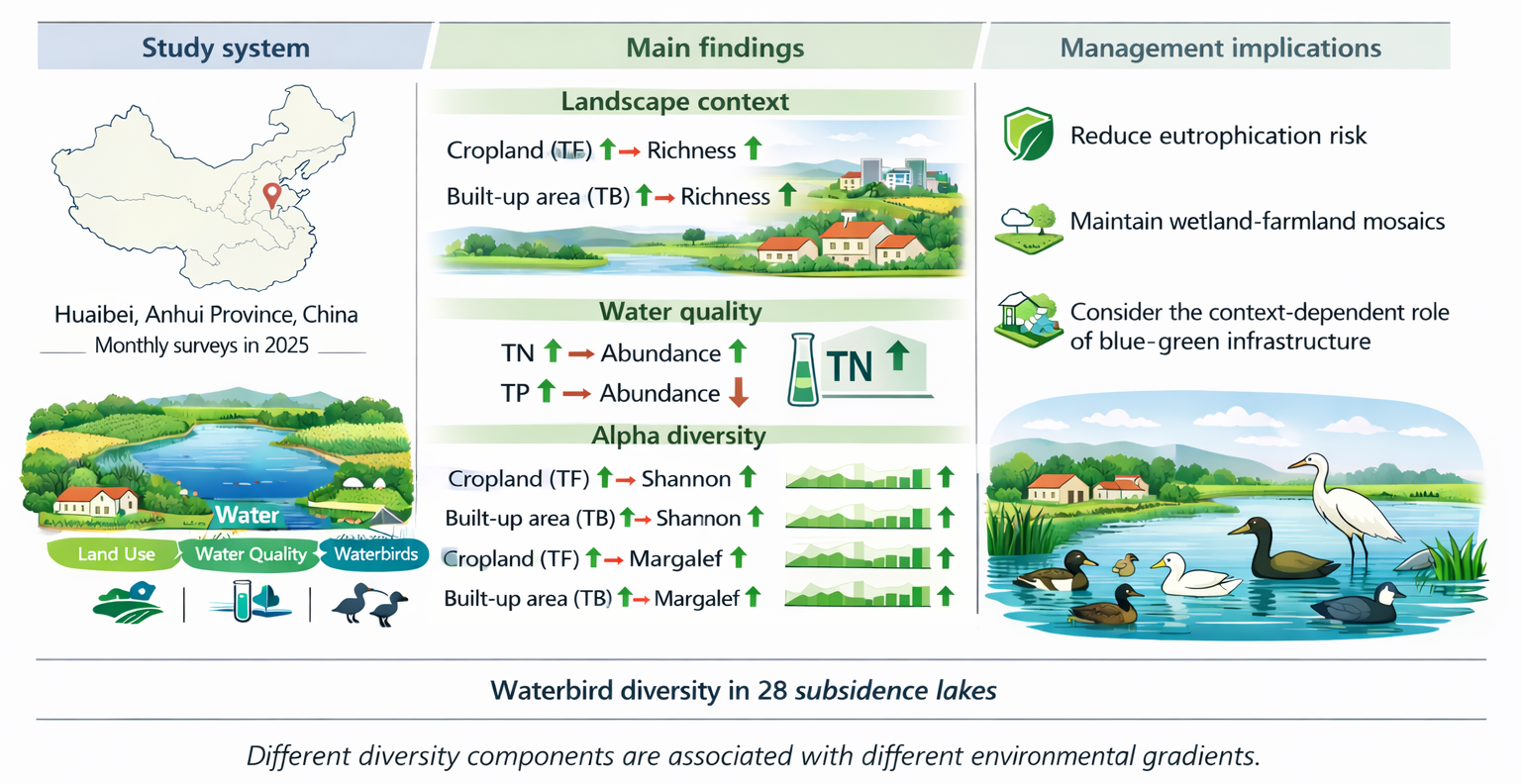
Coal-mining subsidence lakes are an expanding artificial wetland type in China, yet the relationships between waterbird diversity components and water-quality and landscape gradients remain unclear. We conducted monthly point-count surveys from January to December 2025 at 28 subsidence lakes in Huaibei, Anhui, China (lake area: 0.01–1.05 km2), and used generalized linear mixed models (GLMMs) to test relationships between waterbird diversity and water quality, lake morphology, landscape composition, and anthropogenic disturbance. Associations differed among diversity components. Species richness was positively associated with surrounding cropland and built-up area, whereas total abundance was positively associated with total nitrogen but negatively associated with total phosphorus, indicating that nutrient-related associations were not uniform across water-quality variables. Both Shannon and Margalef diversity were positively associated with surrounding cropland and also showed positive, context-dependent associations with built-up area. These findings suggest that different components of waterbird diversity were associated with different environmental gradients, with landscape context more strongly associated with richness and diversity indices, whereas water-quality gradients were more strongly associated with abundance. Conserving waterbird diversity in subsidence lakes therefore requires attention not only to nutrient conditions within lakes, but also to the surrounding wetland–farmland landscape context.

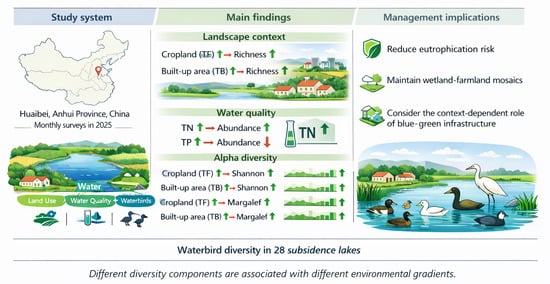
Graphical Abstract

1. Introduction

Natural wetlands have undergone widespread degradation and loss worldwide. Over the past century, more than half of their global extent has disappeared, and from 1970 to 2015, wetland extent declined by about 35% relative to 1970 levels [1,2]. In China, rapid development and land-use change have contributed to substantial wetland loss and degradation over the past 50 years, including reported losses of 23.0% of freshwater swamps and 51.2% of coastal wetlands [3]. Such degradation undermines key ecosystem services and places increasing pressure on wetland-dependent fauna, including waterbirds [4]. Because waterbirds are highly sensitive to water levels, food availability, and disturbance, waterbird assemblages are widely used as indicators of wetland ecological condition [5].
Coal-mining subsidence lakes are one of the rapidly expanding artificial wetland types in China and are receiving increasing attention as potential complementary habitats for waterbirds. More broadly, human-made waterbodies such as rice paddies, ponds, and reservoirs can provide breeding, stopover, and wintering habitats and are increasingly embedded within migratory networks [6,7,8,9,10]. Studies from different regions indicate that some artificial wetland types can provide complementary habitat and foraging opportunities for waterbirds under appropriate management conditions, although their capacity to offset natural wetland loss remains partial and context-dependent [6,7,10,11]. Among these systems, coal-mining subsidence lakes are distinctive because they are formed by underground mining followed by persistent inundation, creating permanent aquatic habitats within formerly terrestrial landscapes [12,13]. In Huaibei, on the North China Plain, long-term mining has produced numerous water-filled subsidence basins whose cumulative surface area exceeds 69 km2 [14]. These newly formed lakes may provide habitat opportunities for waterbirds in a region where natural wetlands are scarce, but they are also characterized by hydrological alteration, variable water chemistry, and continuing human disturbance [15,16].
Despite growing interest in waterbird use of subsidence lakes, previous studies have mostly focused on particular environmental correlates, such as lake area, spatial isolation, landscape context, or direct disturbance, rather than evaluating whether environmental domains operating at different ecological scales are associated with different components of waterbird diversity [12,17]. More importantly, these variables have rarely been considered within a unified multi-scale framework. In subsidence lakes, in-lake conditions characterize habitat conditions at the waterbody scale, whereas surrounding landscape context and anthropogenic disturbance may shape habitat accessibility, resource complementarity, and redistribution processes at broader spatial scales. Because species richness, total abundance, and community evenness represent different dimensions of assemblage structure, they may not respond uniformly to these environmental domains. Although some studies have adopted multi-metric or multi-dimensional approaches to waterbird assemblages, such frameworks remain uncommon in subsidence-lake systems and are rarely used to ask whether different environmental domains are associated with different diversity components [10,12,17]. A clearer conceptual framework is therefore needed to evaluate how environmental domains operating at different ecological scales are associated with different components of waterbird diversity in subsidence lakes.
At the in-lake scale, water quality may be associated with waterbird assemblages because it reflects local habitat conditions relevant to foraging, resting, and site use [9,10]. Nutrient-related variation may be associated with broader changes in productivity, turbidity, oxygen conditions, prey resources, and habitat structure within lakes [18,19], whereas pH may covary with wider in-lake chemical conditions and eutrophication dynamics, with potential implications for aquatic prey communities [20,21]. In this study, however, we do not attempt to resolve these mechanistic pathways directly; instead, we treat total nitrogen (TN), total phosphorus (TP), dissolved oxygen (DO), and pH primarily as integrative indicators of in-lake habitat conditions. At the surrounding landscape scale, cropland and built-up land may also be associated with waterbird assemblages through differences in habitat accessibility, resource complementarity, and local disturbance context [6,7,22]. Considering these predictors together may therefore clarify whether different components of waterbird diversity are associated with different environmental domains in subsidence lakes.
In this study, we conducted monthly surveys at 28 coal-mining subsidence lakes in Huaibei, Anhui, China, from January to December 2025. This study aimed to evaluate how environmental domains operating at different ecological scales are associated with multiple components of waterbird diversity in subsidence lakes. Specifically, we examined how water quality, lake morphology, landscape context, and anthropogenic disturbance were associated with species richness, total abundance, and α-diversity indices, and whether the dominant associations differed among diversity components, particularly between species richness and total abundance. Our study provides baseline evidence for understanding how subsidence lakes function as waterbird habitats in human-dominated landscapes and may inform conservation planning and management of these rapidly expanding artificial wetlands.

2. Materials and Methods

2.1. Study Area

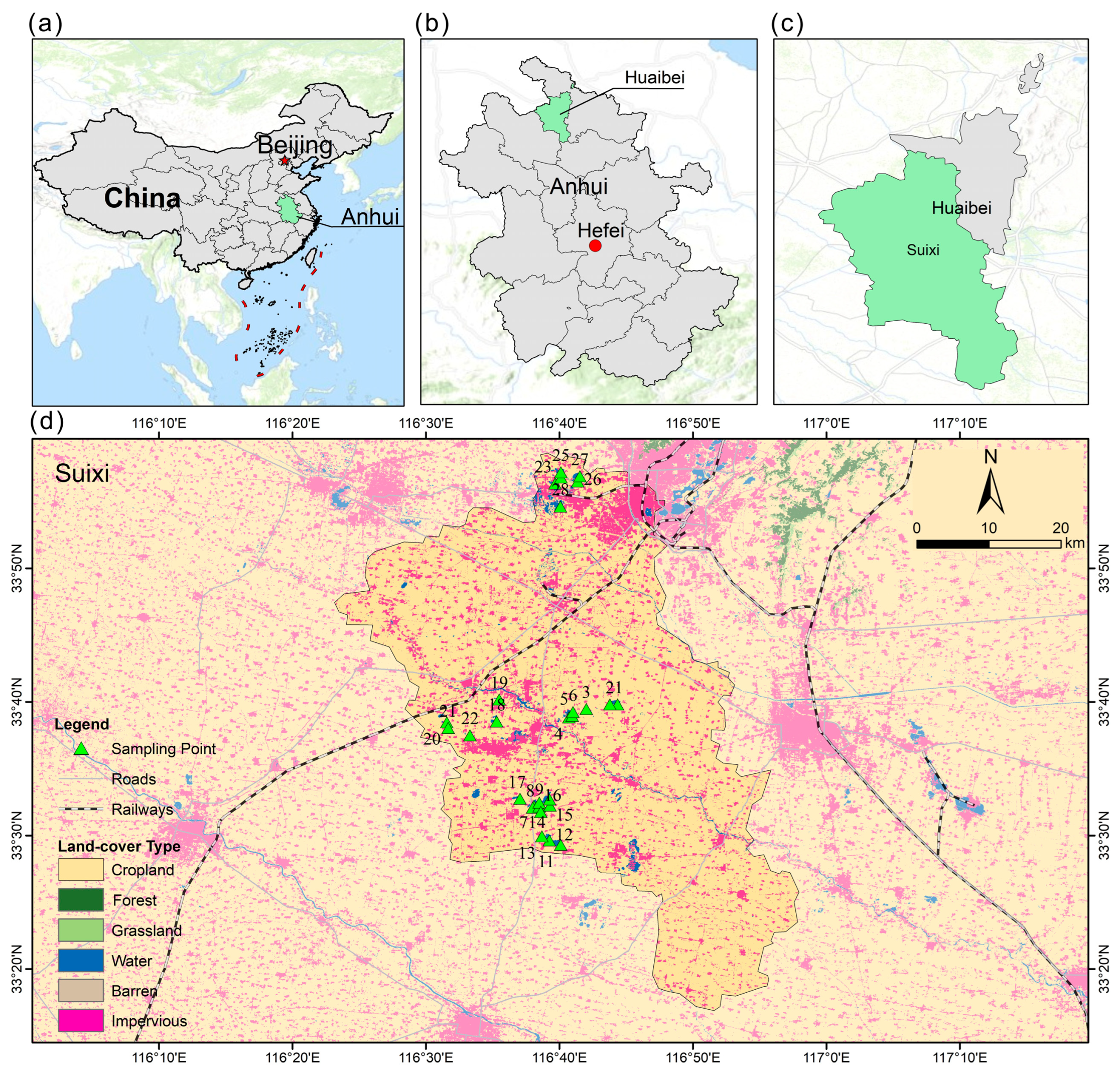
This study was conducted in Huaibei City, Anhui Province, China (116°23′–117°23′ E, 33°16′–34°14′ N), on the Huaibei Plain north of the Huai River (Figure 1). The landscape is dominated by fluvial–alluvial plains interspersed with low hills and depressions. The region has a warm-temperate, semi-humid monsoonal climate, with a mean annual temperature of 14.5 °C and mean annual precipitation of 870 mm, most of which falls in summer. Surface hydrology is relatively well developed, and shallow groundwater typically occurs at depths of 2–3 m [23].
Prolonged underground coal mining has caused extensive land subsidence in the region. By the end of 2022, the cumulative subsidence area in Huaibei had reached 279.54 km2, and more than half had become persistently inundated because of high groundwater tables, forming newly created subsidence lakes [24,25]. These waterbodies exhibit key wetland characteristics and now constitute an important component of the regional artificial-wetland network. Because Huaibei lies along the mid-section of the East Asian–Australasian Flyway (EAAF), subsidence lakes may provide alternative habitats for migratory waterbirds amid the ongoing loss of natural wetlands [26,27].
The surveyed lakes were embedded in a heterogeneous human-modified landscape dominated by cropland, with smaller areas of built-up land and open water in the surrounding matrix. Shoreline habitats varied among lakes and typically included open-water margins, exposed muddy banks, herbaceous edges, and adjacent farmland or built-up land.

2.2. Bird Surveys

We conducted monthly waterbird surveys from January to December 2025 at 28 coal-mining subsidence lakes in Huaibei, Anhui, China, using the point-count method. At each lake, we established one to three fixed vantage points to cover open-water and shoreline habitats according to lake area, shoreline accessibility, and shape complexity. Vantage points were selected to maximize visibility across the focal lake and its accessible shoreline zones, and additional points were used where a single location was insufficient because of lake size or irregular shape. Observers conducted 15 min visual counts at each point using binoculars (USCAMEL UW077, Guangzhou Wenmai Trading Co., Ltd., Guangzhou, China; 8 × 42) and a spotting scope (Celestron C100B, Celestron, Torrance, CA, USA; 22–66 × 100 mm). For all lakes, the selected vantage points were intended to provide broad visual coverage of the observable water surface and shoreline habitat during each survey, so as to record as completely as possible the waterbirds present within view. The effective observation radius at each point was ≤1 km. Vantage points were spaced to avoid overlapping fields of view, and movements of visible flocks were tracked and cross-checked to minimize double counting. When flocks moved between adjacent vantage points during the same lake survey, cross-checking was based on flock size, species composition, movement direction, and timing; in uncertain cases, birds were counted conservatively only once. We acknowledge that detection probability may still vary among lakes and survey conditions, particularly for abundance estimates. To improve comparability, surveys were conducted once per month (12 rounds in total) under fair weather and low-wind conditions (Beaufort scale ≤ 3). When weather conditions were unsuitable on the planned survey date, the survey was rescheduled to the nearest suitable day within the same month, and no monthly survey rounds were missed during the study period. All surveys were conducted by the same observer throughout the study, following a consistent field protocol. Direct individual counts were used for flocks of fewer than 100 individuals. For aggregations of 100 individuals or more, abundance was estimated by dividing the flock into visually distinguishable subgroups, typically in units of about 10 individuals, and summing subgroup counts across repeated scans. The same visual point-count protocol was applied across all recorded waterbird species, but the observer adjusted the pace and scan sequence according to flock dispersion, body size, and whether birds occurred mainly as dispersed individuals, mixed-species groups, or dense aggregations. Large-bodied and widely spaced birds were usually counted individually, whereas small-bodied or tightly aggregated birds were counted using repeated subgroup scans. Taxonomy followed the IOC World Bird List (version 15.1) [28], and “waterbirds” were defined according to the Ramsar Convention.

2.3. Measurement of Environmental Variables

We compiled 11 environmental variables for 28 subsidence lakes (Table 1). These variables included morphometric variables, namely lake area (AL, km2), shoreline length (PL, km), and shape index (SI, unitless), which describes the relationship between shoreline length and lake area; water-quality variables, including dissolved oxygen (DO, mg/L), pH, total nitrogen (TN, mg/L), and total phosphorus (TP, mg/L); landscape variables within a 1 km buffer, including total cropland (TF, km2), total built-up area (TB, km2), and total water area (TW, km2); and an anthropogenic disturbance variable, namely distance to the nearest major urban road (DR, km), measured as the shortest Euclidean distance from the lake shoreline.
Immediately after completing the bird counts at each lake, we conducted water-quality measurements and sampling. At a single suitable shoreline sampling location at each lake, observers measured DO and pH in situ using a portable multiparameter meter (WTW Multi 3630 Xylem Analytics Germany Sales GmbH & Co. KG, Weilheim, Germany). At the same location, a 500 mL surface-water sample was collected from 0.5 m below the water surface for laboratory analysis within 24 h. Sampling locations were selected to avoid obvious local disturbance sources and atypical microhabitats, such as shoreline pollution inputs, dense emergent vegetation, or areas immediately adjacent to inflow or outflow zones where present. Most subsidence lakes in the study area are relatively enclosed waterbodies without strong through-flow; accordingly, these measurements were used as standardized indicators of local nearshore conditions at the time of survey. TN was determined using alkaline persulfate digestion followed by ultraviolet spectrophotometry [29], and TP was determined using persulfate digestion followed by ammonium molybdate spectrophotometry with ascorbic acid reduction [30]. Nevertheless, we treated these measurements as point-based indicators of local nearshore conditions rather than complete representations of whole-lake water quality. Because only one shoreline sampling point was used per lake per survey, within-lake spatial heterogeneity was not quantified, and this limitation should be considered when interpreting the observed associations with waterbird diversity.
Morphometric and buffer-zone landscape variables were derived from the Esri/Impact Observatory Sentinel-2 10 m Land Use/Land Cover Time Series product [31]. In the present study, these landscape variables were treated as annual indicators of the surrounding habitat context rather than month-specific predictors, to match the annual-scale analysis framework used here. Land-cover data were classified to extract cropland, built-up, and water areas within a 1 km buffer around each lake polygon constructed in the Universal Transverse Mercator (UTM) projection. In the land-cover classification, “barren land” denotes sparsely vegetated or unvegetated surfaces (e.g., exposed soil or bare substrate), whereas “impervious surfaces” denote artificial sealed surfaces associated with roads, buildings, and other constructed infrastructure. We selected a 1 km buffer to characterize the immediate landscape context surrounding each focal lake because this scale broadly corresponded to the local observation extent of our field surveys and captured adjacent land-cover features most likely to influence observed waterbird use. This buffer was not intended to represent the full movement range of all waterbird species, but rather to provide a standardized local-scale measure of surrounding habitat context. Road vectors were obtained from OpenStreetMap and filtered by highway class (primary, primary_link, secondary, and secondary_link) to derive road-related metrics [32]. Area and distance calculations were performed in WGS 84/UTM Zone 50N (EPSG:32650). All geographic information system (GIS) processing was conducted in ArcGIS Pro 3.0 (Esri, Redlands, CA, USA).

2.4. Statistical Analyses

We evaluated the effects of environmental predictors on waterbird diversity using generalized linear mixed models (GLMMs) with random intercepts for lake identity and month to account for repeated surveys, broad temporal variation across the annual cycle, and the hierarchical design. This specification was intended to account statistically for repeated temporal structure across months, but it was not designed to replace an explicit ecological analysis of seasonal dynamics. Continuous predictors were Z-standardized to facilitate effect-size comparison. Multicollinearity was assessed using a stepwise variance inflation factor (VIF) procedure, and shoreline length (PL) was sequentially removed because its VIF exceeded 10. Extreme response values were removed based on the 1.5 × interquartile range (IQR) criterion to reduce the undue influence of outliers [33]. In addition, as a sensitivity check, we examined whether the number of vantage points per lake was associated with sample-level richness and abundance using Spearman rank correlations. The sensitivity check indicated no significant association of point number with either richness or abundance. As an exploratory sensitivity check, we calculated Moran’s I for spatial autocorrelation diagnostics under a k-nearest-neighbor spatial weighting scheme (k = 4), and checked robustness across alternative neighbor definitions (k = 3–6; Table S8). These analyses were used as supplementary diagnostics and did not alter the main model structure.
Species richness was modeled using a Poisson GLMM, and total abundance was modeled using a negative binomial type 2 (NB2) GLMM. Alternative count models, including nbinom1 and zero-inflated Poisson and NB2 models, were also assessed for robustness. Shannon and Margalef indices were modeled using Gaussian GLMMs, whereas Pielou’s evenness was modeled using a beta GLMM with a logit link after nudging 0 and 1 values to the open interval (0.01, 0.99). Fixed effects were consistent across all models and comprised 10 predictors: AL, SI, DO, pH, TN, TP, TF, TB, TW, and DR.
Model diagnostics followed the DHARMa framework and included randomized quantile residual tests for uniformity, dispersion tests, and, for count models only, zero-inflation tests. Diagnostic plots of Pearson residuals versus fitted values were also inspected. Model fit was summarized using marginal and conditional R2 following previous recommendations [34,35]. Fixed-effect significance was evaluated primarily using likelihood-ratio tests (LRTs), with Wald statistics reported as supplementary evidence. Significant predictors (two-sided tests, α = 0.05) were visualized using forest plots of fixed-effect estimates and marginal-effect plots with 95% confidence bands. For visualization of significant predictors, 95% confidence bands for fixed-effect predictions were calculated on the link scale and then back-transformed to the response scale. The resulting fitted curves and confidence bands were plotted against the observed values in the original measurement units.
Full model outputs and diagnostic checks are provided in the Supplementary Material. Fixed-effect estimates for all GLMMs are reported in Tables S1–S4, model-fit metrics (marginal and conditional R2) are summarized in Table S5, and a complete species checklist with International Union for Conservation of Nature (IUCN) categories is provided in Table S6, lake-level occurrence of globally threatened and Near-Threatened species is summarized in Table S7, spatial autocorrelation sensitivity results are provided in Table S8, and representative landscape photographs are shown in Figure S1. All analyses were conducted in R 4.5.2 using the packages glmmTMB, DHARMa, performance, car, ggeffects, and ggplot2 [36,37,38].

3. Results

3.1. Waterbird Community Composition

From January to December 2025, we recorded more than 40,000 waterbird individuals, representing 49 species, 10 families, and 6 orders. The most species-rich families were Anatidae (17 species) and Scolopacidae (9 species). Two numerically dominant species, Falcated Duck (Mareca falcata (Georgi, 1775), 59%) and Eurasian Coot (Fulica atra, Linnaeus, 1758, 14%), together accounted for 73% of all individuals, whereas no other single species exceeded 10%.
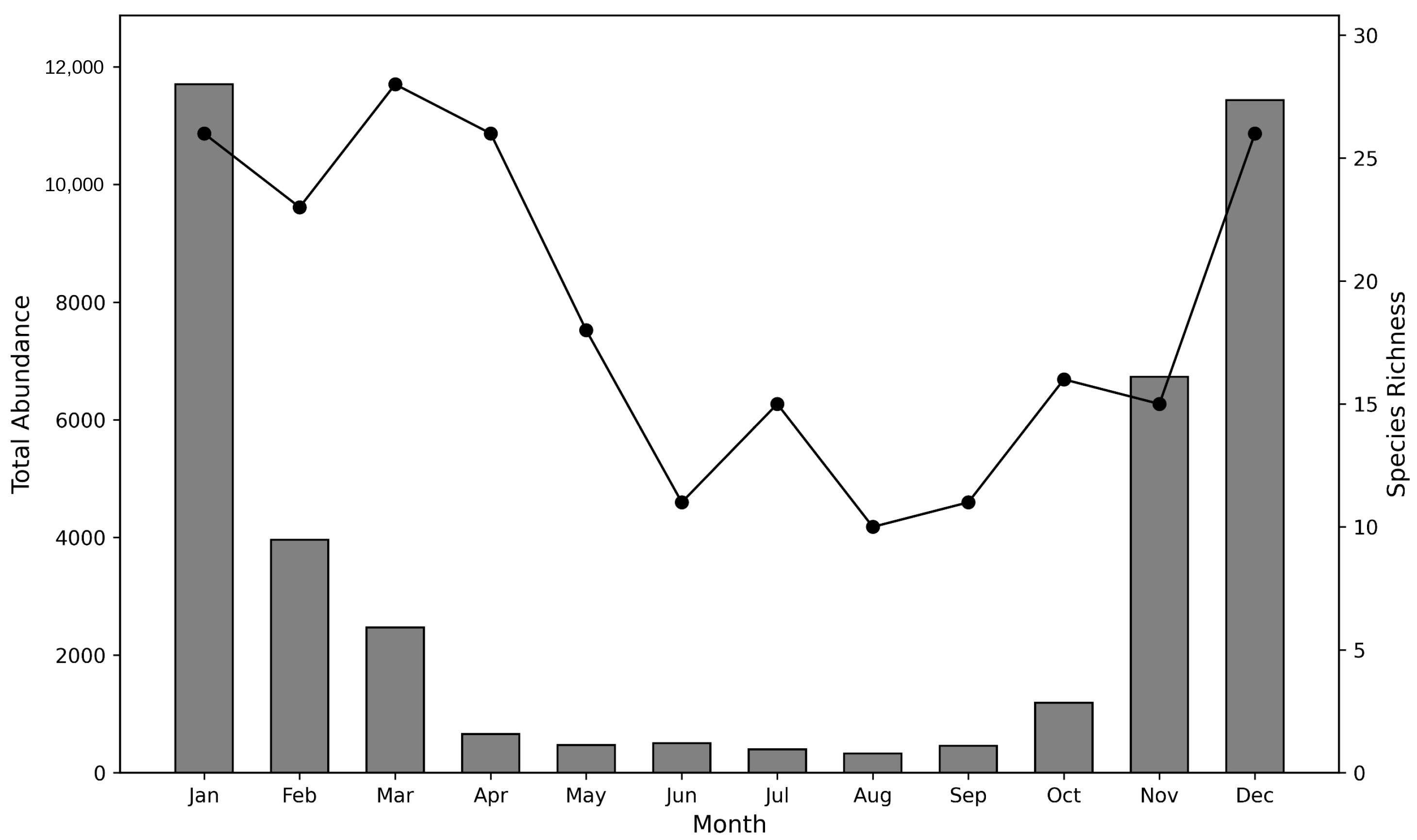
Across the 12 monthly censuses pooled over all lakes, mean ± standard deviation (SD) totals were 3359 ± 4288 individuals per census (range 328–11,703) and 23.3 ± 2.93 species (range 19–28), indicating marked seasonality. Total abundance peaked in January (11,703 individuals) and December (11,435 individuals), declined through spring and summer to a minimum in August (328 individuals), and then increased in autumn. Species richness remained relatively high from January to April, decreased in summer, and showed minor fluctuations in late autumn and early winter (Figure 2). This pattern likely reflects pronounced seasonal turnover in lake use across the annual cycle, with greater use during winter and migratory periods and reduced use during summer.
Six recorded species were classified as globally threatened or Near-Threatened on the IUCN Red List of Threatened Species (version 2025-2) [39]: Ferruginous Duck (Aythya nyroca, (Güldenstädt, 1770), NT, 2 individuals), Baer’s Pochard (Aythya baeri, Radde, 1863, CR, 2), Swan Goose (Anser cygnoides, (Linnaeus, 1758), EN, 3), Common Pochard (Aythya ferina, (Linnaeus, 1758), VU, 1), Northern Lapwing (Vanellus vanellus, (Linnaeus, 1758), NT, 8) and Dunlin (Calidris alpina, (Linnaeus, 1758), NT, 2). These records highlight the conservation value of coal-mining subsidence lakes in Huaibei.

3.2. Environmental Variables

Basin morphology varied considerably among study lakes, although most were relatively small in area (AL: 0.01–1.05 km2; mean ± SD = 0.18 ± 0.26) and irregular in shape (SI: 1.16–2.35; 1.63 ± 0.29). Water chemistry also showed clear variation, with pH ranging from 7.71 to 9.21 (8.38 ± 0.23), TN from 0.18 to 5.10 mg/L (1.82 ± 1.01), and TP from 0.02 to 0.84 mg/L (0.15 ± 0.13). Within 1 km buffers, cropland was the dominant land-cover type (TF: 2.40–6.40 km2; 3.60 ± 0.95), whereas built-up area (TB: 0.04–1.57 km2; 0.35 ± 0.32), open-water cover (TW: 0.01–1.24 km2; 0.34 ± 0.24), and distance to major roads (DR: 0.01–3.66 km; 1.03 ± 0.95) also varied markedly among lakes (Table 1).

3.3. Effects of Environmental Factors on Waterbird Diversity

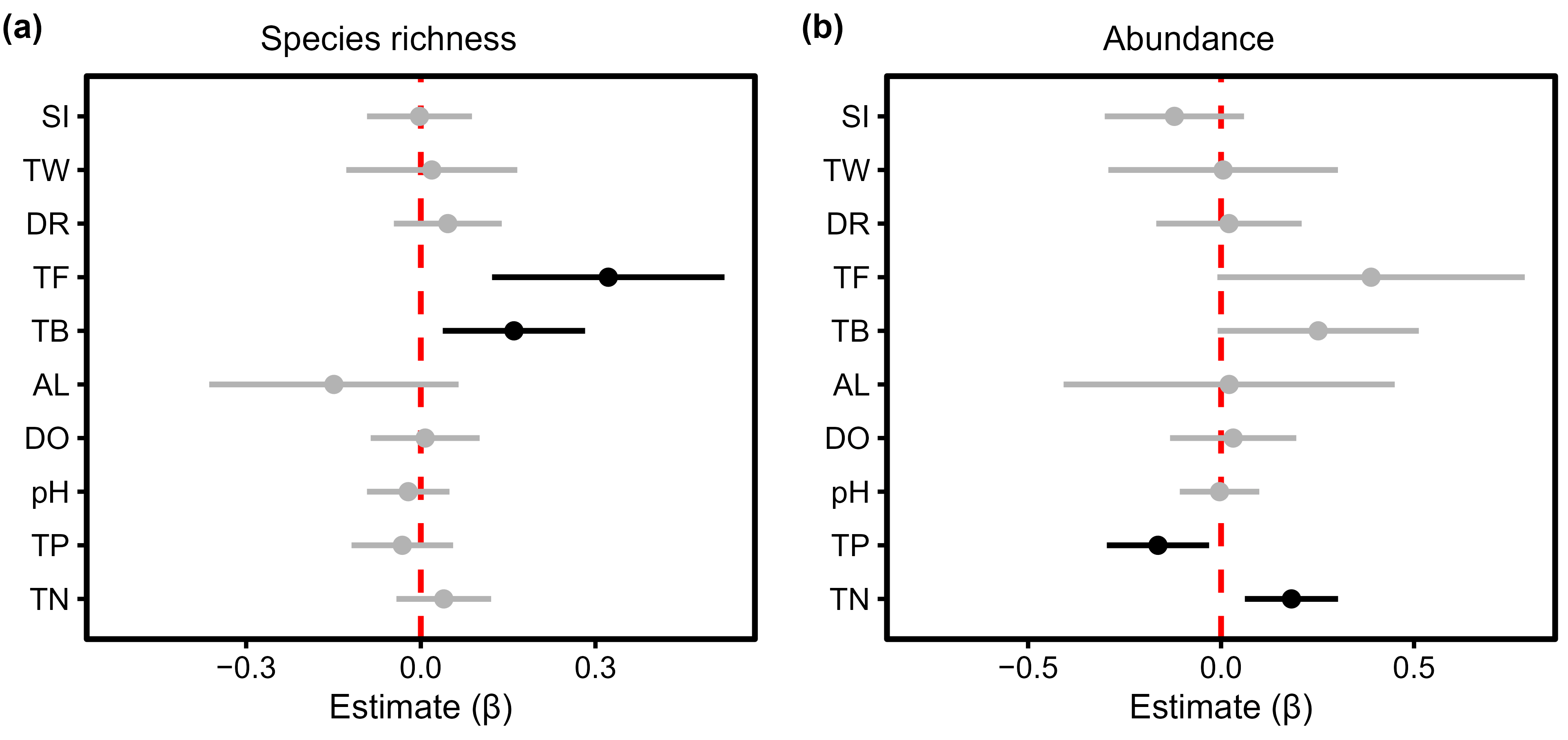
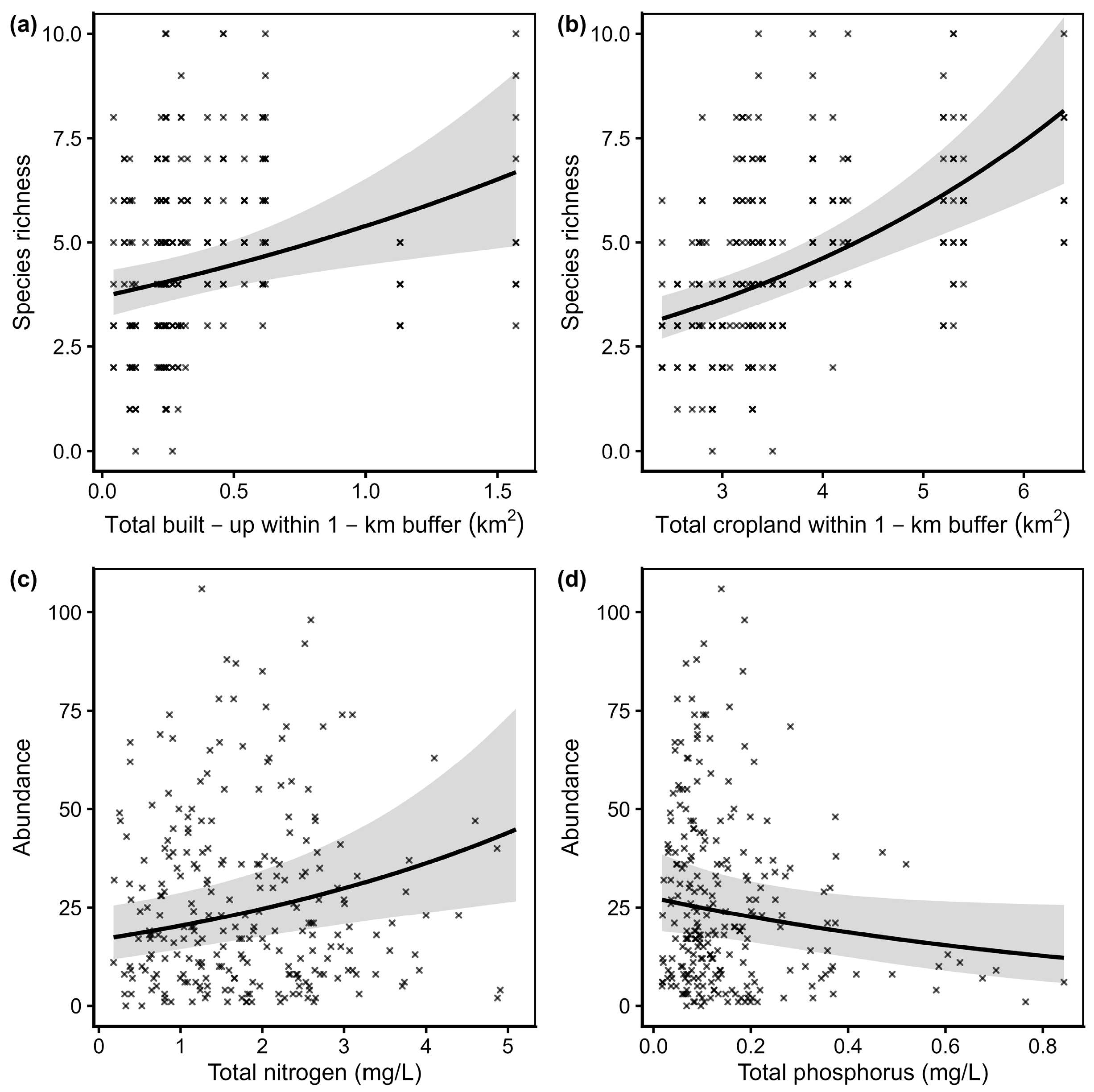
Significant predictors differed between species richness and abundance (Figure 3 and Figure 4; Table S1). Species richness increased with TF (p = 0.002) and TB (p = 0.010), and these two landscape variables were the only significant predictors retained in the richness model, whereas the remaining predictors were not significant (Figure 3a; Table S1). The fitted partial-effect curves showed monotonic increases in expected richness with both TB and TF across the observed ranges (Figure 4a,b).
Abundance showed a different pattern, increasing with TN (p = 0.003) and decreasing with TP (p = 0.018), whereas the remaining predictors were not significant (Figure 3b; Table S1). Within the same annual abundance model, TN and TP were retained as independent predictors and showed opposite associations with total abundance. The fitted curves were consistent with these effects, with abundance increasing along the TN gradient and decreasing along the TP gradient (Figure 4c,d). Model fit was marginal R2 (R2m) = 0.202 and conditional R2 (R2c) = 0.320 for richness, and R2m = 0.269 and R2c = 0.612 for abundance (Table S5).
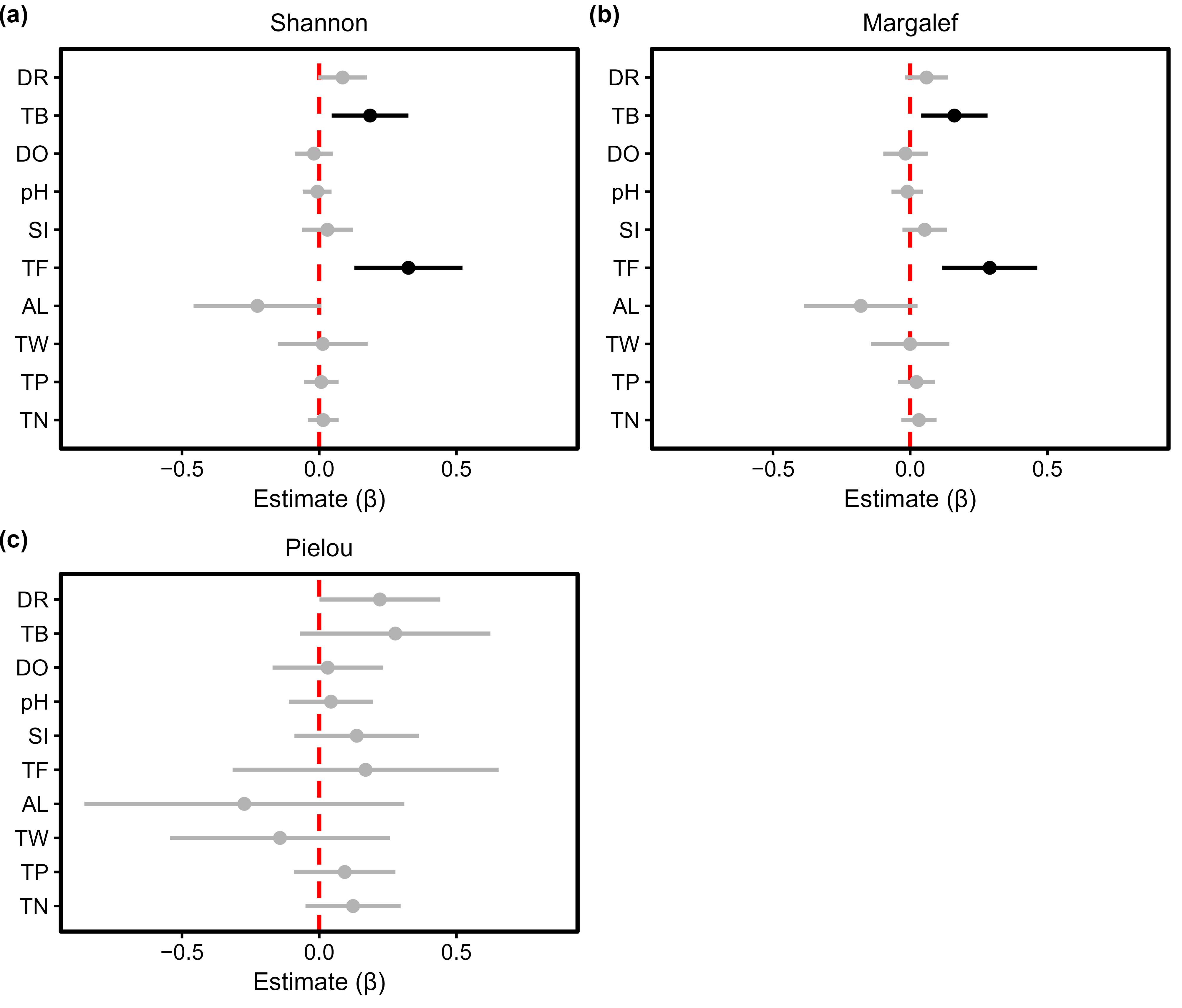
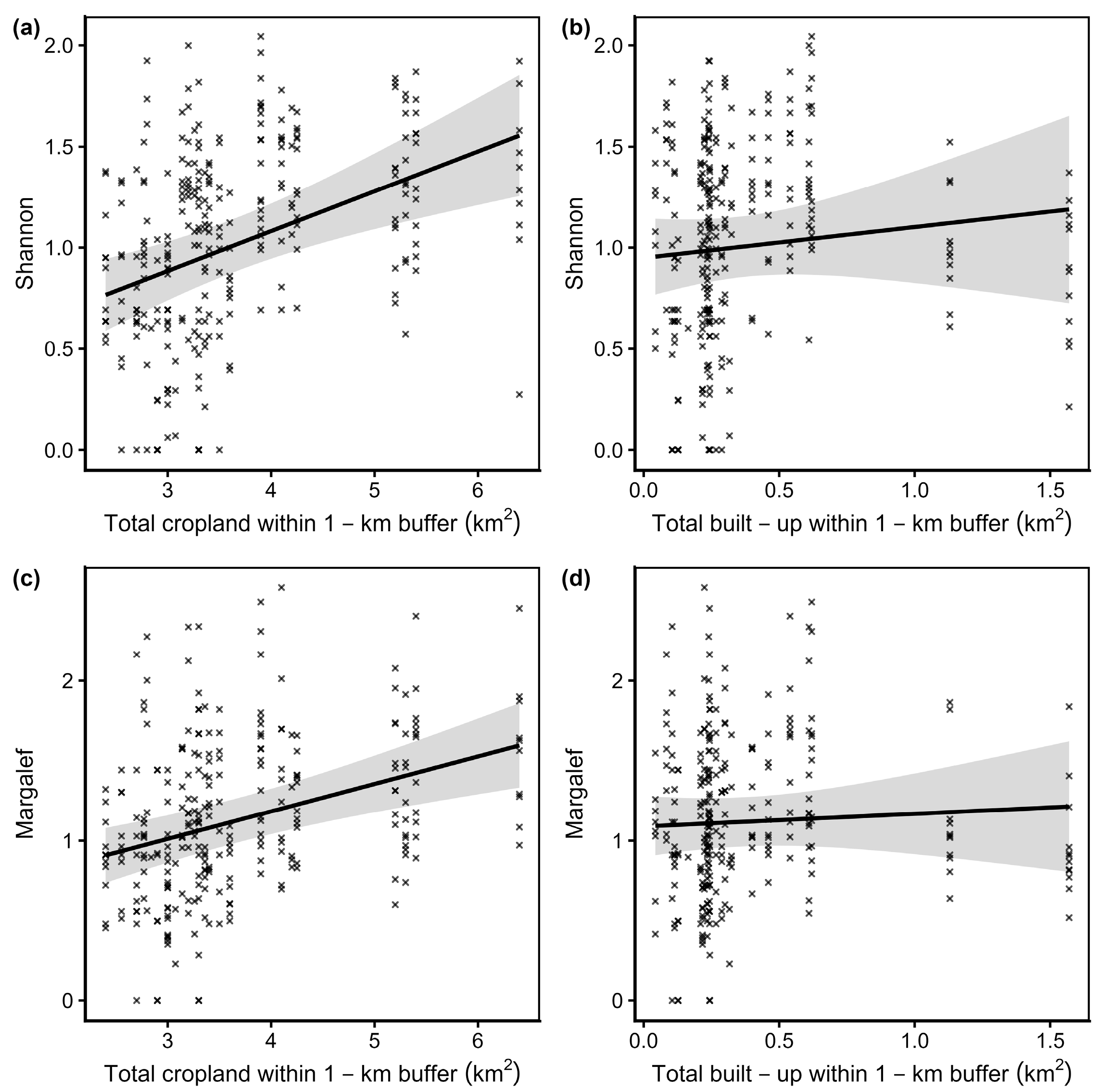
For α-diversity, significant effects were detected only for the landscape variables TF and TB, whereas no water-quality variable showed a significant association with Shannon diversity, Margalef diversity, or Pielou’s evenness (Figure 5 and Figure 6; Tables S2–S4). Shannon diversity increased with total cropland within a 1 km buffer (TF; p = 0.003) and total built-up area within a 1 km buffer (TB; p = 0.013), whereas the remaining predictors were not significant (Figure 5a; Table S2). The fitted partial-effect curves likewise showed consistent positive relationships of Shannon diversity with both TF and TB across the observed gradients, with predicted values increasing progressively from lower to higher levels of surrounding cropland and built-up area (Figure 6a,b). The Shannon model had marginal R2 (R2m) = 0.219 and conditional R2 (R2c) = 0.468 (Table S5). Margalef diversity showed a similar pattern, increasing with TF (p = 0.003) and TB (p = 0.014), whereas the remaining predictors were not significant (Figure 5b; Table S3). The fitted curves also indicated positive responses of Margalef diversity to both landscape variables (Figure 6c,d). The Margalef model had R2m = 0.176 and R2c = 0.399 (Table S5). For Pielou’s evenness, none of the predictors showed significant effects (all p > 0.05; Figure 5c; Table S4), indicating that evenness did not vary systematically along the measured environmental gradients. The Pielou model had R2m = 0.204 and R2c = 0.686 (Table S5).
Across all models, marginal R2 ranged from 0.176 to 0.269, whereas conditional R2 ranged from 0.320 to 0.686 (Table S5).

4. Discussion

A central finding of this study is the clear separation between the environmental correlates of species richness and total abundance in newly formed coal-mining subsidence lakes. Species richness was positively associated with total cropland within a 1 km buffer (TF) and total built-up area within a 1 km buffer (TB), whereas total abundance was positively associated with total nitrogen (TN) and decreased with total phosphorus (TP). These contrasting associations suggest that species richness may be more strongly associated with landscape-scale habitat complementarity and heterogeneity, whereas the observed abundance pattern—strongly shaped by the numerical dominance of Falcated Duck and Eurasian Coot—may be more closely associated with local water-quality conditions. Accordingly, abundance in this study likely reflects variation in the aggregation of dominant species more than a uniform response across the full waterbird community, and therefore does not necessarily indicate higher ecological integrity [10]. Such associations between waterbirds and nutrient-related conditions have been reported in other wetland systems, yet eutrophication may also simplify communities and amplify dominance by a few taxa. Therefore, management actions aimed solely at increasing abundance may conflict with conservation goals focused on richness and community balance and should be evaluated using multiple diversity metrics [10,40].
The positive relationship between TF and species richness is consistent with previous studies suggesting that agricultural landscapes may provide complementary foraging and roosting opportunities through irrigation networks, ephemeral flooded patches, and wetland–farmland ecotones, thereby expanding niche space at the landscape scale [6,7,41]. Similarly, the positive association between TB and richness is counterintuitive, because urbanization is often associated with habitat loss, disturbance, and biotic homogenization. In our study system, however, TB may not simply represent urban pressure per se. Instead, it may partly reflect local landscape configurations in which built-up land co-occurs with managed shorelines, retention ponds, drainage canals, and other forms of blue–green infrastructure that may increase habitat heterogeneity, edge availability, and connectivity around subsidence lakes [22,42]. In addition, lakes near built-up areas may differ in shoreline accessibility, visibility, or management intensity, and TB may therefore covary with unmeasured habitat attributes rather than directly benefiting waterbirds. We therefore interpret this result cautiously as a context-dependent association, not as evidence that urbanization generally promotes waterbird diversity. More generally, these findings are consistent with the view that anthropogenically modified water bodies can have ecological importance in human-dominated landscapes [43,44].
Total abundance responded to water-quality variables rather than to landscape structure. However, this pattern should be interpreted in light of the strong dominance structure of the assemblage: Falcated Duck and Eurasian Coot together accounted for 73% of all recorded individuals. Accordingly, the associations of abundance with TN and TP likely reflect, to a substantial extent, aggregation responses of these numerically dominant species rather than a uniform response across the full waterbird community. The opposite associations of TN and TP with abundance indicate that the relationships between abundance and nutrient conditions were more complex than a single directional effect. Because nitrogen and phosphorus are often ecologically interrelated components of eutrophication processes, their effects should not be interpreted as fully independent pathways. In the present model, the coefficients for TN and TP represent conditional associations after accounting for each other, rather than isolated nutrient effects. More broadly, waterbird responses may depend not only on the absolute concentrations of TN and TP, but also on their joint balance and covariation with other unmeasured limnological conditions. Given that mechanistic variables related to productivity, turbidity, prey availability, and habitat structure were not directly measured, the following ecological interpretations should be regarded as possible explanations rather than demonstrated mechanisms. TN may be associated with broader local conditions potentially linked to productivity or organic inputs [40]. In contrast, higher TP within the observed range was associated with lower abundance and may be consistent with poorer habitat conditions, potentially including reduced water clarity or other changes that could be unfavorable to foraging and habitat use [45,46]. At the same time, these abundance–nutrient relationships may also partly reflect ecological feedbacks in the opposite direction, because high-density waterbird aggregations can themselves contribute nutrient inputs to local water conditions [40]. The observed associations should therefore be interpreted as potentially bidirectional rather than as one-way environmental effects. These nutrient-related associations should also be interpreted in light of the point-based nature of the water-quality measurements, because a single shoreline sample may not fully represent spatially heterogeneous conditions across the entire lake. Thus, higher total abundance in this system should not be interpreted straightforwardly as greater community diversity or conservation value, because it may primarily capture the numerical concentration of a few common taxa. These interpretations should be treated as tentative hypotheses rather than demonstrated mechanisms, because key variables such as prey availability, aquatic vegetation, water transparency, and chlorophyll-a were not measured.
The α-diversity results generally paralleled the richness pattern, with Shannon and Margalef diversity showing positive associations with TF and TB, whereas Pielou’s evenness showed no significant associations. These patterns suggest that surrounding landscape context may be associated not only with species numbers but also with broader taxonomic diversity, although these relationships should be interpreted as context-dependent rather than generally positive effects of cropland or built-up land [6,7,22,41,42]. In contrast, Pielou’s evenness showed no significant relationships with the predictors considered, indicating that although landscape context may be associated with the occurrence of more species, it does not necessarily correspond to a more even distribution of individuals among species [10].
The subsidence lakes examined here supported multiple threatened or near-threatened waterbird species, underscoring their potential role within regional wetland networks [12,17]. This conservation significance is consistent with findings from other wetland systems in China and elsewhere showing that artificial or human-modified wetlands can provide important complementary habitat for waterbirds, although their community value may differ from that of natural wetlands. For example, studies in the Yellow River Delta found that migratory and wintering waterbirds made substantial use of artificial habitats, including aquaculture ponds, paddy fields, irrigation canals, reservoirs, and saltpans, even though natural wetlands generally supported higher bird-community indicators. Similar patterns have also been reported from artificial wetlands in other countries, where some human-made wetlands supported bird communities of considerable diversity despite differing from nearby natural wetlands [43,47]. Given continuing losses of key staging habitats along the East Asian–Australasian Flyway (EAAF), inland artificial wetlands may become increasingly important for waterbird conservation [26]. At the same time, our results also indicate that no single environmental dimension adequately captures habitat quality across all components of waterbird diversity. Species richness and α-diversity were more strongly associated with landscape context, whereas total abundance was more closely related to nutrient conditions. Moreover, abundance alone may largely reflect the concentration of a few dominant taxa. Conservation planning for subsidence lakes should therefore avoid relying on single metrics or single-factor management targets, and may benefit from jointly considering nutrient conditions, wetland–farmland heterogeneity, and the context-dependent role of surrounding blue–green infrastructure.
Several limitations should also be acknowledged. First, water-quality variables were measured from a single nearshore sampling point at each lake during each survey and therefore may not adequately represent whole-lake conditions. Because within-lake spatial heterogeneity was not quantified, substantial measurement error is possible. Accordingly, associations involving water-quality predictors should be interpreted cautiously as relationships with local nearshore conditions rather than as robust evidence of whole-lake water-quality effects. This limitation weakens the strength of inference for conclusions involving water-quality variables. Second, Figure 2 reveals pronounced seasonal variation in abundance and species richness across the annual cycle. We agree that including month as a random effect accounts statistically for repeated temporal structure, but does not by itself resolve the ecological role of seasonality. In our study system, the winter peaks in abundance and the relatively high richness from winter to early spring likely reflect the influx of migratory and wintering waterbirds, whereas the summer decline likely reflects seasonal departure or redistribution of many taxa. Accordingly, the annual GLMM coefficients reported here should be interpreted as average associations across periods with different community composition and intensity of lake use, rather than as season-invariant relationships. Environmental associations may therefore differ among seasons, because migration, overwintering use, and seasonal changes in habitat conditions may alter both species composition and habitat selection. Future analyses should explicitly test season × environment interactions or apply stratified seasonal analyses. Third, although lake identity and month were included as random intercepts to account for repeated observations and broad temporal variation, spatial autocorrelation among lakes was not explicitly modeled. As an exploratory sensitivity check, Moran’s I did not indicate significant spatial autocorrelation across alternative k-nearest-neighbor definitions (Table S8). Nevertheless, because spatial structure was not incorporated directly into the modeling framework, this issue should still be interpreted with caution, and future studies could evaluate spatially explicit modeling approaches more formally. Fourth, although TN and TP were included simultaneously as independent predictors in the annual models, we did not explicitly test nutrient interaction terms or other formulations that capture their ecological interdependence, such as nutrient balance or ratio effects. Therefore, the present results should not be interpreted as evidence for a combined TN–TP effect or as proof that TN and TP act through fully separate ecological pathways. Additional mechanistic covariates, such as prey biomass, macrophyte cover, Secchi depth, chlorophyll-a, water level, and quantified disturbance, are needed to better evaluate whether TN and TP may operate primarily through productivity, turbidity, or habitat-structure pathways. Fifth, the effects of TF and TB should be examined across multiple buffer sizes and land-use intensity metrics to distinguish true habitat complementarity from disturbance-driven homogenization [6,42]. In addition, surrounding land-cover variables were treated as annual rather than month-specific predictors. Therefore, finer temporal variation in landscape context during the survey period was not incorporated and should be considered in future time-matched analyses. Sixth, detection probability was not explicitly modeled. Although surveys followed a standardized protocol, visual counts across lakes differing in area, shoreline configuration, and visibility conditions may still have introduced heterogeneity in detectability. In particular, larger or more structurally complex lakes, or lakes with less uniform shoreline visibility, may have been more prone to undercounting than smaller or more open lakes. Accordingly, the abundance-related relationships reported here should be interpreted cautiously as associations in observed counts rather than precise effects on absolute abundance. This issue may be more important for total abundance than for species richness, because imperfect detection can influence the number of individuals recorded even when conspicuous species are still detected. Future work should combine standardized surveys with explicit approaches to account for detectability, such as distance sampling, repeated-observer designs, or hierarchical models.

5. Conclusions

Coal-mining subsidence lakes in Huaibei supported substantial waterbird diversity, including several globally threatened or near-threatened species, highlighting their conservation value as rapidly expanding artificial wetlands. Our results suggest that species richness, Shannon diversity, and Margalef diversity may be more strongly associated with landscape context, whereas the observed abundance pattern—largely shaped by the numerical dominance of Falcated Duck and Eurasian Coot—may be more closely associated with nutrient conditions. Specifically, species richness was positively associated with total cropland within a 1 km buffer (TF; p = 0.002) and total built-up area within a 1 km buffer (TB; p = 0.010), whereas total abundance was positively associated with total nitrogen (TN; p = 0.003) but decreased with total phosphorus (TP; p = 0.018). Pielou’s evenness showed no significant relationships with the predictors considered. These results suggest that abundance alone may be insufficient for evaluating habitat quality in subsidence lakes, because the observed abundance pattern was strongly shaped by the numerical dominance of Falcated Duck and Eurasian Coot and may therefore reflect the concentration of a few common taxa rather than a community-wide response. Accordingly, conservation planning for multiple dimensions of waterbird diversity in subsidence lakes should consider both nutrient conditions and landscape context rather than relying on abundance as a single indicator. Further research is needed to identify suitable nutrient conditions and landscape configurations for supporting waterbird diversity while maintaining ecosystem integrity in subsidence lakes.

Supplementary Materials

The following supporting information can be downloaded at: https://www.mdpi.com/article/10.3390/d18040218/s1. Table S1: Fixed-effect estimates from generalized linear mixed models (GLMMs) for species richness (Poisson) and total abundance (Negative binomial, NB2); Table S2: Fixed-effect estimates from GLMM for Shannon diversity (Gaussian); Table S3: Fixed-effect estimates from GLMM for Margalef diversity (Gaussian); Table S4: Fixed-effect estimates from GLMM for Pielou’s evenness (Beta-logit); Table S5: Model fit summary for all GLMMs, including marginal R2 and conditional R2; Table S6: Checklist of 49 waterbird species recorded in coal-mining subsidence lakes of Huaibei City, with IUCN Red List category (2025); Table S7: Lake-level occurrence of globally threatened and Near-Threatened waterbird species recorded in coal-mining subsidence lakes of Huaibei City, with IUCN Red List category (2025-2); Table S8: Sensitivity analysis of spatial autocorrelation based on Moran’s I under different k-nearest-neighbor definitions; Figure S1: Representative landscape photographs of surveyed coal-mining subsidence lakes in Huaibei, China.

Author Contributions

Conceptualization, J.Z.; methodology, J.Z. and Z.S.; investigation, J.Z. and Z.S.; data curation, Z.S.; formal analysis, Z.S.; visualization, Z.S.; writing—original draft preparation, Z.S.; writing—review and editing, J.Z., Z.S. and Y.S. All authors have read and agreed to the published version of the manuscript.

Funding

This work was supported by the National Natural Science Foundation of China (NSFC; Grant No. 32471569).

Institutional Review Board Statement

Ethical review and approval were waived for this study because it was based exclusively on non-invasive field observations of wild birds, with no capture, handling, or experimental manipulation. All activities complied with relevant laws and site-access permissions in Huaibei City, China.

Data Availability Statement

All data supporting the findings of this study, including raw waterbird survey counts, lake-level characteristics of the surveyed lakes, environmental variables, and R scripts used for analyses, are publicly available in Zenodo at https://doi.org/10.5281/zenodo.19135410 (accessed on 20 March 2026). Researchers can access these datasets and scripts to reproduce the results reported in this manuscript.

Conflicts of Interest

The authors declare no conflicts of interest.

Abbreviations

ALlake area
DRdistance to the nearest major urban road
DOdissolved oxygen
EAAFEast Asian–Australasian Flyway
GLMMgeneralized linear mixed model
PLshoreline length
SIshape index
TBtotal built-up area within a 1 km buffer
TFtotal cropland within a 1 km buffer
TNtotal nitrogen
TPtotal phosphorus
TW
SD
NB2
total water area within a 1 km buffer
standard deviation
Negative binomial type 2

References

  1. Amano, T.; Székely, T.; Wauchope, H.S.; Sandel, B.; Nagy, S.; Mundkur, T.; Langendoen, T.; Blanco, D.; Michel, N.L.; Sutherland, W.J. Responses of global waterbird populations to climate change vary with latitude. Nat. Clim. Change 2020, 10, 959–964. [Google Scholar] [CrossRef]
  2. WWF. Living Planet Report 2020: Bending the Curve of Biodiversity Loss; WWF: Gland, Switzerland, 2020; Available online: https://wwfin.awsassets.panda.org/downloads/lpr_2020_full_report.pdf (accessed on 20 March 2026).
  3. An, S.; Li, H.; Guan, B.; Zhou, C.; Wang, Z.; Deng, Z.; Zhi, Y.; Liu, Y.; Xu, C.; Fang, S.; et al. China’s natural wetlands: Past problems, current status, and future challenges. Ambio 2007, 36, 335–342. [Google Scholar] [CrossRef] [PubMed]
  4. Butchart, S.H.M.; Walpole, M.; Collen, B.; van Strien, A.; Scharlemann, J.P.W.; Almond, R.E.A.; Baillie, J.E.M.; Bomhard, B.; Brown, C.; Bruno, J.; et al. Global biodiversity: Indicators of recent declines. Science 2010, 328, 1164–1168. [Google Scholar] [CrossRef] [PubMed]
  5. Cyranoski, D. Putting China’s wetlands on the map. Nature 2009, 458, 134. [Google Scholar] [CrossRef]
  6. Paulino, J.; Granadeiro, J.P.; Matos, P.; Catry, T. Rice fields play a complementary role within the landscape mosaic supporting structurally and functionally distinct waterbird communities. Hydrobiologia 2024, 852, 3503–3522. [Google Scholar] [CrossRef]
  7. Conlisk, E.E.; Golet, G.H.; Reynolds, M.; Elliott, N.; Reiter, M.E. Factors influencing shorebird use of post-harvest flooded rice fields in California’s Sacramento Valley. J. Wildl. Manag. 2024, 88, e22661. [Google Scholar] [CrossRef]
  8. Herring, M.W.; Robinson, W.A.; Zander, K.K.; Garnett, S.T. Increasing water-use efficiency in rice fields threatens an endangered waterbird. Agric. Ecosyst. Environ. 2021, 322, 107638. [Google Scholar] [CrossRef]
  9. Rajpar, M.N.; Ahmad, S.; Zakaria, M.; Ahmad, A.; Guo, X.; Nabi, G.; Wanghe, K. Artificial wetlands as alternative habitat for a wide range of waterbird species. Ecol. Indic. 2022, 138, 108855. [Google Scholar] [CrossRef]
  10. Mott, R.; Prowse, T.A.A.; Jackson, M.V.; Rogers, D.J.; O’Connor, J.A.; Brookes, J.D.; Cassey, P. Measuring habitat quality for waterbirds: A review. Ecol. Evol. 2023, 13, e9905. [Google Scholar] [CrossRef]
  11. Aarif, K.M.; Nefla, A.; Rubeena, K.A.; Xu, Y.; Musilova, Z.; Musil, P.; Wen, L.; Guo, Y.; Naikoo, M.I.; Sonne, C.; et al. Rice fields as alternative foraging grounds: Rising shorebird diversity and abundance despite declines in natural coastal wintering sites. Ecol. Indic. 2025, 173, 113425. [Google Scholar] [CrossRef]
  12. Li, C.; Yang, S.; Zha, D.; Zhang, Y.; de Boer, W.F. Waterbird communities in subsidence wetlands created by underground coal mining in China: Effects of multi-scale environmental and anthropogenic variables. Environ. Conserv. 2019, 46, 67–75. [Google Scholar] [CrossRef]
  13. Liu, H.; Zhang, M.; Su, L.; Chen, X.; Liu, C.; Sun, A. A boundary model of terrain reconstruction in a coal-mining subsidence waterlogged area. Environ. Earth Sci. 2021, 80, 187. [Google Scholar] [CrossRef]
  14. Huaibei Water Affairs Bureau. Modern Water Network Construction Plan of Huaibei (2022–2035). Public Consultation Draft, March 2024; Huaibei Water Affairs Bureau: Huaibei, China, 2024. Available online: http://shuiwu.huaibei.gov.cn (accessed on 20 March 2026). (In Chinese)
  15. Song, X.; Liu, T.; Wang, G.; Zhang, Y.; Li, C. Floating photovoltaic systems homogenize the waterbird communities across subsidence wetlands in the North China Plain. J. Environ. Manag. 2024, 349, 119417. [Google Scholar] [CrossRef] [PubMed]
  16. Yang, S.; Zhang, Y.; Tian, D.; Liu, Z.; Ma, Z. Water-surface photovoltaic systems have affected water physical and chemical properties and biodiversity. Commun. Earth Environ. 2024, 5, 632. [Google Scholar] [CrossRef]
  17. Li, C.; Zhang, Y.; Zha, D.; Yang, S.; Huang, Z.Y.X.; de Boer, W.F. Assembly processes of waterbird communities across subsidence wetlands in China: A functional and phylogenetic approach. Divers. Distrib. 2019, 25, 1118–1129. [Google Scholar] [CrossRef]
  18. Budria, A. Beyond troubled waters: The influence of eutrophication on host–parasite interactions. Funct. Ecol. 2017, 31, 1345–1351. [Google Scholar] [CrossRef]
  19. Neijnens, F.K.; Moreira, H.; de Jonge, M.M.J.; Linssen, B.B.H.P.; Huijbregts, M.A.J.; Geerling, G.W.; Schipper, A.M. Effects of nutrient enrichment on freshwater macrophyte and invertebrate abundance: A meta-analysis. Glob. Chang. Biol. 2024, 30, e17094. [Google Scholar] [CrossRef]
  20. U.S. Environmental Protection Agency. Ammonia. Available online: https://www.epa.gov/caddis/ammonia (accessed on 20 March 2026).
  21. Oregon Department of Environmental Quality. Aquatic Life Water Quality Standards for Ammonia. Available online: https://www.oregon.gov/deq/wq/pages/wq-standards-ammonia.aspx (accessed on 20 March 2026).
  22. Alikhani, S.; Nummi, P.; Ojala, A. Urban wetlands: A review on ecological and cultural values. Water 2021, 13, 3301. [Google Scholar] [CrossRef]
  23. Guan, J.; Yu, P. Does coal mining have effects on land use changes in a coal resource-based city? Evidence from Huaibei City on the North China Plain. Int. J. Environ. Res. Public Health 2021, 18, 11616. [Google Scholar] [CrossRef]
  24. Ouyang, Z.; Gao, L.; Yang, C. Distribution, sources and influence factors of polycyclic aromatic hydrocarbon at different depths of the soil and sediments of two typical coal mining subsidence areas in Huainan, China. Ecotoxicol. Environ. Saf. 2018, 163, 255–265. [Google Scholar] [CrossRef]
  25. Quan, L.A.; Jin, S.; Zhang, J.; Chen, J.; He, J. Subsidence characteristics in North Anhui coal mining areas using space–air–ground collaborative observations. Sensors 2024, 24, 3869. [Google Scholar] [CrossRef] [PubMed]
  26. Studds, C.E.; Kendall, B.E.; Murray, N.; Wilson, H.B.; Rogers, D.I.; Clemens, R.S.; Gosbell, K.; Hassell, C.J.; Jessop, R.; Melville, D.S.; et al. Rapid population decline in migratory shorebirds relying on Yellow Sea tidal mudflats as stopover sites. Nat. Commun. 2017, 8, 14895. [Google Scholar] [CrossRef] [PubMed]
  27. Li, C.; Zhao, B.; Wang, Y. Nestedness of waterbird assemblages in the subsidence wetlands recently created by underground coal mining. Curr. Zool. 2019, 65, 155–163. [Google Scholar] [CrossRef] [PubMed]
  28. IOC World Bird List (v15.1). 2025. Available online: https://www.worldbirdnames.org/ (accessed on 20 March 2026).
  29. Ministry of Ecology and Environment of the People’s Republic of China. Water Quality—Determination of Total Nitrogen—Alkaline Potassium Persulfate Digestion UV Spectrophotometric Method (HJ 636—2012); Ministry of Ecology and Environment of the People’s Republic of China: Beijing, China, 2012.
  30. Ministry of Ecology and Environment of the People’s Republic of China. Water Quality—Determination of Total Phosphorus—Ammonium Molybdate Spectrophotometric Method (GB 11893—89); Ministry of Ecology and Environment of the People’s Republic of China: Beijing, China, 1990.
  31. Esri. Sentinel-2 10 m Land Use/Land Cover Time Series. ArcGIS Living Atlas of the World. 2024. Available online: https://livingatlas.arcgis.com/landcoverexplorer/ (accessed on 20 March 2026).
  32. OpenStreetMap Contributors. OpenStreetMap. 2026. Available online: https://www.openstreetmap.org (accessed on 20 March 2026).
  33. Fox, J.; Weisberg, S. An R Companion to Applied Regression, 3rd ed.; SAGE: Thousand Oaks, CA, USA, 2019. [Google Scholar]
  34. Nakagawa, S.; Schielzeth, H. A general and simple method for obtaining R2 from generalized linear mixed-effects models. Methods Ecol. Evol. 2013, 4, 133–142. [Google Scholar] [CrossRef]
  35. Nakagawa, S.; Johnson, P.C.D.; Schielzeth, H. The coefficient of determination R2 and intra-class correlation coefficient from generalized linear mixed-effects models revisited and expanded. J. R. Soc. Interface 2017, 14, 20170213. [Google Scholar] [CrossRef]
  36. Wickham, H. ggplot2: Elegant Graphics for Data Analysis, 2nd ed.; Springer: New York, NY, USA, 2016. [Google Scholar]
  37. Brooks, M.E.; Kristensen, K.; van Benthem, K.J.; Magnusson, A.; Berg, C.W.; Nielsen, A.; Skaug, H.J.; Maechler, M.; Bolker, B.M. glmmTMB balances speed and flexibility among packages for zero-inflated generalized linear mixed modeling. R J. 2017, 9, 378–400. [Google Scholar] [CrossRef]
  38. Lüdecke, D.; Ben-Shachar, M.S.; Patil, I.; Waggoner, P.; Makowski, D. performance: An R package for assessment, comparison and testing of statistical models. J. Open Source Softw. 2021, 6, 3139. [Google Scholar] [CrossRef]
  39. IUCN. The IUCN Red List of Threatened Species. Version 2025-2. 2025. Available online: https://www.iucnredlist.org (accessed on 20 March 2026).
  40. Tóth, P.; Tarcsay, B.L.; Kovács, Z.; Ionescu, D.T.; Németh, S.; Domokos, E. Assessment of the correlation between the nutrient load from migratory bird excrement and water quality by principal component analysis in a freshwater habitat. Environ. Sci. Pollut. Res. 2023, 30, 66033–66049. [Google Scholar] [CrossRef]
  41. Sesser, K.A.; Iglecia, M.; Reiter, M.E.; Strum, K.M.; Hickey, C.M.; Kelley, J.M. Waterbird response to variable-timing of drawdown in rice fields after winter-flooding. PLoS ONE 2018, 13, e0204800. [Google Scholar] [CrossRef]
  42. Andrade, R.; Bateman, H.L.; Franklin, J.; Allen, D. Waterbird community composition, abundance, and diversity along an urban gradient. Landsc. Urban Plan. 2018, 170, 103–111. [Google Scholar] [CrossRef]
  43. Giosa, E.; Mammides, C.; Zotos, S. The importance of artificial wetlands for birds: A case study from Cyprus. PLoS ONE 2018, 13, e0197286. [Google Scholar] [CrossRef]
  44. Andreychev, A.; Kuznetsov, V.; Lapshin, A. Distribution and population density of the Russian desman (Desmana moschata L., Talpidae, Insectivora) in the Middle Volga of Russia. For. Stud. 2019, 71, 48–68. [Google Scholar] [CrossRef]
  45. Hilt, S.; Brothers, S.; Jeppesen, E.; Veraart, A.J.; Kosten, S. Translating regime shifts in shallow lakes into changes in ecosystem functions and services. BioScience 2017, 67, 928–936. [Google Scholar] [CrossRef]
  46. Janssen, A.B.G.; Hilt, S.; Costas, N.; de Klein, J.J.M.; Paerl, H.W.; Van de Waal, D.B.; Van Donk, E.; Mooij, W.M.; Domis, L.N.D.S. Shifting states, shifting services: Linking regime shifts to changes in ecosystem services of shallow lakes. Freshw. Biol. 2021, 66, 1–12. [Google Scholar] [CrossRef]
  47. Li, D.; Chen, S.; Lloyd, H.; Zhu, S.; Shan, K.; Zhang, Z. The importance of artificial habitats to migratory waterbirds within a natural/artificial wetland mosaic, Yellow River Delta, China. Bird Conserv. Int. 2013, 23, 184–198. [Google Scholar] [CrossRef]
Figure 1. Location of the study area and the 28 surveyed coal-mining subsidence lakes in Huaibei, Anhui, China. (a) Location of Anhui Province within China; Beijing, the national capital, is indicated by a red star. (b) Location of Huaibei within Anhui Province; Hefei, the provincial capital, is indicated by a red dot, and Huaibei is highlighted. (c) Location of Suixi County within Huaibei. (d) Land-cover map of Suixi showing the 28 survey lakes (green triangles; numbers indicate lake IDs), major roads (solid lines), and railways (dashed lines). Land-cover types are classified as cropland, forest, grassland, water, barren land, and impervious surfaces. The map also includes a scale bar, north arrow, and geographic coordinates.
Diversity 18 00218 g001
Figure 2. Monthly variation in total abundance (bars; left y-axis) and species richness (line; right y-axis) of waterbirds across the 28 surveyed coal-mining subsidence lakes in Huaibei, China, from January to December 2025.
Diversity 18 00218 g002
Figure 3. Forest plots of fixed-effect estimates from generalized linear mixed models (GLMMs), shown as points with 95% confidence intervals (horizontal lines). (a) Species richness modeled with a Poisson distribution. (b) Total abundance modeled with a negative binomial type 2 (NB2) distribution. The red dashed line indicates the null effect (β = 0). Black symbols indicate significant effects (p < 0.05), whereas light gray symbols indicate non-significant effects.
Diversity 18 00218 g003
Figure 4. Predicted partial effects of significant environmental variables on waterbird diversity with 95% confidence bands (gray bands). (a,b) Species richness vs. total built-up area within a 1 km buffer (TB; km2) and total cropland within a 1 km buffer (TF; km2), respectively. (c,d) Total abundance vs. total nitrogen (TN; mg/L) and total phosphorus (TP; mg/L), respectively. Axes are back-transformed to the original units, and points represent observed values.
Diversity 18 00218 g004
Figure 5. Forest plots of fixed-effect estimates from generalized linear mixed models (GLMMs) for α-diversity indices, shown as points with 95% confidence intervals (horizontal lines). (a) Shannon diversity (Gaussian), (b) Margalef diversity (Gaussian), and (c) Pielou’s evenness (Beta-logit). The vertical red dashed line indicates the null effect (β = 0). Black points denote significant effects (p < 0.05), and light gray points denote non-significant effects.
Diversity 18 00218 g005
Figure 6. Predicted partial effects of significant landscape variables on α-diversity indices with 95% confidence bands (gray bands) across 28 coal-mining subsidence lakes in Huaibei, China. (a,b) Shannon diversity in relation to total cropland within a 1 km buffer and total built-up area within a 1 km buffer, respectively. (c,d) Margalef diversity in relation to total cropland within a 1 km buffer and total built-up area within a 1 km buffer, respectively. Axes are back-transformed to the original units, and points represent observed values.
Diversity 18 00218 g006
Table 1. Summary statistics (range and mean ± standard deviation (SD)) for the environmental variables used in analyses of waterbird diversity across 28 coal-mining subsidence lakes in Huaibei, China, surveyed from January to December 2025, including morphometric variables (AL, PL, SI), water-quality variables (TN, TP, pH, DO), surrounding land-cover variables within 1 km (TF, TB, TW), and road proximity (DR).
VariableDescriptionRangeMean ± SD
Morphometric   
AL (km2)Area of each lake0.01–1.050.18 ± 0.26
PL (km)Shoreline length of each lake0.16–7.432.07 ± 1.80
SI (—)Shape index of each lake. SI = L/(2√(π × A)) (L = shoreline length; A = lake area)1.16–2.351.63 ± 0.29
Water Quality   
TN (mg/L)Sum of all nitrogen-containing compounds in water0.18–5.101.82 ± 1.01
TP (mg/L)Sum of all phosphorus-containing compounds in water0.02–0.840.15 ± 0.13
pH (—)Value of acidity/alkalinity in water7.71–9.218.38 ± 0.23
DO (mg/L)Dissolved molecular oxygen in water2.09–13.657.30 ± 1.94
Landscape   
TF (km2)Total area of cropland within a 1 km buffer zone surrounding each lake2.40–6.403.60 ± 0.95
TB (km2)Total area of built-up area within a 1 km buffer zone surrounding each lake0.04–1.570.35 ± 0.32
TW (km2)Total area of water within a 1 km buffer zone surrounding each lake0.01–1.240.34 ± 0.24
Anthropogenic   
DR (km)Shortest Euclidean distance from the lake shoreline to the nearest major urban road0.01–3.661.03 ± 0.95
Disclaimer/Publisher’s Note: The statements, opinions and data contained in all publications are solely those of the individual author(s) and contributor(s) and not of MDPI and/or the editor(s). MDPI and/or the editor(s) disclaim responsibility for any injury to people or property resulting from any ideas, methods, instructions or products referred to in the content.