
Postglacial Origin and Regional Differentiation of Microtus arvalis in the Baltic Region

 ,
,  , ,
, ,  and
and 
Abstract
1. Introduction
2. Materials and Methods
2.1. Sample Collection
2.2. Molecular Analysis
2.3. Data Analysis
3. Results
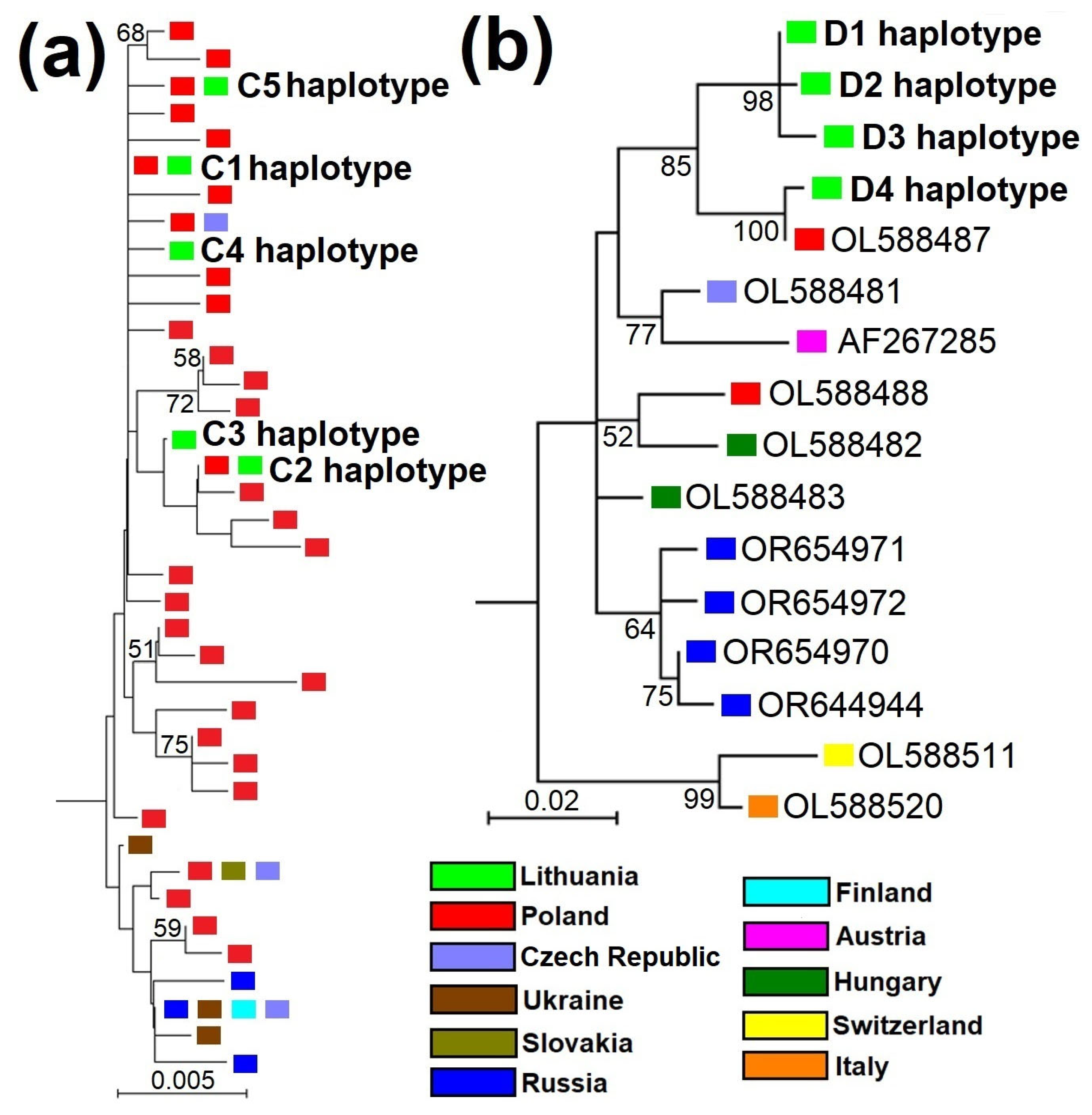
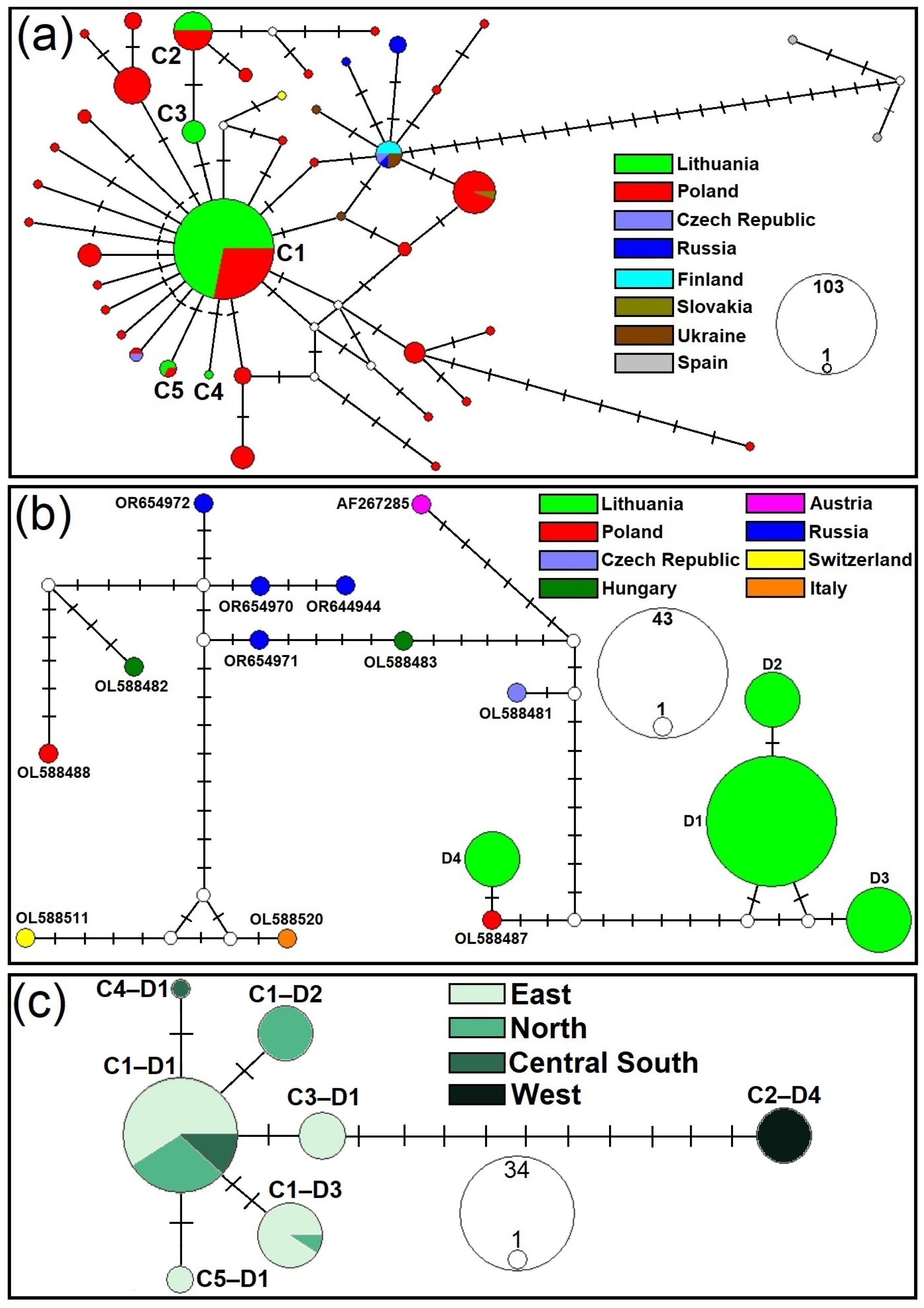
3.1. Genetic Variation of Microtus arvalis in Two mtDNA Loci
3.2. The Genetic Origin of Lithuanian Microtus arvalis
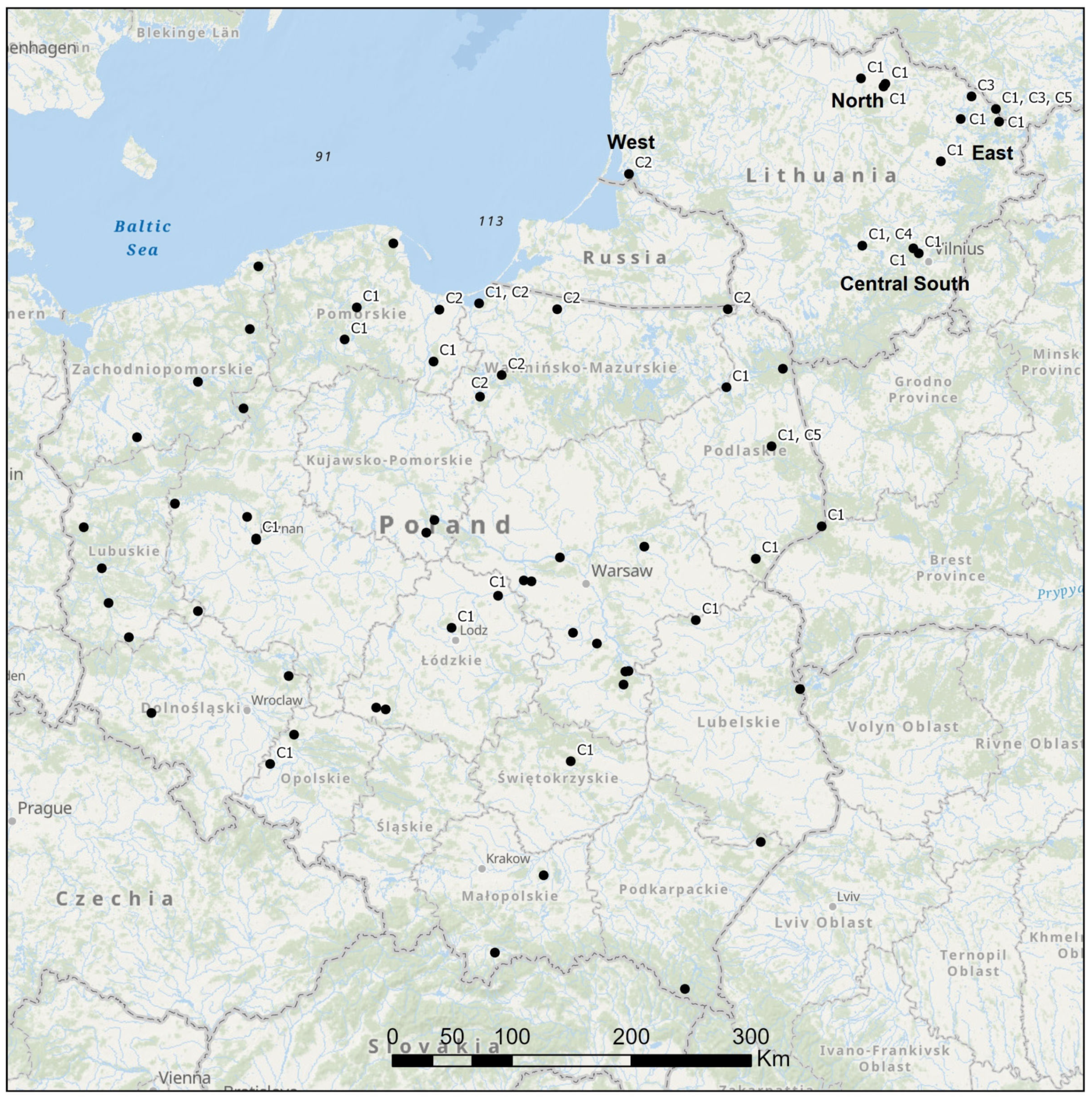
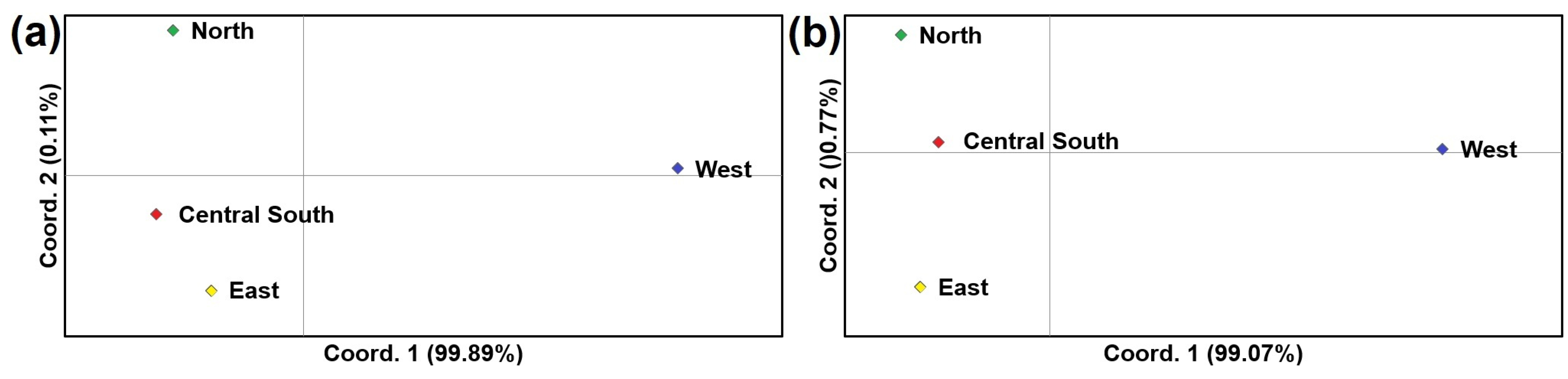
3.3. The Inter-Population Genetic Comparison of Microtus arvalis from Lithuania
4. Discussion
4.1. Low Mitochondrial Diversity in Lithuanian Populations
4.2. Phylogenetic Affinity to Central and Eastern European Lineages
4.3. Evidence of Two Mitochondrial Groups Within Lithuania
4.4. Comparison with Broader Microtus Phylogeography
4.5. Implications for Postglacial Colonization in the Baltic Region
4.6. Note on Taxonomic Framework and Citation Rationale
5. Conclusions
Supplementary Materials
Author Contributions
Funding
Institutional Review Board Statement
Data Availability Statement
Acknowledgments
Conflicts of Interest
References
- Hewitt, G. The genetic legacy of the Quaternary ice ages. Nature 2000, 405, 907–913. [Google Scholar] [CrossRef] [Scilit]
- Tougard, C.; Renvoisé, E.; Petitjean, A.; Quéré, J.-P. New insight into the colonization processes of common voles: Inferences from molecular and fossil evidence. PLoS ONE 2008, 3, e3532. [Google Scholar] [CrossRef] [Scilit]
- Stojak, J.; McDevitt, A.D.; Herman, J.S.; Searle, J.B.; Wójcik, J.M. Post-glacial colonization of eastern Europe from the Carpathian refugium: Evidence from mitochondrial DNA of the common vole Microtus arvalis. Biol. J. Linn. Soc. 2015, 115, 927–939. [Google Scholar] [CrossRef] [Scilit]
- Stojak, J.; McDevitt, A.D.; Herman, J.S.; Kryštufek, B.; Uhlíková, J.; Purger, J.J.; Wójcik, J.M. Between the Balkans and the Baltic: Phylogeography of a common vole mitochondrial DNA lineage limited to Central Europe. PLoS ONE 2016, 11, e0168621. [Google Scholar] [CrossRef] [Scilit]
- Haynes, S.; Jaarola, M.; Searle, J.B. Phylogeography of the common vole (Microtus arvalis) with particular emphasis on the colonization of the Orkney archipelago. Mol. Ecol. 2003, 12, 951–956. [Google Scholar] [CrossRef] [Scilit]
- Jaarola, M.; Martínková, N.; Gündüz, İ.; Brunhoff, C.; Zima, J.; Nadachowski, A.; Searle, J.B. Molecular phylogeny of the speciose vole genus Microtus (Arvicolinae, Rodentia) inferred from mitochondrial DNA sequences. Mol. Phylogenet. Evol. 2004, 33, 647–663. [Google Scholar] [CrossRef] [Scilit] [PubMed]
- Fink, S.; Excoffier, L.; Heckel, G. Mitochondrial gene diversity in the common vole Microtus arvalis shaped by historical divergence and local adaptations. Mol. Ecol. 2004, 13, 3501–3514. [Google Scholar] [CrossRef] [Scilit] [PubMed]
- Bužan, E.V.; Förster, D.W.; Searle, J.B.; Kryštufek, B. A new cytochrome b phylogroup of the common vole (Microtus arvalis) endemic to the Balkans and its implications for the evolutionary history of the species. Biol. J. Linn. Soc. 2010, 100, 788–796. [Google Scholar] [CrossRef] [Scilit]
- Borkowska, A.; Ratkiewicz, M. Sex-related spatial structure and effective population size in the common vole, Microtus arvalis, as revealed by mtDNA analysis. Ann. Zool. Fenn. 2008, 45, 255–262. [Google Scholar] [CrossRef] [Scilit]
- Barbosa, S.; Pauperio, J.; Searle, J.B.; Alves, P.C. Genetic identification of Iberian rodent species using both mitochondrial and nuclear loci: Application to noninvasive sampling. Mol. Ecol. Resour. 2013, 13, 43–56. [Google Scholar] [CrossRef] [Scilit]
- Triant, D.A.; DeWoody, J.A. Accelerated molecular evolution in Microtus (Rodentia) as assessed via complete mitochondrial genome sequences. Genetica 2006, 128, 95–108. [Google Scholar] [CrossRef] [Scilit]
- Folkertsma, R.; Westbury, M.V.; Eccard, J.A.; Hofreiter, M. The complete mitochondrial genome of the common vole, Microtus arvalis (Rodentia: Arvicolinae). Mitochondrial DNA Part B 2018, 3, 446–447. [Google Scholar] [CrossRef] [Scilit]
- Fink, S.; Fischer, M.C.; Excoffier, L.; Heckel, G. Genomic scans support repetitive continental colonization events during the rapid radiation of voles (Rodentia: Microtus): The utility of AFLPs versus mitochondrial and nuclear sequence markers. Syst. Biol. 2010, 59, 548–572. [Google Scholar] [CrossRef] [Scilit] [PubMed]
- Martínková, N.; Barnett, R.; Cucchi, T.; Struchen, R.; Pascal, M.; Pascal, M.; Searle, J.B. Divergent evolutionary processes associated with colonization of offshore islands. Mol. Ecol. 2013, 22, 5205–5220. [Google Scholar] [CrossRef] [Scilit] [PubMed]
- García, J.T.; Domínguez-Villaseñor, J.; Alda, F.; Calero-Riestra, M.; Pérez Olea, P.; Fargallo, J.A.; Martínez-Padilla, J.; Herranz, J.; Oñate, J.J.; Santamaría, A.; et al. A complex scenario of glacial survival in Mediterranean and continental refugia of a temperate continental vole species (Microtus arvalis) in Europe. J. Zool. Syst. Evol. Res. 2019, 58, 459–474. [Google Scholar] [CrossRef] [Scilit]
- Baca, M.; Popović, D.; Lemanik, A.; Bañuls-Cardona, S.; Conard, N.J.; Cuenca-Bescós, G.; Nadachowski, A. Ancient DNA reveals interstadials as a driver of common vole population dynamics during the last glacial period. J. Biogeogr. 2023, 50, 183–196. [Google Scholar] [CrossRef] [Scilit]
- Tougard, C.; Montuire, S.; Volobouev, V.; Markova, E.; Contet, J.; Aniskin, V.; Quere, J.P. Exploring phylogeography and species limits in the Altai vole (Rodentia: Cricetidae). Biol. J. Linn. Soc. 2013, 108, 434–452. [Google Scholar] [CrossRef] [Scilit]
- Golenishchev, F.; Malikov, V.; Petrova, T.; Bodrov, S.; Abramson, N. Toward assembling a taxonomic puzzle: Case study of Iranian gray voles of the subgenus Microtus (Rodentia, Cricetidae). Mamm. Biol. 2019, 94, 98–105. [Google Scholar] [CrossRef] [Scilit]
- Sibiryakov, P.A.; Tovpinets, N.N.; Dupal, T.A.; Semerikov, V.L.; Yalkovskaya, L.E.; Markova, E.A. Phylogeography of the common vole Microtus arvalis, the obscurus form (Rodentia, Arvicolinae): New data on mitochondrial DNA variability. Russ. J. Genet. 2018, 54, 1185–1198. [Google Scholar] [CrossRef] [Scilit]
- Bannikova, A.A.; Lebedev, V.S.; Lissovsky, A.A.; Matrosova, V.; Abramson, N.I.; Obolenskaya, E.V.; Tesakov, A.S. Molecular phylogeny and evolution of the Asian lineage of vole genus Microtus (Rodentia: Arvicolinae) inferred from mitochondrial cytochrome b sequence. Biol. J. Linn. Soc. 2010, 99, 595–613. [Google Scholar] [CrossRef] [Scilit]
- Lissovsky, A.A.; Petrova, T.V.; Yatsentyuk, S.P.; Golenishchev, F.N.; Putincev, N.I.; Kartavtseva, I.V.; Abramson, N.I. Multilocus phylogeny and taxonomy of East Asian voles Alexandromys (Rodentia, Arvicolinae). Zool. Scr. 2018, 47, 9–20. [Google Scholar] [CrossRef] [Scilit]
- Mahmoudi, A.; Darvish, J.; Aliabadian, M.; Yazdani Moghaddam, F.; Kryštufek, B. New insight into the cradle of the grey voles (subgenus Microtus) inferred from mitochondrial cytochrome b sequences. Mammalia 2017, 81, 583–593. [Google Scholar] [CrossRef] [Scilit]
- Mažeikytė, R.; Baranauskas, K.; Morkūnas, V.; Mickevičius, E. Distribution of the sibling vole (Microtus rossiaemeridionalis Ognev, 1924) (Rodentia, Cricetidae) in Lithuania. Acta Zool. Litu. 1999, 9, 3–15. [Google Scholar] [CrossRef] [Scilit]
- Skiriutė, D.; Paulauskas, A.; Mažeikytė, R. Isoenzyme analysis of mouse-like rodents (Rodentia, Cricetidae). Acta Zool. Litu. 2000, 10, 95–102. [Google Scholar] [CrossRef] [Scilit]
- Mahmoudi, A.; Konečný, A.; Khanalipour, F.; Barkshadi, F.B.; Sayyahi, A.; Kryštufek, B. First confirmed record of Microtus rossiaemeridionalis from Iran. Mammalia 2025, 89, 220–223. [Google Scholar] [CrossRef] [Scilit]
- Domínguez, J.C.; Alda, F.; Calero-Riestra, M.; Olea, P.P.; Martínez-Padilla, J.; Herranz, J.; Oñate, J.J.; Santamaría, A. Genetic footprints of a rapid and large-scale range expansion: The case of cyclic common vole in Spain. Heredity 2023, 130, 381–393. [Google Scholar] [CrossRef] [Scilit] [PubMed]
- Stakheev, V.V.; Khlyap, L.A.; Mironova, T.A.; Abramson, N.I.; Malygin, V.M.; Lissovsky, A.A. Geographic distribution of Microtus arvalis and Microtus rossiaemeridionalis in Eastern Europe. Russ. J. Theriol. 2023, 22, 53–61. [Google Scholar] [CrossRef] [Scilit]
- Balčiauskas, L.; Balčiauskienė, L. Small mammal diversity changes in a Baltic country, 1975–2021: A review. Life 2022, 12, 1887. [Google Scholar] [CrossRef] [Scilit]
- Prūsaitė, J. (Ed.) Lithuanian Fauna. Mammals; Mokslas: Vilnius, Lithuania, 1988; p. 295. [Google Scholar]
- Aljanabi, S.M.; Martinez, I. Universal and rapid salt-extraction of high-quality genomic DNA for PCR-based techniques. Nucleic Acids Res. 1997, 25, 4692–4693. [Google Scholar] [CrossRef] [Scilit]
- Prakas, P.; Butkauskas, D.; Vaišvilienė, J.; Balčiauskienė, L.; Balčiauskas, L. The Spatial Pattern of the Two Genetic Lineages of the Field Vole in Lithuania. Diversity 2022, 14, 820. [Google Scholar] [CrossRef] [Scilit]
- Prakas, P.; Butkauskas, D.; Balčiauskienė, L.; Balčiauskas, L. Low Genetic Variability of the Tundra Vole in Lithuania. Animals 2024, 14, 270. [Google Scholar] [CrossRef] [Scilit]
- Altschul, S.F.; Gish, W.; Miller, W.; Myers, E.W.; Lipman, D.J. Basic local alignment search tool. J. Mol. Biol. 1990, 215, 403–410. [Google Scholar] [CrossRef]
- Villesen, P. FaBox: An online toolbox for FASTA sequences. Mol. Ecol. Notes 2007, 7, 965–968. [Google Scholar] [CrossRef] [Scilit]
- Kumar, S.; Stecher, G.; Suleski, M.; Sanderford, M.; Sharma, S.; Tamura, K. MEGA12: Molecular evolutionary genetics analysis version 12 for adaptive and green computing. Mol. Biol. Evol. 2024, 41, msae263. [Google Scholar] [CrossRef] [Scilit] [PubMed]
- Bandelt, H.-J.; Forster, P.; Röhl, A. Median-joining networks for inferring intraspecific phylogenies. Mol. Biol. Evol. 1999, 16, 37–48. [Google Scholar] [CrossRef] [Scilit]
- Rozas, J.; Ferrer-Mata, A.; Sánchez-DelBarrio, J.C.; Guirao-Rico, S.; Librado, P.; Ramos-Onsins, S.E.; Sánchez-Gracia, A. DnaSP 6: DNA sequence polymorphism analysis of large data sets. Mol. Biol. Evol. 2017, 34, 3299–3302. [Google Scholar] [CrossRef] [Scilit]
- Tajima, F. Statistical method for testing the neutral mutation hypothesis by DNA polymorphism. Genetics 1989, 123, 585–595. [Google Scholar] [CrossRef] [Scilit]
- Excoffier, L.; Laval, G.; Schneider, S. Arlequin (Version 3.0): An integrated software package for population genetics data analysis. Evol. Bioinform. 2005, 1, 47–50. [Google Scholar] [CrossRef] [Scilit]
- Nei, M. Genetic distance between populations. Am. Nat. 1972, 106, 283–292. [Google Scholar] [CrossRef] [Scilit]
- Peakall, R.; Smouse, P.E. GenAlEx 6.5: Genetic analysis in Excel. Population genetic software for teaching and research—An update. Bioinformatics 2012, 28, 2537–2539. [Google Scholar] [CrossRef] [Scilit]
- Kostin, D.S.; Gromov, A.R.; Lavrenchenko, L.A. The complete mitochondrial genomes of Altai vole Microtus obscurus and common vole Microtus arvalis (Rodentia: Arvicolinae). Russ. J. Theriol. 2023, 22, 137–141. [Google Scholar] [CrossRef] [Scilit]
- Yalkovskaya, L.E.; Bolshakov, V.N.; Krokhaleva, M.A.; Gasanova, L.V.; Kuliev, G.N.; Sibiryakov, P.A.; Borodin, A.V. Genetic diversity of representatives of the genus Microtus (Arvicolinae, Rodentia): New data from the Eastern Greater Caucasus. Dokl. Biol. Sci. 2022, 502, 88–92. [Google Scholar] [CrossRef] [Scilit]
- Tkachenko, E.A.; Witkowski, P.T.; Radosa, L.; Dzagurova, T.K.; Okulova, N.M.; Yunicheva, Y.V.; Morozov, V.G.; Ivanov, L.I.; Lundkvist, Å.; Kruger, D.H. Adler hantavirus, a new genetic variant of Tula virus identified in Major’s pine voles (Microtus majori) sampled in southern European Russia. Infect. Genet. Evol. 2015, 29, 156–163. [Google Scholar] [CrossRef] [Scilit] [PubMed]
- Polat, C.; Ergünay, K.; Irmak, S.; Erdin, M.; Brinkmann, A.; Çetintaş, O.; Çoğal, M.; Sözen, M.; Matur, F.; Nitsche, A.; et al. A novel genetic lineage of Tula orthohantavirus in Altai voles (Microtus obscurus) from Turkey. Infect. Genet. Evol. 2019, 67, 150–158. [Google Scholar] [CrossRef] [Scilit]
- Chen, J.-T.; Qin, J.; Li, K.; Xu, Q.-Y.; Wang, X.-P.; Plyusnin, A.; Hou, W.; Zhang, Y.-Z. Identification and characterization of a novel subtype of Tula virus in Microtus arvalis obscurus voles from Xinjiang, China. Infect. Genet. Evol. 2019, 75, 104012. [Google Scholar] [CrossRef] [Scilit] [PubMed]
- Lavrenchenko, L.; Potapov, S.G.; Bulatova, N.; Golenishchev, F. A genetic study of natural hybridization between two forms of the common vole (Microtus arvalis) with the use of molecular and cytogenetic methods. Dokl. Biol. Sci. 2009, 426, 222–224. [Google Scholar] [CrossRef] [Scilit]
- Erdin, M.; Smura, T.; Kalkan, K.K.; Cetintas, O.; Cogal, M.; Irmak, S.; Matur, F.; Polat, C.; Sironen, T.; Sozen, M.; et al. Detection of divergent Orthohantavirus tulaense provides insight into wide host range and viral evolutionary patterns. npj Viruses 2024, 2, 62. [Google Scholar] [CrossRef] [Scilit]
- Haring, E.; Herzig-Straschil, B.; Spitzenberger, F. Phylogenetic analysis of Alpine voles of the Microtus multiplex complex using the mitochondrial control region. J. Zool. Syst. Evol. Res. 2000, 38, 231–238. [Google Scholar] [CrossRef] [Scilit]
- Fink, S.; Excoffier, L.; Heckel, G. Mammalian monogamy is not controlled by a single gene. Proc. Natl. Acad. Sci. USA 2006, 103, 10956–10960. [Google Scholar] [CrossRef] [Scilit]
- Thanou, E.; Tryfonopoulos, G.; Chondropoulos, B.; Fraguedakis-Tsolis, S. Comparative phylogeography of the five Greek vole species infers the existence of multiple South Balkan subrefugia. Ital. J. Zool. 2012, 79, 363–376. [Google Scholar] [CrossRef] [Scilit]
- Vanmechelen, B.; Meurs, S.; Horemans, M.; Loosen, A.; Joly Maes, T.; Laenen, L.; Vergote, V.; Raymond Koundouno, F.; Magassouba, N.; Kader Konde, M.; et al. The characterization of multiple novel paramyxoviruses highlights the diverse nature of the subfamily Orthoparamyxovirinae. Virus Evol. 2022, 8, veac061. [Google Scholar] [CrossRef] [Scilit]
- Bogdanov, A.S.; Khlyap, L.A.; Kefelioğlu, H.; Selcuk, A.Y.; Stakheev, V.V.; Baskevich, M.I. High molecular variability in three pine vole species of the subgenus Terricola (Microtus, Arvicolinae) and plausible source of polymorphism. J. Zool. Syst. Evol. Res. 2021, 59, 2519–2538. [Google Scholar] [CrossRef] [Scilit]
- Schmidt-Chanasit, J.; Essbauer, S.; Petraityte, R.; Yoshimatsu, K.; Tackmann, K.; Conraths, F.J.; Sasnauskas, K.; Arikawa, J.; Thomas, A.; Pfeffer, M.; et al. Extensive host sharing of central European Tula virus. J. Virol. 2010, 84, 459–474. [Google Scholar] [CrossRef] [Scilit] [PubMed]
- Liu, S.Y.; Sun, Z.Y.; Liu, Y.; Wang, H.; Guo, P.; Murphy, R.W. A new vole from Xizang, China and the molecular phylogeny of the genus Neodon (Cricetidae: Arvicolinae). Zootaxa 2012, 3235, 1–22. [Google Scholar] [CrossRef] [Scilit]
- Bulatova, N.; Golenishchev, F.; Koval’skaya, Y.; Emelyanova, L.; Bystrakova, N.; Pavlova, S.; Nadzhafova, R.S.; Lavrenchenko, L.A. Cytogenetic study of the parapatric contact zone between two 46-chromosomal forms of the common vole in European Russia. Russ. J. Genet. 2010, 46, 443–448. [Google Scholar] [CrossRef] [Scilit]
- Mazurok, N.A.; Rubtsova, N.V.; Isaenko, A.A.; Pavlova, M.; Slobodyanyuk, S.; Nesterova, T.; Zakian, S. Comparative chromosome and mitochondrial DNA analyses and phylogenetic relationships within common voles (Microtus, Arvicolidae). Chromosome Res. 2004, 12, 107–120. [Google Scholar] [CrossRef] [Scilit]
- Withnell, C.B.; Scarpetta, S.G. A new perspective on the taxonomy and systematics of Arvicolinae (Gray, 1821) and a new time-calibrated phylogeny for the clade. PeerJ 2024, 12, e16693. [Google Scholar] [CrossRef] [Scilit]
- Chaline, J.; Brunet-Lecomte, P.; Graf, J. Validation de Terricola Fatio, 1867 pour les campagnols souterrains (Arvicolidae, Rodentia) paléarctiques actuels et fossiles. C. R. Acad. Sci. Paris 1988, 306, 475–478. [Google Scholar]
- Barbosa, S.; Paupério, J.; Pavlova, S.; Alves, P.; Searle, J. The Microtus voles: Resolving the phylogeny of one of the most speciose mammalian genera using genomics. Mol. Phylogenet. Evol. 2018, 125, 85–92. [Google Scholar] [CrossRef] [Scilit]
- Baskevich, M.I.; Potapov, S.G.; Khlyap, L.; Okulova, N.; Ashibokov, U.M.; Grigoriev, M.P.; Dzagurova, T. Chromosomal and molecular studies of cryptic species of the subgenus Terricola (Rodentia, Arvicolinae, Microtus) in the Caucasian region: Analysis of new records. Biol. Bull. 2016, 43, 1120–1128. [Google Scholar] [CrossRef] [Scilit]
- Bogdanov, A.; Khlyap, L.; Baskevich, M.I. Differentiation and phylogenetic relationships of three pine vole species of the subgenus Terricola (Rodentia, Arvicolinae, Microtus): Results of analysis of the BRCA1 and XIST nuclear gene fragments. Biol. Bull. 2020, 47, 559–563. [Google Scholar] [CrossRef] [Scilit]
- Abramson, N.; Bodrov, S.; Bondareva, O.; Genelt-Yanovskiy, E.; Petrova, T. A mitochondrial genome phylogeny of voles and lemmings (Rodentia: Arvicolinae): Evolutionary and taxonomic implications. PLoS ONE 2021, 16, e0248198. [Google Scholar] [CrossRef] [Scilit]
- Abramson, N.; Skalon, E.K.; Bondareva, O.; Bodrov, S.; Petrova, T.V.; Dvoyashov, I.A. Resolving rapid radiation of voles and lemmings (Arvicolinae: Cricetinae, Rodentia) with QuaddRAD sequencing and transcriptome analysis. Diversity 2025, 17, 61. [Google Scholar] [CrossRef] [Scilit]
- Bulatova, N.; Potapov, S.G.; Lavrenchenko, L. Genomic versus chromosomal polytypy in studies of mitochondrial and nuclear DNA markers in the Microtus arvalis group. Russ. J. Genet. 2010, 46, 586–594. [Google Scholar] [CrossRef] [Scilit]
- Orlov, V.N.; Malygin, V.M. Two forms of 46-chromosome Microtus arvalis Pallas. In The Mammals (Evolution, Karyology, Systematics, Faunistics); Materials of the 2nd All-Union Symposium on Mammals: Novosibirsk, Russia, 1969; pp. 143–144. [Google Scholar]
- Golenishchev, F.N.; Meyer, M.N.; Bulatova, N.S. The hybrid zone between two karyomorphs of Microtus arvalis (Rodentia, Arvicolidae). Proc. Zool. Inst. RAS 2001, 289, 89–94. [Google Scholar]
- Lavrenchenko, L.A.; Gromov, A.; Martynov, A.; Kostin, D.; Komarova, V.A.; Krivonogov, D.; Cherepanova, E.V. Structure of the hybrid zone between allied species of the common vole, Microtus arvalis and M. obscurus: Influence of genetic factors and landscape-geographical conditions. Russ. J. Genet. 2024, 60, 304–315. [Google Scholar] [CrossRef] [Scilit]
- Çetintürk, D.; Yiğit, N.; Çolak, E.; Markov, G.; Ćirović, D.; Márton, M. Inferring phylogenetic relationships in the common vole (Microtus arvalis) based on mitochondrial and nuclear sequence diversities. Turk. J. Zool. 2021, 45, 117–130. [Google Scholar] [CrossRef] [Scilit]



| cytb | Control Region | |||||||
|---|---|---|---|---|---|---|---|---|
| Species/Origin of Sample | n | Sequence Similarity, % | TN93 + G Distance * | No. of Difference | n | Sequence Similarity, % | TN93 + G Distance * | No. of Difference |
| M. arvalis/Lithuania | 91 | 99.6–100 | 0.001 | 0.491 | 70 | 97.6–100 | 0.006 | 2.349 |
| M. arvalis/Finland | 4 | 99.5–99.7 | 0.003 | 2.275 | 0 | ND | ND | ND |
| M. arvalis/Poland | 146 | 97.9–100 | 0.005 | 3.217 | 4 | 94.1–99.7 | 0.048 | 15.861 |
| M. arvalis/Czech Republic | 9 | 98.8–99.9 | 0.006 | 4.497 | 1 | 96.7–97.2 | 0.034 | 11.429 |
| M. arvalis/Slovakia | 2 | 98.9–99.1 | 0.007 | 4.775 | 1 | 95.5–95.7 | 0.054 | 18.000 |
| M. arvalis/Hungary | 1 | 99.0–99.3 | 0.007 | 5.275 | 2 | 96.2–96.8 | 0.036 | 12.236 |
| M. arvalis/Ukraine | 6 | 95.7–99.9 | 0.017 | 11.505 | 0 | ND | ND | ND |
| M. arvalis/Denmark | 3 | 98.1–98.5 | 0.017 | 11.608 | 0 | ND | ND | ND |
| M. arvalis/Serbia | 3 | 96.8–99.0 | 0.017 | 11.927 | 1 | 92.1–93.0 | 0.083 | 26.729 |
| M. arvalis/Netherlands | 39 | 96.6–98.8 | 0.019 | 12.928 | 0 | ND | ND | ND |
| M. arvalis/Germany | 24 | 96.7–98.6 | 0.027 | 18.570 | 2 | 95.3–95.7 | 0.056 | 18.229 |
| M. arvalis/Italy | 1 | 97.3–97.7 | 0.027 | 18.791 | 1 | 94.4–94.8 | 0.054 | 18.000 |
| M. arvalis/Montenegro | 2 | 97.0–97.3 | 0.030 | 20.275 | 0 | ND | ND | ND |
| M. arvalis/UK | 140 | 96.4–97.5 | 0.030 | 20.593 | 2 | 91.3–93.0 | 0.092 | 28.293 |
| M. arvalis/Switzerland | 4 | 96.8–97.3 | 0.030 | 20.599 | 1 | 94.6–94.8 | 0.064 | 21.000 |
| M. arvalis/ Bosnia and Herzegovina | 16 | 96.1–97.5 | 0.031 | 20.900 | 0 | ND | ND | ND |
| M. arvalis/France | 183 | 96.0–98.6 | 0.032 | 21.940 | 135 | 90.8–95.4 | 0.093 | 28.504 |
| M. arvalis/Portugal | 1 | 96.7–97.0 | 0.032 | 22.275 | 0 | ND | ND | ND |
| M. arvalis/Spain | 107 | 96.1–97.1 | 0.034 | 23.367 | 0 | ND | ND | ND |
| M. arvalis/Belgium | 24 | 96.7–97.0 | 0.035 | 23.967 | 0 | ND | ND | ND |
| M. arvalis/Luxemburg | 2 | 96.7–97.0 | 0.035 | 23.967 | 0 | ND | ND | ND |
| M. arvalis/Slovenia | 3 | 98.6–99.0 | 0.038 | 23.692 | 0 | ND | ND | ND |
| M. arvalis/Georgia | 1 | 96.0–96.3 | 0.042 | 27.967 | 0 | ND | ND | ND |
| M. arvalis/Armenia | 1 | 95.7–96.0 | 0.045 | 29.923 | 0 | ND | ND | ND |
| M. arvalis/Russia | 141 | 94.8–99.5 | 0.047 | 31.384 | 146 | 91.3–96.5 | 0.088 | 28.211 |
| M. arvalis/China | 8 | 95.2–95.7 | 0.050 | 33.011 | 0 | ND | ND | ND |
| M. arvalis/Austria | 0 | ND | ND | ND | 1 | 95.7–96.2 | 0.048 | 15.929 |
| M. obscurus | 73 | 95.0–96.4 | 0.047 | 31.293 | 6 | 91.1–92.9 | 0.092 | 29.086 |
| M. levis = M. rossiaemeridionalis | 28 | 93.0–94.5 | 0.073 | 46.398 | 23 | 89.3 –92.3 | 0.115 | 35.196 |
| M. mystacinus | 8 | 93.1–94.2 | 0.076 | 48.291 | 0 | ND | ND | ND |
| M. transcaspicus | 9 | 92.7–93.5 | 0.081 | 51.392 | 0 | ND | ND | ND |
| M. kermanensis | 2 | 92.1–92.5 | 0.089 | 55.791 | 0 | ND | ND | ND |
| Haplotype | Variable Sites in cytb | Mutations in Control Region | |||||||||||||
|---|---|---|---|---|---|---|---|---|---|---|---|---|---|---|---|
| 86 | 290 | 480 | 514 | 807 | 858 | 859 | 862 | 887 | 888 | 923 | 956 | 960 | 988 | 1109 | |
| C1–D1 | G | G | G | T | C | T | T | T | A | C | T | G | A | T | - |
| C1–D2 | . | . | . | . | . | C | . | . | . | . | . | . | . | . | - |
| C1–D3 | . | . | . | . | . | . | . | . | . | . | . | A | T | . | - |
| C2–D4 | A | A | . | . | T | . | C | G | G | T | C | C | . | C | A |
| C3–D1 | A | . | . | . | . | . | . | . | . | . | . | . | . | . | - |
| C4–D1 | . | . | A | . | . | . | . | . | . | . | . | . | . | . | - |
| C5–D1 | . | . | . | C | . | . | . | . | . | . | . | . | . | . | - |
| Sample | n | h | S | η | k | Hd ± SD | π ± SD | Tajima’s D |
|---|---|---|---|---|---|---|---|---|
| cytb | ||||||||
| Lithuania | 91 | 5 | 4 | 4 | 0.49084 | 0.330 ± 0.061 | 0.00068 ± 0.00014 | −0.75867 |
| UK | 140 | 28 | 41 | 43 | 2.62950 | 0.804 ± 0.029 | 0.00363 ± 0.00031 | −2.01175 * |
| Czech Republic | 9 | 9 | 14 | 14 | 3.61111 | 1.000 ± 0.052 | 0.00497 ± 0.00094 | −1.43500 |
| Spain | 107 | 48 | 44 | 48 | 4.53253 | 0.970 ± 0.008 | 0.00624 ± 0.00057 | −1.58773 |
| Russia | 141 | 63 | 85 | 92 | 4.63607 | 0.944 ± 0.014 | 0.00639 ± 0.00080 | −2.29307 ** |
| Poland | 146 | 52 | 62 | 67 | 5.06160 | 0.930 ± 0.012 | 0.00697 ± 0.00053 | −1.80891 * |
| Bosnia and Herzegovina | 16 | 13 | 34 | 35 | 7.67500 | 0.967 ± 0.036 | 0.01057 ± 0.00324 | −1.13606 |
| Netherlands | 39 | 7 | 31 | 31 | 7.85965 | 0.772 ± 0.043 | 0.01083 ± 0.00246 | 0.24924 |
| France | 183 | 77 | 84 | 89 | 8.98271 | 0.894 ± 0.020 | 0.01239 ± 0.00063 | −1.29133 |
| Germany | 24 | 11 | 36 | 36 | 13.41667 | 0.844 ± 0.063 | 0.01848 ± 0.00134 | 1.49430 |
| control region | ||||||||
| Lithuania | 70 | 4 | 10 | 11 | 2.34948 | 0.580 ± 0.057 | 0.00558 ± 0.00107 | 0.08034 |
| Russia | 147 | 55 | 56 | 69 | 4.20045 | 0.925 ± 0.013 | 0.01138 ± 0.00162 | −2.06395 * |
| Central Europe 1 | 8 | 8 | 39 | 44 | 15.50000 | 1.000 ± 0.063 | 0.04201 ± 0.00552 | −0.46453 |
| France | 133 | 82 | 82 | 99 | 16.08259 | 0.980 ± 0.006 | 0.04358 ± 0.00180 | −0.36008 |
| East | North | Central South | West | |
|---|---|---|---|---|
| East | 0.23340 ** | 0.07365 | 0.92945 *** | |
| North | 0.02448 | 0.15386 | 0.94565 *** | |
| Central South | 0.09254 | 0.29760 | 0.94565 * | |
| West | 0.89657 *** | 1.00000 ** | 0.93934 ** |
Disclaimer/Publisher’s Note: The statements, opinions and data contained in all publications are solely those of the individual author(s) and contributor(s) and not of MDPI and/or the editor(s). MDPI and/or the editor(s) disclaim responsibility for any injury to people or property resulting from any ideas, methods, instructions or products referred to in the content. |
© 2026 by the authors. Licensee MDPI, Basel, Switzerland. This article is an open access article distributed under the terms and conditions of the Creative Commons Attribution (CC BY) license.
Share and Cite
Prakas, P.; Butkauskas, D.; Šneideris, D.; Jasiulionis, M.; Stirkė, V.; Balčiauskienė, L.; Balčiauskas, L. Postglacial Origin and Regional Differentiation of Microtus arvalis in the Baltic Region. Diversity 2026, 18, 215. https://doi.org/10.3390/d18040215
Prakas P, Butkauskas D, Šneideris D, Jasiulionis M, Stirkė V, Balčiauskienė L, Balčiauskas L. Postglacial Origin and Regional Differentiation of Microtus arvalis in the Baltic Region. Diversity. 2026; 18(4):215. https://doi.org/10.3390/d18040215
Chicago/Turabian StylePrakas, Petras, Dalius Butkauskas, Donatas Šneideris, Marius Jasiulionis, Vitalijus Stirkė, Laima Balčiauskienė, and Linas Balčiauskas. 2026. "Postglacial Origin and Regional Differentiation of Microtus arvalis in the Baltic Region" Diversity 18, no. 4: 215. https://doi.org/10.3390/d18040215
APA StylePrakas, P., Butkauskas, D., Šneideris, D., Jasiulionis, M., Stirkė, V., Balčiauskienė, L., & Balčiauskas, L. (2026). Postglacial Origin and Regional Differentiation of Microtus arvalis in the Baltic Region. Diversity, 18(4), 215. https://doi.org/10.3390/d18040215