Article

Postglacial Origin and Regional Differentiation of Microtus arvalis in the Baltic Region

State Scientific Research Institute Nature Research Centre, Akademijos Str. 2, LT-08412 Vilnius, Lithuania
*
Author to whom correspondence should be addressed.
Diversity 2026, 18(4), 215; https://doi.org/10.3390/d18040215
Submission received: 16 March 2026 / Revised: 1 April 2026 / Accepted: 3 April 2026 / Published: 7 April 2026
(This article belongs to the Special Issue Population Genetics of Animals and Plants—2nd Edition)

Abstract

Postglacial expansion dynamics strongly influence the genetic structure of temperate species; however, mitochondrial data from the Baltic region are limited. To assess diversity, phylogenetic origins, and regional structuring, we analyzed mitochondrial cytochrome b (726 bp) and control region (421–422 bp) sequences of the common vole (Microtus arvalis Pallas, 1779) from Lithuania. Of the 91 cytb sequences and 70 control region sequences analyzed, five and four haplotypes were identified, respectively. Markedly low haplotype and nucleotide diversity compared with most European populations were detected. Phylogenetic Maximum Likelihood and network analyses revealed that all Lithuanian haplotypes belong to the eastern European lineage and are most closely related to Polish and central European samples, which supports recolonization from a Carpathian refugium. Despite the overall low variation, we detected two distinct mitochondrial groups: a highly differentiated western group and a second group encompassing eastern, northern, and central–southern populations. This strong regional structuring suggests limited maternal gene flow on a small geographic scale. There was no evidence of introgression from related taxa, such as Microtus obscurus. Our findings refine the phylogeographic context of Baltic M. arvalis and highlight the region’s role in shaping postglacial diversity patterns.

1. Introduction

Reconstructing the evolutionary history of temperate species remains central to understanding present-day patterns of biodiversity. In Europe, Quaternary climatic oscillations, particularly the Last Glacial Maximum, strongly influenced species distributions, demographic processes, and genetic structure [1]. Classical phylogeographic models proposed that most temperate taxa survived glaciations in southern Mediterranean refugia and subsequently recolonized central and northern Europe. However, increasing molecular and fossil evidence demonstrates that northern and extra-Mediterranean refugia, including the Carpathian Basin and adjacent regions, also played an important role in shaping contemporary genetic diversity [2,3,4].
Small mammals, particularly arvicoline rodents, have proven especially informative for investigating postglacial recolonization scenarios because of their short generation times, rapid demographic responses, and well-documented fossil records. The common vole (Microtus arvalis sensu lato) is one of the most intensively studied model species in European phylogeography. Its evolutionary history has been examined using mitochondrial markers, nuclear loci, karyological analyses, and fossil data [2,5,6,7].
Mitochondrial DNA (mtDNA), particularly the cytochrome b (cytb) gene and control region, has been widely applied to resolve phylogenetic relationships and infer demographic history in Microtus [8,9,10]. High substitution rates in mtDNA of Microtus spp. further enhance its suitability for resolving recent divergence events [11]. Complete mitochondrial genomes have provided additional resolution and confirmed close phylogenetic relationships within the genus [12].
Across Europe, several distinct mitochondrial lineages of M. arvalis have been identified, often linked to separate glacial refugia. Western, Central, Eastern, Italian, and Balkan lineages reflect a complex evolutionary history shaped by both southern and northern survival and multiple expansion waves [2,13,14]. A spatially explicit Bayesian diffusion analysis further suggested that M. arvalis originated in Central Europe and survived the last glaciation in multiple Mediterranean and continental refugia, with complex postglacial dispersal dynamics [15]. Ancient DNA analyses further support long-term persistence and lineage continuity across glacial cycles [16].
Particular attention has been given to the Eastern lineage, which is associated with a Carpathian or nearby northern refugium and subsequent postglacial expansion toward central and northern Europe [3,4]. These findings highlight central and eastern Europe as important phylogeographic contact zones rather than merely regions recolonized from southern peninsulas. The Baltic region, located at the northern margin of postglacial expansion routes and near potential suture zones, is therefore of particular biogeographic interest.
In addition to intraspecific structuring, the M. arvalis complex presents significant taxonomic complexity. Cytogenetic studies identified distinct chromosomal forms traditionally referred to as the “arvalis” and “obscurus” forms, which share the same diploid chromosome number but differ in the fundamental number of chromosomal arms [17]. The eastern form, often treated as Microtus obscurus, occupies eastern Europe and western Asia and forms hybrid zones with M. arvalis sensu stricto [17,18].
Phylogeographic investigations of the obscurus form revealed the presence of major mitochondrial clades, including the Sino-Russian clade spanning large parts of eastern Eurasia [19]. These studies indicate region-specific demographic histories and multiple expansion events, emphasizing the dynamic evolutionary processes within the arvalis group. Broader systematic analyses across Microtus confirm rapid radiation and complex lineage diversification [20,21,22].
The Baltic region, including Lithuania, represents a potential contact zone between western and eastern lineages and between sibling species within the arvalis complex. Historical studies in Lithuania documented the occurrence and distribution of M. arvalis and its sibling species Microtus rossiaemeridionalis Ognev, 1924 [23,24]. More recent research has highlighted the ongoing expansion and changing distribution of sibling species across Europe [25,26]. However, comprehensive mitochondrial phylogeographic analyses of Lithuanian populations remain limited.
Given the important role of the Baltic region in postglacial recolonization routes and its proximity to documented northern refugia and lineage contact zones, detailed analysis of mitochondrial diversity in Lithuania is essential. Such data can clarify the phylogenetic placement of local populations within the broader European framework, reveal potential signals of bottlenecks or founder events, and contribute to refining continental colonization models [2,4,7].
Despite the broad European phylogeographic framework established for Microtus arvalis, detailed knowledge of its distributional dynamics and population structure in the Baltic region remains limited and could be misinterpreted. For instance, M. arvalis distribution modelling across eastern Europe has highlighted incomplete sampling and insufficiently resolved occurrence data, particularly within sympatric zones of sibling species [27], interpreting Lithuania as only moderately suitable. At the same time, long-term small mammal monitoring in Lithuania indicates that M. arvalis has historically been one of the dominant herbivorous small mammals, although its proportional dominance has decreased in recent decades following major land-use changes [28]. This combination of ecological prominence and limited phylogeographic resolution underscores the need for a detailed genetic assessment of Lithuanian populations within the broader European context.
In this study, we analyzed mitochondrial cytb and control region sequences of M. arvalis populations from Lithuania to (i) assess levels of genetic variability, (ii) determine their phylogenetic placement within European lineages, (iii) evaluate possible intra-country genetic structuring, and (iv) infer likely postglacial colonization routes contributing to present-day patterns. By integrating regional data with established continental phylogeographic frameworks based on both modern and ancient DNA studies, this work contributes to a more comprehensive understanding of the evolutionary processes shaping small mammal diversity in northeastern Europe.

2. Materials and Methods

2.1. Sample Collection

Samples of M. arvalis were collected from 12 sites in Lithuania. The captured voles for genetic analysis were combined into four geographical samples. The individual most numerous eastern sample comprised six collection sites, Bileišiai (n = 2), Deikiškiai (n = 15), Kukinis (n = 5), Utena (n = 11), Stelmužė (n = 5) and Zarasai (n = 21); the northern sample encompassed Aukštikalniai (n = 8) and Mieliūnai (n = 11) sites; the central–southern was composed of Saldenė (n = 1), Sudervė (n = 2) and Žiežmariai (n = 2) sites; and finally the western sample was made up single Rusnė (n = 8) site. Thus, eastern, northern, central–southern and western samples consisted of 59, 19, 5 and 8 voles.
The biological material used for the study was collected during small mammal trapping carried out in 2011–2012 (Zarasai and Rusnė samples) and 2023–2024 (all other samples). Small mammals were trapped in various habitats including natural meadows, young and older forests, shrubby clearings and orchards. A standard snap trap line method was applied to collect biological material, consisting of 25 traps placed at 5 m intervals. Sunflower oil-soaked bread was used as bait and was replaced following rainfall or after being consumed by animals. The captured animals were stored at −20 °C until dissection and further examinations at the Laboratory of Mammalian Ecology of State Scientific Research Institute Nature Research Centre, Vilnius, Lithuania. The collected voles were assigned to M. arvalis sensu lato based on dental characteristics and cranial measurements [29]. However, the final species identification was made based on the comparison of obtained cytb sequences. Heart muscles of captured M. arvalis were placed in microtubes containing ethanol and stored for further molecular investigations.
Snap-trapping was justified, as biological material of small mammals (including M. arvalis) captured were used in numerous studies including detailed parasitological investigations, stable isotope and elemental analyses, and assessment of reproductive parameters for ecological studies. The current investigation was approved by the Animal Welfare Committee of the State Scientific Research Institute Nature Research Centre (Nos. GGT-7 and GGT-8).

2.2. Molecular Analysis

The genomic DNA was purified from hear muscles of M. arvalis using salt-extraction method design to extract DNA from various tissues [30]. The isolated DNA was diluted to working 50 ng/μL concentrations and stored at –20 °C for further manipulation.
For the population genetic analysis, samples of M. arvalis were characterized at two mtDNA loci, cytb and control region. The amplification of partial sequences of cytb and control region was conducted using Micr-2L (5′-CAACAACAGCATTCTCATCA-3′) and Micr-2R (5′-TGCTCGTTGTTTTGAAGTGT-3′), and Pro+ (5′-CACCATCAGCACCCAAAGCTG-3′) and MicrF (5′-ATTTAAGGGGAACGTATGGACG-3′) primers [31] as described previously [32]. The resulting fragments of the PCR were visualized using 1.5% agarose gel electrophoresis. Amplification products were purified using the enzymatic approach, with a help of exonuclease ExoI and alkaline phosphatase FastAP (Thermo Fisher Scientific Baltics, Vilnius, Lithuania). Sequencing of PCR amplicons was conducted bidirectionally with the same forward and reverse primers applied in amplification, using the BigDye® Terminator v3.1 Cycle Sequencing Kit (Thermo Fisher Scientific Baltics, Vilnius, Lithuania). The products were separated and analyzed on an ABI 3500 Genetic Analyser (Applied Biosystems, Foster City, CA, USA) in accordance with the manufacturer’s recommendations.
All pure 726 bp cytb and 421–422 bp control region sequences generated in the present study were deposited in the NCBI GenBank repository under accession numbers PZ124696–PZ124786 and PZ124787–PZ124856, respectively.

2.3. Data Analysis

Sequences generated in the present study were checked manually for ambiguously placed nucleotides and truncated to eliminate primer binding sites. Subsequently, to calculate percentage sequence similarity values, the resulting sequences of M. arvais sensu lato were compared with those of closely related Microtus species using Nucleotide BLAST (http://blast.ncbi.nlm.nih.gov/, accessed on 2 February 2026) search algorithm [33].
The identification of cytb and control region haplotypes was performed using FaBox v. 1.5 [34]. Mean pairwise intragroup and intergroup distances were estimated using p-distance and the Tamura–Nei model with gamma-distributed rate variation as implemented in MEGA12.0.14 [35]. Sequences of M. arvalis generated in this study were compared among themselves using the “Compute Within Group Mean Distance” option. Additionally, sequences obtained in this study were compared with those of other species, as well as conspecific sequences from different countries, using the “Compute Between Group Mean Distance” option. Given ongoing debates on the taxonomy within the genus, Microtus species were assigned exclusively based on the taxonomy provided in GenBank records for the calculation of sequence similarity and pairwise genetic distances.
Phylogenetic analyses were performed with MEGA12 12.0.14. Multiple sequence alignments were generated using the Clustal W algorithm. All the sequences analyzed were truncated to begin and end at the same nucleotide position. Phylogenetic trees were constructed using the Maximum Likelihood (ML) method. For each dataset, the best-fit nucleotide substitution model was chosen based on the lowest Bayesian Information Criterion (BIC) value using the “Find Best DNA/Protein Models (ML)” function implemented in MEGA12. HKY + I and HKY + G nucleotide substitution models were set for cytb and control region analyses, respectively. Sequences of M. obscurus were chosen as outgroup for the phylogenetic analyses of M. arvalis haplotypes based on cytb and control region sequence data. The bootstrap method with 1000 replications was used for testing the reliability of the resulting phylogeny. The haplotype network analysis based on cytb and control region sequences was carried out using the median-joining method [36] implemented in NETWORK 10.2.0.0 software (https://www.fluxus-engineering.com/sharenet.htm), accessed on 8 February 2026).
The main indices of genetic diversity in datasets analyzed were estimated with a DnaSP v. 6.12.03 software [37]. Hence, number of haplotypes (h), number of polymorphic sites (S), total number of mutations (η), average number of nucleotide differences (k), the haplotype diversity (Hd), the nucleotide diversity (π) and standard deviation (SD) for the last two parameters were assessed. Furthermore, values of Tajima’s D neutrality test [38] were calculated using the same software.
The genetic differentiation of M. arvalis samples from Lithuania were evaluated using ΦST between the pairs of samples with Arlequin v. 3.5.2.2 [39] using the Tamura–Nei model. The statistical significance of each ΦST value was assessed by 10,000 permutations at the 95% confidence level. Principal coordinates analysis (PCoA) of Lithuanian M. arvalis samples based on Nei’s genetic distance [40] was conducted using GenAlEx v. 6.502 [41].
Sequences of cytb and control region of M. arvalis and other closely related retrieved from the NCBI GenBank [2,3,4,5,6,7,8,9,10,11,12,13,14,15,16,17,18,19,20,21,22,25,26,42,43,44,45,46,47,48,49,50,51,52,53,54,55] are provided in Table S1.

3. Results

3.1. Genetic Variation of Microtus arvalis in Two mtDNA Loci

Among voles morphologically identified as M. arvalis, we generated 91 cytb (726 bp; PZ124696–PZ124786) and 70 control region (421–422 bp; PZ124787–PZ124856) sequences. The discrepancy in sequence numbers between markers resulted from DNA degradation during storage. As the cytb fragment was analyzed first, samples from the Zarasai locality (n = 21) collected in 2011 were characterized exclusively using this locus. Based on the BLAST analysis our sequences were assigned to M. arvalis. Specifically, cytb sequences obtained from M. arvalis in Lithuania showed highest similarity values (up to 99.7–100%) to those reported from Poland, Czech Republic and Finland (Table 1). For this genetic marker, the lowest genetic distances were observed relative to samples from Finland, Poland, the Czech Republic, Slovakia and Hungary (0.003–0.007), followed by samples from Ukraine, Denmark, Serbia, and the Netherlands (0.017–0.019). The greatest genetic distances were detected in comparison with samples from Georgia, Armenia, Russia, and China (0.042–0.050). For the analyzed fragment of the control region, our sequences exhibited the lowest genetic distances to samples from the Czech Republic, Hungary, Poland, and Austria (0.034–0.048), whereas the highest genetic distances were observed relative to samples from Russia, the United Kingdom, and France (0.088–0.093). Comparing with closely related vole species, the smallest genetic distances from M. arvalis were observed with Microtus obscurus (Eversmann, 1841) and M. rossiaemeridionalis (syn. M. levis).
Analysis of the combined dataset comprising cytb and control region sequences from M. arvalis in Lithuania obtained in this study (1148 bp in total) revealed 15 polymorphic sites. Of these, four single-nucleotide polymorphisms (SNPs) were identified in cytb, whereas 10 SNPs and one indel were detected in the control region (Table 2). In total, five haplotypes (C1–C5) were identified for cytb and four haplotypes (D1–D4) for the control region. When the cytb and control region sequences were combined, seven haplotypes were distinguished, as individuals carrying the cytb haplotype C1 displayed three different control region haplotypes (D1–D3).
Based on both mtDNA loci, the Lithuanian sample of M. arvalis was characterized by lowest amount of genetic variability (Table 3). Notably, higher values of genetic diversity parameters were calculated at cytb (k = 0.49084, Hd = 0.330 ± 0.061, π = 0.00068 ± 0.00014) than for the control region (k = 2.34948, Hd = 0.580 ± 0.057, π = 0.00558 ± 0.00107). Other analyzed samples were distinguished by high haplotype variation in cytb (Hd ≥ 0.772). Moderate nucleotide variation in this region was observed for samples from the UK, Czech Republic, Spain, Russia, and Poland (π = 0.00363–0.00697), whereas higher variation was found in samples from Bosnia and Herzegovina, the Netherlands, France, and Germany (π = 0.01057–0.01848). Based on control region high genetic variability was detected in Russian, central European and French samples (Table 3). Furthermore, the Lithuanian sample demonstrated non-significant values in neutrality tests. By contrast, statistically significant negative Tajima’s D values were observed for Russian samples at both loci, and for the UK and Polish samples at cytb, which appear to indicate a recent bottleneck for these regions.

3.2. The Genetic Origin of Lithuanian Microtus arvalis

Five cytb haplotypes detected in the Lithuanian sample were placed together with those previously reported from Poland, Czech Republic, Ukraine, Slovakia, Russia and Finland.
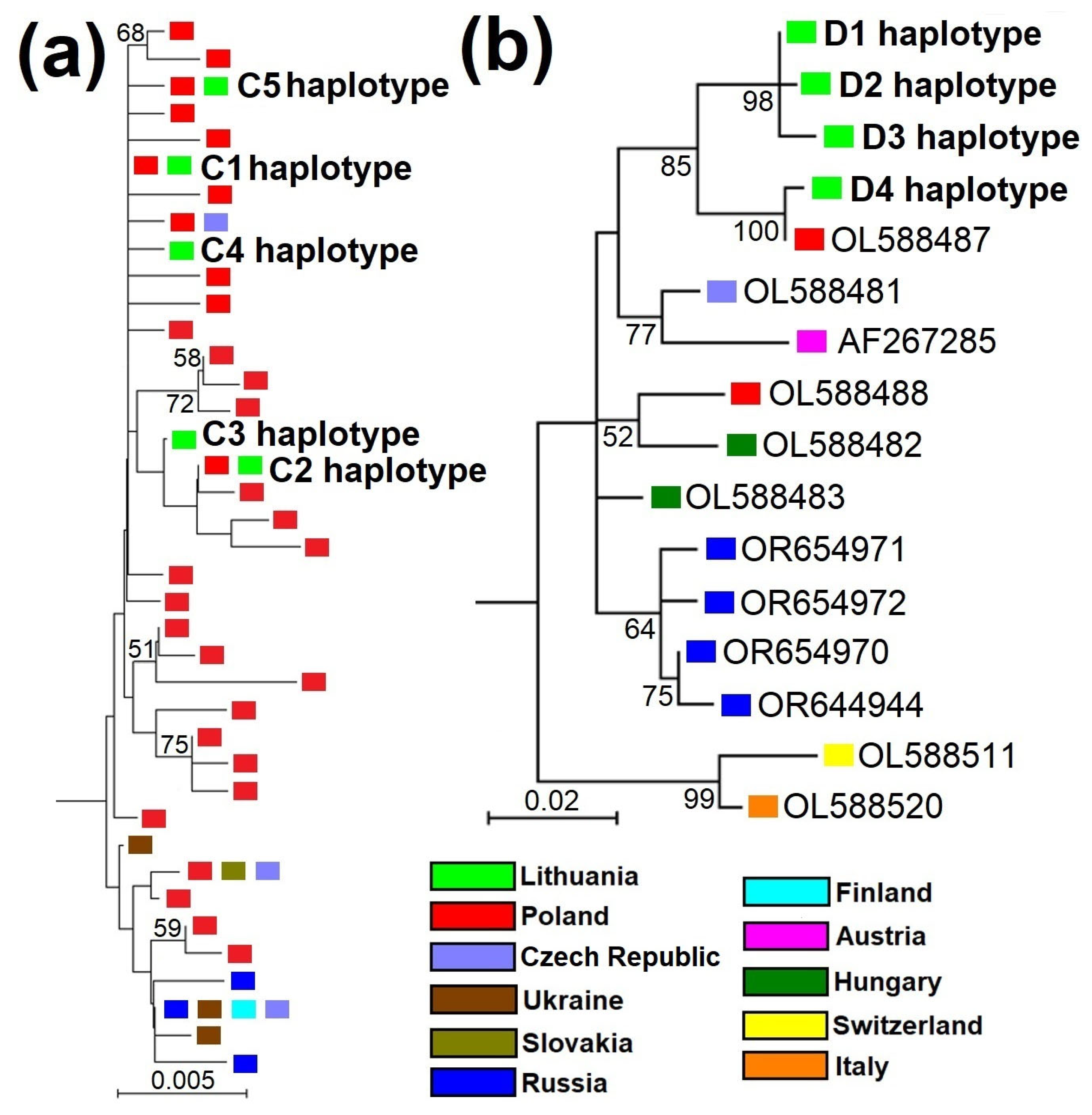
The Lithuanian haplotypes clustered within a clade dominated by Polish haplotypes, including one haplotype also reported from the Czech Republic, although phylogenetic relationships among cytb C1–C5 haplotypes were poorly supported (Figure 1a). In contrast, the D1–D4 haplotypes of the control region identified in the Lithuanian sample with a high support were placed together with OL588487 sequence from Poland. Specifically, D1–D3 formed a distinct clade, while D4 and OL588487 were sister haplotypes to this clade (Figure 1b). In control region, haplotypes from Lithuania showed high relatedness to those identified in M. arvalis from the Czech Republic, Austria, Hungary, and some samples from Russia; however, this clade, distinct from sequences from Switzerland and Italy, is poorly supported.
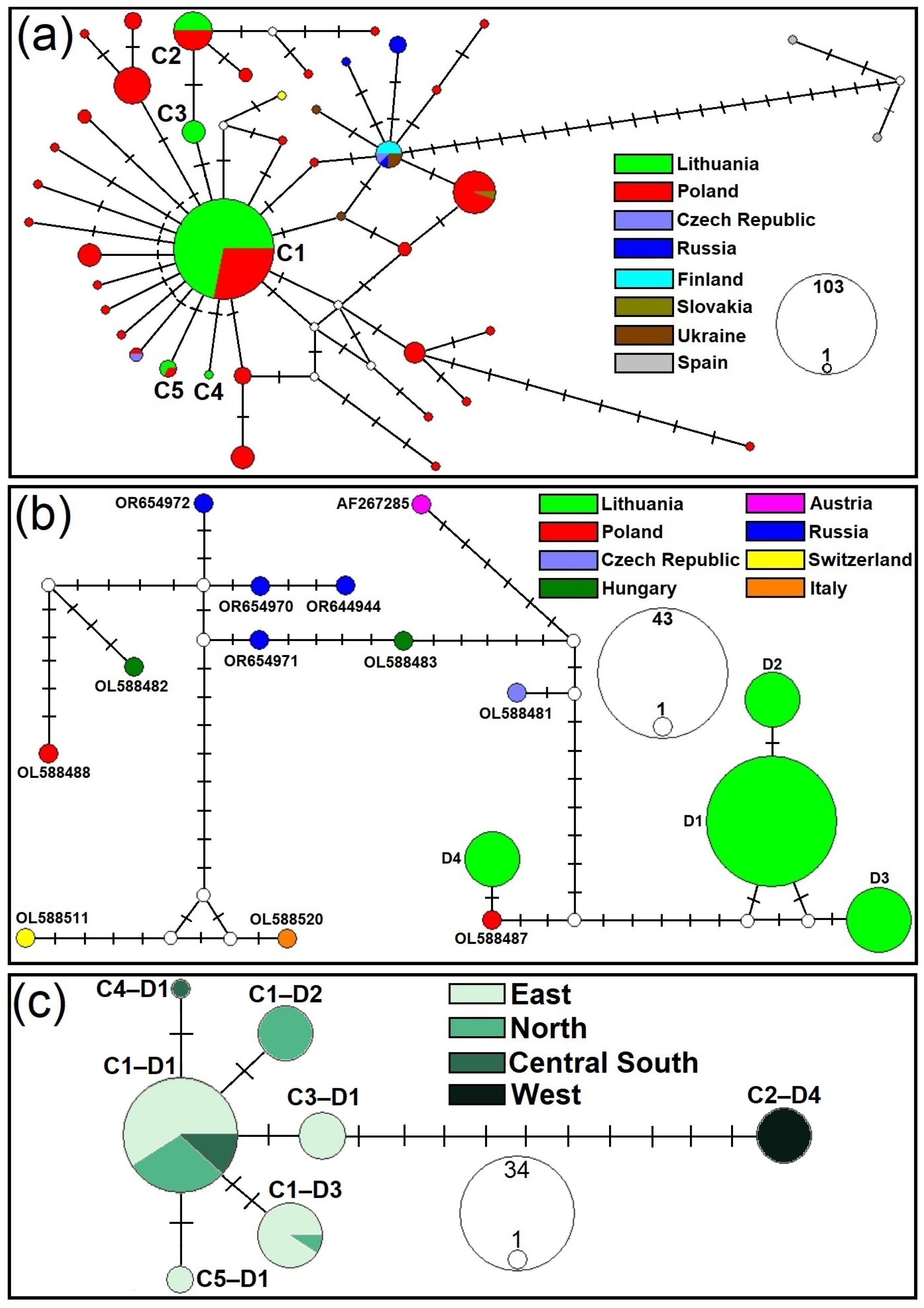
Notably, C3 and C4 cytb haplotypes, as well as all four control region haplotypes (D1–D4), were newly identified in the current study. In contrast, cytb haplotypes C1, C2, and C5 were detected in both Lithuanian and Polish samples (Figure 2a). In the haplotype network based on cytb sequences, all five haplotypes identified in the present study showed the highest genetic affinity to haplotypes from Lithuania and Poland, strongly supporting a common origin. Based on the control region analysis, two genetic groups of M. arvalis in Lithuania were confirmed by network analysis (Figure 2b). Specifically, haplotypes D1–D3 were separated from all other haplotypes by at least eight mutational steps and demonstrated the highest genetic relatedness to haplotype D4 and sequence OL588487 obtained from Poland. These two genetic variants (D4 and OL588487), in turn, differed from other European haplotypes by at least ten mutational steps. Notably, the Western Lithuanian sample was characterized exclusively by the D4 control region haplotype and the cytb C2 haplotype (Figure 2c). Thus, one of the genetic groups identified in M. arvalis from Lithuania was represented solely in the western population, whereas voles collected in eastern, northern, and central–southern Lithuania belonged to the second genetic groups.
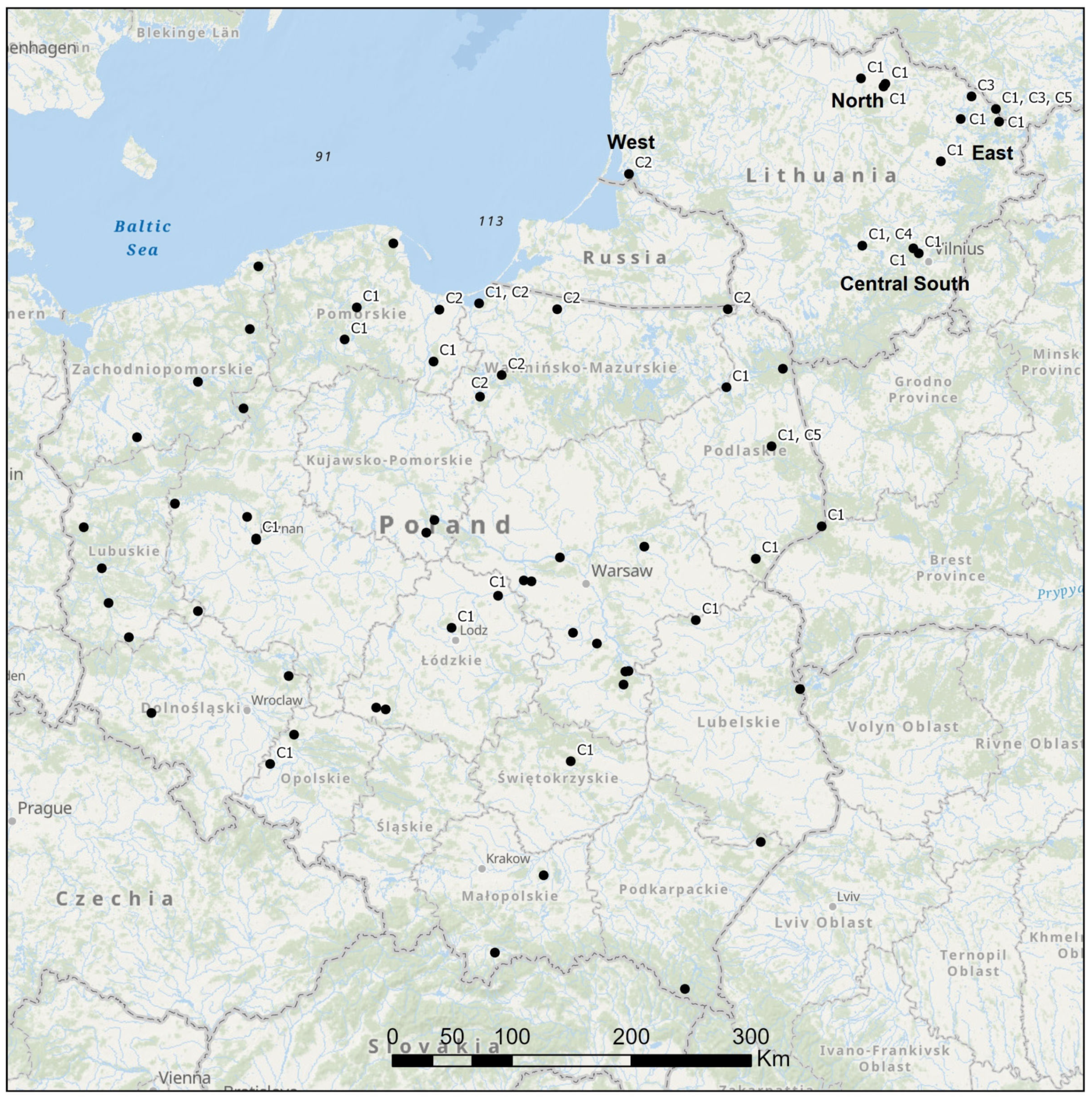
As three of five cytb haplotypes (C1, C2 and C5) identified in Lithuania were detected in Poland, a more detailed analysis was conducted to determine geographic distribution of these haplotypes within Poland. These haplotypes were identified at numerous Polish sampling sites, particularly in the northeastern part of the country (Figure 3). Overall, these haplotypes were detected in about one third of Polish sampling sites (19 of 55). The most frequent haplotype C1 was observed in 12 sites, while haplotype C2 was detected in five sites. The combinations of haplotypes, C1 + C2 and C1 + C5 were each identified in a single sampling site. Notably, haplotype C2 occurred in northern Poland, relatively close to the borders with the Kaliningrad District of Russia and Lithuania. Haplotype C5 was found at a single site in northeastern Poland, whereas haplotype C1 was distributed across several geographically distinct regions of the country.

3.3. The Inter-Population Genetic Comparison of Microtus arvalis from Lithuania

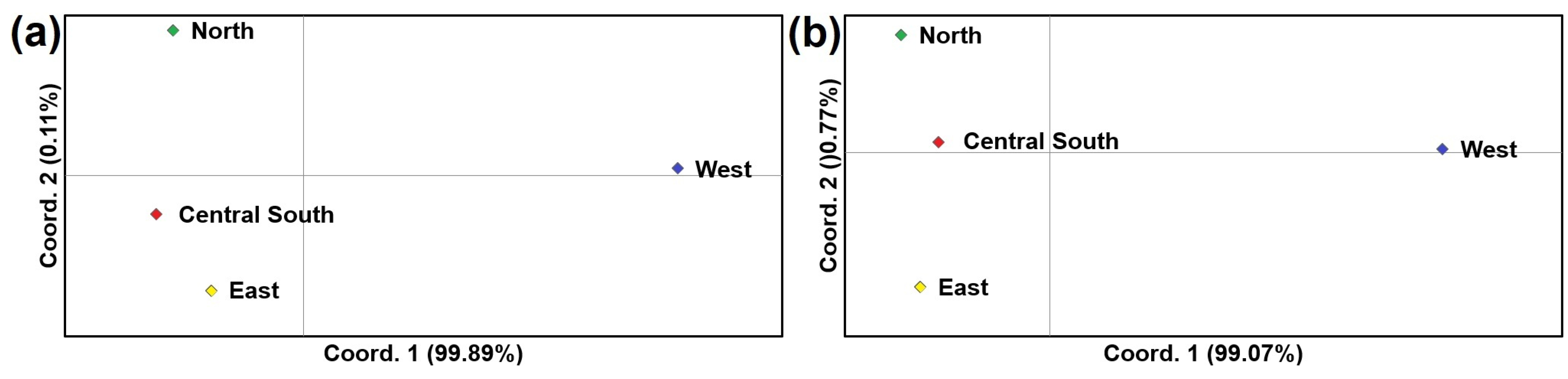
Analysis of four geographical populations, eastern (n = 59), northern (n = 19), central–southern (n = 5), and western (n = 8) of M. arvalis from Lithuania revealed extremely high and highly significant genetic differentiation, as indicated by ΦST values for both cytbST = 0.75485; p < 0.00001) and the control region (ΦST = 0.75485; p = 0.00684). A pair-wise comparison of the samples examined showed extremely high genetic differentiation between western samples as compared to three other samples (Table 4). Furthermore, based on control region high and significant genetic differentiation was observed between eastern and northern samples (ΦST = 0.23340; p = 0.00059). The principal coordinates analysis (PCoA) confirmed results of ΦST evaluation, exhibiting clear genetic distinction between the western sample and the other three samples (Figure 4).

4. Discussion

4.1. Low Mitochondrial Diversity in Lithuanian Populations

The present study revealed very low mitochondrial genetic variability of Microtus arvalis in Lithuania at both analyzed loci. Haplotype diversity for cytb (Hd = 0.330) was markedly lower than values reported for populations from Poland, Russia, Spain, France, Germany, and other European regions [4,7]. Our analysis also showed substantially lower nucleotide diversity in Lithuania (π = 0.00068), at least five times lower than those reported for other European countries (0.00363–0.01848) (Table 3). Similarly, nucleotide diversity in Lithuania was considerably lower than that reported for the Western (π = 0.0131), Eastern (π = 0.0062), Central (π = 0.0053), and Italian (π = 0.0049) lineages across Europe [2]. Higher levels of cytb diversity have been documented particularly in southern and central European regions, including France, Spain, and Bosnia and Herzegovina [2,7]. Similarly, eastern European populations, including those from Poland and Russia, display substantially higher haplotype richness and nucleotide diversity [3,4]. Analysis of the control region revealed considerably higher genetic variability in populations from Russia, Central Europe, and France compared to Lithuania (Table 3). However, this mitochondrial locus has been investigated less frequently than cytb in studies of M. arvalis [2,16,42,49], which limits broader comparisons across its geographic range.
The reduced mitochondrial variability observed in Lithuania is consistent with patterns expected in regions colonized during postglacial expansion events, where founder effects and demographic bottlenecks can reduce genetic diversity relative to refugial areas [2,13]. Ancient DNA analyses have further demonstrated that lineage persistence and demographic changes across glacial cycles were region-specific, with expansions following climatic amelioration [16]. However, it should be emphasized that Lithuania represents a relatively limited geographic area and, consequently, may encompass only a fraction of the species’ overall genetic diversity. Nevertheless, higher levels of genetic variability have been documented in several countries of similar or even smaller spatial extent (e.g., the Netherlands, Bosnia and Herzegovina, and the Czech Republic), indicating that geographic size alone cannot account for the observed patterns. Instead, the low genetic variability detected in Lithuania is more likely explained by pronounced founder effects and associated demographic bottlenecks.

4.2. Phylogenetic Affinity to Central and Eastern European Lineages

The ML phylogenetic trees and haplotype network analyses of cytb sequences placed Lithuanian haplotypes together with those previously reported from Poland, the Czech Republic, Slovakia, Finland, and parts of Russia (Figure 1 and Figure 2). This pattern is consistent with the documented distribution of the Eastern mitochondrial lineage associated with the Carpathian refugium and subsequent northward expansion [3,4]. The absence of Western or Mediterranean lineages in the Baltic region suggests recolonization from continental sources rather than from southern peninsulas. Our results therefore support the view that continental refugia, rather than southern Mediterranean refugia, played a dominant role in recolonization of northern and northeastern Europe [15].
The close relationship between Lithuanian and Polish haplotypes, particularly the shared cytb haplotypes C1, C2, and C5 (Figure 2 and Figure 3), supports a common phylogeographic origin. Stojak et al. demonstrated that the Eastern lineage expanded from the Carpathian region toward the Baltic Sea, exhibiting reduced diversity in northern populations [4]. The low variability and clustering pattern observed in Lithuania correspond with this expansion model.
Control region data further confirmed strong affinity to central European haplotypes, including sequences reported from Poland, Austria, Hungary, and the Czech Republic. Similar congruence between cytb and control region markers has been reported previously [2,9].

4.3. Evidence of Two Mitochondrial Groups Within Lithuania

The ML phylogenetic trees and haplotype network analyses based on the control region revealed two distinct genetic groups within Lithuania. One group was represented only in the western population (Rusnė) and had exclusively C2 cytb and D4 control region haplotypes, whereas the eastern, northern, and central–southern populations belonged to the second group (Figure 2c). The very high genetic differentiation between the western sample and other Lithuanian populations (ΦST > 0.88; p < 0.01 for both loci) (Table 4) indicates restricted gene flow and distinct evolutionary trajectories at a regional scale. Similar patterns of geographically structured mitochondrial variation have been described in other European regions [2,7].
Phylogeographic suture zones and lineage boundaries are well documented in central and eastern Europe [3]. The observed differentiation in western Lithuania may reflect historical colonization dynamics or secondary contact between closely related haplogroups, although all haplotypes remain within the broader Eastern lineage framework described previously [4].

4.4. Comparison with Broader Microtus Phylogeography

The placement of Lithuanian haplotypes within the M. arvalis lineage, and their clear separation from M. obscurus and M. rossiaemeridionalis (syn. = M. levis), confirm species identification. Previous studies have documented hybrid zones and mitochondrial introgression between M. arvalis and M. obscurus [17,19]. However, our mitochondrial data do not indicate the presence of obscurus-type haplotypes in Lithuanian samples.
Comparable mitochondrial structuring within M. arvalis from M. obscurus has been reported from the eastern part of the Greater Caucasus, where new cytb haplotypes were identified and regional differentiation was documented [43]. In addition, complete mitochondrial genome analyses from Central Russia further confirmed that individuals of M. arvalis from this region belong to the Eastern mitochondrial lineage [42].
Rapid radiation and high evolutionary rates within Microtus have been well established [11,20]. Despite this rapid diversification at the genus level, intraspecific mitochondrial structure within M. arvalis appears to reflect historical demographic processes rather than deep taxonomic divergence [5,6].

4.5. Implications for Postglacial Colonization in the Baltic Region

The overall pattern observed in Lithuania—low diversity, phylogenetic clustering with central and eastern European haplotypes, and strong differentiation of a western population—is consistent with postglacial recolonization from a Carpathian refugium followed by regional differentiation. This interpretation aligns with evidence supporting northern refugial contributions to present-day European diversity [2,3].
Furthermore, ancient DNA evidence demonstrates that vole populations experienced region-specific demographic histories through the Late Pleistocene and Holocene [16], supporting the notion that present-day Baltic populations represent the outcome of complex historical processes rather than simple linear expansion.
Taken together, our results integrate Lithuanian populations into the broader European phylogeographic framework of M. arvalis and provide additional evidence for the role of central and eastern Europe, including the Baltic region, in shaping postglacial biodiversity patterns.

4.6. Note on Taxonomic Framework and Citation Rationale

A brief rationale for citation choices and taxonomic framework is provided in Supplementary Note (Supplementary Note S1).

5. Conclusions

This study provides the first mitochondrial DNA assessment of M. arvalis populations in Lithuania using cytb and control region markers. Lithuanian populations exhibit very low haplotype and nucleotide diversity compared with most European populations, consistent with postglacial colonization involving founder effects and demographic bottlenecks. Phylogenetic ML and haplotype network analyses place Lithuanian haplotypes within the eastern European mitochondrial lineage, showing closest affinity to populations from Poland and central Europe, supporting northward expansion from a Carpathian refugium.
Despite the overall low diversity, two distinct mitochondrial control region groups were detected within Lithuania, with the western population displaying strong and significant genetic differentiation from eastern, northern, and central–southern populations. This pattern suggests limited maternal gene flow and regional structuring at a relatively small geographic scale. No evidence of introgression from closely related taxa, including M. obscurus, was found. Overall, Lithuanian populations reflect postglacial expansion dynamics and contribute to refining phylogeographic patterns in the Baltic region.

Supplementary Materials

The following supporting information can be downloaded at https://www.mdpi.com/article/10.3390/d18040215/s1, Table S1: GenBank accession numbers of cytb and control region sequence datasets used for intraspecific and interspecific comparisons; Supplementary Note S1: Rationale for citation choices and taxonomic framework [56,57,58,59,60,61,62,63,64,65,66,67,68,69].

Author Contributions

Conceptualization, D.B. and L.B. (Linas Balčiauskas); methodology, P.P. and D.B.; formal analysis, P.P. and D.B.; investigation, D.Š., M.J., V.S., L.B. (Laima Balčiauskienė) and L.B. (Linas Balčiauskas); resources, P.P. and D.B.; data curation, L.B. (Laima Balčiauskienė); writing—original draft preparation, P.P., L.B. (Laima Balčiauskienė) and L.B. (Linas Balčiauskas); writing—review and editing, all authors. All authors have read and agreed to the published version of the manuscript.

Funding

This research received no external funding.

Institutional Review Board Statement

Snap-trapping was justified as under dissection, we collected samples for numerous studies, including parasitological investigations, stable isotope and elemental analyses and assessment of reproductive parameters. The study was conducted in accordance with the Lithuanian (the Republic of Lithuania) Law on the Welfare and Protection of Animals No. XI-2271, “Requirements for the Housing, Care and Use of Animals for Scientific and Educational Purposes”, approved by Order No B1-866, 31 October 2012 of the Director of the State Food and Veterinary Service (Paragraph 4 of Article 16), and European legislation (Directive 2010/63/EU) on the protection of animals, approved by the Animal Welfare Committee of the State Scientific Research Institute Nature Research Centre (Nos. GGT-7 and GGT-8).

Data Availability Statement

The cytb and control region sequences of Microtus arvalis generated in the present study were submitted to the GenBank database under accession numbers repository under accession numbers PZ124696–PZ124786 and PZ124787–PZ124856, respectively.

Acknowledgments

We are grateful to Jevgenija Vaišvilienė for her assistance in molecular investigations, Ida Šaltenienė for participation in trapping, and Andrius Kučas for help with map.

Conflicts of Interest

The authors declare no conflicts of interest.

References

  1. Hewitt, G. The genetic legacy of the Quaternary ice ages. Nature 2000, 405, 907–913. [Google Scholar] [CrossRef]
  2. Tougard, C.; Renvoisé, E.; Petitjean, A.; Quéré, J.-P. New insight into the colonization processes of common voles: Inferences from molecular and fossil evidence. PLoS ONE 2008, 3, e3532. [Google Scholar] [CrossRef]
  3. Stojak, J.; McDevitt, A.D.; Herman, J.S.; Searle, J.B.; Wójcik, J.M. Post-glacial colonization of eastern Europe from the Carpathian refugium: Evidence from mitochondrial DNA of the common vole Microtus arvalis. Biol. J. Linn. Soc. 2015, 115, 927–939. [Google Scholar] [CrossRef]
  4. Stojak, J.; McDevitt, A.D.; Herman, J.S.; Kryštufek, B.; Uhlíková, J.; Purger, J.J.; Wójcik, J.M. Between the Balkans and the Baltic: Phylogeography of a common vole mitochondrial DNA lineage limited to Central Europe. PLoS ONE 2016, 11, e0168621. [Google Scholar] [CrossRef]
  5. Haynes, S.; Jaarola, M.; Searle, J.B. Phylogeography of the common vole (Microtus arvalis) with particular emphasis on the colonization of the Orkney archipelago. Mol. Ecol. 2003, 12, 951–956. [Google Scholar] [CrossRef]
  6. Jaarola, M.; Martínková, N.; Gündüz, İ.; Brunhoff, C.; Zima, J.; Nadachowski, A.; Searle, J.B. Molecular phylogeny of the speciose vole genus Microtus (Arvicolinae, Rodentia) inferred from mitochondrial DNA sequences. Mol. Phylogenet. Evol. 2004, 33, 647–663. [Google Scholar] [CrossRef] [PubMed]
  7. Fink, S.; Excoffier, L.; Heckel, G. Mitochondrial gene diversity in the common vole Microtus arvalis shaped by historical divergence and local adaptations. Mol. Ecol. 2004, 13, 3501–3514. [Google Scholar] [CrossRef] [PubMed]
  8. Bužan, E.V.; Förster, D.W.; Searle, J.B.; Kryštufek, B. A new cytochrome b phylogroup of the common vole (Microtus arvalis) endemic to the Balkans and its implications for the evolutionary history of the species. Biol. J. Linn. Soc. 2010, 100, 788–796. [Google Scholar] [CrossRef][Green Version]
  9. Borkowska, A.; Ratkiewicz, M. Sex-related spatial structure and effective population size in the common vole, Microtus arvalis, as revealed by mtDNA analysis. Ann. Zool. Fenn. 2008, 45, 255–262. [Google Scholar] [CrossRef]
  10. Barbosa, S.; Pauperio, J.; Searle, J.B.; Alves, P.C. Genetic identification of Iberian rodent species using both mitochondrial and nuclear loci: Application to noninvasive sampling. Mol. Ecol. Resour. 2013, 13, 43–56. [Google Scholar] [CrossRef]
  11. Triant, D.A.; DeWoody, J.A. Accelerated molecular evolution in Microtus (Rodentia) as assessed via complete mitochondrial genome sequences. Genetica 2006, 128, 95–108. [Google Scholar] [CrossRef]
  12. Folkertsma, R.; Westbury, M.V.; Eccard, J.A.; Hofreiter, M. The complete mitochondrial genome of the common vole, Microtus arvalis (Rodentia: Arvicolinae). Mitochondrial DNA Part B 2018, 3, 446–447. [Google Scholar] [CrossRef]
  13. Fink, S.; Fischer, M.C.; Excoffier, L.; Heckel, G. Genomic scans support repetitive continental colonization events during the rapid radiation of voles (Rodentia: Microtus): The utility of AFLPs versus mitochondrial and nuclear sequence markers. Syst. Biol. 2010, 59, 548–572. [Google Scholar] [CrossRef] [PubMed]
  14. Martínková, N.; Barnett, R.; Cucchi, T.; Struchen, R.; Pascal, M.; Pascal, M.; Searle, J.B. Divergent evolutionary processes associated with colonization of offshore islands. Mol. Ecol. 2013, 22, 5205–5220. [Google Scholar] [CrossRef] [PubMed]
  15. García, J.T.; Domínguez-Villaseñor, J.; Alda, F.; Calero-Riestra, M.; Pérez Olea, P.; Fargallo, J.A.; Martínez-Padilla, J.; Herranz, J.; Oñate, J.J.; Santamaría, A.; et al. A complex scenario of glacial survival in Mediterranean and continental refugia of a temperate continental vole species (Microtus arvalis) in Europe. J. Zool. Syst. Evol. Res. 2019, 58, 459–474. [Google Scholar] [CrossRef]
  16. Baca, M.; Popović, D.; Lemanik, A.; Bañuls-Cardona, S.; Conard, N.J.; Cuenca-Bescós, G.; Nadachowski, A. Ancient DNA reveals interstadials as a driver of common vole population dynamics during the last glacial period. J. Biogeogr. 2023, 50, 183–196. [Google Scholar] [CrossRef]
  17. Tougard, C.; Montuire, S.; Volobouev, V.; Markova, E.; Contet, J.; Aniskin, V.; Quere, J.P. Exploring phylogeography and species limits in the Altai vole (Rodentia: Cricetidae). Biol. J. Linn. Soc. 2013, 108, 434–452. [Google Scholar] [CrossRef]
  18. Golenishchev, F.; Malikov, V.; Petrova, T.; Bodrov, S.; Abramson, N. Toward assembling a taxonomic puzzle: Case study of Iranian gray voles of the subgenus Microtus (Rodentia, Cricetidae). Mamm. Biol. 2019, 94, 98–105. [Google Scholar] [CrossRef]
  19. Sibiryakov, P.A.; Tovpinets, N.N.; Dupal, T.A.; Semerikov, V.L.; Yalkovskaya, L.E.; Markova, E.A. Phylogeography of the common vole Microtus arvalis, the obscurus form (Rodentia, Arvicolinae): New data on mitochondrial DNA variability. Russ. J. Genet. 2018, 54, 1185–1198. [Google Scholar] [CrossRef]
  20. Bannikova, A.A.; Lebedev, V.S.; Lissovsky, A.A.; Matrosova, V.; Abramson, N.I.; Obolenskaya, E.V.; Tesakov, A.S. Molecular phylogeny and evolution of the Asian lineage of vole genus Microtus (Rodentia: Arvicolinae) inferred from mitochondrial cytochrome b sequence. Biol. J. Linn. Soc. 2010, 99, 595–613. [Google Scholar] [CrossRef]
  21. Lissovsky, A.A.; Petrova, T.V.; Yatsentyuk, S.P.; Golenishchev, F.N.; Putincev, N.I.; Kartavtseva, I.V.; Abramson, N.I. Multilocus phylogeny and taxonomy of East Asian voles Alexandromys (Rodentia, Arvicolinae). Zool. Scr. 2018, 47, 9–20. [Google Scholar] [CrossRef]
  22. Mahmoudi, A.; Darvish, J.; Aliabadian, M.; Yazdani Moghaddam, F.; Kryštufek, B. New insight into the cradle of the grey voles (subgenus Microtus) inferred from mitochondrial cytochrome b sequences. Mammalia 2017, 81, 583–593. [Google Scholar] [CrossRef]
  23. Mažeikytė, R.; Baranauskas, K.; Morkūnas, V.; Mickevičius, E. Distribution of the sibling vole (Microtus rossiaemeridionalis Ognev, 1924) (Rodentia, Cricetidae) in Lithuania. Acta Zool. Litu. 1999, 9, 3–15. [Google Scholar] [CrossRef]
  24. Skiriutė, D.; Paulauskas, A.; Mažeikytė, R. Isoenzyme analysis of mouse-like rodents (Rodentia, Cricetidae). Acta Zool. Litu. 2000, 10, 95–102. [Google Scholar] [CrossRef]
  25. Mahmoudi, A.; Konečný, A.; Khanalipour, F.; Barkshadi, F.B.; Sayyahi, A.; Kryštufek, B. First confirmed record of Microtus rossiaemeridionalis from Iran. Mammalia 2025, 89, 220–223. [Google Scholar] [CrossRef]
  26. Domínguez, J.C.; Alda, F.; Calero-Riestra, M.; Olea, P.P.; Martínez-Padilla, J.; Herranz, J.; Oñate, J.J.; Santamaría, A. Genetic footprints of a rapid and large-scale range expansion: The case of cyclic common vole in Spain. Heredity 2023, 130, 381–393. [Google Scholar] [CrossRef] [PubMed]
  27. Stakheev, V.V.; Khlyap, L.A.; Mironova, T.A.; Abramson, N.I.; Malygin, V.M.; Lissovsky, A.A. Geographic distribution of Microtus arvalis and Microtus rossiaemeridionalis in Eastern Europe. Russ. J. Theriol. 2023, 22, 53–61. [Google Scholar] [CrossRef]
  28. Balčiauskas, L.; Balčiauskienė, L. Small mammal diversity changes in a Baltic country, 1975–2021: A review. Life 2022, 12, 1887. [Google Scholar] [CrossRef]
  29. Prūsaitė, J. (Ed.) Lithuanian Fauna. Mammals; Mokslas: Vilnius, Lithuania, 1988; p. 295. [Google Scholar]
  30. Aljanabi, S.M.; Martinez, I. Universal and rapid salt-extraction of high-quality genomic DNA for PCR-based techniques. Nucleic Acids Res. 1997, 25, 4692–4693. [Google Scholar] [CrossRef]
  31. Prakas, P.; Butkauskas, D.; Vaišvilienė, J.; Balčiauskienė, L.; Balčiauskas, L. The Spatial Pattern of the Two Genetic Lineages of the Field Vole in Lithuania. Diversity 2022, 14, 820. [Google Scholar] [CrossRef]
  32. Prakas, P.; Butkauskas, D.; Balčiauskienė, L.; Balčiauskas, L. Low Genetic Variability of the Tundra Vole in Lithuania. Animals 2024, 14, 270. [Google Scholar] [CrossRef]
  33. Altschul, S.F.; Gish, W.; Miller, W.; Myers, E.W.; Lipman, D.J. Basic local alignment search tool. J. Mol. Biol. 1990, 215, 403–410. [Google Scholar] [CrossRef]
  34. Villesen, P. FaBox: An online toolbox for FASTA sequences. Mol. Ecol. Notes 2007, 7, 965–968. [Google Scholar] [CrossRef]
  35. Kumar, S.; Stecher, G.; Suleski, M.; Sanderford, M.; Sharma, S.; Tamura, K. MEGA12: Molecular evolutionary genetics analysis version 12 for adaptive and green computing. Mol. Biol. Evol. 2024, 41, msae263. [Google Scholar] [CrossRef] [PubMed]
  36. Bandelt, H.-J.; Forster, P.; Röhl, A. Median-joining networks for inferring intraspecific phylogenies. Mol. Biol. Evol. 1999, 16, 37–48. [Google Scholar] [CrossRef]
  37. Rozas, J.; Ferrer-Mata, A.; Sánchez-DelBarrio, J.C.; Guirao-Rico, S.; Librado, P.; Ramos-Onsins, S.E.; Sánchez-Gracia, A. DnaSP 6: DNA sequence polymorphism analysis of large data sets. Mol. Biol. Evol. 2017, 34, 3299–3302. [Google Scholar] [CrossRef]
  38. Tajima, F. Statistical method for testing the neutral mutation hypothesis by DNA polymorphism. Genetics 1989, 123, 585–595. [Google Scholar] [CrossRef]
  39. Excoffier, L.; Laval, G.; Schneider, S. Arlequin (Version 3.0): An integrated software package for population genetics data analysis. Evol. Bioinform. 2005, 1, 47–50. [Google Scholar] [CrossRef]
  40. Nei, M. Genetic distance between populations. Am. Nat. 1972, 106, 283–292. [Google Scholar] [CrossRef]
  41. Peakall, R.; Smouse, P.E. GenAlEx 6.5: Genetic analysis in Excel. Population genetic software for teaching and research—An update. Bioinformatics 2012, 28, 2537–2539. [Google Scholar] [CrossRef]
  42. Kostin, D.S.; Gromov, A.R.; Lavrenchenko, L.A. The complete mitochondrial genomes of Altai vole Microtus obscurus and common vole Microtus arvalis (Rodentia: Arvicolinae). Russ. J. Theriol. 2023, 22, 137–141. [Google Scholar] [CrossRef]
  43. Yalkovskaya, L.E.; Bolshakov, V.N.; Krokhaleva, M.A.; Gasanova, L.V.; Kuliev, G.N.; Sibiryakov, P.A.; Borodin, A.V. Genetic diversity of representatives of the genus Microtus (Arvicolinae, Rodentia): New data from the Eastern Greater Caucasus. Dokl. Biol. Sci. 2022, 502, 88–92. [Google Scholar] [CrossRef]
  44. Tkachenko, E.A.; Witkowski, P.T.; Radosa, L.; Dzagurova, T.K.; Okulova, N.M.; Yunicheva, Y.V.; Morozov, V.G.; Ivanov, L.I.; Lundkvist, Å.; Kruger, D.H. Adler hantavirus, a new genetic variant of Tula virus identified in Major’s pine voles (Microtus majori) sampled in southern European Russia. Infect. Genet. Evol. 2015, 29, 156–163. [Google Scholar] [CrossRef] [PubMed]
  45. Polat, C.; Ergünay, K.; Irmak, S.; Erdin, M.; Brinkmann, A.; Çetintaş, O.; Çoğal, M.; Sözen, M.; Matur, F.; Nitsche, A.; et al. A novel genetic lineage of Tula orthohantavirus in Altai voles (Microtus obscurus) from Turkey. Infect. Genet. Evol. 2019, 67, 150–158. [Google Scholar] [CrossRef]
  46. Chen, J.-T.; Qin, J.; Li, K.; Xu, Q.-Y.; Wang, X.-P.; Plyusnin, A.; Hou, W.; Zhang, Y.-Z. Identification and characterization of a novel subtype of Tula virus in Microtus arvalis obscurus voles from Xinjiang, China. Infect. Genet. Evol. 2019, 75, 104012. [Google Scholar] [CrossRef] [PubMed]
  47. Lavrenchenko, L.; Potapov, S.G.; Bulatova, N.; Golenishchev, F. A genetic study of natural hybridization between two forms of the common vole (Microtus arvalis) with the use of molecular and cytogenetic methods. Dokl. Biol. Sci. 2009, 426, 222–224. [Google Scholar] [CrossRef]
  48. Erdin, M.; Smura, T.; Kalkan, K.K.; Cetintas, O.; Cogal, M.; Irmak, S.; Matur, F.; Polat, C.; Sironen, T.; Sozen, M.; et al. Detection of divergent Orthohantavirus tulaense provides insight into wide host range and viral evolutionary patterns. npj Viruses 2024, 2, 62. [Google Scholar] [CrossRef]
  49. Haring, E.; Herzig-Straschil, B.; Spitzenberger, F. Phylogenetic analysis of Alpine voles of the Microtus multiplex complex using the mitochondrial control region. J. Zool. Syst. Evol. Res. 2000, 38, 231–238. [Google Scholar] [CrossRef]
  50. Fink, S.; Excoffier, L.; Heckel, G. Mammalian monogamy is not controlled by a single gene. Proc. Natl. Acad. Sci. USA 2006, 103, 10956–10960. [Google Scholar] [CrossRef]
  51. Thanou, E.; Tryfonopoulos, G.; Chondropoulos, B.; Fraguedakis-Tsolis, S. Comparative phylogeography of the five Greek vole species infers the existence of multiple South Balkan subrefugia. Ital. J. Zool. 2012, 79, 363–376. [Google Scholar] [CrossRef]
  52. Vanmechelen, B.; Meurs, S.; Horemans, M.; Loosen, A.; Joly Maes, T.; Laenen, L.; Vergote, V.; Raymond Koundouno, F.; Magassouba, N.; Kader Konde, M.; et al. The characterization of multiple novel paramyxoviruses highlights the diverse nature of the subfamily Orthoparamyxovirinae. Virus Evol. 2022, 8, veac061. [Google Scholar] [CrossRef]
  53. Bogdanov, A.S.; Khlyap, L.A.; Kefelioğlu, H.; Selcuk, A.Y.; Stakheev, V.V.; Baskevich, M.I. High molecular variability in three pine vole species of the subgenus Terricola (Microtus, Arvicolinae) and plausible source of polymorphism. J. Zool. Syst. Evol. Res. 2021, 59, 2519–2538. [Google Scholar] [CrossRef]
  54. Schmidt-Chanasit, J.; Essbauer, S.; Petraityte, R.; Yoshimatsu, K.; Tackmann, K.; Conraths, F.J.; Sasnauskas, K.; Arikawa, J.; Thomas, A.; Pfeffer, M.; et al. Extensive host sharing of central European Tula virus. J. Virol. 2010, 84, 459–474. [Google Scholar] [CrossRef] [PubMed]
  55. Liu, S.Y.; Sun, Z.Y.; Liu, Y.; Wang, H.; Guo, P.; Murphy, R.W. A new vole from Xizang, China and the molecular phylogeny of the genus Neodon (Cricetidae: Arvicolinae). Zootaxa 2012, 3235, 1–22. [Google Scholar] [CrossRef]
  56. Bulatova, N.; Golenishchev, F.; Koval’skaya, Y.; Emelyanova, L.; Bystrakova, N.; Pavlova, S.; Nadzhafova, R.S.; Lavrenchenko, L.A. Cytogenetic study of the parapatric contact zone between two 46-chromosomal forms of the common vole in European Russia. Russ. J. Genet. 2010, 46, 443–448. [Google Scholar] [CrossRef]
  57. Mazurok, N.A.; Rubtsova, N.V.; Isaenko, A.A.; Pavlova, M.; Slobodyanyuk, S.; Nesterova, T.; Zakian, S. Comparative chromosome and mitochondrial DNA analyses and phylogenetic relationships within common voles (Microtus, Arvicolidae). Chromosome Res. 2004, 12, 107–120. [Google Scholar] [CrossRef]
  58. Withnell, C.B.; Scarpetta, S.G. A new perspective on the taxonomy and systematics of Arvicolinae (Gray, 1821) and a new time-calibrated phylogeny for the clade. PeerJ 2024, 12, e16693. [Google Scholar] [CrossRef]
  59. Chaline, J.; Brunet-Lecomte, P.; Graf, J. Validation de Terricola Fatio, 1867 pour les campagnols souterrains (Arvicolidae, Rodentia) paléarctiques actuels et fossiles. C. R. Acad. Sci. Paris 1988, 306, 475–478. [Google Scholar]
  60. Barbosa, S.; Paupério, J.; Pavlova, S.; Alves, P.; Searle, J. The Microtus voles: Resolving the phylogeny of one of the most speciose mammalian genera using genomics. Mol. Phylogenet. Evol. 2018, 125, 85–92. [Google Scholar] [CrossRef]
  61. Baskevich, M.I.; Potapov, S.G.; Khlyap, L.; Okulova, N.; Ashibokov, U.M.; Grigoriev, M.P.; Dzagurova, T. Chromosomal and molecular studies of cryptic species of the subgenus Terricola (Rodentia, Arvicolinae, Microtus) in the Caucasian region: Analysis of new records. Biol. Bull. 2016, 43, 1120–1128. [Google Scholar] [CrossRef]
  62. Bogdanov, A.; Khlyap, L.; Baskevich, M.I. Differentiation and phylogenetic relationships of three pine vole species of the subgenus Terricola (Rodentia, Arvicolinae, Microtus): Results of analysis of the BRCA1 and XIST nuclear gene fragments. Biol. Bull. 2020, 47, 559–563. [Google Scholar] [CrossRef]
  63. Abramson, N.; Bodrov, S.; Bondareva, O.; Genelt-Yanovskiy, E.; Petrova, T. A mitochondrial genome phylogeny of voles and lemmings (Rodentia: Arvicolinae): Evolutionary and taxonomic implications. PLoS ONE 2021, 16, e0248198. [Google Scholar] [CrossRef]
  64. Abramson, N.; Skalon, E.K.; Bondareva, O.; Bodrov, S.; Petrova, T.V.; Dvoyashov, I.A. Resolving rapid radiation of voles and lemmings (Arvicolinae: Cricetinae, Rodentia) with QuaddRAD sequencing and transcriptome analysis. Diversity 2025, 17, 61. [Google Scholar] [CrossRef]
  65. Bulatova, N.; Potapov, S.G.; Lavrenchenko, L. Genomic versus chromosomal polytypy in studies of mitochondrial and nuclear DNA markers in the Microtus arvalis group. Russ. J. Genet. 2010, 46, 586–594. [Google Scholar] [CrossRef]
  66. Orlov, V.N.; Malygin, V.M. Two forms of 46-chromosome Microtus arvalis Pallas. In The Mammals (Evolution, Karyology, Systematics, Faunistics); Materials of the 2nd All-Union Symposium on Mammals: Novosibirsk, Russia, 1969; pp. 143–144. [Google Scholar]
  67. Golenishchev, F.N.; Meyer, M.N.; Bulatova, N.S. The hybrid zone between two karyomorphs of Microtus arvalis (Rodentia, Arvicolidae). Proc. Zool. Inst. RAS 2001, 289, 89–94. [Google Scholar]
  68. Lavrenchenko, L.A.; Gromov, A.; Martynov, A.; Kostin, D.; Komarova, V.A.; Krivonogov, D.; Cherepanova, E.V. Structure of the hybrid zone between allied species of the common vole, Microtus arvalis and M. obscurus: Influence of genetic factors and landscape-geographical conditions. Russ. J. Genet. 2024, 60, 304–315. [Google Scholar] [CrossRef]
  69. Çetintürk, D.; Yiğit, N.; Çolak, E.; Markov, G.; Ćirović, D.; Márton, M. Inferring phylogenetic relationships in the common vole (Microtus arvalis) based on mitochondrial and nuclear sequence diversities. Turk. J. Zool. 2021, 45, 117–130. [Google Scholar] [CrossRef]
Figure 1. Fragments of ML trees based on cytb (a) and control region (b) sequences displaying phylogenetic placement of haplotypes identified in Lithuania. Only different haplotypes for analyzed regions were included. HKY + I (a) and HKY + G (b) evolutionary models were set for analysis. Figures next to branches show bootstrap values greater than 50. Coloured rectangles show different samples.
Diversity 18 00215 g001
Figure 2. Median-joining haplotype networks of M. arvalis based on cytb (a) control region (b) and combined cytb and control region (c) sequences detected in this study. In the panel (c) different colours indicate four Lithuanian samples. Dashes indicate single mutational steps. Each circle is scaled according to the haplotype frequency. Hypothetical intermediate haplotypes are displayed as white circles.
Diversity 18 00215 g002
Figure 3. The geographical map of Lithuania and Poland showing collection sites of M. arvalis where cytb C1–C5 haplotypes were identified. Haplotypes in Lithuania were identified in the current work, whereas those detected in Poland were established in previous studies [3,4]. Sample sites from Lithuania were grouped into East, North, Central South, and West regions.
Diversity 18 00215 g003
Figure 4. Principal coordinate analysis (PCoA) of four geographical populations of M. arvalis from Lithuania based on Nei’s genetic distances derived from cytb (a) and control region (b) sequence data.
Diversity 18 00215 g004
Table 1. Intraspecific and interspecific genetic comparison of obtained cytb and control region sequences.
cytbControl Region
Species/Origin of SamplenSequence
Similarity, %
TN93 + G
Distance *
No. of
Difference
nSequence
Similarity, %
TN93 + G
Distance *
No. of
Difference
M. arvalis/Lithuania9199.6–1000.0010.4917097.6–1000.0062.349
M. arvalis/Finland499.5–99.70.0032.2750NDNDND
M. arvalis/Poland14697.9–1000.0053.217494.1–99.70.04815.861
M. arvalis/Czech Republic998.8–99.90.0064.497196.7–97.20.03411.429
M. arvalis/Slovakia298.9–99.10.0074.775195.5–95.70.05418.000
M. arvalis/Hungary199.0–99.30.0075.275296.2–96.80.03612.236
M. arvalis/Ukraine695.7–99.90.01711.5050NDNDND
M. arvalis/Denmark398.1–98.50.01711.6080NDNDND
M. arvalis/Serbia396.8–99.00.01711.927192.1–93.00.08326.729
M. arvalis/Netherlands3996.6–98.80.01912.9280NDNDND
M. arvalis/Germany2496.7–98.60.02718.570295.3–95.70.05618.229
M. arvalis/Italy197.3–97.70.02718.791194.4–94.80.05418.000
M. arvalis/Montenegro297.0–97.30.03020.2750NDNDND
M. arvalis/UK14096.4–97.50.03020.593291.3–93.00.09228.293
M. arvalis/Switzerland496.8–97.30.03020.599194.6–94.80.06421.000
M. arvalis/
Bosnia and Herzegovina
1696.1–97.50.03120.9000NDNDND
M. arvalis/France18396.0–98.60.03221.94013590.8–95.40.09328.504
M. arvalis/Portugal196.7–97.00.03222.2750NDNDND
M. arvalis/Spain10796.1–97.10.03423.3670NDNDND
M. arvalis/Belgium2496.7–97.00.03523.9670NDNDND
M. arvalis/Luxemburg296.7–97.00.03523.9670NDNDND
M. arvalis/Slovenia398.6–99.00.03823.6920NDNDND
M. arvalis/Georgia196.0–96.30.04227.9670NDNDND
M. arvalis/Armenia195.7–96.00.04529.9230NDNDND
M. arvalis/Russia14194.8–99.50.04731.38414691.3–96.50.08828.211
M. arvalis/China895.2–95.70.05033.0110NDNDND
M. arvalis/Austria0NDNDND195.7–96.20.04815.929
M. obscurus7395.0–96.40.04731.293691.1–92.90.09229.086
M. levis = M. rossiaemeridionalis2893.0–94.5 0.07346.3982389.3 –92.30.11535.196
M. mystacinus893.1–94.2 0.07648.2910NDNDND
M. transcaspicus992.7–93.5 0.08151.3920NDNDND
M. kermanensis292.1–92.5 0.08955.7910NDNDND
n—sample size; * genetic distance was estimated under the Tamura–Nei (TN93) model with gamma-distributed rate variation; ND—not determined. The species and origin of each sample were assigned solely according to GenBank records.
Table 2. Variable sites of M. arvalis from Lithuania in combined fragment consisting of cytb and control region. Nucleotide positions follow the sequences generated in this study, including truncated fragments. The name of the haplotype combines the names of the cytb (C1–C5) and the control region (D1–D4) haplotypes.
HaplotypeVariable Sites in cytbMutations in Control Region
862904805148078588598628878889239569609881109
C1–D1GGGTCTTTACTGAT-
C1–D2.....C........-
C1–D3...........AT.-
C2–D4AA..T.CGGTCC.CA
C3–D1A.............-
C4–D1..A...........-
C5–D1...C..........-
Table 3. Intra-population genetic diversity indices of cytb and control region sequences in M. arvalis.
Sample nhSηkHd ± SDπ ± SDTajima’s D
cytb
Lithuania915440.490840.330 ± 0.0610.00068 ± 0.00014−0.75867
UK1402841432.629500.804 ± 0.0290.00363 ± 0.00031−2.01175 *
Czech Republic9914143.611111.000 ± 0.0520.00497 ± 0.00094−1.43500
Spain1074844484.532530.970 ± 0.0080.00624 ± 0.00057−1.58773
Russia 1416385924.636070.944 ± 0.0140.00639 ± 0.00080−2.29307 **
Poland1465262675.061600.930 ± 0.0120.00697 ± 0.00053−1.80891 *
Bosnia and Herzegovina161334357.675000.967 ± 0.0360.01057 ± 0.00324−1.13606
Netherlands39731317.859650.772 ± 0.0430.01083 ± 0.002460.24924
France 1837784898.982710.894 ± 0.0200.01239 ± 0.00063−1.29133
Germany 2411363613.416670.844 ± 0.0630.01848 ± 0.001341.49430
control region
Lithuania70410112.349480.580 ± 0.0570.00558 ± 0.001070.08034
Russia 1475556694.200450.925 ± 0.0130.01138 ± 0.00162−2.06395 *
Central Europe 188394415.500001.000 ± 0.0630.04201 ± 0.00552−0.46453
France13382829916.082590.980 ± 0.0060.04358 ± 0.00180−0.36008
1 Samples from Poland, Czech Republic, Slovakia and Hungary were included. * p < 0.05, ** p < 0.01. n—sample size, h number of haplotypes, S number of polymorphic sites, η—total number of mutations, k average number of nucleotide differences, Hd the haplotype diversity, π the nucleotide diversity, SD standard deviation.
Table 4. Genetic differentiation analysis among four M. arvalis samples from Lithuania. Pairwise ΦST values were estimated based on cytb (below diagonal) and control region (above diagonal) sequences. Statistically significant ΦST values (p < 0.05) are indicated by a grey background.
EastNorth Central SouthWest
East 0.23340 **0.073650.92945 ***
North0.02448 0.153860.94565 ***
Central South0.092540.29760 0.94565 *
West0.89657 ***1.00000 **0.93934 **
* <0.01, ** <0.001, *** <0.00001.
Disclaimer/Publisher’s Note: The statements, opinions and data contained in all publications are solely those of the individual author(s) and contributor(s) and not of MDPI and/or the editor(s). MDPI and/or the editor(s) disclaim responsibility for any injury to people or property resulting from any ideas, methods, instructions or products referred to in the content.