Article

Effect of Different Algal Biofilms on the Larval Settlement of the Holothuria tubulosa Sea Cucumber (Gmelin, 1788)


1
Department of Life and Environmental Science, University of Cagliari, Via Tommaso Fiorelli 2, 09126 Cagliari, Italy
2
Marine & Freshwater Research Centre, Department of Natural Sciences, Atlantic Technologic University, H91 T8NW Galway, Ireland
3
Department of Biomedical Sciences, University of Cagliari, University Campus, S.P. 8, 09042 Monserrato, Italy
*
Author to whom correspondence should be addressed.
Diversity 2026, 18(4), 204; https://doi.org/10.3390/d18040204
Submission received: 20 February 2026 / Revised: 24 March 2026 / Accepted: 27 March 2026 / Published: 30 March 2026
(This article belongs to the Special Issue Marine Species Chemical Ecology)

Abstract

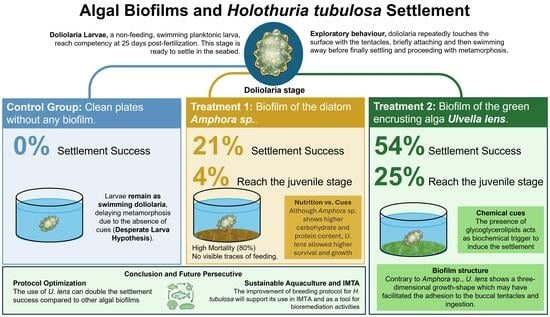
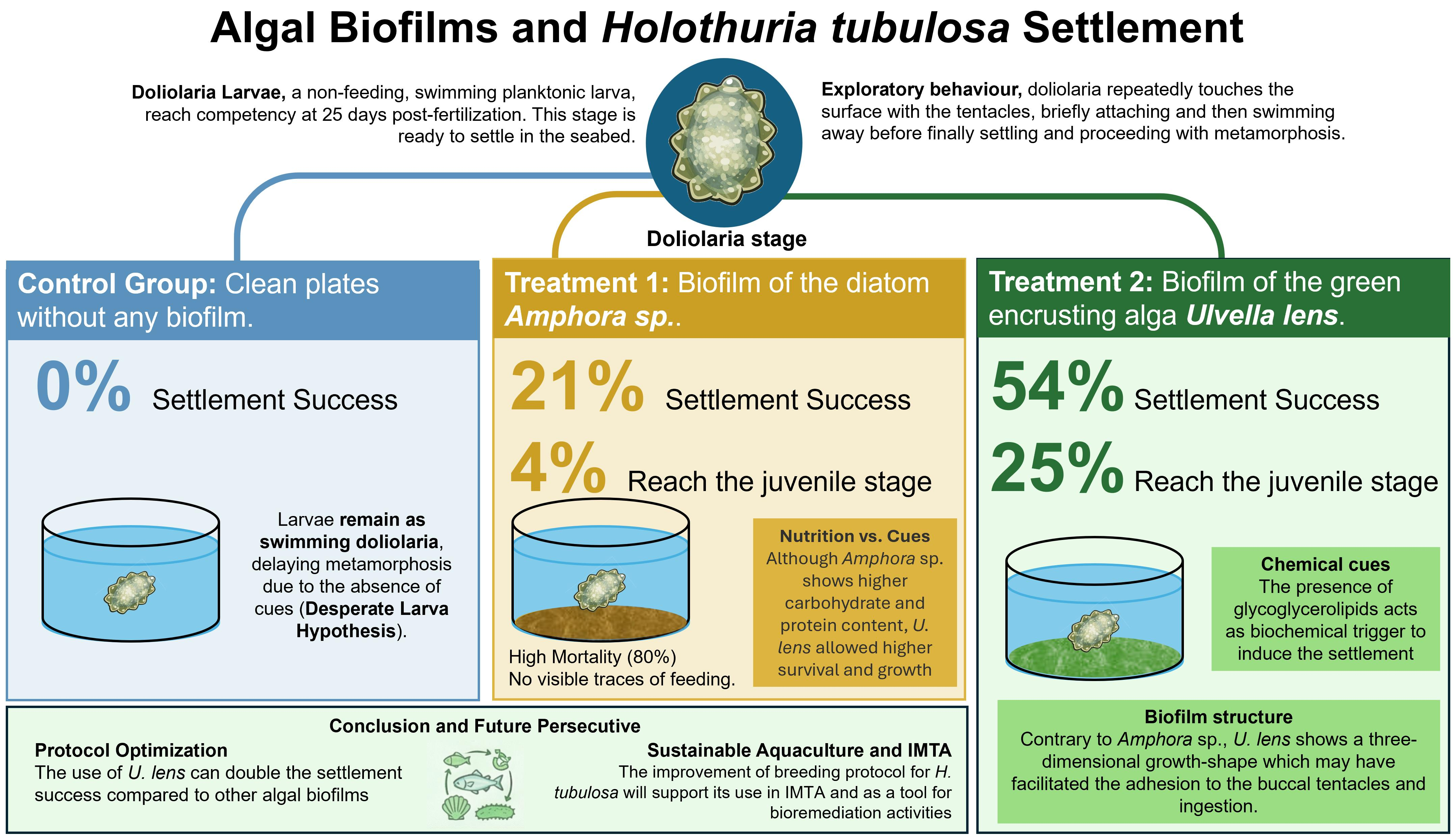
The increasing exploitation of sea cucumbers has driven widespread population declines, highlighting the need to improve knowledge and understanding of the early life history stages of exploited species such as Holothuria tubulosa, one of the most common holothurians along Mediterranean coasts. This study investigated larval settlement success and juvenile early survival of H. tubulosa larvae, considering two algal biofilms as settlement cues: the diatom Amphora sp. and the green alga Ulvella lens. Larvae were reared under controlled hatchery conditions, and, once reaching the doliolaria stage, larvae were individually exposed to biofilm-conditioned substrates vs. a control without biofilm. Settlement dynamics and larval development were monitored over 35 days and analysed using generalised linear mixed models, while the biochemical composition of the biofilms was assessed through protein, carbohydrate, and lipid quantifications. Larvae exposed to algal biofilms successfully settled and metamorphosed, whereas no settlement occurred in the control. U. lens induced the highest settlement success (54%) and supported subsequent juvenile development, while Amphora sp. resulted in lower settlement rates (21%) and higher post-settlement mortality. Although Amphora sp. showed higher protein and carbohydrate content, settlement and survival were enhanced on U. lens, suggesting that biofilm structure and biochemical cues play a primary role in regulating settlement processes. These findings improve the understanding of settlement mechanisms in H. tubulosa and provide valuable insights for hatchery production, conservation strategies, and the sustainable aquaculture of Mediterranean sea cucumbers.

Graphical Abstract

1. Introduction

The high market value of sea cucumbers and the increasing global demand for their products have driven a worldwide expansion of fisheries since the 1980s [1], leading to the overexploitation of several highly valuable species (i.e., Holothuria scabra and Apostichopus japonicus). In some cases, populations have failed to recover through natural self-recruitment [2,3]. Currently, approximately sixteen species are listed on the IUCN Red List, with nine classified as vulnerable and seven as endangered. Moreover, four species are listed in the appendices of the Convention on International Trade in Endangered Species (CITES) [4]. The delay in implementing—or absence of effective fisheries regulatory measures—has contributed to the decline of newly targeted species, including Mediterranean sea cucumbers, negatively affecting the conservation status of local wild populations [5,6,7]. In response, the Italian Ministry of Agriculture, Food, and Forestry has banned sea cucumber harvesting along the entire national coastline since 2018 [8]. Overexploitation of sea cucumber is exacerbated by intrinsic biological traits, including low recruitment rates, density-dependent reproduction, and external fertilisation, combined with the ease of capture and inadequate management practices [9,10]. Despite growing interest in Mediterranean species such as Holothuria tubulosa, key life history traits remain poorly understood [8]. Recent studies have attempted to address these gaps, particularly regarding the species’ reproductive biology [11,12,13,14,15,16] and ecological functions [17,18,19,20], whereas recruitment mechanisms and the ecological niche of early juvenile stages remain completely unknown. This paper focuses on the species H. tubulosa (Gmelin, 1788) (Echinodermata: Holothuroidea), one of the most common sea cucumbers in the shallow water of the Mediterranean Sea [8]. H. tubulosa is a broadcast spawner with external fertilisation and exhibits a single yearly reproductive period [14]. Sperm and eggs are released into the water column by the males and females, and, after the fertilisation and hatching of the eggs is achieved, the motile swimming larval cycle begins with a feeding planktonic stage called auricularia (early, mid, and late), followed by a non-feeding planktonic stage called doliolaria, in which the larvaesettles into a benthic stage called pentactula and feeds on the benthic substrate. The transition from swimming to the benthic stage is a critical phase in which larvae move from the water column to the benthic environment, with important consequences for population dynamics and ecosystem structure. The metamorphosis is typically triggered by specific environmental and chemical cues rather than occurring spontaneously (ref. [21] and references within). The settlement requires both the detection of physical or chemical cues and subsequent contact with a suitable substrate. Once larvae reach competency and are capable of cue detection, successful settlement is largely determined by the availability of appropriate substrate and the presence and concentration of relevant cues in the surrounding water. Waterborne chemical signals from conspecifics and from algal biofilm substrates can induce settlement and metamorphosis, often in large settlement events [21]. These induction cues generally operate over short distances, requiring larvae to be near their source, and settlement is completed only after physical contact with the specific substrate [21].
As in other benthic marine invertebrates, larval settlement represents a critical and complex transition regulated by anatomical change and interactions between biotic and abiotic factors operating across spatial and temporal scales [21]. Both adult echinoderms [22,23,24] and their larvae respond to environmental settlement cues that trigger metamorphosis from planktonic to benthic life stages [25,26]. Settlement is associated with the presence of a variety of cues, including waterborne signals from macroalgae, microalgae, bacterial biofilms and microbiome, and adult conspecifics [26,27]. Detection of such cues by competent larvae induces substrate attachment and irreversible metamorphosis, involving the development of settlement structures (e.g., tentacles and podia) that mark the transition to the benthic phase [26,28,29]. Several of these cues have been used to induce metamorphosis in marine invertebrates in mesocosms and as a food source for their rearing [30,31,32,33,34,35,36]. Specifically, some settlement cues for sea cucumbers include natural biofilms, seagrass extracts, and benthic diatom biofilms [11,12,37,38,39]. Once the metamorphosis is complete, post-larvae enter the juvenile stage and begin feeding on the settlement substrate.
Understanding how biofilms can drive the settlement is therefore essential for clarifying recruitment dynamics and population resilience. To investigate the interaction between larval settlement and benthic substrates, this study evaluates the effects of two algal biofilms: the diatom Amphora sp. and the green macroalgae Ulvella lens P.Crouan & H.Crouan 1859 on settlement induction and metamorphic success in H. tubulosa. We further assess the biochemical composition of these biofilms to explore whether nutritional quality influences early post-larval and juvenile survival.

2. Materials and Methods

The larval rearing and the settlement trials were carried out at the Gillalab facility (https://gillalab.it/, accessed on 20 January 2026) of the University of Cagliari, Sardinia. The facility specialises in echinoderm reproduction [40]. The trials were carried out at the purpose-built hatchery unit [41].

2.1. Plates Conditioning with Algal Biofilms

The induction of settlement and the metamorphic success were explored using two biofilms: one with Amphora sp., a benthic diatom commonly used as a settlement cue for invertebrate larvae [42,43], and the second with the green encrusting macroalgae U. lens [44,45]. Both algal strains were monospecific but not axenic and were cultured on site in 4 L of f/2 medium at a concentration of 1 mL/L. For the Amphora sp. culture, sodium metasilicate (Na2SiO3) was added at a concentration of 1 mL/L [44]. The cultures were maintained at 20 °C under a 12 h (light)/12 h (dark) photoperiod. The effect of the biofilms was compared with plates without biofilms (control).
The experimental design used multiple chamber plates (six chambers per plate; four replicates per treatment), each with a volume of 3 mL (18 mm diameter), in which algae were inoculated. The treatment Amphora sp. was inoculated in experimental chambers filled with f/2 medium supplemented with sodium metasilicate (Na2SiO3); the treatment U. lens was inoculated in chambers filled with f/2 medium containing U. lens zoospores obtained using the protocol described by Hannon et al. [45]. The plates inoculated with U. lens and Amphora sp. were incubated under ambient light at 20 °C for 15 days prior to the settlement trials to allow the growth of the algal biofilms. For the biochemical analyses of biofilms, 50 extra Petri dishes (diameter: 92 mm) for each biofilm were conditioned with the same protocol: the biofilm was collected, centrifugated, and about 15 g of wet weight of biofilm were collected and freeze-dried to be subsequently analysed.

2.2. Larval Rearing and Competency

The induction of settlement and metamorphic success (i.e., the proportion of larvae that completed metamorphosis into juveniles) was examined in full-sibling batches of H. tubulosa. Sea cucumber larvae were reared in September 2021. The larvae were bred in a 150 L tank (considering a density of 1 larva/mL) and were fed with a microalgae pabulum made of a mix of different microalgal species that included Chaetoceros calcitrans, Isochrysis galbana, and Tetraselmis suecica. The larvae were examined every three days, and their subsequent metamorphosis was observed from the early auricularia stage to the mid- and late stages. After 25 days of fertilisation, larvae reached the doliolaria stage (407.7 ± 3.2 μm) (Figure 1). All doliolaria larvae were collected from a single batch of larvae, and only those at the same stage were selected and singularly placed in the chamber. A total of 72 doliolaria were transferred individually to the experimental chambers (one doliolaria per chamber), which had been previously conditioned with the algal biofilm as described above (Supplementary Figure S1). The biofilm cover was checked under microscope, and only chambers fully covered with biofilm were used for the trial. For each treatment, we considered four replicates, each containing six chambers.
Prior to transferring the doliolaria to the plates, the medium was exchanged for seawater that had been treated with a sand filter, skimmer, ozone, and a series of cartridge filters (50, 10, 1 μm) and then UV sterilised. The plates were kept at 24 °C with a 12 h light/dark cycle, and the settlement experiment lasted 35 days, wherein clear signs of feeding were evident in the plates. Fifty per cent of the water was exchanged daily, and the larvae were observed under a stereomicroscope, by the same observer, every five days to monitor settlement progress. Settlement was considered successful when the larvae reached the pentactula stage and displayed the first tube foot (ambulacral podium) and the five anterior tentacles (Figure 1) [38,39]. When the second posterior ambulacrum appeared, the specimen was considered juvenile. This criterion was selected a priori based on our hatchery experience with Holothuria tubulosa as an indicator of the transition from larval to juvenile stage. Mortality of larvae, combined for doliolaria and pentactula, and the progress of settlement were monitored every five days by observing the morphological changes under a stereomicroscope. This interval was selected as a practical compromise to monitor larval development and survival while minimising handling stress and disturbance to the cultures. Settlement success was calculated as the ratio of settlers (pentactula and juveniles) to initial larvae, expressed as a percentage.

2.3. Biochemical Analyses of Algal Biofilms

Carbohydrate extraction and analysis were performed using the phenol–sulfuric acid method, according to Dubois et al. (1956) [46]. Briefly, 20 mg of lyophilised sample was placed in a 15 mL Falcon tube with 5 mL of HCl (1 M), sonicated in a bath for 15 min, and warmed in a hot water bath (100 °C) for 1 h. Following this, 100 µL of the sample was diluted to 1 mL with deionised water. To the water extract was added 1 mL of phenol at 5% in deionised water (w·v−1) in a 15 mL Falcon tube and vigorously shaken in a vortex for 3 min. After thorough mixing, 5 mL of H2SO4 (95.5%) was added slowly, with gentle stirring at room temperature for 30 min. The samples were then cooled in freshwater and read at 488 nm against a control blank (H2O, 5% phenol, and H2SO4). The five-point calibration curve of D-glucose (20–100 mg/L) was considered acceptable if r2 ≥ 0.997.
To determine the total lipids, as described by Chen and Vaidyanathan (2012) [47], 10 mg of lyophilised sample was suspended in 40 μL of PBS 0.05 M (pH 7.4) with 460 μL of NaOH 1 N/MeOH (75/25), and the cells were fragmented in the vortex for 10 min in the presence of glass beads. Subsequently, 1 mL of NaOH 1 N in MeOH (75/25) was added, and the resulting suspension was vortexed for 5 min. Saponification was performed by heating at 100 °C for 30 min.
The solution was cooled down to room temperature and centrifuged at 3154× g at 10 °C for 5 min to precipitate cell debris. An aliquot of 1 mL of the solution was transferred to a Falcon tube, combined with 3 mL of CHCl3/MeOH (2/1) and 0.5 mL of 0.88% KCl, vortexed, and centrifuged at 3154× g at 10 °C for 10 min to obtain three distinct phases. The total lipids were calculated by weight, evaporating 1 mL of the organic solution under a gentle nitrogen stream.
The extraction and analysis of the proteins were performed according to Lowry et al. [48], as rearranged by Rice (1982) [49]. Briefly, 10 mg of lyophilised sample was placed in a 15 mL Falcon tube with 1 mL of deionised water, vigorously shaken in a vortex (1 min), and sonicated for 3 min with 30 s intervals between each minute of sonication. After adding 0.9 mL of Solution A (2 g of Na-K tartrate and 100 g Na2CO3 anhydrous in 500 mL of 1 N NaOH diluted to 1000 mL with deionised water), the tube was shaken for 1 min and was heated in a hot water bath (50 °C) for 10 min. To each tube was added 0.1 mL of Solution B (2 g of Na-K tartrate + 1 g of CuSO4 + 90 mL of deionised water and 10 mL of 1 N NaOH), and the tube was shaken with a vortex (1 min) and left to react for 10 min at room temperature. To each tube was added 3 mL of Solution C (1 mL of Folin–Ciocalteau reagent diluted with 15 mL of deionised water), vigorously shaken for 1 min, and heated in a hot water bath (50 °C) for 10 min. Subsequently, the tubes are centrifuged for 10 min at 4000 rpm. The supernatant was analysed with a Cary 50 Varian Inc. (Palo Alto, CA, USA) spectrophotometer at 650 nm against a reagent-deionised water blank. Analytical quantification was carried out using a five-point calibration graph using BSA (bovine albumin) from 20 to 300 mg L−1. Calibration curves were considered acceptable if r2 ≥ 0.997.

2.4. Statistical Analysis

Larval development (settlement success) was analysed using generalised linear mixed-effects models (GLMMs) with a binomial error distribution. These were fitted using Laplace approximation with the lme4 package for R [50]. Three separate models were fitted to analyse: (i) the occurrence of the pentactula stage, (ii) larval mortality, and (iii) the proportion of larvae remaining in the doliolaria stage.
The full model structure was specified as:
R e s p o n s e ~ T r e a t m e n t   ×   T i m e + 1 R e p l i c a t e )
Biofilm treatment (Amphora sp., U. lens, and control) was included as a fixed factor, while time (expressed in 5-day intervals) was treated as a continuous predictor to model temporal trends. The interaction between treatment and time was included in the model. Replicate identity was included as a random intercept to account for repeated observations of the same experimental units over time. Due to the complete absence of pentactula larvae in the control treatment, analyses of the pentactula stage were restricted to the U. lens and Amphora sp. treatments.
Model diagnostics were assessed using the DHARMa package [51], which revealed no significant deviation from model assumptions. Overdispersion was evaluated based on Pearson residuals, and no evidence of extra-binomial variation was detected in any of the fitted models (dispersion ratio c.a. 1). Model significance was assessed using Wald X2 tests [52] implemented in the car package [53]. Estimated marginal means and predicted probabilities of the models were obtained using the emmeans package [54] and back-transformed to the response scale to facilitate biological interpretation and visualisation of the effects of treatment and time.
Differences in the quantity and biochemical composition (proteins, carbohydrates, and lipids) of the algal biofilms were investigated using univariate permutational analyses of variance (PERMANOVA), with species (Amphora sp. and U. lens) as the factor. PERMANOVA is a semiparametric method described as a geometric partitioning of multivariate variation in the space of a chosen dissimilarity measure according to a given ANOVA design, with p-values obtained using appropriate distribution-free permutation techniques [55]. PERMANOVA on one response variable using Euclidean distance yields the classical univariate F statistic, so that it can also be used to do univariate ANOVA, but where p-values are obtained by permutation, thus avoiding the assumption of normality [55]. PERMANOVA tests were carried out on a resemblance matrix based on the Euclidean distance of the data, using 999 random permutations of the appropriate units [55], using the routines included in the PRIMER 7+ software [56].

3. Results

3.1. Effect of Algal Biofilm on the Settlement of H. tubulosa

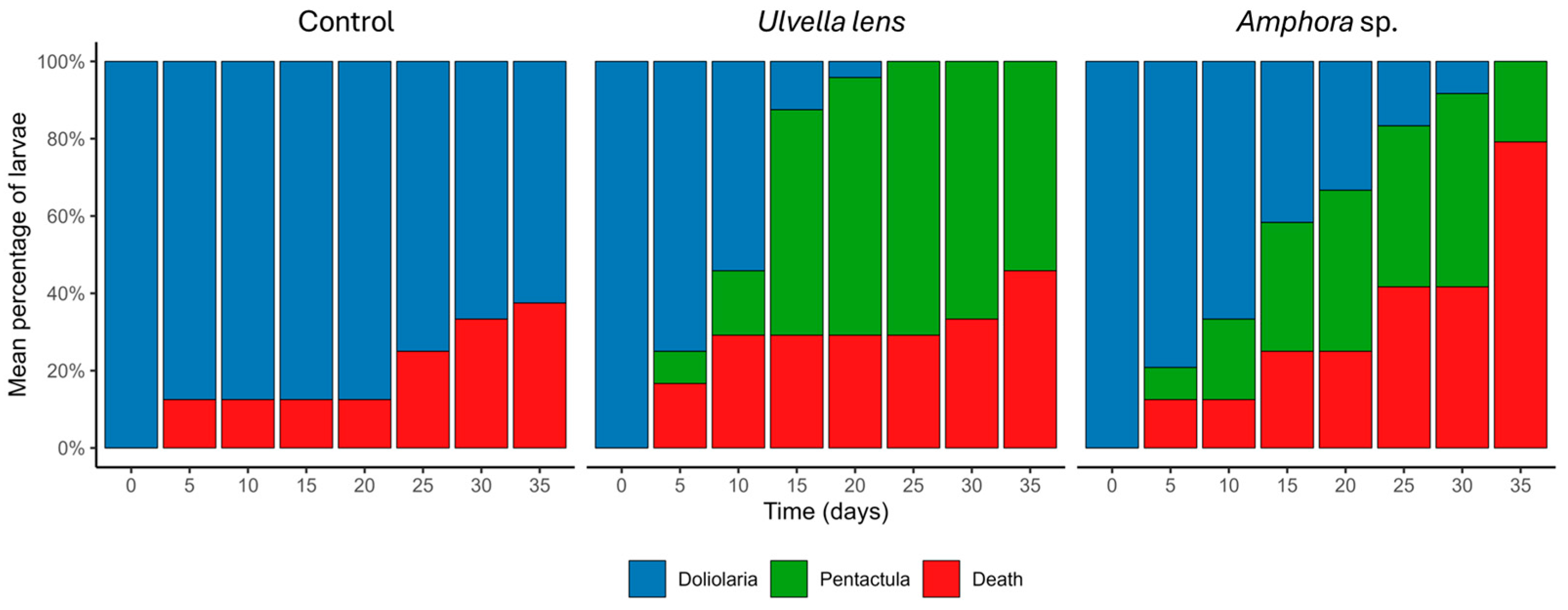
The settlement trials revealed that competent larvae are sensitive to algal biofilms, with sensitivity increasing as the experiment progressed (Figure 2). The proportion of swimming doliolaria in the treatment with both algal biofilms decreased as the larvae settled in the experimental plates (Figure 2). Specifically, the swimming doliolaria larvae first disappeared with the U. lens biofilm (after 20 days), followed by the Amphora sp. biofilm (after 30 days) (Figure 2). By contrast, 62% of the swimming doliolaria were still present and actively swimming in the control plates at the end of the experiment (Figure 2). In all treatments, except the control, where no settlement occurred, the pentactula stage was observed within five days, and their number increased until day 25 in all the treatments involving algal biofilms. However, after day 30, a reduction in the number of settled pentactula was observed, caused by the death of some post-settlers.
The success of the settlement, expressed as the percentage of the ratio between the number of settlers and the initial number of larvae, was estimated at the end of the experiment (35th day). The highest success rate was observed in the treatment with U. lens, where 54% ± 12.5 SE of the larvae underwent metamorphosis. This was followed by the Amphora sp. treatment, where 21% ± 12.5 SE of the larvae settled (Figure 2). Post-settler development was considered as the number of post-larvae reaching the juvenile stage. The best performance was observed in the treatment with U. lens, with 25% of the post-settlers reaching the juvenile stage, followed by the treatment with Amphora sp., with only 4% of juveniles. Interestingly, the highest mortality was observed in the treatment Amphora sp. (80%), whereas it was 46% and 38% in U. lens and the control, respectively. Moreover, the settlement plates with U. lens clearly showed traces of sea cucumbers feeding and their faeces, whereas no clear trace of feeding was observed in the Amphora sp. plates.
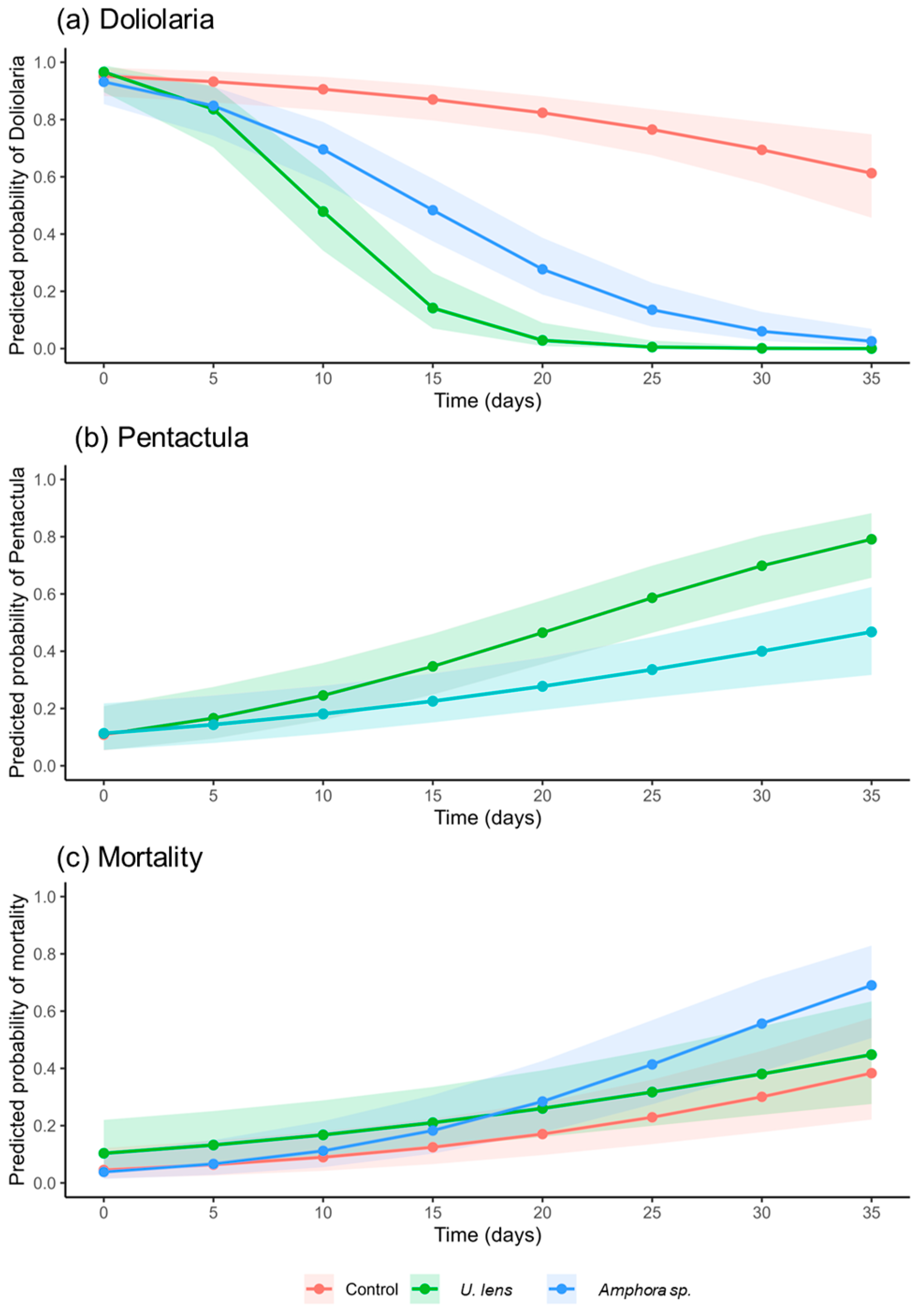
The generalised linear mixed-effects models confirmed the patterns (Figure 3). The proportion of larvae remaining in the doliolaria stage was significantly affected by both biofilm treatment and time (GLMM, Wald χ2 = 69.49 and 79.09, respectively, p < 0.001 for both). A highly significant treatment × time interaction was detected (χ2 = 28.76, p < 0.001), indicating that the temporal decline of the doliolaria stage differed markedly among treatments. Notably, larvae treated with U. lens experienced a rapid loss of the doliolaria stage, whereas doliolaria larvae persisted for longer in the control, with Amphora sp. exhibiting an intermediate pattern.
The occurrence of the pentactula stage was strongly influenced by time, with a significant increase in the probability of reaching this developmental stage over the course of the experiment (GLMM, Wald χ2 = 44.17, p < 0.001). A significant effect of biofilm treatment was also detected, indicating differences in overall pentactula occurrence between U. lens and Amphora sp. (χ2 = 5.96, p = 0.015). The interaction between treatment and time was not significant (χ2 = 3.61, p = 0.057), suggesting there were no strong treatment-specific temporal trajectories in the progression towards the pentactula stage.
Larval mortality increased significantly over time in all treatments (GLMM, Wald χ2 = 55.59, p < 0.001), indicating a strong temporal effect on survival. In contrast, no significant differences in overall mortality were observed among feeding treatments (χ2 = 3.00, p = 0.223). The interaction between treatment and time was also marginally significant (χ2 = 5.63, p = 0.060), suggesting that there were no strong treatment-specific temporal patterns in mortality dynamics.

3.2. Biochemical Composition of Algal Biofilms

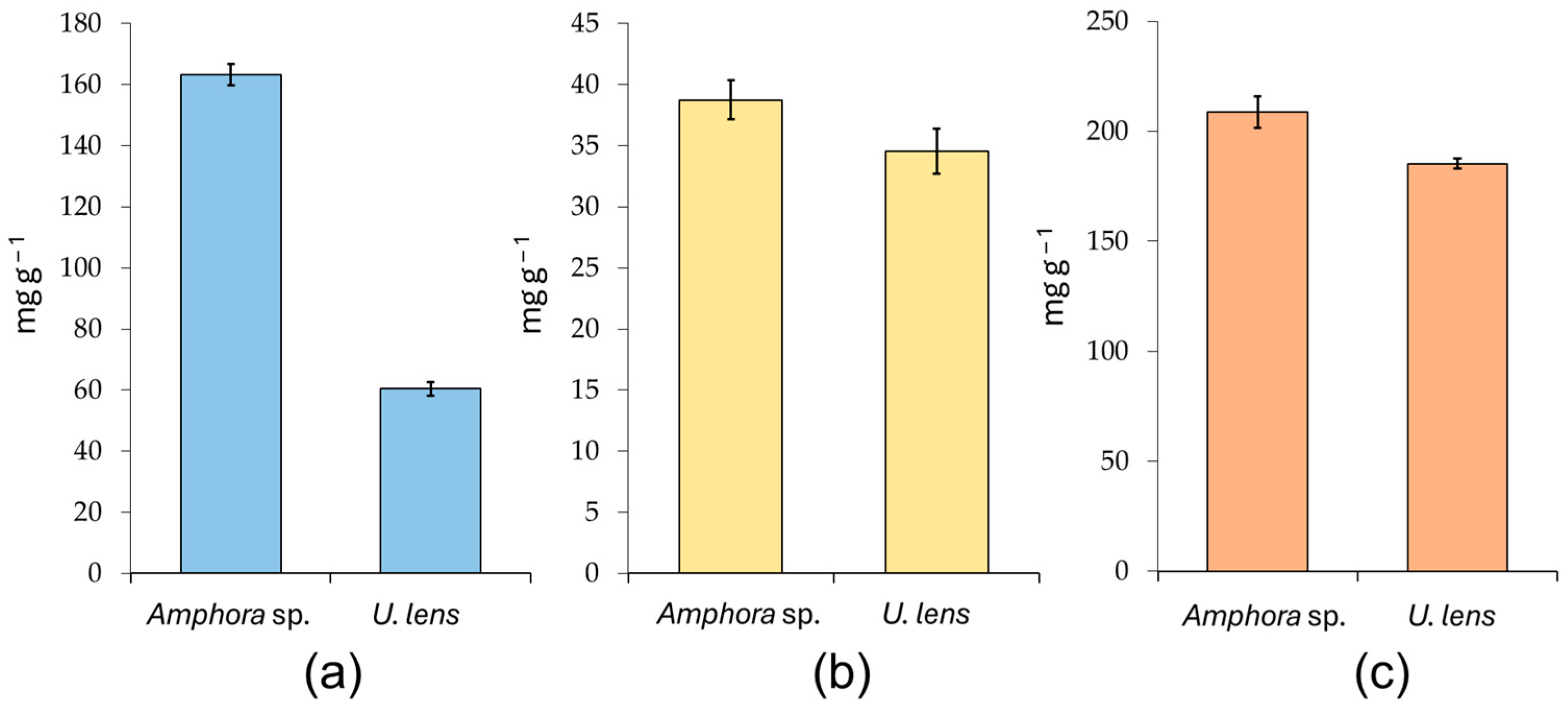
Biochemical analyses showed significant differences in the compositions of the two biofilms (Table 1). The protein content was 2.7 times higher in Amphora sp. than in U. lens, while the carbohydrate content was 1.2 times higher in Amphora sp. than in U. lens. There was no difference in the lipid content between the biofilms (Table 1, Figure 4). The biochemical composition of the dry biomass of the two biofilms was dominated by carbohydrates (21% for Amphora sp. and 19% for U. lens), followed by proteins (16% Amphora sp. and 6% U. lens) and lipids (4% Amphora sp. and 3% U. lens). Furthermore, the moisture content of the two algal biofilms was similar (5–7%), whereas the ash content was higher in U. lens (31%) than in Amphora sp. (15%).

4. Discussion

The settlement process in sea cucumbers is still poorly understood in natural environments. This is primarily due to the difficulty of locating recruits and juveniles, which are often cryptic and dispersed over large areas. Consequently, in situ observations and studies are highly challenging, and the dynamics of settlement and early growth remain largely unexplored. On the other hand, valuable sea cucumbers can be cultivated in captivity to meet consumer demand for use in Integrated Multitrophic Aquaculture (IMTA) or biotechnological applications. Ecologically, reared sea cucumbers can be used as a tool to restore benthic ecosystems, enhance sediment quality, and support nutrient cycling in degraded habitats.
Commercial-scale hatchery techniques developed for Indo-Pacific species could potentially be adapted for Mediterranean species. Nevertheless, a major bottleneck in production remains the larval settlement stage, during which the final planktonic larvae settle and undergo metamorphosis to transition to a benthic life [11,17,38,39,57,58,59,60]. Understanding and optimising this critical stage is therefore essential for improving culture practices, as it defines the baseline for the life history traits of this key ecological species and is valuable. To stimulate the settlement, sea cucumber larvae are typically exposed to natural biofilms by immersing the plate in diatoms or adding an extract of Sargassum sp. or seagrass leaves [37]. Larval settlement can also be encouraged using different surfaces such as oyster and scallop shells, which are highly effective for A. japonicus [61]. In this study, it was observed that doliolaria larvae exhibited exploratory behaviour, repeatedly touching the surface with the tentacles, briefly attaching and then swimming away before finally settling and proceeding with metamorphosis. This observation is consistent with previous observations [26,62].
The results reported in this paper showed that both algal biofilms allowed the settlement of the doliolaria and its metamorphosis into pentactula, albeit with varying degrees of success. Specifically, the best settlement performance was observed with the biofilms produced by U. lens, followed by those of Amphora sp. This set of biofilms is relatively new in terms of sea cucumber settlement induction, and the results obtained are difficult to compare with reference data from the literature. However, the U. lens biofilm has been reported to improve the settlement of other echinoderms such as the sea urchins Strongylocentrotus intermedius and Paracentrotus lividus [25,44]. The only study to explore the survival of H. tubulosa settlers and post-settlers was conducted by Rakaj et al. (2018) [39] using benthic diatoms (Navicula spp., Nitzschia spp., and Phaeodactylum tricornutum) as settlement substrates, achieving a 7% survival rate for post-settlers after 30 days. However, the authors reported that this survival rate may have been underestimated.
The settlement process is the transition between planktonic larval phase and a benthic post-larval phase, which is complex and comprises a cascade of events, including the location, exploration, and selection of suitable benthic habitat and metamorphosis to adapt from a pelagic to a benthic lifecycle. The settlement for sea cucumbers, as well as for other echinoderms, is characterised by natural high mortality [21]. The mortality observed here was significant only over time, between 40 and 80%, without the effect of treatments; however, this finding should be interpreted with caution, given the relatively small sample size and high variability. Nonetheless, this mortality rate is consistent with a previous research study on this species [38] and is corroborated by the generally high mortality rates of holothurian larvae, with only a small proportion of larvae successfully completing development and settlement [21].
A particularly interesting result obtained in this paper was that the larvae that survived on the control plates remained in the doliolaria stage throughout the experiment, and no settlement occured. This indicates that (a) the absence of biofilm will inhibit the settlement, (b) the presence of certain cues is necessary for H. tubulosa to undergo metamorphosis, and (c) larvae can delay metamorphosis when no suitable substrate is available. In the control condition, competent larvae may continue to swim and return to the water column. Similar behaviour has also been observed in Holothuria scabra, which can delay the settlement for a relatively short period (about 96 h) [63]. Stichopus californicus could even survive ten days in the absence of suitable substrate [64], and Cucumaria frondosa larvae can survive for eight days [65]. However, because doliolaria larvae are in a non-feeding stage but actively swim, as reported in a previous study, the larval size decreases due to the utilisation of endogenous resources, mainly stored in the hyaline sphere [66,67]. For this reason, settlement speed is crucial for successfully completing metamorphosis and surviving. Although we did not measure the energy depletion, the persistence of the doliolaria stage in the control plates and the different effects of the settlement biofilms, compared to the control, can be interpreted with the desperate larva hypothesis. According to this hypothesis [68], and its revision to be applicable to the non-feeding stage of the larval cycle [68], as the non-feeding stage of doliolaria continues, the larvae become “desperate” to settle, and their selectivity towards the substratum decreases. Consequently, the larvae will take the risk of settling on non-optimal substrates and performing metamorphosis rather than extending the planktonic period. As a result, the older larvae will only settle, but only in response to a minimum cue, because metamorphosing in the absence of substratum would be fatal for the post-settler that feeds [68]. The low number of juveniles in the Amphora sp. treatment (4%) suggests that, while the cues for settlement appear sufficient to induce it, they may not ensure the survival and growth of the post-settlers.
Biochemical analyses of the biofilms revealed that Amphora sp. had a higher nutritional value than U. lens in terms of protein and carbohydrate content. This suggests that settlement performance is not solely related to the nutritional characteristics of the substrate. The observed results may also be influenced by the presence of bioactive compounds acting as chemical cues that the larvae are sensitive to. Previous studies have used lipidomic approaches to identify compounds such as glycoglycerolipids, as well as surface-bound molecules, as potential mediators of settlement and metamorphosis in marine invertebrates [69,70]. In this context, the presence of glycoglycerolipids in U. lens extracts may represent a plausible contributing factor, as reported for the sea urchins Strongylocentrotus intermedius and Strongylocentrotu nudus [25]. However, these compounds were not directly identified or quantified in the present study, and their specific role as settlement cues remains to be confirmed. Another possible explanation for our results is that the different performances of the juveniles could be related to the microscopic characteristics of the biofilm. The species of diatom used in this study exhibits a growth form known as Type A, which is typically observed in Amphora angusta var. ventricosa, Navicula sp., and Nitzschia sp. [71]. This growth form is characterised by solitary cells with a prostrate form, swift gliding movement, and low adhesive strength [72]. Conversely, U. lens shows a more three-dimensional growth shape [73], which may have facilitated the adhesion to the buccal tentacles and ingestion. This assumption is also supported by the absence of visible faeces on the diatom plates, in contrast to what was observed with U. lens. However, the detailed structure and specific biochemical components of the biofilm matrix, as well as the effect of possible bacterial contamination, were not specifically investigated in the present study.
Overall, our results indicate that diatom taxa, such as those related to Amphora sp. and the green encrusting macroalgae U. lens, which are common and ecologically relevant components of Mediterranean coastal communities [74], can play an important role in promoting the settlement of H. tubulosa in natural environments. However, the observed differences in settlement cannot be fully explained by quantitative biochemical composition alone. Other factors, including the structural characteristics of the biofilm, the presence of associated bacterial communities, and potential bioactive compounds, are also likely to contribute. Clarifying these mechanisms would require targeted chemical and structural analyses, which are beyond the scope of the present study and should be addressed in future research.

5. Conclusions

Our findings demonstrate that specific environmental cues are required to trigger the settlement and metamorphosis of doliolaria larvae into the pentactula stage. Among the tested substrates, Ulvella lens induced the highest settlement success, while larvae maintained in the control, without settlement cues, remained in the doliolaria stage without performing the settlement, confirming that competent larvae can delay metamorphosis in the absence of suitable cues.
By clarifying the ecological drivers of settlement in H. tubulosa, this study contributes to a better understanding of recruitment dynamics and population persistence in exploited Mediterranean sea cucumbers. Such knowledge is essential for evidence-based resource management, conservation planning, and the development of sustainable IMTA strategies, as well as for enhancing the species’ potential role in bioremediation processes.

Supplementary Materials

The following supporting information can be downloaded at https://www.mdpi.com/article/10.3390/d18040204/s1. Supplementary Figure S1: Experimental design of the trails.

Author Contributions

Conceptualization, V.P.; methodology, V.P. and M.M.; software, V.P. and F.P.; formal analysis, V.P. and M.M.; resources, P.A.; data curation, V.P. and M.M.; writing—original draft preparation, V.P.; writing—review and editing, V.P., F.P., A.A., C.H., P.S., and P.A.; supervision, P.A. and A.A.; funding acquisition, P.A. All authors have read and agreed to the published version of the manuscript.

Funding

We acknowledge financial support under the National Recovery and Resilience Plan (NRRP), Mission 4 Component 2 Investment 1.5—Call for tender No. 3277, published on 30 December 2021 by the Italian Ministry of University and Research (MUR), funded by the European Union—NextGenerationEU; Project Code ECS0000038—Project Title eINS Ecosystem of Innovation for Next Generation Sardinia—CUP F53C22000430001—Grant Assignment Decree No. 1056, adopted on 23 June 2022 by the Italian Ministry of University and Research (MUR); and the EU co-founded project “InEVal: Increasing Echinoderm Value Chains” (grant n. ID 101 InEVal), funded by ERA-NET BlueBio programme.

Institutional Review Board Statement

Ethical review and approval was not required for the use of the sea cucumber Holothuria tubulosa larvae and post-larvae. All experimental procedures are fully compliant with European Directive 2010/63/EU concerning animal protection during the scientific research. The collection of sea cucumbers was authorised with a scientific research permit for echinoderms by Regione Autonoma della Sardegna (Prot. N. 6261, 3 May 2018; Prot. N. 1845, 6 February 2019; Prot. N. 20,735, 28 November 2019; Prot. N. 810, 31 January 2021; Prot. N. 0023,738, 3 February 2022).

Data Availability Statement

The original data presented in the study are openly available at https://github.com/vivianapasquini/dataset_Sea-Cucumber_Biochem-Analyses (accessed on the 25 March 2026) at DOI: 10.5281/zenodo.19204249.

Acknowledgments

We are thankful to Marco Secci and Marco Maxia (Agris Sardinia Agency) for their help in the field and sampling activities. The collection of sea cucumbers was authorised with a scientific research permit for echinoderms by Regione Autonoma della Sardegna (Prot. N. 6261, 3 May 2018; Prot. N. 1845, 6 February 2019; Prot. N. 20735, 28 November 2019). The authors have reviewed and edited the output and take full responsibility for the content of this publication.

Conflicts of Interest

The authors declare no conflicts of interest.

References

  1. Purcell, S.W.; Mercier, A.; Conand, C.; Hamel, J.-F.; Toral-Granda, M.V.; Lovatelli, A.; Uthicke, S. Sea cucumber fisheries: Global analysis of stocks, management measures and drivers of overfishing. Fish Fish. 2013, 14, 34–59. [Google Scholar] [CrossRef] [Scilit]
  2. Friedman, K.; Eriksson, H.; Tardy, E.; Pakoa, K. Management of sea cucumber stocks: Patterns of vulnerability and recovery of sea cucumber stocks impacted by fishing. Fish Fish. 2011, 12, 75–93. [Google Scholar] [CrossRef] [Scilit]
  3. Ramírez-González, J.; Moity, N.; Andrade-Vera, S.; Reyes, H. Overexploitation and More Than a Decade of Failed Management Leads to No Recovery of the Galápagos Sea Cucumber Fishery. Front. Mar. Sci. 2020, 7, 554314. [Google Scholar] [CrossRef] [Scilit]
  4. Conand, C.; Polidoro, B.; Mercier, A.; Gamboa, R.; Hamel, J.F.; Purcell, S. The IUCN Red List assessment of aspidochirotid sea cucumbers and its implications. SPC Beche-De-Mer Inf. Bull. 2014, 34, 3–7. [Google Scholar]
  5. Gonzàlez-Wangüemert, M.; Valente, S.; Aydin, M. Effects of fishery protection on biometry and genetic structure of two target sea cucumber species from the Mediterranean Sea. Hydrobiologia 2015, 743, 65–74. [Google Scholar] [CrossRef] [Scilit]
  6. González-Wangüemert, M.; Domínguez-Godino, J.A.; Cánovas, F. The fast development of sea cucumber fisheries in the Mediterranean and NE Atlantic waters: From a new marine resource to its over-exploitation. Ocean Coast. Manag. 2018, 151, 165–177. [Google Scholar] [CrossRef] [Scilit]
  7. Dereli, H.; Aydin, M. Sea cucumber fishery in Turkey: Management regulations and their efficiency. Reg. Stud. Mar. Sci. 2021, 41, 101551. [Google Scholar] [CrossRef] [Scilit]
  8. Pasquini, V.; Giglioli, A.A.; Pusceddu, A.; Addis, P. Biology, ecology and management perspectives of overexploited deposit-feeders sea cucumbers, with focus on Holothuria tubulosa (Gmelin, 1788). Adv. Oceanogr. Limnol. 2021, 12, 9995. [Google Scholar] [CrossRef] [Scilit]
  9. Kinch, J.; Purcell, S.; Uthicke, S.; Friederich, K. Population status, fisheries and trade of sea cucumbers in the Western Central Pacific. In Sea Cucumbers: A Global Review of Fisheries and Trade; Toral-Granda, M.V., Lovatelli, A., Vasconcellos, M., Eds.; FAO Fisheries and Aquaculture Technical Paper; FAO: Rome, Italy, 2008; Volume 516, pp. 7–55. [Google Scholar]
  10. Purcell, S.W. Managing Sea Cucumber Fisheries with an Ecosystem Approach; Lovatelli, A., Vasconcellos, M., Yimin, Y., Eds.; FAO Fisheries and Aquaculture Technical Paper No. 520; FAO: Rome, Italy, 2010; 157p. [Google Scholar]
  11. Domínguez-Godino, J.A.; González-Wangüemert, M. Breeding and larval development of Holothuria mammata, a new target species for aquaculture. Aquac. Res. 2018, 49, 1430–1440. [Google Scholar] [CrossRef] [Scilit]
  12. Domínguez-Godino, J.A.; Slater, M.J.; Hannon, C.; González-Wangüermert, M. A new species for sea cucumber ranching and aquaculture: Breeding and rearing of Holothuria arguinensis. Aquaculture 2015, 438, 122–128. [Google Scholar] [CrossRef] [Scilit]
  13. Marquet, N.; Conand, C.; Power, D.M.; Canário, A.V.; González-Wangüemert, M. Sea cucumbers, Holothuria arguinensis and H. mammata, from the southern Iberian Peninsula: Variation in reproductive activity between populations from different habitats. Fish. Res. 2017, 191, 120–130. [Google Scholar] [CrossRef] [Scilit]
  14. Pasquini, V.; Porcu, C.; Marongiu, M.F.; Follesa, M.C.; Giglioli, A.A.; Addis, P. New insights upon the reproductive biology of the sea cucumber Holothuria tubulosa (Echinodermata, holothuroidea) in the Mediterranean: Implications for management and domestication. Front. Mar. Sci. 2022, 9, 1029147. [Google Scholar] [CrossRef] [Scilit]
  15. Gerçeklioğlu, B.; Tolon, M.T. Inspection of Gonadal Maturation in Mediterranean Sea Cucumber (Holothuria tubulosa Gmelin 1791) Under a Constant Temperature Regime. Fishes 2025, 10, 560. [Google Scholar] [CrossRef] [Scilit]
  16. Engin, S.; Tolon, M.T.; Günay, D.; Emiroğlu, D. Reproductive cycle of the temperate sea cucumber Holothuria tubulosa in the northeastern Aegean Sea. Mar. Coast. Fish. 2024, 16, e10307. [Google Scholar] [CrossRef] [Scilit]
  17. Tolon, M.T.; Emiroglu, D.; Gunay, D.; Ozgul, A. Sea cucumber (Holothuria tubulosa Gmelin, 1790) culture under marine fish net cages for potential use in integrated multi- trophic aquaculture (IMTA). Indian J. Geo Mar. Sci. 2017, 46, 749–756. [Google Scholar]
  18. Abyaba, H.; Pasquini, V.; Ennas, C.; Addis, P.; Pusceddu, A. Organic matter ingestion and assimilation rates by the sea cucumber Holothuria (Holothuria) tubulosa (Gmelin, 1788) at different temperatures and potential effects on benthic trophic status. Mar. Environ. Res. 2025, 203, 106830. [Google Scholar] [CrossRef] [Scilit] [PubMed]
  19. Ennas, C.; Pasquini, V.; Abyaba, H.; Addi, P.; Sarà, G.; Pusceddu, A. Sea cucumbers bioturbation potential outcomes on marine benthic trophic status under different temperature regimes. Sci. Rep. 2023, 13, 11558. [Google Scholar] [CrossRef] [Scilit] [PubMed]
  20. Pasquini, V.; Addis, P.; Giglioli, A.A.; Moccia, D.; Pusceddu, A. Outcomes of feeding activity of the sea cucumber Holothuria tubulosa on quantity, biochemical composition, and nutritional quality of sedimentary organic matter. Front. Mar. Sci. 2023, 9, 1010014. [Google Scholar] [CrossRef] [Scilit]
  21. Doll, P.C.; Caballes, C.F.; Hoey, A.S.; Uthicke, S.; Ling, S.D.; Pratchett, M.S. Larval settlement in echinoderms: A review of processes and patterns. In Oceanography and Marine Biology an Annual Review; CRC Press: Boca Raton, FL, USA, 2022; Volume 60, pp. 433–494. [Google Scholar] [CrossRef] [Scilit]
  22. Solari, P.; Pasquini, V.; Secci, M.; Giglioli, A.A.; Crnjar, R.; Addis, P. Chemosensitivity in the sea urchin Paracentrotus lividus (Echinodermata: Echinoidea) to food-related compounds: An innovative behavioral bioassay. Front. Ecol. Evol. 2021, 9, 749493. [Google Scholar] [CrossRef] [Scilit]
  23. Addis, P.; Pasquini, V.; Angioni, A.; Malavasi, V.; Moccia, D.; Solari, P. Ulva as potential stimulant and attractant for a valuable sea urchin species: A chemosensory study. J. Appl. Phycol. 2023, 35, 1407–1415. [Google Scholar] [CrossRef] [Scilit]
  24. Solari, P.; Sollai, G.; Pasquini, V.; Giglioli, A.; Crnjar, R.; Addis, P. Blue-Green Algae as Stimulating and Attractive Feeding Substrates for a Mediterranean Commercial Sea Urchin Species, Paracentrotus lividus. Life 2023, 13, 1510. [Google Scholar] [CrossRef] [Scilit]
  25. Takahashi, Y.; Itoh, K.; Ishii, M.; Suzuki, M.; Itabashi, Y. Induction of larval settlement and metamorphosis of the sea urchin Strongylocentrotus intermedius by glycoglycerolipids from the green alga Ulvella lens. Mar. Biol. 2002, 140, 763–771. [Google Scholar] [CrossRef] [Scilit]
  26. Mos, B.; Cowden, K.L.; Nielsen, S.J.; Dworjanyn, S.A. Do cues matter? Highly inductive settlement cues don’t ensure high post-settlement survival in sea urchin aquaculture. PLoS ONE 2011, 6, e28054. [Google Scholar] [CrossRef] [Scilit]
  27. Dworjanyn, S.A.; Pirozzi, I. Induction of settlement in the sea urchin Tripneustes gratilla by macroalgae, biofilms, and con-specifics: A role for bacteria? Aquaculture 2008, 274, 268–274. [Google Scholar] [CrossRef] [Scilit]
  28. Hadfield, M.G.; Paul, V.J. Natural chemical cues for settlement and metamorphosis of marine invertebrate larvae. In Marine Chemical Ecology; McClintock, J.B., Baker, B.J., Eds.; CRC Press: Boca Raton, FL, USA, 2001; pp. 431–461. [Google Scholar]
  29. Nontunha, N.; Tinikul, R.; Chaichotranunt, S.; Tanes, P.; Sobhon, P.; Tinikul, Y. The presence and distribution of gamma-aminobutyric acid and dopamine during the developmental stages of the sea cucumber, Holothuria scabra, with emphasis on settlement organs. Cell Tissue Res. 2023, 391, 457–483. [Google Scholar] [CrossRef] [Scilit] [PubMed]
  30. Devakie, M.N.; Ali, A.B. Effective use of plastic sheet as substrate in enhancing tropical oyster (Crassostrea iredalei Faustino) larvae settlement in the hatchery. Aquaculture 2002, 212, 277–287. [Google Scholar] [CrossRef] [Scilit]
  31. Avendano-Herrera, R.; Riquelmes, C.; Silva, F.; Avendanod, M.; Irgang, R. Optimization of settlement of larval Argopecten purpuratus using natural diatom biofilms. J. Shellfish Res. 2003, 22, 393–399. [Google Scholar]
  32. Zhao, B.; Zhang, S.; Qian, P.Y. Larval settlement of the silver- or goldlip pearl oyster Pinctada maxima (Jameson) in response to natural biofilms and chemical cues. Aquaculture 2003, 220, 883–901. [Google Scholar] [CrossRef] [Scilit]
  33. Kang, K.H.; Kim, B.H.; Kim, J.M. Induction of larval settlement and metamorphosis of the abalone, Haliotis discus hannai larvae using bromomethane and potassium chloride. Aquaculture 2004, 230, 249–259. [Google Scholar] [CrossRef] [Scilit]
  34. Su, Z.X.; Huang, L.M.; Yan, Y.; Li, H. The effect of different substrates on pearl oyster Pinctada martensii (Dunker) larvae settlement. Aquaculture 2007, 271, 377–383. [Google Scholar] [CrossRef] [Scilit]
  35. Leyton, Y.E.; Riquelme, C.E. Use of specific bacterial-microalgal biofilms for improving the larval settlement of Argopecten purpuratus (Lamarck, 1819) on three types of artificial spat-collecting materials. Aquaculture 2008, 276, 78–82. [Google Scholar] [CrossRef] [Scilit]
  36. Yu, X.J.; He, W.H.; Gu, J.D.; He, M.X.; Yan, Y. The effect of chemical cues on settlement of pearl oyster Pinctada fucata martensii (Dunker) larvae. Aquaculture 2008, 277, 83–91. [Google Scholar] [CrossRef] [Scilit]
  37. Agudo, N. Sandfish Hatchery Techniques; Australian Centre for International Agricultural Research: Forrest, Australia; Secretariat of the Pacific Community and WorldFish Center: Noumea, New Caledonia, 2006; 45p.
  38. Rakaj, A.; Fianchini, A.; Boncagni, P.; Lovatelli, A.; Scardi, M.; Cataudella, S. Spawning and rearing of Holothuria tubulosa: A new candidate for aquaculture in the Mediterranean region. Aquacult. Res. 2017, 49, 557–568. [Google Scholar] [CrossRef] [Scilit]
  39. Rakaj, A.; Fianchini, A.; Boncagni, P.; Scardi, M.; Cataudella, S. Artificial reproduction of Holothuria polii: A new candidate for aquaculture. Aquaculture 2018, 498, 444–453. [Google Scholar] [CrossRef] [Scilit]
  40. Giglioli, A.A.; Addis, P.; Pasquini, V.; Secci, M.; Hannon, C. First assessment of restocking efficacy of the depleted sea urchin Paracentrotus lividus populations in two contrasted sites. Aquac. Res. 2021, 52, 2896–2900. [Google Scholar] [CrossRef] [Scilit]
  41. Pani, S.M.; Coroneo, V.; Pasquini, V.; Sanna, A.; Addis, P. Microbiological characterization of a rearing system for the common sea urchin Paracentrotus lividus: A support to technical production regulations redaction and system monitoring. Food Qual. Saf. 2024, 8, fyae012. [Google Scholar] [CrossRef] [Scilit]
  42. Ito, S.; Kitamura, H. Induction of larval metamorphosis in the sea cucumber Stichopus japonicus by periphitic diatoms. Hydrobiologia 1997, 358, 281–284. [Google Scholar] [CrossRef] [Scilit]
  43. Daume, S.; Krsinich, A.; Ferrell, S.; Gervis, M. Settlement, early growth and survival of Haliotis rubra in response to different algal species. J. Appl. Phycol. 2000, 12, 479–488. [Google Scholar] [CrossRef] [Scilit]
  44. Hannon, C.; Officier, R.A.; Chamberlain, J. Evaluation of the efficacy of algal-conditioned substrates for inducing settlement of Paracentrotus lividus larvae. Aquac. Res. 2017, 48, 1968–1973. [Google Scholar] [CrossRef] [Scilit]
  45. Hannon, C.; Officer, R.A.; Le Dorven, J.; Chamberlain, J. Culture methods of live algal feeds for European aquaculture: Optimising culture conditions for Ulvella lens. Aquac. Int. 2014, 22, 1813–1822. [Google Scholar] [CrossRef] [Scilit]
  46. Dubois, M.; Gilles, K.A.; Hamilton, J.K.; Rebers, P.A.; Smith, F. Colorimetric Method for Determination of Sugars and Related Substances. Anal. Chem. 1956, 28, 350–356. [Google Scholar] [CrossRef] [Scilit]
  47. Chen, Y.; Vaidyanathan, S. A simple, reproducible and sensitive spectrophotometric method to estimate microalgal lipids. Anal. Chim. Acta 2012, 724, 67–72. [Google Scholar] [CrossRef] [Scilit]
  48. Lowry, O.H.; Rosebrough, N.J.; Farr, A.L.; Randall, R.J. Protein measurement with the Folin phenol reagent. J. Biol. Chem. 1951, 193, 265–275. [Google Scholar] [CrossRef] [Scilit]
  49. Rice, D.L. The detritus nitrogen problem: New observations and perspectives from organic geochemistry. Mar. Ecol. Prog. Ser. 1982, 9, 153–162. [Google Scholar] [CrossRef] [Scilit]
  50. Bates, D.; Maechler, M.; Bolker, B.; Walker, S. Fitting linear mixed-effects models using lme4. J. Stat. Softw. 2015, 67, 1–48. [Google Scholar] [CrossRef] [Scilit]
  51. Hartig, F. R Package, version 0.4.1; DHARMa: Residual Diagnostics for Hierarchical (Multi-Level/Mixed) Regression Models; The Comprehensive R Archive Network (CRAN): Vienna, Austria, 2021. [Google Scholar]
  52. Bolker, B.M.; Brooks, M.E.; Clark, C.J.; Geange, S.W.; Poulsen, J.R.; Stevens, M.H.; White, J.S. Generalized linear mixed models: A practical guide for ecology and evolution. Trends Ecol. Evol. 2009, 24, 127–135. [Google Scholar] [CrossRef] [Scilit]
  53. Fox, J.; Weisberg, S. An R Companion to Applied Regression, 3rd ed.; Sage Publishing: Thousand Oaks, CA, USA, 2019. [Google Scholar]
  54. Lenth, R.; Singmann, H.; Love, J.; Buerkner, P.; Herve, M. R Package, Version 1.6.0; Emmeans: Estimated Marginal Means; The Comprehensive R Archive Network (CRAN): Vienna, Austria, 2021.
  55. Anderson, M.J. Permutational multivariate analysis of variance (PERMANOVA). In Wiley StatsRef: Statistics Reference Online; Balakrishnan, N., Colton, T., Everitt, B., Piegorsch, W., Ruggeri, F., Teugels, J.L., Eds.; Wiley: Hoboken, NJ, USA, 2017; pp. 1–15. [Google Scholar]
  56. Anderson, M.; Gorley, R.; Clarke, K. PERMANOVA+ for Primer: Guide to Software and Statistical Methods; PRIMER-E: Plymouth, UK, 2008; Volume 214. [Google Scholar]
  57. Laguerre, H.; Raymond, G.; Plan, P.; Améziane, N.; Bailly, X.; Le Chevalier, P. First description of embryonic and larval development, juvenile growth of the black seacucumber Holothuria forskali (Echinodermata: Holothuroidea), a new species for aquaculture in the north-eastern Atlantic. Aquaculture 2020, 521, 734961. [Google Scholar] [CrossRef] [Scilit]
  58. Schagerström, E.; Christophersen, G.; Sunde, J.; Snorre Bakke, S.; Matusse, N.R.; Dupont, S.; Sundell, K.S. Controlled spawning and rearing of the sea cucumber, Parastichopus tremulus. J. World Aquac. Soc. 2021, 53, 224–240. [Google Scholar] [CrossRef] [Scilit]
  59. Cheng, C.; Wu, F.; Ren, C.; Jiang, X.; Zhang, X.; Li, X.; Luo, P.; Hu, C.; Chen, T. Aquaculture of the tropical sea cucumber, Stichopus monotuberculatus: Induced spawning, detailed records of gonadal and embryonic development, and improvements in larval breeding by digestive enzyme supply in diet. Aquaculture 2021, 540, 736690. [Google Scholar] [CrossRef] [Scilit]
  60. Günay, D.; Tolon, M.T.; Emiroğlu, D. Effects of various stocking densities on hatching and survival rates of sea cucumber Holothuria tubulosa eggs (Gmelin, 1788). Ege J. Fish. Aquat. Sci. 2018, 35, 381–386. [Google Scholar] [CrossRef] [Scilit]
  61. Ru, X.; Feng, Q.; Zhang, S.; Liu, S.; Zhang, L.; Yang, H. Eco-friendly method forrearing sea cucumber (Apostichopus japonicus) larvae. Aquac. Res. 2022, 53, 3759–3766. [Google Scholar] [CrossRef] [Scilit]
  62. Scheibling, R.E.; Robinson, M.C. Settlement behavior and early post-settlement predation of the sea urchin Strongylocentrotus droebachiensis. J. Exp. Mar. Biol. Ecol. 2008, 365, 59–66. [Google Scholar] [CrossRef] [Scilit]
  63. Mercier, A.; Battaglene, S.C.; Hamel, J.F. Influence of behavioural and environmental factors on the recruitment, distribution, population structure and movements of sea cucumbers Holothuria scabra in the Solomon Islands. Hydrobiologia 2000, 440, 81–100. [Google Scholar] [CrossRef] [Scilit]
  64. Smiley, S.; McEuen, F.-S.; Chaffee, C.; Krishan, S. Echinodermata: Holothuroidea. In Reproduction of Marine Invertebrates, Echinoderms and Lophophorates; Giese, A.C., Pearse, J.S., Pearse, V.B., Eds.; Boxwood Press: Pacific Grove, CA, USA, 1991; pp. 663–750. [Google Scholar]
  65. Hamel, J.-F.; Mercier, A. Early development, settlement, growth, and spatial distribution of the sea cucumber Cucumaria frondosa (Echinodermata: Holothuroidea). Can. J. Fish. Aquat. Sci. 1996, 53, 253–271. [Google Scholar] [CrossRef]
  66. Peters-Didier, J.; Sewell, M.A. The role of the hyaline spheres in sea cucumber metamorphosis: Lipid storage via transport cells in the blastocoel. EvoDevo 2019, 10, 8. [Google Scholar] [CrossRef] [Scilit]
  67. Knight-Jones, E.W. Decreased discrimination during settling after prolonged planktonic life in larvae of Spirorbis borealis (Serpulidae). J. Mar. Biol. Assoc. UK 1953, 32, 337–345. [Google Scholar] [CrossRef] [Scilit]
  68. Botello, G.; Krug, P.J. Desperate larvae’ revisited: Age, energy and experience affect sensitivity to settlement cues in larvae in the gastropod Alderia sp. Ecol. Prog. Ser. 2006, 312, 149–159. [Google Scholar] [CrossRef] [Scilit]
  69. Sakata, K.; Ina, K. Digalactosyldiacylglycerols isolated from a brown alga as effective phagostimulants for a young abalone. Agric. Biol. Chem. 1983, 47, 2957–2960. [Google Scholar] [CrossRef] [Scilit]
  70. Tsukamoto, S.; Hirota, H.; Kato, H.; Fusetani, N. Phlorotannins and sulfoquinovosyl diacylglycerols: Promoters of larval meta-morphosis in ascidians, isolated from the brown alga Sargassum thunbergii. Fish. Sci. 1994, 60, 319–321. [Google Scholar] [CrossRef] [Scilit]
  71. Kawamura, T. Taxonomy and ecology of marine benthic diatoms. Mar. Fouling 1994, 10, 7–25. (In Japanese) [Google Scholar] [CrossRef] [Scilit]
  72. Onitsuka, T.; Unuma, T.; Kawamura, T. Effects of diet and temperature on post-settlement growth and survival of the short-spined sea urchin Strongylocentrotus intermedius. Aquac. Res. 2013, 45, 1–15. [Google Scholar] [CrossRef] [Scilit]
  73. Nielsen, R. Culture studies on Ulvella lens and Ulvella setchellii. Br. Phycol. J. 1977, 12, 1–5. [Google Scholar] [CrossRef] [Scilit]
  74. Gallardo, T.; Gçmez Garreta, A.; Ribera, M.A.; Cormaci, M.; Furnari, G.; Giaccone, G.; Bouduoresque, C.F. Check-list of Mediterranean Seaweeds, II Chlorophyceae Wille s.l. Bot. Mar. 1993, 36, 399–421. [Google Scholar] [CrossRef] [Scilit]
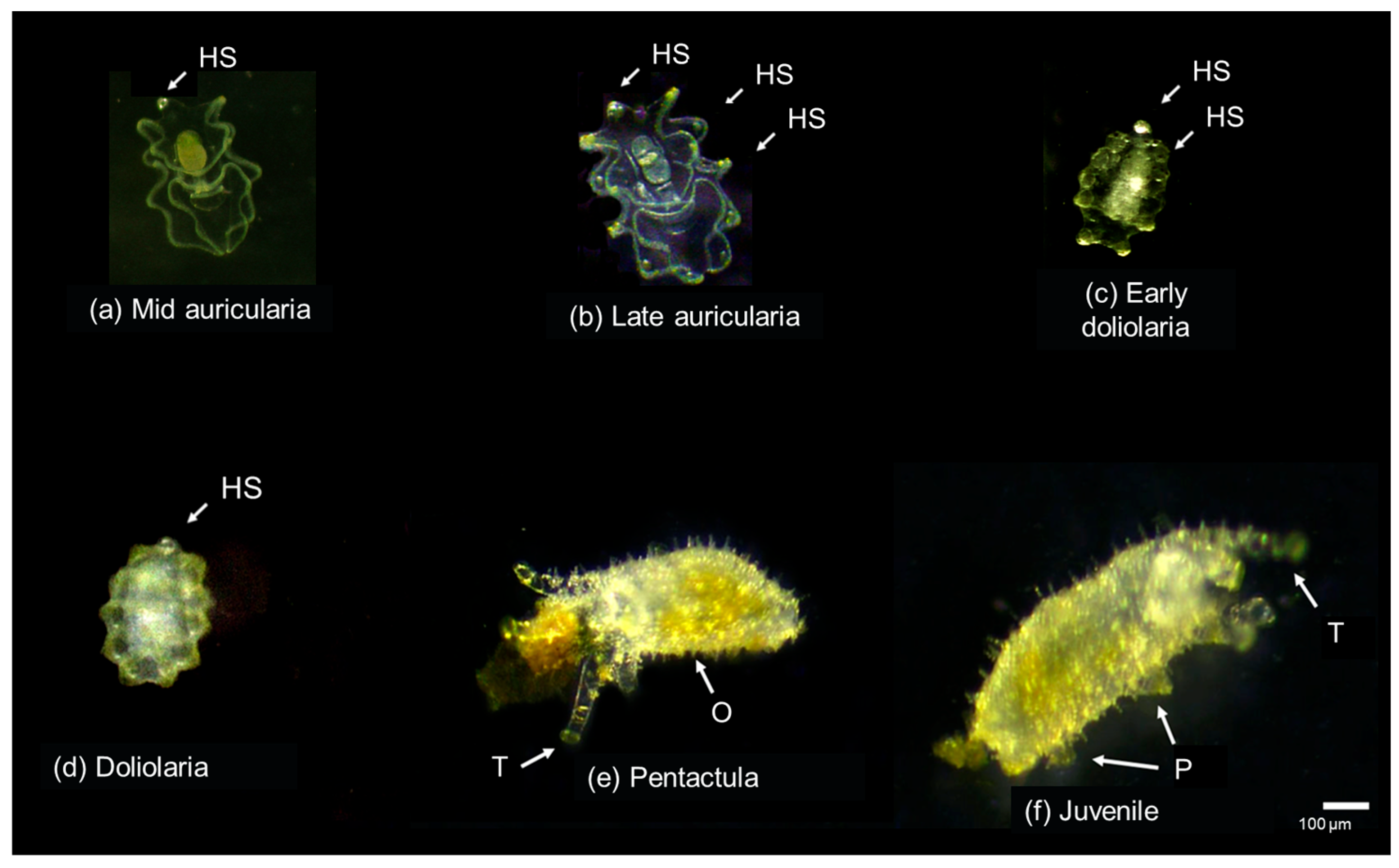
Figure 1. Larval development of Holothuria tubulosa from auricularia stage (a,b) to doliolaria (c,d), pentactula (e), and finally juvenile (f). HS: hyaline sphere; T: tentacles; O: derma ossicles; P: ambulacral podia.
Diversity 18 00204 g001
Figure 2. Temporal changes in larval developmental stages under different biofilm treatments. Stacked bar plots show the mean percentage of larvae in the doliolaria (blue), pentactula (green), and death (red) categories over time (days) for the control, U. lens, and Amphora sp. treatments. Sample size was n = 4 per treatment at each time point.
Diversity 18 00204 g002
Figure 3. Predicted probabilities of larval developmental stages over time based on generalised linear mixed-effects models (GLMMs). Panels show model-based predictions for (a) doliolaria, (b) pentactula, and (c) mortality as a function of time (days) under different biofilm treatments (Control, U. lens, Amphora sp.). Lines represent predicted values, and shaded areas indicate 95% confidence intervals. Sample size was n = 4 per treatment at each time point.
Diversity 18 00204 g003
Figure 4. Biochemical composition of the two algal biofilms Amphora sp. and Ulvella lens in terms of protein content (a), lipid content (b), and carbohydrate content (c). Data are expressed as mg g−1 dry weight (mean ± SE).
Diversity 18 00204 g004
Table 1. Data on the biochemical composition of biofilms (mean ± SE) and the results of the PERMANOVA for the differences in the biochemical composition of the two biofilms Amphora sp. and U. lens. DW = dry weight; P (MC) = probability level after Monte Carlo simulations.
Amphora sp.
(mg g−1 DW)
U. lens
(mg g−1 DW)
P (MC)
Protein163.332 ± 3.53260.433 ± 2.230.001
Carbohydrate208.843 ± 7.123185.265 ± 2.3170.030
Lipid38.759 ± 1.59834.555 ± 1.8620.144
Disclaimer/Publisher’s Note: The statements, opinions and data contained in all publications are solely those of the individual author(s) and contributor(s) and not of MDPI and/or the editor(s). MDPI and/or the editor(s) disclaim responsibility for any injury to people or property resulting from any ideas, methods, instructions or products referred to in the content.