Article

Ensemble Species Distribution Modeling Reveals Stable High-Suitability Areas and Conservation Priorities for Stephania tetrandra in China Under CMIP6 Scenarios


1
State Key Laboratory for Quality Ensurance and Sustainable Use of Dao-di Herbs, National Resource Center for Chinese Materia Medica, China Academy of Chinese Medical Sciences, Beijing 100700, China
2
Jiangxi Key Laboratory for Sustainable Utilization of Chinese Materia Medica Resources, Institute of Traditional Chinese Medicine Health Industry, China Academy of Chinese Medical Sciences, Nanchang 330115, China
3
Dexing Research and Training Center of Chinese Medical Sciences, China Academy of Chinese Medical Sciences, Dexing 334213, China
*
Author to whom correspondence should be addressed.
These authors contributed equally to this work.
Diversity 2026, 18(3), 179; https://doi.org/10.3390/d18030179
Submission received: 2 February 2026 / Revised: 11 March 2026 / Accepted: 12 March 2026 / Published: 17 March 2026
(This article belongs to the Section Plant Diversity)

Abstract

Stephania tetrandra is a medicinal plant with ecological, germplasm, and economic value whose wild resources are increasingly constrained by overexploitation and climate change. To support conservation planning and sustainable cultivation, we quantified current and future potential habitat suitability across China using an ensemble species distribution modeling (SDM) framework and translated the outputs into climate-based priority areas for protection, germplasm safeguarding, monitoring, and phased cultivation trials. Occurrence records were compiled from multiple sources and preprocessed via cleaning and spatial thinning to reduce sampling bias. Current predictors were derived from WorldClim (1970–2000) and complemented with topographic and edaphic variables; future climates were represented by CMIP6 projections for the 2050s, 2070s, and 2090s under SSP1-2.6, SSP2-4.5, and SSP5-8.5. Multiple algorithms were trained in a consistent cross-validation workflow and filtered using AUC (ROC) and TSS before generating a weighted ensemble (EMwmean). Current projections indicate a well-defined suitability core in the humid subtropical monsoon region south of the Yangtze River. Nationally, high-, moderate-, and low-suitability areas were estimated at 51.90 × 10⁴ km2, 22.95 × 10⁴ km2, and 31.05 × 10⁴ km2, respectively. Future impacts are dominated by suitability-grade reallocation rather than a collapse of total suitable extent. Under SSP5-8.5 in the 2090s, high suitability declines to 13.32 × 10⁴ km2 (≈74% reduction), accompanied by contraction of stable habitat (48.95 × 10⁴ km2) and expansion of loss areas (33.64 × 10⁴ km2), while gains remain limited (4.30 × 10⁴ km2). Extrapolation diagnostics (Multivariate Environmental Similarity Surface, MESS; Most Dissimilar Variable, MoD) highlight elevated uncertainty in northwestern arid/high-elevation and strongly seasonal transition zones. Environmental-space niche overlap decreases moderately (Schoener’s D = 0.51–0.67), indicating niche displacement and a narrowing suitability window. These results represent potential climatic habitat suitability rather than guaranteed future occupancy. They support prioritizing in situ protection and germplasm safeguarding in areas that are currently highly suitable and remain comparatively stable under future climates, while treating marginal gain zones as candidates for monitoring and carefully phased cultivation or introduction trials.

1. Introduction

Climate change is reshaping species distributions by altering the climatic conditions that govern survival, reproduction, and population persistence, with cascading consequences for biodiversity and ecosystem services [1,2,3]. For plant resources used by humans, shifts in climatic suitability can reconfigure where harvestable populations persist and where conservation, restoration, or cultivation efforts are likely to succeed, making spatially explicit forecasting increasingly important for decision-making under uncertainty [2,3].
Stephania tetrandra S. Moore (syn. Botryodiscia tetrandra (S. Moore) L. Lian & W. Wang) is an important medicinal plant in East Asia and a valuable germplasm resource for traditional medicine and future cultivation [4,5,6,7]. The species is not an arbitrary modeling target: in China it is mainly associated with warm–humid hilly landscapes, and its wild resources are increasingly exposed to sustained harvesting pressure, habitat disturbance, and climate-driven environmental change. These pressures raise both conservation concerns and practical questions about where long-term resource security may still be maintained.
For a species with both conservation and utilization value, identifying climatically suitable habitats and potential cultivation areas is not merely a descriptive exercise. Such information can help indicate where in situ populations may remain resilient, where germplasm collection and backup should be prioritized, and where restoration or phased cultivation trials may be more likely to succeed. Recent studies on medicinal plants have likewise shown that integrating ensemble modeling with germplasm or original-species identification can improve the delineation of suitable cultivation areas and strengthen planning for sustainable utilization under climate change [8,9]. Because conservation resources are limited, however, not all suitable areas can be treated equally: management requires distinguishing comparatively stable high-suitability areas from marginal, newly emerging, or highly uncertain zones so that protection and investment can be prioritized more defensibly.
Correlative species distribution models (SDMs) provide an efficient framework for large-scale screening of climate-based suitability, but the reliability of future transfer depends on whether projection environments remain comparable to the calibration domain [10,11,12,13,14]. For this reason, MESS and MoD analyses are important in the present study: they diagnose environmental novelty, identify where extrapolation risk is highest, and reveal which predictors contribute most strongly to that uncertainty. Likewise, niche comparison in environmental space helps evaluate whether projected changes mainly represent redistribution within familiar environmental conditions or a shift toward novel climate combinations, thereby strengthening interpretation of both mechanism and forecast reliability.
Against this background, we used an ensemble SDM framework to reconstruct current potential suitability for S. tetrandra across China and to project changes under CMIP6 climate scenarios. Specifically, we aimed to (1) calibrate and evaluate multi-algorithm models with transparent predictor screening; (2) quantify scenario- and time-slice-specific changes, including gain, stability, loss, and suitability-grade transitions; (3) diagnose projection reliability using MESS/MoD and characterize niche dynamics in environmental space; (4) identify stable high-suitability areas and conservation-priority suitable areas that can inform in situ protection, germplasm safeguarding, monitoring, and phased cultivation planning. Throughout, we interpret model outputs as potential climatic suitability rather than direct predictions of realized occupancy.

2. Materials and Methods

2.1. Study Species and Taxonomic Note

Stephania tetrandra S. Moore is currently treated as Botryodiscia tetrandra (S. Moore) L. Lian & W. Wang following a recent taxonomic revision of Cissampelideae (Menispermaceae) [15]. Because the name S. tetrandra remains dominant in the medicinal-plant literature and in occurrence repositories, we retain S. tetrandra throughout the manuscript while providing the currently accepted name at first mention. The species is a dioecious perennial herbaceous vine/scrambling subshrub with a fleshy root system that is harvested as the medicinal part, and it is mainly distributed in hilly areas south of the Huaihe River in China [7,16]. Consequently, all SDM outputs in this study are interpreted as potential climatic habitat suitability rather than realized occupancy (see Section 4.5).

2.2. Occurrence Data

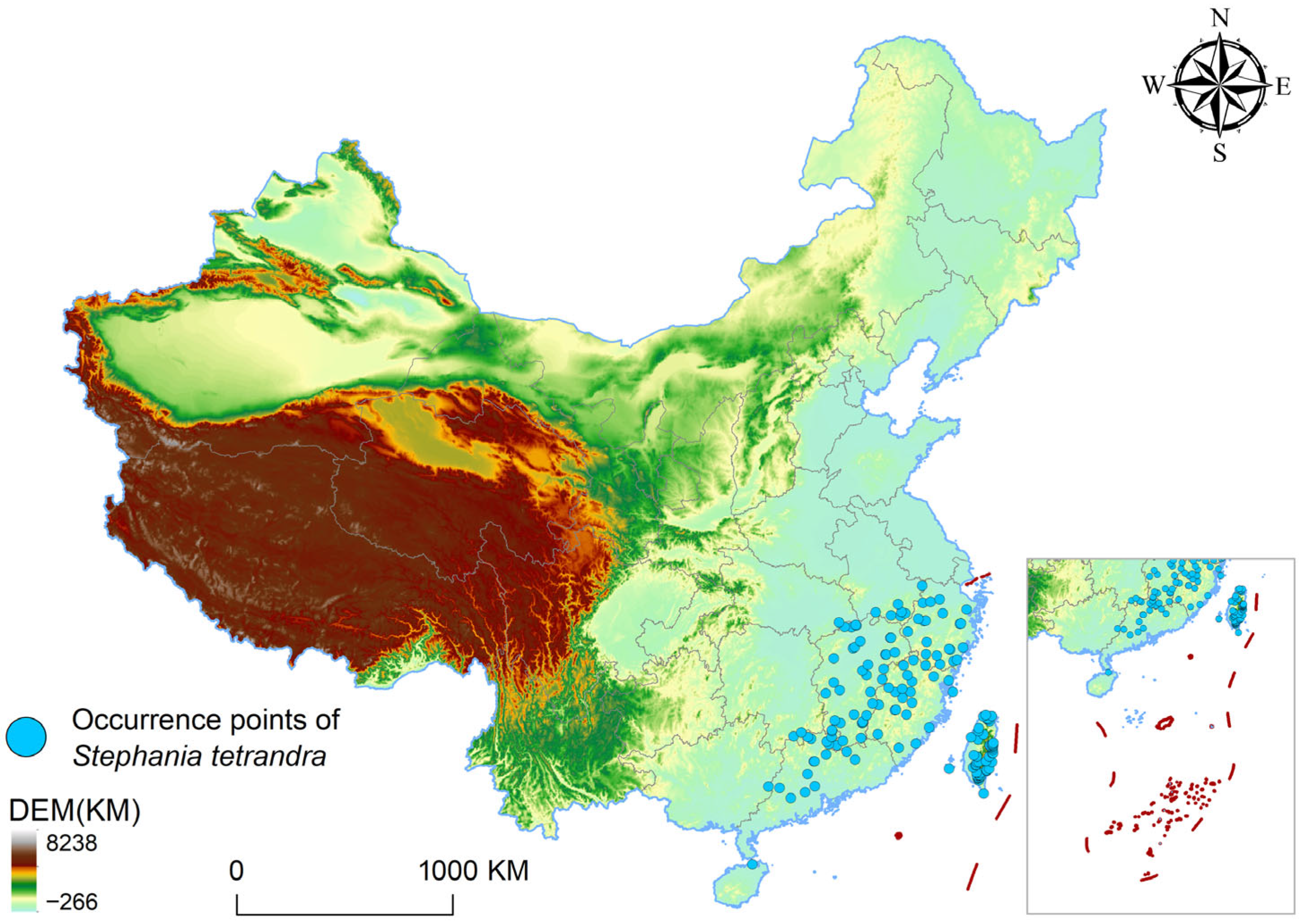
Occurrence records of S. tetrandra were compiled from herbarium databases and published sources and then standardized by removing duplicated entries and records lacking reliable geographic coordinates. To reduce spatial sampling bias and spatial autocorrelation in model calibration, we spatially thinned occurrences by enforcing a minimum nearest-neighbor distance of 1 km, retaining 298 spatially filtered records for subsequent analyses. The final occurrence dataset and its spatial coverage are shown in Figure 1.

2.3. Environmental Predictors and Collinearity Control

Environmental predictors were prepared at a consistent spatial resolution and geographic extent, including contemporary climate baselines and additional non-climatic covariates (e.g., edaphic, topographic, and anthropogenic layers) to better represent habitat constraints. Contemporary climate variables were taken as long-term means for 1970–2000 from WorldClim 2 [17].
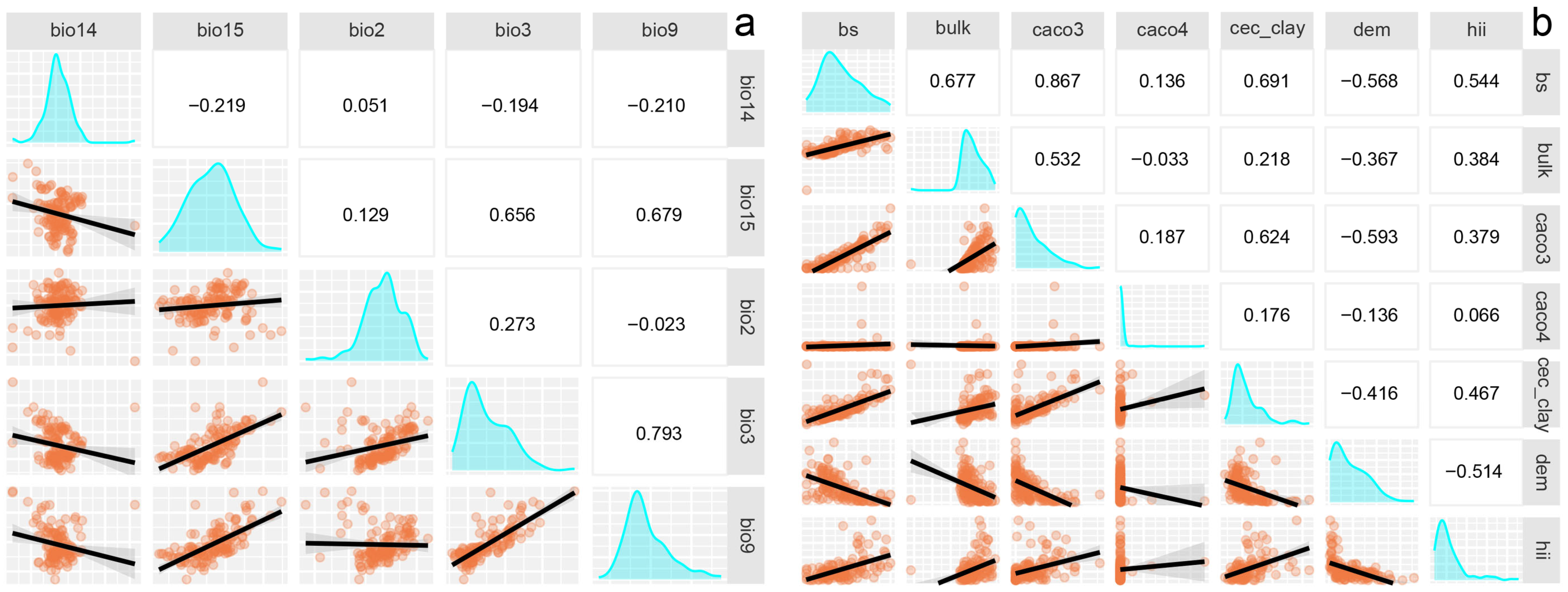
We initially assembled 28 candidate predictors and quantified collinearity using pairwise Pearson correlations and variance inflation factors (VIFs). Predictors were screened by removing variables with strong pairwise correlation (|r| > 0.8) and/or excessive multicollinearity (VIF > 10), yielding 15 retained predictors for model fitting [18]. The correlation structure among the original predictors and the rationale for exclusion are summarized in Figure 2.

2.4. Species Distribution Modeling Framework

Species distribution models (SDMs) were fitted in R (version 4.3.1; R Foundation for Statistical Computing, Vienna, Austria) using the biomod2 package (version 4.2-5-2), which enabled multi-algorithm model fitting, evaluation, and ensemble projection. We implemented 12 algorithms (ANN, CTA, FDA, GAM, GBM, GLM, MARS, MaxEnt, MaxNet, RF, SRE, and XGBoost).
Because absence data are generally unavailable for herbarium-based plant records, we generated 500 pseudo-absence points per modeling run. Occurrence/pseudo-absence data were partitioned into 75% for model training and 25% for validation, and the procedure was repeated 10 times to stabilize accuracy estimates. Model performance was evaluated using the area under the ROC curve (AUC) and the true skill statistic (TSS). Models meeting AUC > 0.8 and TSS > 0.6 were considered sufficiently robust and were retained for downstream analyses and ensemble building.

2.5. Future Climate Scenarios and Time Slices

Future climate projections were derived from the CMIP6 framework [19] and summarized under three Shared Socioeconomic Pathways—SSP1-2.6, SSP2-4.5, and SSP5-8.5—following ScenarioMIP/SSP conventions [20,21], evaluated for three standard future periods, the 2050s (2041–2060), 2070s (2061–2080), and 2090s (2081–2100). To represent inter-model uncertainty, projections were obtained from five CMIP6 general circulation models (GCMs): BCC-CSM2-MR, CanESM5, CNRM-CM6-1, CNRM-ESM2-1, and MIROC6. For each SSP–time-slice combination, SDMs were projected onto the corresponding future predictor layers to generate continuous habitat suitability indices.

2.6. Extrapolation Diagnostics

To ensure interpretability of projections in non-analog climates, we assessed environmental novelty by comparing future conditions against the calibration domain. Novelty diagnostics were used to flag regions where projections were driven by extrapolation beyond observed environmental ranges, supporting cautious interpretation of suitability changes in those areas (especially under SSP5-8.5 and late-century periods).

2.7. Range Change Quantification

Continuous suitability outputs were used to summarize distributional shifts across scenarios and time slices by quantifying (i) areas remaining suitable through time (stable), (ii) areas becoming newly suitable (gain), and (iii) areas losing suitability (loss). The suitable/unsuitable distinction used for change-type summaries followed a thresholding approach commonly adopted for presence-only SDMs [22]. This decomposition enabled explicit separation of persistence versus redistribution under climate change, while maintaining consistent criteria across all SSP–time combinations.

2.8. Software Environment

All analyses were conducted in R (v4.3.1; R Foundation for Statistical Computing, Vienna, Austria), and spatial preprocessing and map production were completed in ArcGIS 10.8 (Esri, Redlands, CA, USA). Modeling and ensemble operations were performed with biomod2 (v4.2-5-2); additional niche and overlap metrics followed established SDM and niche-quantification practices referenced below.

3. Results

3.1. Model Performance and Ensemble Selection

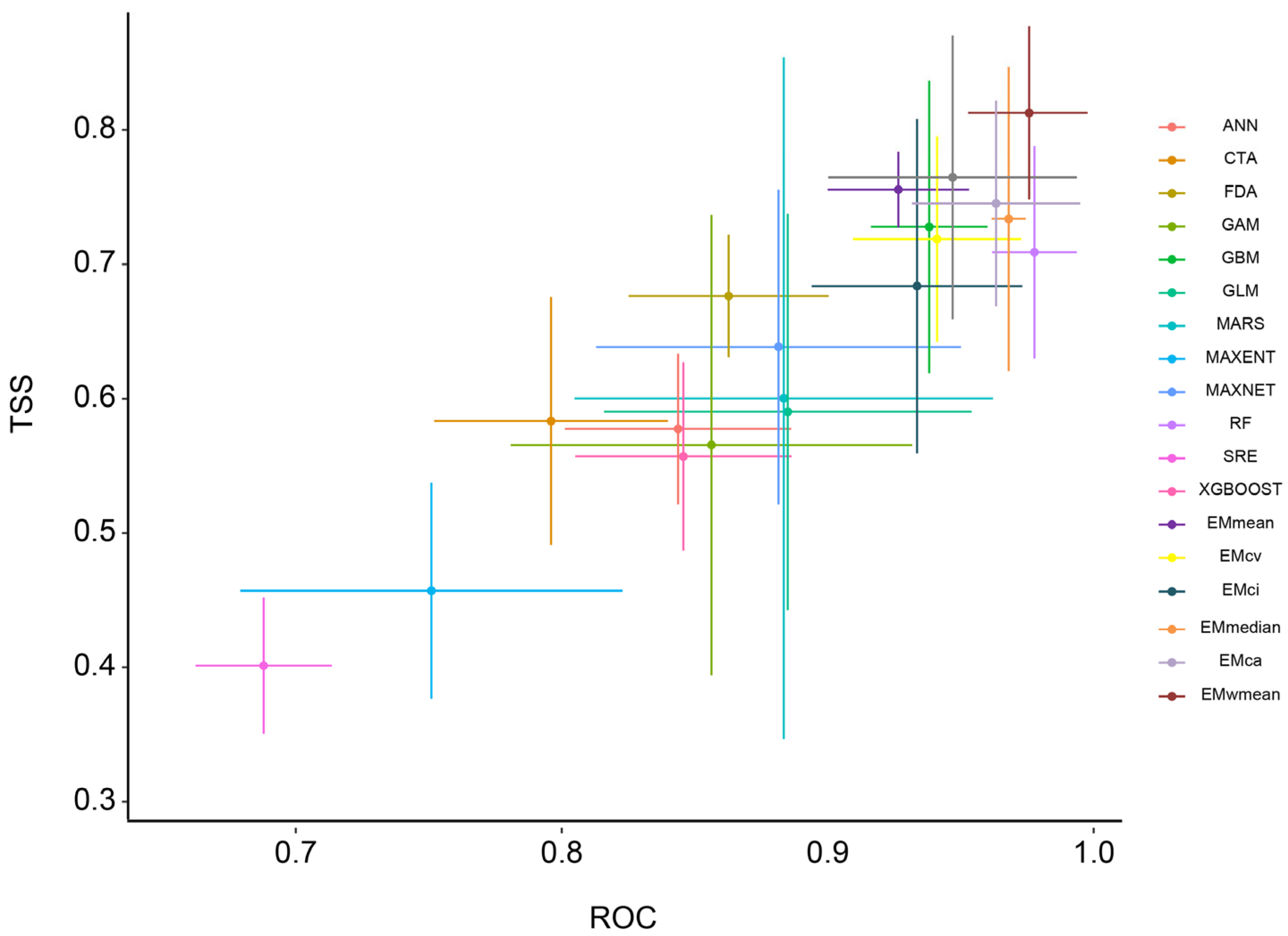
Model performance varied substantially among the 12 single algorithms (Figure 3), indicating clear differences in predictive discrimination and classification ability. Overall, AUC (ROC) ranged from approximately 0.688 to 0.978, while TSS ranged from approximately 0.399 to 0.726. Among single models, RF achieved the highest discrimination (AUC ≈ 0.978) and maintained strong classification skill (TSS ≈ 0.707), whereas GBM produced the strongest classification performance among individual algorithms (TSS ≈ 0.726, AUC ≈ 0.938). In contrast, SRE yielded the weakest performance (AUC ≈ 0.688, TSS ≈ 0.399), and MAXENT showed only moderate discrimination with limited TSS (AUC ≈ 0.780, TSS ≈ 0.455), suggesting reduced robustness for spatial prediction in this case.
To ensure that only high-quality algorithms contributed to the final ensemble, models were screened using a joint criterion emphasizing both discrimination and accuracy (AUC ≥ 0.80 and TSS ≥ 0.60). Under this criterion, four algorithms were retained for ensemble construction: RF, GBM, FDA, and MAXNET. Notably, several models achieved relatively high AUC but did not reach the TSS threshold (e.g., GLM and MARS), highlighting that strong ranking ability does not necessarily translate into reliable binary classification or threshold-dependent performance.
Across ensemble strategies, performance was consistently improved relative to most single models (Figure 3). Ensemble AUC spanned approximately 0.927–0.976, while ensemble TSS spanned approximately 0.681–0.810. The weighted-mean ensemble (EMwmean) provided the best overall performance (AUC ≈ 0.976; TSS ≈ 0.810), outperforming alternative ensemble summaries such as EMmean (AUC ≈ 0.927; TSS ≈ 0.753) and EMmedian (AUC ≈ 0.968; TSS ≈ 0.732). Given its superior and well-balanced performance across both metrics, EMwmean was selected as the final ensemble model for subsequent suitability mapping and spatial change analyses.

3.2. Key Predictors and Response Curves

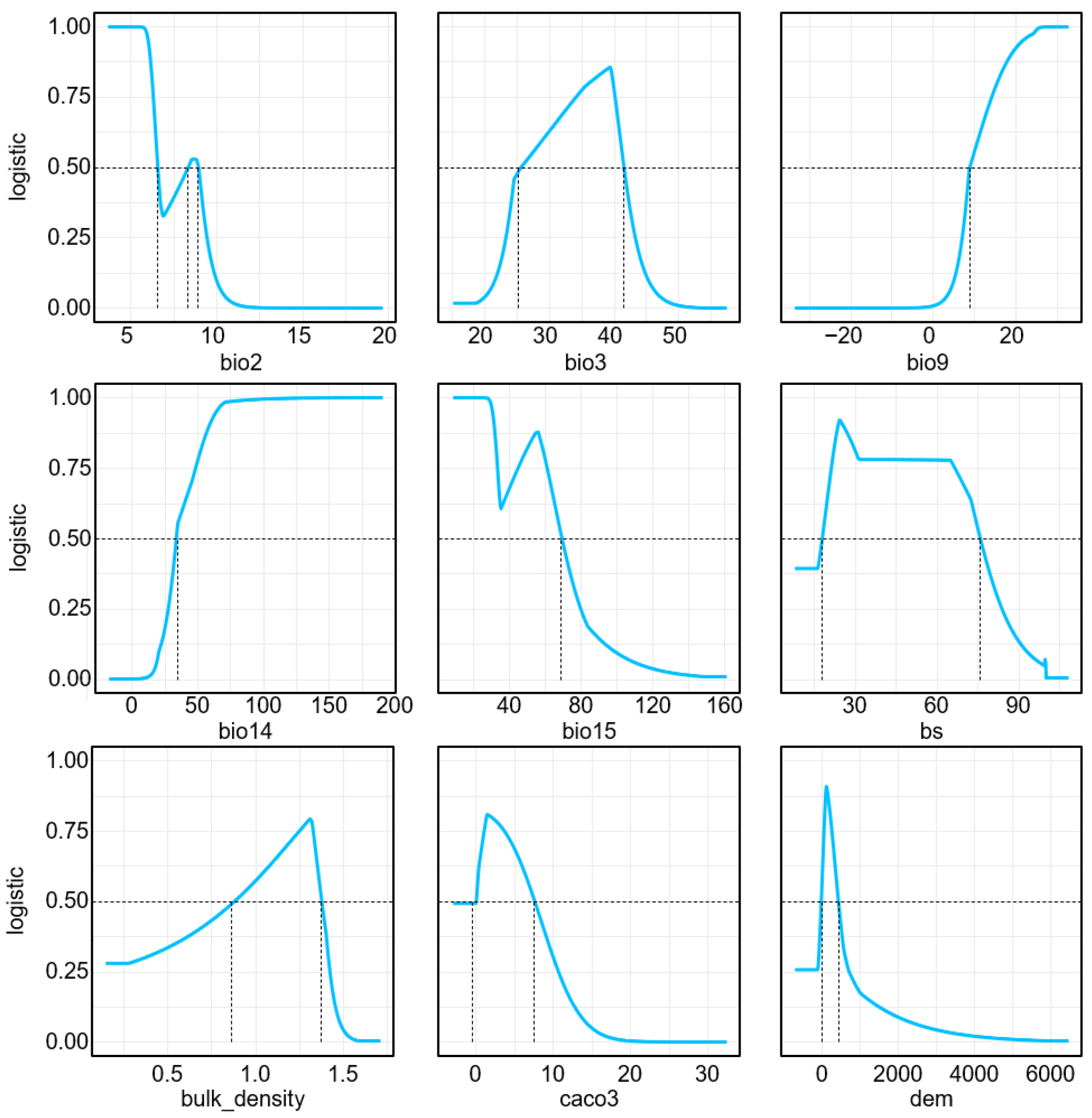
The ensemble model revealed clear, nonlinear (threshold-like) responses to a small set of climatic and edaphic predictors (Figure 4). Overall, suitability was most strongly constrained by thermal variability and dry-season hydroclimate (bio2, bio3, bio9, bio14, bio15), with additional filtering by topography (dem) and soil physical/chemical properties (bulk_density, caco3, bs). These response curves collectively indicate that S. tetrandra is favored by (i) relatively stable thermal regimes with moderate seasonality, (ii) sufficiently wet dry periods, and (iii) low-elevation landscapes with moderately structured, weakly calcareous soils.
Temperature-related predictors showed pronounced suitability windows. Suitability was highest under a low to moderate mean diurnal temperature range (bio2), remaining near maximal at approximately ≤6.8 °C and then dropping sharply. A smaller, local rebound in suitability is also visible around ~8.4–9.0 °C in the response curve, but suitability declines rapidly toward near zero beyond ~10 °C. This pattern suggests sensitivity to day–night temperature contrasts and a preference for thermally buffered environments. For isothermality (bio3), suitability increased steeply and remained high between approximately ~26 and ~42, peaking around ~35–40 before declining, indicating an optimum at intermediate isothermality rather than at either extreme. In addition, the mean temperature of the driest quarter (bio9) exhibited a clear positive threshold: suitability remained low at cooler conditions and exceeded the 0.5 threshold at approximately ~9–10 °C, increasing toward saturation under warmer dry-season temperatures. Together, these temperature responses imply that suitable habitats are characterized by comparatively warm dry seasons and limited exposure to strong thermal amplitudes.
Precipitation variables primarily defined the lower bounds of moisture availability during the driest part of the year and penalized highly seasonal rainfall regimes. Precipitation of the driest month (bio14) showed a strong monotonic threshold: suitability crossed the 0.5 level at approximately ~35 mm, rising quickly thereafter and approaching saturation at roughly ~60–70 mm and above. Precipitation seasonality (bio15) displayed a declining relationship after an intermediate optimum, with suitability generally higher when seasonality was <~70 (crossing the 0.5 threshold near ~70), and an apparent optimum around ~45–60. Ecologically, these patterns support the interpretation that S. tetrandra requires reliable dry-season moisture while being disadvantaged by highly concentrated rainfall (i.e., strong wet–dry contrasts) that can intensify physiological drought stress outside the wet season.
Edaphic and topographic predictors further refined the realized suitability space. Soil bulk density (bulk_density) increased suitability up to an intermediate–high range and then imposed a sharp upper constraint: suitability exceeded 0.5 at approximately ~0.85 g cm−3, peaked near ~1.25–1.35 g cm−3, and dropped back toward/below 0.5 beyond ~1.45 g cm−3, consistent with reduced performance under excessive compaction or unfavorable rooting conditions. Soil CaCO3 content (caco3) showed a low-to-moderate optimum: suitability was highest at low CaCO3 (~1–5) and fell below the 0.5 threshold at approximately ~8, suggesting intolerance of strongly calcareous substrates (likely via nutrient availability and soil chemistry constraints). The “bs” variable (interpretable as a soil base saturation-type index on a 0–100 scale) indicated a broad favorable range of approximately ~20–75, with highest suitability spanning ~30–65 and rapid decline at higher values, implying preference for intermediate base status rather than extremes. Finally, elevation (dem) exhibited a strong low-elevation optimum: suitability remained above 0.5 primarily within approximately ~0–500 m, declining quickly thereafter and approaching near-zero values at high elevations (multi-kilometer ranges), consistent with the species’ tendency toward lowland to lower-montane climatic envelopes where dry-season warmth and moisture are more readily met.
In combination, these threshold effects provide an interpretable mechanistic basis for the spatial predictions: suitable areas emerge where dry-season warmth co-occurs with adequate dry-month precipitation, under moderate rainfall seasonality and low-elevation terrain with moderately structured, weakly calcareous soils (Figure 4).

3.3. Current Habitat Suitability Pattern

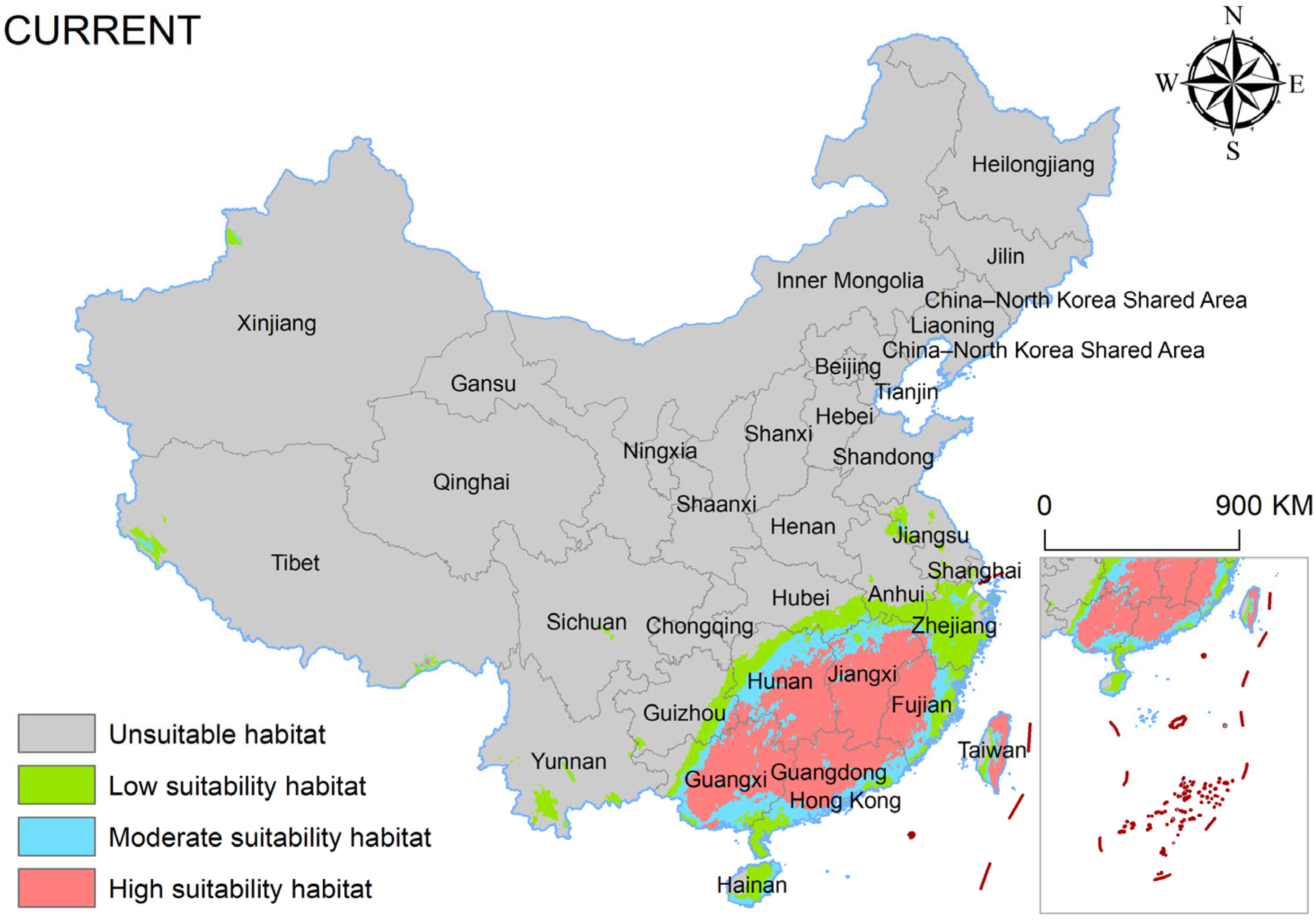
Under current climatic conditions, the ensemble SDM predicted that the potential suitable habitat of S. tetrandra is spatially concentrated in southern China, forming a clear south-of-Yangtze River hilly belt and a southeastern coastal monsoon core (Figure 5). In terms of area (unit: 104 km2), the model classified 854.11 as unsuitable habitat, while suitable habitat (low–high combined) totaled 105.89, corresponding to ~11.03% of the national land domain used in this study. Within the suitable domain, high suitability accounted for 51.90 (≈5.41% of the total; ≈49.0% of all suitable area), moderate suitability for 22.95 (≈2.39% of the total), and low suitability for 31.05 (≈3.23% of the total). This structure indicates that a substantial fraction of the predicted suitable area is not marginal, but rather clustered as a contiguous high-suitability nucleus.
Spatially, the high-suitability core (red) is continuous and most prominent across Jiangxi–Fujian–Guangdong–Guangxi, extending westward into Hunan, thereby delineating a humid subtropical belt characterized by warm dry-season temperatures and reliable dry-season moisture. A moderate-suitability transition zone (cyan) surrounds this core and expands northward and northwestward into the ecotonal margins, including parts of Hunan and the periphery toward Zhejiang, Anhui, Hubei, and Guizhou, consistent with a gradual weakening of the optimal hydrothermal envelope away from the subtropical monsoon center. The low-suitability belt (green) forms a broader fringe that traces the northern and western edges of the core distribution and appears in scattered patches in the lower Yangtze region (including small areas in Jiangsu and around Shanghai) as well as along coastal and mountainous margins, representing environmentally suboptimal but potentially conditionally suitable habitats.
Outside the main southeastern distribution, suitability is largely absent across northern and inland China; however, isolated low-suitability pockets are visible in northern Xinjiang, parts of Tibet, and southern Yunnan (Figure 5). These patches are spatially fragmented and small relative to the southeastern core, suggesting that they are likely governed by localized topographic or microclimatic conditions rather than representing a coherent, large-scale suitable region. Notably, Hainan is predicted predominantly as low-suitability, indicating that even within tropical settings, suitability is not uniform and may be constrained by combinations of edaphic conditions and climatic seasonality.
Overall, the present-day suitability pattern exhibits a strong regional aggregation and a clear core–periphery gradient, with the highest suitability concentrated in the humid subtropical monsoon provinces south of the Yangtze River and progressively lower suitability toward the margins and isolated outlying environments (Figure 5).

3.4. Future Projections and Habitat Change Types

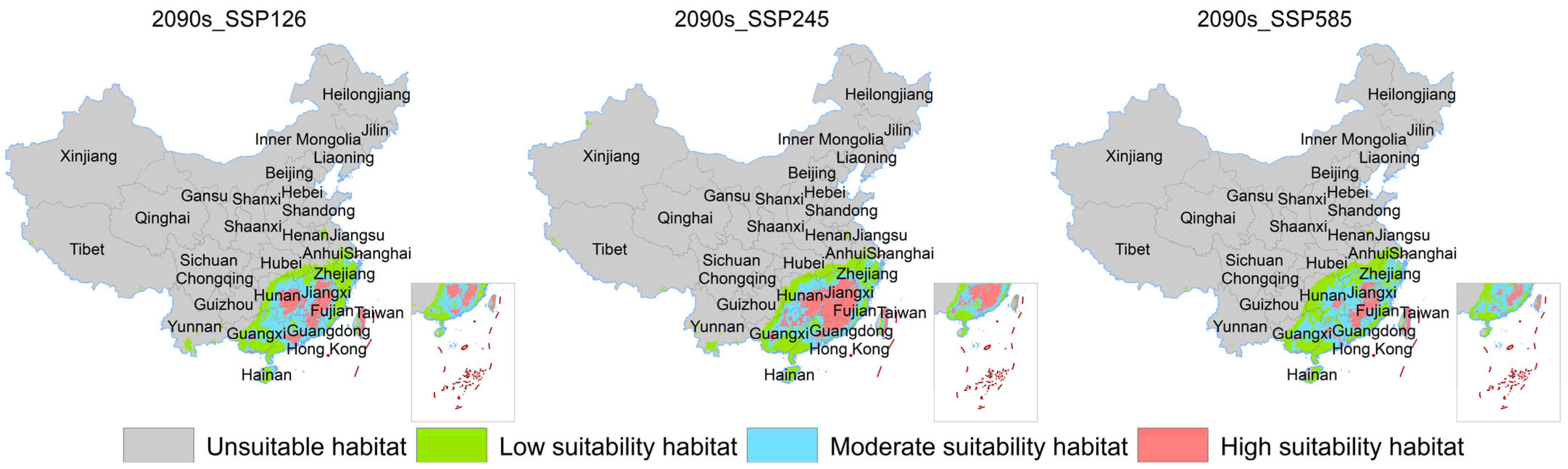
Across CMIP6 scenarios and time slices, the projected distribution of S. tetrandra generally retains a southern–southeastern China core but undergoes pronounced suitability downgrading and increasing spatial fragmentation under warmer forcing. In the baseline (current) period, the total suitable area (low + moderate + high) is 105.89 × 10⁴ km2, with high suitability accounting for 51.90 × 10⁴ km2. Under future climates, the total suitable extent changes modestly (typically within ~−7% to +2% relative to current), whereas high-suitability habitat declines consistently and sharply, indicating that climate change is expressed more as quality loss (high → moderate/low) than as a simple areal collapse. For brevity, Figure 6 and Figure 7 present the 2090s comparison under SSP1-2.6, SSP2-4.5, and SSP5-8.5, while the full scenario × period matrices are provided in Supplementary Figures S1 and S2.
Across the full set of future projections (Figure S1), suitability remains concentrated in the subtropical monsoon belt south of the Yangtze River, with the main suitable “backbone” spanning Hunan–Jiangxi–Fujian–Guangdong–Guangxi and extending toward Zhejiang. By the 2050s, high-suitability area declines from 51.90 × 10⁴ km2 (current) to 42.49 × 10⁴ km2 under SSP1-2.6 (−18.13%), 28.35 × 10⁴ km2 under SSP2-4.5 (−45.38%), and 18.12 × 10⁴ km2 under SSP5-8.5 (−65.09%). Despite this contraction of the highest-quality habitat, low/moderate suitability expands in several scenarios, suggesting that warming initially promotes marginal north/east expansion while simultaneously eroding the climatic optimum that supports high suitability in the current core areas.
By the 2070s–2090s, divergence among scenarios becomes clearer (Figure 6; Figure S1). Under SSP1-2.6, the suitable extent reaches a local maximum in the 2070s (107.97 × 10⁴ km2, +1.96%) driven mainly by growth in low suitability (47.04 × 10⁴ km2), but the 2090s map still shows a notable decline in high suitability (20.43 × 10⁴ km2, −60.63%) and a reduction in total suitable area (98.63 × 10⁴ km2, −6.85%), implying that even mitigated warming may progressively reduce optimal climatic conditions. The 2090s SSP2-4.5 pattern is intermediate between SSP1-2.6 and SSP5-8.5, with the southeastern core retained but increasingly reallocated to moderate and low suitability. In contrast, SSP5-8.5 shows the strongest late-century fragmentation and the most severe high-suitability loss, with high suitability dropping to 13.32 × 10⁴ km2 (−74.33%) while moderate/low suitability dominate the remaining suitable landscape (42.66 × 10⁴ km2 and 43.57 × 10⁴ km2, respectively). Spatially, the current continuous core becomes increasingly discontinuous, and stable suitable areas are progressively confined to coastal–hilly sectors and scattered patches, while some range-margin gains still occur but are insufficient to offset widespread losses.
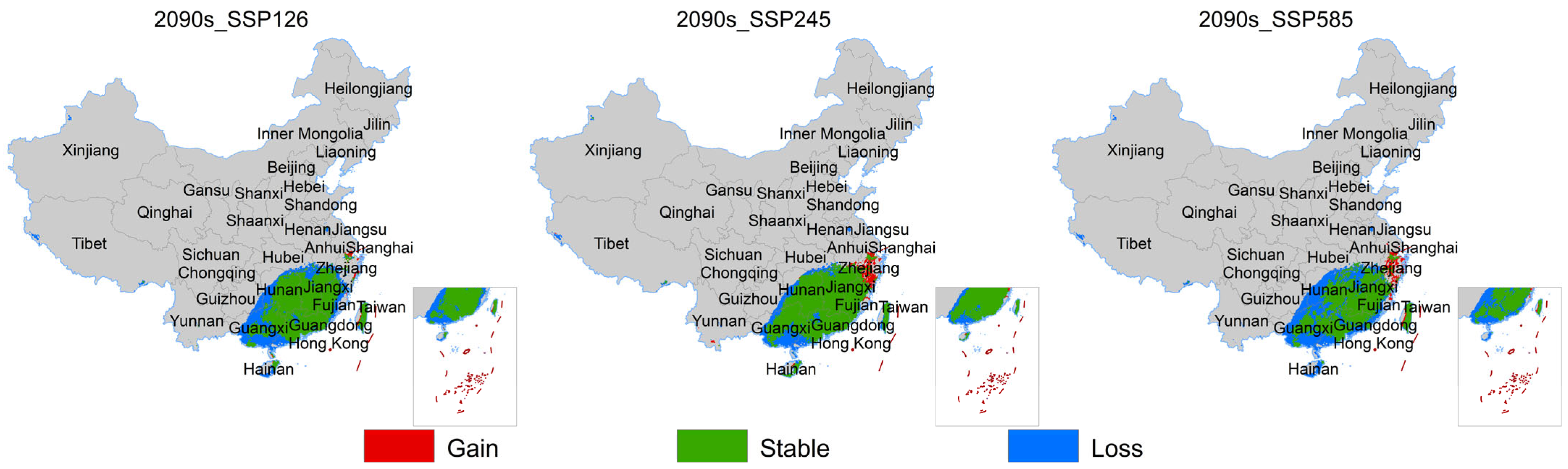
The change-type decomposition further quantifies these dynamics. Across all scenario–time combinations (Figure S2), the 2050s SSP1-2.6 case is dominated by stable area (76.99 × 10⁴ km2), with relatively limited loss (5.61 × 10⁴ km2) and the largest gain among scenarios (9.18 × 10⁴ km2), indicating a primarily persistent distribution with moderate range-margin expansion. The simplified 2090s comparison in Figure 7 highlights the late-century gradient most clearly: under SSP1-2.6, stable area still dominates; under SSP2-4.5, stable habitat contracts and loss becomes more prominent; and under SSP5-8.5, loss expands to 33.64 × 10⁴ km2 while stable area shrinks to 48.95 × 10⁴ km2, accompanied by only 4.30 × 10⁴ km2 of gains. Gains are mainly expressed along the northeastern edge of the current distribution (e.g., Zhejiang–Jiangsu/Shanghai corridor and adjacent coastal zones) and in some island/coastal settings, whereas losses accumulate across large portions of the present suitable belt, producing a net effect of range instability + habitat quality degradation and ultimately a more patchy, climate-limited distribution under high emissions.

3.5. Extrapolation Risk (MESS/MoD)

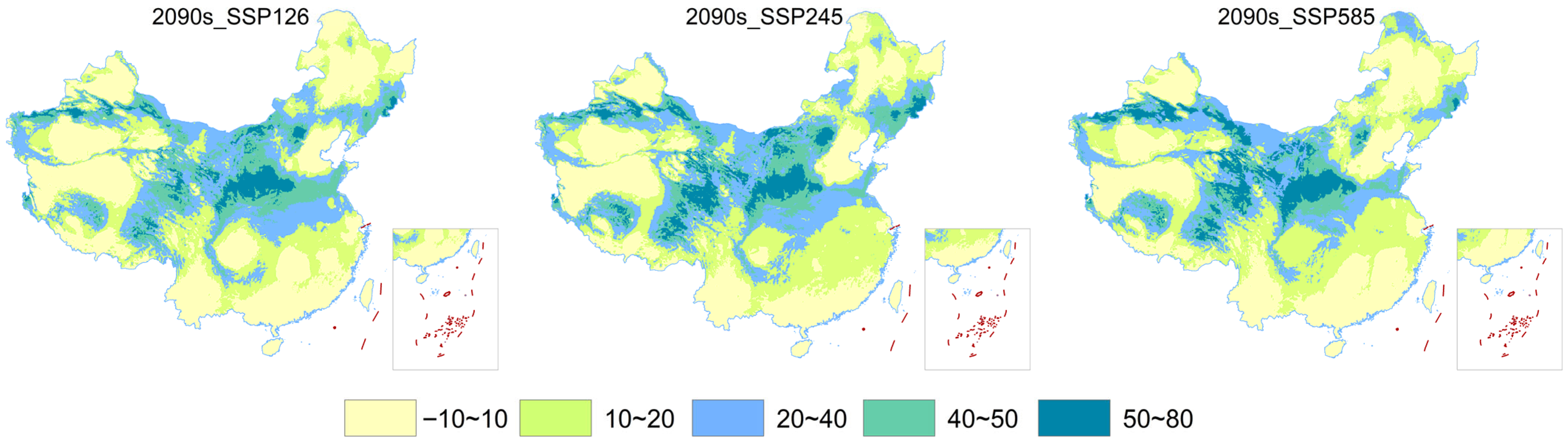
For brevity, Figure 8 shows the 2090s MESS maps under the three SSP scenarios, whereas the full time-slice matrix is provided in Supplementary Figure S3. The late-century maps reveal a broadly consistent spatial configuration of environmental similarity across scenarios. Moderate-to-high MESS values (20–50, locally 50–80) form a relatively continuous belt across central-eastern China, extending from the eastern margin of the Qinghai–Tibet Plateau through the central transitional zone to North China and parts of the eastern monsoon region, indicating that future climates in this belt remain comparatively close to the calibration domain. In contrast, the lowest MESS class (−10 to 10) is concentrated in the northwestern arid interior and the interior of the Qinghai–Tibet Plateau, including basin–mountain transition zones in Xinjiang, the margins of the Qaidam Basin, and parts of the western to northern plateau. Additional scattered low-value patches also occur in parts of southern China and locally in northeast China. Although the extent of individual low-MESS patches varies among SSPs, the central-eastern high-similarity belt remains evident in all three late-century projections.
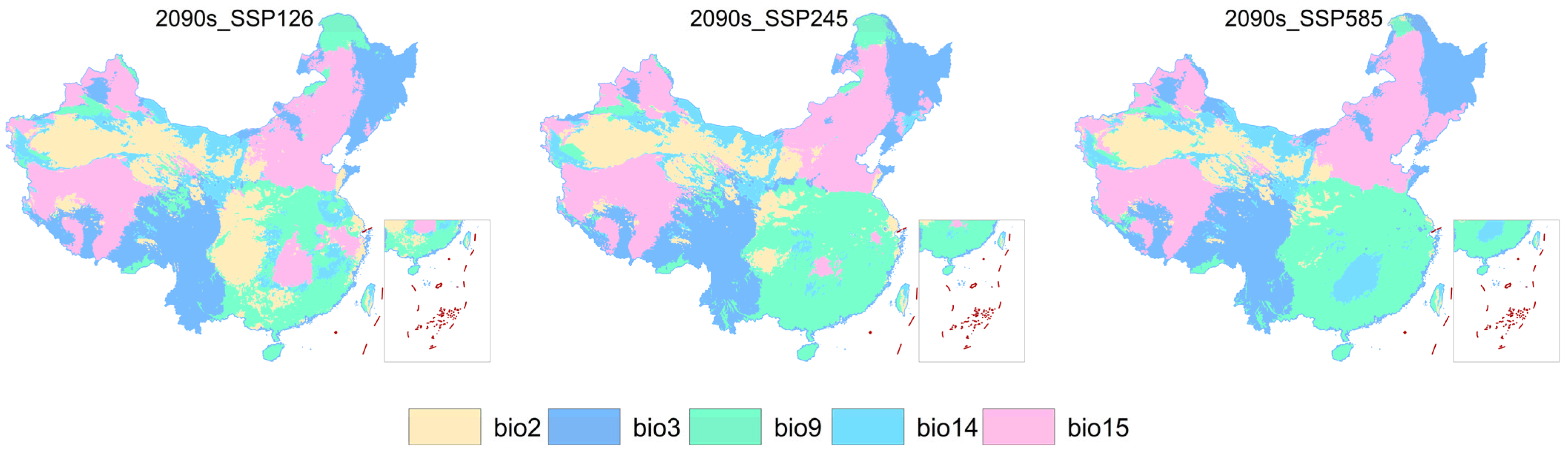
The 2090s MoD maps likewise show clear regional partitioning in the climatic variables responsible for environmental novelty (Figure 9; Figure S4). Bio15 is a dominant dissimilar variable across much of northern China, Inner Mongolia, and parts of northeast China, indicating that changes in precipitation seasonality are a major source of future environmental divergence in these regions. Bio3 dominates extensive areas of southwestern China, the southeastern margin of the Qinghai–Tibet Plateau, and large parts of eastern China, making it one of the most widespread drivers of novelty. Bio9 is concentrated mainly in the south-central and southeastern monsoon regions, especially under SSP2-4.5 and SSP5-8.5, whereas bio2 is most prominent in the northwestern inland–plateau transition zone and fragmented interior ecotonal areas. By contrast, bio14 occurs more patchily and is mainly restricted to scattered parts of central and eastern China. Overall, the MoD results indicate that future environmental novelty is regionally structured rather than controlled by a single climatic dimension, with precipitation seasonality dominating in the north, dry-season temperature in the monsoon south, and temperature-related metrics contributing strongly in the inland western and southwestern sectors.

3.6. Niche Dynamics

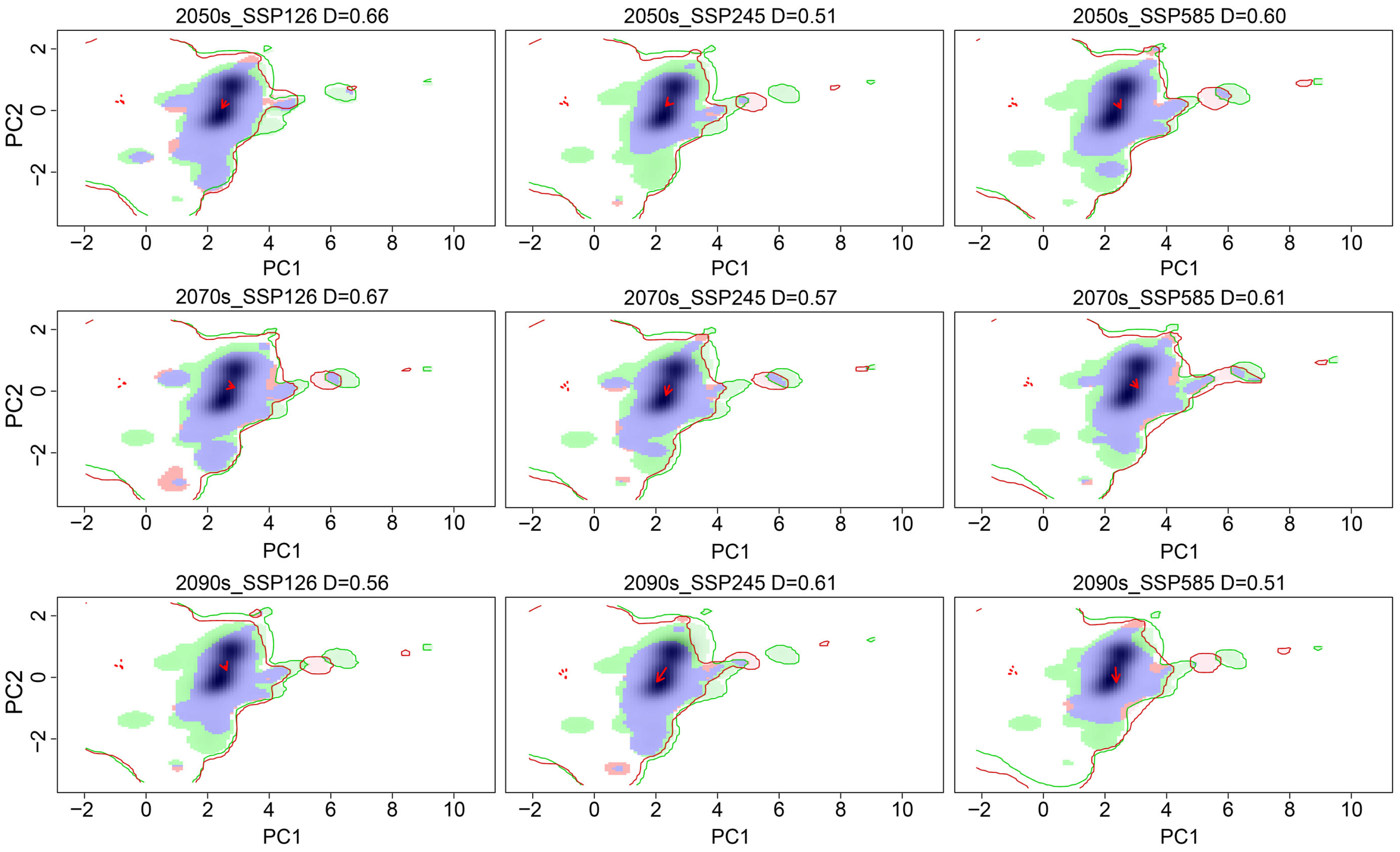
Niche comparisons in environmental space indicate moderate but non-negligible niche shifts between the current period and future projections (Figure 10). Across all scenario–time combinations, Schoener’s D values range from 0.51 to 0.67, implying that only about 51–67% of the current niche is retained in overlap with future conditions. The highest overlap occurs under SSP1-2.6 in the 2070s (D = 0.67), consistent with relatively stronger niche conservatism under mitigated forcing. In contrast, the lowest overlaps are observed under SSP2-4.5 in the 2050s (D = 0.51) and SSP5-8.5 in the 2090s (D = 0.51), representing an overlap reduction of roughly ~49% relative to complete niche coincidence.
The structure of the density surfaces and contour mismatch further suggests that future niches are not only displaced but also reorganized along the primary environmental gradient (PC1), with the future niche envelope showing partial separation from the current core in several panels. The late-century high-emission outcome (SSP5-8.5, 2090s) exhibits the most pronounced divergence, where overlap is minimized and the shared environmental space becomes more restricted, consistent with a shift in the niche centroid and a tendency toward a narrower effective suitability window. Collectively, these results indicate that climate change is likely to drive S. tetrandra toward environmental re-positioning rather than simple niche stability, with the strongest niche reconfiguration emerging toward the late century under stronger forcing (Figure 10).

4. Discussion

4.1. Reliability and Interpretation of the Ensemble Projections

The credibility of our projections primarily stems from an explicit strategy to reduce algorithmic and sampling-driven uncertainty through an ensemble forecasting framework, rather than relying on a single “best” model. Ensemble SDMs have become a standard response to the well-documented sensitivity of suitability maps to model choice, calibration settings, and response-shape assumptions, especially when projections are transferred across space or time [12,23]. In this study, multiple algorithms were trained and evaluated under a consistent data-preprocessing and cross-validation workflow, and only models meeting predefined discrimination standards (AUC/ROC and TSS) were retained for ensemble construction. Such performance-based filtering is widely recommended because it constrains the influence of structurally inadequate models and yields a more stable spatial signal [13,24]. The final ensemble was generated using a weighted-mean approach (EMwmean), which further down-weights weaker members and is therefore expected to dampen idiosyncratic overfitting and algorithm-specific artifacts while preserving the consensus climatic envelope [12,13,23].
Importantly, our results indicate that future impacts are expressed less as a dramatic collapse of total suitable area than as a pronounced redistribution among suitability classes-i.e., a systematic shift from high suitability toward moderate/low suitability under warming scenarios. This pattern is ecologically meaningful: it implies that climate change may primarily erode habitat “quality” (in terms of suitability magnitude and persistence), increasing fragmentation and reducing the availability of highly favorable microclimatic windows, even when coarse-grain suitability extent remains comparable. In SDM terms, this class redistribution is consistent with the expectation that climatic displacement can compress the upper tail of suitability as environmental constraints become more frequently limiting, producing a degradation signal that would be missed if only total area were reported [25,26]. Thus, interpreting suitability change through grade reallocation provides a more management-relevant narrative than binary presence/absence comparisons.
Nevertheless, we explicitly acknowledge that uncertainty remains non-trivial in time-transfer projections. First, spatial dependence can inflate apparent model performance if cross-validation is not aligned with the intended prediction task; blocked or structured validation better approximates extrapolative use cases and typically yields more conservative accuracy estimates [27]. Second, projections into novel climates are vulnerable to extrapolation error even for high-scoring models; best practice therefore recommends diagnosing novelty (e.g., MESS/clamping logic) and interpreting predictions with caution where environmental conditions fall outside the training envelope [25,28]. Finally, transparent reporting standards (e.g., ODMAP) emphasize that SDM credibility is ultimately a function of both performance metrics and documentation of assumptions, thresholds, and transferability constraints [26]. These considerations motivate the next section, where we interpret the environmental drivers most plausibly responsible for the observed suitability–quality declines.

4.2. Climate-Edaphic Constraints and Threshold Effects Shaping Suitability

The response curves (Figure 4) indicate that hydrothermal seasonality—especially dry-season conditions—constitutes the primary niche axis shaping habitat suitability. Suitability declines rapidly as thermal variability increases (Bio2, mean diurnal range), with an apparent “window” concentrated at low–moderate Bio2 (~4–9 °C) and a sharp drop beyond ~10 °C, consistent with the broader inference that diurnal thermal instability constrains plant performance and elevational/biogeographic occupancy [29]. In parallel, suitability increases with warmer dry-season temperatures (Bio9), crossing a clear threshold at approximately Bio9 ≈ 10 °C, implying that cold dry-season conditions likely limit overwinter survival and early-season establishment. These temperature thresholds interact with atmospheric and soil water stress, because warming tends to elevate vapor pressure deficit and thereby intensify dry-season desiccation risk even when precipitation does not decrease proportionally [30].
A second, more decisive constraint is dry-season moisture supply. Suitability rises strongly with the precipitation of the driest month (Bio14) and shows a steep threshold around Bio14 ≈ 35 mm, below which suitability collapses. Likewise, precipitation seasonality (Bio15) exhibits a threshold-like pattern: suitability is highest at moderate seasonality (~45–60) and declines markedly beyond Bio15 ≈ 70, consistent with a narrowing “suitability window” under stronger seasonal water deficits. This hydroclimatic signature aligns with the emergence of a coherent core in the humid subtropical/monsoon domain, where seasonal water limitation is buffered and woody floras are historically structured by monsoon regimes [31]. Because precipitation seasonality is expected to amplify under stronger warming, high-emission trajectories can shift regions across these thresholds more readily, accelerating quality loss in the core habitat [32].
Within climatically suitable regions, edaphic and topographic filters further impose local fragmentation. Suitability decreases sharply once CaCO3 exceeds ~7–10 (Figure 4), consistent with the well-documented constraints of calcareous soils on nutrient availability and drought sensitivity under climate change [33]. Similarly, the bulk-density curve suggests an optimum at intermediate values (~1.1–1.3), with reduced suitability toward extremes, matching the expectation that soil physical impedance and associated rooting limitations can modulate realized habitat even under favorable climates [34]. Consequently, future redistribution is expected to be driven primarily by dry-season hydrothermal reorganization, with soil and terrain acting as secondary gatekeepers that convert broad climatic suitability into patchy realized habitat opportunities.

4.3. Present-Future Redistribution: Core Stability, Degradation, and Fragmentation Under High Emissions

The present-day suitability pattern exhibits a coherent biogeographic “core–margin” structure, with high-suitability hotspots concentrated south of the Yangtze River, especially across the humid subtropical monsoon belt and adjacent hilly terrains of southeastern China (Figure 5). This spatial backbone is consistent with broader evidence that climate-driven redistribution increasingly reshapes biodiversity and ecosystem services, while concentrating conservation and utilization pressures within climatically stable, resource-rich regions—often overlapping with areas of long-term human use and “geo-authentic” production systems for medicinal plants [2].
Across future projections (Figure 6 and Figure 7; Figures S1 and S2), the dominant signal is not a collapse in total suitable area, but rather a quality downgrade and spatial fragmentation of the core. Specifically, the high-suitability class declines from ~51.90 × 10⁴ km2 at present to ~13.32 × 10⁴ km2 under SSP5-8.5 by the 2090s, a reduction of roughly three quarters, while low–moderate suitability expands, implying a progressive erosion of optimal habitat conditions. This pattern aligns with global assessments showing that climate change often compresses best climates faster than it eliminates marginal suitability, thereby promoting fragmented persistence rather than uniform retreat [35,36].
The late-century gain–stable–loss comparison in Figure 7 further supports this interpretation, while Figure S2 shows the full time-slice sequence: under SSP5-8.5 in the 2090s, stable areas shrink (~48.95 × 10⁴ km2) and loss areas expand (~33.64 × 10⁴ km2), whereas gains remain comparatively modest (~4.30 × 10⁴ km2). Such gains likely occur along climatic transition zones and range margins, but they are dominated by low–moderate suitability and may not be functionally equivalent to today’s high-suitability core [37]. In line with climate-impact syntheses, SSP5-8.5 late-century conditions systematically elevate disruption risk and intensify fragmentation, underscoring the conservation value of limiting warming and prioritizing climatically stable high-suitability areas [38,39].

4.4. Novel Climate Space and Niche Reorganization: Implications for Conservation and Germplasm Prioritization

The simplified 2090s MESS/MoD comparison in Figure 8 and Figure 9, together with the full time-slice results in Figures S3 and S4, indicates that future projections are not uniformly interpolative across China; instead, low-similarity (high-extrapolation) areas concentrate in the northwestern arid belt, high-elevation margins, and strongly seasonal climatic transition zones, where forecasts are increasingly driven by non-analog combinations of temperature and moisture regimes rather than by conditions represented in the calibration domain [40,41]. In such settings, model outputs should be interpreted as hypothesis-generating signals rather than deterministic range estimates, because novelty arises not only from covariate extremes but also from shifts in covariate correlation structure—an effect known to inflate projection uncertainty even when single-variable ranges appear only moderately displaced [40]. The elevated risk under SSP5-8.5 is therefore mechanistically consistent: stronger forcing amplifies thermal variability and reorganizes dry-season hydroclimate, pushing more grid cells into novel climate space; correspondingly, MoD highlights an increasing dominance of temperature-related predictors in driving dissimilarity, indicating that heat/variability constraints progressively overtake precipitation as the leading source of extrapolation pressure [41].
Consistent with this, Figure 10 shows a pronounced decline in environmental-space niche overlap (Schoener’s D ≈ 0.51–0.67 across scenarios/periods), implying both a shift in niche centroid and a contraction of the effective suitability window, rather than a simple geographic translation of the current niche [42,43]. From a conservation and germplasm perspective, these two lines of evidence motivate a dynamic prioritization logic: (i) prioritize in situ protection in areas that are currently highly suitable and remain stable, because these are the most defensible climate-based priority areas for maintaining ecological performance and genetic resources [44]; (ii) treat gain zones as candidates for monitoring and phased introduction/cultivation trials, but only after screening out high-novelty cells and verifying edaphic compatibility; (iii) avoid making strong decisions based solely on SDM outputs within high-extrapolation regions, where uncertainty is structurally high and where germplasm investment risks may be misallocated [45]. Accordingly, our analysis identifies stable high-suitability areas and conservation-priority suitable areas rather than complete representations of future realized distributions.

4.5. Limitations and Ecological Realism of Modeled Suitability

Like most correlative SDMs, our models estimate potential climatic–environmental suitability rather than realized occupancy. Habitat suitability is an important prerequisite for persistence, but it is not equivalent to actual colonization, establishment, or long-term population maintenance. Whether S. tetrandra can occupy a climatically suitable grid cell will also depend on dispersal limitation, propagule availability, recruitment bottlenecks, interspecific competition or facilitation, soil microsite conditions, and demographic performance across life stages. In addition, habitat fragmentation, land-use conversion, harvesting pressure, and other human activities can interrupt movement pathways or reduce local survival even where climate appears favorable.
Accordingly, the future suitable areas identified here should be interpreted as climate-based screening results and priority candidates, not as guaranteed future distributions. Their principal value lies in highlighting where monitoring, in situ conservation, germplasm backup, assisted cultivation, or experimental introduction may deserve higher priority under climate change. Future research should integrate life-history traits, dispersal processes, connectivity or fragmentation metrics, land-use constraints, and potentially human-assisted migration scenarios so that climatic suitability can be evaluated together with the processes that determine realized establishment and persistence.

5. Conclusions

This study developed an ensemble species distribution modeling framework to quantify the current and future potential habitat suitability of S. tetrandra across China under CMIP6 climate scenarios. By integrating multi-algorithm screening, weighted ensemble prediction, change-type decomposition (gain/stable/loss), extrapolation-risk diagnostics (MESS/MoD), and environmental-space niche overlap, we linked scenario-driven forecasts to stable high-suitability areas and conservation-priority suitable areas.
Under contemporary climate conditions, potential suitable habitat is concentrated in the humid subtropical monsoon region south of the Yangtze River, forming a continuous core across the southern hilly belt and the southeastern coastal zone. Future projections consistently indicate that climate change is expressed mainly as suitability-grade downgrading and fragmentation of this core, rather than as a uniform collapse of total suitable extent.
The strongest degradation is projected under late-century SSP5-8.5, where high-suitability habitat is greatly reduced and stable suitable areas contract, while gains remain comparatively limited and are often associated with higher extrapolation risk. Together, these results support (i) prioritizing in situ protection in currently high-suitability areas that remain stable across scenarios, (ii) safeguarding germplasm from stable core regions to maintain genetic resources under climate change, and (iii) treating marginal gain zones as targets for monitoring and stepwise cultivation trials, with decisions guided by novelty diagnostics and local ecological constraints.
Overall, the areas identified here should be understood as climate-based priority areas or stable high-suitability areas, not as guaranteed future occupancy or complete representations of realized distribution. Their main value is to guide conservation prioritization, germplasm safeguarding, monitoring, and phased cultivation planning under climate change.

Supplementary Materials

The following supporting information can be downloaded at https://www.mdpi.com/article/10.3390/d18030179/s1. Figure S1: Full scenario × period matrix of projected potential habitat suitability for S. tetrandra across China (expanded version of the late-century summary shown in main-text Figure 6); Figure S2: Full scenario × period matrix of habitat change types relative to the current period (expanded version of the late-century summary shown in main-text Figure 7); Figure S3: Full scenario × period matrix of MESS maps (expanded version of the late-century summary shown in main-text Figure 8); Figure S4: Full scenario × period matrix of Most Dissimilar Variable (MoD) maps (expanded version of the late-century summary shown in main-text Figure 9).

Author Contributions

Conceptualization, data curation, formal analysis, investigation, methodology, validation, visualization, writing—original draft preparation—review and editing, J.W.; data curation, resources, software, validation, writing—review and editing, Y.W.; funding acquisition, writing—review and editing and resources, S.W.; supervision, project administration, Q.Y. All authors have read and agreed to the published version of the manuscript.

Funding

This work was funded by the Project for the National Key Research and Development Program of China, grant number: No. 2023YFC3503801; Innovative Leading Talent in Jiangxi “Ganpo excellent talent plan” (gpyc20240024 to S.W.); Science and Technology projects of Xizang Autonomous, grant number: No. XZ202402ZD0002.

Data Availability Statement

The data presented in this study are available on request from the corresponding author.

Acknowledgments

The authors thank the anonymous reviewers and the Academic Editor for their constructive comments, which helped improve the manuscript.

Conflicts of Interest

The authors declare no conflicts of interest.

References

  1. IPCC. Climate Change 2021: The Physical Science Basis; Cambridge University Press: Cambridge, UK, 2021. [Google Scholar] [CrossRef]
  2. Pecl, G.T.; Araújo, M.B.; Bell, J.D.; Blanchard, J.; Bonebrake, T.C.; Chen, I.-C.; Clark, T.D.; Colwell, R.K.; Danielsen, F.; Evengård, B.; et al. Biodiversity redistribution under climate change: Impacts on ecosystems and human well-being. Science 2017, 355, eaai9214. [Google Scholar] [CrossRef] [PubMed]
  3. Urban, M.C. Accelerating extinction risk from climate change. Science 2015, 348, 571–573. [Google Scholar] [CrossRef]
  4. Davis, C.C.; Choisy, P. Medicinal plants meet modern biodiversity science. Curr. Biol. 2024, 34, R158–R173. [Google Scholar] [CrossRef]
  5. Chen, S.-L.; Yu, H.; Luo, H.-M.; Wu, Q.; Li, C.-F.; Steinmetz, A. Conservation and sustainable use of medicinal plants: Problems, progress, and prospects. Chin. Med. 2016, 11, 37. [Google Scholar] [CrossRef]
  6. Chi, X.; Zhang, Z.; Xu, X.; Zhang, X.; Zhao, Z.; Liu, Y.; Wang, Q.; Wang, H.; Li, Y.; Yang, G.; et al. Threatened medicinal plants in China: Distributions and conservation priorities. Biol. Conserv. 2017, 210, 89–95. [Google Scholar] [CrossRef]
  7. Jiang, Y.; Liu, M.; Liu, H.; Liu, S. Stephania tetrandra S. Moore: A review of its phytochemistry, pharmacology, and clinical applications. Phytochem. Rev. 2020, 19, 1171–1198. [Google Scholar] [CrossRef]
  8. Wang, Y.; Liu, H.; Zhao, D.; Wang, S.; Wang, J.; Chi, X.; Zhang, C.; Wang, T.; Lyu, C.; Kang, C.; et al. Assessment of suitable cultivation area for Paris polyphylla var. chinensis and var. yunnanensis under anthropogenic disturbance based on ensemble modeling and germplasm identification. BMC Plant Biol. 2026, 26. [Google Scholar] [CrossRef]
  9. Wang, Y.; Liu, K.; Li, M.; Bai, Y.; Zhang, C.; Yan, B.; Dong, W.; Zhang, Y.; Sun, J. Original species identification of Epimedii Folium (Epimedium) and their distributional responses to climate change. Sci. Tradit. Chin. Med. 2025, 3, 178–185. [Google Scholar] [CrossRef]
  10. Elith, J.; Leathwick, J.R. Species distribution models: Ecological explanation and prediction across space and time. Annu. Rev. Ecol. Evol. Syst. 2009, 40, 677–697. [Google Scholar] [CrossRef]
  11. Phillips, S.J.; Anderson, R.P.; Schapire, R.E. Maximum entropy modeling of species geographic distributions. Ecol. Model. 2006, 190, 231–259. [Google Scholar] [CrossRef]
  12. Araújo, M.B.; New, M. Ensemble forecasting of species distributions. Trends Ecol. Evol. 2007, 22, 42–47. [Google Scholar] [CrossRef] [PubMed]
  13. Thuiller, W.; Lafourcade, B.; Engler, R.; Araújo, M.B. BIOMOD—A platform for ensemble forecasting of species distributions. Ecography 2009, 32, 369–373. [Google Scholar] [CrossRef]
  14. Hao, T.; Elith, J.; Guillera-Arroita, G.; Lahoz-Monfort, J.J. A review of evidence about use and performance of species distribution modelling ensembles like BIOMOD. Divers. Distrib. 2019, 25, 839–852. [Google Scholar] [CrossRef]
  15. Lian, L.; Peng, H.-W.; Erst, A.S.; Ortiz, R.D.C.; Jabbour, F.; Chen, Z.-D.; Wang, W. Bayesian tip-dated phylogeny and biogeography of Cissampelideae (Menispermaceae): Mitigating the effects of homoplastic morphological characters. Cladistics 2024, 40, 391–410. [Google Scholar] [CrossRef]
  16. Wu, M.; Bai, Y.; Huang, L.; Dong, Z.; Li, Y.; Yan, G.; Xie, Y. SSR Marker–Based Genetic Diversity and Relationship Analyses of Stephania tetrandra S. Moore. Plant Mol. Biol. Report. 2024, 42, 675–687. [Google Scholar] [CrossRef]
  17. Fick, S.E.; Hijmans, R.J. WorldClim 2: New 1-km spatial resolution climate surfaces for global land areas. Int. J. Climatol. 2017, 37, 4302–4315. [Google Scholar] [CrossRef]
  18. Dormann, C.F.; Elith, J.; Bacher, S.; Buchmann, C.; Carl, G.; Carré, G.; Marquéz, J.R.G.; Gruber, B.; Lafourcade, B.; Leitão, P.J.; et al. Collinearity: A review of methods to deal with it and a simulation study evaluating their performance. Ecography 2013, 36, 27–46. [Google Scholar] [CrossRef]
  19. Eyring, V.; Bony, S.; Meehl, G.A.; Senior, C.A.; Stevens, B.; Stouffer, R.J.; Taylor, K.E. Overview of the Coupled Model Intercomparison Project Phase 6 (CMIP6) experimental design and organization. Geosci. Model Dev. 2016, 9, 1937–1958. [Google Scholar] [CrossRef]
  20. O’NEill, B.C.; Tebaldi, C.; van Vuuren, D.P.; Eyring, V.; Friedlingstein, P.; Hurtt, G.; Knutti, R.; Kriegler, E.; Lamarque, J.-F.; Lowe, J.; et al. The Scenario Model Intercomparison Project (ScenarioMIP) for CMIP6. Geosci. Model Dev. 2016, 9, 3461–3482. [Google Scholar] [CrossRef]
  21. Riahi, K.; Van Vuuren, D.P.; Kriegler, E.; Edmonds, J.; O’Neill, B.C.; Fujimori, S.; Bauer, N.; Calvin, K.; Dellink, R.; Fricko, O.; et al. The Shared Socioeconomic Pathways and their energy, land use, and greenhouse gas emissions implications: An overview. Glob. Environ. Change 2017, 42, 153–168. [Google Scholar] [CrossRef]
  22. Liu, C.; White, M.; Newell, G. Selecting thresholds for the prediction of species occurrence with presence-only data. J. Biogeogr. 2013, 40, 778–789. [Google Scholar] [CrossRef]
  23. Marmion, M.; Parviainen, M.; Luoto, M.; Heikkinen, R.K.; Thuiller, W. Evaluation of consensus methods in predictive species distribution modelling. Divers. Distrib. 2009, 15, 59–69. [Google Scholar] [CrossRef]
  24. Allouche, O.; Tsoar, A.; Kadmon, R. Assessing the accuracy of species distribution models: Prevalence, kappa and the true skill statistic (TSS). J. Appl. Ecol. 2006, 43, 1223–1232. [Google Scholar] [CrossRef]
  25. Brun, P.; Thuiller, W.; Chauvier, Y.; Pellissier, L.; Wüest, R.O.; Wang, Z.; Zimmermann, N.E. Model complexity affects species distribution projections under climate change. J. Biogeogr. 2020, 47, 130–142. [Google Scholar] [CrossRef]
  26. Zurell, D.; Franklin, J.; König, C.; Bouchet, P.J.; Dormann, C.F.; Elith, J.; Fandos, G.; Feng, X.; Guillera-Arroita, G.; Guisan, A.; et al. A standard protocol for reporting species distribution models. Ecography 2020, 43, 1261–1277. [Google Scholar] [CrossRef]
  27. Roberts, D.R.; Bahn, V.; Ciuti, S.; Boyce, M.S.; Elith, J.; Guillera-Arroita, G.; Hauenstein, S.; Lahoz-Monfort, J.J.; Schröder, B.; Thuiller, W.; et al. Cross-validation strategies for data with temporal, spatial, hierarchical, or phylogenetic structure. Ecography 2017, 40, 913–929. [Google Scholar] [CrossRef]
  28. Elith, J.; Kearney, M.; Phillips, S. The art of modelling range-shifting species. Methods Ecol. Evol. 2010, 1, 330–342. [Google Scholar] [CrossRef]
  29. Gallou, A.; Jump, A.S.; Lynn, J.S.; Field, R.; Irl, S.D.H.; Steinbauer, M.J.; Beierkuhnlein, C.; Chen, J.-C.; Chou, C.-H.; Hemp, A.; et al. Diurnal temperature range as a key predictor of plants’ elevation ranges globally. Nat. Commun. 2023, 14, 7890. [Google Scholar] [CrossRef]
  30. Grossiord, C.; Buckley, T.N.; Cernusak, L.A.; Novick, K.A.; Poulter, B.; Siegwolf, R.T.W.; Sperry, J.S.; McDowell, N.G. Plant responses to rising vapor pressure deficit. New Phytol. 2020, 226, 1550–1566. [Google Scholar] [CrossRef] [PubMed]
  31. Chen, W.-Y.; Su, T. Asian monsoon shaped the pattern of woody dicotyledon richness in humid regions of China. Plant Divers. 2020, 42, 148–154. [Google Scholar] [CrossRef]
  32. Wang, X.; Luo, M.; Song, F.; Wu, S.; Chen, Y.D.; Zhang, W. Precipitation Seasonality Amplifies as Earth Warms. Geophys. Res. Lett. 2024, 51, e2024GL109132. [Google Scholar] [CrossRef]
  33. Bontpart, T.; Gérard, F.; Vile, D.; Lacombe, B.; Weiss, A.; Reichheld, J.-P.; Mari, S. Growing on calcareous soils and facing climate change. Trends Plant Sci. 2024, 29, 1319–1330. [Google Scholar] [CrossRef]
  34. Jacobsen, A.G.R.; Jervis, G.; Xu, J.; Topping, J.F.; Lindsey, K. Root growth responses to mechanical impedance are regulated by a network of ROS, ethylene and auxin signalling in Arabidopsis. New Phytol. 2021, 231, 225–242. [Google Scholar] [CrossRef] [PubMed]
  35. Beyer, R.M.; Manica, A. Historical and projected future range sizes of the world’s mammals, birds, and amphibians. Nat. Commun. 2020, 11, 5633. [Google Scholar] [CrossRef]
  36. Trisos, C.H.; Merow, C.; Pigot, A.L. The projected timing of abrupt ecological disruption from climate change. Nature 2020, 580, 496–501. [Google Scholar] [CrossRef]
  37. Morelli, T.L.; Barrows, C.W.; Ramirez, A.R.; Cartwright, J.M.; Ackerly, D.D.; Eaves, T.D.; Ebersole, J.L.; Krawchuk, M.A.; Letcher, B.H.; Mahalovich, M.F.; et al. Climate-change refugia: Biodiversity in the slow lane. Front. Ecol. Environ. 2020, 18, 228–234. [Google Scholar] [CrossRef]
  38. Warren, R.; Price, J.; Graham, E.; Forstenhaeusler, N.; VanDerWal, J. The projected effect on insects, vertebrates, and plants of limiting global warming to 1.5 °C rather than 2 °C. Science 2018, 360, 791–795. [Google Scholar] [CrossRef]
  39. IPCC. Summary for Policymakers. In Climate Change 2022: Impacts, Adaptation and Vulnerability (AR6 WGII); Cambridge University Press (IPCC): Cambridge, UK, 2023. [Google Scholar] [CrossRef]
  40. Mesgaran, M.B.; Cousens, R.D.; Webber, B.L. Here be dragons: A tool for quantifying novelty due to covariate range and correlation change when projecting species distribution models. Divers. Distrib. 2014, 20, 1147–1159. [Google Scholar] [CrossRef]
  41. Yates, K.L.; Bouchet, P.J.; Caley, M.J.; Mengersen, K.; Randin, C.F.; Parnell, S.; Fielding, A.H.; Bamford, A.J.; Ban, S.; Barbosa, A.M.; et al. Outstanding challenges in the transferability of ecological models. Trends Ecol. Evol. 2018, 33, 790–802. [Google Scholar] [CrossRef]
  42. Broennimann, O.; Fitzpatrick, M.C.; Pearman, P.B.; Petitpierre, B.; Pellissier, L.; Yoccoz, N.G.; Thuiller, W.; Fortin, M.-J.; Randin, C.; Zimmermann, N.E.; et al. Measuring ecological niche overlap from occurrence and spatial environmental data. Glob. Ecol. Biogeogr. 2012, 21, 481–497. [Google Scholar] [CrossRef]
  43. Warren, D.L.; Glor, R.E.; Turelli, M. ENMTools: A toolbox for comparative studies of environmental niche models. Ecography 2010, 33, 607–611. [Google Scholar] [CrossRef]
  44. Hoban, S.; Archer, F.I.; Bertola, L.D.; Bragg, J.G.; Breed, M.F.; Bruford, M.W.; Coleman, M.A.; Ekblom, R.; Funk, W.C.; Grueber, C.E.; et al. Global genetic diversity status and trends: Towards a suite of Essential Biodiversity Variables for genetic composition. Biol. Rev. 2022, 97, 1511–1538. [Google Scholar] [CrossRef] [PubMed]
  45. Castañeda-Álvarez, N.P.; Khoury, C.K.; Achicanoy, H.A.; Bernau, V.; Dempewolf, H.; Eastwood, R.J.; Guarino, L.; Harker, R.H.; Jarvis, A.; Maxted, N.; et al. Global conservation priorities for crop wild relatives. Nat. Plants 2016, 2, 16022. [Google Scholar] [CrossRef] [PubMed]
Figure 1. Spatial distribution of S. tetrandra occurrence records in China after data cleaning and 1 km spatial thinning (n = 298). Points indicate retained occurrences used for SDM calibration; the background shows the national study extent.
Diversity 18 00179 g001
Figure 2. Pearson correlation matrix of candidate environmental predictors prior to multicollinearity screening. Color indicates the direction and magnitude of pairwise correlations, and symbol size/intensity reflects the absolute value of |r|. Variables with |r| > 0.8 and/or VIF > 10 were removed; retained predictors were used for ensemble SDM calibration.
Diversity 18 00179 g002
Figure 3. Performance comparison of single-algorithm SDMs and ensemble strategies for S. tetrandra, evaluated using AUC (ROC) and TSS. Horizontal dashed lines indicate the screening thresholds used to retain models for the final ensemble.
Diversity 18 00179 g003
Figure 4. Ensemble SDM response curves for key predictors of S. tetrandra. Curves show marginal effects from the weighted-mean ensemble (EMwmean); the y-axis is the predicted suitability index (0–1).
Diversity 18 00179 g004
Figure 5. Current potential habitat suitability of S. tetrandra across China predicted by the final ensemble SDM. Suitability is classified into four levels: unsuitable, low, moderate, and high.
Diversity 18 00179 g005
Figure 6. Projected potential habitat suitability of S. tetrandra across China in the 2090s under SSP1-2.6, SSP2-4.5, and SSP5-8.5.From left to right, the three panels correspond to SSP1-2.6, SSP2-4.5, and SSP5-8.5, respectively, and use the same there suitability classes as Figure 5, allowing direct comparison of late-century suitability-grade reallocation, persistence of the southeastern core, and fragmentation under contrasting emissions. The full scenario × period matrix is provided in Supplementary Figure S1.
Diversity 18 00179 g006
Figure 7. Habitat change types for S. tetrandra relative to the current period in the 2090s under SSP1-2.6, SSP2-4.5, and SSP5-8.5. From left to right, the three panels correspond to SSP1-2.6, SSP2-4.5, and SSP5-8.5, respectively. “Stable” indicates cells remaining suitable in both periods, “gain” indicates newly suitable cells, and “loss” indicates cells transitioning from suitable to unsuitable. The full scenario × period matrix is provided in Supplementary Figure S2.
Diversity 18 00179 g007
Figure 8. Multivariate Environmental Similarity Surface (MESS) maps for S. tetrandra across China in the 2090s under SSP1-2.6, SSP2-4.5, and SSP5-8.5. From left to right, the three panels correspond to SSP1-2.6, SSP2-4.5, and SSP5-8.5, respectively. Negative (low) values indicate greater environmental novelty and therefore higher extrapolation risk relative to the calibration domain, whereas positive values indicate closer environmental similarity. The full scenario × period matrix is provided in Supplementary Figure S3.
Diversity 18 00179 g008
Figure 9. Most Dissimilar Variable (MoD) maps for the 2090s under SSP1-2.6, SSP2-4.5, and SSP5-8.5. From left to right, the three panels correspond to SSP1-2.6, SSP2-4.5, and SSP5-8.5, respectively, and identify for each grid cell the predictor contributing most to environmental novelty in future projections. These maps indicate where transfer uncertainty is elevated and which environmental dimensions most strongly drive that uncertainty. The full scenario × period matrix is provided in Supplementary Figure S4.
Diversity 18 00179 g009
Figure 10. Niche overlap between the current period and future projections of S. tetrandra in environmental space, quantified by Schoener’s D across CMIP6 scenarios and time slices. Lower D values indicate reduced overlap and stronger niche displacement; the density surfaces and contour shifts visualize whether future suitable conditions are reorganized within, or displaced relative to, the current environmental niche space.
Diversity 18 00179 g010
Disclaimer/Publisher’s Note: The statements, opinions and data contained in all publications are solely those of the individual author(s) and contributor(s) and not of MDPI and/or the editor(s). MDPI and/or the editor(s) disclaim responsibility for any injury to people or property resulting from any ideas, methods, instructions or products referred to in the content.