Article

Neuropeptide F and Its Receptor Genes in the Cuttlefish Sepiella japonica: Identification, Characterization, Expression, and Potential Role in Food Intake

National and Provincial Joint Engineering Research Centre for Marine Germplasm Resources Exploration and Utilization, School of Marine Science and Technology, Zhejiang Ocean University, 1st Haidanan Road, Changzhi Island, Lincheng, Zhoushan 316022, China
*
Author to whom correspondence should be addressed.
These authors contributed equally to this work.
Diversity 2026, 18(3), 140; https://doi.org/10.3390/d18030140
Submission received: 6 February 2026 / Revised: 23 February 2026 / Accepted: 24 February 2026 / Published: 26 February 2026

Abstract

Neuropeptide F (NPF), an invertebrate homolog of vertebrate neuropeptide Y (NPY), exerts pleiotropic functions through its interaction with the G protein-coupled receptor (GPCR) neuropeptide F receptor (NPFR). However, the role of the NPF/NPFR system in the Chinese common cuttlefish Sepiella japonica Sasaki, 1929—a commercially and scientifically important cephalopod species in East China Sea aquaculture—remains unclear. In the present study, SjNPF/SjNPFR genes were cloned from S. japonica. Multiple alignments demonstrated that SjNPF/SjNPFR exhibited a high identity with that of other cephalopods. Spatio-temporal expression patterns revealed that SjNPF and SjNPFR transcripts were relatively highly expressed in the central nervous and digestive systems across all developmental stages. In situ hybridization (ISH) monitored clear and stable positive signals of SjNPF and SjNPFR mRNA at the junction of the subvertical lobe and the vertical lobe, as well as in the brachial lobe, pedal lobe and the palleovisceral lobe. Subcellular localization studies showed that SjNPF was primarily localized in the cytoplasm, whereas SjNPFR was membrane-localized. Moreover, under feeding-regulatory conditions (5-day starvation followed by 3-day refeeding), mRNA expression levels of SjNPF and SjNPFR in the treated group were positively correlated with starvation and negatively correlated with refeeding. These findings provide valuable insights for future investigations into the pleiotropic functional roles of the NPF/NPFR system in S. japonica and the peptidergic regulation of this system in cephalopods.

1. Introduction

Neuropeptide Y (NPY) is a 36-amino acid polypeptide that belongs to the same peptide superfamily as peptide YY (PYY) and pancreatic polypeptide (PP) [1,2]. These peptides share a characteristic pancreatic polypeptide fold (PP-fold) in their secondary structure, which is essential for full activation of NPY receptors (NPYRs)—members of the G protein-coupled receptor (GPCR) family [3]. In vertebrates, NPY is one of the most potent orexigenic (appetite-stimulating) neuropeptides in the brain [4] and participates in a variety of physiological processes, including feeding behavior, metabolism, digestion, memory regulation, blood pressure control, and circadian rhythms [5]. In invertebrates, neuropeptide F (NPF) and short neuropeptide F (sNPF) are classified as homologous analogs of vertebrate NPY based on evolutionary, structural, and functional evidence: despite their distinct C-terminal motifs (XRF(Y)-amide for NPF and M/T/L/FRF(W)-amide for sNPF), they share a common ancestral origin, conserve key residues (Arg and aromatic F/Y/W) critical for receptor activation, and exhibit similar roles in regulating feeding and energy metabolism [6,7,8]. NPF was first identified in the tapeworm Moniezia expansa Rudolphi, 1805 (Platyhelminthes) [9]. Thereafter, scientists obtained NPF from the esophageal ganglion of a garden snail Helix aspersa O.F.Müller, 1774 (Mollusca) [10]. This snail-derived NPF is a 39-amino acid helical peptide that exhibits structural features characteristic of an invertebrate NPY homolog and shows high sequence homology with vertebrate NPY/PP family members [10]. Subsequently, NPF homologs were identified in various mollusks, including the gastropods Helix aspersa O. F. Müller, 1774, Aplysia californica Cooper, 1863, Lymnaea (Lymnaea) stagnalis (Linnaeus, 1758 (https://www.gbif.org/zh/species/2291253, accessed on 19 February 2026)), Lottia gigantea G. B. Sowerby I, 1834, Haliotis discus hannai Ino, 1953, and the cephalopod Idiosepius paradoxus (Ortmann, 1888), as well as in the arthropod Macrobrachium nipponense (De Haan, 1849) [11,12,13,14,15,16,17]. Functional studies further indicate that NPF acts as a key regulatory polypeptide in arthropods, modulating diverse processes such as feeding, learning and memory, stress response, ethanol sensitivity, aggression, circadian rhythms, and reproduction [18,19,20,21,22,23]. The role of NPF in regulating feeding behavior has been verified in various arthropods. For instance, interference of the NPF signaling pathway in the desert locust Schistocerca gregaria (Forskål, 1775) significantly reduced adult food intake, a phenotype that was rescued by NPF re-injection, confirming its orexigenic effect [24]. In Drosophila melanogaster Meigen, 1830 (https://www.gbif.org/zh/species/5073713, accessed on 19 February 2026), Caenorhabditis elegans (Maupas, 1899) Dougherty, 1953, and Dendroctonus armandi Tsai & Li, 1959, NPF was involved in the adjust of food acceptance and rejection behavior [25,26,27]. In long-horned cone bug Rhodnius prolixus Stål, 1859, NPF immunoreactivity is present in the gastrointestinal nervous system, and radioimmunoassay revealed a decrease in signal intensity within neuronal somata and axons following feeding, suggesting NPF release into the hemolymph [28]. Beyond arthropods, NPF from the clam Ruditapes philippinarum (A.Adams & Reeve, 1850) similarly regulates filter-feeding behavior, indicating a broader conserved function [29,30].
The NPFR was first identified in the snail Lymnaea stagnalis brain and subsequently in fruit fly Drosophila melanogaster larvae [31,32]. These receptors retain typical features of vertebrate NPY receptors and exhibit high sequence identity with mammalian NPY2R [33]. When expressed in Chinese hamster ovary (CHO) cells, they mediated NPF-induced inhibition of trichostatin-stimulated adenylate cyclase activity, consistent with Gi/o-protein coupling analogous to vertebrate NPYRs [34,35,36]. Furthermore, the Drosophila melanogaster NPFR expressed in Xenopus laevis (Daudin, 1802) oocytes could be activated by mammalian NPY, supporting functional conservation [31,32]. NPF with a C-terminal sequence and N-terminal proline structure of typical RPRF could activate NPFR expressed in CHO cells [34]. Functional analyses further revealed that knockdown of the NPFR gene in the silkworm Bombyx mori Linnaeus, 1758 reduced food intake and inhibited growth, confirming a positive role for NPF signaling in feeding regulation [37]. In Aplysia californica, NPF (termed apNPY) interacts with central pattern generator (CPG) circuits governing feeding, facilitating the transition from starvation to satiety; injection of apNPY reduces both food intake and feeding rate [38]. Similarly, in the abalone Haliotis discus hannai, NPFR displays structural and functional resemblance to the NPY2R subtype, specifically binds NPF, and promotes feeding behavior [12].
The cephalopod nervous system is the most complicated one within all the invertebrates [39] featuring the largest brains in all but vertebrates, complete with central, peripheral, and sympathetic divisions [40,41]. Their complex behaviors, such as feeding and reproduction, are governed by intricate neuropeptide-receptor systems [42,43]. Being one of the typical species among cephalopods, the Chinese common cuttlefish Sepiella japonica Sasaki, 1929, is an ideal model for studying the regulatory mechanisms of peptides, because it has many neuropeptide receptor systems, including FMRFamide-like peptide/receptor system [44], and GnRH-like peptide/receptor system [45]. Although studies on the NPF/NPFR system in mollusks, particularly regarding its role in feeding and reproduction, have been conducted, reports on this system in cephalopods remain scarce. In this research, we cloned and characterized the genes encoding neuropeptide F and its receptor (SjNPF and SjNPFR) in S. japonica. With quantitative real-time PCR (qRT-PCR) and in situ hybridization (ISH), we analyzed the spatial and temporal expression patterns of SjNPF/SjNPFR across various tissues and developmental stages. Subcellular localization of both proteins was examined in HEK293 cells. Furthermore, we investigated changes in SjNPF and SjNPFR expression in response to short-term fasting and refeeding. Our findings provide foundational insights into the NPF/NPFR system’s role in feeding regulation in cephalopods.

2. Materials and Methods

2.1. Animals and Tissue Preparation

All S. japonica at developmental stages I–VI were reared at the Xixuan Island Experimental Farm of Zhejiang Marine Fisheries Research Institute (Zhoushan, Zhejiang, China; 29°53′ N, 122°18′ E). The developmental stages were classified based on gonadal maturity following the criteria established by Jiang et al. [46,47]. For gene cloning and cellular localization experiments, individuals with an average body weight of 51.2 ± 20.5 g and mantle length of 7.2 ± 1.3 cm were sampled. For the short-term fasting and re-feeding experiments, stage V individuals (average body weight: 49.2 ± 24.3 g; mantle length: 7.5 ± 1.5 cm) were specifically selected. Stage V cuttlefish was chosen due to its developmental maturity and physiological stability, which are suitable for metabolic studies, whereas stage VI (post-spawning) was excluded because these individuals undergo reproductive senescence and physiological decline. As for the quantitative real-time PCR (qRT-PCR) analysis, cuttlefish were deeply anesthetized with 17 g/L MgCl2 for about 30 s. Thirteen different tissue types were then dissected, frozen in liquid nitrogen, and stored at −80 °C until RNA extraction (Jiang et al., 2008) [48]. For in situ hybridization (ISH), brain tissues were fixed in 4% paraformaldehyde (PFA).

2.2. Total RNA Extraction and cDNA Synthesis

The total RNA was isolated using RNAiso Plus (Takara, Tokyo, Japan) as a previous study [43]. An amount of 1 μg total RNA was used for the first strand of cDNA synthesis using PrimeScript reagent II Reverse Transcriptase (Takara, Tokyo, Japan) with Oligo(dT)18 primers. The quality of the extracted RNA was assessed by 1.5% agarose gel electrophoresis, and its concentration was measured using a NanoDrop nucleic acid/protein detector (Thermo Scientific, Waltham, MA, USA).

2.3. Identification and Phylogenetic Analysis of NPF and NPFR in S. japonica

2.3.1. Core Fragments’ cDNA Amplification and Cloning

Partial sequences of SjNPF and SjNPFR were retrieved from the S. japonica transcriptome database. Specific primers (Table 1) were designed with Primer Premier 6.0 (Premier Biosoft International, Palo Alto, CA, USA) for sequence verification. PCR amplifications were performed in a 25 μL reaction mixture containing 12.5 μL of 2 × EasyTaq PCR SuperMix (Takara, Tokyo, Japan), 10.5 μL of nuclease-free water, 0.5 μL each of forward and reverse primers, and 1 μL of brain cDNA template. The PCR thermal cycling protocol comprised: initial denaturation at 95 °C for 5 min; 34 cycles of 95 °C for 30 s (denaturation), 55 °C for 30 s (annealing), and 72 °C for 50 s (extension); followed by a final extension at 72 °C for 10 min. The PCR products were analyzed by 1.5% agarose gel electrophoresis and subsequently sent to Sangon Biotech (Shanghai, China) for sequencing.

2.3.2. Bioinformatic Analysis

For the bioinformatic characterization, several online tools were employed. The molecular weight (MW) and theoretical isoelectric point (pI) of the deduced proteins were predicted using the ExPASy ProtParam server (http://web.expasy.org/protparam/ (accessed on 23 January 2025)). Signal peptide prediction was performed with SignalP 5.0 (https://services.healthtech.dtu.dk/services/SignalP-5.0/ (accessed on 23 January 2025)). Potential phosphorylation and N-glycosylation sites were analyzed using the NetPhos 3.1 Server (https://services.healthtech.dtu.dk/services/NetPhos-3.1/ (accessed on 23 January 2025)) and the NetNGlyc 1.0 Server (https://services.healthtech.dtu.dk/services/NetNGlyc-1.0/ (accessed on 23 January 2025)), respectively. Multiple sequence alignment was performed using MEGA X 10.1.8 (Pennsylvania State University, University Park, PA, USA), and the phylogenetic tree was constructed with RAxML v7.2.6 (Heidelberg Institute for Theoretical Studies (HITS), Heidelberg, Germany). The resulting alignment was visualized and annotated for secondary structure elements using ESPript 3.0 (https://espript.ibcp.fr/ (accessed on 23 January 2025)). Finally, following verification of the open reading frame (ORF) by sequence comparison in DNAMAN 9 (Lynnon Corporation, Vaudreuil-Dorion, QC, Canada), conserved protein domains were predicted with the SMART online tool (https://smart.embl.de/ (accessed on 27 January 2025)).

2.4. qRT-PCR

For qRT-PCR analysis, three biological replicates per sex were included, each with three technical replicates. Reactions were performed in a total volume of 12.5 μL containing 6.25 μL of TB Green Premix Ex Taq II (Tli RNaseH Plus) (Takara, Tokyo, Japan), 1 μL of cDNA template, 0.5 μL of each primer (10 mmol L−1; see Table 1), and 4.25 μL of ddH2O. Thermal cycling was conducted on a Bio-Rad CFX Connect system (Bio-Rad Laboratories, Hercules, CA, USA.) according to the manufacturer’s protocol: initial denaturation at 94 °C for 5 min; followed by 35 cycles of 94 °C for 30 s, 60 °C for 30 s, and 72 °C for 30 s; with a final extension at 72 °C for 10 min. β-actin (JN564496.1) and β-tubulin (HE687196.1) served as endogenous controls.

2.5. In Situ Hybridization (ISH)

Gene-specific sense and anti-sense probes for ISH were designed with Primer Premier 6.0 (Table 1). For probe synthesis, the T7 promoter sequence must be incorporated in upstream region of the reverse primer for anti-sense probes, and upstream region of the forward primer for sense probes. Corresponding PCR fragments of SjNPF and SjNPFR were cloned into the pGEM-T Easy vector and confirmed by sequencing (Sangon Biotech, Shanghai, China). Digoxigenin (DIG)-labeled RNA probes were then synthesized in vitro using the Riboprobe® Combination System-SP6/T7 RNA Polymerase kit along with the DIG RNA Labeling Mix (Roche Diagnostics, Mannheim, Germany). The ISH procedure was performed as previously described [43]. Briefly, after a series of pre-treatments, tissue sections were pre-hybridized at 42 °C for 2 h, followed by hybridization with the probe (0.5 μg/mL) at 45 °C for 16 h. Subsequently, sections were immersed with a blocking buffer and then with Anti-Digoxigenin-AP Fab fragments (Roche Diagnostics, Mannheim, Germany) antibody overnight at 4 °C. Finally, colour development was achieved using the NBT/BCIP substrate (Roche Diagnostics, Mannheim, Germany), and the slides were imaged under a microscope (Nikon, Tokyo, Japan).

2.6. Subcellular Localization of SjNPF/SjNPFR

The subcellular localization procedure was performed following an established protocol from our laboratory [49]. HEK293 cells were cultured in DMEM high-glucose complete medium (Hyclone, Logan, UT, USA) at 37 °C under 5% CO2 for 24 h. Gene-specific primers containing Xho I and EcoR I restriction sites (Table 1) were designed to amplify the target fragments. Both the pEGFP-N1 vector and the PCR products were digested at 37 °C for 1 h and then ligated at 16 °C overnight to construct the recombinant plasmids (SjNPF/SjNPFR-EGFP). Positive clones confirmed by sequencing were used for plasmid extraction with an Endotoxin-Free Plasmid Extraction Kit (Tiangen, Beijing, China). For transfection, the medium was replaced with 2 mL Opti-MEM (Gibco, Waltham, MA, USA). Quantities of 2.5 μg Plasmid DNA and 5 μL Lipo6000™ reagent (Beyotime, Shanghai, China) were separately diluted in 125 μL Opti-MEM each, incubated for 5 min, gently mixed, and added to the cells. Following 6 h of incubation, the mixture was replaced with fresh DMEM complete medium for 24 h. Prior to imaging, cells were stained with DiI and DAPI (Beyotime, Shanghai, China) for membrane and nucleus visualization, respectively, and then examined using a Leica TCS SP5 confocal microscope (TCS SP5II, Leica, Wetzlar, Germany).

2.7. Short-Term Fasting and Refeeding

One week prior to the experiment, cuttlefish were acclimated in a cylindrical tank (2 m in diameter, 1.2 m in height). Throughout this period, the water was continuously aerated and renewed, with the temperature maintained at 24–26 °C. Waste was removed by siphoning, and the animals were fed with red shrimp twice daily at 7:00 and 17:00. For the experiment, S. japonica individuals were allocated into a treatment group (n = 25) and a control group (n = 25). The control group was fed normally, whereas the treatment group was subjected to 5 days of fasting, followed by a return to normal feeding from days 6 to 8. At each sampling time point (Day 1, Day 3, and Day 5 during the fasting phase, and Day 6 and Day 8 during the re-feeding phase), three cuttlefish from each group were sampled at the same time, using different individuals for each time point.

2.8. Data Analysis

Cycle threshold (Ct) values were determined using Bio-Rad CFX Maestro software 1.1 (Bio-Rad Laboratories, Hercules, CA, USA). The relative expression levels of SjNPF and SjNPFR genes across different tissues, developmental stages, and under starvation/refeeding conditions were calculated with the 2−ΔΔCt method [50]. Statistical analyses were performed using SPSS 27.0 software (IBM Corp., Armonk, NY, USA). In the experiment examining NPF/NPFR expression across different developmental stages, we compared various tissues from three independent individuals within the same stage. The tissue with the highest expression level was selected as the reference for unified processing across all tissues (including itself); however, one-way ANOVA or t-tests were not conducted, and expression levels were simply arranged in descending order. For the starvation/refeeding experiment, one-way ANOVA and t-tests were employed. For the assessment of normality and variance homogeneity, we applied a sixth root transformation (i.e., x^(1/6)) to the data and used the Shapiro–Wilk test to evaluate normality. This method effectively adjusted the variance. For data that met the assumption of homogeneity of variance after transformation, Tukey’s test was used for post hoc comparisons. For data that did not meet the assumption of homogeneity of variance after transformation, Welch’s ANOVA was employed, followed by Tamhane’s T2 and Games-Howell tests for post hoc comparisons. Graphs were generated using GraphPad Prism 8 (GraphPad Software, LLC, Boston, MA, USA), with the y-axis displayed on a logarithmic scale. The statistical significance was set at p < 0.05, and the high significance at p < 0.01.

3. Results

3.1. Characterization of cDNA Encoding SjNPF and SjNPFR

The SjNPF gene was cloned, revealing a ORF of 243 bp predicted to encode an 80-amino acid (aa) polypeptide. The deduced protein has a predicted MW of 47.6 kDa and a pI of 9.8. Bioinformatics analysis indicated a 22-aa signal peptide and a 36-aa mature peptide (Figure 1A). For SjNPFR, the ORF is 1266 bp, encoding a 421 aa protein with a predicted MW of 34.1 kDa and a pI of 9.08. Structural prediction revealed that SjNPFR contains seven transmembrane domains, along with 3 glycosylation sites and multiple potential phosphorylation sites (19 Ser, 5 Thr, and 9 Tyr residues) (Figure 1B).

3.2. Sequence Alignment and Phylogenetic Analysis of SjNPF and SjNPFR

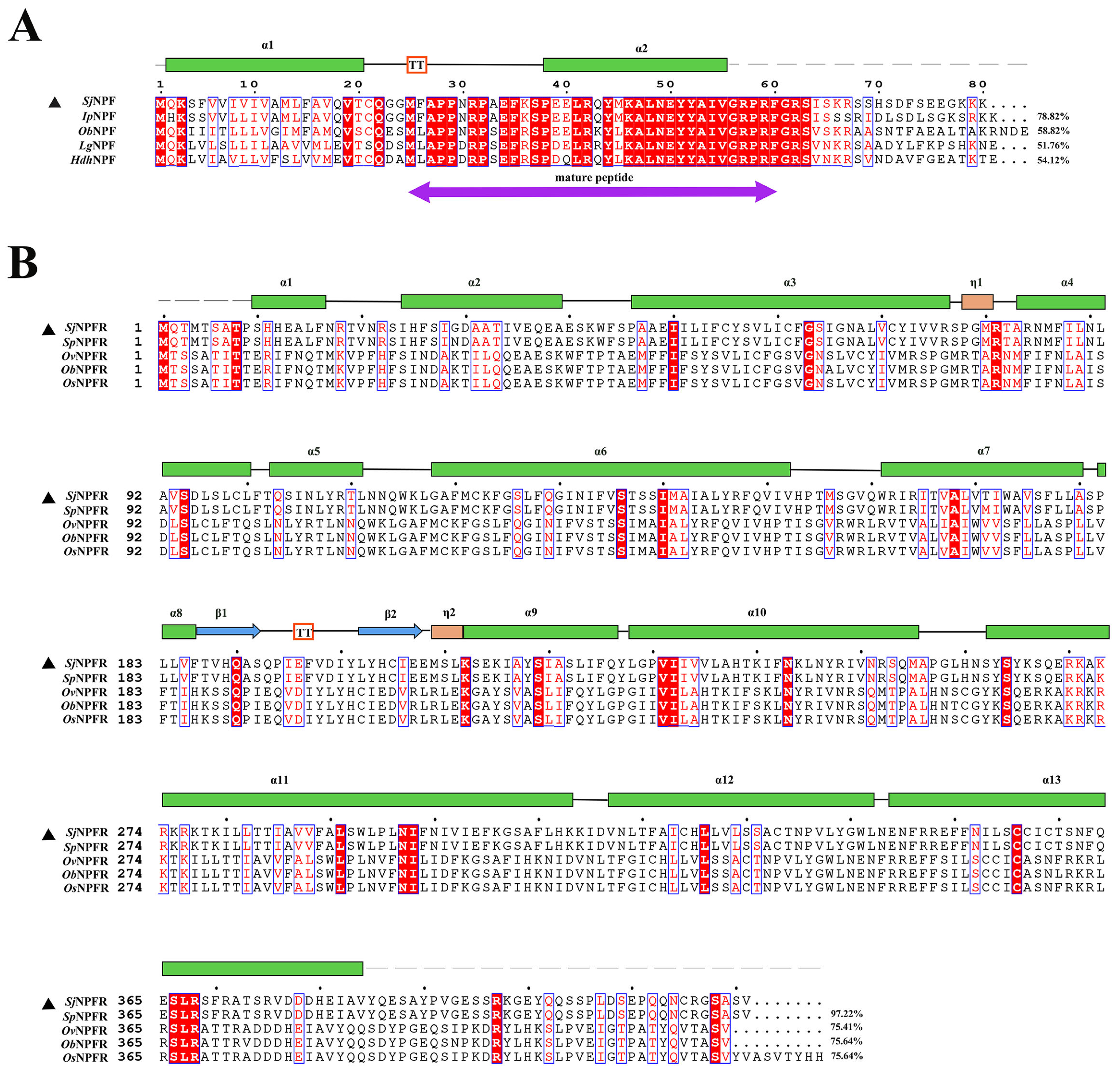
Alignment analysis of the deduced amino acid sequences from the full-length ORFs revealed that SjNPF shares high sequence identity with invertebrate NPFs, exhibiting 78.82% identity with Idiosepius paradoxus (AFW19652.1), 58.82% with Octopus bimaculoides Pickford & McConnaughey, 1949 (XP_014777727.1), 54.12% with Haliotis discus hannai (AVW85486.1), and 51.76% with Lottia gigantea (AFW19651.1). The predicted secondary structure of SjNPF comprises two α-helices and a tetratricopeptide repeat (TPR) domain (TT) (Figure 2A). Similarly, alignment of the SjNPFR ORF-derived amino acid sequences showed high sequence identity with NPFRs from other mollusks, particularly cephalopods and bivalves. The identity was 97.22% with Sepia (Acanthosepion) pharaonis Ehrenberg, 1831 (CAE1283031.1), 75.64% with Octopus bimaculoides (XP_014780691.1) and O. sinensis d’Orbigny, 1834 (XP_0209653981.2), and 75.41% with O. vulgaris Cuvier, 1797 (QHX41536.1). The secondary structure of SjNPFR was predicted to contain thirteen α-helices, two β-sheets, a TPR (TT), and two η-helices (Figure 2B).
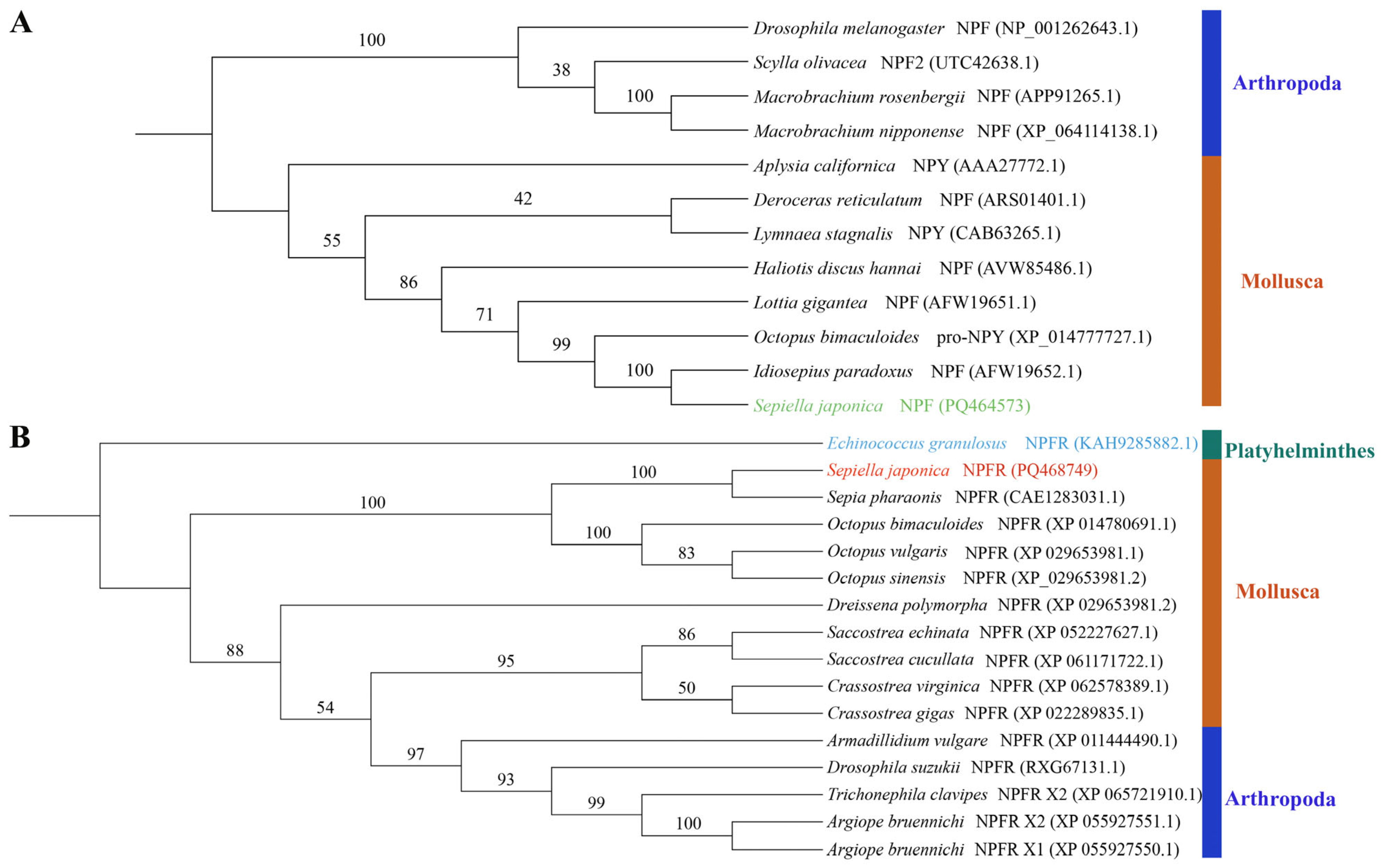
Phylogenetic analysis based on the deduced amino acid sequence of the full-length ORF revealed that SjNPF (Figure 3A) forms a highly supported clade with Idiosepius paradoxus (bootstrap ≥ 70%), both belonging to the Coleoidea, although one of them to the order Idiosepida, another to Sepiida. These sequences were placed within a larger molluscan branch, including Lottia gigantea (subclass Patellogastropoda) and Haliotis discus hannai (subclass Vetigastropoda), while arthropods, including Drosophila melanogaster, were used as the outgroup. Similarly, phylogenetic analysis of the deduced amino acid sequence of the SjNPFR ORF (Figure 3B) showed the closest genetic relationship with Sepia (Acanthosepion) pharaonis Ehrenberg, 1831 and clustered with other cephalopod receptors from Octopus vulgaris, O. sinensis, and O. bimaculoides. The cephalopod clade also exhibited high similarity with other molluscan species, including Dreissena polymorpha (Pallas, 1771), Saccostrea cucullata (Born, 1778), Saccostrea echinata (Quoy & Gaimard, 1835), Crassostrea gigas (Thunberg, 1793), and Crassostrea virginica (Gmelin, 1791). In contrast, flatworms were evolutionarily distant from mollusks and arthropods. Therefore, Echinococcus granulosus (Batsch, 1786) was selected as the outgroup.

3.3. Expression Patterns of SjNPF and SjNPFR Genes at Different Developmental Stages

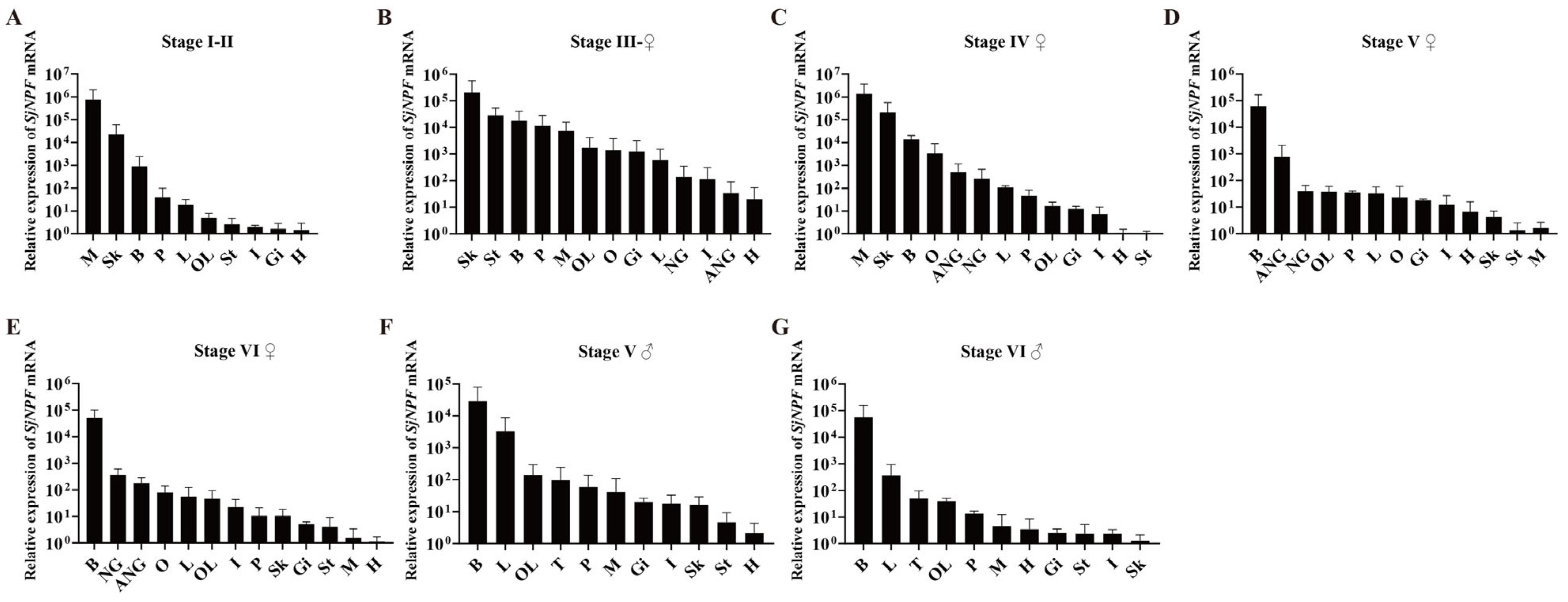
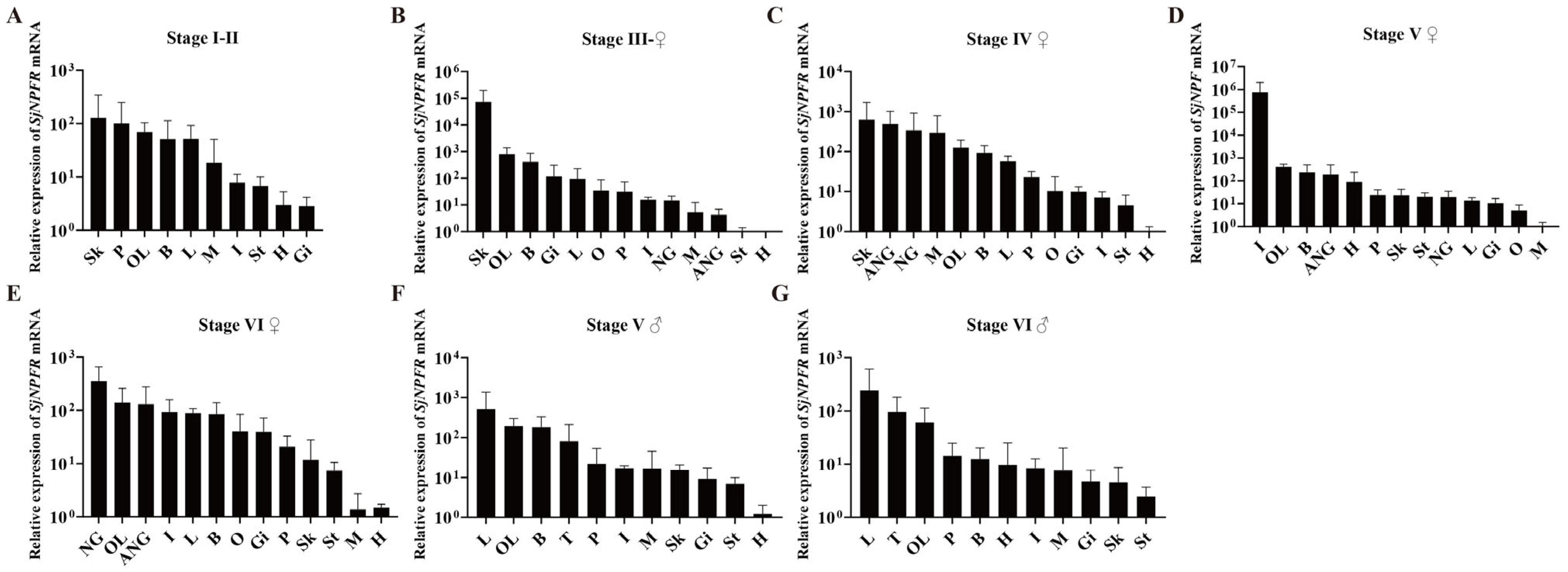
In order to explore the expression patterns of SjNPF and SjNPFR in various tissues at different developmental stages, we detected the expression changes of SjNPF and SjNPFR at the undifferentiated gonad stage (Stage I-II), female stages (Stage III, IV, V, VI), and male stages (Stage V, VI) by qRT-PCR (Figure 4 and Figure 5).
The tissue-specific expression profiles of SjNPF in both genders are shown in Figure 4. At the undifferentiated stage (I-II; Figure 4A), transcript levels peaked in the muscle, followed by the skin, brain, and pancreas. In females at stage III (Figure 4B), the highest expression was detected in the skin, followed by stomach, brain, and pancreas. By stage IV (Figure 4C), expression was again highest in the muscle, then in the skin and brain. At female stages V and VI (Figure 4D,E), the brain showed the strongest expression level, followed by the nidamental and accessory nidamental glands. In males at stages V and VI (Figure 4F,G), relatively higher expression was observed in the brain and liver.
The expression pattern of SjNPFR across developmental stages is shown in Figure 5. During the undifferentiated gonad stage I-II (Figure 5A), the relative expression level of SjNPFR was highest in the skin, followed by the pancreas. At female stage III (Figure 5B), its expression level was highest in the skin, followed by the optic lobe and brain. At female stage IV (Figure 5C), the expression was highest in the skin, while the levels in the accessory nidamental gland and nidamental gland were relatively higher than those in other tissues. At female stage V (Figure 5D), the expression level in the intestine was relatively higher compared to other tissues. At female stage VI (Figure 5E), expression was the highest in the nidamental gland, followed by the optic lobe and accessory nidamental gland. However, at male stages V and VI (Figure 5F,G), the relative expression level was highest in the liver.

3.4. Distribution of SjNPF and SjNPFR in the Brain at Different Developmental Stages

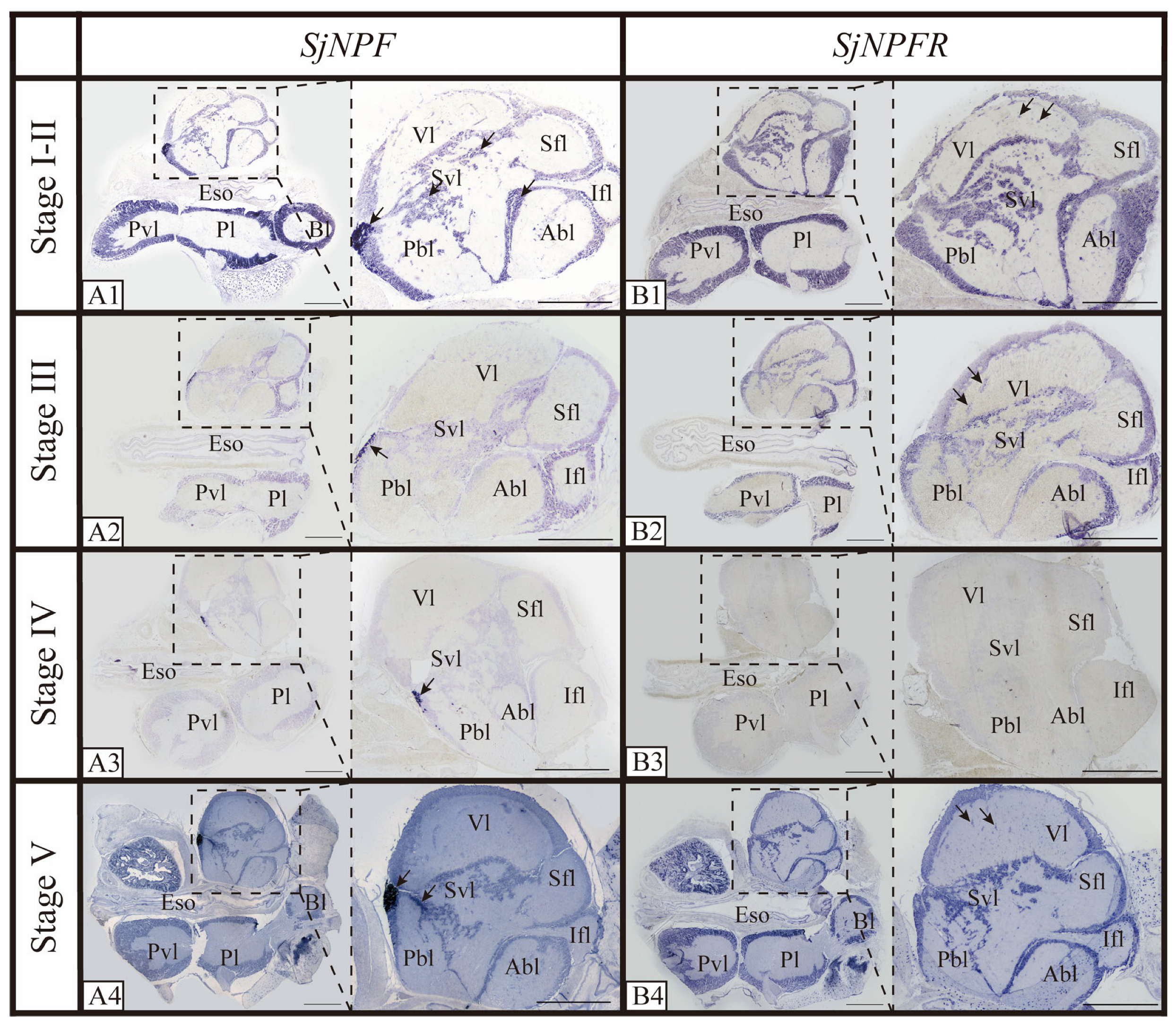
The anatomical architecture of the cuttlefish brain was examined through sagittal sectioning of the entire brain. In the brain, there were not any positive signals incubated with sense probes as control (Figure S1). In the brain sagittal sections, SjNPF-positive signals were widely distributed at the periphery of each brain lobe across all developmental stages (Figure 6(A1–A4)). The signal intensity was strongest at stages I-II. From stages I-II to stage IV, the overall SjNPF signal gradually weakened, before increasing again to a higher level at stage V. At stages I-II, the SjNPF -positive signals in the peripheral nerve regions of the pedal lobe complex, palliovisceral lobe complex, and brachial lobe complex were stronger than those at subsequent stages. Within the supraesophageal mass at each stage, the positive SjNPF signal was also localized to the periphery of the constituent nerve lobes, exhibiting an intensity comparable to that observed in the subesophageal mass. Notably, a clear and stable strong positive signal was consistently detected at the junction between the vertical lobe and the subvertical lobe (Figure 6(A1–A4)).
For SjNPFR, the temporal changes in signal intensity from stages I-II to stage IV were similar to those of SjNPF, with signals also primarily distributed at the periphery of each brain lobe, but displaying lower region specificity. Furthermore, unlike SjNPF, a small amount of SjNPFR signal was diffusely distributed within the central regions of the vertical and brachial lobes specifically at stages I-II and stage V (Figure 6(B1–B4)).

3.5. Localization of SjNPF and SjNPFR in HEK293 Cells

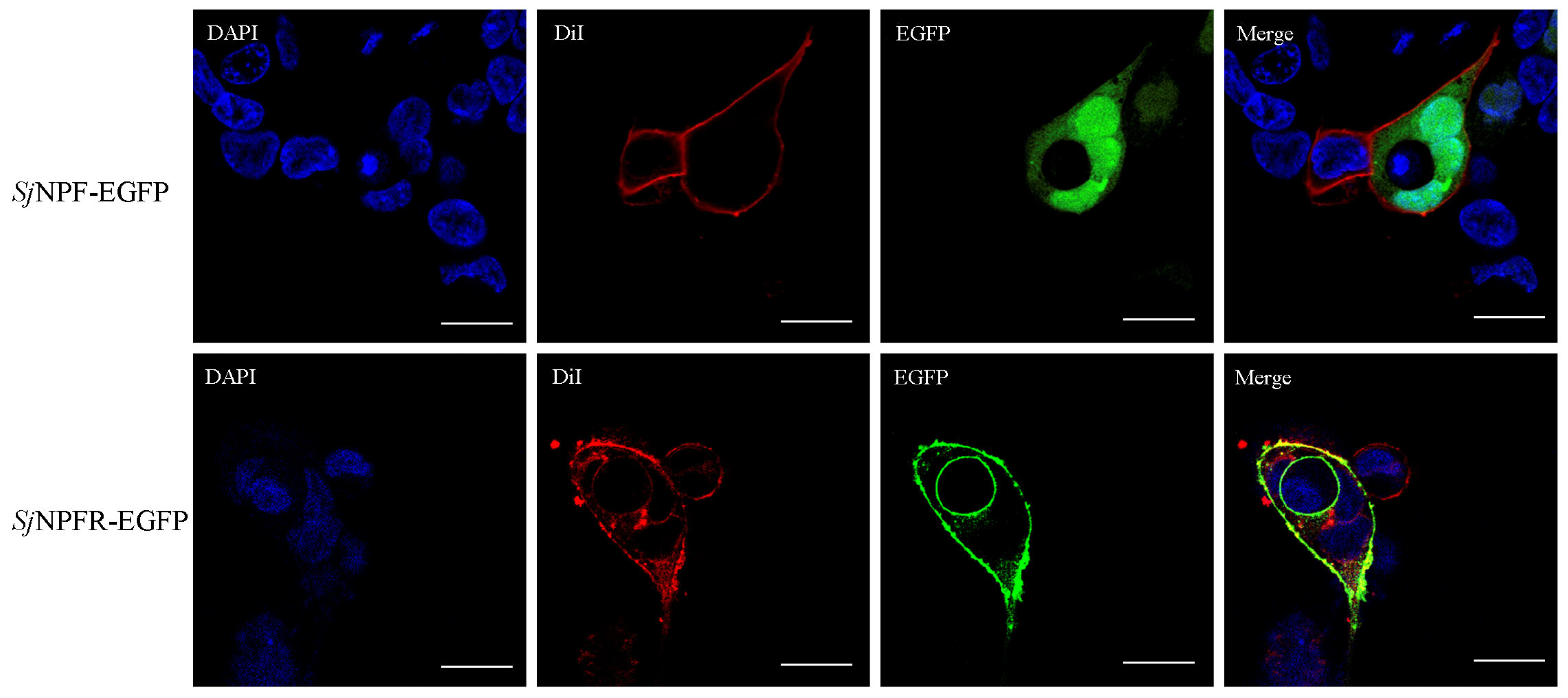
To determine the subcellular localization of SjNPF and SjNPFR, HEK293 cells were transfected with eukaryotic expression vectors encoding SjNPF-EGFP or SjNPFR-EGFP fusion proteins. Fluorescence was examined by laser confocal microscopy 24 h post-transfection. The results showed that green fluorescence from SjNPF-EGFP was distributed throughout the cytoplasm, indicating cytoplasmic localization of SjNPF. In contrast, SjNPFR-EGFP fluorescence was localized to the cell membrane (Figure 7).

3.6. Expression Patterns of SjNPF and SjNPFR Genes Under Feeding Regulation

To explore the expression changes of SjNPF and SjNPFR under the regulation of feeding in the cuttlefish, sampling and qRT-PCR detection were carried out under the conditions of starvation and refeeding at certain intervals: D1, D3, D5: 1, 3, 5 days of starvation, D6, D8: 1 and 3 days of re-feeding.

3.6.1. Specific Expression of SjNPF in Starved Tissues of S. japonica

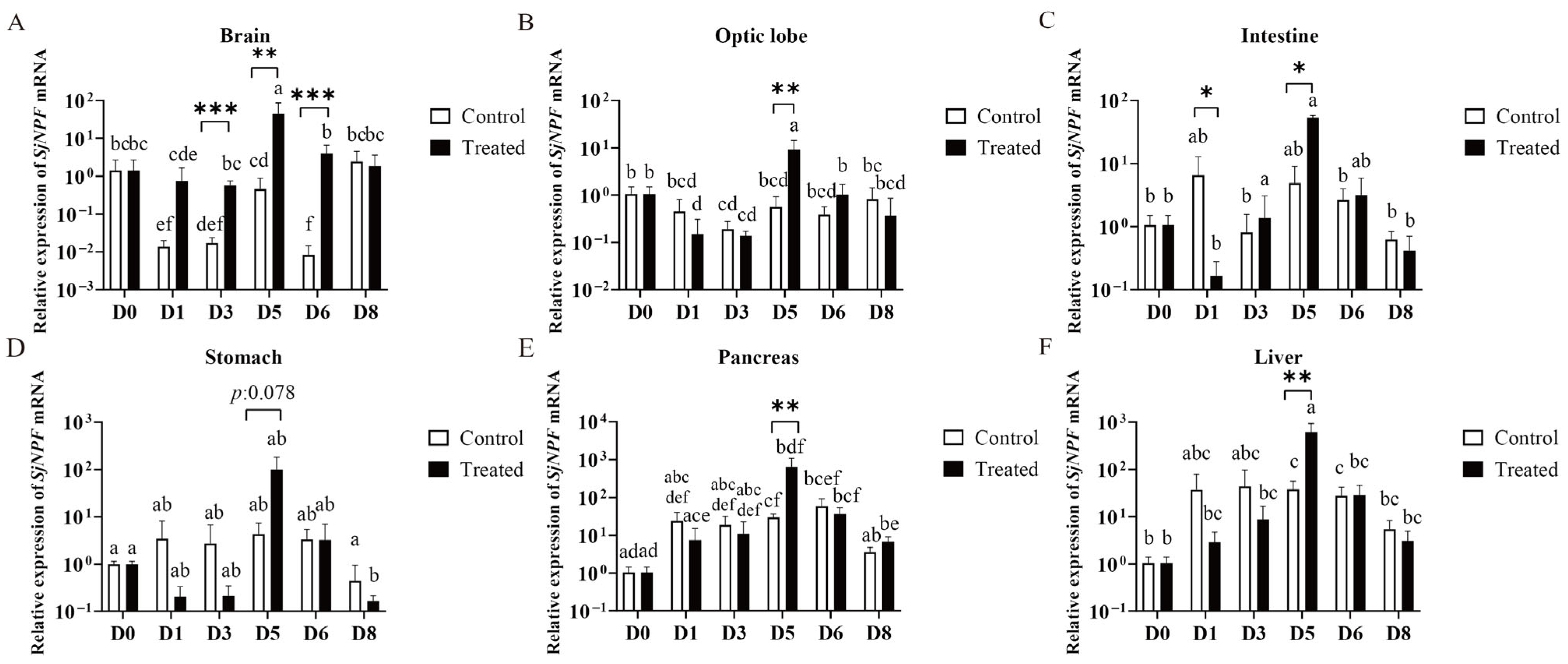
As shown in Figure 8, the expression level of the SjNPF gene in both central nervous system (CNS) and digestive organs generally followed a temporal pattern of an increase at the beginning followed by a decrease. Specifically, its relative expression level in the treated group peaked at D5, which was higher than that at other time points. In the brain (Figure 8A), a significant difference in SjNPF expression levels between the treated and control groups was observed on D3, D5 and D6 (p < 0.05). In the optic lobe, pancreas, and liver (Figure 8B,E,F), expression levels were significantly increased at D5 (p < 0.05). In contrast, in the intestine (Figure 8C), expression levels showed a very significant decrease at D1 and significant increase at D5 (p < 0.05).

3.6.2. Specific Expression of the SjNPFR Gene in Starved Tissues of S. japonica

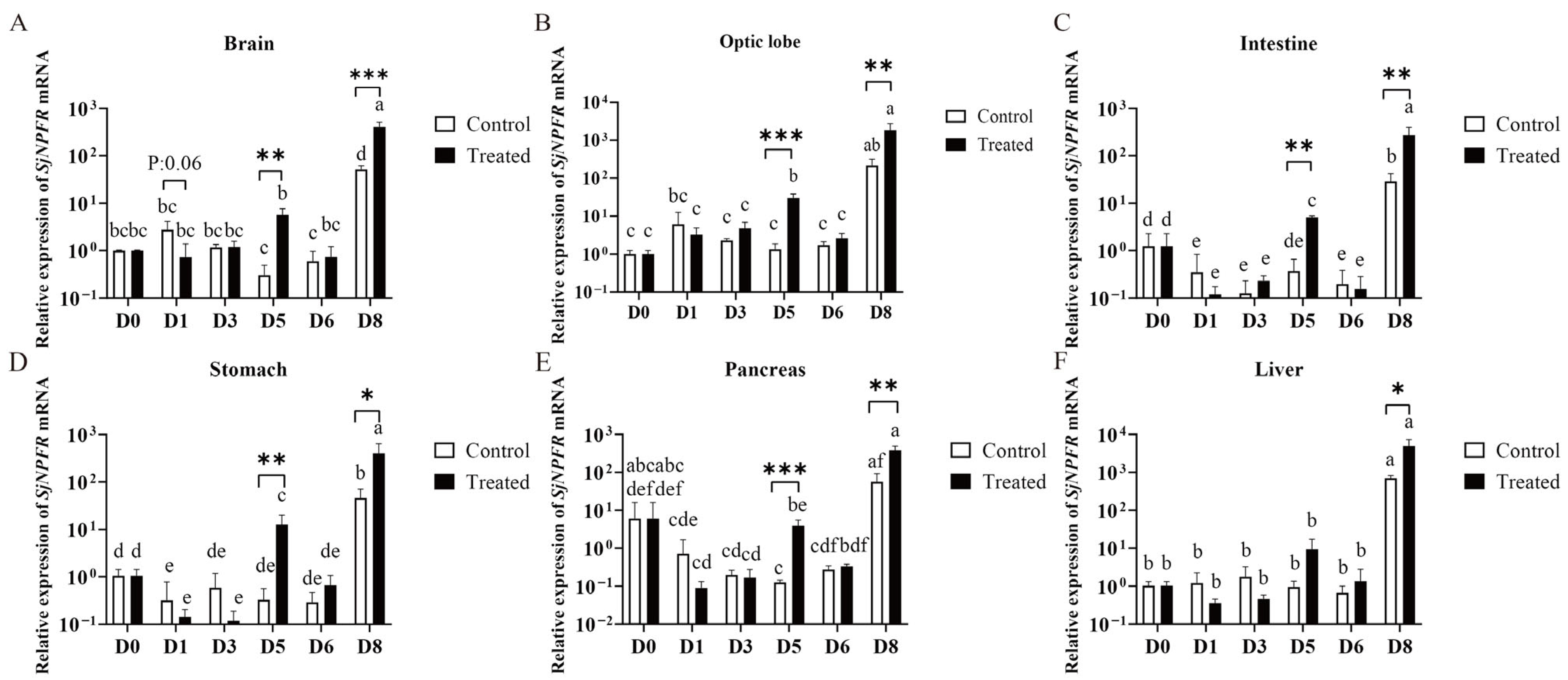
According to Figure 9, from the first day of starvation (D1) to the fifth day of starvation (D5) and the first day of refeeding (D6), significant differences in the expression of the SjNPFR gene were observed on D5 (p < 0.05) except in liver, which is consistent with the increased expression of SjNPF observed on D5. Furthermore, on the third day of refeeding (D8), its expression in the central nervous system and digestive organs was significantly higher than that at all previous time points.
Specifically, in the brain and optic lobes (Figure 9A,B), significant differences in SjNPFR expression were observed at D5 and D8 (p < 0.05). In the intestine, stomach, and pancreas (Figure 9C–E), a significant increase in expression was also detected at D5 and D8 (p < 0.05). Finally, in the liver (Figure 9F), a significant difference in expression was only detected at D8 (p < 0.05).

4. Discussion

4.1. Cloning and Identification of NPF and NPFR Genes in S. japonica

In this study, NPF and NPFR genes of cephalopod S. japonica were cloned and identified for the first time, and their core coding regions’ cDNA sequences were characterized. The deduced SjNPF precursor exhibits a typical architecture common to most NPF/NPY family members, consisting of a signal peptide, the mature NPF sequence, and proteolytic cleavage sites. Genomic analyses across vertebrates and invertebrates have predominantly indicated that NPF is encoded by a single gene [51]. However, studies have identified exceptions in certain species, which possess two homologous genes featuring a C-terminal Arg-Tyr (RY) amide motif [7,52,53]. Furthermore, some species express distinct splice variants encoding peptides with a C-terminal Arg-Pro-Arg-Phe (RPRF) amide [51,54,55].
In this study, the SjNPF gene was successfully cloned and characterized. This contrasts with findings in Loligo vulgaris Lamarck, 1798, from which two distinct NPF forms were isolated from brain tissue [56]. A related short peptide (YAIVARPRFamide, 9 aa) from L. vulgaris shows significant homology with PYY and the C-terminal nonapeptide of many NPFs but lacks the characteristic PP fold [56]. The amino acid multiple sequence alignment of SjNPF with other mollusks showed a high similarity in conserved regions among different species and found that the characteristic sequence (xnPxRxnYLx2Lx2YYx4RPRFamide), especially the last four residues at the C-terminus, were highly conserved—a feature also observed in other species—and this conserved C-terminal tetrapeptide has been demonstrated to be critical for the biological activity of NPY, as substitutions at these residues lead to a significant loss of receptor affinity and bioactivity [6,57,58,59]. Phylogenetic analysis results indicated that the NPF of S. japonica is most close to that of I. paradoxus and clusters within a clade containing other mollusks such as gastropods. Future studies are needed to further illustrate the evolutionary relationships of these peptides across the molluscan lineages.
Sequence analysis results showed that SjNPFR was a representative rhodopsin receptor with seven transmembrane structures suggesting that it belongs to this superfamily [37], and can covalently bind to the cell membrane. GPCR can respond to stimuli such as neurotransmitters, transmit signals, and maintain communication between the intracellular and extracellular environments [60]. Bioinformatic analysis predicted 19 Ser, 5 Thr, and 9 Tyr residues as potential phosphorylation sites in SjNPFR. While phosphorylation is known to regulate GPCR endocytosis and desensitization, further experimental validation is required to confirm the functional significance of these predicted sites. Additionally, N-linked glycosylation motifs (Asn-X-Ser/Thr) were identified in the extracellular N-terminal region, suggesting potential glycosylation [61]. The SjNPFR protein contains 3 glycosylation sites, which may affect its stability, folded conformation, and membrane function [62,63]. Phylogenetic analysis indicated that SjNPFR is most closely related to the NPFR of Sepia (Acanthosepion) pharaonis, forming a clade, and clustered with other cephalopods such as Octopus bimaculoides into a larger clade. The subcellular localization of SjNPF and SjNPFR was assessed by transfecting HEK293 cells with constructed SjNPF-EGFP and SjNPFR-EGFP fusion vectors, which revealed that SjNPF was localized in the cytoplasm while SjNPFR was targeted to the cell membrane. This differential localization is consistent with the characteristic biosynthesis pathway of NPF as a secretory protein, which is synthesized and processed intracellularly before secretion, and with the expected membrane topology of its receptor. Specifically, the membrane localization of SjNPFR aligns with prior findings in B. mori where NPFR-EGFP was shown to co-localize with the plasma membrane [51]. These observations support a functional model whereby NPF is synthesized in the cytoplasm, is secreted, and binds to its membrane-localized receptor NPFR to initiate downstream signaling, an interaction preliminarily supported by experiments in our lab [64]. In conclusion, SjNPF and SjNPFR genes are highly conserved among mollusks and are hypothesized to influence key physiological processes such as energy metabolism, growth, development, and reproduction, although their precise molecular regulatory mechanisms require further investigation.

4.2. Study on the Spatio-Temporal Expression of SjNPF and SjNPFR Genes in S. japonica

In this study, SjNPF showed a relatively high distribution in key digestive organs—including the liver, pancreas, and stomach—across different developmental stages. Under conditions of energy insufficiency, neuropeptides such as NPF may influence feeding behavior and promote reproductive maturation through associated physiological pathways, as observed in O. vulgaris [65]. These findings suggest that SjNPF likely plays a vital role in regulating energy storage, food intake, nutrient consumption, and metabolic balance throughout development. As components of a conserved neuropeptide system, both SjNPF and SjNPFR were also prominently distributed in the brain and optic lobes of both gender cuttlefish. Previous studies indicate that even slight variations in the expression of NPY receptors (e.g., NPYR-1) in the brain can lead to measurable changes in feeding behavior [66,67], supporting the potential role of the SjNPF/SjNPFR system in modulating cephalopod feeding and energy homeostasis. In addition to its potential central role in energy homeostasis, the elevated expression of SjNPF in peripheral digestive tissues—including the hepatopancreas, pancreas, and stomach—suggests a possible local paracrine function within the gastrointestinal tract. The widespread distribution of NPF in midgut endocrine cells across arthropod lineages points to a conserved role in digestive regulation, potentially involving the modulation of digestive enzyme secretion [7,52]. Moreover, NPF has been demonstrated to exert a myoinhibitory effect on the hindgut of Rhodnius prolixus [68]. Collectively, these findings support a dual role for SjNPF in S. japonica, functioning both as a central modulator of feeding behavior and as a local regulator of digestive physiology.

4.3. Tissue Distribution of NPF and NPFR in S. japonica

The brain of S. japonica shares a conserved lobular architecture with O. vulgaris and other cephalopods, comprising distinct functional regions [69,70]. This structural conservation suggests that the specific expression patterns of neuropeptides within the cuttlefish brain may correspond to particularly physiological functions. ISH revealed widespread expression of SjNPF and SjNPFR transcripts across three major brain regions in females at all developmental stages, a finding consistent with qRT-PCR results. This supports the potential role of the NPF/NPFR signaling system in regulating specific physiological processes during cuttlefish growth and development. Within the supraesophageal mass, SjNPF expression was notably highest in the posterior basal lobe at the junction of the vertical and subvertical lobes. This region constitutes a complex neural pathway where the subpeduncle lobe connects to the optic gland, forming a circuit from the retina to the subpeduncle lobe and then to the optic gland [71]. The subpeduncle nerve ends with neurosecretory terminals at the pharynx-ophthalmic vein, appearing to be involved in growth and/or maturation [72]. The anterior and the posterior basal lobe controlled the direction of body movement and the movement of the arm [40]. In these regions, SjNPF-positive signals were detected in the anterior basal lobe, whereas expression in the inferior and superior frontal lobes was minimal. Similar to SjNPF, SjNPFR was expressed throughout both the supraesophageal and subesophageal masses. Notably, high expression was observed in the brachial, pedal, and palliovisceral lobes of the subesophageal mass near the esophageal margin—regions responsible for arm control, feeding, and buccal biting movements [73]. This overlapping expression pattern suggests that SjNPF and SjNPFR may be co-expressed to coordinately regulate motor functions. These findings align with NPF/NPY immunohistochemical and in situ hybridization results reported in O. vulgaris [65,74] and other mollusks such as Aplysia [11,38] and L. stagnalis [17]. In addition, studies have shown that the immune co-localization of NPY and FMRFamide in the brain has been found in both vertebrates and invertebrates [74]. These results indicate that there is a close relationship between FMRFamide and NPY, which needs to be further explained in S. japonica.
Moreover, ISH was employed to examine the spatial and developmental expression patterns of SjNPF/SjNPFR at the tissue-section level and to correlate these findings with qRT-PCR data. However, the expression profiles obtained by ISH did not fully align with the qRT-PCR results. The authors have considered several possible reasons for this inconsistency. First, the ISH analysis presented in Figure 6 depicts a single specimen, while the qRT-PCR results were derived from three individuals per stage, which may reflect individual biological variation. Additionally, the algorithm used to compare qRT-PCR expression levels of the same tissue across different developmental stages (Figure 4) has limitations. The marked differences in relative expression could be related to substantial genetic heterogeneity among the experimental animals and the unique biological characteristics of S. japonica. Beyond biological variation, several technical factors may explain the discrepancies. ISH accuracy depends on probe sensitivity and experimental conditions (e.g., tissue fixation), which can reduce hybridization efficiency. In contrast, qRT-PCR quantifies RNA from homogenized tissues and is generally more sensitive for low-abundance transcripts, but its accuracy may be affected by RNA extraction efficiency or PCR inhibitors. Additionally, differential mRNA stability could lead to detection bias, as partially degraded transcripts may still be quantified by qRT-PCR but fail to hybridize with ISH probes in situ. In future research, efforts should be made to address these points by increasing sample size for morphological techniques, utilizing more robust analytical approaches for longitudinal comparisons, and accounting for population genetic diversity.

4.4. Preliminary Study on the Feeding Regulation Function of NPF and NPFR Genes in S. japonica

The results showed that SjNPF mRNA was significantly up-regulated on the fifth day of starvation (D5) but down-regulated on the first day of re-feeding (D6), returning to the original level—a pattern also observed in mice [75]. This response in S. japonica is consistent with the effects of starvation and re-feeding on NPF/NPY expression in diverse species, including desert locusts (S. gregaria), zebrafish (Danio rerio (Hamilton, 1822)), salmons, crucian carp (Carassius Carassius (Linnaeus, 1758)), Manila clam (R. philippinarum), A. californica, as well as with NPY dynamics in hungry rodents and D. melanogaster [24,29,38,76].
Both NPF and 5-hydroxytryptamine (5-HT) could induce the release of the insulin-like peptide from the D. melanogaster brain [51,58]. In the same organism, starvation-induced dopamine (DA) release enhances food sensitivity [77]. A parallel relationship exists in bivalves: the levels of 5-HT and DA in the visceral ganglion of the clam decrease during starvation and increase shortly after feeding; notably, injection of NPF also up-regulates their contents [29]. Currently, the roles of 5-HT and DA neurons in feeding regulation have not been reported in cephalopods. Interestingly, a temporal lag was observed between the expression peaks of SjNPF and SjNPFR, with SjNPF expression peaking at D5 and subsequently declining, while SjNPFR expression increased significantly at D8, suggesting a potential ligand-induced regulatory mechanism. In classical GPCR signaling, prolonged ligand exposure often triggers receptor internalization and transcriptional downregulation as part of the desensitization process [78,79,80], and the later increase in SjNPFR expression may therefore represent a compensatory recovery or resensitization phase that allows the system to restore sensitivity to the ligand [81].
Therefore, further investigation is needed to elucidate the potential roles and interactions of NPF, 5-HT, and DA in this context.
Relevant studies have shown that mutations in the NPF-1 gene of C. elegans can lead to alterations in its feeding behavior [26]. In other invertebrates, injection of NPY significantly increased the average daily food intake of shrimp (Penaeus semisulcatus De Haan, 1844) [82] and elevated food consumption along with glycogen content in L. stagnalis [17]. Conversely, injection of apNPY into Aplysia induced a state of satiety, characterized by reduced food intake and a slower feeding rate [38]. To date, direct injection of NPF/NPY into the brain has not been reported in cephalopods, likely due to the particular complexity of their head anatomy. To further explore the dose-dependent relationship between NPF/NPY and feeding regulation—and the specific form this relationship takes—targeted injection studies will be essential.

Supplementary Materials

The following supporting information can be downloaded at: https://www.mdpi.com/article/10.3390/d18030140/s1, Supplementary Figure S1. Distribution of SjNPF and SjNPFR in the brain at different developmental stages. ISH detecting SjNPF (A) and SjNPFR (B) mRNA in the brain of female S. japonica across all developmental stages (I-II, III, IV, V, VI).

Author Contributions

Y.L.: Writing—original draft, Investigation, Formal analysis. C.S.: Investigation, Formal analysis, Writing—original draft. P.F.: Investigation, Formal analysis. S.L.: Writing—review and editing. X.Z.: Writing—review and editing, Resources (including reagents, materials, and analytical tools). C.C.: Writing—review and editing, Conceptualization, Methodology, Resources (including reagents, materials, and analytical tools). All authors have read and agreed to the published version of the manuscript.

Funding

This research was funded by the Natural Science Foundation of Zhejiang Province, China (Grant No. LTGN24C190005) and the National Natural Science Foundation of China (Grant No. 32473136 and 42406102).

Institutional Review Board Statement

Not applicable.

Data Availability Statement

The original manuscript of this study is included in the article and further information is available upon reasonable request to the corresponding author.

Acknowledgments

We thank H.-L.P., T.Z. and H.-L.S. for their support in providing cuttlefish samples.

Conflicts of Interest

The authors declare no conflicts of interest.

References

  1. Andrews, P.C.; Hawke, D.; Shively, J.E.; Dixon, J.E. A nonamidated peptide homologous to porcine peptide YY and neuropeptide YY. Endocrinology 1985, 116, 2677–2681. [Google Scholar] [CrossRef]
  2. Larhammar, D.; Blomqvist, A.G.; Söderberg, C. Evolution of neuropeptide Y and its related peptides. Toxicol. Endocrinol. 1993, 106, 743–752. [Google Scholar] [CrossRef] [PubMed]
  3. Fuhlendorff, J.; Johansen, N.L.; Melberg, S.G.; Thøgersen, H.; Schwartz, T.W. The antiparallel pancreatic polypeptide fold in the binding of neuropeptide Y to Y1 and Y2 receptors. J. Biol. Chem. 1990, 265, 11706–11712. [Google Scholar] [CrossRef] [PubMed]
  4. Eva, C.; Serra, M.; Mele, P.; Panzica, G.; Oberto, A. Physiology and gene regulation of the brain NPY Y1 receptor. Front. Neuroendocrinol. 2006, 27, 308–339. [Google Scholar] [CrossRef] [PubMed]
  5. Wettstein, J.G.; Earley, B.; Junien, J.L. Central nervous system pharmacology of neuropeptide Y. Pharmacol. Ther. 1995, 65, 397–414. [Google Scholar] [CrossRef]
  6. Fadda, M.; Hasakiogullari, I.; Temmerman, L.; Beets, I.; Zels, S.; Schoofs, L. Regulation of Feeding and Metabolism by Neuropeptide F and Short Neuropeptide F in Invertebrates. Front. Endocrinol. 2019, 10, 64. [Google Scholar] [CrossRef]
  7. Nässel, D.R.; Wegener, C. A comparative review of short and long neuropeptide F signaling in invertebrates: Any similarities to vertebrate neuropeptide Y signaling. Peptides 2011, 32, 1335–1355. [Google Scholar] [CrossRef]
  8. Yañez-Guerra, L.A.; Zhong, X.; Moghul, I.; Butts, T.; Zampronio, C.G.; Jones, A.M.; Mirabeau, O.; Elphick, M.R. Echinoderms provide missing link in the evolution of PrRP/sNPF-type neuropeptide signalling. eLife 2020, 9, e57640. [Google Scholar] [CrossRef]
  9. Maule, A.G.; Shaw, C.; Halton, D.W.; Thim, L.; Johnston, C.F.; Fairweather, I.; Buchanan, K.D. Neuropeptide F: A novel parasitic flatworm regulatory peptide from Moniezia expansa (Cestoda: Cyclophyllidea). Parasitology 1991, 102, 309–316. [Google Scholar] [CrossRef]
  10. Leung, P.S.; Shaw, C.; Maule, A.G.; Thim, L.; Johnston, C.F.; Irvine, G.B. The primary structure of neuropeptide F (NPF) from the garden snail, Helix aspersa. Regul. Pept. 1992, 41, 71–81. [Google Scholar] [CrossRef]
  11. Rajpara, S.M.; Garcia, P.D.; Roberts, R.; Eliassen, J.C.; Owens, D.F.; Maltby, D.; Myers, R.M.; Mayeri, E. Identification and molecular cloning of a neuropeptide Y homolog that produces prolonged inhibition in Aplysia neurons. Neuron 1992, 9, 505–513. [Google Scholar] [CrossRef]
  12. Kim, K.S.; Kim, M.A.; Park, K.; Sohn, Y.C. NPF activates a specific NPF receptor and regulates food intake in Pacific abalone Haliotis discus hannai. Sci. Rep. 2021, 11, 20912. [Google Scholar] [CrossRef] [PubMed]
  13. Thongrod, S.; Changklungmoa, N.; Chansela, P.; Siangcham, T.; Kruangkum, T.; Suwansa-Ard, S.; Saetan, J.; Sroyraya, M.; Tinikul, Y.; Wanichanon, C.; et al. Characterization and tissue distribution of neuropeptide F in the eyestalk and brain of the male giant freshwater prawn, Macrobrachium rosenbergii. Cell Tissue Res. 2016, 367, 181–195. [Google Scholar] [CrossRef] [PubMed]
  14. Veenstra, J.A. Neurohormones and neuropeptides encoded by the genome of Lottia gigantea, with reference to other mollusks and insects. Gen. Comp. Endocrinol. 2010, 167, 86–103. [Google Scholar] [CrossRef] [PubMed]
  15. Nuss, A.B.; Forschler, B.T.; Crim, J.W.; TeBrugge, V.; Pohl, J.; Brown, M.R. Molecular characterization of neuropeptide F from the eastern subterranean termite Reticulitermes flavipes (Kollar) (Isoptera: Rhinotermitidae). Peptides 2010, 31, 419–428. [Google Scholar] [CrossRef]
  16. Leung, P.S.; Shaw, C.; Johnston, C.F.; Irvine, G.B. Immunocytochemical distribution of neuropeptide F (NPF) in the gastropod mollusc, Helix aspersa, and in several other invertebrates. Cell Tissue Res. 1994, 275, 383–393. [Google Scholar] [CrossRef]
  17. De Jong-Brink, M.; Reid, C.N.; Tensen, C.P.; Ter Maat, A. Parasites flicking the NPY gene on the host’s switchboard: Why NPY. FASEB J. 1999, 13, 1972–1984. [Google Scholar] [CrossRef]
  18. Lingo, P.R.; Zhao, Z.; Shen, P. Co-regulation of cold-resistant food acquisition by insulin-and neuropeptide Y-like systems in Drosophila melanogaster. Neuroscience 2007, 148, 371–374. [Google Scholar] [CrossRef]
  19. Krashes, M.J.; DasGupta, S.; Vreede, A.; White, B.; Armstrong, J.D.; Waddell, S. A neural circuit mechanism integrating motivational state with memory expression in Drosophila. Cell 2009, 139, 416–427. [Google Scholar] [CrossRef]
  20. Wen, T.; Parrish, C.A.; Xu, D.; Wu, Q.; Shen, P. Drosophila neuropeptide F and its receptor, NPFR1, define a signaling pathway that acutely modulates alcohol sensitivity. Proc. Natl. Acad. Sci. USA 2005, 102, 2141–2146. [Google Scholar] [CrossRef]
  21. Lee, G.; Bahn, J.H.; Park, J.H. Sex-and clock-controlled expression of the neuropeptide F gene in Drosophila. Proc. Natl. Acad. Sci. USA 2006, 103, 12580–12585. [Google Scholar] [CrossRef] [PubMed]
  22. Hermann, C.; Yoshii, T.; Dusik, V.; Helfrich-Förster, C. Neuropeptide F immunoreactive clock neurons modify evening locomotor activity and free-running period in Drosophila melanogaster. J. Comp. Neurol. 2012, 520, 970–987. [Google Scholar] [CrossRef] [PubMed]
  23. Qiao, H.; Jiang, S.F.; Xiong, Y.W.; Zhang, W.Y.; Xu, L.; Jin, S.B.; Gong, Y.S.; Wu, Y.; Fu, H.T. Molecular cloning, characterization and functional analysis of two neuropeptide F genes from the oriental river prawn (Macrobrachium nipponense). Comp. Biochem. Physiol. Part A Mol. Integr. Physiol. 2020, 253, 110844. [Google Scholar] [CrossRef] [PubMed]
  24. Van Wielendaele, P.; Dillen, S.; Zels, S.; Badisco, L.; Vanden Broeck, J. Regulation of feeding by Neuropeptide F in the desert locust, Schistocerca gregaria. Insect Biochem. Mol. Biol. 2013, 43, 102–114. [Google Scholar] [CrossRef]
  25. Wu, Q.; Zhang, Y.; Xu, J.; Shen, P. Regulation of hunger-driven behaviors by neural ribosomal S6 kinase in Drosophila. Proc. Natl. Acad. Sci. USA 2005, 102, 13289–13294. [Google Scholar] [CrossRef]
  26. De Bono, M.; Bargmann, C.I. Natural variation in a neuropeptide Y receptor homolog modifies social behavior and food response in C. elegans. Cell 1998, 94, 679–689. [Google Scholar] [CrossRef]
  27. Liu, B.; Fu, D.Y.; Gao, H.M.; Ning, H.; Sun, Y.Y.; Chen, H.; Tang, M. Cloning and expression of the neuropeptide F and neuropeptide F receptor genes and their regulation of food intake in the Chinese white pine beetle Dendroctonus armandi. Front. Physiol. 2021, 12, 662651. [Google Scholar] [CrossRef]
  28. Gonzalez, R.; Orchard, I. Characterization of neuropeptide F-like immunoreactivity in the blood-feeding hemipteran, Rhodnius prolixus. Peptides 2008, 29, 545–558. [Google Scholar] [CrossRef]
  29. Wang, X.; Miao, J.J.; Liu, P.P.; Pan, L.Q. Role of Neuropeptide F in regulating filter feeding of manila clam, Ruditapes philippinarum. Comp. Biochem. Physiol. Part B Biochem. Mol. Biol. 2017, 205, 30–38. [Google Scholar] [CrossRef]
  30. Ji, W.; Ping, H.C.; Wei, K.J.; Zhang, G.R.; Shi, Z.C.; Yang, R.B.; Zou, G.W.; Wang, W.M. Ghrelin, neuropeptide Y (NPY) and cholecystokinin (CCK) in blunt snout bream (Megalobrama amblycephala): cDNA cloning, tissue distribution and mRNA expression changes responding to fasting and refeeding. Gen. Comp. Endocrinol. 2015, 223, 108–119. [Google Scholar] [CrossRef]
  31. Feng, G.; Reale, V.; Chatwin, H.; Kennedy, K.; Venard, R.; Ericsson, C.; Yu, K.; Evans, P.D.; Hall, L.M. Functional characterization of a neuropeptide F-like receptor from Drosophila melanogaster. Eur. J. Neurosci. 2003, 18, 227–238. [Google Scholar] [CrossRef] [PubMed]
  32. Li, X.J.; Wu, Y.N.; North, R.A.; Forte, M. Cloning, functional expression, and developmental regulation of a neuropeptide Y receptor from Drosophila melanogaster. J. Biol. Chem. 1992, 267, 9–12. [Google Scholar] [CrossRef] [PubMed]
  33. Larhammar, D.; Salaneck, E. Molecular evolution of NPY receptor subtypes. Neuropeptides 2004, 38, 141–151. [Google Scholar] [CrossRef] [PubMed]
  34. Tensen, C.P.; Cox, K.J.; Burke, J.F.; Leurs, R.; Van Der Schors, R.C.; Geraerts, W.P.; Vreugdenhil, E.; Van Heerikhuizenl, H. Molecular cloning and characterization of an invertebrate homologue of a neuropeptide Y receptor. Eur. J. Neurosci. 1998, 10, 3409–3416. [Google Scholar] [CrossRef]
  35. Garezynski, S.F.; Brown, M.R.; Shen, P.; Murray, T.F.; Crim, J.W. Characterizationof a functional neuropeptide F receptor from Drosophila melanogaster. Peptides 2002, 23, 773–780. [Google Scholar] [CrossRef]
  36. Lundberg, J.M. Pharmacology of cotransmission in the autonomic nervous system:integrative aspects on amines, neuropeptides, adenosine triphosphate, amino acids andnitricoxide. Pharmacol. Rev. 1996, 48, 113–178. [Google Scholar] [CrossRef]
  37. Deng, X.Y.; Yang, H.P.; He, X.B.; Liao, Y.; Zheng, C.X.; Zhou, Q.; Zhu, C.G.; Zhang, G.Z.; Gao, J.M.; Zhou, N.M. Activation of Bombyx Neuropeptide G protein-Coupled Receptor A4 via a Gαi-Dependent Signaling Pathway by Direct Interaction with Neuropeptide F from Silkworm, Bombyx mori. Insect Biochem. Mol. Biol. 2013, 45, 77–88. [Google Scholar] [CrossRef]
  38. Jing, J.; Vilim, F.S.; Horn, C.C.; Alexeeva, V.; Hatcher, N.G.; Sasaki, K.; Yashina, I.; Zhurov, Y.; Kupfermann, I.; Sweedler, J.V. From hunger to satiety: Reconfiguration of a feeding network by Aplysia neuropeptide Y. J. Neurosci. 2007, 27, 3490–3502. [Google Scholar] [CrossRef]
  39. Li, S.; Hao, Q.; Qiu, J.; Zhou, X.; Chi, C.; Zheng, L. The First Non-Chordates QRFP-Like Peptide Receptor Gene in the Cephalopod Sepiella japonica: Identification, Characterization and Possible Role in Food Intake. J. Ocean. Univ. China 2025, 24, 195–208. [Google Scholar] [CrossRef]
  40. Shigeno, S.; Yamamoto, M. Organization of the nervous system in the pygmy cuttlefish, Idiosepius paradoxus Ortmann (Idiosepiidae, Cephalopoda). J. Morphol. 2002, 254, 65–80. [Google Scholar] [CrossRef]
  41. Polese, G.; Bertapelle, C.; Cosmo, A.D. Role of ol-faction in Octopus vulgaris reproduction. Gen. Comp. Endocrinol. 2015, 210, 55–62. [Google Scholar] [CrossRef]
  42. Song, C.P.; Sun, L.L.; Zheng, L.B.; Chi, C.F. Gonadotropin-releasing hormone-like gene in the cephalopod, Sepia pharaonis: Characterization, expression analysis, and localization in the brain. Invertebr. Reprod. Dev. 2021, 65, 226–234. [Google Scholar] [CrossRef]
  43. Qiu, J.Y.; Zheng, L.B.; Chi, C.F. Identification, Characterization, and Expression of a PRQFVamide-Related Peptide in Cephalopod Sepiella japonica. Front. Mar. Sci. 2022, 9, 805209. [Google Scholar] [CrossRef]
  44. Li, Y.; Cao, Z.; Li, H.; Liu, H.; Lü, Z.; Chi, C. Identification, Characterization, and Expression Analysis of a FMRFamide-Like Peptide Gene in the Common Chinese Cuttlefish (Sepiella japonica). Molecules 2018, 23, 742. [Google Scholar] [CrossRef] [PubMed]
  45. Wu, J.H.; Cao, Z.H.; Zheng, L.B.; Chi, C.F. Identification, characterization, and expression analysis of a GnRH-like gene at mature stage in the cephalopod Sepiella japonica (Sepiidae). Oceanol. Limnol. Sin. 2021, 52, 1530–1539. [Google Scholar] [CrossRef]
  46. Jiang, X.M.; Fu, F.Y.; Li, Z. Oogenesis and ovarian development of Sepiella japonica. J. Fish. China 2007, 5, 607–617. [Google Scholar] [CrossRef]
  47. Ye, S.L.; Wang, J.X.; Wu, C.W. Histological studies on the male reproductive system of Sepiella japonica. J. Zhejiang Ocean. Univ. (Nat. Sci.) 2007, 4, 371–377. [Google Scholar]
  48. Jiang, X.M.; Fu, F.Y.; Li, Z.; Feng, X.D. Anatomy and histology of reproductive system in cultured Sepiella japonica. J. Fish. Sci. China 2008, 15, 63–72. [Google Scholar] [CrossRef]
  49. Xie, J.J.; Li, Y.; Wu, J.H.; Fang, P.X.; Li, S.; Zhou, X.; Chi, C.F. FMRFamide G protein-coupled receptors (GPCR) in the cuttlefish Sepiella japonica: Identification, characterization and expression profile. Neuropeptides 2025, 109, 102491. [Google Scholar] [CrossRef]
  50. Schmittgen, T.D.; Livak, K.J. Analyzing real-time PCR data by the comparative CT method. Nat. Protoc. 2008, 3, 1101–1108. [Google Scholar] [CrossRef]
  51. Roller, L.; Yamanaka, N.; Watanabe, K.; Daubnerová, I.; Žitňan, D.; Kataoka, H.; Tanaka, Y. The unique evolution of neuropeptide genes in the silkworm Bombyx mori. Insect Biochem. Mol. Biol. 2008, 38, 1147–1157. [Google Scholar] [CrossRef] [PubMed]
  52. Huang, Y.; Crim, J.W.; Nuss, A.B.; Brown, M.R. Neuropeptide F and the corn earworm, Helicoverpa zea: A midgut peptide revisited. Peptides 2011, 32, 483–492. [Google Scholar] [CrossRef] [PubMed]
  53. Liu, X.G.; Zhang, Y.F.; Zhou, Z.J.; Zhao, Z.G.; Liu, X.G. Cloning and sequence analysis of neuropeptide F from the oriental tobacco budworm Helicoverpa assulta (Guenée). Arch. Insect Biochem. Physiol. 2013, 84, 115–129. [Google Scholar] [CrossRef] [PubMed]
  54. Garczynski, S.F.; Crim, J.W.; Brown, M.R. Characterization of neuropeptide F and its receptor from the African malaria mosquito, Anopheles gambiae. Peptides 2005, 26, 99–107. [Google Scholar] [CrossRef]
  55. Yue, Z.; Guang, L.X.; Jing, Z.Z.; Hou, G.; Hua, J.; Zhao, Z. Development of a novel-type transgenic cotton plant for control of cotton bollworm. Plant Biotechnol. J. 2016, 14, 1747–1755. [Google Scholar] [CrossRef]
  56. Smart, D.; Shaw, C.; Johnston, C.; Thim, L.; Halton, D.; Buchanan, K. Peptide tyrosine phenylalanine: A novel neuropeptide F-related nonapeptide from the brain of the squid, Loligo vulgaris. Biochem. Biophys. Res. Commun. 1992, 186, 1616–1623. [Google Scholar] [CrossRef]
  57. Lundberg, J.M.; Franco-Cereceda, A.; Hemsen, A.; Lacroix, J.S.; Pernow, J. Pharmacology of noradrenaline and neuropeptide tyrosine (NPY)-mediated sympathetic cotransmission. Fundam. Clin. Pharmacol. 1990, 4, 373–391. [Google Scholar] [CrossRef]
  58. Nässel, D.R.; Kubrak, O.I.; Liu, Y.T.; Luo, J.N.; Lushchak, O.V. Factors that regulate insulin producing cells and their output in Drosophila. Front. Physiol. 2013, 4, 252. [Google Scholar] [CrossRef]
  59. Mazarguil, H.; Gouardères, C.; Tafani, J.A.; Marcus, D.; Kotani, M.; Mollereau, C.; Roumy, M.; Zajac, J.M. Structure-activity relationships of neuropeptide FF: Role of C-terminal regions. Peptides 2001, 22, 1471–1478. [Google Scholar] [CrossRef]
  60. Rosenbaum, D.M.; Rasmussen, S.G.F.; Kobilka, B.K. The structure and function of G-protein-coupled receptors. Nature 2009, 459, 356–363. [Google Scholar] [CrossRef]
  61. Wang, X.L.; Wang, X.R.; Lu, T.C. The Research Progress of Protein Glycosylation Modification. Genom. Appl. Biol. 2017, 36, 4380–4384. [Google Scholar] [CrossRef]
  62. Simoni, M.; Gromoll, J.; Nieschlag, E. The follicle-stimulating hormone receptor: Biochemistry, molecular biology, physiology, and pathophysiology. Endocr. Rev. 1997, 18, 739–773. [Google Scholar] [CrossRef] [PubMed]
  63. Tansky, M.F.; Pothoulakis, C.; Leeman, S.E. Functional consequences of alteration of N-linked glycosylation sites on the neurokinin 1 receptor. Proc. Natl. Acad. Sci. USA 2007, 104, 10691–10696. [Google Scholar] [CrossRef] [PubMed]
  64. Zhou, X.; Fang, P.X.; Qiu, J.Y.; Li, S.; Chi, C.F. Neuropeptide F interacts with its receptor and regulates the immune response of Sepiella japonica. Fish Shellfish. Immunol. 2025, 167, 110862. [Google Scholar] [CrossRef]
  65. Di Cosmo, A.; Di Cristo, C. Neuropeptidergic control of the optic gland of Octopus vulgaris: FMRF-amide and GnRH immunoreactivity. J. Comp. Neurol. 1998, 398, 1–12. [Google Scholar] [CrossRef]
  66. Gicquiaux, H.; Lecat, S.; Gaire, M.; Dieterlen, A.; Mély, Y.; Takeda, K.; Bucher, B.; Galzi, J.-L. Rapid internalization and recycling of the human neuropeptide Y Y1 receptor. J. Biol. Chem. 2002, 277, 6645–6655. [Google Scholar] [CrossRef]
  67. Lundell, I.; Blomqvist, A.G.; Berglund, M.M.; Schober, D.A.; Johnson, D.; Statnick, M.A.; Gadski, R.A.; Gehlert, D.R.; Larhammar, D. Cloning of a human receptor of the NPY receptor family with high affinity for pancreatic polypeptide and peptide YY. J. Biol. Chem. 1995, 270, 29123–29128. [Google Scholar] [CrossRef]
  68. Gonzalez, R.; Orchard, I. Physiological Activity of Neuropeptide F on the Hindgut of the Blood-Feeding Hemipteran, Rhodnius prolixus. J. Insect Sci. 2009, 9, 1–14. [Google Scholar] [CrossRef][Green Version]
  69. Shigeno, S.; Andrews, P.L.; Ponte, G.; Fiorito, G. Cephalopod brains: An overview of current knowledge to facilitate comparison with vertebrates. Front. Physiol. 2018, 9, 220–224. [Google Scholar] [CrossRef]
  70. Stern-Mentch, N.; Winter, G.; Belenky, M.; Moroz, L.; Hochner, B. Neurotransmission and neuromodulation systems in the learning and memory network of Octopus vulgaris. J. Morphol. 2022, 283, 557–584. [Google Scholar] [CrossRef]
  71. Nishioka, R.S.; Bern, H.A.; Golding, D.W. Innervation of the cephalopod optic gland. In Aspects of Neuroendocrinology; Springer: Berlin/Heidelberg, Germany, 1970; pp. 47–54. [Google Scholar]
  72. Froesch, D. The subpedunculate lobe of the octopus brain: Evidence for dual function. Brain Res. 1974, 75, 277–285. [Google Scholar] [CrossRef] [PubMed]
  73. Montague, T.G.; Rieth, I.J.; Gjerswold-Selleck, S.; Garcia-Rosales, D.; Aneja, S.; Elkis, D.; Zhu, N.; Kentis, S.; Rubino, F.A.; Nemes, A.; et al. A brain atlas for the camouflaging dwarf cuttlefish, Sepia bandensis. Curr. Biol. 2023, 33, 2794–2801.e2793. [Google Scholar] [CrossRef] [PubMed]
  74. Suzuki, H.; Yamamoto, T.; Nakagawa, M.; Uemura, H. Neuropeptide Y-immunoreactive neuronal system and colocalization with FMRFamide in the optic lobe and peduncle complex of the octopus (Octopus vulgaris). Cell Tissue Res. 2002, 307, 255–264. [Google Scholar] [CrossRef] [PubMed]
  75. Chen, Y.; Lin, Y.C.; Kuo, T.W.; Knight, Z.A. Sensory detection of food rapidly modulates arcuate feeding circuits. Cell 2015, 160, 829–841. [Google Scholar] [CrossRef]
  76. Silverstein, J.T.; Breininger, J.; Baskin, D.G.; Plisetskaya, E.M. Neuropeptide Y-like gene expression in the salmon brain increases with fasting. Gen. Comp. Endocrinol. 1998, 110, 157–165. [Google Scholar] [CrossRef]
  77. Inagaki, H.K.; de-Leon, S.B.-T.; Wong, A.M.; Jagadish, S.; Ishimoto, H.; Barnea, G.; Kitamoto, T.; Axel, R.; Anderson, D.J. Visualizing neuromodulation in vivo: TANGO-mapping of dopamine signaling reveals appetite control of sugar sensing. Cell 2012, 148, 583–595. [Google Scholar] [CrossRef]
  78. Gainetdinov, R.R.; Premont, R.T.; Bohn, L.M.; Lefkowitz, R.J.; Caron, M.G. Desensitization of G Protein–Coupled Receptors and Neuronal Functions. Annu. Rev. Neurosci. 2004, 27, 107–144. [Google Scholar] [CrossRef]
  79. Ferguson, S.S.G. Evolving Concepts in G Protein-Coupled Receptor Endocytosis: The Role in Receptor Desensitization and Signaling. Pharmacol. Rev. 2001, 53, 1–24. [Google Scholar] [CrossRef]
  80. Tsao, P.; Zastrow, M.V. Downregulation of G protein-coupled receptors. Curr. Opin. Neurobiol. 2000, 10, 365–369. [Google Scholar] [CrossRef]
  81. Böhm, S.K.; Grady, E.F.; Bunnett, N.W. Regulatory mechanisms that modulate signalling by G-protein-coupled. Biochem. J. 1997, 322, 1–18. [Google Scholar] [CrossRef]
  82. Kiris, I.G.A.; Eroldoğan, O.T.; Kır, M.; Kumlu, M. Influence of neuropeptide Y (NPY) on food intake and growth of penaeid shrimps Marsupenaeus japonicus and Penaeus semisulcatus (Decapoda: Penaeidae). Comp. Biochem. Physiol. Part A Mol. Integr. Physiol. 2004, 139, 239–244. [Google Scholar] [CrossRef]
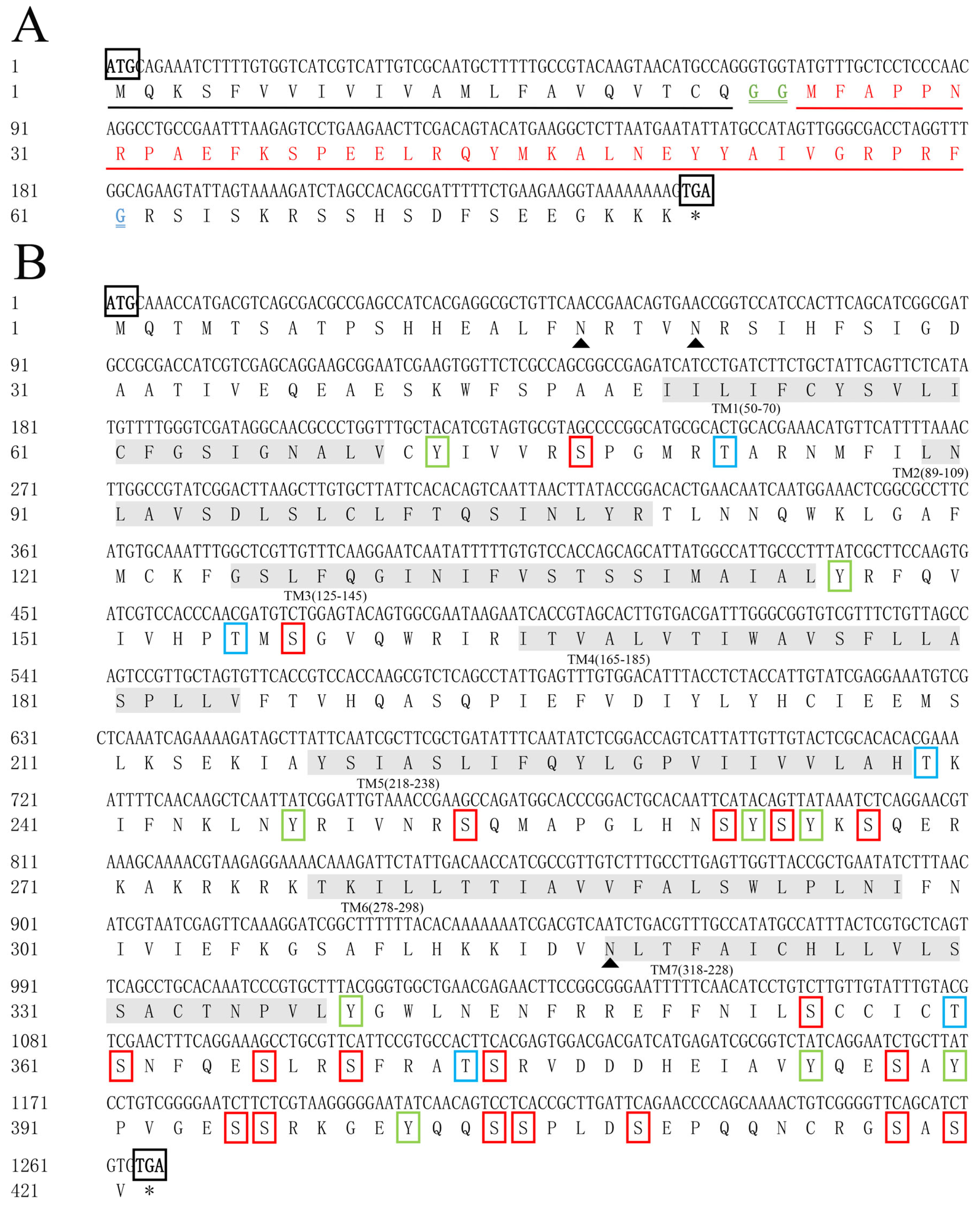
Figure 1. ORF and predicted amino acid sequences of SjNPF (A) and SjNPFR (B). (A) The start (ATG) and stop (TGA) codons are marked in black boxes. The signal peptide and mature peptide are underlined in black and red, respectively. Cleavage and amidation sites are indicated by green and blue double underlines, respectively. The asterisk (*) indicates a stop codon that does not encode any amino acid. (B) Start (ATG) and stop (TGA) codons are indicated with black boxes. Transmembrane helices 1–7 (TM1–7) within the conserved domain are shaded in gray. Potential phosphorylation sites are denoted by colored boxes: green for tyrosine (Tyr, Y), red for serine (Ser, S), and blue for threonine (Thr, T). Putative N-glycosylation sites are marked with black triangles. The asterisk (*) indicates a stop codon that does not encode any amino acid.
Diversity 18 00140 g001
Figure 2. Alignment of amino acids with multiple sequences of SjNPF (A) and SjNPFR (B) with other species. The sequence of S. japonica is indicated by a black triangle (▲). A color-code scheme denotes sequence conservation: identical amino acids are highlighted in red, conserved amino acids are shown in red font, and conserved motifs are indicated by lines with blue boxes. The dashed line indicates that no predicted domain was identified in this region. The black dots above the sequence represent counting nodes used to indicate every 10 amino acid for numbering and positional reference. The black dots after the sequence indicate that no amino acids are translated from this region. The sequence identity is shown as a percentage on the right side at the end of the alignment results. The secondary structure of SjNPF and SjNPFR were annotated: (A) The green box represents the α-helix, and the TT is the tetratricopeptide repeat (TPR) domain. The purple arrow indicates the mature peptide. Sj: Sepiella japonica; Ip: Idiosepius paradoxus; Ob: Octopus bimaculoides; Lg: Lottia gigantea; Hdh: Haliotis discus hannai; (B) The green box represents the α-helix, the TT is the tetratricopeptide repeat (TPR) domain, the blue arrow indicates the β-sheet, and the brown box represents the η-helix. Sj: Sepiella japonica; Sp: Sepia (Acanthosepion) pharaonis Ehrenberg, 1831; Ov: Octopus vulgaris; Ob: Octopus bimaculoides; Os: Octopus sinensis.
Diversity 18 00140 g002
Figure 3. Phylogenetic tree of the species used for the evolutionary analysis of NPF (Y) genes (A) and NPFR genes (B). The amino acid sequences of NPF (Y) from 12 representative species and NPFR from 16 representative species were retrieved from the NCBI GenBank database. The trees were built using the maximum likelihood method implemented in RAxML. SjNPF is indicated in green, and SjNPFR in red. The arthropod branch was used as the outgroup for SjNPF, while the blue species, Echinococcus granulosus, serves as the outgroup for SjNPFR. Bootstrap values (%) at each node are denoted by numbers.
Diversity 18 00140 g003
Figure 4. Expression patterns of SjNPF at different developmental stages. The data are shown in the form of mean ± standard deviation (n = 3). (AG) represent the expression levels in different tissues of both gender individuals at different developmental stages. The x-axis denotes the sampled tissues, and the y-axis represents the relative expression level of SjNPF (logarithmic scale). B, brain; Sk, skin; O, ovary; T, testis; I, intestine; L, liver; OL, optic lobe; H, heart; Gi, gill; P, pancreas; St, stomach; NG, nidamental gland; M, muscle; ANG, accessory nidamental gland.
Diversity 18 00140 g004
Figure 5. Expression patterns of SjNPFR at different developmental stages. The data are shown in the form of mean ± standard deviation (n = 3). (AG) represent the relative expression levels in different tissues of both gender individuals at different developmental stages. The x-axis denotes the sampled tissues, and the y-axis represents the relative expression level of SjNPFR (logarithmic scale). B, brain; Sk, skin; O, ovary; T, testis; I, intestine; L, liver; OL, optic lobe; H, heart; Gi, gill; P, pancreas; St, stomach; NG, nidamental gland; M, muscle; ANG, accessory nidamental gland.
Diversity 18 00140 g005
Figure 6. Distribution of SjNPF and SjNPFR in the brain at different developmental stages. ISH detecting SjNPF (A) and SjNPFR (B) mRNA in the brain of female S. japonica at six developmental stages (I–II, III, IV, V, VI). The purple-blue area indicate positive hybridization signals. Light yellow areas represent background staining. Black arrows indicate signals. A1A4 show the distribution of the SjNPF mRNA in the brain at stages I–II, III, IV, V, and VI, respectively. B1B4 show the distribution of the SjNPFR mRNA in the brain at stages I–II, III, IV, V, and VI, respectively. Scale bar: 1000 μm. Abl: Anterior basal lobes; Eso: Esophagus; Ifl: Inferior frontal lobe; Vl: Vertical lobe; Sfl: Superior frontal lobe; Svl: Subvertical lobe; Bl: Brachial lobe; Pbl: Posterior basal lobes; Pl: Pedal lobe; Pvl: palleovisceral lobe.
Diversity 18 00140 g006
Figure 7. Localization of SjNPF-EGFP and SjNPFR-EGFP in HEK293 cells. DAPI: nuclear staining (blue); DiI: cell membrane staining (red); EGFP: expression of SjNPF-EGFP and SjNPFR-EGFP fusion proteins (green); Merge: combined image of all fluorescence signals. The yellow fluorescence indicates the area of overlap of the green and red signals. The scale is 25 μm.
Diversity 18 00140 g007
Figure 8. The expression changes of the SjNPF gene in the tissues of brain (A), optic lobe (B), intestine (C), stomach (D), pancreas (E), and liver (F) at different days under feeding regulation (n = 3). The expression levels of the SjNPF gene in different tissues of the treatment and control groups were indicated as mean ± standard deviation (SD). The differences among different groups were assessed with One-way ANOVA. Significant differences (p < 0.05) were indicated by different letters above the error bars. Further t-tests were conducted for pairwise comparisons between groups. An asterisk (*) marks a statistically significant difference compared with the control group (p < 0.05). For different significance levels: * p < 0.05, ** p < 0.01, *** p < 0.001. The x-axis represents the duration of feeding regulation: 0–8, corresponding to 0, 1, 3, 5 days of starvation, 1 and 3 days of re-feeding. The y-axis shows the relative expression level of SjNPF on a logarithmic scale.
Diversity 18 00140 g008
Figure 9. The relative expression changes of the SjNPFR gene in the tissues of brain (A), optic lobe (B), intestine (C), stomach (D), pancreas (E), and liver (F) at different days under feeding regulation (n = 3). The data were shown as mean ± standard deviation (SD). The differences among different groups were assessed with One-way ANOVA. Different letters above the error bars mark significant differences (p < 0.05). Further t-tests were conducted for pairwise comparisons between groups. An asterisk (*) marks a statistically obvious difference compared with the control group (p < 0.05). For significance levels: * p < 0.05, ** p < 0.01, *** p < 0.001. The x-axis represents the duration of feeding regulation: 0–8, corresponding to 0, 1, 3, 5 days of starvation, 1 and 3 days of re-feeding. The y-axis shows the relative expression level of SjNPFR on a logarithmic scale.
Diversity 18 00140 g009
Table 1. The PCR primers’ information.
NameSequence (5′–3′)Application
SjNPF-F1CCAGGGTGGTATGTTTGCCore sequence cloning
SjNPF-R1GCCATTTCAGCGTTCTTT
SjNPF-F2TCTTTTGTGGTCATCGTCATTG
SjNPF-R2CCTGCCATTTCAGCGTTCT
SjNPFR-F1CCGAAACACAAGGAAGCCACAT
SjNPFR-R1CCAACTCAAGGCAAAGACAACG
SjNPFR-F2CAAACCATGACGTCAGCGACGC
SjNPFR-R2CACAGATGCTGAACCCCGACAGT
SjNPF-probe FCCAGGGTGGTATGTTTGCISH
SjNPF-probe RGCCATTTCAGCGTTCTTT
SjNPFR-probe RCCTTGAAACAACGAGCCAAA
SjNPFR-probe FACAGTGAACCGGTCCATCC
NPF-Xho I-FCCGCTCGAGATGCAGAAATCTTTTSubcellular localization
NPF-EcoR I-RCGGGAATTCGCACAGATGCTGA
NPFR-Xho I-FCCGCTCGAGATGCAAACCATGACGTCA
NPFR-EcoR I -RCGGGAATTCGCACAGATGCTGAACCCCG
RT-SjNPF-FGCCATAGTTGGGCGACCTqRT-PCR
RT-SjNPF-RCGATTGCCATTTCAGCGT
RT-SjNPFR-FCCGAGATCATCCTGATCTTCT
RT-SjNPFR-RGCGTTGCCTATCGACCCAA
RT-β-actin-FGCCAGTTGCTCGTTACAG
RT-β-actin-RGCCAACAATAGATGGGAAT
RT-β-tubulin-FGATGCTGCCAACAACTACGCC
RT-β-tubulin-RAAGCCACTTCCTGTGCCTCCA
Disclaimer/Publisher’s Note: The statements, opinions and data contained in all publications are solely those of the individual author(s) and contributor(s) and not of MDPI and/or the editor(s). MDPI and/or the editor(s) disclaim responsibility for any injury to people or property resulting from any ideas, methods, instructions or products referred to in the content.