


Abstract
The biodiversity of wild bees (Hymenoptera: Anthophila) in southern Italy—particularly in Calabria and Basilicata—remains poorly documented despite the region’s high species richness. This study addresses this gap by assessing bee fauna through field surveys conducted across diverse habitats, including national parks, reserves, and agroecosystems, between 2016 and 2023. Bees were collected using hand nets or traps, and DNA barcoding was applied to 63 specimens to support species identification. A total of 223 species were recorded, including 10 new records for Basilicata, 57 for Calabria, 20 for southern Italy, 3 for the Italian mainland, and 1 for Italy, Eucera (Eucera) colaris Dours, 1873 (Apidae). The results reveal the unexpected presence of several central European species in mountainous areas of southern Italy, co-occurring with Mediterranean taxa. These findings indicate that these regions act as important refugia for species from both Mediterranean and Central European biogeographic zones, contributing to high regional diversity. DNA barcoding also revealed notable genetic divergence in several species compared to other European populations, highlighting the uniqueness of southern Italian bee fauna. Continuous monitoring and habitat protection are urgently needed in light of agricultural intensification and climate change.
1. Introduction
The Mediterranean region is globally recognized as a biodiversity hotspot, exhibiting a remarkable variety of ecosystems and species [1]. Among European countries, Italy has one of the most diverse bee faunas, particularly in the south [2,3]. Its unique geographical position places the country within three major biogeographical regions: Alpine, Continental and Mediterranean. Italian biodiversity is further shaped by the complex orography of territories, with the Alps and Apennines acting as natural biogeographical barriers. The altitudinal gradients created by these mountain ranges promote considerable diversity in species, ecosystems, and landscapes at a regional scale [1,3]. Despite this high species richness, knowledge of bee communities in southern Italy remains fragmented or limited, hindering efforts to fully assess the diversity and conservation needs of these species [4]. This knowledge gap is reflected in the fact that some species assessed in the IUCN Red List are still classified as Data Deficient [5], due to the lack of data necessary for reliable extinction-risk evaluations.
Pollinators play a crucial role in maintaining the balance of terrestrial ecosystems [6,7,8]. Most flowering plants depend on insect pollinators for reproduction [9], with wild bees being among the most important taxonomic groups [4,10]. Biodiversity is currently undergoing a dramatic decline, particularly among insects [11,12]. In Europe, the primary threat to bee populations include habitat loss caused by agricultural intensification, urbanization, increased fire frequency, and climate change [13,14,15]. It has been argued that conservation initiatives should focus on safeguarding habitats that support high bee diversity and endemic species, with a special attention to Mediterranean regions, mountainous areas, and species-rich grasslands [16]. To counteract habitat loss and mitigate its adverse effects, continuous monitoring of pollinator populations is essential, along with identification and preservation of bee hotspots [4].
Insular and southern Italy (including Calabria, Basilicata, Apulia, Campania, Abruzzo and Molise) represent particularly intriguing areas for melittological studies [17]. In particular, the Calabria and Basilicata regions stand out as significant biodiversity hotspots deserving detailed study [18]. Many areas within these regions remain largely unexplored or insufficiently studied from an entomological perspective, especially concerning bees. Moreover, the available data are often of poor quality or entirely missing, which challenges effective conservation planning and implementation and hinders the assessment of the conservation status of potentially threatened bee species in Italy [4]. The faunistic richness of Calabria and Basilicata still holds considerable potential for discovery. However, in wild bees, the morphological identification may be problematic because of interspecific similarity, intraspecific morphological variability, sexual dimorphism, and the presence of cryptic or closely related species complexes [19,20,21].
These difficulties are particularly evident in many Mediterranean bee groups, where close species often look very similar and show geographical variations that make traditional (morphology-based) identification difficult, requiring the support of molecular data. In this context, molecular tools such as DNA barcoding based on the mitochondrial cytochrome c oxidase subunit I (COI) gene provide an effective complement to traditional taxonomy [19,22].
Beyond species-level identification, analyses of COI sequences allow the evaluation of lineage coherence, the detection of divergent or geographically structured lineages, and the identification of potential cryptic diversity [19]. Such approaches are especially valuable in Mediterranean regions, where complex geological history and multiple refugial areas have shaped genetic differentiation within species [23]. Integrating morphological and molecular data therefore represents a powerful framework for resolving taxonomic uncertainties and for placing southern Italian bee populations within a broader European and Mediterranean evolutionary context [20,22,24].
This study provides relevant new data on the diversity and distribution of wild bees in these areas, significantly contributing to our understanding of wild bee diversity. Crucially, these findings establish a comprehensive baseline, serving as a vital starting point for long-term monitoring and future investigations into the population dynamics of these pollinators.
2. Materials and Methods
The data presented in this study was collected through various projects of the Laboratory of General and Applied Entomology (University of Calabria, Department of Biology, Ecology and Earth Science).
Bees were collected during spring and summer from 2016 to 2023 across various areas of Calabria and Basilicata (southern Italy). The selected sites included national parks (Aspromonte and Sila), a regional park (Serre), a reserve (Marchesale Biogenetic Nature Reserve), agroecosystems, and natural grasslands and pastures at different altitudes. Wild bees were sampled at 58 localities, including 4 in Basilicata and 54 in Calabria (Figure 1; Table 1).
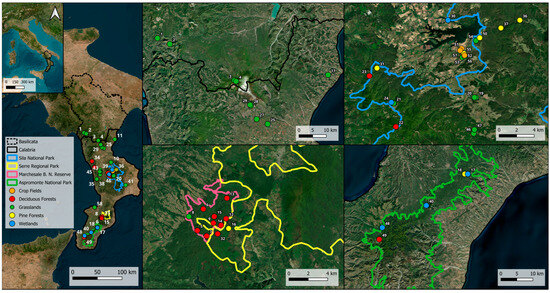
Figure 1.
Map of southern Italy (Basilicata and Calabria) showing the sampling sites where bees were collected between 2016 and 2023. Colored dots indicate the sampling sites categorized by habitat type: Crop Fields (orange), Deciduous Forests (red), Grasslands (green), Pine Forests (yellow), and Wetlands (blue); outlines indicate protected areas: Sila National Park (blue), Serre Regional Park (yellow), and Aspromonte National Park (green) (QGIS Geographic Information System. Version 3.44.1. Open Source Geospatial Foundation Project).

Table 1.
Sampling sites are listed with respective region, province (CS: Cosenza; KR: Crotone; PZ: Potenza; RC: Reggio di Calabria; VV: Vibo Valentia), and municipality (in alphabetical order), along with the altitude of each site (meters above sea level) and geographical coordinates (latitude and longitude in decimal degrees).
Samples were collected along designated transects using hand nets, as well as passive traps, including colored pan traps, Malaise traps, pitfall traps, and bait-bottle traps. Distribution data was compared with previous literature and supplemented by a critical review of online resources, including the catalog “Hymenoptera: Apoidea: Anthophila of Italy. Bibliographic checklist of Italian wild bees with notes on taxonomy, biology, and distribution” [25], Atlas Hymenoptera [26] and Global Biodiversity Information Facility (GBIF) [27]. Online records not verified by experts were excluded. Species records were reported using World Geodetic System 1984 (WGS84) decimal degree coordinates and the date format yyyy.mm.dd (see Supplementary Materials File S1).
Acronyms of specimen depositories:
TBC = Teresa Bonacci Collection, University of Calabria, Rende, Italy.
CPCN = Christophe Praz Collection, University of Neuchâtel, Neuchâtel, Switzerland.
ADCM = Achik Dorchin research Collection, University of Mons, Mons, Belgium.
2.1. Taxonomic Framework
Taxonomy followed the system adopted by Ghisbain et al. [2]. Most morphological identifications were performed by the authors using standard identification keys and relevant specialized literature [28,29,30,31,32,33,34,35,36,37,38,39,40,41,42,43,44,45,46]. Reference collections at the University of Neuchâtel (Switzerland) and University of Mons (Belgium) were consulted to compare specimens. Specimens of Osmiini were kindly identified by Andreas Müller (ETH, Zurich).
2.2. DNA Barcoding
Challenging morphological identifications were confirmed by DNA barcoding. DNA barcoding was also performed when taxonomic uncertainties arose among the detected species or for species whose presence in Calabria or Basilicata was unusual based on known distributions. In total, 85 specimens were analyzed; in some case, we intentionally sequenced several individuals per species to confirm identifications across different sites or to account for morphological variability. DNA was extracted from a mid-leg using a NucleoSpin Tissue Kit (Macherey-Nagel, Düren, Germany) at the University of Neuchâtel. Two overlapping fragments of the 658-bp section of the mitochondrial Cytochrome Oxidase I gene (DNA barcoding fragment; hereafter COI) were amplified in separate PCRs: one using the primers LepF1 (ATT CAA CCA ATC ATA AAG ATA TTG G) [47] and LepR1 (TAA ACT TCT GGA TGT CCA AAA AAA TA) [47], and the other using the alternate forward primer UAE3 (TAT AGC ATT CCC ACG AAT AAA TAA) [48] with LepR1. The first fragment was sequenced using LepR1, and the second fragment using UAE3, resulting in full-length (658 bp) sequences when both PCR were successful. The advantages of this approach are as follows: (i) it provides an independent check for possible contamination, since two distinct PCRs are performed; (ii) it minimizes the risk of co-amplification of Wolbachia DNA (we observed that Wolbachia amplification was more frequent with LepF1/LepR1 than with UAE3/LepR1); (iii) it reduces the risk of co-amplifying NUMTs (Nuclear Mitochondrial DNA Segments); and (iv) it allows amplification in specimens with degraded DNA duet to the smaller size of the UAE3/LepR1 fragment. Primer sequences and laboratory protocols were previously reported [49].
Chromatograms were assembled using Geneious Prime Version 2025.0.3 (Biomatters, Auckland, New Zealand). The resulting consensus sequences were submitted to the identification tool of the Barcode of Life Database [50].
All newly generated sequences have been uploaded to the BOLD systems with accession numbers HYMAAXXX-25. The occurrence data associated with these sequences were automatically exported and published on the GBIF platform through BOLD’s synchronization process.
Neighbor-Joining (NJ) trees [51] were constructed in R studio (version 2025.09.1+401, Posit Software, PBC, Boston, MA, USA; https://posit.co/; accessed on 1 December 2025). RStudio: Integrated Development Environment for R. Version 2026.1.0.392). Sequences were aligned using the MUSCLE algorithm [52] through the ‘msa’ package (version 1.34.0; https://bioconductor.org/packages/msa/; accessed on 1 December 2025) [53] after the columns containing only gaps were. Genetic distances were estimated using the Kimura 2-parameter (K80) substitution model. To account for varying sequence lengths and incomplete taxa, a pairwise deletion approach was implemented. Branch support was assessed using 1000 bootstrap replicates, and support values ≥ 50% are shown at the nodes.
The analysis included our generated sequences from southern Italy, as well as publicly available European sequences in BOLD or authors’ private sequences to evaluate lineage coherence and regional differentiation. Trees were visualized using the ‘ape’ package (version 5.7-1; https://cran.r-project.org/web/packages/ape/; accessed on 1 December 2025) [54] and were rooted using outgroup taxa identified in phylogenetic studies [55,56,57].
Additional Neighbor-Joining trees not shown in the main manuscript are provided in Supplementary Materials File S3.
3. Results
Overall, we report 1835 specimens representing 223 bee species, belonging to six families and 29 genera (see Supplementary Materials File S2). The genera with the highest species diversity were Andrena (n = 57) and Lasioglossum (n = 44). Other notable genera included Osmia (n = 15), Eucera (n = 14), Hylaeus (n = 12), Nomada (n = 12) and Halictus (n = 11). The conservation status of these species, according to the new European Red List of Bees, was: 208 species were classified as Least Concern (LC), 6 as Near Threatened (NT), 4 Vulnerable (VU) and 1 as Endangered (EN). Additionally, 3 species were designated as Data Deficient (DD), indicating a need for further research, while 1 species fall outside the scope of the European Red List assessment [5]. Of the 85 samples subjected to DNA barcoding, 63 yielded high-quality sequences representing 48 different species.
Many records represent the first reports for Basilicata and Calabria, and several are also first records for southern Italy, the Italian mainland, and Italy as a whole. Specifically, we recorded 10 first records for Basilicata, 57 for Calabria, 20 for southern Italy, 3 for the Italian mainland, and 1 for Italy.
We report records that are new to Italy, the Italian mainland (excluding Sardinia and Sicily), southern Italy (Calabria, Basilicata, Puglia, Campania, Abruzzo and Molise) or other interesting finding. New regional records (Calabria and Basilicata) and the full list of all other species collected during the study are provided in Supplementary Materials File S1.
3.1. New Record for Italy
Order: Hymenoptera
Family: Apidae
Subfamily: Eucerinae
Eucera (Eucera) colaris Dours, 1873
Material examined. Region: Calabria; Province: Cosenza; Municipality: Castrovillari; Elevation: 424 m; Latitude: 39.805 N; Longitude: 16.258 E; Date: 28 April 2022; Sex: 1 ♂; Leg.: Francesco Carlomagno, Federica Mendicino; Det.: Achik Dorchin; Collection Code: TBC; Code ID: O012.
Note. This species is currently reported in northwestern Africa (Morocco, Algeria and Tunisia) [27] and in Europe from Spain, Portugal and France [3]. Our sample was collected in grassland characterized by the presence of several orchid species and genera, with the most abundant populations comprising Anacamptis morio (L.) R. M. Bateman, Pridgeon & M. W. Chase, 1997 and Anacamptis papilionacea (L.) R. M. Bateman, Pridgeon & M. W. Chase, 1997 (Orchidales: Orchidaceae). Eucera colaris is classified as Least Concern (LC) in the European Red List of Bees [5].
3.2. New Records for the Italian Mainland
Order: Hymenoptera
Family: Andrenidae
Subfamily: Andreninae
Andrena (Chlorandrena) kamarti Schmiedeknecht, 1900
Material examined. Region: Calabria; Province: Cosenza; Municipality: Longobucco; Elevation: 1275 m; Latitude: 39.387 N; Longitude: 16.571 E; Date: 8 June 2022; Sex: 1 ♂; Leg.: Federica Mendicino, Francesco Carlomagno; Det.: Thomas J. Wood; Collection Code: CPCN; Code ID: S107.
Note. In Europe, the species is known only from Sicily [25] and from northwestern Africa (Morocco, Algeria, Tunisia) [27]. To our knowledge, this represents the first European record since 2002, when the species was last recorded in Sicily (T. Wood, personal observation). The specimen was collected in a natural pine forest within Sila National Park. Andrena kamarti is classified as Data Deficient (DD) in the European Red List of Bees [5].
Andrena (Microandrena) rugothorace Warncke, 1985
Material examined. Region: Calabria; Province: Cosenza; Municipality: Cassano allo Ionio; Elevation: 520 m; Latitude: 39.789 N; Longitude: 16.305 E; Date: 25 May 2022; Sex: 1 ♀; Leg.: Francesco Carlomagno, Federica Mendicino; Det.: Thomas J. Wood; Collection Code: CPCN; Code ID: O169.
Note. Outside of Sicily [25], this species occurs is North Macedonia, Greece, Turkey, Lebanon, and Israel [58]. Our sample was collected in a grassland dominated by populations of Orchis italica Poir., 1798 (Orchidales: Orchidaceae). Andrena rugothorace is classified as Least Concern (LC) in the European Red List of Bees [5].
Order: Hymenoptera
Family: Halictidae
Subfamily: Halictinae
Halictus (Platyhalictus) alfkenellus Strand, 1909
Material examined. Region: Calabria; Province: Cosenza; Municipality: Longobucco; Elevation: 1275 m; Latitude: 39.387; Longitude: 16.571; Date: 5 June 2023; Sex: 1 ♀; Leg.: Federica Mendicino, Francesco Carlomagno; Det.: Thomas Brau; Collection Code: CPCN; Code ID: S672; Genetic Code: HYMAA949-25.
Note. This rare species was previously known from Sicily, southern France, Greece and European Russia [3]. The sample was collected in a natural pine forest in Sila National Park and its COI sequence was 99.67% similar to a H. alfkenellus sequence from France (BOLD: CODAB2030-23). Halictus alfkenellus is classified as Data Deficient (DD) in the European Red List of Bees [5].
3.3. New Records for Southern Italy
Order: Hymenoptera
Family: Andrenidae
Subfamily: Andreninae
Andrena (Andrena) apicata Smith, 1847
Material examined. Region: Calabria; Province: Cosenza; Municipality: Celico; Elevation: 1140 m; Latitude: 39.395 N; Longitude: 16.501 E; Date: 2 March 2020/7 May 2020; Sex: 2 ♀; Leg.: Federica Mendicino, Francesco Carlomagno; Det.: Thomas J. Wood; Collection Code: CPNC; Code ID: A036;A041.
Region: Calabria; Province: Reggio di Calabria; Municipality: Canolo; Elevation: 912 m; Latitude: 38.329 N; Longitude: 16.151 E; Date: 3 March 2020; Sex: 1 ♀; Leg.: Domenico Bonelli; Det.: Thomas J. Wood; Collection Code: CPNC; Code ID: A477; Genetic Code: HYMAA938-25.
Note. In Italy, this species was known only from the north and Sicily [25]. Samples were collected in a wetland near Cecita Lake (Sila National Park) (A036;A041) whereas A477 was collected in a wetland in Aspromonte National Park. Comba [25] indicates that this species is found below 800 m above sea level, while our samples were found at higher altitudes. Our sample of A. apicata shows a genetic divergence of 0.53% from the French sequence (Figure S1). Andrena apicata is classified as Least Concern (LC) in the European Red List of Bees [5].
Andrena (Melandrena) barbareae Panzer, 1805
Material examined. Region: Calabria; Province: Cosenza; Municipality: Spezzano della Sila; Elevation: 1240 m; Latitude: 39.357 N; Longitude: 16.520 E; Date: 8 June 2022; Sex: 1 ♀; Leg.: Federica Mendicino, Francesco Carlomagno; Det.: Thomas J. Wood; Collection Code: TBC; Code ID: S056.
Region: Calabria; Province: Cosenza; Municipality: Longobucco; Elevation: 1275 m; Latitude: 39.387 N; Longitude: 16.571 E; Date: 5 June 2023; Sex: 2 ♀; Leg.: Federica Mendicino, Francesco Carlomagno; Det.: Thomas J. Wood; Collection Code: TBC; Code ID: S655-S666.
Region: Calabria; Province: Cosenza; Municipality: San Giovanni in Fiore; Elevation: 1555 m; Latitude: 39.279 N; Longitude: 16.535 E; Date: 4 June 2023; Sex: 1 ♂; Leg.: Francesco Carlomagno, Federica Mendicino; Det.: Thomas J. Wood; Collection Code: TBC; Code ID: O673.
Note. In Italy, this species was previously known only from Aosta, Piedmont, Veneto and Umbria [25]. Our samples were collected in a pasture on the Sila Plateau (S056), and in Sila National Park within a natural pine forest (S655;S666) and in a grassland with a large population of An. morio and Dactylorhiza sambucina (L.) Soó, 1962 (Orchidales: Orchidaceae) (O673). Andrena barbareae is classified as Least Concern (LC) in the European Red List of Bees [5].
Andrena (Hoplandrena) bucephala Stephens, 1846
Material examined. Region: Calabria; Province: Reggio di Calabria; Municipality: Canolo; Elevation: 912 m; Latitude: 38.329 N; Longitude: 16.151 E; Date: 10 May 2020; Sex: 4 ♂; Leg.: Domenico Bonelli; Det.: Thomas J. Wood; Collection Code: TBC; Code ID: A440;A442;A446;A447.
Note. This European species of temperate woodland was previously known in Italy only from the Viterbo area and Po plains [17]. All individuals in our study were collected in a wetland within Aspromonte National Park. Andrena bucephala is classified as Least Concern (LC) in the European Red List of Bees [5].
Andrena (Andrena) fucata Smith, 1847
Materials examined. Region: Calabria; Province: Cosenza; Municipality: Longobucco; Elevation: 1275 m; Latitude: 39.387 N; Longitude: 16.571 E; Date: 8 June 2022/5 June 2023; Sex: 2 ♀, 3 ♂; Leg.: Federica Mendicino, Francesco Carlomagno; Det.: Thomas J. Wood; Collection Code: TBC, CPCN; Code ID: S112;S657;S662;S664;S667; Genetic Codes: HYMAA934-25; HYMAA937-25.
Region: Calabria; Province: Cosenza; Municipality: Casali del Manco; Elevation: 1699 m; Latitude: 39.310 N; Longitude: 16.429 E; Date: 2 June 2022; Sex: 1 ♂; Leg.: Francesco Carlomagno, Federica Mendicino; Det.: Thomas J. Wood; Collection Code: TBC; Code ID: O435.
Region: Calabria; Province: Cosenza; Municipality: San Giovanni in Fiore; Elevation: 1555 m; Latitude: 39.279 N; Longitude: 16.535 E; Date: 20 June 2023; Sex: 1 ♀; Leg.: Francesco Carlomagno, Federica Mendicino; Det.: Thomas J. Wood; Collection Code: TBC; Code ID: O758.
Note. This species is associated with cool temperate habitats. In Italy, it was previously recorded only in northern and in central regions [25]; our findings represent the southernmost records of its range in the country. All new records are from a natural pine forest (S112;S657;S662;S664;S667), a pasture area (O435), and a grassland dominated by An. morio and D. sambucina (O758) in Sila National Park. Our samples of A. fucata show a genetic divergence of 5.53% from the Northern European specimen ACUFI1648 (Figure S1). Andrena fucata is classified as Least Concern (LC) in the European Red List of Bees [5].
Andrena (Euandrena) fulvata Stoeckhert, 1930
Materials examined. Region: Calabria; Province: Cosenza; Municipality: Spezzano della Sila; Elevation: 1192 m; Latitude: 39.361 N; Longitude: 16.522 E; Date: 21 June 2023; Sex: 2 ♀; Leg.: Federica Mendicino, Francesco Carlomagno; Det.: Thomas J. Wood; Collection Code: TBC; Code ID: S690;S706.
Region: Calabria; Province: Cosenza; Municipality: Celico; Elevation: 1425 m; Latitude: 39.346 N; Longitude: 16.407 E; Date: 21 May 2021; Sex: 1 ♂; Leg.: Federica Mendicino, Francesco Carlomagno; Det.: Thomas J. Wood; Collection Code: TBC; Code ID: A040.
Region: Calabria; Province: Cosenza; Municipality: Fagnano Castello; Elevation: 1086 m; Latitude: 39.551 N; Longitude: 16.023 E; Date: 31 May 2023; Sex: 1 ♀; Leg.: Francesco Carlomagno, Federica Mendicino; Det.: Thomas J. Wood; Collection Code: CPCN; Code ID: A137; Genetic Code: HYMAA931-25.
Region: Calabria; Province: Reggio di Calabria; Municipality: Canolo; Elevation: 979 m; Latitude: 38.329 N; Longitude: 16.140 E; Date: 11 June 2019; Sex: 1 ♀; Leg.: Domenico Bonelli; Det.: Thomas J. Wood; Collection Code: TBC; Code ID: A435.
Region: Calabria; Province: Reggio di Calabria; Municipality: Canolo; Elevation: 912 m; Latitude: 39.329 N; Longitude: 16.151 E; Date: 9 May 2019/30 May 2020; Sex: 6 ♀; Leg.: Domenico Bonelli; Det.: Thomas J. Wood; Collection Code: TBC; Code ID: A457–A459-A480–A482.
Region: Calabria; Province: Cosenza; Municipality: San Giovanni in Fiore; Elevation: 1555 m; Latitude: 39.279 N; Longitude: 16.535 E; Date: 20 June 2023; Sex: 1 ♀; Leg.: Francesco Carlomagno, Federica Mendicino; Det.: Thomas J. Wood; Collection Code: TBC; Code ID: O756.
Note. These records represent the southernmost occurrences of the species known to date. The specimens were collected in two anthropogenic pine forests (S690;S706;A040) and in a grassland with a population of An. morio (O756) in Sila National Park, as well as in a pine forest (A435), a beech forest (A137) and in a wetland (A457–A459-A480–A482) in Aspromonte National Park. Our sample exhibits minimal genetic divergence compared to other A. fulvata individuals (0.15–0.50%) (Figure S2). Andrena fulvata is classified as Least Concern (LC) in the European Red List of Bees [5].
Andrena (Micrandrena) subopaca Nylander, 1848
Materials examined. Region: Calabria; Province: Cosenza; Municipality: Fagnano Castello; Elevation: 1097 m; Latitude: 39.551 N; Longitude: 16.021 E; Date: 31 May 2023; Sex: 1 ♀; Leg.: Francesco Carlomagno, Federica Mendicino; Det.: Thomas J. Wood; Collection Code: TBC; Code ID: A143.
Note. This species is widely distributed across Europe, from western to eastern regions, and from southern areas to northern countries including Sweden and Finland [3]. The specimen was collected in a deciduous forest. Andrena subopaca is currently classified as Least Concern (LC) in the European Red List of Bees [5].
Order: Hymenoptera
Family: Apidae
Subfamily: Anthophorinae
Anthophora (Paramegilla) balneorum Lepeletier, 1841
Materials examined. Region: Calabria; Province: Cosenza; Municipality: Spezzano della Sila; Elevation: 1240 m; Latitude: 39.357 N; Longitude: 16.520 E; Date: 5 July 2023; Sex: 1 ♂; Leg.: Federica Mendicino, Francesco Carlomagno; Det.: Thomas J. Wood; Collection Code: CPCN; Code ID: S813; Genetic Code: HYMAA917-25.
Note. The species is mainly distributed in southwestern Europe, occurring from Portugal and Spain to France, Switzerland, and Italy [3]. Our sample was collected in a pasture area in Sila plateau. The genetic analysis of our sample shows a close affinity with French (1.23%) and Spanish (2.49%) populations. Notably, we observed a deep genetic divergence, ranging from 10.0% to 14.0%, between our specimen and North African (Moroccan) populations. These high genetic distances indicate that A. balneorum may be a complex of cryptic species (Figure S3). Anthophora balneorum is classified as Least Concern (LC) in the European Red List of Bees [5].
Order: Hymenoptera
Family: Apidae
Subfamily: Eucerinae
Eucera (Eucera) terminata Pèrez, 1895
Material examined. Region: Calabria; Province: Cosenza; Municipality: Spezzano della Sila; Elevation: 1178 m; Latitude: 39.366 N; Longitude: 16.519 E; Date: 8 June 2022; Sex: 2 ♀; Leg.: Federica Mendicino, Francesco Carlomagno; Det.: Achik Dorchin; Collection Code: CPCN, TBC; Code ID: S530;S536; Genetic Codes: HYMAA947-25; HYMAA948-25.
Region: Calabria; Province: Cosenza; Municipality: Acri; Elevation: 673 m; Latitude: 39.531 N; Longitude: 16.474 E; Date: 3 June 2021; Sex: 1 ♀; Leg.: Francesco Carlomagno, Federica Mendicino; Det.: Achik Dorchin; Collection Code: CPCN; Code ID: A029; Genetic Code: HYMAA915-25.
Note. This species is distributed in Bulgaria, Cyprus, Greece and Italy [3]. The specimens S530;S536 were collected in an organic agricultural field in Sila plateau, while the specimen A029 was found in a grassland in a rural area. The genetic results suggest that the southern Italian specimens are closely related to specimens from Greece and Israel (Figure 2), but form a distinct clade; the average genetic distance between this Italian clade and the specimens from Greece and Israel was 1.3% (min: 1.1%; max: 1.5%). Eucera terminata is classified as Least Concern (LC)) in the European Red List of Bees [5].
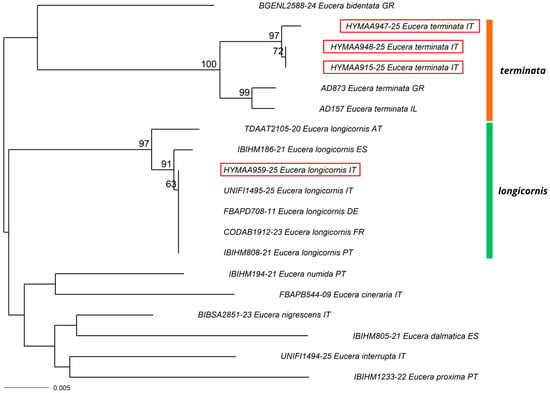
Figure 2.
Neighbor-joining tree of Eucera terminata and Eucera longicornis based on the mitochondrial COI gene. Numbers above branches represent bootstrap support values (values < 50% are omitted). Outgroup taxa were removed for better graphical representation. Sequences generated in this study are outlined in red.
Order: Hymenoptera
Family: Apidae
Subfamily: Nomadinae
Melecta (Melecta) festiva Lieftinck, 1980
Materials examined. Region: Calabria; Province: Cosenza; Municipality: Spezzano della Sila; Elevation: 1240 m; Latitude: 39.357 N; Longitude: 16.520 E; Date: 8 June 2022; Sex: 1 ♀; Leg.: Federica Mendicino, Francesco Carlomagno; Det.: Christophe J. Praz; Collection Code: CPCN; Code ID: S052; Genetic Code: HYMAA956-25.
Note. The species is primarily distributed in southern and eastern Europe [3]. In Italy, it had previously recorded only in the northern and below 800 m a.s.l. [25]. Its host remains unknown. Our specimen, collected on the Sila Plateau, is genetically nearly identical to French individual (0.3% divergence) but stands at a 4.11% genetic distance from the Greek sequence (Figure S4). Melecta festiva is currently classified as Least Concern (LC) in the European Red List of Bees [5].
Nomada castellana Dusmet y Alonso, 1913
Materials examined. Region: Calabria; Province: Cosenza; Municipality: Spezzano della Sila; Elevation: 1218 m; Latitude: 39.358 N; Longitude: 16.523 E; Date: 5 June 2023; Sex: 1 ♂; Leg.: Federica Mendicino, Francesco Carlomagno; Det.: Christophe J. Praz; Collection Code: CPCN; Code ID: S1063.
Note. It is widespread across central, southern, and eastern Europe [3]. It is a brood parasite of Andrena (Micrandrena) species [59]. Our specimen was collected in a pasture on the Sila Plateau. Potential hosts were not detected in this area, though they are present in adjacent areas (e.g., Andrena minutuloides, Andrena tomora). Nomada castellana is classified as Least Concern (LC) in the European Red List of Bees [5].
Nomada mutabilis Morawitz, 1870
Materials examined. Region: Calabria; Province: Cosenza; Municipality: Spezzano della Sila; Elevation: 1203 m; Latitude: 39.359 N; Longitude: 16.523 E; Date: 8 June 2022; Sex: 1 ♂; Leg.: Federica Mendicino, Francesco Carlomagno; Det.: Thomas J. Wood; Collection Code: CPCN; Code ID: S036; Genetic Code: HYMAA907-25.
Note. The species occurs across central, southern, and eastern Europe [3]. In addition to Andrena chrysopyga, Amiet et al. [41] and Smith [60] listed Andrena gravida, Andrena labialis and Andrena polita as potential hosts of N. mutabilis. At our study site, one female of A. gravida and two females of A. polita were observed in syntropy with N. mutabilis. Since A. gravida flies considerably earlier than N. mutabilis in central Europe [61], our observations support the hypothesis previously suggested by that Amiet et al. [41] that A. polita is a probable host of this species. Comba [25] reported N. mutabilis as occurring below 800 m a.s.l. Our specimen was collected in an agricultural field on the Sila Plateau; molecular analysis shows it is genetically nearly identical to other European sequences, with a minimal divergence of 0.15% (Figure S5). Nomada mutalis is classified as Least Concern (LC) in the European Red List of Bees [5].
Nomada pleurosticta Herric-Schaeffer, 1839
Materials examined. Region: Calabria; Province: Cosenza; Municipality: Spezzano della Sila; Elevation: 1203 m; Latitude: 39.359 N; Longitude: 16.523 E; Date: 6 July 2022; Sex: 1 ♂; Leg.: Federica Mendicino, Francesco Carlomagno; Det.: Christophe J. Praz; Collection Code: CPCN; Code ID: S282.
Note. The species is distributed in central and southern Europe [3]. Our specimen was collected in an agricultural field on the Sila Plateau, together with its known host, A. polita [60]. Nomada pleurosticta is classified as Least Concern (LC) in the European Red List of Bees [5].
Order: Hymenoptera
Family: Colletidae
Subfamily: Hylaeinae
Hylaeus (Dentigera) kahri Förster, 1871
Materials examined. Region: Calabria; Province: Cosenza; Municipality: Longobucco; Elevation: 1275 m; Latitude: 39.387 N; Longitude: 16.571 E; Date: 22 August 2023; Sex: 2 ♀; Leg.: Federica Mendicino, Francesco Carlomagno; Det.: Romain Le Divelec; Collection Code: TBC, CPCN; Code ID: S1054;S1057; Genetic Code: HYMAA912-25.
Note. The species occurs throughout central, southern, and eastern Europe [3]. The specimens examined here were collected in a natural pine forest within Sila National Park. In Europe, two markedly divergent mitochondrial COI clades (BOLD BIN: AAN3379 and BOLD BIN: AAN3379) have been documented [62]. Both clades appear to be broadly distributed in Europe; both clades are known to be present in Switzerland, Austria and Northern Italy (Aosta Valley). The specimen reported here from southern Italy belong to clade 2 (Figure 3). The average genetic distance between these two clades is 4.6% (min: 3.4%, max: 5.8%). Although additional molecular analyses based on nuclear markers are required, given the limited reliability of COI for species delimitation in Hylaeus [63] morphological examination suggests that these mitochondrial lineages represent intraspecific variation rather than distinct species. Hylaeus kahri is currently classified as Least Concern (LC) in the European Red List of Bees [5].
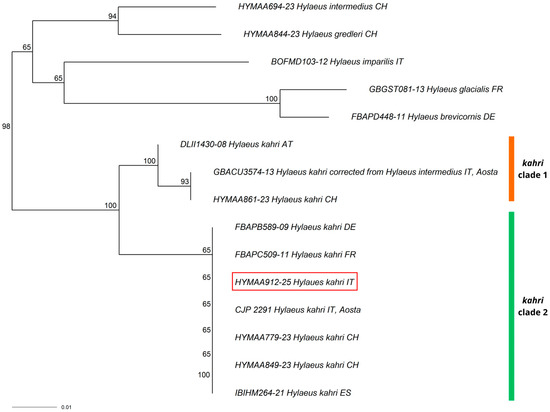
Figure 3.
Neighbor-joining tree of Hylaeus kahri based on the mitochondrial COI gene. Numbers above branches represent bootstrap support values (values < 50% are omitted). Outgroup taxa were removed for better graphical representation. Sequence generated in this study is outlined in red.
Order: Hymenoptera
Family: Halictidae
Subfamily: Halictinae
Lasioglossum (Hemihalictus) convexiusculum (Schenck, 1853)
Materials examined. Region: Calabria; Province: Cosenza; Municipality: Spezzano della Sila; Elevation: 1192 m; Latitude: 39.361 N; Longitude: 16.522 E; Date: 8 June 2022; Sex: 1 ♀; Leg.: Federica Mendicino, Francesco Carlomagno; Det.: Simone Flaminio; Collection Code: CPCN; Code ID: S102.
Note. The species occurs in Russia, throughout Europe (excluding the northern regions), and in Turkey, in Lebanon, and Iran [64]. In southern Italy, it was collected for the first time in a grazed pine forest on the Sila Plateau. Lasioglossum convexiusculum is classified as Near Threatened (NT) on the European Red List of Bees [5].
Lasioglossum (Dialictus) leucopus (Kirby, 1802)
Materials examined. Region: Calabria; Province: Cosenza; Municipality: Longobucco; Elevation: 1275 m; Latitude: 39.387 N; Longitude: 16.571 E; Date: 4 August 2022/21 September 2023; Sex: 2 ♀; Leg.: Federica Mendicino, Francesco Carlomagno; Det.: Simone Flaminio; Collection Code: TBC; Code ID: S640;S1149.
Region: Calabria; Province: Reggio di Calabria; Municipality: Oppido Mamertina; Elevation: 1090 m; Latitude: 38.241 N; Longitude: 16.003 E; Date: 16 June 2021; Sex: 1 ♀; Leg.: Francesco Carlomagno, Federica Mendicino; Det.: Simone Flaminio; Collection Code: TBC; Code ID: A396.
Note. The species is primarily distributed in central and northern Europe [3]. Specimens were collected in a natural pine forest in Sila National Park (S640;S1149) and in a wetland of Aspromonte National Park (A396). Lasioglossum leucopus is classified as Least Concern (LC) on the European Red List of Bees [5].
Sphecodes miniatus Hagens, 1882
Materials examined. Region: Calabria; Province: Cosenza; Municipality: Spezzano della Sila; Elevation: 1178 m; Latitude: 39.366 N; Longitude: 16.519 E; Date: 8 June 2022; Sex: 1 ♀; Leg.: Federica Mendicino, Francesco Carlomagno; Det.: Simone Flaminio; Collection Code: TBC; Code ID: S572.
Region: Calabria; Province: Cosenza; Municipality: Spezzano della Sila; Elevation: 1203 m; Latitude: 39.359 N; Longitude: 16.523 E; Date: 8 June 2022; Sex: 1 ♀; Leg.: Federica Mendicino, Francesco Carlomagno; Det.: Simone Flaminio; Collection Code: TBC; Code ID: S030.
Note. This species is common throughout Europe, except in southern regions where it is rare, occurring primarily in warmer and sandy habitats [65]. Its confirmed host is Lasioglossum nitidiusculum, although other potential hosts include Lasioglossum morio, Lasioglossum sexstrigatum, and Lasioglossum politum. Females have also been observed in association with Lasioglossum pauxillum and Lasioglossum punctatissimum [65]. Specimens were recorded for the first time in southern Italy in agricultural fields on the Sila Plateau. In the same area, we collected the potential hosts L. morio, L. pauxillum and L. punctatissimum. Sphcodes miniatus is classified as Least Concern (LC) on the European Red List of Bees [5].
Sphecodes pseudofasciatus Blüthgen, 1925
Materials examined. Region: Calabria; Province: Cosenza; Municipality: Spezzano della Sila; Elevation: 1240 m; Latitude: 39.357 N; Longitude: 16.520 E; Date: 21 June 2023; Sex: 1 ♀; Leg.: Federica Mendicino, Francesco Carlomagno; Det.: Simone Flaminio; Collection Code: CPCN; Code ID: S686; Genetic Code: HYMAA954-25.
Note. This species is distributed in central and southern Europe [3]. Its host was recently confirmed as Lasioglossum glabriusculum in Germany [30]. In our study, however, L. glabriusculum was not collected at the same site as S. pseudofasciatus, although it was present at a nearby location. Our sequence shows a genetic divergence of 0.52% and 1.84% compared to specimens from Switzerland (BOLD: HYMAA687-23) and Portugal (IBIHM859-21), respectively (Figure S6). Sphecodes pseudofasciatus is classified as Least Concern (LC) on the European Red List of Bees [5].
Order: Hymenoptera
Family: Megachilidae
Subfamily: Megachilinae
Chelostoma (Chelostoma) grande (Nylander, 1852)
Materials examined. Region: Calabria; Province: Cosenza; Municipality: Longobucco; Elevation: 1275 m; Latitude: 39.387 N; Longitude: 16.571 E; Date: 8 June 2022; Sex: 1 ♂; Leg.: Federica Mendicino, Francesco Carlomagno; Det.: Andreas Müller; Collection Code: TBC; Code ID: S109.
Note. The species is distributed across central and southern Europe [3]. In Italy, it has been recorded only four times in the northern regions: twice in Piedmont, one in Liguria and once in Val di Fiemme, Trentino-Alto Adige/Süd Tirol [17]. The present record, based on a single individual, represents the first observation in a pine forest of Sila National Park. Chelostoma grande is currently classified as Near Threatened (NT) in the European Red List of Bees [5].
Hoplitis (Anthocopa) papaveris (Latreille, 1799)
Materials examined. Region: Calabria; Province: Cosenza; Municipality: Spezzano della Sila; Elevation: 1203 m; Latitude: 39.359 N; Longitude: 16.523 E; Date: 6 July 2022; Sex: 1 ♀; Leg.: Federica Mendicino, Francesco Carlomagno; Det.: Andreas Müller; Collection Code: CPCN; Code ID: S285; Genetic Code: HYMAA964-25.
Note. This rare species has previously been found in Italy only from a few localities in the north and on the islands [25]. In Europe, its distribution includes central regions and the Balkan Peninsula [3]. The specimen was collected in an agricultural field on the Sila Plateau. Two COI clades are known within this species [22], one from Germany and one from southern France (Figure 4). The sequence from one southern Italian showed 99.01% similarity to a specimen of Ho. papaveris from southern France (BOLD: FBAPC536-11). The genetic distance between these two clades was on average 4.8% (min: 4.7%; max: 4.9%). Hoplitis papaveris is currently classified as Least Concern (LC) in the European Red List of Bees [5].
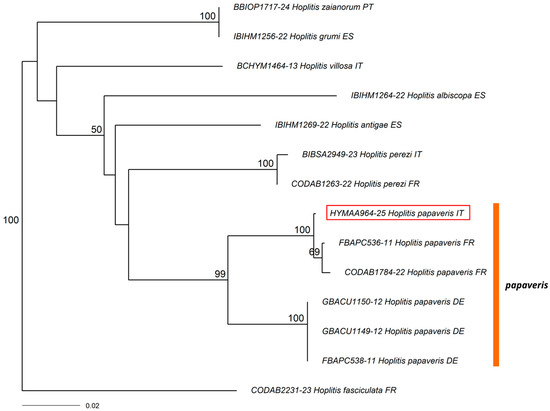
Figure 4.
Neighbor-joining tree of Hoplitis papaveris based on the mitochondrial COI gene. Numbers above branches represent bootstrap support values (values < 50% are omitted). Outgroup taxa were removed for better graphical representation. Sequence generated in this study is outlined in red.
Osmia (Osmia) cerinthidis Morawitz, 1875.
Materials examined. Region: Calabria; Province: Cosenza; Municipality: Longobucco; Elevation: 1275 m; Latitude: 39.387 N; Longitude: 16.571 E; Date: 8 June 2022; Sex: 1 ♀; Leg.: Federica Mendicino, Francesco Carlomagno; Det.: Andreas Müller; Collection Code: CPCN; Code ID: S114.
Region: Calabria; Province: Reggio di Calabria; Municipality: Oppido Mamertina; Elevation: 1090 m; Latitude: 38.241 N; Longitude: 16.003 E; Date: 16 June 2021; Sex: 1 ♀; Leg.: Francesco Carlomagno, Federica Mendicino; Det.: Andreas Müller; Collection Code: CPCN; Code ID: A386. Genetic Code: HYMAA961-25.
Note. The species has a wide distribution across southern, eastern and central Europe. Its presence has also been documented in Anatolia and Iran [66]. In Italy, it has so far been recorded only in Piedmont (northern Italy) [18]; the subspecies O. (Osmia) cerinthidis crassiclypeata Peters, 1978 was described from Sicily [67]. Here, we report specimens collected in a natural pine forest (S114) in Sila National Park and in a grazed wetland (A386) in Aspromonte National Park. Our sequence shows a genetic distance of approximately 1% from both an additional Italian specimen (GENBANK: MW126590.1) and a sequence from Ukraine (GENBANK: MW126588.1) (Figure S7). Osmia cerinthidis is classified as Least Concern (LC) in the European Red List of Bees [5].
3.4. Other Interesting Records
Order: Hymenoptera
Family: Andrenidae
Subfamily: Andreninae
Andrena (Ulandrena) fulvitarsis Brulle, 1832
Material examined. Region: Calabria; Province: Cosenza; Municipality: Spezzano della Sila; Elevation: 1178 m; Latitude: 39.366 N; Longitude: 16.512 E; Date: 8 June 2022; Sex: 1 ♀; Leg.: Federica Mendicino, Francesco Carlomagno; Det.: Thomas J. Wood; Collection Code: TBC; Code ID: S531.
Region: Calabria; Province: Cosenza; Municipality: Spezzano della Sila; Elevation: 1178 m; Latitude: 39.364 N; Longitude: 16.517 E; Date: 21 September 2023; Sex: 1 ♀; Leg.: Federica Mendicino, Francesco Carlomagno; Det.: Thomas J. Wood; Collection Code: TBC; Code ID: S723.
Region: Calabria; Province: Cosenza; Municipality: Spezzano della Sila; Elevation: 1240 m; Latitude: 39.357 N; Longitude: 16.520 E; Date: 21 June 2023/19 July 2023; Sex: 2 ♀; Leg.: Federica Mendicino, Francesco Carlomagno; Det.: Thomas J. Wood; Collection Code: TBC; Code ID: S726;S865.
Region: Calabria; Province: Cosenza; Municipality: Spezzano della Sila; Elevation: 1218 m; Latitude: 39.358 N; Longitude: 16.523 E; Date: 5 July 2023; Sex: 1 ♀; Leg.: Federica Mendicino, Francesco Carlomagno; Det.: Thomas J. Wood; Collection Code: TBC; Code ID: S794.
Region: Calabria; Province: Cosenza; Municipality: Spezzano della Sila; Elevation: 1192 m; Latitude: 39.361 N; Longitude: 16.522 E; Date: 21 September 2023; Sex: 1 ♀; Leg.: Federica Mendicino, Francesco Carlomagno; Det.: Thomas J. Wood; Collection Code: CPCN; Code ID: S1144; Genetic Code: HYMAA922-25.
Note. The species shows an eastern Mediterranean and west Asian distribution. Its range extends from Italy, Slovenia, and the Balkans to Middle East [27]. Our samples were found in an agroecosystem in the Sila plateau. Considerable genetic variation was observed within this species, with our sequence exhibiting an average divergence of 5.7% from sequences of Greece and 11.3% from that of Israel (Figure S8). Andrena fulvitarsis is classified as Least Concern (LC) in the European Red List of Bees [5].
Andrena (Taeniandrena) gelriae van der Vecht, 1927
Materials examined. Region: Calabria; Province: Cosenza; Municipality: Longobucco; Elevation: 1275 m; Latitude: 39.387 N; Longitude: 16.571 E; Date: 21 June 2022; Sex: 1 ♀; Leg.: Federica Mendicino, Francesco Carlomagno; Det.: Christophe J. Praz; Collection Code: CPCN; Code ID: S223; Genetic Code: HYMAA905-25.
Region: Calabria; Province: Cosenza; Municipality: San Giovanni in Fiore; Elevation: 1555 m; Latitude: 39.279 N; Longitude: 16.535 E; Date: 20 June 2023; Sex: 1 ♂; Leg.: Francesco Carlomagno, Federica Mendicino; Det.: Thomas J. Wood; Collection Code: TBC; Code ID: O745.
Note. Many literature records of this species are doubtful, as only males can be identified with certainty. Praz et al. [20] provided the first reliable records of A. gelriae from southern Italy, based on males and females collected on the Monte Pollino, on the boundary between Basilicata and Calabria. Our record represents an additional occurrence of this rare species in southern Italy, in Sila National Park. Genetically, our samples were identical to those from Monte Pollino (Figure 5); these southern Italian specimens are separated from other European specimens by a genetic distance of 1.12% [20]. Andrena gelriae is classified as Vulnerable (VU) in the European Red List of Bees [5].
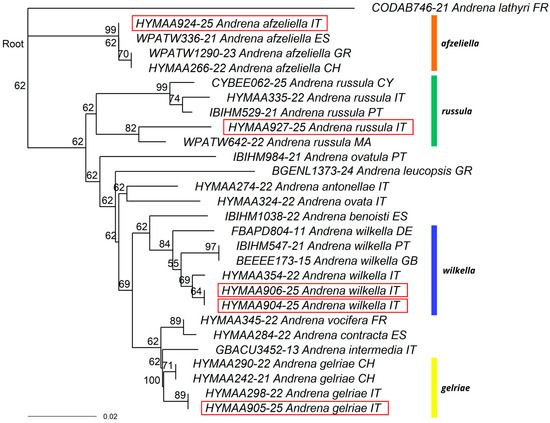
Figure 5.
Neighbor-joining tree of Andrena afzeliella, Andrena russula, Andrena wilkella and Andrena gelriae based on the mitochondrial COI gene. Numbers above branches represent bootstrap support values (values < 50% are omitted). Outgroup taxa were removed for better graphical representation. Sequences generated in this study are outlined in red.
Andrena (Lepidandrena) mocsaryi Schmiedeknecht, 1883
Material examined. Region: Calabria; Province: Cosenza; Municipality: Casali del Manco; Elevation: 1338 m; Latitude: 39.316 N; Longitude: 16.538 E; Date: 18 May 2023; Sex: 1 ♀; Leg.: Francesco Carlomagno, Federica Mendicino; Det.: Thomas J. Wood; Collection Code: CPCN; Code ID: O596; Genetic Code: HYMAA926-25.
Note. This species has a highly localized and sparse distribution in south eastern Europe [3]. Our specimen was collected in a grassland hosting a population of An. morio in Sila National Park. The obtained DNA barcode was not closely related to specimens of A. mocsaryi from Greece (average genetic distance 6.20%, min: 5.10%, max: 6.70%), but was in fact closer to the recently described Andrena baetica Wood, 2020 from the Iberian Peninsula (genetic distance 6.05%, min: 5.15%, max: 6.95%) (Figure 6). Morphologically, the southern Italian specimen appears to be closer to A. mocsaryi. Further work is needed to determine whether the southern Italian populations represent a distinct, cryptic species. Andrena mocsaryi is classified as Least Concern (LC) in the European Red List of Bees [5].
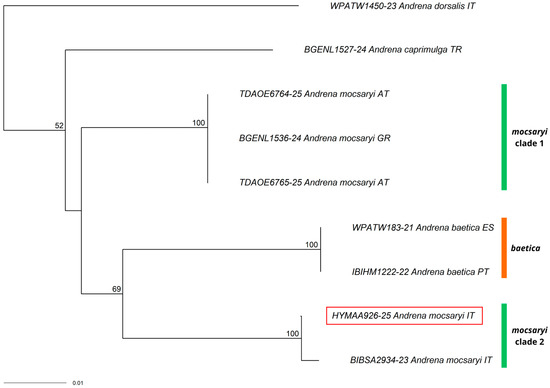
Figure 6.
Neighbor-joining tree of Andrena mocsaryi based on the mitochondrial COI gene. Numbers above branches represent bootstrap support values (values < 50% are omitted). Outgroup taxa were removed for better graphical representation. Sequence generated in this study is outlined in red.
Andrena ranunculorum Morawitz, 1878.
Material examined. Region: Calabria; Province: Cosenza; Municipality: San Giovanni in Fiore; Elevation: 1555 m; Latitude: 39.279 N; Longitude: 16.535 E; Date: 4 June 2023/20 June 2023; Sex: 4 ♀; Leg.: Francesco Carlomagno, Federica Mendicino; Det.: Thomas J. Wood; Collection Code: CPCN, TBC; Code ID: O683;O734;O748;O762; Genetic Code: HYMAA928-25.
Note. The distribution of this species spans western Europe and extends eastward across the Mediterranean Basin into central Asia [68]. It is a rare species, with only four records from Italy [68,69]. Our specimens were collected in a grassland characterized by An. morio and D. sambucina. The COI sequence showed 100% similarity to an A. ranunculorum sequence from Switzerland (BOLD: HYMAA636-23). Andrena ranunculorum is classified as Endangered (EN) in the European Red List of Bees [5].
Andrena (Taeniandrena) russula Lepeletier, 1842
Materials examined. Region: Calabria; Province: Cosenza; Municipality: San Giovanni in Fiore; Elevation: 1555 m; Latitude: 39.279 N; Longitude: 16.535 E; Date: 18 May 2023; Sex: 1 ♂; Leg.: Francesco Carlomagno, Federica Mendicino; Det.: Thomas J. Wood; Collection Code: CPCN; Code ID: O606; Genetic Code: HYMAA927-25.
Note. Warncke [70] considered the Italian endemic Andrena croceiventris to be a subspecies of A. russula. This view was challenged by Praz et al. [20], who suggested that A. croceiventris is a distinct species and provided both a record and a DNA barcode for A. russula from the Marche Region (Monte Vettore, Sibillini Mountains). An additional southern Italian record (without genetic data) was reported in Calabria [69]. As discussed by Praz et al. [20] and Wood [21,46], A. russula exhibits substantial genetic and morphological variation across its wide geographic range, and a broad-taxon approach has been adopted. Furthermore, a strongly divergent genetic lineage has been identified from Portugal and Spain [20,46], but in the absence of clear morphological differences, no taxonomic decision has yet been taken. The sequence obtained in the present study for the specimen from Sila National Park represents an additional divergent lineage, being closely related neither to typical A. russula (average genetic distance 5.9%) nor to the Iberian lineage (Figure 5). Instead, it forms a clade with one specimen from Morocco (genetic distance 2.7%); in our analysis (Figure 5), this clade was sister to the true A. russula, but not in the recent analysis of Wood [21]. The taxonomic status of this lineage remains uncertain and awaits further studies using nuclear genetic markers. For now, these specimens are provisionally treated as A. russula. The specimen was collected in a grassland with An. morio and D. sambucina in Sila National Park. Andrena russula is classified as Least Concern (LC) in the European Red List of Bees [5].
Andrena (Micrandrena) saxonica Stockhert, 1935
Material examined. Region: Calabria; Province: Cosenza; Municipality: Fagnano Castello; Elevation: 1086 m; Latitude: 39.551 N; Longitude: 16.023 E; Date: 31 May 2023; Sex: 1 ♀; Leg.: Francesco Carlomagno, Federica Mendicino; Det.: Thomas J. Wood; Collection Code: CPCN; Code ID: A133; Genetic Code: HYMAA925-25.
Note. New record for Calabria. This species occurs widely across Europe, from the Iberian and Italian peninsulas to central, eastern, and southeastern Europe, including parts of Ukraine [3]. The sample was collected in a deciduous forest. Genetically (Figure 7), our sample was divergent from other European populations: average genetic distances were between 3.6% and 4.7% compared to populations from Greece, France or Spain, suggesting considerable genetic variation within this species at the European level. Andrena saxonica is classified as Least Concern (LC) in the European Red List of Bees [5].
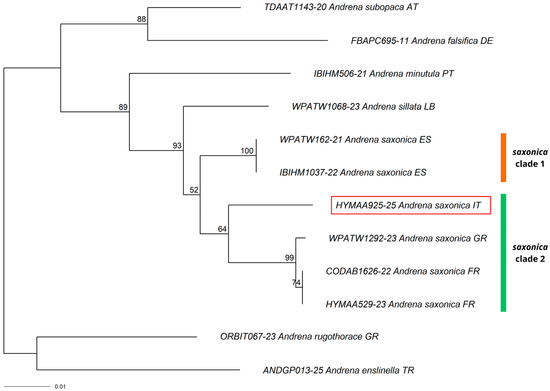
Figure 7.
Neighbor-joining tree of Andrena saxonica based on the mitochondrial COI gene. Numbers above branches represent bootstrap support values (values < 50% are omitted). Outgroup taxa were removed for better graphical representation. Sequence generated in this study is outlined in red.
Order: Hymenoptera
Family: Megachilidae
Subfamily: Osmiini
Hoplitis (Hoplitis) pallicornis (Friese, 1895)
Material examined. Region: Calabria; Province: Cosenza; Municipality: Castrovillari; Elevation: 670 m; Latitude: 39.852 N; Longitude: 16.230 E; Date: 29 May 2023; Sex: 1 ♂; Leg.: Francesco Carlomagno, Federica Mendicino; Det.: Andreas Müller; Collection Code: CPCN; Code ID: O638; Genetic Code: HYMAA962-25.
Note. New record for Calabria, previously known in Italy only from very few locations (Friuli Venezia Giulia and Campania) [25]. The species is primarily distributed in the eastern Mediterranean Basin and the Balkan Peninsula, forming a continuous arc [3]. The specimen was collected in a grassland characterized by several orchid species (Anacamptis spp. Orchis spp., Ophyrs spp.). The obtained DNA barcode was 5.9% divergent from specimens of Ho. pallicornis from eastern Europe, and in fact more closely related (genetic distance 2.9%) to Hoplitis fabrei van der Zanden, 1987, a south-eastern European species so far not known from Italy (Figure 8). Morphologically, both species are very similar and the single southern Italian specimen examined is unclear. Further studies are needed to determine the identity of this specimen. Hoplitis pallicornis is classified as Least Concern (LC) in the European Red List of Bees [5].
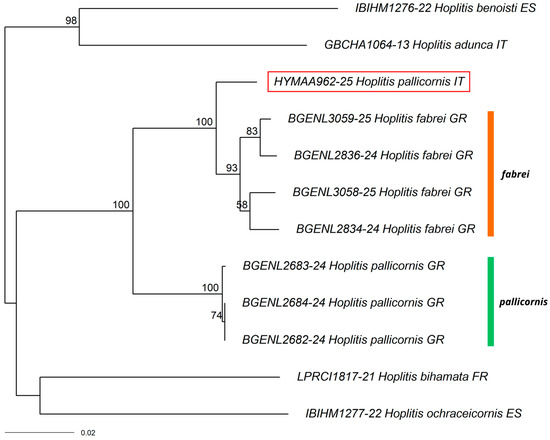
Figure 8.
Neighbor-joining tree of Hoplitis pallicornis based on the mitochondrial COI gene. Numbers above branches represent bootstrap support values (values < 50% are omitted). Outgroup taxa were removed for better graphical representation. Sequence generated in this study is outlined in red.
Osmia (Osmia) kohli Ducke, 1899
Material examined. Region: Calabria; Province: Crotone; Municipality: Petilia Policastro; Elevation: 180 m; Latitude: 39.115 N; Longitude: 16.820 E; Date: 5 May 2023/12 May 2023; Sex: 2 ♀, 1 ♂; Leg.: Cristian Mirabelli; Det.: Christophe J. Praz; Collection Code: TBC, CPCN; Code ID: P011;P019;P020.
Note. It is an endemic species of the Mediterranean Basin, occurring in Malta, Sicily, and north Africa [71]. Regarding the Italian mainland, the only historical record dates back to 1905 by Paganetti [27], and its presence in southern Calabria was later reported from Antonimina and Ciminà, two municipalities in the province of Reggio Calabria [72]. The species was collected in a grassland in a rural area, and its COI sequence was 100% identical to a sequence from Malta (BOLD: AEA3243). This geographically restricted species undoubtedly represents the descendant of populations that survived in glacial refugia located in southern Italy and Sicily [72]. O. kohli and Osmia tricornis Latreille 1811 (Supplementary Materials File S1) appear to be two parapatric species with no known area of overlap. We recorded O. tricornis in Castrovillari and Cassano allo Ionio, two municipalities of the province of Cosenza (Calabria), and O. kohli in Petilia Policastro, a municipality in the province of Crotone (Calabria). The minimal distance between these localities is approximately 80 km. Our records help better delineate the distribution of these two species. It is important to note, however, that O. kohli was not reported for mainland Italy by Reverté et al. [3]. Osmia kohli is classified as Least Concern (LC) in the European Red List of Bees [5].
4. Discussion
The results of this study advance current knowledge of wild bees diversity in Calabria and Basilicata (southern Italy), two regions that, despite their high environmental heterogeneity, remain among the least melittology explored areas of the Italian Peninsula. A total of 223 species were recorded, including numerous first records for southern Italy, the Italian mainland, and Italy as a whole. These findings represent a major faunistic contribution, revealing that the study areas host an unexpectedly rich and biogeographically complex bee fauna of national significance. The discovery of Eucera colaris, reported here for the first time from Italy, is of exceptional faunistic relevance. This species, characterized by a fragmented western Mediterranean distribution [27], highlights the role of Calabria as a cross road between the western and eastern Mediterranean regions.
Equally noteworthy is the rediscovery of Andrena kamarti, not recorded in Europe for over two decades, which provides compelling evidence that Calabria acts as a key Mediterranean refugium for rare, relictual, or poorly known species. The record of the rare Halictus alfkenellus, previously known only from Sicily, southern France, Greece, and European Russia, further underscores the presence of unique and geographically isolated lineages in the Calabrian and Lucanian territory.
Additional noteworthy findings include the first southern Italian records of Andrena barbareae or Andrena subopaca, two taxa typically associated with central and northern European regions [27]. Their presence within the study area highlights the coexistence of northern, temperate elements with strictly Mediterranean species, demonstrating the relevant faunistic and biogeographical complexity of these regions. This north–south faunal overlap supports the interpretation of Calabria and Basilicata as key refuge zones capable of maintaining species with different ecological requirements [73]. The mosaic of habitats across the study area, from coastal and sub-montane agroecosystems to montane and high-altitude environments, further contributes to the extraordinarily high species richness documented. The co-occurrence of Mediterranean specialists and Central European taxa underscores the unique status of Calabria within the broader context of the Italian peninsula. This region exemplifies the “refugia-within-refugia” model [23,74], where a fragmented geological history has shaped a complex mosaic of micro-refugia. Rather than acting as a monolithic sanctuary during climatic oscillations, the peninsula facilitated the isolation of species within geographically distinct pockets. This prolonged isolation not only preserved ancient genetic lineages—many of which predate the Pleistocene—but also drove profound genetic divergence through independent evolutionary trajectories [23]. Historically, the region functioned as both a “rear edge” (Southern Calabria), acting as an isolated genetic reservoir, and a “leading edge” (Northern Calabria), serving as the primary biological bridge for northward expansion during warmer periods. This ancient fragmentation remains the fundamental architect of the genetic structure found across the Italian peninsula today [23]. The Calabria region was already recognized as a glacial refugium for numerous temperate species [73,75,76,77,78,79,80,81].
From a conservation perspective, montane refugia hosting isolated insect populations are particularly vulnerable to habitat alteration and climate-driven range contraction. However, this study also demonstrates that biodiversity persistence is not limited to remote mountainous areas. Managed areas agroecosystems, and even urban reserves can function as important refugia, as shown in Rome [82], and the Vesuvius National Park [83]. These studies highlight that effective, continuous biodiversity management, within national parks, agricultural ecotones, or urban reserves, are essential for enhancing pollinator resilience against major threats, a principle equally applicable to long-term conservation strategies in southern Italy. Crucially, while several new records were obtained within parks and protected areas (i.e., Andrena apicata, Andrena bucephala, Andrena kamarti, and Halictus alfkenellus), others were detected in anthropized or rural contexts (i.e., Andrena florentina, Andrena ventricosa, Colletes cunicularius, Eucera numida, Eucera proxima and Eucera vulpes). This indicates that conservation efforts must extend beyond formally designated reserves to include managed agricultural landscapes and rural areas that maintain key floral resources.
Future research should implement comprehensive phylogeographic and genomic analyses across multiple insect taxa to quantify divergence and endemism within the Calabrian-Lucanian block. Such efforts are essential for establishing a robust foundation for conservation strategies and preserving this critical Mediterranean refugium [23].
The study also recorded several threatened species in limited numbers, including one Endangered species (Andrena ranunculorum) restricted to a national park, three Vulnerable species found exclusively in protected areas (Andrena gelriae, Lasioglossum subfasciatum and Nomada rhenana), and one Vulnerable species occurring in both parks and agricultural fields (Lasioglossum leave).
Given the unique biodiversity of Calabria and Basilicata, and the presence of several rare and endemic insect species, these regions should be prioritized for conservation initiatives aimed at preserving pollinator diversity. The added value of this research lies in its integrated methodological framework, combining temporally extensive, multi-habitat sampling with genetic analyses. The distinctive characteristics of wild bee populations in these regions further support the need to recognize Calabria and Basilicata as high-priority conservation areas within Europe.
Southern Italy thus confirms its status as an important biodiversity hotspot requiring further investigation, particularly in light of our genetic findings. We highlight several cases (e.g., Andrena fulvitarsis, Andrena mocsaryi, Andrena russula, Andrena saxonica and Hoplitis pallicornis) where the southern Italian populations are genetically strongly divergent from other European populations. These lineages may represent additional taxa, or simply genetically divergent populations. This result calls for further taxonomic work in this important biodiversity hotspot.
5. Conclusions
This study provides an important contribution to the knowledge of wild bee biodiversity in Calabria and Basilicata, revealing very high species richness, rare taxa, genetically divergent populations, and several first records for Italy. These findings confirm the role of these regions as Mediterranean refugia and biogeographical crossroads, capable of preserving unique evolutionary lineages and sustaining both Mediterranean and Central European elements. Our results demonstrate that both montane habitats and managed rural landscapes, such as agroecosystems and ecotonal areas, function as important reservoirs for vulnerable pollinator species, highlighting the necessity of conservation strategies that extend beyond formally protected areas. Considering climate changes and ongoing habitat degradation, the implementation of targeted conservation measures, together with continuous, systematic, long-term monitoring, is essential. Only through a detailed understanding of faunal composition and population structure can effective strategies be developed to safeguard pollinators and the essential ecosystem services they provide.
Future research should aim to expand the molecular characterization of the wild bee fauna in these regions, as larger datasets will be crucial to further enrich international genetic databases and refine our understanding of Mediterranean biodiversity.
Supplementary Materials
The following supporting information can be downloaded at: https://www.mdpi.com/article/10.3390/d18020074/s1. File S1: Additional faunistic records for the investigated areas (excluding new records for Italy, Italian mainland, southern Italy and other noteworthy findings reported in the main text); File S2: Summarized database of all recorded species, including regional/national new records, abundances per site, habitat categories, and identification of specimens used for DNA extraction; File S3: Additional Neighbor-Joining trees, comprising Figure S1: Neighbor-joining tree of Andrena apicata, Andrena fucata and Andrena fulva; Figure S2: Neighbor-joining tree of Andrena bicolor and Andrena fulvata; Figure S3: Neighbor-joining tree of Anthophora balneorum; Figure S4: Neighbor-joining tree of Melecta festiva; Figure S5: Neighbor-joining tree of Nomada mutabilis; Figure S6: Neighbor-joining tree of Sphecodes pseudofasciatus; Figure S7: Neighbor-joining tree of Osmia cerinthidis and Osmia tricornis; Figure S8: Neighbor-joining tree of Andrena fulvitarsis; File S4: Complete list of sequences used for phylogenetic tree construction. References [84,85,86,87,88,89,90,91,92,93] are cited in Supplementary Materials.
Author Contributions
Conceptualization, C.J.P. and T.B.; methodology, F.M., F.C., C.J.P. and T.B.; validation, F.M., F.C., C.J.P., T.J.W., A.D., S.F., M.A., R.L.D., M.P., G.P. and T.B.; formal analysis, F.M., F.C., C.J.P. and T.B.; investigation, F.M., F.C., D.B., E.D.B., F.F., G.P. and T.B.; resources, C.J.P., G.P. and T.B.; data curation, F.M., F.C., C.J.P. and T.B.; writing—original draft preparation, F.M., F.C., C.J.P., M.P. and T.B.; writing—review and editing, F.M., F.C., C.J.P., T.J.W., A.D., M.A., R.L.D., M.P., G.P. and T.B.; visualization, F.M., F.C., C.J.P., T.J.W., A.D., S.F., M.A., R.L.D., G.P. and T.B.; supervision, C.J.P. and T.B.; project administration, C.J.P., G.P. and T.B.; funding acquisition, C.J.P., G.L., A.S., G.P. and T.B. All authors have read and agreed to the published version of the manuscript.
Funding
This research was supported both by the FSE-REACT-EU program, PON “Ricerca e Innovazione” 2014–2020 (D.M. 1061/2021), through the PhD project “Biodiversity and sustainable agricultural production in Calabria” (Azione IV.5 “Dottorati su tematiche Green”) and by the Ministry of Education, University and Research (MIUR) under the project PRIN 2017: “Mediterranean orchids as a model system to quantify intrinsic and extrinsic factors influencing distribution and conservation-oriented restoration”. Additional funding were provided by several National Parks and Nature Reserves: the Aspromonte National Park (project: “Valutazione ecologica di alcune aree del Parco Nazionale dell’Aspromonte mediante analisi della fauna selvatica stanziale anche in relazione alla vigente zonazione del Parco”), the Sila National Park (project: “Monitoraggio dei Ditteri sarco-saprofagi e di interesse medico-veterinario all’interno del Parco Nazionale della Sila”), and the Marchesale Biogenetic Nature Reserve (project: “Servizio di monitoraggio per l’attuazione delle misure di conservazione nelle Z.S.C./S.I.C. che ricadono all’interno delle riserve naturali statali gestite dall’Arma dei Carabinieri”).
Institutional Review Board Statement
Ethical review and approval were waived for this study as it involved non-cephalopod invertebrates that do not require specific ethical permits according to current legislation.
Data Availability Statement
The original contributions presented in this study are included in the article/Supplementary Materials. Further inquiries can be directed to the corresponding authors.
Acknowledgments
We are grateful to Gianfranco Raffaele and Cristian Mirabelli to help authors to collect wild bees during their final work of their master degree. We also grateful to Thomas Brau and Clément Tourbez for their identification of some species of the genus Halictus and Megachile, and to Andreas Müller for the identification of the Osmiini. We thank the farms Scrivano Terre D’Altopiano and Fattoria Pupo for granting access to their farms for insect sampling and for their cooperation during the fieldwork.
Conflicts of Interest
The authors declare no conflicts of interest.
Abbreviations
The following abbreviations are used in this manuscript:
| TBC | Teresa Bonacci Collection, University of Calabria, Rende, Italy. |
| CPCN | Christophe Praz Collection, University of Neuchâtel, Neuchâtel, Switzerland. |
| ADCM | Achik Dorchin research Collection, University of Mons, Mons, Belgium. |
References
- Primack, R.B. Conservazione Della Natura; Zanichelli: Bologna, Italy, 2007; 514p. [Google Scholar]
- Ghisbain, G.; Rosa, P.; Bogusch, P.; Flaminio, S.; Le Divelec, R.; Dorchin, A.; Kasparek, M.; Kuhlmann, M.; Litman, J.; Mignot, M.; et al. The new annotated checklist of the wild bees of Europe (Hymenoptera: Anthophila). Zootaxa 2023, 5327, 1–147. [Google Scholar] [CrossRef]
- Reverté, S.; Milicic, M.; Acanski, L.; Andric, A.; Aracil, A.; Aubert, M.; Balzan, M.V.; Bartomeus, I.; Bogusch, P.; Bosch, J.; et al. National records of 3000 European bee and hoverfly species: A contribution to pollinator conservation. Insect Conserv. Divers. 2023, 16, 758–775. [Google Scholar] [CrossRef]
- Quaranta, M.; Cornalba, M.; Biella, P.; Comba, M.; Battistoni, A.; Rondinini, C.; Teofili, C. Lista Rossa IUCN Delle Api Italiane Minacciate; Comitato Italiano IUCN e Ministero dell’Ambiente e della Tutela del Territorio e del Mare; Stamperia: Roma, Italy, 2018; 68p.
- IUCN Red List. Available online: https://www.iucnredlist.org (accessed on 15 January 2026).
- Kevan, P.G. Pollinator as bioindicator of the state of the environment: Species, activity and diversity. Agric. Ecosyst. Environ. 1999, 74, 373–393. [Google Scholar] [CrossRef]
- Katumo, D.M.; Liang, H.; Ochola, A.C.; Lv, M.; Wang, Q.; Yang, C. Pollinator diversity benefits natural and agricultural ecosystems, environmental health, and human welfare. Plant Divers. 2022, 44, 429–435. [Google Scholar] [CrossRef] [PubMed]
- Maggi, T.; Pardo, L.; Chreil, R. Pollinator Diversity: A key to Ecosystem Resilience and Food Security. Pollinators 2023, 6, 33–48. [Google Scholar]
- Ollerton, J.; Winfree, R.; Tarrant, S. How many flowering plants are pollinated by animals? Oikos 2011, 120, 321–326. [Google Scholar] [CrossRef]
- Hristov, P.; Neov, B.; Shumkova, R.; Palova, N. Significance of Apoidea as Main Pollinators. Ecological and Economic Impact and Implications for Human Nutrion. Diversity 2020, 12, 280. [Google Scholar] [CrossRef]
- Rhodes, J.C. Are insect species imperilled? Critical factors and prevailing evidence for a potential global loss of the entomofauna: A current commentary. Sci. Prog. 2019, 102, 181–196. [Google Scholar] [CrossRef]
- Sánchez-Bayo, F.; Wyckhuys, K.A.G. Worldwide decline of the entomofauna: A review of its drivers. Biol. Conserv. 2019, 232, 8–27. [Google Scholar] [CrossRef]
- Sánchez-Bayo, F.; Wyckhuys, K.A.G. Further evidence for a global decline of the entomofauna. Aust. Entomol. 2021, 60, 9–26. [Google Scholar]
- Harvey, J.A.; Tougeron, K.; Gols, R.; Heinen, R.; Abarca, M.; Abram, P.K.; Basset, Y.; Berg, M.; Boggs, C.; Brodeur, J.; et al. Scientists’ warning on climate change and insects. Ecol. Monogr. 2022, 93, e1553. [Google Scholar] [CrossRef]
- Rumohr, Q.; Baden, C.U.; Bergtold, M.; Marx, M.T.; Oellers, J.; Schade, M.; Toschki, A.; Maus, C. Drivers and pressures behind insect decline in Central and Western Europe based on long-term monitoring data. PLoS ONE 2023, 18, e0289565. [Google Scholar] [CrossRef]
- Nieto, A.; Roberts, S.P.M.; Kemp, J.; Rasmont, P.; Kuhlmann, M.; García Criado, M.; Biesmeijer, J.C.; Bogusch, P.; Dathe, H.H.; De la Rúa, P.; et al. European Red List of Bees; Rosseels Printing: Leuven, Belgium, 2014; 98p. [Google Scholar]
- Cornalba, M.; Quaranta, M.; Selis, M.; Flaminio, S.; Gamba, S.; Mei, M.; Bonifacino, M.; Cappellari, A.; Catania, R.; Niolu, P.; et al. Exploring the hidden riches: Recent remarkable faunistic records and range extensions in the bee fauna of Italy (Hymenoptera, Apoidea, Anthophila). Biodivers. Data J. 2024, 12, e116014. [Google Scholar] [CrossRef] [PubMed]
- Marziliano, P.A.; Lomabardi, F.; Menguzzato, G.; Scuderi, A.; Altieri, V.; Coletta, V.; Marcianò, C. Biodiversity conservation in Calabria region (southern Italy): Perspectives of management in the sites of the “Natura 2000” network. In Proceedings of the I International Conference on Research for Sustainable Development in Mountain Regions, Braganca, Portugal, 3–7 October 2016. [Google Scholar]
- Gibbs, J. Integrative taxonomy identifies new (and old) species in the Lasioglossum (Dialictus) tegulare (Robertson) species group (Hymenoptera, Halictidae). Zootaxa 2009, 2032, 1–38. [Google Scholar] [CrossRef]
- Praz, C.; Genoud, D.; Vaucher, K.; Bénon, D.; Monks, J.; Wood, T.J. Unexpected levels of cryptic diversity in European bees of the genus Andrena subgenus Taeniandrena (Hymenoptera, Andrenidae): Implications for conservation. J. Hymenopt. Res. 2022, 91, 375–428. [Google Scholar] [CrossRef]
- Wood, T.J. Revisions to the Andrena fauna of north-western Africa with a focus on Morocco (Hymenoptera: Andrenidae). Eur. J. Taxon. 2023, 916, 1–85. [Google Scholar] [CrossRef]
- Schmidt, S.; Schmid-Egger, C.; Morinière, J.; Haszprunar, G.; Hebert, P.D.N. DNA barcoding largely supports 250 years of classical taxonomy: Identifications for Central European bees (Hymenoptera, Apoidea partim). Mol. Ecol. Resour. 2015, 15, 985–1000. [Google Scholar] [CrossRef] [PubMed]
- Schmitt, T.; Fritz, U.; Delfino, M.; Ulrich, W.; Habel, J.C. Biogeography of Italy revisited: Genetic lineages confirm major phylogeographic patterns and a pre-Pleistocene origin of its biota. Front. Zool. 2021, 18, 34. [Google Scholar] [CrossRef]
- Annessi, M.; Riccieri, A.; Marconi, M.; Rossi, S.; Di Giulio, A. Integrating taxonomic, genetic and ecological data to explore the species richness of wild bees (Hymenoptera, Apoidea, Anthophila) of the Culuccia Peninsula (NE Sardinia, Italy). J. Hymenopt. Res. 2025, 98, 117–145. [Google Scholar] [CrossRef]
- Hymenoptera: Apoidea: Anthophila of Italy. Available online: https://digilander.libero.it/mario.comba/ (accessed on 15 November 2025).
- Atlas Hymenoptera. Available online: www.atlashymenoptera.net (accessed on 13 November 2025).
- GBIF.org. Data Manually Accessed for Distribution Analysis of 223 Bee Species. Available online: https://www.gbif.org (accessed on 15 November 2025).
- Friese, H. Die Bienen Europa’s (Apidae Europaeae) Nach ihren Gattungen, Arten und Varietaten auf Vergleichend Morphologisch-Biologischer Grundlage. Theil I. Schmarotzerbienen; R. Friedlander & Sohn: Berlin, Germany, 1895; 218p. [Google Scholar]
- Friese, H. Die Bienen Europa’s (Apidae Europaeae) Nach Ihren Gattungen, Arten und Varietaten auf Vergleichend Morphologisch-Biologischer Grundlage. Theil II. Solitare Apiden. Genus Eucera; R. Friedlander & Sohn: Berlin, Germany, 1896; 216p. [Google Scholar]
- Friese, H. Die Bienen Europa’s (Apidae Europaeae) Nach Ihren Gattungen, Arten und Varietaten auf Vergleichend Morphologisch-Biologischer Grundlage. Theil III. Solitare Apiden. Genus Podalirius; R. Friedlander & Sohn: Berlin, Germany, 1897; 316p. [Google Scholar]
- Friese, H. Die Bienen Europa’s (Apidae Europaeae) Nach Ihren Gattungen, Arten und Varietaten auf Vergleichend Morphologisch-Biologischer Grundlage. Theil IV. Solitare Apiden: Genus Eriades, Genus Trachusa, Genus Anthidium; R. Druck u. Verlag von C. Lampe: Innsbruck, Austria, 1898; 304p. [Google Scholar]
- Friese, H. Die Bienen Europa’s (Apidae Europaeae) Nach Ihren Gattungen, Arten und Varietaten auf vergleichend Morphologisch-Biologischer Grundlage. Theil V. Solitare Apiden: Genus Lithurgus, Genus Megachile (Chalicodoma); Druck u. Verlag von C. Lampe: Innsbruck, Austria, 1899; 228p. [Google Scholar]
- Friese, H. Die Bienen Europa’s (Apidae Europaeae) Nach Ihren Gattungen, Arten und Varietaten auf Vergleichend Morphologisch-Biologischer Grundlage. Theil VI. Solitare Apiden: Subfam. Panurginae, Melittinae, Xylocopinae; Duck von C. Lampe: Innsbruck, Austria, 1901; 284p. [Google Scholar]
- Ebmer, A.W. Neue westpaläarktische Halictidae (Halictinae, Apoidea), Teil III. Linz. Biol. Beitr. 1975, 7, 41–118. [Google Scholar]
- Dathe, H. Die Arten der Gattung Hylaeus F. in Europa (Hymenoptera: Apoidea, Colletidae). Mitt. Zool. Mus. Berl. 1980, 56, 207–294. [Google Scholar]
- Schmid-Egger, C.; Scheuchl, E. Illustrierte Bestimmungstabellen der Wildbienen Deutschlands und Österreichs unter Berücksichtigung der Arten der Schweiz; Band III: Andrenidae; Eigenverlag: Velden, Germany, 1997; 180p. [Google Scholar]
- Amiet, F.; Herrmann, M.; Müller, A.; Neumeyer, R. Fauna Helvetica 6. In Apidae 3. Halictus, Lasioglossum; CSCF & SEG: Neuchâtel, Switzerland, 2001; 208p. [Google Scholar]
- Amiet, F.; Herrmann, M.; Müller, A.; Neumeyer, R. Fauna Helvetica 9. In Apidae 4. Anthidium, Chelostoma, Coelioxys, Dioxys, Heriades, Lithurgus, Megachile, Osmia, Stelis; CSCF & SEG: Neuchâtel, Switzerland, 2004; 274p. [Google Scholar]
- Michez, D.; Terzo, M.; Rasmont, P. Revision des especes ouest-palearctiques du genre Dasypoda Latreille 1802 (Hymenoptera, Apoidea, Melittidae). Linz. Biol. Beitr. 2004, 36, 847–900. [Google Scholar]
- Scheuchl, E. Illustrierte Bestimmungstabellen der Wildbienen Deutschlands und Österreichs, für Osmia s.l. unter Berücksichtigung der Arten der Schweiz, Ungarns, Sloweniens und der Slowakei; Band II: Megachilidae, Melittidae; Apollo Books: Stenstrup, Denmark, 2006; 192p. [Google Scholar]
- Amiet, F.; Herrmann, M.; Müller, A.; Neumeyer, R. Fauna Helvetica 20. In Apidae 5. Ammobates, Ammobatoides, Anthophora, Biastes, Ceratina, Dasypoda, Epeoloides, Epeolus, Eucera, Macropis, Melecta, Melitta, Nomada, Pasites, Tetralonia, Thyreus, Xylocopa; CSCF & SEG: Neuchâtel, Switzerland, 2007; 356p. [Google Scholar]
- Amiet, F.; Herrmann, M.; Müller, A.; Neumeyer, R. Fauna Helvetica 26. In Apidae 6. Andrena, Melitturga, Panurginus, Panurgus; CSCF & SEG: Neuchâtel, Switzerland, 2010; 316p. [Google Scholar]
- Amiet, F.; Muller, A.; Neumeyer, R. Fauna Helvetica 4. In Apidae 2. Colletes, Dufourea, Hylaeus, Nomia, Nomioides, Rhophitoides, Rophites, Sphecodes, Systropha; CSCF & SEG: Neuchâtel, Switzerland, 2014; 219p. [Google Scholar]
- Dathe, H.H.; Scheuchl, E.; Ockermüller, E. Illustrierte Bestimmungstabelle für die Arten der Gattung Hylaeus F. (Maskenbienen) in Deutschland, Österreich und der Schweiz; Entomologica Austriaca; Österreichische Entomologische Gesellschaft: Vienna, Austria, 2016; 51p. [Google Scholar]
- Aubert, M. Proposition de Clé D’identification des Eucerini (Hymenoptera: Anthophila) de France Continentale; Version provisoire; Observatoire des Abeilles: Carcassonne, France, 2020; 45p. [Google Scholar]
- Wood, T.J. The Genus Andrena Fabricius, 1775 in the Iberian Peninsula (Hymenoptera, Andrenidae). J. Hymenopt. Res. 2023, 96, 241–484. [Google Scholar] [CrossRef]
- Hebert, P.D.N.; Penton, E.H.; Burns, J.M.; Janzen, D.H.; Hallwachs, W. Ten species in one: DNA barcoding reveals cryptic species in the neotropical skipper butterfly Astraptes fulgerator. Proc. Natl. Acad. Sci. USA 2004, 101, 14812–14817. [Google Scholar] [CrossRef] [PubMed]
- Lunt, D.H.; Zhang, D.X.; Szymura, J.M.; Hewitt, G.M. The insect cytochrome oxidase I gene: Evolutionary patterns and conserved primers for phylogenetic studies. Insect Mol. Biol. 1996, 5, 153–165. [Google Scholar] [CrossRef] [PubMed]
- Praz, C.; Müller, A.; Genoud, D. Hidden diversity in European bees: Andrena amieti sp. n., a new Alpine bee species related to Andrena bicolor (Fabricius, 1775) (Hymenoptera, Apoidea, Andrenidae). Alp. Entomol. 2019, 3, 11–38. [Google Scholar] [CrossRef]
- BOLD System. Available online: https://id.boldsystems.org (accessed on 15 November 2025).
- Saitou, N.; Nei, M. The neighbor-joining method: A new method for reconstructing phylogenetic trees. Mol. Biol. Evol. 1987, 4, 406–425. [Google Scholar] [CrossRef]
- Edgar, R.C. MUSCLE: Multiple sequence alignment with high accuracy and high throughput. Nucleic Acids Res. 2004, 32, 1792–1797. [Google Scholar] [CrossRef]
- Bodenhofer, U.; Bonatesta, E.; Horejš-Kainrath, C.; Hochreiter, S. Msa: An R package for multiple sequence alignment. Bioinformatics 2015, 31, 3997–3999. [Google Scholar] [CrossRef]
- Paradis, E.; Klaus Schliep, K. Ape 5.0: An environment for modern phylogenetics and evolutionary analyses in R. Bioinformatics 2019, 35, 526–528. [Google Scholar]
- Sedivy, C.; Dorn, S.; Müller, A. Molecular phylogeny of the bee genus Hoplitis (Megachilidae: Osmiini)—How does nesting biology affect biogeography? Zool. J. Linn. Soc. 2013, 167, 28–42. [Google Scholar]
- Pisanty, G.; Richter, R.; Martin, T.; Dettman, J.; Cardinal, S. Molecular phylogeny, historical biogeography and revised classification of andrenine bees (Hymenoptera: Andrenidae). Mol. Phylogenet. Evol. 2022, 170, 107151. [Google Scholar] [CrossRef]
- Bossert, S.; Hung, K.L.; Neff, J. Evolutionary History and Ecology of Andrena (Foveoandrena) androfovea: A New Nearctic Mining Bee (Hymenoptera, Andrenidae) Species and Subgenus. Ecol. Evol. 2024, 14, e70453. [Google Scholar] [CrossRef] [PubMed]
- Wood, T.J.; Ghisbain, G.; Michez, D.; Praz, C.J. Revisions to the faunas of Andrena of the Iberian Peninsula and Morocco with the descriptions of four new species (Hymenoptera: Andrenidae). Eur. J. Taxon. 2021, 758, 147–193. [Google Scholar] [CrossRef]
- Baldock, D.; Wood, T.; Cross, I.; Smit, J. Bees of Portugal (Hymenoptera: Apoidea, Anthophila); Entomofauna; Museum Witt: Munich, Germany, 2018; Volume 22, 164p. [Google Scholar]
- Smith, J. Identification Key to the European Species of the Bee Genus Nomada Scopoli, 1770 (Hymenoptera: Apidae), Including 23 New Species; Entomofauna; Museum Witt: Munich, Germany, 2018; Volume 3, 253p. [Google Scholar]
- Atlas of the Swiss Bees. Info Fauna, Neuchâtel. Available online: https://species.infofauna.ch/groupe/1 (accessed on 31 October 2025).
- Praz, C.; Müller, A.; Bénon, D.; Herrman, M.; Neumeyer, R. Annotated checklist of the Swiss bees (Hymenoptera, Apoidea, Anthophila): Hotspots of diversity in the xeric inner Alpine valleys. Alp. Entomol. 2023, 7, 219–267. [Google Scholar] [CrossRef]
- Magnacca, K.N.; Brown, M.J. Mitochondrial heteroplasmy and DNA barcoding in Hawaiian Hylaeus (Nesoprosopis) bees (Hymenoptera: Colletidae). BMC Evol. Biol. 2010, 10, 174. [Google Scholar] [CrossRef]
- Astafurova, Y.V.; Proshchalykin, M.Y. Review of the bee genus Lasioglossum Curtis, 1833 (Hymenoptera: Halictidae) fauna of the European South of Russia. Russ. Entomol. J. 2024, 33, 230–242. [Google Scholar] [CrossRef]
- Bogusch, P.; Straka, J. Review and identification of the cuckoo bees of central Europe (Hymenoptera: Halictidae: Sphecodes). Zootaxa 2012, 3311, 1–41. [Google Scholar] [CrossRef]
- Güler, Y. The Wild Bee Fauna of Afyonkarahisar Province: Andrenidae, Anthophoridae and Megachilidae (Hymenoptera: Apoidea). Linz. Biol. Beitr. 2011, 43, 731–746. [Google Scholar]
- Van Der Zanden, G. Beitrag zur systematik und nomenklatur der paläarktischen osmiini, mit angaben über ihre verbreitung. Zool. Meded. 1988, 62, 113–133. [Google Scholar]
- Wood, T.; Praz, C.; Selis, M.; Flaminio, S.; Mei, M.; Cornalba, M.; Rosa, P.; Le Divelec, R.; Michez, D. Revisions to the Andrena fauna of Italy, with the description of a new species (Hymenoptera: Andrenidae). Fragm. Entomol. 2023, 55, 271–310. [Google Scholar]
- Vommaro, M.L.; Lento, M.; Michez, D.; Flaminio, S.; Flori, S.; Treccosti, I.; Di Prisco, G.; Goglia, L.; Brandmayr, P.; Giglio, A. Assessing wild bee fauna (Hymenoptera: Apoidea: Anthophila) in Calabria (southern Italy). Eur. Zoo. J. 2025, 92, 769–780. [Google Scholar] [CrossRef]
- Warncke, K. Beitrag zur Klärung paläarktischer Andrena-Arten (Hym. Apidae). Eos 1967, 43, 171–318. [Google Scholar]
- Ungricht, S.; Muller, A.; Dorn, S. A taxonomic catalogue of the Palaearctic bees of the tribe Osmiini (Hymenoptera: Apoidea: Megachilidae). Zootaxa 2008, 1865, 1–253. [Google Scholar] [CrossRef]
- Peters, D.S. Systematik und Zoogeographie der west-paläarktischen Arten von Osmia Panzer 1806 s. str., Monosmia Tkalcu 1974 und Orientosmia n. subgen. (Insecta: Hymenoptera: Megachilidae). Senck. Biol. 1978, 58, 287–346. [Google Scholar]
- Chiocchio, A.; Maiorano, L.; Pezzarossa, A.; Bisconti, R.; Canestrelli, D. From the mountains to the sea: Rethinking Mediterranean glacial refugia as dynamic entities. J. Biogeogr. 2024, 51, 956–967. [Google Scholar] [CrossRef]
- Médail, F.; Diadema, K. Glacial refugia influence plant diversity patterns in the Mediterranean Basin. J. Biogeogr. 2009, 36, 1333–1345. [Google Scholar] [CrossRef]
- Canestrelli, D.; Cimmaruta, R.; Costantini, V.; Nascetti, G. Genetic diversity and phylogeography of the Apennine yellow-bellied toad Bombina pachypus, with implications for conservation. Mol. Ecol. 2006, 15, 3741–3754. [Google Scholar] [CrossRef]
- Canestrelli, D.; Cimmaruta, R.; Nascetti, G. Population genetic structure and diversity of the Apennine endemic stream frog, Rana italica–insights on the Pleistocene evolutionary history of the Italian peninsular biota. Mol. Ecol. 2008, 17, 3856–3872. [Google Scholar] [CrossRef]
- Grill, A.; Amori, G.; Aloide, G.; Lisi, I.; Tosi, G.; Wauters, L.A.; Randi, E. Molecular phylogeography of European Sciurus vulgaris: Refuge within refugia? Mol. Ecol. 2009, 18, 2687–2699. [Google Scholar] [CrossRef]
- Vega, R.; Amori, G.; Aloise, G.; Cellini, S.; Loy, A.; Searle, J.B. Genetic and morphological variation in a Mediterranean glacial refugium: Evidence from Italian pygmy shrews, Sorex minutus (Mammalia: Soricomorpha). Biol. J. Linn. Soc. 2010, 100, 774–787. [Google Scholar] [CrossRef]
- Colangelo, P.; Aloise, G.; Annesi, F.; Amori, G. Mitochondrial DNA reveals hidden diversity and an ancestral lineage of the bank vole in the Italian peninsula. J. Zool. 2011, 287, 41–52. [Google Scholar] [CrossRef]
- Mattoccia, M.; Marta, S.; Romano, A.; Sbordoni, V. Phylogeography of an Italian endemic salamander (genus Salamandrina): Glacial refugia, postglacial expansions, and secondary contact. Biol. J. Linn. Soc. 2011, 104, 903–992. [Google Scholar] [CrossRef]
- Chiocchio, A.; Colangelo, P.; Aloise, G.; Amori, G.; Bertolino, S.; Bisconti, R.; Castiglia, R.; Canestrelli, D. Population genetic structure of the bank vole Myodes glareolus within its glacial refugium in peninsular Italy. J. Zool. Syst. Evol. Res. 2019, 4, 959–969. [Google Scholar] [CrossRef]
- Fortini, L.; Ruzzier, E.; Mei, M.; Di Giulio, A. The wild bees (Hymenoptera, Apoidea, Anthophila) of the urban nature reserves of Rome (Italy, Latium): A preliminary survey. Biodivers. Data J. 2024, 2, e139087. [Google Scholar] [CrossRef]
- Goglia, L.; Flaminio, S.; Chianese, F.V.; Quaranta, M.; Conti, P.; Di Prisco, G. Italian wild bees biodiversity and Vesuvius National Park. Riv. Studi. Sulla Sostenibilità 2024, 14, 125–140. [Google Scholar] [CrossRef]
- Pisanty, G.; Scheuchl, E.; Martin, T.; Cardinal, S.; Wood, T.J. Twenty-five new species of mining bees (Hymenoptera: Andrenidae: Andrena) from Israel and the Levant. Zootaxa 2022, 5185, 1–109. [Google Scholar] [CrossRef]
- Boustani, M.; Rasmont, P.; Dathe, H.H.; Ghisbain, G.; Kasparek, M.; Michez, D.; Muller, A.; Pauly, A.; Risch, S.; Straka, J.; et al. The bees of Lebanon (Hymenoptera: Apoidea: Anthophila). Zootaxa 2021, 4976, 001–146. [Google Scholar] [CrossRef]
- Wood, T.J.; Cross, I.; Baldock, D.W. Updates to the bee fauna of Portugal with the description of three new Iberian Andrena species (Hymenoptera: Apoidea: Anthophila). Zootaxa 2020, 4790, 201–228. [Google Scholar] [CrossRef]
- Pauly, A. Les abeilles sauvages de la lande de Streupas (Hymenoptera: Apoidea). Belg. J. Entomol. 2018, 60, 1–36. [Google Scholar]
- Fiordaliso, W.; Revertè, S.; Wood, T.; Barbier, Y.; Rasmont, P.; Lefèbvre, A.; Loockx, M.; Reese, A.; Ruelle, E.; Michez, D. Inventaire et conservation des abeilles sauvages (Hymenoptera: Anthophila) du sillon industriel hainuyer (Belgique). Belg. J. Entomol. 2022, 132, 1–64. [Google Scholar]
- Schedl, W. Stechimmen II im Botanischen Garten Innsbruck (Tirol, Österreich): Artengarnitur, Blütenbesuch, Phänologie (Insecta: Hymenoptera). Linz. Biol. Beitr. 2015, 47, 939–954. [Google Scholar]
- Fateryga, A.V.; Proshchalykin, M.Y. 150 years after Ferdinand Morawitz: A survey of megachilid bees (Hymenoptera, Megachilidae) of Dagestan, Russia. ZooKeys 2024, 1217, 101–117. [Google Scholar] [CrossRef]
- Proshchalykin, M.Y.; Maharramov, M.M.; Aliyev, K.A. New data on the tribe Osmiini (Hymenoptera: Megachilidae) from Azerbaijan. Far East. Entomol. 2019, 383, 12–20. [Google Scholar]
- Quaranta, M.; Sommaruga, A.; Balzarini, P.; Felicioli, A. A new species for the bee fauna of Italy: Megachile sculpturalis continues its colonization of Europe. Bull. Insectology 2014, 67, 287–293. [Google Scholar]
- Ruzzier, E.; Menchetti, M.; Borlotti, L.; Selis, M.; Monterastelli, E.; Forbicioni, L. Updated distribution of the invasive Megachile sculpturalis (Hymenoptera: Megachilidae) in Italy and its first record on a Mediterranean island. Biodiver. Data J. 2020, 8, e57783. [Google Scholar] [CrossRef] [PubMed]
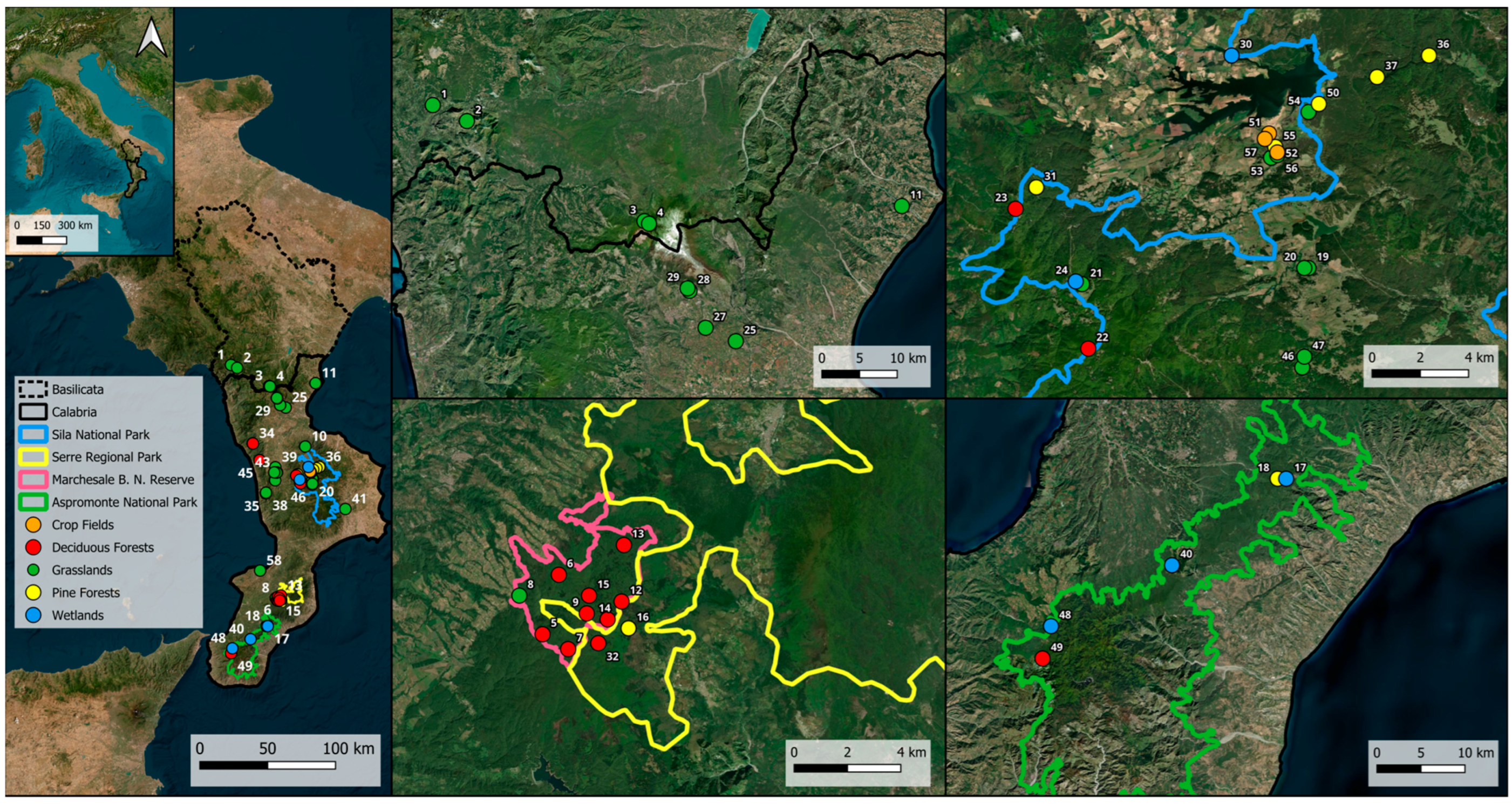
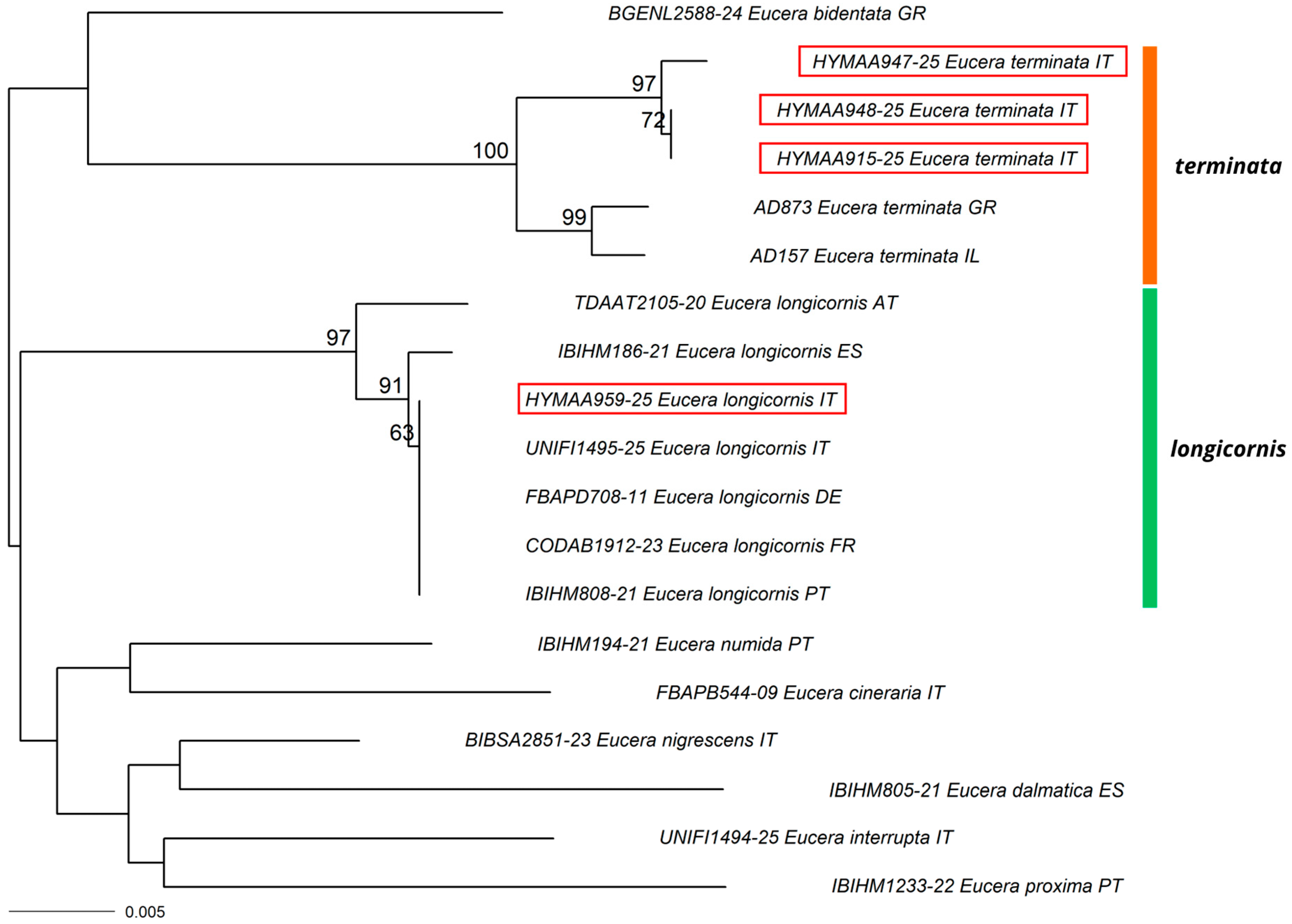
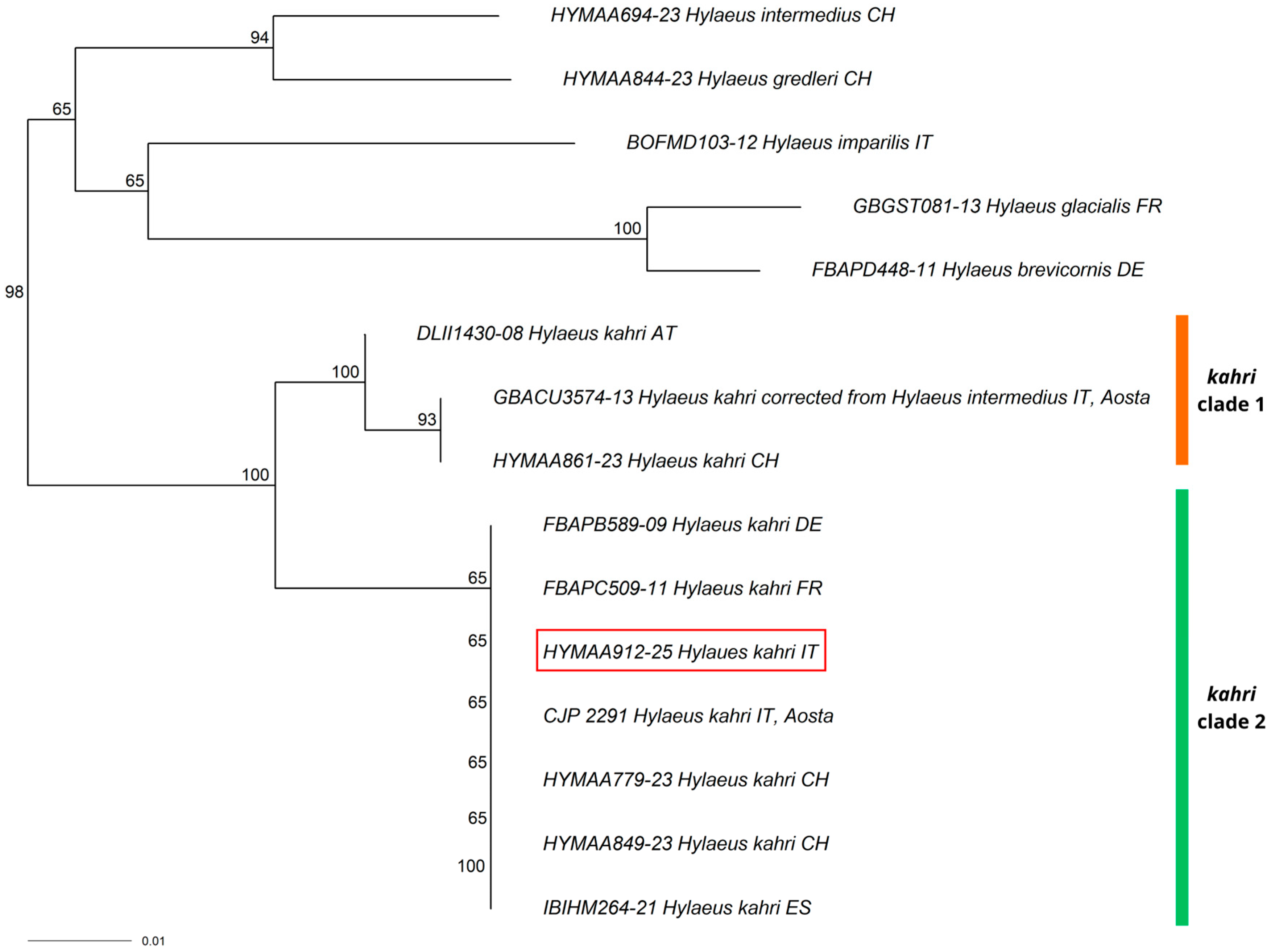
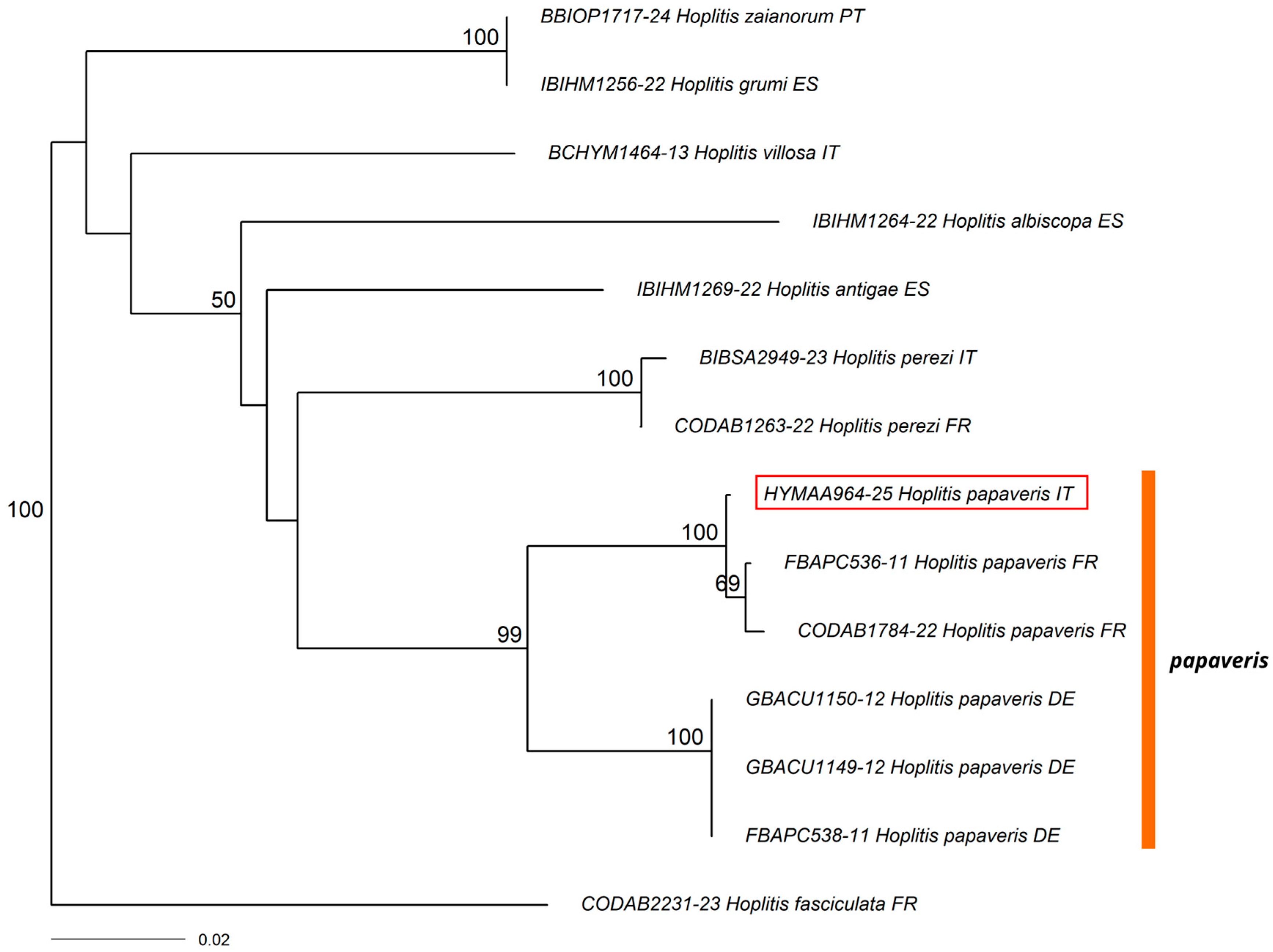
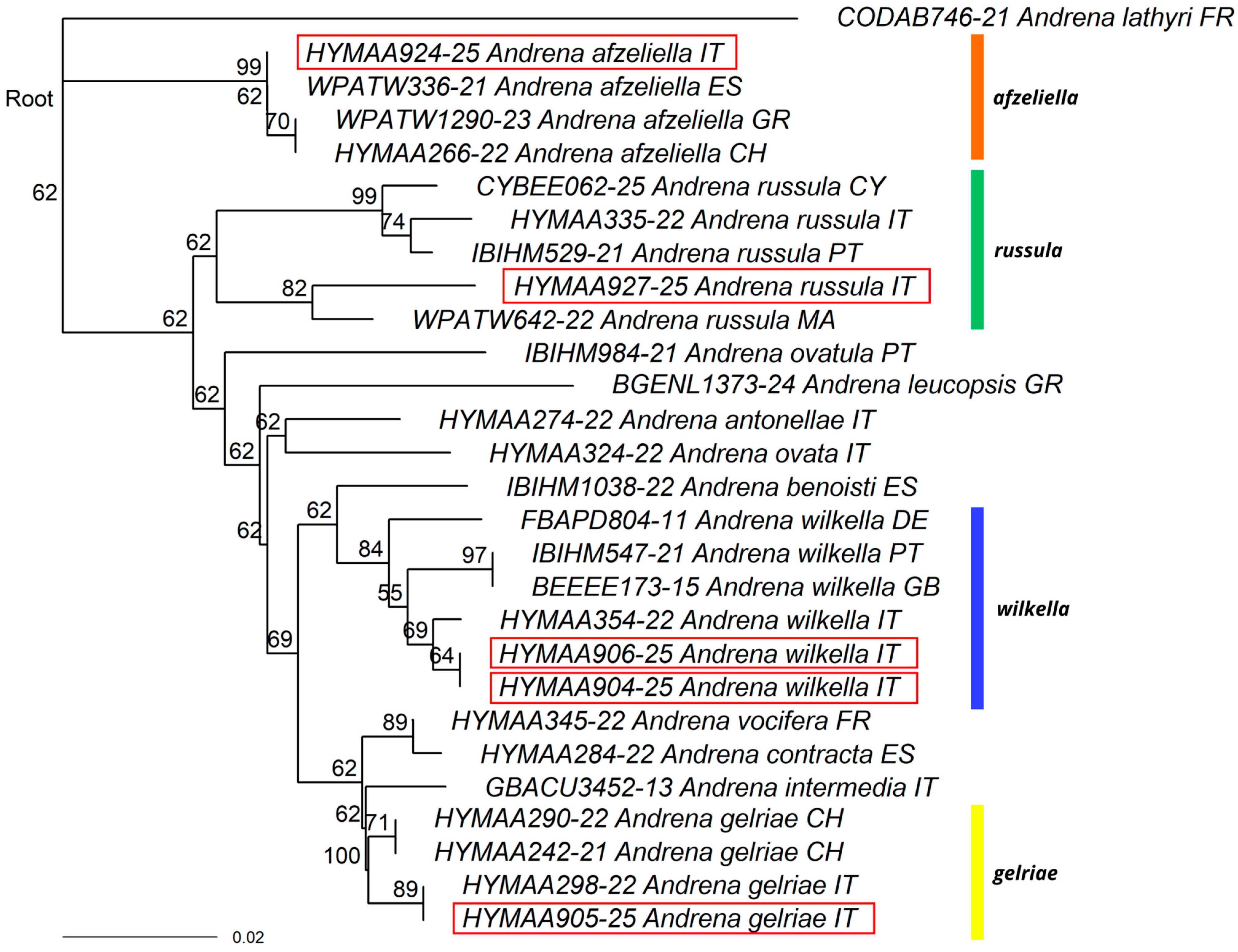
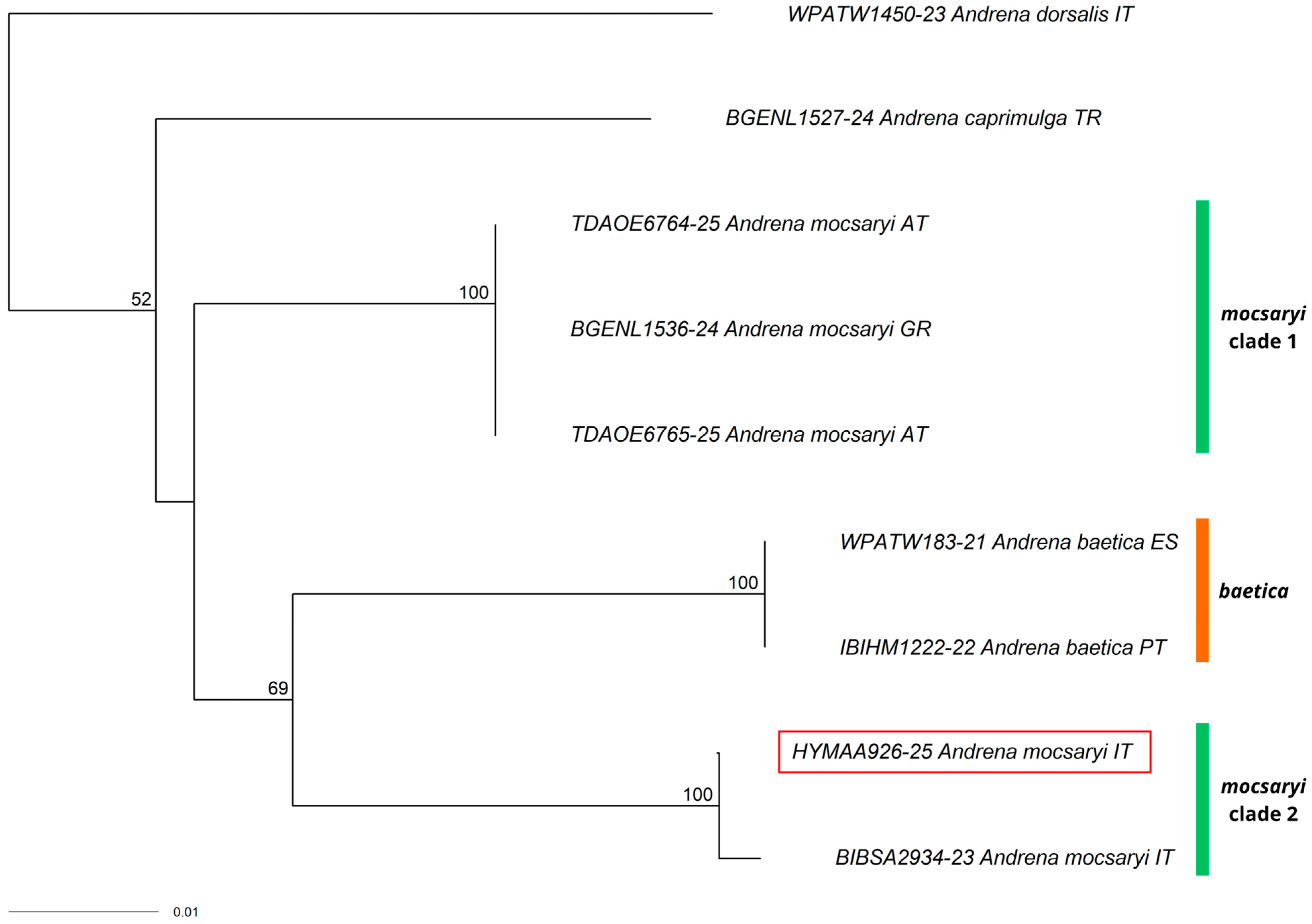
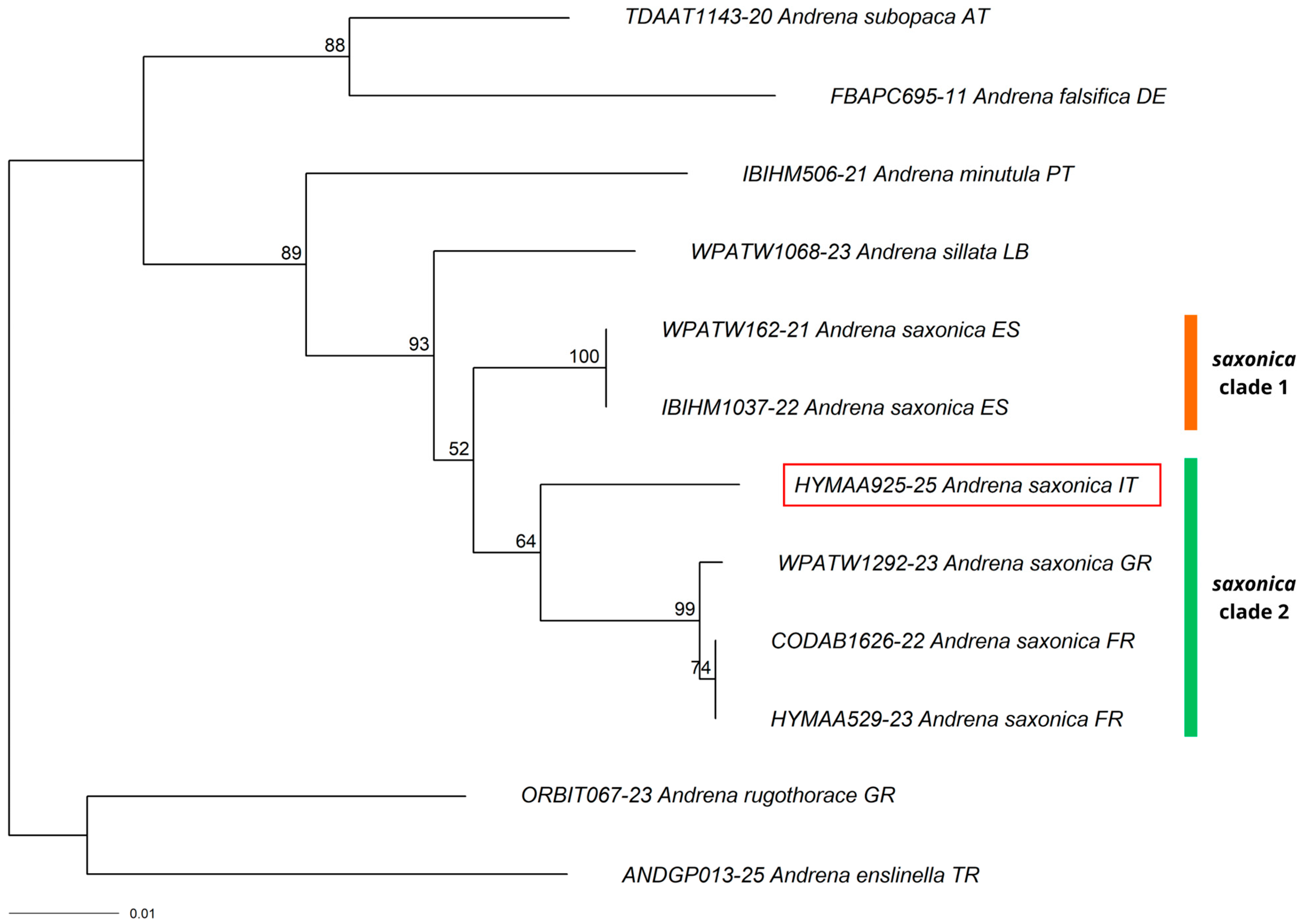
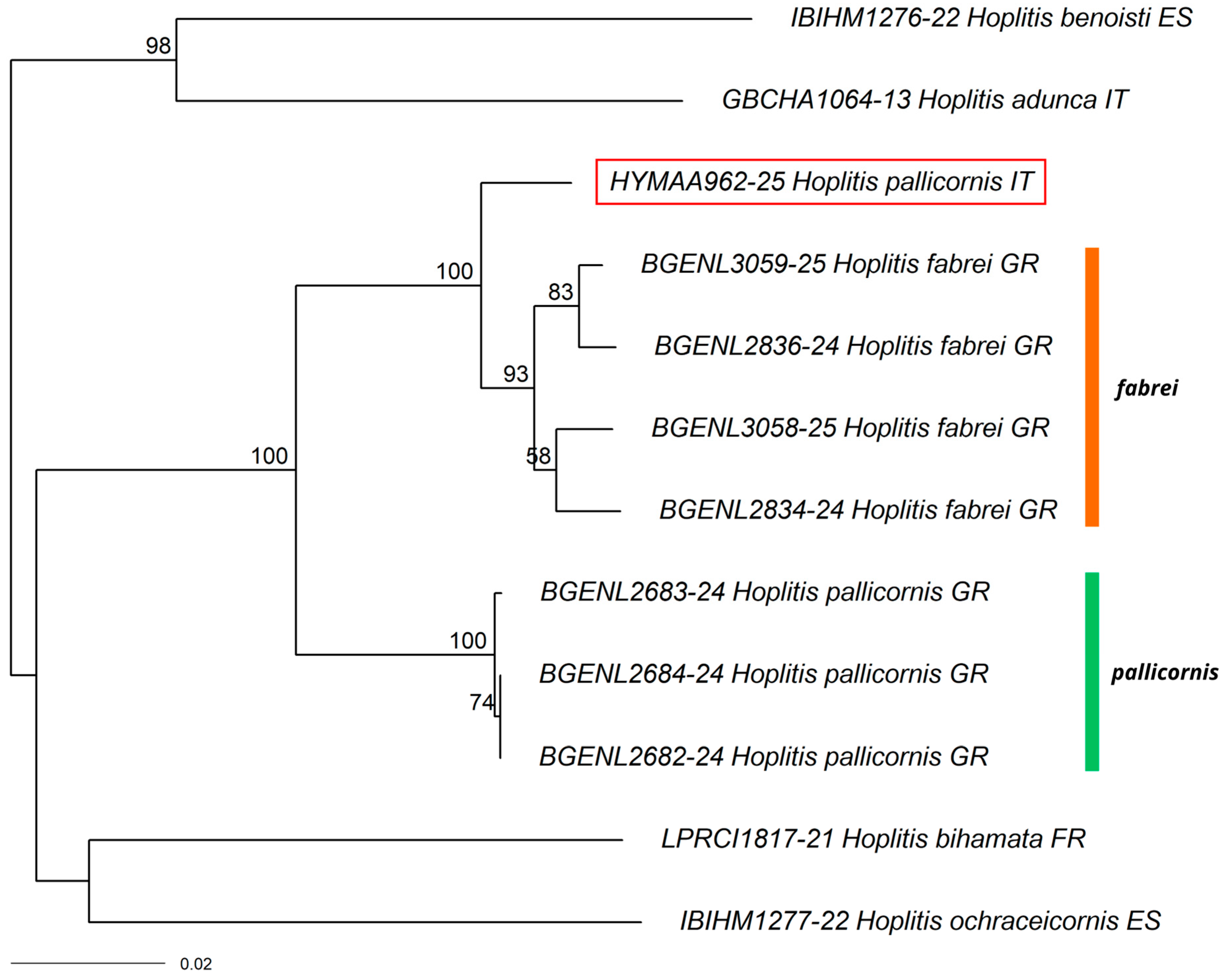
Disclaimer/Publisher’s Note: The statements, opinions and data contained in all publications are solely those of the individual author(s) and contributor(s) and not of MDPI and/or the editor(s). MDPI and/or the editor(s) disclaim responsibility for any injury to people or property resulting from any ideas, methods, instructions or products referred to in the content. |
© 2026 by the authors. Licensee MDPI, Basel, Switzerland. This article is an open access article distributed under the terms and conditions of the Creative Commons Attribution (CC BY) license.