
Plant Endemism and Biodiversity Conservation in the Alashan–Ordos Dryland of Inner Mongolia

 ,
,
Abstract
1. Introduction
2. Materials and Methods
2.1. Study Area
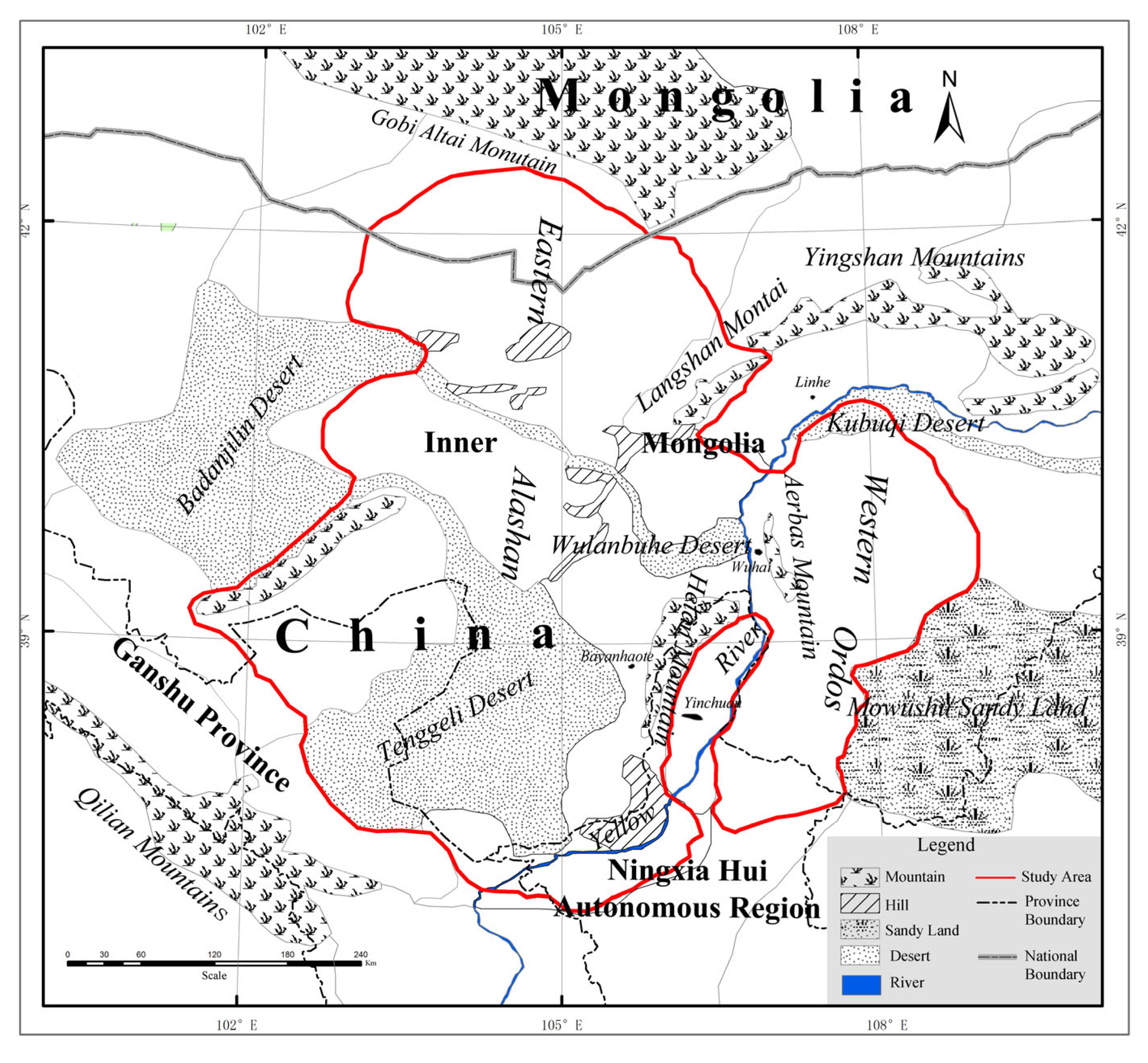
2.1.1. Alashan–Ordos Plateau
2.1.2. Helan Mountains
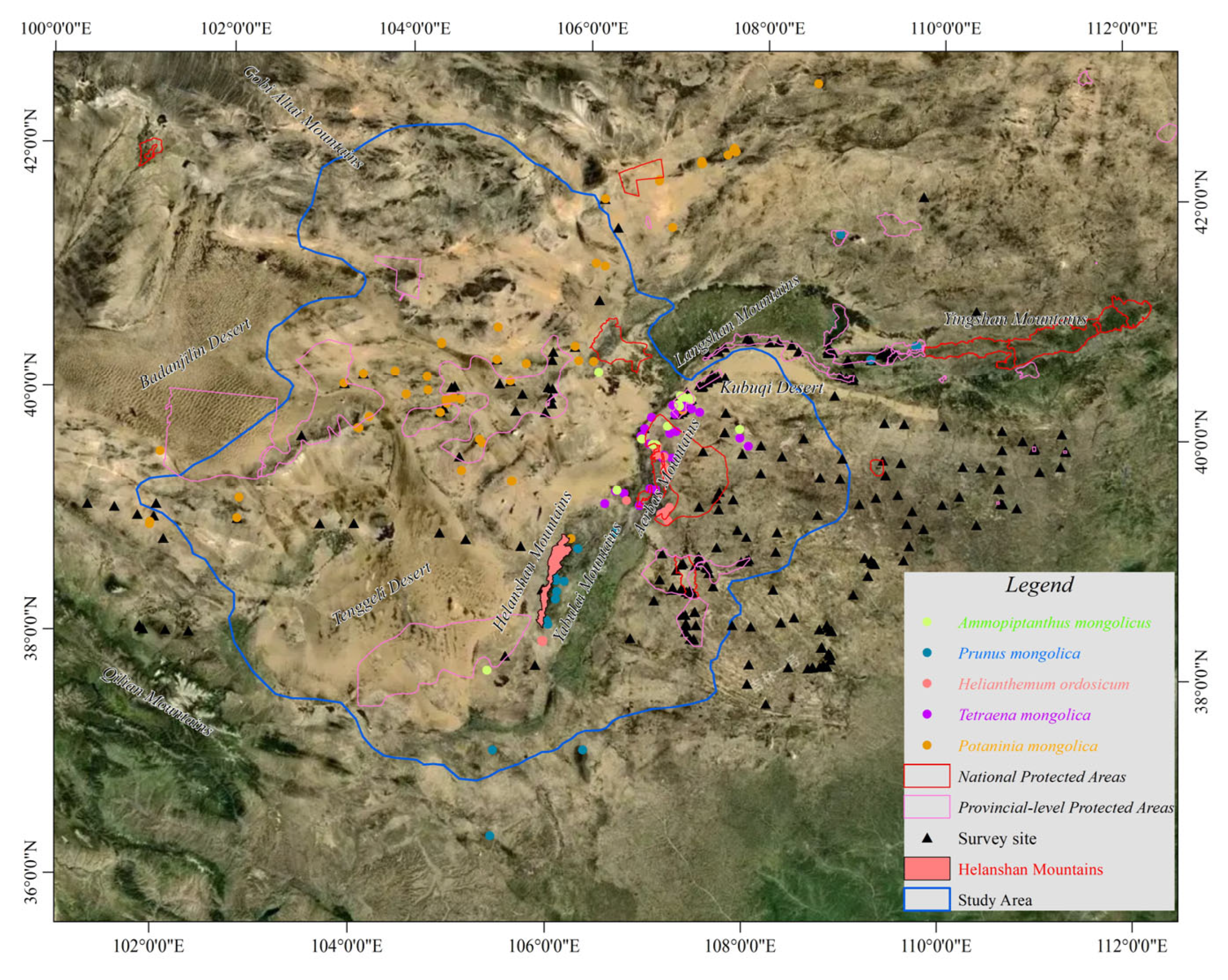
2.2. Field Sampling Methods
2.3. Data Analysis
3. Results
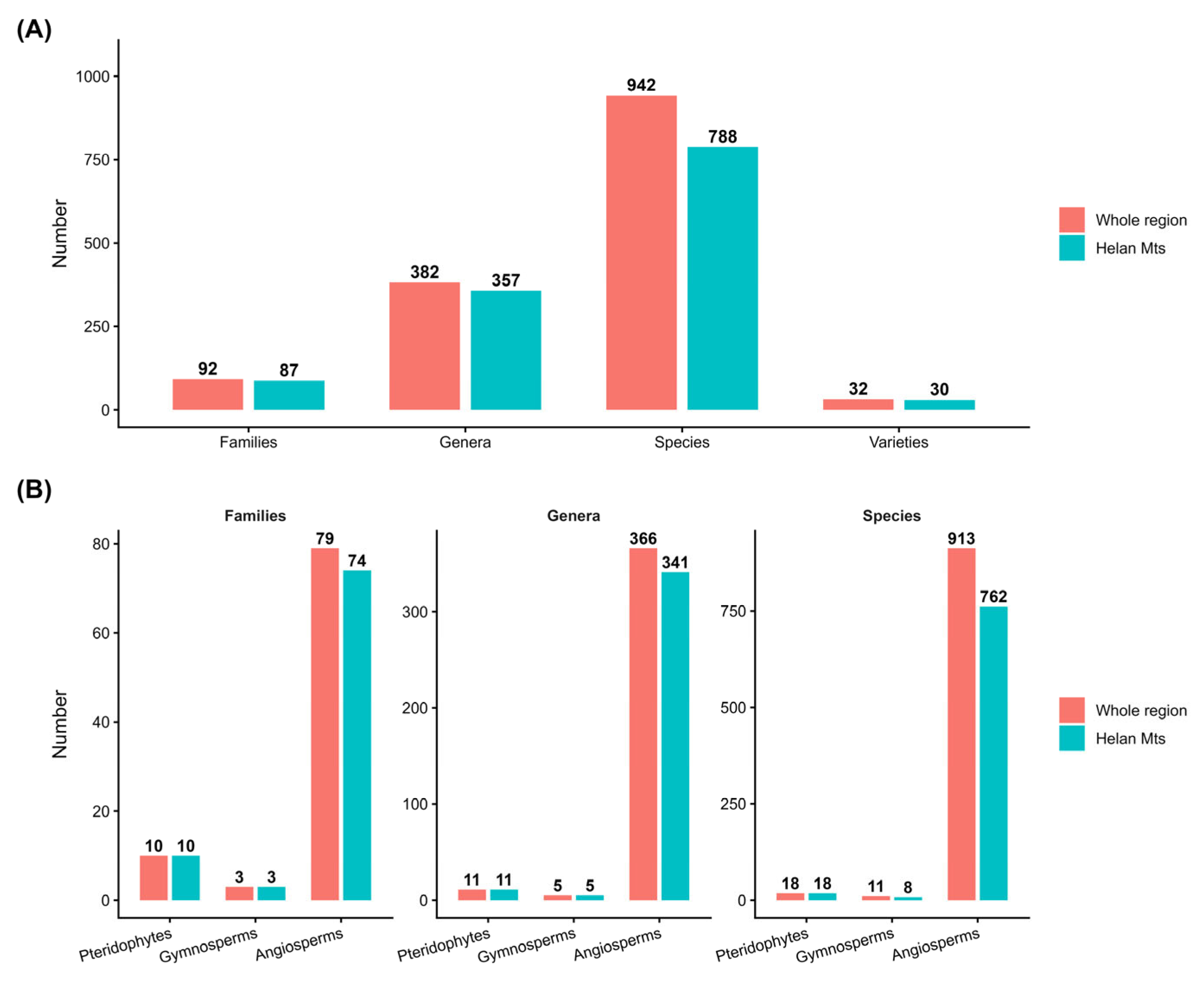
3.1. General Status of Plant Biodiversity
3.2. Plant Endemism and Spatial Distribution
3.2.1. Endemic Species and Their Distribution
3.2.2. Endemic Genera and Their Spatial Distribution
3.2.3. Endemic Communities and Their Distribution
4. Discussion
4.1. The Foundation to Establish a Biodiversity Center
4.2. Remnants of Ancient Endemic Genera in the Plain Area
4.3. Variation in New Endemic Plants in Mountainous Areas
4.4. Conservation Gaps and Recommendations
5. Conclusions
- (1)
- There is an endemic sub-family (Tetraenoideae), 5 endemic genera (Tetraena, Potaninia, Tugarinovia, Stipnolepis, and Pugionium), and 2 endemic genera from mid-Asian deserts (Ammopiptanthus and Elachanthemum). The 6 endemic or quasi-endemic genera in the region are all located in high plain or piedmont areas.
- (2)
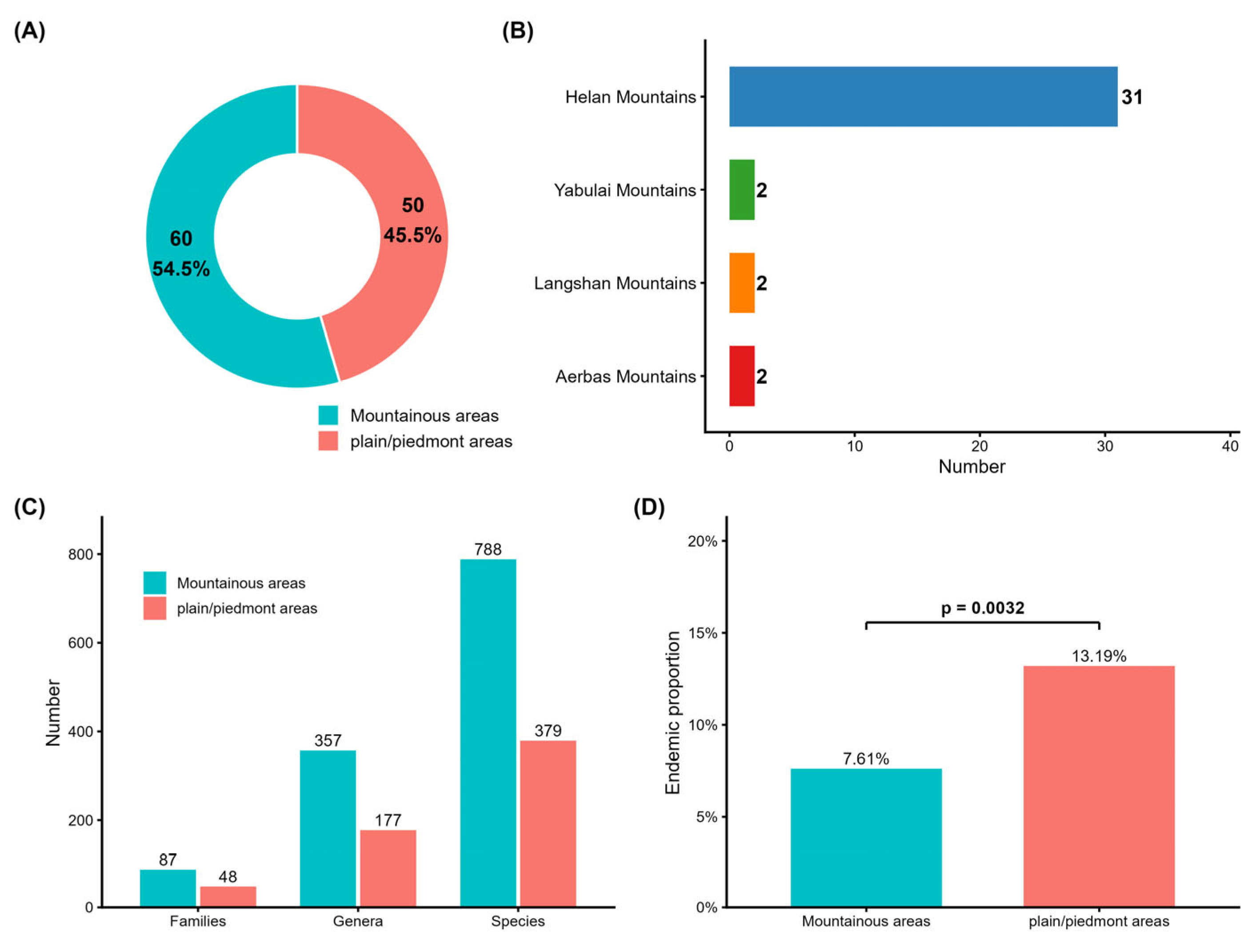
- There are 92 endemic or quasi-endemic seed plants in the local region and 18 varieties, accounting for 11.3% of the area’s plants. Of these, 60 species (including varieties) are in mountainous areas and 50 in plain or piedmont areas.
- (3)
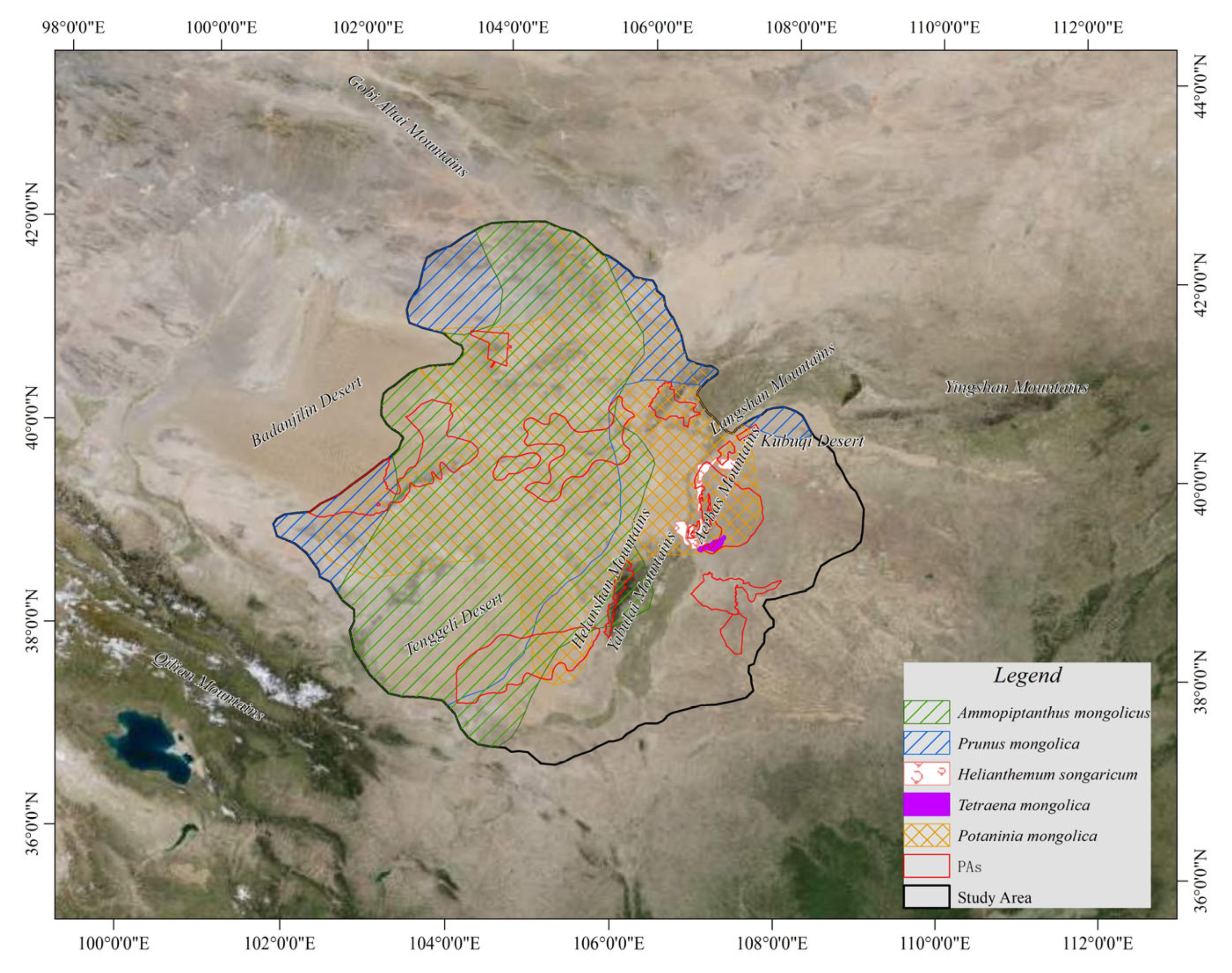
- There are 10 species that may form endemic communities. Of these communities, there are three in the Helan Mountains: the Leptodermis ordosica community in Mongolia, and the Hippolytia alashanensis community in the Helan Mountains. There are also eight communities in plain or piedmont areas: the Ephedra rhytidosperma community, the Tetraena mongolica community, the Helianthemum ordosicum community, the Potaninia mongolica community, the Prunus mongolica community, the Ammopiptanthus mongolicus community, the Reaumuria trigyna community, and the Brachanthemum gobicum community.
- (4)
- The endemic flora of the area is both ancient and young, and also exhibits strong xeromorphism (xerophytes: 45% in mountains vs. 78% in the plain or piedmont areas). Most endemic taxa in the plain or piedmont areas are ancient elements inferred from taxonomic literature and distribution patterns, whereas endemic taxa in the mountains are mainly narrow-range young elements.
Supplementary Materials
Author Contributions
Funding
Data Availability Statement
Acknowledgments
Conflicts of Interest
References
- Hoover, D.L.; Bestelmeyer, B.; Grimm, N.B.; Huxman, T.; Reed, S.C.; Sala, O.; Seastedt, T.R.; Wilmer, H.; Ferrenberg, S. Traversing the wasteland: A framework for assessing ecological threats to drylands. BioScience 2020, 70, 35–47. [Google Scholar] [CrossRef] [Scilit]
- McNeely, J.A. Biodiversity in arid regions: Values and perceptions. J. Arid Environ. 2003, 54, 61–70. [Google Scholar] [CrossRef] [Scilit]
- Scherson, R.A.; Luebert, F.; Pliscoff, P.; Fuentes-Castillo, T. Flora of the hot deserts: Emerging patterns from phylogeny-based diversity studies. Am. J. Bot. 2020, 107, 1467–1469. [Google Scholar] [CrossRef] [Scilit]
- Davis, S.D. Centres of Plant Diversity: A Guide and Strategy for Their Conservation. Volume 2: Asia, Australasia and the Pacific; IUCN/WWF: Gland, Switzerland, 1995. [Google Scholar]
- McGowan, P.J.K.; Hutchinson, A.; Brooks, T.M.; Elliott, W.; Hoffmann, M.; Mair, L.; McDougall, A.; Raimondo, D.C.; Butchart, S.H.M. Understanding and achieving species elements in the Kunming–Montreal Global Biodiversity Framework. BioScience 2024, 74, 614–623. [Google Scholar] [CrossRef] [Scilit]
- Michaelsen, P.; Sundström, A.; Jagers, S.C. Mass support for conserving 30% of the Earth by 2030: Experimental evidence from five continents. Proc. Natl. Acad. Sci. USA 2025, 122, e2503355122. [Google Scholar] [CrossRef] [Scilit]
- Lewin, A.; Murali, G.; Rachmilevitch, S.; Roll, U. Global evaluation of current and future threats to drylands and their vertebrate biodiversity. Nat. Ecol. Evol. 2024, 8, 1448–1458. [Google Scholar] [CrossRef] [Scilit]
- Wang, H.S.; Zhang, Y.L. The biodiversity and characters of spermatophytic genera endemic to China. Acta Bot. Yunnanica 1994, 16, 209–220. (In Chinese) [Google Scholar]
- Zhu, Z.Y. Study on researchers from Europe-America inspecting geographical environment of Northwestern China since 1800. J. Arid Land Resour. Environ. 1999, 13, 54–64. (In Chinese) [Google Scholar]
- Liang, C.Z.; Zhu, Z.Y. The Vegetation of Helan Mountain; Ningxia Sunshine Press Co., Ltd.: Yinchuan, China, 2012. (In Chinese) [Google Scholar]
- Li, E.; Huang, Y.; Chen, H.; Zhang, J. Floristic diversity analysis of the Ordos Plateau, a biodiversity hotspot in arid and semi-arid areas of China. Folia Geobot. 2018, 53, 405–416. [Google Scholar] [CrossRef] [Scilit]
- Zheng, Y.; Dong, L.; Li, Z.; Zhang, J.; Li, Z.; Miao, B.; Jia, C.; Liang, C.; Wang, L.; Li, F.Y. Phylogenetic structure and formation mechanism of shrub communities in arid and semiarid areas of the Mongolian Plateau. Ecol. Evol. 2019, 9, 13320–13331. [Google Scholar] [CrossRef] [Scilit] [PubMed]
- Yuan, J.; Muyi, K.; Shuo, L.; Lianshu, T.; Mingde, L.A. Study on the Vegetation in the East Side of Helan Mountain. Plant Ecol. 2000, 149, 119–130. [Google Scholar] [CrossRef] [Scilit]
- Zhu, Z.Y.; Liang, C.Z.; Wang, W.; Liu, Z.L. The landscape ecological division of desert region in Alashan. J. Arid Land Resour. Environ. 2000, 14, 37–48. (In Chinese) [Google Scholar]
- Harrison, S.; Noss, R. Endemism hotspots are linked to stable climatic refugia. Ann. Bot. 2017, 119, 207–214. [Google Scholar] [CrossRef] [Scilit]
- Wassenaar, T.; Henschel, J.; Pfaffenthaler, M.; Mutota, E.; Seely, M.; Pallett, J. Ensuring the future of the Namib’s biodiversity: Ecological restoration as a key management response to a mining boom. J. Arid Environ. 2013, 93, 126–135. [Google Scholar] [CrossRef] [Scilit]
- Villarreal-Quintanilla, J.A.; Bartolomé-Hernández, J.A.; Estrada-Castillón, E.; Ramírez-Rodríguez, H.; Martínez-Amador, S.J. The endemic element of the Chihuahuan Desert vascular flora. Acta Bot. Mex. 2017, 118, 65–96. [Google Scholar] [CrossRef] [Scilit]
- Ma, Y.C. Study on the systematic position of Tetraena Maxim. J. Syst. Evol. 1990, 28, 89–95. [Google Scholar]
- Popov, M.G. Between Mongolia and Iran. Trudy Prikl. Bot. Genet. Selekts. (Bull. Appl. Bot. Genet. Pl.-Breed.) 1931, 26, 45–84. [Google Scholar]
- Cheng, S.-H. Ammopiptanthus Cheng f., a new genus of Leguminosae from Central Asia. Bot. Zhurn. 1959, 44, 1381–1386. [Google Scholar]
- Komarov, V.L. (Ed.) Flora of the USSR; Israel Program for Scientific Translations: Jerusalem, Israel, 1968; Volume 1: Archegoniatae and Embryophyta. [Google Scholar]
- Zhao, Y.Z.; Cheng, W.L.; Yin, J.; Cao, R.; Zhang, J.Q. A reevaluation of the status of Potaninia based on internal transcribed spacer sequences. Bull. Bot. Res. 2003, 23, 402–406. (In Chinese) [Google Scholar]
- Ma, Y.C. Revision of the genus Tugarinovia Iljin and its systematic position. J. Syst. Evol. 1980, 18, 217–219. [Google Scholar]
- Shi, C. A new combination of the Compositae-Anthemideae from China. Acta Phytotaxon. Sin. 1985, 23, 470–472. [Google Scholar]
- Wu, Z.; Sun, H.; Zhou, Z.K.; Peng, H.; Li, D.Z. Origin and differentiation of endemism in the flora of China. Front. Biol. China 2007, 2, 125–143. [Google Scholar] [CrossRef] [Scilit]
- Elsen, P.R.; Monahan, W.B.; Merenlender, A.M. Global patterns of protection of elevational gradients in mountain ranges. Proc. Natl. Acad. Sci. USA 2018, 115, 6004–6009. [Google Scholar] [CrossRef] [Scilit]
- Saura, S.; Bertzky, B.; Bastin, L.; Battistella, L.; Mandrici, A.; Dubois, G. Protected area connectivity: Shortfalls in global targets and country-level priorities. Biol. Conserv. 2018, 219, 53–67. [Google Scholar] [CrossRef] [Scilit] [PubMed]
- Magurran, A.E.; Baillie, S.R.; Buckland, S.T.; Dick, J.M.; Elston, D.A.; Scott, E.M.; Smith, R.I.; Somerfield, P.J.; Watt, A.D. Long-term datasets in biodiversity research and monitoring: Assessing change in ecological communities through time. Trends Ecol. Evol. 2010, 25, 574–582. [Google Scholar] [CrossRef] [Scilit] [PubMed]



| Endemic Genera | In Family | Number of Species (Local/Genus) | Endemic Type | Distribution |
|---|---|---|---|---|
| Tetraena | Zygophyllacese | 1/1 | Local, West Ordos | West Ordos |
| Potaninia | Rosaceae | 1/1 | Local, East Alashan—West Ordos | East Alashan–West Ordos |
| Tugarinovia | Compositae | 1/1 | Local, Alashan–Ordos | Alashan–Ordos |
| Stilpnolepis | Compositae | 1/1 | Local, Alashan–Ordos | Alashan–Ordos |
| Pugionium | Cruciferae | 3/4 | Local, south Mongolian Plateau | Sand lands in south Mongolian Plateau |
| Ammopiptanthus | Fabaceae | 1/2 | Nearly local, Gobi desert in Mid-Asia | Gobi desert in Mid-Asia |
| Elachanthemum | Compositae | 2/2 | Nearly local, Gobi desert in Mid-Asia | Gobi desert in Mid-Asia |
| Ostryopsis | Betulaceae | 1/2 | Chinese | North–Southwest China |
| Yinshannica | Cruciferae | 1/8 | Chinese | North to Southwest China |
| Plagiopspermum | Rosaceae | 1/3 | Chinese | North to Southwest China |
| Speranskia | Euphorbiaceae | 1/3 | Chinese | North to Southwest China |
| Xanthoceras | Sapindaceae | 1/1 | Chinese | North and Northeast China |
| Xanthopappus | Compositae | 1/1 | Chinese | Northwest to Southwest China |
| Anemarrhena | Liliaceae | 1/1 | Chinese | North to Southwest China |
Disclaimer/Publisher’s Note: The statements, opinions and data contained in all publications are solely those of the individual author(s) and contributor(s) and not of MDPI and/or the editor(s). MDPI and/or the editor(s) disclaim responsibility for any injury to people or property resulting from any ideas, methods, instructions or products referred to in the content. |
© 2026 by the authors. Licensee MDPI, Basel, Switzerland. This article is an open access article distributed under the terms and conditions of the Creative Commons Attribution (CC BY) license.
Share and Cite
Cao, Y.; Mo, Y.; Jia, C.; Miao, B.; Shi, K.; Li, Y.; Wang, Y.; Zhang, K.; Li, Z.; Wang, Y.; et al. Plant Endemism and Biodiversity Conservation in the Alashan–Ordos Dryland of Inner Mongolia. Diversity 2026, 18, 128. https://doi.org/10.3390/d18020128
Cao Y, Mo Y, Jia C, Miao B, Shi K, Li Y, Wang Y, Zhang K, Li Z, Wang Y, et al. Plant Endemism and Biodiversity Conservation in the Alashan–Ordos Dryland of Inner Mongolia. Diversity. 2026; 18(2):128. https://doi.org/10.3390/d18020128
Chicago/Turabian StyleCao, Yue, Yu Mo, Chengzhen Jia, Bailing Miao, Keyi Shi, Yuhan Li, Yixuan Wang, Kun Zhang, Zhiyong Li, Yongli Wang, and et al. 2026. "Plant Endemism and Biodiversity Conservation in the Alashan–Ordos Dryland of Inner Mongolia" Diversity 18, no. 2: 128. https://doi.org/10.3390/d18020128
APA StyleCao, Y., Mo, Y., Jia, C., Miao, B., Shi, K., Li, Y., Wang, Y., Zhang, K., Li, Z., Wang, Y., & Liang, C. (2026). Plant Endemism and Biodiversity Conservation in the Alashan–Ordos Dryland of Inner Mongolia. Diversity, 18(2), 128. https://doi.org/10.3390/d18020128