Article

From Hulls to Caves: Insights into the Introduction and Expansion of Non-Indigenous Marine Bivalves of the Genera Isognomon and Malleus in the Eastern Mediterranean Sea


by
Eirini Gratsia
1,2,*,
Argyro Zenetos
3,
Markos Digenis
4,
Vasilis Gerovasileiou
4,
Panagiotis Kasapidis
2 and
Ioannis Karakassis
1
1
Department of Biology, University of Crete, 70013 Heraklion, Greece
2
Hellenic Centre for Marine Research (HCMR), Institute of Marine Biology, Biotechnology and Aquaculture (IMBBC), 71500 Heraklion, Greece
3
Hellenic Centre for Marine Research, Institute of Marine Biological Resources and Inland Waters, 19003 Anavissos, Greece
4
Department of Environment, Faculty of Environment, Ionian University, 29100 Zakynthos, Greece
*
Author to whom correspondence should be addressed.
Diversity 2026, 18(2), 127; https://doi.org/10.3390/d18020127
Submission received: 6 December 2025 / Revised: 10 February 2026 / Accepted: 14 February 2026 / Published: 19 February 2026
(This article belongs to the Special Issue 2026 Feature Papers by Diversity's Editorial Board Members)

Abstract

Although the Eastern Mediterranean Sea is a hotspot for marine bioinvasions, the accurate identification and monitoring of non-indigenous species (NIS) remain impeded by the ambiguous morphologies of species and limited regional genetic data. This study applied an integrative approach, combining morphological identification with DNA barcoding, to assess the taxonomy and expansion of bivalves from the genera Isognomon and Malleus in the Eastern Mediterranean Sea. Specimens were collected from a broad range of habitats, including marinas, ship hulls, reefs, and marine caves. Phylogenetic analyses revealed two distinct Isognomon species in the region: I. bicolor, frequently associated with artificial substrates and showing evidence of multiple introductions, and I. aff. legumen, restricted to cryptic natural habitats. A single species of Malleus cf. regula was also detected, clustering with sequences from neighboring Mediterranean regions. The study highlights the limitations of morphology-based taxonomy and the urgent need to enhance genetic reference databases, particularly with sequences from areas of nativity. As NIS increasingly expand from anthropogenic habitats into natural ecosystems, validated data are essential for risk assessment and conservation management.

1. Introduction

The global rate of Non-Indigenous Species (NIS) introductions and their establishment in new ecosystems have escalated in recent decades, following the increased economic growth and globalization [1], particularly in the Mediterranean Sea [2,3,4], causing significant biodiversity changes [5]. In the Mediterranean Sea, moderate to high impacts of bioinvasions on biodiversity have been documented for 88 marine non-indigenous and cryptogenic species from 16 different phyla, affecting ecosystem services and human health [6]. While Lessepsian migration (i.e., the influx of Indo-Pacific and Red Sea-originated species through the Suez Canal) is the main pathway of introduction to the Eastern Mediterranean, ballast water disposals and biofouling on ship hulls related to maritime transportation are considered to be the second most important pathway, in which targeted policies and mitigation measures can be effectively implemented [7,8].
Among the invaders of the Eastern Mediterranean Sea are several bivalve species of the genus Isognomon [Lightfoot], 1786, and Malleus Lamarck, 1799. The genus Isognomon of the family Isognomonidae Woodring, 1925 (1828) includes 16 distinct species [9] whose nomenclature has undergone several revisions due to the high number of genetically distinct cryptic (classified as a single species due to their identical morphology) and pseudocryptic (species with almost identical morphology due to physical complexities) species and their widespread distribution [10]. The genus Malleus, of the family Malleidae Lamark, 1818, includes eight morphologically similar species [11] that have often been mis- determined, especially within the genus Isognomon, due to their similar morphological characteristics. Both genera include species with confirmed introductions and expansion in parts of the Mediterranean, but their ecological impacts remain uncertain; they are not yet classified as highly invasive according to the EU Invasive Alien Species of Union Concern, but their continued spread requires monitoring due to the general regional trend of NIS introductions and spread [10].
Several species of the genus Isognomon are recent invaders, and one is spreading rapidly in the Mediterranean. The first confirmed record of Isognomon in the Mediterranean Sea dates back to 2016 and was reported as I. legumen (Gmelin, 1791) based on its morphological features, and was collected in 2015 from the Shikmona marine reserve, south of Haifa [12,13]. Subsequent records were then reported across the region. Specifically, it was documented in the Aegean Sea [14,15,16], the Levantine coast of Turkey [17], the Italian Ionian coast [18], Cyprus [19,20] and Albania [21]. The same species was also reported as I. australicus (Reeve, 1858) from the Ionian islands of Greece [22] and as I. aff. australicus in southern Crete and Cyprus [23].
Isognomon bicolor (C.B. Adams, 1845), is a species native to the tropical western Atlantic/Caribbean and is considered to have arrived in the Mediterranean Sea through commercial shipping [10]. Isognomon bicolor is a prominent species with a high invasive potential and dispersal ability, and has been associated with disruption to native communities (e.g., intertidal sandstone reefs), also causing economic impacts (e.g., marine activities) [24,25,26,27]. In Brazil, where it was first reported, I. bicolor was primarily found in ports, suggesting that the most possible pathways of introduction are ballast waters and/or ship fouling [28,29]. However, the species has also colonized natural habitats such as rocky beaches and intertidal crevices [30,31] dominating over native species.
On the other hand, the first report of the genus Malleus in the Mediterranean Sea belongs to the species Malleus regula (Forsskål, 1775), dating back to 1929. Initially, it was reported from the coasts of Tyre in Lebanon and the bay of Saint-Georges near Beirut and Syria [32], indicating that this species entered through the Suez Canal. The species was subsequently recorded in Israel [33] and Cyprus [34], the Gulf of Antalya in Turkey [35] and Egypt [36], gradually expanding in the Eastern Mediterranean. Although reports by [37] from Libya were later shown to be misidentifications, referring in fact to I. legumen [16], the presence of M. regula in Greece was confirmed from Astypalaia Island [15]. The latest record of M. regula is from the Gulf of Taranto, Italy [38] and of I. bicolor from the south Aegean [39], Tunisia [40], the Tyrrhenian Sea [41], and Egypt [42].

1.1. Taxonomic Complexity and Morphological Similarity

Isognomon legumen, I. bicolor, and Malleus regula can be characterized as cryptic species due to their morphological similarity to one another and other congeneric species. This has led to several misidentifications over the years when relying only on the conchological characteristics. Specifically, both I. australicus and M. regula were previously misclassified as I. legumen in Mediterranean records [16,39], while I. bicolor can also be easily confused with I. alatus (Gmelin, 1791) [24]. Additionally, both I. australicus and I. bicolor share common morphological characteristics, such as the irregular shell outline, which can be affected by the substrate where they grow, making the identification challenging. However, I. australicus exhibits prominent radial ribs and occasional tubular spines (more evident in juveniles), characteristics which are absent in the concentric-lamellae-dominated I. bicolor [19,39,43], whose juveniles show a set of ridge-like pits along the hinge. In adults, color can be another distinguishing feature: while I. australicus has a uniformly pale, corneous exterior with nacreous interiors, I. bicolor has a distinctive bicoloration—yellowish near the umbones grading to dark brown or purplish edges, with a bright, silvery nacre [43]. Despite misidentifications in the past, M. regula can be distinguished from the others by its spatulate “hammer” shell, reduced lateral wings, and concentric growth lines’ pattern [16,44,45], in contrast with I. legumen, which has a wide series of short ligamental pits resembling tooth-like structures, M. regula lacks both pits and hinge teeth.

1.2. Ecology and Habitat

Habitat is an essential factor in species expansion and settlement. All three species attach by byssus to hard substrates. Isognomon aff. legumen is typically found in cryptic habitats such as below overhangs or even inside empty shells, favoring sheltered microhabitats in contrast to the more exposed, high-energy shore occurrences typical of I. bicolor [19]. The latter species prefers hard substrates but inhabits the more exposed intertidal and shallow subtidal zone. In both its native and introduced range (e.g., Brazil and the Mediterranean), it is often found in clusters, colonizing cracks and crevices on high-turbidity rocky coasts or encrusting pier pilings, and buoys in harbors, sometimes outcompeting native bivalves [24]. Malleus regula also prefers cryptic environments such as coral reefs and rocky bottoms, as well as artificial environments such as under floating platforms in marinas, from the low intertidal to about 50–60 m depth [36].

1.3. Integrative Approaches to Address Taxonomic Challenges

Despite the increasing effort and reports of Isognomon and Malleus species in the Eastern Mediterranean, their exact identity, distribution, and ecological preferences remain unresolved. Their taxonomically challenging morphology still leads to misidentifications, leading to confusion and mis-documentation of their invasion steps, and as a result, delaying effective monitoring and risk assessment studies. Only lately have a few studies begun to combine both morphological and molecular data, while very few include diverse habitats.
For instance, the 16S rRNA gene marker was used to assess the preliminary identification of Isognomon sp. and Malleus sp. specimens from different localities in the Southern Mediterranean Sea, and concluded that the primarily identified Isognomon specimens belonged to the Atlantic species I. bicolor [10,39]. More recently, the systematics of the genus Isognomon in the Mediterranean Sea was revised using both morphological and molecular approaches and showed the presence of two species only: I. bicolor, distributed in the Central and Eastern Mediterranean, and the Indo-Pacific I. australicus, only from the Eastern Mediterranean, which was suggested to be renamed as Isognomon aff. legumen [39,45].
Unravelling species identities is of major concern when studying NIS, especially for those with high dispersal abilities, especially in hard-to-reach shaded environments (e.g., marine caves). Utilizing genetic methods such as DNA barcoding could help to decrypt taxonomically problematic high-risk species as a prerequisite to monitor their expansion, understand their pathways, and eventually predict their next steps.
This study aimed to conduct an integrative survey of Isognomon and Malleus bivalves in the Eastern Mediterranean Sea, combining morphological identification with DNA barcoding using mitochondrial 16S rRNA and COI markers. The specific objectives were to: (1) document new occurrence records from both artificial and natural habitats, including hard-to-access environments such as marine caves; (2) expand the molecular reference database for these taxa; (3) clarify their current status in the surveyed region; and (4) evaluate species’ habitat preferences and potential pathways of introduction.

2. Materials and Methods

2.1. Field Sampling Sites & Habitats

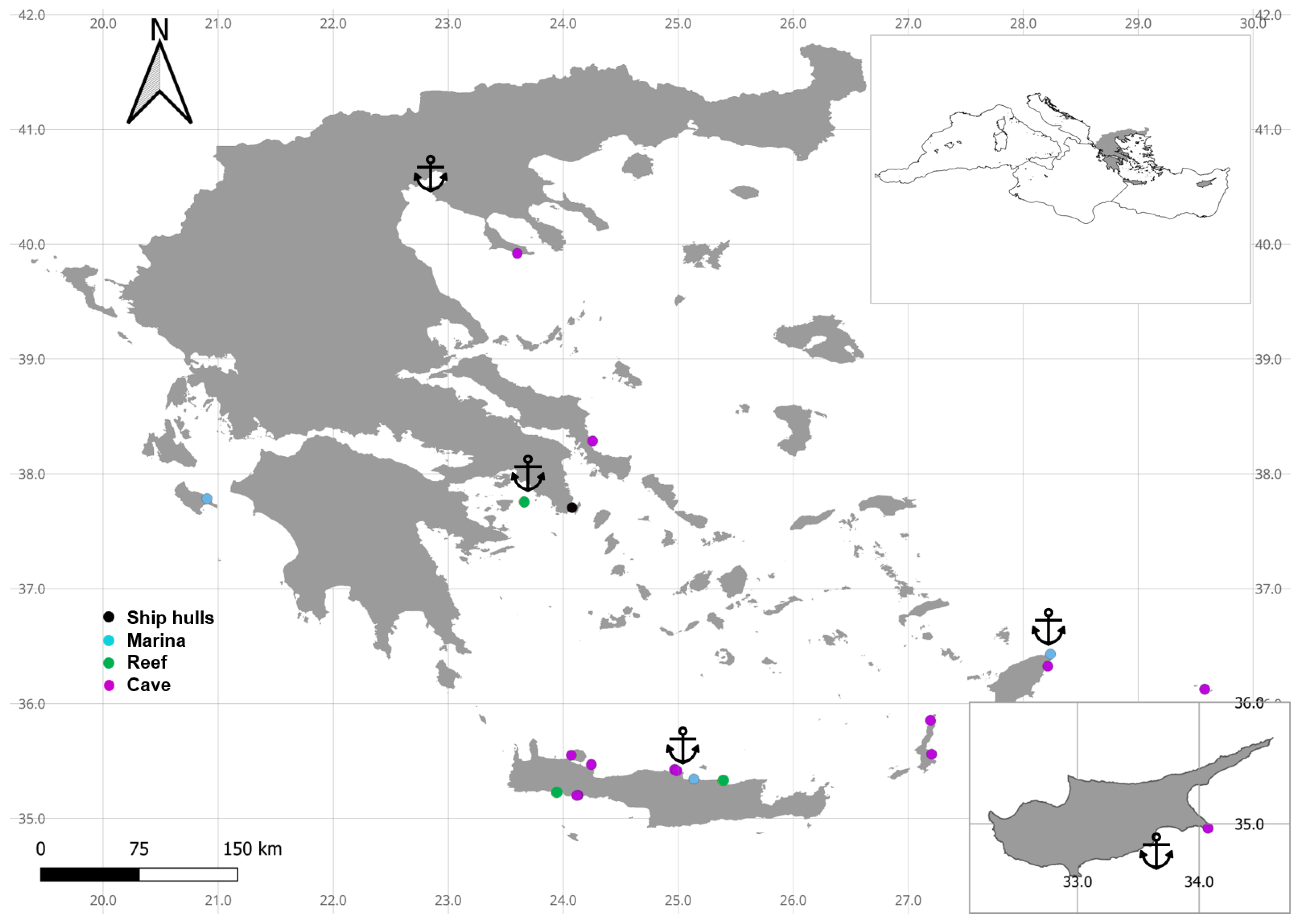
A total of 39 specimens belonging to Isognomonidae and Malleidae families were collected from October 2020 to December 2024, in the framework of multiple projects and sampling campaigns in Greece and Cyprus. The sampling locations were from artificial environments such as ship hulls, ports, and marinas to natural environments such as marine caves and rocky reefs (Table 1, Figure 1). In ports and marinas, the specimens were collected by scraping off hard substrates from the ship hulls while SCUBA diving. During the years 2020–2023, and in the framework of the “ECOHULLCLEAN’’ program (Integrated System for Underwater Ecological Hull Cleaning of Vessels), only two juvenile specimens were collected during the cleaning of 30 different ship hulls in total. Both specimens were collected from the bulk carrier GINGO (IMO: 9182710) in Lavrio (Attica, Greece), which had previously anchored in the Suez Canal and anchorages in Sri Lanka, India, and a port in South Africa. Samples from marine caves and rocky reefs were all detached from hard substrates while SCUBA diving. Specimens were obtained through opportunistic sampling, with divers collecting target taxa whenever they were encountered during surveys. In marine cave habitats, collections were made across a depth range of approximately 1–16 m, ranging from 1 m in Agia Paraskevi Cave (Chalkidiki) to 16 m in Purple Cave (Evia Island). The same approach was applied across all habitat types, with sampling conducted at depths of 1–2 m in marina environments and 3–4 m on reef sites. All the collected specimens were preserved in 99% ethanol for morphological and molecular identification.

2.2. Morphological Identification and Imaging

Specimens were initially sorted and examined morphologically. Small-sized individuals were photographed through a Zeiss SteREO Discovery V12 stereomicroscope, while larger specimens were photographed with an Olympus System Tough TG-7, accompanied by proper scaling.
The morphological identification was performed following the keys and published literature [16,19,38,39,43,44,45]. Exterior sculpture, shell thickness and coloration, hinge and ligament were used as main identifiers of the different specimens. Isognomon specimens were usually either oval to oblong and very flat, with thin but rigid valves, or more elongated in shape and relatively thicker and harder with smaller valves. In some specimens, the exterior exhibited coarse, wavy lamellar sculpture and variable, often pale cream to purplish bicoloration, while others presented a creamy or brown/grey coloration with present ligament pits. Malleus specimens, presented mostly a different shell structure, more elongated with thin transparent valves, from brownish to purple coloration, with no hinge teeth.

2.3. DNA Extraction and Sequencing

DNA was extracted from the abductor muscle tissue of each specimen using the DNeasy® Blood & Tissue kit (Qiagen, Hilden, Germany), following the manufacturer’s instructions with minor adjustments. The mitochondrial 16S rRNA gene fragment was amplified using the primers 16SAR-L (5′-CGCCTGTTTATCAAAAACAT-3′) and 16SBR-H (5′-CGGTCTGAACTCAGATCACGT-3′) [46]. The mitochondrial COI gene was amplified using the primers LCO1490 (5′-GGTCAACAAATCATAAAGATATTGG-3′) and HCO2198 (5′-TAAACTTCAGGGTGACCAAAAAATCA-3′) [47].
The PCR reaction for most specimens was performed in a total volume of 12.5 μL containing the following: 1 μL of DNA (10-20 ng), 6.75 μL of ddH2O, 2.5 μL of MyTaq Red Reaction Buffer (5×), 0.25 μL MyTaq™ Red DNA Polymerase (meridian BIOSCIENCE, Cincinnati, USA), and 0.5 μL of each primer (10 μM). PCR amplification for the 16S gene was performed using the following program: initial denaturation for 3 min at 94 °C, followed by 38 denaturation cycles at 94 °C for 30 s; primers’ annealing at 45 °C for 30 s and extension at 72 °C for 40 s; final extension for 10 min at 72 °C. For the COI gene, only QIAGEN Multiplex PCR Master Mix (2×) (QIAGEN, Hilden, Germany) was used, following the program: initial denaturation for 15 min at 95 °C, followed by 36 denaturation cycles at 94 °C for 30 s; primers’ annealing at 45 °C for 90 s and extension at 72 °C for 90 s; final extension for 10 min at 72 °C. The repetitive PCR reactions for specimens with technical difficulties were performed in a total volume of 12.5 μL consisting of the following: 1 μL of DNA (~ 10 ng), 4.25 μL of dd H2O, 6.25 μL of PCRBIO Taq Mix (2×) (PCRBIOSYSTEMS, London, UK) or QIAGEN Multiplex PCR Master Mix (2x) (QIAGEN, Hilden, Germany), and 0.5 μL of each primer (10 μM). All reactions were performed in a T100 Thermal Cycler (Bio-Rad, Hercules, CA, USA).
Amplified gene PCR products were excised from the gel and cleaned using the NucleoSpin Gel and PCR Clean-up kit (Macherey-Nagel, Düren, Germany). Sanger sequencing reactions were performed bidirectionally using BigDye™ Terminator v3.1 Cycle Sequencing Kit and were electrophoresed on an ABI 3730xl DNA Analyzer (Applied Biosystems™, Waltham, MA, USA). All resulting sequences were confirmed by sequencing both strands (forward and reverse directions).

2.4. Phylogenetic Analysis

The obtained sequences were initially compared with existing sequences in GenBank using Basic Local Alignment Tools v2.17.0 (BLAST) analysis at The National Center for Biotechnology Information (NCBI), accessible at https://www.ncbi.nlm.nih.gov (accessed on 21 August 2025). The sequences were aligned using the AliView software v1.30.
Maximum Likelihood phylogenetic analyses were performed using IQ-TREE v3 [48]. For each dataset, the best-fit nucleotide substitution model was selected independently using ModelFinder based on the Bayesian Information Criterion (BIC), and tree inference was conducted under the corresponding model. Branch support was assessed with 1000 ultrafast bootstrap replicates. For the 16S rRNA gene, the best-fit nucleotide substitution model for the Isognomonidae family was TPM3+G4, whereas for the Malleidae family it was TPM3u+R2 according to the Bayesian Information Criterion (BIC). For the COI gene, the best-fit model selected by BIC was TN+F+I+G4 for Isognomonidae and HKY+F+I for Malleidae.
Moreover, datasets for both genes (16S, COI) were further analyzed with Bayesian inference (BI) in MrBayes 3.2.7 software [49]. The GTR+G model was used, running two MCMC of 1,000,000 generations, sampled every 1000. The BI trees were visualized using FigTree v.1.4.5 [50] (Figure S2 in Supplementary Material). Two Brachidontes pharaonis (P. Fischer, 1870) sequences (16S: MF345840, COI: MF345914) were used in all of the analyses as outgroups. In all COI gene trees, due to the bigger number of sequences available, species were limited to haplotypes to get depicted easier. Phylogenetic tree visualization and annotation were carried out using the Interactive Tree Of Life (iTOL).

3. Results

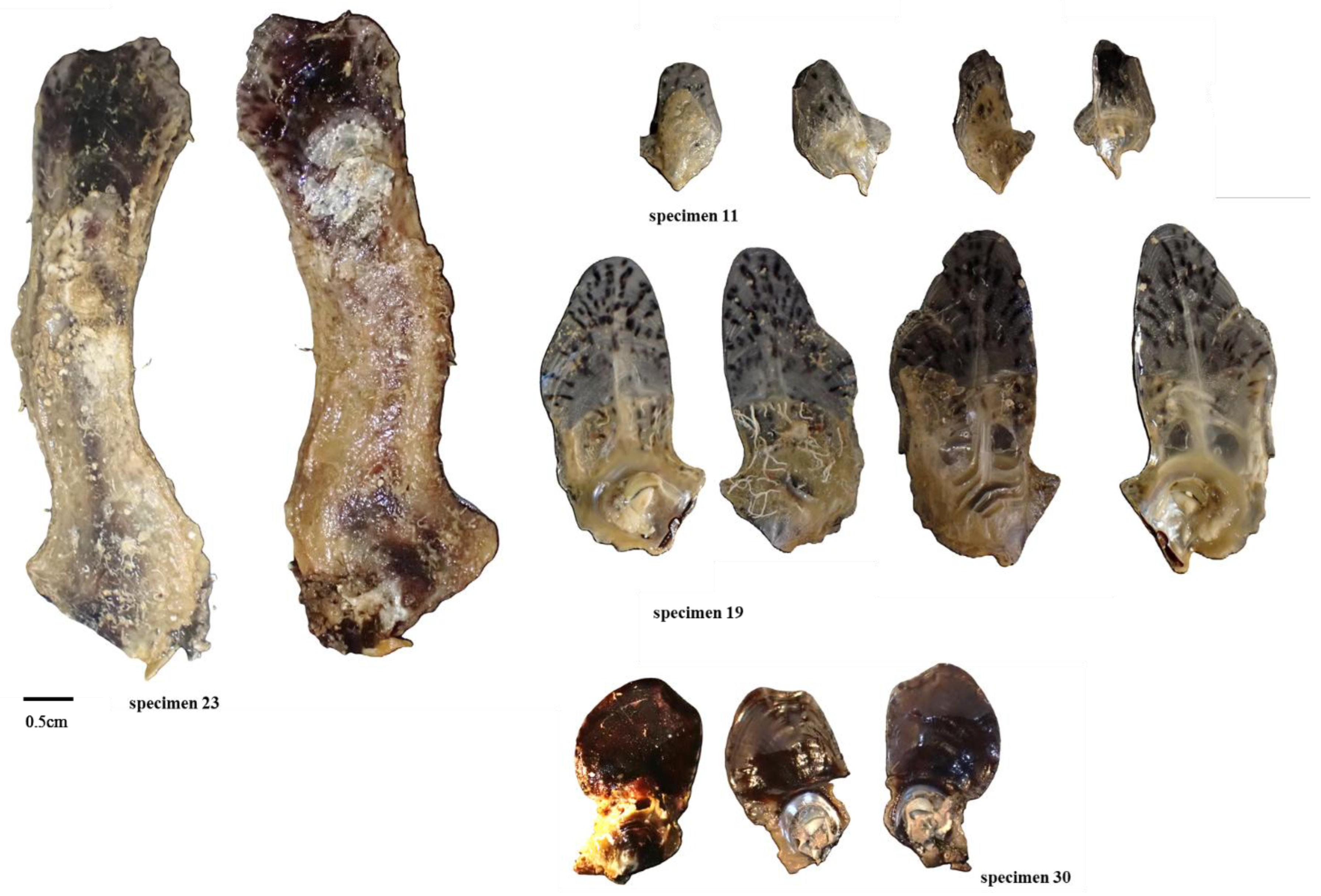
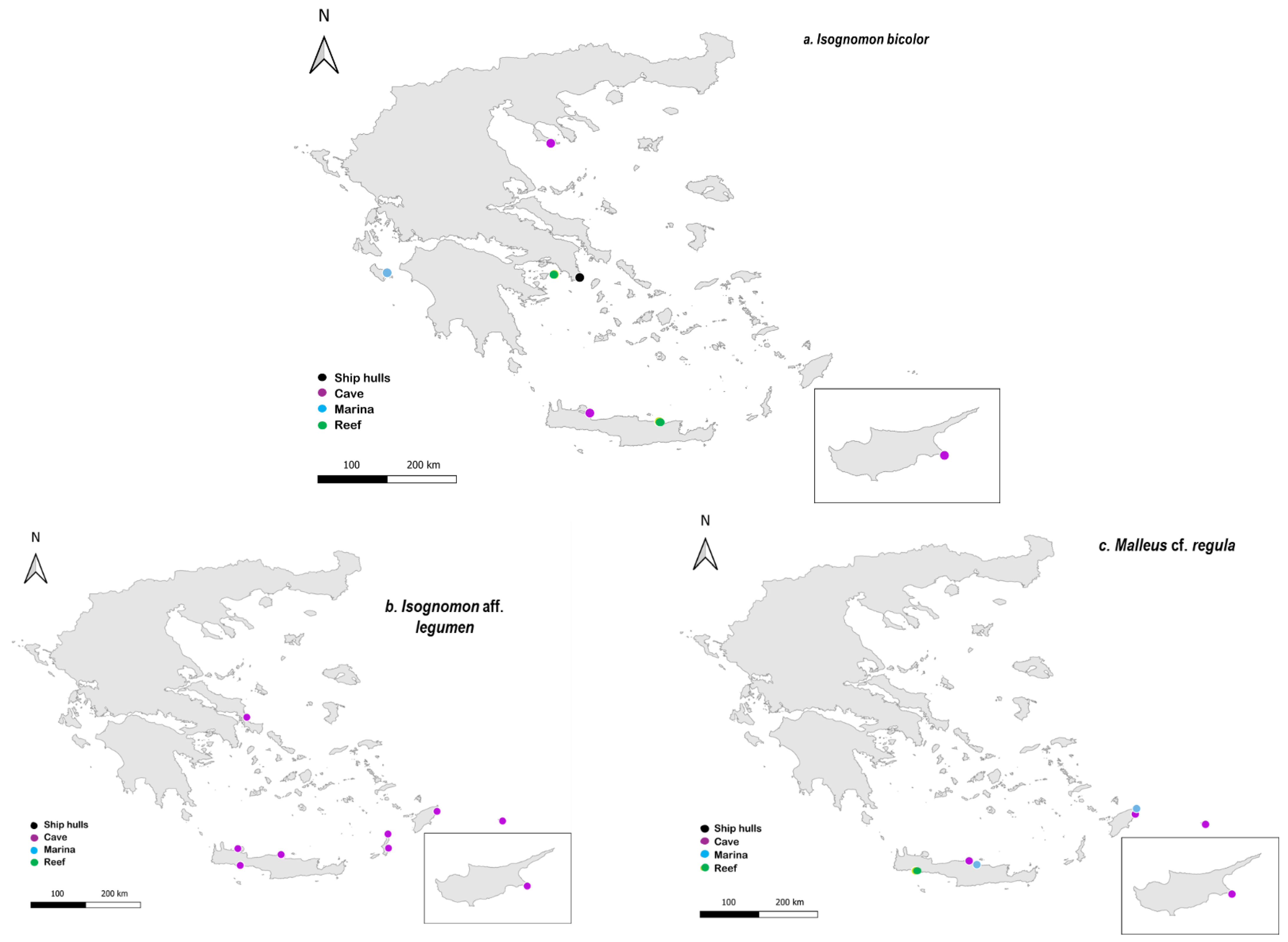
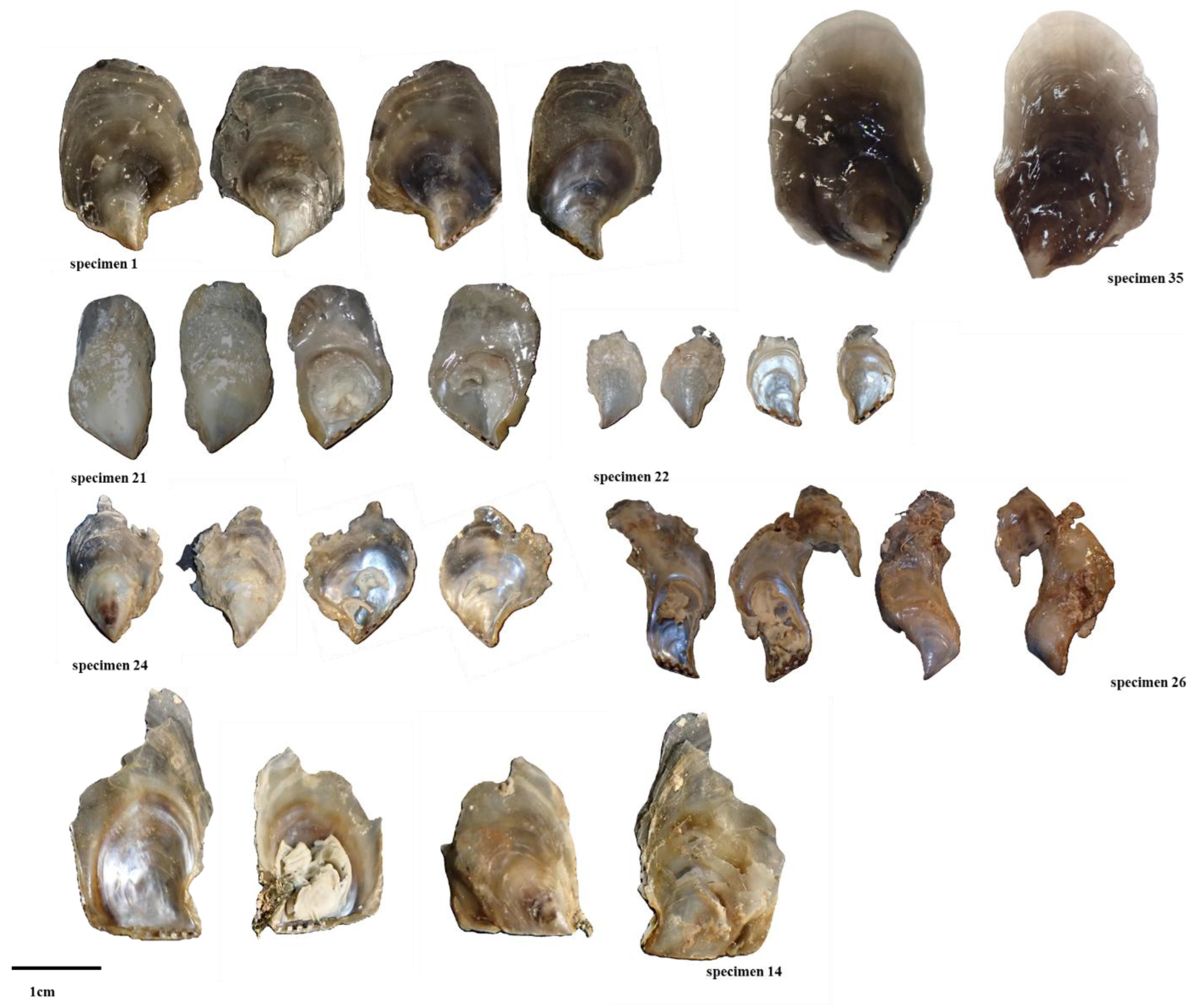
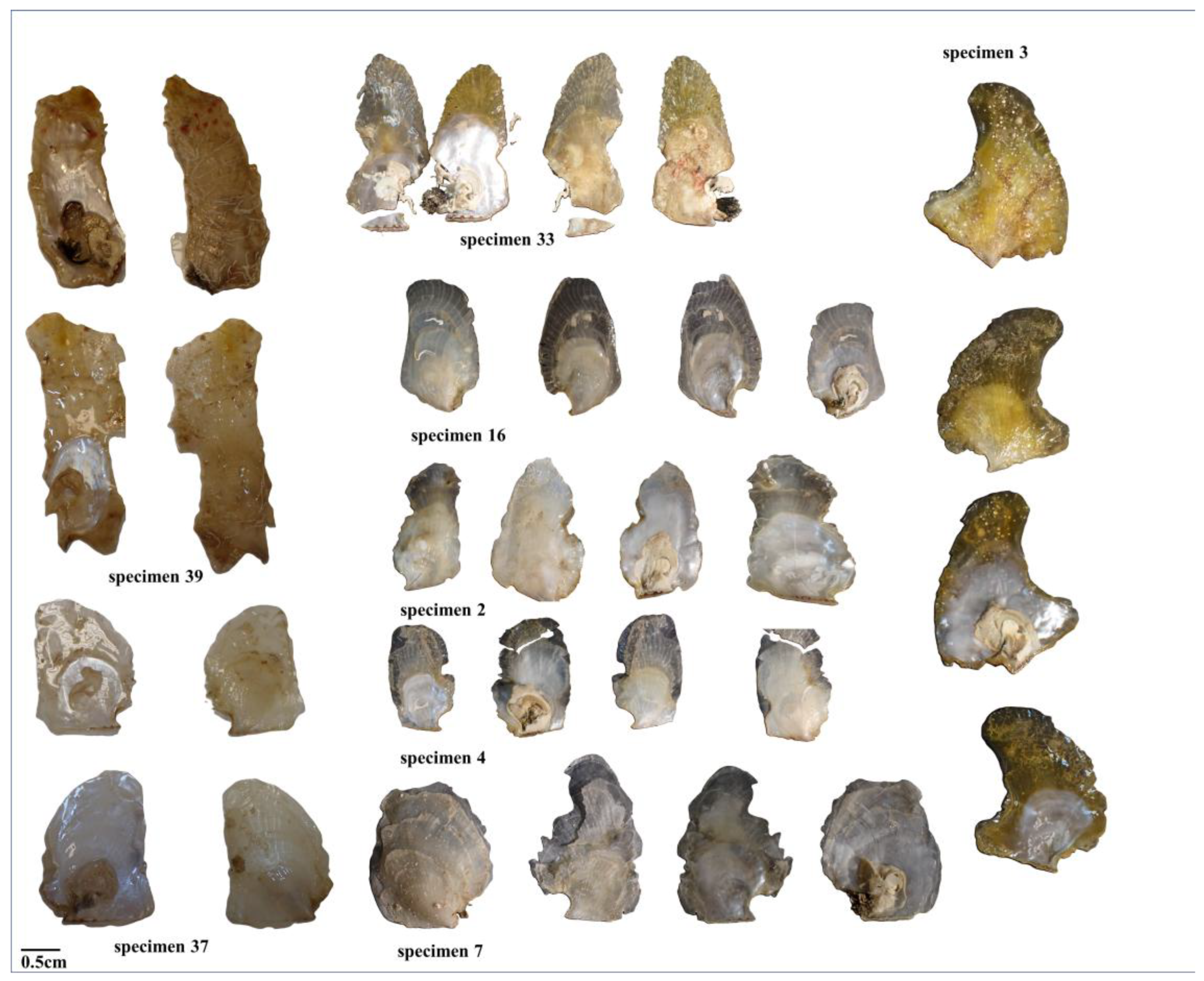
Bivalve specimens collected from various localities in the Eastern Mediterranean Sea were identified as belonging to three NIS (Figure 2). Specifically, ten individuals were identified as I. bicolor (Figure 3), seventeen as I. aff. legumen (Figure 4) and twelve as M. cf. regula (Figure 5). Of the ten specimens identified as I. bicolor (Figure 3), two were found in marinas, two on ship hulls, two on rocky reefs, and four in marine caves (Figure 2). All seventeen I. aff. legumen specimens were found exclusively in marine caves (Figure 2). Lastly, among the twelve M. cf. regula specimens (Figure 4), three were collected from marinas, one from a rocky reef, and eight from marine caves. A summary of species occurrences by habitat type is presented in Figure 2.

Molecular Analysis

Isognomon bicolor: Ten specimens (specimen codes: 1, 14, 21, 22, 24, 25, 26, 29, 35, 36) were identified as I. bicolor based on more than 99% BLAST similarity to sequences in GenBank (e.g., HQ329406.1; PP034416–419.1; OK104096–097.1) [10,19,51]. These specimens presented less than 94% similarity to other congeneric species such as I. recognitus (Mabille, 1895) (GenBank: KT317424.1), and less than 82% similarity to I. ephippium (Linnaeus, 1758) (GenBank: KY081325.1) and I. alatus (GenBank: KC429251.1), supporting their assignment to I. bicolor.
Isognomon aff. legumen: Seventeen specimens (IDs: 2, 3, 4, 6, 7, 9, 13, 16, 17, 18, 27, 31–34, 37, 39) were assigned to I. aff. legumen, sharing more than 99% similarity to GenBank sequences PP034420.1, PP034421.1, and HQ329409.1, and less than 87% similarity to other Isognomon species.
Malleus cf. regula: Twelve specimens (IDs: 5, 8, 10–12, 15, 19, 20, 23, 28, 30, 38) matched Malleus sequences (e.g., OK166813.1, OK104098.1) with more than 99% identity and less than 89% similarity to other Malleus species. Due to limited molecular representation of Malleus spp. in public databases, these specimens were provisionally assigned as Malleus cf. regula.
All resulting sequences have been deposited in GenBank under accession numbers PV955598-PV955637 for the 16S rRNA gene and (pending accession numbers) for the mitochondrial COI gene. Both phylogenetic approaches, Maximum Likelihood and Bayesian Inference, produced consistent tree topologies and relationships between species.
Figure 5. Malleus cf. regula specimens. Specimens 19 and 23 were collected from marinas in Crete and Rhodes, and specimens 11 and 30 from marine caves in Kastellorizo and Crete, respectively (Table 1). Scale bar = 0.5 cm.
Diversity 18 00127 g005

4. Discussion

This study presents an integrative assessment of non-indigenous bivalves of the genera Isognomon and Malleus in the Eastern Mediterranean Sea, combining morphological identification with molecular tools to overcome long-standing taxonomic uncertainties. By leveraging an extended and spatially broad sampling effort across both natural and artificial habitats, this research captures a more complete picture of these species’ current distribution and ecological preferences. Our approach included cryptic and understudied natural environments, such as marine caves and areas beneath rocks, which are often overlooked in marine biodiversity surveys, as well as heavily disturbed artificial habitats (i.e., ports and marinas), which form key entry points and stepping stones for the establishment and further spread of NIS. The species I. bicolor and I. aff. legumen constitute new records for the marine cave habitat in the Mediterranean Sea [52]. The integrative methodology applied here provides critical insights not only into species identification and phylogenetic relationships but also into their potential pathways of introduction and patterns of habitat colonization.

4.1. Taxonomic Complexity and Morphological Plasticity

The integration of taxonomic and molecular approaches offers more reliable insights into the identification and origin of NIS, particularly in cases where taxonomic classification remains uncertain. This is especially relevant for the bivalve genera Isognomon and Malleus, whose systematics are still controversial and in need of revision supported by molecular evidence. For instance, some of the I. aff. legumen specimens analyzed in this study (specimens 2, 3, 6, 9, 37, and 39) were previously assigned to I. cf. australicus, while four M. cf. regula specimens (5, 10, 11, and 38) had been assigned to M. regula in a previous study of ours [53]. These earlier assignments were based solely on morphological examination and the literature available at that time (e.g., [16,54]).
In addition, the genera Isognomon and Malleus present significant taxonomic challenges due to their pronounced morphological plasticity, particularly in shell shape and size. These traits are largely influenced by environmental factors such as substrate type, hydrodynamic conditions, salinity, and exposure [55,56]. Shell morphology in both genera adapts to local microhabitats, resulting in considerable phenotypic variation that complicates identification at both species and genus levels. This variability is a major source of taxonomic confusion, especially in juvenile specimens, which often exhibit incompletely developed and highly variable morphological features.
For instance, I. australicus and M. regula have historically been misidentified as I. legumen in Mediterranean records [54], underscoring the limitations of shell morphology-based taxonomy. A critical issue lies in the overlap of diagnostic characters, many of which likely reflect environmental adaptation rather than genetic divergence. Occupation of structurally complex substrates, like caves or reefs, could further enhance phenotypic plasticity, increasing the likelihood of misidentification and obscuring the true taxonomic identity of these NIS.
It is important to distinguish between true cryptic species and phenotypic plasticity when interpreting morphological variation. Cryptic species are typically defined as morphologically indistinguishable but genetically distinct evolutionary lineages [57]. In other words, they are separate species that have been hidden under one name due to a lack of obvious morphological differences. Phenotypic plasticity is the capacity of one genotype (one species or population) to produce different phenotypes depending on environmental conditions [58]. The morphological variability observed in the present study is not accompanied by clear genetic divergence in the markers examined and, therefore, is interpreted as intra-specific variation rather than evidence of cryptic speciation. Nevertheless, the possibility of undetected genetic structuring cannot be entirely excluded given the resolution limits of the markers used, and further investigation using higher-resolution genomic approaches would be valuable.

4.2. Phylogenetic Trees and Species’ Spread

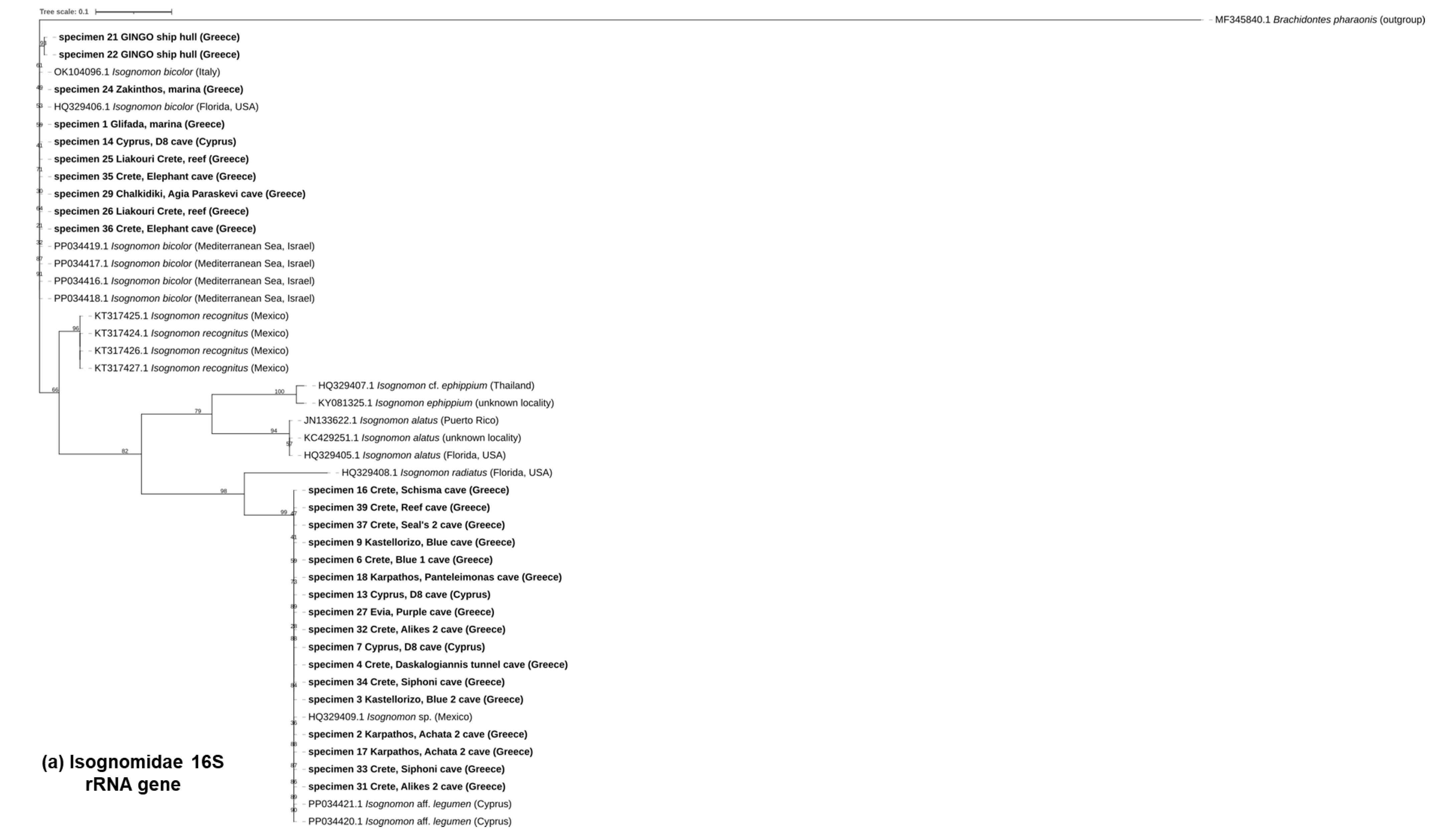
The phylogenetic hypotheses inferred by the Maximum Likelihood and Bayesian Inference analyses demonstrated complete agreement regarding the evolutionary relationships. The phylogenetic analysis of the 16S rRNA gene for Isognomon (Figure 6a) revealed six well-supported clades. The first clade includes the majority of specimens from Greece and Cyprus, which cluster with Isognomon sp. from Mexico and Isognomon aff. legumen specimens from Cyprus, with strong bootstrap support (99%). All 17 specimens assigned to I. aff. legumen were found exclusively in cryptic natural environments such as marine caves, in agreement with earlier observations suggesting that I. aff. legumen prefers such habitats, as opposed to I. bicolor [19].
A distinct monophyletic clade contains ten Isognomon specimens from Greece and Cyprus, clustering with I. bicolor sequences from Florida, Israel, and Italy, supporting their identification as I. bicolor. The species in this clade seem to have a broader distribution in contrast to Isognomon aff. legumen specimens, possibly assisted by human activities. More specifically, specimens 21 and 22, which were collected from fouling material on the hull of ship GINGO, form a small though distinct sub-clade within this group. This pattern suggests either the presence of a separate haplotype reflecting regional variation or distinct biogeographic populations introduced via different pathways. Isognomon bicolor seems to be favored in disturbed environments, such as ports and marinas, with its presence confirmed in samples from Glifada and Zakynthos marinas. However, molecular analysis also identified I. bicolor in natural environments in Cyprus (specimen 14), Crete (specimens 25, 26, 35, and 36), and Chalkidiki (specimen 29) (Table S1 in Supplementary Material, Figure 6a and Figure 7a), suggesting ongoing expansion into less disturbed habitats.
The second clade in the 16S tree includes only I. radiatus from Florida, while the third comprises four I. recognitus individuals from Mexico. Additional clades are comprised of I. ephippium and I. alatus species, both from the Caribbean.
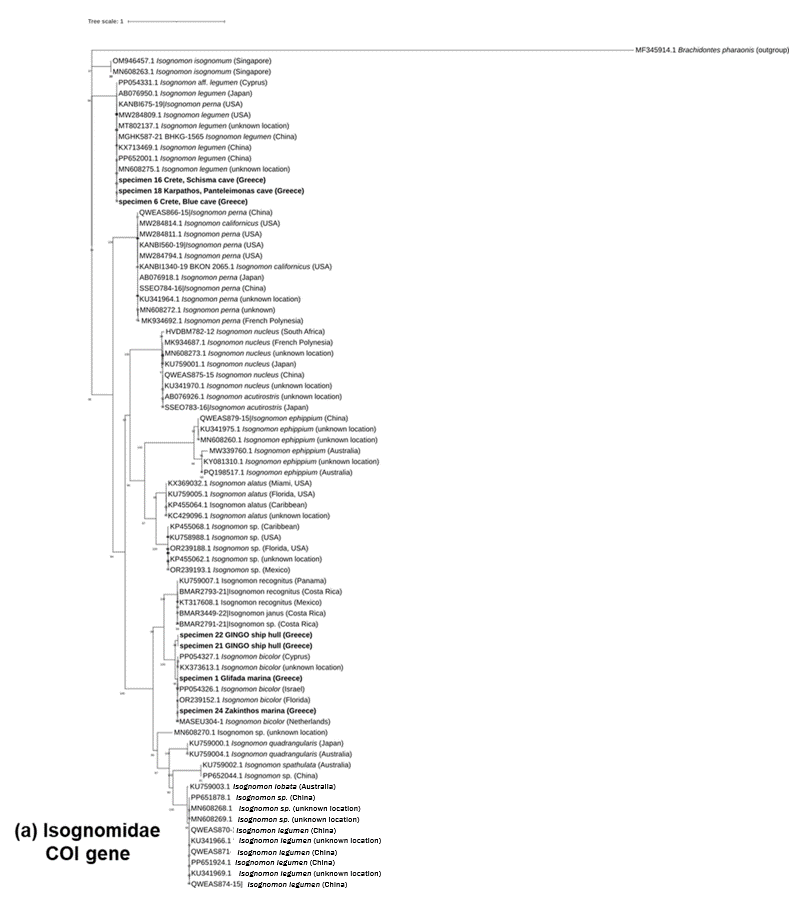
The phylogenetic tree of the mitochondrial COI gene (Figure 7a) provides more information on phylogenetic relationships within the genus Isognomon, likely due to the broader availability of COI barcodes in GenBank and BOLD databases. The tree resolves a larger number of clades such as I. legumen (China), I. lobata Reeve, 1858 (Australia), I. quadrangularis (Reeve, 1858) (Australia, Japan), I. spathulata (Reeve, 1858) (Australia, Japan), I. sp., I. recognitus (Costa Rica), I. bicolor (Florida, Gingo ship hulls), I. ephippium (China), I. ephippium (Australia), I. acutirostris (Lamarck, 1819), I. nucleus (Lamarck, 1819) (South Africa), I. nucleus (China), I. alatus (Caribbean), I. sp. (Caribbean, Florida), I. perna (Linnaeus, 1758) (USA, China), I. isognomum (Linnaeus, 1758) (Singapore) and a mixed clade of I. australicus/aff.legumen/legumen. The clade of I. australicus/aff.legumen/legumen is differentiated from the I. legumen clade, indicating either (i) misidentification of one or both clades, (ii) that the second clade contains misidentified I. legumen or I. aff. legumen specimens, or (iii) that the second clade contains specimens originating from the Pacific and Atlantic Oceans and can be assigned as I. aff. legumen, until further sequences from Australia become available to reconstruct the tree.
Specimens 21 and 22, collected from fouling material on the ship GINGO, again form a distinct sister clade very close to I. bicolor. This finding is consistent with the results on the 16S tree, where a second haplotype appears inside the clade of I. bicolor, suggesting firstly the transportation of the species most probably via shipping into the Mediterranean and the existence of multiple biogeographic populations in the genus with genetic differences. Shipping has been previously suggested as a putative mechanism for transportation of I. bicolor for its ability to attach as ship fouling [59]. The species has been recorded to attach to empty shells of the barnacles Megabalanus spp. [60], as observed also in our study in specimens 21 and 22. However, tracking of the route of GINGO vessel over a year, from November 2019 to October 2020, indicates that the native area of I. bicolor (Western Central Atlantic Coast), was not visited, leading to the conclusion that I. bicolor could have already existed, in the ports that GINGO stopped before reaching its destination, such as the Suez Canal, and therefore suggesting secondary dispersion. Another plausible explanation for this finding could be the co-existence of a very similar and closely related species of I. bicolor, supported by the grouping of the two specimens in the same clade, yet separate from the rest of the I. bicolor specimens. The most probable scenario is that those two specimens belong to a subspecies or an isolated population that is separated genetically from others of the same species, due to geographic barriers.
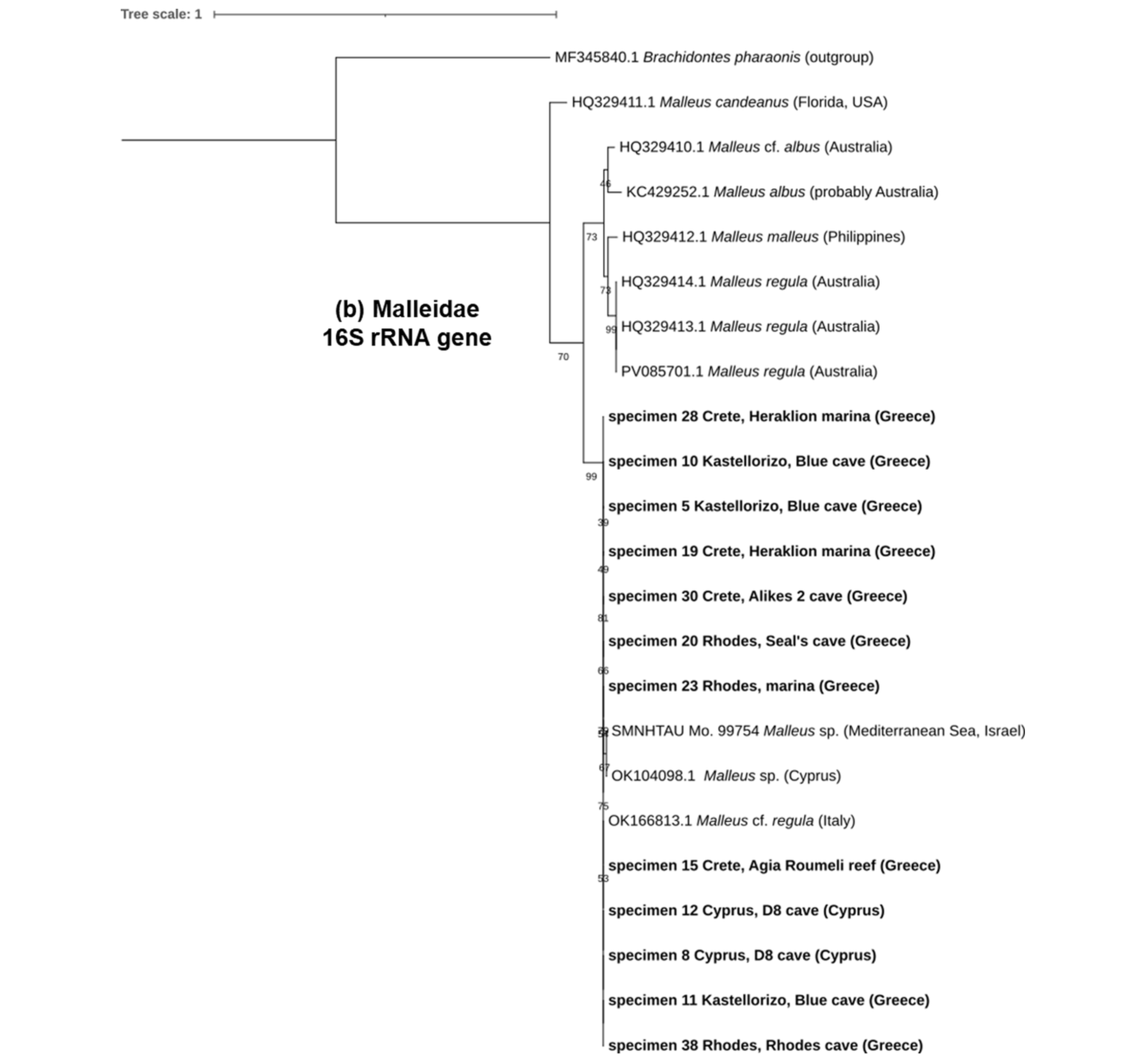
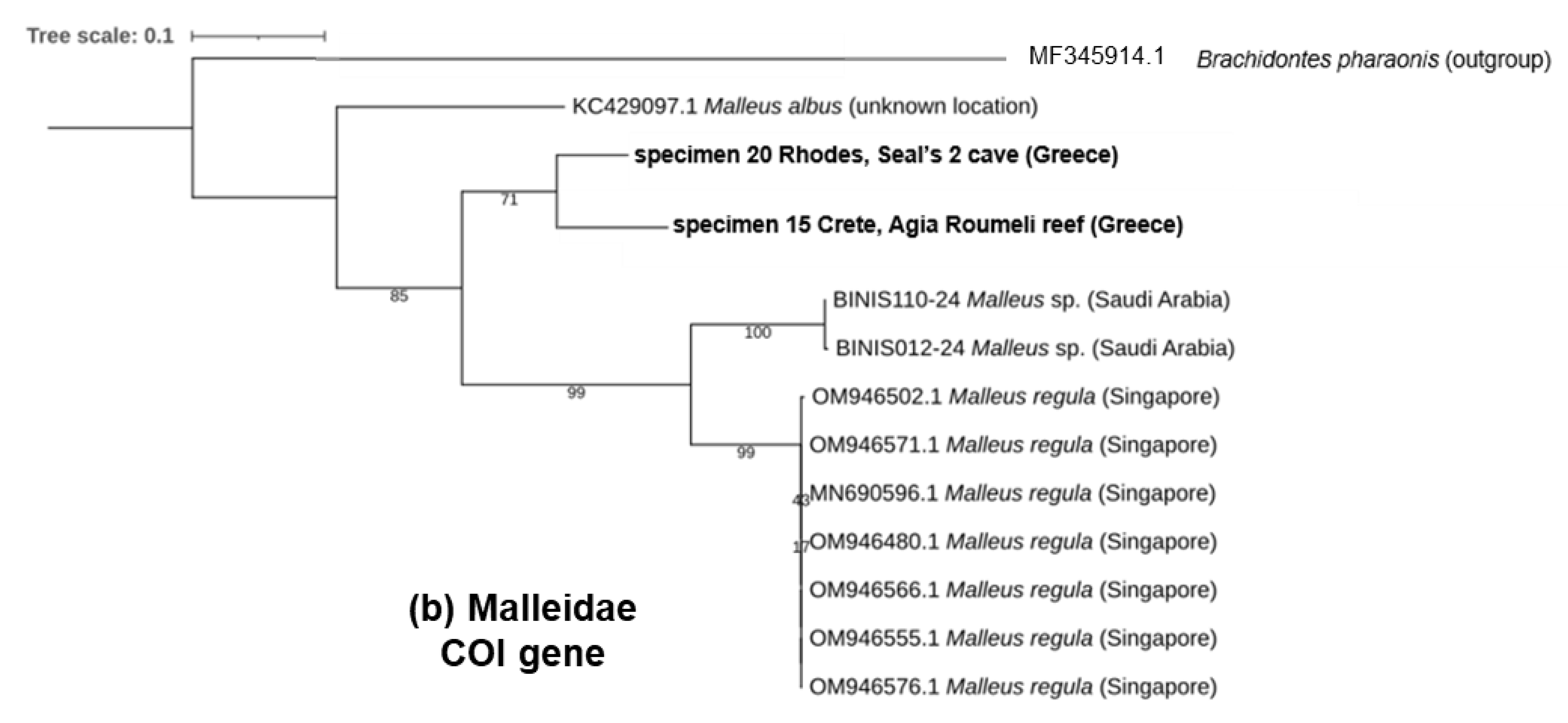
Regarding Malleus, phylogenetic analyses of both 16S rRNA (Figure 6b) and COI genes (Figure 7b) showed that all specimens in this study belong to the species Malleus cf. regula, clearly separated from other known Malleus species. The family Malleidae is underrepresented in global sequence databases compared to Isognomon species. However, phylogenetic grouping of our specimens within a distinct clade containing Malleus sequences from neighboring Italy and Cyprus supports their assignment to this taxon. Given the limited database representation, we designate our samples according to the closest identification available. These results are consistent with previous studies [10], as all of our specimens represent one haplotype and form a separate clade grouping with Malleus sp. (OK104098) and M. cf. regula (OK166813), distant from the clade of M. regula and M. albus Lamarck, 1819 from Australia.
As with I. bicolor, M. cf. regula appears to follow a pattern of initial establishment in anthropogenically impacted areas (e.g., marinas) followed by expansion into more natural habitats. Unfortunately, the genetic information is not yet enough to provide total insight into the species’ introduction and expansion. The limited genetic data currently available restricts a complete understanding of its introduction pathways and population structure. Further sequencing and broader geographic sampling are needed to fully resolve the phylogenetic placement and invasion dynamics of both Isognomon and Malleus in the Mediterranean.

4.3. Methodological and Taxonomic Limitations

Several limitations must be taken into consideration in interpreting the findings of this study. Firstly, specimens were collected in small numbers, especially from hard-to-reach areas (e.g., ship hulls, marine caves), leading to a limited sample size, therefore preventing further quantitative comparisons and introducing regional biases in invasion patterns and community composition. Secondly, taxonomic uncertainty persists for Isognomon aff. legumen and Malleus cf. regula [10,16,19], so until formal taxonomic revision and genetic confirmation are available, species-level assignments for these taxa should be considered as interim. Finally, the phylogenetic analyses relied on standard mitochondrial markers (16S rRNA and COI genes) to ensure compatibility with the existing sequence data available for these species. While these markers are widely used for species identification, they offer limited resolution for invasion pathways and dispersal patterns over shorter timescales [61,62,63], especially when compared to nuclear markers.
In this study, our primary objective was to identify broad phylogeographic patterns and assess whether sampled individuals correspond to known lineages previously reported from native and introduced ranges. Therefore, the results do not constitute direct estimates of migration. Future studies could benefit from more sensitive genetic markers, such as microsatellites or single-nucleotide polymorphisms (SNPs), which offer higher resolution. Despite these limitations, the records presented here provide valuable baseline information on NIS associated with maritime vectors in the Eastern Mediterranean.

4.4. Planktonic Larval Dispersal and Connectivity

Planktonic larval dispersal is an additional key factor facilitating the spread and connectivity of bivalve populations. Larval duration, together with local hydrodynamic conditions, influences dispersal potential and the establishment of new populations. The planktonic phase supports demographic and genetic connectivity among otherwise isolated sessile populations, promoting persistence and range expansion [64]. Pelagic larval duration (PLD) determines dispersal opportunity: longer PLDs generally increase transport potential, though realized connectivity is often reduced by mortality and retention processes [65,66].
In Mediterranean bivalves, dispersal patterns help explain regional connectivity and invasive success, particularly in semi-enclosed basins such as the Eastern Mediterranean [66,67]. However, the relationship between PLD and gene flow is species-specific—oceanographic barriers or behavior may limit connectivity even in long-PLD species, while short-PLD species can remain connected through stepping-stone habitats [65]. In this context, the similarities among sampled populations may result from both larval dispersal and human-mediated transport (e.g., shipping). Considering larval dispersal processes offers a more mechanistic way to interpret the observed phylogeographic patterns. This also highlights the need for future studies that combine genetic data with larval ecology models.

4.5. The Role of Reference Databases in Molecular Identification of NIS

DNA barcoding plays a critical role in the identification of NIS, especially in cases involving juvenile or morphologically ambiguous specimens such as individuals 21 and 22 in our study. However, its effectiveness is directly dependent on the completeness as well as the accuracy of the reference databases. This limitation is particularly evident in taxa like Isognomon, where database representation remains uneven and incomplete. Many species in the Isognomonidae family do not yet carry sequences for the 16S gene or COI gene. Notably, only five out of the 16 species in this family are currently represented by 16S rRNA gene sequences, and 13 by the mitochondrial COI gene. Recently, I. legumen was reported in Albania [21] and Tunisia [40] based solely on morphological identification, so the absence of corresponding molecular data meant these records could not be reflected in our phylogenetic analysis.
The reliability and taxonomic resolution of DNA-based identifications are closely tied to the quality and breadth of the reference database used. A well-curated, taxonomically diverse reference library for each ecoregion allows for more accurate species assignments, more informative evolutionary inferences, and greater confidence in the results. In contrast, limited or poorly curated databases may increase uncertainty, even when working with high-quality sequence data [68]. Ultimately, the effectiveness of any DNA analysis is totally dependent on how comprehensive and robust the reference databases are, like GenBank and the Barcode of Life Data System (BOLD).
This research highlights a collaboration of scientists from different areas of expertise, utilizing samples from diverse sampling campaigns and habitats. By joining efforts with experts in molecular methods and bioinvasion research, this study was able to correct long-standing morphology-based errors. This research validates the need for integration of methods, combining morphological identification with DNA barcoding, to resolve taxonomic issues in highly variable bivalve genera like Isognomon and Malleus. We documented the expanding distribution of three NIS (I. bicolor, I. aff. legumen, and M. cf. regula) across both anthropogenic and natural, difficult-to-reach environments often neglected by standard monitoring. Our phylogenetic analyses suggest the presence of potentially different introduction pathways for the Isognomon bicolor species and evidence of intraspecific variation among I. bicolor samples associated with hull fouling, while the remaining samples appear to represent a single haplotype. Furthermore, the data provides no clear support for the presence of cryptic species; instead, the observed morphological variability in both families is more plausibly attributable to phenotypic plasticity, which may complicate reliable identification. Molecular analyses expose significant deficiencies in current genetic databases, underscoring the urgent need for robust, geographically diverse reference sequences. To effectively monitor the introduction and expansion of NIS across all different habitat types, future strategies must integrate collaborative sampling, high-quality genetic databases, and open-access data sharing.

Supplementary Materials

The following supporting information can be downloaded at: https://www.mdpi.com/article/10.3390/d18020127/s1, Table S1: Unique specimen codes, accession numbers for the 16S and COI genes, specific habitat, exact geographic location (GR: Greece, CY: Cyprus), area, date of samplings, collector names, and comments; Figure S1: Phylogenetic positioning based on 16S rRNA gene of the families of (a) Isognomonidae and (b) Malleidae, in relation to outgroup taxa from other bivalve families. Evolutionary relationships were inferred using Bayesian Inference (BI). The GTR+G model was used, running two MCMC of 1,000,000 generations, sampled every 1000. Brachidontes pharaonis (MF345840.1) was used as an outgroup in the Isognomonidae and Malleidae trees; Figure S2: Phylogenetic positioning based on (COI mitochondrial gene for species of the families of (a) Isognomonidae and (b) Malleidae, in relation to outgroup taxa from other bivalve families. Evolutionary relationships were inferred using Bayesian Inference (BI). The GTR+G model was used, running two MCMC of 1,000,000 generations, sampled every 1000. Brachidontes pharaonis (MF345914.1) was used as an outgroup in the Isognomonidae and Malleidae trees. COI trees contain only haplotypes of each species, to reduce the excessive amount of duplicate and triplicate sequences from the same localities.

Author Contributions

Conceptualization, A.Z. and E.G.; Methodology, E.G., Sample collection, M.D. and V.G.; Sample identification, A.Z., M.D. and V.G.; Writing—Original Draft Preparation, E.G. and A.Z.; Writing—Review & Editing, A.Z., M.D., V.G., P.K. and I.K.; Visualization, E.G.; Supervision, I.K., A.Z. and P.K.; Funding Acquisition, A.Z. and P.K. All authors have read and agreed to the published version of the manuscript.

Funding

Sample collection and related research activities were supported by the following projects and funding schemes (in chronological order): (1) Project ALAS—“ALiens in the Aegean—a Sea under siege” (Project Number: HFRI-FM17-1597), which was funded by the Hellenic Foundation for Research and Innovation (HFRI); (2) AlienPorts project which was funded by the General Secretariat of Research and Innovation (GSRI) and the HFRI; (3) ECOHULLCLEAN (Integrated System for Underwater Ecological Hull Cleaning of Vessels), which was funded by Operational Programme Competitiveness, Entrepreneurship and Innovation (NSRF 2014-2020); (4) “Centre for the study and sustainable exploitation of Marine Biological Resources (CMBR)” (MIS 5002670), funded by the Operational Programme “Competitiveness, Entrepreneurship, and Innovation” (NSRF 2014-2020) and co-financed by Greece and the EU; (5) the project “Mapping and evaluation of Posidonia meadows and other important marine habitats under the European Habitats Directive (92/43/EEC), in the coastal waters of Cyprus”, funded by the Department of Fisheries and Marine Research (DFMR) of the Republic of Cyprus (25% National Resources, 75% European Maritime and Fisheries Fund—EMFF)”; (6) the action “Support of the Dodecanese Protected Areas Management Body for the implementation of management measures for protected areas, species and habitats (MIS 5034797)”, of the NSRF 2014-2020 Operational Program “Transport Infrastructure, Environment and Sustainable Development”; (7) the project “SponBIODIV—Marine sponge biodiversity from genes to ecosystems: delivering knowledge and tools for sustainable management and conservation”, funded by Biodiversa+, the European Biodiversity Partnership under the 2021-2022 BiodivProtect joint call for research proposals, co-funded by the European Commission (GA N°101052342) and the funding organisation GSRI (ΓΓΒΙO-0559429); (8) Autonomous Reef Monitoring System (ARMS) of European Marine Biodiversity Observation Network (MBON); (9) the project “MARine Biodiversity and Ecosystem Functioning leading to Ecosystem Services (MARBEFES)” funded by the EU’s “Horizon Europe research and innovation programme” under Grant Agreement no 101060937.

Institutional Review Board Statement

Not Applicable.

Data Availability Statement

The original contributions presented in this study are included in the article/Supplementary Material. Further inquiries can be directed to the corresponding author.

Acknowledgments

We are grateful to Michail Ragkousis, Stelios Katsanevakis, Giorgos Chatzigeorgiou, Thanos Dailianis, Drosos Koutsoubas, Dimitris Kletou, Leda Cai, Melina Marcou, Panagiotis Ovalis, Ioannis Rallis, Nikos Chelmis, and Konstantinos Protopappas, for their invaluable assistance during fieldwork and laboratory work. We also thank Diving Status Underwater Solutions and the Management Units of the Southeastern Aegean Protected Areas and the Samaria National Park of the Natural Environment and Climate Change Agency (NECCA) for their support. Additionally, we extend our appreciation to the port authorities of Heraklion, Rhodes, Zakynthos, and Piraeus. Moreover, the authors would like to thank Tamar Feldstein for sequencing sample SMNHTAU: Mo 99754 and the collection manager of the mollusks, Oz Ritner from the Steinhardt Museum of Natural History, Tel Aviv University and Liron Goren for facilitating communication and providing the sequence.

Conflicts of Interest

The authors declare no conflicts of interest.

References

  1. Seebens, H.; Blackburn, T.M.; Dyer, E.E.; Genovesi, P.; Hulme, P.E.; Jeschke, J.M.; Pagad, S.; Pyšek, P.; Winter, M.; Arianoutsou, M.; et al. No Saturation in the Accumulation of Alien Species Worldwide. Nat. Commun. 2017, 8, 14435. [Google Scholar] [CrossRef] [Scilit]
  2. Zenetos, A.; Albano, P.G.; López Garcia, E.; Stern, N.; Tsiamis, K.; Galanidi, M. Established Non-Indigenous Species Increased by 40% in 11 Years in the Mediterranean Sea. Mediterr. Mar. Sci. 2022, 23, 196–212. [Google Scholar] [CrossRef] [Scilit]
  3. Zenetos, A.; Albano, P.; López Garcia, E.; Stern, N.; Tsiamis, K.; Galanidi, M. Corrigendum to the Review Article (Mediterr. Mar. Sci. 23 2022, 196-212): Established non-indigenous species increased by 40% in 11 years in the Mediterranean Sea. Mediterr. Mar. Sci. 2022, 23, 876–878. [Google Scholar] [CrossRef] [Scilit]
  4. Galanidi, M.; Aissi, M.; Ali, M.; Bakalem, A.; Bariche, M.; Bartolo, A.G.; Bazairi, H.; Beqiraj, S.; Bilecenoglu, M.; Bitar, G.; et al. Validated Inventories of Non-Indigenous Species (NIS) for the Mediterranean Sea as Tools for Regional Policy and Patterns of NIS Spread. Diversity 2023, 15, 962. [Google Scholar] [CrossRef] [Scilit]
  5. Rilov, G.; Canning-Clode, J.; Guy-Haim, T. Ecological Impacts of Invasive Ecosystem Engineers: A Global Perspective across Terrestrial and Aquatic Systems. Funct. Ecol. 2024, 38, 37–51. [Google Scholar] [CrossRef] [Scilit]
  6. Tsirintanis, K.; Azzurro, E.; Crocetta, F.; Dimiza, M.; Froglia, C.; Gerovasileiou, V.; Langeneck, J.; Mancinelli, G.; Rosso, A.; Stern, N.; et al. Bioinvasion Impacts on Biodiversity, Ecosystem Services, and Human Health in the Mediterranean Sea. Aquat. Invasions 2022, 17, 308–352. [Google Scholar] [CrossRef] [Scilit]
  7. Korpinen, S.; Klančnik, K.; Peterlin, M.; Nurmi, M.; Laamanen, L.; Zupančič, G.; Popit, A.; Murray, C.; Harvey, T.; Andersen, J.H.; et al. Multiple Pressures and Their Combined Effects in Europe’s Seas; ETC/ICM Technical Report 4/2019: European Topic Centre on Inland, Coastal and Marine Waters; ETC/ICM: Magdeburg, Germany, 2019. [Google Scholar]
  8. Zenetos, A.; Tsiamis, K.; Galanidi, M.; Carvalho, N.; Bartilotti, C.; Canning-Clode, J.; Castriota, L.; Chainho, P.; Comas-González, R.; Costa, A.C.; et al. Status and Trends in the Rate of Introduction of Marine Non-Indigenous Species in European Seas. Diversity 2022, 14, 1077. [Google Scholar] [CrossRef] [Scilit]
  9. Wullur, S.; Rumampuk, N.D.; Tilaar, S.O.; Tindi, M.; Smolak, R. Phylogenetic Relationships of Isognomon (Lightfoot, 1786) Oysters from North Sulawesi, Indonesia. Bul. Oseanografi Mar. 2024, 13, 70–78. [Google Scholar] [CrossRef] [Scilit]
  10. Garzia, M.; Furfaro, G.; Renda, W.; Rosati, A.M.; Mariottini, P.; Giacobbe, S. Mediterranean Spreading of the Bicolor Purse Oyster, Isognomon bicolor, and the Chicken Trigger, Malleus sp., vs. the Lessepsian Prejudice. Mediterr. Mar. Sci. 2022, 23, 777–788. [Google Scholar] [CrossRef] [Scilit]
  11. WoRMS Editorial Board. World Register of Marine Species. Available online: https://www.marinespecies.org (accessed on 5 December 2025).
  12. Mienis, H.; Rittner, O.; Shefer, S.; Feldstein, T.; Yahel, R. First Record of the Indo-Pacific Isognomon legumen from the Mediterranean Coast of Israel (Mollusca, Bivalvia, Isognomonidae). Triton 2016, 33, 9–11. [Google Scholar]
  13. Galanidi, M.; Gratsia, E.; Zenetos, A. Backdating First Records of Non-Indigenous Species in the Mediterranean: Are Initial Findings Underestimated? Mediterr. Mar. Sci. 2025, 26, 642–656. [Google Scholar] [CrossRef] [Scilit]
  14. Micali, P.; Siragusa, F.; Agamennone, F.; Germanà, A.; Sbrana, C. Karpathos Island (Greece) and Its Indo-Pacific Alien Species. Part 1. Boll. Malacol. 2017, 53, 40–49. [Google Scholar]
  15. Lipej, L.; Acevedo, I.; Akel, E.H.K.; Anastasopoulou, A.; Angelidis, A.; Azzurro, E.; Castriota, L.; Çelik, M.; Cilenti, L.; Crocetta, F.; et al. New Mediterranean Biodiversity Records (March 2017). Mediterr. Mar. Sci. 2017, 18, 179–201. [Google Scholar] [CrossRef] [Scilit]
  16. Crocetta, F. Malleus regula in Libya: Another case of misidentification for Isognomon legumen. Triton 2018, 37, 4–5. [Google Scholar]
  17. Stamouli, C.; Akel, E.; Azzurro, E.; Bakiu, R.; Bas, A.; Bitar, G.; Boyaci, Y.; Cakalli, M.; Corsini-Foka, M.; Crocetta, F.; et al. New Mediterranean Biodiversity Records (December 2017). Mediterr. Mar. Sci. 2017, 18, 534–556. [Google Scholar] [CrossRef] [Scilit]
  18. Scuderi, D.; Viola, A. The Last Alien Reaching Sicily: Isognomon legumen (Gmelin, 1791) (Mollusca Bivalvia Isognomonidae). Biodivers. J. 2019, 10, 337–342. [Google Scholar] [CrossRef] [Scilit]
  19. Albano, P.G.; Hong, Y.; Steger, J.; Yasuhara, M.; Bartolini, S.; Bogi, C.; Bošnjak, M.; Chiappi, M.; Fossati, V.; Huseyinoglu, M.F.; et al. New Records of Non-Indigenous Species from the Eastern Mediterranean Sea (Crustacea, Mollusca), with a Revision of Genus Isognomon (Mollusca: Bivalvia). PeerJ 2024, 12, e17425. [Google Scholar] [CrossRef] [Scilit] [PubMed]
  20. Kolokotronis, D.; Manousis, T.; Papavasileiou, Κ.; Kontadakis, C.; Galinou-Mitsoudi, S. New Records and Distributional Status of Marine Μollusca of Cyprus (by September 2022). Xenophora Taxon. 2023, 38, 25–32. [Google Scholar]
  21. Nasto, I.; Sota, D.; Vashaj, B. New Record of Alien Species in Albania: Isognomon legumen (Gmelin, 1791) (Mollusca, Bivalvia, Isognomonidae). Egypt J. Aquat. Res. 2024, 50, 117–120. [Google Scholar] [CrossRef] [Scilit]
  22. Micali, P.; Agamennone, F.; Germanà, A.; Nardi, N. New Records of Non-Indigenous Species at Lefkada Island (Greece). Boll. Malacol. 2022, 58, 143–146. [Google Scholar] [CrossRef] [Scilit]
  23. Albano, P.G.; Steger, J.; Bakker, P.A.J.; Bogi, C.; Bošnjak, M.; Guy-Haim, T.; Huseyinoglu, M.F.; LaFollette, P.I.; Lubinevsky, H.; Mulas, M.; et al. Numerous New Records of Tropical Non-Indigenous Species in the Eastern Mediterranean Highlight the Challenges of Their Recognition and Identification. Zookeys 2021, 1010, 1–95. [Google Scholar] [CrossRef] [Scilit] [PubMed]
  24. Agostini, V.O.; Ozorio, C.P. Colonization Record of Isognomon bicolor (Mollusca: Bivalvia) on Pipeline Monobuoys in the Brazilian South Coast. Mar. Biodivers. Rec. 2016, 9, 84. [Google Scholar] [CrossRef] [Scilit]
  25. Castro, M.C.T.d.; Fileman, T.W.; Hall-Spencer, J.M. Invasive Species in the Northeastern and Southwestern Atlantic Ocean: A Review. Mar. Pollut. Bull. 2017, 116, 41–47. [Google Scholar] [CrossRef] [Scilit] [PubMed]
  26. Soares, M.O.; Xavier, F.R.d.L.; Dias, N.M.; da Silva, M.Q.M.; de Lima, J.P.; Barroso, C.X.; Vieira, L.M.; Paiva, S.V.; Matthews-Cascon, H.; Bezerra, L.E.A.; et al. Alien Hotspot: Benthic Marine Species Introduced in the Brazilian Semiarid Coast. Mar. Pollut. Bull. 2022, 174, 113250. [Google Scholar] [CrossRef] [Scilit]
  27. Queiroz, R.N.M.; Dias, T.L.P.; Batista, R.; da Silva, P.M. Reproduction and Population Dynamics of the Invasive Bivalves Mytilopsis sallei and Isognomon bicolor on the Northeast Coast of Brazil. Zoology 2022, 153, 126028. [Google Scholar] [CrossRef] [Scilit]
  28. Breves-Ramos, A.; Junqueira, A.O.R.; Lavrado, H.P.; Silva, S.H.G.; Ferreira-Silva, M.A.G. Population Structure of the Invasive Bivalve Isognomon bicolor on Rocky Shores of Rio de Janeiro State (Brazil). J. Mar. Biol. Assoc. UK 2010, 90, 453–459. [Google Scholar] [CrossRef] [Scilit]
  29. Bezerra, D.; Franklin, W.; Spotorno, P.; Barreira, C. Molluscan Assemblages on Artificial Structures: A Bioinvasion Perspective from Northeast Brazilian Ports. Aquat. Invasions 2022, 17, 494–515. [Google Scholar] [CrossRef] [Scilit]
  30. Zamprogno, G.C.; Fernandes, L.L.; Fernandes, F.D.C. Spatial Variability in the Population of Isognomon bicolor (C.B. Adams, 1845) (Mollusca, Bivalvia) on Rocky Shores in Espírito Santo, Brazil. Braz. J. Oceanogr. 2010, 58, 23–29. [Google Scholar] [CrossRef] [Scilit]
  31. Dias, T.L.P.; Mota, E.L.S.; Gondim, A.I.; Oliveira, J.M.; Rabelo, E.F.; Almeida, S.M.d.; Christoffersen, M.L. Isognomon bicolor (C. B. Adams, 1845) (Mollusca: Bivalvia): First Record of This Invasive Species for the States of Paraíba and Alagoas and New Records for Other Localities of Northeastern Brazil. Check List 2013, 9, 157. [Google Scholar] [CrossRef] [Scilit]
  32. Gruvel, A.; Moazzo, G. Contribution à La Faune Malacologique Marine Des Côtes Libano-Syriennes. In Les États de Syrie: Richesses Marines et Fluviatiles. Exploitation Actuelle et Avenir; Gruvel, A., Ed.; Société d’Éditions Géographiques, Maritimes et Coloniales: Paris, France, 1931; pp. 437–453. [Google Scholar]
  33. Bodenheimer, F.S. Prodromus Faunae Palestinae. Essai sur les élements zoogéographiques et historiques du sud-ouest du sous-régne paléarctique. Mém. Inst. Egypt. 1937, 33, 1–286. [Google Scholar]
  34. Demetropoulos, A. Marine Molluscs of Cyprus, Part B, Bivalvia (Lamellibranchiata). Some Additions to Part A (Placophora, Gastropoda, Scaphopoda and Cephalopoda). A Check List of Cyprus Molluscs. Fish. Bull. Fisheries Dept. 1971, 3, 3–24. [Google Scholar]
  35. Falchi, S. Molluschi di provenienza Indopacifica lungo le coste Turche. Conchiglie Milano 1974, 10, 89–90. [Google Scholar]
  36. Barash, A.; Danin, Z. Additions to the knowledge of Indo-Pacific Mollusca in the Mediterranean. Conchiglie 1977, 13, 85–116. [Google Scholar]
  37. Giannuzzi-Savelli, R.; Pusateri, F.; Palmeri, A.; Ebreo, C. Atlante Delle Conchiglie Marine del Mediterraneo (Bivalvia: Protobranchia—Pteriomorpha); Evolver: Roma, Italy, 2001; Volume 7, 246p. [Google Scholar]
  38. Kousteni, V.; Bakiu, R.; Benhmida, A.; Crocetta, F.; Di Martino, V.; Dogrammatzi, A.; Doumpas, N.; Durmishaj, S.; Giovos, I.; Gökoglu, M.; et al. New Mediterranean Biodiversity Records (April 2019). Mediterr. Mar. Sci. 2019, 20, 230–247. [Google Scholar] [CrossRef] [Scilit]
  39. Angelidis, A.; Polyzoulis, G.; Gubili, C. Tropical Isognomonids in the Mediterranean Sea: When the West Atlantic Met the Indo-Pacific Region in the South Aegean Sea. Thalassas 2024, 40, 1445–1459. [Google Scholar] [CrossRef] [Scilit]
  40. Antit, M.; Gofas, S. Here They Come: Multiple New Records of Indo-Pacific Alien Mollusca in Tunisia. Biol. Invasions 2025, 27, 181. [Google Scholar] [CrossRef] [Scilit]
  41. Bariche, M.; Abd Ellah, S.M.; Akyol, O.; Alfergani, E.S.; Alvito, A.; Alshawy, F.; Ammar, I.A.; Becker, É.C.; Bello, G.; Beton, D.; et al. New records of introduced species in the Mediterranean Sea (December 2025). Mediterr. Mar. Sci. 2025, 26, 960–992. [Google Scholar] [CrossRef] [Scilit]
  42. Abd Ellah, S. First Record of the Invasive Species Indothais malayensis (Gastropoda) and New Record of Isognomon bicolor (Bivalvia) in the Mediterranean Sea. Egypt. J. Aquat. Biol. Fish. 2025, 29, 3317–3329. [Google Scholar] [CrossRef] [Scilit]
  43. Domaneschi, O.; Martins, C.M. Isognomon bicolor (C.B. Adams) (Bivalvia, Isognomonidae): Primeiro Registro Para o Brasil, Redescrição Da Espécie e Considerações Sobre a Ocorrência e Distribuição de Isognomon Na Costa Brasileira. Rev. Bras. Zool. 2002, 19, 611–627. [Google Scholar] [CrossRef] [Scilit]
  44. Poutiers, J.-M. Malleus. In FAO Species Identification Guide; Carpenter, K.E., Niem, V.H., Eds.; FAO: Rome, Italy, 1998; Volume 1, pp. 123–362. [Google Scholar]
  45. Zenetos, A.; Gofas, S.; Russo, G.; Templado, J. CIESM Atlas of Exotic Species in the Mediterranean; Briand, F., Ed.; Molluscs; CIESM Publishers: Monaco, France, 2004; Volume 3, 376p. [Google Scholar]
  46. Kessing, B.; Croom, H.; Martin, A.; McIntosh, C.; McMillan, W.O.; Palumbi, S.P. The Simple Fool’s Guide to PCR, Version 1.0; Special Publication of the Department of Zoology; University of Hawaii: Hawaii, HL, USA, 1989; 45p. [Google Scholar]
  47. Folmer, O.; Black, M.; Hoeh, W.; Lutz, R.; Vrijenhoek, R. DNA Primers for Amplification of Mitochondrial Cytochrome c Oxidase Subunit I from Diverse Metazoan Invertebrates. Mol. Mar. Biol. Biotechnol. 1994, 3, 294–299. [Google Scholar]
  48. Nguyen, L.T.; Schmidt, H.A.; von Haeseler, A.; Minh, B.Q. IQ-TREE: A fast and effective stochastic algorithm for estimating maximum-likelihood phylogenies. Mol. Biol. Evol. 2015, 32, 268–274. [Google Scholar] [CrossRef] [Scilit]
  49. Ronquist, F.; Teslenko, M.; van der Mark, P.; Ayres, D.L.; Darling, A.; Höhna, S.; Larget, B.; Liu, L.; Suchard, M.A.; Huelsenbeck, J.P. MrBayes 3.2: Efficient Bayesian Phylogenetic Inference and Model Choice Across a Large Model Space. Syst. Biol. 2012, 61, 539–542. [Google Scholar] [CrossRef] [Scilit]
  50. Rambaut, A. FigTree, v1.4.5 (Pre-Release). 2024. Available online: http://tree.bio.ed.ac.uk/software/figtree/ (accessed on 21 August 2025).
  51. Tëmkin, I. Molecular Phylogeny of Pearl Oysters and Their Relatives (Mollusca, Bivalvia, Pterioidea). BMC Evol. Biol. 2010, 10, 342. [Google Scholar] [CrossRef] [Scilit]
  52. Gerovasileiou, V.; Bancila, R.I.; Katsanevakis, S.; Zenetos, A. Introduced Species in Mediterranean Marine Caves: An Increasing but Neglected Threat. Mediterr. Mar. Sci. 2022, 23, 995–1005. [Google Scholar] [CrossRef] [Scilit]
  53. Ragkousis, M.; Zenetos, A.; Ben Souissi, J.; Tsiamis, K.; Ferrario, J.; Marchini, A.; Edelist, D.; Crocetta, F.; Bariche, M.; Deidun, A.; et al. Unpublished Mediterranean and Black Sea Records of Marine Alien, Cryptogenic, and Neonative Species. Bioinvasions Rec. 2023, 12, 339–369. [Google Scholar] [CrossRef] [Scilit]
  54. Angelidis, A.; Polyzoulis, G.; Vangeli Str, K. New Distributional Records of Four Indo-Pacific Species from Astypalaia Island, South Aegean Sea, Greece. Xenophora Taxon. 2018, 21, 3–10. [Google Scholar]
  55. Yonge, C.M. Form and Habit in Species of Malleus (Including the “Hammer Oysters”) with Comparative Observations on Isognomon isognomon. Biol. Bull. 1968, 135, 378–405. [Google Scholar] [CrossRef] [Scilit] [PubMed]
  56. Tëmkin, I.; Printrakoon, C. Morphology and Taxonomy of Isognomon spathulatus (Reeve, 1858), a Cryptic Bivalve from the Mangroves of Thailand. Zootaxa 2016, 4107, 141–174. [Google Scholar] [CrossRef] [Scilit]
  57. Shin, C.P.; Allmon, W.D. How we study cryptic species and their biological implications: A case study from marine shelled gastropods. Ecol. Evol. 2023, 9, e10360. [Google Scholar] [CrossRef] [Scilit]
  58. Sommer, R.J. Phenotypic Plasticity: From Theory and Genetics to Current and Future Challenges. Genetics 2020, 1, 1–13. [Google Scholar] [CrossRef] [Scilit]
  59. Breves, A.; Scarabino, F.; Leoni, V. First Records of the Non-Native Bivalve Isognomon bicolor (C. B. Adams, 1845) Rafting to the Uruguayan Coast. Check List 2014, 10, 684–686. [Google Scholar] [CrossRef] [Scilit]
  60. Martinez, A.S. Spatial Distribution of the Invasive Bivalve Isognomon bicolor on Rocky Shores of Arvoredo Island (Santa Catarina, Brazil). J. Mar. Biol. Assoc. U. K. 2012, 92, 495–503. [Google Scholar] [CrossRef] [Scilit]
  61. Galtier, N.; Nabholz, B.; Glemin, S.; Hurst, G.D.D. Mitochondrial DNA as a marker of molecular diversity: A reappraisal. Mol. Ecol. 2009, 92, 4541–4550. [Google Scholar] [CrossRef] [Scilit]
  62. Fitzpatrick, B.M.; Fordyce, J.A.; Niemiller, M.L.; Graham Reynolds, R. What can DNA tell us about biological invasions? Biol. Invasions 2012, 14, 245–253. [Google Scholar] [CrossRef] [Scilit]
  63. Mamos, T.; Grabowski, M.; Rewicz, T.; Bojko, J.; Strapagiel, D.; Burzyński, A. Mitochondrial genomes, phylogenetic associations, and SNP recovery for the key invasive Ponto-Caspian amphipods in Europe. Int. J. Mol. Sci. 2021, 22, 10300. [Google Scholar] [CrossRef] [Scilit]
  64. Gary, S.F.; Fox, A.D.; Biastoch, A.; Roberts, J.M.; Cunningham, S.A. Larval Behaviour, Dispersal and Population Connectivity in the Deep Sea. Sci. Rep. 2020, 10, 10675. [Google Scholar] [CrossRef] [Scilit]
  65. Treml, E.A.; Ford, J.R.; Black, K.P.; Swearer, S.E. Identifying the Key Biophysical Drivers, Connectivity Outcomes, and Metapopulation Consequences of Larval Dispersal in the Sea. Mov. Ecol. 2015, 3, 17. [Google Scholar] [CrossRef] [Scilit]
  66. Coolen, J.W.P.; Luttikhuizen, P.C.; van der Weide, B.E.; Van Pelt, H.; Kleissen, F.; Gerla, D.; Beermann, J.; Birchenough, S.N.R.; Becking, L.E.; Luttikhuizen, P.C. Marine Stepping-Stones: Connectivity of Mytilus edulis Populations Between Offshore Energy Installations. Mar. Environ. Res. 2020, 159, 104961. [Google Scholar] [CrossRef] [Scilit]
  67. Pickett, T.; David, A.A. Global Connectivity Patterns of the Invasive Mussel Mytilus galloprovincialis Using Archived COI Sequence Data. BMC Res. Notes 2018, 11, 508. [Google Scholar] [CrossRef] [Scilit]
  68. Jin, S.; Kim, K.Y.; Kim, M.-S.; Park, C. An Assessment of the Taxonomic Reliability of DNA Barcode Sequences in Publicly Available Databases. Algae 2020, 35, 293–301. [Google Scholar] [CrossRef] [Scilit]
Figure 1. Map of the sampling locations in Greece and Cyprus. Areas and habitat types where samples were collected are depicted by differently colored circles (Ship hulls, cave, marina, reef). Anchors mark locations of major ports of Greece and Cyprus. Coordinates of the sampling locations can be found in Table S1 of the Supplementary Material.
Diversity 18 00127 g001
Figure 2. Habitat types across sampling locations for the species (a) Isognomon bicolor; (b) Isognomon aff. legumen; (c) Malleus cf. regula. Colored circles represent habitat types: marine caves (purple), rocky reefs (green), marinas (blue), and ship hulls (black).
Diversity 18 00127 g002
Figure 3. Isognomon bicolor specimens. Specimens 21 and 22 were collected from the hull of the GINGO vessel; specimens 1 and 24 from marinas; and specimens 14, 26, and 35 from marine caves in Cyprus, Chalkidiki and Crete (Table 1). Scale bar = 1 cm.
Diversity 18 00127 g003
Figure 4. Isognomon aff. legumen specimens. All specimens were collected from marine caves. Specimens 2, 3 and 4 were collected from marine caves in Karpathos, Kastellorizo and Crete, respectively; specimen 7 was collected from Cyprus, specimen 16, 33, 39 from Crete, while specimen 37 was collected from Rhodes (Table 1). Scale bar = 0.5 cm.
Diversity 18 00127 g004
Figure 6. Phylogenetic positioning based on 16S rRNA gene and of the families of (a) Isognomonidae and (b) Malleidae, in relation to outgroup taxa from other bivalve families. Evolutionary relationships were inferred using the Maximum Likelihood method under the best-fit nucleotide substitution model for the Isognomonidae family which was TPM3+G4, whereas for the Malleidae family it was TPM3u+R2 according to the Bayesian Information Criterion (BIC). Brachidontes pharaonis (MF345840.1) was used as an outgroup in the Isognomonidae and Malleidae trees.
Diversity 18 00127 g006aDiversity 18 00127 g006b
Figure 7. Phylogenetic positioning based on COI gene and of the families of (a) Isognomonidae and (b) Malleidae, in relation to outgroup taxa from other bivalve families. Evolutionary relationships were inferred using the Maximum Likelihood method under the models selected by BIC which was TN+F+I+G4 for Isognomonidae and HKY+F+I for Malleidae. Brachidontes pharaonis (MF345914.1) was used as an outgroup in the Isognomonidae and Malleidae trees. COI trees contain only haplotypes of each species, to reduce the excessive amount of duplicate and triplicate sequences from the same localities.
Diversity 18 00127 g007aDiversity 18 00127 g007b
Table 1. Specimen number, habitat type, geographic location, and sampling date for each collected specimen. GR: Greece, CY: Cyprus. More details can be found in Table S1 of the Supplementary Material.
Specimen Code HabitatGeographic LocationSampling Date
sp. 1: Glifada marinaMarinaSaronikos Gulf (GR)1 April 2023
sp. 2: Achata 2 caveCaveKarpathos Island (GR)5 August 2020
sp. 3: Blue 2 caveCaveKastellorizo Island (GR)10 August 2020
sp. 4: Daskalogiannis tunnelCaveCrete Island (GR)12 June 2021
sp. 5: Blue 2 caveCaveKastellorizo Island (GR)10 August 2020
sp. 6: Blue 1 caveCaveCrete Island (GR)24 May 2021
sp. 7: D8 caveCaveCape Greco (CY)31 July 2021
sp. 8: D8 caveCaveCape Greco (CY)31 July 2021
sp. 9: Blue 2 caveCaveKastellorizo Island (GR)10 August 2020
sp. 10: Blue 2 caveCaveKastellorizo Island (GR)10 August 2020
sp. 11: Blue 2 caveCaveKastellorizo Island (GR)10 August 2020
sp. 12: D8 caveCaveCape Greco (CY)31 July 2021
sp. 13: D8 caveCaveCape Greco (CY)31 July 2021
sp. 14: D8 caveCaveCape Greco (CY)31 July 2021
sp. 15: Agia Roumeli reefReefCrete Island (GR)5 June 2023
sp. 16: Schisma caveCaveCrete Island (GR)6 June 2023
sp. 17: Achata 2 cave CaveKarpathos Island (GR)7 June 2023
sp. 18: Panteleimonas caveCaveSaria Island (GR)9 June 2023
sp. 19: Heraklion marinaMarinaCrete Island (GR)1 September 2022
sp. 20: Seal’s 2 caveCaveRhodes Island (GR)9 August 2020
sp. 21: Gingo ship hullShip hullsSaronikos Gulf (GR)20 October 2020
sp. 22: Gingo ship hullShip hullsSaronikos Gulf (GR)20 October 2020
sp. 23: Rhodes marinaMarinaRhodes Island (GR)22 September 2020
sp. 24: Zakynthos marinaMarinaZakynthos Island (GR)18 April 2024
sp. 25: Liakouri beachReefCrete Island (GR)31 May 2023
sp. 26: Liakouri beachReefCrete Island (GR)31 May 2023
sp. 27: Purple caveCaveEvia Island (GR)8 October 2024
sp. 28: Heraklion marinaMarinaCrete Island (GR)10 December 2024
sp. 29: Agia ParaskeviCaveChalkidiki (GR)18 July 2024
sp. 30: Alikes 2 caveCaveCrete Island (GR)19 November 2024
sp. 31: Alikes 2 caveCaveCrete Island (GR)19 November 2024
sp. 32: Alikes 2 caveCaveCrete Island (GR)19 November 2024
sp. 33: Siphoni caveCaveCrete Island (GR)20 November 2024
sp. 34: Siphoni caveCaveCrete Island (GR)20 November 2024
sp. 35: Elephant caveCaveCrete Island (GR)16 December 2022
sp. 36: Elephant caveCaveCrete Island (GR)16 December 2022
sp. 37: Seal’s 2 caveCaveRhodes Island (GR)9 August 2020
sp. 38: Seal’s 2 caveCaveRhodes Island (GR)9 August 2020
sp. 39: Reef caveCaveCrete Island (GR)12 June 2021
Disclaimer/Publisher’s Note: The statements, opinions and data contained in all publications are solely those of the individual author(s) and contributor(s) and not of MDPI and/or the editor(s). MDPI and/or the editor(s) disclaim responsibility for any injury to people or property resulting from any ideas, methods, instructions or products referred to in the content.