Article

Cultivable Foliar Endophytic Fungal Community in Endemic Mexican Quercus Species Across a Forest–Avocado Orchard Landscape

by
María Isabel Méndez-Solórzano
1,
Ken Oyama
2,*,
Pablo Cuevas-Reyes
3,
Yurixhi Maldonado-López
4 and
Gerardo Vázquez-Marrufo
1,*
1
Laboratorio de Conservación y Biotecnología Microbiana, Centro Multidisciplinario de Estudios en Biotecnología, Facultad de Medicina Veterinaria y Zootecnia, Universidad Michoacana de San Nicolás de Hidalgo, Km 9.5 Carretera Morelia-Zinapécuaro, Col. La Palma, Tarímbaro 58893, Michoacán, Mexico
2
Escuela Nacional de Estudios Superiores Unidad Morelia, Universidad Nacional Autónoma de México (ENES-Morelia, UNAM), Antigua Carretera a Pátzcuaro 8701, Ex-Hacienda de San José de la Huerta, Morelia 58190, Michoacán, Mexico
3
Laboratorio de Ecología de Interacciones Bióticas, Facultad de Biología, Universidad Michoacana de San Nicolás de Hidalgo, Ciudad Universitaria, Morelia 58030, Michoacán, Mexico
4
Cátedras CONACYT-Instituto de Investigaciones Sobre los Recursos Naturales, Universidad Michoacana de San Nicolás de Hidalgo, Avenida San Juanito Itzícuaro SN, Nueva Esperanza 58330, Michoacán, Mexico
*
Authors to whom correspondence should be addressed.
Diversity 2026, 18(2), 125; https://doi.org/10.3390/d18020125
Submission received: 19 January 2026 / Revised: 14 February 2026 / Accepted: 14 February 2026 / Published: 17 February 2026
(This article belongs to the Section Biodiversity Loss & Dynamics)

Abstract

Temperate oak forests are biodiversity-rich ecosystems, and Mexico is a major center of diversification for Quercus, with high levels of endemism. In Michoacán (central Mexico), the rapid expansion of avocado cultivation has reduced oak forest cover and increased landscape fragmentation. Foliar endophytic fungi can contribute to host performance under biotic and abiotic stress, yet their diversity in endemic Mexican oaks and their response to land-use change remain poorly characterized. Here, we characterized the cultivable foliar endophytic fungal communities associated with Quercus castanea and Quercus obtusata along a forest–avocado orchard cover gradient. We isolated 112 endophytic fungal strains from leaves of Q. castanea (n = 56) and Q. obtusata (n = 56). All isolates belonged to Ascomycota and were assigned to four classes, 10 orders, and 32 genera based on nrITS sequences and genus-level phylogenetic analyses. The most abundant genera were Nigrospora (8%), Xylaria (7%), Nodulisporium (6%), and Daldinia (6%). Patterns of genus exclusivity and richness indices consistently showed higher diversity in forest-dominated landscapes than in orchard-dominated sites. Overall, our results indicate that forest-to-orchard conversion is associated with shifts in the structure of the cultivable foliar endophytic fungal communities of oak species and with a tendency toward reduced diversity in more disturbed landscapes. Further studies integrating culture-dependent and culture-independent approaches are needed to evaluate the functional implications of these patterns for host health and ecosystem resilience.

1. Introduction

Temperate forests are ecologically important ecosystems characterized by high biodiversity and a key role in the global distribution of pine (Pinus spp.) and oak (Quercus spp.) forests [1,2,3,4]. In Mexico, temperate forests are the second most extensive vegetation type, covering 16.96% of the national territory [5], and harbor exceptional plant diversity, including 55 pine and 161 oak species [6]. Beyond their floristic richness, these forests provide essential ecosystem services, including carbon sequestration, soil stabilization, water regulation, and habitat for a wide range of organisms [7].
Despite their importance, temperate forests face mounting threats from deforestation and land-use change driven by timber extraction, urban expansion, livestock grazing, and agricultural intensification. In Mexico, these pressures have intensified over the past few decades, resulting in substantial forest loss and fragmentation [8,9]. These transformations alter landscape structure and microclimatic conditions, disrupt biogeochemical cycles, degrade soils, and ultimately lead to biodiversity loss across multiple trophic levels [10]. Although the effects of land-use change on vegetation structure and vertebrate and invertebrate diversity are well documented, its consequences for microbial biodiversity—particularly plant-associated fungal communities—remain comparatively understudied.
In central Mexico, the state of Michoacán exemplifies this problem, as it is among the regions most affected by the degradation of temperate forests due to the rapid expansion of avocado (Persea americana Mill.) plantations [11,12]. Over the past eight years, avocado cultivation has driven the loss of approximately 1343 hectares of temperate forest [9], largely fueled by export demand and favorable economic conditions [13]. Because avocado plantations require climatic and edaphic conditions similar to those of temperate forests, competition for suitable land has intensified, accelerating forest-to-orchard conversion in the region [14,15]. These land-use changes not only fragment forest habitats—i.e., break continuous forest into smaller, isolated patches—but also modify ecological interactions, potentially affecting host-associated microbial communities [15].
The genus Quercus is a dominant and ecologically foundational component of temperate forests worldwide [16] and has a broad distribution across the Northern Hemisphere [17,18]. Mexico is the second-largest center of oak diversification, harboring approximately 161 of the ~450 described species, of which 109 are endemic [19,20]. This high level of endemism confers exceptional conservation value to Mexican oak forests. Oaks are also recognized as “super-hosts” for supporting extraordinary biological diversity, including epiphytic plants [21], arthropods [22,23,24,25], and diverse microbial symbionts [26,27]. Among these, endophytic fungi constitute a particularly diverse and ecologically relevant group.
Endophytic fungi colonize internal plant tissues without causing visible disease symptoms and exhibit broad taxonomic and functional diversity, predominantly within the subkingdom Dikarya [28,29]. These fungi can enhance plant health by improving resistance to pathogens and tolerance to biotic and abiotic stress (i.e., stress caused by living organisms and environmental factors), as well as by influencing nutrient cycling during leaf senescence. In Quercus species, foliar endophytic fungi have been shown to contribute to host fitness through these mechanisms [30,31,32]. Previous studies have documented that oak endophytic fungal communities vary across geographic regions, climatic conditions, host species, phenological stages, and environmental stress gradients [33,34,35,36,37]. However, despite the high diversity and endemism of Mexican oaks, the composition and diversity of their associated endophytic fungi remain poorly characterized, particularly in landscapes undergoing rapid land-use change driven by agricultural expansion.
Addressing this knowledge gap is essential for understanding how forest-to-orchard conversion affects microbial biodiversity and, by extension, the ecological resilience of temperate forest ecosystems. We hypothesized that increasing conversion of temperate forests to avocado orchards leads to measurable changes in the diversity and community composition of foliar endophytic fungi associated with endemic Quercus species across landscape gradients. Therefore, this study aimed to characterize the diversity of cultivable foliar endophytic fungi associated with Quercus castanea and Quercus obtusata, two endemic oak species of Mexico [20,38], and to evaluate how endophytic fungal diversity and community composition vary across landscapes with differing proportions of forest and avocado orchard cover. A culture-based approach was used to recover living fungal isolates for reliable taxonomic identification using the nuclear ribosomal internal transcribed spacer (nrITS), a widely used fungal DNA barcode, as well as for phylogenetic analyses and future functional studies. By integrating taxonomic, phylogenetic, and landscape-level analyses, this study offers new insights into how oak-associated endophytic fungi respond to land-use change in a biodiversity hotspot.

2. Materials and Methods

Both oak species are endemic to Mexico, as their presence has not been reported outside the country’s borders, and they have a wide distribution within it, with areas where they overlap and others that are exclusive to each species. Quercus castanea belongs to the section Lobatae (red oaks) and has a wide geographic and altitudinal distribution in Mexico [20], with populations in the Sierra Madre Occidental, the Central Plateau, the Trans-Mexican Volcanic Belt, and the Sierra Madre del Sur [39]. It is a monoecious, wind-pollinated tree that reaches 10–18 m in height. Adults produce flowers from March to June and mature acorns from October to December [38]. Quercus obtusata occurs throughout the western, central, southern, and southeastern regions of the country [40]. It belongs to the section Quercus (white oaks). It occurs between 620 and 2800 m above sea level, with a height range of 6 to 30 m. It blooms in April and May and bears fruit from August to November [38].
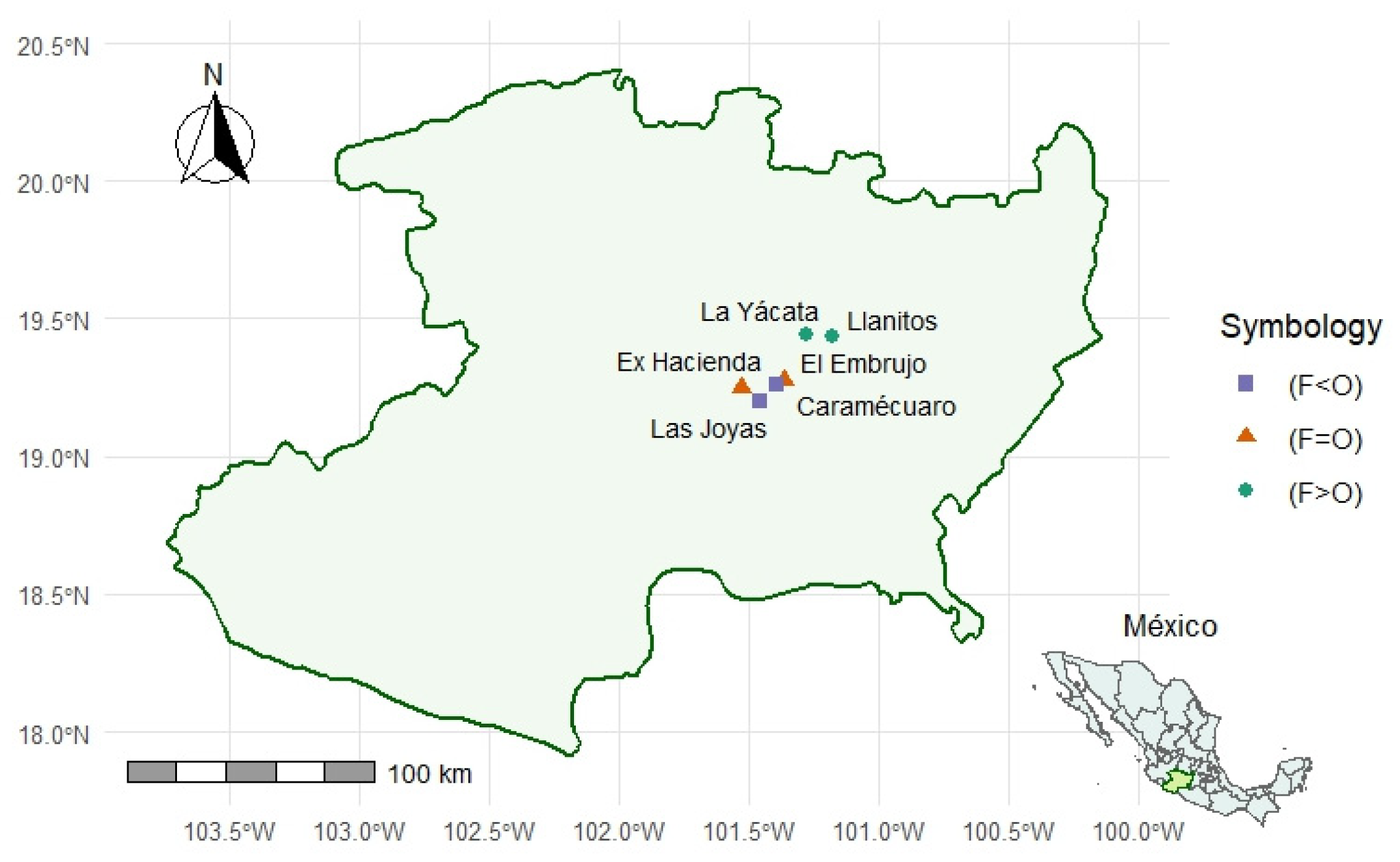
Sampling was conducted in December 2021 at six sites with varying proportions of forest and orchard cover (Figure 1), as described in Pérez-Solache et al. [15]. Sites were categorized as forest-dominated (F > O), mixed forest–orchard (F = O), or orchard-dominated (F < O), following the vegetation-cover approach used in the referenced landscape characterization. These mixed temperate forests are dominated by species from the families Asteraceae, Fabaceae, and Poaceae, along with pines such as Pinus montezumae, P. oocarpa, P. hartwegii, P. pringlei, P. pseudostrobus, and P. lawsoni. Other common tree species include Abies religiosa, Pseudotsuga menziesii, Juniperus deppeana, J. flaccida, and several oak species (Quercus magnoliifolia, Q. calophylla, Q. castanea, Q. laurina, Q. rugosa, Q. laeta, Q. crassipes, Q. obtusata, and Q. crassifolia) [20]. The selected oak species were chosen for study because of their Mexican endemism, as previously stated. At each site, three adult trees of Q. castanea and three of Q. obtusata, at least 5 m tall and 15 cm in diameter at breast height, were selected. From each tree, three undamaged leaves were collected with sterile scissors and immediately transported to the laboratory in sterile, sealed plastic bags within a cooler with ice packs for processing within 24 h of collection. Sampling effort was standardized across sites and host species by collecting the same number of leaves per tree and applying identical isolation and incubation protocols (see following sections).
For the isolation of endophytic fungi, Potato Dextrose Agar (PDA) medium (BD Difco™, Sparks, MD, USA) was prepared according to the manufacturer’s instructions and sterilized in an autoclave at 15 lb/in2 for 15 min. After cooling, amoxicillin/clavulanic acid was added to the medium at 0.005 g/L to suppress bacterial growth, and the mixture was then dispensed into 10 cm diameter Petri dishes.
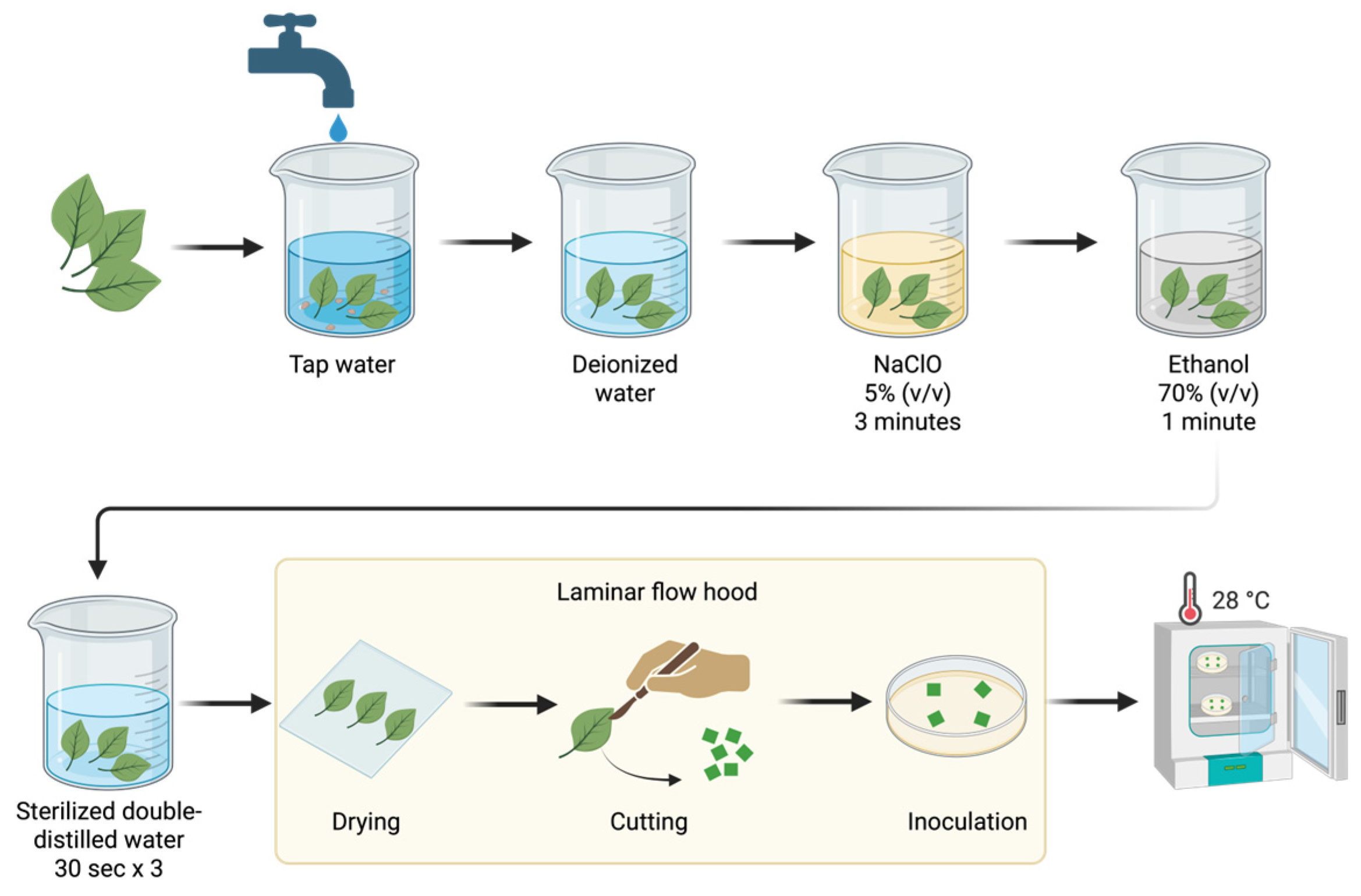
Surface sterilization of the leaves was performed following the method of Kusari et al. [41], with modifications. The leaf tissues were thoroughly washed with running tap water, then with deionized water, to remove any adhering organic residues (Figure 2). The leaf surface was sterilized by sequential immersion in 5% (v/v) sodium hypochlorite for 3 min and 70% (v/v) ethanol for one minute. The sterilized leaves were rinsed three times in sterile double-distilled water for 30 s each to remove excess sterilization solutions from the surface. Finally, the leaves were dried by placing them on sterilized filter paper in a laminar flow hood. The Q. obtusata leaves were cut into approximately 20 × 20 mm fragments using a sterilized scalpel, with the blade sterilized by a flame from a burner. Because Q. castanea leaves are smaller, they were divided in half along the central vein, and each half was further subdivided into four segments with a sterilized scalpel. The surface-sterilized leaf fragments were evenly spread on the surface of PDA medium (four fragments per plate), with one half facing up and the other half with the underside facing the medium. The Petri dishes containing the inoculated medium were incubated at 28 ± 1 °C in the dark until fungal colonies formed.
From the emerging colonies, mycelium fragments from the colony edge were collected with a 6 mm-diameter cork borer and inoculated into the center of a Petri dish containing PDA medium. For each initiated subculture, sampling and inoculation were repeated several times until a morphologically homogeneous colony was observed. In this way, axenic cultures of each isolated strain were established. As a control for the surface sterilization process, the ‘print technique’ was used, in which several sterilized leaf fragments, prepared as previously described, were pressed multiple times onto the surface of the PDA medium and incubated without the leaf fragments under the same conditions as the cultures with the foliar tissue samples [42]. No fungal growth was observed on these control plates.
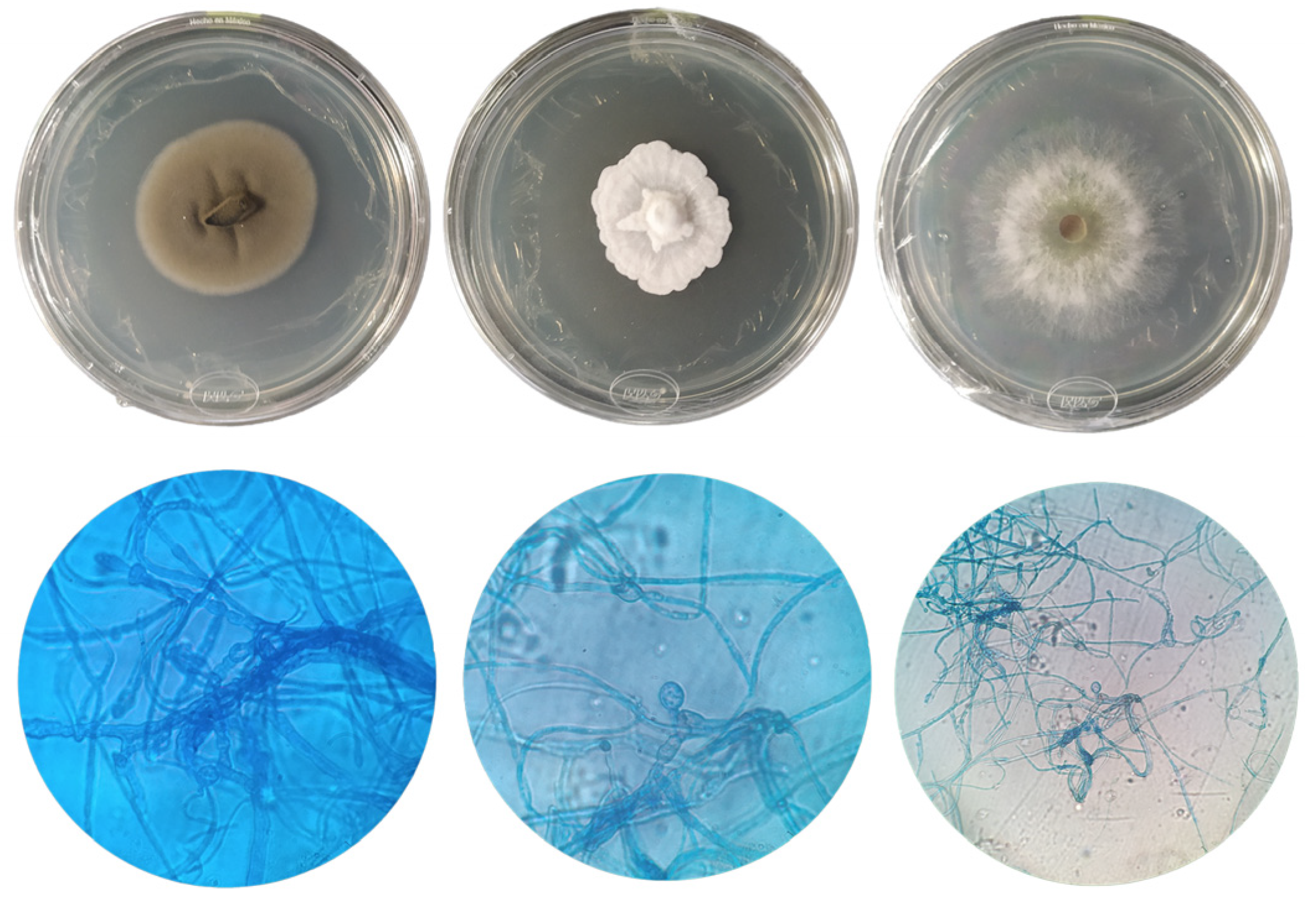
The classification of the isolated strains by colonial morphology followed Agostinelli et al. [43]. Briefly, macroscopic colony characteristics on PDA were considered, including shape, color, margin, elevation, texture, presence or absence of surface secretions, changes in the color of the culture medium (Figure 3), and growth rate at the isolation temperature (28 °C). When distinguishing between two colonies was difficult, mycelial observations were made using bright-field microscopy. Based on these characteristics, a strain was defined as a unique morphotype (MT) if it could not be grouped with any other strain. The microscopic observations were conducted on a Leica DMLB microscope (Leica Biosystems, Deer Park, TX, USA) in bright-field mode; the mycelial samples were stained with cotton blue (Figure 3). Morphotypes were used as an operational unit to guide subsequent molecular identification.
During the study, each isolate in axenic culture was maintained by re-inoculation onto PDA medium. For long-term storage, several cylindrical plugs were taken from the edge of an actively growing colony on PDA medium at 28 °C using a 6 mm-diameter punch. Five mycelial plugs from each isolate were placed in cryovials (Corning®, Union City, CA, USA) containing 10% glycerol (v/v) and stored at −80 °C.
DNA extraction was performed using the phenol-chloroform protocol on actively growing mycelial colonies on PDA medium at 28 °C. The recovered mycelium from the cultures was transferred to a 1.5 mL microcentrifuge tube with Lysing Matrix Y (MP Biomedicals®, Irvine, CA, USA). Then, 400 μL of lysis buffer (0.5% w/v SDS, 250 mM NaCl, 25 mM EDTA, 200 mM Tris-HCl, pH 8.5) was added, and the mixture was processed for cell disruption in a FastPrep-24 machine, shaking at 4 m/s for 40 s. The resulting lysate was centrifuged for 10 min at 1500× g. The supernatant was recovered and transferred to a new tube, and an equal volume of phenol-chloroform (1:1 v/v) was added. The mixture was vortexed for 5 min. It was then centrifuged again as previously described, and the supernatant was transferred to a new tube, with an equal volume of cold isopropanol added. The mixture was gently mixed by inversion and incubated at −20 °C for 60 min. Afterward, the sample was centrifuged again for 10 min at 1500× g, and the supernatant was discarded. The resulting pellet was washed with 300 μL of 70% ethanol and left to dry at room temperature. The DNA pellet was dissolved in 70 μL of sterile deionized water and stored at −20 °C for later use. The quality of the DNA was assessed using 1% agarose gels (w/v) stained with Sybr Safe (Invitrogen, Carlsbad, CA, USA) at a final concentration of 0.5 μg/mL.
Amplification of the ITS region of the Nuclear Ribosomal Unit (ITS1-5.8S-ITS2) by PCR was performed using primers ITS1 (5′-TCCGTAGGTGAACCTGCGG-3′) and ITS4 (5′-TCCTCCGCTTATTGATATGC-3′) [44]. The PCR reaction was carried out in a total volume of 15 µL containing lysis buffer (Tris-HCl 10 mM, pH 8.0, MgCl2 1.5 mM), 0.25 mM of each dNTP, 0.2 U of Taq DNA polymerase (Invitrogen, Carlsbad, CA, USA), and 2.5 ng of DNA, with the final volume adjusted with sterile deionized water to 15 µL. PCR was performed in a Veriti™ thermal cycler (Applied Biosystems, Foster City, CA, USA) with the following conditions: initial denaturation at 95 °C for 3 min, 35 cycles at 95 °C for 1 min, 52 °C for 30 s, 72 °C for 2 min, and a final extension at 72 °C for 10 min. PCR products were verified by electrophoresis on a 2% agarose gel stained with Sybr Safe (Invitrogen, Carlsbad, CA, USA) and visualized under UV light. Each PCR assay was performed with its corresponding negative control, in which no template DNA was added. The concentration of each PCR product was determined with a Varioskan LUX (Thermo Fisher Scientific, Carlsbad, CA, USA). The PCR products were sent to Elim Biopharmaceuticals Inc. (Hayward, CA, USA) for bidirectional sequencing. Electropherograms were reviewed in BioEdit ver. 7.7.1 [45] to assess sequence quality and manually edited to remove sequences with indeterminate positions at the ends. The ITS sequences obtained for each fungal isolate were deposited in GenBank. Accession numbers (PX884095 to PX884189) are provided in the Supplementary Table S1.
Each of the obtained sequences was compared with the curated database of the Internal Transcribed Spacer (ITS) region of fungi type and reference material from the National Center for Biotechnology Information (NCBI, https://www.ncbi.nlm.nih.gov, accessed on 17 October 2025) using the Basic Local Alignment Search Tool (BLASTn, accessed on 17 October 2025). When the similarity between a study sequence and a reference sequence was ≥99%, the sequences were considered congeneric [46]. Sequences with the highest similarity to those obtained in this work were selected to generate a FASTA file for each set of study sequences. Depending on the taxonomic group in which the BLASTn search placed each study sequence, additional sequences not present in the curated database were added, selected based on phylogenetic analyses of recent publications for each taxonomic group. This was done to obtain the most robust phylogenetic analysis possible for each identified genus. The sequences from the FASTA files obtained for each genus in the BLASTn search were aligned using the MAFFT v.7 server [47]. The best evolutionary model was inferred, and phylogenetic reconstruction using the Maximum Likelihood (ML) method was performed for each fungal genus on the IQ-TREE web server [48,49]. Best-fit models were selected per genus dataset; model differences reflect dataset-specific substitution patterns. The robustness of the internal branches was evaluated with 1000 bootstrap replicates. The resulting phylogenetic trees were edited in iTOL server (accessed on 7 November 2025) [50].
Diversity was evaluated at the genus level. Genera richness was assessed using the Margalef index (Dmg = (S − 1)/ln(N)), where S is the number of genera and N is the total number of isolates per sample. Diversity was measured using the Shannon (H = −ΣPi lnPi) and Simpson (D = 1 − ΣPi2) indices, where Pi = ni/N. Evenness was evaluated using Pielou’s equitability index (J = H/lnS). All indices were calculated in Past software version 5.2 (Past5) for Mac (https://www.nhm.uio.no/english/research/resources/past/ accessed on 7 November 2025). In the same software, 95% confidence intervals for each diversity index were computed using bootstrap resampling (9999 iterations), enabling conservative comparisons of diversity patterns despite limited sample sizes.
For diversity analyses, data were aggregated at the site level, with each sampling site treated as the statistical unit. Accordingly, diversity indices were calculated using the total number of isolates recovered per site-host species combination, while individual trees were treated as subsamples contributing to site-level diversity estimates rather than as independent statistical replicates.

3. Results

3.1. Identification of Foliar Endophytic Fungi Isolated from Q. castanea and Q. obtusata

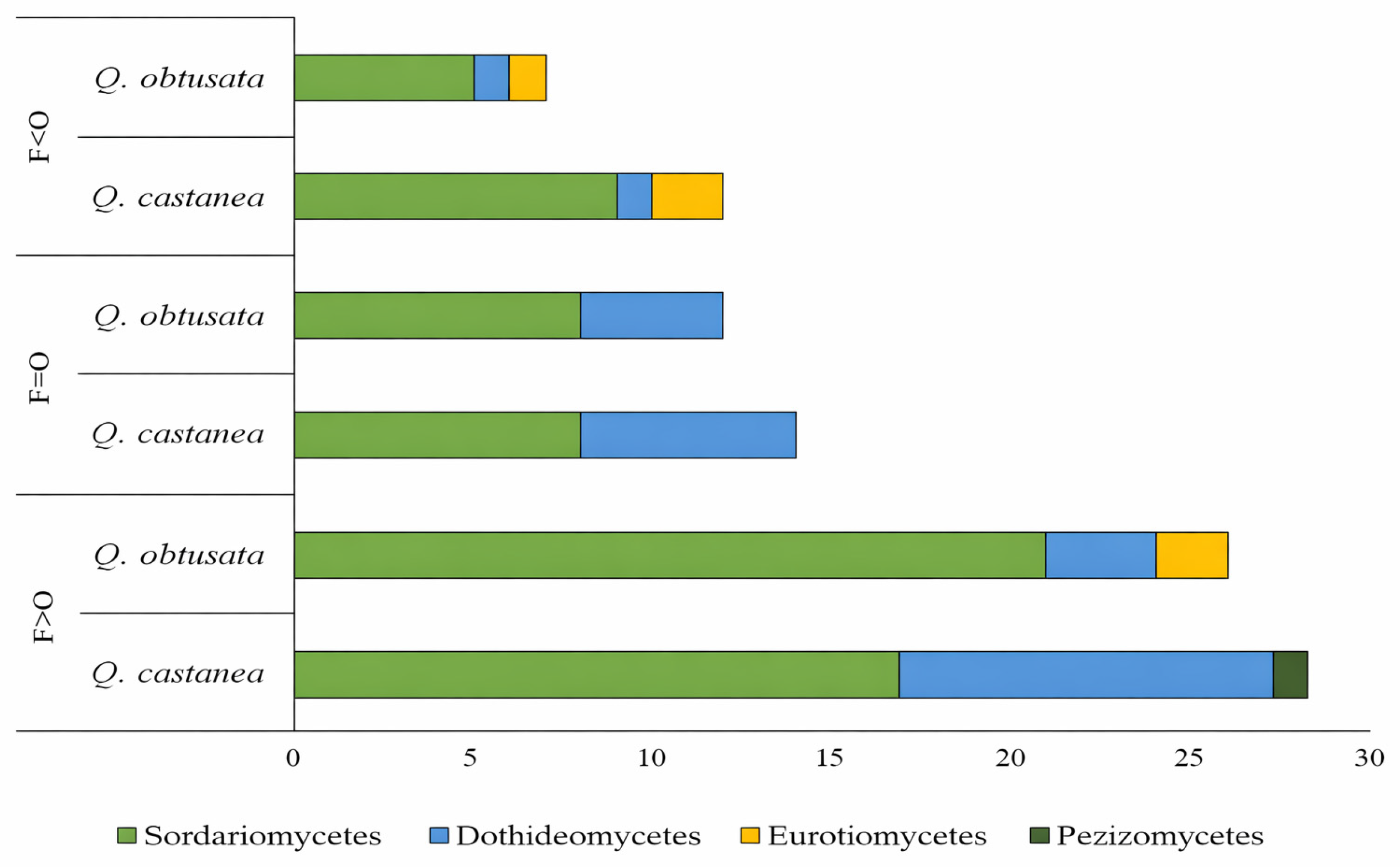
A total of 112 cultivable foliar endophytic fungal strains were isolated from Quercus castanea (56 isolates) and Quercus obtusata (56 isolates) collected in avocado-growing regions of Michoacán, under vegetation-cover conditions ranging from forest-dominated sites to avocado orchards. Of the 112 isolates, 95 distinct morphotypes were selected for sequencing. The remaining 17 isolates were not sequenced because their macro- and microscopic characteristics were indistinguishable from those of isolates already included in the analysis. All isolates belonged to Ascomycota and were assigned to four classes (Dothideomycetes, Eurotiomycetes, Sordariomycetes, and Pezizomycetes) (Figure 4), 10 orders (Botryosphaeriales, Capnodiales, Pleosporales, Eurotiales, Pezizales, Diaporthales, Glomerellales, Hypocreales, Sordariales, and Xylariales), and 32 genera, based on nrITS sequence comparisons and genus-specific phylogenetic placement.
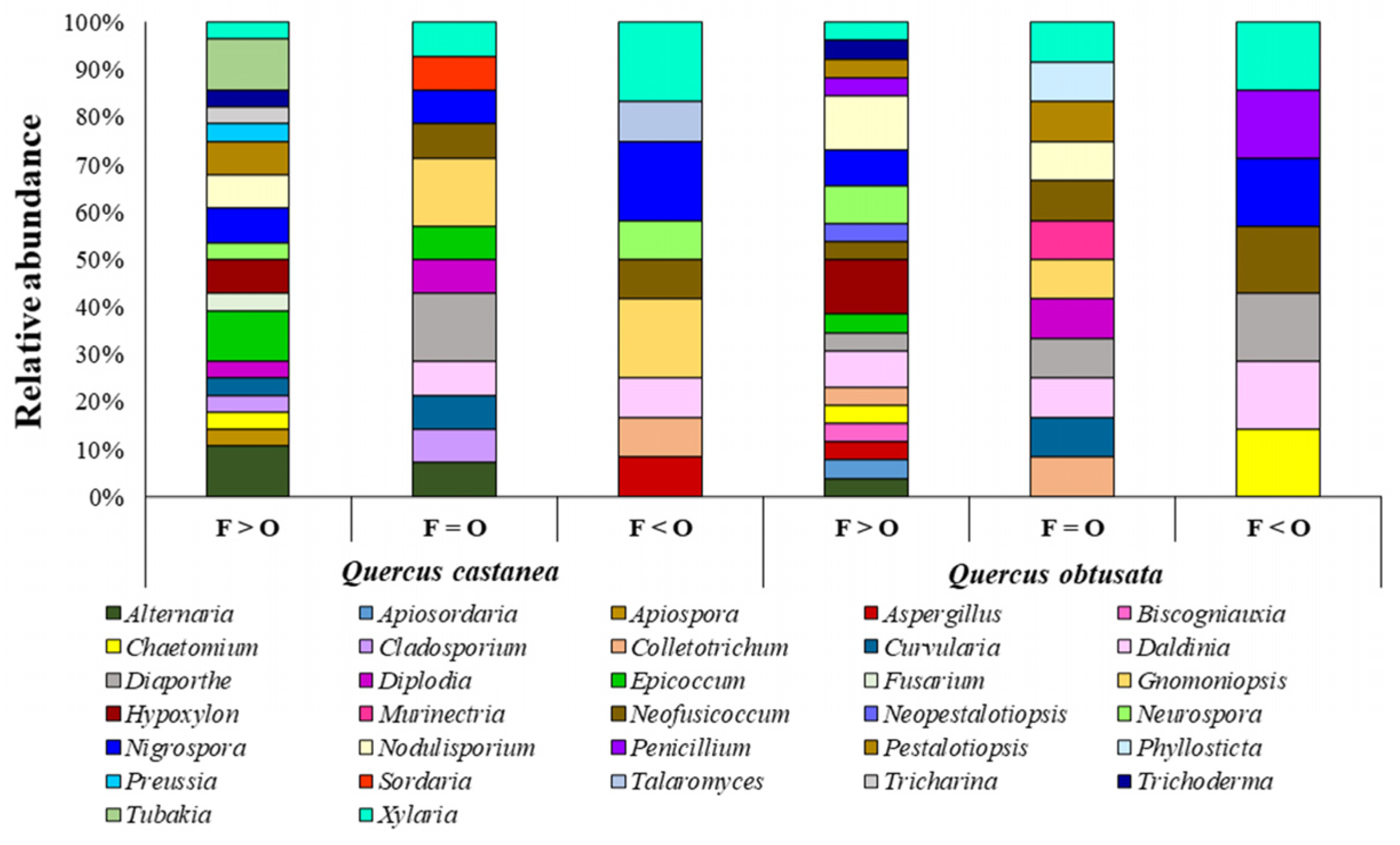
Sordariomycetes was the most abundant class (68.68%), followed by Dothideomycetes (25.25%), Eurotiomycetes (5.05%), and Pezizomycetes (1.00%). The relative abundances of genera across both oak species and vegetation-cover categories are shown in Figure 5. Of the 32 genera, 11 had relative abundances ≤ 1%. The most abundant genera were Nigrospora (8%), Xylaria (7%), Nodulisporium (6%), and Daldinia (6%).
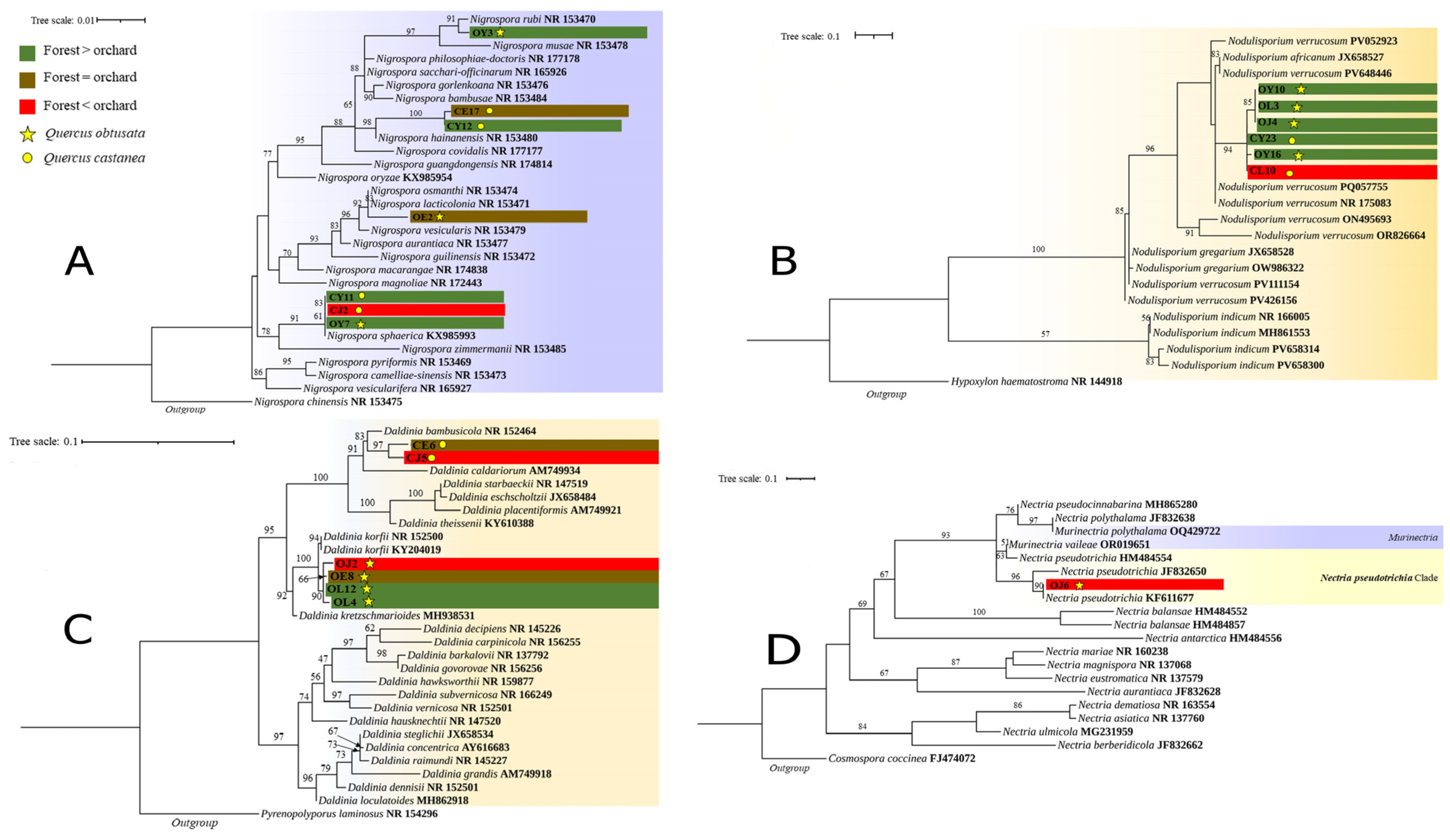
Genus-specific phylogenetic reconstructions (31 trees, Figure 6 and Supplementary Figures S1–S27) enabled species-level identification for a subset of isolates (Supplementary Table S1) and provided a detailed assessment of intra-generic diversity. For example, Nigrospora isolates were distributed across four clades, three of which included strains assignable to Nigrospora sphaerica (Figure 6A). In contrast, Nodulisporium and Daldinia isolates did not form terminal clades that supported confident species-level identification (Figure 6B,C). In Nectria, one isolate was assigned to Nectria pseudotrichia (Figure 6D). Similar patterns of variable taxonomic resolution were observed across other genera (Supplementary Figures S1–S27). Therefore, subsequent diversity analyses were conducted at the genus level.

3.2. Distribution of Endophytic Fungal Genera Across Forest–Orchard Cover Categories

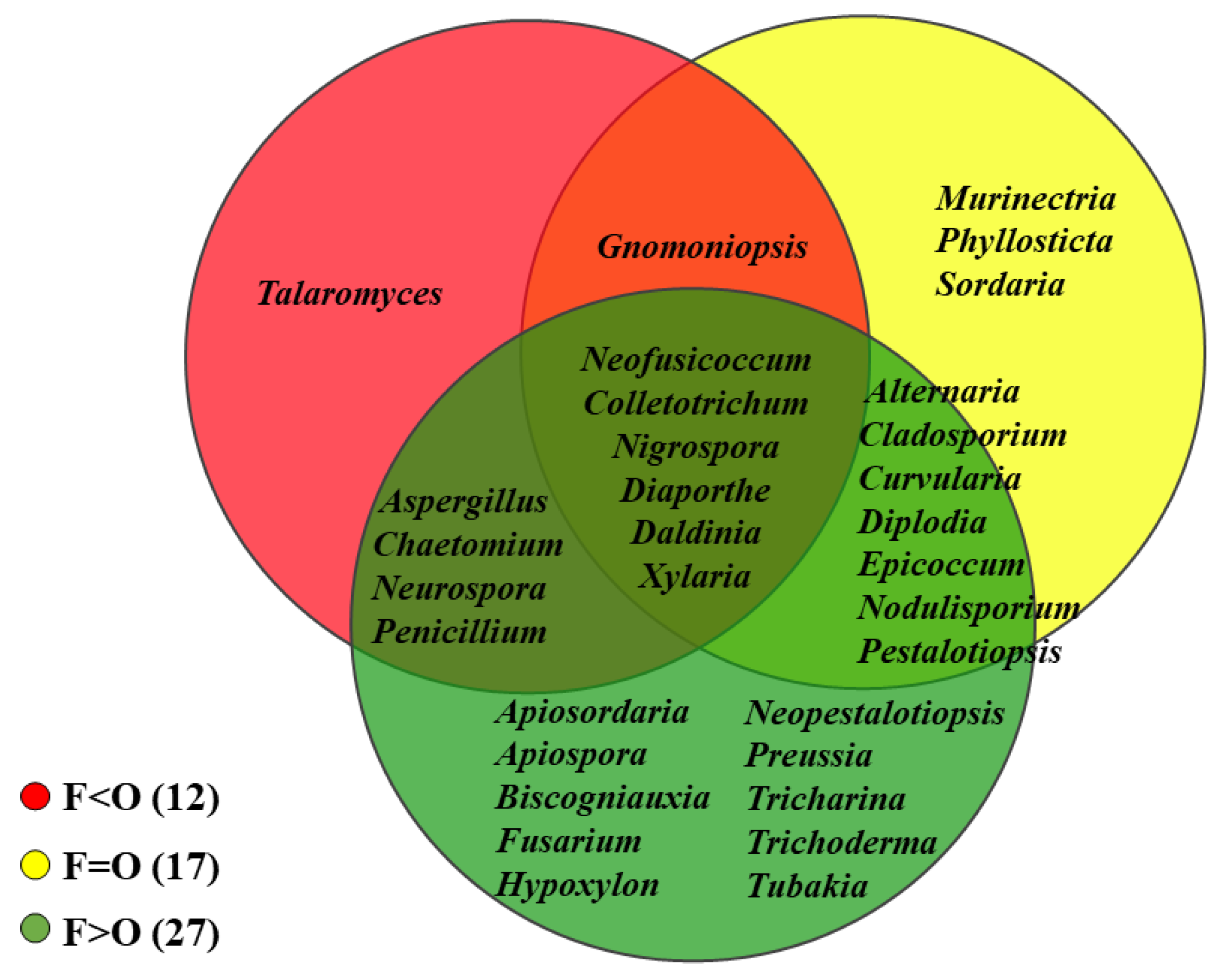
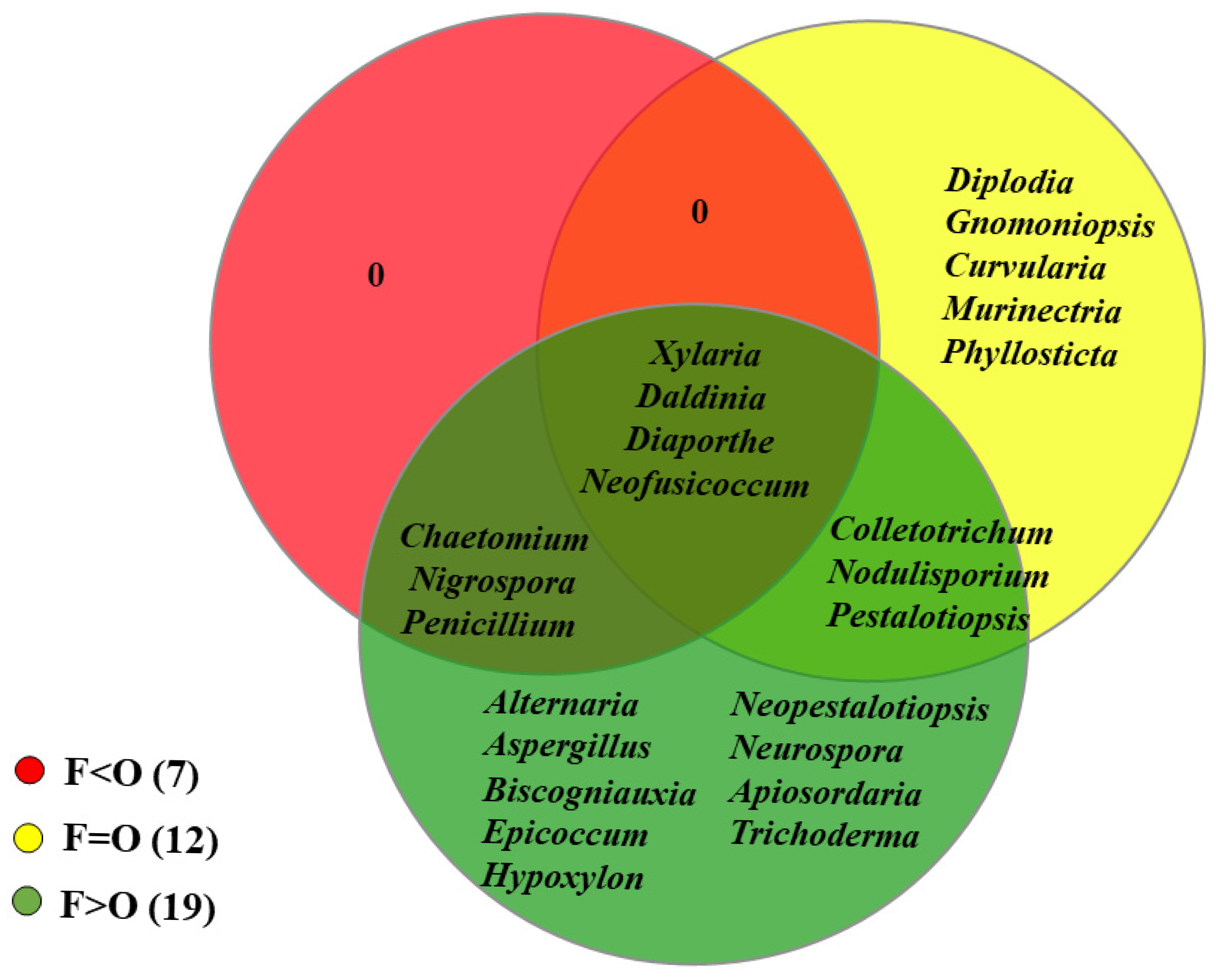
Across all samples, 27 genera were isolated from F > O sites, 17 from F = O sites, and 12 from F < O sites (Figure 7). Six genera (Colletotrichum, Neofusicoccum, Nigrospora, Diaporthe, Daldinia, and Xylaria) were shared among all categories. The F > O and F < O sites shared four genera, whereas F > O and F = O sites shared seven. One genus was shared exclusively between F = O and F < O sites. Ten genera were exclusive to F > O sites, three to F = O sites, and one to F < O sites.
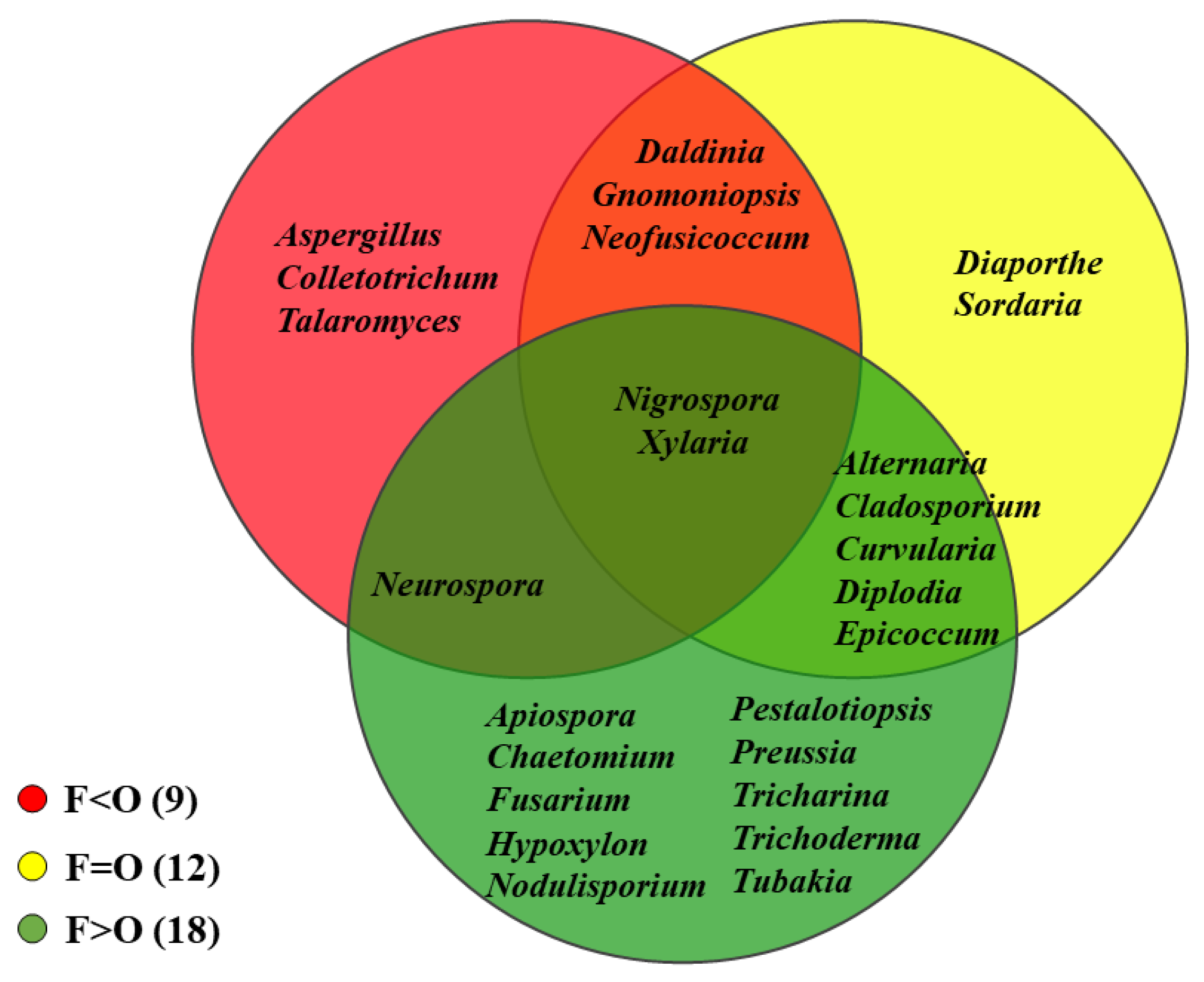
For Q. castanea, 25 genera were identified: 18 in F > O, 12 in F = O, and nine in F < O sites (Figure 8). Nigrospora and Xylaria were present across all categories. Ten genera were exclusive to F > O sites, whereas Diaporthe and Sordaria were detected only in F = O sites. Aspergillus, Colletotrichum, and Talaromyces were isolated exclusively from F < O sites.
For Q. obtusata, 24 genera were identified: 19 in F > O, 12 in F = O, and seven in F < O sites (Figure 9). Nigrospora, Chaetomium, and Penicillium were shared between F > O and F < O sites, whereas Colletotrichum, Nodulisporium, and Pestalotiopsis were shared between F > O and F = O sites. No genera were shared exclusively between F = O and F < O sites. Four genera occurred across all categories, nine were exclusive to F > O sites, five to F = O sites, and none to F < O sites.

3.3. Richness and Diversity Indices

Genus richness (Table 1) and diversity (Table 2) were assessed using the Simpson 1-D index, Shannon’s, Margalef’s (Dmg), and Pielou’s evenness (Equitability_J). Simpson values exceeded 0.94 at all sites. Shannon values ranged from 1.531 to 2.531, with the lowest at F < O sites for Q. obtusata and Q. castanea. Margalef’s values for Q. castanea and Q. obtusata were lowest at F < O sites (2.885), intermediate at F = O sites (3.693 and 3.883), and highest at F > O sites (5.434 and 4.659). Pielou’s evenness was high (>0.78), reaching 0.86 at F > O sites for Q. obtusata.
Foliar endophytic fungal diversity associated with Q. castanea and Q. obtusata showed a consistent gradient across forest areas (F > O > F = O > F < O) for both host species. This pattern was consistently observed across taxonomic richness (Taxa_S), number of individuals, and the Shannon and Margalef diversity indices (Table 2). The F > O area showed the highest richness and diversity, whereas the F < O area showed a marked reduction across all metrics. The 95% confidence intervals support this pattern, with little to no overlap between the extreme areas (F > O vs. F < O), particularly for the Taxa_S, Shannon, and Margalef indices, indicating consistent patterns in community structure.
Simpson’s diversity index (1–D) was consistently high across all areas (>0.94), indicating low taxonomic dominance in both oak species. However, partial overlap of the 95% CIs was observed, especially between the F > O and F = O areas, suggesting gradual rather than abrupt changes in dominance patterns. Evenness (J) remained relatively high and stable across areas and between host species, with broad overlap of the 95% CIs, indicating comparable abundance distributions despite changes in overall richness.
When comparing host species within each area, Q. castanea consistently exhibited higher richness and diversity (Shannon and Margalef) than Q. obtusata, particularly in the F > O area. In contrast, Q. obtusata showed slightly higher evenness values; however, these differences were not clearly supported by the separation of the 95% CIs.

4. Discussion

Endophytic foliar fungi can contribute to tree survival and adaptation, particularly under changing biotic and abiotic conditions [51,52]. Across both host species, forest-dominated sites (F > O) consistently supported higher genus richness and more exclusive taxa than orchard-dominated sites (F < O), consistent with an association between landscape context and patterns of cultivable foliar endophytic fungal diversity in this oak–avocado mosaic. Michoacán is a biodiversity-rich region and a reservoir of endemic species, yet it is experiencing a decline in temperate forest cover associated with avocado expansion [53]. In this study, we characterized the cultivable foliar endophytic fungal community of Quercus castanea and Quercus obtusata, two endemic Mexican oaks, across a forest–orchard vegetation-cover gradient.
Foliar endophytic fungal communities associated with Q. castanea and Q. obtusata were dominated by Ascomycota, a pattern consistently reported across oak species in temperate, Mediterranean, and subtropical regions [37,54,55,56]. Studies of Q. cerris, Q. pubescens, and Q. ilex have similarly documented strong dominance of Sordariomycetes and Dothideomycetes in leaf-associated endophytic assemblages, suggesting these fungal classes are particularly well adapted to oak foliar tissues [36,37,57].
Twenty-six genera of foliar endophytic fungi were identified in Q. castanea and 24 in Q. obtusata, representing a relatively high genus-level diversity compared with previous studies of cultivable foliar endophytes in Quercus spp. For example, in Q. gambelii, eight genera and strains from three orders were identified, with 40 isolates from foliar tissue, all within Ascomycota [58]. A subsequent study on the same oak species, starting with 763 foliar endophyte isolates and using morphological grouping of vegetative mycelium colonies, identified 49 strains, representing only 11 fungal species [59]. In Q. brantii, only six genera and 23 strains were found, assigned only at the family level to Gnomoniaceae, without identifying the genera [56]. In healthy and deteriorated leaves of Q. robur and Q. cerris from northeastern Italy, strains from 13 endophytic fungal species were isolated and assigned to 5 and 7 genera, respectively [54]. In these same oak species, seven genera of foliar endophytic fungi were identified in Q. cerris and only 6 in Q. robur and Q. pubescens, which were also included in the study [34].
At the genus level, Nigrospora was the most abundant endophyte across both oak species and vegetation-cover categories evaluated in this study. To the best of our knowledge, the genus Nigrospora has not previously been reported as a foliar endophyte of Quercus species, though it has been reported in other tissues. In this context, Nigrospora sphaerica was isolated from annual shoots of Q. robur [60], whereas N. oryzae was isolated from branches of Q. pyrenaica and Q. macranthera [61,62]. The high abundance and phylogenetic diversity of Nigrospora observed within Q. castanea and Q. obtusata suggest that this genus may be an essential functional component of these oak endophytic mycobiomes, but its contribution to the plant’s health remains to be determined. The Xylaria and Daldinia genera have previously been associated with oak tissues. They are thought to play a role in the decomposition of wood and leaf litter following host senescence while remaining endophytic throughout the host’s life cycle [63,64]. The phylogenetic clustering observed within Daldinia suggests the presence of taxa not currently represented in reference databases, reinforcing previous assertions that tree foliar fungal communities, particularly in under-sampled regions such as Mexico, harbor substantial undocumented diversity [65,66,67].
Although ITS-based phylogenetic analyses enabled species-level identification for some isolates, such as Nigrospora sphaerica and Nectria pseudotrichia, many oak-associated endophytes could not be confidently resolved beyond the genus level. The limitations of the ITS region as a unique marker for fungal identification stem from its intraspecific and intragenomic variability, low interspecific divergence, and incomplete taxonomic coverage, all of which complicate species delimitation in ecological studies [68,69,70]. These challenges are particularly pronounced in fungi associated with endemic plants or poorly studied ecosystems, where hidden diversity and new taxa remain to be discovered [71,72,73]. It has also been widely documented that fungal identification at the species level cannot rely solely on BLASTn to find the best matches. In contrast, multiple-alignment phylogenetic analysis correctly places the sequence in a clade, at least at the genus level. This is because BLAST searches can be misleading due to database errors and mislabeling, and because similarity-based identifications are not a substitute for phylogenetic inference when accuracy and precision are essential [68,74,75,76].
Consequently, conducting diversity analyses at the genus level, as done in this study, is a robust and conservative approach under limited sampling designs and has been widely used in oak endophyte research. Genus-level analyses reduce taxonomic noise despite variable ITS resolution and are widely used; however, cryptic diversity may be underestimated. The apparent presence of undescribed taxa further underscores the need for multilocus phylogenetic or metabarcoding frameworks for the oak species examined here.
Using a culture-dependent strategy in this study enabled the recovery of viable foliar endophytic fungi associated with Q. castanea and Q. obtusata, facilitating taxonomic identification, phylogenetic placement, and future functional analyses. Culture-based approaches remain particularly valuable in oak endophyte research because they provide living material for downstream studies of ecological function, host interactions, and potential biotechnological applications that cannot be achieved with sequence-based methods alone [35,58,74,77]. The dominant genera recovered here, Nigrospora, Nodulisporium, Xylaria, and Daldinia, are readily culturable and have been consistently reported as endophytes in culture-based surveys of diverse plant hosts [78], including oak species [62,79,80,81]. However, these predominant taxa differ markedly from those previously reported for Quercus in Europe, Asia, and North America, highlighting the strong regional structuring of oak-associated endophytic assemblages.
Comparisons with culture-based studies of European oaks show limited taxonomic overlap, with endophytic communities typically dominated by genera such as Aureobasidium, Apiognomonia, Epicoccum, Trichoderma, and Alternaria [36,61,82,83,84]. A similar lack of concordance is observed in studies from North America [55] and in metabarcoding-based surveys from Asia [37], where dominant taxa also differ substantially. These consistent discrepancies across regions suggest that geographic context and local environmental conditions outweigh host genus identity in shaping endophytic community composition.
Overall, the pronounced biogeographic differentiation observed here supports the view that foliar endophytic diversity in oaks is highly context dependent. Our results provide novel baseline data on oak endophytes from an underrepresented region and reinforce the importance of expanding geographically diverse surveys to better understand the ecological drivers of endophytic fungal diversity.
However, it is essential to acknowledge the inherent limitations of culture-dependent methods. This approach likely underestimates total endophytic diversity, as fast-growing or sporulating fungi are overrepresented, whereas slow-growing, obligately biotrophic, or nutritionally fastidious taxa may remain undetected [35,74,85]. Across tree species, comparisons between culture-dependent and high-throughput sequencing approaches have shown that only a subset of the endophytic community is recoverable in culture, with metabarcoding revealing additional lineages not detected by isolation techniques [85,86,87]. In some cases, although the cultivation approach detected lower fungal richness, the results for the stem were consistent with those for fungal community composition and richness. Consequently, the patterns reported here should be interpreted as reflecting the diversity and structure of the cultivable fraction of the foliar endophytic community rather than the full mycobiome.
Despite these limitations, the consistency of community patterns across hosts and vegetation-cover gradients suggests that culture-dependent data capture biologically meaningful responses of oak-associated endophytes to landscape modification. Integrative approaches that combine culture-based isolation with culture-independent sequencing will be essential for future studies to more fully characterize the diversity, dynamics, and functional roles of foliar endophytic fungi in the Quercus species examined here [87].
Although sampling was limited, standardized sampling combined with resampling-based confidence intervals provided a conservative framework for comparing diversity patterns across landscapes. Given the inherent heterogeneity of endophytic fungal communities, patterns were interpreted descriptively rather than through hypothesis testing with adequate statistical power. In this context, the study did not implement formal hierarchical statistical models. Future studies incorporating mixed-effects modeling frameworks that explicitly account for tree-level replication nested within landscape categories would allow a more robust inferential structure for evaluating landscape effects on endophytic fungal diversity.
The results indicate that fungal diversity is primarily structured by environmental gradients across forest areas, with a secondary but consistent effect of host identity. The higher richness and diversity observed in the F > O area suggest more favorable conditions for establishing diverse fungal assemblages. The progressive decline in diversity toward the F < O area, supported by consistent reductions in Taxa_S and the Shannon index, indicates an environmental filtering effect, in which only a subset of fungal taxa can persist. Despite this reduction in richness, consistently high Simpson and evenness values indicate that these communities are not dominated by a few taxa but maintain relatively balanced abundance distributions. Such patterns are characteristic of species-poor communities that are structurally stable under limiting environmental conditions.
This pattern aligns with findings from temperate and boreal forests across Europe, Asia, and North America, where structurally complex, less disturbed stands support more diverse endophytic communities than managed or fragmented landscapes, likely due to greater microenvironmental heterogeneity, substrate availability, and forest structural complexity [61,88,89,90,91]. Previous studies in forest ecosystems have shown that changes in canopy structure, humidity, temperature, and surrounding vegetation influence endophyte colonization dynamics and community composition [61,92,93]. Thus, the intermediate changes in the fungal foliar endophytic community at F = O sites may reflect transitional conditions in which both forest-associated oak endophytes and disturbance-tolerant taxa coexist, a pattern also reported in fragmented oak woodlands [91,94]. However, other studies report no differences in isolation rates or endophyte diversity between forest fragmentation levels or between declining and healthy trees [36,43,95,96].
Differences between Q. castanea and Q. obtusata suggest a moderate host effect on fungal community structure, particularly in terms of richness and overall diversity. Host-specific patterns in endophytic fungi have been documented among oak species and are attributed to interspecific differences in leaf chemistry, phenology, and defensive compounds [34,37,82,89,97,98]. Thus, the higher diversity associated with Q. castanea may reflect differences in host-related traits, such as tissue chemistry, canopy architecture, or the availability of microhabitats that promote fungal colonization. Conversely, the higher evenness observed in Q. obtusata suggests more homogeneous abundance distributions, potentially reflecting lower competitive asymmetry among fungal taxa or a more strongly filtered community assembly process. By contrast, the consistent presence of Nigrospora and Xylaria across both hosts and at all coverage levels suggests that these genera may constitute a core foliar endophytic microbiome of Mexican oaks. Similar “core” assemblages have been proposed for European oak species, supporting the idea that specific fungal lineages maintain stable associations with Quercus hosts across broad environmental gradients [37,99].
Although some indices showed partial overlap in their 95% confidence intervals, particularly between the F > O and F = O areas, the consistency of the observed pattern across multiple diversity metrics and both host species is consistent with an ecological influence of the environmental gradient rather than sampling-driven patterns.
This integrative approach, emphasizing concordant trends across indices supported by confidence intervals, aligns with current ecological studies of fungal diversity. Given emerging evidence that oak endophytes contribute to host resilience, pathogen resistance, and ecosystem functioning [51,52], the erosion of endophytic diversity in orchard-dominated landscapes may have long-term consequences for oak persistence in agroforestry mosaics. For example, agroforestry management of oak forests can increase insect-caused foliar damage [100]. Interactions between endophytic fungi on oak leaves and gall-forming or leaf-mining insects are complex, with positive, negative, and neutral effects reported depending on the oak species, the endophyte, and the insect [101]. Therefore, future work should evaluate how the composition of the endophytic fungal community in Q. castanea and Q. obtusata affects insects that can impact the tree’s vitality.
Environmental changes can also trigger transitions from endophytic to phytopathogenic lifestyles in oak fungi, with interspecific variation in outcomes [35,99,102,103]. These transitions are driven by multiple stressors that, together, can contribute to oak decline, underscoring the need for evaluation in the oak-avocado orchard ecosystem examined here. Additionally, various species of foliar endophytes in oaks can initiate leaf tissue decomposition after leaves senesce [58,59]. By initiating decomposition immediately upon senescence, these fungi increase nutrient cycling efficiency, thereby benefiting biogeochemical cycles in the forest.

5. Conclusions

This study shows that Quercus castanea and Quercus obtusata host diverse assemblages of cultivable foliar endophytic fungi dominated by Ascomycota. Across a forest–avocado orchard landscape gradient, forest-dominated areas consistently supported higher genus richness and greater taxonomic exclusivity than orchard-dominated sites. These results indicate that landscape context is associated with patterns of cultivable endophytic fungal diversity in endemic Mexican oaks. Although based on a limited sampling design, this work provides baseline evidence that forest-to-orchard conversion is linked to shifts in oak-associated fungal communities and highlights the need for integrative approaches to further evaluate their ecological and functional implications.

Supplementary Materials

The following supporting information can be downloaded at: https://www.mdpi.com/article/10.3390/d18020125/s1, Figures S1–S27: Phylogenetic trees based on ITS sequences of species in each genus; Table S1: Data of the ITS sequences from the endophytic fungal strains of Q. castanea and Q. obtusata.

Author Contributions

Conceptualization, P.C.-R., K.O. and G.V.-M.; methodology, M.I.M.-S., P.C.-R., Y.M.-L. and G.V.-M.; software, M.I.M.-S. and G.V.-M.; validation, K.O., P.C.-R. and Y.M.-L.; formal analysis, M.I.M.-S., K.O. and G.V.-M.; investigation, K.O., M.I.M.-S., P.C.-R. and G.V.-M.; resources, K.O. and G.V.-M.; data curation, K.O., P.C.-R. and G.V.-M.; writing—original draft preparation, M.I.M.-S., K.O. and G.V.-M.; writing—review and editing, K.O., P.C.-R. and G.V.-M.; visualization, M.I.M.-S., Y.M.-L. and G.V.-M.; supervision, K.O. and G.V.-M.; project administration, P.C.-R. and Y.M.-L.; funding acquisition, K.O. and P.C.-R. All authors have read and agreed to the published version of the manuscript.

Funding

This project was supported by Secretaría de Desarrollo Institucional, UNAM, and by the Programa de Investigación Científica CIC-UMSNH 2026.

Institutional Review Board Statement

Not applicable.

Data Availability Statement

The ITS sequences obtained for each fungal isolate were deposited in GenBank. Accession numbers (PX884095 to PX884189) are provided in the Supplementary Table S1.

Acknowledgments

Thanks are given to SECIHTI for the doctoral scholarship granted to M.I.M.S. (No. 732728).

Conflicts of Interest

The authors declare no conflicts of interest. The funders had no role in the design of the study; in the collection, analyses, or interpretation of data; in the writing of the manuscript; or in the decision to publish the results.

Abbreviations

The following abbreviations are used in this manuscript:
BLASTBasic Local Alignment Search Tool
nrITSnuclear ribosomal internal transcribed spacer
NCBINational Center for Biotechnology Information

References

  1. Keenan, R.J.; Reams, G.A.; Achard, F.; de Freitas, J.V.; Grainger, A.; Lindquist, E. Dynamics of global forest area: Results from the FAO Global Forest Resources Assessment 2015. For. Ecol. Manag. 2015, 352, 9–20. [Google Scholar] [CrossRef]
  2. Riitters, K.; Wickham, J.; Costanza, J.K.; Vogt, P. A global evaluation of forest interior area dynamics using tree cover data from 2000 to 2012. Landsc. Ecol. 2016, 31, 137–148. [Google Scholar] [CrossRef]
  3. FAO; UNEP. The State of the World’s Forests 2020; Forests, biodiversity and people; FAO: Rome, Italy, 2020. [Google Scholar]
  4. Singh, S.P.; Zobel, D.B. Pine-Oak type: A unique resilient global system with high potential for nature-based solutions. Ecol. Indic. 2025, 175, 113536. [Google Scholar] [CrossRef]
  5. INEGI. Cuentas de los Ecosistemas de México. Resultados del Proyecto Natural Capital Accounting and Valuation of Ecosystem Services (NCAVES); INEGI: Mexico City, Mexico, 2021; p. 258.
  6. Galicia, L.; Potvin, C.; Messier, C. Maintaining the high diversity of pine and oak species in Mexican temperate forests: A new management approach combining functional zoning and ecosystem adaptability. Can. J. For. Res. 2015, 45, 1358–1368. [Google Scholar] [CrossRef]
  7. Galicia, L.; Zarco-Arista, A.E. Multiple ecosystem services, possible trade-offs and synergies in a temperate forest ecosystem in Mexico: A review. Int. J. Biodivers. Sci. Ecosyst. Serv. Manag. 2014, 10, 275–288. [Google Scholar] [CrossRef]
  8. Legarreta-Miranda, C.K.; Prieto-Amparán, J.A.; Villarreal-Guerrero, F.; Morales-Nieto, C.R.; Pinedo-Álvarez, A. Long-term land-use/land-cover change increased the landscape heterogeneity of a fragmented temperate forest in Mexico. Forests 2021, 12, 1099. [Google Scholar] [CrossRef]
  9. Ramírez-Mejía, D.; Levers, C.; Kolb, M.; Ghilardi, A.; Godínez-Gómez, O.; Mas, J.F. Mapping spatiotemporal patterns of avocado expansion and land-use intensity in central Mexico and their effects on landscape connectivity. Environ. Res. Lett. 2024, 19, 124090. [Google Scholar] [CrossRef]
  10. Viljur, M.L.; Abella, S.R.; Adámek, M.; Alencar, J.B.R.; Barber, N.A.; Beudert, B.; Chao, A.; Chergui, B.; Choi, C.Y.; Cleary, D.F.R.; et al. The effect of natural disturbances on forest biodiversity: An ecological synthesis. Biol. Rev. 2022, 97, 1930–1947. [Google Scholar] [CrossRef]
  11. Denvir, A. Avocado expansion and the threat of forest loss in Michoacán, Mexico under climate change scenarios. Appl. Geogr. 2023, 151, 102856. [Google Scholar] [CrossRef]
  12. Solórzano, J.V.; Mas, J.F.; Ramírez-Mejía, D.; Gallardo-Cruz, J.A. Long-term trajectory analysis of avocado orchards in the avocado belt, Mexico. Land 2025, 14, 1792. [Google Scholar] [CrossRef]
  13. Young, K.R.; Arima, E.Y.; Denvir, A.; García-Oliva, F.; González-Rodríguez, A.; Latorre-Cárdenas, M.C.; Valdivia-Ramírez, O.M.; Torres, R. Coupling effects of Mexican avocado production with demand in the United States: A social–ecological perspective on sustainability concerns. J. Lat. Am. Geogr. 2025, 24, 141–152. [Google Scholar] [CrossRef]
  14. Bravo-Espinosa, M.; Mendoza, M.E.; Carlón Allende, T.; Medina, L.; Sáenz-Reyes, J.T.; Páez, R. Effects of converting forest to avocado orchards on topsoil properties in the Trans-Mexican Volcanic System, Mexico. Land Degrad. Dev. 2012, 25, 452–467. [Google Scholar] [CrossRef]
  15. Pérez-Solache, A.; Vaca-Sánchez, M.S.; Maldonado-López, Y.; de Faria, M.L.; Borges, M.A.Z.; Fagundes, M.; Oyama, K.; Méndez-Solórzano, M.I.; Aguilar-Peralta, J.S.; Hernández-Guzmán, R.; et al. Changes in land use of temperate forests associated with avocado production in Mexico: Impacts on soil properties, plant traits and insect–plant interactions. Agric. Syst. 2023, 204, 103556. [Google Scholar] [CrossRef]
  16. Manos, P.S.; Hipp, A.L. An updated infrageneric classification of the North American oaks (Quercus subgenus Quercus). Forests 2021, 12, 786. [Google Scholar] [CrossRef]
  17. Denk, T.; Grimm, G.W.; Manos, P.S.; Deng, M.; Hipp, A.L. An updated infrageneric classification of the oaks: Review of previous taxonomic schemes and synthesis of evolutionary patterns. In Oaks Physiological Ecology: Exploring the Functional Diversity of Genus Quercus L.; Gil-Pelegrín, E., Peguero-Pina, J., Sancho-Knapik, D., Eds.; Springer: Cham, Switzerland, 2017; pp. 13–38. [Google Scholar]
  18. Backs, J.R.; Ashley, M.V. Quercus conservation genetics and genomics: Past, present, and future. Forests 2021, 12, 882. [Google Scholar] [CrossRef]
  19. Hipp, A.L.; Manos, P.S.; González-Rodríguez, A.; Hahn, M.; Kaproth, M.; McVay, J.D.; Valencia-Ávalos, S.; Cavender-Bares, J. Sympatric parallel diversification of major oak clades in the Americas and the origins of Mexican species diversity. New Phytol. 2018, 217, 439–452. [Google Scholar] [CrossRef]
  20. Valencia-A., S. Diversidad del género Quercus (Fagaceae) en México. Bol. Soc. Bot. Méx. 2004, 75, 33–53. [Google Scholar] [CrossRef]
  21. Martínez-Meléndez, N.; Ramírez-Marcial, N.; García-Franco, J.G.; Cach-Pérez, M.J.; Martínez-Zurimendi, P. Importance of Quercus spp. for diversity and biomass of vascular epiphytes in a managed pine–oak forest in southern Mexico. For. Ecosyst. 2022, 9, 100034. [Google Scholar] [CrossRef]
  22. García-Jain, S.E.; Maldonado-López, Y.; Oyama, K.; López-Maldonado, M.C.; Fagundes, M.; Lopes de Faria, M.; Espírito Santo, M.M.; Vaca-Sánchez, M.S.; Cuevas-Reyes, P. Guild-dependent effects of forest fragmentation in canopy arthropod diversity associated with Quercus deserticola. Eur. J. For. Res. 2023, 142, 217–230. [Google Scholar] [CrossRef]
  23. Pascual-Alvarado, E.; Nieves-Aldrey, J.L.; Castillejos Lemus, D.E.; Cuevas-Reyes, P.; Oyama, K. Diversity of galls induced by wasps (Hymenoptera: Cynipidae, Cynipini) associated with oaks (Fagaceae: Quercus) in Mexico. Bot. Sci. 2017, 95, 461–472. [Google Scholar] [CrossRef]
  24. Prieto-Dueñas, I.S.; Cuevas-Reyes, P.; Vaca-Sánchez, M.S.; Oyama, K.; Santos de Araujo, W.; Zazá Borges, M.A.; Fagundes, M.; Wilson Fernandes, G.; Maldonado-López, Y. Tri-trophic networks of oak gall-inducing insects and their parasitoids in Mexican avocado agrosystems: Forest coverage and local climatic variables importance. Ecol. Complex. 2025, 63, 101133. [Google Scholar]
  25. Vaca-Sánchez, M.S.; Maldonado-López, Y.; Oyama, K.; Delgado, G.; Aguilar-Peralta, J.S.; Zazá Borges, M.A.; Lopes de Faria, M.; Fagundes, M.; López-Maldonado, M.C.; Cuevas-Reyes, P. Changes in herbivory patterns and insect herbivore assemblages associated to canopy of Quercus laurina: Importance of oak species diversity and foliar chemical defense. Trees 2023, 37, 699–715. [Google Scholar] [CrossRef]
  26. García-Guzmán, O.M.; Garibay-Orijel, R.; Hernández, E.; Arellano-Torres, E.; Oyama, K. World-wide meta-analysis of Quercus forests ectomycorrhizal fungi diversity reveals southwestern Mexico as a hotspot. Mycorrhyza 2017, 27, 811–822. [Google Scholar] [CrossRef] [PubMed]
  27. Rosales-Castillo, J.A.; Oyama, K.; Vázquez-Garcidueñas, M.S.; Aguilar-Romero, R.; García-Oliva, F.; Vázquez-Marrufo, G. Fungal community and ligninolytic enzyme activities in Quercus deserticola Trel. litter from forest fragments with increasing levels of disturbance. Forests 2018, 9, 11. [Google Scholar] [CrossRef]
  28. Rodriguez, R.J.; White, J.F., Jr.; Arnold, A.E.; Redman, A.R. Fungal endophytes: Diversity and functional roles. New Phytol. 2009, 182, 314–330. [Google Scholar] [CrossRef] [PubMed]
  29. Collinge, D.B.; Jensen, B.; Jørgensen, H.J. Fungal endophytes in plants and their relationship to plant disease. Curr. Opin. Microbiol. 2022, 69, 102177. [Google Scholar] [CrossRef]
  30. Ferus, P.; Barta, M.; Konôpková, J. Endophytic fungus Beauveria bassiana can enhance drought tolerance in red oak seedlings. Trees 2019, 33, 1179–1186. [Google Scholar] [CrossRef]
  31. Jin, W.; Peng, L.; Zhang, X.; Sun, H.; Yuan, Z. Effects of endophytic and ectomycorrhizal basidiomycetes on Quercus virginiana seedling growth and nutrient absorption. J. Sustain. For. 2019, 38, 457–470. [Google Scholar] [CrossRef]
  32. Costa, D.; Lopes, T.; Díaz, J.; Baptista, P.; Lino-Neto, T. Natural endophyte reduces disease severity in cork oak caused by Biscogniauxia mediterranea and Diplodia corticola under different watering regimes. Discov. Plants 2025, 2, 193. [Google Scholar] [CrossRef]
  33. Collado, J.; Platas, G.; González, I.; Peláez, F. Geographical and seasonal influences on the distribution of fungal endophytes in Quercus ilex. New Phytol. 1999, 144, 525–532. [Google Scholar] [CrossRef]
  34. Ragazzi, A.; Moricca, S.; Capretti, P.; Dellavalle, I.; Turco, E. Differences in composition of endophytic mycobiota in twigs and leaves of healthy and declining Quercus species in Italy. For. Pathol. 2003, 33, 31–38. [Google Scholar] [CrossRef]
  35. Moricca, S.; Ragazzi, A. Fungal endophytes in Mediterranean oak forests: A lesson from Discula quercina. Phytopathology 2008, 98, 380–386. [Google Scholar] [CrossRef] [PubMed]
  36. Moricca, S.; Ginetti, B.; Ragazzi, A. Species- and organ-specificity in endophytes colonizing healthy and declining Mediterranean oaks. Phytopathol. Mediterr. 2012, 51, 587–598. [Google Scholar]
  37. Nguyen, M.H.; Shin, K.C.; Lee, J.K. Fungal community analyses of endophytic fungi from two oak species, Quercus mongolica and Q. serrata, in Korea. Mycobiology 2021, 49, 385–395. [Google Scholar] [CrossRef]
  38. Arizaga, S.; Martínez-Cruz, J.; Salcedo-Cabrales, M.; Bello-González, M.A. Manual de la biodiversidad de Encinos Michoacanos; Instituto Nacional de Ecología: Mexico City, Mexico, 2009. [Google Scholar]
  39. Herrera-Arroyo, M.L.; Sork, V.L.; González-Rodríguez, A.; Rocha-Ramírez, V.; Vega, E.; Oyama, K. Seed-mediated connectivity among fragmented populations of Quercus castanea (Fagaceae) in a Mexican landscape. Am. J. Bot. 2013, 100, 1663–1671. [Google Scholar] [CrossRef]
  40. Romero-Rangel, S.; Rojas-Zenteno, E.C. Aspectos taxonómicos de la morfología floral masculina de Quercus (Fagaceae) en México. Polibotánica 2019, 48, 13–27. [Google Scholar] [CrossRef][Green Version]
  41. Kusari, S.; Lamshöft, M.; Zühlke, S.; Spiteller, M. An endophytic fungus from Hypericum perforatum that produces hypericin. J. Nat. Prod. 2008, 71, 159–162. [Google Scholar] [CrossRef]
  42. Schulz, B.; Guzke, S.; Dammann, U. Endophyte–host interactions. II. Defining symbiosis of the endophyte–host interaction. Symbiosis 1998, 25, 213–227. [Google Scholar]
  43. Agostinelli, M.; Cleary, M.; Martin, J.A.; Albrectsen, B.R.; Witzell, J. Pedunculate oaks (Quercus robur L.) differing in vitality as reservoirs for fungal biodiversity. Front. Microbiol. 2018, 9, 1758. [Google Scholar] [CrossRef]
  44. White, T.J.; Bruns, T.; Lee, S.J.W.T.; Taylor, J. Amplification and direct sequencing of fungal ribosomal RNA genes for phylogenetics. In PCR Protocols: A Guide to Methods and Applications; Innis, M.A., Gelfand, D.H., Sninsky, J.J., White, T.J., Eds.; Academic Press: San Diego, CA, USA, 1990; pp. 315–322. [Google Scholar]
  45. Hall, T. Available online: https://thalljiscience-github-io.translate.goog/?_x_tr_sl=en&_x_tr_tl=es&_x_tr_hl=es&_x_tr_pto=tc (accessed on 22 September 2025).
  46. Yuan, Z.L.; Zhang, C.L.; Lin, F.C.; Kubicek, C.P. Identity, diversity, and molecular phylogeny of the endophytic mycobiota in the roots of rare wild rice (Oryza granulata) from a nature reserve in Yunnan, China. Appl. Environ. Microbiol. 2010, 76, 1642–1652. [Google Scholar] [CrossRef]
  47. Katoh, K.; Rozewicki, J.; Yamada, K.D. MAFFT online service: Multiple sequence alignment, interactive sequence choice and visualization. Brief. Bioinform. 2019, 20, 1160–1166. [Google Scholar] [CrossRef] [PubMed]
  48. Nguyen, L.T.; Schmidt, H.A.; von Haeseler, A.; Minh, B.Q. IQ-TREE: A fast and effective stochastic algorithm for estimating maximum-likelihood phylogenies. Mol. Biol. Evol. 2015, 32, 268–274. [Google Scholar] [CrossRef] [PubMed]
  49. Trifinopoulos, J.; Nguyen, L.T.; von Haeseler, A.; Minh, B.Q. W-IQ-TREE: A fast online phylogenetic tool for maximum-likelihood analysis. Nucleic Acids Res. 2016, 44, W232–W235. [Google Scholar] [CrossRef] [PubMed]
  50. Letunic, I.; Bork, P. Interactive Tree of Life (iTOL) v5: An online tool for phylogenetic tree display and annotation. Nucleic Acids Res. 2021, 49, W293–W296. [Google Scholar] [CrossRef]
  51. Terhonen, E.; Blumenstein, K.; Kovalchuk, A.; Asiegbu, F.O. Forest tree microbiomes and associated fungal endophytes: Functional roles and impact on forest health. Forests 2019, 10, 42. [Google Scholar] [CrossRef]
  52. Qin, X.; Xu, J.; An, X.; Yang, J.; Wang, Y.; Dou, M.; Wang, M.; Huang, J.; Fu, Y. Insight of endophytic fungi promoting the growth and development of woody plants. Crit. Rev. Biotechnol. 2024, 44, 781–799. [Google Scholar] [CrossRef]
  53. Latorre-Cárdenas, M.C.; González-Rodríguez, A.; Godínez-Gómez, O.; Arima, E.Y.; Young, K.R.; Denvir, A.; García-Oliva, F.; Ghilardi, A. Estimating fragmentation and connectivity patterns of the temperate forest in an avocado-dominated landscape to propose conservation strategies. Land 2023, 12, 631. [Google Scholar] [CrossRef]
  54. Gennaro, M.; Gonthier, P.; Nicolotti, G. Fungal endophytic communities in healthy and declining Quercus robur L. and Q. cerris L. trees in Northern Italy. Phytopathology 2003, 151, 529–534. [Google Scholar] [CrossRef]
  55. Hoffman, M.; Gunatilaka, M.; Ong, J.; Shimabukuro, M.; Arnold, A.E. Molecular analysis reveals a distinctive fungal endophyte community associated with foliage of montane oaks in southeastern Arizona. J. Ariz.-Nev. Acad. Sci. 2008, 40, 91–100. [Google Scholar] [CrossRef]
  56. Hagh-Doust, N.; Akbarinia, M.; Safaie, N.; Yousefzadeh, H.; Bálint, M. Community analysis of Persian oak fungal microbiome under dust storm conditions. Fungal Ecol. 2017, 29, 1–9. [Google Scholar] [CrossRef]
  57. Postiglione, A.; Prigioniero, A.; Zuzolo, D.; Tartaglia, M.; Scarano, P.; Maisto, M.; Ranauda, M.A.; Sciarrillo, R.; Thijs, S.; Vangronsveld, J.; et al. Quercus ilex phyllosphere microbiome environmental-driven structure and composition shifts in a Mediterranean context. Plants 2022, 11, 3528. [Google Scholar] [CrossRef] [PubMed]
  58. Weatherhead, E.; Davis, E.L.; Koide, R.T. Many foliar endophytic fungi of Quercus gambelii are capable of psychrotolerant saprotrophic growth. PLoS ONE 2022, 17, e0275845. [Google Scholar] [CrossRef] [PubMed]
  59. Davis, E.L.; Weatherhead, E.; Koide, R.T. The potential saprotrophic capacity of foliar endophytic fungi from Quercus gambelii. Fungal Ecol. 2023, 62, 101221. [Google Scholar] [CrossRef]
  60. Gonthier, P.; Gennaro, M.; Nicolotti, G. Effects of water stress on the endophytic mycobiota of Quercus robur. Fungal Divers. 2006, 21, 69–80. [Google Scholar]
  61. Martínez-Álvarez, P.; Rodríguez-Ceinós, S.; Martín-García, J.; Diez, J.J. Monitoring endophyte populations in pine plantations and native oak forests in northern Spain. For. Syst. 2012, 21, 373–382. [Google Scholar] [CrossRef]
  62. Ghasemi-Esfahlan, S.; Khodaei, S.; Karimi, K.; Tavakoli, M.; Pertot, I.; Arzanlou, M. Biodiversity study of endophytic fungi associated with two Quercus species in Iran. For. Syst. 2019, 28, e003. [Google Scholar] [CrossRef]
  63. Suwannasai, N.; Sangvichien, E.; Phosri, C.; McCloskey, S.; Wangsawat, N.; Thamvithayakorn, P.; Ruchikachorn, N.; Thienhirun, S.; Mekkamol, S.; Sihanonth, P.; et al. Exploring the Xylariaceae and its relatives. Bot. Stud. 2023, 64, 15. [Google Scholar] [CrossRef]
  64. Zmitrovich, I.V.; Shishlyannikova, A.B. Xylosaprotrophic fungi associated with Quercus robur within the northeastern part of its range. Biol. Bull. Rev. 2025, 15, 572–589. [Google Scholar] [CrossRef]
  65. Ganley, R.J.; Brunsfeld, S.J.; Newcombe, G. A community of unknown, endophytic fungi in western white pine. Proc. Natl. Acad. Sci. USA 2004, 101, 10107–10112. [Google Scholar] [CrossRef]
  66. Porras-Alfaro, A.; Bayman, P. Hidden fungi, emergent properties: Endophytes and microbiomes. Annu. Rev. Phytopathol. 2011, 49, 291–315. [Google Scholar] [CrossRef]
  67. Liao, C.; Doilom, M.; Jeewon, R.; Hyde, K.D.; Manawasinghe, I.S.; Chethana, K.W.T.; Balasuriya, A.; Thakshila, S.A.D.; Luo, M.; Mapook, A.; et al. Challenges and update on fungal endophytes: Classification, definition, diversity, ecology, evolution and functions. Fungal Divers. 2025, 131, 301–367. [Google Scholar] [CrossRef]
  68. Lücking, R.; Aime, M.C.; Robbertse, B.; Miller, A.N.; Ariyawansa, H.A.; Aoki, T.; Cardinali, G.; Crous, P.W.; Druzhinina, I.S.; Geiser, D.M.; et al. Unambiguous identification of fungi: Where do we stand and how accurate and precise is fungal DNA barcoding? IMA Fungus 2020, 11, 14. [Google Scholar] [CrossRef] [PubMed]
  69. Bradshaw, M.J.; Aime, M.C.; Rokas, A.; Maust, A.; Moparthi, S.; Jellings, K.; Pane, A.M.; Hendricks, D.; Pandey, B.; Li, Y.; et al. Extensive intragenomic variation in the internal transcribed spacer region of fungi. iScience 2023, 26, 107317. [Google Scholar] [CrossRef] [PubMed]
  70. Kauserud, H. ITS alchemy: On the use of ITS as a DNA marker in fungal ecology. Fungal Ecol. 2023, 65, 101274. [Google Scholar] [CrossRef]
  71. Arnold, A.E.; Lutzoni, F. Diversity and host range of foliar fungal endophytes: Are tropical leaves biodiversity hotspots? Ecology 2007, 88, 541–549. [Google Scholar] [CrossRef]
  72. Karimzadeh, S.; Safaie, N.; Mojerlou, S.; Ebrahimi, L. Identity and diversity of culturable endophytic fungi associated with Capparis spinosa L. in Iran. Sci. Rep. 2025, 15, 41502. [Google Scholar] [CrossRef]
  73. Yadav, G.; Meena, M. Unveiling the hidden culturable endophytic fungal diversity in aerial vegetative parts of Wrightia tinctoria (Roxb.) R.Br. of southern Aravalli hills. Sci. Rep. 2025, 15, 29378. [Google Scholar] [CrossRef]
  74. Arnold, A.E. Understanding the diversity of foliar endophytic fungi: Progress, challenges, and frontiers. Fungal Biol. Rev. 2007, 21, 51–66. [Google Scholar] [CrossRef]
  75. U’Ren, J.M.; Dalling, J.W.; Gallery, R.E.; Maddison, D.R.; Davis, E.C.; Gibson, C.M.; Arnold, A.E. Diversity and evolutionary origins of fungi associated with seeds of a neotropical pioneer tree: A case study for analysing fungal environmental samples. Mycol. Res. 2009, 113, 432–449. [Google Scholar] [CrossRef]
  76. Raja, H.A.; Miller, A.N.; Pearce, C.J.; Oberlies, N.H. Fungal identification using molecular tools: A primer for the natural products research community. J. Nat. Prod. 2017, 80, 756–770. [Google Scholar] [CrossRef]
  77. Nguyen, M.H.; Yong, J.H.; Sung, H.J.; Lee, J.K. Screening of endophytic fungal isolates against Raffaelea quercus-mongolicae causing oak wilt disease in Korea. Mycobiology 2020, 48, 484–494. [Google Scholar] [CrossRef]
  78. Santra, H.K.; Banerjee, D. Fungal endophytes: A source for biological control agents. In Agriculturally Important Fungi for Sustainable Agriculture: Functional Annotation for Crop Protection; Yadav, A.N., Mishra, S., Kour, D., Yadav, N., Kumar, A., Eds.; Springer Nature: Cham, Switzerland, 2020; Volume 2, pp. 181–216. [Google Scholar]
  79. Osono, T.; Tateno, O.; Masuya, H. Diversity and ubiquity of xylariaceous endophytes in live and dead leaves of temperate forest trees. Mycoscience 2013, 54, 54–61. [Google Scholar] [CrossRef]
  80. Wang, M.; Liu, F.; Crous, P.W.; Cai, L. Phylogenetic reassessment of Nigrospora: Ubiquitous endophytes, plant and human pathogens. Persoonia 2017, 39, 118–142. [Google Scholar] [CrossRef] [PubMed]
  81. Barbosa-Reséndiz, A.; Valenzuela, R.; Sánchez-Flores, M.; Bautista-Hernández, S.; Cobos-Villagrán, A.; Pérez-Valdespino, A.; Espinoza-Mellado, M.R.; Martínez-Pineda, M.; Raymundo, T. El género Daldinia (Sordariomycetes, Ascomycota) en México. Acta Bot. Mex. 2020, 127, e1600. [Google Scholar] [CrossRef]
  82. Collado, J.; Platas, G.; Peláez, F. Host specificity in fungal endophytic populations of Quercus ilex and Quercus faginea from central Spain. Nova Hedwig. 2000, 71, 421–430. [Google Scholar] [CrossRef]
  83. Von Halmschlager, E.; Butin, H.; Donaubauer, E. Endophytische pilze in blättern und zweigen von Quercus petraea. Eur. J. For. Pathol. 1993, 23, 51–63. [Google Scholar] [CrossRef]
  84. Ragazzi, A.; Moricca, S.; Mancini, F.; Dellavalle, I.; Capretti, P. Endophytic fungi in Quercus cerris: Isolation frequency in relation to phenological phase, tree health and the organ affected. Phytopathol. Mediterr. 2001, 40, 1000–1007. [Google Scholar]
  85. Oono, R.; Lefèvre, E.; Simha, A.; Lutzoni, F. A comparison of the community diversity of foliar fungal endophytes between seedling and adult loblolly pines (Pinus taeda). Fungal Biol. 2015, 119, 917–928. [Google Scholar] [CrossRef]
  86. Dissanayake, A.J.; Purahong, W.; Wubet, T.; Hyde, K.D.; Zhang, W.; Xu, H.; Zhang, G.; Fu, C.; Liu, M.; Xing, Q.; et al. Direct comparison of culture-dependent and culture-independent molecular approaches reveals the diversity of fungal endophytic communities in stems of grapevine (Vitis vinifera). Fungal Divers. 2018, 90, 85–107. [Google Scholar] [CrossRef]
  87. Wijayawardene, N.N.; Bahram, M.; Sanchez-Castro, I.; Dai, D.Q.; Ariyawansa, K.G.; Jayalal, U.; Suwannarach, N.; Tedersoo, L. Current insight into culture-dependent and culture-independent methods in discovering ascomycetous taxa. J. Fungi 2021, 7, 703. [Google Scholar] [CrossRef]
  88. Saikkonen, K. Forest structure and fungal endophytes. Fungal Biol. Rev. 2007, 21, 67–74. [Google Scholar] [CrossRef]
  89. Matsumura, E.; Fukuda, K. A comparison of fungal endophytic community diversity in tree leaves of rural and urban temperate forests of Kanto district, eastern Japan. Fungal Biol. 2013, 117, 191–201. [Google Scholar] [CrossRef] [PubMed]
  90. U’Ren, J.M.; Lutzoni, F.; Miadlikowska, J.; Zimmerman, N.B.; Carbone, I.; May, G.; Arnold, A.E. Host availability drives distributions of fungal endophytes in the imperilled boreal realm. Nat. Ecol. Evol. 2019, 3, 1430–1437. [Google Scholar] [CrossRef] [PubMed]
  91. Diez-Hermano, S.; Poveda, J.; Benito, Á.; Peix, Á.; Martín-Pinto, P.; Diez, J.J. Soil mycobiome and forest endophytic fungi: Is there a relationship between them? For. Ecol. Manag. 2024, 562, 121924. [Google Scholar] [CrossRef]
  92. Zimmerman, N.B.; Vitousek, P.M. Fungal endophyte communities reflect environmental structuring across a Hawaiian landscape. Proc. Natl. Acad. Sci. USA 2012, 109, 13022–13027. [Google Scholar] [CrossRef]
  93. Bowman, E.A.; Arnold, A.E. Drivers and implications of distance decay differ for ectomycorrhizal and foliar endophytic fungi across an anciently fragmented landscape. ISME J. 2021, 15, 3437–3454. [Google Scholar] [CrossRef]
  94. Menkis, A.; Redr, D.; Bengtsson, V.; Hedin, J.; Niklasson, M.; Nordén, B.; Dahlberg, A. Endophytes dominate fungal communities in six-year-old veteranisation wounds in living oak trunks. Fungal Ecol. 2022, 59, 101020. [Google Scholar] [CrossRef]
  95. Willing, C.E.; Pierroz, G.; Guzman, A.; Anderegg, L.D.; Gao, C.; Coleman-Derr, D.; Taylor, J.W.; Bruns, T.D.; Dawson, T.E. Keep your friends close: Host compartmentalisation of microbial communities facilitates decoupling from effects of habitat fragmentation. Ecol. Lett. 2021, 24, 2674–2686. [Google Scholar] [CrossRef]
  96. Diez-Hermano, S.; Ahmad, F.; Niño-Sanchez, J.; Benito, Á.; Hidalgo, E.; Escudero, L.M.; Morel, W.A.; Diez, J.J. Health condition and mycobiome diversity in Mediterranean tree species. Front. For. Glob. Change 2022, 5, 1056980. [Google Scholar] [CrossRef]
  97. Nickerson, M.N.; Moore, L.P.; U’Ren, J.M. The impact of polyphenolic compounds on the in vitro growth of oak-associated foliar endophytic and saprotrophic fungi. Fungal Ecol. 2023, 62, 101226. [Google Scholar] [CrossRef]
  98. Köhler, M.; Castro Sánchez-Bermejo, P.; Hähn, G.; Ferlian, O.; Eisenhauer, N.; Wubet, T.; Haider, S.; Bruelheide, H. Foliar endophytic fungal communities are driven by leaf traits—Evidence from a temperate tree diversity experiment. Ecol. Evol. 2025, 15, e71691. [Google Scholar] [CrossRef]
  99. Linaldeddu, B.T.; Sirca, C.; Spano, D.; Franceschini, A. Variation of endophytic cork oak-associated fungal communities in relation to plant health and water stress. For. Pathol. 2011, 41, 193–201. [Google Scholar] [CrossRef][Green Version]
  100. Pereira, P.F.; Lourenço, R.; Lopes, C.; Oliveira, A.; Ribeiro-Silva, J.; Rabaça, J.E.; Pinto-Correia, T.; Figueiredo, D.; Mira, A.; Marques, J.T. The influence of management and environmental factors on insect attack on cork oak canopy. For. Ecol. Manag. 2019, 453, 117582. [Google Scholar] [CrossRef]
  101. Lawson, S.P.; Christian, N.; Abbot, P. Comparative analysis of the biodiversity of fungal endophytes in insect-induced galls and surrounding foliar tissue. Fungal Divers. 2014, 66, 89–97. [Google Scholar] [CrossRef]
  102. Cohen, S.D. Endophytic–host selectivity of Discula umbrinella on Quercus alba and Quercus rubra characterized by infection, pathogenicity and mycelial compatibility. Eur. J. Plant Pathol. 2004, 110, 713–721. [Google Scholar] [CrossRef]
  103. Carluccio, G.; Benigno, A.; Panzavolta, T.; Vergine, M.; De Bellis, L.; Luvisi, A.; Moricca, S. Understanding oak decline in Europe: Ecological factors, symptoms, causative agents, and management strategies. Plant Dis. 2025, 109, 1805–1823. [Google Scholar] [CrossRef]
Figure 1. Distribution map of sampling sites in the avocado-growing region of the state of Michoacán, Mexico. Symbology Key: F < O, site dominated by avocado orchard cover over forest; F = O, site with equal proportions of forest and orchard cover; F > O, site dominated by forest cover over avocado orchard.
Diversity 18 00125 g001
Figure 2. Flow of washing and surface sterilization of Quercus spp. leaves. The washing and sterilization solutions used on leaf tissue to remove organic debris and cells deposited on the surface of the studied oak leaves are shown in sequence. See the text for details. (Created in BioRender. Vázquez-Marrufo, G. (2026) https://BioRender.com/6zb0bo5, accessed on 5 February 2026).
Diversity 18 00125 g002
Figure 3. Examples of colonial morphology and microscopic characteristics of the isolated strains. Macroscopic (upper panel) and microscopic (bottom panel) comparisons of the isolated strains were used to group them into morphotypes. Strains were grown in potato dextrose medium at 28 °C. When necessary, microscopic observations of cotton blue-stained mycelia in the bottom panel were conducted at 100× (left), 40× (center), and 10× (right). The bottom panel shows the same mycelium morphotype at the three magnifications as an example.
Diversity 18 00125 g003
Figure 4. Distribution of endophytic foliar fungi isolated from Q. castanea and Q. obtusata at sites with varying proportions of forest and avocado orchard vegetation cover, according to the class level. Key: F < O, site dominated by avocado orchard cover over forest; F = O, site with equal proportions of forest and orchard cover; F > O, site dominated by forest cover over avocado orchard. See the text for details.
Diversity 18 00125 g004
Figure 5. Relative abundance at the genus level of endophytic foliar fungi isolated from Q. castanea and Q. obtusata at sites with varying proportions of forest and avocado orchard vegetation cover. Key: F > O, site dominated by forest cover over avocado orchard; F = O, site with equal proportions of forest and orchard cover; F < O, site dominated by avocado orchard cover over forest.
Diversity 18 00125 g005
Figure 6. Examples of phylogenetic reconstructions of fungal strains from genera with higher and lower abundance in samples of Q. castanea and Q. obtusata. Phylogenetic trees of strains from the major genera Nigrospora ((A), best-fit evolutionary model: TNe + I), Nodulisporium ((B), best-fit evolutionary model: TIMe + G4), and Daldinia ((C), best-fit evolutionary model: TIMe + G4), as well as the only strain from the genus Nectria ((D), best-fit evolutionary model: TIMe + I + G4), are shown. In the Nectria tree, the corresponding clades are shown at the ends of the terminal branches. All phylogenetic trees were constructed using the Maximum Likelihood (ML) criterion, with 1000 bootstrap iterations to generate the values shown at each bifurcation. Best-fit models were selected per genus dataset as described in Methods; model differences reflect dataset-specific substitution patterns.
Diversity 18 00125 g006
Figure 7. Venn diagram showing the distribution of endophytic foliar fungi isolated from Q. castanea and Q. obtusata across sites with varying proportions of forest and avocado orchard vegetation cover. Key: F < O, site dominated by avocado orchard cover over forest; F = O, site with equal proportions of forest and orchard cover; F > O, site dominated by forest cover over avocado orchard. Numbers in parentheses indicate the total number of genera for each vegetation cover type.
Diversity 18 00125 g007
Figure 8. Venn diagram showing the distribution of endophytic foliar fungi isolated from Q. castanea across sites with varying proportions of forest and avocado orchard vegetation cover. Key: F < O, site dominated by avocado orchard cover over forest; F = O, site with equal proportions of forest and orchard cover; F > O, site dominated by forest cover over avocado orchard. Numbers in parentheses indicate the total number of genera for each vegetation cover type.
Diversity 18 00125 g008
Figure 9. Venn diagram showing the distribution of endophytic foliar fungi isolated from Q. obtusata across sites with varying proportions of forest and avocado orchard vegetation cover. Key: F < O, site dominated by avocado orchard cover over forest; F = O, site with equal proportions of forest and orchard cover; F > O, site dominated by forest cover over avocado orchard. Numbers in parentheses indicate the total number of genera for each vegetation cover type.
Diversity 18 00125 g009
Table 1. Number of culturable foliar endophytic fungal isolates per genus recovered from Quercus castanea and Quercus obtusata across a forest–avocado orchard landscape gradient 1.
F > O 2F = OF < O
Fungal GeneraQ. castaneaQ. obtusataQ. castaneaQ. obtusataQ. castaneaQ. obtusata
Alternaria1-31-1
Apiosordaria1-----
Apiospora1-----
Aspergillus--111-
Biscogniauxia-1-1--
Chaetomium211---
Cladosporium--1---
Colletotrichum22---1
Curvularia1-1-1-
Daldinia24---1
Diaporthe-313--
Diplodia-11-1-
Epicoccum2-3112
Fusarium---1--
Gnomoniopsis12--2-
Hypoxylon11-3--
Murinectria-1----
Neofusicoccum231---
Neopestalotiopsis-----1
Neurospora1111--
Nigrospora61-2--
Nodulisporium13-1-1
Penicillium11----
Pestalotiopsis-2--1-
Phyllosticta----1-
Preussia1-----
Sordaria-1----
Talaromyces1-----
Tricharina1-----
Trichoderma--11--
Tubakia2--1--
Xylaria33---1
Total3331151788
1 Isolate counts reflect standardized sampling effort across sites and host species. 2 Key: F > O, site dominated by forest cover over avocado orchard; F = O, site with equal proportions of forest and orchard cover; F < O, site dominated by avocado orchard cover over forest.
Table 2. Analysis of the diversity of endophytic foliar fungi isolated from Q. castanea and Q. obtusata in sites with different proportions of forest cover and avocado orchard.
F > O 1F = OF < O
Q. castanea
Taxa_S20 (16–20)11 (7–11)7 (4–7)
Individuals33 (33–33)15 (15–15)8 (8–8)
Simpson_1-D0.955 (0.917–0.97) 20.943 (0.819–0.962)0.964 (0.786–0.964)
Shannon_H2.531 (2.287–2.615)1.935 (1.49–2.005)1.531 (1.068–1.531)
Margalef5.434 (4.29–5.434)3.693 (2.216–3.693)2.885 (1.443–2.885)
Equitability_J0.845 (0.806–0.878)0.807 (0.743–0.845)0.787 (0.706–0.814)
Q. obtusata
Taxa_S17 (14–17)12 (8–12)7 (4–7)
Individuals31 (31–31)17 (17–17)8 (8–8)
Simpson_1-D0.955 (0.908–0.961)0.949 (0.86–0.956)0.964 (0.75–0.964)
Shannon_H2.438 (2.171–2.482)2.04 (1.669–2.071)1.531 (1.026–1.531)
Margalef4.659 (3.786–4.659)3.883 (2.471–3.883)2.885 (1.443–2.885)
Equitability_J0.86 (0.807–0.881)0.821 (0.769–0.857)0.787 (0.706–0.818)
1 Key: F < O, site dominated by avocado orchard cover over forest; F = O, site with equal proportions of forest and orchard cover; F > O, site dominated by forest cover over avocado orchard. See the text for details. 2 The values in parentheses show the lower (left) and upper (right) confidence limits obtained from 9999 bootstrap permutations.
Disclaimer/Publisher’s Note: The statements, opinions and data contained in all publications are solely those of the individual author(s) and contributor(s) and not of MDPI and/or the editor(s). MDPI and/or the editor(s) disclaim responsibility for any injury to people or property resulting from any ideas, methods, instructions or products referred to in the content.